On: 17 December 2007
Access Details: [subscription number 772815468] Publisher: Routledge
Informa Ltd Registered in England and Wales Registered Number: 1072954 Registered office: Mortimer House, 37-41 Mortimer Street, London W1T 3JH, UK
Total Quality Management &
Business Excellence
Publication details, including instructions for authors and subscription information: http://www.informaworld.com/smpp/title~content=t713447980
Integrating Hoshin Kanri and the Balanced Scorecard
for Strategic Management: The Case of Higher
Education
Şeyda Serdar Asana; Mehmet Tanyaşb
aDepartment of Industrial Engineering, Istanbul Technical University, Maçka, Istanbul, Turkey
bInternational Logistics Department, Okan University, Tuzla, Istanbul, Turkey
Online Publication Date: 01 November 2007
To cite this Article: Asan, Şeyda Serdar and Tanyaş, Mehmet (2007) 'Integrating Hoshin Kanri and the Balanced Scorecard for Strategic Management: The Case of Higher Education', Total Quality Management & Business Excellence, 18:9, 999 - 1014
To link to this article: DOI: 10.1080/14783360701592604 URL:http://dx.doi.org/10.1080/14783360701592604
PLEASE SCROLL DOWN FOR ARTICLE
Full terms and conditions of use:http://www.informaworld.com/terms-and-conditions-of-access.pdf
This article maybe used for research, teaching and private study purposes. Any substantial or systematic reproduction, re-distribution, re-selling, loan or sub-licensing, systematic supply or distribution in any form to anyone is expressly forbidden.
The publisher does not give any warranty express or implied or make any representation that the contents will be complete or accurate or up to date. The accuracy of any instructions, formulae and drug doses should be independently verified with primary sources. The publisher shall not be liable for any loss, actions, claims, proceedings, demand or costs or damages whatsoever or howsoever caused arising directly or indirectly in connection with or arising out of the use of this material.
Downloaded By: [ANKOS 2007 ORDER Consortium] At: 23:40 17 December 2007
Integrating Hoshin Kanri and the
Balanced Scorecard for Strategic
Management: The Case of Higher
Education
S¸EYDA SERDAR ASAN
& MEHMET TANYAS¸
Department of Industrial Engineering, Istanbul Technical University, Mac¸ka, Istanbul, Turkey, International Logistics Department, Okan University, Tuzla, Istanbul, Turkey
ABSTRACT This paper suggests a methodology that focuses on the vision and the deployment of strategies throughout the organization by merging Balanced Scorecard and Hoshin Kanri. The authors believe that combining a performance-oriented approach like the Balanced Scorecard with a process-oriented approach like Hoshin Kanri creates synergy. The proposed methodology begins with the selection of strategic objectives according to the Balanced Scorecard perspectives, which is followed by the generation of the strategy map. The developed strategies are then deployed down to implementation plans which are reviewed by Hoshin Kanri, and the outcomes are evaluated by utilizing both tools. The implementation of the proposed methodology is illustrated based on an Engineering Management Graduate Program (EngMan). Finally, using the proposed methodology, implementation plans for the management of EngMan are realized, facilitating EngMan to attain its vision in the long term.
KEYWORDS: Balanced scorecard, Hoshin Kanri, strategic management, higher education
Introduction
In today’s world, organizations need to be global, cross functional, keep up with the rapid change of technology, have close relations with customers and suppliers, and accept their intellectual capital as an asset. These needs leverage the organizations to create customer-driven, value-added products and services. In the pursuit of strategic management, man-agers require a system to develop policies, communicate, allocate resources, focus and align actions, and control and evaluate corporate performance. Although there are many ways to manage, they are generally burdened with difficulties and charged with bureauc-racy, short-termism, lack of experience, and failure to adapt to changes. Their limited Vol. 18, No. 9, 999 – 1014, November 2007
Correspondence Address:S¸eyda Serdar Asan, Department of Industrial Engineering, Istanbul Technical Univer-sity, Mac¸ka, 34357 Istanbul, Turkey. Email address: [email protected]. Current Postal Address: Qualita¨tswis-senschaft, IWF/PTZ3, Pascalstr. 8 – 9, 10587. Berlin, Germany
1478-3363 Print/1478-3371 Online/07/090999 – 16#2007 Taylor & Francis
Downloaded By: [ANKOS 2007 ORDER Consortium] At: 23:40 17 December 2007
success is claimed to be due to the absence of explicit links between strategy and oper-ational initiatives (Tennant & Roberts, 2001). Leonard & McAdam (2002) state that man-agement often tends to delegate implementation of strategic initiatives to operational levels without providing the overall strategic concept, which leads to deficiencies in trans-lating strategy into deliverable, achievable activities and targets.
Since linking strategy and operational initiatives is an important success factor in the long term, this paper concentrates on two strategic management tools: Balanced Scorecard and Hoshin Kanri. These focus on the vision of the organization and emphasize the import-ance of deployment of strategies down to operational initiatives.
The Balanced Scorecard (Kaplan & Norton, 1992) is initially introduced as a perform-ance measurement system and draws the organization’s strategic route by focusing on cause and effect relationships between strategic objectives. Since publication, it has been widely used both by academicians and practitioners.
Hoshin Kanri (Akao, 1991) – which is used by leading companies such as Hewlett-Packard, NEC Japan, Xerox, and Procter and Gamble – offers an alternative way to over-come the common problems associated with strategic management, in that it connects managers and employees by a systematic deployment process through vertical and horizontal communication, where the goals set by the management are deployed and all endeavors are aligned to the same vision and goal.
Although their focal points address the same issues, they differ in the way they operate. The Balanced Scorecard clearly describes the perspectives to focus upon and builds the conceptual framework, while Hoshin Kanri presents a brilliant way of deployment, communication, and execution.
The authors suggest the integration of the Balanced Scorecard and Hoshin Kanri to structure and implement strategies in order to meet the ever-changing needs of organizations. The proposed methodology combines the two tools, and utilizes the Balanced Scorecard for building the framework and Hoshin Kanri for planning, implementation, and documentation. The paper begins with a brief review of Hoshin Kanri and Balanced Scorecard, then describes the proposed methodology, and finally illustrates its application to an educational program.
Strategic Management Tools
Strategic management involves integrating an organization’s vision, goals, policies, and tactics into a unified whole. Once the strategic vision and main policies have been ident-ified, tools for implementation must be determined, which are necessary for managing the organization effectively. It is important for organizations to select the appropriate tools, which upon implementation will cohesively integrate the strategic and operational initiat-ives. This study is concerned with two such strategic management tools to structure and implement strategies: Balanced Scorecard and Hoshin Kanri. Next, these tools are introduced briefly.
Balanced Scorecard
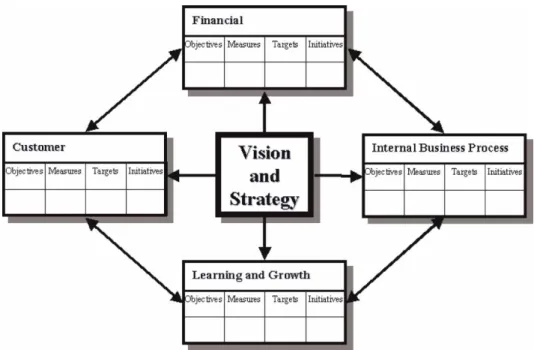
Kaplan & Norton (1992) initially developed the Balanced Scorecard as a model that was aimed at translating the vision and strategy of the organization into objectives, measures, and targets in four perspectives: financial, customer, internal business processes, and
Downloaded By: [ANKOS 2007 ORDER Consortium] At: 23:40 17 December 2007
learning and growth. Figure 1 demonstrates Kaplan & Norton’s (1996) Balanced Scorecard. Basically, the Balanced Scorecard is about creating a strategic framework, where all corporate actions fit together in a cause and effect chain, setting goals and measuring performance, and communicating with everyone to provide them with a clear understanding of the effects of their own actions on the organization’s vision (Kaplan & Norton, 2001).
Regarding the four perspectives, Kaplan & Norton (1996) recommend four ques-tions to be answered during the scorecard building process; to succeed financially, how should we look to our shareholders; to succeed with our vision, how should we look to our customers; to satisfy our shareholders and customers, at what internal business processes must we excel, and to succeed with our vision, how shall we sustain our capacity to learn and grow. By answering these questions for each perspec-tive, strategic aims, measures, goals, and implementation plans are formulated. Then the scorecard is used to highlight what should be the focal points of organizational efforts.
In their book, Strategy Focused Organization, Kaplan & Norton (2001) expand the use of a scorecard as a tool for managing strategy by creating strategy maps and align-ing the organization to the strategy at the individual level by creatalign-ing personal score-cards. Doing so facilitates developing strategic awareness and making strategy everyone’s everyday job. Thus, the organization translates its strategy into deliverable and achievable activities and targets. A strategy map (Kaplan & Norton, 2000) pro-vides clarity on the different items in an organization’s Balanced Scorecard by linking them using a cause and effect chain, which connects desired outcomes with the drivers of those results.
Downloaded By: [ANKOS 2007 ORDER Consortium] At: 23:40 17 December 2007
Hoshin Kanri
Hoshin Kanri is described by Akao (1991) as a systematic approach that integrates the entire organization’s daily activities with its strategic goals. The ‘daily activities’ incor-porate not only operations, but also everything that is necessary for an organization’s routine management of its mission.
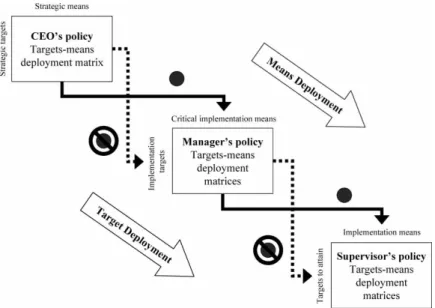
Hoshin Kanri perceives the strategic management of an organization as a process and implements process control activities to strategic management. Deming’s PDCA (Plan-Do-Control-Act) cycle is adapted to Hoshin Kanri as the FAIR (Focus-Alignment-Integration-Review) cycle by Witcher & Butterworth (1999), which is presented in Figure 2. FAIR is an annual cycle, which begins when management ‘acts’ to review the previous year’s performances and formulates the strategic focus for the coming year, which is expressed as the ‘vital few objectives’. Then the cycle turns to the ‘plan’ phase and the vital few objectives are aligned with annual plans and deployed by the ‘catchball process’ through the business units. The ‘do’ phase is the integration of the vital few objectives into daily management, in other words the plans are executed where the PDCA cycle is used continuously for taking corrective actions, process improvement and standardization. The ‘control’ phase is a review of the annual perform-ance. Data from a completed cycle are fed back into the act phase, so the cycle starts over. The catchball process remains at the heart of Hoshin Kanri, which is the key process for alignment and integration of strategies. To deploy the vital few objectives within the organization, target and means deployment is used. Targets are defined as expected results and means are the guidelines for achieving a target. As depicted in Figure 3 only means are negotiated using the catchball process, however targets are determined by each level more or less autonomously.
Tennant & Roberts (2001) cite the following as merits of Hoshin Kanri: integration of strategic objectives with tactical daily management, the application of the PDCA circle to
Downloaded By: [ANKOS 2007 ORDER Consortium] At: 23:40 17 December 2007
business process management, parallel planning and execution methodology, and improvements in companywide communication. Hoshin Kanri is especially valuable in its inherent ability to align employees from all levels of the organization to a common goal and to ensure that they are aware of where they stand in relation to top management strategy. Thus, it facilitates integration of long term and short term goals in the organiz-ation as well as integrorganiz-ation of these corporate goals with those of the individual employee.
An Integrated Methodology for Strategic Management
Balanced Scorecard and Hoshin Kanri are analogous tools (Tennantet al., 2002; Witcher, 2003; Andersen et al., 2004; McCarthy, 2005), both seek breakthrough performance, alignment of strategies, and integrated targets for all levels within an organization, yet there are areas where they differ. First of all, the Balanced Scorecard is a performance-based approach, and it considers the results and what is achieved as important. On the con-trary, Hoshin Kanri is a process-based approach and concentrates not only on the results but also the means (or how) to reach them. In this respect, the Balanced Scorecard is per-ceived to be target-oriented and Hoshin Kanri as means-oriented. In order to reveal the differences between the two their strengths and weaknesses should also be mentioned. Kanji & Sa (2002) claim that the Balanced Scorecard is not a participative but a top-down approach. Lohmanet al. (2004) report that, in an organization they studied, the Balanced Scorecard did not support development, communication, and implementation of strategies. According to Kanji & Sa (2002), the Balanced Scorecard provides only a con-ceptual framework. Hence, the lack of an implementation methodology may cause devi-ations from the merit of the concept itself (Malina & Selto, 2001; Kanji & Sa, 2002). On the other hand, Hoshin Kanri practitioners complain about determining the vital few objec-tives, and declare conflicts in arranging them into a framework. One very noteworthy
Downloaded By: [ANKOS 2007 ORDER Consortium] At: 23:40 17 December 2007
contribution of Hoshin Kanri is the catchball process, the process of give and take between levels that helps to communicate strategic and operational initiatives in organizations. Table 1 presents the major differences between Balanced Scorecard and Hoshin Kanri.
Although both tools are valuable for strategic management of an organization, they are likely to become more efficient when merged, creating a synergy. By inheriting the power-ful aspects of each tool, an integrated methodology is developed, where the Balanced Scorecard is used for building the framework and Hoshin Kanri for planning, implemen-tation, and documentation. The approach consists of six steps, which are presented in Figure 4. The review and evaluation of the activities are done either according to Hoshin Kanri or Balanced Scorecard through the process.
The first step to be taken is the preparation activities, which include environmental and organizational current situation analysis followed by setting the organization’s vision and mission statements and strategies. This step also involves the definition of strategic con-cepts: values, competencies, customers, products, market, competitors, resources, and processes.
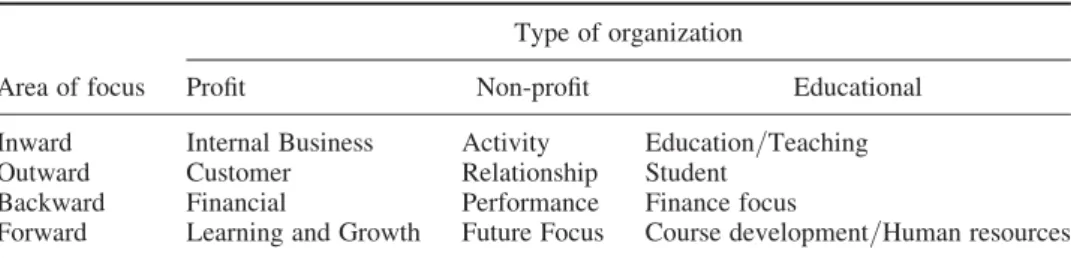
Based on the data from the first step, the perspectives of the company scorecard are determined. Although Kaplan & Norton (1996) suggest financial, customer, internal business and learning and growth perspectives, these can differ according to the organiz-ation. Examples of different perspectives for different types of organizations offered by Olveet al. (1999) are presented in Table 2. These key perspectives are interdependent (Norreklit, 2000) yet perform specific roles in the overall strategy formulation and the implementation process.
The scorecard construction should facilitate balancing the organization’s strategy for-mulations into four perspectives. Therefore, strategy statements should first be classified into strategic objectives – the outcomes – and the critical success factors – the drivers.
Figure 4.The integrated methodology for strategic management
Table 1.Comparison of Balanced Scorecard and Hoshin Kanri
Balanced Scorecard Hoshin Kanri
Focus Vision and strategy Vision and vital few objectives Characteristic Performance based Process based
Orientation Target oriented Means oriented
Strength Structured conceptual framework Catchball process, communicative Weakness Top down, not participative Hard to determine the vital few
Downloaded By: [ANKOS 2007 ORDER Consortium] At: 23:40 17 December 2007
The outcomes correspond to the targets and the drivers correspond to the means in Hoshin Kanri terminology.
Derived from the scorecard, the next step is generating the strategy map to enable the organization to describe and illustrate the cause and effect relationships between the desired outcomes and their drivers. The strategy map provides a visual representation of an organization’s strategies and the crucial relationships among them that drive organ-izational performance.
The ‘strategic objectives’ of the Balanced Scorecard correspond to the ‘vital few objectives’ of Hoshin Kanri. These are the first level strategies to be deployed by using the catchball process. The catchball process is a two-way communication system that is essential for the deployment of targets and means to every level of the organization. It gives all the participants in the process the opportunity to throw ideas back and forth, at each level, about what can be done to achieve each strategy, where there might be problems and what commitments need to be made to address these pro-blems. Target and means matrices are then deployed until reaching the tactical level, where implementation plans are developed. Besides target and means matrices, their equivalent plan tables can also be used to record the deployment process. During the strategy deployment process illustrated in Figure 5, the strategies from the former level become the objectives of the next level and the driving activities, related measures and activity owners are determined accordingly.
Through the planning process, documentation of the planning activities and continuous feedback are performed mainly using the tools of Hoshin Kanri. Hoshin Kanri uses many planning and management tools, such as cause – effect diagrams, control charts, matrix diagrams, tree diagrams, activity network diagrams for communicating, auditing and effective decision-making.
After the plans have been completely deployed down to implementation plans, the plans are rolled back, from bottom to top, to check inconsistencies, resource shortages and con-straints. After the approval of the implementation plans the organization is ready for the execution phase. The activity owners are responsible, for the execution, documentation and communication of each activity.
As plans are executed, a documentation of the activities are kept. In doing so, the gaps between targets and the achieved results are compared and immediate corrective actions are taken where possible. At the end of the planning period, the outcomes of the implementation activities and their performance evaluations are taken as the input for the next cycle, which serves as a mechanism for improving the organization’s overall performance and facilitating the organizational learning.
Table 2.Areas of focus for organizations (Olveet al., 1999)
Area of focus
Type of organization
Profit Non-profit Educational
Inward Internal Business Activity Education/Teaching Outward Customer Relationship Student
Backward Financial Performance Finance focus
Downloaded By: [ANKOS 2007 ORDER Consortium] At: 23:40 17 December 2007 By implementing Hoshin Kanri and Balanced Scorecard together, the results become not only performance but also process driven. This helps the organization to focus on the vision while communicating it with the daily activities.
Balanced Scorecard and Hoshin Kanri in Higher Education
Educational institutions also need to be managed through strategic concepts, in order to meet demands and keep up with the change. Many studies on educational models have been developed and excellence models, like Malcolm Baldrige or EFQM, and performance models, like Balanced Scorecard, have been successfully implemented. As the paper concerns the Balanced Scorecard and Hoshin Kanri, their applications to educational institutions are reviewed.
Use of the Balanced Scorecard for educational institutions is reported widely. Bailey et al. (1999) discuss the use of a Balanced Scorecard at a business school and create a sample scorecard based on the opinions of business school deans. O’Neil et al.(1999) support the idea of adapting the Balanced Scorecard approach for the strategic manage-ment of universities, where they create an academic scorecard. Amaratunga & Baldry (2000) discuss the development of a framework based on the Balanced Scorecard to measure performance relating to higher education establishments. Cullen et al. (2003) illustrate development of a Balanced Scorecard for a faculty of business and management. Leeet al.(2000) propose a framework that integrates SWOT analysis, Balanced Score-card, quality function deployment methodology and Malcolm Baldrige education criteria for strategy development in vocational education. Karathanos & Karathanos (2005) report
Downloaded By: [ANKOS 2007 ORDER Consortium] At: 23:40 17 December 2007
the adaptation of Malcolm Baldrige education criteria to Balanced Scorecard at three Baldrige Education Award recipients. Kettunen (2005) suggests providing higher education institutions with strategies of continuing education and using the Balanced Scorecard approach to communicate and implement these strategies. Dorweiler & Yakhou (2005) offer a framework for an objective scorecard for the performance of academic administrators. Despite its broad usage for higher education, none of the mentioned studies illustrates a clear, step by step execution of strategies.
There is less evidence of Hoshin Kanri application at educational institutions. Roberts & Tennant (2003) represent the application of Hoshin Kanri at the University of Warwick to demonstrate the potential of Hoshin Kanri in service sector organizations. Emiliani (2004) point out that Hoshin Kanri can be used to determine which business courses to offer in MSc in management and MBA education.
The Case of EngMan
The educational organization considered in this paper is a non-thesis engineering manage-ment program (EngMan). EngMan is a part of the Industrial Engineering Departmanage-ment of Istanbul Technical University in Turkey. The EngMan program is a strategic business unit, which has its own market, competitors and an executive committee in charge. Since it was established in 2000, the interest of customers in EngMan remained roughly the same; therefore, the executive committee decided to undertake strategic management efforts.
The implementation of the proposed methodology for strategic management of EngMan begins with preparation activities to facilitate the generation of strategic management con-cepts. The product presented by EngMan is education and the Master of Science degree in industrial engineering. The customers/target groups of EngMan are engineers – except industrial engineers – who are currently working in industry in the fields of R&D, tech-nology management, project management and engineering management. The competitive environment, where EngMan resides, consists of educational institutions that serve
Downloaded By: [ANKOS 2007 ORDER Consortium] At: 23:40 17 December 2007
engineering management or similar programs such as technology management, industrial management and business administration.
The major processes that are executed at EngMan are: promotional activities, edu-cational activities, administrative activities, academic activities, and financial activities. It should be noted that EngMan is a non-profit educational program, so financial income and expenses are equal without a profit.
The resources of the program can be grouped as physical, human, and organizational resources. As the program is carried out by the industrial engineering department, the physical resources such as laboratories, library, classrooms and technological facilities are shared. The human resources of the program are the academic staff of the industrial engineering department and the organizational resources are culture, image and brand.
To identify competencies of the EngMan, the competence analysis study of the indus-trial engineering department made by Asan & Soyer (2003) is used. Since EngMan is a part of the industrial engineering department, the same competencies are assumed to be valid. These competencies are then evaluated for EngMan in terms of creating competitive advantage and importance for the product and the market. As a result, strategic competen-cies are defined such as the quality of the academic staff in terms of self-improvement and teaching, ability to provide a diversity of courses, establishing close relations with industry
Downloaded By: [ANKOS 2007 ORDER Consortium] At: 23:40 17 December 2007 during projects and thesis, ability to transfer industrial experiences into lectures and to provide practice oriented education.
Examining EngMan’s current situation includes a SWOT analysis in order to develop a set of strategies important to the organization. Within the SWOT analysis the critical pro-cesses, resources, and competencies are considered to determine strengths and weak-nesses, while for opportunities and threats the current and future states of the market, customers, and competitors are considered. The SWOT of EngMan is presented in Figure 6.
The vision statement of the EngMan determined during its foundation is ‘be an interna-tionally recognized engineering management program and a pioneer in Turkey’, and its mission statement is ‘to offer engineers, the knowledge and skill on technology and engin-eering management’.
A group discussion on the identification of EngMan’s strategies and their relations is held by the program’s academic staff. To identify strategies, the critical processes, vision and mission statements, the strengths and weaknesses of EngMan as well as oppor-tunities and treats are considered. The relations between the strategies are then examined by a relationship diagram given in Figure 7. The relationship diagram provides prioritiza-tion of importance and demonstrates the interrelaprioritiza-tionships between the strategies. Conse-quently, it improves the understanding of the influence and dependencies in the system. Entities with a large number of outgoing arrows have more influence on others and are called drivers, and ones with a large number of incoming arrows are dependent on others and calledoutcomes. Since the drivers have a dominant effect on the system, the plans should be developed to impact the drivers most, assuring the realization of outcomes at the same time. From the relationship analysis, the drivers are determined as: increase
Downloaded By: [ANKOS 2007 ORDER Consortium] At: 23:40 17 December 2007
promotional activities, improve physical and technological facilities, improve teaching methods, improve industrial relations, and increase the financial income. Fulfilling these drivers leads to the outcomes: become a well-known program/create a brand, increase the market share, improve the quality of applicants, improve the educational quality, and better academic development support for staff.
Strategic drivers and outcomes are then related with Balanced Scorecard perspectives. Outcomes are thestrategic objectivesand drivers are thecritical success issuesto focus upon. In order to make the scorecard fit EngMan, some modifications in the wording of the four perspectives have been made. The internal business perspective was replaced withactivity, which stands for teaching, research, and consulting activities. And the learn-ing and growth perspective was replaced withdevelopment, which includes development of academic staff. We kept the original names of the remaining two perspectives. Although there is no strategic outcome relating directly to the financial perspective, we included it in the scorecard to balance our strategies. Thus, the implementation of the strategies is balanced between the measures for customers and activities reflecting the current perform-ance, the measures of finance resulting from past efforts, and the measures of development that drive the future performance. Figure 8 illustrates the Balanced Scorecard of EngMan with critical success factors. In the Hoshin planning terminology, the strategic objectives
Downloaded By: [ANKOS 2007 ORDER Consortium] At: 23:40 17 December 2007
are thefirst level strategies to focus upon and critical success factors are the meansto achieve this.
The relationships between strategies are not as absolute as depicted in Figure 8, rather they are interrelated. To illustrate their relations clearly, it is better to map them.
Downloaded By: [ANKOS 2007 ORDER Consortium] At: 23:40 17 December 2007
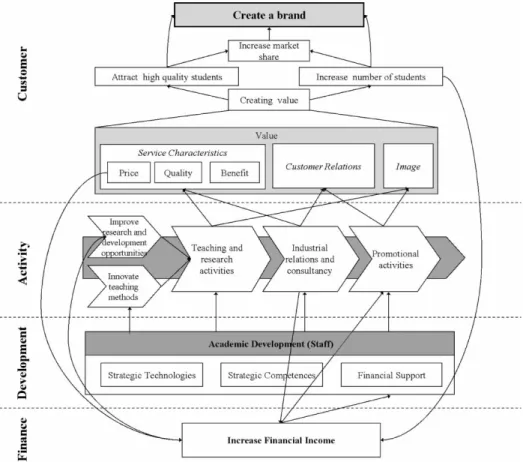
The strategy map of EngMan is illustrated in Figure 9. The process of drawing the strategy map required extensive thinking about the functioning of the organization, the role of strat-egies, and how to implement them effectively. At the top of the strategy map is placed the ultimate goal of EngMan, ‘create a brand’. The customer perspective contains two stra-tegic objectives: increase market share and attract high quality engineers/students. In order to drive these objectives we need to create value for the customers, reflecting the characteristics of the product, relations with our customers, and our image. This can be achieved through the processes including teaching, research, consultancy, and promotion activities, and building industrial relationships described in the activity perspective. The development perspective includes three themes: strategic technologies, strategic compe-tencies, and financial support, these are the drivers for the strategies in the activity perspec-tive. The financial perspective includes ‘increase the financial income’, provided through two main sources: external funding from industry and education fees from students. These are used to finance the technology and facility investments, promotion activities, and teaching and research activities. Indeed, the strategies in the financial, development, and activity perspectives have to be accomplished in order to achieve the desired outcomes in the customer perspective.
After clarifying the relations between the leading and lagging strategies by mapping them, it is time to deploy them to the implementation plans. The plan table of first level strategies of EngMan is given in Figure 10. For each objective, the means to achieve it, related measures with the targeted improvement direction and activity owners are deter-mined. As the organizational levels of the EngMan program are few in number, only two levels of Hoshin plan are generated before reaching the implementation plan. An example of the deployment of second level strategies on a tree diagram and some sample phrases from the implementation plan are illustrated in Figure 11. According to
Downloaded By: [ANKOS 2007 ORDER Consortium] At: 23:40 17 December 2007
the Hoshin plan, the activity owners are responsible for the review and execution of the plans. By the review activities the working of the plans are continuously examined and corrected, where possible, throughout the process. At the end of the annual cycle the overall performances are evaluated using the Balanced Scorecard, thus gaps between the targeted and achieved values are revealed, producing a basic input for the next cycle. As a result, the requirements to take action in areas of promotion activities, academic activities and investment activities to develop and sustain the quality of education have emerged. By executing the implementation plans in the long term, the EngMan program is likely to attain its vision of ‘be an internationally recognized engineering management program and a pioneer in Turkey’.
This implementation depicts the practical use of the proposed methodology. It should be noted that through the merging of Hoshin Kanri and Balanced Scorecard, the results become not only performance but also process driven. This helps the organization to focus on its vision and align it with its daily activities.
Conclusions
Both Balanced Scorecard and Hoshin Kanri are powerful tools for strategic management of organizations, they focus on the vision and put an emphasis on communication and con-tinuous organizational learning. Implementing them jointly facilitates the strategic man-agement process in that it provides a systematic conceptual framework and structures the implementation process. With this aim, an integrated methodology is proposed where two strategy focused management tools are merged.
From the literature review it is clear that the Balanced Scorecard facilitates building the strategic framework; however, it lacks details on communicating strategies, leaving this mainly to the user. This gap is supposed to be filled by the use of Hoshin Kanri. Simul-taneously, the difficulty in determining the vital few objectives in Hoshin Kanri can be overcome with the help of the framework the Balanced Scorecard provides. Combining a performance oriented approach with a process oriented approach certainly creates synergy. Within this paper, the Balanced Scorecard is utilized in drawing the organiz-ation’s strategic route, and Hoshin Kanri in deployment and execution of the plans and documentation of the activities.
The proposed methodology is illustrated with the case of an educational program. First, the scorecard and strategy map of the program are built and critical strategies are deter-mined accordingly. Then the hoshin plans are developed and executed for each strategy. This implementation also depicts the practical use of the proposed methodology. As further research, the implementation of the proposed methodology for other types of organizations rather than educational institutions can be studied.
References
Akao, Y. (1991)Hoshin Kanri: Policy Deployment for Successful TQM(Portland Oregon: Productivity Press). Amaratunga, D. & Baldry, D. (2000) Assessment of facilities management performance in higher education
prop-erties,Facilities, 18(7 – 8), pp. 293 – 301.
Andersen, H. V.et al. (2004) Effective quality management through third generation Balanced Scorecard, Inter-national Journal of Productivity and Performance Management, 53(7), pp. 634 – 645.
Downloaded By: [ANKOS 2007 ORDER Consortium] At: 23:40 17 December 2007
Asan, U. & Soyer, A. (2003) A structured technique for core competence analysis and an application, IGIP 2003,
32nd International Conference on Information Communication and Knowledge: Engineering Education Today, Karlsruhe, Germany, 15 – 18 September 2003.
Bailey, A. R.et al. (1999) Continuous improvement in business education: insights from the for-profit sector and business school deans,Journal of Education for Business, 74(3), pp. 165 – 180.
Cowley, M. & Domb, E. (1997)Beyond Strategic Vision: Effective Corporate Action with Hoshin Planning
(Newton, MA: Butterworth-Heinemann).
Cullen, J.et al. (2003) Quality in higher education: from monitoring to management,Quality Assurance in Edu-cation, 11(1), pp. 5 – 14.
Dorweiler, V. P. & Yakhou, M. (2005) Scorecard for academic administration performance on the campus,
Managerial Auditing Journal, 20(2), pp. 138 – 144.
Emiliani, M. L. (2004) Improving business school courses by applying lean principles,Quality Assurance in Education, 12(4), pp. 175 – 187.
Kanji, G. K. & Sa, P. M. (2002) Kanji’s business scorecard,Total Quality Management, 13(1), pp. 13 – 27. Kaplan, R. S. & Norton, D. P. (1992) The Balanced Scorecard – measures that drive performance,Harvard
Business Review, January – February, pp. 71 – 79.
Kaplan, R. S. & Norton, D. P. (1996) Using the Balanced Scorecard as a strategic management system,Harvard Business Review, January – February, pp. 75 – 85.
Kaplan, R. S. & Norton, D. P. (2000) Having trouble with your strategy? Then map it,Harvard Business Review, September – October, pp. 167 – 176.
Kaplan, R. S. & Norton, D. P. (2001)The Strategy Focused Organization: How Balanced Scorecard Companies Thrive in the New Business Environment(Boston, MA: Harvard Business School Press).
Karathanos, D. & Karathanos, P. (2005) Applying the Balanced Scorecard to education,Journal of Education for Business, 80(4), pp. 222 – 230.
Kettunen, J. (2005) Implementation of strategies in continuing education,International Journal of Educational Management, 19(3), pp. 207 – 217.
Lee, S. F. et al. (2000) Strategy formulation framework for vocational education: integrating SWOT analysis, Balanced Scorecard, QFD methodology and MBNQA education criteria,Managerial Auditing Journal, 15(8), pp. 407 – 423.
Leonard, D. & McAdam, R. (2002) The corporate strategic-operational divide and TQM,Measuring Business Excellence, 6(1), pp. 5 – 14.
Lohman, C.et al. (2004) Designing a performance measurement system: a case study,European Journal of Oper-ational Research, 156(2) pp. 267 – 286.
Malina, M. & Selto, F. (2001) Communicating and controlling strategy: an empirical study of the effectiveness of the Balanced Scorecard,Journal of Management Accounting Research, 13, pp. 47 – 90.
Mazur, G.et al. (1998)Policy Management: Quality Approach to Strategic Planning(Torrance, CA: Integrated Quality Dynamics).
McCarthy, G. (2005) Leadership practices in German and UK organizations,Journal of European Industrial Training, 29(3), pp. 217 – 234.
Norreklit, H. (2000) The balance on the Balanced Scorecard: a critical analysis of some of its assumptions,
Management Accounting Research, 11, pp. 65 – 88.
O’Neil, H. F.et al. (1999) Designing and implementing an academic scorecard,Change, 31(6), pp. 32 – 40. Olve, N.et al. (1999)Performance Drivers: A Practical Guide to Using the Balanced Scorecard(Chichester,
West Sussex, UK: Wiley).
Roberts, P. & Tennant, C. (2003) Application of the Hoshin Kanri methodology at a higher education establish-ment in the UK,The TQM Magazine, 15(2), pp. 82 – 87.
Tennant, C. & Roberts, P. (2001) Hoshin Kanri: a tool for strategic policy deployment,Knowledge and Process Management, 8(4), pp. 262 – 269.
Tennant, C.et al. (2002) A continuous improvement process at Severn Trent Water,The TQM Magazine, 14(5), pp. 284 – 292.
Witcher, B. J. (2003) Policy management of strategy,Strategic Change, 12, pp. 83 – 94.
Witcher, B. J. & Butterworth, R. (1999) Hoshin Kanri: how Xerox manages,Long Range Planning, 32(3), pp. 323 – 332.