Towards a new policy direction
for an improved housing delivery
system in Nigerian cities
Theoretical, Empirical and Comparative Perspectives
Job Taiwo Gbadegesin
17
Towards a new policy direction
for an improved housing delivery
system in Nigerian cities
Theoretical, Empirical and Comparative Perspectives
Job Taiwo Gbadegesin
Delft University of Technology, Faculty of Architecture and the Built Environment, Department of OTB - Research for the Built Environment
abe.tudelft.nl
Design: Sirene Ontwerpers, Rotterdam ISBN 978-94-6366-067-9
ISSN 2212-3202
© 2018 Job Taiwo Gbadegesin
All rights reserved. No part of the material protected by this copyright notice may be reproduced or utilized in any form or by any means, electronic or mechanical, including photocopying, recording or by any information storage and retrieval system, without written permission from the author.
Unless otherwise specified, all the photographs in this thesis were taken by the author. For the use of illustrations effort has been made to ask permission for the legal owners as far as possible. We apologize for those cases in which we did not succeed. These legal owners are kindly requested to contact the publisher.
Towards a new policy direction
for an improved housing delivery
system in Nigerian cities
Theoretical, Empirical and Comparative Perspectives
Dissertation
for the purpose of obtaining the degree of doctor at Delft University of Technology
by the authority of the Rector Magnificus prof.dr.ir. T.H.J.J. van der Hagen chair of the Board for Doctorates
to be defended publicly on
Tuesday 4 September 2018 at 12:30 o’clock by
Job Taiwo GBADEGESIN
Master of Science in Estate Management, Obafemi Awolowo University, Ile-Ife, Nigeria
This dissertation has been approved by the promotors.
Composition of the doctoral committee:
Rector Magnificus chairperson
Prof.dr. P.J. Boelhouwer Delft University of Technology, promotor Dr. H.M.H. van der Heijden Delft University of Technology, copromotor
Independent members:
Prof. dr. M. Omirin University of Lagos, Nigeria
Prof. dr. P. Hooimeijer University of Utrecht
Prof. dr. ir. M.G. Elsinga Delft University of Technology Prof. ir. D.E. van Gameren Delft University of Technology Prof. dr. A.H. Kleinknecht Professor Emeritus Delft University of Technology
Dedication
To God Almighty, my source of inspiration
and
My family;
Darling wife, Dr Taiwo Frances GBADEGESIN, my lovely jewels; Oreofeoluwa, Otitololuwa and Ikeoluwa
Preface
My coming to Delft University of Technology (TU DELFT), The Netherlands from my home country for my PhD is a golden opportunity on one hand, but finishing the programme is another challenge on the other hand. This was my big concern at the start of my PhD. I vividly remember as I arrived during a peak moment of cold breeze, I was troubled. Today, I am greatly indebted to all people who have contributed to the success of my doctoral pursuit and completion.
I am very grateful to my Daily Supervisor/ Co-Promotor, Dr. Harry van der Heijden and Promotor, Professor Peter Boelhoewer. I wish to thank them specially for granting me the opportunity, support, counsel and proper guide to do my PhD in such a conducive and standard environment like this. I like to appreciate the unwavering commitment, constructive criticism, unflinching support, great motivation and guidance that I received from Peter and Harry. I greatly enjoyed and benefited a lot from their
mentorship and coaching, emanated from their wealth of experience and wisdom. They have painstakingly supervised my PhD thesis right from the start while establishing a direction for my study. Not only are they interested in my academic success, but also in other aspects of life. Several times, they were concerned about my welfare and family. I sincerely appreciate your effort. Thank you. Lovely gesture of OTB staff is worth mentioning while considering the interaction on any issue relating to research, needs and intellectual debates. I would like to thank all the academic staff of my unit at OTB; Marja, Joris, Harry B, Kees, Cor and Gust for their remarks and contribution during my presentations at the department level/ informal meetings. Thank you Marietta for bailing me out the very day I overstayed in the office and I was mistakenly locked up and stranded in the OTB staircase. Thanks to Sylvia for making the comments at the group meetings available to me in order to improve my work. My fellow PhD students cannot be left out in this acknowledgement: KyungHo, Gong, Qi Wenjing, Alfred, Juan, Taozhi, Paula and Boram. And to the Assistant Professor, Queena for quickly exposing me to the course, Research Techniques and Proposal in the Built Environment at the early stage of my Ph D. My sincere appreciation goes to all the OTB support staff for their kind assistance throughout the PhD process. I am particularly grateful to Elianne and Dirk for helping me with the plan and arrangements for the defence of my dissertation. Thank you Manon and Kim for your roles. Thank you Véro Crickx for helping with the layout and design of the thesis. Your training was very useful.
I am grateful to Tertiary Trust Funds (TETFUNDS) who provided living expenses, though not enough to sustain my programme without additional sources. Also, I appreciate the authority of Obafemi Awolowo University, Ile-Ife, for granting me study leave for the programme. I thank the respondents from Ministry of Housing, Lagos State Development and Property Corporation (LSDPC), Land Bureau, University of Lagos, financial institutions, landlords associations/cooperative societies, estate surveying and valuation firms, private property/ construction companies and others stakeholders involved. My gratitude goes to all the members of doctoral committee for taking their precious time to read through the thesis and their objective assessments. Their comments and observations were useful in the last revision.
I also want to thank my family and friends; My sweet heart, Taiwo Frances Gbadegesin (PhD Leeds) and my great jewels; Oreofeoluwa, Otitololuwa and Ikeoluwa. My parents; Janet Gbadegesin (sweet mother) and my father, Late Pa Matthew Gbadegesin, who passed on to glory during my PhD. My precious brother, Dr M.A. Gbadegesin (PhD, Bath). To the mummy of all times, Mrs Anne Jumoke Akinrolabu, for your encouragement and prayer. To friends and all well-wishers both home and abroad, for their support . Mr. Jelil, Egbon Sola, Sister Khaphila and Mr Abubakar. Without these people, I could have got stuck on the way. Also, my appreciation goes to all brethren at Deeper Life Bible Ministry, Rotterdam, The Netherlands and Leeds, UK for the warm fellowship.
Contents
List of Tables 20 List of Figures 21 Summary 25 Samenvatting 291
Background to the research problem
33 1.1 Introduction 331.2 Interconnectedness of demographic, institutional and socio-economic profiles of housing in Nigeria 36
1.3 Problem statement and the main research question 40
1.4 Research questions 41
1.5 Aim and significance of the research 43
1.6 Structure of the thesis 44
2
Context of the Nigerian housing situation
492.1 Introduction 49
2.2 Political and government institutional (administrative) system in Nigeria 50
2.2.1 Implication of the political system on the Nigerian housing delivery system 52
2.3 Demographics: Population and urbanisation trends in Nigeria 54
2.4 Structure of the Nigerian economy: “Informality versus formality” 59
2.4.1 Economic growth: GDP and GDP per capita 62
2.4.2 GDP in Nigeria (2000 - 2015) 63
2.4.3 GDP per capita in Nigeria (2000 - 2015) 64
2.4.4 Implication of economic changes on urban housing delivery in Nigeria 66
2.5 Nature of the provision shortages in the Nigerian housing system 66
2.6 Conclusion 70
3
Theoretical and analytical frameworks
733.1 Introduction 73
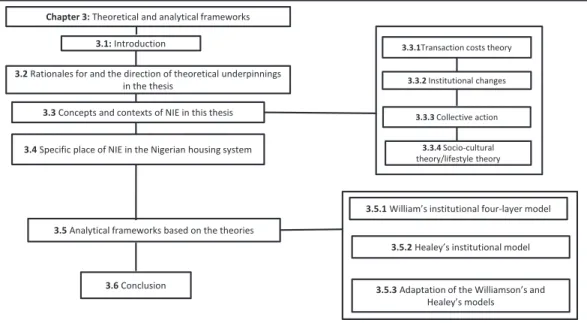
3.2 Rationales for and the direction of theoretical underpinnings in the thesis 74
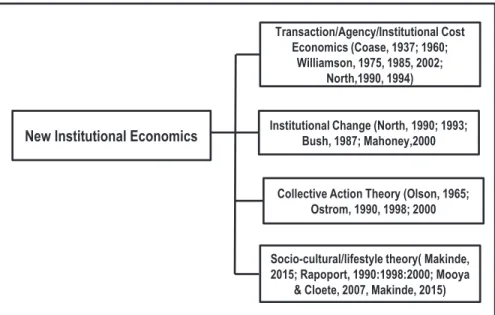
3.3 Concepts and contexts of NIE in this thesis 75
3.3.1 Transaction costs theory 77
3.3.2 Institutional changes theory 80
3.3.3 Collective action 80
3.3.4 Socio-cultural theory/lifestyle theory 81
3.4 Specific place of NIE in the Nigerian housing system 81
3.5 Analytical frameworks based on the theories 84
3.5.1 William’s institutional four-layer model 84
3.5.2 Healey’s institutional model 85
3.5.3 Adaptation of the Williamson’s and Healey’s models 87
3.6 Conclusion 89
4.1 Introduction 91
4.2 The research technique 92
4.2.1 Pilot study phase 95
4.2.2 Interview 96 4.2.3 Questionnaire survey 98 4.2.4 Validation of the proposed solutions framework through consultation 98 4.3 Rationales for the adoption of both qualitative and quantitative approaches 98 4.4 Target population/respondents 99 4.4.1 Sampling procedure 100 4.4.2 Sample size 101 4.4.3 Qualitative study 101 4.4.4 Quantitative study 103
4.5 The study area, rationale for the selection and the mapping strategy 104
4.6 Data analysis and tools 107
4.6.1 Thematic analysis, coding and formation of themes 107
4.6.2 Desk analysis of literature and policy documents 109
4.6.3 Analysis of the questionnaire surveyed data 109
4.7 Limitations and the challenges 109
4.8 Conclusion 110
5
Structure of housing provision in Nigeria
1115.1 Introduction 111
5.2 Overview of the existing provision structure and characteristics: formal and informal systems 112
5.3.1 Structure of the housing provision system (colonial administration: 1920s - 1960) 114
5.3.2 Structure of housing provision system (post-independence period: first civilian and military administrations, 1960 - 1979) 115
5.3.3 Structure of housing provision system (civilian administration, 1980 - 1983; military regime, 1984 - May 28, 1999) 116
5.3.4 Structure of housing provision system (civilian administrations: May 29, 1999 - May 28, 2007; May 29, 2007 - May 5, 2010; May 2015 -2017) 117
5.4 Structure of housing finance system and the existing scenarios 118
5.5 Conclusion 120
6
Government roles in the housing provision in Nigerian cities
1216.1 Introduction 121
6.2 Federal and state government roles in housing provision 123
6.2.1 Federal and state government provision during the colonial administration (1920s - 1960s) 123
6.2.2 Federal and state government provision during the post-independence era (civilian and military rule; 1960 - 1979) 124
6.2.3 Federal and state government provision during the civilian administration (1980 - 1983) 125
6.2.4 Federal and state government provision during the military regime (1984 - May 28, 1999) 126
6.2.5 Federal and state government provision during the civilian administration (May 29, 1999 - May 28, 2007) 127
6.2.6 Federal and state government provision during the civilian administration (May 29, 2007 - May 5, 2010) 128
6.2.7 Federal and state government provision during the civilian administration (May 6, 2010 - 2015) 128
6.2.8 Federal and state government provision during the civilian administration (May 6, 2015 - 2017) 129
6.3 Federal and state government roles in the formulation and implementation of housing policy and legal frameworks 129
6.3.1 During pre-colonial and colonial administration (1900s - 1960) 129
6.3.2 During post-colonial administration (1960 - 1979) 130
6.3.3 During civilian administration (1980 - 1983) 130
6.3.4 During military administration (1984 - May 28, 1999) 131
6.3.5 During civilian administration (May 29, 1999 - May 28, 2007) 132
6.3.6 During civilian administration (May 28, 2007 - 2010) 133
6.3.7 During civilian administration (2010 - 2015) 133
6.4 State government roles in enabling policy frameworks (between 1920s - 2017) 133
6.5 Other roles such as PPP policy and the context 135
6.5.1 Uncertain and unclear mode of the PPP operation 136
6.5.2 Institutional barriers to PPP model for urban housing provision 137
6.6 Conclusion 141
7
Strategies of housing provision in the formal system
1437.1 Introduction 143
7.2 Strategies and the evaluation of housing provision in the formal system 145
7.2.1 Site identification and land acquisition (pre-construction stage) 146
7.2.2 Finance procurement (pre-construction and construction stage) 148
7.2.3 Resources (labour and building materials) procurement (development planning to construction) 149
7.2.4 Planning 151
7.2.5 Design 152
7.2.6 Tender and construction 153
7.2.7 Output management: renting, sales and servicing (post-construction stage) 155
7.3 Formal rules of the game (formal laws and policy instruments) 156
7.3.1 7.3.1. Urban and Regional Planning Decree No. 88 of 1992, building development permits and approval procedures (planning permission) 157
7.3.3 National Housing Fund Act, No. 1992, Federal Mortgage Bank of Nigeria Decree No. 82 of 1993, loan application procedure, condition and bureaucracy 160
7.3.4 National Housing Code of 2006: formal procedures and requirements 161
7.3.5 Contract law and agreement procedures 162
7.4 Governance and alignment with transactions 163
7.4.1 Administrative structure in the formal housing system 163
7.4.2 Jurisdiction of government operations in the formal housing system 166
7.4.3 Transaction costs in the formal housing system 169
7.5 Activities, outputs and market players interaction 172
7.6 Motivation and challenges in the formal housing delivery system 174
7.6.1 Motivations in the formal housing delivery system in Nigeria 174
7.6.2 Challenges (barriers) to the formal housing delivery system in Nigeria 177
7.7 Conclusion 179
8
Strategies of housing provision in the informal system
1818.1 Introduction 181
8.2 Land acquisition (pre-construction stage) 183
8.3 Finance procurement (pre-construction and construction stage) 187
8.3.1 Cooperative societies and housing finance strategy 189
8.4 Human labour and material resources procurement (construction stage) 192
8.5 Management of the outputs (post-construction stage) 196
8.6 Rules of the game: Rules, dos, don'ts and modus operandi 198
8.7 Governance aligning with transaction in the context of production factors 200
8.7.1 Land administration and the transactions 201
8.7.2 Omo-onile and other traditional role-players in land administration 202
8.7.3 Governance in the informal finance system and transaction 205
8.8 Output nature, exchange and role-players’ interactions in the market 206
8.8.1 Housing provision outputs 207
8.8.2 Incremental and self-help activities of urban informal housing outputs in Nigeria 208
8.9 Conclusion 213
9
Motivation (why) and challenges in the informal delivery system
2159.1 Introduction 215
9.2 Motivation and challenges in informal land acquisition strategies 217
9.3 Motivation and challenges in the informal finance strategies 222
9.4 Motivation and challenges in the use of human and material resources 226
9.5 Motivation and challenges of housing outputs in the informal market 227 9.6 General challenges of defiant landlord/rental housing owners and tenants in the private rental market in Nigeria (formal and informal systems) 229 9.7 General motivating factors that influence the growth of informal housing provision in Nigeria (a questionnaire survey) 230 9.8 Conclusion 233
10
How the situation in the Nigerian housing systems is explained
in the context of NIE rationale – a discussion of findings
23510.1 Introduction 235
10.2 The Nigerian housing situations in the theories 236
10.3 The current situation in Nigerian housing provision in the context of transaction cost theory 237
10.3.1 Production and resources; land acquisition, finance security, other resource sourcing and output distribution 237
10.4 How the situations of housing provision in Nigerian cities today are explained using the socio-cultural/lifestyle theory 239
10.4.1 Production and resources; land acquisition, finance security, other resource sourcing and output distribution 239
10.5 How the situations of housing provision in Nigerian cities today are explained using collective action theory 241
10.5.1 Production and resources; land acquisition, finance security, other resource sourcing and output distribution 241
10.6 How the situations of housing provision in Nigerian cities today are explained using institutional path changes 242
10.6.1 Housing delivery: structural context of housing provision and government roles 242
10.7 Conclusion 243
11
Possible solutions towards addressing the challenges
in Nigerian housing provision (Analysis of results
and stakeholders’ perspectives)
24511.1 Introduction 245
11.2 Diagnosis results of the housing delivery strategies 246
11.3.1 Perception (outcomes and observations) from the outcomes of the analysis 253
11.3.2 Respondents’ suggestions for land acquisition and ownership solutions (formal and informal respondents) 253
11.3.3 Respondents’ suggestions for housing finance solutions (formal and informal respondents) 255
11.3.4 Respondents’ suggestions for local building materials usage and the existing informal housing outputs 256
11.4 Conclusion 259
12
A comparative analysis of policy measures aimed
at improving housing provision
26112.1 Introduction 261
12.2 Concepts of housing policy instruments 262
12.3 The rationale for selecting South Africa, Brazil and Mexico 263
12.4 The South African context 264
12.5 South Africa’s policy strategies toward improving housing provision and informal housing 265
12.5.1 Housing provision policies (1994 and 1997) 265
12.5.2 Breaking the New Ground, BNG (2004): in-situ upgrading, PHP, ePHP, IRDP and SHP 267
12.5.3 Lessons learned 270
12.6 The Brazilian context 271
12.7 Brazil’s policy strategies toward improving housing provision and informal housing 273
12.7.1 Regularisation programmes: Legalisation, tenure security, urban infrastructure management and planning 273
12.8 The Mexican context 275
12.9 Mexico’s policy strategies towards improving housing provision and informal housing 276
12.9.1 Regularisation programme 277
12.9.2 Lessons learned 278
12.10 Summary of the lessons learned from South Africa, Brazil and Mexico. 279
13
A proposed framework for a comprehensive overview of possible
solutions to address the Nigerian challenges in housing delivery
28113.1 Introduction 281
13.2 Proposed solution frameworks in the context of land, finance, materials and the informalities (formal and informal procedural analysis, RQ1-RQ5) 282
13.2.1 Highlights of the challenges in the procurement of land, finance, material resources and output delivery 283
13.2.2 Integration of formal and informal institutions as a land solution framework 284
13.2.3 Connecting land and finance solution frameworks for an improved delivery system 285
13.2.4 Proposed frameworks to strengthen and formalise informal finance sources 286
13.2.5 Connecting subsidies to land, building materials and labour solutions for an improved delivery framework (Government roles in the formal and informal market) 288
13.2.6 Proposed solutions emanating from South Africa, Brazil and Mexico. 289
13.3 A proposed comprehensive framework for possible solutions (pre-validation framework) 289
13.4 Consultation for the validation of the proposed policy solution framework 292
13.5 Post-validation framework for an improved housing delivery system 292
13.5.1 Solution 1: Integration of customary and statutory systems to resolve Omo-oniles 293
13.5.2 Solution 2: Ensuring titling of land of existing informal housing for free or at a low cost 294
13.5.3 Solution 3: Upgrading the existing informal settlements/housing with the joint consent of the owners or occupiers and ensuring their socio-economic empowerment. 294
13.5.4 Solution 4: Introducing and implementing housing subsidies towards housing development and maintenance. 295
13.5.5 Solution 5: Formulating policies and educating new house owners to comply with building codes for safety reasons 295
13.5.6 Solution 6: Implement a social and affordable housing instrument 296
13.5.7 Solution 7: Making cooperative societies formal and upgrading them to NGO status towards PPPs to build and manage social housing 296
14
Summary of findings, reflection on the theories, conclusion,
recommendations and reflection on the study
299 14.1 Introduction 299 14.2 Summary of findings 299 14.3 Reflection on the theories 303 14.4 Conclusion 304 14.5 Recommendations 305 14.6 Reflection on the study 306 References 307 Appendix A Interviews 321 Appendix B Demographic profiles of the respondents 325 Appendix C Validation 337 Curriculum Vitae 341List of Tables
2.1 Trends of government administration in Nigeria 53
2.2 Proportion of urban and rural population in Nigeria 56
2.3 Comparison of the world’s largest megacities (1970 and 2015) 57
2.4 Quintile income distribution and Gini-Coefficient Index (1980 - 2010) 65 2.5 Minimum standard size of rooms and
suggested reductions 69
2.6 Distribution of persons per room and household size in Lagos 69
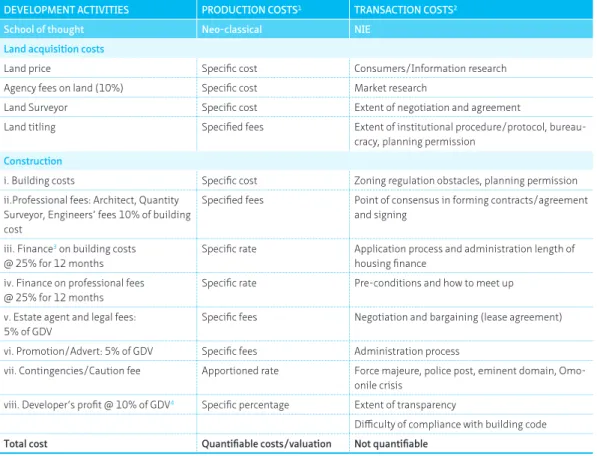
3.1 Differences between production costs and transaction costs in housing development 79 4.1 Description of research design 94
4.2 Respondents’ profiles 102
4.3 Consulted experts for validation and their profiles 103
4.4 Sampling of the questionnaire survey conducted 104
4.5 Lagos State senatorial districts and the existing locations 105
5.1 Four relationship scenarios of housing finance system in Nigeria 119
6.1 Pattern of government roles (1960 - 2015) 122
7.1 Design stage activities 153
7.2 Outlines of construction programme 154 7.3 Formal agencies, regulators and the locations
in Nigeria 165
7.4 Production and transaction costs in different stages of the development process for a formal single bungalow in Lagos, Nigeria 170 7.5 Housing development, activities, actors and
relevant laws/regulations 173 7.6 Observed benefits of the formal housing
delivery system in Nigeria 176
7.7 Observed challenges in the formal housing delivery system in Nigeria 178
8.1 Land acquisition approaches and status of title documentation 184
8.2 Approaches in the housing design in Nigerian urban centres 193
8.3 Informal housing provision routes and features in Nigerian urban centres 207 9.1 Contents of the survey instrument and the
bases 231
9.2 Reasons for the informal housing growth in Nigeria from the perspective of landlords/ householders or representatives 232 9.3 Reasons for the informal housing growth
in Nigeria from the perspectives of policy-makers (staff members at the Ministry of Housing and housin 232
11.1 Summary of findings from the formal and informal housing systems in Nigeria 248 11.2 Respondents’ profiles 252
11.3 Summary of respondents’ suggestions on possible solutions 260
12.1 Summary of the main lessons on policy programmes, instruments and implementation in South Africa, Brazil and Mexico 279
List of Figures
1.1 Nigeria population and urbanisation growth 37
1.2 Extent of income disparity in Nigeria 38 1.3 Urban housing provision situation in
Nigeria 39
1.4 General overview of the research 43 1.5 Overview of chapters 47
2.1 Overview of Chapter 2 50
2.2 Proportion of ethnic group population in Nigeria 51
2.3 Trends of population growth (1952 - 2010) 54
2.4 Five yearly population trend based on age (1950 - 2010) 55
2.5 Lagos urbanisation rate among other major cities in Africa 57
2.6 Trend of population growth in Lagos, Nigeria 58
2.7 Contribution of informal sector activities to GDP (share in total %) 61
2.8 Trends of Nigerian informal sector size 62 2.9 Oil production trend, quarter one, issue 9
(2016) 63
2.10 GDP in Nigeria (2000 - 2015) 64 2.11 GDP per capita in Nigeria (2000 - 2015) 65 2.12 Estimated population trend and housing
shortages in Nigeria 68
2.13 Identified quality features of informal housing outputs 70
3.1 Schematic overview of Chapter 3 74
3.2 A framework of the branches and interconnectedness of the NIE rationale 76 3.3 Housing provision system in Nigeria 83 3.4 Williamson’s four-layer institutional
model 85
3.5 Structure-agency (Healey’s) institutional model 86
3.6 Adapted analytical framework: Healey’s and Williamson’s institutional models 88 4.1 Overview of Chapter 4 92
4.2 Overall framework of the study 93 4.3 chema of the research and process 95 4.4 The scenes of the interviews 97 4.5 Sub-Sahara Africa, Nigeria and Lagos in
maps 106
5.1 Schematic overview of Chapter 5 112 5.2 Main classification of institutions in the
Nigerian urban housing system 113 5.3 Early housing system in Nigeria (pre-colonial
era) 114
5.4 Housing provision system (late 1960s - early 1980) 115
5.5 Housing provision system in early 1991 NHP 116
5.6 The present housing provision system in Nigeria (21st century) 117
5.7 Housing finance system in Nigeria 119 6.1 Schematic overview of Chapter 6 122 6.2 Dimension of land factors 138
6.3 Forces against the effectiveness of PPP for housing delivery in Nigeria 140
7.1 Overview of strategies evaluation framework in the formal system 144
7.2 Housing production chain in the Nigerian formal system 145
7.3 Flow chart for each of the activities under site investigation 147
7.4 Participants coordinated by the project manager on behalf of the client 150 7.5 Overall control plan after decision 151 7.6 Planning process in the pre-construction and
post-construction stages 151 7.7 Final design brief 152
7.8 he control cycle of a housing project 154 7.9 Management strategies schema
(post-construction) 156
7.10 Procedures on the formation of management contract 162
7.11 Governance structure of the formal housing provision system in Nigeria 164
7.12 Client, project manager and the development components 172
8.1 Overview of strategies evaluation framework in the informal system 182
8.2 Informal land acquisition methods 183 8.3 Adopted housing financing methods 187 8.4 Identified building materials procurement channels 194 8.5 Local bricks production site and outputs inspected 195 8.6 A householder, brother (driver) and his little boy doing maintenance activities on his house 196
8.7 Wooden bridge construction and community electrification project 197
8.8 Nature of cooperative societies in Nigerian urban centres and phases of housing finance. 200
8.9 Customary land tenure structure before colonial administration 203
8.10 British first colonial land tenure structure (non-customary system) 204
8.11 Land Use Decree (Act) of 1978 tenure structure 205
8.12 Governance structure in the informal system 206
8.13 Interior view of an informal housing 211 8.14 Concept of incremental housing in
Nigeria 212
9.1 Overview of Chapter 9 216 9.2 Motivation and challenges of the
practices 228
10.1 Schema of Chapter 10 236 10.2 Nigerian housing situation in the
theories 237
11.1 Schema of Chapter 11 246 11.2 The main causes of housing provision
challenges in both the formal and informal systems 251
11.3 Perspectives of suggested possible solutions in Nigerian housing provision 252 11.4 Suggestions of possible solutions from the
formal respondents’ perspectives 258 11.5 Suggestions of possible solutions from the
informal respondents’ perspectives 259 12.1 Overview of Chapter 12 262
12.2 South Africa’s cases and lessons 271 12.3 Level of informality across Brazil cities
(2000) 272
12.5 Mexico’s cases and lessons. 278 13.1 Schema of Chapter 13 282
13.2 Recognition of customary land ownership system (Omo-oniles) and incentives for PPP 285
13.3 Land and finance solution framework for improved provision 286
13.4 Framework for the reform of the informal housing finance system 287
13.5 Connecting subsidies with land, building materials and labours 288
13.6 A comprehensive possible solution framework (pre-validation version) 291
Summary
In Nigeria, housing units are not adequate for the entire population, especially in cities (Anosike et al. 2011, Makinde 2014). For instance, the deficit grows at an alarming rate, from about 8 million in 1991 to over 16 million in 2000s (Aribigbola, 2000; Aribigbola and Ayeniyo 2012). The challenges of housing provision are not only quantitative but also qualitative and have to be dealt with in a dual institutional perspective: the formal and the informal sector (Makinde, 2014; National Population Census, NPC, 2006). How can the Nigerian housing provision be improved and what are the new roles that policy can play to address the housing shortages in Nigerian cities? Several researchers have examined the subject of housing in Nigeria and confirmed the existence of shortages. Some have also attempted to advocate that there are challenges without giving an appropriate policy way forward. Also, most of the existing studies are not based on appropriate theoretical underpinnings. Therefore, this thesis contains a diagnosis of the housing problems in Nigeria, based on the nature of the housing provision systems (formal and informal) and a framework for possible policy solution(s), using theoretical, empirical and comparative approaches. Emphasis was placed on the theoretical and empirical perspectives, while an insight was gained into possible solutions adopted in some selected countries through a synthesis of extant studies. To capture the actual contexts of housing challenges, six objectives raised in the form of research questions were pursued. In the first objective, the Nigerian housing situations were examined in the contexts of political, economic and demographic developments in order to identify the nature of the housing shortages. Findings from the first objective indicated that housing shortages in Nigerian cities are both quantitative and qualitative in nature. The major problems were found in the informal sector because the formal sector is not accessible due to changes in government administration, the low income condition and institutional barriers. It was found that the decline in the formal provision resulted in the growth of the informal provision.
Against the backdrop, new institutional economics, NIE theoretical approach was embraced owing to the fact that Nigerian property market constitutes formal and informal institutions, and fraught with non-availability of data (Omirin and Antwi, 2004). This is central to the second objective. With the adoption of NIE as the appropriate school of thought, the structure, institutions, agencies, strategies, interests, and how these elements are connected to housing delivery could be examined, using an appropriate analytical framework, based on factors of production. Subsequently, the structure of housing provision was examined over the pace of time.
Because the influence of government was identified in the structures, objective four elaborates on the actual roles, the units of housing provided by the government and the changing roles of the government.
The research question five is the central focus of this dissertation where the strategies of procuring factors of production, (land, labour, materials and finance) were
examined. Housing outputs, its management, institutional environment, structure, transactions, motivating factors and the existing challenges were examined. The main findings include inadequacy of finance and the complexity of securing formal funds are key to decent housing provision by individual formal providers, from the pre-construction to post-construction stage. There are also difficulties of acquiring land and securing it, due to threat of Omo-oniles (families of the customary owners who often lay claims to land). In addition, formal system is only accessible to higher income groups and inaccessible to lower class in Nigeria
Since the formal market cannot be easily accessed by many people, low income groups rely on the informal sector. In the informal finance system, member of a financial association mandatorily saves an agreed amount, within the limit of his/her income capacity, and augments it with personal or family funds. One of the motivations behind these informal group finance systems is that they serve as saving mechanisms for the people. Other production factors, such as human and material resources, are equally procured in an informal manner either through family members or by friendly arrangements and instalment agreements in order to avoid the complex hurdles identified in the formal system, e.g. transaction hurdles.
To gain insight into other countries with similar housing experiences, a review of the situation in South Africa, Brazil and Mexico was done. In South Africa, existing studies and existing policy documents revealed that various policy approaches were adopted. I found in the review that the perceived improved performance in transforming informal housing is attributed to the joint cooperative, participatory approach and political support through legal instruments. I observed that policy approaches in Brazil are channelled towards addressing informal housing. The review of existing literature and documents revealed that legal instruments have been the intervening tool in the context of the regularisation goals, which includes legalisation, recognition of tenure rights, upgrading and provision of services/amenities (urban management). These exercises could only be executed within the broader, integrated, multi-sectoral scope of city and land use planning, concurrently implemented and recognition of politico-institutions, i.e. the involvement of a cooperative government, informal residents, NGOs and private developers with substantial technical, managerial and financial support.
In Mexico, regularisation projects, through an extensive land titling programme, taxation instruments and planning tools, made it a result-oriented land regularisation programme in the developing world, as indicated by Monkkonen (2012). Mexico’s approach is known for its recorded successes, however, it is not without challenges. It was also mentioned that the whole process commenced from the ejido system, which indicates an integration of communities and civil societies into the land system. Mexico has also attempted to incorporate informal housing finance institutions on a limited level into mainstream financial institutions (FONHAPO and SOFOLES). The point is that the land titling process, in collaboration with agencies and NGOs in procuring production factors, contributes significantly to progress in some cities. Nevertheless there is still room for improvement.
Having examined the strategies, their motivations and the challenges, it was recommended that a combination of suggested possible solutions and lessons from the three selected countries resulted in a comprehensive solutions framework which includes the following recommendations:
–
Review of Land Use Act (LUA) of 1978 to incorporate both customary and statutory systems in order to resolve Omo-onile crisis.–
Ensuring prompt tilting of land of existing informal houses at a low cost.–
Upgrading the existing informal settlements/housing with joint consent of the owners or the occupiers and ensuring their socio-economic empowerment.–
Introducing, implementing and government monitoring of housing subsidies for development and maintenance.–
Formulating policies and educating new home owners ( both owner-occupied and rental housing owners) to comply with building codes for safety reasons.–
Government should implement and manage affordable housing that can lead to social housing.–
Government should be involved in making cooperative societies formal and embraced PPP agenda that can touch low income groups.Samenvatting
Nigeria kampt met een woningtekort, vooral in de steden (Anosike et al. 2011, Makinde 2014). Het tekort is bovendien sterk toegenomen van rond de 8 miljoen in 1991 tot meer dan 16 miljoen woningen in het begin van deze eeuw (Aribigbola, 2000; Aribigbola and Ayeniyo 2012). De uitdaging waarvoor Nigeria staat is niet alleen kwantitatief maar ook kwalitatief van aard en moet worden aangepakt vanuit een duaal institutioneel perspectief: een formele en een informele sector (Makinde, 2014; National Population Census, NPC, 2006). De hoofdvraag die aan deze dissertatie ten grondslag ligt is dan ook: Hoe kan de Nigeriaanse woningvoorziening worden verbeterd en welke rol kan overheidsbeleid spelen om de woningtekorten in de Nigeriaanse steden aan te pakken? Verschillende onderzoekers hebben het bestaan van woningtekorten in Nigeria bevestigd en benoemd als grote uitdaging, veelal zonder bruikbare oplossingen te geven. Bovendien hebben de meeste studies geen theoretische basis. Daarom is deze studie gericht op het geven van een diagnose van de problemen in Nigeria, gebaseerd op de aard van de woonvoorziening in de formele en de informele sector, en op het formuleren van een raamwerk voor mogelijke oplossingen. Daarbij wordt gebruik gemaakt van theoretische, empirische en internationaal vergelijkende benaderingen. De nadruk ligt op theoretische en empirische perspectieven, terwijl voor het formuleren van oplossingsrichtingen ook gebruik gemaakt is van ervaringen in enkele andere ontwikkelingslanden die worden geconfronteerd met min of meer vergelijkbare problemen. Om de feitelijke aard en context van de huisvestingsproblemen in Nigeria te kunnen doorgronden, zijn zes onderzoeksvragen geformuleerd. De eerste vraag is gericht op het identificeren van de achtergrond van de woningtekorten in Nigeria. Hiertoe is de huisvestingssituatie in Nigeria in kaart gebracht in de context van politieke, demografische en economische ontwikkelingen. Duidelijk kwam naar voren dat woningtekorten in de Nigeriaanse steden kwantitatief en kwalitatief van aard zijn. Veel problemen doen zich met name voor in de informele sector; de formele sector is voor veel huishoudens niet toegankelijk door lage inkomens, institutionele barrières en een gebrek aan continuïteit in het overheidsbeleid. Een afname van de woningproductie in de formele sector droeg bij aan de groei van huisvesting in de informele sector. Tegen deze achtergrond is in deze studie de nieuwe institutionele economie gebruikt als theoretische basis (tweede onderzoeksvraag). Deze benadering onderkent het bestaan van informele naast formele markten en de beperkte beschikbaarheid van data (Omirin and Antwi, 2004). Vanuit de nieuwe institutionele economie is een analytisch kader ontwikkeld, gebaseerd op de verschillende onderscheiden productiefactoren,waarmee de structuur, instituties, actoren, strategieën en belangen in relatie tot woonvoorziening in de loop van de tijd konden worden onderzocht. Vervolgens is aan de hand van de derde onderzoeksvraag de ontwikkeling van de structuur van het Nigeriaanse volkshuisvestingssysteem in kaart gebracht. De veranderende rol van de overheid in deze ontwikkeling en het aantal door en via de Nigeriaanse overheid geproduceerde woningen zijn aan de orde bij de beantwoording van de vierde onderzoeksvraag. De beantwoording van de vijfde onderzoeksvraag neemt een centrale plaats in in dit onderzoek: Hoe voorziet de stedelijke bevolking in hun huisvestingsbehoeften en wat is hiervan de achtergrond? Op basis van het ontwikkelde analytisch kader zijn strategieën onderscheiden waarmee huishoudens in de formele en in de informele sector voorzien in hun woonbehoeften. Deze strategieën zijn beschreven op basis van de wijze waarop in de productiefactoren (grond, arbeid, materialen en financiering) wordt voorzien. Daarbij is ingegaan op de productie en het beheer van woningen volgens de verschillende strategieën, de institutionele omgeving, transacties, de achterliggende motivatie en de ervaren problemen.
Uit het onderzoek komt naar voren dat er in de formele sector, waartoe ook de door of met betrokkenheid van de overheid gerealiseerde woningen behoren, sprake is van complexe procedures en protocollen rond bouwregelgeving, vergunningen en financiering. Bovendien doen zich vaak problemen voor rond het aankopen van grond, het ‘beschermen’ van de gekochte grond tegen Omo-oniles (families van traditionele grondeigenaren die claims leggen op gronden) en het verkrijgen van het formele eigendomsrecht. Het gevolg van dit alles is dat de formele sector in Nigeria alleen toegankelijk is voor de hogere inkomensgroepen. Omdat de formele markt veelal niet toegankelijk is voor lagere inkomensgroepen, zijn deze huishoudens voor wat betreft huisvesting aangewezen op de informele sector. Voor wat betreft het aankopen van grond doen zich vergelijkbare problemen voor als in de formele sector. Voor de financiering van de bouw van een woning wordt veelal gebruik gemaakt van informele coöperatieve vormen van bouwsparen, aangevuld met leningen bij familie. Omdat het veelal niet mogelijk is om de totale financiering voor de aankoop van grond en het bouwen van een woning in één keer te regelen, worden veel woningen in de loop van jaren op ‘incrementele’ wijze gebouwd. Andere productiefactoren, zoals arbeid en materialen worden eveneens informeel geregeld. De resultaten van de analyses en de door geïnterviewden (uit de formele en informele sector) aangedragen oplossingen zijn gebruikt om de zesde onderzoeksvraag te beantwoorden, die is gericht op het geven van aanbevelingen om de woningproductie
in Nigeria te vergroten. Daaraan voorafgaand is gekeken naar mogelijke lessen voor Nigeria op basis van ervaringen in enkele andere ontwikkelingslanden: Zuid-Afrika, Brazilië en Mexico. In deze landen is ook sprake van een grote informele woningsector. In Zuid-Afrika en Brazilië bestaan programma’s om informele nederzettingen te ‘formaliseren’ (legaliseren) en de aanwezige voorzieningen te verbeteren. Deze programma’s zijn gebaseerd op een samenwerking van overheden, bewoners, NGO’s en private partijen en worden technisch, financieel en beheersmatig ondersteund. In Mexico is veel ervaring opgedaan met het legaliseren van informeel grondgebruik (Monkkonen, 2012). Hoewel niet alle problemen zijn opgelost, is deze aanpak in een aantal steden succesvol. Ook probeert Mexico op beperkte schaal om bestaande informele vormen van woningfinanciering te incorporeren in formele financieringsinstituties (FONHAPO en SOFOLES).
Op basis van de onderzochte strategieën van woningproductie in de formele en de informele sector, de achterliggende motivaties, gesignaleerde problemen, door verschillende actoren aangedragen oplossingen en lessen uit Zuid-Afrika, Brazilië en Mexico, is een aantal aanbevelingen geformuleerd. De belangrijkste daarvan zijn:
–
Herziening van de ‘Land Use Act’ (1978) waarbij ook traditionele vormen van grondeigendom in de wet worden geregeld, zodat problemen met Omo-onile kunnen worden opgelost;–
Formalisering van ‘informeel’ grondeigendom van bestaande woningen tegen lage kosten;–
Aanleggen/verbeteren van publieke voorzieningen (wegen, riolering, stromend water etc.) in bestaande informele wijken en buurten in samenwerking met de eigenaren en bewoners;–
Ontwikkeling van educatieve programma’s voor woningeigenaren (eigenaar-bewoners en verhuurders) over het belang van bouwtechnische kwaliteitseisen en ‘veilig’ bouwen;–
Introductie en monitoring van subsidies voor de bouw en het onderhoud van woningen;–
Invoering en beheer van een sociale sector door de overheid, gericht op betaalbaar wonen voor lagere inkomens;–
Formalisering van coöperatieve financieringsvormen en uitbreiding van het bestaande programma van publiek-private samenwerking zodat ook lagere inkomensgroepen hiervan kunnen profiteren.1
Background to the research problem
§ 1.1
Introduction
Housing is a key factor that can transform the status of a society, especially in the developing countries of the world. Kissick, Leibson et al. (2006) argue that good governance, an orderly civil society and a robust economy cannot be separated from adequate housing delivery in a developing and emerging economy. In the league of the growing nations in the sub-Saharan Africa (SSA), Nigeria is a large society, confronted with an alarming growing number of urban housing shortages1. This is upheld by the
then Nigerian Minister of Finance and the national coordinator of economy, Okonjo-Iweala (2014), who indicates that the housing sector is a potential driver of economic growth if the challenges in the market can be identified and addressed effectively in Nigeria.
Over the years, the focus of policy-makers has been on the conventional system of housing delivery at various levels in Nigeria. The conventional system is the mainstream system and is often referred to as the formal system. The unconventional system comprises the extra-legal practices, referred to as the informal2 system.
Rapid increases in housing needs and declines in the formal provision system result in more shortages and growth of informalities in cities (Berner 2001). Thus, the shortages become obvious within the institutional and policy-related contexts in the Nigerian system (Olotuah and Bobadoye 2009, Ibem 2010, Waziri and Roosli 2013, Makinde 2014).
1 Categories of situation (Edgar, B., J. Doherty and A. Mina-Coull (1999). Services for homeless people: innovation and change in the European Union, JSTOR, Springer, S. (2000). “Homelessness: a proposal for a global definition and classification.” Habitat international24 (4): 475-484, Tipple, G. and S. Speak (2005). “Definitions of home-lessness in developing countries.” Habitat International29(2): 337-352.
2 Unconventional housing provision practices by an individual or collective bodies or actors with attempts to avoid some or most institutional procedures and requirements of the formal institution, although the product meets urgent housing needs, there is obvious evidence of deficiencies. Berner, E. (2001). “Learning from informal markets: Innovative approaches to land and housing provision.” Development in practice11(2-3): 292-307.
In Nigeria, the main policy document is the National Housing Policy (NHP) and its focus is on the formal housing provision system (FRN 2006). In the formal system, housing provision is organised in compliance with institutional procedures. Housing typologies usually include public housing (housing units delivered by Government through its policy instrument), formal private housing (individual householders, owners or landlords who comply with the formal regulations) and housing units delivered through public-private partnership (PPP) (collaboration between Government through its ministries and profit-oriented private developers) (Ojo and Gbadegesin 2017). Therefore, all the formal system outlets for housing provision are entrenched in the NHP procedures in Nigerian cities.
In addition, Government has emphasised its focus on adequacy3 and
housing-for-all over the years. For instance, Government posited in the NHP that its goal would be centred on the following objectives: tenure security, affordability, accessibility, proximity to services and availability of infrastructure. Despite government effort, the implementation of the NHP programmes has not been able to reverse the bulk of the housing deficit in Nigerian cities. On several occasions, different Nigerian governments in power have claimed that the housing outputs produced are meant for low-middle income groups. However, high-income groups have been found to transcend the lower classes in making use of the available outputs (Ibem 2010). The primary reason for this is that the low-middle income groups in Nigerian society cannot meet the stated requirements to acquire the housing units provided by the formal system. If housing, as posited by international communities UN-HABITAT (2005) and Tibaijuka (2013), is really a strategic means to drive economic progress, and to be an impetus for poverty alleviation and the foundation of good governance and security, it is necessary to look critically into the problems that hinder adequate provision in the system (Kissick, Leibson et al. 2006).
Moreover, in Nigeria, many urban dwellers are pressurised by persistent changes to the institutional and socio-political systems, demographics and the quest to have a personal residential dwelling (Opoko and Oluwatayo 2014). It thus propels people to embrace a variety of strategies, often referred to as informal strategies (Adebayo 2000, Danmole 2004, Nubi 2008). Consequently, informal housing provision spreads across the cities. Today, substantial urban housing provision (not less than 85%) in Nigeria is
3 The provision of housing that is safe, secure, accessible, affordable with sanitary necessities as a fundamental human right and as enshrined in the United Nations Habitat Agenda such as No. 4 (1991), No. 7 (1997) and No. 12. The American Convention on Human Rights, the African Charter on Human and Peoples’ Rights and the Charter of Fundamental Rights of the European Union.
achieved by individuals, through informal ways, starting from the process of securing production factors (UN-HABITAT 2006, Boleat and Walley 2008, Opoko, Ibem et al. 2015). Although the informal housing system is situated outside the scope of the NHP and is constrained by challenges in production and transaction, it is embraced today more than the formal methods in Nigeria. The pertinent question is thus to identify what the actual problem in the system is which trigger s inadequacy.
Therefore, in this study, I investigate the Nigerian housing delivery system in the context of the formal system to unravel the current state of the system and the challenges it faces. In what follows I examine the informal system to identify the missing gaps left by the grassroot actors. The discussion of my investigation will be conducted as follows. Firstly, I report on my examination of the events of housing provision in the formal system in which I performed a desktop analysis of the readily available data via policy documents, building codes, regulations, standards, acts, extant literature and official data, sourced in the Nigerian building industry in order to position the template of the expected formal housing provision in Nigeria. Secondly, I discuss my empirical investigation of the informal system, i.e. the major routes of provision today, and identify the strategies and motivations for the adoption and the challenges faced using a scientific analytical framework. Thirdly, I compare studies of South Africa, Brazil and Mexico (which are more or less similar in context to Nigeria) using desktop reviews of extant cutting-edge studies.
My investigation can also be viewed as a process of strategies evaluation in the context of factors of production. In my study I delve into how production factors are procured in the informal market in comparison with the formal system. This is done in order to make appropriate policy recommendations for the improvement of the housing delivery system. As stated by Malpass and Murie (1994) and Jenkins and Smith (2001), the idea of policy recommendations, based on critical and contextual evaluation, would not only improve the adequacy of housing but also sustain the provision cycle which often helps to tap into potential opportunities for productive provision in the housing market.
Existing studies on housing problems and solutions in Nigeria indicate that most of the approaches adopted over the years have been top-down i.e. they focus on what is happening at the top or macro level of the system (Olotuah and Bobadoye 2009). Practical research steps that incorporate housing system diagnoses (critical study) and prescription (policy recommendations) using a bottom-up approach are imperative to unravel the root cause of the problem and choices of policy solutions. This study therefore takes a step towards adopting a theoretical framework, referred to as the New Institutional Economics (NIE) school of thought. This theory recognises the existence of dual institutional systems and the unavailability of data on informal housing markets
(North 1991, Ostrom 2005). On the basis of these results, this study provides insights in the actual nature of housing shortages and provision systems and presents solutions to decrease the shortages. In this study, I also seek to contribute to current knowledge and extend the frontier of existing studies in housing provision, not only in Nigeria but in the whole SSA.
I begin this chapter with an exposition on the interconnectedness of the housing situation and demographic, institutional and socio-economic developments in Nigeria. Specific problem definition and the research main question are discussed in Section 1.3. The chapter also presents the research questions, the research objectives in Section 1.4 and the research aims in Section 1.5. It concludes with the outline of the thesis structure in Section 1.6.
§ 1.2
Interconnectedness of demographic, institutional and
socio-economic profiles of housing in Nigeria
In Nigeria, there appears to be a relationship between housing shortages and the demographic, institutional and socio-economic characteristics of the nation when considering the trends of city growth. In terms of demographics, for instance, the United Nations Department of Economics and Social Affairs, (UNDESA 2010, UNDESA 2012) envisaged that world population growth would increase from 3.6 billion in 2011 to 6.3 billion in 2050 and that much of the expected growth would be concentrated in cities of developing countries. According to Onokerhoraye (1995), Cohen (2006), Potts (2012) and UN (2009) examinations of demographic trends indicate that approximately 1.1 billion people would emanate from SSA and roughly 20% from Nigeria. In addition, a review of UNDESA (2012) shows that the rapid growth in the number of people might be more than double within the range of 160 million and about 400 million in the year 2050. Figure 1.1 presents this trend.
0 50000000 100000000 150000000 200000000 250000000 300000000 350000000 400000000 450000000 1921 1931 1954 1963 1972 1984 1991 1999 2006 2013 2014 2050 Po pu la tio n in m illio n
Total population in million Urban population in million
FIGURE 1.1 Nigeria population and urbanisation growth Source: (UN 2009, NBS 2013)
According to UN-HABITAT (2010) and Obeng-Odoom (2013), the nation currently experiences a 3.8% annual population growth and a high rate of overcrowding. As a result of this growth, Nigeria’s population is currently the largest in SSA. Studies by Ajanlekoko (2001) and Makinde (2014), and the Federal Government of Nigeria (FGN) report (2004) also indicate that the rapid change in the demographics over the years in cities have manifested in gross inadequate dwelling units. It thus triggers overcrowding, incessant rent increase in the private rental housing market, poor urban living conditions, low infrastructure services, high crime rates and outright homelessness4.
Empirical information further established that more than 55% of the total population reside in cities and over 60% of these urban residents live in poor housing conditions (Nwaka 2005, Daramola and Ibem 2010, Onibokun and Faniran 2013). For instance, the population of Lagos alone is approximately 15 million (Centre for Human
Settlements and Urban Development (CHSUD) for UN-HABITAT, 2005, p. 3 as cited by Potts (2012)). Currently, this figure is one of the highest in Africa, following a growth rate of urbanisation (65%) in Nigeria. Not only is Lagos the most highly populated city in Nigeria, it is also prominent and peculiar in its status as a multi-ethnic city. (Olukoju,1993; 2003; 2005)
4 Either a specially or hurriedly designed abode in the form of short or long stay, housing in deplorable and inse-cure places or shackles not fit for human living (Daly,1994; Springer, 2000; Tipple and Speak, 2005).
Literature in SSA countries describes socio-economic issues in relation to wages as one of the factors that influence housing shortages (Tipple, Korboe et al. 1997, Tipple, Korboe et al. 1999). In Nigeria, wage procedures are associated with the government administrative roles (governance) and mainly concern those who work in government establishments. Limited availability of formal jobs and inadequate wages often force people to depend on informal or casual jobs (UN-HABITAT 2010). The National Bureau of Statistics of Nigeria (NBS 2012, NBS 2013) also reports that there is an increasing rate of annual unemployment in Nigeria. Osalor (2014) indicates that, in 2014, the Nigerian unemployment rate was approximately 23.9%. In Nigeria, currently, unemployment is obvious in cities as many people are engaged in work that is not regular or permanent, and are thus forced to earn an insufficient income to meet their needs. Even among some of the employed categories of the population, the income is not stable. According to Africa Development Bank (AfDB 2011), the average monthly income of most of the employed people in Africa remains within the range NGN75, 000 - 100,000 ($480 - 645, or roughly $6,000 - 7,000pa)5.
There is also a situation of an increasing pace of inequality in income distribution, thus widening the gap between the rich and the poor (Centre for Affordable Housing Finance in Africa (CAHF 2013)).This is confirmed by the World Bank and Nigerian Federal Office of Statistics’ (FOS) database from1980 to 2010. The quintile income distribution (1980-2010) in Nigeria is presented in Figure 1.2 to indicate the extent of income disparity.
41,2 45,01 49,37 52,11 48,61 54,01 24 23,04 23,26 20,22 21,91 20,33 15,77 15,52 14,51 13,55 14,68 12,98 12,02 11,41 8,8 8,8 9,67 8,27 7,01 6,02 4 5 5,13 4,41 0 10 20 30 40 50 60 1980 1986 1992 1998 2004 2010 In co m e reci pi en ts q ui nt ile ( % )
Lowest 20% Second 20% Third 20% Fourth 20% Highest 20%
FIGURE 1.2 Extent of income disparity in Nigeria
Source: World Bank database & Federal Office of Statistics, Nigeria (1980-2010)
5 1 US Dollar ($) = 0.93 Euro (€); 1 US Dollar = 199.25 Nigeria Naira (N) and 1 Euro (€) = 213.54 Nigeria Naira (N) as at November 2015.
As is evident in Figure 1.2, there is a wide gap between the highest 20% and the lowest 20% of the income-earners. As a result of the foregoing circumstances, most individual providers aim to provide any form of shelter, if at all, within their capacities, disregarding a complete adherence to the formal institutional requirements in order to satisfy their housing needs.
Moreover, there are observed inconsistencies in the government system of administration over the years, thus affecting housing policy plans in Nigerian cities (Daramola 2006). Evidence of government instability is indicated in Table 2.1. For instance, between 1960 and post-independence eras when military and democratic systems were in control, the trends of administration and policy plans varied in the urban housing programmes. The inconsistencies were most notable during the implementation of housing plans by various political dispensations from 1950s until the era of NHP (1991) across the federation. It is important to note that although all housing plans are carried out within the framework of NHP across the capital cities of the country, outputs have not been able to meet the projection (Waziri and Roosli 2013). In Figure 1.3, the urban housing situation is illustrated.
Operational formal procedures Operational institutions: formal regulations Operational governance & transactions Increasing informal provision regime Declining formal provision regime Housing market situation Emerging governance & transactions Emerging institutions:
rules of the game Emerging strategies
FIGURE 1.3 Urban housing provision situation in Nigeria Source: Author’s illustration from literature in Nigeria
Figure 1.3 shows that the housing situation is an expression of the decline in the formal provision system and an increase in the informal system. In addition, I observed that the informal system is facing constraints in the process of provision and in the context of production factors, i.e. land, labour and capital. According to Ajanlekoko (2001), the combined effect of the transaction costs of procedures and unstable per capita income have made it virtually impossible for people to opt for a mortgage due to the associated complex conditions. Consequently, housing shortages continue to increase, especially for the low-middle income people and the poor in Nigerian societies.
More recently, however, four summarised opinions on possible solutions for addressing quantitative or qualitative shortages in the housing market have been proposed (Sule 1990, UN-HABITAT 2010, Mardeusz 2014). They are: (1) providing more formal housing units to avoid informal practices; (2) allowing the observed informal housing within the urban settlements, but initiating an agenda towards improvement in the provision; (3) clearing the informal settlements in the hope that residents will be discouraged and driven away by the loss of their houses; and (4), allowing government involvement in reform plans by subsidising production factors (land, labour and capital) in cities. These topical suggestions often generate debates among stakeholders in the Nigerian urban setting. To recommend an appropriate policy solution that complies with the nature of the system, this study comprises an investigation of the context of the informal provision within the provision chain, compared with the operational formal system template in Nigeria. This leads to the definition of the research problem, objectives and questions.
§ 1.3
Problem statement and the main research question
As previously indicated, Nigeria at present has the largest population in Africa and the largest portions of its population focus on living in cities within the country. Nigeria’s experience of government involvement in the formal housing provision started solely with the provision of public housing in Nigerian cities, particularly in Lagos, prior to the independence declaration of 1960. In the early years of independence in Nigeria, focus had been on the mainstream and/or conventional housing delivery system, i.e. the formal delivery system. Later, there was a high population growth combined with a decline in the formal housing delivery which led to an increase of housing shortages. It thus triggered the growth of the informal housing delivery system in Nigerian cities. The formal system operates within the context of statutory systems through National Housing Policy (NHP), while the informal market operates deeply within the customary system, often described as the extra-legal system.
In addition, the formal system is unable to provide for the entire population, while the informal system provides a significant portion of the units (about 85%) of the housing today, although some outputs from the latter are characterised by deficiencies. Thus, it implies that housing shortages in Nigeria are orchestrated by dual institutional perspectives in the context of quantity and quality (NPC 2006, Ibem 2010, Ibem, Anosike et al. 2011, Makinde 2014). Against this backdrop, the deficit has grown at an alarming rate, from approximately 8 million in 1991 to an estimated figure of
over 16 million in 2015 (Aribigbola 2000, Aribigbola and Ayeniyo 2012). In addition, circumstances of the formal and informal institutions vary greatly from the mannerism of housing market operations (Gbadegesin, Van der Heijden et al. 2016). Having identified that a policy perspective is a promising answer to the situation of inadequacy, in this thesis, I investigated the formal and informal systems to identify obstacles in the systems and the motivating factors for the proliferation of informal strategies, concentrating on the most densely populated city in sub-sahara Africa (SSA), Lagos. In doing so, I took into perspective the rules, regulations, culture and governance over the years in the contexts of the production factors in the systems. The pertinent question is thus:How can the Nigerian housing provision be improved and what are the new roles that policy can play to address the housing shortages in Nigerian cities?
§ 1.4
Research questions
To address the main question, the study is guided by six research questions. Figure 1.4 presents a general overview of this study:
RQ1: What are the contexts of the Nigerian housing situation?
In response to this question, I elaborate on the influence of politics, population, urbanisation, GDP and GDP per capita on the housing situation in Nigeria. Therefore, the nature of the housing shortages in Nigeria is examined.
RQ2: Which theoretical and analytical frameworks are relevant to examine the Nigerian housing provision system?
In response to this question, I discuss the place of theories, the theoretical underpinnings and the emerging analytical frameworks for this thesis.
RQ3: What is the structural context of the Nigerian housing provision system?
In addressing this question,�