B
YF
IONAF
UI-H
OONN
AH, K
ENGS
IAU,
ANDH
ONGS
HENGM
obile and wireless devices
are enabling organizations
to conduct business
more effectively. Mobile
applications can be used to support
e-commerce with customers and suppliers, and to conduct e-business within and
across organizational boundaries. Despite these benefits, organizations and their
customers still lack an understanding of the value of mobile applications. Value is
defined here as the principles for evaluating the consequences of action, inaction,
or decision [4]. The value proposition of mobile applications can be defined as
the net value of the benefits and costs associated with the adoption and
adaptation of mobile applications [2].
A road map for
implementing mobile and
wireless applications.
The
VALUE
of Mobile
Applications:
A Utility
Although mobile applications present tremendous opportunities to companies, their proliferation is still limited. The advantages of using such applications include [9]:
• Mobility.Users can conduct business anytime and anywhere.
• Flexibility.Data can be captured at the source, or point of origin, and “reverse wireless” services can be provided, including problem area alerts. Since mobile devices are inherently portable, users can engage in other activities, such as travel-ing, while conducting business or transactions via their Internet-enabled wireless devices.
• Dissemination.Some wireless infrastructures support simultaneous delivery of data to mobile users within a specific geographical region. This functionality offers an efficient means of dissemi-nating real-time information to a large user popu-lation, thus providing another avenue to enhance and improve customer service.
Companies including UPS, Wells Fargo, and Cerner Corporation have noted these advantages and have embraced mobile applications. UPS, the world’s largest package delivery company, offers wireless solu-tions to its customers for tracking packages and veri-fying delivery. Wells Fargo, a major U.S. financial institution, uses wireless applications to provide cus-tomer banking services and employee access to cor-porate applications. Cerner Corporation, a major developer of health care information management systems, has developed wireless solutions that allow nurses and physicians to access secure clinical infor-mation at the point of care.
To better understand the value of mobile applica-tions, we studied a major public utility company in the initial phase of adopting mobile applications. We interviewed key personnel from various departments, including those undertaking the mobile applications implementation effort, in order to ascertain different perspectives on mobile applications. Based on the data collected during the interviews, we developed a means-ends objective network depicting the value structure of mobile applications to the company. The results provide important information about the fun-damental values that mobile applications offer, as well as the means to achieve these values. The utility com-pany we analyzed has 425 employees, about half of whom work in the field. The company serves approx-imately 115,000 customers and owns about $687 million worth of electric plant assets. Its 2001 revenue was approximately $159 million.
The company adopted an Enterprise Resource
Planning (ERP) system from SAP in 1998. Currently, Blackberry wireless handheld devices support field workers who are always on the move. However, the current implementation is primarily limited to email. The IT department has begun to explore the possibil-ity of making a major investment in wireless devices and services and implementing a series of mobile applications through a three-phase plan. First, it plans to install wireless access in meeting rooms; second, it will provide wireless communication within the main building; and third, it will provide wireless access across the different buildings and to personnel in the field. Despite the potential and promise of mobile applications, there is a need to justify their viability, usefulness, and values to the stakeholders.
To identify the values of mobile applications, we conducted interviews based on Keeney’s [4] value-focused thinking approach, which fundamentally involves deciding what is important and how to achieve it. It provides a systematic approach for
artic-ulating and organizing values, which leads to a more complete set of alternative solutions and a clearer understanding of how each alternative con-tributes to the achievement of objectives.
Values are made explicit by the identification of objectives, which are statements about what one desires to achieve [4]. There are two kinds of tives: fundamental and means. Fundamental objec-tives, as the name implies, refer to the objectives underlying the essential reasons for the problem/situ-ation on hand. Means objectives are those whose attainment will help achieve fundamental objectives. Using the value-focused thinking approach, we acquired these values from interviews with key per-sonnel, including the CIO, ERP supervisor, customer service supervisor, IT security coordinator, and several field workers and technicians. We continued to inter-view employees from different divisions until we could not identify additional new values or objectives. We interviewed a total of 10 employees, although the “saturation point” was reached after the seventh inter-view. This is a standard approach for determining the stopping point in data collection in qualitative research. Each interview lasted approximately one hour. The interview procedure involved the following
Convert values to objectives Build means-ends objective network Distinguish between means and fundamental objectives Identify values Figure 1. Procedures of value-focused thinking.
steps, which are summarized in Figure 1.
Identify employees’ wishes, concerns, problems, and mobile application values. A value may be expressed or implied in various forms such as desired traits, char-acteristics of consequences that matter, guidelines for actions, and priorities. We asked interviewees ques-tions such as “What are the mobile application func-tions you wish to have?” and “In what ways can mobile applications be used to achieve your compa-ny’s objectives?” From the interviews, we collected a list of values that apply to mobile applications.
Convert user input into objectives. A value is
expressed in various ways and must be converted to a common form representing its corresponding objec-tive. An objective consists of a decision context, an object, and a direction of preference that one wants to strive toward. For example, if one states that “I want
mobile devices to be easy to use,” this value can be converted to “Maximize ease of use of mobile devices.”
Distinguish between fundamen-tal and means objectives. Keeney [3] suggested that means objec-tives can be differentiated from fundamental objectives by using the “Why is that important?” (WITI) test. If one objective is important because it will help achieve another objective, it is a means objective. Otherwise, it is a fundamental objective.
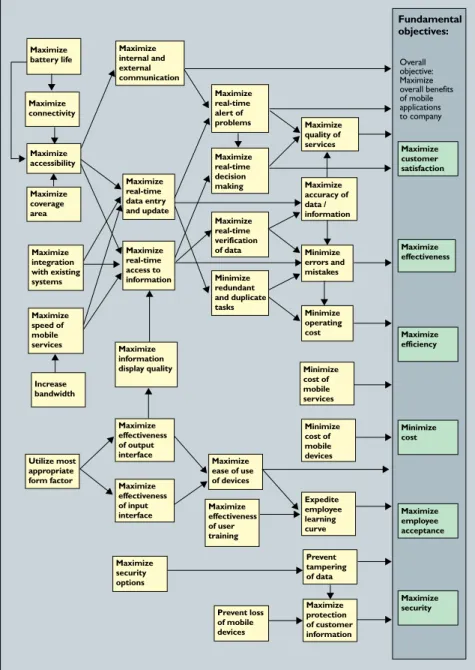
Build a means-ends objective network.The purpose of this step is to link means objectives to each other as well as to fundamental objectives. For example, if an objective such as “Maximize cov-erage area” influences the “Maxi-mize accessibility of mobile services” objective, we draw an arrow from the first to the second objective. By linking the objec-tives, we derived the cause-effect relationships of these objectives.
Research Results
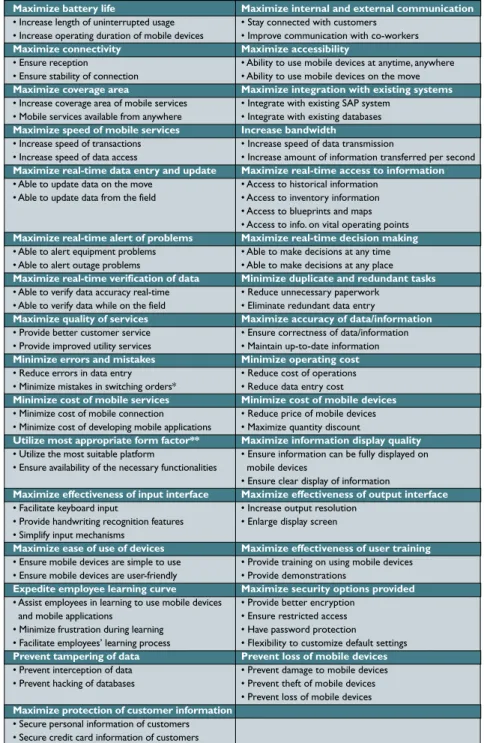
The means and fundamental objectives derived from our study are shown in Tables 1 and 2, and the means-ends network is depicted in Figure 2. The overall objective for mobile applications is to maximize the overall bene-fits to the company. Six fundamental objectives are considered most important: efficiency, effectiveness, customer satisfaction, security, cost, and employee acceptance.
Efficiency and effectiveness. Efficiency can be improved by minimizing delay and saving time in retrieving, updating, and communicating informa-tion. This company has a large number of field work-ers, who often lack access to needed information when in the field or on the road. For example, if field workers want to check inventory information on spe-cific parts, they must call the office and request the office staff to run the check for them. Also, they must carry large collections of maps and blueprints with them while on the move in order to have access to
Maximize battery life Maximize connectivity Maximize coverage area Increase bandwidth Utilize most appropriate form factor Maximize ease of use of devices Maximize information display quality Maximize effectiveness of output interface Maximize effectiveness of input interface Maximize security options Prevent loss of mobile devices Maximize integration with existing systems Maximize real-time data entry and update Maximize real-time alert of problems Maximize real-time decision making Maximize real-time verification of data Minimize redundant and duplicate tasks Maximize effectiveness of user training Maximize protection of customer information Prevent tampering of data Expedite employee learning curve Minimize cost of mobile devices Minimize cost of mobile services Minimize operating cost Minimize errors and mistakes Maximize accuracy of data / information Maximize quality of services Maximize real-time access to information Maximize internal and external communication Maximize speed of mobile services Maximize accessibility Maximize customer satisfaction Overall objective: Maximize overall benefits of mobile applications to company Fundamental objectives: Maximize effectiveness Maximize efficiency Minimize cost Maximize employee acceptance Maximize security
Figure 2. The means-ends objective network.
essential information, such as the design information and locations of electrical connections and generation stations. Further, changes made in the field (such as fixing electrical problems and
installing new parts) are noted by the field workers on paper and are updated into the system in batch mode by office staff. Because data is not updated at the source, the information in the system is not always accurate.
These problems pose chal-lenges to the company because they not only result in additional paperwork, but also in delays and potential inaccuracies. With more extensive implementation of wireless applications, field workers could access and update information in real time, thus improving the quality and accu-racy of information, and enabling tasks to be carried out more accu-rately and quickly.
Customer satisfaction. Real-time access to up-to-date cus-tomer and utility service information helps improve the quality of services and customer communication. As the company policy is to terminate electricity supply to a residence or business when payment is not received on time, the payment status should be updated immediately upon receipt to ensure the customers can have their power quickly switched back on. For example, a customer may be paying his bill in one of the offices when a ser-vice representative in the field ter-minates the customer’s electrical supply. With wireless applica-tions, an alert will be
automati-cally issued to the field worker and an unfortunate incident will be avoided.
Security.This is a major con-cern for the company. One such concern is the theft or loss of mobile devices, which are easily misplaced or stolen, and likely contain sensitive or confidential data that can be accessed by unauthorized persons. Wireless
• Make customers happy with our services • Fulfill customer requests quicker • Able to do job quicker • Save time in completing tasks
• Increase employees’ interest to use mobile applications • Ensure employees adapt to new technology
• Maintain higher quality of work • Make better decisions
• Minimize cost of implementing mobile applications • Reduce business expenses
• Ensure security of data
• Ensure security of business transactions
Maximize customer satisfaction
Maximize efficiency
Maximize employee acceptance
Maximize effectiveness
Minimize cost
Maximize security
Note:
* “Switching orders” refers to instructions to switch electricity on or off ** “Form factors” refer to size, configuration, and functionality of the devices.
• Increase length of uninterrupted usage • Increase operating duration of mobile devices • Ensure reception
• Ensure stability of connection • Increase coverage area of mobile services • Mobile services available from anywhere • Increase speed of transactions • Increase speed of data access • Able to update data on the move • Able to update data from the field • Able to alert equipment problems • Able to alert outage problems • Able to verify data accuracy real-time • Able to verify data while on the field • Provide better customer service • Provide improved utility services • Reduce errors in data entry • Minimize mistakes in switching orders* • Minimize cost of mobile connection • Minimize cost of developing mobile applications • Utilize the most suitable platform
• Ensure availability of the necessary functionalities • Facilitate keyboard input
• Provide handwriting recognition features • Simplify input mechanisms
• Ensure mobile devices are simple to use • Ensure mobile devices are user-friendly • Assist employees in learning to use mobile devices and mobile applications
• Minimize frustration during learning • Facilitate employees’ learning process • Prevent interception of data • Prevent hacking of databases
• Secure personal information of customers • Secure credit card information of customers
• Stay connected with customers • Improve communication with co-workers • Ability to use mobile devices at anytime, anywhere • Ability to use mobile devices on the move • Integrate with existing SAP system • Integrate with existing databases • Increase speed of data transmission
• Increase amount of information transferred per second • Access to historical information
• Access to inventory information • Access to blueprints and maps • Access to info. on vital operating points • Able to make decisions at any time • Able to make decisions at any place • Reduce unnecessary paperwork • Eliminate redundant data entry • Ensure correctness of data/information • Maintain up-to-date information • Reduce cost of operations • Reduce data entry cost • Reduce price of mobile devices • Maximize quantity discount
• Ensure information can be fully displayed on mobile devices
• Ensure clear display of information • Increase output resolution • Enlarge display screen
• Provide training on using mobile devices • Provide demonstrations
• Provide better encryption • Ensure restricted access • Have password protection
• Flexibility to customize default settings • Prevent damage to mobile devices • Prevent theft of mobile devices • Prevent loss of mobile devices
Maximize battery life
Maximize connectivity
Maximize coverage area
Maximize speed of mobile services
Maximize real-time data entry and update
Maximize real-time alert of problems
Maximize real-time verification of data
Maximize quality of services
Minimize errors and mistakes
Minimize cost of mobile services
Utilize most appropriate form factor**
Maximize effectiveness of input interface
Maximize ease of use of devices
Expedite employee learning curve
Prevent tampering of data
Maximize protection of customer information
Maximize internal and external communication
Maximize accessibility
Maximize integration with existing systems
Increase bandwidth
Maximize real-time access to information
Maximize real-time decision making
Minimize duplicate and redundant tasks
Maximize accuracy of data/information
Minimize operating cost
Minimize cost of mobile devices
Maximize information display quality
Maximize effectiveness of output interface
Maximize effectiveness of user training
Maximize security options provided
Prevent loss of mobile devices
Table 1. List of fundamental objectives.
data transmission poses another problem for data security. During transmission, data can be intercepted or tampered with. To maximize security in mobile applications, various security options must be pro-vided, including powerful encryption, restricted access, password protection, and customized default settings, in order to assure user and data authentica-tion, confidentiality, and integrity.
Cost.To implement mobile applications, the com-pany must invest in mobile devices, pay service fees for wireless access, and train employees. On the other hand, mobile applications can help to lower operating cost by reducing paperwork and eliminating redun-dant work. A cost-benefit analysis may be needed to justify the investment.
Employee acceptance.Not every employee is will-ing to embrace new technology. Personality traits may determine whether an employee is willing to try something new—some employees accustomed to standard operating procedures will resist change. Because of the current limitations of mobile devices and their interfaces, employees may perceive mobile devices as difficult to use [7]. Therefore, the selection of appropriate form factors (such as size, configura-tion, and functionality) is important. The input inter-face must be user friendly and the input mechanisms must be simple. Screen size should be large enough to ensure a readable display. Also, employees need ade-quate training to adopt mobile devices and become proficient in their usage.
These fundamental objectives highlight the bene-fits and costs of mobile applications that are most essential to a company. There are similarities between the fundamental objectives we have found and those discussed in the literature. For example, UPS adopted mobile applications to provide better tracking and delivery services to its customers, in order to improve customer satisfaction (fundamental objective). Wire-less applications developed by Cerner Corporation enable hospital personnel to manage their time more efficiently and improve the quality of patient care, thus improving efficiency and effectiveness. Although Wells Fargo planned to use wireless applications to “gain new operating efficiencies” [6], its mobile initia-tive failed because of the lack of customer satisfaction with the (limited) services provided and the lack of acceptance of the technology for m-banking [5]. Banks are now prioritizing cost cutting rather than cutting-edge technology [5]. M-banking will become a priority again only if mobile technology can support a cost-cutting priority, which is a fundamental objec-tive of mobile applications in most organizations. Fur-ther, security is a major concern in wireless applications—it is important to ensure confidential
information is not compromised [1, 11].
The results obtained in this study of just one orga-nization are applicable and useful to other companies embarking on or in the midst of mobile application projects. The findings not only provide a more in-depth understanding of the benefits of mobile appli-cations to organizations, but also highlight the principles for evaluation of mobile applications.
Implications for Managers and Practitioners
Some of the means objectives provided by the electric company are directly related to mobile devices or ser-vices. Such examples include “maximize battery life,” “maximize connectivity,” “maximize accessibility,” “maximize coverage area,” and “maximize mobile ser-vice speed.” These are some of the basic requirements for mobile applications. They contribute toward the achievement of other means objectives. The highest level of means objectives (those with arrows pointing into fundamental objectives) helps to achieve the fundamental company objectives. Without these basic requirements, mobile applications would not be beneficial to the company.
We also identified three necessary conditions that were emphasized by almost all interviewees—accessi-bility, real-time access and updates, and integration with existing systems. Accessibility is a key require-ment for wireless applications: being able to use them anytime, anywhere, and while on the move are impor-tant criteria. The company we studied has several offices, many substations, and field workers who are constantly traveling. In addition to personal comput-ers and traditional office equipment, the company needs mobile and wireless devices to provide its employees with access to information whenever the need arises and regardless of location.
Real-time access and updates refers to the ability to access and update data, including maps and blue-prints, while on the move. One employee articulated this perspective as follows: “This is very important for field workers because they don’t have to drive back to the main office just to check some minor detail, and they don’t need to carry a huge deck of maps or blue-prints with them to the field. Everything can be dis-played on these small devices.”
Integration with existing systems is also crucial. The company wants to use mobile devices to access and update data in the ERP system and other existing systems. Hence, the implementation should comple-ment and integrate with existing systems to maximize its overall value to the company. With an integrated implementation, workers could retrieve information, maps, and blueprints in the field or on the move, thus
increasing the application value.
Although mobile applications can provide signifi-cant value to companies, some limitations hinder their widespread adoption. Two main obstacles con-cern the current limitations of mobile devices and the quality of mobile services. Some researchers [8, 10, 12] have noted that mobile devices suffer from major drawbacks, including: small screen size and key pads; limited computational power, memory, and disk capacity; shorter battery life; complicated text input mechanisms; higher risk of data storage and transac-tion errors; lower display resolutransac-tion; unfriendly and cumbersome user interfaces; and graphical limita-tions. These limitations have prevented companies from rolling out full implementation of mobile appli-cations. Such limitations were highlighted by the interviewees and were described as some of the main obstacles in implementing wireless and mobile appli-cations. The interviewees were also concerned that the existing limitations of mobile devices would make it difficult for employees to learn, use, and adopt them. Also, the small display screen and poor resolu-tion prevent certain forms of informaresolu-tion, such as maps, blueprints, and drawings, from being displayed fully and clearly. The limited battery life constrains the length of operations of the devices and the mobil-ity of the users.
There are some technical restrictions and limita-tions related to mobile services, which add new chal-lenges to widespread adoption and diffusion of mobile applications. They are: limited bandwidth, unstable connections, low predictability, and lack of a standardized protocol [8]. Users expect stability and responsiveness when using these applications; how-ever, current mobile connections cannot satisfy these two requirements. Mobile services have limited cover-age area and lack a standardized protocol. Thus, when users travel out of the area, they cannot access the mobile services they need. This drawback poses potential problems for companies whose employees travel frequently. Another problem with mobile ser-vices is the low speed. A typical cellular data transfer speed is approximately 10Kbps. Such low speed is not suitable for displaying rich information that contains graphics, audio, or other data-intensive material.
The limitations of mobile services and mobile technology have posed challenges for companies plan-ning to adopt mobile applications. Other issues asso-ciated with mobile applications must be considered. Security issues were mentioned in most interviews. Security and privacy risks are greater with the wireless medium [1]. Mobile applications must provide more and better security options to protect confidential and sensitive data stored in the mobile devices. Cost of
mobile devices and mobile services were also indi-cated as investment concerns.
Mobile applications, however, are advancing by leaps and bounds. Most of the technical limitations and constraints will be alleviated in the near future, making mobile applications more usable, friendly, and financially worthwhile for companies.
Conclusion
In this study, we interviewed employees across the various departments of a company to understand the values of mobile applications. A means-ends net-work that depicts the causal relationships among the objectives was developed and discussed. The net-work is useful to researchers as it highlights the issues, concerns, and values of mobile applications. For managers and practitioners, the network pre-sents a road map that can help them achieve their companies’ objectives of implementing mobile and wireless applications.
References
1. Ghosh, A.K, and Swaminatha, T.M. Software security and privacy risk in mobile e-commerce. Commun. ACM 44, 2 (Feb. 2001), 51–57. 2. Keeney, R.L. The value of Internet commerce to the customer.
Man-agement Science 45, 4 (1999), 533–542.
3. Keeney, R.L. Creativity in decision making with value-focused think-ing. Sloan Management Review 35, 4 (Summer 1994), 33–41. 4. Keeney, R.L. Value-focused Thinking. Harvard University Press,
Cam-bridge, MA, 1992.
5. McCall, M. Saving for a rainy day. Wireless Internet Magazine (Sept. 16, 2002), 24.
6. McDonough, D., Jr. Wells Fargo counts down to total wireless. Wire-less NewsFactor (July 19, 2001); www.wireWire-lessnewsfactor.com/ perl/story/12122.html.
7. Nah, F. and Davis, S. HCI research issues in e-commerce. Journal of Electronic Commerce Research 3, 3 (Aug. 2002), 98–113.
8. Siau, K., Lim, E., and Shen, Z. Mobile commerce: Promises, challenges and research agenda. Journal of Database Management 12, 3 (2001), 3–10. 9. Siau, K. and Shen, Z. Building customer trust in mobile commerce.
Commun. ACM 46, 4 (Apr. 2003), 91–94.
10. Siau, K. and Shen, Z. Mobile communications and mobile services.
International Journal of Mobile Communication 1, 1–2 (2003), 3–14. 11. Siau, K., Sheng, H., and Nah, F. The value of mobile commerce to
cus-tomers. In Proceedings of the Third Annual Workshop on HCI Research in MIS, Washington D.C. (Dec. 10–11, 2004), 65–69.
12. Siau, K., Sheng, H., Nah, F., and Davis, S.A. Qualitative investigation on consumer trust in mobile commerce. International Journal of Elec-tronic Business 2, 3 (May–June 2004), 283–300.
Fiona Fui-Hoon Nah([email protected]) is an associate professor at the University of Nebraska-Lincoln.
Keng Siau([email protected]) is an associate professor at the University of Nebraska-Lincoln and the editor-in-chief of the Journal of Database Management.
Hong Sheng([email protected]) is a Ph.D. student at the University of Nebraska-Lincoln.
Permission to make digital or hard copies of all or part of this work for personal or classroom use is granted without fee provided that copies are not made or distributed for profit or commercial advantage and that copies bear this notice and the full cita-tion on the first page. To copy otherwise, to republish, to post on servers or to redis-tribute to lists, requires prior specific permission and/or a fee.
© 2005 ACM 0002-0782/05/0200 $5.00