Prediction of Respiratory Motion Using A
Statistical 4D Mean Motion Model
Jan Ehrhardt1, Ren´e Werner1, Alexander Schmidt–Richberg1, and Heinz
Handels1
Department of Medical Informatics, University Medical Center Hamburg–Eppendorf, Germany,[email protected]
Abstract. In this paper we propose an approach to generate a 4D sta-tistical model of respiratory lung motion based on thoracic 4D CT data of different patients. A symmetric diffeomorphic intensity–based registra-tion technique is used to estimate subject–specific moregistra-tion models and to establish inter–subject correspondence. The statistics on the diffeomor-phic transformations are computed using the Log–Euclidean framework. We present methods to adapt the genererated statistical 4D motion model to an unseen patient–specific lung geometry and to predict individ-ual organ motion. The prediction is evaluated with respect to landmark and tumor motion. Mean absolute differences between model–based pre-dicted landmark motion and corresponding breathing–induced landmark displacements as observed in the CT data sets are 3.3±1.8mm consid-ering motion between end expiration to end inspiration, if lung dynamics are not impaired by lung disorders.
The statistical respiratory motion model presented is capable of provid-ing valuable prior knowledge in many fields of applications. We present two examples of possible applications in the fields of radiation therapy and image guided diagnosis.
1
Introduction
Respiration causes significant motion of thoracical and abdominal organs and thus is a source of inaccuracy in image guided interventions and in image acqui-sition itself. Therefore, modeling and prediction of breathing motion has become an increasingly important issue within many fields of application, e.g in radiation therapy [1].
Based on 4D images, motion estimation algorithms enable to determine patient–specific spatiotemporal information about movements and organ defor-mation during breathing. A variety of respiratory motion estidefor-mation approaches have been developed in the last years, ranging from using simple analytical functions to describe the motion over landmark–, surface– or intensity–based registration techniques [2, 3] to biophysical models of the lung [4]. However, the computed motion models are based on individual 4D image data and their use is usually confined to motion analysis and prediction of an individual patient.
The key contribution of this article is the generation of astatistical 4D inter– individual motion model of the lung. A symmetric diffeomorphic non–linear
intensity–based registration algorithm is used to estimate lung motion from a set of 4D CT images from different patients acquired during free breathing. The computed vector motion fields are transformed into a common coordinate sys-tem and a 4D mean motion model (4D–MMM) of the respiratory lung motion is extracted using the Log–Euclidean framework [5] to compute statistics on the diffeomorphic transformations. Furthermore, methods are presented to adapt the computed 4D–MMM to the patient’s anatomy in order to predict individual or-gan motion without 4D image information. We perform a quantitative in–depth evaluation of the model–based prediction accuracy for intact and impaired lungs and two possible applications of the 4D–MMM in the fields of radiation therapy and image guided diagnosis are shown.
Few works that deal with the development of statistical lung motion models have been published. Some approaches exist for the generation of 3D lung at-lases [6], or the geometry–based simulation of cardiac and respiratory motions [7]. First steps towards an average lung motion model generated from different patients were done by Sundaram et al. [8], but their work focuses on 2D+tlung MR images and the adaptation of the breathing model to a given patient has not been addressed. First methods for building inter–patient models of respiratory motion and the utilization of the generated motion model for model–based pre-diction of individual breathing motion were presented in [9] and [10]. This paper is an extension of [10] with regard to the methodology and the quantitative eval-uation. In [9] motion models were generated by applying a Principal Component Analysis (PCA) to motion fields generated by a surface–based registration in a population of inhale–exhale pairs of CT images. Our approach is different in all aspects: the registration method, the solution of the correspondance problem, the spatial transformation of motion fields, and the computation of statistics of the motion fields. Furthermore, we present a detailed quantitative evaluation of a model based prediction for intact and impaired lungs. This offers interest-ing insights into the prediction accuracy to be expected dependinterest-ing on size and position of lung tumors.
2
Method
The goal of our approach is to generate a statistical model of the respiratory lung motion based on a set of Np thoracic 4D CT image sequences. Each 4D
image sequence is assumed to consist of Nj 3D image volumes Ip,j : Ω → R
(Ω ⊂ R3), which are acquired at corresponding states of the breathing cycle.
This correspondance is ensured by the applied 4D image reconstruction method [11] and therefore, a temporal alignment of the patient data sets is not necessary. Our method consists of three main steps: First, the subjectspecific motion is estimated for each 4D image sequence by registering the 3D image frames. In a second step, an average shape and intensity model is generated from the CT images. In the last step, the average shape and intensity model is used as anatomical reference frame to match all subject-specific motion models and to build an average intersubject model of the respiratory motion.
Image registration is required in all three steps. We use a non–linear, intensity– based, diffeomorphic registration method as described in the next section. The three steps to generate the statistical model of the respiratory motion are de-tailed in Sect. 2.2. The utilization of the 4D–MMM for motion predicition is presented in Sect. 2.3.
2.1 Diffeomorphic image registration
Diffeomorphic mappings ϕ : Ω → Ω, (ϕ ∈ Dif f(Ω), Ω ⊂ Rd) guarantee
that the topology of the transformed objects is preserved and are therefore used in computational anatomy to analyze and characterize the biological variabil-ity of human anatomy [12]. A practical approach for fast diffeomorphic image registration was recently proposed in [13] by constraining ϕ to a subgroup of diffeomorphisms. Here, diffeomorphisms are parametrized by a stationary veloc-ity field v, and the diffeomorphic transformation ϕ is given by the solution of thestationary flow equation at timet= 1 [5]:
∂
∂tφ(x, t) =v(φ(x, t)) andφ(x,0) =x. (1) The solution of eq. (1) is given by the group exponential mapϕ(x) =φ(x,1) = exp(v(x)) and the significant advantage of this approach is that these exponen-tials can be computed very efficiently (see [5] for details).
The problem of image registration can now be understood as finding a para-metrizing velocity fieldv, so that the diffeomorphic transformationϕ= exp(v) minimizes a distanceDbetween a reference imageI0and the target imageIjwith
respect to a desired smoothnessS of the transformation:J[ϕ] =D[I0, Ij;ϕ] +
αS[ϕ]. UsingS[ϕ] =R
Ωk∇vk
2dx(withϕ= exp(v)) as regularization scheme,
the following iterative registration algorithm can be derived:
Algorithm 1Symmetric diffeomorphic registration Setv0= 0,ϕ=ϕ−1=Idandk= 0
repeat
Compute the update stepu=12“fI0,Ij◦ϕ−fIj,I0◦ϕ−1
”
Update the velocity field and perform a diffusive regularization:
vk+1= (Id−τ α∆)−1 “
vk+τu
”
(2) Calculateϕ= exp(vk+1) andϕ−1= exp(−vk+1)
Letk←k+ 1
The update fielduis calculated in an inverse consistent form to assure source to target symmetry. The force termf is related toDand is chosen to be:
fI0,Ij◦ϕ(x) =−
(I0(x)−(Ij◦ϕ)(x))∇(Ij◦ϕ)(x)
k∇(Ij◦ϕ)(x)k2+κ2(I0(x)−(Ij◦ϕ)(x))2
(3)
withκ2being the reciprocal of the mean squared spacing. Eq. (2) performs the update of the velocity fieldv, whereτ is the step width. The term (Id−τ α∆)−1 is related to the diffusive smoother S and can be computed efficiently using additive operator splitting (AOS).
We have chosen this diffeomorphic registration approach because of three rea-sons: In the context of the motion model generation, it is important to ensure that the calculated transformations are symmetric and diffeomorphic because of the multiple usage of inverse transformations. The second reason is related to runtime and memory requirements: due to the size of the 4D CT images dif-feomorphic registration algorithms using non–stationary vector fields, e.g. [14], are not feasible. Third, the representation of diffeomorphic transformations by stationary vector fields provides a simple way for computing statistics on diffeo-morphisms via vectorial statistics on the velocity fields.
For a diffeomorphism ϕ= exp(v), we call the velocity field v = log(ϕ) the logarithm of ϕ. Remarkably, the logarithm v = log(ϕ) is a simple 3D vector field and this allows to perform vectorial statistics on diffeomorphisms, while preserving the invertibility constraint [15]. Thus, the Log-Euclidean mean of diffemorphisms is given by averaging the parametrizing velocity fields:
¯ ϕ= exp 1 N X i log(ϕi) ! . (4)
The mean and the distance are inversion-invariant, since log(ϕ) =−log(ϕ−1).
Even though the metric linked to this distance is not translation invariant, it provides a powerful framework where statistics can be computed more efficiently than in the Riemannian distance framework. For a more detailed introduction to the mathematics of the diffeomorphism group and the associated tangent space algebra, we refer to [5] and the references therein.
2.2 Generation of a 4D mean motion model
In the first step, we estimate the intra–patient respiratory motion for each 4D image sequence by registering the 3D image frames. LetIp,j:Ω→R(Ω⊂R3)
be the 3D volume of subject p∈ {1, . . . , Np} acquired at respiratory state j ∈
{0, . . . , Nj−1}. Maximum inhale is chosen as reference breathing state and the
diffeomorphic transformations ϕp,j : Ω → Ω are computed by registering the
reference image Ip,0 with the target imagesIp,j, j ∈ {1, . . . , Nj −1}. In order
to handle discontinuities in the respiratory motion between pleura and rib cage, lung segmentation masks are used to restrict the registration to the lung region by computing the update field only inside the lung (see [3] for details).
In order to build a statistical model of respiratory motion, correspondence between different subjects has to be established, i.e. an anatomical reference frame is necessary. Therefore, the reference images Ip,0 for p = 1, . . . , Np are
used to generate an average intensity and shape atlas ¯I0 of the lung in the
reference breathing state by the method described in [10]. This 3D atlas image ¯
I0 is now used as reference frame for the statistical lung motion model. Each
patient–specific reference imageIp,0is mapped to the average intensity and shape
atlas ¯I0 by an affine alignment and a subsequent diffeomorphic registration.
Letψp be the transformation between the reference imageIp,0 of subjectp
and the atlas image ¯I0. Since the intra–subject motion modelsϕp,j are defined
in the anatomical spaces of Ip,0, we apply a coordinate transformation
˜
ϕp,j=ψp◦ϕp,j◦ψp−1 (5)
to transfer the intra–subject deformations into the atlas coordinate space. Such a coordinate transformation accounts for the differences in the coordinate sys-tems of subject and atlas due to misalignment and size/shape variation and eliminates subject–specific size, shape and orientation information in the de-formation vectors. This enables the motion fields of each of the subjects to be compared directly quantitatively and qualitatively and the 4D–MMM is gener-ated by calculating the Log-Euclidean meanϕ¯j of the mapped transformations
for each breathing state j:
¯ ϕj = exp 1 Np X p log ( ˜ϕp,j) ! = exp 1 Np X p log ψp◦ϕp,j◦ψ−p1 ! . (6)
The method proposed in [16] was used to compute the logarithms log ( ˜ϕp,j).
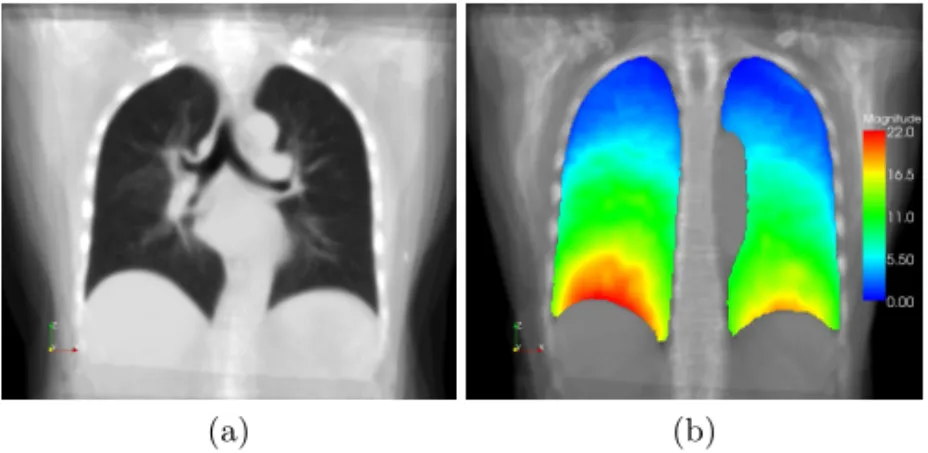
The resulting 4D–MMM consists of an average lung image ¯I0 for a
refer-ence state of the breathing cycle, e.g. maximum inhalation, and a set of motion fields ϕ¯j describing an average motion between the respiratory statej and the
reference state (Fig. 1).
2.3 Utilization of the 4D–MMM for individual motion prediction The 4D–MMM generated in section 2.2 can be used to predict respiratory lung motion of a subjectseven if no 4D image information is available. Presuming a 3D imageIs,0 acquired at the selected reference state of the breathing cycle is
available, the 4D–MMM is adapted to the individual lung geometry of subject sby registering the average lung atlas ¯I0 with the 3D imageIs,0. The resulting
transformation ψs is used to apply the coordinate transformation eq. 5 to the
mean motion fields ϕ¯j in order to obtain the model–based prediction of the
subject–specific lung motion: ˆϕs,j=ψs−1◦ϕ¯j◦ψs.
However, two problems arise. First, breathing motion of different individuals varies significantly in amplitude [1]. Therefore, motion prediction using the mean amplitude will produce unsatisfying results. To account for subject–specific mo-tion amplitudes, we propose to introduce addimo-tional informamo-tion by providing the
(a) (b)
Fig. 1.Visualization of average lung model ¯I0(a) and magnitude of mean deformation ¯
ϕj between end inspiration and end expiration (b). The average deformation model shows a typical respiratory motion pattern. Different windowing and leveling functions are used to accentuate inner/outer lung structures.
required change in lung air content∆Vair. Even without 4D-CT data, this
infor-mation can be acquired by spirometry measurements. Thus, we search a scaling factorλso that the air content of the transformed reference image Is,0◦λϕˆ−s,j1
is close to the air content Vair(Is,0) +∆Vair. In order to ensure that the scaled
motion field is diffeomorphic, the scaling is performed in the Log–Euclidean. To determine the correct scaling factorλ, a binary search strategy is applied and the air content is computed using the method described in [17]. ∆Vair can be
regarded as a parameter that describes the depth of respiration. In general, other measurements can also be used to calculate appropriate scaling factors, e.g. the amplitude of the diaphragm motion.
Further, a second problem arises when predicting individual breathing motion of lung cancer patients. Lung tumors will impair the atlas–patient registration because there is no corresponding structure in the atlas. This leads to distortions inψsnear the tumor region and consequently the predicted motion fields ˆϕs,jare
affected. Therefore, we decided to computeψsby registering lung segmentation
masks from atlas and subjectsand by omitting the inner lung structures.
3
Results
To capture the respiratory motion of the lung, 18 4D CT images were acquired using a 16–slice CT scanner operating in cine-mode. The scanning protocol and optical–flow based reconstruction method was described in [11]. The spatial res-olution of the reconstructed 4D CT data sets is between 0.78×0.78×1.5mm3
and 0.98×0.98×1.5mm3. Each data set consists of 3D CT images at 10 to 14
preselected breathing phases. Due to computation times, in this study we use the following 4 phases of the breathing cycle: end inspiration (EI), 42% exhale (ME), end expiration (EE) and 42% inhale (MI). A clinical expert delineated left and right lung and the lung tumors in the images.
Fig. 2. Result of the motion estimatation by intra–patient registration (top row) and the model–based motion prediction (bottom row) of patient 01. Visualization of the magnitude of the displacement field computed by intra–patient registration (top left) and of the displacement field predicted by the 4D mean motion model (bot-tom left). Right: contours at end inspiration (green), end expiration (yellow) and esti-mated/predicted contours at end expiration (red).
The aim of the model generation is to create a representation of the mean healthy lung motion. In a dynamic MRI study by Plathow et al. [18], tumors with diameter >3cmwere shown to influence respiratory lung dynamics. According to their observations, we divide the lungs into two groups: lungs with intact
dynamics and lungs with impaired motion. Lungs without or with only small tumors (volume<14.1cm3or diameter<3cm) are defined as intact. Lungs with
large tumors or lungs affected by other diseases (e.g. emphysema) are defined as impaired. According to this partitioning, we have 12 data sets with both lungs intact and 6 data sets with at least one impaired lung. Only data sets with intact lungs are used to generate the 4D–MMM.
3.1 Landmark–based evaluation
Due to the high effort of the manual landmark identification only 10 of the 18 data sets are used for the detailed quantitative landmark–based evaluation. Between 70 and 90 inner lung landmarks (prominent bifurcations of the bronchial tree and the vessel tree) were identified manually in the four breathing phases, about 3200 landmarks in total. An intraobserver variability of 0.9±0.8mmwas
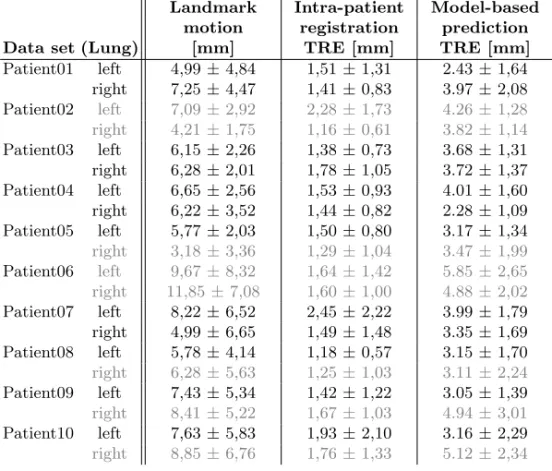
Table 1. Landmark motion amplitudes and target registration errors REE for the patients considered (inmm). Values are averaged over all landmarks per lung. Lungs with impaired motion are indicated by a gray text color.
Landmark Intra-patient Model-based motion registration prediction
Data set (Lung) [mm] TRE [mm] TRE [mm]
Patient01 left 4,99±4,84 1,51±1,31 2.43±1,64 right 7,25±4,47 1,41±0,83 3.97±2,08 Patient02 left 7,09±2,92 2,28±1,73 4.26±1,28 right 4,21±1,75 1,16±0,61 3.82±1,14 Patient03 left 6,15±2,26 1,38±0,73 3.68±1,31 right 6,28±2,01 1,78±1,05 3.72±1,37 Patient04 left 6,65±2,56 1,53±0,93 4.01±1,60 right 6,22±3,52 1,44±0,82 2.28±1,09 Patient05 left 5,77±2,03 1,50±0,80 3.17±1,34 right 3,18±3,36 1,29±1,04 3.47±1,99 Patient06 left 9,67±8,32 1,64±1,42 5.85±2,65 right 11,85±7,08 1,60±1,00 4.88±2,02 Patient07 left 8,22±6,52 2,45±2,22 3.99±1,79 right 4,99±6,65 1,49±1,48 3.35±1,69 Patient08 left 5,78±4,14 1,18±0,57 3.15±1,70 right 6,28±5,63 1,25±1,03 3.11±2,24 Patient09 left 7,43±5,34 1,42±1,22 3.05±1,39 right 8,41±5,22 1,67±1,03 4.94±3,01 Patient10 left 7,63±5,83 1,93±2,10 3.16±2,29 right 8,85±6,76 1,76±1,33 5.12±2,34
assessed by repeated landmark identification in all test data sets. The target registration error (TRE) was determined for a quantitative evaluation of the patient–specific registration method and the model–based prediction. The TRE Rjk is the difference between the motion of landmarkkestimated byϕjand the
landmark motion as observed by the medical expert.
The mean landmark motion magnitude, i.e. the mean distance of correspond-ing landmarks, between EI and EE is 6.8±5.4mm, (2.6±1.6mmbetween EI and ME and 5.0±2.8mm between EI and MI). The TRE of the intra–patient reg-istration is a lower bound for the accuracy of the model–based prediction using the 4D–MMM. The average TREREE between the reference phase (EI) and EE
for patient 01 to 10 (averaged over all landmarks and patients) is 1.6±1.3mm (1.5±0.8mmbetween EI and ME and 1.6±0.9mmbetween EI and MI). Details for all test data sets are shown in table 1.
For each of the 10 test data sets the 4D–MMM is used to predict landmark motion as described in Sect. 2.3. If both lungs of the test data set are intact, a leave–one–out strategy is applied to ensure that the patient data is not used for the model generation. The change in lung air content ∆Vair needed for the
computation of the scaling factorλwas calculated from the CT imagesIEI and
scale the predicted motion fields ˆϕEE, ˆϕM E and ˆϕM I. Besides ∆Vair no 4D
information is used for the model–based prediction.
In Fig. 2 the motion field predicted by the 4D–MMM is compared to the motion field computed by patient–specific registration. A good correspondency between the motion fields is visible, except in the right upper lobe where small deviations occur. The prediction accuracy is illustrated by overlayed contours.
The average TREsREE are listed in table 1 for each of the test data sets and
for both the patient–specific and model–based motion estimation. Lungs with impaired motion are indicated by a gray text color. Regarding table 1, lungs with impaired motion generally show higher TREs for the model–based prediction than intact lungs. The average TREREEfor intact lungs is 3.3±1.8mm, which
is significantly lower (p < 0.01) than for lungs with impaired motion (REE =
4.2±2.2mm). Significance is tested by applying a multilevel hierarchical model with the individualRk values nested within the patient (software: SPSS v.17); data are logarithmized to ensure normal distribution and the model is adjusted to landmark motion.
3.2 Model-based prediction of tumor motion
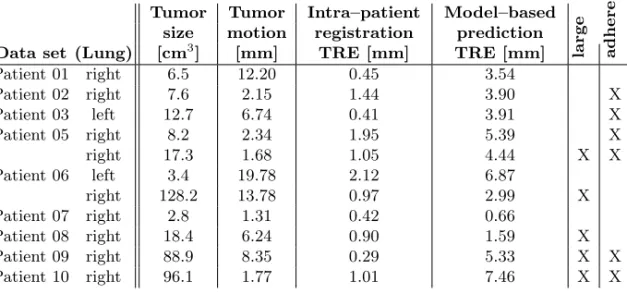
For a second evaluation of the model, we use expert generated tumor segmenta-tions in two breathing phases (EI and EE) of 9 patient data sets with solid lung tumors. The 4D–MMM is transformed into the coordinate space of each test data set (see Sect. 2.3) and then used to warp the expert–generated tumor seg-mentation at maximum exhale towards maximum inhale. The distance between the predicted tumor mass center and the center of the manual segmentation was used to evaluate the accuracy of the model–based prediction. Correspond-ing results are summarized in table 2. Large tumors with a diameter>3cmare marked in the table as “large”.
Regarding table 2 accuracy of the model–based predicted motion of the tu-mor mass center from EI to EE ranges from 0.66mm to 7.38mm. There is no significant correlation between the tumor motion amplitude and the accuracy of the model-based predicted mass center (r= 0.19,p >0.15). Furthermore, it cannot be shown that the prediction accuracy for small tumors is significantly better than for large tumors (p >0.4). In contrast, the model–based prediction accuracy of non-adherent tumors is significantly better than for tumors adher-ing to chest wall or hilum (p < 0.05). In these cases the model presumes the tumour moves like surrounding lung tissue, whereas it rather moves like the ad-jacent non-lung structure (e.g. chest wall or hilum). In the last column in table 2 those tumors are tagged. Significance is tested by applying a linear mixed model (software: SPSS v.17) and the model is adjusted to tumor motion.
4
Discussion
In this paper, we proposed a method to generate an inter–subject statistical model of the breathing motion of the lung, based on individual motion fields
Table 2.Tumor size and motion amplitude, and the center distances between manually segmented tumor and predicted tumor position (see text for details).
Tumor Tumor Intra–patient Model–based size motion registration prediction
Data set (Lung) [cm3] [mm] TRE [mm] TRE [mm] large ad
here Patient 01 right 6.5 12.20 0.45 3.54 Patient 02 right 7.6 2.15 1.44 3.90 X Patient 03 left 12.7 6.74 0.41 3.91 X Patient 05 right 8.2 2.34 1.95 5.39 X right 17.3 1.68 1.05 4.44 X X Patient 06 left 3.4 19.78 2.12 6.87 right 128.2 13.78 0.97 2.99 X Patient 07 right 2.8 1.31 0.42 0.66 Patient 08 right 18.4 6.24 0.90 1.59 X Patient 09 right 88.9 8.35 0.29 5.33 X X Patient 10 right 96.1 1.77 1.01 7.46 X X
extracted from 4D CT images. Methods to apply this model in order to predict patient–specific breathing motion without knowledge of 4D image information were presented. Ten 4D CT data sets were used to evaluate the accuracy of the image–based motion field estimation and the model–based motion field predic-tion. The intra–patient registration shows an average TRE in the order of the voxel size, e.g. 1.6±1.3mmwhen considering motion between EI and EE. The 4D–MMM achieved an average prediction error (TRE) for the motion between EI and EE of 3.3±1.8mm. Regarding that besides the calculated scaling factor λno patient–specific motion information is used for the model–based prediction and that the intra–patient registration as well as the atlas–patient registration is error prone, we think this is a promising result. Thus we believe that a sta-tistical respiratory motion model has the capability of providing valuable prior knowledge in many fields of applications.
Since the statistical model represents intact respiratory dynamics, it was shown that the prediction precision is significantly lower for lungs affected by large tumours or lung disorders (4.2±2.2mm). These results indicate (at least for the 10 lung tumor patients considered) that large tumors considerably influence respiratory lung dynamics. This finding is in agreement with Plathow et al. [18]. In addition, we applied the 4D–MMM to predict patient–specific tumor motion. No correlation between prediction accuracy and tumor size or tumor motion amplitude could be detected (at least for our test data sets). We observed that tumors adhering to non–lung structures degrade local lung dynamics significantly and model–based prediction accuracy is decreased for these cases.
To conclude this paper, we present two examples of possible applications of the statistical respiratory motion model.
Application examples: The capability of the 4D–MMM to predict tumor motion for radiotherapy planning is exemplarily illustrated for patient 01. This patient has a small tumor not adherent to another structure, and a therapeutically
(a) (b)
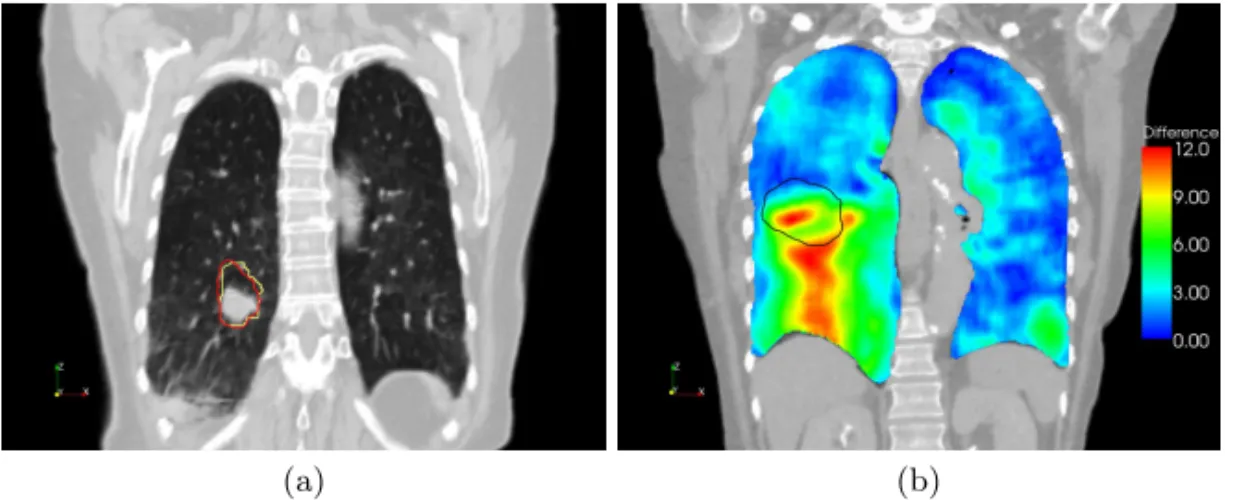
Fig. 3.(a) Visualization of the internal target volume (ITV) of patient 01 in a coronal CT slice. The ITV was calculated from expert-defined tumor segmentations (yellow contour) and from tumor positions predicted by the average motion model (red con-tour). (b) Visualization of the difference between lung motion estimated by patient– specific registration and lung motion predicted by the 4D–MMM for patient 09. The left lung shows intact lung motion; dynamics of the right lung are impaired by the large tumor. The contour of the tumor is shown in black.
relevant tumor motion of 12.2mm. An important measure for planning in 3D conformal radiotherapy is the internal target volume (ITV), which contains the complete range of motion of the tumour. For this patient, the ITV is calculated first from expert-defined tumor segmentations in the images acquired at EI, EE, ME and MI. In a second step, the expert segmentation in EI is warped to EE, ME and MI using the 4D–MMM and the ITV is calculated based on the warped results. The outlines of both ITVs are shown in Fig. 3(a).
A second example demonstrates that the 4D–MMM could be helpful from the perspective of image-guided diagnosis. Here, the motion pattern of individual patients are compared to a “normal” motion, represented by the 4D–MMM. To visualize the influence of a large tumor to the respiratory motion, the difference between the individual motion field computed by intra–patient registration and the motion field predicted by the 4D–MMM is shown in Fig. 3(b). The left lung shows differences of only about 3mm, whereas the large differences to the intact lung motion indicate that the respiratory dynamics of the right lung are influenced by the large tumor.
Currently, the statistical motion model represents the average motion in the training population. A main focus of our future work is to include the variability of the motion into the model. Here, the Log–Euclidean framework provides a suitable technique for more detailed inter–patient statistics.
References
1. Keall, P.J., Mageras, G., Balter, J.M., et al.: The management of respiratory motion in radiation oncology report of AAPM task group 76. Med Phys33(10)
(2006) 3874–3900
2. Vik, T., Kabus, S., von Berg, J., Ens, K., Dries, S., Klinder, T., Lorenz, C.: Vali-dation and comparison of registration methods for free-breathing 4D lung CT. In: SPIE Medical Imaging 2008. Volume 6914., SPIE (2008) 2P
3. Werner, R., Ehrhardt, J., Schmidt-Richberg, A., Handels, H.: Validation and com-parison of a biophysical modeling approach and non-linear registration for estima-tion of lung moestima-tion fields in thoracic 4D CT data. In: SPIE Medical Imaging 2009: Image Processing. Volume 7259. (2009) 0U–1–8
4. Werner, R., Ehrhardt, J., Schmidt, R., Handels, H.: Patient-specific finite element modeling of respiratory lung motion using 4D CT image data. Med Phys35(5) (May 2009) 1500–1511
5. Arsigny, V.: Processing Data in Lie Groups: An Algebraic Approach. Application to Non-Linear Registration and Diffusion Tensor MRI. Th`ese de sciences (phd thesis), ´Ecole polytechnique (November 2006)
6. Li, B., Christensen, G.E., Hoffman, E.A., McLennan, G., Reinhardt, J.M.: Estab-lishing a normative atlas of the human lung: intersubject warping and registration of volumetric CT images. Acad Radiol10(2003) 255–265
7. Segars, W., Lalush, D., Tsui, B.: Modeling respiratory mechanics in the MCAT and spline-based MCAT phantoms. IEEE Trans Nucl Sci48(1) (Feb 2001) 89–97 8. Sundaram, T.A., Avants, B.B., Gee, J.C.: A dynamic model of average lung defor-mation using capacity-based reparameterization and shape averaging of lung mr images. In: MICCAI 2004, Springer (2004) 1000–1007
9. Klinder, T., Lorenz, C., Ostermann, J.: Respiratory motion modeling and estima-tion. In: Workshop on Pulmonary Image Analysis, New York, USA (2008) 53–62 10. Ehrhardt, J., Werner, R., Schmidt-Richberg, A., Schulz, B., Handels, H.:
Genera-tion of a mean moGenera-tion model of the lung using 4D CT data. In: Visual Computing for Biomedicine, Delft, Eurographics Association (2008) 69–76
11. Ehrhardt, J., Werner, R., S¨aring, D., Frenzel, T., Lu, W., Low, D., Handels, H.: An optical flow based method for improved reconstruction of 4D CT data sets acquired during free breathing. Med Phys34(2) (Feb 2007) 711–721
12. Miller, M.I.: Computational anatomy: shape, growth, and atrophy comparison via diffeomorphisms. NeuroImage23 Suppl 1(2004) S19–S33
13. Vercauteren, T., Pennec, X., Perchant, A., Ayache, N.: Symmetric log-domain diffeomorphic registration: a demons-based approach. In: Med Image Comput Comput Assist Interv, MICCAI 2008, Springer (2008) 754–761
14. Beg, M.F., Miller, M.I., Trouve, A., Younes, L.: Computing large deformation metric mappings via geodesic flows of diffeomorphisms. Int J Comp Vis 61(2) (2005) 139–157
15. Arsigny, V., Commowick, O., Pennec, X., Ayache, N.: A log-Euclidean framework for statistics on diffeomorphisms. In: MICCAI 2006, Springer (2006) 924–931 16. Bossa, M.N., Gasso, S.O.: A new algorithm for the computation of the group
logarithm of diffeomorphisms. In: MFCA 2008, New York, USA (2008)
17. Lu, W., Parikh, P.J., El Naqa, I.M., et al.: Quantitation of the reconstruction qual-ity of a four-dimensional computed tomography process for lung cancer patients. Med Phys32(2005) 890–901
18. Plathow, C., Fink, C., Ley, S., M.Puderbach, M.Eichinger, I.Zuna, A.Schm¨ahl, H.Kauczor: Measurement of tumor diameter-dependent mobility of lung tumors by dynamic MRI. Radiother Oncol73(2004) 349–354