Using DIC to compare selection models with non-ignorable missing responses
Abstract
Data with missing responses generated by a non-ignorable missingness mechanism can be anal-ysed by jointly modelling the response and a binary variable indicating whether the response is observed or missing. Using a selection model factorisation, the resulting joint model consists of a model of interest and a model of missingness. In the case of non-ignorable missingness, model choice is difficult because the assumptions about the missingness model are never verifiable from the data at hand. For complete data, the Deviance Information Criterion (DIC) is routinely used for Bayesian model comparison. However, when an analysis includes missing data, DIC can be constructed in different ways and its use and interpretation are not straightforward. In this paper, we present a strategy for comparing selection models by combining information from two measures taken from different constructions of the DIC. A DIC based on the observed data likelihood is used to compare joint models with different models of interest but the same model of missingness, and a comparison of models with the same model of interest but different models of missingness is carried out using the model of missingness part of a conditional DIC. This strategy is intended for use within a sensitivity analysis that explores the impact of different assumptions about the two parts of the model, and is illustrated by examples with simulated missingness and an application which compares three treatments for depression using data from a clinical trial. We also examine issues relating to the calculation of the DIC based on the observed data likelihood.
1
Introduction
Missing data is pervasive in many areas of scientific research, and can lead to biased or inefficient infer-ence if ignored or handled inappropriately. A variety of approaches have been proposed for analysing such data, and their appropriateness depends on the type of missing data and the mechanism that led to the missing values. Here, we are concerned with analysing data with missing responses thought to be generated by a non-ignorable missingness mechanism. In these circumstances, a recommended approach is to jointly model the response and a binary variable indicating whether the response is observed or missing. Several factorisations of the joint model are available, including the selection model factorisation and the pattern-mixture factorisation, and their pros and cons have been widely discussed (Kenward and Molenberghs, 1999; Michiels et al., 2002; Fitzmaurice, 2003). In this paper, attention is restricted to selection models with a Bayesian formulation.
Spiegelhalteret al. (2002) proposed aDeviance Information Criterion, DIC, as a Bayesian measure of model fit that is penalised for complexity. This can be used to compare models in a similar way to the Akaike Information Criterion (for non-hierarchical models with vague priors on all parameters, DIC≈ AIC), with the model taking the smallest value of DIC being preferred. However, for complex models, the likelihood, which underpins DIC, is not uniquely defined, but depends on what is considered as forming the likelihood and what as forming the prior. With missing data, there is also the question of what is to be included in the likelihood term, just the observed data or the missing data as well. For models allowing non-ignorable missing data, we must take account of the missing data mechanism in addition to dealing with the complication of not observing the full data.
Celeuxet al. (2006) (henceforth CRFT) assess different DIC constructions for missing data models, in the context of mixtures of distributions and random effects models. Daniels and Hogan (2008), Chapter 8, discuss two different constructions for selection models, one based on the observed data likelihood, DICO, and the other based on the full data likelihood, DICF. However, DICF has proved difficult
to implement in practice. The purpose of this paper is to first examine issues of implementation and usability of DICOand to clarify possible misuse. We then build on this to show how insights from DICO
can be complemented by information from part of an alternative, ‘conditional’, DIC construction, thus providing the key elements of a strategy for comparing selection models.
In Section 2, we introduce selection models and review the general definition of DIC, before discussing how DICO and a DIC based on a likelihood that is conditional on the missing data, DICC, can
provide complementary information about the comparative fit of a set of models. Issues concerning the calculation of DICO are discussed in Section 3, including choice of algorithm, plug-ins and sample
size. In Sections 4 and 5 we describe the use of a combination of DICO and DICC to compare models
for simulated and real data missingness respectively, emphasising that this should be carried out within the context of a sensitivity analysis rather than to select a single ‘best’ model. We conclude with a discussion in Section 6.
2
DIC for selection models
We start this section by introducing the selection model factorisation, then discuss the general formula for DIC, and finally look at different constructions of DIC for selection models.
2.1 Introduction to selection models
Suppose our data consists of a univariate response with missing values, y= (yi), and a vector of fully
observed covariates, x = (x1i, . . . , xpi), for i = 1, . . . , n individuals, and let λ denote the unknown
parameters of our model of interest. y can be partitioned into observed, yobs, and missing, ymis,
values, i.e. y= (yobs,ymis). Now define m= (mi) to be a binary indicator variable such that
mi=
{
1: yi observed
0: yi missing
and let θ denote the unknown parameters of the missingness function. The joint distribution of the full data, (yobs,ymis,m|λ,θ), can be factorised as
f(yobs,ymis,m|λ,θ) =f(m|yobs,ymis,θ)f(yobs,ymis|λ) (1)
suppressing the dependence on the covariates, and assuming thatm|y,θis conditionally independent of λ, andy|λ is conditionally independent ofθ, which is usually reasonable in practice. This factori-sation of the joint distribution is known as a selection model (Schafer and Graham, 2002). Both parts of the model involve ymis, so they must be fitted jointly. Consequently assumptions concerning the
model of interest will influence the model of missingness parameters through ymis, and vice versa.
2.2 Introduction to DIC
Deviance is a measure of overall fit of a model, defined as -2 times the log likelihood, D(ϕ) =
−2logL(ϕ|y), with larger values indicating poorer fit. In Bayesian statistics deviance can be sum-marised in different ways, with the posterior mean of the deviance,D(ϕ) =E{D(ϕ)|y}, suggested as
a sensible Bayesian measure of fit (Dempster, 1973) (reprinted as Dempster (1997)), though this is not penalised for model complexity. Alternatively, the deviance can be calculated using a point estimate such as the posterior means forϕ,D( ¯ϕ) =D{E(ϕ|y)}. In general we use the notationE(h(ϕ)|y) to denote the expectation of h(ϕ) with respect to the posterior distribution of ϕ|y. However, in more complex formula, we will occasionally use the alternative notation,Eϕ|y(h(ϕ)).
Spiegelhalteret al. (2002) proposed that the difference between these two measures,pD =D(ϕ)−D( ¯ϕ),
is an estimate of the ‘effective number of parameters’ in the model. The DIC proposed by Spiegelhalter
et al. (2002) adds pD to the posterior mean deviance, giving a measure of fit that is penalised for
complexity,
DIC =D(ϕ) +pD. (2)
DIC can also be written as a function of the log likelihood, i.e.
DIC = 2logL{E(ϕ|y)|y} −4Eϕ|y{logL(ϕ|y)}. (3) More generally, if ¯Ddenotes the posterior mean of the deviance and ˆDdenotes the deviance calculated using some point estimate, then DIC = 2 ¯D−D. We will refer to ˆˆ D as a plug-in deviance, and the point estimates of the parameters used in its estimation as plug-ins. The value of DIC is dependent on the choice of plug-in estimator. The posterior mean, which is a common choice, leads to a lack of invariance to transformations of the parameters (Spiegelhalteret al., 2002), and the reasonableness of the choice of the posterior mean depends on the approximate normality of the parameter’s posterior distribution. Alternatives to the posterior mean include the posterior median, which was investigated at some length by Spiegelhalter et al. (2002), and the posterior mode, which was considered as an alternative by CRFT.
Further, in hierarchical models we can define the prior and likelihood in different ways depending on the quantities of interest, which will affect the calculation of both ¯D and ˆD and hence DIC. The chosen separation of the joint density into prior and likelihood determines what Spiegelhalter et al. (2002) refer to as thefocus of the model.
For complete data, DIC is routinely used by Bayesian statisticians to compare models, a practice facilitated by its automatic calculation by the WinBUGS software, which allows Bayesian analysis of complex statistical models using Markov chain Monte Carlo (MCMC) techniques (Spiegelhalter
et al., 2003). WinBUGS calculates DIC, taking D(ϕ) to be the posterior mean of−2logL(ϕ|y), and evaluatingD( ¯ϕ) as -2 times the log likelihood at the posterior mean of the stochastic nodes. However, other values of DIC can be obtained by using different plug-ins or a different model focus.
When data include missing values, the possible variations in defining DIC are further increased. Different treatments of the missing data lead to different specifications, and there is also the question of what is to be included in the likelihood, just the observed data or the missing data as well.
2.3 DIC based on the observed data likelihood
One construction is based on the observed data likelihood,L(λ,θ|yobs,m),
where
L(λ,θ|yobs,m)∝
∫
f(yobs,ymis,m|λ,θ)dymis.
For a selection model, recalling Equation 1: L(λ,θ|yobs,m)∝
∫
f(m|yobs,ymis,θ)f(yobs,ymis|λ) dymis
=f(yobs|λ)Eymis|yobs,λ{f(m|yobs,ymis,θ)}.
(4)
So the first term in the likelihood is the yobs part of the model of interest, f(yobs|λ), and the second
term evaluates the model of missingness by integrating overymis. The calculation of the expectation
in Equation 4 creates complexity in the DICO computation.
The fit of the model of interest to yobs is optimised if this part of the model is estimated in isolation,
i.e. we assume ignorable missingness. As soon as we allow for informative missingness by estimating the model of interest jointly with the model of missingness, the fit of the model of interest part toyobs
necessarily deteriorates. This is because, in a selection model, the same model of interest is applied to both the observed and the missing data, and so the λ estimates will depend on both yobs and
the imputed ymis. Since the latter are systematically different from the former under an informative
missingness model, the fit of the model of interest to the observed data will necessarily be worse than ifλhad just been estimated usingyobs. Consequently, the value of the part of the DICO attributable
to the fit of the model of interest will increase when the model of missingness departs from MAR. This may partially or completely offset any reduction in the part of DICO attributable to improvements in
fit of the model of missingness (as happens in our simulated example in Section 4.2 and application in Section 5). Thus, while DICO will indicate which selection model best fits the observed data (yobs and
m), it can be misleading when our true purpose is to compare the fit of selection models to both the observed and missing data (yobs,m andymis). Neither DICO nor any other model selection criterion
can answer this question directly as they can never provide information about the fit to the missing data. However, DICO can provide useful insight into the comparative fit of certain aspects of these
types of models. As we will show, reasonable comparisons can be made using DICO by fixing the
model of missingness part and using it to compare selection models with different models of interest (conditional on the appropriateness of the missingness model). Even so, we must still be careful how we use DICO, remembering that it only tells us about the fit of a selection model to the observed data
and nothing about its fit to the missing data.
Because of the fact that the imputed ymis will depend on the model of missingness, and DICO does
not account for the fit to the missing data, we do not recommend using DICO to compare selection
models with different models of missingness. Hence, it would be useful to have an additional model comparison measure that focusses on the missing data. Clearly we cannot examine the fit of the missing data as we can for the observed data, but we do have information brought by the missingness indicator. We would therefore like a DIC construction that allows us to use this additional information and consider the fit of the model of missingness separately.
2.4 Conditional DIC
An alternative option is a conditional DIC, which treats the missing data as additional parameters (CRFT). This can be written as:
DICC = 2logL{E(λ,θ,ymis|yobs,m)|yobs,m} −4Eλ,θ,ymis|yobs,m{logL(λ,θ,ymis|yobs,m)}. For selection models the likelihood on which this is based is
L(λ,θ,ymis|yobs,m)∝f(yobs,m|λ,θ,ymis)
=f(yobs|ymis,λ)f(m|yobs,ymis,θ).
(5)
For many examples, including all those discussed in this paper, f(yobs|ymis,λ) can be simplified to
f(yobs|λ). In this case DICC only differs from DICO in the second term, f(m|yobs,ymis,θ), which
is evaluated by conditioning on ymis rather than by integrating over it. The plug-ins for DICC
include the missing data, ymis, and are evaluated as E(λ,θ,ymis|yobs,m). However, as pointed out
by CRFT, conditional DICs have asymptotic difficulties, since the number of missing values and hence the dimension of the parameter space increase with sample size.
The DIC automatically generated by WinBUGS in the presence of missing data is a conditional DIC, and WinBUGS produces DIC values for the model of interest and model of missingness separately.
ymis are treated as extra parameters in the model of missingness, with the model of interest acting
as their prior distribution. This is a natural construction for considering the fit of the model of missingness separately, where the focus is on predicting the missingness. Thus, we propose that the part of DICC relating to the model of missingness, f(m|yobs,ymis,θ), can be used for comparing the
fit of the model of missingness for selection models with the same model of interest. While there is no sense in considering this measure in isolation, we will see that it can provide useful additional information when used in conjunction with DICO in the context of a sensitivity analysis.
CRFT suggest a different formulation for a conditional DIC, which they call DIC8, whereby the
missing data are dealt with as missing variables rather than additional parameters. The idea of DIC8
is to first condition on the imputed ymis, calculating the parameters of the model of interest and
the model of missingness for each completed dataset, denoted ˆλ(yobs,m,ymis) and ˆθ(yobs,m,ymis).
Then integrate over ymis conditional on the observed data (yobs,m) by averaging the resulting log
likelihoods for these datasets. It can be written as:
DIC8= 2Eymis|yobs,m{logL(ˆλ(yobs,m,ymis),θˆ(yobs,m,ymis),ymis|yobs,m)}
−4Eλ,θ,ymis|yobs,m{logL(λ,θ,ymis|yobs,m)}.
DIC8 differs from DICC in the plug-in part of the formula (first term), and cannot be computed using
only WinBUGS. We describe its calculation and compare it to DICC in the first simulated example
in Section 4.1.
2.5 Plug-ins for calculating DIC
In general, the required plug-in likelihood can be calculated by using plug-ins on different scales. In a regression framework these can be the stochastic parameters used to calculate the linear predictor
or the linear predictor itself. This choice affects both parts of the model, but to illustrate we consider the model of missingness. Let the model of missingness be defined as
mi ∼Bernoulli(pi),
link(pi) =f(yi,θ),
θ ∼prior distribution.
(6)
where ‘link’ would typically be taken to be the logit or probit function. Then, we could use the posterior means of θ as our plug-in values (θ plug-ins) or alternatively we might use the posterior mean oflink(pi) as plug-ins (linkpplug-ins). WinBUGS uses the former, taking the posterior means
ˆ
θk=E(θk) for allθkin the set of model of missingness parameters as the plug-ins. If we use thelinkp
plug-ins to calculate DICC instead, then our plug-ins are evaluated asE(λ,linkp|yobs,m) rather than
E(λ,θ,ymis|yobs,m). These plug-ins lead to a different plug-in deviance, and hence a different DIC
which may affect our model comparison.
For DICO we must choose plug-ins that ensure consistency in the calculation of the posterior mean
deviance and the plug-in deviance, so that missing values are integrated out in both parts of the DIC. The θ plug-ins allow us to evaluate ˆD by integrating over ymis as required. By contrast, the linkp
plug-ins are not appropriate as they do not allow averaging over a sample ofymis values, and in fact
would lead to the same plug-in deviance as the one used for calculating DICC. Hence for DICO, we
only useθ plug-ins, evaluated as E(λ,θ|yobs,m).
2.6 Strategy for using DIC to compare selection models
Suppose that we have a number of models of interest that are plausible for the question under in-vestigation, and a number of models of missingness that are plausible for describing the missingness mechanism that generated the missing outcomes. Then our proposed strategy is to fit a set of joint models, that combine each model of interest with each model of missingness. DICO can then be used
to compare models with the same model of missingness, and the model of missingness part of DICC
can be used to compare models with the same model of interest. Hence, by combining complementary information provided by the two DIC measures we contend that we can usefully assess the comparative fit of a set of models, whereas this is not possible with a single DIC measure.
DICOcannot be computed using WinBUGS alone, because in general the required expectations cannot
be evaluated directly from the output of a standard MCMC run. For these, either “nested” MCMC is required, or some other simulation method. In the next section, we discuss the steps involved in calculating DICO for a selection model where f(y|β, σ) is the model of interest, typically a linear
regression model assuming Normal or t errors in our applications, andf(m|y,θ) is a commonly used Bernoulli model of non-ignorable missingness.
3
Implementation of DIC
ODaniels and Hogan (2008) (henceforth DH) provide a broad outline of an algorithm for calculat-ing DICO, which we use as a starting point for our implementation which uses the R software with
calls to WinBUGS to carry out MCMC runs where necessary (the code will be made available on
http://www.bias-project.org.uk/). We start by describing our preferred algorithm and then ex-plain how and why it differs from the suggestions of DH. We then discuss issues connected with the choice of plug-ins, and the checks that we consider necessary to ensure that the samples generated for its calculation are of sufficient length.
3.1 Algorithm
Our preferred algorithm, used to calculate the DICO for selection models implemented in the
exam-ples in Sections 4 and 5, can be summarised by the following steps (fuller detail is provided in the Appendix):
1 Call WinBUGS to carry out a standard MCMC run on the selection model, and save samples of length K of the model of interest and model of missingness parameters, denoted β(k), σ(k) and
θ(k),k= 1, . . . , K, (Ksample).
2 Evaluate the Ksample posterior means of the model parameters, ˆβ, ˆσ and ˆθ.
3 For each member, k, of the Ksample, generate a sample of length Q of missing responses from the appropriate likelihood evaluated at β(k) and σ(k) using f(yobs,ymis|β(k), σ(k)) (the sample
associated with member k of the Ksample is the Qsample(k)).
4 Next, for each member, k, of the Ksample, evaluate the expectation term from Equation 4, Eymis|y
obs,β(k),σ(k){f(m|yobs,ymis,θ
(k))}, by averaging over its associated Qsample. Using these
expectations, calculate the posterior mean of the deviance, ¯D, by averaging over the Ksample. (See step 4 in the Appendix for the required equations.)
5 Generate a new Qsample of missing responses from the appropriate likelihood evaluated at the posterior means of the model of interest parameters using f(yobs,ymis|βˆ,σ). Evaluate the expec-ˆ
tation term of the plug-in deviance by averaging over this new Qsample, and calculate the plug-in deviance, ˆD, using the posterior means from the Ksample. (See step 5 in the Appendix for the required equations.)
6 Finally, calculate DICO= 2 ¯D−D.ˆ
The main differences between this algorithm and the DH proposal is in steps 3 and 4. DH propose using reweighting to avoid repeatedly generating samples for the evaluation of the expectations required in step 4. An implementation using reweighting involves generating a single Qsample of missing responses from the appropriate likelihood evaluated at the posterior means of the model of interest parameters (as in step 5) instead of the multiple Qsamples at step 3. Step 4 then involves calculating a set of weights for each member of the Ksample, and using these in the evaluation of the expectation term. Fuller detail of the changes to these steps is provided in the Appendix.
The reweighting is a form of importance sampling, used when we wish to make inference about a distribution f∗(·) using Monte Carlo integration, but instead have available a sample, z(1), . . . , z(Q), from a different distribution f(·). The available sample can be reweighted to make some inference
based onf∗(·), using weights of the form
wq=
f∗(z(q))
f(z(q)) .
Details of the equations for the weights required for calculating DICO using the reweighting method
are given in the Appendix. The success of importance sampling is known to be critically dependent on the variability of the sampling weights (Peruggia, 1997), with greater variability leading to poorer estimates. For the method to be successful, we require that the two distributions f(·) and f∗(·) are reasonably close, and in particular that f(·) has a heavier tail than f∗(·) (Liu, 2001; Gelman et al., 2004).
We have run both versions of the algorithm (with and without weighting) on some examples and rec-ommend the version without weighting because it (1) avoids effective sample size problems associated with reweighting, (2) reduces instability and (3) has no computational disadvantage. We now discuss each of these issues in more detail.
Effective sample size
In the calculation of DICO using reweighting, a set of sampling weights, w(qk), is produced for each
member of the Ksample. We would like the effective sample size (ESS) of each of these sets of weights to be close to the actual sample size, Q. Following Liu (2001), Chapter 2, we define ESS as
ESS = Q
1 +var(w) (7)
where Qis the number of samples generated from a distribution, f(·), and var(w) is the variance of normalised importance weights. A small variance is good as ESS approaches the actual sample size, Q, when var(w) gets smaller. This variance can be estimated by
Q
∑
q=1
(wq−w)¯ 2
(Q−1) ¯w2 (8)
where ¯wis the mean of the sample ofwqs. Using these formulae, a set of ESS values can be calculated,
one corresponding to each Ksample member. We found that the ESS is highly variable in examples based on simulated data, including a sizeable proportion which are sufficiently low to be of concern. By using an algorithm without reweighting, we avoid potential problems associated with low ESS. Stability
We would like the calculated value of DICO to be stable, and not depend on the random number
seed used to generate either the Ksample or Qsample. For an example based on data with simulated missingness, we calculated DICO using the reweighted algorithm with K = 2,000 and Q = 2,000.
Firstly, we repeated the calculation four times, using different random number seeds for generating the Ksample, but the same random number seed to generate the Qsample. The variation between the DICO from the five calculations (original and four repetitions) was small (less that 1). Note that in
this case although the Qsample is generated from the same random number seed, it will also differ between runs due to the Ksample differences. Secondly, we repeated the calculation another four times, but using the same random number seed to generate the Ksample and four different random number seeds for generating the Qsample. As the Ksample is generated from the same random number
seed, any differences are attributable to variation in the Qsample. Both ¯D and ˆD now exhibit much larger variation, resulting in a difference between the highest and lowest DICO of about 6 which is
sufficiently large to be a concern, given that rules of thumb suggest that differences of 3-7 in DIC should be regarded as important (Spiegelhalteret al., 2002). (These results are shown in Table 11 of the Supplementary Material.) Repeating the exercise withQincreased to 10,000 lowered the variation only slightly.
Using the algorithm without reweighting resulted in much greater stability of ¯D, but ˆD, and hence DICO, remained variable. A method for assessing this instability is discussed in Section 3.3.
Computational time
One of the original reasons for using reweighting was to speed up the computation of DICO, since our
preferred method involves generating K+ (K ×Q) +Q samples, whereas the importance sampling method just generates K +Q samples, and then reweights the single Q sample for every replicate in the K sample. However, for equivalent sample sizes we found that our implementation of both algorithms ran in about the same time, so there appears to be no computational advantage to using reweighting in practice. This is because the computational time saved in the reweighting algorithm by not generating the extra samples, is offset by evaluating the weights which also requires the calculation of K×Qmodel of interest likelihoods.
3.2 Choice of plug-in
As with calculating any DIC using posterior mean plug-ins, checks that these posterior means come from approximately symmetric unimodal distributions are essential. One possibility is a visual inspec-tion of the posterior distribuinspec-tions of the proposed plug-ins and a check that the coefficient of skewness, where coefficient of skewness = 1 n n ∑ i=1 (xi−x)¯ 3 sd(x)3 , (9)
which is a measure of the asymmetry of a distribution, is close to 0.
3.3 Adequacy of the size of the Qsample
As discussed above (see paragraph headed “Stability” in Section 3.1), we would like to be sure thatQ is large enough to ensure that the DICOresulting from our calculations is stable. We have developed a
method for checking the stability of our results using subsets of the Qsample. These subsets are created by splitting the complete Qsample in half, and then successively splitting the resulting subsets. ¯Dand
ˆ
Dfor each subset and the full sample are then plotted against the size of the Qsample. (DICO could
also be plotted against Qsample size, but as it is a function of ¯D and ˆD, it provides no additional information.) The required extra calculations can be carried out with negligible additional cost in running time.
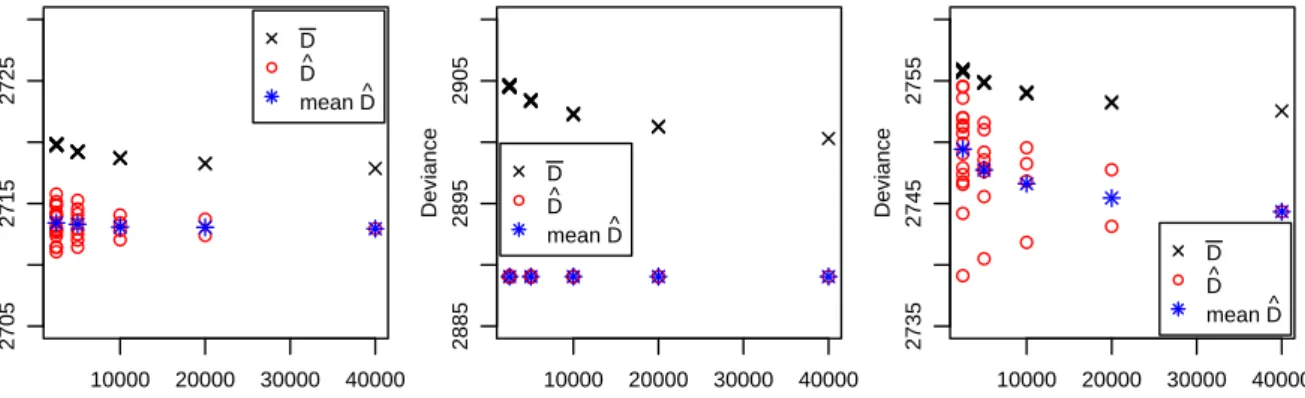
Figure 1 provides examples of such plots, where Q = 40,000 and the sample is repeatedly split until a sample size of 2,500 is reached. This gives 2 non-overlapping Qsamples of length 20,000, 4
overlapping Qsamples of length 10,000, 8 overlapping Qsamples of length 5,000 and 16 non-overlapping Qsamples of length 2,500. These plots show little variation in ¯Dat eachQ(all the crosses are on top of each other), but a clear downwards trend asQincreases, which converges towards a limit. However, ˆD exhibits instability for the plots labelled JM1 and especially for JM3, that decreases as Qincreases. (We will explain the stability in the JM2 plot in Section 4.) A similar downwards trend to ¯D, converging to a limit is indicated by the mean values of ˆD.
We consider the Qsample size to be sufficient if our proposed deviance plot suggests both ¯D and ˆD have converged to a limit and ˆDhas stabilised. On this basis 40,000 appears an adequate sample size for calculating DICO for JM1, but a higherQmight produce a more accurate DICOfor JM2 and JM3.
The plots for this and other synthetic examples suggest that higher variability and slower convergence to a limit are associated with poorer fitting models.
4
Illustration of strategy on simulated data
In this section we illustrate our proposed strategy using simulated bivariate Normal data, and demon-strate the inadequacies of using only DICO for comparing selection models with simulated time series
data.
4.1 Bivariate Normal data
We now assess how DICO and the missingness part of DICC can be used to help compare models,
using simulated data with simulated missingness so that the correct model is known. For this purpose, we generate a dataset of bivariate Normal data with 1000 records comprising a response, y, and a single covariate,x, s.t. ( x y ) ∼N (( 0 1 ) , ( 1 0.5 0.5 1 )) . (10)
For this dataset the correct model of interest is
yi∼N(µi, σ2) (11)
µi =β0+β1xi
and the true values of the parameters areβ0 = 1 and β1 = 0.5.
We then delete some of the responses according to the equation pi=ϕ0+ϕ1yi. The values ofϕ0 and
ϕ1 are chosen to impose linear non-ignorable missingness with a steep positive gradient, such that the
probability of being missing for the lowest value ofy is 0 and the probability of being missing for the highest value of y is 1. The chosen values also ensure that 0 ≤pi ≤1 for all yi. Although the true
model of missingness is the linear equation pi =ϕ0+ϕ1yi, this can be adequately modelled by the
linear logistic equationlogit(pi) =θ0+θ1yi, which ensures that the estimated probabilities always lie
in the range [0,1].
Our investigation is based on fitting four joint models (JM1-JM4), as specified in Table 1, to this simulated dataset with simulated missingness. For JM1, we know that the specified model of interest
is correct and that the specified linear logit is a good approximation for the true model of missingness. However, JM2 has an inadequate model of interest, JM3 has an incorrect error distribution and JM4 has too complex a model of missingness. So for the simulated data, we consider three different models of interest and two different models of missingness. A full implementation of our proposed strategy would involve fitting a set of joint models which pairs each model of interest with each model of missingness (six joint models), and we do this in our real data application in Section 5.
Table 1: Specification of joint models for the bivariate Normal simulated data Model Name Model of Interest Model of Missingness
JM1 yi ∼N(µi, σ2); µi =β0+β1xi logit(pi) =θ0+θ1yi
JM2 yi ∼N(µi, σ2); µi =β0 logit(pi) =θ0+θ1yi
JM3 yi ∼t4(µi, σ2); µi =β0+β1xi logit(pi) =θ0+θ1yi
JM4 yi ∼N(µi, σ2); µi =β0+β1xi logit(pi) =θ0+θ1yi+θ2y2i
Vague priors are specified for the unknown parameters of the model of interest: theβ parameters are assigned N(0,100002) priors and the precision,τ = σ12, a Gamma(0.001,0.001) prior. Following
Wake-field (2004) and Jacksonet al. (2006), we specify a logistic(0,1) prior forθ0 and a weakly informative
N(0,0.68) prior forθ1 andθ2, which corresponds to an approximately flat prior on the scale ofpi.
We calculate the DICO for the three models with the same model of missingness (JM1, JM2 and JM3)
using the algorithm described in Section 3, with K = 2,000 and Q= 40,000. The likelihood for the model of interest is calculated using
f(y|β) =(2πσ2)− n 2 exp ( − 1 2σ2 n ∑ i=1 (yi−µi)2 ) for JM1&JM2 and f(y|β) = n ∏ i=1 Γ(52) 2σ√π [ 1 + ( yi−µi 2σ )2]−52 for JM3. In the t4distributionσis a scale parameter, s.t.σ =
√var
2 , wherevaris the variance of the distribution.
For all three models, the likelihood for the model of missingness is calculated using
f(m|y,θ) = n ∏ i=1 pmi i (1−pi) 1−mi where pi = eθ0+θ1yi 1 +eθ0+θ1yi.
The samples produced by the WinBUGS runs are from 2 chains of 15,000 iterations, with 10,000 burn-in and the thburn-innburn-ing parameter set to 5. Based on the Gelman-Rubburn-in convergence statistic (Brooks and Gelman, 1998) and a visual inspection of the chains, the WinBUGS runs required for calculating DICO for the three models all converged.
As recommended in Section 3, we start by checking that the posterior means used as plug-ins come from approximately symmetric unimodal distributions. From their coefficients of skewness (Equation 9) we find that theθ are skewed to some extent in all the models, and that theymis are badly skewed
for JM3 (see Table 12 in the Supplementary Material for figures). However, as this simple example is for illustration, we continue with these plug-ins, interpreting the DICO with caution.
As discussed in Section 3.3, Figure 1 allows us to assess the adequacy of the length of our Qsample for the different models by splitting it into subsets and plotting ¯D and ˆD against the sample lengths. The scale ranges of the three plots are consistent, but the magnitudes vary. Downward trends in the deviance estimates, converging towards a limit, are shown for all models. However, for JM3 and possibly for ¯Din JM2, this limit appears not to have yet been reached. In this example, as DICO for
these models is substantially higher than for JM1, we consider the sampling variability in DICO to be
inconsequential by comparison and hence rerunning with largerQ to be unnecessary. Also, increased instability is evident in the ˆDestimates for JM3 compared to JM1. The stability in the ˆDfor JM2 is because the posterior mean of θ1 is close to 0, and so any variation in theymis estimates between the
Qsubsamples will have a minimal impact on the model of missingness likelihood and hence ˆD.
Figure 1: Deviance plots for checking the adequacy of the Qsample length for JM1-JM3
10000 20000 30000 40000 2705 2715 2725 JM1 Q sample length Deviance D D^ mean D^ 10000 20000 30000 40000 2885 2895 2905 JM2 Q sample length Deviance D D^ mean D^ 10000 20000 30000 40000 2735 2745 2755 JM3 Q sample length Deviance D D^ mean D^
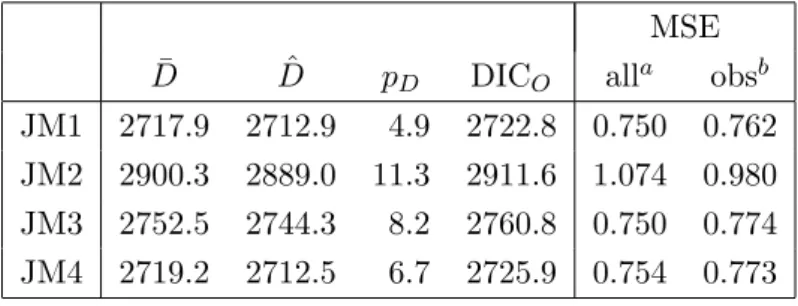
Recall that since the data and missingness are simulated, we know that JM1 is the correct model. Table 2 shows the DICO for JM1-JM3, and two versions of an alternative measure of overall fit, the
mean square error (MSE) for the model of interest, as defined by MSE = 1 n n ∑ i=1 (yi−E(yi|β))2, (12)
where E(yi|β) is evaluated as the posterior mean of µi in Equation 11. One version (obs) is based
only on the observed data, and the other (all) uses both the observed and missing data which is possible with this dataset because we have simulated the missingness and know the true values of the missing yi. Based only on the observed data, the MSE slightly favours JM1 and JM2 is clearly
a very poor choice. If the missing data are also brought into consideration, then there is nothing to choose between JM1 and JM3. In contrast to the MSE, DICO assesses the joint fit of both parts of
the model, penalised for complexity, although, as with MSE obs, the fit of the model of interest is only considered with respect to the observed responses. Following our proposed strategy, we only use DICO
to compare models with the same model of missingness, i.e. JM1-JM3, and DICO correctly suggests
that JM1 is a better fitting model than JM2 or JM3. However, if we calculate DICO for JM4 (see
Table 2) and use DICO to compare models with a different model of missingness, we would conclude
that there is little to choose between JM1 and JM4.
We now look at the model of missingness part of DICC, to compare JM1 and JM4, the two models
with the same model of interest. In calculating DICC we are not restricted in our choice of plug-ins
for computational reasons as for DICO. So we calculate two versions, one automatically generated
Table 2: Comparison of DICO and MSE for JM1-JM4
MSE ¯
D Dˆ pD DICO alla obsb
JM1 2717.9 2712.9 4.9 2722.8 0.750 0.762 JM2 2900.3 2889.0 11.3 2911.6 1.074 0.980 JM3 2752.5 2744.3 8.2 2760.8 0.750 0.774 JM4 2719.2 2712.5 6.7 2725.9 0.754 0.773
a
MSE based on all data (observed and missing)
bMSE based on observed data only
as logitp plug-ins as we have specified a logistic link for this example). We find that the posterior distributions of thelogitpplug-ins are very skewed for JM4 (Table 12 in the Supplementary material). However, the DICC based on θ plug-ins is unusable for JM4 as it returns a negative pD. Very skew
plug-in distributions or negative pD are often symptomatic of poor models. A comparison of the
model of missingness DICC based on thelogitp plug-ins (Table 3) suggests clearly that the model of
missingness in JM1 fits better than the JM4 model of missingness.
Table 3: Model of Missingness DICC and DIC8 for JM1 and JM4
logitp plug-ins ¯
D Dˆ pD DICC Dˆ pD DIC8
JM1 1323.5 1297.9 25.6 1349.1 1321.5 2.0 1325.5 JM4 1305.5 1209.4 96.0 1401.5 1302.5 3.0 1308.5
Table 3 also shows the model of missingness DIC8, the alternative formulation of a conditional DIC
suggested by CRFT, which was introduced in Section 2.4. The posterior mean deviance is as for DICC and hence generated by WinBUGS, but some additional calculations are required to produce
the plug-in deviance. Firstly, the ymis sample produced by the WinBUGS MCMC run is used to
generate K complete datasets. Then using the R software, the model of missingness logistic regression is fitted to each complete dataset in turn to produce ˆθ(yobs,m,ymis). (We are able to fit the model of
missingness separately as the likelihood factorises in the presence of the full data.) Finally, the values of the partial DIC are averaged over the K simulated datasets. Fuller details of this algorithm are given in the Appendix.
In contrast to DICC, the model of missingness part of DIC8 suggests that we should favour JM4 over
JM1. The pD for DIC8 is close to the number of parameters in the model of missingness for this
example, which is consistent with CFRT’s findings for mixture models. In this context, DIC8 does
not penalise enough for complexity and we do not consider its use further.
Summarising, if we use DICO to compare models with the same model of missingness, we will prefer
JM1 to JM2 and JM3, and if we use the model of missingness part of DICC to compare different
selection models with the same model of interest we will find JM1 is more plausible than JM4. So in this example, combining information from these two DIC measures successfully identifies the correct model, whereas using only DICOto compare all four models we would be unsure of the correct model.
Before proceeding to our application, we consider some simulated longitudinal data which mimics the basic structure of the clinical trial data that we will analyse in Section 5.
4.2 Time series data
For our second simulation we generate response data, yit, fori= 1, . . . ,1000 individuals at two time
points, t= 1,2, using the random effects model:
yit∼N(µit, σ2)
µit=βi+ηt
βi ∼N(γ, ρ2)
(13)
with σ = 1, η =−1, γ = 0 and ρ = 1. We then impose non-ignorable missingness on yi2 according
to the linear logistic equation,logit(pi) =yi2−yi1, wherepi is the probability that yi2 is missing. So
in this example, the missingness is dependent on the change in yi between time points. Three joint
models are fitted to this data, all with a correctly specified model of interest, as given by Equation 13, but different models of missingness as specified in Table 4. The priors are similar to those specified for the models in Section 4.1, and all the models exhibit satisfactory convergence. The model of interest parameter estimates show that mnar2 is closest to fitting the true data generating model (see Table 13 in the Supplementary Material).
Table 4: Specification of the models of missingness for the simulated time series data Model Name Model of Missingness equation
mar logit(piw) =θ0+θ1yi1
mnar logit(piw) =θ0+θ2yi2
mnar2 logit(piw) =θ0+θ3yi1+θ4(yi2−yi1)
We calculate DICOfor the three models as described in the previous section. Our recommended checks
show that the skewness in the posterior distributions of the plug-ins is acceptable and a Qsample length of 40,000 is adequate (see Table 14 and Figure 4 in the Supplementary Material). In Section 2.3 we discussed the limitations of DICOfor comparing selection models with different models of missingness
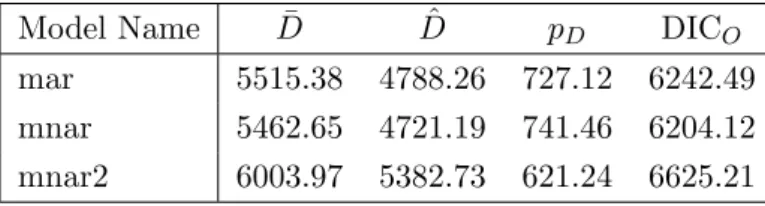
and recommended that DICOis not used for this purpose. Table 5 provides empirical support for this
recommendation, as the correct model (mnar2) clearly has the highest DICO. However, if instead we
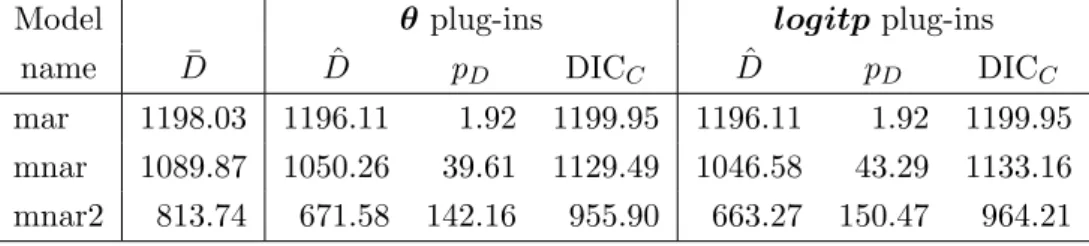
use the model of missingness part of DICC, in line with our proposed strategy, we will conclude that
the mnar2 model best explains the missingness pattern regardless of the plug-ins chosen (Table 6).
Table 5: DICO for the simulated time series data
Model Name D¯ Dˆ pD DICO
mar 5515.38 4788.26 727.12 6242.49 mnar 5462.65 4721.19 741.46 6204.12 mnar2 6003.97 5382.73 621.24 6625.21
Table 6: Model of missingness DICC for the simulated time series data
Model θ plug-ins logitp plug-ins
name D¯ Dˆ pD DICC Dˆ pD DICC
mar 1198.03 1196.11 1.92 1199.95 1196.11 1.92 1199.95 mnar 1089.87 1050.26 39.61 1129.49 1046.58 43.29 1133.16 mnar2 813.74 671.58 142.16 955.90 663.27 150.47 964.21
and support our proposed two measure strategy in preference to using a single DIC measure for comparing selection models with suspected non-ignorable missing responses. We now examine this approach in a case study comparing three treatments of depression using longitudinal data.
5
Application
5.1 Description of HAMD data
As an application, we analyse data from a six centre clinical trial comparing three treatments of depression, which were previously analysed by Diggle and Kenward (1994) (DK) and Yunet al. (2007). DK found evidence of informative missingness given their modelling assumptions. In this clinical trial, 367 subjects were randomised to one of three treatments and rated on the Hamilton depression score (HAMD) on five weekly visits, the first before treatment, week 0, and the remaining four during treatment, weeks 1-4. The HAMD score is the sum of 16 test items and takes values between 0 and 50, where the higher the score the more severe the depression. In this example, we are interested in any differences between the effects of the three treatments on the change in depression score (HAMD) over time. Some subjects dropped out of the trial from week 2 onwards, with approximately one third lost by the end of the study. Similar numbers of subjects received each treatment (120, 118 and 129 for treatments 1, 2 and 3 respectively), but the levels and timing of drop-out differ. In particular, fewer subjects drop out of treatment 3, and although the missingness percentage is similar for treatments 1 and 2 by week 4, more of the drop-out occurs earlier for treatment 2.
The missing responses in the HAMD data force us to make modelling assumptions that are untestable from the data, and no measure can tell the whole story regarding model fit. In these circumstances we know that sensitivity analysis is essential, and cover a range of options by proposing two different models of interest and three different models of missingness. Attempting to select a single ‘best’ model from the six possible combinations would defeat the object of the sensitivity analysis, but we use our two measure DIC strategy to determine whether some of these models are more plausible than others.
5.2 Models of interest for HAMD data
Exploratory plots indicate a downwards trend in the HAMD score over time, so for our model of interest we follow DK and regress HAMD against time, allowing a quadratic relationship and a different intercept for each centre. We use two variants of this model: an autoregressive model and a random
effects model. In the first (AR), we specify
yiw =µiw+δiw
µiw =βc(i)+ηt(i)w+ξt(i)w2
(14)
where i=individual, t=treatment (1,. . . ,3), c=centre (1,. . . ,6) and w=week (0,. . . ,4). c(i) and t(i) denote the centre and treatment of individual i respectively. The δiws follow a second-order
autore-gressive process defined by
δi0=ϵi0,
δi1=α1δi0+ϵi1,
δiw =α1δi(w−1)+α2δi(w−2)+ϵiw, w≥2
ϵiw ∼N(0, σ2).
(15)
In the second (RE), we allow individual random effects on the intercept s.t. yiw ∼N(µiw, σ2)
µiw =βi+ηt(i)w+ξt(i)w2
βi∼N(γc(i), ρ2c(i)).
(16)
For both variants we assign vague priors to the unknown parameters: giving the regression coefficients N(0,10000) priors and the precision (σ12) a Gamma(0.001,0.001) prior. In the RE version, eachγc(i) is
assigned a N(0,10000) prior and the hierarchical standard deviationsρc(i)are assigned noninformative uniform priors (with an upper limit of 100) as suggested by Gelman (2005).
5.3 Models of missingness for HAMD data
We specify three models of missingness as detailed in Table 7, and assign a logistic prior to θ0 and
weakly informative Normal priors to all the other θ parameters as previously discussed (Section 4.1). The simplest form of informative drop-out is given by MoM1 where missingness depends on the current value of the HAMD score, while the form of MoM2 allows dependence on the previous week’s HAMD score and the change in the HAMD score as parameterised byθ3. MoM3 has the same form as MoM2,
but includes separate θ for each treatment, which allows treatment to directly affect the missingness process.
Table 7: Specification of the models of missingness for the HAMD data Model Name Model of Missingness equation
MoM1 logit(piw) =θ0+θ1yiw
MoM2 logit(piw) =θ0+θ2yi(w−1)+θ3(yiw−yi(w−1))
MoM3 logit(piw) =θ0t(i)+θ2t(i)yi(w−1)+θ3t(i)(yiw−yi(w−1))
5.4 Comparison of joint models for HAMD data
Joint models combining the model of missingness MoM1 with the RE and AR models of interest will be referred to as JM1(RE) and JM1(AR) respectively, and similarly for models of missingness MoM2
and MoM3. Runs of these six joint models and the models of interest estimated on complete cases only, CC(RE) and CC(AR), converged based on the Gelman-Rubin convergence statistic and a visual inspection of the chains. Adding a missingness model makes little difference to the β orγ estimates, but there are substantial changes in some of the η and ξ parameters associated with the effect of treatment over time. The impact of these changes will be assessed shortly using plots of the mean response profiles for each treatment.
The model of missingness parameter estimates are shown in Table 8. The positive θ1 estimates for
the JM1 models suggest that drop-out is associated with high HAMD scores, while the negativeθ3 in
the JM2 models indicate that change in the HAMD score is informative, with individuals more likely to drop-out if their HAMD score goes down. These two complementary messages are that the more severely depressed subjects, and those for whom the treatment appears most successful are more likely to drop-out. The JM3 models provide some evidence that the missingness process is affected by the treatment. These findings hold for both the AR and RE models.
Table 8: Parameter estimates for the model of missingness for the HAMD data
JM1(AR) JM2(AR) JM3(AR) JM1(RE) JM2(RE) JM3(RE)
θ0 -3.12 (-3.72,-2.53) -3.19 (-3.80,-2.62) -2.61 (-3.22,-2.03) -3.10 (-3.75,-2.50) θ0(t1) -2.65 (-3.91,-1.58) -2.22 (-3.22,-1.31) θ0(t2) -3.75 (-5.20,-2.56) -3.79 (-5.38,-2.41) θ0(t3) -3.89 (-5.10,-2.81) -3.57 (-4.87,-2.38) θ1 0.08 (0.04,0.11) 0.04 (0.01,0.08) θ2 0.04 (0.00,0.09) -0.01 (-0.07,0.04) θ2(t1) 0.04 (-0.04,0.12) -0.02 (-0.10,0.05) θ2(t2) 0.01 (-0.10,0.10) -0.10 (-0.27,0.03) θ2(t3) 0.08 (0.00,0.15) -0.01 (-0.12,0.09) θ3 -0.14 (-0.27,-0.02) -0.28 (-0.39,-0.18) θ3(t1) 0.00 (-0.21,0.27) -0.17 (-0.32,-0.04) θ3(t2) -0.34 (-0.59,-0.10) -0.54 (-0.87,-0.30) θ3(t3) -0.08 (-0.28,0.08) -0.32 (-0.54,-0.13)
Table shows the posterior mean, with the 95% interval in brackets
5.4.1 How much difference does the choice of model of interest make?
To see whether using AR or RE as our model of interest makes a difference, we compare the mean response profiles for each pair of models (Figure 2). For a complete case analysis the solid (AR) and dashed (RE) lines for each treatment are almost identical, and there are very small differences for JM1 and JM2, which accentuate for the more complex JM3. This is consistent with the discussion in Daniels and Hogan (2008) concerning the increased importance of correctly specifying the dependence structure in the model of interest when dealing with missing data.
5.4.2 How much difference does the choice of model of missingness make?
The impact of the addition of the MoM1 model of missingness to the AR model of interest can be seen by comparing the CC (solid lines) and JM1 (dot-dash lines) in Figure 3 and noticing a small upward shift of JM1; the impact is hardly discernible when the RE model of interest is used. By contrast, there is a consistent downwards shift from CC when MoM2 is added to both models of interest (dashed
Figure 2: Modelled mean response profiles for the HAMD data - comparing the model of interest 0 1 2 3 4 0 5 10 15 20 25
CC
weekmean HAMD score
treatment 1 − AR treatment 1 − RE treatment 2 − AR treatment 2 − RE treatment 3 − AR treatment 3 − RE 0 1 2 3 4 0 5 10 15 20 25
JM1
weekmean HAMD score
treatment 1 − AR treatment 1 − RE treatment 2 − AR treatment 2 − RE treatment 3 − AR treatment 3 − RE 0 1 2 3 4 0 5 10 15 20 25
JM2
weekmean HAMD score
treatment 1 − AR treatment 1 − RE treatment 2 − AR treatment 2 − RE treatment 3 − AR treatment 3 − RE 0 1 2 3 4 0 5 10 15 20 25
JM3
weekmean HAMD score
treatment 1 − AR treatment 1 − RE treatment 2 − AR treatment 2 − RE treatment 3 − AR treatment 3 − RE
lines). However, adding MoM3 (dotted lines) shifts the CC profiles by different amounts resulting in increased differences between treatments, particularly for the AR model of interest.
5.5 Use of DICO to help with model comparison
DICO is calculated for the six HAMD models using the algorithm discussed in Section 3 and given
more fully in the Appendix. The runs using MoM1 and MoM2 take approximately 5 hours on a desktop computer with a dual core 2.4GHz processor and 3.5GB of RAM, while the more complex models with MoM3 run in about 24 hours. As before we shall refer to the samples generated at steps 1 and 3 as our ‘Ksample’ and ‘Qsample’ respectively, with K and Q denoting the lengths of these samples. The Ksample is set to 2,000, formed from 2 chains of 110,000 iterations, with 100,000 burn-in and the thinning parameter set to 10, andQis set to 40,000. Table 9 shows DICO for our six models
for the HAMD data. The likelihood for the model of missingness is calculated for the weeks with drop-out, and for each of these weeks excludes individuals who have already dropped out.
Before discussing these results, we check that they are soundly based. Looking at the coefficients of skewness for the posterior distributions of the plug-ins (not shown), we find that some are skewed, most notably for the two JM3 models. To examine the adequacy of the Qsample, we split it into subsets and plot ¯D and ˆDagainst the sample lengths as described in Section 3. From these plots for the six
Figure 3: Modelled mean response profiles for the HAMD data - comparing the model of missingness 0 1 2 3 4 0 5 10 15 20 25
AR
weekmean HAMD score
treat 1 − CC treat 1 − JM1 treat 1 − JM2 treat 1 − JM3 treat 2 − CC treat 2 − JM1 treat 2 − JM2 treat 2 − JM3 treat 3 − CC treat 3 − JM1 treat 3 − JM2 treat 3 − JM3 0 1 2 3 4 0 5 10 15 20 25
RE
weekmean HAMD score
treat 1 − CC treat 1 − JM1 treat 1 − JM2 treat 1 − JM3 treat 2 − CC treat 2 − JM1 treat 2 − JM2 treat 2 − JM3 treat 3 − CC treat 3 − JM1 treat 3 − JM2 treat 3 − JM3
In the AR plot, the CC and JM3 lines for treatment 1 are almost coincident. In the RE plot, the CC and JM1 lines are almost coincident for all treatments, and the JM2 and JM3 lines for treatment 3 are almost coincident.
Table 9: DICO for the HAMD data θ plug-ins ¯ D Dˆ pD DICO JM1(AR) 9995.8 9978.6 17.2 10013.0 JM1(RE) 9663.2 9359.6 303.7 9966.9 JM2(AR) 9991.0 9965.5 25.5 10016.5 JM2(RE) 9680.6 9372.6 308.0 9988.5 JM3(AR) 9995.1 9965.0 30.1 10025.2 JM3(RE) 9698.1 9392.1 306.0 10004.2
models (shown as Figure 5 in the Supplementary Material), we see that both ¯Dand ˆDare stable and show little variation even for small Q for both JM1 models. For the other models, trends similar to those exhibited by our synthetic data (see Figure 1) are evident, but again there is convergence to a limit suggesting the adequacy ofQ=40,000. As before, we also see that the instability associated with small Qdecreases with increased sample size. The trends and variation are more pronounced for the RE models than the AR models.
Our investigation with simulated data suggests that DICO can give useful information about the
relative merits of the model of interest. For the HAMD example, DICO provides consistent evidence
that the random effects model of interest is preferable to the autoregressive model of interest when combined with each model of missingness, as can be seen by DICO always being smaller for RE than
5.6 Use of the model of missingness DICC to help with model comparison
We now turn to the model of missingness part of DICC, to see what additional information it provides.
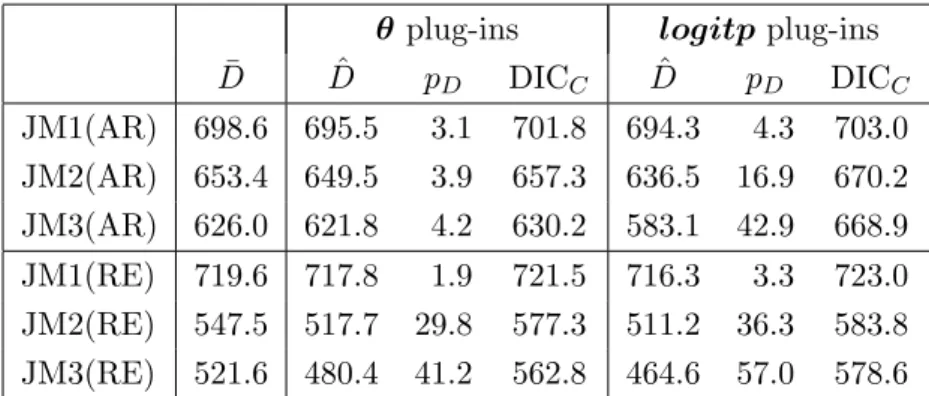
Table 10 shows two versions, one based on the θ plug-ins and one on the logitp plug-ins. As with the θ plug-ins, the posterior distributions of the logitp plug-ins become increasingly skewed as the model of missingness becomes more complex. We have reservations about both sets of plug-ins, but find that they provide a consistent message from the model of missingness DICC. MoM2 and MoM3,
used in the JM2 and JM3 models, provide clearly a better fit to this part of the model than JM1, with an edge towards JM3 rather than JM2, i.e. a missingness model that allows treatment specific parameters.
Table 10: Model of missingness DICC for the HAMD data θ plug-ins logitpplug-ins ¯ D Dˆ pD DICC Dˆ pD DICC JM1(AR) 698.6 695.5 3.1 701.8 694.3 4.3 703.0 JM2(AR) 653.4 649.5 3.9 657.3 636.5 16.9 670.2 JM3(AR) 626.0 621.8 4.2 630.2 583.1 42.9 668.9 JM1(RE) 719.6 717.8 1.9 721.5 716.3 3.3 723.0 JM2(RE) 547.5 517.7 29.8 577.3 511.2 36.3 583.8 JM3(RE) 521.6 480.4 41.2 562.8 464.6 57.0 578.6
5.7 Combined use of DICO and the model of missingness DICC
To conclude, within this sensitivity analysis, DICO suggests that the RE model of interest is more
plausible than the AR. For RE models, there are substantial improvements in the model of missingness DICC for JM2 and JM3 over JM1, i.e. JM2 and JM3 better explain the missingness pattern than JM1.
Overall, of the joint models explored, those with a RE model of interest and a model of missingness that depends on the change in HAMD (either treatment specific or not) seem most appropriate for the HAMD data.
If we based our analysis of this clinical trial data on a complete case analysis, we would conclude that treatment 2 lowers the HAMD score more than treatments 1 and 3 throughout the trial, and treatment 1 is more successful than treatment 3 in lowering HAMD in the later weeks. The same conclusions are reached using our preferred joint models, i.e. JM2(RE) and JM3(RE), but all the treatments appear a little more effective in lowering HAMD (compare the dotted and dashed lines with the solid lines in the RE plot of Figure 3).
6
Discussion
For complete data, DIC is routinely used by Bayesian statisticians to compare models, a practice facilitated by its automatic generation in WinBUGS. However, using DIC in the presence of missing
data is far from straightforward. The usual issues surrounding the choice of plug-ins are heightened, and in addition we must ensure that its construction is sensible. No single measure of DIC, or indeed combination of measures, can provide a full picture of model fit since we can never evaluate fit to the missing data. However, the use of two complementary measures can provide more information than one DIC measure used in isolation. The model comparison strategy that we have developed relies on using both DICO and the model of missingness part of DICC. A DIC based on the observed data
likelihood, DICO, can help with the choice of the model of interest, and should be used to compare
joint models built with the same model of missingness but different models of interest. The model of missingness part of DICC, which uses information provided by the missingness indicators, allows
comparison of the fit of different models of missingness for selection models with the same model of interest.
DICO cannot be generated by WinBUGS, but can be calculated from WinBUGS output using other
software. DH provide an algorithm for its calculation, which we have adapted and implemented for both simulated and real data examples. We recommend performing two sets of checks: (1) that the plug-ins are reasonable (i.e. if posterior means are used, they should come from symmetric, unimodal posterior distributions, and they must ensure consistency in the calculation of the posterior mean deviance and the plug-in deviance, so that missing values are integrated out in both parts of the DIC) and (2) that the size of the samples generated from the likelihoods (Qsamples) is sufficiently large to avoid overestimating DICO and problems with instability in the plug-in deviance (we suggest plotting
deviance against sample length and checking for stability, as in Figure 1). Based on limited exploration of synthetic and real data, we tentatively propose working with a Qsample of at least 40,000. Again based on our experience, we tentatively suggest that even with a well chosen Qsample size, a DIC difference of at least 5 is required to provide some evidence of a genuine difference in the fit of two models, as opposed to reflecting sampling variability.
A model’s fit to the observed data can be assessed, but its fit to the unobserved data given the observed data cannot be assessed. So, in using DICOwe must remember that it will only tell us about
the fit of our model to the observed data and nothing about the fit to the missing data. However, it does seem reasonable to use it to compare joint models with different models of interest but the same models of missingness. DH discussed an alternative construction (DICF) for selection models
based on the posterior predictive expectation of the full data likelihood, L(β,θ|yobs,ymis,m), and
provided a broad outline for its implementation. DICF may provide additional information for model
comparison, but its calculation is complicated as the expectation for the plug-ins is conditional on
ymis. We have found it to be computationally very unstable in preliminary investigations (DH also
noted similar computational problems; personal communication).
An alternative to using DIC to compare models, is to assess model fit using a set of data not used in the model estimation, if available. In surveys, sometimes data is collected from individuals who are originally non-contacts or refusals, and using this for comparing model fit is particularly attractive as such individuals are likely to be similar to those who have missing data. By contrast, alternatives such as K-fold validation will only tell us about the fit to the observed data and as such provide an alternative to the DICO part of the strategy. The link between cross-validation and DIC is discussed
by Plummer (2008).
the comparative fit of various selection models, it would be a mistake to use them to select a single model. Rather our strategy should be viewed as a screening method that can help us to identify plausible models. Even with straightforward data, such as our first simulated example, the usual plug-ins are affected by skewness. This skewness makes the interpretation of DIC more complicated, as we have to allow for some additional variability that can obscure the message from the proposed strategy. Given this and the lack of knowledge regarding the fit of the missing data, we emphasise that DIC should never be used in isolation. Our DIC strategy should be used in the context of a sensitivity analysis, designed to check that conclusions are robust to a range of assumptions about the missing data. In summary, our investigations have shown that these two DIC measures have the potential to assist in the selection of a range of plausible models which have a reasonable fit to quantities that can be checked and allow the uncertainty introduced by non-ignorable missing data to be propagated into conclusions about a question of interest.
Appendix
Algorithm for calculating DICO
Our preferred algorithm for calculating DICOproceeds as follows: (f(y|β, σ) is the model of interest,
typically Normal or t in our applications, and f(m|y,θ) is a Bernoulli model of missingness in a selection model)
1 Carry out a standard MCMC run on the joint model f(y,m|β, σ,θ). Save samples of β,σ and θ, denoted by β(k),σ(k) and θ(k),k= 1, . . . , K, which we shall call the Ksample.
2 Evaluate the posterior means of β, σ and θ, denoted by ˆβ, ˆσ and ˆθ. (Evaluate ˆσ on the log scale and then back transform, see discussion headed “Skewness in the plug-ins for the simulated example” in the Supplementary Material for rationale.)
3 For each member of the Ksample, generate a sample y(miskq), q = 1, . . . , Q, from the appropriate likelihood evaluated atβ(k)andσ(k), e.g.ymisk ∼N(Xβ(k), σ(k)2).We denote the sample associated with memberk of the Ksample asQsample(k).
4 Then evaluate
h(k)=Eymis|y
obs,β(k),σ(k){f(m|yobs,ymis,θ
(k))} ≈ 1 Q Q ∑ q=1 f(m|yobs,ymis(kq),θ(k)).
Calculate the posterior expectation of the observed data log likelihood as
logL(β, σ,θ|yobs,m)≈ 1 K K ∑ k=1 [
logL(β(k), σ(k)|yobs) + logh(k)
] .
Multiply this by -2 to get the posterior mean of the deviance, denoted ¯D.
5 Generate a new Qsample, ymis(q), q = 1, . . . , Q, using ˆβ and ˆσ. Evaluate the plug-in observed data log likelihood using the posterior means from the Ksample as
logL(β, σ,θ|yobs,m)≈logL( ˆβ,σˆ|yobs) + log
( Ey
mis|yobs,βˆ,σˆ{f(m|yobs,ymis,
ˆ
θ)} )