City, University of London Institutional Repository
Citation
:
Petroulakis, N. E. (2019). A pattern-based framework for the design of secure and dependable SDN/NFV-enabled networks. (Unpublished Doctoral thesis, City, University of London)This is the accepted version of the paper.
This version of the publication may differ from the final published
version.
Permanent repository link:
https://openaccess.city.ac.uk/id/eprint/24065/Link to published version
:
Copyright and reuse:
City Research Online aims to make research
outputs of City, University of London available to a wider audience.
Copyright and Moral Rights remain with the author(s) and/or copyright
holders. URLs from City Research Online may be freely distributed and
linked to.
City Research Online: http://openaccess.city.ac.uk/ [email protected]
City Research Online
A Pattern-Based Framework for the
Design of Secure and Dependable
SDN/NFV-Enabled Networks
Nikolaos E. Petroulakis
Department of Computer Science
School of Mathematics, Computer Science and Engineering
City, University of London
Supervisor Prof. George Spanoudakis
Thesis for the degree of Doctor of Philosophy
Declaration
I hereby declare that except where specific reference is made to the work of others, the contents of this dissertation are original and have not been submitted in whole or in part for consideration for any other degree or qualification in this, or any other university. This dissertation is my own work and contains nothing which is the outcome of work done in collaboration with others, except as specified in the text.
Nikolaos E. Petroulakis November 2019
Acknowledgements
This PhD is the result of a hard but satisfying work with many challenging but valuable experiences that it would not have been possible without the support and guidance of many people to who I would like to express my sincere appreciation.
First of all, I would like to express my gratitude to my supervisor Prof. George Spanoudakis for giving me the opportunity to work with him on pursuing this PhD. His expertise and his consistent guidance together with his vision helped me to complete this research. Under his supervision, I had the opportunity to investigate and acquire further knowledge in new research topics and directions. Without his support and constant feedback, this PhD would not have been realised.
Besides my advisor, I would like to thank my second supervisor, Dr. Christos Kloukinas, for all his insightful comments and his valuable support during the whole period of my research.
I would also like to express my sincere appreciation to my external supervisor Dr. Ioannis Askoxylakis for his mentoring and guidance from the beginning of this PhD until the end of my research. Sharing with me his knowledge and technical know how were precious for the accomplishment of this work.
My sincere thanks to my closest friends for their unconditional support and patience. After the completion of this PhD, we will have more spare time to spend together as this was not so often possible during the writing period.
My deepest gratitude to my family. More specifically, I would like to thank my parents who have always been there for me. I would also like to express my thanks to my sister for standing by me not only as a sister but also as a friend.
Last but not least, I would like to thank my wife , my inspiration, for her practical
and emotional support and for her patience and humour. She has always been a devoted co-traveller in this journey.
Abstract
As the world becomes an interconnected network where objects and humans interact, cyber and physical networks appear to play an important role in smart ecosystems due to their increasing use on critical infrastructure and smart cities. Software Defined Networking (SDN) and Network Function Virtualisation (NFV) are a promising combination for programmable connectivity, rapid service provisioning and service chaining as they offer the necessary end-to-end optimisations. However, with the actual exponential growth of connected devices, future networks, such as SDN and NFV, require open architectures, facilitated by standards and a strong ecosystem.In this thesis, a model-based approach is proposed to support the design and verification of secure and dependable SDN/NFV-enabled networks. The model is based on the development of a pattern-based approach to design executable patterns as solutions for reusable designs and interactions of objects, encoded in a rule-based reasoning system, able to guarantee security and dependability (S&D) properties in SDN/NFV-enabled networks. To execute S&D patterns, a pattern-based framework is implemented for the insertion of patterns at design and at runtime level. The developed pattern framework highlights also the benefit of leveraging the flexibility of SDN/NFV-enabled networks to deploy enhanced reactive security mechanisms for the protection of the industrial network via the use of service function chaining (SFC). To prove the importance of this approach and the functionality of the pattern framework, different pattern instances are implemented to guarantee S&D in network infrastructures. The developed design patterns are able to design network topologies, guarantee network properties and offer security service provisioning and chaining. Finally, in order to evaluate the developed patterns in the pattern framework, three different use cases are described, where a number of usage scenarios are deployed and evaluated experimentally.
Table of contents
List of figures xv
List of tables xix
Notations xxi
1 Introduction 1
1.1 Overview . . . 1
1.2 Motivation and Research Challenges . . . 7
1.3 Research Aims and Objectives . . . 12
1.4 Research Assumption and Hypothesis . . . 13
1.5 Research Contributions . . . 13
1.5.1 Pattern Schema . . . 14
1.5.2 Pattern Instances . . . 14
1.5.3 Pattern Framework . . . 15
1.5.4 Reactive Security Leveraging SFC . . . 15
1.5.5 Network Simulator . . . 16
1.5.6 Evaluation of the Pattern Framework . . . 16
1.6 Publications . . . 16
1.7 Outline of Thesis . . . 20
2 Background and Literature Review 23 2.1 Overview . . . 23
2.2 Security and Dependability Attributes . . . 23
2.3 Security and Dependability Threats . . . 25
2.3.1 Generic Threats . . . 26
2.3.2 Radio Access Threats . . . 28
2.3.3 SDN/NFV Threats . . . 29
2.4.1 Generic Countermeasures . . . 31
2.4.2 Radio Access Countermeasures . . . 35
2.4.3 SDN/NFV Countermeasures . . . 36
2.5 Service Provisioning and Chaining . . . 41
2.5.1 Security Service Functions . . . 42
2.5.2 Service Function Chaining . . . 44
2.5.3 SFC Related Research . . . 45
2.6 Design Patterns . . . 46
2.7 Open Issues Addressed by this Work . . . 48
2.8 Summary . . . 49
3 Definition of the Pattern Schema and Language 51 3.1 Overview . . . 51
3.2 Pattern Definition . . . 51
3.3 Pattern Topology . . . 53
3.4 Pattern Requirements and Properties of Compositions . . . 54
3.4.1 Composition Properties . . . 54
3.4.2 Functional Requirements . . . 56
3.4.3 Non-Functional Requirements . . . 56
3.5 Pattern Specification . . . 57
3.6 Pattern Composition and Reasoning . . . 58
3.6.1 Forward Chaining . . . 58
3.6.2 Backward Chaining . . . 60
3.7 Pattern Components . . . 60
3.7.1 Network Graphs . . . 60
3.7.2 Network Components . . . 64
3.7.3 SFC Terms and Components . . . 64
3.7.4 Data Flows and Policies . . . 66
3.8 Pattern Language . . . 69
3.9 Summary . . . 72
4 Secure and Dependable Design Patterns 75 4.1 Overview . . . 75
4.2 Topology Patterns . . . 75
4.2.1 Physical Topology Patterns . . . 75
4.2.2 Logical Topology Patterns . . . 86
Table of contents xiii
4.4 Reliability Patterns . . . 93
4.4.1 Reliability in Compositions . . . 93
4.4.2 Serial and Parallel Reliability Pattern . . . 96
4.4.3 Serial-Parallel Reliability Pattern . . . 99
4.5 Fault Tolerance, Detection and Restoration Patterns . . . 101
4.5.1 Fault Tolerance Pattern . . . 102
4.5.2 Fault Detection and Restoration Pattern . . . 103
4.6 Security Patterns . . . 105
4.6.1 Link Encryption Pattern . . . 105
4.6.2 End-to-End Encryption Pattern . . . 109
4.7 Service Function Chaining Patterns . . . 113
4.7.1 VNF Instantiation Pattern . . . 114
4.7.2 SFC Path Finding Pattern . . . 119
4.8 Summary . . . 122
5 Implementation of the Pattern Framework 123 5.1 Overview . . . 123
5.2 Pattern Framework . . . 124
5.2.1 Pattern Schema and Requirements . . . 124
5.2.2 Pattern Engine in the Application Layer . . . 126
5.2.3 Pattern Engine in the SDN Controller . . . 127
5.3 SFC Reactive Security . . . 130
5.3.1 Virtual Network Functions . . . 132
5.3.2 SFC Manager . . . 135
5.3.3 SFC GUI . . . 136
5.3.4 SFC in the NFV MANO . . . 137
5.3.5 Dynamic SFC instantiation . . . 138
5.4 Network Simulator . . . 139
5.5 Testing and Evaluation Environment . . . 143
5.5.1 Emulated Infrastructure . . . 143
5.5.2 Virtual Infrastructure . . . 143
5.5.3 Software Setup . . . 145
5.6 Summary . . . 145
6 Evaluation of Design Patterns in the Pattern Framework 147 6.1 Overview . . . 147
6.2.1 End-to-End Connected Network Topologies . . . 148
6.2.2 Maximum Coverage and Redundancy in Network Topologies . . . 150
6.2.3 Scalable Network Design . . . 151
6.3 Design and Verification of S&D Networks . . . 152
6.3.1 Reliable Network Designs . . . 153
6.3.2 Fault Tolerance, Detection and Restoration in SDN . . . 158
6.3.3 Secure Transmission in SDN-enabled Networks . . . 162
6.4 Design Secure Industrial Networks Leveraging Service Function Chaining . 167 6.4.1 Virtual Functions Instantiation based on SFC Requests . . . 169
6.4.2 SFC Path Finding and Traffic Classification . . . 172
6.5 Summary . . . 178
7 Conclusion 181 7.1 Overview . . . 181
7.2 Summary of the Research . . . 181
7.3 Contributions . . . 182
7.4 Limitations . . . 184
7.5 Future Work . . . 186
References 189
Appendix A Developed Java Classes 203
List of figures
1.1 Evolution of Industry . . . 2
1.2 SDN Architecture . . . 4
1.3 SDN Mapping in NFV architecture . . . 7
2.1 Relation Between non-Functional and Functional Attributes . . . 26
2.2 SDN Threats . . . 29
2.3 IPsec Framework . . . 34
3.1 Stepwise Decomposition . . . 56
3.2 Forward Chaining Schema . . . 59
3.3 Class Diagram of the Network Components in Graphs . . . 62
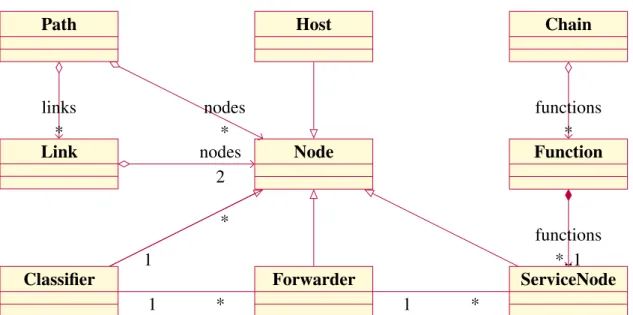
3.4 Class Diagram of the Network Components in Service Function Chaining . 66 3.5 Class Diagram of Packet Components . . . 67
3.6 OpenFlow Rule Example . . . 68
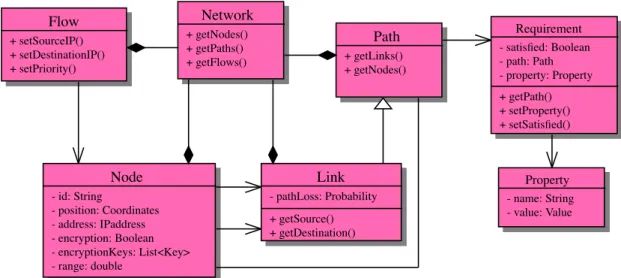
3.7 Class Diagram of Network Components . . . 71
4.1 Physical Network Topologies . . . 76
4.2 Network Pattern Compositions (i) Line (ii) Tree (iii) Mesh (v) Full-Mesh . 77 4.3 Distance and Position of Nodes . . . 79
4.4 Line Composition . . . 80
4.5 Line Decomposition . . . 81
4.6 Stepwise Decomposition . . . 85
4.7 Basic Logical Topologies: (a) Sequence (b) Parallel-split-join (c) Multi-choice-join (d) Exclusive-Multi-choice-join . . . 87
4.8 Class Diagram of the Workflow Patterns . . . 88
4.9 Path Decomposition . . . 91
4.10 Non-reducible Split of Fully Mesh Pattern . . . 95
4.11 Activity Diagram of Reliability Pattern . . . 97
4.13 Fault Tolerance Pattern . . . 102
4.14 Fault Detection and Restoration Pattern . . . 104
4.15 Activity Diagram of the E2E Security Procedure . . . 111
4.16 Service Functions (i) on Same Service Node, (ii) on Same Switch (iii) on Same Domain (iv) on Different Domains . . . 115
4.17 VNF Instantiation based on SFC Request . . . 117
4.18 Conceptual, Simple and Extensive Service Function Chaining Example . . 120
(a) Conceptual service function chain architecture . . . 120
(b) Simple Service Function Chain . . . 120
(c) Extensive Service Function Chain . . . 120
5.1 Architecture of the Pattern Framework . . . 124
5.2 Drools Patterns . . . 126
5.3 Network Design within the Pattern Framework . . . 127
5.4 Network Verification and Adaptation within the Pattern Framework . . . . 129
5.5 OpenDaylight SDN Pattern Framework GUI . . . 130
5.6 Security Functions in NFV Architecture . . . 132
5.7 Reactive Security SFC GUI . . . 137
5.8 Expanded, NFV-O Managed and ETSI-aligned, Framework Architecture . . 138
5.9 SFC Requests in the Pattern Framework . . . 139
5.10 Network Topology Json Example . . . 141
5.11 Implemented Network Simulator . . . 142
5.12 Network Simulator and Pattern Framework Interaction . . . 142
5.13 Hypervisors . . . 144
6.1 Evaluated Use Case and Scenarios . . . 148
6.2 End to End Connected Networks . . . 149
6.3 Line Pattern Output on Network Simulator . . . 150
6.4 Mesh Networking in Rural and Urban Environments . . . 150
6.5 Mesh Pattern Output on Network Simulator . . . 152
6.6 Scalable Network Designs based on Tree Topologies . . . 153
6.7 Network Simulator Outputs on Tree Pattern . . . 154
6.8 Reliable Network Designs . . . 155
6.9 Design Phases of a Sensor Network with Reliability (a) 96% (b) 98% (c) 99.9%156 6.10 OpenDaylight SDN Infrastructure Topology . . . 158
6.11 Network Simulator Outputs on Reliability Patterns . . . 159
List of figures xvii
(b) Serial-Parallel Output . . . 159
6.12 Fault Tolerance in SDN . . . 160
6.13 Experimental Results of Fault Detection and Restoration Pattern . . . 161
6.14 End to End and Link Encryption Use Case . . . 162
6.15 Link to Link Encryption in Network Topologies . . . 164
(a) Network Topology . . . 164
(b) Network Topology Security . . . 164
6.16 End to End Encryption in Network Topologies . . . 166
6.17 Evaluation of the End-to-End Security Pattern in the Network Simulator (green: secure, red: insecure, orange: undefined) . . . 168
(a) Partially Secure Traffic from n1 to n2 . . . 168
(b) Partially Secure Traffic from n1 to n3 . . . 168
(c) Multi-hop Partially Secure Traffic from n2 to n3 . . . 168
(d) Insecure Traffic from n2 to n3 . . . 168
(e) Partially Secure Traffic from n2 to n4 . . . 168
(f) Fully Secure Traffic from n1 to n4 . . . 168
6.18 Reactive Security - Implemented Service Chains . . . 169
6.19 SFC - Per Traffic Type Classification Example . . . 170
(a) Intra Domain . . . 170
(b) Inter Domain . . . 170
6.20 VNF Instantiation in OpenStack . . . 172
6.21 VNF Instantiation in Proxmox . . . 173
6.22 Service Functions Imported in the ODL . . . 173
6.23 Service Node Imported in the ODL . . . 174
6.24 Service Function Chains Imported in the ODL . . . 174
6.25 Service Function Forwarders Imported in the ODL . . . 175
6.26 Access Control Lists Imported in the ODL . . . 175
6.27 OpenFlow Rules Inside the Forwarders and the Classifiers . . . 176
6.28 Demo Shell Script . . . 176
6.29 Reactive Security - Demo . . . 177
6.30 Real-time Traffic Flows on the Controller’s GUI . . . 178
(a) Legitimate traffic . . . 178
(b) Legitimate traffic classified by DPI . . . 178
(c) SCADA traffic . . . 178
(d) SCADA traffic classified by DPI . . . 178
List of tables
2.1 SDN Fault Tolerance Mechanisms . . . 40
2.2 Examples of Network Security Service Functions . . . 43
2.3 Security Properties and Functions . . . 44
3.1 Comparison Between Forward and Backward Chaining . . . 61
3.2 Pattern Language Semantics . . . 72
4.1 Composition Metrics . . . 89
4.2 Reliability in Physical Network Topology Patterns . . . 96
5.1 Abstract SFC Component Structure . . . 136
6.1 Experimental Results of the Line Pattern Execution . . . 149
6.2 Experimental Results of the Mesh Pattern Execution . . . 151
6.3 Experimental Results of the Tree Pattern Execution . . . 151
6.4 Experimental Results of the Serial and Parallel Pattern Execution . . . 157
6.5 Experimental Results of the Serial-Parallel Pattern Execution . . . 157
6.6 Experimental Results of Fault Tolerance Pattern Flow Configurations . . . . 160
6.7 Link Encryption on a Network Topology . . . 163
6.8 End to End Security on a Network Topology . . . 166
Notations
Property Notations C={c1,c2,...} Set of componentsc A={a1,a2,...} Set of activitiesa P(c) Property of componentc R(P(c)) Requirement of propertyPP={p1,p2,...} Set of probability of components
R={r1,r2,...} Set of reliability of atomic components
Graph Notations
G=(V,E) Graph withV vertices andE edges
N ={n1,n2,...} Set of physical nodesn
L={l1,l2,...} Set of physical linksln,n0
G=(N,L) Physical network graph
P={p1,p2,...} Set of network pathsp={n1,n2,...}
¯
N ={n1¯,n2¯,...} Set of virtual nodesn¯
¯
L={l1¯,l2¯,...} Set of virtual linksl¯=l(n¯0,n¯0)
¯
G=(N¯,L¯) Virtual network graph
Nd={nd
1,n2d,...} Set of demanded nodesnd
Ld={l¯d
1,l¯2d,...} Set of demanded virtual linksld
Gd=(Nd,Ld) Network graph demand
d(n,n0) Distance between two nodes
r(n) Range capability of node
n(x,y) Position of a node
deg(n) Degree of noden
weight(l) Weight of a linkl
G=(N,L,W) Weighted network graph
SFC Notations
F={f1,f2,...} Set of virtual network functions f
fij Function typeiin service node j
fi,u Function fiinstantiated at mostutimes
S={s1,s2,...} Set of service function chainss={f1,f2,...}
sd Service function chain demand
Resource Notations
CP Computation power capacity
M Memory capacity
T Storage capacity
E Energy capacity
D Delay capacity
BW Bandwidth capacity
Rn={CPn,Mn,Tn,En} Nodenresource capacity
Rl={Dl,BWl} Linkl resource capacity
Rd
n Nodenresource capacity demandd
Rd
l Linkl resource capacity demandd
Rf ={CPf,Mf,Tf,Ef} Function resource capacity
Rd
f Function resource capacity demand
Data and Flow Notations
p Data packet
ppld Data packet payload
phdr Data packet header
k Encryption key
K={k1,k2,...} Set of encryption keys
c Cipher packet
Ek Encryption function where ESk the symmetric and EAk
the asymmetric
Dk Decryption function whereDSk the symmetric andDAk
the asymmetric
f wherefais the ACL andfothe Openflow Rule
Chapter 1
Introduction
1.1 Overview
In an interconnected cyber-physical world, people, devices and infrastructures interact, establishing a smart environment in which the exchange of data and decisions is continuous. With the anticipated exponential growth of connected devices, future networks require open architectures, facilitated by standards and a strong ecosystem. Such devices need a simple interface to the connected network to enable the kind of communication service characterised with the required security and dependability guarantees. In response, the network should grant the network resources and program the intermediate networking devices based on device profile and privileges. A similar requirement comes also from business applications where application itself asks for particular network end-to-end guarantees based on users and tenants requests.
The fifth generation of networking (5G) aims to provide the next generation of mobile
networks to fulfill the increasing demand in the business contexts of 2020 and beyond
including service management and orchestration [1, 2]. Software Defined Networking (SDN) and Network Function Virtualisation (NFV), important parts of 5G networking [3], provide promising combination leading to programmable connectivity, rapid service provisioning and service chaining and can thus help to decrease the capital and operational expenditure costs (CAPEX/OPEX) in the control network infrastructure. Especially, with the fast growth of SDN together with NFV and their integration with existing network architectures, the
design of networks enters in a new era. SDN and NFV in the Industry 4.0arrive as new
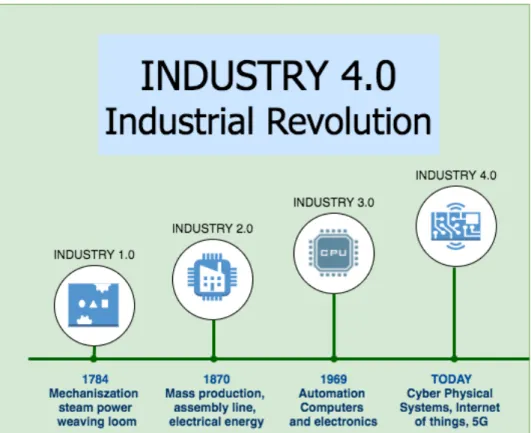
concepts to promote the computerisation of the manufacturing part of the network. Industry 4.0 [4] is the current trend for data exchange and automation in manufacturing technologies that can help in communicating essential technologies such as the Internet of Things (IoT), communication machine-to-machine (M2M) and Cyber-Physical Systems (CPS) [5], cloud
computing and cognitive computing. The evolution of the industry can be found in Figure 1.1. Furthermore, by appropriately leveraging the flexibility of SDN/NFV-enabled networks in the context of the adopted security mechanisms, industrial infrastructures can not only match but also improve their security posture compared to the existing legacy networking environments [6]. However, industrial networks typically come with strict performance, security, and reliability requirements [7]. Nevertheless, SDN and NFV expand the attack surface of the communication infrastructure, necessitating the introduction of additional security mechanisms.
Fig. 1.1 Evolution of Industry
The key concept of SDN is the decoupling of control and packet forwarding functionality of the network. In legacy networks, both data and control functions are performed by the forwarding devices of the network. In SDN, the separation has two specific functionality planes: the control plane and the data plane. The separation of these two planes in SDNs has two significant advantages. The first advantage includes the reduction of the complexity in the configuration and alteration of the control functions of the network. This can be done since the forwarding devices of the network, which tend to have proprietary implementations, are no longer responsible for executing a set of functions. The second advantage enables the
1.1 Overview 3 implementation of more consistent control policies through fewer and uniformly accessible controllers.
In traditional networks, administrators manually control the application access and config-ure the network accordingly. This process demands a lot of engineering and operations effort. In an SDN environment, the access of the applications to network resources is simplified through the enabled network programmability. SDN has been envisioned as a promising technology to reduce complexity and increase the flexibility of network configuration and management. It allows network programmability, allowing network control to be decoupled from the forwarding plane and the forwarding plane to be directly programmable by the control plane. In SDN networks, the control plane, handling management operations, is logi-cally centralised and physilogi-cally decoupled from data plane, responsible for data forwarding operations, thus enabling high network configurability and programmability. The decoupling of the control plane from data plane provides SDN deployments the ability to easily add new powerful network set of functions or protocols. Although the control plane can be distributed [8], its logical centralised architecture offers one of the most important advantages of it such as the simplification of network configuration, operation and management. The required high level network policies and functionalities (e.g. routing, traffic engineering, access control) are translated to low level network commands. Based on this translation, the controller can insert appropriate flow rules to the programmable switching elements. The described network programmability is expected to alleviate the burden of the data onslaught from Internet of Things (IoT) deployments. This can be done primarily via centralised Network Resources Optimisation (NRO) and optimally exploiting the underutilised network resources [9]. As presented in [10], an SDN controller is employed to decouple the control plane, which runs on top of the Wireless Sensor Networks (WSN), from the data plane, which is still implemented in the sensor nodes. This appears to play an very important role especially in smart cities and on critical infrastructure and is considered to be one of the key elements of the 21st century. More specifically, the main target of SDN is to drive the reconfiguration of these capabilities through specifications embedded especially in critical infrastructures. In this view, SDN becomes another component in the IoT implementation stack that, like other components, can be dynamically configured.
According to the Open Networking Foundation (ONF) [11], the SDN architecture consists of different layers: the infrastructure layer, the control layer and the application layer including also the respective intermediate interfaces, as can be seen in the Figure 1.2.
• The Infrastructure Layer, also referred as data plane, is responsible for the data
forwarding functionality of the network. The functionality of this plane is guaranteed through a set of physical network devices (network elements). This layer includes
Client Services Industrial infrastructure (e.g. PLC) Application Plane Control Plane Data Plane M an agem en t
East/Westbound Interface (EWI)Northbound Interface (NBI) Southbound Interface (SBI) Management Interface (MBI)
Fig. 1.2 SDN Architecture
SDN network deployments containing physical instances of the network such as the switching devices, the communication medium etc. (wired or wireless).
• The Control Layer, also referred as control plane, is responsible for the control
functionality of the network. The functionality of this plane is realised through a set of devices and controllers that are able to facilitate the creation and destruction of network flows and paths. This plane includes both the hardware (e.g. controllers, interfaces) and software used to realise SDN control (e.g. interfaces for the controller communication), along with system configuration and control data. Different controllers are responsible to control the SDN network over disjoint subsets of forwarding devices. The different parts of the SDN can be handled by the controller through these forwarding devices. The control layer is focused on the control functionality of the network containing base network service functions such as topology/flow/connection manager and flow statistics. An SDN controller is able to (i) proactively plan redundant paths for critical services and (ii) react in real-time in case of emergency. There is a number of open source and commercial SDN controllers such as OpenDaylight (ODL) [12], Open Network Operating System (ONOS) [13], POS, NOS, Ryu, Floodlight, Onix, Brocade, Juniper [14].
1.1 Overview 5
• TheApplication Planeis responsible for generic network management auditing, and
reporting functionalities (e.g., SDN management, monitoring and security). All the applications that are used to implement network functionalities such as network virtu-alisation, network monitoring, intrusion detection and flow balancing are realised on this layer. Furthermore, the application layer includes SDN applications, SDN/network management and security/dependability management.
There are different application program interfaces (APIs) which are used for the communica-tion between the different layers of SDN architecture.
• TheSouthbound Interface (SBI)is used to connect the control layer with the
infras-tructure layer. The SBI is capable of supporting multiple protocols, e.g., OpenFlow [15], BGP [16], PCEP [17] or NetCONF [18]. This interface enables the commu-nication between these forwarding devices and the controllers of the network. The OpenFlow standard, managed and promoted by the ONF, is one of the most pop-ular SBI SDN standards. One of the main functionalities of the SBI is to support (i) Initial discovery of device capabilities and physical interconnections, (ii) runtime configuration and (iii) synchronous and asynchronous monitoring.
• The Northbound Interface (NBI) is available for the application layer to interact
with the control layer. The NBI is implemented by the controllers of the SDN and is used to facilitate the communication between controllers and the network management applications. Representative examples of such APIs are FML, Procera, Frenetic, Maple and RESTful. In this direction, ODL and ONOS are the most prominent open source SDN Controllers which expose open NBI APIs, to be used by SDN applications. In addition, platform-oriented services and other extensions can also be inserted into the controller platform for enhanced SDN functionality.
• TheEast/West Bound Interface (EWBI)is implemented by the different controllers
of the SDN and is used to facilitate communications between them. Representative examples of such APIs are ALTO and Hyperflow [19, 20].
On the other hand, NFV’s main vision is to address networking open issues by utilising standard IT virtualisation technology. Furthermore, it aims to transform traditional network operations, as software can easily be moved to, or instantiated in, various locations (e.g. data centres, network nodes, end-user premises) without the need to use new equipment. In this manner, a large number of network services can be easily deployed on standard servers in a virtualised manner leveraging a number of important business and operational benefits.
In this direction, Open Platform for NFV (OPNFV1) is an open source project focusing
on accelerating the evolution of NFV. Moreover, OpenMANO2 proposes an open source
platform for NFV Management and Orchestration (MANO).
According to the European Telecommunications Standards Institute (ETSI)3the NFV
archi-tecture consists of different components and layers as described below:
• Operations Support Systems and Business Support Systems (OSS/BSS)is
respon-sible for network management and service provision.
• Virtual Network Functions (VNF) can be run as software instances on top of an
abstracted infrastructure for a more dynamic and cost-effective network sharing. VNFs deliver software-only entities (e.g. vRouter, Firewall, vHoneypot etc.) to be installed and run, storage and switching platforms residing in the local control centre.
• NFV Infrastructure (NFVI)can provide the separation of hardware and software
components that build up the environment in which related VNFs are deployed, man-aged and executed agnostically over hardware platform.
• NFV Orchestrator (NFVO)are responsible for on-boarding of new network services
(NS) and VNF packages, NS lifecycle management, global resource management, validation and authorisation of NFVI resource requests.
• Virtualised Network Function Manager (VNFM)oversees lifecycle management of
VNF instances, coordination and adaptation role for configuration and event reporting between NFVI and E/NMS.
• Virtualised Infrastructure Manager (VIM)controls and manages the NFVI
com-pute, storage and network resources and corresponding virtualisation. It contains physical hardware resources (computing, storage and network) and the virtualisation layer, all managed by the (candidate component e.g. OpenStack).
NFV technology applies to all layers of SDN infrastructure including control plane
functions as well asdata planepacket processing and has the potential to revolutionise both
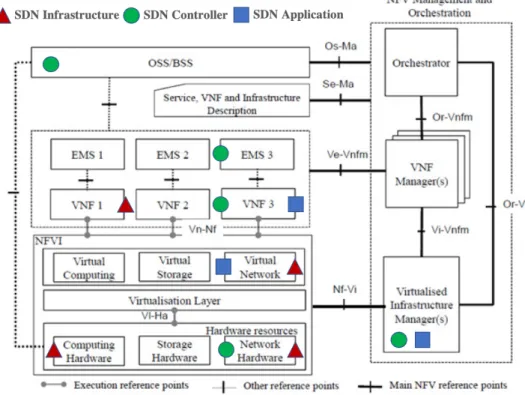
fixed and mobile network infrastructures. The fit of SDN layers in the NFV architecture can provide a clear view on how both concepts may be highly complementary as described in [21] and depicted in Figure 1.3. Although the location and the functionality of each layer of SDN architecture may be placed in more than one location in NFV architecture, this can be
1https://www.opnfv.org
2https://github.com/nfvlabs/openmano 3http://www.etsi.org
1.2 Motivation and Research Challenges 7
Fig. 1.3 SDN Mapping in NFV architecture
valid due to the NFV different view of the virtualisation concept. Therefore, the integration of network orchestration with NFV and SDN can allow network operators to deploy their services automatically in the cloud environment. Moreover, NFV is mostly involved with abstraction of service function aiming to bring flexibility and cost reduction. On the other hand, SDN focuses with the networking abstraction promises to bring unified programmable control and open interfaces. Before network orchestration, the same has been achieved via lengthy and sometimes error prone manual processes. Therefore, from a functional point of view (non-automated) orchestration has always been the part of service provider’s solutions.
1.2 Motivation and Research Challenges
Critical infrastructures such as wind parks, water and gas distribution networks, power grids, etc. constitute complex infrastructures [6], which reliable, safe and secure operation is of paramount importance for daily activities at both national and international level. Military applications, factories and industries, bridges, medical and health and environmental applications are some examples where security threats should be taken into consideration. Global networks such as SDN and NFV together with the IoT create an enormous potential
for new generations of applications. Synergies arising through the convergence of consumer, business and industrial Internet, can create open networks to connect people, data, and
things. A series of innovations across the landscape have converged to make network products, platforms and devices technically and economically feasible. However, despite these advancements the realisation of the potential risks requires overcoming significant business and technical hurdles. All the above risks should be considered during the design of network architectures due to their increasing role in the implementation of IoT and SDN involving integrated cyber and physical components and devices.
Today, organisations are targeted by cyber adversaries with a range of goals from political activism and sabotage to intellectual-property theft and financial gain. In the era of advanced cyber threats, including mobile threats, greater situational awareness is essential to detect and mitigate sophisticated attacks effectively. Organisations need to obtain the latest data on threats, relate it to real-time insights into their dynamic IT and business environments, determine what is relevant, make risk decisions, and take defensive action. Intelligence gathering and analysis have become essential of information security capabilities. However, most organisations while extending their network infrastructure by exploiting the use of SDN/NFV and/or moving towards IoT, have not been designed with this objective in mind. Security and Dependability (S&D) on SDN/NFV-enabled networks are both critical issues for public security and safety. Cyber-attacks on remote monitored and managed IoT add new security and safety threats, and consequently energy and economic losses. Integrating IoT and SDN can increase the efficiency of the network by responding to changes or events detected at IoT application layer, with network reconfiguration. One of the challenges of future networks is to develop SDN/NFV capabilities tailored to the IoT. Lately, SDN extensions have been proposed to directly incorporate IoT devices in SDN networks. Applications running on top of SDN architecture need to be resource and network-aware, in order to take full advantage of underlying network programmability and to become more agile. Moreover, SDN requires a careful investigation of new S&D capabilities and risks, which have not beeityn relevant in legacy systems. The design and verification methods for developing secure and dependable system networks is necessary and should be considered at the design level to guarantee security and mitigate safety threats, on remote monitored and managed networks. However, the design of such networks effectively encounters difficulties that stem from the highly distributed and heterogeneous nature of SDN and the extent of intelligence, dependability and security that they need to demonstrate during their operation.
In addition to the above, paradigms of SDN/NFV security techniques and in consideration of
the criticality of industrial networks, the followingprinciplesoutline design considerations
1.2 Motivation and Research Challenges 9
• Dynamic device associationwill ensure network function continuity and minimise
downtime and data loss. Network elements should be able to dynamically associate to a backup controller in case of compromisation or inaccessibility of the primary controller.
• Replicationis an essential function for achieving dependability of a system or an entire infrastructure. Replicated multiple instances of the controller as well as application replication will ensure failure tolerance and minimise downtime whether the threat is an attack or a physical disaster.
• Self-healing mechanismswhether proactive or reactive in combination with proper
maintenance can provide diversity in the recovery process, thus enhanced protection towards attacks by exploiting targeted vulnerabilities.
• Diversityof controller types (e.g. different operating systems, hardware) can improve dependability as it is unlikely that a variety of software and hardware combinations will have the same vulnerabilities.
SDN/NFV-enabled network infrastructures face a number of security, privacy and de-pendability issues which need to be resolved in order to step forward into the interconnected world and the Future Internet. These issues can be categorised as: i) Data Plane issues (e.g. data forging in switching devices), ii) Control Plane issues (e.g. controllers/interfaces exploitation ) and iii) Application Plane issues (e.g. network monitoring, traffic engineering) [23]. Furthermore, the discrepancy between technologies and the attempt to interconnect them have brought new security challenges and gaps which need to be filled. By appropriately leveraging the flexibility of SDN/NFV-enabled networks in the context of the adopted security mechanisms, industrial infrastructures can not only match but also improve their security posture compared to the existing, traditional networking environments [6]. Nevertheless, the flexibility of SDN networks guarantees that they can also help provide better security for industrial networks. Due to the controller’s global view of the network and the ability to reprogram the data plane at real-time, SDN allows not only to revisit old security concepts (e.g. firewalls) but introduce new techniques (e.g. steering suspicious traffic to Supervisory Control and Data Acquisition (SCADA) Honeypots, adopting moving target defence and other reactive techniques). The deployment of these enhanced security concepts is in line with the enhanced protection requirements of critical infrastructures, given that the old paradigm of perimeter defences and trusted internal networks is obsolete, as the attacks demonstrated in [24]. Thus, enhanced security services should be a requirement, as evidenced by the
North American Electric Reliability Corporation (NERC)4Critical Infrastructure Protection standards (CIP) (ie. CIP-007-6 [25]). This update dictates the required continuous network monitoring and deployment of network defences to detect/block malicious activity within the utilities’ perimeter. In typical network deployments, the end-to-end traffic of various appli-cations typically must go through several network services (e.g. firewalls, load-balancers, WAN accelerators). It can also be referred to as Service Functions (or L4-L7 Services, or Network Functions, depending on the source/organisation) that are placed along its path. This traditional networking concept and the associated service deployments have a number ofconstraintsandinefficiencies[26], such as:
• Topology constraints: network services are highly dependent on a specific network
topology, which is hard to update.
• Complex configuration and scaling-out: a consequence of topological
dependen-cies, especially when trying to ensure consistent ordering of service functions and/or when symmetric traffic flows are needed this complexity also hinders scaling out the infrastructure.
• Constrained high availability: as alternative and/or redundant service functions must
typically be placed on the same network location as the primary one.
• Inconsistent or inelastic service chains: network administrators have no consistent
way to impose and verify the ordering of individual service functions, rather than using strict topologies. On the other hand, these topology constraints necessitate that traffic goes through a rigid set of services functions. This often imposes unnecessary capacity and latency costs, while changes to this service chain can introduce a significant administrative burden.
• Coarse policy enforcement: classification capabilities and the associated policy
en-forcements mechanisms are of coarse nature, e.g. using topology information.
• Coarse traffic selection criteria: as all traffic in a particular network segment typically has to traverse all the service functions along its path.
As network services become decoupled from the underlying hardware, enterprises have the opportunity to create software virtual networks, thus simplifying deployment and man-agement; a direct impact on CAPEX and OPEX. NFV comes with the promise of a fully virtualised network security solution that does not suffer from feature deprecation when
1.2 Motivation and Research Challenges 11 compared to hardware-based solutions. The above are exacerbated nowadays with the ubiq-uitous use of virtual platforms, which necessitates the dynamicity and flexibility of service environments. This is even more pronounced in service provider and/or cloud environments, with infrastructures spanning different domains and serving numerous tenants, each with their own requirements. The tenants may share a subset of the providers’ service functions, and may require dynamic changes to traffic and service function routing, to follow updates to their policies (e.g. security) or Service Level Agreements. Security can be achieved using the same centralised management platforms used today on physical solutions and promises to offer enhanced visibility into applications, users and content. A further improvement over hardware-based networks is that security can now be performed, in a simplified and transparent manner, on the network device (VNF) itself, thus providing the ability to protect against a wider range of threats. An effective NFV security program has to secure users, clients, applications, data, servers and the network itself. As with other elements of an IT Infrastructure, it is useful to approach NFV security from a functional perspective rather than through the devices involved. This means starting with a list of functions that must be applied holistically rather than attempting to secure each entity separately.
Based on the above, the most critical identifiedchallengesthat this thesis aims to investigate
and address are detailed below:
• Connectivity and scalabilityis required due to the fast-growing number of
intercon-nected users, smart objects and applications. At the network layer, the vastly increased demands require highly efficient programmable connectivity. Scalability in the network infrastructure level requires seamless discovery and bootstrapping of highly efficient orchestration, event processing and analytics and platform integration.
• End-to-end security and privacyremains a particularly challenging problem, due
to the difficulty of: (a) analysing vulnerabilities in the complex end-to-end composi-tions of heterogeneous components, (b) selecting appropriate controls (e.g., different schemes for ID and key management, different encryption mechanisms) and (c) pre-serving end-to-end security and privacy under dynamic changes in applications and security incidents.
• Reliability and fault tolerancerequire the design of reliable network architectures to guarantee also end-to-end availability in order to avoid potential attacks or failures and enable fault tolerance reactive mechanisms at runtime. Furthermore, the provision of reliable and fault tolerance networking is required integrating the current advancements and vulnerabilities of SDN and NFV technologies.
• Service provisioning and chaining is one of the main challenges (objectives) of Industry 4.0 aim to reduce the time from several days to several minutes. This also implies the potential to reduce CAPEX and OPEX, especially for short lived service. Moreover, security functions can be chained in order to reduce the impact of the security functions on the network’s performance and to alleviate the burden of deploying and managing the security services themselves.
1.3 Research Aims and Objectives
All the above challenges give rise to significant complexities, and relate to the design, implementation and deployment stack of network infrastructures. To address them, the overall aim of this thesis is:
The purpose of this thesis is to develop a pattern framework to enable and guarantee connectivity, S&D behaviour and service provisioning in SDN/NFV-enabled network infrastructures. The pattern framework supports cross-layer intelligent dynamic adap-tation. The above will be validated, using diverse usage scenarios to design network topologies, guarantee S&D network properties and provide security network provision-ing leveragprovision-ing service function chainprovision-ing in SDN/NFV-enabled network infrastructures.
The purpose of the work is to overpass the above open challenges by the use of design patterns applied in a pattern framework. More specifically, to achieve the overall aim of this thesis, the following key objectives were pursued:
• Objective 1: Review the literature on the most effective security and dependability
challenges, threats and mitigation mechanisms to identify gaps and controls relevant to the overall research aim of the thesis.
• Objective 2: Definition of a pattern specification and pattern language for expressing the pattern instances.
• Objective 3: Development of a number of pattern instances in order to design network
topologies, guarantee security and dependability properties and service provisioning and chaining.
• Objective 4: Deployment of a pattern framework able to enforce the developed patterns
providing proactive and reactive S&D properties in SDN/NFV-enabled architectures.
• Objective 5: Evaluation of the proposed pattern framework, through different use
1.4 Research Assumption and Hypothesis 13
1.4 Research Assumption and Hypothesis
Regarding the proposed approach followed by this research, the following assumptions are made as starting points and directions of this thesis:
• The proposed design of large-scale network topologies in this research does not take in account some additional parameters such as cost, energy consumptions in constrained environments that are considered in deployment of actual topologies.
• The communication protocols, the semantic interoperability and the exposed interfaces between the connected network component are assumed to be compatible during the design and evaluation phase.
• The satisfaction of S&D properties in the design of SDN/NFV-enabled networks through the developed patterns requires the existence of a deployed network containing programmable switches controlled by an SDN controller.
• The focus of this research is to propose a way on how networks can be designed and managed through a model-driven approach based on the developed pattern schema. Therefore, the provision of additional more advanced patterns can offer further designs and deployments ie. in industrial environments but the initial assumption of the importance of the pattern schema will remain the same.
• Finally, the involved components and parties for the security assurance guarantees are assumed to be trusted, fully complied with the required security and trustworthy policies.
1.5 Research Contributions
The main contributions of this thesis contain the specification of apattern schemafor the
definition ofpattern instances. In addition, the development of thepattern framework
together with the deployment of pattern-basedreactive securityleveraging service function
chaining are also presented in this research. Moreover, anetwork simulatoris implemented
to monitor and management of the deployed SDN/NFV-enabled networks. Finally, the last
contribution includes theevaluationof the proposed framework and developed mechanisms
as a complete solution to enforce the different patterns on different use cases and scenarios. All the previously identified developed contributions are also described in the following subsections.
1.5.1 Pattern Schema
The first contribution of this thesis is the specification of the pattern schema. The pattern schema includes the pattern specification and the pattern language.
• The pattern specification defines a template able to describe the patterns. These
patterns can be used as a model driven reusable solutions to general problems, to design, operate and verify network infrastructures regarding the functional properties satisfied, such as connectivity and scalability, or the non-functional ones, such as security and dependability. The specification contains the basic parts of the pattern such as the name, the problem, the solution and the contribution with respect to the state of the art. The main contribution of the approach is that design patterns can encode designs of SDN/NFV-enabled network topologies, which are proven to satisfy S&D properties and enable the semantic interoperability.
• The definition of a genericpattern languageis proposed to encode patterns through
rule-based reasoning. By the use of this pattern language, patterns are encoded as design solutions that can guarantee network properties for higher layers in the imple-mentation stack of SDN/NFV-enabled networks. The semantics of the pattern language provide interaction with the SDN controller and the NFV MANO for handling and instantiating physical and virtual network component such as nodes, links and service functions. Specific semantics have been also defined to enable the insertion, modifica-tion and delemodifica-tion of OpenFlow (OF) rules through the controller to the programmable switches of SDN/NFV-enabled infrastructures.
1.5.2 Pattern Instances
The second contribution of this work includes the definition of different design patterns able to support network designs, verification, management, monitoring and service provision in SDN/NFV-enabled network architectures.
• Topology Patternscan design network topologies to support connectivity, scalability
and coverage based on different network topology patterns.
• Path Finding Patterncan offer end-to-end connectivity verification and guarantees
in network topologies.
• Dependability Patternscan assure end-to-end dependable networks enabling
1.5 Research Contributions 15
• Security Patternscan provide link encryption and end-to-end secure transmissions.
• Service Function Chaining Patterns can provide security provision for reactive
security based on the defined Service Function Chaining (SFC) patterns.
1.5.3 Pattern Framework
The third contribution of this work is the development of a pattern framework that can be used by designers or administrators of SDN/NFV-enabled networks to (a) create designs of their systems to satisfy network properties, (b) verify if existing designs systems satisfy required properties and (c) provide reactive security monitor and management of SDN/NFV-enabled networks at runtime. The pattern framework consists of two parts: the pattern engine for the design and verification of network infrastructures and the pattern user interface for enabling the insertion of implemented patterns in the pattern engine as described below.
• Pattern Engineis implemented to handle design patterns and to interact with network
components of SDN/NFV-enabled infrastructure. The pattern engine is based on the Drools Business Rules Management System [27] that enables the insertion, modifica-tion, execution and deletion of design patterns expressed as pattern rules. Moreover, the respective interfaces are used to enable also the interaction with core functionalities of the controller and the SDN/NFV-enabled network architectures. Pattern engine is distributed in two layers, i) in the application layer for designing network physical and virtual topologies and ii) in the SDN controller to manage and monitor network configurations.
• Pattern Graphical Use Interface (GUI)is developed to provide suitable interfaces to
insert defined patterns at design and runtime to monitor and manage network together with pattern handling.
1.5.4 Reactive Security Leveraging SFC
The fourth contribution of this work is the development of a reactive security solution to enhance SFC, enabling also the interaction between the developed pattern framework and the respective SFC patterns. In addition, a number of different mechanisms such as IDS/DPI and honeypot are deployed in order to assure end-to-end security. The presented solution allows the continuous monitoring of the SDN/NFV-enabled networks, with provisions to reduce CAPEX and OPEX based on the traffic classification and forwarding based on the different identified type of traffics. Finally, the reactive security solution provides the capability for interaction with NFV MANO infrastructures enabling the design of virtualised environments.
1.5.5 Network Simulator
The fifth contribution of this work, includes the development of a network simulator to monitor and manage deployed SDN/NFV-enabled network infrastructures. The need for the development of such simulator came after the lack of a simulator able to cover all the involved network elements of our infrastructure. After the development of this simulator, it is possible to preview network topologies at runtime as designed by the related patterns and evaluated through the pattern framework and the reactive security. Finally, the simulator is able to depict not only physical infrastructures but also virtual ones including also the presentation of service function chains.
1.5.6 Evaluation of the Pattern Framework
Finally, the last contribution of this work is the deployment and experimental evaluation of the proposed scheme covering different aspects such as performance, usability, level of assurance in SDN/NFV-enabled designs developed and emulated on different use cases and usage scenarios. The first use case focuses on the design of network topologies based on different topology patterns, the second use case is involved with the design of S&D network designs and the third use case includes the evaluation of the reactive security built upon the pattern framework leveraging SFC in an industrial environment.
1.6 Publications
The contributions of this thesis have been also submitted and published to different journal, technical reports and conference papers. Bellow all published papers are presented.
Journals
• Nikolaos E. Petroulakis, Konstantinos Fysarakis, Ioannis Askoxylakis and George
Spanoudakis,Reactive security for SDN/NFV-enabled industrial networks leveraging
service function chainingin Transactions on Network and Service Management, Wiley July 2018.
In this work, we present a Reactive Security Framework for next generation 5G (and SDN/NFV in specific) enabled industrial networks leveraged by SFC. More specifically, considering the energy production critical infrastructures, the framework features enhanced security functions, such as SCADA honeypots, are modelled based upon an operational wind park and ready to be deployed in one. The presented framework allows the continuous monitoring of the wind park industrial network, with provisions
1.6 Publications 17 to reduce the impact of the security functions on the network’s performance and to alleviate the burden of deploying and managing the security services themselves.
• Nikolaos E. Petroulakis, George Spanoudakis, Ioannis G. Askoxylakis,Patterns for
the design of secure and dependable software defined networks– Elsevier Computer Networks, November 2016.
In this paper, we present a model driven approach to the design and verification of secure and dependable SDN networks that is based on S&D network design patterns (referred to as S&D patterns in the rest of this paper). These patterns can be used to design and/or verify SDN network infrastructures and identify suitable paths and nodes that can guarantee S&D properties. S&D patterns can be used to design SDN infrastructures, and determine also the type, location and connectivity of end nodes with forwarding devices. At the control layer, S&D patterns can ensure secure connectivity between the controllers and the programmable switches.
• Nikolaos E. Petroulakis, Elias Z. Tragos, Alexandros Fragkiadakis, George
Spanouda-kis,A Lightweight Framework for Secure Life-logging in Smart Environments, Informa-tion Security Technical Report, Elsevier, Volume 17, Issue 3, Pages 58–70, February 2013.
The purpose of this paper is to present in details the current topics of life-logging in smart environments, while describing interconnection issues, security threats and suggesting a lightweight framework for ensuring security, privacy and trustworthy life-logging. In order to investigate the efficiency of the lightweight framework and the impact of the security attacks on energy consumption, an experimental test-bed was developed including two interconnected users and one smart attacker, who attempts to intercept transmitted messages or interfere with the communication link. Several mitigation factors, such as power control, channel assignment and AES-128 encryption were applied for secure life-logging. Finally, research into the degradation of the consumed energy regarding the described intrusions is presented.
Technical Reports
• Adrian Belmonte Martin (ENISA), Louis Marinos (ENISA), Evangelos Rekleitis
(ENISA), George Spanoudakis (City University London) andNikolaos Petroulakis
(City University London)Threat Landscape and Good Practice Guide for Software
Defined Networks/5G, European Union Agency For Network And Information Security, December 2015.
SDN/5G networks. More specifically, this report contains a review of the emerging threat landscape of 5G networks with particular focus on Software Defined Networking. It also considers security of NFV and radio network access. To provide a compre-hensive account of the emerging threat SDN/5G landscape, this report has identified related network assets and the security threats, challenges and risks arising for these assets. Driven by the identified threats and risks, this report has also reviewed and identified existing security mechanisms and good practices for SDN/5G/NFV, and based on these it has analysed gaps and provided technical, policy and organisational recommendations for proactively enhancing the security of SDN/5G.
Conferences
• Nikolaos E. Petroulakis, George Spanoudakis, Ioannis G. Askoxylakis,Fault
Toler-ance using an SDN Pattern Frameworkin Globecom 2017.
In this paper, we propose a pattern framework built in an SDN controller able to import design patterns in a rule-based language in order to provide fault tolerance in SDN networks. We evaluate the framework for network fault tolerance as it appears to be a critical topic for research and we propose suitable patterns able to guarantee network connectivity, fault detection, fault restoration and fault tolerance. To evaluate the SDN Pattern Framework, we import our patterns to handle network component as retrieved by the inventory of the controller. Patterns are able to install flows and decrease the failover time in case of faults and network failures providing fault tolerance in SDN network architecture.
• Konstantinos Fysarakis, Nikolaos E. Petroulakis, Andreas Roos, Khawar Abbasi,
Petra Vizarreta, George Petropoulos, Ermin Sakic, George Spanoudakis, and Ioannis
Askoxylakis, A Reactive Security Framework for Operational Wind Parks Using
Service Function Chaining, ISCC 2017.
This work highlights the benefit of leveraging the flexibility of SDN/NFV-enabled networks to deploy enhanced, reactive security mechanisms for the protection of the industrial network, via the use of Service Function Chaining. Moreover, a proof of concept implementation of the reactive security framework for an industrial-grade wind park network is presented. The framework is equipped with SDN and Supervisory Control and Data Acquisition (SCADA) honeypots, modelled on (and deployable to) an actual, operating wind park, allowing continuous monitoring of the industrial network and detailed analysis of potential attacks, thus isolating attackers and enabling the assessment of their level of sophistication.
1.6 Publications 19
• Nikolaos E. Petroulakis, George Spanoudakis, Ioannis G. Askoxylakis, Andreas
Miaoudakis and Apostolos Traganitis,A Pattern-Based Approach for Designing
Reli-able Cyber-Physical Systems, Globecom 2015.
The purpose of this work is the development of a pattern-based approach for the design of CPS. The main contribution of the approach is that encodes designs of CPS, which are proven to satisfy S&D properties, as CPS design patterns. The first set of S&D patterns includes the Reliability Component Composition (RCC) Patterns for designing reliable CPS. RCC patterns are encoded in Drools, which is a rule-based reasoning system. To evaluate our approach, we use RCC patterns as a methodology for designing a reliable wireless sensor network attached to a physical architecture to send monitored data to a central controller through relay nodes and paths.
• Nikolaos E. Petroulakis, Ioannis. G. Askoxylakis, Apostolos Traganitis, George
Spanoudakis, A Privacy-Level Model for User Centric Cyber Physical Systems, In
the 1st International Conference on Human Aspects of Information Security, Privacy and Trust (affiliated with the 15th International Conference on Human-Computer Interaction), Las Vegas, USA, July 2013.
This work presents an overview and analysis of the most effective attacks, privacy challenges and mitigation techniques for preserving the privacy of users and their interconnected devices. In order to preserve privacy, a privacy-level model is proposed in which users have the capability of assigning different privacy levels based on the variety and severity of privacy challenges and devices’ capabilities. Finally, we evaluate the performance of specific CPSs at different privacy-levels in terms of time and consumed energy in an experimental test-bed that we have developed.
Other Related Publications of Candidate
• Petra Vizarreta, Amaury van Bemten, Ermin Sakic, Khawar Abbasi, Khawar,Nikolaos
E. Petroulakis, and Wolfgang Kellerer and Carmen Mas Machuca, Incentives for a Softwarization of Wind Park Communication Networks", IEEE Communications Magazine, 2019. Othonas Soultatos, George Spanoudakis, Konstantinos Fysarakis,
Ioannis G. Askoxylakis, George Alexandris, Andreas I. Miaoudakis, Nikolaos E.
Petroulakis: Towards a Security, Privacy, Dependability, Interoperability Framework for the Internet of Things. CAMAD 2018:
• E. Sakic , V. Kulkarni, V. Theodorou, A. Matsiuk, S. Kuenzer, N. E. Petroulakis
and K. Fysarakis, VirtuWind–An SDN-and NFV-Based Architecture for Softwarized Industrial Networks. In International Conference on Measurement, Modelling and Evaluation of Computing Systems, Munich, February 2018.
• Ioanins Askoxylakis, Nikolaos Petroulakis, Vivek Kulkarni, Florian Zieger, Vir-tuWind–Security in a Virtual and Programmable Industrial Network Prototype De-ployed in an operational Wind ParkI Askoxylakis - ERCIM News, 2016.
• Nikolaos E. Petroulakis, Toktam Mahmoodi, Vivek Kulkarni, Petra Vizarreta,
An-dreas Roos, Khawar Abbasi, Xavier Vilajosana, Spiros Spirou, Anton Matsiuk, Ermin Sakic, Yannis Askoxylakis, VirtuWind: Virtual and Programmable Industrial Network Prototype Deployed in Operational Wind Park, EUCNC 2016.
• Alexandros G Fragkiadakis, Vasilios A Siris,Nikolaos E. Petroulakis, and Apostolos
Traganitis. Detection of Jamming Attacks, Local versus Collaborative Detection. in IEEE Wireless Communications and Mobile Computing, 15 (2), 276-294, 2015. • Ioannis G Askoxylakis, Antonis Makrogiannakis, Andreas Miaoudakis, Stefanos
Papadakis,Nikolaos E. Petroulakis, Manolis Surligas, Apostolos Traganitis, Nikolaos
Vervelakis, 2014 IEEE 19th International Workshop on Computer Aided Modeling and Design of Communication Links and Networks (CAMAD), Athens, Greece, 1-3 December 2014,
• Andreas I. Miaoudakis, Nikolaos E. Petroulakis, Diomidis Kastanis, Ioannis G.
Askoxylakis, "Communications in Emergency and Crisis Situations", in the 2nd In-ternational Conference on Distributed, Ambient and Pervasive Interactions, (affiliated with the 16th International Conference on Human-Computer Interaction), Heraklion, Greece, July, 2014.
• Panos Chatziadam, Ioannis G. Askoxylakis,Nikolaos E. Petroulakis, Alexandros G
Fragkiadakis, "Early Warning Intrusion Detection System", in the 7th International Conference on Trust and Trustworthy Computing (TRUST), Heraklion, Greece, June 2014.
1.7 Outline of Thesis
The rest of this thesis is organised in 7 chapters as follows:
• Chapter 1 includes an introduction to the topic, motivation, objectives, main contribu-tions and publicacontribu-tions.
• Chapter 2 provides background and literature review including also an overview analysis of the most effective security challenges, fault detection and and mitigation techniques for preserving security and dependability of network infrastructures.
1.7 Outline of Thesis 21 • Chapter 3 defines the conceptual model of the pattern schema and the pattern language. • Chapter 4 presents different design pattern instances to design and verify network
topologies that guarantee security, dependability and service provisioning.
• Chapter 5 describes the implementation of an architecture, including the development of the pattern framework, the reactive security and the network simulator.
• Chapter 6 provides the evaluation of the proposed framework to design and verify SDN/NFV-enabled networks on different use cases.
• Chapter 7 presents concluding remarks of this research, limitations and future objec-tives.
Chapter 2
Background and Literature Review
2.1 Overview
SDN/NFV-enabled networks face a number of security, privacy and dependability issues which need to be resolved in order to step forward into the interconnected world and the Future Internet. Furthermore, the discrepancy between technologies and the attempt to interconnect them have brought new security challenges and gaps which need to be filled. In this chapter, an overview analysis of security and dependability attributes is presented. In addition, the most effective attacks, privacy challenges and mitigation techniques for preserving security, privacy and dependability in SDN/NFV-enabled networks are analysed. Security and privacy threats are occurred from passive attacks, such as eavesdropping and traffic analysis or from active attacks, such as impersonation and jamming. Suitable countermeasures which can be applied in generic and SDN/NFV-enabled networks independently of devices’ capabilities and operating systems, are described to protect data transmission, identity, location and routing paths.
2.2 Security and Dependability Attributes
The general concept of CIA triad (Confidentiality, Integrity and Availability) supported by [28] can be applied successfully for the secure data transmissions. In addition, dependability is the ability of a system to deliver its intended level of service to its users [29]. The main attributes which constitute dependability are reliability, availability and fault tolerance. More specifically, the core security and dependability attributes can be defined as follows:
• Confidentialityfocuses on keeping information private and ensuring that only the
does not disclose to not authorised agents. This means that data should be not revealed not only from the component which reacts as the source or destination, but also through all the intermediate components. In addition, confidentiality is also related to privacy. A passive listener can easily identify traffic without being identified. The widespread use of network devices on uncontrolled environment endangers the possibility of disclosing private data that should not be revealed. For instance, a wireless installed camera for recording possible intruders, connected to an insecure home network could be a susceptible threat to disclose the private actions of a family. Privacy is a major concept in insecure smart environments in which a variety of data from users and devices are exchanged and collected. The mass production and transfer of sensitive data exposes the danger of privacy violation.
• Integrityguarantees the degrees of complete, consistent and accurate data [30].
In-tegrity confirms also that data has not been modified. Impersonation attacks involve the interaction of an adversary with the human user. A malicious node can easily intercept transmitted information or impersonate a receiver. The adversary acts either as a man in the middle or as a masquerade, pretending to be a legal node in the network to apply spoofing attacks. These kinds of attacks not only appear to be critical for a user’s privacy but also the consequences of such attacks can be extremely dangerous. • Availabilityguarantees that information is available when it is needed [30]. The lack
of channel availability has a severe influence on the security of network. Network availability is the ability of a system to be operational and accessible when required for use.
In addition to the CIA concept, other properties such asreliability,fault toleranceand
authenticationcan be added in the list of S&D properties.
• Reliability is the ability of a system to perform a required function under stated
conditions, for a specified period of time [30]. It is an attribute of system dependability and it is also correlated with availability [29]. For hardware components, the property is usually provided by the manufacturer. This is calculated by the complexity and the age of the component. Moreover, reliability in networks is the probability of successful packet reception [31]. Different network topologies such as star, hierarchical/tree or mesh networks affect the reliability of the network and of the system respectively. Other factors which affect the reliability of a link are the transmission range of the signal strength, noise, fading effects, interference, modulation method, and frequency. Especially in wireless networks, the reliability of links can be classified into two