United States
Department of
Agriculture
Economic
Research
Service
Technical
Bulletin
Number 1929
March 2011
Andrew Muhammad, James L. Seale, Jr., Birgit Meade,
and Anita Regmi
International Evidence
on Food Consumption
Patterns
An Update Using 2005 International
Comparison Program Data
The U.S. Department of Agriculture (USDA) prohibits discrimination in all its programs and activities on the basis of race, color, national origin, age, disability, and, where applicable, sex, marital status, familial status, parental status, religion, sexual orientation, genetic information, political beliefs, reprisal, or because all or a part of an individual's income is derived from any public assistance program. (Not all prohibited bases apply to all programs.) Persons with disabilities who require alternative means for communication of program information (Braille, large print, audiotape, etc.) should contact USDA's TARGET Center at (202) 720-2600 (voice and TDD).
To file a complaint of discrimination write to USDA, Director, Office of Civil Rights, 1400 Independence Avenue, S.W., Washington, D.C. 20250-9410 or call (800) 795-3272 (voice) or (202) 720-6382 (TDD). USDA is an equal opportunity provider and employer.
w
w
w
w
w
.
ww
e
r
s
r
.usd
a
.
g
o
o
o
v
Visit Our Website To Learn More!
www.ers.usda.gov/
Recommended citation format for this publication:
Muhammad, Andrew, James L. Seale, Jr., Birgit Meade,and
Anita Regmi. International Evidence on Food Consumption Patterns:
An Update Using 2005 International Comparison Program Data.
i
United States
Department
of Agriculture
www.ers.usda.gov
A Report from the Economic Research Service
Technical Bulletin Number 1929 March 2011
International Evidence on Food
Consumption Patterns
An Update Using 2005 International
Comparison Program Data
Abstract
In a 2003 report, International Evidence on Food Consumption Patterns, ERS
econo-mists estimated income and price elasticities of demand for broad consumption
catego-ries and food categocatego-ries across 114 countcatego-ries using 1996 International Comparison
Program (ICP) data. This report updates that analysis with an estimated two-stage
demand system across 144 countries using 2005 ICP data. Advances in ICP data
collec-tion since 1996 led to better results and more accurate income and price elasticity
esti-mates. Low-income countries spend a greater portion of their budget on necessities, such
as food, while richer countries spend a greater proportion of their income on luxuries,
such as recreation. Low-value staples, such as cereals, account for a larger share of the
food budget in poorer countries, while high-value food items are a larger share of the
food budget in richer countries. Overall, low-income countries are more responsive to
changes in income and food prices and, therefore, make larger adjustments to their food
consumption pattern when incomes and prices change. However, adjustments to price
and income changes are not uniform across all food categories. Staple food consumption
changes the least, while consumption of higher-value food items changes the most.
Andrew Muhammad,
[email protected]
James L. Seale, Jr.
Birgit Meade,
[email protected]
Contents
Summary . . . iii
Introduction . . . 1
International Comparison Program Data . . . 2
Two-Stage Cross-Country Demand Model . . . 6
Estimation Procedure and Results . . . 11
Conclusion . . . 19
iii
Summary
In a 2003 report, International Evidence on Food Consumption Patterns,
ERS and collaborating economists estimated income and price elasticities of
demand for broad consumption categories—such as food, clothing,
educa-tion, and other goods—and for food categories such as cereals, meats, and
dairy across 114 countries using 1996 International Comparison Program
(ICP) data. These elasticities measure the degree to which consumption
changes when prices or incomes change. The estimates have been widely
used in economic models such as the USDA’s Baseline model, the Global
Trade Analysis Project (GTAP) model, and the International Food Policy
Research Institute’s IMPACT model. This report updates that analysis with a
similar two-stage demand system using 2005 ICP data.
What Is the Issue?
An understanding of food demand and food trends across countries, and
the ability to predict potential shifts in demand for different food products,
are invaluable tools. The most prominent measures of food consumption
behavior are income and price elasticities. A number of studies have
esti-mated income and price elasticities using 1996 ICP data and data from years
prior. However, advances in ICP data collection since 1996 should lead
to better results and more accurate income and price elasticity estimates.
Furthermore, the most recent ICP data round (2005) includes a greater
number of countries, like developing countries in Sub-Saharan Africa, as
well as China and India.
What Did the Study Find?
• Low-income countries allocate a greater portion of additional income
to food. As countries become more affluent, more is allocated to luxury
categories like recreation. For instance, a dollar increase in income would
cause food expenditures in the Democratic Republic of Congo to increase
by 63 cents, but only by 6 cents in the United States. In contrast, recreation
expenditures in the Democratic Republic of Congo would not increase at
all, while in the United States recreation expenditures would increase by
13 cents.
• The share of total budget allocated to housing is lowest in low-income
countries and fairly similar in middle- and high-income countries, while
the budget share on house furnishings is fairly similar across all income
groups. Spending on health clearly rises with income, from 4.5 percent of
the average household budget in low-income countries to 8.9 percent in
high-income countries.
• The income elasticity of demand for food varies greatly among countries
and is highest among low-income countries, where it varies from 0.85 for
the Democratic Republic of Congo to 0.71 for Tunisia. It ranges between
0.71 and 0.57 for middle-income countries, and from 0.56 to 0.35 for
high-income countries. The average high-income elasticity for low-high-income countries
is 0.78, over 1.5 times the average for high-income countries.
• With affluence, the portion of additional food expenditures allocated to
cereals and other staples decreases. For instance, a dollar increase in food
expenditures results in cereal expenditures in the Democratic Republic
of Congo increasing by 31 cents. By contrast, cereal expenditures in the
United States would actually decrease by 2 cents, indicating the lower
status afforded this food category by most consumers in rich countries.
• The own-price elasticities (holding marginal utility of income constant) for
the food subcategories vary by affluence according to economic theory;
low-income countries are more responsive to price changes compared
with higher-income countries. For instance, the own-price elasticity value
for breads and cereals ranges from -0.50 for the Democratic Republic of
Congo to near zero for the United States.
• Overall, low-income countries are more responsive to changes in income
and food prices and, therefore, make larger adjustments to their food
consumption pattern when incomes and prices change.
• Unlike previous ICP data, restaurant and catering expenditures are
included among food in the 2005 data. Consequently, our estimates of the
income elasticity of demand for food in high-income countries are larger
than the estimates in Seale et al. (2003, derived using 1996 ICP data). We
find that the average income elasticity for high-income countries is 0.50,
while Seale et al. found it to be 0.34.
How Was the Study Conducted?
We estimate a two-stage demand system using 2005 ICP data. We analyze
demand across 144 countries. The first stage involves estimating an
aggre-gate demand system using the Florida-Preference Independence model
across nine broad consumption categories: food—which includes food
prepared and consumed at home, food away from home, and beverages and
tobacco—clothing and footwear, education, housing, house furnishings and
operations, medical care, transportation and communications, recreation,
and other expenditures. The second stage of the analysis involves a second
demand system using the Florida-Slutsky model to estimate demand across
eight food subcategories: bread and cereals, meat, fish, dairy products, fruits
and vegetables, oils and fats, beverages and tobacco, and other food
prod-ucts. Estimates are used to derive income and price elasticities of demand for
broad consumption categories and food categories by country.
1
Introduction
An understanding of food demand and food trends across countries and the
ability to predict potential shifts in demand for different food products is an
invaluable tool for all individuals involved in the agricultural sector. In an
earlier ERS report, International Evidence on Food Consumption Patterns,
Seale, Regmi, and Bernstein (2003) fit a two-stage demand system to 1996
International Comparison Program (ICP) data across 114 countries. In that
report, Seale and his colleagues estimated income and own-price elasticities
of demand for broad consumption categories—such as food, clothing,
educa-tion, and other goods—and for food categories such as cereals, meats, dairy,
and other food groups.
This report updates that analysis with a similar two-stage demand system
using 2005 ICP data. In this study, we analyze demand across 144 countries
and present income and price elasticities that can be used as inputs in future
work to forecast food demand, as well as the need for housing, clothing,
transportation, medical care, and other broad consumption categories.
Consumers make food purchase decisions based on a budget that must also
cover expenses for other goods and services. The budget available for food is
dependent on the amount of income spent on these other goods and services.
Therefore, an indepth study of food demand requires an understanding of the
complete demand patterns of consumers. In this study, we present such a
complete demand analysis where household decisionmaking is examined in
two stages. In the first stage, a consumer is assumed to make budgetary
deci-sions across broad consumption categories (food, housing, clothing,
educa-tion, and other goods). In the second stage, the total food budget is further
allocated to different food items. In conducting such a complete analysis,
we provide demand estimates and income and own-price elasticities for nine
broad consumption categories and eight food subcategories. These estimates
are provided for countries ranging from low-income and developing, such
as Zimbabwe, to high-income developed countries like Canada and the
United States.
Advances in ICP data collection since the 1996 round should lead to better
results and more accurate income and price elasticity estimates. The Inter-
national Comparison Project started as a joint venture between the United
Nations and the University of Pennsylvania, with the overall purpose of
providing comparable Gross Domestic Product (GDP) data for a large
number of consumption items across countries (World Bank, 2008; Kravis
et al., 1975). The latest ICP round (2005) covers 146 countries; corrects
for the scaling problem common to past ICP data as reported by Seale et
al. (2003); and employs a new methodology to ensure data accuracy and
consistency across the selected countries (Diewert, 2010). The elasticity
esti-mates derived by Seale, Regmi, and Bernstein (2003) using 1996 ICP data
have been widely used as input in economic models such as the USDA’s
Baseline model, the Global Trade Analysis Project (GTAP) model (Reimer
and Hertel (2003, 2004), the International Food Policy Research Institute’s
IMPACT model, and others (see, for example, studies by Winters (2005),
von Braun (2007), Hertel and Winters (2006), and Valenzuela et al. (2007)).
Additionally, Cox and Alm (2007) used the parameter estimates from Seale
et al. (2003) to derive elasticities based on 2006 expenditure data. The
updated results in this report should prove equally valuable.
International Comparison Program Data
Expenditure and price data for the two-stage cross-country demand model
were again obtained from the International Comparison Project, initiated in
1975 by researchers at the University of Pennsylvania (Kravis et al., 1978)
and maintained by the ICP Development Data Group of the World Bank.
Over the years, data collected by the ICP have increased from 10 countries in
Phase I (1970) to 146 countries in 2005 (table 1). The elasticities presented
in this report are based on modeling work that began with Theil, Chung, and
Seale (1989) using the data from the first four phases, covering a total of 60
countries. Seale, Regmi, and Bernstein (2003) provided updates for existing
countries and additional coverage based on 1996 data that included 65
more countries. However, 10 countries included in the earlier 3 phases were
excluded in the 1996 data, resulting in a total of 115 countries, 114 of which
were covered by Seale et al. (2003).
The current analysis is based on the latest ICP data (2005), which cover
146 countries. These 146 economies account for more than 95 percent of
the world’s population and 98 percent of the world’s nominal GDP (World
Bank, 2008). Figure 1 shows a world map highlighting the countries that
were covered in the 2005 ICP, and a list of all countries is provided in
table 1. Most of the countries included for the first time in this round are
low-income countries in Africa. The number of African countries included
more than doubled from 22 in 1996 to 48 in 2005. Several new Asian
coun-*ICP countries from 1996 missing in 2005 are: Greece, Turkmenistan, Uzbekistan, and 12 countries from the Carribean.
1980-2005 (40) 1996-2005 (59) 2005 (46)
Not current members* Figure 1
3
Table 1
Countries in the 2005 ICP Round
Latin America Asia Africa West Asia CIS Europe/OECD
Argentina** Bangladesh* Angola Bahrain* Armenia* Belgium**
Bolivia** Bhutan Burundi Iraq Azerbaijan* Denmark**
Brazil** Brunei Darussalam Benin* Jordan* Belarus* Germany*
Chile** Cambodia Burkina Faso Kuwait Georgia* Spain**
Colombia China Botswana** Lebanon* Kazakhstan* France**
Ecuador** Fiji* Central African Rep. Oman* Kyrgyz Rep.* Ireland**
Peru** Hong Kong** Côte d'Ivoire* Qatar* Moldova* Italy**
Paraguay** India Cameroon* Saudi Arabia Tajikistan* Luxembourg**
Uruguay* Indonesia** Congo, Rep.* Syria* Ukraine* Netherlands**
Venezuela** Iran* Comoros Yemen* Russia* Austria**
Lao PDR Cape Verde Portugal**
Macao Djibouti Finland**
Malaysia Egypt* Sweden*
Maldives Ethiopia United Kingdom**
Mongolia* Gabon* Cyprus
Nepal* Ghana Czech Republic*
Pakistan** Gambia, The Estonia*
Philippines** Guinea-Bissau Hungary**
Singapore* Equatorial Guinea Latvia*
Sri Lanka** Guinea* Lithuania*
Taiwan Kenya* Malta
Thailand* Liberia Poland**
Vietnam* Lesotho Slovakia*
Morocco** Slovenia* Madagascar** Bulgaria* Mali* Romania* Mozambique Turkey* Mauritania Iceland* Mauritius* Norway** Malawi* Switzerland* Namibia Croatia Niger Macedonia* Nigeria** Albania*
Rwanda Bosnia & Herzegovina
Sudan Montenegro
Senegal** Serbia
Sierra Leone* Australia*
São Tomé and Principe New Zealand*
Swaziland* Japan**
Chad Korea**
Togo Canada*
Tunisia** Mexico*
Tanzania** United States**
Uganda Israel**
South Africa Congo, Dem. Rep. Zambia**
Zimbabwe*
* Denotes countries (59) present in the 1996 International Comparison Program (ICP) and not in the 1980 ICP. ** Denotes countries (40) present both in the 1996 and the 1980 ICP.
Countries from 1996 missing in 2005 are Greece, Turkmenistan, Uzbekistan, and 12 countries from the Carribean. Greece is not available at the basic heading but is included at the aggregate level by the World Bank.
OECD = Organisation for Economic Co-operation and Development. Yellow: included for the first time in the 2005 ICP.
tries have been included, most notably China and India. In Latin America,
Colombia has been added, while 12 Caribbean countries were excluded.
The Commonwealth of Independent States no longer covers Turkmenistan
and Uzbekistan. In West Asia, Iraq and Kuwait were added, while the
countries added to the Eurostat/Organisation for Economic Co-operation
and Development (OECD) group include Cyprus and Malta in addition to
Croatia, Bosnia and Herzegovina, Montenegro, and Serbia.
1Problems in comparing expenditures across countries occur due to
differ-ences in currency. Using exchange rates to convert expenditures to a single
currency may not always be desirable since exchange rates fail to account
for the fact that services are cheaper in developing countries. The 2005 ICP
uses a new methodology to compare relative price levels and GDP levels
across the 146 countries included in this round.
2This time, the world was
divided into 6 regions: 5 geographic regions—Africa (48 countries included),
Asia Pacific (23 countries), West Asia (11 countries), South America (10
countries), and the Commonwealth of Independent States (CIS) (10
coun-tries)—and the OECD and other European countries, plus Israel and Russia
(46 countries). In earlier rounds, one product list was used for all countries
covered, and prices for these products needed to be collected. However,
consumption varies sufficiently across regions, making such a common
product list impractical. For the 2005 round, each of the regions was able
to develop its own product lists and determine its purchasing power parity
(PPP) and volume shares independently. Later, the regional results were
linked into a global world comparison model, which left the regional relative
parities intact. The linking was accomplished by a methodology using 19 ring
countries, thus providing representatives from each region.
3To facilitate the analysis, the 144 countries covered by the 2005 ICP are
divided into low-, middle-, and high-income countries, based on their income
relative to that of the United States.
4Low-income countries represent those
with real per capita income less than 15 percent of the U.S. level,
middle-income countries are those with middle-income between 15 and 45 percent of the
U.S. level, and high-income countries have per capita income equal to or
greater than 45 percent of the U.S. level. This criterion for grouping indicates
that the majority of Sub-Saharan African countries, poor transition
econo-mies such as Mongolia and Turkmenistan, and low-income Middle Eastern
and Asian countries such as Yemen and Nepal fall within the first group.
High-income countries include most Western European countries, Australia,
New Zealand, Canada, and the United States; while the middle-income
countries include better-off transition economies such as Estonia, Hungary,
Slovenia, North African countries, and many Latin American countries.
Budget Shares and Volume of Consumption
5The average budget shares for the aggregate consumption categories and
each of the three country groups are presented in table 2. In the past, the
food grouping included food prepared and consumed at home, plus
bever-ages and tobacco. In the 2005 ICP round, food for the first time includes food
consumed away from home, captured under the “other food” category. As
expected, the budget shares for food tend to decrease as incomes rise, ranging
from over 73 percent of the total budget in Tanzania to about 14 percent in
the United States. These shares are very close to those of the 1996 round, an
1India and Colombia were in ICP Phases I, II, III, and IV. They were not included in the 1996 ICP data.
2Regional total sums to 148 countries, but Egypt appears in both the African and West Asia regions and Russia appears in both the OECD and CIS regions. This discussion draws heav-ily on Diewert (2010), who provides detailed methodological information on the 2005 ICP.
3Ring countries serve as a small sample of countries stratified by regions that are both representative of their region and have available a wide range of goods and services found in countries outside of their region.
4This classification facilitates analysis in this publication and is not based on any generally accepted criteria for classification. Since the classification is based on the ICP data used in this analysis, some countries may be in a group with which they normally would not be associated. Although the 2005 ICP covers 146 countries, Greece is not available at the basic heading level and Comoros was excluded from the analysis.
5For detailed data on volume of con-sumption, nominal expenditures, and budget shares for each country, see World Bank (2008).
5
indication that income levels and corresponding budget shares do not tend
to change dramatically over relatively short periods of time. Although the
range of budget shares for clothing and footwear is not as large as for food,
the average budget shares are also higher for low-income countries compared
with the other two groups. Interestingly, even the budget share for
educa-tion is slightly lower for high-income countries than for middle-income and
low-income countries, a result that differs from the 1996 ICP data. However,
comparisons between the two rounds have to be treated with caution given
the differences in how the data were collected. The proportion of the total
budget spent on housing is lowest in low-income countries and fairly similar
in middle- and high-income countries, while the budget share on house
furnishings is fairly similar across all income groups. Health spending budget
shares clearly rise with income (from 4.5 percent in low-income countries
to 8.9 percent in high-income countries). This is also true for spending on
recreation, a luxury good for which budget shares vary between 3.1 and 9.5
percent. Transportation and communications budget shares are highest in
middle-income countries at 15.5 percent, followed by high-income countries
at 14.9 percent.
The conditional budget shares for the eight food subcategories are also
presented in table 2. Cereals, fats and oils, and fruits and vegetables account
for almost three times as much of the total food budget in low-income
countries as in high-income countries.
6The fruits and vegetable category
includes roots and tubers, a cheap source of calories in many poor countries.
Therefore, a large portion of the food budget in Sub-Saharan countries—for
example, 50 percent in Rwanda and 46 percent in Côte d’Ivoire, where more
than one-third of daily per capita calorie consumption is derived from roots
and tubers—is spent on fruits and vegetables. On the other hand, the budget
shares for meat and dairy are highest in middle-income countries, and the
budget share for beverages/tobacco is highest in high-income countries.
Similarly , the budget share for the other food category—which includes
away-from-home food purchases—is highest in high-income countries (37
percent), over 2.5 times the budget share in low-income countries.
6 Including roots and tubers in the veg-etable category is somewhat misleading as roots and tubers constitute the major staple crop in some low-income African countries, similar to basic grains in other countries. In most other countries, the fruits and vegetables group consists of higher-value food products.
Table 2
Budget shares for broad aggregates and conditional budget shares for food categories
Food, beverages, & tobacco Clothing & footwear Housing House furnishings Medical & health Transport &
communications Recreation Education Other Low-income 0.485 0.061 0.135 0.052 0.045 0.102 0.031 0.034 0.054 Middle-income 0.311 0.055 0.183 0.056 0.059 0.155 0.061 0.033 0.087 High-income 0.204 0.051 0.187 0.060 0.089 0.149 0.095 0.031 0.134
Cereals Meats Fish Dairy Oils & fats vegetablesFruits & Food other Beverages & tobacco Low-income 0.233 0.134 0.063 0.078 0.049 0.181 0.146 0.116 Middle-income 0.124 0.172 0.035 0.099 0.030 0.145 0.208 0.187 High-income 0.086 0.118 0.041 0.066 0.014 0.098 0.369 0.208
Two-Stage Cross-Country Demand Model
Our analysis of international food consumption patterns is conducted in two
steps. The first step involves estimating an aggregate demand system using
the Florida-Preference Independence (PI) model across nine broad
consump-tion categories: food—which includes food prepared and consumed at home,
food away from home, and beverages and tobacco—clothing and footwear,
education, housing, house furnishings and operations, medical care, transport
and communications, recreation, and other expenditures. The second step
of the analysis involves a second demand system using the Florida-Slutsky
model across eight food subcategories: bread and cereals, meat, fish, dairy
products, fruits and vegetables, oils and fats, beverages and tobacco, and
other food products. Both the Florida-PI model and the Florida-Slutsky
model are discussed in more detail later in this section.
Stepwise demand analysis, which assumes that consumers spend their
income in stages, requires assumptions about the separability of consumer
preferences. Consumer preferences are independent or strongly separable
if the preference ordering among goods is not dependent on the quantities
consumed of any other goods. This concept can be applied to broad product
groups or categories and is referred to as block independence. Block
inde-pendence or strong group separability implies that the preference ordering
among items within one broad consumption group is not dependent on the
quantities of items consumed in other groups. This assumption enables
stepwise demand analysis, where in the first stage consumers allocate their
incomes across broad categories of goods, like food, shelter, and
entertain-ment. In the second stage, consumers spend the amount budgeted to a
partic-ular product group on goods within the group.
While it is reasonable to assume that expenditures among broad consumption
categories in the first stage of the budgeting process might be independent,
demand for goods within the food product group may not be independent.
For example, many food products are substitutes or complements and have
cross-price effects. Therefore, when estimating the second stage of the
model, preference independence is generally replaced by weak separability,
which suggests that food categories are groupwise-dependent. In our analysis
of the food categories, the Florida-Slutsky model assuming weak separability
is used instead of the Florida-PI model.
Florida-Preference Independence (PI) Model
The Florida-PI model—also known as the Working-Preference Independence
model—is an extension of the model developed by Working (1943). In its
general form, Working’s model expresses budget shares as a linear function
of real aggregate expenditures and is specified as follows:
.
(1)
i i
E
w=E
is the budget share for good i, E
i
represents the expenditure on good
i
, and
n1 i iE=
∑
=Eis real aggregate expenditures.
ε
iis a residual term and
α
iand
β
iare parameters to be estimated. Since the budget shares across
log
i iE
i i iw
E
E
α
β
ε
=
= +
+
7
all consumption categories sum to 1,
α
and
β
are subject to the following
adding-up conditions:
.
(2)
From equation 1 we can derive the marginal share (
θ
i), which is a measure of
how an additional unit of expenditure is allocated to the ith good:
.
(3)
Note that the marginal share is not constant but varies with affluence, and it
exceeds the budget share (w
i) by
β
i. Accordingly, when income changes, w
ichanges as does the marginal share.
Using the differential approach to consumer demand, Theil, Chung, and
Seale (1989) incorporated prices into Working’s model to derive the
Florida-PI model. The resulting specification can be divided into linear,
quadratic, and cubic components, as indicated below:
w
ic= LINEAR + QUADRATIC + CUBIC +
e
ic.
(4a)
LINEAR = Real-income term
.
(4b)
QUADRATIC = Pure-price term
=
.
(4c)
CUBIC = Substitution term
=
.
(4d)
The c subscript denotes the country. q
cis the natural logarithm of Q
c,
which is a measure of real per capita income, and q
c* = (1+q
c).
1
1
log
p
i=
N
∑
Nc=log
p
ic, which is the geometric mean of the price of i (p
i)
over all countries, and
φ
is the income flexibility coefficient—the inverse of
the income elasticity of the marginal utility of income—which is assumed
constant in the model.
The linear term in the model represents the effect of a change in real
income—that is, the volume of total expenditures—on the budget share.
Since the quadratic and cubic terms vanish at geometric mean prices, the
linear term is also the budget share at geometric mean prices. The quadratic
term—quadratic because it contains products of
α
and
β
—is the pure-price
term, showing how an increase in price results in a higher budget share on
good i, even if the volume of expenditures goes down or stays the same. The
cubic term—cubic because it involves
φ
—is a substitution term reflecting
how higher prices cause a lower budget share for good i due to the
substitu-tion of good i for other goods.
1
1;
10
n n i i i=α
=
i=β
=
∑
∑
(1 log )
i idE
dE
i iE
w
i iθ
=
= +
α
β
+
= +
β
i i cq
α
β
= +
(
)
(
)
1log
log
n jc ic i i c j j c i j jp
p
q
q
p
p
α
β
α
β
=
+
−
+
∑
(
*)
(
*)
1log
ic nlog
jc i i c j j c i j jp
p
q
q
p
p
φ α
β
α
β
=
+
−
+
∑
The expenditure elasticity for the Florida-PI model is calculated by the ratio
of the marginal share to the budget share as follows (see Theil et al., 1989,
pp. 110-111 for derivation):
,
(5)
where, in this case,
w
icrepresents the budget share of good i at geometric
mean prices, c represents the country,
θ
icis the marginal share of good i in
country c, and
β
iis the estimated coefficient on q
cin the ith good equation.
7Three types of own-price elasticities of demand can be calculated from the
parameter estimates in the Florida-PI model. The first of these, the
Frisch-deflated own-price elasticity of good i, is the own-price elasticity when price
changes and income is compensated to keep the marginal utility of income
constant. It is given by:
.
(6)
The Slutsky (compensated) own-price elasticity measures the change in
demand for good i when the price of i changes, while real income remains
unchanged. It is calculated as follows:
.
(7)
The Cournot (uncompensated) own-price elasticity refers to the situation
when own-price changes while nominal income remains constant but real
income changes, and is given by:
.
(8)
How each elasticity measure is applied depends on the needs of the
researcher. For instance, the Slutsky elasticity is more suitable if the concern
is the substitution effect of a change in price, while the Cournot elasticity
encompasses both the substitution and real income effect. Consequently,
the Slutsky elasticity will be smaller than the Cournot elasticity (in absolute
value) for a normal good because the real income effect reinforces the
substi-tution effect. However, the difference between these two measures declines
with affluence since the real income effect decreases with rising income. The
(absolute) value of the Frisch elasticity is between the Slutsky and Cournot
elasticity. The three elasticities can be significantly different for low-income
countries, but are relatively close for high-income countries.
log
1
log
ic ic i ic c ic icd
E
d
E
w
w
θ
β
η =
=
= +
7Because expenditures in this instance are spending on all product categories, equation (5) is also referred to as the income elasticity. ic i ic
w
F
w
β
φ
+
=
(
)(
1
)
(
)
1
ic i ic i ic i icw
w
S
F
w
w
β
β
φ
+
−
−
β
=
=
−
−
(
ic i)(
1
ic i)
(
)
(
)
ic i ic i icw
w
C
w
S
w
w
β
β
φ
+
−
−
β
β
=
−
+
= −
+
9
Florida-Slutsky Model
The Florida-Slutsky model is used to estimate the second stage of the model,
the food subcategories. Like the Florida-PI model, the Florida-Slutsky model
has three components: a linear real-income term, a quadratic pure-price term,
and a linear substitution term replacing the cubic term in the former model,
that is:
(9)
.
The
π
ij’s represent the Slutsky price coefficients, a matrix of compensated
price responses. The compensated (Slutsky) price elasticities may be
esti-mated by the ratio
π
ijw
ic, while the uncompensated (Cournot) own-price
elasticity is given by the difference between the compensated elasticity and
the income effect, that is
π
ijw
ic−
(
w
ic+
β
i)
. Similar to the Florida-PI
model, the expenditure elasticity for the Florida-Slutsky model can be
calcu-lated at geometric mean prices using the formula given by equation 5.
Conditional Florida-Slutsky Model
The Florida Slutsky model can be written in terms of a conditional demand
system—that is, the demand for good i contained in group S
gconditional on
group expenditures. The conditional Florida-Slutsky model is:
(10)
,
where
w
ic*=
w W
ic/
gc, the conditional budget share of good
i S∈ g, w
icis the
unconditional budget share of good
i S∈ g, W
gcis the budget share of group
S
gin country c,
p
iis the geometric mean price of good
i S∈ g, q
gcis the
log of real expenditures on group S
g, and
α β
*i,
i*and
π
ij*are conditional
parameters to be estimated where
*ij
π
is the conditional Slutsky
(compen-sated) price parameter.
Expenditure and price elasticities estimated from the conditional
Florida-Slutsky model are conditional on total food expenditures. The unconditional
demand elasticities can be obtained using the parameters estimated in the first
step of the analysis. For example, the unconditional expenditure elasticity
(
Uic
η
) is simply the conditional expenditure elasticity
( * 1 * *) ic i wicη = +β
multi-plied by the income elasticity of demand for food as a group (
η
Fc) obtained
from the Florida-PI model (equation 5):
8.
(11)
(
)
ic i i cw
=
α
+
β
q
(
)
(
)
1log
ic nlog
jc i i c j j c i j jp
p
q
q
p
p
α
β
α
β
=
+
+
−
+
∑
1log
n jc ij j jp
p
π
=
+
∑
* * * ic i i gcw
=
α
+
β
q
, * * * *(
) log
g(
)log
g g i S c jc i i gc j S j j gc i S jp
p
q
q
p
p
α
β
∈ ∈α
β
∈
+
+
−
+
∑
*log
g jc ij j S jp
p
π
∈+
∑
* U ic Fc ici S
gη
=
η η
∀ ∈
8 The subscript Fc is used instead of ic since we are referring to the food group.
The unconditional Frisch own-price elasticity is given by:
(12)
where
Θ
gcis the marginal share for group S
gin country c,
*/
ic ic gc
θ
=
θ
Θ
is the conditional marginal share of good
i S∈ g,
θ
icis the unconditional
marginal share of good i, and
φ
is the income flexibility parameter estimated
in stage one using the Florida-PI model.
9The unconditional Slutsky price elasticity is given by:
,
(13)
where
ε
ijc*=
π
*ij/
w
ic*is the conditional Slutsky price elasticity for good i in
country c with respect to changes in the price of good j.
Φ = Θ
gcφ
gc/
W
gc;
*
ic
η
and
η
*jcare the conditional expenditure elasticities for i and j,
respec-tively, in country c; and
η
gcis the unconditional expenditure elasticity for
the group (food, in our case) in country c.
The unconditional Cournot price elasticity can be estimated using the
uncon-ditional Slutsky elasticity, as given by equation 13:
.
(14)
* * * gc u ic i gc ic gc icF
W w
φ
θ
φη η
Θ
=
=
9 The unconditional and conditional Frisch own-price elasticities of good
g i S∈ are equal.
(
)
* * * *1
gc ijc ijc gc ic jc icw
W
gcε
=
ε
+Φ
η η
−
η
* * ijc ijc ic jc gc gcC
=
ε
−
η
w
η
W
11
Estimation Procedure and Results
The parameters in the Florida-PI and the Florida-Slutsky model were
esti-mated by maximum likelihood (ML) using the scoring method (Harvey,
1990, pp. 133-135) and the GAUSS software. Similar to Seale et al. (2003),
groups of countries had variances of differing magnitudes resulting in
hetero-skedasticity that was country/group-specific. Consequently, the ML
esti-mator used in this analysis explicitly takes heteroskedasticity into account.
According to Theil et al. (1989), the covariance matrix for the group of
countries in the original ICP data rounds differs from that of the newly added
countries in latter data phases. Following Seale et al. (2003, p. 23), three
country groups are considered: group 1 is all countries included in the first
three phases of ICP data collection, group 2 includes the countries added in
phase 4, and group 3 includes all newly added countries since the 1996 data
round. For more details on the ML procedure when the covariance matrix is
heteroskedastic by country groups, see Seale et al. (2003, pp. 20-23).
Seale and Regmi (2006) note that poor quality data for some countries,
particularly low-income countries and newly added countries, are a
continuing problem with ICP data. While the possibility of data outliers
could be ignored, this could lead to model estimates being unreliable.
To identify the outliers, we follow Theil et al. (1989) and calculate the
infor-mation inaccuracy measure from statistical inforinfor-mation theory. The model
estimates reported here account for the identified outlier countries. The
details of this procedure are in Seale et al. (2003, pp. 50-51).
Aggregate Model Estimates
Table 3 presents the estimated parameters for the first stage (aggregate
categories) from equations 4a-4d. The ML estimation procedure resulted in
two measures of heteroskedasticity (K2 and K3). Since the heteroskedasticity
measure for country group 1 is normalized to equal one, K2 and K3 measure
the heteroskedasticity of groups 2 and 3 relative to group 1. The estimates
for the K’s both exceed 1, confirming the presence of heteroskedasticity. The
negative beta (
β
) estimates for food, beverages, and tobacco; clothing and
footwear; and education indicate that these consumption categories are
neces-sities. All other consumption categories are luxuries. The following
catego-ries have near-zero
β
estimates: clothing and footwear; housing and utilities;
furnishing, household equipment, and maintenance; and education. Thus,
the income elasticity for these categories is close to unity. The
β
estimate for
food, beverages, and tobacco is by far the largest in absolute value at -0.108.
Our estimate is smaller than that obtained by Theil et al. (-0.134) (1989, table
5-4, p. 105), and by Seale et al. ( 0.135) (2003, table 5, p. 24). Both studies
used ICP data from previous years. The smaller value in this analysis could
be due to an increase in global affluence, resulting in a smaller share of
additional income being allocated to food, or due to the relative affluence of
newly added countries—such as China, India, and Taiwan—to the 2005 ICP
data series. As with previous estimates, our estimate retains the property of
the strong version of Engel’s law: when income doubles, the budget share of
food declines by approximately 10 percent (Theil et al., 1989, p. 44).
Marginal Shares for Consumption Aggregates
Marginal shares measure how an additional dollar of income in a particular
country is allocated across the nine broad consumption categories. The
marginal share estimates for the 144 countries are plotted in figure 2, which
illustrates how the marginal share for a consumption category varies by
country based on the level of affluence. These estimates are derived using
equation 3 and the beta estimate from equations 4a-4d, and reported for each
country in appendix table 7. Low-income countries allocate a greater portion
of an additional unit of income to food. As countries become more affluent,
the portion of additional income allocated to food decreases and a greater
portion is allocated to other expenditures such as recreation and health. For
instance, a dollar increase in income would cause food expenditures in the
Democratic Republic of Congo to increase by 63 cents, but only by 6 cents in
the United States. In contrast, expenditures on health would increase by less
than 1 cent in the Democratic Republic of Congo, while recreation
expen-ditures would not increase at all. In the United States, health expenexpen-ditures
would increase by 12 cents and recreation expenditures by 13 cents with an
additional dollar of income.
Table 3
Maximum likelihood estimates of the aggregate model, 144 countries, 2005
1Parameter Standard error
Income flexibility φ -0.732 0.034*
Beta β
Food, beverage, and tobacco -0.108 0.005*
Clothing and footwear -0.002 0.002*
Housing and utilities 0.011 0.004*
Furnishing, household equipment, and maintenance 0.003 0.001*
Medical and health 0.020 0.002*
Transportation and communication 0.022 0.003*
Recreation and culture 0.026 0.002*
Education -0.002 0.002*
Other 0.030 0.002*
Alpha α
Food, beverage, and tobacco 0.165 0.010*
Clothing and footwear 0.052 0.004*
Housing and utilities 0.183 0.007*
Furnishing, household equipment, and maintenance 0.060 0.003*
Medical and health 0.096 0.005*
Transportation and communication 0.173 0.006*
Recreation and culture 0.103 0.003*
Education 0.027 0.004*
Other 0.141 0.005*
Heteroskedasticity measures
K2 0.989 0.111*
K3 1.474 0.081*
1Comoros is excluded from the analysis. Egypt and Russia were reported twice and were
averaged for estimation. Three country groups are considered for heteroskedasticity. * denotes that the estimate is significant at the 0.01 level. Alpha and beta estimates are based on equations 4a-4d.
13
Income and Price Elasticities
The most prominent measures of income and price sensitivity for a good
are income and own-price elasticities. These measures are not constant but
should vary with different levels of affluence. For example, the income
elasticity of demand for a necessity such as food should be larger for a
low-income country than for a high-low-income country. Own-price elasticities of
demand should also be larger in absolute value for low-income countries
than for high-income countries (Timmer, 1981). The expenditure and
own-price elasticities derived from the aggregate Florida-PI model are reported in
appendix tables 1-4 and have the desired properties.
Appendix table 1 presents the income elasticities (equation 5) calculated
at geometric mean prices for the 144 countries. The income elasticity
value measures the estimated percentage change in demand for a particular
consumption category if total expenditures on all categories increase by
1 percent. From equation 5, we note that a luxury good (income elasticity
greater than 1) is associated with positive values of
β
i, while a necessity
(income elasticity less than 1 but greater than 0) is associated with
nega-tive values of
β
i. If
β
iequals zero, the good is unitary elastic. The estimated
budget shares for medical/health in the Democratic Republic of Congo,
and recreation in the Democratic Republic of Congo, Burundi, Liberia,
Zimbabwe, Ethiopia, Guinea-Bissau, Niger, Mozambique, Malawi and
Rwanda were negative. The income elasticities for these countries and
consumption categories are estimated using actual budget shares.
The income elasticity of demand for food, beverages, and tobacco varies
greatly among countries and is highest among low-income countries, where
United States Per capita income
Congo, Democratic Republic Other Education Recreation Transportation & communication Health Furnishings Housing Clothing Food 1.00
Marginal share value .90 .80 .70 .60 .50 .40 .30 .20 .10 0 Figure 2
Distribution of an additional $1 of income across 144 countries, broad categories
11Countries are arranged in ascending order of affluence.
it varies from 0.85 for the Democratic Republic of Congo to 0.71 for Tunisia.
It ranges between 0.71 and 0.57 for middle-income countries, and from 0.56
to 0.35 for high-income countries. The average income elasticity for
low-income countries is 0.78, over 1.5 times the average for high-low-income
coun-tries (0.50). The average food-income elasticity for high-income councoun-tries
derived using 1996 ICP data (Seale et al., 2003, table 7, pp. 26-28) is smaller
(0.34) than our estimate. Unlike the prior analysis, restaurant and catering
expenditures are included among food in the 2005 ICP data, raising the
income elasticity for food in high-income countries.
The income elasticity for clothing and footwear, another necessity, also
decreases in value with income. However, given that the estimated value of
β
iis close to zero, the income elasticity values are close to unity for all
coun-tries. Like clothing and footwear, education is also a necessity, and given the
small value of
β
i, the income elasticity for education is also close to unity for
all countries. The average value ranges from 0.93 for low-income countries
to 0.91 for high-income countries. Using 1996 ICP data, Seale, Regmi and
Bernstein (2003, table 7, pp. 26-28) found that education was a luxury
cate-gory with an income elasticity ranging from 1.08 for low-income countries
to 1.07 for high-income countries. Although the two estimates are close and
are likely not statistically different, the fact that the more current estimate is
smaller may indicate growing global affluence.
All other consumption categories are luxuries, with income elasticities
greater than 1. The elasticity values are higher for less affluent countries
and span a wide range. Recreation is by far the most luxurious good, with
an income elasticity of demand ranging from 13.1 for Chad to 1.25 for the
United States. The categories medical/health and “other” are the next most
luxurious goods, followed by transportation/communication, housing, and
house furnishings. The income elasticity for medical and health also spans a
wide range, from 8.6 for Liberia to 1.21 for the United States.
Using equations 6-8, three types of own-price elasticities of demand for a
good can be calculated from the parameter estimates of the Florida-PI model.
Appendix tables 2-4 present the estimated Frisch, Slutsky, and Cournot
own-price elasticities for the 9 aggregate commodity groups, across 144
coun-tries. In the tables, the countries are listed in ascending order of affluence.
The elasticity measures perform in accordance with Timmer’s proposition:
own-price elasticities of demand are larger in absolute value for low-income
countries than for high-income countries. The Cournot and Frisch own-price
elasticities decline monotonically in absolute value from poor to rich
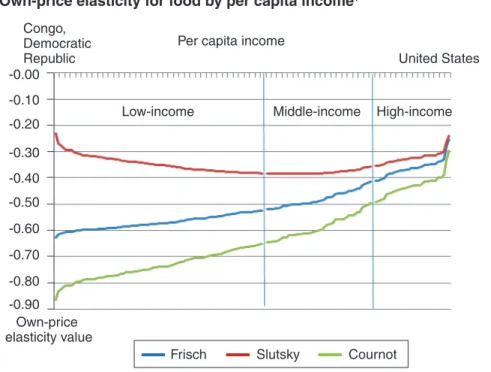
coun-tries. The Cournot and Frisch own-price elasticities for food are all larger
than the corresponding Slutsky elasticity. However, with rising affluence the
real income effect of a food-price change becomes increasingly smaller and
the three elasticities converge (fig. 3). The discussion that follows is limited
to the Slutsky own-price elasticity for food since it is the only measure that
did not fully perform in accordance with Timmer’s proposition.
In appendix table 3, the Slutsky own-price elasticity (equation 7) of demand
for food, beverages, and tobacco begins at -0.23 for the Congo, increases (in
absolute value) to -0.384 (Malaysia to Argentina), and declines thereafter
(absolutely) to -0.24 for the United States. To clarify the reason for this, take
15
the logarithmic derivative of equation 7, using equation 1 and suppressing
the error term:
.
(15)
If good i is a luxury,
β
i> 0, and the derivative is negative, as real per capita
income increases, the Slutsky own-price elasticity of the good decreases.
If good i is a necessity,
β
i< 0 so that –
β
i> 0. If the term in brackets on the
right side of equation 15 is positive, then both the numerator and the
deriva-tive are posideriva-tive. This is the case for food, beverages, and tobacco. When
w
icis sufficiently large—that is, when Q
cis sufficiently small—the derivative
for this good is positive for the poorest countries. Eventually, however,
w
icbecomes sufficiently small so that the derivative becomes negative. In this
case, the Slutsky own-price elasticity becomes smaller in absolute value. The
turning point, when the Slutsky own-price elasticity starts declining with
increasing per capita income, is at the per capita income level of Argentina—
or at 22 percent of the per capita income level of the United States.
Food Subgroups—Estimates and Elasticities
Table 4 presents the estimated parameters for the second-stage model
(equa-tion 10), the food subgroups. The estimate for K3 exceeds 1, confirming the
presence of heteroskedasticity in country group 3. The beta (
β
) estimates
for cereals, meat, fish, oils and fat, and fruits and vegetables are negative,
indicating that these food-product categories are (conditionally)
inelastic, while the remaining categories are conditionally
expenditure-elastic.
10The negative beta estimates for cereals and fruits/vegetables are larger
(in absolute value) than for the other food categories. These categories include
expenditures on grains, roots, and tubers, and both categories are particularly
sensitive to the level of affluence. Table 4 also includes the diagonal elements
(
)
(
)
(
)(
)
21
log
1
i ic i i c ic ic i ic iw
d
S
Q
w w
w
β
β
β
φ
β
β
−
+
−
=
+
−
−
10 The parameter estimates in table 8 are conditional on total per capita food expenditures, not total per capita expenditures.
Figure 3
Own-price elasticity for food by per capita income
1United States Per capita income
Low-income Middle-income High-income Congo,
Democratic Republic
1Countries are arranged in ascending order of affluence.
Source: Author’s calculations using the 2005 International Comparison Program (ICP) data.
-0.90 -0.80 -0.70 -0.60 -0.50 -0.40 -0.30 -0.20 -0.10 -0.00 Own-price elasticity value
of the Slutsky matrix, which are the compensated own-price effects for each
food subgroup. These effects are all negative, satisfying the law of demand.
Marginal share estimates for each food subgroup, conditional on total food
expenditures, are plotted in figure 4 and reported in appendix table 8 by
country. These estimates measure how an additional unit of food
expendi-tures is allocated across the eight food subgroups. Figure 4 illustrates how
the marginal share for a food category varies by country based on the level
of affluence. With low-income countries, a greater portion of an additional
unit of food expenditures is allocated to cereals and fruits/vegetables, which
include staples such as corn meal and rice. As countries become more
affluent, the portion of additional food expenditures allocated to cereals
and fruits/vegetables decreases, and a greater portion is allocated to “other”
food expenditures, which includes restaurant expenditures and high-end
purchases, and beverages/tobacco. For instance, a dollar increase in food
Table 4
Maximum-likelihood estimates of the food subgroups model,
144 countries, 2005
aParameter Standard error Beta β*
Cereals -0.077 0.008*
Meat -0.001 0.007
Fish -0.009 0.004**
Dairy and eggs 0.002 0.004
Oils and fat -0.014 0.003*
Fruit and vegetables -0.039 0.007*
Food other 0.088 0.010*
Beverages and tobacco 0.051 0.008*
Alpha α*
Cereals 0.062 0.011*
Meat 0.143 0.010*
Fish 0.037 0.006*
Dairy and eggs 0.084 0.007*
Oils and fat 0.014 0.004*
Fruit and vegetables 0.100 0.010*
Food other 0.333 0.014*
Beverages and tobacco 0.228 0.011*
Slutsky own-price effects
π
*iiCereals -0.205 0.033*
Meat -0.136 0.023*
Fish -0.102 0.012*
Dairy and eggs -0.100 0.015*
Oils and fat -0.036 0.006*
Fruit and vegetables -0.210 0.022*
Food other -0.231 0.051*
Beverages and tobacco -0.127 0.027
Heteroskedasticity measures
K2 0.851 0.019*
K3 1.090 0.013*
aComoros is excluded from the analysis. Egypt and Russia were reported twice and were
averaged for estimation. Three country groups are considered for heteroskedasticity. * and ** denote significance at the 0.01 and 0.05 level, respectively. Alpha, beta, and pi estimates are based on equations 10a−10c.
17
Figure 4
Distribution of an additional $1 of income across 144 countries, food subcategories
1United States Per capita income
Congo, Democratic Republic 1.00
Marginal share value
.90 .80 .70 .60 .50 .40 .30 .20 .10 0
Beverages and tobacco Food other
Fruits and vegetables Oils and fats
Dairy Fish Meats Cereals
1Countries are arranged in ascending order of affluence.
Source: Author’s calculations using the 2005 International Comparison Program (ICP) data.
expenditures results in cereal expenditures in the Democratic Republic of
Congo increasing by 31 cents (appendix table 8). However, cereal
expendi-tures in the United States decrease by 1.5 cents, indicating the lower status
afforded this category by most consumers in rich countries. In contrast,
expenditures on “other” food increase by only 5 cents in the Democratic
Republic of Congo, but by 42 cents in the United States.
The expenditure and price elasticities calculated using the Florida-Slutsky
model are conditional on a given food budget. In other words, the
expendi-ture elasticity measures the percentage change in demand given a percentage
change in total food expenditures, while the price elasticity measures the
percentage response given a percentage change in price assuming a given
food budget. However, the conditional elasticities can be converted to
uncon-ditional elasticities using the parameters estimated from the Florida-PI model
in the first stage, as specified by equations 11-14.
The unconditional expenditure elasticity (equation 11) measures the
percentage change in demand from a percentage change in overall income
(or total spending). The unconditional income elasticities are all less than
1, except for “other” food and beverages/tobacco in low-income countries
(appendix table 5). This is consistent with conventional theory that food is a
necessity and not a luxury item in household expenditures. Given the
rela-tively low food budget share of beverages/tobacco in many low-income
coun-tries, this category can be considered a luxury item among consumers in some
poorer countries.
Similar to the estimated income elasticity for aggregate consumption
catego-ries, the income elasticity for the food subcategories is largest in the poorer
countries and declines in magnitude with affluence. Across each country,
staple food items (with negative
*i
β