Worcester Polytechnic Institute
Digital WPI
Doctoral Dissertations (All Dissertations, All Years)
Electronic Theses and Dissertations
2012-01-09
Mining and Managing Neighbor-Based Patterns in
Data Streams
Di Yang
Worcester Polytechnic Institute
Follow this and additional works at:
https://digitalcommons.wpi.edu/etd-dissertations
This dissertation is brought to you for free and open access byDigital WPI. It has been accepted for inclusion in Doctoral Dissertations (All Dissertations, All Years) by an authorized administrator of Digital WPI. For more information, please [email protected].
Repository Citation
Yang, D. (2012).Mining and Managing Neighbor-Based Patterns in Data Streams. Retrieved from https://digitalcommons.wpi.edu/etd-dissertations/16
Mining and Managing Neighbor-Based
Patterns in Data Streams
by Di Yang A Dissertation
Submitted to the Faculty of the WORCESTER POLYTECHNIC INSTITUTE In partial fulfillment of the requirements for the
Degree of Ph.D. in Computer Science
by
January 6th, 2012
APPROVED:
Professor Elke A. Rundensteiner, Advisor Professor Matthew O. Ward, Co-Advisor
Professor Daniel J. Dougherty, Committee Member Professor Evimaria Terzi , External Committee Member Professor Craig Wills, Head of Department
ii
Abstract
The current data-intensive world is continuously producing huge volumes of live streaming data through various kinds of electronic devices, such as sensor networks, smart phones, GPS and RFID systems. To understand these data sources and thus better leverage them to serve human soci-ety, the demands for mining complex patterns from these high speed data streams have significantly increased in a broad range of application do-mains, such as financial analysis, social network analysis, credit fraud de-tection, and moving object monitoring.
In this dissertation, we present a framework to tackle the mining and management problem for the family of neighbor-based patterns in data streams, which covers a broad range of popular pattern types, including clusters, outliers, k-nearest neighbors and others.
First, we study the problem of efficiently executing single neighbor-based pattern mining queries. We propose a general optimization princi-ple for incremental pattern maintenance in data streams, called “Predicted Views”. This general optimization principle exploits the “predictability” of sliding window semantics to eliminate both the computational and storage
iii
effort needed for handling the expiration of stream objects, which usually constitutes the most expensive operations for incremental pattern mainte-nance.
Second, the problem of multiple query optimization for neighbor-based pattern mining queries is analyzed, which aims to efficiently execute a heavy workload of neighbor-based pattern mining queries using shared ex-ecution strategies. We present an integrated pattern maintenance strategy to represent and incrementally maintain the patterns identified by queries with different query parameters within a single compact structure. Our solution realizes fully shared execution of multiple queries with arbitrary parameter settings.
Third, the problem of summarization and matching for neighbor-based patterns is examined. To solve this problem, we first propose a summariza-tion format for each pattern type. Then, we present computasummariza-tion strategies, which efficiently summarize the neighbor-based patterns either during or after the online pattern extraction process. Lastly, to compare patterns extracted on different time horizon of the stream, we design an efficient matching mechanism to identify similar patterns in the stream history for any given pattern of interest to an analyst.
Our comprehensive experimental studies, using both synthetic as well as real data from domains of stock trades and moving object monitoring, demonstrate superiority of our proposed strategies over alternate methods in both effectiveness and efficiency.
iv
Publications
Publications Contributing to this Dissertation
Publications Related to Part IPart I of this dissertation discusses single query optimization for neighbor-based pattern mining queries in streaming environments.
• 1. Di Yang, Elke A. Rundensteiner and Matthew O. Ward,
“Neighbor-Based Pattern Detection for Windows Over Streaming Data”. EDBT, 2009, pages 517-528.
Relationship to this dissertation:This work presents the single query ex-ecution strategies for density-based cluster mining queries in streams. Chapters 5 and 6 in Part I of this dissertation are based on this work.
• 2. Di Yang, Avani Shastri, Elke A. Rundensteiner and Matthew O.
Ward, “An optimal strategy for monitoring top-k queries in stream-ing windows”, EDBT, 2011, pages 57-68.
Relationship to this dissertation: This work presents the single query execution strategies for kNN queries in streams. Chapter 7 in Part I of this dissertation is based on this work.
v
• 3. Di Yang, Elke A. Rundensteiner and Matthew O. Ward, “Mining
Neighbor-Based Patterns from Streaming Data”. WPI Technical Re-port, 2008.
Relationship to this dissertation:This work conducts an in-depth perfor-mance analysis for alternative neighbor-based pattern mining algo-rithms, including cost models, cost analysis and more experimental studies. Chapter 8 in Part I of this dissertation is based on this work. Publications Related to Part II
Part II of this dissertation discusses multiple query optimization strate-gies for neighbor-based pattern mining query workloads in streaming en-vironments.
• 4. Di Yang, Elke A. Rundensteiner, Matthew O. Ward, “A Shared
Exe-cution Strategy for Multiple Pattern Mining Requests over Streaming Data”. VLDB, 2009, pages 874-885.
Relationship to this dissertation:This work presents the multiple query execution strategies for density-based cluster mining queries in streams. The key content in Part II of this dissertation about multiple query execution strategies for density-based cluster mining queries is based on this work.
• 5. Avani Shastri, Di Yang, Elke A. Rundensteiner and Matthew O.
Ward, “MTopS: Scalable Processing of Continuous Top-K Multi-Query Workloads”, CIKM 2011,1107-1116.
vi
execution strategies for density-based cluster mining queries in streams. The content in Part II of this dissertation about multiple query execu-tion strategies for kNN mining queries shows the key ideas presented in this work.
• 6. Di Yang, Elke A. Rundensteiner and Matthew O. Ward,
“Multi-ple Query Optimization for Neighbor-Based Pattern Mining Requests over Data Streams. TODS 2011. Accepted.
Relationship to this dissertation: This work concludes several general optimization principles for multiple neighbor-based pattern mining query workloads in streaming environments. Part II of this disserta-tion has the same structure as this work does.
• 7. Di Yang, Zhenyu Guo, Zaixian Xie, Elke A. Rundensteiner and
Matthew O. Ward, “Interactive Visual Exploration of Neighbor-Based Patters in Data Stream”, SIGMOD demonstration paper, 2010, pages 1151-1154.
Relationship to this dissertation:This work demonstrates our prototype system composed of a computational backend integrating the mining techniques proposed in the Part I and Part II of this dissertation, and a visual frontend, allowing human users to interact with the stream mining process.
Publications Related to Part III
Part III of this dissertation discusses summarization and matching of neighbor-based patterns in streaming environments.
vii
• 8. Di Yang, Elke A. Rundensteiner and Matthew O. Ward,
“Summa-rization and Matching of Density-Based Clusters in Steaming Envi-ronments”, PVLDB vol.5(2) pages 121-132 2011.
Relationship to this dissertation:This work presents the summarization and matching for density-based clusters in streaming environments. The major component of Part III of this dissertation about summa-rization and matching for density-based clusters in streaming envi-ronments is based on this work.
• 9. Di Yang, Kaiyu Zhao, Hanyuan Lu, Elke A. Rundensteiner and
Matthew O. Ward, “ViStream T: An Integrated Platform for Mining Complex Patterns in the Past, the Present and the Future of Streams WPI Technical Report, 2011.
Relationship to this dissertation:This work demonstrates our prototype system composed by a computational backend integrating all the ma-jor mining techniques proposed in this whole dissertation, and a vi-sual frontend, allowing human users to interact with the stream min-ing process.
Publications Related to Future Work
• 10: Di Yang, Zhenyu Guo, Elke A. Rundensteiner and Matthew O.
Ward, “CLUES: A Unified Framework Supporting Interactive Explo-ration of Density-Based Clusters in Streams”, CIKM, pages 815-824, 2011.
viii
and evolution tracking methods for density-based clusters in stream-ing environments This is an initial effort into our future work of track-ing the evolution of more types of neighbor-based patterns in streams.
Other Publications
My other publications were mainly published during my master pro-gram at WPI and related to my Master Thesis: “Analysis Guided Visual Exploration of Multivariate Data”.
• 11. Di Yang, Elke A. Rundensteiner, Matthew O. Ward, “Nugget
Dis-covery in Visual Exploration Environments by Query Consolidation”, CIKM 2007, pages 603-612.
• 12. Di Yang, Elke A. Rundensteiner, Matthew O. Ward, “Analysis
Guided Visual Exploration to Multivariate Data”, VAST, October 2007, pages 83-90.
• 13. Di Yang, Z. Xie, Elke. A. Rundensteiner and Matthew O. Ward,
“Managing Discoveries in The Visual Analytics Process”, ACM SIGKDD Explorations special issue on visual analytics, Volume 9, Issue 2, pages 22-30, 2007.
• 14. Elke Rundensteiner, Matthew Ward, Zaixian Xie, Qingguang Cui,
Charudatta Wad, Di Yang, Shiping Huang, “XmdvT oolQ:
Quality-Aware Interactive Data Exploration”, SIGMOD 2007, demonstration paper, pages 1109-1112, 2007.
ix
• 15. Matthew O. Ward, Zaixian Xie, Di Yang and Elke A.
Runden-steiner. “Quality-Aware Visual Data Analysis” Computational Statis-tics. Volume 26, Number 4, 567-584.
x
Acknowledgments
At this moment of reaching the greatest achievement of my life so far, I need to first give my deepest gratitude to my parents, namely my dad Yang Zhiming and my mom Wang Caiyun, and my wife Pu Di. Without their selfless support and continuous trust, finishing this dissertation is simply impossible.
I would like to sincerely thank my advisors Professor Elke A. Runden-steiner and Professor Matthew O. Ward, and my committee members Pro-fessor Daniel J. Dougherty and ProPro-fessor Evimaria Terzi. It is their excellent inspiration and patient guidance, which has guided me through my Ph.D career.
I also would like to thank all my colleagues in XMDV and DSRG labs at WPI, including Zhu Yali, Wei Mingzhu, Ding Luping, Wang Song, Wang Ling, Venkatesh Raghavan, Xie Zaixian, Cui Qingguang, Abhishek Mukherji, Guo Zhenyu, Wang Di, Liu Mo, Zhao Kaiyu, Karen Works, Lin Xika, Lei Chuan, Cao Lei, Lu Hanyuan, Qi Yingmei, Zhang Dazhi and Medhabi Ray, for all the help that they have given me, and all the wonderful time that we have spent together.
xi
Last but not the least, I thank every member of my family besides my parents, including my grandparents Wang Zhizhen, Yu Qinglian, Yang Yu-long, Wu Yanmei, my anties Wang Caiwen, Wang Caixia, Wang Cailin, Wan Caihong, Yang Ying, Yang Suqin, and all my cousins Zhang Yujia, Lang Shuang, Ma Lele, Zhang Jing, Yin Jinglei and Peng Kaifeng, for always tak-ing me as their pride.
My Master and Ph.D programs at WPI from 2005 to 2012, including the accomplishment of this dissertation, are supported by NSF, under a series of research grants, including CCF 0811510, IIS 0812027 and IIS 1018443.
xii
Contents
1 Introduction 1
1.1 Motivation . . . 1
1.1.1 Neighbor-Based Pattern Mining . . . 3
1.1.2 Efficient Pattern Extraction Query Execution . . . 4
1.1.3 Multiple Pattern Extraction Query Optimization . . . 5
1.1.4 Pattern Summarization and Matching . . . 7
1.2 State-Of-the-Art . . . 9
1.2.1 Mining Data Streams . . . 9
1.2.2 Multiple Mining Query Optimization . . . 11
1.2.3 Summarization and Matching for Mined Patterns . . 12
1.3 Proposed Solutions . . . 13
1.3.1 Solutions for Pattern Extraction Query Execution . . 13
1.3.2 Solutions for Multiple Query Optimization . . . 16
1.3.3 Solutions for Pattern Summarization and Matching . 20 1.4 Where our Proposed Techniques May Not Work . . . 23
1.5 Research Impact and Open Research Questions . . . 25
1.6 Dissertation Organization . . . 27
2 Preliminaries 28 2.1 General Notion of Neighbor-Based Patterns . . . 28
2.2 Definitions for Specific Neighbor-Based Patterns . . . 30
2.2.1 Density-Based Cluster . . . 30
2.2.2 Distance-Based Outlier . . . 31
2.2.3 Top-k Nearest Neighbors (kNN . . . 33
2.3 Sliding Window Semantics . . . 33
2.4 Where Streaming Neighbor-Based Pattern Mining Lies in Data Mining Family . . . 36
CONTENTS xiii
I Efficient Processing of Single Neighbor-Based Pattern
Extraction Queries 40
3 Naive vs. Incremental Approach 41
3.1 Naive Solution–Recompute from Scratch at Each Window . 41
3.2 Why Incremental Computation . . . 43
3.3 Basic Incremental Computation Strategies . . . 44
3.4 Limitations of Basic Incremental Strategies . . . 47
4 Predicted View Technique 50 4.1 Performance Bottleneck – Handle Expiration . . . 50
4.2 Predicted View . . . 51
5 Proposed Algorithms for Density-Based Clusters 54 5.1 Abstract Neighborship Maintenance – Abstract-C . . . 54
5.2 Exact+abstractedneighborshipBased Solution (Extra-N) . . . 57
5.2.1 What Abstract-C Suffers From : “Amnesia” . . . 59
5.2.2 Enhanced AbstractedNeighborship . . . 59
5.2.3 Challenges for Maintaining Cluster Memberships . . 61
5.2.4 View Prediction for Cluster Membership Maintenance 62 5.2.5 A Stepping-Stone Algorithm: Abstract-M . . . 64
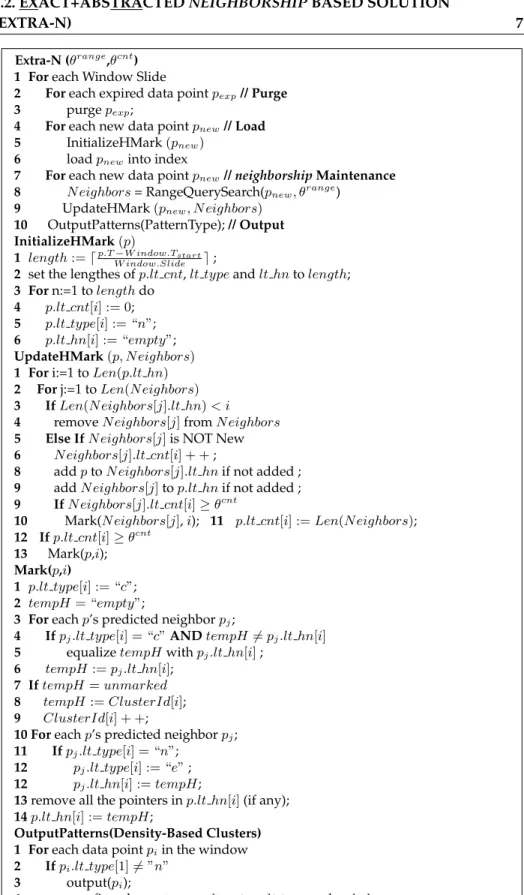
5.2.6 Proposed Solution: Extra-N . . . 66
6 Proposed Algorithms for Distance-Based Outliers 73 7 Proposed Algorithms for kNN 75 7.1 Equivalence to Top-k Problem . . . 75
7.2 Theoretical Foundations . . . 76
7.3 An Initial Approach: PreTopk . . . 80
7.4 Proposed Solution: MinTopk . . . 83
7.4.1 Properties of Predicted Top-k Results . . . 83
7.4.2 Solution: Integrated View Maintenance . . . 84
7.4.3 Optimal Integration Strategy based on Continuous Top-k Career . . . 86
7.4.4 Super-Top-K List Maintenance . . . 88
7.4.5 Final Move Towards Optimality . . . 91
8 Cost Analysis for Proposed Algorithms 96 8.1 Cost Analysis for Density-Based Cluster and Distance-Based Outlier Detection . . . 96
CONTENTS xiv
8.1.2 Performance Analysis . . . 103
8.2 Cost Analysis for kNN Detection Algorithms . . . 107
8.2.1 Cost Analysis for PreTopk Algorithm . . . 107
8.2.2 Cost Analysis for MinTopk Algorithm . . . 109
9 Experimental Study 115 9.1 Real and Synthetic Streaming Datasets . . . 115
9.1.1 Real Streaming Datasets . . . 115
9.1.2 Synthetic Streaming Datasets . . . 116
9.2 Experimental Studies for Density-Based Cluster Extraction . 117 9.2.1 Experimental Platform . . . 117
9.2.2 Experimental Methodologies . . . 117
9.2.3 Overall Evaluation . . . 118
9.2.4 Abstract-M vs. Extra-N . . . 122
9.2.5 Scalability Analysis . . . 124
9.2.6 Evaluation with Real Data . . . 126
9.3 Experimental Studies for Distance-Based Outlier Extraction 127 9.3.1 Experimental Platform . . . 127
9.3.2 Experimental Methodologies . . . 128
9.3.3 Alternative Methods . . . 128
9.3.4 Performance Evaluation . . . 130
9.4 Experimental Studies for kNN (top-k) Extraction . . . 132
9.4.1 Experimental Platform . . . 132
9.4.2 Alternative Methods . . . 132
9.4.3 Experimental Methodologies . . . 133
9.4.4 Evaluation for DifferentkCases . . . 133
9.4.5 Evaluation for DifferentwinCases . . . 135
9.4.6 Evaluation for DifferentslideCases . . . 136
9.4.7 Evaluation for Non-Uniform Arrival Rate Cases . . . 138
10 Related Work for Part I 141
II Multiple Neighbor-Based Pattern Extraction
Query Optimization 146
11 Problem Definition 147
CONTENTS xv
13 Sharing Among Queries with Arbitrary Pattern Parameters 151
13.1 “Containment” among Neighbor-Based Pattern Sets . . . 152
13.1.1 “Growth Property” . . . 152
13.1.2 Hierarchical Pattern Representation . . . 154
13.1.3 Incremental Representation for Other Pattern Types . 156 13.2 Integrated Maintenance for Multiple Density-Based Clustering Queries . . . 157
13.3 Integrated Maintenance for Multiple Distance-Based Outlier Detection Queries . . . 168
13.4 Integrated Maintenance for Multiple kNN Queries . . . 171
14 Sharing Among Queries with Arbitrary Window Parameters 175 14.1 Samewin, ArbitraryslideCase. . . 176
14.2 Sameslide, ArbitrarywinCase . . . 179
14.3 Arbitraryslide, ArbitrarywinCase . . . 180
15 Putting IT All Together: The General Case 183 16 Experimental Study 192 16.1 Experimental Platform . . . 192
16.2 Real and Synthetic Streaming Datasets . . . 192
16.3 Alternative Algorithms . . . 193
16.4 Experimental Methodologies . . . 194
16.5 Evaluation for One-Arbitrary-Parameter Cases . . . 194
16.5.1 Arbitraryθcntcase . . . 195
16.5.2 Arbitraryθrangecase . . . 196
16.5.3 Arbitrarywincase . . . 198
16.5.4 Arbitraryslidecase . . . 198
16.6 Evaluation for Two-Arbitrary-Parameter Cases . . . 199
16.6.1 Arbitrary Pattern Parameters . . . 200
16.6.2 Arbitrary Window Parameters . . . 200
16.7 General Case: Four Arbitrary Parameters. . . 202
16.8 Evaluation for Scalability . . . 204
16.9 Conclusion for Experimental Study of Density-Based Cluster Detection Algorithms . . . 206
16.10Performance Analysis for Distance-Based Outlier and kNN Detection Algorithms . . . 207
CONTENTS xvi
III Summarization and Matching of Neighbor-Based Patterns214
18 Supported Queries and System Overview 216
18.1 Continuous Pattern Extraction Queries . . . 216
18.2 Pattern Matching Queries . . . 217
18.3 System Overview . . . 217
19 Pattern Summarization 219 19.1 Summarization for Density-Based Clusters . . . 219
19.1.1 Features of Density-Based Clusters . . . 219
19.1.2 Skeletal Point Summarization . . . 221
19.1.3 Proposed Solution: Skeletal Grid Summarization . . 224
19.2 Summarization for Distance-Based Outliers . . . 230
19.3 Summarization for kNN . . . 231
20 Pattern Extractor 232 20.1 Extracting and Summarizing Density-Based Clusters . . . . 232
20.1.1 A Two Stage Strategy and Its Limitations . . . 232
20.1.2 Incremental Computation and Challenges . . . 234
20.1.3 “Lifespan” Analysis . . . 235
20.1.4 Proposed C-SGS Algorithm . . . 239
20.2 Extracting and Summarizing Distance-Based Outliers . . . . 244
20.3 Extracting and Summarizing kNN . . . 245
21 Pattern Archiver 246 21.1 Pattern Compression . . . 246
21.1.1 Cluster Summarization in Multi-Resolutions. . . 247
21.1.2 Distance-Based Outlier Summarization in Multi-Resolutions248 21.1.3 kNN Summarization in Multi-Resolutions. . . 249
21.2 Budget- and Accuracy-Aware Resolution Selection. . . 249
21.3 Selective Pattern Archiving . . . 251
22 Pattern Storage and Match 252 22.1 Storage and Matching for Density-Based Clusters . . . 252
22.1.1 Cluster Organization in Pattern Base . . . 252
22.1.2 Cluster Matching Process . . . 253 22.2 Storage and Matching for Distance-Based Outliers and kNN 256
CONTENTS xvii
23 Experimental Study 259
23.1 Experimental Platform . . . 259 23.2 Real and Synthetic Streaming Datasets . . . 259 23.3 Alternative Summarization Formats . . . 259 23.4 Performance of Cluster Extraction and Summarization . . . 260 23.5 Effectiveness for Cluster Matching Queries . . . 268 23.6 Efficiency of Cluster Matching Queries . . . 272 23.7 Evaluation for SGS at Multiple Resolutions . . . 275
24 Related Work for Part III 281
25 Conclusions of This Dissertation 284
26 Future Work 288
26.1 Efficient Pattern Extraction for Other Complex Pattern Types 288 26.2 Pattern Evolution Model and Evolution Tracking . . . 289 26.3 Dynamic Stream Mining Queries . . . 291
xviii
List of Figures
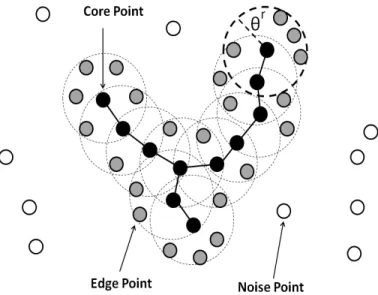
2.1 An Example of A Density-Based Cluster . . . 31
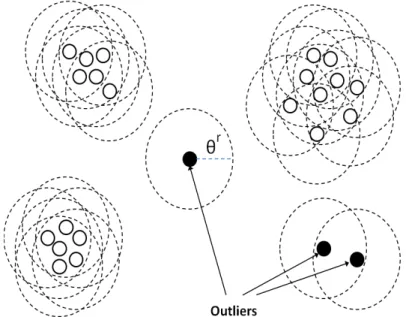
2.2 An Example of 3 Distance-Based Oultiers . . . 32
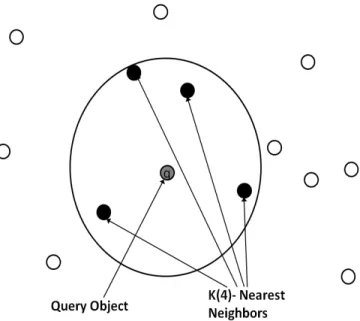
2.3 An Example ofk= 4Nearest Neighbors . . . 34
2.4 Template for a Density-Based Cluster Detection Query for Sliding Windows over a Data Steam . . . 35
2.5 Template for a Distance-Based Outlier Detection Query for Sliding Windows over a Data Stream . . . 35
2.6 Template for a kNN Detection Query for Sliding Windows over a Data Stream . . . 35
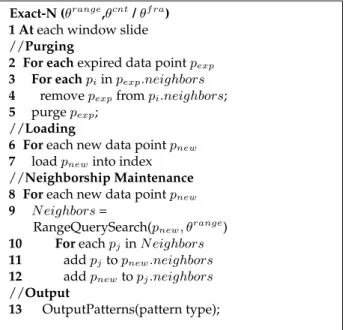
3.1 Pseudo-Code for Exact-N Algorithm (Part 1) . . . 46
3.2 Pseudo-Code for Exact-N Algorithm (Part 2) . . . 46
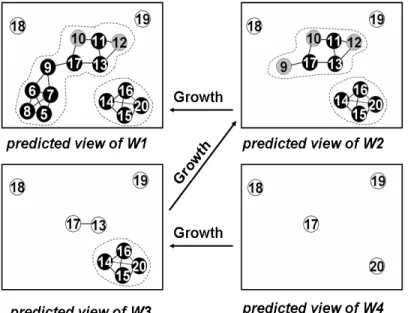
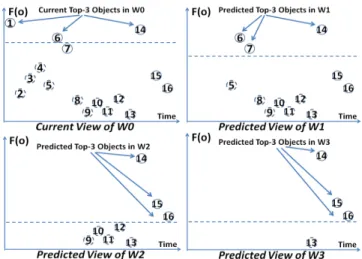
4.1 Predicted views of four consecutive windows atW0 . . . 53
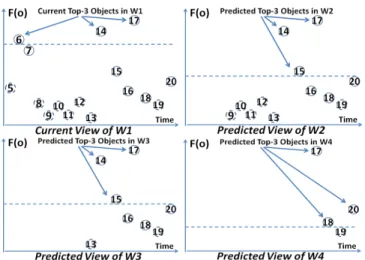
4.2 Updated predicted views of four windows atW1 . . . 53
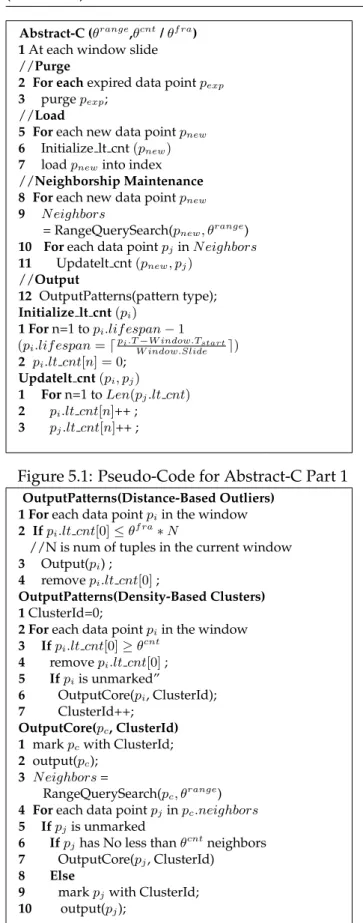
5.1 Pseudo-Code for Abstract-C Part 1 . . . 58
5.2 Pseudo-Code for Abstract-C Part 2 . . . 58
5.3 “Predicted Views” of 4 Successive Windows atW0 . . . 65
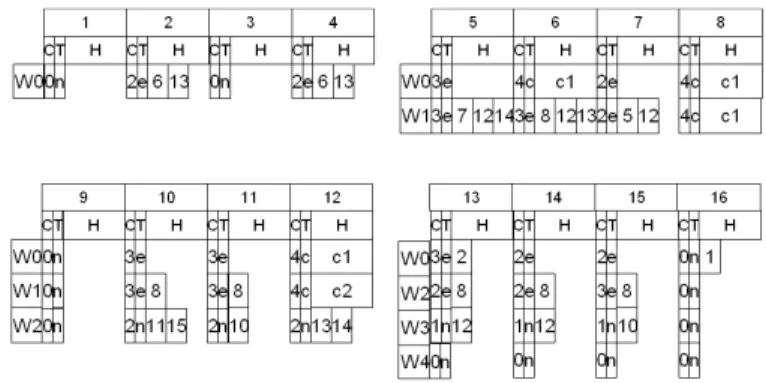
5.4 Updated “Predicted Views” of 4 Successive Windows atW1 65 5.5 The H-Marks of the Data Points atW0 . . . 68
5.6 Psuedo Code of Extra-N Algorithm . . . 71
7.1 (Predicted) Top-k Results Four Consecutive Windows at time ofW0(slide size = 4 objects) . . . 77
7.2 Updated Predicted Top-k Results of Four Consecutive Win-dows at time ofW1 (slide size = 4 objects) . . . 81
7.3 Update Process of Predicted Top-k sets From Time ofW0toW1 81 7.4 Independent Top-k Result Sets vs. Super-top-kStructure us-ing Complete and Summarized Window Marks . . . 86
LIST OF FIGURES xix
7.5 Update Process ofsuper-top-k listFromW0toW1 . . . 90
7.6 Proposed Solution: MinTopk Algorithm . . . 95
9.1 Comparison on CPU Performances of Five Algorithms . . . 119
9.2 Comparison on Memory Performances of Five Algorithms . 120 9.3 Comparison on CPU Time of Abstract-M and MPS inN¯(pi)= 5%cases . . . 123
9.4 Comparison on Memory Usage of Abstract-M and MPS in ¯ N(pi)= 5%cases . . . 123
9.5 Comparison of CPU Scalability on Base (Window) Size . . . 125
9.6 Comparison of Memory Scalability on Base (Window) Size . 125 9.7 Comparison of CPU Scalability on Dimensionality . . . 126
9.8 Comparison on CPU Time with GMTI data . . . 126
9.9 Comparison on Memory Usage with GMTI data . . . 126
9.10 Comparison on CPU Time with STT data . . . 127
9.11 Comparison on Memory Usage with STT data . . . 127
9.12 Comparison on CPU Time for Count-Based Window Sce-nario . . . 131
9.13 Comparison on Memory Usage for Count-Based Window Scenario . . . 131
9.14 Comparison on CPU Time for Time-Based Window Scenario 131 9.15 Comparison on Memory Usage for Time-Based Window Sce-nario . . . 131
9.16 CPU time used by three algorithms with differentkvalues . 134 9.17 Memory space used by three algorithms with differentkvalues134 9.18 CPU times for varying window sizes . . . 136
9.19 Memory space for varying window sizes . . . 136
9.20 CPU times for varying slide sizes . . . 137
9.21 Memory space for varying slide sizes . . . 137
9.22 Response time for processing each window given non-uniform arrival rate. . . 139
13.1 Cluster Set 1 containing 3 clusters . . . 153
13.2 Cluster Set 2 containing 3 clusters, which is a growth of Clus-ter Set1 . . . 153
13.3 Independent Cluster Membership Storage for Cluster Sets 1 and 2 . . . 155
13.4 Hierarchical Cluster Membership Storage for Cluster Sets 1 and 2 . . . 155
LIST OF FIGURES xx
13.6 IntV iew θcnt: Integrated Representation for density-based
clusters identified by three different queries . . . 160 13.7 Distance-Based Outliers Identified byQ1andQ2 . . . 172
13.8 Independent vs. Integrated Representation for Distance-Based Outliers Identified byQ1andQ2 . . . 172
14.1 Predicted Views Maintained By Three Queries Q1, Q2 and Q3 Independently versus Those Maintained By a Single Meta Query . . . 182 15.1 IntV iew: Integrated Representation for Predicted Views
Iden-tified by 3 Queries in 5 Predicted Windows . . . 185 15.2 Chandi: Proposed Algorithm for Multiple Density-Based
Clus-tering Queries (Part 1) . . . 186 15.3 Chandi: Proposed Algorithm for Multiple Density-Based
Clus-tering Queries (Part 2) . . . 187 15.4 SDOD: Proposed Algorithm for Processing Multiple
Distance-Based Outlier Detection Queries . . . 188 15.5 SkNN: : Proposed Algorithm for Processing Multiple kNN
Queries . . . 189 16.1 CPU Time used by Five Competitors in ArbitraryθcntCases 196
16.2 Memory Space used by Five Competitors in Arbitrary θcnt
Cases . . . 196 16.3 CPU Time used by Five Competitors in ArbitraryθrangeCases 197
16.4 Memory Space used by Five Competitors in Arbitraryθrange
Cases . . . 197 16.5 CPU Time used by Five Competitors in ArbitrarywinCases 198 16.6 Memory Space used by Five Competitors in Arbitrary win
Cases . . . 198 16.7 CPU Time Used by Five Competitors in ArbitraryslideCases 199 16.8 Memory Space used by Five Competitors in Arbitraryslide
Cases . . . 199 16.9 CPU Time used by Five Competitors in Arbitrary Pattern
Pa-rameter Cases . . . 201 16.10Memory Space used by Five Competitors in Arbitrary
Pat-tern Parameter Cases . . . 201 16.11CPU Time used by Five Competitors in Arbitrary Window
LIST OF FIGURES xxi
16.12Memory Space used by Five Competitors Arbitrary Window Parameter Cases . . . 201 16.13Detailed Comparison on CPU Time Consumption of Five
Al-gorithms . . . 203 16.14CPU Time used by Five Competitors in Logarithmic Scale . 205 16.15Memory Space used by Five Competitors in Logarithmic Scale205 18.1 Continuous Pattern Extraction Query Returning Full(f)and
Summarized(s)Representations of Neighbor-Based Patterns 216 18.2 Pattern Matching Query finding Patterns Similar to the
To-Be-Matched Cluster Based on Cluster Summarization . . . . 217 18.3 System Overview . . . 218 19.1 Example of full representation, basic SGS and compressed
SGS of a 2D cluster . . . 228 20.1 Examples of updating cell status. θc = 4, grey circle=edge
point, black circle=core point, number on each object= number of windows the object can survive. . . 242 23.1 CPU Time and Memory Comparison for Generating
Alter-native Summarizations on STT Stream . . . 264 23.2 CPU Time and Memory Comparison for Generating
Alter-native Summarizations on GMTI Stream . . . 264 23.3 CPU Time Comparison Using Time-Based Window (STT Stream)
265
23.4 CPU Time Comparison using Time-Based Window (GMTI Stream) . . . 267 23.5 Similar Rating by Users for Matched Clusters found by
Al-ternative Summarization Methods . . . 272 23.6 CPU Time Comparison for Cluster Matching Queries using
Alternative Cluster Summarization Methods . . . 275 23.7 Memory Comparison for Cluster Matching Queries using
Alternative Cluster Summarization Methods (in Logarithmic measure) . . . 275 23.8 CPU Time Comparison for Cluster Matching Queries using
Alternative Cluster Summarization Methods . . . 278 23.9 Memory Comparison for Cluster Matching Queries using
Alternative Cluster Summarization Methods . . . 278 23.10Similar Ratings by Users For Matched Clusters using
xxii
List of Tables
8.1 Symbols Used In The Cost Models. . . 98 8.2 CPU Cost of Individual Operations. . . 98 8.3 CPU Costs of Alternative Algorithms at Four Stages . . . 100 8.4 Memory Costs of Individual Data Structures. . . 102 8.5 Memory Costs of Each Algorithm. . . 104 8.6 Cost Analysis of Each Algorithm (↓=small, ⇓=very small,
1
Chapter 1
Introduction
1.1
Motivation
As the ability of hardware to collect and transmit large amounts of live data continues to advance [SPP+06, CKW+12, DSJ+12, CLW12], such as the development of RFID systems, smart phones, GPS systems and sensor networks, the need for processing streaming data in information infra-structures has become significant. Similar to the case of static data on which data mining techniques have been applied to find useful information for decades [DHZS02, GRS98, NH94, AGGR98, KN98a], our modern applica-tions now post strong demands on analyzing and thus drawing value from streaming data resources. For example, to make proper investment deci-sions, financial analysts may want to continuously monitor the trade pat-tern changes in the stock market by mining the stock transaction streams. As another example, to analyze traffic patterns, such as the congestion ar-eas in the daily traffic and their changes over time, the traffic analysts may
1.1. MOTIVATION 2
need to be not only continuously updated with the patterns mined from the vehicle position streams, but also to have the capabilities of comparing and contrasting the patterns mined at different time points.
Along with the rapidly increasing volume and speed of streaming data, the difficulties for analyzing and understanding them are also correspond-ingly mounting. Traditional data mining techniques, which focus on an-alyzing large volumes of static data collections in an offline fashion, are no longer sufficient to handle the needs of mining such highly dynamic streaming data sources. This is because the dynamic characteristics of both streaming data and stream analysis tasks impose many new challenges for data mining systems. The crucial ones: 1) The data sources are no longer statically collected but continuously arriving in high speed. 2) The data sources may be infinite and thus impossible to be all stored in the disk. 3) The mining process to the data sources may no longer be an one-time anal-ysis tasks rather may consist of continuous assessment of patterns across a long time duration. 4) The mining process may need to be highly efficient in order to return mining results in real-time. 5) Stream mining systems may have very limited computational, storage or even power resources, as they may be sensors or other micro-systems that are remotely located. To overcome these challenges, new mining infrastructures and techniques need to be designed to catch up with the high speed of the data streams and also provide long-term analysis support for live streams.
1.1. MOTIVATION 3
1.1.1 Neighbor-Based Pattern Mining
In my dissertation, I focus on both real-time and long-term analysis of
Neighbor-Based Patternsin streaming data. The neighbor-based pattern
family is an important class of complex patterns covering a broad range of popular pattern types, including density-based cluster detection [EKSX96, GM06, CT07, CEQZ06], distance-based outlier detection [KN98b, AF07], k nearest neighbors search (kNN) [MP07, YOTJ01] and reverse top-k nearest neighbor search (R-top-kNN) [AKK+09, ABK+06]. Neighbor-based pattern mining queries share the important property that their target pat-terns are defined based on the “neighbor relationships” (links) among ob-jects. Such requirement for identifying neighbors, namely similar or closely related objects, is essential for many pattern mining tasks. This is because the similarity (distance) is an important interrelationship among objects and thus constitutes a key evidence from which analysts can draw con-clusions about the data. The class of the neighbor-based pattern mining requests is defined in Chapter 2.
Although the problem of efficiently mining neighbor-based patterns in static environments has been well studied [KN98b, KN99, LS09, EKSX96, AKK+09], the problem of mining and managing them in highly dynamic streaming environments remains unsolved. Due to the new challenges brought by streaming environments as listed earlier, those traditional neighbor-based pattern mining strategies designed for static environments are not sufficient to handle high-speed input streams. To study the problem of neighbor-based pattern mining and management in streaming environments,
1.1. MOTIVATION 4
my dissertation investigates three different aspects of it, namelyefficient
neighbor-based pattern extraction,multiple query optimization for
neighbor-based pattern mining queriesandsummarization and matching for
neighbor-based patterns. I discuss the motivation for each of these three topics
be-low.
1.1.2 Efficient Pattern Extraction Query Execution
Efficient real-time pattern extraction constitutes the foundation for neighbor-based pattern analysis. Clearly, only when a stream processing system is able to extract the patterns within the time requirement of the applications, the subsequent pattern analysis processes can become meaningful.
Many applications providing monitoring services over streaming data require this capability of real-time pattern detection. For example, to mon-itor main trends as well as the abnormal phenomena arising in the stock market, a financial analyst may want to be kept updated about major clus-ters as well as the outliers existing in the latest stock transactions. The major clusters formed by similar transactions in the stream may reveal key trad-ing patterns, such as which stocks are intensively betrad-ing traded in which time periods, currently exist in the market. In contrast, the abnormal trans-actions, such as individual transactions with unusually high transaction volumes or transaction prices, may indicate some special trading behav-iors arising in the market. As another example, to understand the major threats of an enemy’s air force, a battlefield commander needs to be con-tinuously aware of the “clusters” formed by enemy warcraft based on the objects’ most recent positions reported from satellites or ground stations.
1.1. MOTIVATION 5
In contrast, the “outliers” in our own solider groups may be especially vul-nerable units who need immediate help.
However, the previous research effort for stream data processing mainly focus on on processing traditional SPJ queries [BW01, ABB+03, VNB03] and simple aggregation queries [GKS01, GKMS01]. Little research effort has been made torward efficiently extracting neighbor-based patterns from data streams (See Chapter 1.2.1 for detailed state-of-the-art analysis). Thus, it is the first topic that I studied in my dissertation.
1.1.3 Multiple Pattern Extraction Query Optimization
Parameterized Queries. Complex pattern detection queries are usually
parameterized, because pattern detection processes are driven by the do-main knowledge of the analysts and the specific analysis tasks. A neighbor-based pattern mining request over sliding windows typically has two sets of input parameters, namely a set of pattern-specific parameters and a set of window-specific parameters. Using the density-based clustering as ex-ample, it has two pattern-specific parameters: a range thresholdθrangeand
a count thresholdθcnt, which together define the minimum density that a
group objects has to reach to qualify for a cluster. A density-based cluster-ing query over slidcluster-ing window also has two window-specific parameters: window size win and slide size slide, which represent how large is the query window and how often the query window slides respectively.
Why Multiple Queries. Given the prevalence of parameterized
pat-tern mining queries, stream processing systems often need to handle a large number of such queries. This is caused for two major reasons. First, it
1.1. MOTIVATION 6
is well known that in many applications a popular data stream is moni-tored by a large number of analysts [WRGB06, ZKOS05, HFAE03, LMT+05, AW04]. For example, the stock transaction stream from NYSE is monitored by thousands of financial analysts every day. In my case, due to the specific domain knowledge and analytical tasks of different analysts, the analysts may submit the same types of neighbor-based pattern mining queries but with different parameter settings. For example, while many analysts are monitoring the same pattern type, say outliers, in the NYSE stock transac-tion stream, they may have their own customized interpretatransac-tion about the pattern mining parameter settings. In particular, some of them may have very strict definitions of what constitutes an outlier in the stream. They may require the system to report only very abnormal transactions (out-liers), while others may be interested in all abnormal transaction behaviors and thus request much more frequent updates to the outlier report.
Second, determining a priori the most appropriate parameter settings is a difficult problem for almost all data mining tasks, especially when faced with an unknown input stream or an unpredictable fluctuating in-put stream. In static environments, this problem is usually tackled by con-ducting pre-analysis of the static datasets or repeatedly trying different pa-rameter settings until satisfactory results have been obtained. In streaming environments, the nonrepeatability of streaming data requires analysts to supply the most appropriate input parameters early on. Otherwise, they may permanently lose the opportunity to accurately discover the patterns in the portion of the stream just gone by. Therefore, even a single analyst may submit multiple queries of the same type but with different parameter
1.1. MOTIVATION 7
settings, when she is not sure which parameter setting is the best. An ideal stream processing system should be able to accommodate such multiple query workloads covering many, if not all, major parameter settings of a parameterized query. Note that given the number of parameters required by streaming neighbor-based pattern mining queries, even allowing a very limited number of optional settings on each parameter, say four or five, can easily end up with hundreds of parameter combinations, namely hundreds of different queries.
The general problem of multiple query optimization has gained much research attention in the database community. However, similar to single query processing, the main focus of previous work on shared execution strategies for multiple queries in streaming environments has also been on SPJ and aggregation queries [HFAE03, KFHJ04, WRGB06] (see Chapter 1.2.2 for a detailed state-of-the-art analysis). Thus, the unsolved problem of multi-query optimization for neighbor-based pattern mining queries is the second research topic of my dissertation.
1.1.4 Pattern Summarization and Matching
To extend the horizon of neighbor-based pattern mining in streams from pattern extraction only to now also analyze and manage the extracted pat-terns, a streaming pattern mining system does not only need to be equipped with highly efficient pattern extraction algorithms, but more importantly, it must also provide effective pattern analysis support, as motivated below:
1) Pattern feature abstraction. The key features of detected patterns
1.1. MOTIVATION 8
analysts without analytical assistance. For example, in real-time traffic monitoring, a cluster representing a congestion area in the traffic of Bei-jing may be composed of 10K or even more vehicles and may spread to an area over 10km2. By simply looking at the information about individual cluster members (vehicles), such as their positions and moving speed, an analyst may not be able to identify the key features of this cluster in real time, such as where is the key bottleneck causing the congestion.
2)Pattern compression. Some patterns need to be kept for long-term
analysis, yet keeping the full representation of the complex patterns tends to be impractical in streaming environments. In the previous example, stor-ing the full representation of the detected traffic congestion patterns (arbi-trarily shaped clusters), namely the individual cluster member tuples (tens of thousands of tuples for each cluster) would cause not only a huge burden on the storage space but also low efficiency for pattern transmission.
3)Pattern retrieval (matching). For stream analysis, the archived
pat-terns may need to be retrieved based on their features. Using the above ex-ample, when a new traffic congestion arises, the analysts may ask whether similar congestion patterns have been detected before. If yes, rather than figuring out a new congestion-relief plan from scratch, the previous proven-to-work solution for such congestion patterns could be directly applied.
In short, an effective pattern summarization method is the key for com-plex pattern analysis and management. It is needed for many different aspects of pattern analysis, including feature abstraction, compression and pattern retrieval (as mentioned above). Also, the pattern summarization can be used for approximate pattern representation. For example, one can
1.2. STATE-OF-THE-ART 9
design pattern visualization or full representation re-generation techniques based on pattern summarizations.
Although the general problems of information summarization and match-ing have been studied by many previous researcher [CMR05, HYJS06, LLYZ03, MVW98], the problems of summarizing and matching neighbor-based pat-terns that are defined based on the neighbor relationships among stream objects are not solved yet (see Chapter 1.2.3 for a detailed state-of-the-art analysis). Thus, the third topic of my dissertation is effective
summariza-tionandmatchingtechniques for neighbor-based patterns in streaming
en-vironments.
1.2
State-Of-the-Art
1.2.1 Mining Data Streams
The majority of the previous working studying streaming data processing focus on processing traditional SPJ (Selection, Projection and Join) queries [BW01, ABB+03, VNB03] or aggregation queries [GKS01, GKMS01]. Re-cently, research effort toward mining more complex patterns in streams, such as clusters [GMMO00, AHWY03, YRW09], outliers [Agg05, SPP+06, AF07] and association rules [Pei09], emerges. However, two major differ-ences distinguish my work from these existing works.
First, I focus on the general notion of neighbor-based patterns, which is a family of important pattern types defined by the topological relation-ships among individual tuples, including density-based clusters [EKSX96, YRW09], distance-based outliers [KN98a, AF07] and k nearest neighbors
1.2. STATE-OF-THE-ART 10
[MP07, YOTJ01] and reverse k nearest neighbors [AKK+09, ABK+06]. There is no existing work discussing the general principles of efficiently min-ing this type of pattern in streammin-ing environments. In general, the pre-vious works studying the problem of mining data streams usually deal with patterns represented using statistical summarizations. For example, [AHWY03] and its variations [DHYC06, BH06] use a summarization method, called Cluster Feature Vectors (CFV), to represent the clusters in the streams. The neighbor-based patterns that are tackled in my dissertation, however, need to be computed at the individual tuple level by considering topolog-ical relationships among the tuples. Such pattern mining at the individual tuple level is critical for applications where every individual tuple is of great importance, such as tracking the movement of soldiers on the battle-field.
Second, I studied the neighbor-based pattern mining problem consider-ing slidconsider-ing window semantics, which is a common semantics for boundconsider-ing infinite streams for SPJ query processing, while having been barely applied to the area of complex pattern mining. Sliding window semantics assume a window size (either a time interval or a count of objects), with the pattern detection results generated based on the most recent data that falls into the sliding window. However, in previous clustering work [GMMO00, GMM+03], objects with different time horizons are either treated equally or given weights decaying as their recentness decreases. These techniques summarize the accumulative characteristics of the incoming data, while losing the ability to isolate and identify the specific patterns existing in the most recent stream portion. Using my earlier example, the financial analyst
1.2. STATE-OF-THE-ART 11
may only be interested in the patterns arising in the most recent transac-tions, for example, those that happened in the last 5 minutes. In such cases, I need the sliding window technique to purge the out-of-date information and form patterns only based on the most recent transactions.
1.2.2 Multiple Mining Query Optimization
Similar to for single query processing, the main focus of previous work on shared execution strategies for multiple queries in streaming environments has been on SPJ [HFAE03, KFHJ04, WRGB06] and aggregation queries [AW04, KWF06]. Little effort has been reported in the literature to date on address-ing the problem of multiple query optimization for complex pattern minaddress-ing queries, such as clusters and outliers. Although some general principles used in previous multiple query optimization work can also be applied in my context, the problem I try to solve in my dissertation is generally more complicated. In particular, the key for multiple query optimization lies in the sharing of meta-information that needs to be maintained by dif-ferent queries, such as sharing the intermediate results or operator states for SPJ and aggregation queries. The meta-information that needs to be maintained in my context, namely the neighbor-based pattern structures defined by individual tuples as well as their topological interrelationships, is much more complex than that needed for join or aggregation operators, which are usually pair-wise relationships or simply numbers (aggregation results).
1.2. STATE-OF-THE-ART 12
1.2.3 Summarization and Matching for Mined Patterns
Summarization techniques have been studied by the database community for decades. A variety of techniques have been developed for effectively summarizing data in relational datasets. The most common techniques are sampling [CMR05, HYJS06], histograms [LLYZ03, MVW98], wavelets [GKMS01, JWK01], and sketches [IKM00]. More recently, researchers have started to look at designing summarization methods for more complex ob-jects in database systems. These techniques can roughly be divided into two categories. The first category considers summarization of spatial ob-jects and the topological relationships among them [LLYZ03, BKS93]. In these techniques, each spatial object is considered as a single entity cor-responding to a single record in the database. The goals for these tech-niques tends to be to effectively represent the external shapes and the topo-logical relationships, such as containment and overlaps, among these ob-jects. More specifically, these techniques usually focus on describing the boundaries of the object and the relationships among the boundaries of different objects. The second category of techniques aims to summarize the objects that are formed by the composition of many smaller granu-larities of objects, such as the patterns formed by many individual tuples [NRS08, THP08, RLL06], for example graphs, time series and clusters. For the latter techniques, the features of the target objects are determined by the characteristics of the member objects that compose them. Usually, statisti-cal methods are applied to integrate the characteristics of member objects and thus derive a representation of the target objects. For example, the
po-1.3. PROPOSED SOLUTIONS 13
sition of a K-means style cluster is commonly represented by a centroid, which is an average value of the positions of all its cluster members. In general, these techniques primarily focus on the “internal features” of the objects, such as internal structures (e.g., connections in graphs) and accu-mulative statistics (e,g., density).
In my dissertation, I design a model for summarizing neighbor-based patterns that are defined over individual tuples and the neighborships among them. To the best of my knowledge, the summarization of this family of patterns has not yet been accomplished in the literature. It falls into the second category as discussed in the previous paragraph.
One of the most important query types that can be specified on the archive of historical patterns are the “matching queries”. which aim to re-turn identical or similar patterns in the history, given a “to-be-matched” pattern. Such matching queries can be either one-time or continuous in streaming environments. The previous work studying such matching queries usually focus on relatively simple patterns, such as graphs [W09] or time series [GW02], while the problem of matching neighbor-based patterns, such as density-based clusters, has not yet been solved in the literature.
1.3
Proposed Solutions
1.3.1 Solutions for Pattern Extraction Query Execution
Challenges. Efficiently detecting neighbor-based patterns for sliding
win-dows is a challenging problem. Naive approaches that run the static neighbor-based pattern detection algorithms from scratch for each window are not
1.3. PROPOSED SOLUTIONS 14
feasible in practice, considering the conflict between the high complexity of these algorithms and the real-time response requirement from streaming applications. Based on my experiments (Chapter 9.2), detecting density-based clusters from scratch in a 50K-object window takes around 100 sec-onds in my test environment, clearly not meeting real-time response re-quirements of some time-critical applications.
The incremental approach, which continuously maintains the exact neigh-bor relationships (henceforth referred to as “neighborship”) among objects, will also fail in many cases. This is because the potentially huge number of pairwiseneighborshipscan easily raise the memory consumption to un-acceptable levels. In the worst case,N2 neighborshipsmay exist in a single
window, with N the number of data points in the window. My experi-ments confirm that this solution consumes on average 15 times more mem-ory than the naive approach in real datasets [EFK99].
To overcome this resource strain of a huge memory consumption while still enabling incremental computation, several neighborship abstractions, such as cluster membership, can be maintained instead of the exact pair-wiseneighborships. However, designing solutions based on abstracted neigh-borships comes with the shortcoming that the maintenance of abstracted neighborshipis extremely expensive in terms of CPU resources. More specif-ically, discounting the effect of expired objects from the abstracted neighbor-shipsbecomes a computation-intensive problem, because such expiration of objects may cause complicated pattern structural changes, such as “split-ting”, whose detection and handling are almost equally computationally expensive as recomputing clusters from scratch.
1.3. PROPOSED SOLUTIONS 15
Proposed Methods. To make the abstracted neighborships
incremen-tally maintainable in a CPU efficient manner, I exploit an important char-acteristic of sliding windows, namely the “predictability” of the expiration of existing objects. Specifically, given a window with a fixed slide size, I can predetermine the “life-span” of any data point in the window, namely the exact future windows it will participate in. I further propose the notion of
“predicted views”. In particular, given the objects in the current window, I
can predict the pattern structures that will persist in subsequent windows by considering the objects (in the current window) that are known to also participate in each of these windows only, and abstract these predicted pat-tern structures into “predicted views” of each future window. This “view
prediction” technique elegantly discounts the effect of expired objects and
thus allows me to efficiently maintain the abstractedneighborshipsby dling the impact of new objects only. Since the computationaly cost of han-dling the insertion of new objects are way more cheaper than hanhan-dling ob-ject expiration. it brings significant savings on the computational resources. Finally, I propose a hybridneighborshipmaintenance mechanism incor-porating two forms of neighbor abstraction and dynamically switching be-tween them when needed. This solution achieves not only linear mem-ory consumption, but now also guarantees optimality in the number of the range query searches (the most CPU-expensive operations in neighbor-based pattern detection processes). My experimental studies in Chapter 9 confirmed that my proposed density-based cluster mining algorithm based on this solution takes only 5 seconds to cluster the same 50K data points at each window given a slide of 5K new objects, which is at least 3 times
1.3. PROPOSED SOLUTIONS 16
faster than Incremental DBSCAN [EKS+98], the state-of-the-art incremen-tal density-based clustering algorithm designed for data warehouse envi-ronments. Also, it is on average 5 times faster than the alternative incre-mental algorithm using abstractneighborshipsonly, while it consumes only
5% of memory space compared to that needed by the method using ex-actneighborships. My proposed distance-based outlier algorithm Abstract-C clearly outperforms the only previous algorithm [AF07] when detect-ing outliers in time-based windows, while performdetect-ing equivalently with it when dealing with count-based windows (See Chapter 9.3). Similarly, my proposed algorithm for kNN monitoring, MinTopk, save at least85%of the CPU time compared with the state-of-the-art solution [MBP06], while using almost negligible memory space, in all my test cases (see Chapter 9.4).
1.3.2 Solutions for Multiple Query Optimization
Challenges. Execution of even a single neighbor-based mining request in
streaming environments is expensive in terms of system resource utiliza-tion. In particular, the “neighbor-based” property of such pattern mining requests requires a potentially large number of neighbor searches during query execution. Each neighbor search has high system resource costs. More specifically, a complete neighbor search for even just one single ob-ject may take a full scan through the window, consuming not only a large amount of CPU processing resources but also forcing the full storage of the whole window. Given such high algorithmic complexity of neighbor-based pattern mining requests, serving a large number of them in a single system is extremely resource intensive. The naive method of executing multiple
1.3. PROPOSED SOLUTIONS 17
queries independently has prohibitively high demands on both computa-tional and memory resources. Thus it is not feasible in practice, especially when the number of queries to be executed is large.
Therefore, the key problem that I solve in this work is to design shared execution strategies that achieve effective sharing of system resources among multiple queries. In particular, I aim to not only minimize the total number of neighbor searches by sharing the neighbor search computation among multiple queries but also to share the maintenance effort for the progressive pattern construction among queries. This is a challenging problem, because the meta-information required to be maintained by neighbor-based pat-tern queries is generally more complex than that for SQL query operators. More specifically, I need to maintain the identified neighbor-based pattern structures, such as clusters and outliers, which are defined by their mem-ber tuples and the global topological relationships among tuples. In con-trast, SQL operators, such as join or aggregation operators, usually main-tain pair-wise relations between two individual tuples (independent from the rest of the tuples) or simply numbers (aggregation results). The tech-niques introduced previously in the database community regarding shar-ing among SQL queries [HFAE03, KFHJ04] are thus not adequate to solve my problem.
Proposed Solution. In order to maximize the efficiency of the system
resource utilization for executing multiple neighbor-based pattern mining queries simultaneously, I analyze the commonalities of such queries. This helps me to identify several general optimization principles which lead to significant system resource sharing among multiple queries.
1.3. PROPOSED SOLUTIONS 18
As the first step towards sharing, I observe that the range query searches (the process of searching for “neighbors” for each object) can be shared among multiple queries and thus reduce the overall CPU consumption (See Chapter 12). Although this is a straightforward sharing strategy, since the range query searches are frequently needed during neighbor-based pattern mining processes, it constitutes an important multiple query optimization principle for such queries.
However, range query search sharing alone is far from sufficient to achieve the goal of scaling to workloads composed of many such queries within a single system. Therefore, I further analyze the interrelations be-tween the patterns identified by queries with different parameters settings, including both pattern-specific and window-specific parameters. First, I study the conditions under which all queries have the same window pa-rameters. I observe that, if the pattern parameters of a query are “more restricted” than those of another one, a “containment” relationship holds between the patterns identified by them. I exploit this foundation of pat-tern containment to incrementally organize the patpat-terns identified by mul-tiple queries into an integrated structure. I call itIntView(See Chapter 13). As a highly compact structure, IntView saves the memory space needed for storing the patterns identified by multiple queries. More importantly, IntViewalso enables integrated maintenance for the progressive patterns of multiple workload queries, and thus effectively saves the computational resources for maintaining them independently.
Second, I proposed a “meta querystrategy”, which uses a single meta query to represent all workload queries whose pattern parameters are the
1.3. PROPOSED SOLUTIONS 19
same while their window parameters differ (See Chapter 14). The proposed meta query strategy adopts a flexible window management mechanism to efficiently organize the query windows that need to be maintained by mul-tiple queries. By leveraging the overlap among query windows, it mini-mizes the number of windows that are actually maintained in the system. I show in Chapter 14 that my meta query technique successfully transforms the problem of maintaining multiple queries into the execution of a single query.
Finally, I combine the three techniques proposed, namely range query search sharing, theIntView technique and themeta querystrategy, to form a proposed comprehensive solution for each specific pattern type, namely the shared execution strategies for multiple density-based clustering, distance-based outlier or kNN queries over sliding windows (see Chapter 15). Computation-wise, these three proposed algorithms require only a single pass through
the new objects at each window slide. In particular, they only run one range query search for each new object. Also each new object only communicates with its neighbors once for a group of shared queries. Memory-wise, given the maximum window size allowed, the upper bound of the memory con-sumption of my solution for a group of shared queries is independent of the number of queries in the group.
My experimental studies (in Chapter 16) show that my proposed solu-tion clearly outperforms all the alternative methods, and has great scalabil-ity in the number of queries it can handle. In particular, for densscalabil-ity-based clustering queries, the system using my proposed algorithm comfortably handles a workload composed of 100 arbitrary queries under a 1K tuples
1.3. PROPOSED SOLUTIONS 20
per second data rate. If the number of workload queries increases to 1K, the system still works stably with a 300 tuples per second input rate. On the same experimental platform, given the 300 tuples per second input rate, the existing execution strategies from the literature, such as IncDBSCAN [EKS+98] andExtra-N [YRW09], can only handle less than 1.7 and 12 per-cent of the same 1K query workload, respectively. My performance analy-sis for distance-based outlier and kNN queries shows that a similar perfor-mance can be expected from my proposed strategies for those two pattern types as well (see Chapter 16.10).
1.3.3 Solutions for Pattern Summarization and Matching
Challenges. Summarization and matching of neighbor-based patterns is
not only an unsolved but also a challenging problem. To serve real-time streaming applications, the proposed techniques must fulfill the following requirements: 1) Pattern summarization must be sufficiently descriptive yet highlycompact. The pattern structure of neighbor-based patterns can be complex. For example, a density-based cluster is defined by a series of densely populated sub-regions as well as the connections among them (See Figure 2.1). Clearly, simple statistical aggregations, such as the cen-troid or minimum bounding rectangle of a cluster, are insufficient for de-scribing such complex pattern structure. For example, the simplistic cen-troid+ radius summarization method preserves no knowledge about how the cluster member objects are distributed in the cluster, not to mention the connections among them. 2) The pattern summarization process has to be highlyefficient. A system conducting expensive online pattern extraction
1.3. PROPOSED SOLUTIONS 21
can hardly afford additional system resources for summarizing patterns in real-time. 3) The summarized pattern representation needs to be effec-tively retrievable (“matchable”). The matching process between pattern summarizations ought to loyally reflect the similarity between the original patterns, yet be computationally efficient.
Proposed Solution. To fulfill the above requirement, I first start with
the pattern type that has complex pattern structure among neighbor-based pattern family, namely, density-based clusters. I analyze density-based cluster structures and identify their key characteristics, namely position, shape,connectivityanddensity distribution. To capture these features, I inves-tigate two commonly-used summarization principles, namely the graph-based and the grid-graph-based strategies. I discover that neither of them alone is capable to provide an effective summarization for density-based clusters. Therefore, I propose a hybrid solution, called Skeletal Grid Summarization (SGS). In terms of its descriptive power, SGS is shown to guarantee its fi-delity to the original clusters on all key features, including postion, shape, density distribution and connectivity. For compactness, my experimental study in Chapter 23 confirms that even the SGS of the highest resolution achieves on average a 98%compression rate of the full representation of the clusters.
Empowered by the proposed SGS summarization, I design a frame-work to support both continuous cluster extraction and cluster matching queries. A continuous cluster extraction query in my system does not only extract clusters in their full representation (all cluster member ob-jects) for online monitoring purposes like the other state-of-the-art
tech-1.3. PROPOSED SOLUTIONS 22
niques [CEQZ06, YRW09], but it also concurrently compacts them into the SGS summarization. The full and the summarized (SGS) representation formats are complementary to each other, providing a description of the clusters at the individual tuple and cluster feature level respectively. To extract these two representation formats simultaneously and in a highly efficient manner, I propose an integrated cluster extraction + summariza-tion algorithm, C-SGS. C-SGS incrementally maintains both the full rep-resentation and the corresponding SGS of the extracted clusters in an in-tegrated manner. This results in an almost “free” cluster summarization generation by piggy-packing the summarization process into the cluster extraction process itself. My experimental study in Chapter 8.2.2 shows that C-SGS, which returns clusters in both full and summarized represen-tation (SGS), has a neglectable overhead, compared with state-of-the-art algorithm Extra-N [YRW09] computing the full representation of clusters only. In all my test cases, the extra response time of C-SGS compared with Extra-N is consistently less than6%(Section 8.1).
For any “to-be-matched” cluster specified by the analyst, a cluster match-ing query identifies similar clusters extracted earlier in the same stream from a pattern archive. To support such queries, my framework first archives the SGS of the extracted clusters into a pattern archive. When execut-ing a cluster matchexecut-ing query, my system deploys a filter-and-refine strat-egy. First, the filter-phase exploits a feature index to locate the potential matching candidates from the pattern store. Then, the refine-phase con-ducts a more detailed cluster match against these promising candidates and returns those with similarity above a given threshold. My
experimen-1.4. WHERE OUR PROPOSED TECHNIQUES MAY NOT WORK 23
tal study shows that, efficiency-wise, my system takes only 3 seconds on average to answer a cluster matching query against 10K archived clusters (Chapter 8.2.2). Quality-wise, my user study, which invites human analysts to visually compare the similarity between matched clusters, shows that human analysts agree with a significant larger percentage of the matched clusters found using my proposed matching mechanism compared to those found by alternatives (Chapter 8.2.2).
For distance-based outlier and kNN, due to their relatively simple pat-tern structure, one can easily use clustering and histogram based summa-rization methods for their summasumma-rization. Correspondingly, their match-ing processes are much simpler compared to density-based clusters. Al-though the potential summarization and matching techniques for distance-based outlier and kNN are discussed in Chapter 22, they are not the focus of this dissertation.
1.4
Where our Proposed Techniques May Not Work
This dissertation proposes several general optimization principles, such as predicted views and pattern representation and maintenance techniques. It shows that these principles can be applied to different pattern types in neighbor-based pattern family with proper customizations. However, same as all the optimization principles, the techniques presented in this work have their own application scopes, and may not be suitable to be used for the areas outside these scopes.
1.4. WHERE OUR PROPOSED TECHNIQUES MAY NOT WORK 24
(slide < win). On one hand, if the slide sizeslideis equal or larger than the window size win, no streaming object can appear in more than one windows, and thus there will be no need and benefit for predicted view maintenance. On the other hand, if the slide size is too small, the dicted view technique may require a system to maintain too many pre-dicted views, which may cause significant computational and storage over-head. Although, one may be able to reduce this overhead by further com-pressing the predicted views in different windows (see Chapter 7), it is not always possible, depending on the specific target pattern types and the characteristics of the input streams.
The pattern representation and maintenance techniques proposed in this work, including different formats of pattern structure representation and computation strategies to maintain those pattern structures, are specif-ically designed for neighbor-based patterns, which are defined based on the pairwise neighbor relationship among data objects. Thus, these tech-niques may not be able to be applied to other pattern types. For example, the incremental density-based cluster maintenance techniques may not be able to be applied to extract clusters with other definitions in which clusters are defined using other criteria rather than local density, such as defining clusters by fixing the number of clusters in the dataset, or defining clusters hierarchically.
1.5. RESEARCH IMPACT AND OPEN RESEARCH QUESTIONS 25
1.5
Research Impact and Open Research Questions
My dissertation is an early research effort in the database community to look at the problem of mining complex patterns in data streams. It extends the traditional database query optimization principles, such as incremen-tal query result update, multiple query optimization and result summa-rization, to solve the challenging problems for mining complex patterns from streams. My dissertation shows that, with innovative tuning and cus-tomization, those well-established query optimization principles, which were designed for executing traditional database retrieval queries, such as SPJ queries, can also be extended to serve complex pattern mining queries. Thus, my work opens a new field of designing solutions for the emerging streaming mining applications based on extending the well-known query optimization principles. Such research practice encourages deep analysis of the characteristics of the targeted complex patterns and designing highly efficient customized mining algorithms for them, while saving the unnec-essary effort of “re-inventing the wheel” from scratch.
Although my dissertation studies three different aspects of complex pattern mining in data streams, namely efficient pattern extraction query execution, multiple query optimization and mining result management, it is just the beginning of a general research agenda of mining and managing complex patterns in data streams. Many research problems for mining and managing complex patterns in data streams remain open and are worth to be explored.
1.5. RESEARCH IMPACT AND OPEN RESEARCH QUESTIONS 26
neighbor-based patterns studied in this dissertation, there are many other complex pattern types that need to be mined from data streams, rang-ing from association rules, sequences to text. Each of these pattern types may have its own very unique pattern structures, and thus may require its own customized mining strategies designed for it. Although some re-search effort has been made towards mining these complex patterns in the stream [Han05], mining of many important pattern types, such as graphs and webs, remains largely unsolved.
Second, unlike traditional data mining in static environments where mining queries are submitted to static datasets for one-time mining results, stream analysis tasks tend to be continuous. That is the later requires a mining system to build atemporal contextfor mining results for analysts, reflecting how the patterns change over time in streams. To achieve this goal, the pattern evolution model,