Effect of a ketogenic diet on EEG: Analysis of
sample entropy
Myung-Kul Yum
a, Ki-Young Jung
b,*
, Hoon-Chul Kang
c,**
,
Heung Dong Kim
d, Young-Min Shon
e, Joong-Ku Kang
f, Il Keun Lee
g,
Ki-Jong Park
h, Oh-Young Kwon
ha
Department of Pediatrics, Hanyang University School of Medicine, Seongdong-gu, Seoul 133-791, Republic of Korea
b
Department of Neurology, Korea University Medical Center, Korea University College of Medicine, #126-1, 5-Ga, Anam-Dong, Seongbuk-Gu, Seoul 136-705, Republic of Korea
c
Department of Pediatrics, Epilepsy Center, Sang-gye Paik Hospital, Inje University College of Medicine, 761-1 Sang-gye 7 Dong, Nowon-Gu, Seoul 139-707, Republic of Korea
d
Department of Pediatrics, Severance Hospital, Handicapped Children’s Research Institute, Brain Research Institute, Yonsei University College of Medicine, Seoul, Republic of Korea
e
Department of Neurology, St. Mary’s Hospital, Catholic university, School of Medicine, Seoul, Republic of Korea
f
Department of Neurology, Asan Medical Center, Ulsan University School of Medicine, Seoul, Republic of Korea
g
Department of Neurology, Konkuk University School of Medicine, Seoul, Republic of Korea
h
Department of Neurology, Gyeongsang Institute of Health Science, Gyeongsang National University School of Medicine, Jinju, Republic of Korea
Received 19 June 2007; received in revised form 27 January 2008; accepted 29 February 2008
www.elsevier.com/locate/yseiz KEYWORDS Ketogenic diet; EEG; Sample entropy; Anticonvulsive mechanism; Therapeutic responsiveness
Summary Although ketogenic diet (KD) is an effective alternative therapy for controlling intractable seizures, the anticonvulsant mechanism still remains unclear. Sample entropy (SampEn) provides a generalized measure of regularity in time-series data. To investigate the potential anticonvulsive mechanism of a KD, we analyzed the SampEn of electroencephalography (EEG) data in patients with intractable pediatric epilepsy before and after treatment with a KD. Seventeen pediatric patients with epilepsy who were treated with KD were enrolled in present study. Patients were classified as good responder and poor responder according to therapeutic respon-siveness on KD. Thirty segments of 30-s epochs were selected before and after KD from each patient which were subject to SampEn. The KD increased the SampEn in the whole patient population; the SampEn increased significantly in all electrodes in the
* Corresponding author. Tel.: +82 2 920 6649; fax: +82 2 925 2472. ** Corresponding author. Tel.: +82 2 950 1080; fax: +82 2 951 1246.
E-mail addresses:[email protected](K.-Y. Jung),[email protected](H.-C. Kang).
1059-1311/$ — see front matter#2008 British Epilepsy Association. Published by Elsevier Ltd. All rights reserved. doi:10.1016/j.seizure.2008.02.007
Introduction
The ketogenic diet (KD), a high-fat, adequate-pro-tein, low-carbohydrate diet designed to mimic many of the biochemical changes associated with
pro-longed starvation,1is an effective alternative
ther-apy for controlling intractable seizures. Researchers from a wide array of fields have investigated how systemic metabolic changes induced by a high-fat, low-carbohydrate diet, which results in prominent ketosis, can dampen neuronal excitability and hypersynchrony, the presumed end product(s) of the diet’s action. The vast majority of studies on the anticonvulsive mechanisms of a KD have been focused mainly at the biochemical and microscopic
morphological level.2,3 However, the mechanisms
underlying the KD have not been clarified through such bottom—up approaches.
Epilepsy is a state of increased neuronal excit-ability and abnormal hypersynchrony among neuro-nal networks even in the interictal state, which can be reflected in electroencephalography (EEG) as forms of interictal epileptiform discharges and
abnormal slow waves.4EEG is a mesoscopic
indica-tor of the collective behavior of neuronal
assem-blies.5It provides a top—down model that is often
designed with the assistance of ‘‘black boxes’’ to make it easier to complete. While it is insufficient and irrelevant in understanding the elementary mechanisms, EEG can help elucidate the underlying therapeutic mechanisms of the KD if the EEG is analyzed carefully using mathematical methods, even without detailed information regarding the biochemical mechanisms.
To investigate the potential anticonvulsive
mechanism of a KD, we calculated the sample entropy (SampEn) of EEG data in patients with intractable pediatric epilepsy and compared the results before and after treatment with a KD. We then correlated the results of the SampEn with therapeutic responsiveness according to the results of long-term follow-up in regard to the good respon-ders versus poor responrespon-ders, as differences in ther-apeutic responsiveness may reflect underlying, distinct dynamic changes during treatment. SampEn quantifies the regularity of subsequent amplitude values of EEG based on knowledge of previous
ampli-tude values6; it is a revised version of the
approx-imate entropy,7 which has been widely used for
quantifying signal regularity or the system complex-ity generating the signals, such as heart rate varia-bility and EEG.
Methods
Subjects
The subjects of the present study were selected from a series of 199 patients who were treated for epilepsy at three university epilepsy centers. The detailed clinical characteristics of the patients and
efficacy of the KD were reported elsewhere.8All the
patients received a classic KD with a lipid-to-non-lipid ratio of 4:1 following either the Hopkins pro-tocol or a revised propro-tocol that did not include the initial fasting and fluid restriction. We tried to
maintain ‘‘strong ketosis’’ as defined by>3 + (50—
150 mg/dl urinary ketones) in routine urinalysis and
a high level (3.6—5.6 mM) of serumb
-hydroxybuty-rate. Antiepileptic drugs were maintained at the same dosage as before the diet at least at the time of the EEG recording.
We enrolled patients who fulfilled the following criteria: they were treated from February 1999 to March 2003, had an age when starting the KD of 12— 36 months, had EEGs that were recorded just before the KD and at 3—6 months after starting the KD, and were followed for at least 12 months. Patients who had an underlying inherited metabolic disease or neurodegenerative disease were excluded from the study. Patients were classified into two groups, good responders and poor responders, according to our criteria. The good responders were defined as patients who were seizure-free or had a reduction
in their seizure frequency of >50%, and the poor
responders were patients who experienced a
reduc-tion in their seizure frequency of <50%.1,9 The
epileptic classifications were delimited by partial and generalized seizures because of the small num-ber of patients in the present study.
EEG recordings and sample entropy
EEGs were acquired using a digital EEG system after patients fell asleep in a quiet room without the
good responders, but the change in SampEn varied according to the electrode in the poor responders. Before the KD, the good responders had significantly lower SampEn values than the poor responders, but after the KD, SampEn values were higher in the good responders than in the poor responders. KD may have an anticonvulsive effect by decreasing the regularity of the EEG dynamics.
administration of chloral hydrate to avoid any effect of sedatives. EEG recordings were made from 16 electrodes of a standard 10—20-electrode system referenced to the Pz electrode. Electrical
impe-dance was maintained at 5 kV. The filter settings
were 0.5—70 Hz, with a sampling rate of 256 Hz and 16-bit A-to-D precision. All recorded data were carefully reviewed for technical and biological arti-facts. As most EEG records showed frequent parox-ysmal generalized or multifocal high amplitude spikes or sharp waves intermixed with high ampli-tude delta slows, we were not able to select a quiet background EEG activity without epileptiform dis-charges. Therefore, three 30-s-long EEG segments, including background and abnormal activities for each patient, were selected during light sleep for analysis by a neurologist (JKY) who was blind to the clinical information. After transformation to an average reference, the EEG data were digitally filtered with a band pass between 0.5 Hz and 32 Hz. The SampEn is the negative logarithm of the
conditional probability that two template
sequences with similarmpoints will remain similar
at the next point. It is a corrected version of the approximate entropy, which has been widely used for quantifying signal regularity or the system com-plexity generating the signal. To compute the
Sam-pEn(m,r,N), three input parameters should be fixed
(m, the length of the compared runs;r, the effective
filter; andN, the length of the data points). In the
present study,m= 2,r= 0.2, andN= 7680 (i.e., 30-s
length).
Let each EEG data set be represented as
x(i). SampEn(m,r,N) = the average over i of
ln[p jx(j + m)x(i+m)j r, given that
jx(j+k)x(i+k)j fork= 0, 1,. . .,m1, i6¼j],
wherepis the conditional probability.
From x(i), the vector sequences u(1) through
u(Nm+ 1) are formed, defined by um(i) = [x(i),
. . .,x(i+m1)]. Then,um+1(i) = [x(i),. . .,x(i+m)].
These vectors representmandm+ 1 consecutive
x values, commencing with the ith point,
respec-tively. Define the distanced[um(i),um(j)] between
vectorum(i) andum(j) as the maximum difference in
their respective scalar components. Use the
sequence um(1), um(2), . . ., um(Nm+ 1) to
con-struct for each iNm+ 1
Bmi ðrÞ ¼
numbers ofjNmþ1 suchg
thatd½umðiÞ;umðjÞ r; j6¼i
Nm1 (1)
In Eq.(1),j6¼iindicates the elimination of the
self-matching strategy. DefineBmðrÞ ¼ ðNmÞ1X Nm i¼1 Bmi ðrÞ: Similarly, Am i ðrÞ ¼ ðthe numbers ofjNm such thatd½umþ1ðiÞ;umþ1ðjÞ r;j6¼iÞ=ðNm1Þ:
In addition, j6¼i indicates the elimination of the
self-matching strategy.
Define AmðrÞ ¼ ðNmÞ1PNmi¼1 Am
i ðrÞ. Then,
SampEn(m,r) =ln[Am(r)/Bm(r)].
Statistical analysis
Statistical procedures were completed using the SPSS package (version 10.0; SPSS Inc., Chicago, IL). For the statistical significance of clinical vari-ables between two groups, the chi-square test and Mann—Whitney rank-sum test were used. SampEn was analyzed with analysis of variance (ANOVA). These consisted of a ‘‘treatment’’ factor (before versus after the KD), ‘‘group’’ factor (good respon-ders versus poor responrespon-ders), and ‘‘location’’ factor (the 16 electrodes). All analyses were performed using an alpha level of 0.01 as the criterion for statistical significance.
Results
Electroclinical characteristics
Nineteen of the 199 patients with the KD fulfilled our selection criteria. Of these, two patients were excluded due to an inadequate quality of the EEG, which prevented further analysis. Therefore, 17 patients (13 males and 4 females) were included in the present study. Ten patients were classified as good responders, and seven patients were classified as poor responders. Fourteen patients had West syndrome and two had Lennox—Gastaut syndrome evolved from West syndrome. One patient was diag-nosed with early infantile epileptic encephalopathy. The age of seizure onset and age when beginning the KD were not significantly different between the
good responder and poor responder groups (Table 1).
However, the duration of the KD was significantly longer in the good responder group compared to the poor responder group (18.1 months versus 5.0
months, respectively, p= 0.001). Generalized
sei-zures were much more common than partial seisei-zures in both groups. No difference was observed in the number of antiepileptic drugs used between the two groups.
Sample entropy
In one patient (patient 14) from the poor responder group, only one EEG segment was available due to the presence of frequent movement artifacts. As a result, 30 EEG segments in the good responder group
and 19 segments in the poor responder group were analyzed.
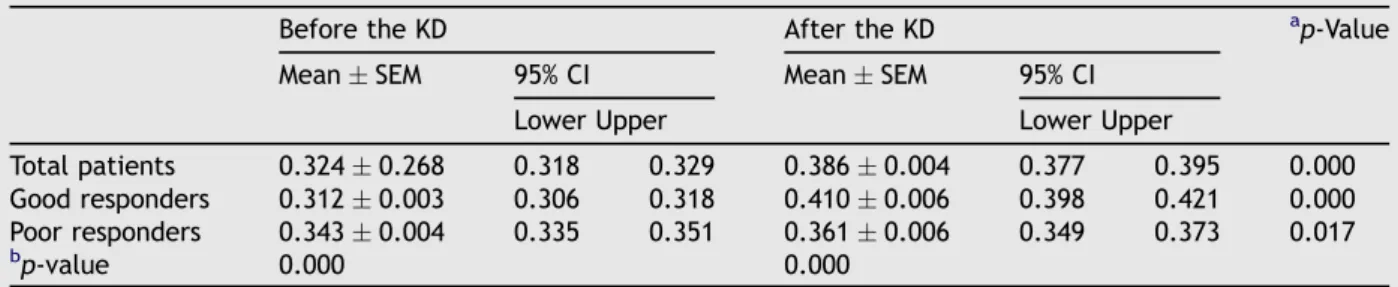
The KD significantly increased the mean SampEn, irrespective of the patient group (treatment effect,
d.f. = 1,F= 147.4,p= 0.000;Table 2). The location
also showed a significant effect on the SampEn
(d.f. = 15, F= 6.8, p= 0.000). However, the effect
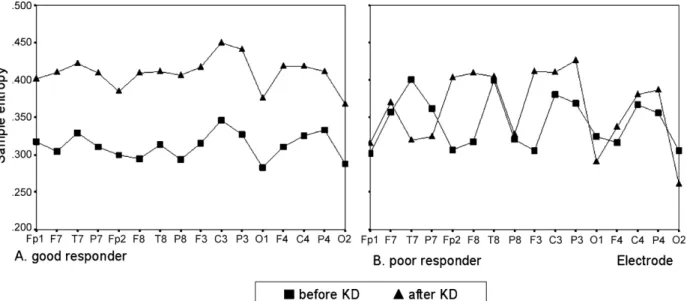
of the group by location did not show a significant interaction. In the good responder group, SampEn values significantly increased in all electrodes after
the KD (d.f. = 1, F= 268.4, p= 0.000; Fig. 1A). In
contrast, in the poor responder group, the change in SampEn after the KD varied according to the
elec-trode (d.f. = 1,F= 5.7,p= 0.017;Fig. 1B).
Before the KD, the mean SampEn revealed a
significant between-group effect (d.f. = 1,
F= 35.2, p= 0.000; Table 2). The good responder
group had significantly lower SampEn values than
the poor responder group (Fig. 1). The location
effect and grouplocation interaction were also
significant. After the KD, the mean SampEn was higher in the good responder group than in the poor
responder group (group effect, d.f. = 1, F= 33.1,
p= 0.000; Fig. 1). The location effect was also
significant. The interaction between the group effect and location effect did not reach the level
of significance (d.f. = 15,F= 1.4,p= 0.113).
Discussion
The objective of the present study was to investi-gate the effect of a KD on EEG dynamics in patients with drug-resistant pediatric epilepsy. We found that a KD increased SampEn in intractable pediatric epilepsy patients, and this was independent of ther-apeutic responsiveness. However, the increase in SampEn was more evident and extensive in good responders than in poor responders.
EEGs represent time-series data that are spatio-temporal summations of the electrochemical
activ-ities of several million neurons.10 Interactions
between neurons and synapses have nonlinear
char-acteristics. Therefore, quantifying nonlinear
dynamic structure of the EEG signal could provide insight into the characteristics and behavior of the underlying neurophysiological processes that
gen-erate the signals.11 The SamEn(m,r,N) is precisely
the negative natural logarithm of the conditional
probability that two sequences within a tolerancer
for m points remain within r of each other at the
next point. SampEn provides a generalized measure of regularity in EEG time-series data. A determinis-tic signal with high regularity has a higher probabil-ity of remaining close for longer vectors of the series and hence has a very small SampEn value. Table 1 Clinical characteristics of the patients
Good responders Poor responders p-Value
Number of patients 10 7
Gender (male:female) 7:3 6:1
Age of seizure onset (months) 4.90.3 3.70.2 NSa
Age at beginning the KD (months) 19.10.5 22.10.6 NSa
Duration on KD (months) 18.10.6 5.00.4 0.001a
Epilepsy syndrome NSb
Generalized seizure 8 6
Partial seizure 2 1
Number of AEDs 2.50.05 3.40.2 NSa
AED, antiepileptic drug.
aMann—Whitney rank-sum test. b
x2test.
Table 2 Sample entropy before and after the ketogenic diet in both patient groups
Before the KD After the KD ap-Value
MeanSEM 95% CI MeanSEM 95% CI
Lower Upper Lower Upper
Total patients 0.3240.268 0.318 0.329 0.3860.004 0.377 0.395 0.000
Good responders 0.3120.003 0.306 0.318 0.4100.006 0.398 0.421 0.000
Poor responders 0.3430.004 0.335 0.351 0.3610.006 0.349 0.373 0.017
b
p-value 0.000 0.000
SEM, standard error of the mean; KD, ketogenic diet; CI, confidence interval.
aANOVA comparing sample entropy before the ketogenic diet to that after the ketogenic diet. b ANOVA comparing good responders to poor responders.
In contrast, a random signal has a very low regularity and produces a high SampEn value.
An increased SampEn value as a result of under-going the KD in the whole patient group indicates that the regularity of the underlying neurodynamics was decreased by this unique treatment. Epileptic activity requires that large aggregates of neuronal activity synchronize and recruit surrounding
neu-rons progressively,12which results in increased
reg-ularity. Most previous studies using nonlinear
analysis methods13 and various entropy
mea-sures14,15 confirmed decreased complexity during
ictal state in patients with epilepsy. The loss of
complexity16,17or irregularity14,15has been
demon-strated even in interictal and preictal states when compared to normal subjects or normal hemi-spheres.
Decreased regularity may be related to reduction of increased neuronal synchrony and/or synaptic interaction in the epileptic state. Previous studies demonstrated that anticonvulsive mechanisms of antiepileptic drugs were associated with increased complexity of brain dynamics. Lehnertz and Elger found a significant inverse relationship between the loss of complexity and serum level of
carbamaze-pine in primary epileptogenic areas.18They assumed
that the anticonvulsive mechanism of carbamaze-pine was attributable to an inhibition of sustained high-frequency firing of bursting neurons. Kim et al. found increased brain complexity after treatment
with valproate in patients with partial epilepsy.17
Our results are in agreement with these previous studies.
Although the KD increased SampEn in the whole patient population, the degree of change was
somewhat different when considering the thera-peutic responsiveness to the diet. It is remarkable that all clinical variables except duration on KD were not significantly different between two groups. Before the KD, however, the patients with
good therapeutic responses (good responder
group) showed significantly lower SampEn values than patients with poor responses (poor responder group). This difference in SampEn between the two groups was reversed after treatment with the KD. In other words, the good responders revealed a marked increase in SampEn in all locations of the brain, while in the poor respon-ders SampEn increased slightly in only some locations of the brain. Jung et al. showed that a lower level of correlation dimension in the late period of status epilepticus was associated with a good response to diazepam in pilocarpine-induced
status epilepticus rats.19 These findings suggest
that susceptibility to the changes in regularity that result from the KD increases as the brain dynamics become more regular. Furthermore, it appears that patients may show a better response to therapy as the increase in SampEn becomes larger.
It could be possible that EEG can be changed either by natural course of epileptic syndrome as patient grows or by the effect of ketogenic diet. The mean age of our patients at beginning the KD was 19—22 months old. The development of brain in this age is not as fast as in infant. In addition, the interval between two EEG data was less than 6 months. Therefore, it can be thought that EEG change is attributed to the KD rather than to the epileptic syndrome itself.
Figure 1 Change in sample entropy before and after the ketogenic diet in good responders (A) and poor responders (B). KD, ketogenic diet.
Electrophysiological studies from rats treated with the KD showed reduced CA1 excitability in vitro and decreased mossy fiber sprouting which suggests that anticonvulsive mechanism of KD may involve long-term changes of excitability
at the level of synaptic networks.20,21 Taken
together, it can be hypothesized that KD may have
anticonvulsive mechanisms by which disturb
synchronizing activities and disconnect synaptic networks ensuing decrease regularity of EEG dynamics.
We used sample entropy instead of approximate entropy to calculate general regularity of EEG dynamics in present study. In contrast to approx-imate entropy, which calculates probabilities in a
template-wise fashion,22SampEn(m,r,N) calculates
the negative logarithm of a probability associated with the time-series as a whole and self-matches are not included in calculating the probability. Thus, it is largely independent of data length and displays relative consistency under circumstances when
approximate entropy does not.6 In addition, the
statistic of sample entropy is a robust quantifier of complexity suited for short physiological signals such as the EEG which results in detecting subtle
changes in the brain state.23
There are some limitations of present study. EEG data were collected retrospectively and the number of patients was small. It is demanded a large cohort of patients who will be treated with the KD to substantiate our results and to identify long-term effect of KD.
Conclusions
The present study revealed that a KD may have an anticonvulsive effect by decreasing the regularity of the EEG in patients with drug-resistant pediatric epilepsy. Nonlinear analysis of EEG may help us understand the pathophysiological mechanisms of therapeutic modalities.
Acknowledgment
This study was supported in part by the research fund of Hanyang University (HY-2005-I) and by a Korea University grant.
References
1. Freeman JM, Kossoff EH, Hartman AL. The ketogenic diet: one decade later.Pediatrics2007;119:535—43.
2. Bough KJ, Rho JM. Anticonvulsant mechanisms of the keto-genic diet.Epilepsia2007;48:43—58.
3. Schwartzkroin PA. Mechanisms underlying the anti-epileptic efficacy of the ketogenic diet. Epilepsy Res 1999;37: 171—80.
4. de Curtis M, Avanzini G. Interictal spikes in focal epilepto-genesis.Prog Neurobiol2001;63:541—67.
5. Freeman WJ. Mesoscopic neurodynamics: from neuron to brain.J Physiol Paris2000;94:303—22.
6. Richman JS, Moorman JR. Physiological time-series analysis using approximate entropy and sample entropy.Am J Physiol Heart Circ Physiol2000;278:H2039—49.
7. Pincus S. Approximate entropy (ApEn) as a complexity mea-sure.Chaos1995;5:110—7.
8. Chul Kang H, Joo Kim Y, Wook Kim D, Dong Kim H. Efficacy and safety of the ketogenic diet for intractable childhood epi-lepsy: Korean multicentric experience.Epilepsia2005;46: 272—9.
9. Thiele EA. Assessing the efficacy of antiepileptic treatments: the ketogenic diet.Epilepsia2003;44(Suppl. 7):26—9. 10. Buzsaki G, Traub RD, Pedley TA.The cellular basis of EEG
activity. 3rd ed. Philadelphia: Lippincott Williams & Wilkins; 2003.
11. Lehnertz K, Andrzejak RG, Arnhold J, Kreuz T, Mormann F, Rieke C,et al.Nonlinear EEG analysis in epilepsy: its possible use for interictal focus localization, seizure anticipation, and prevention.J Clin Neurophysiol2001;18:209—22.
12. Schwartzkroin PA. Origins of the epileptic state.Epilepsia
1997;38:853—8.
13. Stam CJ. Nonlinear dynamical analysis of EEG and MEG: review of an emerging field. Clin Neurophysiol
2005;116:2266—301.
14. Burioka N, Cornelissen G, Maegaki Y, Halberg F, Kaplan DT, Miyata M,et al.Approximate entropy of the electroence-phalogram in healthy awake subjects and absence epilepsy patients.Clin EEG Neurosci2005;36:188—93.
15. van Drongelen W, Nayak S, Frim DM, Kohrman MH, Towle VL, Lee HC,et al.Seizure anticipation in pediatric epilepsy: use of Kolmogorov entropy.Pediatr Neurol2003;29:207—13. 16. Weber B, Lehnertz K, Elger CE, Wieser HG. Neuronal
com-plexity loss in interictal EEG recorded with foramen ovale electrodes predicts side of primary epileptogenic area in temporal lobe epilepsy: a replication study. Epilepsia
1998;39:922—7.
17. Kim JM, Jung KY, Choi CM. Changes in brain complexity during valproate treatment in patients with partial epilepsy. Neu-ropsychobiology2002;45:106—12.
18. Lehnertz K, Elger CE. Neuronal complexity loss in temporal lobe epilepsy: effects of carbamazepine on the dynamics of the epileptogenic focus.Electroencephalogr Clin Neurophy-siol1997;103:376—80.
19. Jung KY, Kim JM, Kim DW. Nonlinear dynamic characteristics of electroencephalography in a high-dose pilocarpine-induced status epilepticus model. Epilepsy Res 2003;54: 179—88.
20. Stafstrom CE, Wang C, Jensen FE. Electrophysiological obser-vations in hippocampal slices from rats treated with the ketogenic diet.Dev Neurosci1999;21:393—9.
21. Muller-Schwarze AB, Tandon P, Liu Z, Yang Y, Holmes GL, Stafstrom CE. Ketogenic diet reduces spontaneous seizures and mossy fiber sprouting in the kainic acid model. Neurore-port1999;10:1517—22.
22. Pincus SM. Approximate entropy as a measure of system complexity.Proc Natl Acad Sci USA1991;88:2297—301. 23. Ramanand P, Nampoori VP, Sreenivasan R. Complexity
quan-tification of dense array EEG using sample entropy analysis.J Integr Neurosci2004;3:343—58.