Louisiana State University
LSU Digital Commons
LSU Doctoral Dissertations Graduate School
2015
Context Aware Textual Entailment
Soha Arab-KhazaeliLouisiana State University and Agricultural and Mechanical College
Follow this and additional works at:https://digitalcommons.lsu.edu/gradschool_dissertations
Part of theEngineering Science and Materials Commons
Recommended Citation
Arab-Khazaeli, Soha, "Context Aware Textual Entailment" (2015).LSU Doctoral Dissertations. 1188.
CONTEXT AWARE TEXTUAL ENTAILMENT
A Dissertation
Submitted to the Graduate Faculty of the Louisiana State University and Agricultural and Mechanical College
in partial fulfillment of the requirements for the degree of
Doctor of Philosophy in
The Interdepartmental Program in Engineering Science
by
Soha A. Khazaeli
B.S., Shahid Beheshti University, 2001 M.S., Isfahan University, 2004
ACKNOWLEDGMENTS
I express my sincere appreciation to my advisor Dr. Gerald M. Knapp for his support, guidance and constructive criticism during the past four and half years of graduate study. I am also thankful to Dr. Jianhua Chen, Dr. Jerry Trahan, and Dr. David Constant for being on my committee.
I would like to thank my fellow graduate students Dr. Leili Javadpour, Dr. Mehdi Khazaeli, Shahrzad Shirzad, and Alireza Kheirkhahan for the help they gave and the knowledge they shared, and the entire semantic analysis research group at LSU.
My gratitude and appreciation goes to Mr. Scott St. Cyr, Mr. and Mrs. Valiollahi, and Mr. and Mrs. Kuehne for their generosity and unconditional love. Along the educational path and throughout my life they have always offered words of encouragement and advice. Their kindness will never be forgotten.
The most substantial contributions to my entire education are, of course, from my parents, siblings Ali, Roja, Mehdi, my in-laws and friends who have been supportive and helpful throughout my life.
I thank my precious son, Faraz, for his sweet smile and his understanding. He has grown up watching me study and juggle with family and work. I am thankful to him for giving me happiness during the hard days.
Finally and most importantly, my deepest appreciation and love goes to my best friend and husband, Reza. He has been by my side throughout this entire process, providing words of encouragement and giving me a shoulder to lean on when I most needed it.
TABLE OF CONTENTS
ACKNOWLEDGMENTS ... ii
LIST OF TABLES ... vi
LIST OF FIGURES ... vii
ABSTRACT ... ix
CHAPTER 1 – PROBLEM STATEMENT ... 1
1.1 Objectives ... 7
CHAPTER 2- LITERATURE REVIEW ... 9
2.1 Inference Based on Text ... 9
2.1.1 Statistical methods ... 9
2.1.2 Transformation based methods ... 12
2.1.3 Logic based methods ... 13
2.2 Context ... 14 2.2.1 Identity ... 16 2.2.2 Status ... 17 2.2.3 Location ... 17 2.2.4 Time ... 17 2.3 Text Representation ... 20 2.3.1 Dependency graphs ... 21
2.4 Common Sense Knowledge ... 21
2.4.1 WordNet ... 22 2.4.2 VerbOcean ... 23 2.5 Related Corpora ... 25 CHAPTER 3- APPROACH ... 26 3.1 Tools ... 27 3.2 Corpus ... 28
CHAPTER 4- CONTEXT IDENTIFICATION ... 32
4.1 Preprocessing ... 33
4.2 Classifying Fine-Grain Contexts (Contexts) ... 33
4.2.1 Features ... 33
4.2.2 Classifier ... 37
4.3 Classifying Coarse-Grain Contexts (Scenes) ... 37
4.4 Context Identification Evaluation ... 38
4.5 Scene Elements ... 41 4.5.1 Context ... 41 4.5.2 Join ... 42 4.5.3 State ... 42 4.5.4 Conversation ... 43 4.4.5 Speech ... 44
4.6 Scene Element Evaluation ... 44
4.7 Evaluation for Semantic Hierarchy ... 48
CHAPTER 5- CONTEXT AWARE TEXT REPRESENTATION... 51
5.1 Structure ... 51 5.1.1 Scene nodes ... 53 5.1.2 Context nodes ... 53 5.1.3 Object nodes ... 54 5.1.4 State nodes ... 54 5.1.5 Event nodes ... 54
5.2 Extraction and Loading of Representation from Stories... 55
5.2.1 Extracting scene nodes’ semantic data ... 56
5.2.2 Extracting context nodes’ semantic data ... 57
5.2.3 Extracting object nodes’ semantic data ... 58
5.2.4 Extracting state nodes’ semantic data ... 58
5.2.5 Extracting event nodes’ semantic data ... 60
5.3 A Short Example of the Text Representation ... 64
CHAPTER 6- KNOWLEDGE GENERATION AND REASONING ... 71
6.1 Knowledge Generation ... 71
6.1.1 Facts ... 72
6.1.2 Inference rules ... 72
6.1.3 Inference results ... 73
6.2 Querying the Knowledge ... 76
6.3 Generalization of Assertions of Scenes and Contexts ... 78
6.4 Text Entailment Evaluation ... 80
CHAPTER 7- CONCLUSION AND FUTURE WORK ... 83
7.1 Recommendations for Future Work... 84
REFERENCES ... 85
LIST OF TABLES
Table 1: Five best participant performances in RTE-7 (main task) ... 3
Table 2: Text features used in textual entailment research ... 10
Table 3: Performance of temporal tagging systems ... 19
Table 4: Semantic relations identified in VerbOcean (Chklovski and Pantel 2004) ... 23
Table 5: Two different measures for inter-annotator agreement ... 29
Table 6: Information about the short stories in the corpus ... 31
Table 7: Context identification evaluation by Pk metric ... 39
Table 8: Pk error comparison ... 40
Table 9: Other evaluation metrics between contexts ... 40
Table 10: Rules for extracting states, modified objects and events ... 43
Table 11: Evaluation metrics for scenes elements ... 45
Table 12: Evaluation by word sense disambiguation ... 49
Table 13: Statistics of the text representation structure ... 66
Table 14: Number of different nodes ... 67
Table 15: Time spent to produce extended TE files ... 76
Table 16: Number of entailed event nodes ... 76
LIST OF FIGURES
Figure 1: RTE example ... 1
Figure 2: Timex3 representation (Pustejovsky et al. 2003) ... 18
Figure 3: TimeML representation (Pustejovsky et al. 2003) ... 19
Figure 4: Dependency graph (De Marneffe and Manning 2008) ... 22
Figure 5: A part of VerbOcean file ... 24
Figure 6: Context aware textual entailment overview ... 27
Figure 7: A tagged document in the corpus ... 30
Figure 8: Context identification overview ... 32
Figure 9: Merging the contexts ... 39
Figure 10: Scene structure ... 41
Figure 11: IsObject function algorithm... 42
Figure 12: Error sources for object-object ... 47
Figure 13: Hierarchical semantic structure ... 51
Figure 14: Text representation structure ... 52
Figure 15: Part of TIPSemB output file ... 57
Figure 16: Dependency graph (Manning et al. 2014) ... 64
Figure 17: Text representation file structure ... 66
Figure 18: The text representation nodes for the example text ... 67
Figure 19: First-order-logic representation ... 70
Figure 20: Knowledge generation overview ... 71
Figure 22: Inference rules ... 73
Figure 23: Extended text entailment file structure ... 74
Figure 24: Part of an extended TE file ... 75
ABSTRACT
In conversations, stories, news reporting, and other forms of natural language, understanding requires participants to make assumptions (hypothesis) based on background knowledge, a process called entailment. These assumptions may then be supported, contradicted, or refined as a conversation or story progresses and additional facts become known and context changes. It is often the case that we do not know an aspect of the story with certainty but rather believe it to be the case; i.e., what we know is associated with uncertainty or ambiguity.
In this research a method has been developed to identify different contexts of the input raw text along with specific features of the contexts such as time, location, and objects. The method includes a two-phase SVM classifier along with a voting mechanism in the second phase to identify the contexts. Rule-based algorithms were utilized to extract the context elements.
This research also develops a new context˗aware text representation. This representation maintains semantic aspects of sentences, as well as textual contexts and context elements. The method can offer both graph representation and First-Order-Logic representation of the text.
This research also extracts a First-Order Logic (FOL) and XML representation of a text or series of texts. The method includes entailment using background knowledge from sources (VerbOcean and WordNet), with resolution of conflicts between extracted clauses, and handling the role of context in resolving uncertain truth.
Keywords: context identification, context aware text representation, first-order-logic, textual entailment, and machine learning.
CHAPTER 1 – PROBLEM STATEMENT
Significant improvements in computational capabilities in recent years, coupled with an explosive growth in online text documents (news, e-books, social media, etc.) have led to growing interest in Natural Language Processing (NLP) research, and in particular Natural Language Understanding (NLU) which deals with the automated extraction of meaning from natural language text or speech.
A significant hurdle remaining for NLU is the area of textual entailment or natural language inference. Textual entailment is a directional relationship between a pair of text expressions: an entailing text (denoted T), and an entailed hypothesis (denoted H). T is said to entail H if the meaning of H can be inferred from the meaning of T, as would typically be interpreted by people (Dagan, Glickman, and Magnini 2006). To illustrate, Figure 1 shows an example of a Recognizing Textual Entailment (RTE) task. The "Text" entails Hyp1 and Hyp3, but not Hyp2.
Text: The Humane Society and SPCA are doing their best to rescue pets trapped in sweltering homes for more than a week. Getting them all will be impossible.
Hyp1: Some pets remained trapped in homes.
Hyp2: ASPCA tried to rescue trapped pets.
Hyp3: SPCA tried to rescue animals
Many NLP problems can benefit from or require RTE capabilities. For example, in document summarization, textual entailment can be used to recognize and remove redundant sentences by checking whether a sentence can or cannot be entailed directly from previous text (Dang and Owczarzak 2008). Information Extraction (IE), the task of extracting instances of certain sets of templates in a text like “X born in Y” or “X capital of Y” can be converted to an entailment problem (Roth, Sammons, and Vydiswaran 2009). Question Answering (QA), which seeks to provide the best answer to a question based on a large collection of documents can use entailment to find the best answers among candidate answers (Harabagiu and Hickl 2006). New research in Machine Translation (MT) evaluation uses entailment to test whether the candidate translation entails (and is entailed by) the reference translation to estimate approximate semantic equivalence between candidate translation and reference translation (Padó et al. 2009). One of the most recently used applications of Textual Entailment is for Intelligent Tutor Systems (ITS), where entailment has been used to determine the extent to which a student’s answer to a question is entailed by the concept which is being taught (Nielsen, Ward, and Martin 2009).
Entailment can be applied in one of two directions: (1) starting with text and deducing hypothesis/hypotheses from the text (the focus of this research), or (2) starting with hypothesis/hypotheses and determining if it/they are entailed from a document or set of documents (the focus of RTE Challenge tasks).
Since 2005, an annual RTE Challenge has been run under PASCAL (Pattern Analysis, Statistical Modelling and Computational Learning), a Network of Excellence (NoE) funded by the European Union. In 2008, the RTE Challenge became a track at the annual Text Analysis Conference (TAC). This challenge provides a uniform platform for comparing state-of-the-art
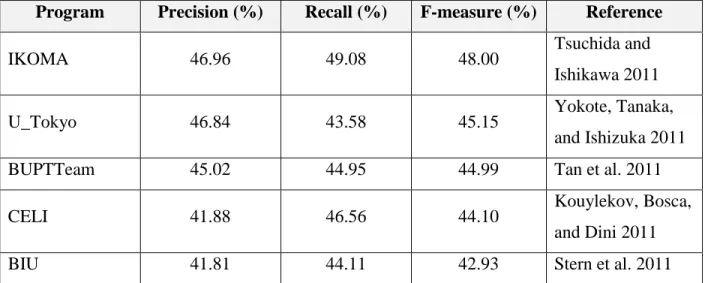
systems. Table 1 shows the performance of the five best participants in the RTE-7 main task held in 2011 (Bentivogli et al. 2011). The results show that task performance is still far from desired for practical application and indicate that more research is needed to achieve satisfactory performance. The joint Student Response Analysis and 8th Recognizing Textual Entailment Challenge was held at the International Workshop on Semantic Evaluation in 2013. The task involved providing feedback on student answers based on reference answers. Although it required semantic inference and therefore is related to recognizing textual entailment (or paraphrasing), the system contained the extracted answer and there was no need to work on a complete text in this particular challenge.
Table 1: Five best participant performances in RTE-7 (main task)
Program Precision (%) Recall (%) F-measure (%) Reference
IKOMA 46.96 49.08 48.00 Tsuchida and
Ishikawa 2011
U_Tokyo 46.84 43.58 45.15 Yokote, Tanaka,
and Ishizuka 2011
BUPTTeam 45.02 44.95 44.99 Tan et al. 2011
CELI 41.88 46.56 44.10 Kouylekov, Bosca,
and Dini 2011
BIU 41.81 44.11 42.93 Stern et al. 2011
Many different approaches have been used in textual entailment research, but they all contain certain shared components. In general, the steps of an RTE system include preprocessing,
off-tagging, dependency parsing, syntactic parsing, named entity recognition (NER), coreference resolution, and semantic role labeling. In the enrichment phase, other resources are often used to provide additional semantic tagging, including WordNet (Fellbaum 1998), VerbNet (Schuler 2005), VerbOcean (Chklovski, Timothy, and Pantel 2004), and FrameNet (Baker, Fillmore, and Lowe 1998).
The alignment component attempts to align the H (hypothesis) to a portion of T (text). The idea is that only a small piece of the text is potentially relevant to a hypothesis. Thus, aligners extract the portion of text which appears relevant to a hypothesis, reducing the search space and simplifying the inference process. De Marneffe et al. used supervised learning by using human annotated alignment data to train their aligner (2007). MacCartney and his colleagues (2008) proposed the MANLI aligner which used phrase-based edit distance and syntactic and semantic features for supervised learning by Microsoft Research (MSR) corpus (Brockett 2007). Other researchers have used different versions of edit distance, and similarity metrics such as WordNet-based word similarity (Hickl and Bensley 2007; Mehdad 2009). Graph-WordNet-based aligners have been very successful as they can capture implicit syntax and semantic aspects, in addition to lexical aspects (Zanzotto, Dell'Arciprete, and Moschitti 2011). The graphs, based on the dependency parse tree of the text and hypothesis, which may be enriched by other resources, are compared together. The most similar part of the text graph and the hypothesis graph, or the portion of text which can be transformed to the hypothesis graph in a series of defined operations, is extracted as the aligned text part (Stern et al. 2011).
The inference component determines whether the starting hypothesis is entailed by, not entailed by, or contradicted by the text. Machine Learning (ML) techniques are the primary method
utilized by most research systems for the inference component. Some researchers have explored First Order Logic (FOL) or other more semantic-oriented methods, but these typically have been "fragile" and cannot handle many situations; their precision may be slightly higher but recall is dramatically lower (Bos and Markert 2005; Bos2013). The successful RTE systems in the RTE-7 Challenges to date have all used machine learning methods, but differ in various features and the extent to which these features are semantic-oriented.
One group of RTE systems research has focused on selecting the best features from (1)
lexical similarity: Lin Similarity (Lin 1998), directional similarity (Kotlerman et al. 2010), similarity based on WordNet, VerbOcean, geographic resource, and n-grams (Heilman and Madnani 2013); (2) syntactic similarity : similarity on matched POS tag words only, similarity on chunk level (Tsuchida and Ishikawa 2011); and (3) semantic similarity: Discovery of Inference Rule from Text (DIRT) similarity (Lin and Pantel 2001), predicate-argument-structure features (Tsuchida and Ishikawa 2011;Tan et al. 2011; Kouylekov, Bosca, and Dini 2011), Named Entity similarity and time expression similarity (Rudzewitz and Ziai 2015).
A second body of research has focused on graph representation of the hypothesis and the text, both containing syntactic and semantic aspects of the reference document. Researchers have defined graph operations, as opposed to inference rules, which can be applied to the graphs. They also have defined various graph features (subgraph similarities, graph operations) to use in ML methods (Stern et al. 2011; Zanzotto, Dell'Arciprete, and Moschitti 2011).
A third group has explored different logic methods for text-inference, such as first-order logic (FOL), natural logic, and episodic logic. Bos and Markert (2005) used the following deep
semantic features extracted from the theorem prover1 Vampire (Riazanov and Voronkov 2002)
and from Paradox, a model builder2 (Claessen and Sorensson 2003): entailed, inconsistent,
domainsize, modelsize, domainsizeabsdif, domainsizereldif, modelsizeabsdif, modelsizereldif. Both programs operate based on first-order logic. MacCartney designed and implemented a natural language inference system (NatLog), based on natural logic theory (Lakoff 1972;van Benthem 1988). In NatLog, machine learning methods were used in some phases of inference (MacCartney 2009). EPILOG, an episodic logic system, uses semantic representation, which supports interpretive and inferential needs of natural logic understanding (Schubert and Hwang 2000). It uses probabilistic methods in some phases of inference, researchers also plan to apply ML methods to increase the scope and robustness of EPILOG (Schubert, Van Durme, and Bazrafshan 2010).
Context has a long history in different areas of artificial intelligence. Context defines state of the environment or world, and clauses may only be true in certain contexts. For instance, the assertion “Joe is hungry” may be true before a dinner event but false immediately after. The first formalization of context was offered by McCarthy (1993). Buvač and Mason (1994) proposed Propositional Logic of Context (PLC). Ghidini and Giunchiglia (2001) proposed MultiContext Systems (MCS) and argued that contextual reasoning can be analyzed as the result of the interaction of the principle of locality3, and the principle of compatibility4. Dey (2001) identified
four categories of context: identity, location, status and time. In spite of the long history of context
1 A system able to prove theorems in first-order logic.
2 A system provides finite-domain models for first-order problems. 3 Reasoning always happens in a context.
in other research areas and its importance in natural language understanding, it has not been considered in advanced text entailment systems.
Despite years of research in textual entailment, state-of-the-art techniques only slightly outperform pure statistical methods. The textual entailment methods suffer from a lack of deep semantics. In addition, most of them require alignment to decrease the problem complexity inherent in textual entailment challenges. Alignment causes local entailment which is in direct contrast to the goal of natural language understanding. In fact, alignment excludes any understanding that requires evaluating relations across more than one sentence. This research focuses on semantic and first-order-logic to obtain inference based on an overall understanding of the text.
1.1 Objectives
The major objectives of this study are:
Develop a system to model document level entailment from story-style documents (news, novels) incorporating the following research advancements:
o Development of a method for detecting context changes in documents. o Development of a FOL and XML representation model for expressing state,
identity, temporal, and spatial knowledge from a document, including knowledge from background (common-sense) knowledge sources.
o Development of a set of rules to enable entailment based on the FOPL representation using common reasoning rules and incorporating background knowledge and context within the rules.
Performance analysis and method refinement of the methods to balance accuracy and semantic depth versus model complexity.
CHAPTER 2- LITERATURE REVIEW
In this chapter, the following text inference methodologies are reviewed: statistical methods, transformation based methods, and logic based methods. Context, definitions and relevant research are discussed followed by an overview of existing text representations. Additionally, two common sense knowledge resources are introduced.
2.1 Inference Based on Text
A critical task in textual entailment is inference. Various research teams utilize different methods to perform inference. These methods are categorized as statistical methods, transformation based methods, and logic based methods.
2.1.1 Statistical methods
Statistical methods and machine learning have been extensively utilized in textual entailment research. Generally, lexical, syntactical and semantic features are extracted for use in a machine learning method, though the selected features vary significantly from research to research. At TAC 2011, Tsuchida and Ishikawa (IKOMA) utilized lexical level, chunk level and predicate-argument-structure level information in a LibSVM classifier (2011). Yokote and his colleagues (2011), as team U-Tokyo, used WordNet Similarity::lch (Leacock and Chodorow 1998) and WordNet Similarity::jcn (Jiang and Conrath 1997), as well as term weights as features. Tan et al. (BUPTTeam) (2011) used the well-known term frequency-inverse document frequency (tf-idf)
factor to feed their SVM-based classifier. Hickl and Bensley used Levenstein (2007) string-edit distance and named entity similarity along with other features. Zanzotto and colleagues (2011),
trees extracted from entailment cases. Bär and his colleages added feature by Greedy String Tiling (GST)5 along other feature in their system Ukp (2012). Bjerva and his colleagues (2014) used more
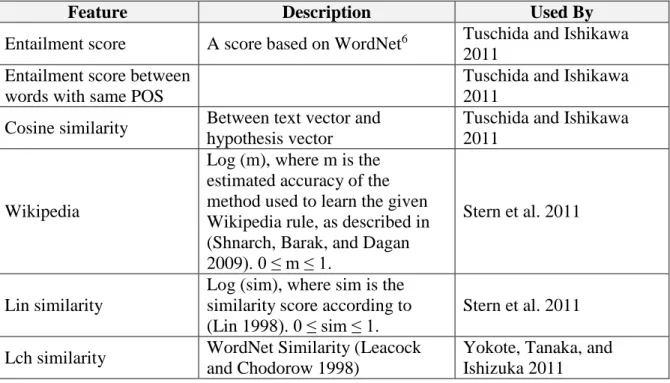
semantic-oriented features such as agent-pair similarity and patient-pair similarity in Discourse Representation Structure (DRS). Rudzewitz and Ziai (2015) added named entity similarity and time expression similarity to their CoMiC system.Table 2 summarizes lexical, syntactical and semantic features which have been used in textual entailment systems.
Table 2: Text features used in textual entailment research
Feature Description Used By
Entailment score A score based on WordNet6 Tuschida and Ishikawa
2011 Entailment score between
words with same POS
Tuschida and Ishikawa 2011
Cosine similarity Between text vector and hypothesis vector
Tuschida and Ishikawa 2011
Wikipedia
Log (m), where m is the estimated accuracy of the method used to learn the given Wikipedia rule, as described in (Shnarch, Barak, and Dagan 2009). 0 ≤ m ≤ 1.
Stern et al. 2011
Lin similarity
Log (sim), where sim is the similarity score according to (Lin 1998). 0 ≤ sim ≤ 1.
Stern et al. 2011
Lch similarity WordNet Similarity (Leacock
and Chodorow 1998)
Yokote, Tanaka, and Ishizuka 2011
5 GST algorithm recognizes the longest sequence of substrings in the source document which is suspected to be plagiarized in another document. The algorithm returns the sequence as tiles from the source document and the suspicious document. 6 Ent_sc(T, H)=∑𝑡ℎ𝜖𝐻𝑡𝑚𝑎𝑡𝑐ℎ(𝑡ℎ,𝑇ℎ𝑡,𝑅)𝑤(𝑡ℎ) ∑𝑡ℎ∈𝐻𝑡𝑤(𝑡ℎ) 𝑤(𝑡) = (𝑙𝑜𝑔 𝑁 𝑓𝑟𝑒𝑞(𝑡)) 𝛼
Here, each Tt and Ht denote a set of words in each given text T and H. w(t) is the weight of the word t, and freq(t) is the weight of the word t in a corpus. N is the number of the texts in the corpus. R is a set of knowledge resources. Match(t,Tt, R) takes 1 if the word t corresponds to a word in Tt, otherwise takes 0.
Table 2 continued
Feature Description Used By
Jcn similarity WordNet Similarity (Jiang and
Conrath 1997)
Yokote, Tanaka, and Ishizuka 2011 WordNet-based
similarity
(Pedersen, Patwardhan, and Michelizzi 2004)
Hickl and Bensley, 2007 , Rudzewitz and Ziai 2015
tf-idf factor Tan et al. 2011
Levenstein string edit-distance
Edit-distance calculated by Levenstein algorithm
Hickl and Bensley, 2007, Rudzewitz and Ziai 2015
Directional similarity
Log (sim), where sim is the similarity score according to (Kotlerman et al. 2010) 0 ≤ sim ≤1.
Tan et al. 2011
Named entity similarity Hickl and Bensley 2007
DIRT
Log (sim), where sim is the similarity score according to (Lin and Pantel 2001). 0 ≤ sim ≤ 1.
Stern et al. 2011
Graph similarity
Similarity between pairs of text trees and pairs of hypothesis trees
Zanzotto, Dell'Arciprete, and Moschitti 2011 Matching ratio for each
chunk type (e.g., NP and VP)
Tuschida and Ishikawa 2011
Matching ratio for each argument type
Tuschida and Ishikawa 2011
The number of negation mismatch in all
corresponding Predicate Argument Structure (PAS)
Tuschida and Ishikawa 2011
The number of modal verb mismatch in all corresponding PAS pairs
Tuschida and Ishikawa 2011
Greedy String Tiling Bär et al. 2012
agent-pair similarity and
patient-pair similarity Bjerva, et al. 2014
Time Expression
2.1.2 Transformation based methods
Transformation based systems attempt to transform the text (or aligned parts of the text) into the hypothesis. The steps utilized usually employ edit distance methods or graph methods. Tree edits distance for textual inference was first used by Punyakanok and his colleagues (2004) in a question answering application. Later, several teams applied the idea in the RTE Challenge (Kouylekov and Magnini 2005). Using Edit Distance Textual Entailment Suite (EDITS) software, edit distance was used to transform the text into the hypothesis using edit distance operation at the string, token, and tree level (Mehdad 2009).
De Salvo Braz et al. (2005) described an RTE system which attempts to transform a text graph to a hypothesis graph using hand-coded rules. The rules capture alternative expressions of information at the lexical, phrasal, syntactic and predicate-argument levels. Bar-Haim et al. and Stern et al. (2007; 2011) classified their system, BIUTEE, as a hybrid system. In the first phase, BIUTEE transforms the tree representation of the text to intermediate trees. The goal was to convert text trees to hypothesis trees, but in most cases it was found not to be possible. Therefore, the transformation steps use a set of lexical and syntactical rules to produce the intermediate tree. Then, the entailment phase extracts features from the intermediate tree and the hypothesis tree and, using a statistical method, decides on the entailment. Lien (2014) classified their system, UIO-Lien, as a graph-based method. They use a semantic representation formalism called Minimal Recursion Semantics (MRS) to represent the text and the hypothesis. Alignment of key nodes in the hypothesis MRS to nodes in the text MRS is indicator of entailment in their system.
One of the most frequently used approaches in transformation based methods is to assign to each substitution in word, phrase or tree level in texts a certain and defined cost. The costs
determine which substitution should be chosen in each step. In the final step, the total cost determines if the transformation with total cost X is a possible transformation from the text to the hypothesis (i.e., the hypothesis is entailed by the text) or not.
2.1.3 Logic based methods
Bos and Markert (2005) investigated adding semantic features to textual entailment using first order logic. Their research used deep semantic features extracted from Vampire, a theorem prover (Riazanov and Voronkov 2002) and Paradox, an FOL model builder (Claessen and Sorensson 2003). Using a statistical method, they applied the semantic features, along with other lexical and syntactical features.
The Boeing Language Understanding Engine (BLUE) system by Clark and Harrison (2009) is based on a formal logical approach. The system converts the text to a logical representation using a bottom-up chart parser. The logical form is then used to infer entailment by WordNet and Discovery of Inference Rule from Text (DIRT) rules. The system uses a Bag of Words (BoW) module if the logical module fails to infer or refute an entailment.
EPILOG, an episodic logic system by Schubert and Hwang using semantic representation, is a reasoning system which has been under development since 1990. EPILOG is based on a natural logic-like representation and inference mechanism (2010) and is designed for forward and goal-directed inference, but there has been no application of this system to textual entailment.
MacCartney (2009) designed and implemented NatLog, a textual entailment system based on natural logic. NatLog implements a new model which extends the monotonicity calculus of van
MacCartney described an expressive set of entailment relations and the algebra employed to determine their joins.
2.2 Context
Context awareness, as a core feature of computing systems, emerged and has been employed since the early 1990s. Since then, researchers and computer scientists have proposed many different definitions, systems, and prototypes - in various applications - to employ the concept of context (Perera et al. 2014). The term context has been defined by many researchers (Brown 1995; Franklin and Flaschbart 1998; Hull, Neaves, and Bedford-Roberts 1997). Dey (2001) provided the most cited definition of context: “Context is any information that can be used to characterize the situation of an entity”. Many context features and context models have been proposed in varied applications (Strang and Linnhoff-Popien 2004). Schilit and his colleagues (1994) used key-value pairs to model context. Several research systems have employed markup scheme models (Knappmeyer et al. 2010; Held, Buchholz, and Schill 2002; Capra, Emmerich, and Mascolo 2003). Bauer et al. and Henricksen et al. (2003; 2003) used the graphical models such as Unified Modeling Language (UML) and Object-Role Modeling (ORM). Strang et al. and Wang et al. (2003; 2004) developed an ontology based model.
The first logic-based formalization of context was offered by McCarthy (1993) and Giunchiglia (1993). According to McCarthy, contexts can partition knowledge into limited sets that include locally true axioms. It is always possible to extrapolate from a local context to a more general context. Buvač and Mason (1994) proposed Propositional Logic of Context (PLC). PLC was an attempt to formalize McCarthy's ideas on context. Conversely, according to Giunchiglia, context is a tool to localize reasoning to a subset of facts, and a more global context for each local
context is not guaranteed (Giunchiglia, Maltese, and Dutta 2012). Ghidini and Giunchiglia (2001) proposed MultiContext Systems (MCS) and argued that contextual reasoning can be analyzed as the result of the interaction of the principle of locality and the principle of compatibility.
The concept of context can be used in natural language processing (NLP) to provide a more complete and unencumbered image of the text in any time and location. According to Miller (1998), context as used in NLP research and applications can be defined by WordNet as follows: “Discourse that surrounds a language unit and helps to determine its interpretation.”
NLP research found context features are valuable data. Therefore, the context features are extracted and applied. The NLP systems that use context features define a length-specific window (e.g., several adjacent words or sentences) and extract the features in the designated window (Gabrilovich and Markovitch 2009; Lin, Ng, and Kan 2014). In more focused research, context is categorized as either local or global. Local context is a short word sequence surrounding the target word whereas global context includes the whole text (Socher et al. 2013; Huang et al. 2012). Local context is valuable, though not sufficient. Dethlefs and Cuayahuitl (2015) cited this particular issue in their research on natural language generation. Processing the entire text is time consuming. Moreover, some of the extracted features can be misleading because they don't belong to the same scene or semantic, and may even be in contradiction to the current point of the text. Context, as based on the above definition, is the largest semantic unit in the text that possesses a coherent and non-contradictory image of the text world, and usually it has a limited time period and a specific location. If this semantic unit (context) can be identified, its features can be very valuable in different applications of NLP.
In linear text segmentation, early approaches utilized linguistic information such as cue phrases, syntax or lexical features (Beeferman, Berger, and Lafferty 1999). The dominant direction in current text segmentation research is based on the idea that when the topic changes, the vocabulary also changes (Choi 2000; Malioutov and Barzilay 2006). Another recent notable research trend is using topic models for text segmentation (Misra et al. 2009; Du, Buntine, and Johnson 2013).
About 15 years ago, researchers began exploring scene detection in video segmentation. A scene is a section of a motion picture with unified time and space (Katz 1998), and is very close to the concept of context in this research. The goal is to find a semantically meaningful scene automatically (Del Fabro and Böszörmenyi 2013). The features available for the task include visual, audio and text. Zhai and her colleagues (2005) used text cues to construct a text feature along with other features to boost scene detection accuracy. Wang and his colleagues (2008) developed multimodal features including images, audio streams, and text transcripts to segment the videos, and reported the results according to the type of feature and the hybrid system used. The text features alone produced an F-measure of about 50 percent.
2.2.1 Identity
Identity describes the concept of assigning a unique identifier to an entity. An entity is any unique object or event. An entity may (and often does) exist across contexts.
2.2.2 Status
Status refers to the intrinsic characteristics of an entity within a context. Every status property assigned to an entity during the timeline of the text develops the status context. Generally these attributes are adjectives or adverbs.
2.2.3 Location
Context location includes places, geographical coordinates, elevation, and/or relative spatial relations (e.g., here, there, up, down, etc.). Named Entity Recognition (NER) systems extract locations within the text in addition to other entities (e.g., organization, person, etc.). Latitude and longitude of the location can be obtained via a geocoding API (e.g., Google) and added to the extracted information.
2.2.4 Time
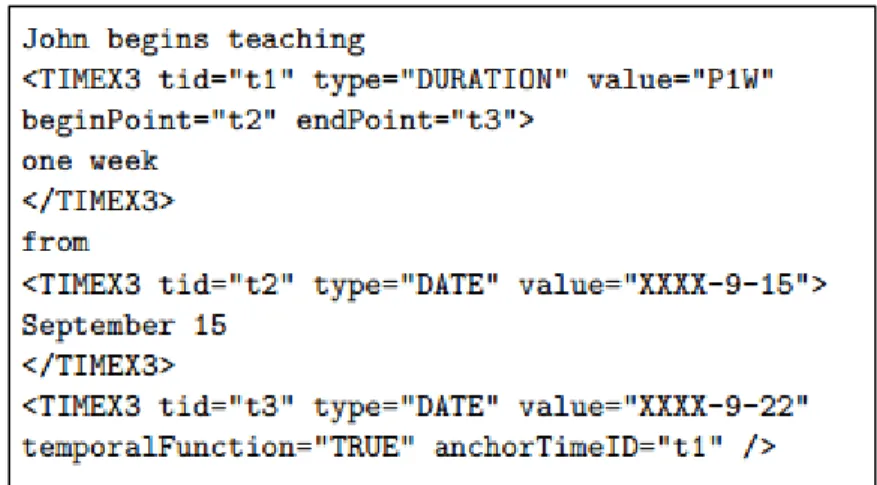
Time is an important contextual feature and, as such, a standard representation of the expression and temporal order of events should be used. TimeML is a powerful specification language for event and temporal expressions in natural language text. It includes four major data structures: Event, Timex3, Signal, and Link. Event refers to the situation or event that occurred, including
attributes such as the id, tense, aspect, etc. Timex3 (an extension of Timex2) is used to markup
explicit temporal expressions, including times, dates, durations. Figure 2 shows Timex3 tags for “John begins teaching one week from September 15”.
Figure 2: Timex3 representation (Pustejovsky et al. 2003) .
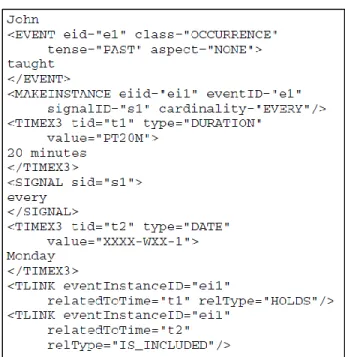
Signal is a tag to show function words, which indicate temporal relation. In Figure 3, “every” is a signal. Link tags encode the different relations that exist between the temporal elements of a text. Link tags include TLink7, Slink8, and ALink9. Figure 3 is a TimeML representation of “John taught 20 minutes every Monday”.
State-of-the-art approaches to temporal challenges exhibit high accuracy in temporal expression extraction (Timex3) and event detection, but low accuracy in temporal relation detection. Table 3 summarizes the top accuracy performances reported for the TempEval3 Challenge in 2013 (UzZaman et al. 2012).
7 A link representing temporal relations including before, after, includes, is-included, holds, simultaneous, after, before, identity, begins, ends, begun-by, and ended-by.
8 A subordination link used for contexts introducing relations including modal, negative, evidential, neg-evidential,
factive, and counter-factive.
9 A link representing the relationship between an aspectual event and its argument event including initiates, culminates, terminates, and continues.
Figure 3: TimeML representation (Pustejovsky et al. 2003)
Table 3: Performance of temporal tagging systems
Task Name Task Approximate Accuracy
of the Best Systems
A Temporal expression 90%
B Event extraction 80%
C Temporal relation (only) 55%
2.3 Text Representation
Many different approaches have been used in text representation research, but they can be categorized into two major groups. The first group is based on statistics, and the second group, comprised mainly of linguistics experts as opposed to text mining experts, is based on graphs.
Bag of Words (BoW) is a basic methodology of statistical text representation models. BoW is used to track any word in the text, along with its frequency. This method of text representation is called a Vector Space Model (VSM) (Salton, Wong, and Yang 1975). Another text representation model, N-grams, records the frequency of each n-word, rather than each word. In this particular usage, the VSM functions as a unigram model (Brown et al. 1992). To address the shortcomings of previous approaches, researchers assigned appropriate weights to the terms, a process known as term weighting. The most common method of term weighting is term frequency-inverse document frequency (tf-idf) (Lan et al. 2009). Latent Semantic Indexing (LSI) uses statistical methods to glean the most representative features of a document (Wei, Yang, and Lin 2008). Locality Preserving Indexing (LPI) discerns the characteristic features of the document (Cai et al. 2007). These statistical text representation methods work well for certain Natural Language Processing (NLP) problems such as text categorization.
Many computational linguistic experts, however, rely on more semantic-oriented text representation methods (Mihalcea and Radev 2011). The idea of using graphs as conceptual representations for language units and their relationships originated with early work in the field of psychology by Sigmund Freud and psycholinguists such as Schvaneveldt and Spitzer. Although the statistical representation of documents used in some NLP applications generates reasonable accuracy, a large amount of syntactical and semantic information is lost when sentences and
paragraphs are reduced to a vector. Advanced level NLP problems requiring Natural Language Understanding (NLU) (e.g., Text Entailment) can benefit from a more semantic-oriented text representation. For such applications, computational linguists turned to constituency-based and dependency-based parse trees.
2.3.1 Dependency graphs
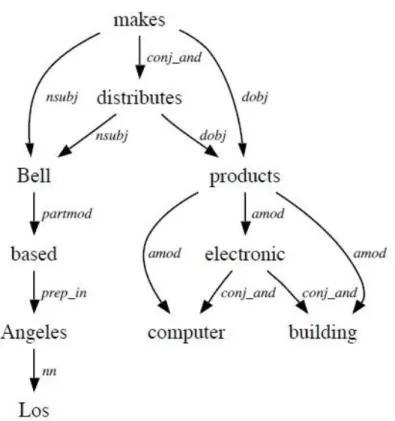
Computational linguists developed tools of generating parse trees automatically both as a means of analyzing sentence structure and as representations of text (De Marneffe et al. 2007). Dependency-based parse graphs (parse trees based on dependency grammar) are used in various NLP research (Heilman and Smith 2010; Schmitz et al. 2012; Socher et al. 2014). They derive from the thematic relation of sentence part to verb and are usually represented by graphs. A major problem for early researchers was the complexity of the resulting structures, and hence any application was limited. This has changed in recent years, and now graph-based text representations are widely used. Figure 4 depicts a dependency graph for the sentence “Bell, based in Los Angeles, makes and distributes electronic, computer and building products”.
2.4 Common Sense Knowledge
Common sense, or background knowledge, plays an important role in entailment. Synonyms, paraphrasing, and common sense facts/relations are considered background knowledge. For example, if somebody reads “An earthquake happened in San Francisco in 1906”, they would likely be able to answer the question “Did an earthquake happen in California in 1906” because they have the unstated background knowledge: San Francisco is located in California. In this
research, WordNet (Fellbaum 1998) and VerbOcean (Chklovski and Pantel 2004) will be used as common sense knowledge sources.
Figure 4: Dependency graph (De Marneffe and Manning 2008)
2.4.1 WordNet
WordNet is a large lexical database of the English language. Nouns, verbs, adjectives and adverbs are assembled into sets of cognitive synonyms (synsets), each expressing a distinct concept. Each word appears in one or more synsets, reflecting the ambiguity of words in natural languages. In some cases (e.g., antonyms), a relation exists only between two words, and not the entire synset. Synsets are interconnected by means of conceptual-semantic and lexical relations, and can be visualized as a graph with edges between words bearing some relationship. Such relationships
include hypernyms10, hyponyms11, coordinate terms12, holonym13, meronym14, troponym15, entailment16, related nouns, similar to, participle of verb, and root adjectives.
2.4.2 VerbOcean
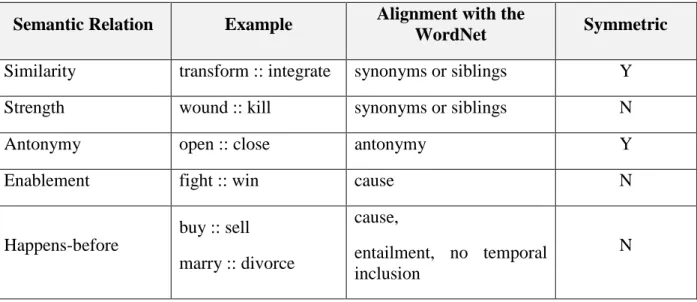
VerbOcean is a semantic network of verbs comprised of 3,477 verbs as nodes and 22,306 relations as edges. VerbOcean groups the relationship between two verbs into one of five categories. Table 4 depicts VerbOcean semantic relations.
Table 4: Semantic relations identified in VerbOcean (Chklovski and Pantel 2004)
Semantic Relation Example Alignment with the
WordNet Symmetric
Similarity transform :: integrate synonyms or siblings Y
Strength wound :: kill synonyms or siblings N
Antonymy open :: close antonymy Y
Enablement fight :: win cause N
Happens-before buy :: sell marry :: divorce cause, entailment, no temporal inclusion N 10Y is a hypernym of X if every X is a Y. 11Y is a hyponym of X if every Y is an X.
12Y is a coordinate term of X if X and Y share a hypernym. 13Y is a holonym of X if X is a part of Y.
VerbOcean pairs verbs according to their semantic relations. A numeric weight is assigned to each verb pair indicating the degree of the relation. Figure 5 depicts part of a VerbOcean file.
Figure 5: A part of VerbOcean file
Discovery of Inference Rules from Text (DIRT) is both an algorithm and a resulting knowledge collection. The algorithm automatically learns paraphrase relations (relations between synonymous expressions) between nouns using a dependency tree. If two different expressions tend to represent a binary relationship between the same set of nouns, DIRT concludes the two different expressions are paraphrase. The DIRT algorithm, mining a 1GB set of newspaper text (San Jose Mercury, Wall Street Journal, and AP Newswire from the TREC-9 collection) generated the following Top-20 paraphrases for “X solves Y”:
Y is solved by X, X resolves Y, X finds a solution to Y, X tries to solve Y, X deals with Y, Y is
resolved by X, X addresses Y, X seeks a solution to Y, X does something about Y, X solution
to Y, Y is resolved in X, Y is solved through X, X rectifies Y, X copes with Y, X overcomes Y,
X eases Y, X tackles Y, X alleviates Y, X corrects Y, X is a solution to Y, X makes Y worse, X
irons out Y.
In this research, VerbOcean is used. While DIRT shows relations generically, VerbOcean identifies relations explicitly and also provides frequency weights for each pair.
2.5 Related Corpora
The research described in this dissertation requires a corpus with features necessary for textual entailment. There are a number of textual entailment-related corpora such as FraCaS Corpus (Cooper et al. 1996) and RTE-7 Corpus (Dzikovska et al. 2013) but these corpora were developed for reverse entailment (entailment proving) rather than the forward entailment (entailment generation) addressed in this research. This research also requires a corpus with context tags but no such corpus exists. Hence a corpus is constructed for this research.
CHAPTER 3- APPROACH
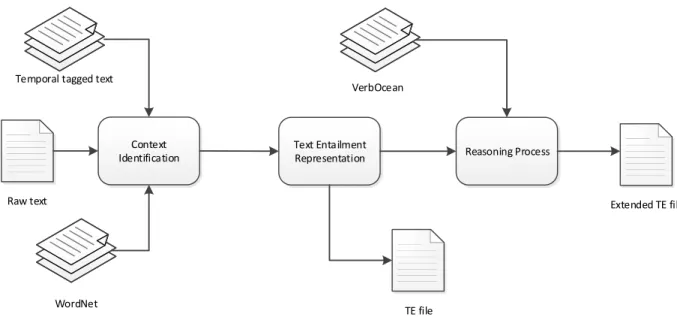
This research develops a forward context aware textual entailment method. A schematic overview of the methodology is shown in Figure 6. The following sub problems were resolved in the development of the model:
Development of a method for detecting context changes in documents.
Development of a method for extracting contexts and their elements in documents.
Development of the necessary preprocessing steps to generate a graph representation of the document supporting semantic hierarchy and the entailment system and
incorporating background knowledge.
Development ofmethods for converting the graph to first-order-logic statements and also xml structured files.
Implementation, measurement and analysis of results, and refinement of the entailment system.
This research aims to provide a forward textual entailment method which is “aware” of context changes in text. Chapter 4 explains how the proposed system identifies changes for two classes of contexts: fine-grain and coarse-grain. A fine-grain context (simply called context) is a cohesive and consistent block of input text consisting of several sentences. Sentences in fine-grain context generally have strong semantic relations. Coarse-grain context is called scene in this research. A coarse-grain context or scene consists of several fine-grain contexts and usually takes place in a specific time and/or location.
Raw text
Context Identification
Text Entailment
Representation Reasoning Process
WordNet
VerbOcean
Extended TE file
TE file Temporal tagged text
Figure 6: Context aware textual entailment overview
Chapter 5 describes a knowledge representation model that incorporates the hierarchical context semantics of a text while maintaining semantic detailed information of text elements. Chapter 6 expounds on reasoning and producing extra knowledge.
3.1 Tools
The following tools and programming language are used in the methodology and evaluation of this research: Java 1.817 in NetBeans IDE 8.0.218; LibSVM 3.18 (Chang and Lin 2011); CoreNLP
3.5.019 (the Stanford NLP Package) (Manning et al. 2014) including word segmentation, POS tagging, named entity recognition, coreference resolution, time expression extraction; WordNet
Similarity Package20 (Pedersen, Patwardhan, and Michelizzi 2004); Google GeoCode API21; TIPSemB22 (Llorens, Saquete, and Navarro 2010) C99 UIMA Text Segmenter23 (Choi 2000)
Babelfy24 (Moro, Cecconi, and Navigli 2014).
3.2 Corpus
To provide the basis for an absolute (rather than comparative) evaluation, a human annotated (gold-standard) corpus was created consisting of 20 English-language documents. Two reviewers annotated the documents. Inter-annotator agreement is calculated for context (scene) identification based on Cohen’s kappa coefficient:
𝜅 =Pr(𝑜) − Pr (𝑒) 1 − Pr (𝑒)
(Eq. 1)
Where Pr(o) is the relative observed agreement among annotators, and Pr(e) is the hypothetical probability of chance agreement. The calculated kappa is equal with 68.82% which categorizes the agreement as a substantial agreement. There are 1716 sentences in the corpus. Each sentence can be the beginning of a scene or not. Two reviewers agreed on this decision on 1633 sentences, so Pr(o) is 1633/1716=95.16%. The hypothetical probability of chance agreement is 84.35%. Reviewer “A” categorized sentences as the end of scene 9.73% of the time, and Reviewer “B” categorized sentences as the end of a scene 7.34% of the time. Thus, the probability both of them
20 https://wn-similarity.sourceforge.net/
21 https://developers.google.com/maps/documentation/geocoding/ 22 http://timexportal.wikidot.com/tipsem
23 https://code.google.com/p/uima-text-segmenter/ 24 https://babelfy.org/
would categorize a sentence as the end of a scene randomly is 9.73%*7.34%=0.71%, and the probability that both of them would not categorize a sentence as the end of a scene randomly is (1-9.73)% * (1-7.34)% = 83.64%. Thus the overall probability of random agreement is Pr(e) = 0.71% + 83.64% = 84.35%. Most of the disagreements were because one of the reviewers marked smaller and more specific scenes. Although Cohen’s kappa coefficient is a standard metric for measuring inter-annotator agreement for NLP corpora, but it doesn’t completely fit for text segmentation problems. Therefore, the Pk Error also is calculated between the two reviewers’ corpus. The Pk
Error between two corpora is calculated as 12.19%. Table 5 shows the result of two different ways of calculating inter-annotator agreement.
Table 5: Two different measures for inter-annotator agreement
Cohen’s kappa coefficient (%) Pk Error (%)
68.82 12.19
Conflicts between the two annotated set of texts were resolved by a third reviewer by voting among the three reviewers. GATE25 Annotation (Cunningham et al. 2002) was used for annotation,
communication, and review in the creation process. The dataset includes 135 scene contexts, 153 scene context changes, and 1,716 sentences. The number of scene context changes is increased 1 unit by appearance of the beginning of a different scene context. The number of scene changes are more than number of scenes because some of the scenes include several segments in different parts of the stories. Figure 7 shows a document in the corpus and Table 6 provides information about the stories in the corpus.
Table 6: Information about the short stories in the corpus
Title Author Genre Year Contexts # Sentences # Words #
Covenant Crystal Arbogast Fiction 2000 6 138 1652
Hobnail Crystal Arbogast Fiction 2001 4 133 1669
The Whale Sound Roger Dean Kiser Fiction - 6 43 983
The Three Fisherman Tom Sheehan Fiction - 3 106 1950
Three Years Katya AaltoTanssija Non-Fiction - 3 57 799
Shame Amy Monticello Non-Fiction 2014 3 41 769
Ten Years Ago Sarah Beth Childers Non-Fiction 2014 4 46 737
Like Momma Lonette Stayton Non-Fiction 2014 2 44 548
The Return Fernando Sorrentino Science Fiction - 7 96 1919
The Star Esther Claes Science Fiction - 6 63 1084
The Adventures Of Aladdin The Brothers Grimm Fairy Tale - 12 146 1826
Beauty and The Beast Unknown Fairy Tale - 13 117 1413
The Adventures of Thumb Tom Unknown Fairy Tale - 7 62 835
The Country Mouse and The Town Mouse Unknown Fairy Tale - 2 58 674
The Mighty Monster Afang Unknown Fairy Tale - 6 108 2267
The King's Treasure Unknown Fairy Tale - 13 118 2217
The Lady of The lake Unknown Fairy Tale - 13 114 2208
The Touch of The Clay Unknown Fairy Tale - 11 93 1797
CHAPTER 4- CONTEXT IDENTIFICATION
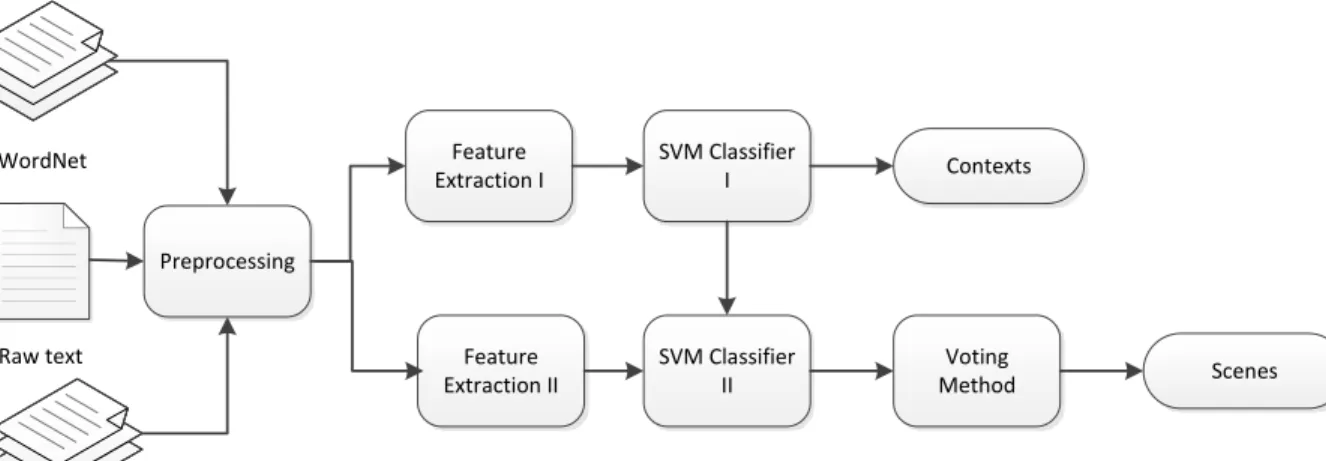
In this chapter, a two-phase technique is presented to identify scene-level contexts within a text. After identifying the contexts, the context elements (including time, location, objects, states, and dialogue) are extracted.
The raw text is first preprocessed to obtain POS tags, dependency graphs, coreferences, name entities, times, events, and their respective relations. Based on this information, 16 features are extracted. A trained supervised classifier will determine whether a particular sentence belongs to the previous context, or is the start of a new context. Fine-grain contexts (here after referred to simply as "contexts") are determined based on the features. A second trained supervised classifier with a cached voting mechanism will determine the coarse-grain contexts (here after referred to as "scenes").
Figure 8: Context identification overview
Raw text
Preprocessing
Feature Extraction I
Temporal tagged text
SVM Classifier I Contexts Feature Extraction II SVM Classifier II Scenes Voting Method WordNet
4.1 Preprocessing
The raw text goes through preprocessing including sentence segmentation, word segmentation, POS tagging (Toutanova and Manning 2000; Toutanova et al. 2003) and sentence parsing (Klein and Manning 2003). These tasks are executed by CoreNLP, developed by the Stanford natural language processing group (Manning et al. 2014). Preprocessing output includes a dependency graph for each sentence (De Marneffe, MacCartney, and Manning 2006) a coreference graph (Lee et al. 2011; Lee et al. 2013) and named entities of input text (Finkel et al. 2005). The coreference graph represents a chain of mentions in textual order, showing all words that coreference to one word. The named entity classifier recognizes person, location, organization, miscellaneous, date, time, money, and number. A very important feature of context is time. TimeML standard rules are
used for time expressions and the temporal order of events. Temporal tags are provided using the temporal information processing system TIPSemB (Llorens, Saquete, and Navarro 2010).
4.2 Classifying Fine-Grain Contexts (Contexts)
A classifier determines whether a particular sentence belongs to: (1) the previous context, or (2) the starting point of a new context.
4.2.1 Features
A group of features is extracted to classify each sentence as part of the previous context, or the start of a new context.
𝐹1 = {
1 𝑖𝑓 𝑡ℎ𝑒 𝑡𝑤𝑜 𝑣𝑎𝑙𝑖𝑑 𝑡𝑖𝑚𝑒𝑠 𝑎𝑟𝑒 𝑑𝑖𝑓𝑓𝑒𝑟𝑒𝑛𝑡 0.5 𝑖𝑓 𝑜𝑛𝑒 𝑜𝑓 𝑡ℎ𝑒 𝑡𝑖𝑚𝑒𝑠 𝑎𝑟𝑒 𝑒𝑚𝑝𝑡𝑦
0 𝑜𝑡ℎ𝑒𝑟𝑤𝑖𝑠𝑒
(Eq. 2)
The existence of a time expression in a sentence, as well as time differences between two sentences, can be an indication of a new context. For example, in “During his high school years, as the weather grew warm, he would cut classes with Vince and hitchhike to the
beach”, the time expression (underlined) signals the start of the new context.
Location Similarity (F2) shows the similarity of the location in current context and previous context: 𝐹2 = { 1 𝑖𝑓 𝑡ℎ𝑒 𝑡𝑤𝑜 𝑣𝑎𝑙𝑖𝑑 𝑙𝑜𝑐𝑎𝑡𝑖𝑜𝑛𝑠 𝑎𝑟𝑒 𝑑𝑖𝑓𝑓𝑒𝑟𝑒𝑛𝑡 0.5 𝑖𝑓 𝑜𝑛𝑒 𝑜𝑓 𝑡ℎ𝑒 𝑙𝑜𝑐𝑎𝑡𝑖𝑜𝑛𝑠 𝑎𝑟𝑒 𝑒𝑚𝑝𝑡𝑦 0 𝑜𝑡ℎ𝑒𝑟𝑤𝑖𝑠𝑒 (Eq. 3)
A location in a sentence can be an indication of a new context. For example, “Uncle Jack had left the county, as well as the state of Virginia”.
Time Type (F3) sorts the time of current context by duration and time point:
𝐹3 = {1 𝑖𝑓 𝑡ℎ𝑒 𝑡𝑖𝑚𝑒 𝑖𝑠 𝑎𝑛 𝑒𝑥𝑝𝑙𝑖𝑐𝑖𝑡 𝑡𝑖𝑚𝑒 𝑜𝑟 𝑑𝑎𝑡𝑒
0 𝑖𝑓 𝑡ℎ𝑒 𝑡𝑖𝑚𝑒 𝑖𝑠 𝑑𝑢𝑟𝑎𝑡𝑖𝑜𝑛 (Eq. 4)
Research suggests the hypothesis that time points increase the probability of a new context more than duration.
Time Position (F4) shows the location of the time expression within a sentence:
𝐹4 = time expression position index
Generally, if the time expression appears in the first words of the sentence, it is probably a new context.
Coreference Ratio (F5):
𝐹5 =|𝑐𝑜𝑟𝑒𝑓𝑒𝑟𝑒𝑛𝑐𝑒𝑠 𝑏𝑒𝑡𝑤𝑒𝑒𝑛 𝑡𝑤𝑜 𝑐𝑜𝑛𝑡𝑒𝑥𝑡𝑠|
|𝑜𝑏𝑗𝑒𝑐𝑡𝑠 𝑖𝑛 𝑐𝑢𝑟𝑟𝑒𝑛𝑡 𝑐𝑜𝑛𝑡𝑒𝑥𝑡| (Eq. 6)
A coreference between two parts of text indicates a strong connection between parts and decreases the probability of a new context.
Transition (F6):
𝐹6 = {1 𝑖𝑓 "before" 𝑜𝑟 "after" temporal link exists between two contexts
0 𝑜𝑡ℎ𝑒𝑟𝑤𝑖𝑠𝑒 (Eq. 7)
Temporal links such as includes, hold, and simultaneous indicate increased concurrency
and coherency, and decrease the probability of a new context.
Special expression (F7):
Existence of the following expressions causes F7 to be 1, otherwise 0:
Once upon a time
hours\days\weeks\months\... later
After several hours\days\weeks\months\... Later on
From this time forth …
Paragraph Start (F8):
𝐹8 = {1 𝑖𝑓 𝑖𝑡 𝑖𝑠 𝑏𝑒𝑔𝑖𝑛𝑛𝑖𝑛𝑔 𝑜𝑓 𝑎 𝑝𝑎𝑟𝑎𝑔𝑟𝑎𝑝ℎ
0 𝑜𝑡ℎ𝑒𝑟𝑤𝑖𝑠𝑒 (Eq. 8)
Context switches often occur at the start of a new paragraph, although many times new paragraphs are not context switches.
Conversation Ratio (F9):
𝐹9 = |𝑐𝑜𝑛𝑣𝑠𝑒𝑛𝑡| |𝑐𝑢𝑟𝐶𝑡𝑥𝑠𝑒𝑛𝑡|
(Eq. 9)
where |𝑐𝑜𝑛𝑣𝑠𝑒𝑛𝑡| is the number of dialogue sentences in the current context and
|𝑐𝑢𝑟𝐶𝑡𝑥𝑠𝑒𝑛𝑡|is the number of sentences in the current context. The conversations take place
within the current context, and they usually do not change the context.
Previous Conversation Ratio (F10):
𝐹10 =|𝑝𝑟𝑒𝐶𝑜𝑛𝑣𝑠𝑒𝑛𝑡| |𝑝𝑟𝑒𝑣𝐶𝑡𝑥𝑠𝑒𝑛𝑡|
(Eq. 10)
where |𝑝𝑟𝑒𝐶𝑜𝑛𝑣𝑠𝑒𝑛𝑡| is the number of dialogue sentences in the previous context and
|𝑝𝑟𝑒𝑣𝐶𝑡𝑥𝑠𝑒𝑛𝑡|is the number of sentences in the previous context.
Common Object (F11):
𝐹11 = {1 𝑖𝑓 𝑎𝑡 𝑙𝑒𝑎𝑠𝑡 𝑜𝑛𝑒 𝑜𝑏𝑗𝑒𝑐𝑡 𝑒𝑥𝑖𝑠𝑡𝑠 𝑖𝑛 𝑏𝑜𝑡ℎ 𝑐𝑜𝑛𝑡𝑒𝑥𝑡𝑠
0 𝑜𝑡ℎ𝑒𝑟𝑤𝑖𝑠𝑒 (Eq. 11)
The term object means a tangible and physical entity. To identify such objects, a recursive
algorithm is used to check the ancestors of the noun and its hypernym hierarchy. This algorithm is described in section 4.5.2. If two parts of the text have common objects, it is more likely that the two parts belong to one context.
Wordnet Similarities (F12-F16): Includes Wu-Palmer Similarity (Wu and Palmer 1994), Leacock-Chodorow Similarity (Leacock and Chodorow 1998), Jiang-Conrath Similarity (Jiang and Conrath 1997) Resnik Similarity (Resnik 1995) and Lin Similarity (Lin 1998). WordNet can only be used for words with identical POS tags. Thus the WordNet similarity is the average of all Wordnet similarities between matching pairs from two contexts:
𝑠𝑖𝑚𝑖𝑗 =
∑ 𝑠𝑖𝑚𝑤𝑖,𝑘,𝑤𝑗,𝑙
𝑛 (Eq. 12)
where 𝑤𝑖, 𝑘is kthword in ithcontext, 𝑠𝑖𝑚𝑤
𝑖,𝑘,𝑤𝑗,𝑙is WordNet similarity between two words,
𝑠𝑖𝑚𝑖𝑗is average WordNet similarity between two contexts, and n is the number of paired
words.
4.2.2 Classifier
The feature vectors related to current and immediately previous sentences (context) are inputs to a classifier, which then determines whether two contexts should merge (class 0) or the current context is the start of a new context (class 1).
LibSVM (Chang and Lin 2011) proven to be powerful and efficient in NLP applications, has been chosen as the classifier to be trained in this research. The feature vectors include both positive and negative instances and were filtered to eliminate redundancy. Several negative instances were randomly removed to balance the number of positive and negative instances.
4.3 Classifying Coarse-Grain Contexts (Scenes)
produce blocks of sentences that are within the same context but are in non-adjacent positions within the text. To handle this, a classifier was developed for a second phase of categorization.
In phase two, the classifier determines whether or not any two recently specified contexts should merge. The feature vector elements for this phase are similar to the previous phase, except that in phase one, all features were calculated based on the current sentence and the previous sentence, whereas in this phase all features are calculated based on two input contexts. Each context now has a number of probable contexts with which it can merge. For this determination, a voting method considering local priority is used. This method merges any two adjacent contexts that the classifier has previously deemed merge-able, thus resolving the smaller than judged context problem. The adjacency problem caused by flash-forward and flashback is also resolved: any two contexts having greater intersection between their probable merge-able contexts and also are closer together rather than other candidates should be merged. The algorithm is shown in Figure 9.
4.4 Context Identification Evaluation
The context identifier in this research splits the text into segments. 𝑃𝑘metric is the standard
measure used to assess text segmentation algorithms (Beeferman, Berger, and Lafferty 1999). 𝑃𝑘
is an error metric indicating the percent error of the text segmentation. To calculate 𝑃𝑘, 𝑘is set to
half the average of true segment size, and then penalties computed by a moving window of length 𝑘. At each location in the reference segmentation it is determined whether the start and end
of the window occurs in the same segment. Same task is done on the classified segmentation concurrently. If the classified segmentation disagrees with reference segmentation, the counter will be increased. The 𝑃𝑘error is the average of the counter over the sliding window, and its value is
between 0 and 1. 𝑃𝑘error is calculated for the both phases of context identification. Table 7 shows
an evaluation of the context identification process.
Figure 9: Merging the contexts
Table 7: Context identification evaluation by Pk metric
Context Identification Phase K Pk error
I 6 0.30
II 6 0.28
The result obtained is then compared to a standard text segmentation algorithm known as C99 (Choi 2000) which is implemented in UIMA26 (Unstructured Information Management
Architecture). The comparison is depicted in Table 8.
Table 8: Pk error comparison
Context Identification Phase Pk error
C99 0.42
I 0.30
II 0.28
In phase I, coherent semantic segments are developed, but the size of the contexts produced is smaller than the judged context. To evaluate this claim, the classified contexts are investigated using Equation 13. 𝐶𝑠𝑖𝑚 = ∑ ∑ |𝐶𝑐𝑙𝑎𝑠𝑠𝑖𝑓𝑖𝑒𝑑𝑖,𝑡∩ 𝐶𝑗𝑢𝑑𝑔𝑒𝑑𝑗,𝑡| |𝐶𝑐𝑙𝑎𝑠𝑠𝑖𝑓𝑖𝑒𝑑𝑖,𝑡| 𝑛 𝑖=1 𝑚 𝑡=1 𝑚 ∗ 𝑛 (Eq. 13) where 𝐶𝑐𝑙𝑎𝑠𝑠𝑖𝑓𝑖𝑒𝑑𝑖,𝑡is the i
th context classified in tth text with the classifier, 𝐶
𝑗𝑢𝑑𝑔𝑒𝑑𝑗,𝑡 is the most
similar judged context to 𝐶𝑐𝑙𝑎𝑠𝑠𝑖𝑓𝑖𝑒𝑑𝑖,𝑡, nis the number of classified contexts, m is the number of
texts, and |𝐶𝑐𝑙𝑎𝑠𝑠𝑖𝑓𝑖𝑒𝑑𝑖,𝑡∩ 𝐶𝑗𝑢𝑑𝑔𝑒𝑑𝑗,𝑡| is the number of sentences appearing in both 𝐶𝑐𝑙𝑎𝑠𝑠𝑖𝑓𝑖𝑒𝑑𝑖,𝑡 and
𝐶𝑗𝑢𝑑𝑔𝑒𝑑𝑗,𝑡. The average of size ratio between judged contexts and classified contexts, and the
average of number of sentences in contexts is calculated. The results are shown in Table 9.
Table 9: Other evaluation metrics between contexts
Context Identification Phase Size Ratioa |𝑪|b 𝑪
𝒔𝒊𝒎𝒄
I 0.2112 3.5361 0.9715
II 0.8104 13.1234 0.7596
a Average of size ratio between judged contexts and classified contexts b Average number of sentences in classified contexts
4.5 Scene Elements
A number of elements and attributes are defined for each scene. Elements of scene include objects, states, conversations and dialogues. Figure 10 depicts the structure.
4.5.1 Context
The context identified in previous steps has a unique identifier, location and time.
Location: Locations extracted by the NER module of CoreNLP are run through Google Geocode API 2014 and complete latitude, longitude, and address is obtained.
Figure 10: Scene structure
Time: TIPSemB and SUTime (CorNLP Temporal Tagger) (Chang and Manning 2012)
4.5.2 Join
Join tags mark the appearance of new objects in the current scene. As previously mentioned, an object is a tangible, physical entity. Figure 11 portrays the algorithm used to determine whether or not a given noun is an object. The algorithm uses a recursive function to assess the WordNet hypernym hierarchy of different synsetsof a word. The order of the synsets is related to the relative frequency of different meanings. Hence, a coefficient is considered to reflect the relative importance of the ordering. The coefficient value obtained (0.65) is based on trial and error.
Figure 11: IsObject function algorithm
4.5.3 State
State tags mark the appearance of new states in the current scene. Dependency graphs are used to find the states, the objects the states modify, and the event causing the state. Each edge is checked, and based on the relation type, the governor part of speech (POS), and the dependent POS, distinct
conclusions are drawn. Table 10 shows a condensed set of rules for extracting states, modified objects and events.
4.5.4 Conversation
All dialogues within a certain proximity range are interpreted as conversation by a unique identifier.
Table 10: Rules for extracting states, modified objects and events
Relation Gova POS Depb POS State Object Event
amod27 - - Dep Gov -
nsubj28 Noun Adjective Dep Gov -
nn29 Noun Adjective Dep Gov -
nn Adjective Noun Gov Dep -
dobj30 - Adjective Dep Gov -
conj-and31
conj-or32
Adjective Adjective Gov Dep of dep Event of dep
- Verb Adjective Dep Subj of dep Gov
a Governor b Dependent
27 Adjectival modifier 28 Nominal subject
29 Noun compound modifier 30 Direct object