A Service Model for the Development of Management
Systems for IT-enabled Services
Nico Ebert
University of St Gallen
[email protected]
Falk Uebernickel
University of St Gallen
[email protected]
Axel Hochstein
University of St Gallen
[email protected]
Walter Brenner
University of St Gallen
[email protected]
ABSTRACTThe shift from device and application towards service-orientated IT Management raises new questions that require concepts such as portfolio management, resource planning or mass customization for IT services. These concepts increase the complexity of IT Service Management and require additional tool support. Conceptual models are necessary in order to develop appropriate tools. The goal of our paper is to propose and validate a conceptual IT service model. We introduce the characteristics of IT services and analyze existing IT service models. A common IT service model is derived (theoretically) from the literature and validated through cases of IT service providers. These case studies from three German IT service providers also yield insights for further research.
Keywords
IT Service, Conceptual Model, IT Service Management, Systems Development, Services Science.
INTRODUCTION
IT service providers are currently facing a variety of challenges. The shift from device and application-oriented to service-oriented management (IT Service Management) has created new issues for concern, such as portfolio management, resource planning or mass customization for IT services (OGC, 2002; Hochstein et al., 2006; Zarnekow et al., 2006). This development is accompanied by customers who demand a higher level of cost transparency and comparability with other service providers. In response to these developments, IT service providers focus on defining standardized and reusable service components and optimizing the internal delivery of IT services (Lichtenstein et al., 2004; Böhmann et al., 2005). Basically, the large number of services, service components and resources involved, leads to an increased complexity of tasks in IT Service Management and requires additional tool support.
In order to develop a more effective tool to support and automate tasks related to IT service management, a conceptual model
is needed. The lack of formal representations such as conceptual models within the services sector has recently been discussed within the evolving field of services science (Chesbrough and Spohrer, 2006; Dietrich, 2006). The objective of this paper is to propose a conceptual IT service model. Therefore, current service modeling approaches are analyzed and a common model is proposed. Three case studies from large German IT service providers are used to validate the model and identify possible extensions to the model. Our research methodology is a design-science approach in the context of information systems research, which implies the development and validation of artifacts e.g. models (March and Smith, 1995; Hevner et al., 2004).
The paper starts with a review of literature on IT services, conceptual modeling and current service models. A conceptual IT service model is proposed in Section 3. Section 4 contains three case studies from German IT service providers. After giving an overview of their services and activities, we analyze the case studies in order to validate the initial model and develop it further. The final section concludes the paper and presents some future research directions.
LITERATURE REVIEW
We define an IT service as a bundle of components that supports business processes with information processing, provisioning and storage. Components (i.e. sub-services) of an IT service can constitute manual services, as well as technical services. Involving personnel in the delivery process is characteristic of IT services (Rands, 1992; Peppard, 2003). First-level customer support is a good example of a manual service. Technical services include application-based services (e.g. operated e-mail application) or infrastructure services (e.g. operated network).
A conceptual model is an abstraction of a represented system and its organizational environment, which is especially important in the analysis stage of information systems development. Thus, it is a model of a real-world system and the basis for a more detailed, technical model in the design stage of information systems (Wand et al., 1995). Therefore, a conceptual IT service model must incorporate major aspects of the real-world of “IT service management”. Services in general can be characterized in terms of four different dimensions, which an IT service model must include (Meyer and Blümelhuber, 1994):
• Customer dimension: service customers, who are involved in the service delivery process,
• Output dimension: service output that has an impact on the customer,
• Process dimension: delivery processes for a service (e.g. provisioning processes),
• Resource dimension: staff and infrastructure necessary to deliver a service.
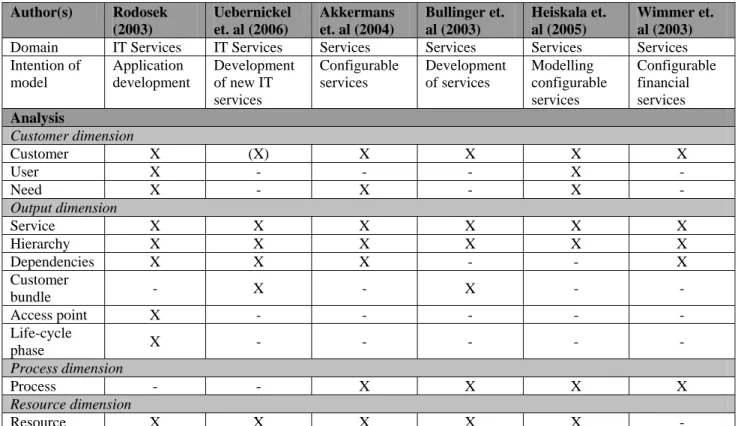
In the following we consider both existing IT service modeling approaches and general service modeling approaches that are not specific to IT. We analyze similarities and differences in the representation of real-world objects within the models. Finally, we point out which of these objects are necessary in an IT service model in the context of IT service management. Table 1 gives an overview of proposed models and the results of our analysis.
Although some authors discuss IT service modeling issues (Böhmann et al., 2005) or IT service engineering issues (Mayerl et al., 2005), to the best of our knowledge, only (Uebernickel et al., 2006), (Rodosek, 2003) and (Garschhammer et al., 2001) propose IT service models. While Uebernickel et al.’s model stems from IT service engineering, the latter developed their models for managing IT services. In the following section, we only describe the models of Uebernickel et al. and Rodosek, as Rodosek’s model is an advancement of Garschhammer et. al’s original work. Apart from these IT specific models, several
Author(s) Rodosek (2003) Uebernickel et. al (2006) Akkermans et. al (2004) Bullinger et. al (2003) Heiskala et. al (2005) Wimmer et. al (2003)
Domain IT Services IT Services Services Services Services Services
Intention of model Application development Development of new IT services Configurable services Development of services Modelling configurable services Configurable financial services Analysis Customer dimension Customer X (X) X X X X User X - - - X - Need X - X - X - Output dimension Service X X X X X X Hierarchy X X X X X X Dependencies X X X - - X Customer bundle - X - X - - Access point X - - - - - Life-cycle phase X - - - - - Process dimension Process - - X X X X Resource dimension Resource X X X X X -
other papers propose general service models not specific to the IT domain (Bullinger et al., 2003; Wimmer et al., 2003; Akkermans et al., 2004; Heiskala et al., 2005). The latter still contribute to our analysis in some respects.
Customer Dimension
All models except that of Uebernickel et al. include a representation of the customer. This representation is necessary in order to model certain characteristics of the customer (e.g. name, billing address). Uebernickel et al. do not include the customer himself, but rather the customer business process, which is supported by the service. Because an IT service can often be assigned to the business process it supports within the customer organization, it is appropriate to model the customer business process. The models of Rodosek and Heiskala et al. differentiate between the customer and the user of a service. While the former is the contractor of a service, the latter is the user. This is the case for IT services which are usually provided for a company or department (contractor), but used by the employees. Thus, a potential benefit and quality of the service is ultimately experienced by the user. Akkermans et. al, Heiskala et. al and Rodosek point out that it is important to model those customer needs that should be satisfied by acquiring a service of a certain quality. Customer needs for IT services are defined through Service Level Agreements (SLA). These are bilateral agreements between the provider and the customer for a group of IT services, which quantify the minimum quality of service which meets the business need (Hiles, 1993). However, SLA reveal many shortcomings, such as a lack of end-user perspective (Trienekens et al., 2004). Thus, an IT service model should represent not only customer, but also user needs.
Output Dimension
The existing modeling approaches define services that can be aggregated to form higher-level services (service hierarchy). This is basically true for IT services, which can be composed of different sub-services. Additionally, the various researchers in the field, except for Bullinger et. al and Heiskala et. al., model dependencies between services (e.g. substitute, optional), which is meaningful in the context of IT services. For instance, there might be technical incompatibilities between sub-services or sub-services enhancing other sub-services (e.g. additional spam protection for e-mail service). Bullinger et. al and Uebernickel et al. present a customer-oriented service bundle referred to in their models as the sales product. They argue that the distinction between a bundle and its services is necessary in order to depict the sales and marketing perspective of an IT service. Indeed, the service bundle bought by a customer might differ from the services actually used. With respect to IT services, a company might buy an e-mail service bundle with support, while a user only accesses the e-mail client application and does not use the sub-service support. Interestingly, Rodosek’s model is the only one to model a service access point. IT services can require a diverse set of assess methods. The access point depends on the type of interaction (i.e. human to human, human to machine, machine to machine), the means of access (e.g. telephone, fax, web browser) and location of access (e.g. home, company, travel). Since the service access point is associated with certain parameters such as costs, quality of service or prerequisites, a representation within an IT service model is appropriate. Another characteristic of Rodosek’s model is the definition of the life cycle phase of a service. She argues that services for different phases in the relationship between provider and customer might be associated with special actions and resources. In fact, IT services require different resources during different phases e.g. human resources for the provisioning of user accounts or applications for information processing (Peppard, 2003).
Process Dimension
The analyzed models, apart from those of Uebernickel et. al and Rodosek, represent the activities necessary to provide a service. In terms of our argumentation, it is necessary to model the process activities of an IT service. The delivery processes for an IT service requires a high level of human involvement. Therefore, personnel constitute an expensive resource in the production of IT services.
Because the activities related to delivering an IT service consume different resources and contribute differently to QoS and costs, it is useful to model them. This is a step towards their control and optimization, as, for instance, in workflow management systems (van der Aalst, 2000). However, also in the case of application-based processes, the representation of process activities within the model is advisable. For example, certain activities could be executed automatically (e.g. bill calculation).
Resource Dimension
Resources are modeled in the existing models with the exception of Wimmer et. al. Most relevant resources for IT services are technical resources such as applications (e.g. operating systems, middleware, business applications), hardware (e.g. client
transferring information (e.g. sending e-mails via LAN) and storing information (e.g. in database systems). Because the delivery of IT services requires a substantial involvement of human resources, it is another resource which needs to be represented in a model (Rands, 1992; Peppard, 2003; Böhmann et al., 2003).
A CONCEPTUAL IT SERVICE MODEL
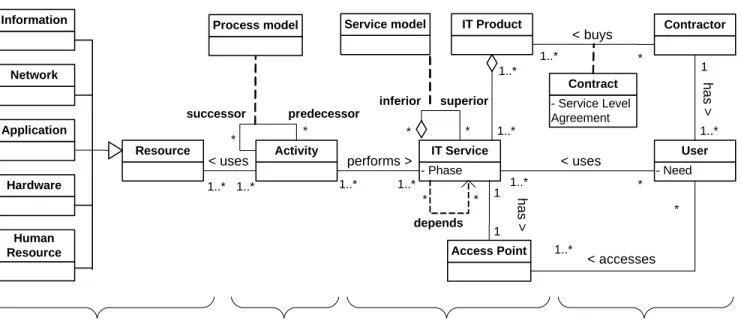
The above findings are summarized in a common, conceptual IT service model. We use the Unified Modeling Language (UML), established in system development, in order to define semi-formal models (Rumbaugh et al., 2005). Figure 1 shows the proposed IT service model, based on the analysis of existing modeling approaches. The customer dimension consists of a
contractor class that represents a contractor as the buyer of an IT product. An IT product is a sales-oriented bundle of IT services. The relationship between the contractor and service provider is depicted through the associated contract class which contains an SLA.
The user class is associated with the contractor class, the IT service class and the access point class and models the individual user of an IT service within the contractor organization. The output dimension consists of an IT service class, which has a life-cycle phase, can be aggregated from its sub-services and has an access point. The service hierarchy is represented through the associated service model class. Mutual IT service dependencies are modeled with a dependency relation (e.g. exclusion, option). An IT service is the result of a single activity or group of activities, which are part of the process dimension and are represented in the activity class. The sequences of activities construct the necessary steps for providing a service and are modeled with the associated process model class. Finally, the resource dimensions consist of resources that are used in activities and can be either applications, hardware, networks, information or a human resource.
* * 1..* 1
Resource
Dimension
Process
Dimension
Output
Dimension
* 1..* Information Application Hardware Human Resource Resource ActivityProcess model Service model
- Phase IT Service - Service Level Agreement Contract Contractor - Need User < uses < buys < uses performs > ha s >
Customer
Dimension
1..* predecessor successor superior inferior 1..* 1..* 1..* 1..* 1..* * Network 1 1..* * * * * IT Product 1 * Access Point 1..* 1..* * 1 1..* 1..* 1 * * * 1..* < accesses ha s > dependsCASE STUDIES
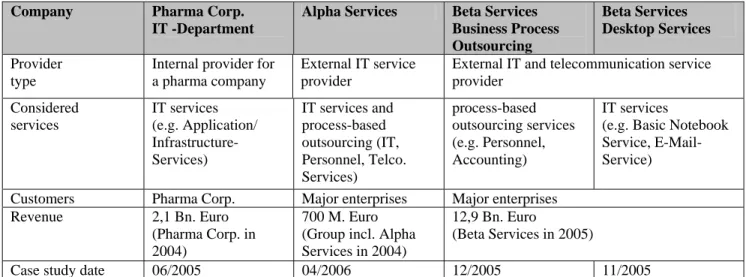
In order to validate the proposed model and identify possible extensions, case studies of different IT service providers have been conducted (Table 2). The selected companies are Pharma IT, Alpha Services and Beta Services1. The following criteria were used to select the case study partners:
• existence of an IT service portfolio with IT services which conforms to our understanding of the concept
• availability of information and documentation about the IT services (e.g. service descriptions, service level agreements, service catalogues).
In-depth interviews with experts from the companies as well as IT service documentation were used to formulate the cases. Finally, the cases were discussed and validated in a focus group in June 2006. The focus group included experts from the respective companies and from the German companies Deutsche Bank and syskoplan.
Company Pharma Corp.
IT -Department
Alpha Services Beta Services Business Process Outsourcing Beta Services Desktop Services Provider type
Internal provider for a pharma company
External IT service provider
External IT and telecommunication service provider Considered services IT services (e.g. Application/ Infrastructure-Services) IT services and process-based outsourcing (IT, Personnel, Telco. Services) process-based outsourcing services (e.g. Personnel, Accounting) IT services
(e.g. Basic Notebook Service, E-Mail-Service)
Customers Pharma Corp. Major enterprises Major enterprises
Revenue 2,1 Bn. Euro
(Pharma Corp. in 2004)
700 M. Euro (Group incl. Alpha Services in 2004)
12,9 Bn. Euro
(Beta Services in 2005)
Case study date 06/2005 04/2006 12/2005 11/2005
Table 2. Overview of case study companies
Description of the Cases
Pharma IT is the IT department of the Pharma Corporation. The corporation is engaged in research and development, as well as the production and worldwide marketing of pharmaceutical products. During 2004, the IT department was gradually restructured into a service provider, because the department had problems with the heterogeneous IT landscape and was unable to satisfy the increasing demands of the growing corporation. The introduction of an IT service catalogue was a basic element of the transformation. By means of such a catalogue, Pharma IT aimed to reduce the diversity of IT infrastructure components and applications, while simultaneously creating a transparent, customer-oriented description of services and calculating the service costs. The catalogue covers application services, e.g. Lotus Notes e-mail functions for PCs, but also infrastructure services such as the provision of managed desktops.
Alpha Services is a separate enterprise within the Alpha Group. It offers IT services and process-based outsourcing services (e.g. payroll outsourcing) with underlying IT to major enterprises worldwide in several domains such as information technology, purchasing and logistics. In 2005, Alpha Services started a project targeting the worldwide unification of its IT service portfolio. The main objectives of the project consisted of defining services that are compatible with the market, the unified definition of services spanning all company locations as well as unified described services. The service specifications of Alpha Services contain IT services like Personnel Administration Service performing payroll accounting for customers, or Application Service ERP for the provisioning of an SAP System.
Beta Services is an independent service company within the Beta Group. The company offers large and medium-sized businesses worldwide IT and telecommunication services. The Business Process Outsourcing (BPO) division provides process-based outsourcing services with underlying IT. This includes, for instance, the payroll services for employees of a customer. In mid-2005 a project had been started to specify services from domains like accounting and finance. For this purpose, uniform standard service elements were defined, which can be merged by the sales department to form customized IT services. An example is the Payroll Service Active Staff SAP, which is provided with an SAP R/3 System. The Desktop Services (DS) division provides services for the management and supply of desktop PCs with office applications. This includes the configuration of computers, setup and management of software and e-mail accounts, dispatching of computers and hosting of applications. In order to support the sales department, a product catalogue was developed, which covers such solutions as a basic package desktop service and the provision and management of computers.
Results of Case Study Analysis
All elements of the proposed model were validated through the cases. Below, we provide a brief overview of the findings. Generally, the case studies show that is necessary to distinguish between customer organization (contractor) and users of the customer organization. While relevant contractor information includes, for example, billing address or bank account information, user information is related directly to services used, such as certain access rights. The relationship between user and customer organization is important for the billing of user related activities, for example (e.g. new software license for user).
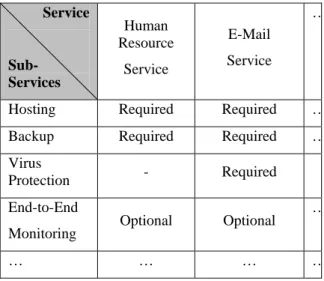
The differentiation between IT products and IT services is important in the cases. IT products, which bundle IT services, are presented in a sales-oriented IT service catalogue and have market-oriented attributes (e.g. price), whereas IT services have greater granularity and describe the use of internal provider attributes (e.g. cost, internal operating requirements). Different levels of IT services have been defined, which can be allocated to higher level services. While Alpha Services and Beta Services have a rather flat service hierarchy with only two levels, Pharma IT has four defined levels of services. Table 3 shows an excerpt from the mapping of sub-services to IS services for Alpha Services. A Human Resource Service is one that facilitates, for example, payroll processing for HR departments. It is based on SAP R/3 and several sub-services such as hosting of the SAP-System, regular data backups and optional end-to-end QoS monitoring. The E-Mail Service requires similar sub-services such as the hosting of Microsoft Exchange.
The companies differentiate between technical and manual activities for service delivery. While technical activities are described through batch scripts, for example, manual activities are described through comprehensive operating instructions, which contain a detailed list of activities that an employee needs to execute. The payroll service delivery process of Beta Services (BPO) is an example of operating instructions. The manually executed payroll process is very repetitive. Thus, the process activities are defined in a process manual. The detailed documentation of activities, as well as the execution and usage time of the payroll information system allows a cost calculation of an IT service with the activity based costing approach. Service Sub-Services Human Resource Service E-Mail Service …
Hosting Required Required …
Backup Required Required …
Virus
Protection - Required
End-to-End
Monitoring Optional Optional
…
… … … …
Resources are usually managed through asset management systems. These contain a technical documentation of, for instance, hardware, networks and applications. The latter are treated as resources, which might have limited capacity (i.e. limited number of software licenses).
The case study analysis has identified necessary extensions to the proposed model:
• Different IT product attributes for the customer organization (contractor) and user: A customer organization might be interested in how the IT service fits into the portfolio of the organization (e.g. compatibility, price, technical integration), while the user might be interested in increasing his personal efficiency or in an easy-to-use service within a user specific context. As a result, it is necessary to model separate service-description classes for both customer and user.
• Different attributes for IT products and IT services: IT products require external description attributes such as customer benefits, service price, service functionality, QoS and delivery system. By contrast, IT services require internal description attributes such as internal cost calculations or internal operating level agreements (e.g. server maintenance). Therefore, it is necessary to model different service descriptions for the IT product class and the IT service class.
• Service catalogues as containers for descriptions: Service catalogues support the provider as well as the customer perspective of an IT service. Customer-oriented catalogues display IT product descriptions in a structured form and allow the configuration of IT products according to customer needs. Beta Systems DS uses a catalogue tool which facilitates selecting, adding, replacing or removing IT products (similar to a car configurator). Provider-oriented catalogues contain IT service descriptions and help the provider to manage the IT service portfolio. Pharma IT uses an Excel-based catalogue that allows a detailed cost calculation and comparison for their IT services. Therefore, it is necessary to model different catalogues for contractor and user-oriented IT product descriptions and provider-oriented IT service descriptions.
CONCLUSION AND FURTHER RESEARCH
Our paper commenced with an introduction to the challenges of IT services providers. In order to develop or customize an appropriate system, an IT service model has been proposed. Our cases have shown that this model can be regarded as a foundation for the development of an appropriate information system for IT service management. However, the cases used for the research were not systematically sampled and it might not be possible to generalize some findings.
In general, the service sector lags behind its industrial counterpart with respect to standard methods for representing resource requirements (Dietrich, 2006). The IT service model could be an initial step towards the transfer of such industrial concepts as enterprise resource planning to the (IT) service domain, because it provides an integrated view of services, processes and resources.
Further research is required to integrate necessary extensions into the model and to describe attributes required for IT service management in greater detail, including demands, capacities, capabilities and costs. Further more, behavioral issues need to be integrated into the model and it might be necessary to tailor the model based on different modeling objectives (e.g. business objectives and constraints). A logical next step in information systems development will be the creation of a more technical model.
ACKNOWLEDGEMENTS
The authors wish to thank Deutsche Bank, Bayer Business Services, Swisscom IT Services, syskoplan und T-Systems for supporting this research. They also thank the members of the research group Competence Center Industrialized Information Management (CC IIM) for the discussions and valuable comments on previous versions of the paper. CC IIM is a group of researchers directed by Prof. Walter Brenner at the Institute of Information Management at the University of St. Gallen.
REFERENCES
1. Akkermans, H., Baida, Z., Gordijn, J., Pena, N., Altuna, A. and Laresgoiti, I., "Value Webs: Using Ontologies to Bundle Real-World Services", IEEE Intelligent Systems, 19, 4, 2004, 57-66.
2. Böhmann, T., Gottwald, R. and Krcmar, H., Towards mass-customized IT services: Assessing a method for identifying reusable service modules and its implication for IT service management, Proceedings of the Americas Conference on Information Systems (AMCIS), 2005.
3. Böhmann, T., Junginger, M. and Krcmar, H., Modular Service Architectures: A Concept and Method for Engineering IT Services, Proceedings of the 36th Hawaii international Conference on System Sciences (HICCS'03), 2003.
5. Chesbrough, H. and Spohrer, J., "A research manifesto for services science", Communications of the ACM, 49, 7, 2006, 35-40.
6. Dietrich, B., "Resource planning for business services", Communications of the ACM, 49, 7, 2006, 62-64.
7. Garschhammer, M., Hauck, R., Hegering, H. and Kempter, B., Towards generic Service Management Concepts–A Service Model Based Approach, Integrated Network Management Proceedings, 2001.
8. Heiskala, M., Tiihonen, J. and Soininen, T., A Conceptual Model for Configurable Services, IJCAI 2005 Workshop on Configuration, Edinburgh, Scotland, 2005.
9. Hevner, A. R., March, S. T., Park, J. and Ram, S., "Design Science in Information Systems Research", MIS Quarterly,
28, 1, 2004, 75-105.
10. Hiles, A. Service Level Agreements: Managing Cost and Quality in Service Relationships, Chapman and Hall, 1993. 11. Hochstein, A., Uebernickel, F. and Brenner, W., Operations Management in IS: Using the SCOR-Model to Source,
Make and Deliver IS Services, Proceedings of the Twelfth Americas Conference on Information Systems, 2006. 12. Lichtenstein, S., Nguyen, L. and Hunter, A., Issues in IT Service-oriented Requirements Engineering, 9th Australian
Workshop on Requirements Engineering, 2004.
13. March, S. T. and Smith, G. F., "Design and natural science research on information technology", Decision Support Systems, 15, 4, 1995, 251-266.
14. Mayerl, C., Link, S., Racke, M., Popescu, S., Vogel, T., Mehl, O. and Abeck, S., Methode für das Design von SLA-fähigen IT-Services, GI-Fachtagung KIVS 2005, 2005.
15. Meyer, A. and Blümelhuber, C. Interdependenzen zwischen Absatz und Produktion in Dienstleistungsunternehmen und ihre Auswirkungen auf konzeptionelle Fragen des Absatzmarketing, In: Dienstleistungsproduktion (Eds., Corsten, H. and Hilke, W.), 1994.
16. OGC (2002) Best Practice for Planning to Implement Service Management, Office of Government Commerce, London. 17. Peppard, J., "Managing IT as a Portfolio of Services", European Management Journal, 21, 4, 2003.
18. Rands, T., "Information technology as a service operation", Journal of Information Technology, 7, 4, 1992, 189-201. 19. Rockart, J. F., "The role of the information systems executive: a critical success factor perspective", Sloan Management
Review, 24, 1982, 3-13.
20. Rodosek, G. D., A generic model for IT services and service management, Integrated Network Management, IFIP/IEEE Eighth International Symposium, 2003.
21. Rumbaugh, J., Jacobson, I. and Booch, G. Unified Modeling Language Reference Manual, Addison-Wesley, Boston, 2005.
22. Trienekens, J. M., Bouman, J. J. and van der Zwan, M., "Specification of Service Level Agreements: Problems, Principles and Practices", Software Quality Journal, 12, 1, 2004.
23. Uebernickel, F., Bravo-Sànchez, C., Zarnekow, R. and Brenner, W., IS Service-Engineering: A process model for the development of IS services, CD-ROM/Online Proceedings of the European and Mediterranean Conference on Information Systems (EMCIS) 2006, 2006.
24. van der Aalst, W., "Loosly coupled interorganizational workflows: modeling and analyzing workflows crossing organizational boundaries", Information & Management, 37, 2, 2000, 67-75.
25. Wand, Y., Monarchi, D. E., Parsons, J. and Woo, C. C., "Theoretical foundations for conceptual modelling in information systems development", Decision Support Systems, 15, 4, 1995, 285-304.
26. Wimmer, A., Mehlau, J. I. and Klein, T., Object Oriented Product Meta-Model for the Financial Services Industry,
Proceedings of the 2nd Interdisciplinary World Congress on Mass Customization and Personalization (MCPC’03), 2003.
27. Zarnekow, R., Brenner, W. and Pilgram, U. Integrated Information Management. Applying Successful Industrial Concepts in IT, Springer, Berlin, 2006.