CROSS-EVALUATION 4
FINAL REPORT
Sara Heikkilä, Mervi Friman, Jaana Ignatius & Marjo-Riitta Järvinen (editors)
The FUAS institutions -HAMK, LUAS and Laurea- collaborate in core competence areas to better serve business and industry, students and the public sector of the greater Helsinki metropolitan area. Through collaboration FUAS is improving the expertise and quality of operations. Cross-evaluations are one form of FUAS development and
finding best practices. This is the final report of the fourth
cross-evaluation of the FUAS Quality Policy, implemented in autumn 2012.
The outcomes of this cross-evaluation create a base for the FUAS Quality Policy. The cross-evaluation process has
defined the aims and contents of the FUAS Quality System
and allocation of responsibilities. The FUAS Strategy 2011-2015 points out that the international quality assurance system will improve the quality and impact of education. This report describes the next steps on the road to
achieving this target.
printed
ISBN 978-951-784-600-4 ISSN 1795-4231
HAMKin julkaisuja 1/2013
FUAS Quality Policy
PDF ISBN 978-951-784-601-1 ISSN 1795-424x HAMKin e-julkaisuja 3/2013 CR OSS-EV ALU A TION 4 FINAL REPOR T FU AS
HAMK University of Applied Sciences (HAMK) – Lahti University
of Applied Sciences (LUAS) – Laurea University of Applied
Sciences (Laurea)
CROSS-EVALUATION 4
FINAL REPORT
FUAS Quality Policy
Sara Heikkilä, Mervi Friman, Jaana Ignatius & Marjo-Riitta Järvinen (editors)
FINAL REPORT
FUAS Quality Policy
Sara Heikkilä, Mervi Friman, Jaana Ignatius & Marjo-Riitta Järvinen (editors) printed ISBN 978-951-784-600-4 ISSN 1795-4231 HAMKin julkaisuja 1/2013 PDF ISBN 978-951-784-601-1 ISSN 1795-424x HAMKin e-julkaisuja 3/2013 JULKAISIJA – PUBLISHER
HAMK University of Applied Sciences PO Box 230
FI-13101 Hämeenlinna, FINLAND tel. +358 3 6461
e-mail [email protected] www.hamk.fi/julkaisut
Printed: Tampereen yliopistopaino, Tampere
1 TABLE OF CONTENTS
For the reader ... 5
Abbreviations ... 7
1 Introduction ... 9
2 Elaboration of the cross-evaluation ... 11
2.1 Aims of cross-evaluation of quality policy ...11
2.2 Basis and scheduling of cross-evaluation ...11
2.3 Preparing cross-evaluation materials ... 12
3 Cross-evaluation discussions ... 13
3.1 First cross-evaluation discussions in September 2012 ... 13
3.2 Second cross-evaluation discussions on 17 September 2012... 16
3.3 Third round, the actual cross-evaluation seminar on 16 November 2012 ... 16
4 Key results and future development ... 21
4.1 FUAS Quality Policy ... 21
4.2 Lessons learned and plans for the future ... 25
Sources ... 27
Appendix ... 29
Appendix 1 Pre-material of the first round ... 30
Appendix 2 Material shown on 16.11... 35
HAMK, Lahti and Laurea Universities of Applied Sciences have been work-ing together for 3 years to create an internationally acknowledged alliance that and inspires regional development and strengthens the competitiveness of the greater Helsinki metropolitan area. FUAS (Federation of Universities of Applied Sciences) can offer the higher education, research and regional development functions required by the metropolitan area’s business and in-dustry. Also FUAS co-operation can provide business and industry, students and the public sector with improved expertise and quality. FUAS is the larg-est alliance of universities of applied sciences in Finland with a total number of 21 000 students.
One form of collaboration and unifying the operations of the UASs has been the cross-evaluation processes. The cross-evaluation method of FUAS is a flexible way of finding best practices and developing operations. The cross-evaluation is also a part of the systematic preparation for the forthcoming FINHEEC (The Finnish Higher Education Evaluation Council) audit. The quality policy is the first audit target of the FINHEEC audits. The FIN-HEEC audit in 2016 will be implemented in each institution of FUAS. Creating a shared quality assurance system is mentioned as a critical success factor in the FUAS Strategy 2011-2015. The FUAS Strategy 2011-2015 also points out that international quality assurance system will improve the quality and impact of education and that FUAS systematically makes use of the ad-vantages generated by the critical mass, especially in the acquisition and use of systems and services and in personnel development. In practise this means utilising the advantage of shared services.
The outcomes of this cross-evaluation create a base for collaboratively built FUAS quality policy that originates from the best practises of the member UASs. The aim of the cross-evaluation was to further develop the FUAS quality policy; to define the aims of the FUAS Quality System, to define the contents of the system and to define the interfaces in comparison to the qual-ity system of each member UAS, to improve the documentation and com-munications on FUAS-level and outline on the allocation of responsibilities.
6
The cross-evaluation process was carried out through three rounds of dis-cussions and FUAS Quality Group rewrote the material after each time ac-cording to the conversation. The FUAS Quality Manual resulting from the quality policy and cross-evaluation will be created in the spring 2013. The FUAS Quality Manual will be published in FUAS webpages as it can be ac-cessed by all members of FUAS (students and personnel) as well as the pub-lic. The FUAS Quality Manual will be printed later as the system is further developed.
We give thanks to everyone for sharing their opinions and being involved in the cross-evaluation process.
In Hämeenlinna, Lahti and Tikkurila 15 January 2013
Sara Heikkilä, Mervi Friman, Marjo-Riitta Järvinen & Jaana Ignatius Editors of the Report
DW Development Workbook Kehittämisen työkirja
FINHEEC The Finnish Higher Education Evaluation Council Korkeakoulujen arviointineuvosto
FUAS Federation of Universities of Applied Sciences Hämeen amk:n, Lahden amk:n ja Laurea-amk:n muodostama liittouma
HAMK HAMK University of Applied Sciences Hämeen ammattikorkeakoulu
HEI Higher Education Institution Korkeakoulu
LaaTi Quality and Data Production Group Laatu- ja tietotuotantoryhmä
Laurea Laurea University of Applied Sciences Laurea-ammattikorkeakoulu
LUAS Lahti University of Applied Sciences Lahden ammattikorkeakoulu LbD Learning by Developing Kehittämispohjainen oppiminen MD Master’s Degree
Ylempi ammattikorkeakoulututkinto MEC Ministry of Education and Culture
Opetus- ja kulttuuriministeriö PDCA Plan, Do, Check, Act method
Plan, Do, Check, Act -toimintamalli
8
RDI Research, Development and Innovation Tutkimus, kehitys ja innovaatio
UAS University of Applied Sciences Ammattikorkeakoulu
FUAS implemented the fourth cross-evaluation on quality policy to find the shared view and language on quality assurance related matters. The aim of the cross-evaluation was to further develop the FUAS quality policy which was based on the three different practices of the member institutions. The cross-evaluation on quality policy supports the FUAS vision and mission and it was implemented with the FUAS Strategy 2011-2015 in mind.
The objectives of the cross-evaluation, regarding the FUAS quality system, were to determine the objectives and contents of the system and to define the interfaces in comparison to the quality system of each member UAS. Anoth-er aim was to commonly agree on the allocation of responsibilities. One of the aims was also to improve the documentation and communications at the FUAS level.
HAMK and Laurea have implemented the cross-evaluation together twice. The theme of the first cross-evaluation was the connection between the qual-ity assurance system and management. The theme of the second cross-eval-uation was the participation of the personnel, students and stakeholders in quality assurance. The third cross-evaluation was implemented in 2011-2012 and all of the current FUAS institutions took part in it. The theme was the international activities of FUAS and in addition to the final report one of the outcomes was the “Cross-evaluation of international activities of FUAS” maintenance manual (MM). This MM functions as a way of utilising the outcomes of the third cross-evaluation and developing the international ac-tivities of FUAS.
Cross-evaluation has become a continual procedure of evaluating the oper-ations of FUAS and it is considered to be an equal and functioning meth-od of developing the FUAS operations. There is a general opinion that cross-evaluation is a good method of giving the participants the knowledge, time and space for critical and constructive discussions and feedback. In addition, they can easily learn from each other and form shared perspectives. It is im-portant that FUAS operates with a shared language and concepts. The cross-evaluation process has itself become an essential part of the quality assurance
10
of FUAS and therefore it was only natural to use this method when develop-ing the shared quality policy.
The cross-evaluations have strengthened cooperation, unified operations, built a common understanding, further developed activities and also supported the FUAS vision and mission. The cross-evaluations have made the progress of FUAS visible and given clear evidence of the development of FUAS for the FINHEEC audits in 2016.
FUAS operates through three strategic management groups; Governance & Systems; RDI; and Education. These are managed by the Rectors Collegi-um and FUAS Governing Board. The strategic management group of Gov-ernance & Systems is responsible for steering the development of the shared quality system while the FUAS Governing Board makes the final decisions. The Quality and Data Production Group (LaaTi) is responsible for building
the quality system and coordinating operations.
The cross-evaluation discussions were organised in autumn 2012 by the FUAS Quality Group. The Quality Group members acted as chairs at the discussions. This report is the collective outcome of the cross-evaluation pro-cess. This final report describes the themes of the FUAS Quality Policy and states what needs to be done in order to develop the quality system as agreed together. The newly shaped structure of the FUAS Quality Policy, the lessons learned and plans for the future are described in the final chapter.
2.1 Aims of cross-evaluation of quality policy
The main aims of the cross-evaluation of the FUAS Quality Policy are to de-fine the quality system’s objectives, contents and interfaces in comparison to the quality systems of each member UAS and to specify the allocation of re-sponsibilities in co-operation with the FUAS personnel. This process is also undergone in order to improve the documentation and communications con-cerning the quality system. Doing all this in a collective way will also help to develop the shared FUAS quality culture and bring the participants clos-er togethclos-er and make FUAS opclos-erations more transparent. This cross-evalu-ation strengthens the opercross-evalu-ation of FUAS and it also shows to outsiders the commitment and shared vision of the members of FUAS.
The results of the cross-evaluation will create the basis for the FUAS Quali-ty Manual. The FUAS QualiQuali-ty Manual will be written in spring 2013 and it will implement the FUAS Strategy 2011-2015. An open approach has been chosen and therefore the first FUAS Quality Manual will be published on the FUAS web pages so that it can be accessed by all members of FUAS (students and personnel) as well as the public. The FUAS Quality Group feels that it is important that the Quality Manual is easy to access and update. The FUAS Quality Manual will be printed later as the system is further developed.
2.2 Basis and scheduling of cross-evaluation
The preparations for the fourth cross-evaluation started in May 2012. The theme “Quality Policy” was approved by the FUAS rectors in autumn 2012 and they saw that it was beneficial to undergo the process at this stage of FUAS operations. The cross-evaluation of the quality policy was seen to be beneficial when visualising the quality policy the forthcoming FINHEEC audit. The quality policy of higher education institutions is the first audit tar-get of FINHEEC’s HEI audits. In this cross-evaluation process, FUAS de-scribes and develops its own quality policy.
12
By August 2012, the theme of the cross-evaluation had been decided by the FUAS Quality Group. The description of the current situation was drafted and the more detailed plans for the project were made at the same time. The cross-evaluation discussions were held in three rounds. In the first round,
each member UAS consulted their own personnel (HAMK: selected expert group, 9 respondents; LUAS: assessment and quality group, 8 persons; and Laurea: quality systems development group, 13 persons). In the second round, the FUAS Strategic Steering Groups of Education and RDI held discussions concerning the quality policy on 17 September 2012. The actual cross-eval-uation seminar for the FUAS Strategic Steering Group of Governance and Systems was held on 16 November 2012. The discussions in each round were based on pre-material sent to the participants in advance.
The Quality Group analysed the results and started writing the final report in November 2012 and the report was completed in January 2013. During the cross-evaluation process, the FUAS Quality and Data Production Group
had meetings once a month.
2.3 Preparing cross-evaluation materials
Pre-material was sent to all the participants before each discussion as back-ground information. The pre-material included a description of the aims of the cross-evaluation, the schedule, description of the current quality system and allocation of responsibilities. The pre-material was written by the FUAS Quality Group and updated after each round. The FUAS Quality Group worked on the material collectively, analysed the discussions thoroughly and created a shared view on the theme.
The pre-materials included questions for the participants to consider before-hand. In addition, the participants were also asked to think about questions and comments of their own. The translated versions of the pre-materials sent to the participants of the first and last rounds of the discussions are attached to this report (Appendix 1 and 2).
Due to the experience and feedback received after the third cross-evalua-tion, it was considered that it would be better to involve more FUAS per-sonnel in smaller groups. At the beginning of the discussions, short presen-tations were held by the members of the Quality Group and the chairs tried to be equal and let everyone be heard. As mentioned before, the cross-evalu-ation discussions were held in three rounds. All together 45people took part in the process.
3.1 First cross-evaluation discussions in September
2012
In the first round, the discussions were held separately in each UAS in early September 2012. Due to mismatching schedules, the hearing of the HAMK personnel was organised via e-mails. Pre-material (Appendix 1) that includ-ed questions relating the topic was sent to the participants to create a base knowledge of the cross-evaluation process. The participants of the first round included middle management personnel and other relevant stakeholders of each member institution.
In HAMK
A convenient time could not be found among the personnel and therefore the hearing was arranged via e-mails by Mervi Friman from the FUAS Quality Group. The material on quality policy was sent altogether to 45 persons. The participants were asked to comment the material within two weeks and with-in that time 11 persons replied.
In general, the development of the shared quality policy of FUAS was con-sidered positive and none of the respondents described the general idea or the objectives as negative. The current quality system and quality management of HAMK was considered good and especially the dissemination of infor-mation concerning the HAMK quality policy got positive feedback. The re-spondents remarked that the new shared system should be built carefully and
14
it should not become too technical and hard to understand. The respondents hoped for an easily adaptable shared system that combines the best practic-es of all member UASs. It was stated that one must give up some activitipractic-es in order to create a coherent shared system. The suggested allocation of respon-sibilities got positive feedback and it was considered fine.
The current quality policy of HAMK was considered open and equal and it was considered to be well adapted by the personnel. That is maybe why col-laboration in building the forthcoming FUAS quality policy was considered important. Collaboration was seen as a factor that would deepen the com-mitment of the personnel. The importance of international point of view was also highlighted and one respondent reminded of the importance of the stu-dents as the real reason of all our activities.
A quality system based on the continuous improvement cycle was considered suitable though one of the respondents suggested considering more operation-oriented approach. This approach rises from defining the essential activities concerning quality. It was seen important that development is based on feed-back and collaboration and that feedfeed-back actually improves quality and fur-ther development. One participant pointed out that this continuous improve-ment is the best feature of the current culture of HAMK.
The respondents stated that shared virtual data warehousing is important in a large coalition, but that the current FUAS extranet does not function well enough. It was said to be disorganised and difficult to use. Especially the need for an extra sign-up was considered useless. A shared, easily accessi-ble FUAS-level documentation and data warehouse system was seen benefi-cial for all. One participant suggested warehousing the data in the UAS-lev-el portals from where it would automatically update the FUAS-levUAS-lev-el systems. Concerning the documentation, the term Maintenance Manual was seen un-fit and it was suggested to be changed.
FUAS-level information dissemination was seen important especially in ex-ternal communication when communicating with the students and stakehold-ers. All in all, improving information dissemination (vertical and horizontal, external and internal communications) and documentation was seen as areas that should be improved it in the future.
On the whole, FUAS cooperation was described mostly with positive ad-jectives, though it was noted that it is not yet visible enough in the everyday life of an average teacher and that there is still some resistance in the mid-dle management.
Multifield networking, cooperation between experts, and support from col-leagues of other member UASs were mentioned to be the best aspects in the FUAS cooperation. One participant mentioned daily contacts with col-leagues in LUAS and Laurea. Cooperation was said to be perhaps too polite and conversational and maybe that is why the respondents wished for more concrete outcomes.
In LUAS
In LUAS, the discussions were held with the Assessment and Quality Group on 11 September 2012. Marjo-Riitta Järvinen from the FUAS Quality Group acted as chair and secretary at the hearing and the discussion went on free-ly in an open atmosphere.
The creation of the shared system was seen positive as LUAS is currently re-assessing and defining the practises of its own quality policy. This is benefi-cial and helpful in the current situation. It was seen worthwhile to develop both levels and the participants were open for development. Even though re-taining some of the UAS’s own well-functioning practices was seen impor-tant, the importance of benchmarking the best practices of the others was seen worthwhile.
The shared practises in quality policy were seen beneficial (e.g. the surveys on quality) as the shared practises give comparable and more reliable knowledge. FUAS activities are not yet visible in the everyday life of the students and teachers, which is why it is seen as more management level activity. The par-ticipants felt that shared practices on the management level are good, but in the lower levels, a more flexible system would function better. Also in LUAS the term Maintenance Manual was seen unfit in the HEI environment.
In Laurea
In Laurea, the discussions were held in Tikkurila with a 13-person Quali-ty Systems Development Group on 7 September 2012. The FUAS QualiQuali-ty Group was represented by Jaana Ignatius, who acted as a chair and secretary at the hearing. Overall, the direction of building a shared FUAS Quality Pol-icy was considered fine and that the creation of the shared system would be easier after the cross-evaluation process.
During the hearing, the participants discussed what would be the best re-lation between the shared FUAS system and Laurea’s own quality system. Some participants felt that the operations should be directed mostly by Lau-rea’s own system and that the FUAS-level system should only be an addi-tional one. The reality of building a common FUAS system was questioned as there are not that many shared processes in general and the UASs operate in different ways. It was noted that mutual systems should arise from mutual processes. And on the other hand, a shared system was seen essential, when verifying FUAS cooperation to the Ministry of Education and Culture. A shared system that still tolerates the individuality of each UAS was seen as a solution to the problem.
Even though the clash of different operational cultures was seen problem-atic, the sharing of best practices was seen important and beneficial for all. The Learning by Developing model (LbD) was seen as one of the key ele-ments of operations that should be saved in Laurea. In addition, the impor-tance of information dissemination and the actual benefit to the studentwere
16
also mentioned in the discussions. It was also mentioned that the feedback should be meaningful and concrete in order to improve the processes and ser-vices. Also, the participants wished for an explicit quality policy and more concrete actions.
3.2 Second cross-evaluation discussions on 17
September 2012
The second cross-evaluation discussion on the quality policy of FUAS was held with the FUAS Strategic Steering Groups of Education and RDI on 17 September 2012 in Laurea. There were 7 representatives from the Stra-tegic Steering Groups of Education and RDI and 3 from the FUAS Quali-ty Group.
The members of the groups pointed out that the student’s viewpointshould be emphasised so that the quality assurance is understandable and that the feed-back of the students is really taken into account. It was also pointed out that the concepts should be mutual and it was stated that a shared language and common understanding are important. It was also expressed that the forms of quality assurance should support the context and vice versa.
There were wishes that the future system would be coherent and that it should be built up together in a way so that relevant FUAS Groups would be heard. And that it would be easier to start building up the quality assurance system
around the operations that have been agreed to be shared. Some participants reminded that the quality policy should not be too strict and that there should be room for innovations.
Participants expressed hopes for close links to everyday activities and the pro-motion of equality and fairness of the personnel and students. In addition, the challenges on information dissemination were pointed out. All in all, the par-ticipants wished for quick and effective ways of gaining information.
3.3 Third round, the actual cross-evaluation seminar
on 16 November 2012
The actual cross-evaluation seminar was held on 16 November 2012 from 10.00 to 12.00. It was held in Laurea, Tikkurila Campus. The participants included the FUAS Strategic Steering Group of Governance & Systems, the FUAS Quality Group and the FUAS Project Planner. There were altogether 11 participants in the seminar.
From HAMK:
Janne Salminen, Vice President, RDI and System Development Ari Kuusio, CIO (distance participant via Webex)
Marjatta Kariniemi, Risk Manager Mervi Friman, Head of Development
From LUAS:
Risto Ilomäki, Project Director
Marjo-Riitta Järvinen, Head of Assessment and Quality
From Laurea:
Kimmo Hannonen, Director, Administration and Finance Pauliina Nurkka, Development Manager
Jaana Ignatius, Quality Manager
From FUAS:
Eeva Lassila, Project Planner Sara Heikkilä, Quality Assistant
Pre-material of the seminar was sent to the participants one week in advance and included the basic information on cross-evaluation and a basic descrip-tion of the current quality system according to the PDCA model and cur-rent views on the allocation of responsibilities, documentation and informa-tion disseminainforma-tion. It also included some preliminary thoughts on the forth-coming international audit and the current issues in the field of quality and data production in FUAS.
Discussions at cross-evaluation seminar
The seminar started with quality group’s introduction to the theme. The dis-cussions went on according to the structure of the pre-material that was sup-plemented by the FUAS Quality Group. The participants were asked to com-ment freely and the seminar had an open and constructive atmosphere. The FUAS Quality Group suggested that the quality policy of FUAS would arise from the best practices of the member UASs and that it would be formed using the 80-20 rule, where 80% of the system would be shared and 20% of the quality management would be formed from each institution’s own prac-tices. It was seen that in this way sufficient unity would be gained, but the institutions would retain a certain level of individuality and freedom. The system would base on the PDCA cycle as it is used in each of the member UASs at the moment. The aim is to have the system fully up and running by the year 2016. The participants mostly followed this structure even though it was asked if other models than PDCA had been considered and if it was time to shaken up the system thoroughly. The quality group answered that
18
other models had been considered, but that the PDCA model was seen the most useful.
It was mentioned in the material, that the aims of the quality system would include promoting the equality and fairness of the personnel and students. The topic was discussed from the angles of employment and involvement of
the personnel. Equality in employment was not seen realistic in the short run, though it was mentioned that the equality would slowly increase. In the end it was decided to remove this item from the aims at this stage.
The Plan stage of the continuous improvement cycle includes the FUAS Vi-sion 2020, strategy, annual action plans and the alliance agreement. These were seen as the guidelines of operations and that the do-processes concern-ing the three main activities - Education, RDI and Governance & Systems - should be highlighted throughout process descriptions.
It was questioned whether it would be possible to draw up these process de-scriptions. But it was stated that it should be possible as otherwise the total existence of FUAS could be questioned. That is why defining the process-es was seen absolutely important and it was seen as a task of the future pro-cess managers for each strategic steering group. The FUAS Strategic Steer-ing Group of Governance & Systems promised to be the first group to work on the process description and a suitable model for describing the core pro-cesses was viewed.
It was seen that creating meaningful indicators for assessing the FUAS activ-ities should be further developed. There are many indicators available at the moment but indicating the FUAS-level information and showing the bene-fits of FUAS cooperation was seen more problematic. Using the information received through different indicators is important when improving FUAS op-erations. Using indicators in the development work has also been mentioned by FINHEEC as an area of development in many UASs. Amending the se-lected FUAS indicators and creating a system where new meaningful indi-cators could be added later was seen important and reassessment was seen worthwhile.
International audits were seen expensive but a beneficial form of assessing the activities. But as the assessment should be systematic, it was suggested that international audits should have internal and national equivalents and only be used internationally once per each strategic period. International audits include Governance Review, Curriculum Review and Research Review. The international audits would secure the global level of operations but should be used only in a way that would bring added value to the assessment.
Acting according to the results of assessments was seen equally important. It was suggested that the Maintenance Manualis developed to become the Development Workbook (DW) that would be used in each FUAS Strategic Steering Group and in the Rectors Collegium. The areas that would need to be developed would be selected into the DW and for each defined area of de-velopment the timing, agreed objectives, responsibilities, ways of monitoring,
procedures and way of utilising the outcomes would be defined. The DW was seen as an illustrative and clarifying tool of FUAS development.
It was also mentioned that the on-going enterprise architecture project will soon create a tool which facilitates operations, assessment, unification of the data warehousing systems and production of information and governance. The shared enterprise architecture was suggested to be mentioned as a fea-ture of the quality policy as well. FUAS is also recruiting an enterprise archi-tect at the moment and it is intended that this person will assist in creating the shared quality policy and systems. On the whole, the Act stagewas seen as the most important stageof continuous improvement and this is the area where FUAS can show the benefits of collaboration and verify its existence. The presented allocation of responsibilities was considered fine but the some of the participants wished for more involvement of the Rectors Collegium. It was also noted that the allocation of responsibilities will become clearer as the processes are described more accurately.
The members of the FUAS Strategic Steering Group of Governance & Sys-tems pointed out that the reshaping and unifying of the data warehousing sys-tems will soon help in documentation. The new enterprise architecture will help in this sector and the problems with the current FUAS extranet and oth-er shared systems will be solved in the future. Evoth-erybody agreed that this will help the daily lives of the personnel and improve the quality of operations. Even though FINHEEC - and also FUAS at the moment - uses the terms quality policy, quality management and quality systems, the participants felt that enterprise resource planning could be a more descriptive term and easi-er to adapt in FUAS. Howeveasi-er, it was pointed out that when applying for the operating licence from the Ministry of Education and Culture, the first set of terms should be used. New operating licences must be applied for in 2013 and quality systems are one topic that needs to be covered in the application. As the operating licences will be applied for separately, each UAS must
pre-sent the UAS-level systems of quality systems.
Also, a little about the future FINHEEC audit in 2016 was discussed. The forthcoming audit will be executed partly together because strategic manage-ment, some areas of operations and development and the operations of the quality management are shared. The parts concerning degree education, RDI, societal impact and regional development work and the examples of degree programmes are executed more or less separately. The optional audit target will be chosen together. The execution of the audit will be modelled in more detail later in cooperation with the FINHEEC representatives.
All in all, discussions were open and fruitful. By the end of the cross-evalua-tion process, the FUAS Quality Policy had been discussed at many levels of the federation and a shared view on the future had been reached.
4.1 FUAS Quality Policy
The aim of the FUAS Quality Policy is to support in attaining the FUAS strategic intent and to steer the development of FUAS operations. The FUAS quality policy will strengthen the quality of general and educational opera-tions of FUAS and unify and emphasise the FUAS Quality Management. It is aimed to support the sharing of best practices inside FUAS, nationally and internationally and strengthen the involvement of the members of FUAS and their competence in the field of quality.
The aim is that FUAS will systematically produce information concerning the FUAS processes and services in order to develop operations and promote the development of its quality culture. The FUAS Quality System, based on the PDCA method, is described in the following picture.
22 Picture In more Strategy agreem implem as well adminis process The fo perform Educati implem Stak Glob 1: FUAS Qu e detail, th y 2011-201 ent with ented thro as the shar stration, vir es. llow-up an med annual on and Cu ents the Go keholders bal challen uality Syste he basis of 15, FUAS the Minis ugh the str red FUAS-co rtual camp nd measure ly. FUAS e ulture’s agr overnance R FUAS Visio FUAS Strat FUAS Actio 2012 FUAS Allia - Strategic - Developm education - RDI deve - Developm services - Developm System -> Dev wor nges m, FUAS PD f operationa Alliance a stry of Ed rategy and oordinated us, global a ement of valuates th reement in Review, Cu on 2020 tegy 2011-2 on Plan 201 ance agreem c developme ment of n lopment ment of supp ment of Qua velopment rkbook Studen DCA cycle al planning greement, ducation a manageme services, q activities, g targets an he strategic ndicators a rriculum Re 2015 0-ment - Strat mana - Educ - RDI p - Supp ent port ality Perspe targets - Intern comp - Regio - Comp and R - Share Other m evaluat inform nts & pers g are the s annual ac and Culture ent, educat quality and governance nd FUAS-st c indicator and finance eviews, Res tegy and agement pro cation proce process port service ectives and m s/FUAS-strat national pre etitiveness onal impact prehensive e RDI services ed operating monitoring a tion of ation sonnel 15.1.2 strategic in ction plan e. These ion and RD data produ e and comm trategic in s and the es and also search Revie ocess ess s measuremen tegic indicat estige and education g culture and Regiona National c 2013 tent, FUAS s and the plans are DI processes ction, data munications dicators is Ministry of o regularly ews, Cross-nt tors: l partners challenges S e e s a s s f y -s s
Picture 1: FUAS Quality System, FUAS PDCA cycle
In more detail, the basis of operational planning are the strategic intent, FUAS Strategy 2011-2015, FUAS Alliance agreement, annual action plans and the agreement with the Ministry of Education and Culture. These plans are implemented through the strategy and management, education and RDI processes as well as the shared FUAS-coordinated services, quality and data production, data administration, virtual campus, global activities, governance and communications processes.
The follow-up and measurement of targets and FUAS-strategic indicators is performed annually. FUAS evaluates the strategic indicators and the Min-istry of Education and Culture’s agreement indicators and finances and also regularly implements the Governance Review, Curriculum Reviews, Re-search Reviews, Cross-evaluations and other self-assessments. An essential part of the FUAS Quality Policy is to undergo national themed audits by FINHEEC and to participate in international audits. International audits are to be implemented at least once in each strategic period.
FUAS will also collect feedback on the quality of education, student welfare, summer studies and apprenticeship education and shared services (as a part of the working group survey) and perform customer satisfaction surveys of
the libraries and ask the opinions of graduates (incl. MD graduates) via the OPALA feedback and career survey. At the moment, some of the follow-up and measurement procedures are not yet in operation but all the above men-tioned monitoring and evaluation procedures are being further developed and placed in the annual cycle of quality management.
The operational development of FUAS is carried out with the help of develop-ment workbooks of Strategic Developdevelop-ment (responsible: FUAS Rectors Col-legium), Development of Education (FUAS Strategic Management Group of Education), Development of RDI Functions (FUAS Strategic Management Group of RDI) and Development of Shared Services (FUAS Strategic Man-agement Group of Governance & Systems). In addition, development work-books can be utilised in the project and working groups.
The FUAS Governing Board is responsible for promoting the strategic de-velopment of FUAS, it makes the decisions concerning the quality system and is responsible for the follow-up and evaluation of the implementation of the strategy. It operates through the Rectors Collegium that implements and fine-tunes the decisions.
The Strategic Management Groups of Education, RDI and Governance & Systems are responsible for the quality management on their own range of operations. In addition, the Strategic Management Groups of Governance & Systems steers the development of the shared FUAS Quality System. The FUAS Quality and Data Production Group is responsible for the overall creation and development of the FUAS Quality Management and Systems and defines the FUAS- and UAS-specific quality functions. In other words, the group is responsible for modelling the quality functions of the shared op-erations and unifying the UAS-level opop-erations rationally.The group will also visualise the UAS-specific practices and methods of operations for the other partners, produce FUAS-level information for follow-up and evaluation, sup-port and coordinate the execution of FUAS-level audits and preserve and de-velop the documentation concerning the FUAS Quality Manual.
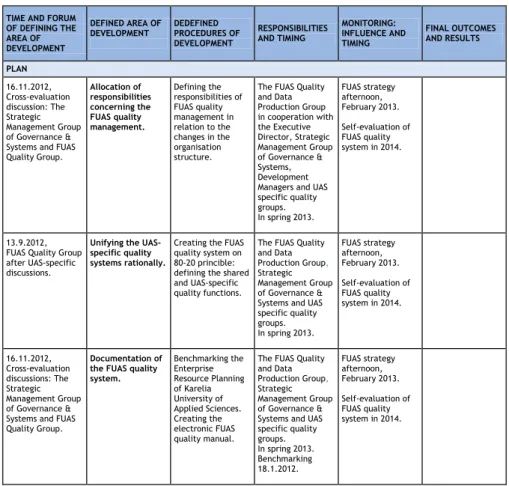
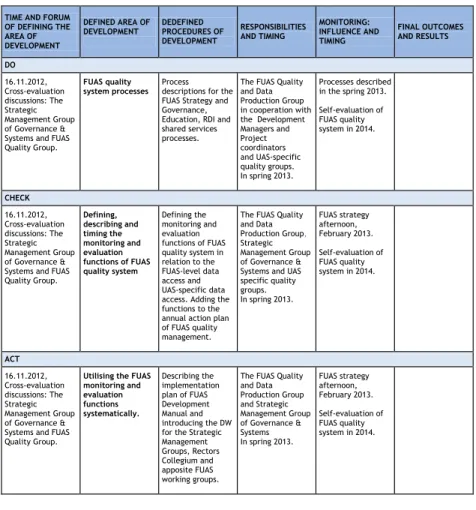
As in the third cross-evaluation, the discussions have been analysed and the most important areas of development have been defined. The following areas of development will be added to the Development Workbook of the FUAS Strategic Steering Group of Governance & Systems. The areas of develop-ment illustrate the current phase, in which there are many open questions. The areas of development have been listed according to the PDCA model.
24
Table 1: Development workbook, PlanPicture 2: Development workbook, Plan
TIME AND FORUM OF DEFINING THE AREA OF DEVELOPMENT
DEFINED AREA OF
DEVELOPMENT DEDEFINED PROCEDURES OF DEVELOPMENT RESPONSIBILITIES AND TIMING MONITORING: INFLUENCE AND TIMING FINAL OUTCOMES AND RESULTS PLAN 16.11.2012, Cross-evaluation discussion: The Strategic Management Group of Governance & Systems and FUAS Quality Group. Allocation of responsibilities concerning the FUAS quality management. Defining the responsibilities of FUAS quality management in relation to the changes in the organisation structure.
The FUAS Quality and Data Production Group in cooperation with the Executive Director, Strategic Management Group of Governance & Systems, Development Managers and UAS specific quality groups. In spring 2013. FUAS strategy afternoon, February 2013. Self-evaluation of FUAS quality system in 2014. 13.9.2012, FUAS Quality Group after UAS-specific discussions.
Unifying the UAS- specific quality systems rationally.
Creating the FUAS quality system on 80-20 princible: defining the shared and UAS-specific quality functions.
The FUAS Quality and Data Production Group,
Strategic Management Group of Governance & Systems and UAS specific quality groups. In spring 2013. FUAS strategy afternoon, February 2013. Self-evaluation of FUAS quality system in 2014. 16.11.2012, Cross-evaluation discussions: The Strategic Management Group of Governance & Systems and FUAS Quality Group.
Documentation of the FUAS quality system. Benchmarking the Enterprise Resource Planning of Karelia University of Applied Sciences. Creating the electronic FUAS quality manual.
The FUAS Quality and Data Production Group,
Strategic Management Group of Governance & Systems and UAS specific quality groups. In spring 2013. Benchmarking 18.1.2012. FUAS strategy afternoon, February 2013. Self-evaluation of FUAS quality system in 2014.
Table 2: Development workbook: Do, Check, Act HAMK-LUAS- LAUREA CROSS EVALUATION 4 FINAL REPORT 21 (25) 15.1.2013
Picture 3: Development workbook: Do, Check, Act
TIME AND FORUM OF DEFINING THE AREA OF DEVELOPMENT
DEFINED AREA OF
DEVELOPMENT DEDEFINED PROCEDURES OF DEVELOPMENT RESPONSIBILITIES AND TIMING MONITORING: INFLUENCE AND TIMING FINAL OUTCOMES AND RESULTS DO 16.11.2012, Cross-evaluation discussions: The Strategic Management Group of Governance & Systems and FUAS Quality Group.
FUAS quality
system processes Process descriptions for the FUAS Strategy and Governance, Education, RDI and shared services processes.
The FUAS Quality and Data Production Group in cooperation with the Development Managers and Project coordinators and UAS-specific quality groups. In spring 2013. Processes described in the spring 2013. Self-evaluation of FUAS quality system in 2014. CHECK 16.11.2012, Cross-evaluation discussions: The Strategic Management Group of Governance & Systems and FUAS Quality Group. Defining, describing and timing the monitoring and evaluation functions of FUAS quality system Defining the monitoring and evaluation functions of FUAS quality system in relation to the FUAS-level data access and UAS-specific data access. Adding the functions to the annual action plan of FUAS quality management.
The FUAS Quality and Data Production Group,
Strategic Management Group of Governance & Systems and UAS specific quality groups. In spring 2013. FUAS strategy afternoon, February 2013. Self-evaluation of FUAS quality system in 2014. ACT 16.11.2012, Cross-evaluation discussions: The Strategic Management Group of Governance & Systems and FUAS Quality Group.
Utilising the FUAS monitoring and evaluation functions systematically. Describing the implementation plan of FUAS Development Manual and introducing the DW for the Strategic Management Groups, Rectors Collegium and apposite FUAS working groups.
The FUAS Quality and Data Production Group and Strategic Management Group of Governance & Systems In spring 2013. FUAS strategy afternoon, February 2013. Self-evaluation of FUAS quality system in 2014.
The next step is starting the full implementation of the development workbooks and creating the shared system. The work on creating the shared quality system has already started and the FUAS Quality Group has preliminary plans for the quality manual.
The next step is starting the full implementation of the development work-books and creating the shared system. The work on creating the shared qual-ity system has already started and the FUAS Qualqual-ity Group has preliminary plans for the quality manual.
4.2 Lessons learned and plans for the future
The implementation of the fourth cross-evaluation on quality policy strength-ened the togetherness of the FUAS personnel and made operational plan-ning more transparent and participatory. Cross-evaluation discussions were considered as valuable opportunities for sharing information, opinions and good practices. The FUAS Quality Group feels that it got valuable infor-mation and support for its daily work. The FUAS Quality Group shares the view that in addition to the top down planning, collaborate and co-opera-tional working methods are essential in FUAS operations. The cross-evalu-ation process has brought the members of FUAS closer together and created shared functions and the quality system in the future seems promising. The FUAS Quality Group received support in creating a shared system that still
26
enables the individuality of each UAS. The quality system based on the 80-20 principle (80 per cent shared and 80-20 per cent UAS specific quality func-tions) is seen realistic.
A clear concern about the poorly functional FUAS extranet was mentioned in most of the discussions. The concerns have been forwarded to the Strategic Management Groups of Governance & Systems. FUAS is recruiting an en-terprise architect at the moment and the improvement of the shared extranet services is seen as one role of the enterprise architecture.
Shared and international audits are an essential part of FUAS operations. At the moment, FUAS is receiving international support for creating its quality functions. FUAS is currently implementing a benchmarking project “Inter-national Benchmarking Project, Exercise on Quality and Education” togeth-er with its strategic partntogeth-er KU Leuven Association (Belgium). FINHEEC funding for this project was confirmed in November 2012 and the bench-marking project will be executed in spring and autumn 2013. This project will help in the development of the FUAS Quality Systems. It will also make FUAS operations more transparent and visible for everybody.
A shared quality policy should support all members of FUAS in their daily work. It means participation in the development functions and involvement in reaching the strategic intent. At its best, quality system is not something separate and added to the daily work but it is embedded in the whole opera-tion. The aim of the FUAS Quality System is to create extra value, not extra work, in a transparent and collaborate way.
So far, unifying the quality functions, especially in the Check stage(e.g. uni-fied feedbacks and surveys) has been rather easy but now it is time to concen-trate on unifying the processes in the Plan and Do stages, add more contexts to the operation and to verify the true benefit of FUAS operations.
With regard to quality, it is important that the added value of FUAS opera-tions can be highlighted in the monitoring and evaluation funcopera-tions and fur-ther utilised in the operational development. Creating the right indicators for monitoring and evaluating FUAS operation and truly developing the opera-tion is vital. In the development of the FUAS Quality System, these aspects are recognised and further developed. Through a well-functioning quality system it is possible to ensure the full utilisation of the follow-up procedures, good practices and learning from each other.
According to the results of the fourth cross-evaluation, there is no doubt that a common quality system has been accepted by the members of FUAS. A shared quality culture is the glue that holds FUAS together and strengthens its connections and operations. To face the challenges of everyday operations, FUAS needs a thorough, transparent and functional quality system that does not rest but grows as operations develop. Creating the FUAS Quality Sys-tem together is an essential way of verifying the true added value of FUAS.
FINHEEC. 2011. Audit manual for the quality assurance systems of higher educa-tion institueduca-tions 2011-2017. Finnish Higher Educaeduca-tion Evaluaeduca-tion Council. Friman M. Ignatius J. Järvinen M-R. 2011. Cross-evaluation in the developing of
Quality System. ECER 2011 13.-16.9.2011. Berlin.
Friman M. Ignatius J. Järvinen M-R. 2012. Creativity in Building up the Quality System, Learning by Developing – Creativity in Higher Education. 9.-11.3. 2012, Leppävaara.
Friman M. Ignatius J. Järvinen M-R. 2012. Building Common Quality System in the Federation of Three Universities of Applied Sciences. ECER 2012 18.-21.9.2012. Cádiz.
H. Malinen & et. al. 2011. Hämeen ammattikorkeakoulun laadunvarmistusjärjest-elmän auditointi. Korkeakoulujen arviointineuvosto. Tampere.
Korppoo M. 2010. Laatutyöhön sitouttamisen edellytykset ammattikorkeakoulus-sa. Helsingin yliopisto. Käyttäytymistieteiden laitos. Kasvatustieteen tut-kimuksia 229. Helsinki.
S. Lampelo & et. al. 2010. Laurea-ammattikorkeakoulun laadunvarmistusjärjest-elmän auditointi. Korkeakoulujen arviointineuvosto. Tampere.
Appendix 1 Pre-material of the first round ...30 Appendix 2 Material shown on 16.11. ... 35 Appendix 3 Development workbook template ... 45
30
CROSS-EVALUATION 1 (5)
25.9.2012
FUAS CROSS-EVALUATION 2012
Theme: The FUAS Quality Policy (FINHEEC audit target 1) The aims regarding the FUAS quality system are to:
• define it’s/the objectives,
• define it’s contents and interfaces in comparison to the quality system of each UAS, • specify the allocation of responsibilities,
• improve the documentation and communications,
develop the FUAS quality culture as a whole.
Executing the cross-evaluation and the forthcoming results will create the basis the FUAS Quality Manual.
Execution /scheduling
Procedure Scheduling Responsible actors
Defining the theme and objectives
of the cross-evaluation May-August 2012 Mervi Friman, Jaana Ignatius, Marjo-Riitta Järvinen Producing the cross-evaluation
ma-terial: description of the current quality system of FUAS
August 2012 Mervi Friman, Jaana Ignatius, Marjo-Riitta Järvinen 1st round of cross-evaluation
discus-sions, executed separately in each UAS
HAMK: e-mail inriquiry weeks 36 and 37
LAMK: 11.9.2012, quality and assessment team
Laurea: 7.9.2012: the quality system development group
Mervi Friman, Jaana Ignatius, Marjo-Riitta Järvinen
Specifying the description of FUAS quality system according to the 1st
round of discussions
13.9.2012 Mervi Friman, Jaana Ignatius, Marjo-Riitta Järvinen Executing the 2nd cross-evaluation
discussions with the FUAS Strategic Steering Groups of Education and RDI
17.9.2012 Mervi Friman, Jaana Ignatius, Marjo-Riitta Järvinen, Erja Katajamäki (Koso), Maarit Fränti (TKIso)
Specifying the description of FUAS quality system according to the 2nd
discussion
October 2012 Mervi Friman, Jaana Ignatius, Marjo-Riitta Järvinen Executing the 3rd cross-evaluation
discussions with the FUAS Strategic Steering Group of Governance & Systems
16.11.2012 Mervi Friman, Jaana Ignatius, Marjo-Riitta Järvinen, Janne Salminen (OJso)
Specifying the description of FUAS quality system according to the 3rd
discussion
November-December 2012 Mervi Friman, Jaana Ignatius, Marjo-Riitta Järvinen Creating the FUAS Quality Manual Spring 2013 Mervi Friman, Jaana Ignatius,
Appendix
CROSS-EVALUATION 2 (5)
25.9.2012
CROSS-EVALUATION MATERIAL FUAS quality system, autumn 2012
FAUS has one quality system which still allows UAS-specific functional means for developing differ-ent practices and methods of operation. UAS-specific practices and methods of operation are made visible to the partner institutions.
The objectives of FUAS quality system are to,
- support attaining of the FUAS strategic intent and to steer the development of FUAS opera-tions
- strengthen the quality of general andeducational operation of FUAS
- systematically produce information concerning the FUAS processes and services in order to develop operations
- support the sharing of best practices inside FUAS, nationally and internationally - unify and emphasise the FUAS quality management
- strengthen the involvement of the actors and their competence on the field of quality - promote the equality of the personnel and students
- promote the development of organization and quality cultures of FUAS
PLAN, basis of opera-tional planning
-FUAS Vision 2020
-FUAS Strategy 2011-2015
-FUAS Action Plan
2010-2012
-FUAS Alliance agreement
DO, processes
-Strategy and management process
-Education process
-RDI process
-Support service
ACT, operational devel-opment -Strategic development -Development of education -RDI development -Development of support services -Development of Quality System -> Maintenance manual
CHECK, monitoring and evaluation
Perspectives and measurement targets/FUAS-strategic indicators:
-International prestige and competiveness
-Regional impact
-Comprehensive education and RDI services
-Shared operating culture
32
25.9.2012
Plan FUAS Vision 2020
FUAS Strategy 2011-2015 FUAS Alliance agreement FUAS Action Plan 2010-2012
Ministry of Education and Culture agreement
Do Strategy and management processes
Education process RDI process
Shared processes: FUAS-coordination, quality and data production, data administration, virtual campus, communications, global activities
Check 2012-2016
Follow upand evaluation
• Follow up of FUAS Strategy 2011-2015 (evaluating the strategic indicators annually), May
• Evaluating the shared operating culture
• Evaluating theMinistry of Education and Culture agreement indicators, May
• Evaluating the finances, May Assessments and audits
• Governance Review 2013, follow up 2015
• Curriculum Review, 2012, follow up 2014
• Research Review 2013, follow up 2015
• Cross-evaluation, expediently annually or every two years
• Self-assessment of FUAS Quality System in 2014
• National themed audit /FINHEEC, expediently by execution schedule
• Audit of the quality system, 2016 Feedback
• Feedback on the quality of education 2012, 2014, 2016
• Feedback on student welfare, 2013, 2015
• Feedback on summer studies, annually
• Feedback of the graduates, UAS (OPALA-feedback)
• Feedback of the MD graduates, annually
• Feedback of the graduates (career survey) 2013, 2015
• Feedback on shared services, 2014, 2016 (as a part of the working group survey)
• Customer satisfaction survey of the libraries 2013, 2016
• Feedback on theapprenticeship education, expediently by execution schedule
Act Maintenance manuals for development
• Strategic development, FUAS Rectors Collegium
• Development of education, FUAS Strategic Management Group of Education
• Development of RDI functions, FUAS Strategic Management Group of RDI
• Development of the shared services, FUAS Strategic Management Group ofGovernance and Systems
Appendix
CROSS-EVALUATION 4 (5)
25.9.2012
Allocation of responsibilities concerning the quality system of FUAS
FUAS Governing Board
- makes the decisions concerning the Quality System - promotes the strategic development
- is responsible for the follow up and evaluation of the implementation of the strategy Rectors Collegium
- implements and fine-tunes the decisions of the FUAS Governing Board
- promotes and supports the communications concerning the FUAS Quality System StrategicSteering Groups of Education, RDI and Governance & Systems
- are responsible for the quality management on their own range of operation FUAS Quality and Data Production Group (LaaTi)
- the overall creation and development of the FUAS Quality Management Systems - defining the FUAS and UAS-specific quality functions
o modelling of the shared operations
o unifying the UAS-level operations rationally
o visualising the UAS-specific practices and methods of operation for the others - producing FUAS follow up and evaluation information
- supporting and coordinating the execution of FUAS level audits
- preserving and developing the documentation concerning the FUAS Quality Manual
The UAS-specific allocationof responsibilities when implementing and developing the FUAS Quality System
- HAMK, the Steering Group of Quality Management
- LAMK, the Steering Group of Quality and the Quality and Assessment Team - Laurea, the Development Group of Quality System
Documentation and Communications of the FUAS Quality System (ideas for development) - the electronic environments of each UAS: FUAS-pages/FUAS Quality Management - FUAS extranet: memos, documantation of the quality management
- FUAS internet pages: FUAS Quality Manual / basic description - FUAS Quality Manual: both electronic and printed
34
CROSS-EVALUATION 5 (5)
25.9.2012
Organisation and Quality Culture of the FUAS-universities
- Quality management to be a part of everyday operation: e.g. the Maintenance Manuals to function as tools of development and making the different evaluations and audits more visi-ble for the students and personnel
A list of activities concerning quality functions that are executed in FUAS-universities with var-ying practises
- gathering the course feedback - assessing the curricula
- executing performance evaluations /executing the assessments of competence - organising recreation days for personnel
- executing different reviews on RDI and education - organizing personnel welfare surveys
- self-assessments of learning environments/instructions (e.g. the laboratories) - (making purchaseing and leasing contracts)
Executed in addition in HAMK - sustainable development
- inner monitoring, risk management Executed in addition in Laurea
- inner audits - inner benchmarking
- surveys concerning accessibility and security
1
Developing the FUAS quality system
Cross‐evaluation, fall 2012 The strategic steering group of Governance and Systems 16.11.2012 Mervi Friman, HAMK Sara Heikkilä, HAMK Jaana Ignatius, Laurea Marjo‐Riitta Järvinen, LAMKThe theme and aims of the cross‐evaluation
Theme of the cross‐evaluation The FUAS Quality Policy (FINHEEC audit target 1) The aims regarding the FUAS quality system are to: define it’s objectives define it’s contents and interfaces in comparison to the quality system of each UAS improve the documentation and communications specify the allocation of responsibilities develop the FUAS quality culture as a whole Executing the cross‐evaluation and the forthcoming results will create the basis the FUAS quality system (based on the “80‐20 principle”) and for the FUAS Quality Manual. 235 Appendix January 25, 2013
Developing the FUAS quality system
Cross‐evaluation, fall 2012 The strategic steering group of Governance and Systems 16.11.2012 Mervi Friman, HAMK Sara Heikkilä, HAMK Jaana Ignatius, Laurea Marjo‐Riitta Järvinen, LAMKThe theme and aims of the cross‐evaluation
Theme of the cross‐evaluation The FUAS Quality Policy (FINHEEC audit target 1) The aims regarding the FUAS quality system are to: define it’s objectives define it’s contents and interfaces in comparison to the quality system of each UAS improve the documentation and communications specify the allocation of responsibilities develop the FUAS quality culture as a whole Executing the cross‐evaluation and the forthcoming results will create the basis the FUAS quality system (based on the “80‐20 principle”) and for the FUAS Quality Manual. 2Appendix 2 Material shown on 16.11.
36
2
The
main
phases
on
the
cross
‐
evaluation
process
Cross evaluation discussions
1stof cross‐evaluation discussions, separately in each UAS, September 2012
2nd round of cross‐evaluation discussions, FUAS Strategic Steering Groups of Education and RDI, September 2012
3rd round of cross‐evaluation discussions with the FUAS Strategic Steering Group of Governance & Systems, November 2012
‐ In between FUAS quality group has specified the description of the FUAS
quality system on the base of the feedback
‐ In addition discussions on the process descriptions has been had in the other
strategic steering groups
‐ The first version of FUAS quality manual in spring 2013
3
FUAS
Quality
System
37
Appendix January 25, 2013
The
main
phases
on
the
cross
‐
evaluation
process
Cross evaluation discussions
1stof cross‐evaluation discussions, separately in each UAS, September 2012
2nd round of cross‐evaluation discussions, FUAS Strategic Steering Groups of Education and RDI, September 2012
3rd round of cross‐evaluation discussions with the FUAS Strategic Steering Group of Governance & Systems, November 2012
‐ In between FUAS quality group has specified the description of the FUAS
quality system on the base of the feedback
‐ In addition discussions on the process descriptions has been had in the other
strategic steering groups
‐ The first version of FUAS quality manual in spring 2013
3
FUAS
Quality
System
In November 2012
January 25, 2013
The
objectives
of
FUAS
Quality
System
are
to:
support attaining of the FUAS strategic intent and to steer the development of FUAS operations strengthen the quality of general and educational operation of FUAS systematically produce information concerning the FUAS processes and services in order to develop the operation support the sharing of best practices inside FUAS, nationally and internationally unify and emphasise the FUAS quality management strengthen the involvement of the actors and their competence on the field of quality promote the equality of the personnel and students promote the development of quality culture of FUAS 5 6
FUAS Quality System
PLAN, basis of operational planning -FUAS Vision 2020 -FUAS Strategy 2011-2015-FUAS Action Plan 2010-2012
-FUAS Alliance agreement
DO, processes
-Strategy and management process
-Education process -RDI process -Support service ACT, operational development -Strategic development -Development of education -RDI development
-Development of support services
-Development of Quality System
-> Development workbook
CHECK, monitoring and evaluation
Perspectives and measurement targets/FUAS-strategic indicators:
-International prestige and competiveness -Regional impact
-Comprehensive education and RDI services -Shared operating culture
38
4
FUAS
Quality
System
1/4
PLAN, basis of operational
planning Strategic intent Strategy 2011‐2015 FUAS Alliance agreement Action Plan 2010‐2012 Ministry of Education and Culture agreement DO, processes Strategy and management processes Education process RDI process Shared processes: FUAS‐ coordination, quality and data production, data administration, virtual campus, communications, global activities 7
FUAS
Quality
System
2/4
Follow up and evaluation Follow up of FUAS Strategy 2011‐ 2015 (evaluating the strategic indicators annually) (inc. Assessing the shared operation culture) Evaluating the Ministry of Education and Culture agreement indicators
Evaluating the finances
Assessments and audits
Governance Review
Curriculum Review
Research Review
Cross‐evaluation
Self‐assessment of FUAS Quality
System National themed audit /FINHEEC, expediently by execution schedule International audit of the quality system 8
CHECK, monitoring and evaluation 1/2
= In development stage
NB. All monitoring and evaluation procedures are placed to the annual cycle of quality management.
39
Appendix January 25, 2013
FUAS
Quality
System
1/4
PLAN, basis of operational
planning Strategic intent Strategy 2011‐2015 FUAS Alliance agreement Action Plan 2010‐2012 Ministry of Education and Culture agreement DO, processes Strategy and management processes Education process RDI process Shared processes: FUAS‐ coordination, quality and data production, data administration, virtual campus, communications, global activities 7
FUAS
Quality
System
2/4
Follow up and evaluation Follow up of FUAS Strategy 2011‐ 2015 (evaluating the strategic indicators annually) (inc. Assessing the shared operation culture) Evaluating the Ministry of Education and Culture agreement indicators
Evaluating the finances
Assessments and audits
Governance Review
Curriculum Review
Research Review
Cross‐evaluation
Self‐assessment of FUAS Quality
System National themed audit /FINHEEC, expediently by execution schedule International audit of the quality system 8
CHECK, monitoring and evaluation 1/2
= In development stage
NB. All monitoring and evaluation procedures are placed to the annual cycle of quality management.
January 25, 2013
FUAS
Quality
System
3/4
Feedback
Feedback on the quality of education
Feedback on student welfare
Feedback on summer studies
Feedback of the MD graduates
Feedback on the apprenticeship education
Feedback on shares services (as a part of the working group survey) Feedback of the graduates, UAS (OPALA‐feedback)
Feedback of the graduates (career survey)
Customer satisfaction survey of the libraries
9
CHECK, monitoring and evaluation 2/2
NB. All monitoring and evaluation procedures are placed to the annual cycle of quality management.
FUAS
Quality
System
4/4
Development workbooks Strategic development (FUAS Rectors Collegium) Development of the education (FUAS Strategic Management Group of Education) Development of RDI functions (FUAS Strategic Management Group of RDI) Development of the shared services (FUAS Strategic Management Group of governance and Systems)
In addition development workbooks are utilised in the project and working
groups
10