The classification performance of Bayesian Networks Classifiers: A case study
of detecting Denial of Service (DoS) attacks in cloud computing environments
By
Lindani Moyo
[BSc Honours]
A dissertation submitted in fulfillment of the requirements of the Degree of Master of Science in
Computer Science
Department of Computer Science Faculty of Science & Agriculture
Supervised by
Prof Khulumani Sibanda
Abstract
In this research we propose a Bayesian networks approach as a promissory classification technique for detecting malicious traffic due to Denial of Service (DoS) attacks. Bayesian networks have been applied in numerous fields fraught with uncertainty and they have been proved to be successful. They have excelled tremendously in classification tasks i.e. text analysis, medical diagnoses and environmental modeling and management. The detection of DoS attacks has received tremendous attention in the field of network security. DoS attacks have proved to be detrimental and are the bane of cloud computing environments. Large business enterprises have been/or are still unwilling to outsource their businesses to the cloud due to the intrusive tendencies that the cloud platforms are prone too. To make use of Bayesian networks it is imperative to understand the ―ecosystem‖ of factors that are external to modeling the Bayesian algorithm itself. Understanding these factors have proven to result in comparable improvement in classification performance beyond the augmentation of the existing algorithms. Literature provides discussions pertaining to the factors that impact the classification capability, however it was noticed that the effects of the factors are not universal, they tend to be unique for each domain problem. This study investigates the effects of modeling parameters on the classification performance of Bayesian network classifiers in detecting DoS attacks in cloud platforms. We analyzed how structural complexity, training sample size, the choice of discretization method and lastly the score function both individually and collectively impact the performance of classifying between normal and DoS attacks on the cloud. To study the aforementioned factors, we conducted a series of experiments in detecting live DoS attacks launched against a deployed cloud and thereafter examined the classification performance in terms of accuracy of different classes of Bayesian networks. NSL-KDD dataset was used as our training set. We used ownCloud software to deploy our cloud platform. To launch DoS attacks, we used hping3 hacker friendly utility. A live packet capture was used as our test set. WEKA version 3.7.12 was used for our experiments. Our results show that the progression in model complexity improves the classification performance. This is attributed to the increase in the number of attribute correlations. Also the size of the training sample size proved to improve classification ability. Our findings noted that the choice of discretization algorithm does matter in the quest for optimal classification performance. Furthermore, our results indicate that the choice of scoring function
does not affect the classification performance of Bayesian networks. Conclusions drawn from this research are prescriptive particularly for a novice machine learning researcher with valuable recommendations that ensure optimal classification performance of Bayesian networks classifiers.
Keywords
Bayesian networks, Bayesian networks classifiers, Classification, Cloud computing, Denial of Service attacks, Discretization, Probability, Score function
Statement of Original Authorship
I, Lindani Moyo do hereby confirm that all the work contained in this dissertation has not been submitted for any other qualification at this or any other University. Furthermore I confirm that the mini-dissertation does not contain any published information except where due reference has been indicated.
Signature: _________________
Plagiarism Declaration
I………student number...………hereby declare that I am fully aware of the University of Fort Hare’s policy on plagiarism and I have taken every precaution to comply with regulations.
Publications
Part of the research work presented in this dissertation has been published or has been submitted for publication or review in the following papers:
L. Moyo and K. Sibanda, Designing an Intelligent Agent for Denial of Service (DoS) Detection
in Cloud Computing Environments: A Bayesian Networks Approach. Poster Presentation, In Proceedings of the 2014 Southern African Telecommunications Networks and Applications Conference, Port Elizabeth, Eastern Cape, South Africa
L. Moyo and K. Sibanda, On the classification performance of Bayesian networks classifiers in detecting denial of service (DoS) attacks in cloud computing environments. In Proceedings of the 2015 Southern African Telecommunications Networks and Applications Conference, Arabella, Hermanus, Western Cape, South Africa
Acknowledgements
―To the only wise God our Saviour, be glory and majesty, dominion and power, both now and ever. Amen‖ (Jude 1:25). I would like to thank my omnipotent Father for his unfailing love, grace and providence that has kept me until this far. Ebenezer!
I am greatly indebted to my research supervisor Professor K. Sibanda for his immeasurable insight, encouragement, guidance and support he offered in this project. A special thanks to the H.o.D of the Department of Computer Science Mr S. Scott for accepting me for the masters programme and providing the necessary equipment to use. Also a heartfelt thanks to Professor M. Thinyane and Mr. Z. Shibeshi for their motivation and concern throughout this study. Thank you to the Masters class of 2015 for the friendship, assistance and knowledge sharing. It was a worthwhile experience.
I would like to acknowledge the on-going support from parents Mr & Mrs C.T. Moyo, my siblings Lungile and Dingani, relatives and Siphephelo, Vukile Ndedwa, Nkosilathi Ndlovu, Gilbert Vundla, Mthulisi Mpofu, Thulani Dube, Noel Nyathi and Mayibongwe Bayana. Their encouragement, love, prayers and support through my academic pursuit was, and still is greatly appreciated.
This work is based on the research undertaken within the Telkom Centre of Excellence in ICT4D supported in part by Telkom SA, Tellabs SA/Coriant, Saab Grintek Technologies, Easttel, Khula Holdings and THRIP. The opinions, findings and conclusions or recommendations expressed here are those of the author and none of the above sponsors accepts any liability whatsoever in this regard.
Table of Contents
Abstract ... I Keywords ... III
Statement of Original Authorship ... IV
Plagiarism Declaration ... V Publications ... VI
Acknowledgements ... VII List of Figures ... XII List of Tables ... XIII List of Acronyms ... XIV
Chapter 1: Introduction ... 1 1.1 Background Information ... 1 1.2 Problem statement ... 2 1.3 Aim ... 5 1.4 Objectives of study... 5 1.5 Research questions ... 5
1.6 Scope of the study ... 5
1.7 Dissertation structure ... 6
1.8 Conclusion ... 7
Chapter 2: Cloud Computing ... 8
2.1 The notion of Cloud Computing ... 8
2.2 Definition of Cloud Computing ... 8
2.2.1 Issues for Cloud Computing ... 11
2.3 Anatomy of Denial of Service attacks ... 13
2.3.1 What is a Denial of Service? ... 13
2.3.2 DoS attacks mechanisms ... 13
2.3.3 Network Flooding ... 14
2.4 Detection method ... 15
2.4.1 Signature-based detection ... 16
2.4.2 Anomaly-based detection ... 16
2.4.3 DoS detection in cloud computing ... 16
Chapter 3: Bayesian Networks Theory ... 18 3.1 Probability theory ... 18 3.1.1 Bayes’ theorem ... 19 3.2 Bayesian Networks ... 20 3.3 Notation ... 21 3.4 Conditional Probabilities ... 23
3.5 Bayesian Networks as classifiers ... 24
3.5.1 Naïve Bayes Classifiers ... 25
3.5.2 Tree Augmented Naïve Bayes Classifier ... 26
3.5.3 Averaged One Dependence Estimators (AODE) ... 28
3.5.4 General Bayesian Networks ... 29
3.6 Learning Bayesian Networks ... 30
3.7 Application of Bayesian network classifiers in the Intrusion detection problem ... 32
3.8 Classification performance of Bayesian Networks Classifiers ... 32
3.8.1 What is classification? ... 32
3.9 Classification performance – Bias and variance trade-off ... 34
3.9.1 Network structure: Model/Structure Complexity ... 35
3.9.2 Training sample size ... 39
3.10 Induction phase: Score functions ... 43
3.10.1 Score+search algorithms ... 43
3.10.1 Score functions for Learning Bayesian networks ... 45
3.11 Discretization ... 51
3.11.1 Discretization methods classification ... 54
3.11.2 Discretization criterions ... 56
3.11.3 The choice of discretization approach ... 60
3.12 Conclusion ... 62
Chapter 4: Methodology and Design ... 63
4.1 Methodology ... 63
4.2 Research Design ... 64
4.2.1 Conceptual approach to BNC-NIDS ... 64
4.2.2 NSL-KDD Intrusion Detection Dataset ... 67
4.2.4 Data pre-processing ... 72
4.2.5 Bayesian Networks Classifier Model ... 73
4.2.6 Performance evaluation ... 74
4.2.7 Results analysis ... 75
4.2.8 Experiments set up ... 76
4.3 Conclusion ... 77
Chapter 5: Results and Discussion ... 78
5.1 The results ... 78 5.1.1 Model Complexity ... 78 5.1.2 Sample size ... 79 5.1.3 Discretization ... 81 5.1.4 Score Function ... 89 5.2 Discussion of results ... 94 5.2.1 Structural/model complexity ... 94
5.2.2 Training sample size ... 95
5.2.3 Choice of discretization approach... 96
5.2.4 Choice of score function ... 97
5.3 Conclusion ... 97
Chapter 6: Conclusion and Future work ... 98
6.1 Introduction ... 98
6.2 Empirical findings vs research questions ... 98
6.3 Recommendations and Future work ... 101
6.4 Conclusion ... 102 References ... 103 Appendix A ... 117 Appendix B ... 117 Appendix C ... 118 Appendix D ... 118 Appendix E ... 119 Appendix F ... 119 Appendix G ... 120 Appendix H ... 120
Appendix I ... 121
Appendix J ... 121
Appendix K ... 122
Appendix M ... 122
List of Figures
Figure 2-1: Cloud computing model (Shahzad, 2014) ... 10
Figure 2-2: Cloud adoption challenges ... 12
Figure 2-3: TCP three-way handshake (Divakaran, Murthy & Gonsalves, 2006) ... 15
Figure 3-1: NB ... 25
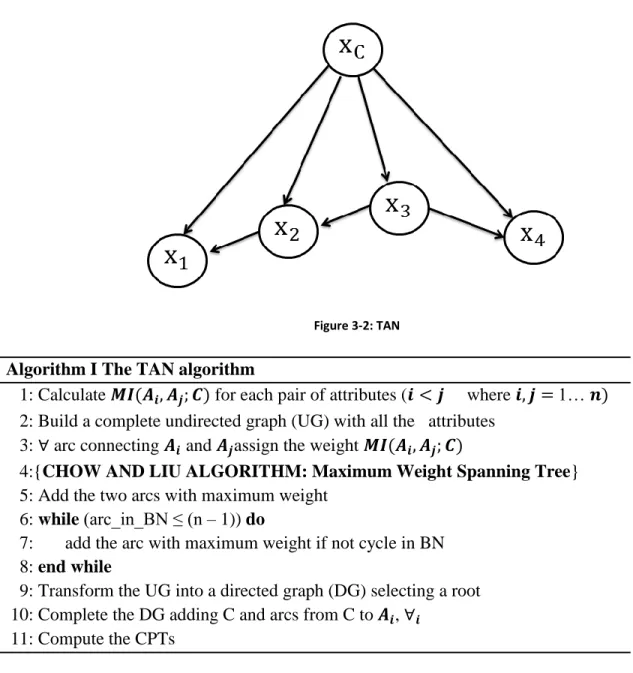
Figure 3-2: TAN ... 27
Figure 3-3: AODE ... 28
Figure 3-4: GBN ... 29
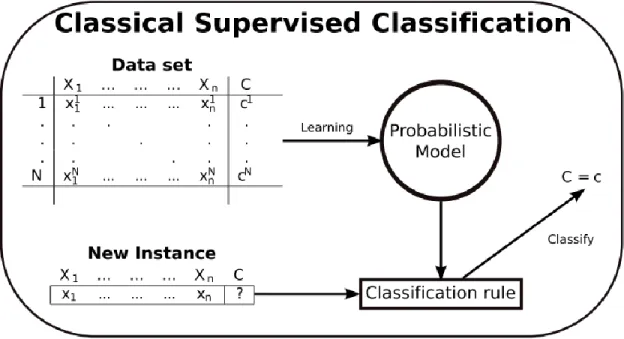
Figure 3-5 : Supervised Classification based on probabilistic classifiers(Rodriguez, 2013) ... 33
Figure 3-6 Bias and variance trade-off ... 34
Figure 3-7: Summary of Bayesian network classifiers (Bielza & Larrañaga, 2014) ... 37
Figure 3-8: Generic learning curve (Figueroa & Zeng-treitler, 2012)... 39
Figure 3-9 : Discretization process(Liu et al., 2002) ... 52
Figure 3-10: Transforming of continuous valued features into discrete (Hacibeyoglu, Arslan & Kahramanli, 2011) ... 53
Figure 3-11: Decomposition of discretization methods... 56
Figure 4-1: Research design ... 64
Figure 4-2: Conceptual Framework ... 65
Figure 4-3: System flowchart used in the study ... 66
Figure 4-4: Overview of the design set-up ... 69
Figure 4-5: Expression invoked for packet capture ... 69
Figure 4-6: Sample of normal traffic activity ... 70
Figure 4-7: Hping3 command ... 71
Figure 4-8: Sample of assembled packets by hping3 ... 71
Figure 4-9: Box plot parameters ... 76
Figure 5-1: Varying training set size ... 80
Figure 5-2: Discretization approach against Classification performance ... 82
Figure 5-3: Classification performance versus training size ... 84
Figure 5-4: Classification accuracy versus training set... 85
Figure 5-5: Classification accuracy versus training set... 86
Figure 5-6: Classification accuracy against training set size ... 87
Figure 5-7: Classification accuracy versus training set size ... 88
Figure 5-8: Classification accuracy vs type of score function ... 90
Figure 5-9: Classification accuracy against training sample size ... 91
Figure 5-10: Classification accuracy against training sample size ... 92
List of Tables
Table 3-1: Research on Bayesian classifiers and their application to intrusion detection domain ... 32
Table 3-2: Results from experiments done by (Bielza & Larranaga, 2014) ... 36
Table 3-3: Results on classification performance of Bayesian network classifiers (Madden, 2009) ... 37
Table 3-4: Results on classification performance of Bayesian classifiers (Baesens et al., 2004) ... 38
Table 3-5: Results on the prediction of the Victimization attribute ... 50
Table 4-1: Features extracted using Wireshark ... 73
Table 4-2: Confusion matrix for binary classification model ... 75
Table 4-3: Data characteristics ... 77
Table 5-1: Model complexity and classification accuracy ... 79
Table 5-2: Varying training set size ... 79
Table 5-3: Results of discretization approach comparison ... 82
Table 5-4: Results of discretization against size of training set of NB ... 84
Table 5-5: Results of discretization approach against size of sample set TAN ... 85
Table 5-6: Results of discretization approach against training set size AODE ... 86
Table 5-7: Results of discretization approach against training set size ... 87
Table 5-8: Results of discretization approach against training set size GBN-HC ... 88
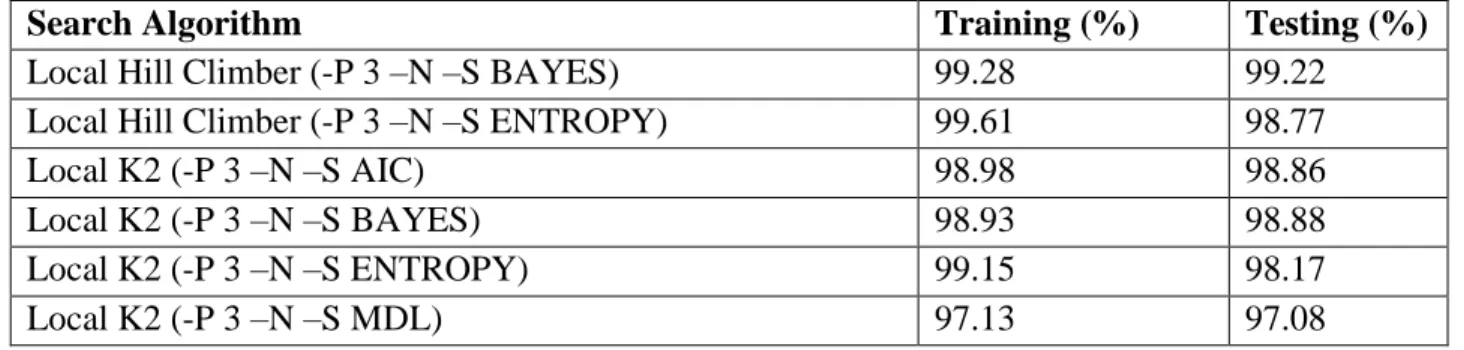
Table 5-9: Results of score function on classification performance ... 89
Table 5-10: Results of score function against varying training sample set ... 91
Table 5-11: Results of score function against varying training set size ... 92
List of Acronyms
AODE Averaged One Dependence Estimators
BD Bayesian Dirichlet
BDe Bayesian Dirichilet (―e‖ for likelihood-equivalence)
BDeu Bayesian Dirichilet (―u‖ for uniform joint distribution)
BN Bayesian Networks
DoS Denial of Service
GBN General Bayesian Network
GUI Graphic User Interface
IaaS Infrastructure as a Service
IDS Intrusion Detection System
LL Log-likelihood
MDL Minimum Description Length
MIT Mutual Information Test
NB Naïve Bayes
NML Normalized Minimum Likelihood
PaaS Platform as a Service
SaaS Software as a Service
TAN Tree Augmented Naïve Bayes
UCI UC Irvine
Chapter 1: Introduction
This dissertation considers the application of Bayesian Network classifiers to Denial of Service (DoS) attack detection, and attempts to reformulate the task of DoS attack detection in Cloud Computing environments. The purpose of this chapter is twofold, firstly to provide underlying reasons for research described in this dissertation and secondly to present research goals. It serves as an introduction to the research and to the chapters that follow. Section 1.1 outlines the background and motivation for the presented work in this dissertation. The problem statement is provided in Section 1.2 and thereafter the aim and research objectives are discussed in Section 1.3 and 1.4 respectively. Section 1.5 outlines the research questions of this study. The scope of the research is presented and clarified in Section 1.6. The final section is devoted for the description of the dissertation structure and the conclusion of this chapter.
1.1 Background Information
In the past decade cloud computing technology has been a buzzword and has become a major fabric of our contemporary lives. Firstly because of its immeasurable importance to large enterprises that deliver their services through the cloud like Google, Amazon, Microsoft etc and its immediate benefits to the customers or users of cloud services. Secondly cloud computing has been buzzy with activities directed at improving management of computational resources in the cloud. Large enterprises such as Amazon, Sales Force and Google own vast computational resources that need efficient mechanisms put in place to manage and scale up those resources. Scalability is particularly important as cloud computing heavily rely on shared infrastructure. However as more critical infrastructures for example power grid and air traffic control management which are vital to our modern society are migrating to cloud computing environments, security concerns at all levels have paralleled the growth of the computing model. According to recent reports on Internet security, voluminous and sophisticated intrusions targeting the network layer have substantially increased (Citrix, 2014; Alotaibi, 2015). Among the various types of intrusive behaviours, the most security breaches are attributed to Denial of Service (DoS) attacks (Ismail et al., 2013; Vidhya, 2014; Alotaibi, 2015). Increased situational awareness and cyber security solutions in the form of intrusion detection systems (IDS) are required to counter these ever growing sophisticated attacks which threaten cloud computing environments (Eskridge et al., 2009). Cloud network attacks are considered as intrusions and any
endeavour to eliminate the attacks entails first detecting those attacks. ID is a form of security management tool that gathers and analyses information with the aim of identifying possible sets of malicious activities that could compromise the confidentiality, integrity and the availability of computer system resources (Scarfone & Mell, 2007). ID is thus a front-end line of defence for securing computer systems. It is essential for alerting security administrators of impending attacks thus ensuring the smooth and efficient running of cloud-based activities. The development of IDSes is naturally inclined towards incorporating trade-offs in terms of detection accuracy, detection speed etc. Advanced and powerful approaches are required for the ID purpose for efficacy and efficient differentiation of normal activities and malicious activities for early and accurate detection. Securing of cloud computing environments against DoS attacks is realised using ID systems.
To ensure reliability and availability of cloud computing environments it requires early and accurate detection of intrusion attempts. Due to the commercialisation of, the increasing popularity and growing dependence on cloud computing by business enterprises, realization of an attack has devastating repercussions. Securing of the cloud computing infrastructure has therefore become an utmost priority research area for exploration. There are two major approaches to intrusion detection: signature-based and anomaly-based (Modi et al., 2013). In signature detection, the learning algorithm is trained using a dataset in which each instance is labelled as either normal or intrusion. A setback on signature-based approach is that only the modelled attack signatures can be detected. In order for the algorithm to detect novel intrusions that were not present in the training sample, the signature database must be updated by retraining the algorithm with new attack instances. However, in anomaly detection approach the behaviour is modelled and any event that deviates from modelled baseline is flagged as intrusive (Modi et al., 2013). Although this method is able to detect new attack activities its major problem is that it suffers from high rates of false positives which are due to unobserved normal events. In fact most methods that have been designed to detect intrusions have a number of setbacks which are presented later in our literature review. In section 1.2 the research presents the problem analysis.
1.2 Problem statement
The process of intrusion detection usually includes the processes of information gathering identification and classification. Classification is one of the core concepts in the field of pattern
recognition (Duda, Hart & Stork, 1997; Bishop, 2006). It has been applied in numerous problems e.g. document classification, speech recognition, internet search engines etc. Classification is the process of taking an instance of a training sample and predicting the class to which it belongs to based on its features. A classifier is a function therefore used to perform a classification task. A classifier may be used for instance to differentiate between cancerous cells from non-cancerous cells. Classifier models are learned from a given training dataset and subsequently used to infer the class of instances of new observations. Learning of classifier models has been an active research area and numerous researchers have developed classifier models for the intrusion detection problem: neural networks (Ryan, Lin & Mikkulainen, 1998; Reddy & Iaeng, 2013), rule-based (Arjunwadkar & Kulkarni, 2010), support vector machines (Khan, Awad & Thuraisingham, 2007), decision trees (Peddabachigari, Abraham & Thomas, 2004) and Bayesian analysis (Barbará, 2001). However, literature points that Bayesian networks are more advantageous as a classification approach e.g. the graphical representation of the problem domain and the quantification of uncertainty using probability (Uusitalo, 2006).
A preliminary study on the use of Bayesian networks algorithms in the intrusion detection problem is documented by (Barbara, Wu & Jajodia, 2001) and subsequently a number of scholars have applied various Bayesian network models for classification of internet traffic (Scott, 2004; Moore & Zuev, 2005; Bringas & Santos, 2010). Despite the widespread use of Bayesian networks in various fields, the researcher felt there exist uncertainties that need to be explored to yield optimal performance of Bayesian networks and consequently the accurate detection of DoS attacks. Most of the concerns are with regards to the impact of the training sample size, the choice of discretization approach and the score metric used in the induction process on the classification performance (Dougherty, Kohavi & Sahami, 1995; Sordo & Zeng, 2005; Liu, Malone & Yuan, 2012). The aforementioned factors generally tend to affect the predictive power of Bayesian networks, albeit in varying extents commensurate with the factors under investigation. Empirical studies conducted on these factors have been analysed and observed to produce varying results hence this rendered their findings inconclusive (Sordo & Zeng, 2005; Mizianty, Kurgan & Ogiela, 2008; Carvalho, 2009; Bielza & Larrañaga, 2014). Notably, the empirical studies were conducted on synthesized datasets or gold standard hence making it difficult to make the findings to be universal even in real world applications. Consequently, this exposes research gaps in the area of classification capability of Bayesian
networks. Furthermore publications that investigate the connection of structural complexity and the classification performance of Bayesian networks point out that the behaviour of a classifier is not universally ideal in all problem domains, hence it is important to conduct an empirically assessment (Madden, 2009; Bielza & Larrañaga, 2014). This consideration is important with respect to the no-free-lunch theorem. Despite the enhancements or augmentation of model structurally, this does not universally guarantee an improved in performance. Hence this factor is open for investigation. Literature indicates that training sample size is important for learning optimal classifiers (Foody et al., 2006). Inasmuch as sufficiently large sample tends to be representative of the real world domain and crucial in Bayesian models, it is important for learning more accurate probability estimates however it is interesting to note the behaviour with training sample size in Bayesian networks. Statistics researchers have pointed out that training sample size six times the sample dimensionality is adequate. There is uncertainty in how the models behave when inputted with novel examples. Considerations are also on the impact of both model complexity and training sample size on classification performance of Bayesian networks.
Studies also reveal disparities on the effect of the type of discretization approach and scoring function on predictive ability of Bayesian networks (Yang & Chang, 2002; Flores et al., 2011). There are a number of discretization techniques and score metrics to use during the learning process. Therefore there is some uncertainty on what is the best choice of algorithm to incorporate in the design of Bayesian networks (Liu, Malone & Yuan, 2012; García et al., 2013). Flores et al. (2011) describes discretization as a process that strongly impacts Bayesian network classification ability in terms of runtime, bias-variance discretization and accuracy. (Friedman, Geiger & Goldszmidt, 1997; Madden, 2003) describe scoring functions as factors that affect the quality of optimal network structure identified during the induction phase and hence influence the performance of Bayesian networks. Numerous studies have been conducted and no justifications were provided for choosing a particular algorithm while there are other candidate choices. Consequently, this exposes research gaps in the area of classification ability of Bayesian networks.
1.3 Aim
Determine how various factors impact the detection of DoS attacks on the cloud using Bayesian network classifiers. This broader aim has been broken down into specific objectives in Section 1.4.
1.4 Objectives of study
To review issues of DoS attacks in cloud environments.
To review Bayesian networks as a method of detection.
To determine how the complexity of Bayesian network classifiers affects their
classification performance.
To determine how the training set size impacts the classification performance of Bayesian network classifiers.
To analyse how discretization approaches impact the classification performance of Bayesian network classifiers.
To determine how the scoring function impact the classification performance of Bayesian
network classifiers.
1.5 Research questions
1) How do DoS attacks impact the cloud computing environments?
2) How do Bayesian networks perform classification tasks?
3) How does structural complexity of Bayesian classifiers affect their classification performance?
4) Does the size of the training dataset impact the classification performance of Bayesian classifiers?
5) Does the choice of discretization technique matter and how is the discretization process affected by the training sample size?
6) Does the choice of scoring function result in better classifiers and how are the score metrics affected by the training sample size?
1.6 Scope of the study
Data mining algorithms have been used to model IDS. In this study we used Bayesian networks for this purpose. The Bayesian based IDSes were applied in securing cloud computing
environments. There are a lot of intrusive behaviours that cloud platforms are prone to, however this study is limited to DoS attacks. Also this study does not focus on producing a new classification algorithm or improving the state-of-the art detection of DoS attacks but our study is limited to how the modelling factors of Bayesian networks affect their classification performance.
1.7 Dissertation structure
The dissertation consists of six chapters inclusive of this introduction chapter.
Chapter 1: gives the introduction of the research by presenting the background information to the study. It outlines the underlying reasons for the research work, presents the problem to be investigated and the research scope is also clarified.
Chapter 2: introduces the cloud computing technology from its definition, its essentials characteristics, the service models and the type of clouds. It provides the issues in terms of security that mar the cloud technology and thereafter limits the intrusive behaviour to DoS attacks. A special section is devoted to describe what DoS attacks are and how they are launched. Chapter 3: provides an in-depth literature review of the concept of Bayesian networks. Furthermore it introduces the Bayesian networks classifiers, which are Bayesian networks adapted for classification tasks. The chapter gives a discussion of the application of Bayesian network classifiers in intrusion detection and outlines also the theory on the induction of Bayesian networks classifiers. It also introduces the classification concept in data mining which is the gist of this study. It thereafter introduces the factors that affect the classification performance of Bayesian networks. There is a relationship between classification performance of Bayesian networks with the type of classifier, the appropriate size of the training sample set, the discretization approach and the score function. This chapter is partitioned into sections that discuss the aforementioned factors and the relevant algorithms under study. After each section a review ensues of the past work done of the factors that impact classification performance. These factors are the focus of the experiments that will be discussed in the later chapters.
Chapter 4: presents the materials used, methodology followed and experiments conducted in this study.
Chapter 5: describes the results and presents the evaluations of the research. The aims of the empirical study are stated, described and the results are analysed. Discussions on the classification performance of BN under the scenarios of the factors investigated.
Chapter 6: presents the conclusions drawn from the research and also give the further areas that can be explored in this particular study.
In addition to the chapters outlined above, Appendix A-M gives the snapshots of the output of the Friedman test, Nemenyi test and lastly the Boxplot. Appendix N gives the detailed characteristics of the NSL-KDD dataset used as our training dataset.
1.8 Conclusion
The chapter introduced the research study by providing the relevant background information, listing the research objectives and outlined the research questions that will be answered by this study. The chapter stated the research scope and concluded with the dissertation structure. An extensive review of the cloud computing technology and the concept of DoS attacks ensues in Chapter 2.
Chapter 2: Cloud Computing
This chapter introduces the notion of cloud computing and related underlying concepts. Furthermore, it introduces the cloud essential characteristics, the service models and lastly the type of clouds. Presented also are the issues in terms of security that characterise the cloud computing environments. It also discusses the concept of DoS attacks and their detection.
2.1 The notion of Cloud Computing
Computing has undergone a series of major innovations since its inception. Throughout the history of computing, there have been several quests to obviate computer hardware needs from users and detach them from time-shared computing (Zissis & Lekkas, 2012a). It is to that end that we have witnessed the emergence of cloud computing. The cloud technology is the latest innovative and distributed computing paradigm in which dynamically scalable and virtualized resources are accessed as a services over the Internet (Kim & Korea, 2009; Shahzad, 2014). At its simplest state, Cloud computing is basically a means through which computational power, storage, collaboration infrastructure, business processes and applications are consumed as services from anywhere through an internet connection. The cloud technology leverages end-users from their local hardware requirements and in the same vein diminishing overall requirements and complexity on the client-side. Basically this contemporary paradigm seeks to provision computing capabilities (Vaquero et al., 2009). The key capabilities are elaborated on in the ensuing section as essential characteristics.
2.2 Definition of Cloud Computing
The term cloud computing was coined from the cloud symbol that is traditionally used to depict the Internet in flowcharts. Presently, migration to the cloud has reached an advanced stage with end-users storing their personal data such as bookmarks, photographs and their music file etc. on datacenters accessible via the internet. The foundation of the cloud computing technology is virtualization (Zissis & Lekkas, 2012a). Virtualization is a technology that was conceived in the late 1960s. A synopsis of the virtualization technology entails abstraction of the computing resources of services from the underlying operating system (Pearce, Zeadally & Hunt, 2013). There are a number of definitions that are associated with cloud computing. The web is awash with efforts to pen down a stable definition that grips the essence of the distributed, elastic
computing paradigm. At its broadest level cloud computing is “A standard IT capability (services, software or infrastructure) delivered via the Internet technologies in a pay-per-use, self-service way”(Scarfone & Mell, 2007, p. 2; Badger et al., 2011, p. 1).
The definition of cloud computing describes some of the essential characteristics, three service models and four deployment models (Badger et al., 2011; Hogan et al., 2011):
Essential Characteristics:-
o On-demand self-service: end-users can provision computing resources such as network bandwidth and storage on-demand (as needed) in an autonomous mode without human intervention from service providers.
o Broad network access: computing resources are available over networks and can be consumed through standard mechanisms that permit the use of different client platforms e.g. mobile phones, tablets, laptops, and workstations
o Resource pooling: the cloud service provider’s cloud resources are pooled to serve end-users using a multi-tenant model that has different physical and virtual resources dynamically assigned and reassigned based on the customer’s demand. In a multi-tenant architecture, customers share the underlying infrastructure. o Rapid elasticity: computing resources can be rapidly scaled up or down at any
given time. To the client, the cloud resources are seemingly an infinite pool that can be consumed in any quantity at any time.
o Measured service: the usage of computing capabilities by cloud clients is monitored, controlled and reported by a metering system. The metering system reports the type of service consumed e.g. storage, processing and provides accurate and transparency to both the cloud vendor and client.
Cloud Computing Service Models – In the stead of products, in cloud computing we speak of services and there are basically three categories of service models as illustrated in Figure 2.1. With respect to the OSI model, the physical layer is the first or lowest layer. The first service model layer is known as the Infrastructure as a Service (IaaS).
IaaS – it is the first and lowest level service available to a cloud computing consumer and provides controlled access to a virtual infrastructure upon which operating systems and application software can be deployed.
PaaS – it is situated above the IaaS. The layer is for deployment of consumer-created applications and also tools provided by the vendor. The vendor exclusively manages or controls the underlying cloud infrastructure such as the network, operating system, servers and storage but however assigns consumers with control rights over the hosted applications and their application hosting platform configurations.
SaaS – it permits the consumer to access the vendor’s application hosted on the cloud infrastructure. The hosted applications can be consumed by use of a thin client interface, for instance a web browser. Consumers have no control rights over the underlying infrastructure but are however permitted to alter the application configurations.
Types of Cloud Computing – there exist three types of cloud computing (Furht & Escalante 2010) as depicted in Figure 2-1.
Figure 2-1: Cloud computing model (Shahzad, 2014)
Public cloud - also known as the external cloud. The cloud resources are accessible to the public. Basically, public clouds are generally under the control of a third-party which sells the cloud services.
Community cloud – the cloud deployment is a collaboration of different organizations and is made available to cater for concerns of a specific community. Usually managed by either the involved organizations or a third party and may be deployed on site or otherwise.
Private cloud – refers to a cloud deployed for a private organization. They are basically built for use by exclusively one client, powered with full control over data, security, and quality of service. The cloud infrastructure may be managed or controlled by the organization or a third party. It may be situated on site or off site.
Hybrid cloud – it is generally an environment that is a fusion of public, community, or private cloud models. The clouds each with its unique characteristics are integrated together by a standard that ensures the portability of the data and applications between the clouds.
2.2.1 Issues for Cloud Computing
Typically like any new technology, there exists limitations by which benefits can be achieved and a new approach may come with unique additional challenges. Since cloud computing is in its infancy, still maturing, it has not been spared in this respect. The implementation of cloud computing is thus marred with critical issues. One of the issues is taking critical applications and sensitive data, to public and shared cloud environments. From a consumer’s point of view there are a lot of discrepancies on security and trust that are currently inherent in the technology. Many users have mixed feelings about the location and storage of their data.
2.2.1.1 Security in the Cloud
Despite the positive business and technical implications associated with cloud computing, security, trust and privacy are notably the prime hurdles that avert the widespread adoption of the technology (Zissis & Lekkas, 2012a; Khalil, Khreishah & Azeem, 2014). Arguably the most critical security issue in Cloud Computing is detecting malicious activities at the network layer (Subashini & Kavitha, 2011; Zissis & Lekkas, 2012b; Fernandes et al., 2014). Adversaries exploit the existing cloud vulnerabilities and consequently temper with the confidentiality, availability and integrity of cloud resources and offered services. IaaS is the core tier for the other service layers in the cloud. Without a strong protection mechanism embedded in this layer, the security of other cloud layers is compromised. It is to that end that, various IaaS vendors are at task to develop defense schemes that will ensure the protection of their customer’s data and applications. Cloud security has thus been widely discussed in industry and academia (Vaquero et al., 2008; Pearce, Zeadally & Hunt, 2013; Sen, 2013). An IDC survey depicted in the Figure
2-2 below reveals that cloud security is the greatest challenge that is preventing many organizations from migration to the cloud (Ramgovind, Eloff & Smith, 2010).
Figure 2-2: Cloud adoption challenges
The Cloud computing environments have brought about certain specific challenges when it comes to the nature of cyber-attacks in the form of theft-of-service (Gruschka & Jensen, 2010), Denial of Service (Khorshed, Ali & Wasimi, 2012; Deshmukh & Devadkar, 2015), cloud malware injection (Zunnurhain & Vrbsky, 2011; Qaisar & Khawaja, 2012), cross VM side channels (Zhang et al., 2012), target shared memory (Khalil, Khreishah & Azeem, 2014) and phishing (Gonzalez et al., 2011).
To date there are several security mechanisms that have been put in place by cloud providers. First and foremost, physical security measures need to be established on-site to protect datacenters from break-ins and other physical violations. Network security uses approaches including firewalls and IPSes which are deployed to analyze network traffic and safeguard data in transit. Deployed also are IDSes to alert network administrators of malicious intrusion attempts (Khalil, Khreishah & Azeem, 2014) and honeypots to detect and thereafter deflect any attempts to unauthorized use of networks.
2.3 Anatomy of Denial of Service attacks
Our contemporary society is largely dependent on the reliability of the Internet, so are the cloud computing environments. It has been proved that it is not adequate to secure communications from eavesdroppers or guard it from being infected with viruses. Traditionally, the security fraternity paid most attention on confidentiality and integrity of information and largely overlooked Denial of Service (DoS) attacks. DoS attacks have become a prevalent security threat that is associated with instability of the internet (Ismail et al., 2013).
2.3.1 What is a Denial of Service?
Denial of Service (DoS) is a form of attack that disrupts a legitimate activity and makes sure that information or data is not available to its intended users (Specht & Lee, 2004; Abliz, 2011). The attack paralyses normal services and consequently affecting the usability and reachability of network services such as web, mail, voice and data. DoS attacks tend to tarnish the reputation of the service provider. There are several methods that are used to implement this attack. A DoS attack is executed by sending useless messages to a target host so as to interfere with its operations, thus making it to crash or process useless operations. The attack renders a machine or a network resource to be unavailable or to extremely slow for use by legitimate users (Mirkovic, 2003).There are however other ways with which services are made to be inaccessible rather than just sending an avalanche of IP packets. This involves the exploitation and attacking of various loopholes that exist on the victim to make it unstable.
2.3.2 DoS attacks mechanisms
There are basically two ways which are used to interfere with a legitimate operation (Douligeris & Mitrokotsa, 2004):-
a) Exploitation of vulnerability inherent on a target machine or application - this entails sending messages made in a specific manner to take advantage of a given vulnerability. b) Sending vast number of messages so as to consume some key resource – useless traffic is
sent to a key resource such as CPU time, bandwidth, and memory at the target machine. It is therefore that target applications, host or network spends critical resources processing malicious traffic and not attending legitimate clients.
2.3.3 Network Flooding
To prevent the exploitation of a vulnerability, simply patching of the system vulnerability is required. It is however difficult to manage flooding-based DoS attacks. Presently, it is easy to launch flooding-based attacks on the Internet because attack tools such as hping and nmap are readily available and easy to use. Basically any Internet user can use them with great ease. Discussed briefly below are common flooding-based DoS attacks:
UDP flood entails sending an overwhelming number of UDP packets with spoofed source
IP addresses to either random or specified ports on the victim machine (Specht & Lee, 2004). The spoofing of the attacking packets helps to hide the identity of the secondary victims due to the fact that the return packets from the victim host will be sent to the spoofed addresses.
ICMP flood follows a similar mechanism and depicts a behavior similar to that of the UDP flood (Bogdanoski & Risteski, 2011). Basically, large volumes of ICMP_ECHO_REPLY packets are generated and directed to a victim machine. The essence of the attack is to ensure that the number of ICMP_ECHO packets significantly saturates the CPU and network resources such as bandwidth of the victim network connection to make full responses. Smurf attack is a well-known instance of ICMP flood (Bogdanoski & Risteski, 2011).
Lastly, TCP flood is a form of DoS attacks that exploits the vulnerability inherent in the implementation of the TCP protocol. The most prevalent instance of TCP flood is the TCP SYN flood. It takes advantage of the vulnerability in TCP’s three-way handshake process and its inability in maintaining half-open connections (Divakaran, Murthy & Gonsalves, 2006). Figure 2-3 shows the diagram of a three-way handshake.
Figure 2-3: TCP three-way handshake (Divakaran, Murthy & Gonsalves, 2006)
The mechanism of the three-way handshake as per TCP connection is described in-depth below. a) The client initiates the connection by sending a TCP-SYN packet to the server to request
a service.
b) Upon reception of the SYN packet, the server enters into a SYN-RECEIVED mode and
allocates a Transmission Control Block (TCB) to store the information about this connection and subsequently responds to the connection request with a SYN-ACK packet.
c) Lastly, in normal and legit conditions, the client sends an ACK upon reception of the SYN-ACK packet from the server and thus finalizes the establishment of the connection with the server.
2.4 Detection method
This section aims to deliver an overview of the security schemes that are designed for the detection of DoS attacks. For the purpose of detecting DoS attacks, detection can be achieved through the use of two complementary strategies namely (Butun, Morgera & Sankar, 2013):
signature-based
2.4.1 Signature-based detection
It is also known as misuse-based detection. Its quest is to detect an attack by defining or modeling a set of rules or signatures or predefined profile baselines that can be used to compare with a given behavior to decide whether it is intrusive (Paxson, 1999; Modi et al., 2013). This approach is characterized by high detection rates and low number of false positives. A slight deviation or variation in the intrusive behavior may however by-pass the detection system. It is thus to that end that signature-based engines are an efficient solution for the detection of known attacks but they have no capacity to detect unknown attacks. The approach requires constant maintenance and updating of signature engines.
2.4.2 Anomaly-based detection
Anomaly-based detection is basically concerned with identifying behaviours or events that might be anomalous with respect to normal behavior (Modi et al., 2013). The approach is based on the assumption that intrusive patterns differ mathematically or statistically with normal behaviours. The classifiers used to detect the anomalous activities are modeled from advanced mathematical or statistical techniques. For example, normal network traffic can be collected over a period of normal operations and thereafter a modeling technique is applied to build the normal network profiles. During the detection phase, any degree of deviation between the current network flow and the modeled normal network profiled is calculated. In the event that the deviation overshoots past a pre-set threshold, the current network flow will be flagged as an intrusive pattern. Anomaly detection systems have the advantage that they can detect previously unknown events, zero-day attacks.
2.4.3 DoS detection in cloud computing
According to CSA (2010), DoS attacks top the list of threats to cloud computing environments. Worldwide Infrastructure Security Reports reveal that 94% of cloud computing clients have been subject to security attacks. Notably, 76% of the attacks are DoS related attacks (Deshmukh & Devadkar, 2015). About 43% experienced partial or total infrastructure outages due to DoS related attacks (Deshmukh & Devadkar, 2015). Many prominent websites such as Yahoo, Facebook and Twitter have been affected by DoS attacks. Not only have DoS attacks become more prevalent, they have intensified in destructive capacity. Numerous detection methods have been constructed to counter DoS attacks in cloud platforms. There exist many solutions towards
DoS traffic detection and each based on differing ideas. Below are synoptic reviews of publications of techniques used to detect DoS attacks on the cloud.
Lonea, Popescu & Tianfield (2013) applied the Dempster-Shafer theory based IDS to detect DoS attacks on the cloud. Their solution proved to be efficient in reducing false alarm rates in their detection. (Ismail et al., 2013) implemented a cloud-IDS based on Covariance Matrix approach to detect DoS attacks. The algorithm was used to model a traffic profile for normal activities. Their results indicate that the approach is quite effective for detecting abnormal activities. Navaz, Sangeetha & Prabhadevi (2013) constructed an entropy based anomaly detection system for detecting DoS attacks on the cloud. Artificial Neural Networks (ANNs) are a machine learning technique inspired by the observation from the human nervous system with an interconnected web of neurons (Moyo & Sibanda, 2015). ANN have been successfully applied in the detection of DoS attacks, such as the work presented by (Alfantookh, 2006). The authors of (Ahmad et al., 2009) conducted a study on the use of multiple layered perceptron architecture with resilient back propagation for modeling a detection system. In comparison with other neural network approaches, the resultant tool has better performance with more accuracy and precision on the detection rate of DoS attacks.
2.5 Conclusion
This chapter gave an introduction to the cloud computing technology. The underlying concepts were stated and a comprehensive definition was provided. The essential characteristics, service models and the four deployments of the cloud were outlined. This chapter also gave a review of issues associated with cloud computing technology. Security challenges and the vendor security mechanisms were discussed in this chapter. Finally the chapter ended by discussing the anatomy of DoS attacks and how the attacks are launched. Furthermore, DoS detection on the cloud was briefly discussed. The information presented is essential in order to appreciate and understand the case-study area of this study. Chapter 3 will deal with the theoretical background and literature of the fundamental of Bayesian networks.
Chapter 3: Bayesian Networks Theory
The focal point of this study revolves around the concept of Bayesian networks. Bayesian networks are a member of the graphical models family and they are used to capture domain knowledge for reasoning and decision making in environments fraught with uncertainty. Uncertainty arises as a result of vagueness and missing or incomplete knowledge in stochastic environments. The probability theory coupled with the statistical analysis in Bayesian networks offer an antidote to the problem of uncertainty hence, making it possible to draw conclusions. Probability is the underlying core of Bayesian network theory and thus a synoptic review of the probability theory will precede the in-depth introduction to Bayesian networks. The inductive learning of accurate Bayesian network classifiers is an important goal in the field of machine learning. Several factors have been noted to adversely impact the classification performance hence the primary focus has been drawn to investigating the influences on the accuracy of BN classifiers. In this chapter we review literature of the existing research on the classification accuracy of Bayesian network classifiers. Much attention will be on the factors outlined in the objectives by which the research work is based. Incredible interest is on the model complexity, type of discretization approach, on sample size and lastly the type of scoring function used. We carefully review previous work done by academia and industry in various case studies. The aim is to identify the approaches used in each case study. The chapter is outlined as follows. The primary concepts of the probability theorem are briefly discussed in Section 3.1. The definition of Bayesian networks based on literature will be provided in Section 3.2. Section 3.3, the notation of Bayesian networks which is of interested in this dissertation will be given. Section 3.4 addresses the foundation of Bayesian networks and the generic flow of information in Bayesian networks. The various kinds of probabilistic inference and variable elimination algorithm are discussed in Section 3.5. Bayesian parameter and structure learning are in discussed in Section 3.6.
3.1 Probability theory
Mathematics provides the foundation of the probability theory. It was conceived more than two thousand years ago and has been a foundational block of all sciences. Probability theory is highly recommended for empirical studies fraught with uncertainty. It provides a rational framework for making intelligent decisions in uncertain environments. Heckerman (1996) states that probability
is the degree of belief in an event and it can be expressed on a linear scale with a range from 0 to 1. There are two schools of thought in interpreting probability: frequentism and Bayesianism. Frequentists interpret probability as a measure of the frequency of trials while Bayesians view probability as a subjective measure of the outcome of a trial. The probability theory is one of the core components of Bayesian networks. Before we delve into the theory of Bayesian networks, it is imperative to commence by reviewing the underlying principle which is the Bayes’ theorem in the ensuing section.
3.1.1 Bayes’ theorem
For a better understanding of the Bayesian networks, it is a prerequisite to familiarize with some notions about the Bayesian theory. The Bayesian theory dates back from the eighteenth century and this work is attributed to the English statistician Reverend Thomas Bayes.
The Bayes theorem is
( | ) ( | ) ( ) ( ) ( )
where
( ) is the prior probability or marginal probability of X.
( | ) is the conditional probability of X given Y. It is also known as the posterior probability because it is dependent on the specified value of Y.
| ) is the conditional probability of Y given X.
( ) is the prior or marginal probability of Y, acts as a normalizing constant.
Intuitively, the Bayes’ theorem is a description of an observer’s beliefs of an event X is updated by the occurrence of event Y. Bayes’ theorem is used to compute ―inverse probability‖. This means that if the conditional probability ( | ) is known, consequently the probability of
( | ) can be computed. The formula basically all entails an overall summary of the theory behind Bayesian tool internals.
3.2 Bayesian Networks
After the discussion on the Bayesian theory, this section is devoted to explaining the term; Bayesian networks. The question is posed, “What are Bayesian networks?”. Literature is awash with differing definitions on what the term Bayesian networks refers and notably all the formulations amount to the same thing. Pearl (1993) coined the term ―Bayesian Networks‖ in 1988. He referred Bayesian networks as (Pearl, 1993, p. 52):
“A probabilistic network (also referred to as a belief network, Bayesian network or causal network) consists of a graphical structure, encoding a domain’s variables and the qualitative relationships between them, and a quantitative part, encoding probabilities over the variables”. The above statement is one of the simple, used and most cited definitions of a Bayesian network. In this dissertation, the term Bayesian networks will stand in for all the terms such as causal networks, belief networks that are interchanged in most literature articles.
Heckerman (1996, p. 1) introduced a simpler, shorter definition of the Bayesian network which he stated as follows:
“Bayesian network is a graphical model for probabilistic relationships among a set of variables.”
Korb & Nicholson (2004, p. 26) proposed a more recent definition of Bayesian network which he stated as follows:
“A Bayesian network is a graphical structure that allows us to represent and reason about an uncertain domain.”
Korb & Nicholson (2004)’s definition provides a broader definition that introduced the term reasoning which adds a new dimension to the concept of Bayesian networks. Basically this implies that new observations will allow updating of knowledge and the belief embedded in a Bayesian network thus Bayesian networks can therefore be used for reasoning in environment marred with uncertainty based on probabilities.
Bayesian algorithms offer the following advantages for data analysis especially when coupled with statistical techniques (Heckerman, 1996, 1997):
They are readily capable of handling scenarios where there are missing data entries because the model can encode dependencies among all the modelled variables. For instance take into account a classification problem where two input variables are strongly anti-correlated. The correlation is not a challenge for standard supervised learning techniques, provided all input are measured in every case. In the event that one of the inputs is not measured, most models tend to produce an inaccurate prediction because they do not encode the correlation between the input variables. Bayesian networks, however offer a natural way to encode such dependencies.
They allow the learning of causal relationships and thus providing an effective way to gain understanding of the problem domain and consequently allow predictions to be made on the presence of new evidence.
When coupled with Bayesian statistics, they present an ideal framework that combines domain knowledge and data because the model is embedded with both causal and probabilistic semantics. Bayesian networks have a causal semantics that makes the encoding of causal prior knowledge fairly straightforward. Additionally, Bayesian networks quantize the strength of causal relationship using probabilities.
Bayesian statistical methods coupled with Bayesian networks impart efficacy and a principled approach to evading the over-fitting of data.
The following section introduces Bayesian networks by an extensive discussion from the first principles.
3.3 Notation
Bayesian networks are a formalism that provides a powerful framework for modelling relationships among random variables in domains fraught with uncertainty. They provide a representation of joint probability distribution on the modelled variables. Bayesian networks are a dual-concept model that consists of the qualitative component where features from the graph theory are implemented and an associated component which comprises of real-valued functions over all the modelled variables on the graph. A Bayesian network built for a set of variables
1. A network structure that encodes a set of conditional independence assertions about random variables in .
2. Each variable has an associated local probability distribution .
The abovementioned properties define the joint probability distribution for The structure is a directed acyclic graph. The variables in are in a bijection function with the variables . The term is used to denote a variable and its corresponding variable. denotes the parents of the variable in as well as the corresponding variables of those parents. A lack thereof of an arc in structure encodes conditional independencies. The probability distribution for given structure is given by
( ) ∏ ( | )
( )
Equation 3.2 represents the local probability distributions which is a product of individual variable distributions. Together the structure and the probability distribution encode the joint probability distribution ( ).
In a Bayesian network, the probabilities encoded maybe either Bayesian or physical. If a Bayesian network is constructed solely from prior knowledge, the probabilities encoded will be Bayesian. When a network is built from data, the structure will be encoded with physical probabilities. The focus of this research we focus on learning a Bayesian network and its corresponding probabilities from data. In subsequent sub-section, we present a discussion on constructing a network from data.
In building a Bayesian network, a directed acyclic graph is constructed that encodes the conditional independence assertions. Using the chain rule of probability:
( ) ∏ ( | )
( )
This basically means that for every , there is a corresponding subset ⊆ { + such
that and * + are conditionally independent given . Therefore for any : ( | ) ( | ) ( )
Equation 3.3 and 3.4 combined will result in
( ) ∏ ( | )
( )
A comparison of Equation 3.3 and 3.4, we observe that the variable set ( ) corresponds to the Bayesian network parents ( ). This will specify the edges linking the variables in structure .
According to Heckerman (1997), the structure is dependent on variable ordering and the variables of interest . The approach suffers from a major challenge in that if the variable ordering is chosen without care, the resultant network structure may specify less conditional independencies among the variables. There are possible variable orderings to explore and seek for the best one. Beside the variable ordering approach for constructing a Bayesian network, there exists another approach that derives a network from observations. Experts will model a Bayesian network for a given set of variables by simply drawing edges connecting variables in a cause and effect relationship. The final phase in constructing a Bayesian network involves encoding the associated local probability distributions ( | ). The arc-direction in Bayesian networks represents causal dependency between variables. Events in a domain are represented as variables. The events are connected by directed edges. An edge is a representation of the causal relationship between the events and the direction of edge is from the cause to the effect. In Bayesian networks, there exists a parent-child relationship if there is an edge from the former to the later. The degree of the strength of the parent-child connections are quantitatively determined by use of probability values. These values are automatically updated as new information is observed.
3.4 Conditional Probabilities
Bayesian networks are a formalism capable for reasoning under uncertainty by use of a graph structure that will present the relations between events. Bayesian networks handle uncertainty in its structure through the use of conditional probabilities.
A variable with states , the probability distribution ( ) over these states is represented as:
( ) ( ) ∑ ( )
where represents the probability of being in a state. The fundamental rule of probability
( | ) ( ) ( ) ( )
where ( ) is the probability of the event and . Furthermore, ( | ) ( )
( | ) ( ) this consequently leads to the Bayes’ rule:
( ) ( | ) ( )
( ) ( ) The probabilities are elicited from a domain expert (Stefanini, 2008; Paulson et al., 2011) or can be induced from a from dataset (Cooper & Herskovits, 1992a; Heckerman, 1996).
Bayesian networks provide a concise and composite representation of a domain and its uncertainty. Any subset of the modeled variables can be conditioned upon reception of new information or evidence. Bayesian networks support the ―flow of information‖, reasoning, in any direction. During the inference process, any variable may be a query variable and can also be an evidence variable as well. In a probabilistic network, the model will compute the posterior probability for the query variables given the evidence variables.
3.5 Bayesian Networks as classifiers
Bayesian network classifiers are a special kind of Bayesian networks tailored for classification tasks (Friedman, Geiger & Goldszmidt, 1997). With Bayesian network classifiers, the conditional probabilities for node are a quantization of the attribute dependencies given their parents. A feature which consists of attributes * + is represented as variables in a Bayesian network and ( ) are the attribute values of an instance . The classification node C is always the top node in a Bayesian network. Let the value of C for instance E be c. According to equation 3.9, a Bayesian network classifier is defined as
( )
3.5.1 Naïve Bayes Classifiers
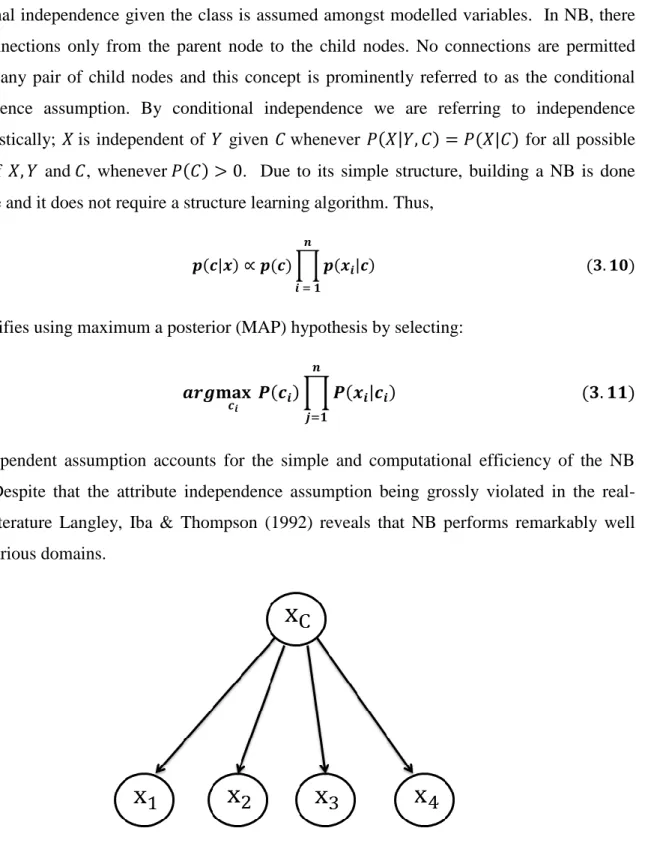
The simplest type of Bayesian network classifier is the Naïve Bayes (NB) classifier (Langley, Iba & Thompson, 1992; Friedman, Geiger & Goldszmidt, 1997) (See Figure 3-3) since conditional independence given the class is assumed amongst modelled variables. In NB, there exist connections only from the parent node to the child nodes. No connections are permitted between any pair of child nodes and this concept is prominently referred to as the conditional independence assumption. By conditional independence we are referring to independence probabilistically; is independent of given whenever ( | ) ( | ) for all possible values of and , whenever ( ) . Due to its simple structure, building a NB is done with ease and it does not require a structure learning algorithm. Thus,
( | ) ( ) ∏ ( | ) ( )
NB classifies using maximum a posterior (MAP) hypothesis by selecting:
( ) ∏ ( | )
( )
The independent assumption accounts for the simple and computational efficiency of the NB model. Despite that the attribute independence assumption being grossly violated in the real-world, literature Langley, Iba & Thompson (1992) reveals that NB performs remarkably well across various domains.