On the Dynamics and Predictability
of the Atlantic Niño
Dissertation
zur Erlangung des Doktorgrades
der Mathematisch-Naturwissenschaftlichen Fakultät
der
Christian-Albrechts-Universität zu Kiel
vorgelegt von
Tina Dippe
Erster Gutachter: Prof. Dr. Richard J.
Greatbatch
Zweite Gutachterin: Prof. Dr. Joke F.
Lübbecke
Tag der mündlichen Prüfung: 19. 12. 2018
Zum Druck genehmigt: 19. 12. 2018
Abstract
This thesis seeks to broaden our understanding of the Atlantic Niño
. The
Atlantic Niño is the dominant mode of coupled interannual climate variability in the
equa-torial Atlantic. Its sea surface temperature (SST) signature is reminiscent of the Pacific El
Niño-Southern Oscillation (ENSO). SST anomalies stretch from the Angolan and
Namib-ian coast into the central equatorial Atlantic in a tongue-shaped pattern, with a preference
for the southern hemisphere. Because the atmosphere and ocean are tightly coupled at
the equator, SST co-varies with both zonal surface wind in the western equatorial ocean
basin, and thermocline depth and upper ocean heat content in the central and eastern
ocean basin. The Atlantic Niño peaks in boreal summer, when SST anomalies reach
values of up to
±
1
◦C
relative to the climatological seasonal cycle. A secondary, weaker
Niño-like phenomenon occurs in boreal winter. Both the summer and winter Niños are
the source of teleconnections that affect seasonal climate variability locally and in remote
regions. Socio-economic impacts, especially in northwestern Brazil and Africa, can be
devastating.
An important question about the Atlantic Niño is to what extent it is driven by
dyna-mical, potentially predictable processes. Using multiple linear regression and the
dynami-cal framework of the Bjerknes feedback, SST variability in the central equatorial Atlantic
is decomposed into a dynamically driven part, and a residual part that is mainly
associ-ated with stochastic processes. During boreal summer and winter, when the Atlantic Niño
is active, the dynamical contribution to SST variability clearly dominates stochastic SST
variability, indicating that the Bjerknes feedback is involved in establishing the Atlantic
Niño.
Previous research has shown that the Atlantic Niño is much more symmetric than
the Pacific ENSO. In contrast to the Pacific, where warm events tend to grow to larger
amplitudes than cold events, Atlantic warm and cold events have SST signatures that
are effectively mirror images of each other. Does the symmetry (or asymmetry) of the
Atlantic and Pacific Niños correspond the symmetry (or asymmetry) of the respective
Bjerknes feedbacks? Decomposing the Bjerknes feedback into three interacting feedback
are less consistent across feedback elements. Additionally, assessing the stationarity of
the Bjerknes feedback shows that both the feedback elements and their symmetries vary
substantially on decadal time scales.
A strong, coupled warm bias in the equatorial Atlantic inhibits realistic simulations of
the Atlantic Niño in virtually all coupled global climate models (CGCMs) of the current
generation. A review of the issue synthesises our current understanding of the processes
that create and maintain the equatorial Atlantic warm bias, concluding that intrinsic biases
exist in both the atmospheric and oceanic modules of a CGCM. When the modules are
coupled to each other, feedbacks enhance the intrinsic biases, forming a complex coupled
bias signature. It is shown that the coupled bias creates a background which is not
compatible with the observed physical processes in the equatorial Atlantic. Biased models
are unable to capture the dynamics of the real ocean, and hence fail to simulate the
Atlantic Niño.
Another important question is how the bias affects the ability of a model to predict
the Atlantic Niño. Analysing two suites of hindcasting experiments – one using a standard
model that develops the equatorial Atlantic warm bias, the other employing surface heat
flux correction to effectively alleviate the bias –, shows that bias alleviation enhances the
predictability of SST variability in boreal summer, promising improved forecasts of the
Atlantic Niño in the future.
Zusammenfassung
Diese Dissertation
versucht unser Verständnis des Atlantischen Niño auszubauen. Der
Atlantische Niño ist die dominante Form zwischenjährlicher, gekoppelter Klimavariabilität
im äquatorialen Atlantik. Seine Signatur der Meeresoberflächentemperatur (SST) erinnert
an die pazifische El Niño-Southern Oscillation (ENSO). SST-Anomalien erstrecken sich
von der angolanischen und namibischen Küste bis in den zentralen äquatorialen Atlantik,
vorzugsweise auf der Südhalbkugel. Da die Atmosphäre und der Ozean in Äquatornähe
stark miteinander gekoppelt sind, treten SST-Anomalien zusammen mit Schwankungen
des zonalen, oberflächennahen Windfeldes im westlichen Ozeanbecken sowie mit der Tiefe
der Thermokline und des Wärmeinhalts des oberen Ozeans im zentralen und östlichen
Ozeanbecken auf. Der Atlantische Niño ist während des Sommers der Nordhalbkugel am
stärksten ausgeprägt. In dieser Zeit können SST-Anomalien Werte von bis zu
±
1
◦C
rel-ativ zum klimatologischen Jahresgang erreichen. Ein zweites, deutlich schwächeres
Niño-ähnliches Phänomen tritt im borealen Winter auf. Sowohl Sommer- als auch Winter-Niños
erzeugen Telekonnektionen, die globale und regionale Klimaschwankungen auslösen und
teils verheerende sozioökonomische Folgen haben können, insbesondere im nordwestlichen
Brasilien und Teilen Afrikas.
Ein wichtiger Streitpunkt der gegenwärtigen Forschung ist, in welchem Maß der
At-lantische Niño von dynamischen, möglicherweise vorhersagbaren Prozessen angetrieben
wird. Um diese Frage zu beantworten, wird die SST-Variabilität im zentralen
äquatori-alen Atlantik mit Hilfe multipler linearer Regression in zwei Komponenten zerlegt: Einen
dynamischen Anteil, der dem Konzept des Bjerknes-Feedbacks entspricht, und einen
kom-plementären, hauptsächlich von stochastischen Prozessen erzeugten Anteil. Im borealen
Sommer und Winter, wenn der Atlantische Niño aktiv ist, dominiert die dynamische
Kom-ponente die SST-Variabilität. Dies legt nahe, dass der Atlantische Niño mit dem
Bjerknes-Feedback zusammen hängt und teilweise dynamisch angetrieben wird.
Studien haben gezeigt, dass der Atlantische Niño symmetrischer ist als die pazifische
ENSO. Während pazifische Warm-Events in der Regel stärker ausgeprägt sind als kalte
Events, entwickeln sich warme und kalte Events im Atlantik für gewöhnlich spiegelbildlich
auf positiven oder negativen Anomalien basieren. Mit Hilfe robuster Regression wird die
Stärke der Komposite abgeschätzt, so dass Asymmetrien zwischen positiven und
nega-tiven Kompositen bewertet werden können. Im Pazifik treten für alle Feedback-Elemente
Asymmetrien auf, wobei positive Komposite negative Komposite deutlich dominieren. Im
Atlantik sind die Unterschiede zwischen positiven und negativen Kompositen weniger
kon-sistent. Zusätzlich wird die Stationarität des Bjerknes-Feedbacks untersucht. Sowohl im
Atlantik als auch im Pazifik variieren die Elemente des Bjerknes-Feedbacks sowie ihre
Symmetrien erheblich auf dekadischen Zeitskalen.
Ein ausgeprägter, gekoppelter Warm-Bias im äquatorialen Atlantik verhindert
realis-tische Simulationen des Atlanrealis-tischen Niño in praktisch allen gegenwärtigen gekoppelten
globalen Klimamodellen (CGCMs). Ein Review fasst den aktuellen Kenntnisstand zum
Thema zusammen und zeigt auf, welche Prozesse den atlantischen Warm-Bias erzeugen.
Sowohl in den atmosphärischen als auch den ozeanischen Komponenten moderner CGCMs
treten intrinsische, systematische Verzerrungen auf, die durch Feedback-Prozesse verstärkt
werden, sobald man beide Komponenten miteinander koppelt. Im Ergebnis entwickelt sich
ein stark verzerrter klimatologischer Grund-Zustand, der mit den beobachteten
physikalis-chen Prozessen im äquatorialen Atlantik nicht kompatibel ist. Modelle, die vom
atlantis-chen Warm-Bias betroffen sind, können die Dynamik des realen Ozeans nicht nachbilden
und den Atlantischen Niño daher nicht simulieren.
Ein weiterer wichtiger Forschungsgegenstand ist, wie sich der Warm-Bias auf die
Vor-hersage-Fähigkeiten eines Models in Bezug auf den Atlantischen Niño auswirkt. Um
diese Frage zu beantworten, werden zwei Hindcast-Experimente analysiert
(retrospek-tive Vorhersagen von historischen Ereignissen). Das erste Experiment wird mit einem
Standard-Modell durchgeführt, das den typischen atlantischen Warm-Bias erzeugt; für
das zweite Experiment wird der Bias reduziert, indem die Klimatologie der Wärmeflüsse
an der Meeresoberfläche korrigiert wird. Die Experimente zeigen, dass der Warm-Bias
die Vorhersagbarkeit des Atlantischen Niño verringert. Im Umkehrschluss versprechen die
Ergebnisse verbesserte Vorhersagen des Atlantischen Niño, sobald effektive Wege gefunden
worden sind, um den atlantischen Warm-Bias zu beheben.
Contents
Abstract
3
Zusammenfassung
5
1 Introduction
9
1.1
What is the Atlantic Niño? . . . 10
1.2
Dynamics of the Atlantic Niño . . . 13
1.2.1
Background state . . . 13
1.2.2
The Bjerknes feedback as the main driver of Atlantic Niño variability 14
1.2.3
Alternative mechanisms . . . 15
1.3
The Atlantic and Pacific Niños: A comparison
. . . 17
1.4
Modelling and predicting the Atlantic Niño: Facing the challenge of the
equatorial Atlantic warm bias . . . 19
1.5
Research questions of this thesis . . . 22
2 On the Dynamics of the Atlantic Niño
23
3 A comparison of the Atlantic and Pacific Bjerknes feedbacks:
Seasonal-ity, Symmetry, and Stationarity
41
4 Can Climate Models simulate the observed strong Summer Surface
Cooling in the equatorial Atlantic?
83
5 Seasonal Predictions of equatorial Atlantic SST in a low-resolution CGCM
with Surface Heat Flux Correction
101
6 Summary, Discussion, Outlook
129
6.1
Summary . . . 129
6.2
Discussion . . . 134
Own Publications
155
Acknowledgements
157
Chapter 1
Introduction
The Atlantic Niño is the dominant mode
of coupled interannual climate variability
in the equatorial Atlantic. During boreal summer, sea surface temperatures (SSTs) can
deviate by up to
1
◦C
from the climatological values if their seasonal cycle, affecting local
and remote areas and creating profound socio-economic impacts.
Previous research has suggested a number of mechanisms that generate the Atlantic
Niño. First, the Bjerknes feedback – the dominant positive feedback of the equatorial
ocean basins that ties atmospheric and oceanic variability into a coupled process – is
involved with establishing both the seasonal cycle in the equatorial Atlantic, and the
interannual variability of the Atlantic Niño. Second, additional dynamical ocean processes
contribute to the Atlantic Niño. Last, atmospheric stochastic forcing has been suggested
as an alternative driver of the variability. This abundance of theories about its nature
demonstrates how intricate a phenomenon the Atlantic Niño is.
Simulating realistic Atlantic Niño variability and predicting it on seasonal time scales
poses substantial challenges to the scientific community. A crucial factor exacerbating
this struggle is a strong coupled warm bias in the equatorial Atlantic ocean that alters
the background state of the basin relative to observations. Several key properties that
are instrumental in generating the Atlantic Niño cannot be reproduced by the current
generation of climate models, deeming useful seasonal predictions of the Atlantic Niño a
futile enterprise.
The goal of this thesis is (i) to improve our understanding of the mechanisms that
form the Atlantic Niño, and (ii) to assess how the equatorial Atlantic warm bias affects
our ability to simulate and predict observed Atlantic Niño variability, using coupled global
climate models (CGCMs).
1.1
What is the Atlantic Niño?
Figure 1.1:
Time series of an Atlantic Niño index, based on the HadISST dataset (Rayner
et al., 2003) for the period 1981-2012. The Atlantic Niño index averages monthly mean
SST for June and July – when Atlantic Niño events tend to peak – over the Atl3 region
(
3
◦S
to
3
◦N,
20
◦W
to
0
◦E). Event years were chosen as follows. Calculate anomalies and
the standard deviation of the Atlantic Niño time series and select all years in which the
time series exceeds
±
0
.
7
×
σ
AN, with
σ
ANbeing the standard deviation of the time series.
Red, blue, and grey bars indicate warm (1987, 1988, 1991, 1995, 1996, 1998, 1999, 2007,
2008, and 2010), cold (1982, 1983, 1992, 1994, 1997, and 2005), and neutral events.
Every few years in early boreal summer
, sea surface temperatures (SSTs) in the
central equatorial Atlantic deviate from their expected seasonal cycle by up to 1
◦C (Fig.
1.1). Figure 1.2 illustrates the general evolution of such an event. In early boreal spring,
the first anomalies appear off the southern coast of Angola. The anomalies intensify and
spread northwestward. Around June, anomalies reach their maximum amplitude and
form a clear tongue-shaped pattern that stretches from the Angolan coast into the central
equatorial Atlantic. In August and September, the event dissipates quickly, and anomalies
throughout the equatorial and subtropical Atlantic of the southern hemisphere vanish
1.
In concert with the SST anomalies, additional elements of the equatorial Atlantic
cli-mate system vary and produce a distinct coupled signature of the event. Prior to the
growth of the SST anomalies, zonal surface winds in the western equatorial Atlantic
de-viate from their seasonal cycle. Weakening trade winds usually – but not always, see
1An interesting feature of Fig. 1.2 is that, for the period 1981-2012, warm and cold Atlantic Niño events in the HadISST dataset are clearly asymmetric, with cold events having a mean amplitude of−0.91◦C in June and July, in contrast to 0.66◦C for warm events. This asymmetry, however, depends on the details of the analysis, including which dataset and analysis period were used (not shown). Repeating the analysis with the ERSSTv2 dataset (Huang et al., 2017; Smith and Reynolds, 2003), for example, produces a much more symmetric Atlantic Niño. Likewise, extending the analysis period back into theFigure 1.2:
Composite evolution of Atlantic Niño events, based on the HadISST dataset
for the period 1981-2012. Years contributing to the cold (first and third column, monthly
composites running from April to September) and warm (second and fourth column)
com-posites are shown in Fig. 1.1 as blue and red bars, respectively. For cold events, SST
anomalies in the central equatorial Atlantic are negative, but are shown here with the same
sign as the warm events to facilitate a direct comparison.
Section 1.2.3 – precede warm equatorial events, while intensifying trade winds pave the
way for cold events. The rain band of the intertropical convergence zone (ITCZ) deviates
from its climatological meridional position, affecting rainfall patterns over the surrounding
continents. The intricate system of equatorial surface currents adjusts to the changing
at-mospheric circulation, and the subsurface structure of the ocean changes, with ocean heat
content being distributed more evenly across the zonal extent of the equatorial Atlantic
for warm events. All of these processes are related to each other and form a coupled event
whose signature feature, from an oceanic point of view, is the formation of a distinct SST
anomaly pattern.
This mode of coupled interannual variability is called the “Atlantic Niño”.
Alterna-tively, research addresses the “Atlantic zonal mode” or the “Atlantic cold tongue mode”.
While these names emphasise subtly different aspects of the Atlantic Niño
2, Lübbecke
2The “Niño” highlights similarities to the much stronger El Niño-Southern Oscillation in the Pacific (ENSO; see Section 1.3). The “zonal mode” stresses that, in contrast to the Pacific, the equatorial Atlanticet al. (2018) argue that they refer to the same phenomenon. Throughout this thesis, the
conventional term “Atlantic Niño” is used.
In addition to the summer Niño, a secondary Niño-like phenomenon occurs during
early boreal winter. Okumura and Xie (2006) show that a weak seasonal intensification
of the equatorial trade wind regime in late boreal fall briefly organizes atmosphere-ocean
variability into the Bjerknes feedback, setting the stage for the emergence of the Atlantic
winter Niño. While the winter Niño resembles the summer Niño dynamically, it is much
weaker in amplitude and restricted to a short period of just a few weeks.
Because the atmosphere-ocean system is tightly coupled in an equatorial ocean basin,
the Atlantic Niño is the source of a number of teleconnections that impact local and remote
areas of the globe (e.g. Carton et al., 1996; Carton and Huang, 1994; Ding, Keenlyside,
and Latif, 2012; Folland et al., 2001; Fontaine and Janicot, 1996; Keenlyside and Latif,
2007; Kucharski et al., 2008; Losada and Rodríguez-Fonseca, 2016; Lübbecke et al., 2018;
C. Wang, 2006). Nobre and Shukla (1996) show that equatorial Atlantic SST variability
in general can have devastating effects on rainfall variability in Brazil’s Nordeste region.
The 1958 drought, for example, forced an approximate 10 million people to temporarily
emigrate (Namias, 1972). The impact of (oceanic) SST on (atmospheric) precipitation
over the surrounding continents is mediated by the close relationship between tropical SST
variability and the meridional position of the ITCZ (e.g. Harzallah, Rocha de Aragāo, and
Sadourny, 1996).
1.2 Dynamics of the Atlantic Niño
The Atlantic Niño is intimately related to the seasonal cycle
of the equatorial
Atlantic. Below, the background state on which the Atlantic Niño acts is briefly
intro-duced, and the main mechanisms that have been proposed to explain the characteristics
of the Atlantic Niño are discussed.
1.2.1
Background state
The basic characteristics of the equatorial Atlantic
are related to its unique
location on earth. The tropics receive the most insolation on the planet, setting up the
easterly trade wind regimes in both hemispheres. The trade wind regimes converge in the
intertropical convergence zone (ITCZ), creating a band of intense precipitation. Due to
air-sea interaction and the shape of the West-African shoreline, the Atlantic marine ITCZ
resides north of the equator on average (Xie and Carton, 2004). Direct wind forcing and
interhemispheric thermohaline forcing create an intricate current system that consists of (i)
a system of alternating zonal surface currents (e.g. Brandt et al., 2006; Schott et al., 2003;
Stramma and Schott, 1999), (ii) the superimposed circulation of the shallow subtropical
cells (McCreary and Lu, 1994), and (iii) the subsurface Equatorial Undercurrent (EUC)
(Cromwell, 1953; Cromwell, Montgomery, and Stroup, 1954), one of the most intense
currents on the planet. Additionally, the vanishing Coriolis force allows the easterly wind
stress forcing to push warm surface water towards the western basin, piling up the Atlantic
warm pool. The equatorial Atlantic thermocline slopes upward, from being relatively deep
in the western warm pool region to being relatively shallow in the central and eastern
equatorial Atlantic. At the surface, the uneven distribution of heat content creates a
pronounced zonal SST gradient. Warm pool waters in the west reach surface temperatures
of up to
28
◦C, while the eastern and central equatorial basin – depleted of warm surface
waters and additionally cooled by upwelling – provide annual mean SSTs of approximately
26
◦C.
This basic set-up varies considerably over the course of the year. Air-sea interaction
and a number of seasonal processes act in concert to establish the seasonal cycles of the
meridional location of the ITCZ, the strength of the trade wind regimes and hence easterly
wind forcing, the configuration of the equatorial current system, and the distribution of
heat content and SST along the equator. The dominant feature of the coupled seasonal
cycle is the formation of the Atlantic cold tongue in boreal summer. Within a few months,
SSTs in the central equatorial Atlantic drop, on average, from
28
.
5
◦C
in April to
24
.
5
◦C
in August, forming a distinct tongue of cold water that resembles the shape of the Atlantic
Niño pattern.
across the equator into the northern hemisphere. Easterly wind stress forcing in the
western ocean basin intensifies, creating upwelling Kelvin waves that propagate along the
thermocline to the east, thinning out the mixed layer in the central Atlantic (e.g. Merle,
1980). Under these conditions, climatological upwelling at the base of the mixed layer cools
the mixed layer more efficiently, and the first cooling signals appear along the central and
eastern equator in late boreal spring. Simultaneously, the West African Monsoon sets in
(e.g. Caniaux et al., 2011; Okumura and Xie, 2004). Northward meridional wind stress
forcing in the Gulf of Guinea strengthens, intensifying upwelling in the eastern equatorial
Atlantic just to the south of the equator and providing additional cooling to the incipient
cold tongue. Last, the relative strengths of the westward surface current and the eastward
EUC vary over the course of the year as well, producing the strongest shear in boreal spring
(e.g. Hazeleger and Haarsma, 2005; Hummels, Dengler, and Bourlès, 2013; Hummels et
al., 2014; Jouanno et al., 2011). As a result, more cold subsurface water is mixed into the
mixed layer in the central and eastern equatorial Atlantic, contributing to SST cooling.
Once the initial seasonal cooling is established in the equatorial Atlantic, the Bjerknes
feedback sets in and quickly grows the incipient cold tongue (e.g. Burls et al., 2011;
Keenlyside and Latif, 2007, see Section 1.2.2 for details). In August, the feedback breaks
down, and the cold tongue dissipates.
The Atlantic Niño is a modulation of the seasonal cycle outlined above. The next
subsections discuss the two main mechanisms that have been proposed to explain these
interannual variations.
1.2.2
The Bjerknes feedback as the main driver of Atlantic Niño
vari-ability
In the canonical approach
, the Atlantic Niño is driven by dynamical processes that
weave atmospheric and oceanic variability into one coupled phenomenon (e.g. Burls et al.,
2012; Keenlyside and Latif, 2007; Lübbecke and McPhaden, 2013; Zebiak, 1993). The
basic framework of this approach is the Bjerknes feedback.
The Bjerknes feedback is the dominant, positive feedback in the equatorial oceans
(Bjerknes, 1966; Bjerknes, 1969). It couples atmospheric and oceanic variability in an
equatorial ocean basin by relating three key parameters to each other: SST in the eastern
ocean basin, zonal surface wind in the western basin, and thermocline depth along the
equator. Because the Bjerknes feedback requires the Coriolis force to vanish, it operates
exclusively in the equatorial ocean basins.
Numerous studies have documented that the Bjerknes feedback is active in the
At-lantic, both in observations (Carton and Huang, 1994; Keenlyside and Latif, 2007) and
modelling studies (Burls et al., 2011; Deppenmeier, Haarsma, and Hazeleger, 2016; Jansen,
Dommenget, and Keenlyside, 2009; Lübbecke and McPhaden, 2013). In contrast to the
show that the feedback is active during boreal summer and again, weakly, during early
boreal winter. Based on this, Burls et al. (2012) argue that the Atlantic summer Niño
arises from a modulation of the seasonally active Atlantic Bjerknes feedback. An enhanced
Bjerknes feedback produces more intense cold tongues and hence cold Atlantic Niño events
(“Niñas”), while a weak Bjerknes feedback grows a weak cold tongue associated with a
warm Atlantic Niño event.
Placing the equatorial Bjerknes feedback into a wider context, Lübbecke et al. (2010),
Lübbecke et al. (2014) and Nnamchi et al. (2016) argue that the Atlantic Niño is the
equatorial manifestation of a basin-wide mode of variability that spans the Atlantic ocean
of the southern hemisphere. Lübbecke et al. (2010) show that SST events in the Angola
Benguela frontal zone off the Angolan coast are dynamically linked to equatorial Niño
events by wind-induced Kelvin waves that propagate first along the equatorial thermocline,
then continue southwards along the African coast. Additionally, their study demonstrates
that wind variability in the western equatorial Atlantic – a crucial element of the Bjerknes
feedback – is related to the variability of the South Atlantic (Saint Helena) Anticyclone in
boreal spring. Lübbecke et al. (2014) expand this work and expose the relationship between
the South Atlantic Anticyclone and the wind variability associated with the Atlantic Niño.
However, they point out that this physical link is not present in all years, providing an
extra-tropical connection for only about half of the investigated Atlantic Niño events. In
agreement with this, Richter et al. (2014a) suggest that (a substantial) part of western
equatorial wind variability during boreal spring is associated with internal atmospheric
variability. Finally, Nnamchi et al. (2016) argue that the Atlantic Niño is the intrinsic
equatorial arm of the South Atlantic Ocean Dipole, a mode of variability that includes
a second center of SST variability in the southwestern Atlantic and is maintained by a
feedback between wind, evaporation, and SST (WES feedback, Xie and Philander, 1994).
1.2.3
Alternative mechanisms
Richter et al. (2013) show that some warm Atlantic Niño events
do not
con-form with the Bjerknes feedback. Indeed, instead of being associated with weak trade
winds in the western basin during boreal spring, they are preceded by anomalously strong
trade winds. The authors demonstrate that meridional advection from the northern
hemi-sphere contributes to these non-canonical warm events, establishing a direct link between
equatorial and subtropical Atlantic variability. In a related study about the non-canonical
cold event of 2009, Burmeister, Brandt, and Lübbecke (2016) show that the reflection of
Rossby waves at the western boundary can contribute to non-canonical events as well.
These results agree with Foltz and McPhaden (2010a,b), who argue that meridional mode
however, has yet to be demonstrated). They show that surface variability in the eastern
equatorial Atlantic shares the 4.5-yr period of the Atlantic equatorial deep jets. The deep
jets are vertically stacked zonal jets of small vertical wavelength that propagate their
en-ergy upwards and can reach velocities of more than
10
cms
−1(e.g. Claus, Greatbatch, and
Brandt, 2014).
Last, Nnamchi et al. (2015) raise the controversial hypothesis that the Atlantic Niño
does not rely on ocean dynamics but is rather driven by stochastically excited
thermo-dynamic feedbacks. Using slab ocean simulations contributing to the third phase of the
Coupled Model Intercomparison Project (CMIP3, Meehl et al., 2007), they argue that wind
and subsequent heat flux perturbations agree with a first-order auto-regressive model,
chal-lenging the paradigm of the dynamically driven Atlantic Niño. The Bjerknes feedback,
they hypothesise, enhances the Niño-like spatial characteristics of the Atlantic Niño but
is not instrumental in generating the variability in the first place.
The wealth of hypotheses about the nature of the Atlantic Niño demonstrates how
complex a phenomenon it is. With respect to this, Zebiak (1993) argues in his early
mod-elling work that equatorial dynamics seem to play “an important but not exclusive role”
in establishing the Atlantic Niño. He writes: “It appears that the coupling is sufficiently
strong to leave its imprint on the total variability, but too weak to dictate it entirely, even
at the equator.”
1.3 The Atlantic and Pacific Niños: A comparison
Figure 1.3:
Seasonal cycle and evolution of individual warm and cold Niño events in a)
the Atlantic Atl3 region (
3
◦S
to
3
◦N
,
20
◦W
to
0
◦E) and b) the Pacific Nino3.4 region
(
5
◦S
to
5
◦N
,
170
to
120
◦W
). Event years were diagnosed as in Fig. 1.1. For the Pacific,
the Niño time series includes monthly mean SST from November, December, and the
subsequent January. During the analysis period nine warm events (El Niños, 1982/83,
1986/87, 1987/88, 1991/92, 1994/95, 1997/98, 2002/03, 2006/07, and 2009/10) and
eight cold events (La Niñas, 1983/84, 1984/85, 1988/89, 1998/99, 1999/2000, 2007/08,
2010/11, and 2011/12) were detected. The black line indicates the climatological seasonal
cycle. Thin red, blue, and grey lines trace the evolution of individual warm, cold, and
neutral events over the course of the year during which the event occurred. Note that
an “event year” lasts from January to December in the Atlantic, but from July to the
subsequent June in the Pacific, due to the seasonal phase-locking of ENSO to boreal winter
(see different x-axes).
The Atlantic and the Pacific share many attributes
. Both basins have similar
physical set-ups consisting of easterly trade wind regimes in both hemispheres,
quasi-uninterrupted easterly wind forcing on the equator, and a pronounced zonal equatorial SST
gradient arising from the contrast of a western warm pool and a seasonally strengthening
cold tongue in the central-to-eastern ocean basin. Additionally, both basins are dominated
by a “Niño” on interannual time scales, a coupled mode of variability that is strongest in
of their cold tongues. The Pacific cold tongue is most pronounced in boreal winter (e.g.
Fu and B. Wang, 2001; Horel, 1982; Mitchell and Wallace, 1992; Wyrtki, 1965), offset
against the Atlantic cold tongue by approximately five months (cf. seasonal cycles in Fig.
1.3). Zebiak (1993) argues that these distinctions are due to both differences in the basin
geometries and their climatological mean fields.
The Niños of the two basins are distinct from each other as well (e.g. Keenlyside and
Latif, 2007; Lübbecke and McPhaden, 2012; Richter et al., 2013). Figure 1.3 summarises
the main differences between them. Pacific Niños are phase-locked to boreal winter and
last several months, while the Atlantic Niño occurs in boreal summer and rarely outlasts
a season. This is shown by the clear separation of warm and cold events that lasts from
May to July in the Atlantic, but persists from at least July to the following May in the
Pacific. The Pacific Niño overrides the seasonal cycle, particularly for warm events (thin
red lines in Fig. 1.3b). The Atlantic seasonal cycle on the other hand always dominates
the evolution of SST over the course of a year, regardless of whether a Niño occurs (Fig.
1.3a). Amplitudes of the SST signal in the Atlantic are about
30
−
50%
of their Pacific
counterparts (a maximum of
1
◦C
in the Atlantic versus
3
◦C
in the Pacific). Last, (linear)
stability analysis suggests that the equatorial climate system in the Atlantic is more stable
than in the Pacific (Keenlyside and Latif, 2007; Lübbecke and McPhaden, 2013; Xie et al.,
1999; Zhu, Huang, and Wu, 2012).
1.4 Modelling and predicting the Atlantic Niño: Facing the
challenge of the equatorial Atlantic warm bias
Simulating the Atlantic Niño continues to pose substantial challenges
to
the scientific community. A major reason for this is that virtually all state-of-the-art
coupled global climate models (CGCMs) suffer from a severe warm bias in the equatorial
Atlantic.
A bias is a systematic difference between the modelled and the observed climate.
Biases can affect any statistical property of any model variable. SST in a given location,
for example, could be biased with respect to the (annual) mean, or its (monthly) variance
or skewness, among other things. In these cases, SST would be too warm or too cold in
general, produce anomalies that are generally too strong or too weak, or favour one type
of anomalies over the other in a way that is inconsistent with observations.
Biases can have various causes. Mulholland et al. (2017), for example, assess the
impact of globally applied model parameterisations on the development of regional biases.
By training a neural network on a set of crowd-funded, perturbed physics simulations that
span a large space of parameterisation settings, they were able to trace the manifestation of
a given bias to a set of parameterisations, and hence a specific set of physical short-comings
of the model. In general, the development of a bias is associated with mis-representations
of physical processes within the model world.
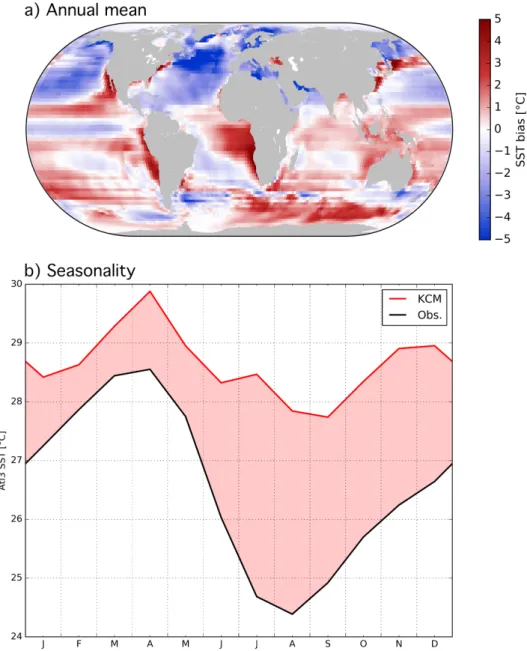
Climatological SST is a notoriously biased variable in CGCMs. Figure 1.4a shows
the annual mean SST bias of a suite of CGCMs that participated in the fifth phase of
the Coupled Model Intercomparison Project (CMIP5, Taylor, Stouffer, and Meehl, 2012).
Evidently, SST biases are abundant in the modelled ocean. Key features that are present
in virtually every current-generation CGCM are the severe warm biases in the western
subtropical ocean basins that reach annual mean amplitudes of up to
5
◦C
(Richter and
Xie, 2008; Richter et al., 2014b). In the Atlantic, the spatial characteristics of the mean
bias are comparable to the structure of the Atlantic Niño. The bias is strongest off
the Namibian coast in the area of the Angola-Benguela front, with CMIP5-mean values
exceeding
5
◦C. It stretches northwestward into the central equatorial Atlantic, producing
an equatorial warm bias with mean amplitudes of
1
−
2
◦C.
As in the real world, the mean state of a CGCM varies over the course of the year.
Consequently, a bias, too, can have a seasonal cycle. Figure 1.4b illustrates the seasonal
cycle of the Atlantic warm bias in a standard run of the Kiel Climate Model (KCM, Dippe,
Greatbatch, and Ding, 2018; Park et al., 2009) that consists of three ensemble members.
The bias is measured in the crucial, central equatorial region Atl3
3. It is relatively small
at the beginning of the year in the KCM, producing amplitudes that are hardly larger
Figure 1.4:
The equatorial Atlantic warm bias, diagnosed with respect to NOAA’s
ob-servational OISST dataset (Banzon et al., 2016; Reynolds et al., 2007) for the period
1982-2009. a) Annual mean SST bias of the ensemble mean of 33 CGCMs contributing
to CMIP5. b) Seasonal cycle of the SST bias in the Atlantic Atl3-region in a standard
integration of the Kiel Climate Model (KCM, red), relative to OISST (black). Both Figures
from Dippe et al. (2018).
tongue formation after May. In July and August, when the observed cold tongue is fully
developed, the KCM’s warm bias exceeds
3
◦C. The KCM has failed to establish the
Atlantic cold tongue.
A host of research has addressed the dynamics of the equatorial Atlantic warm bias.
Because the atmosphere and the ocean are tightly coupled in the equatorial Atlantic,
too-warm SSTs are only one symptom of a coupled bias that links systematic errors in the
Many studies emphasise the importance of a pronounced westerly wind bias in the
western equatorial Atlantic for the development of the equatorial warm bias (Richter et
al., 2012). The westerly wind bias weakens the trade wind regime by substantially reducing
the strength of the easterly surface winds. When the bias is most pronounced in boreal
spring, it can reverse the direction of the zonal wind, turning easterly into weakly westerly
wind stress forcing. The reduced surface wind is in agreement with a systematic southward
displacement of the ITCZ (e.g. Doi et al., 2012; Richter et al., 2012; Siongco, Hohenegger,
and Stevens, 2015) and has been linked to a seesaw pattern of precipitation biases over
South America and Africa (C. Y. Chang et al., 2007; Patricola et al., 2012; Richter et
al., 2014b, 2012). Biased precipitation is related to systematic errors in tropical deep
convection, which in turn affects the gradient of surface pressure along the equator. The
equatorial wind field adapts to the anomalous surface pressure and as a result produces
the westerly wind bias.
The westerly wind bias is present in forced atmospheric simulations. It is an intrinsic
feature of most state-of-the-art atmosphere general circulation models (e.g. Harlaß, Latif,
and Park, 2017; Richter et al., 2014b).
In the strongly coupled equatorial Atlantic, the ocean adapts to the weak equatorial
winds and develops consistent oceanic biases. In agreement with reduced zonal wind stress
forcing, oceanic heat content is distributed more evenly along the equator, and the western
Atlantic warm pool is displaced towards the central ocean basin (C. Y. Chang et al., 2007;
Liu et al., 2013; Richter and Xie, 2008). The modelled thermocline is deeper than in
observations. Strengthening equatorial westerlies in late boreal spring are not sufficient
to shoal the thermocline in the central basin, and the initial cooling that sets off the
formation of Atlantic cold tongue cannot be established. The westerly wind bias keeps the
seasonal variations of surface wind stress in the western ocean basin from preconditioning
the central equatorial Atlantic for the formation of the cold tongue.
While the westerly wind bias is a key ingredient of the equatorial Atlantic warm bias,
the ocean models used in CGCMs are not free of error, either. For example, Grodsky et al.
(2012) show that forced ocean simulations in the tropical Atlantic are intrinsically biased
as well. Feedback processes between the atmosphere and the ocean amplify the intrinsic
biases of the stand-alone models and produce a severely biased system that is inconsistent
with the physical processes observed in the real world.
Based on a biased background that is unable to establish the Atlantic cold tongue,
past attempts to seasonally predict the variability of the Atlantic Niño have not been
successful (Hu and Huang, 2007; Kushnir et al., 2006; Stockdale, Balmaseda, and Vidard,
2006). While many studies have proposed methods to alleviate the equatorial Atlantic
warm bias in a physically consistent way (e.g. DeWitt, 2005; Harlaß, Latif, and Park,
1.5
Research questions of this thesis
A number of mechanisms have been proposed
to explain the Atlantic Niño. The
majority of existing research supports a dynamical Niño that is mainly driven by the
Bjerknes feedback (Burls et al., 2012; Carton et al., 1996; Keenlyside and Latif, 2007;
Zebiak, 1993). Nnamchi et al. (2015), on the other hand, argue that the Atlantic Niño
is a product of stochastic processes, discounting the role of dynamical ocean processes.
Chapter 2 seeks to reconcile these two approaches and raises the question
▶
How dynamical is the Atlantic Niño?
The dynamical interpretation of the Atlantic Niño relies on the framework of the
Bjerknes feedback, which also supports the growth of the Pacific Niño. Chapter 3 takes a
closer look at the Bjerknes feedbacks in the two basins and asks
▶
How symmetric are the Atlantic and Pacific Bjerknes feedbacks? Are
they stationary on decadal time scales?
Chapter 4 reviews the equatorial Atlantic warm bias and attempts to synthesise from
current research an answer to the question
▶
What drives the development of the equatorial Atlantic warm bias?
Last, Chapter 5 assesses the impact of the equatorial warm bias on the predictability
of the Atlantic Niño, asking
▶
Does the equatorial Atlantic warm bias affect the ability of a model to
predict the Atlantic Niño?
Chapter 2
On the Dynamics of the Atlantic
Niño
Previous studies on the mechanisms
generating and sustaining an Atlantic Niño
event have identified numerous processes, both dynamical and stochastic in nature. Here,
the relative contributions of ocean dynamics and residual stochastic processes to SST
variability in the equatorial Atlantic are assessed.
Citation:
Dippe, T., R. J. Greatbatch, and H. Ding (2018). “On the relationship
between Atlantic Niño variability and ocean dynamics”. In:
Climate Dynamics
51.1, pp. 597-612. DOI:
10.1007/s00382-017-3943-z
The candidate’s contributions to this manuscript are as follows. She
• Conceived the basic question that is discussed in the manuscript;
• Developed the statistical method to answer the research question;
• Performed all the analyses;
• Produced all the figures;
Clim Dyn
DOI 10.1007/s00382-017-3943-z
On the
relationship between
Atlantic Niño variability and
ocean
dynamics
Tina Dippe1 · Richard J. Greatbatch1,2 · Hui Ding3
Received: 21 December 2016 / Accepted: 30 September 2017 © The Author(s) 2017. This article is an open access publication
operate in the model. Due to the small zonal extent of the equatorial Atlantic, the observed Bjerknes feedback acts quasi-instantaneously during the dynamically active periods of boreal summer and early boreal winter. Then, all elements of the observed Bjerknes feedback operate simultaneously. The model cannot reproduce this, although it hints at a better performance when using bias reduction.
1 Introduction
The Atlantic Niño is the dominant mode of interannual vari-ability in equatorial Atlantic sea surface temperature (SST). It modulates the seasonal development of the equatorial Atlantic cold tongue and peaks during May–August (Xie and Carton 2004). Similar to other modes of equatorial SST variability, it is the source of a number of teleconnections (e.g. Janicot et al. 1998; Mohino and Losada 2015), both regionally and globally. Through its close relationship with the Inter-Tropical Convergence Zone, it especially affects rainfall variability over the surrounding continents, exerting an important socio-economic impact (Hirst and Hastenrath
1983).
Efforts to simulate and predict equatorial Atlantic sea-sonal-to-interannual SST variability with state-of-the-art coupled global climate models (CGCMs) have not been very successful (Stockdale et al. 2006; Kushnir et al. 2006; Hu and Huang 2007). One reason for this is that most CGCMs suffer from a strong coupled bias in the tropical eastern Atlantic (e.g. Richter and Xie 2008; Grodsky et al. 2012; Wang et al. 2014). The SST signature of this bias stretches from the coast of Namibia and Angola into the equatorial Atlantic and is well established in the cold tongue region in the annual mean. Chang et al. (2007) and Richter et al. (2012) show that the equatorial SST bias is associated with
Abstract The Atlantic Niño is the dominant mode of inter-annual sea surface temperature (SST) variability in the east-ern equatorial Atlantic. Current coupled global climate mod-els struggle to reproduce its variability. This is thought to be partly related to an equatorial SST bias that inhibits summer cold tongue growth. Here, we address the question whether the equatorial SST bias affects the ability of a coupled global climate model to produce realistic dynamical SST variability. We assess this by decomposing SST variabil-ity into dynamical and stochastic components. To compare our model results with observations, we employ empirical linear models of dynamical SST that, based on the Bjerk-nes feedback, use the two predictors sea surface height and zonal surface wind. We find that observed dynamical SST variance shows a pronounced seasonal cycle. It peaks dur-ing the active phase of the Atlantic Niño and is then roughly 4–7 times larger than stochastic SST variance. This indicates that the Atlantic Niño is a dynamical phenomenon that is related to the Bjerknes feedback. In the coupled model, the SST bias suppresses the summer peak in dynamical SST variance. Bias reduction, however, improves the represen-tation of the seasonal cold tongue and enhances dynamical SST variability by supplying a background state that allows key feedbacks of the tropical ocean–atmosphere system to
* Tina Dippe
1 GEOMAR Helmholtz Centre for Ocean Research Kiel, Kiel,
Germany
2 Faculty of Mathematics and Natural Sciences, Christian
Albrechts University, Kiel, Germany
3 Cooperate Institute for Research in Environmental Sciences,
University of Colorado and NOAA Earth Systems Research Laboratory, Boulder, USA
T. Dippe et al.
a fundamentally biased mean state in this region. The pool of warm surface waters that is observed in the western ocean basin shifts into the central ocean basin in biased simula-tions. The thermocline in the cold tongue region deep-ens, and upwelling is strongly reduced. The Atlantic cold tongue—the dominant feature of the SST seasonal cycle in the tropical Atlantic—cannot be established. Without a realistic cold tongue, however, CGCMs struggle to capture the observed Atlantic Niño, even in the presence of realistic forcing. Another factor that likely contributes to the models’ problems is that the dynamical nature of the Atlantic Niño is not yet fully understood.
While the name Atlantic “Niño” suggests a phenome-non that is essentially an Atlantic version of the Pacific El Niño-Southern Oscillation (ENSO), a number of differences exist between the two phenomena (e.g. Keenlyside and Latif
2007; Burls et al. 2011; Lübbecke and McPhaden 2012; Richter et al. 2013). Obvious are the differences in timing characteristics: Both positive and negative ENSO events generally peak in boreal winter and last for several months and in some cases even longer than a year. Atlantic Niño events on the other hand are phase-locked to boreal summer and rarely outlast a season. They have a smaller amplitude than their Pacific counterparts and appear to be the result of weaker atmosphere–ocean coupling. Additionally, while the canonical ENSO agrees with a self-sustained mode in the tropical Pacific, the Atlantic Niño requires external excita-tion (Zhu et al. 2012).
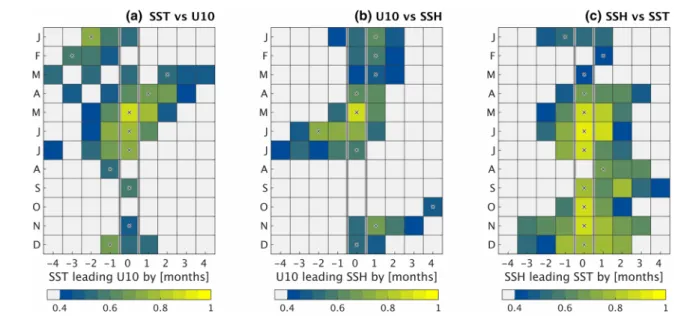
The dominant process that couples equatorial atmos-pheric and oceanic variability is the Bjerknes feedback (Bjerknes 1969). In a positive feedback, it relates SST and thermocline variability in the eastern ocean basin to zonal surface wind variability in the western ocean basin (u10) and lends growth to the Pacific (Bjerknes 1969) and Atlantic Niños (e.g. Keenlyside and Latif 2007; Burls et al. 2012; Lübbecke and McPhaden 2013; Deppenmeier et al. 2016). Traditionally, three elements of the Bjerknes feedback are considered when assessing the overall strength of the feed-back: (1) Eastern ocean basin SST anomalies force u10 anomalies in the western ocean basin, (2) u10 anomalies trigger a thermocline response across the basin that can be measured via thermocline variability in the eastern ocean basin, and (3) eastern basin thermocline anomalies amplify the initial SST anomaly. A closed Bjerknes feedback loop is present when all three elements of the Bjerknes feedback are active simultaneously.
Note, however, that the simplified Bjerknes feedback out-lined above is not the only process that acts in the equatorial oceans. Specifically, the “forcing direction” in the feedback elements (1)–(3) is not strict. In the closely coupled sys-tem of the equatorial oceans, wind variability in the
west-2006). Nevertheless, for the purpose of this study we will rely mainly on the dynamical framework of the simpli-fied Bjerknes feedback.
An important aspect of the Bjerknes feedback is that it must not necessarily act instantaneously. This means that the individual elements of the Bjerknes feedback may be delayed (note that this delay within the positive Bjerknes feedback is not identical with the range of delayed negative feedbacks discussed in Neelin et al. (1998) that ultimately stop anomaly growth in the eastern ocean basin during an El Niño or La Niña event). Physically, the delay within the elements of the positive Bjerknes feedback is due to the fact that information about anomalies on one side of the ocean basin need to be transmitted across the basin to be able to affect the other side. In the atmosphere, this is done via rela-tively quick atmospheric adjustment to eastern ocean basin SST anomalies, which in turn produce anomalous zonal pressure gradients and result in western ocean basin zonal wind anomalies. In the ocean, zonal wind stress anomalies are translated into equatorial Kelvin waves (e.g. Dijkstra
2006). These Kelvin waves than travel westward across the ocean basin and feed the information about the wind vari-ability in the west to the eastern ocean basin. Depending on the width of the ocean basin, the Kelvin wave transmission can happen on a time scale on the order of months. In the tropical Atlantic, Keenlyside and Latif (2007) and Richter et al. (2013), among others, have shown that wind variabil-ity in the western ocean basin precedes SST variabilvariabil-ity in the eastern ocean basin by about 1 month in boreal spring. In the tropical Pacific, this delay is longer due to the larger basin size.
Returning to the dynamical nature of the Atlantic Niño in comparison to ENSO events, Burls et al. (2011) show that the Atlantic and Pacific Niños rely on the Bjerknes feed-back in subtly different ways. The Pacific Niño generally is the result of a free mode of interannual variability that is driven by the Bjerknes feedback; interactions with the seasonal cycle occur, but do not dominate ENSO SST vari-ability. In the tropical Atlantic, on the other hand, the Bjerk-nes feedback is seasonally active (Richter 2016). It helps to develop the cold tongue and is involved in establishing the seasonal cycle. Burls et al. (2012) argue that the Atlantic Niño hence reflects a modulation of the seasonally active Bjerknes feedback instead of an independent mode of inter-annual variability.
Lastly, and in contrast to numerous studies that have provided evidence for a relationship between Atlantic Niño variability and the Atlantic Bjerknes feedback, Nnamchi et al. (2015, 2016) have proposed that the Atlantic Niño is essentially driven by stochastic processes in the atmosphere rather than by dynamical ocean processes that are
poten-On the relationship between Atlantic Niño variability and ocean dynamics
evidence for a significant stochastic component of Niño-like variability in the tropical Atlantic.
Here, we address two questions. First, do dynamical pro-cesses contribute to SST variability in the tropical Atlantic? Is there a seasonality to the ratio of dynamical and stochastic contributions? And second, does the presence of the SST bias—and hence the flawed mean state and missing summer cold tongue—affect the models’ ability to accurately repro-duce the observed dynamical SST variance? To answer these questions, we use two assimilation runs of the Kiel Climate Model (KCM) as well as reanalysis data and decompose SST variance into a part that is due to dynamical processes in the ocean and a stochastic part that is driven by noise.
The rest of the paper is structured as follows: Sect. 2
sketches the Kiel Climate Model and the method that we used to produce our assimilation runs, Sect. 3 reviews the assimilation runs with respect to the impact of the equato-rial Atlantic SST bias. Section 4 presents our SST variance decomposition method; results for our assimilation runs and observations are compared in Sect. 5. Section 6 discusses the impact of lagged feedbacks on our results. A summary and discussion of the results is provided in Sect. 7.
2 Model and
methods
To compare our results with the evolution of the observed climate system, we use the ERA-Interim (Dee 2011) and the Archiving, Validation, and Interpretation of Satellite Oceanographic (AVISO) datasets. We find that differences between ERA-Interim SST and other SST datasets are neg-ligibly small. (Analysis results for alternative validation datasets such as the HadISST dataset (Rayner et al. 2003) are not shown. They differ from the analysis with respect to ERA-Interim only in details.) Furthermore, our variance decomposition approach requires additional surface zonal wind (u10) and sea surface height (SSH) data. We use u10 provided by ERA-Interim for the period 1981–2012, and the AVISO monthly mean SSH anomaly dataset for the period 1993–2012. Throughout this study, we refer to ERA-Interim
(AVISO) when we discuss an “observed” feature of SST and u10 (SSH).
Figure 1 shows important regions for our study as boxes. Atl3 spans the region 3◦S–3◦N, 20◦W–0◦E and is the
Atlan-tic counterpart to the Pacific Nino3.4-region. It is the part of the equatorial Atlantic in which ocean–atmosphere cou-pling is most vigorous and that is hence used to assess SST variability associated with the Atlantic Niño. It is also the region in which the cold tongue is most pronounced in boreal summer. To the west of Atl3 is the western Atlantic region WAtl (3◦S–3◦N, 40– 20◦W). In terms of the Bjerknes
feedback, WAtl is crucial for the wind stress contributions to the feedback.
Model runs were performed with the Kiel Climate Model (KCM, Park et al. 2009), a coupled global climate model (CGCM). We used a low-resolution version of the KCM. The atmospheric component ECHAM5 (Roeckner et al.
2003) is run with 19 vertical levels in T31 horizontal resolu-tion. The ocean component of the NEMO model (Océan Par-allelisé Version 9, OPA9 Madec et al. 1998; Madec 2008) is run in the ORCA2-setup. ORCA2 has 31 vertical levels and an average horizontal resolution of 1.3◦. Towards the equa-tor, the horizontal resolution is refined to 0.5◦. The model
uses seasonally varying radiative forcing that corresponds to mid-twentieth century conditions. In particular, changes in greenhouse gas concentrations and aerosol loading are not considered.
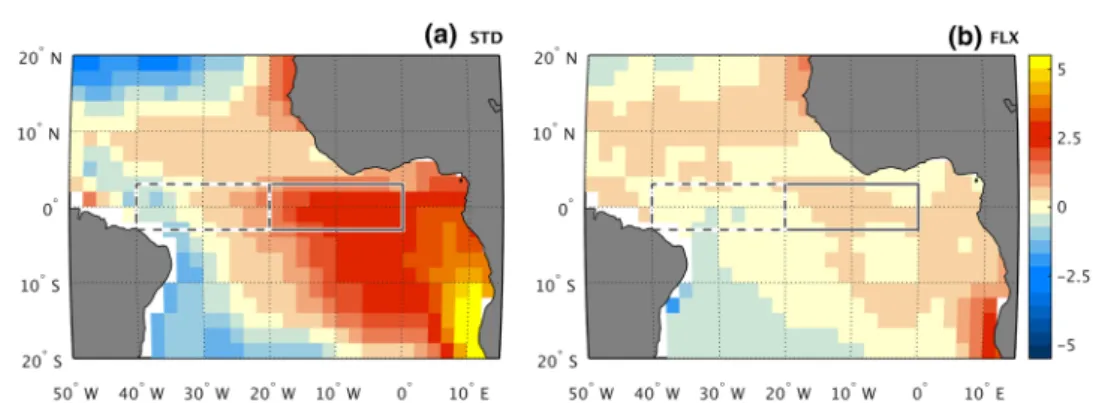
We conducted two sets of experiments. The first set uses a standard version of the KCM (“STD”). The STD-SST cli-matology contains the SST bias in the southern subtropical Atlantic (Fig. 1), which is qualitatively comparable to the bias in other CGCMs (shown for example by Davey 2002; Richter and Xie 2008). The second experiment employs additional surface heat flux correction (“FLX”, see below for details) to reduce the SST bias. We run three and eight ensemble members for the STD and FLX experiments runs, respectively. All ensemble members use the same wind stress forcing (see below), but differ in their initial condi-tions, which are taken from a control run at a time when the model is close to equilibrium.
Fig. 1 Annual mean SST bias relative to ERA-Interim SST in the a STD and b FLX assimila-tion runs in the tropical Atlan-tic. Positive values indicate that the model climatology is too warm. Solid (dashed) boxes show the Atl3 (WAtl) region
T. Dippe et al.
The STD and FLX experiments were run in partially coupled mode. Partial coupling is an assimilation technique that seeks to minimize the equatorial initialization shock in fully coupled hindcasts when they are started from partially coupled initial conditions (e.g. Ding et al. 2013; Thoma et al.
2015). In a partially coupled model the ocean and sea ice components are forced with observed wind stress anomalies that are added to the model’s monthly mean wind stress cli-matology. All other aspects of the model are identical to the fully coupled model. In particular, thermal coupling between the ocean and the atmosphere is preserved, and SST and the atmospheric wind field remain fully prognostic variables.
Surface heat flux correction is employed in the FLX experiment to reduce the SST bias of the KCM. To diag-nose the heat flux correction, we use the same methodol-ogy as Ding et al. (2015): During a control integration, we nudge the first ocean level of the model towards the monthly climatology of observed SST with a restoring time scale of 10 days. After 470 years, when the model has reached an equilibrium state, we continue our integration for another 70 years to diagnose the monthly climatological heat flux term that is associated with the SST restoring. This climatology of the “heat flux correction” is then added as a non-flow-interactive correction to the SST tendency while integrating the heat-flux corrected version of the KCM. For an overview of the performance of the two experiments in the equatorial Atlantic and the impact of the bias on the coupled system, refer to Sect. 3. Here, we note that Ding et al. (2015) showed a substantial improvement in the ability of the partially cou-pled model runs to reproduce observed SST variability in boreal summer in FLX compared to STD.
Monthly anomalies for the model integrations and valida-tion datasets are calculated by detrending the data via least-squares fitting, applied to each month separately. Note that we did not subtract the seasonal cycle from the monthly data prior to the detrending, since it did not yield qualitatively different results. We chose this method to not only calculate our anomalies relative to a static seasonal cycle but allow the possibility that the seasonal cycle itself may vary (lin-early) on long time scales. The analysis period is 1981–2012 (1993–2012) for ERA-Interim and the KCM experiments (AVISO). For the KCM experiments, we detrend each ensemble member separately. The ensemble mean monthly anomaly is the average of the monthly anomalies of all ensemble members.
3 Impact of
the
coupled bias on
the
equatorial
Atlantic
In this section, we assess SST and zonal wind biases in the
experiments share their forcing of observed wind stress anomalies, the only difference between the ensemble means must be due to the bias correction in FLX. Hence, our analy-ses illustrate the impact that the bias has on the coupled equatorial system.
First, we assess the SST bias in STD and FLX. In the annual mean, the STD experiment shows the familiar pattern of the equatorial SST bias (Fig. 1a, 2.00 ◦C in Atl3). FLX
clearly reduces this bias (Fig. 1b, 0.29 ◦C in Atl3).
Addition-ally and in contrast to STD, FLX is able to produce a cold tongue similar to observations (Fig. 2). An interesting detail of Fig. 2 is that the STD experiment, too, simulates Atl3 cooling between April and May, but fails to intensify this cooling to establish the cold tongue from May onwards. In contrast, Atl3 cooling in FLX really only starts in May-June. Effectively, cold tongue development in FLX lags behind observations by roughly 1 month (Fig. 2a). Nevertheless, heat flux correction clearly reduces the SST bias in the tropi-cal Atlantic (Fig. 2b).
Richter and Xie (2008) and Richter et al. (2012) have shown in different CGCMs that the equatorial Atlantic SST bias is related to a bias in zonal surface wind in the west-ern equatorial Atlantic, which in turn can be traced back to precipitation deficiencies of the models. Based on obser-vations, Marin et al. (2009) argue that weak variability in WAtl zonal surface wind fails to precondition the basin-wide thermocline slope for the subsequent summer—the initial cooling of the cold tongue is hence weakened or delayed. In agreement with Richter et al. (2014a), a similar process could be at work in CGCMs: Spring zonal winds that are systematically too weak in the western equatorial Atlantic could inhibit seasonal thermocline shoaling in the eastern
Fig. 2 a Seasonal cycle of SST in Atl3 for (black) ERA-Interim, (red) STD, and (blue) FLX for 1981–2012. b Monthly mean bias of Atl3 SST for (red) STD and (blue) FLX
On the relationship between Atlantic Niño variability and ocean dynamics
Here, we demonstrate that the KCM, too, develops a zonal wind bias in boreal spring that is, however, largely independent of the SST bias in the eastern ocean basin. Figure 3 shows that zonal surface wind in WAtl is greatly reduced in boreal spring relative to ERA-Interim. Surpris-ingly, this behaviour is hardly altered qualitatively in the FLX experiment, indicating that the zonal wind bias depends only weakly on eastern basin SST in the model. In agree-ment with the recent findings of Richter et al. (2014b) and Harlaß et al. (2015) we suspect that the zonal wind bias is at least partly due to the insufficient vertical resolution of the atmosphere model and related deficiencies in vertical momentum transport.
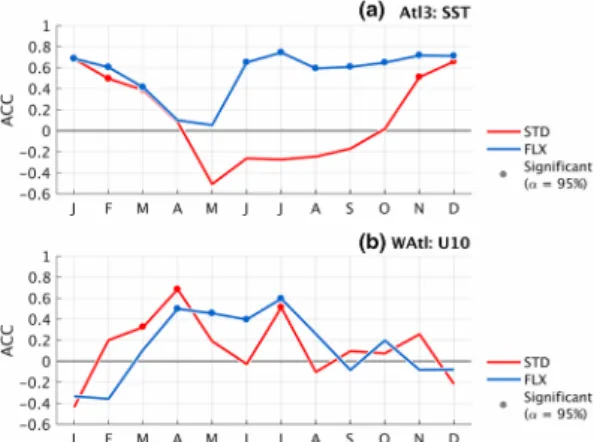
Additionally, we assess how the bias affects the KCM’s ability to simulate observed SST and u10 variability. Fig-ure 4 shows, for each calendar month, the anomaly correla-tion coefficient (ACC) between the ensemble means of the
partially coupled KCM assimilation runs and ERA-Interim. Again, because the FLX and STD experiments only differ in whether they reduce the SST bias or not, differences in the “skill” of the assimilation runs to simulate the observed variability are due to the equatorial SST bias.
In agreement with Ding et al. (2015), bias reduction substantially increases the “skill” of the assimilation runs for boreal summer SST variability. This again supports the notion that the cold tongue is a crucial requirement for Atlantic Niño variability. Zonal wind variability, on the other hand, is only marginally improved by SST bias reduction in late boreal spring and early boreal summer.
An interesting aside with respect to the STD experiment is the strongly negative correlation coefficient for modelled and ERA-Interim SST during May. The value is almost
−0.5, indicating a relationship that could be interesting to explore further. However, analysing in depth the physical processes that give rise to such an outstanding relationship in the biased experiment is not the scope of this paper and should be addressed in future research.
4 SST variance decomposition method
Figure 5 shows the SST variance in the tropical Atlantic and its seasonality. In ERA-Interim, Atl3 SST variance is subject to a well-defined seasonal cycle that peaks in May–July, con-sistent with the peak phase of the Atlantic Niño. In agree-ment with Okumura and Xie (2006) a secondary peak occurs early in boreal winter.
The KCM struggles to reproduce the observed SST vari-ance. While bias alleviation improves model performance, SST variance in FLX is too low and peaks 1 month late (Fig. 5). On the other hand, the STD experiment shows a seasonal cycle of SST variance that is almost the opposite of observations: Variance is high in boreal winter and decreases in boreal summer, reaching its minimum in July. Because the STD experiment is strongly biased in the tropical Atlantic (Figs. 1, 2), the cold tongue cannot develop in boreal sum-mer and cold tongue variability is not captured.
Fig. 3 Same as Fig. 2 but for zonal surface wind u10 in WAtl
Fig. 4 Monthly anomaly correlation coefficients (ACCs) between ERA-Interim and the ensemble mean from the (red) STD and (blue) FLX experiments for a Atl3 SST and b WAtl u10 and the period 1981–2012
Fig. 5 Monthly SST variance in Atl3 for (black) ERA-Interim, (red) STD, and (blue) FLX