
S O F T W A R E
Open Access
Oculus: faster sequence alignment by streaming
read compression
Brendan A Veeneman
1,2, Matthew K Iyer
1,2and Arul M Chinnaiyan
1,2,3,4,5*Abstract
Background:Despite significant advancement in alignment algorithms, the exponential growth of nucleotide sequencing throughput threatens to outpace bioinformatic analysis. Computation may become the bottleneck of genome analysis if growing alignment costs are not mitigated by further improvement in algorithms. Much gain has been gleaned from indexing and compressing alignment databases, but many widely used alignment tools process input reads sequentially and are oblivious to any underlying redundancy in the reads themselves. Results:Here we present Oculus, a software package that attaches to standard aligners and exploits read
redundancy by performing streaming compression, alignment, and decompression of input sequences. This nearly lossless process (> 99.9%) led to alignment speedups of up to 270% across a variety of data sets, while requiring a modest amount of memory. We expect that streaming read compressors such as Oculus could become a standard addition to existing RNA-Seq and ChIP-Seq alignment pipelines, and potentially other applications in the future as throughput increases.
Conclusions:Oculus efficiently condenses redundant input reads and wraps existing aligners to provide nearly identical SAM output in a fraction of the aligner runtime. It includes a number of useful features, such as tunable performance and fidelity options, compatibility with FASTA or FASTQ files, and adherence to the SAM format. The platform-independent C++ source code is freely available online, at http://code.google.com/p/oculus-bio. Keywords:DNA nucleotide sequence alignment streaming identity redundancy compression software algorithm Background
Nucleic acid sequencing throughput has grown expo-nentially for the past ten years, and is expected to con-tinue to shatter Moore’s law [1]. Though the highly anticipated onslaught of inexpensive sequencing empo-wers exciting new biological studies, it also presents a critical problem: the skyrocketing computational costs of sequence analysis [2]. Computers may become the bottleneck of genomics research if these growing proces-sing demands are not mitigated by improvements in software algorithms, especially in light of the sequencing demands of personalized medicine.
Much intellectual effort has been invested in minimiz-ing the time required to align a sminimiz-ingle read against an
indexed database. When performed sequentially, each sequence in the input is processed individually, such that the sum of the alignment times of the input sequences is the total running time. Today’s fastest and most widely used aligners, such as Bowtie [3], BWA [4], MAQ [5], RazerS [6], and BLAST [7], process input reads sequen-tially. These aligners can typically be configured to be consistent and guarantee that identical copies of an input sequence will produce identical alignment results. There-fore, given a set of input reads with ample redundancy, we envisioned that alignment time could be reduced without compromising accuracy by distilling the unique set of sequences and aligning them using a sequential alignment tool.
Harnessing redundancy in sequence alignment input is not a new concept. BLAST + gains a performance benefit by saving alignments within batches [8]. Cloudburst and CloudAligner use MapReduce, and feature a shuffle step wherein seed sequences in the query and database are brought together and combined [9,10]. SEAL also uses * Correspondence:[email protected]
1
Department of Computational Medicine and Bioinformatics, University of Michigan Medical School, Ann Arbor, MI 48109, USA
2
Michigan Center for Translational Pathology, University of Michigan Medical School, Ann Arbor, MI 48109, USA
Full list of author information is available at the end of the article
© 2012 Veeneman et al.; licensee BioMed Central Ltd. This is an Open Access article distributed under the terms of the Creative Commons Attribution License (http://creativecommons.org/licenses/by/2.0), which permits unrestricted use, distribution, and reproduction in any medium, provided the original work is properly cited.
MapReduce; it effectively parallelizes BWA, and can remove duplicate reads by comparing alignment position, after aligning all of them [11]. Similarly, SlideSort sorts together sequences with common substrings [12], and mrsFast uses a sophisticated blocking map to identify unique seeds before performing a direct map-to-map comparison [13]. Finally, Fulcrum performs hashing on seed sequences using MapReduce to conserve computa-tion time in genome assembly [14]. While all of these are excellent tools in their own application spaces, sequential aligners such as Bowtie and BWA enjoy extensive sup-port, remain popular for many applications, and can benefit from the same approach. Furthermore, decoup-ling the process of compressing input reads from the alignment kernel itself could be productive, as improve-ments to both algorithms can proceed independently. To date, no application exists that performs streaming read compression in a generalized way.
Methods
We explored the nature of read redundancy across thir-teen publicly available next-generation nucleotide sequen-cing datasets. In a series of experiments we measured the contributions of the application (whole genome, targeted exome capture, RNA-Seq, and ChIP-Seq), read length, and sequencing depth to overall read redundancy, measured in the percentage of unique reads. Using these observations, we wrote the streaming read compression algorithm Oculus and constructed a model to determine the value of streaming read compression for a given dataset. Finally, we benchmarked Oculus on full sequencing datasets.
Sequence data profiling
We evaluated thirteen publicly available datasets that were
representative of the major applications of
high-throughput sequencing, identified here by their NCBI Se-quence Read Archive (SRA) accession numbers. There were five RNA-Seq datasets (ERS025093 (pooled), and SRR097790, SRR097792, SRR097786, and SRR097787 from the iDEA challenge), three genome datasets (SRR097850 and SRR097852, also from the iDEA chal-lenge, and ERR000589), three Exome sequencing datasets (SRR098490, SRR098492, and SRR171306), and finally two ChIP-Seq datasets: (SRR227346, and SRR299316 + SRR299313 (pooled)). The ChIP-Seq data was downloaded from the ENCODE Project [15], hosted on the UCSC genome browser. Illumina, Inc. carried out the IDEA data-set sequencing, first used by Sun et al. [16]. Additional run metadata can be found in Additional file 1: Table S1.
Sequencing type
The sequencing datasets we selected varied widely in their composition. We compared read redundancy be-tween sequencing types by standardizing the number of
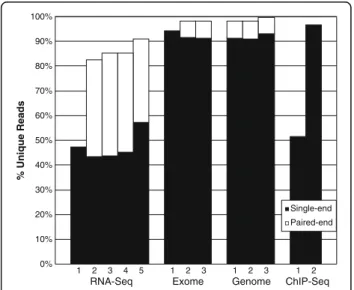
reads per dataset to 24 million with random subsetting, and read length to 36 bases with 3’end trimming (both lowest common denominators). RNA-Seq had relatively redundant reads; only 43% to 57% of each single-end dataset was unique (Figure 1). In contrast, Exome and Genome sequencing had very little read redundancy. The two ChIP-Seq datasets had disparate content, va-rying greatly in their % unique reads – without delving into the specifics of those samples, we believe this may reflect the wide variety of ChIP-Seq applications. As expected, paired-end data compressed less well than single-end, since paired-end compression requires iden-tity on both reads.
Depth of coverage and read length
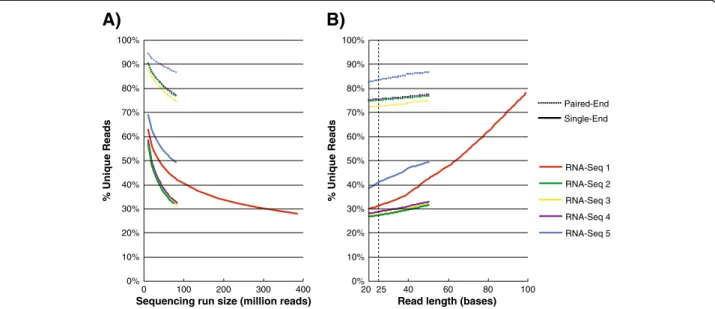
Given some fixed input DNA from which fragments are sampled, each incremental read will be more likely to duplicate previous reads. In particular, RNA-Seq reads may disproportionately reflect highly expressed genes, suggesting that higher sequencing coverage could have a nonlinear effect on read redundancy [17]. Therefore, we measured the impact of coverage depth/sequencing run size (number of reads) and read length on the unique read percentage of each dataset, treating reads indivi-dually (single-end) or as pairs (paired-end) (Figure 2). We fixed the read length for RNA-Seq runs and evaluated % unique reads for a series of random fractions of the original datasets. As predicted, larger sequencing runs corresponded logarithmically to a lower unique fraction
Genome ChIP-Seq Exome RNA-Seq 20% 10% 0% 1 2 3 4 5 % Unique Reads 100% 90% 80% 70% 60% 50% 40% 30% 1 2 3 1 2 3 1 2 Paired-end Single-end
Figure 1RNA-Seq compresses better than other sequencing platforms.Each benchmark dataset was randomly subset to the lowest common denominator number of reads (24 million) and read length (36 bases). Subsequently, Oculus computed the unique read fraction for each dataset using the reverse-complement option. For data with paired-ends available, 12 million pairs were used to computer %unique reads. RNA-Seq #1, Exome #1, and ChIP-Seq #1-2 did not have available paired-end data.
of the datasets (Figure 2A). The unique read fraction va-ried between 56-69% for 10 million reads, 32-49% for 25 million reads, and 28% for 385 million reads in RNA-Seq dataset #1. The differences between datasets likely relates to sample biology and preparation. Next, we fixed coverage depth and evaluated the percentage of unique reads for a series of read lengths (trimming from the end) (Figure 2B). The impact of read length on uniqueness appeared to be exponential in one case (RNA-Seq #1, for which 100 bp reads were available) and linear in the rest (RNA-Seq #2-5). It’s interesting to note that some RNA-Seq algorithms, such as TopHat [18], dice unmapped reads into segments and align each piece individually. This might entail a ~3-fold alignment speedup for RNA-Seq dataset #1 by use of 25 base seg-ments, if further communication between a streaming read compressor such as Oculus and Tophat’s core al-gorithm could be engineered.
Implementation
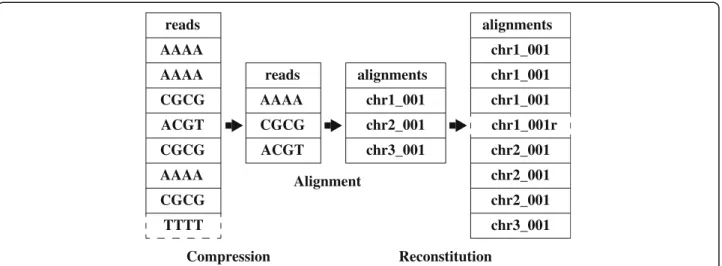
The overall architecture of Oculus is shown in Figure 3. Oculus reads FASTA or FASTQ input files, processes sequences into a compressed form, and compares them to a map containing all sequences it has seen before; new sequences are passed into the aligner as FASTA, while previously observed sequences increment counts in the map. At the reconstitution step, sequences in the SAM output file are then compared back against the map and re-printed as many times as they appeared in the input, correcting for alignment orientation.
Paired-end sequences are handled by concatenating the two sequences to ensure the pair is unique. Oculus can wrap any aligner capable of producing SAM-formatted output.
By design, Oculus sacrifices FASTQ quality scores, read names beyond the first instance of the sequence, and the original order of the reads in the output. Op-tionally, users can direct Oculus to restore the original read names and quality scores by writing them to an intermediate file, sorting it, and reattaching them during the reconstitution step. This option incurs additional memory overhead, and additional time to sort the inter-mediate file.
Data structures
Oculus uses hashmap data structures to store sequences in memory. Users can either compile in standard library (STL) hashmaps, or Google-SparseHash maps, which are faster and require significantly less memory (2 bits of overhead per entry) [19].
Optionally, users can direct Oculus at runtime to store unique reads in a separate hashset, reducing the burden on the hashmap to only redundant sequences. The effect of this is to reduce lookup times in the reconstitution step and total memory consumption, at the cost of more operations in the compression step. Hashsets are expected to be beneficial for lower redundancy input.
Oculus uses a modified version of MurmurHash2 to hash binary sequence data [20]. It has a low incidence of collision for binary data, and was recommended for use with Google-SparseHash by its developer (C. Silverstein,
A)
% Unique Reads
Sequencing run size (million reads)
% Unique Reads
B)
Read length (bases)
0% 10% 20% 30% 50% 40% 60% 70% 80% 100% 90% 0 100 200 300 400 0% 10% 20% 30% 50% 40% 60% 70% 80% 100% 90% 2025 40 60 80 100 RNA-Seq 2 RNA-Seq 3 RNA-Seq 4 RNA-Seq 1 RNA-Seq 5 Single-End Paired-End
Figure 2Compression improves for larger sequencing runs and shorter read lengths. A) Each RNA-Seq dataset was trimmed to 50-base reads, and %unique reads was computed for a series of simulated sequencing run sizes (between 10 million single-end or paired-end reads and their original size).B) Each RNA-Seq dataset was randomly subset to 79 million single-end or paired-end reads, and %unique reads was computed for a series of simulated read lengths by trimming from the end (between 20 bases and their original read size). 25 bases is a typical sequence length that advanced RNA-Seq pipelines such as TopHat may use for segmented alignment.
personal communication). To reduce collisions, the hash algorithm operates only on the sequence field of the compressed sequence objects.
Binary compression
Instead of storing sequences in memory as ASCII char-acters, Oculus uses compressed sequence objects of our own design (cseqs) (Figure 4). DNA sequences are dy-namically compressed into 2 or 3 bits per base, depend-ing on the presence of N nucleotides. Optionally, a 2-bit encoding can be forced if the user wishes for N’s to be evaluated as A’s. Each cseq has three fields: a representa-tion bit indicating the nucleotide encoding, its size in memory, and a variable-length compressed sequence. Storing the size is necessary because null-termination is obviated by the possibility of null bytes in the sequence field.
The most obvious benefit of using cseqs is an approxi-mate four-fold reduction in memory use. However, two engineering benefits also arise for cseq string compari-son, which help efficiently resolve map collisions. Sequences with different lengths or representations can be differentiated by comparing the first byte in constant time (very quickly). Moreover, by comparing nucleotides in blocks instead of individually, comparison time is reduced four-fold. Memory for sequences is allocated in large chunks (default: 10kB), which reduces overhead greatly.
Reverse complements
Lastly, Oculus can be directed to compress together re-verse complements in single-end data, or rere-versed read
order in forward-reverse oriented paired-end data, under the presumption that they should align to the same place in the database. This improves compression and there-fore reduces aligner runtime. Using reverse comple-ments is optional because BWA and Bowtie both use left-end seed sequences, so the orientation of the read can affect its alignment (though typically in a tiny fraction of sequences).
Runtime model
We developed a model to predict the effectiveness of Oculus for any given data set. Given Niinput reads that compress to Nc sequences, and assuming sa and so are the speeds of the aligner and Oculus, in reads/unit time, the following equations give the expected benefit of using Oculus as a fraction of the aligner’s run time.
Aligner Run Time¼ Ni=sa
Oculus Run Time¼ Ni=so
þ Nc=sa
Run Time Ratio¼ðOculus=AlignerÞ¼ sa=so
þðNc=NiÞ The aligner’s run time is simply the total number of input reads divided by the average alignment speed in reads per unit time of the aligner. In the second case,
since Oculus passes some fraction Nc of Na into the
aligner, the aligner only has to do Nc/sawork. However, there’s also an overhead for Oculus on the order of the total number of input reads. The fractional benefit of using Oculus is therefore related only to the compres-sion achieved and Oculus’s speed relative to the aligner it’s wrapping. We therefore derived processing rates in reads per second for Oculus and each aligner, for both
reads AAAA AAAA AAAA CGCG CGCG CGCG ACGT TTTT alignments chr1_001 chr2_001 chr3_001 chr1_001 chr2_001 chr2_001 chr2_001 chr3_001 alignments chr1_001 chr1_001 chr1_001r reads AAAA CGCG ACGT Compression Reconstitution Alignment
Figure 3Flowchart depicting Oculus behavior with example sequences.As input is parsed, new sequences are passed into the aligner in the order they are observed. The aligner then performs normally, mapping each passed read to the database. Downstream of the aligner, Oculus expands the alignment file to reflect the count of each input sequence. Since compression and reconstitution are faster than alignment, there is a net reduction in runtime. In reverse-complement mode (Section 2.4), Oculus would remove the read sequence TTTT, having already seen AAAA, and print an additional alignment: chr-001 with reversed orientation. By default, Oculus treats AAAA and TTTT as distinct sequences–both would be passed into the aligner.
single-end and paired-end data, using experimental results for the 50 and 51-mer datasets. Table 1 indicates the calculated ratio of the speed of the aligners to Oculus. Based on these parameters we predict that Oculus will have a runtime benefit for sequence data with greater than 10% redundant reads, and that benefits would scale linearly with the unique read fraction. This model discounts non-linear factors such as hash colli-sions, read length, percent successful alignment, and po-tentially, alignment location, and disk I/O will produce noise, but it is an effective rule of thumb.
Benchmarking
We compared the performance of Oculus with BWA (version 0.5.9-r16) and Bowtie 1 (version 0.12.7 64-bit) by themselves. All alignment was performed against the reference human genome GRCh37/hg19.
Every benchmarking test was run on the Flux super-computing cluster maintained by the Center for Advanced Computing at the University of Michigan, using single CPU cores of 2.67 GHz Intel X5650 processors, with
64 GB of 1333 MHz DDR3 memory, and distributed ac-cess disks. To reduce noise in runtime measurement from disk I/O, each benchmark test was run three times, and the average runtime is presented here. Memory consump-tion was much less noisy, so similar averaging was un-necessary in reporting memory use. Both aligners ran with entirely default options, and Oculus used only the reverse complement storage option,“–rc”.
To test consistency, we ran Bowtie using “-m 1” to eliminate multi-mapping reads, for which Bowtie reports one random alignment by default. We extracted align-ment positions, sorted by read sequence (grouping to-gether forward and reverse orientations), and counted and classified alignment differences. BWA has no such mono-mapping option, so we did not test Oculus’s wrap-ping of BWA for consistency (BWA was still tested for performance).
Results
Compression and performance
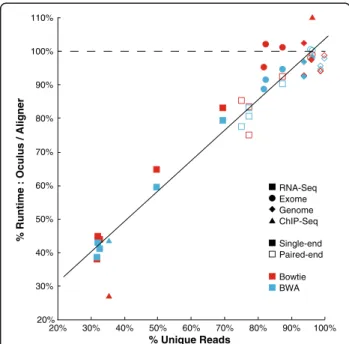
Oculus yielded performance benefits that strongly corre-lated with the unique read fraction of each dataset (Figure 5). Notably, the single-end RNA-Seq datasets aligned in 49.7% as much time on average, i.e., they ran
0
2 00011011 00000000
1 3 00000101 00111000 00000000
1 16 24 32 40 1 16 24 32A)
B)
ACGTAA
ACGTNA
Figure 4Compressed sequence object (cseq) diagrams. Numbers below the data fields indicate the 0-based index in bits from the left end. (A) The sequence ACGTAA contains no N’s, so its encoding bit is 0, indicating 2 bits per base. By that encoding, two bytes are required to store 6 nucleotides, so the size field is 2. The sequence field is populated by A = 00, C = 01, G = 10, T = 11, etc., with the right-most byte padded on the right by zeros. (B) Compression proceeds as before, until the N nucleotide is encountered, at which point the compression starts over and sets the encoding to 1, indicating 3 bits per base. At that compression, now 3 bytes are required to store 6 nucleotides, and the size field is updated accordingly. The sequence field is populated by A = 000, C = 001, G = 010, T = 011, N = 100, etc., and again the right-end is padded with 0 s.
Table 1 Relative processing speeds of Bowtie and BWA to Oculus, for single-end and paired-end data
SE PE
sa/so Bowtie 0.079 0.023
BWA 0.017 0.015
sais the aligner’s speed, and sois Oculus's speed. Since speeds are measured in reads aligned per second, these values indicate that Oculus runs faster than the aligners, and relatively more fast for paired-end data than single-end data. As expected, Bowtie was measured to be faster than BWA, particularly for single-end data. Both aligners were run with default options.
20% 30% 40% 50% 60% 70% 80% 90% 100% 110%
% Runtime : Oculus / Aligner
20% 30% 40% 50% 60% 70% 80% 90% 100% % Unique Reads RNA-Seq Exome Genome ChIP-Seq Single-end Paired-end Bowtie BWA
Figure 5Oculus provides a speedup that correlates linearly with % unique reads.% Runtime represents the ratio of the runtime of Oculus, wrapping each aligner, to the runtime of the aligner by itself (in CPU time). To best demonstrate fractional benefit, Bowtie and BWA results are combined in this graph–individual run data is available in Additional file 1: Table S1. Oculus provided a speed benefit for points below the dashed line. These datasets span a variety of sequencing types, read number, and read length, which we hypothesized all contribute to the % unique reads for a sequencing run. See Additional file 1: Table S1 for individual sequencing run characteristics such as read number and read length.
2.0 times as fast in Oculus compared with Bowtie and BWA. The paired-end datasets compressed less well than their single-end counterparts; on average, the paired-end RNA-Seq datasets aligned 1.2x as fast. ChIP-Seq dataset #1 received the greatest performance benefit: its single-end Bowtie alignment ran 3.7x as fast. However, our Genome and Exome datasets, and ChIP-Seq dataset #2, were generally non-redundant and Oculus did not greatly outperform either aligner. This was consistent with our expectations - if reads are not redundant, they cannot be compressed, and the aligner will receive nearly the complete set of input reads. Since compressing and decompressing incurs a small time overhead, it follows that a nearly completely unique dataset might run more slowly.
Though BWA was much slower than Bowtie for single-end data, and somewhat slower for paired-single-end data, Oculus produced similar fractional speed improvements for the two aligners. Additionally, for the datasets tested, Oculus’s hashset option did not yield a significant im-provement. For sequencing run information and exact CPU run times, see Additional file 1: Table S1.
Consistency
Oculus maintained high fidelity to original alignments for every dataset. Defining accuracy as the percentage of input reads that Oculus mapped to exactly the same location as the aligners, on average Oculus was >99.9% accurate, and in the worst case was 99.874% accurate. For individual dataset accuracy, see Additional file 1: Table S1.
Since they change the seed sequence used in align-ment, the vast majority of the differences (inaccuracies) produced were for reads that Oculus either reversed the orientation of (88% of single-end differences), or order of (67% of paired-end differences). Mostly these were previously unaligned reads that aligned and vice versa, but in some cases, an unambiguously mapped read actu-ally changed alignment positions (single-end, 0.09% of differences; paired-end, 10.15% of differences). Though initially surprising, this can be explained by mismatches in seed sequences. Bowtie is less permissive of mis-matches in the seed than at the end of a read under the assumption that read quality tends to be better toward 5’ end. Of two closely homologous regions of the genome, one may count as the best hit in the forward orientation, and the other in reverse orientation. For example:
CAGT - read
CATT–genome position 1 CCGT–genome position 2
In this case, if CA is the seed, position 1 would be the optimal alignment and the third base would count as a
G-T mismatch. However, if the reverse-complement were aligned, and the seed proceeded from the opposite direction, position 2 would be optimal and the third base would be recorded as a C-A mismatch.
Memory use
Oculus very consistently used (sequence length/4) + 20 bytes of memory per map entry. This 20-byte over-head comes from the forward and reverse count integers (4 each), the hash of the sequence (4), a pointer to the sequence (up to 8 on a 64-bit OS), the size field (2), and some heap memory structure overhead. Although these sum to 22 bytes, hash values are not stored mul-tiple times for hash collisions, and pointer memory use varies by OS architecture, often using less than 8. This 20-byte overhead is halved for paired-end map entries, because each pair is stored together. Using the hashset option reduced memory use by about a third, by mitiga-ting some of this overhead for unique reads.
Total memory use is therefore highly dependent on the quantity and redundancy of input sequence, but in a worst-case scenario (perfect non-redundancy), 100 mil-lion single-end 80mers will use about 3.7 GB of memory, on top of memory used by the aligner’s database. Redun-dancy translates linearly to reduction in memory use–if only half of those reads were unique, 1.85 GB would be required instead.
Discussion
Our benchmarking tests suggest Oculus will generally perform very well with RNA-Seq data and on a case-by-case basis in other applications, particularly those with low complexity libraries. The likely source of benefit to RNA-Seq arises from highly expressed genes that are sequenced at great depth and generate multitudes of du-plicate reads.
Shorter read length and larger datasets both correlated with higher redundancy in sequencing runs. The hidden variable of actual biological redundancy remains at large (particularly, the effects of PCR and the targeted scope of sequencing), but those two metrics provide good insight into the expected value of streaming read com-pression for a given sequencing application. We noted the added value Oculus provides for RNA-Seq applica-tions that segment reads (Oculus can significantly bene-fit the alignment of many 25mers), but Oculus may also yield benefit to customized bioinformatics analyses that take similar approaches. Also of note is that for highly-sensitive but slow aligners such as BLAT [21] and Smith-Waterman [22], Oculus’s relative runtime will be insignificant (i.e., sa/so - > 0), so streaming read align-ment will be of greater use to applications that require such sensitivity. Perhaps most importantly, as sequen-cing throughput increases so too will read redundancy
and the marginal benefit of compressing input reads, though this will be mitigated by longer read lengths and paired-end reads.
To be effective, Oculus requires read redundancy and an aligner that does not already exploit that redundancy. To be consistent, Oculus requires the aligner to ignore quality score and use parameters that guarantee deter-ministic behavior. By default, Bowtie will report one alignment at random for ambiguously mapping reads, and Oculus by definition cannot produce multiple align-ments for a single read sequence. The exception to this is if the aligner is configured to report multiple align-ments per read, either on single or multiple SAM lines, in which case Oculus will reconstitute the reads aligning to each location.
Since both Bowtie and BWA use left-end seeds, it makes sense that Oculus may report different alignments for reverse-complemented single-end reads. However, we were surprised to find alignment differences for paired-end reads with reversed order. Read order shouldn’t mat-ter in paired-end alignment: since the read orientation remains the same, so should the seeds. Developers who wish to incorporate streaming read compression into their aligners may be interested in exploring this phenomenon.
Another surprising result was that Oculus + Bowtie ac-tually outperformed compression for the second ChIP-Seq data set (it ran in 27.0% of the original time, on 35% of the original data set). Stranger still, the runtime data for that dataset was not noisy –each of the three tests ran in < 28% of the original time. It is possible that Oculus may have compressed a disproportionately large number of slow-aligning reads –reads that take longer to align to the human genome. Better understanding this phenomenon may be a key to further alignment algo-rithm improvements.
Though Oculus provides immediate benefit to RNA-Seq alignment, further performance gains may be possible by harnessing the idea of streaming read compression. Although implemented here as a customizable “attach-ment”to a sequential aligner, the streaming compression algorithm could be integrated directly into alignment kernels. One obvious benefit of this would be the ability to store paired-end reads individually (with an extra bit denoting the read number) thereby leveraging additional redundancy (see Figure 1). A more nuanced logical con-tinuation of this idea would be for aligners to use cache objects that retain in memory the alignments of the mostly commonly occurring reads. If present, a skew toward very common reads away from reads with few copies could create the perfect conditions for caching. The combinatorics of sequence length suggests an even greater benefit in storing and reusing alignments of common seed sequences, either in a complete object or a cache.
There are three limitations of Oculus’s current imple-mentation of streaming read compression: FASTQ qua-lity scores are lost, read names are lost beyond the first instance of the sequence, and the order of the reads in the output will not be consistent with normal aligner output. Quality scores and read names can be restored to the final output at the cost of computation time and memory, which adds value for downstream analyses such as SNP calling. However, the alignment itself is still performed without quality scores, which can alter align-ment results. In cases where little faith is placed in the read quality scores this may be acceptable, but to miti-gate this loss otherwise, we suggest the use of read filter-ing or trimmfilter-ing as a preprocessfilter-ing step.
Conclusion
Oculus provides a demonstrable speed improvement in aligning redundant data, with high fidelity and low mem-ory cost. Further, streaming read compression of redun-dant reads is generally useful; aligning the unique set of reads is faster than the full set since the overhead of compression is sufficiently low. We expect streaming read compression will play an important role in RNA-Seq alignment and potentially other sequencing applica-tions in the future as data grows and algorithms improve. Availability and requirements
Project Name: Oculus
Project Home Page:http://code.google.com/p/oculus-bio Operating system:Platform independent
Programming language:C++
Other requirements:Perl version 5 or higher (for config-uration), g++ version 4.1.2 or higher (lower versions may work but are untested), Bowtie or BWA (versions 0.12.7 or 0.5.9-r16, respectively), or another SAM-compatible alignment algorithm
License:GNU GPL v3 Additional file
Additional file 1:Table S1.Oculus performance statistics. Detailed benchmarking data used in generating runtime figures.
Abbreviations
DNA: Deoxyribonucleic acid; BWA: Burroughs-Wheeler aligner; RNA-Seq: Ribonucleic acid sequencing; ChIP-Seq: Chromatin immunoprecipitation sequencing; SAM: Sequence alignment map; MAQ: Mapping and Assembly with Quality; BLAST: Basic local alignment search tool; STL: Standard library; ASCII: American standard code for information interchange; I/O: Input/ output; CPU: Central processing unit; GHz/MHz: Gigahertz/Megahertz; DDR3: Double data rate type 3; OS: Operating system; GB/MB: Gigabyte/ Megabyte; PCR: Polymerase chain reaction; BLAT: BLAST-like alignment tool; GPL: GNU public license; GNU: GNU’s not Unix.
Competing interests
Authors’contributions
BAV provided the original idea, wrote the algorithm, performed the benchmarking, modeling, and data interpretation, and drafted the manuscript. MKI contributed critical feedback on the manuscript, suggestions for datasets, and the reverse complement idea. AMC contributed critical feedback on the manuscript and the project, and provided the computational resources necessary to carry out the work. All authors read and approved the final manuscript.
Acknowledgements
We would like to thank Terrence Barrette for supporting the lab’s infrastructure, Jeremy Hallum and CAC for supporting Flux, Illumina for referring us to the iDEA data’s reference, Craig Silverstein for developing Google Sparse-hash and his helpful comments on hashing, Austin Appleby for developing MurmurHash, Catherine Grasso and O. Alejandro Balbin for their comments on the manuscript, and Karen Giles and Christine Betts for their assistance with the manuscript submission.
Funding
AMC is supported by the Doris Duke Charitable Foundation Clinical Scientist Award and is a Howard Hughes Medical Institute Investigator, an American Cancer Society Research Professor and Alfred A. Taubman Scholar. MKI is supported by a DOD Breast Cancer Predoctoral Research Grant
(W81XWH-11-1-0136). BAV is supported by the National Science Foundation and the Program in Biomedical Sciences at the University of Michigan. This material is based upon work supported by the National Science Foundation under Grant No. 0903629.
Author details
1
Department of Computational Medicine and Bioinformatics, University of Michigan Medical School, Ann Arbor, MI 48109, USA.2Michigan Center for
Translational Pathology, University of Michigan Medical School, Ann Arbor, MI 48109, USA.3Department of Pathology, University of Michigan Medical
School, Ann Arbor, MI 48109, USA.4Howard Hughes Medical Institute, University of Michigan Medical School, Ann Arbor, MI 48109, USA.
5
Department of Urology, University of Michigan Medical School, Ann Arbor, MI 48109, USA.
Received: 10 April 2012 Accepted: 1 November 2012 Published: 13 November 2012
References
1. Wetterstrand KA:DNA sequencing costs: data from the NHGRI large-scale genome sequencing program. http://www.genome.gov/sequencingcosts 2. Pennisi E:Human genome 10th anniversary. Will computers crash
genomics?Science2011,331:666–668.
3. Langmead B, Trapnell C, Pop M, Salzberg SL:Ultrafast and memory-efficient alignment of short DNA sequences to the human genome.Genome Biol2009,10:R25.
4. Li H, Durbin R:Fast and accurate short read alignment with burrows-wheeler transform.Bioinformatics2009,25:1754–1760. 5. Li H, Ruan J, Durbin R:Mapping short DNA sequencing reads and calling
variants using mapping quality scores.Genome Res2008,18:1851–1858. 6. Weese D, Emde AK, Rausch T, Döring A, Reinert K:RazerS–fast read
mapping with sensitivity control.Genome Res2009,19:1646–1654. 7. Altschul SF, Gish W, Miller W, Myers EW, Lipman DJ:Basic local alignment
search tool.J Mol Biol1990,215:403–410.
8. Altschul SF, Madden TL, Schäffer AA, Zhang J, Zhang Z, Miller W, Lipman DJ: Gapped BLAST and PSI-BLAST: a new generation of protein database search programs.Nucleic Acids Res1997,25:3389–3402.
9. Schatz MC:CloudBurst: highly sensitive read mapping with MapReduce. Bioinformatics2009,25:1363–1369.
10. Nguyen T, Shi W, Ruden D:CloudAligner: A fast and full-featured MapReduce based tool for sequence mapping.BMC Res Notes2011, 4:171.
11. Pireddu L, Leo S, Zanetti G:SEAL: a distributed short read mapping and duplicate removal tool.Bioinformatics2011,27:2159–2160.
12. Shimizu K, Tsuda K:SlideSort: all pairs similarity search for short reads. Bioinformatics2010,27:464–470.
13. Hach F, Hormozdiari F, Alkan C, Hormozdiari F, Birol I, Eichler EE, Sahinalp SC: mrsFAST: a cache-oblivious algorithm for short-read mapping. Nat Methods2010,7:576–577.
14. Burriesci MS, Lehnert EM, Pringle JR:Fulcrum: condensing redundant reads from high-throughput sequencing studies.Bioinformatics, in press. 15. Encode Project Consortium:The ENCODE (ENCyclopedia of DNA
elements) project.Science2004,306:636–640.
16. Sun Z, Asmann YW, Kalari KR, Bot B, Eckel-Passow JE, Baker TR, Carr JM, Khrebtukova I, Luo S, Zhang L, Schroth GP, Perez EA, Thompson EA: Integrated analysis of gene expression, CpG island methylation, and gene copy number in breast cancer cells by deep sequencing. PLoS One2011,6:e17490.
17. Łabaj PP, Leparc GG, Linggi BE, Markillie LM, Wiley HS, Kreil DP:
Characterization and improvement of RNA-Seq precision in quantitative transcript expression profiling.Bioinformatics2011,27:i383–i391. 18. Trapnell C, Pachter L, Salzberg SL:TopHat: discovering splice junctions
with RNA-Seq.Bioinformatics2009,25:1105–1111.
19. sparsehash:An extremely memory-efficient hash_map implementation. http://code.google.com/p/sparsehash/
20. MurmurHash: http://sites.google.com/site/murmurhash. 21. Kent Informatics, Inc:BLAT and other fine software.
http://www.kentinformatics.com
22. Smith TF, Waterman MS:Identification of common molecular subsequences.J Mol Biol1981,147:195–197.
doi:10.1186/1471-2105-13-297
Cite this article as:Veenemanet al.:Oculus: faster sequence alignment
by streaming read compression.BMC Bioinformatics201213:297.
Submit your next manuscript to BioMed Central and take full advantage of:
• Convenient online submission
• Thorough peer review
• No space constraints or color figure charges
• Immediate publication on acceptance
• Inclusion in PubMed, CAS, Scopus and Google Scholar
• Research which is freely available for redistribution
Submit your manuscript at www.biomedcentral.com/submit
![5 [(2 Methyl 4 nitro 1H imidazol 1 yl)methyl] 1,3,4 thiadiazol 2 amine](data:image/gif;base64,R0lGODlhAQABAIAAAP///wAAACH5BAEAAAAALAAAAAABAAEAAAICRAEAOw==)