SPECIFIC TARGETED RESEARCH OR INNOVATION PROJECT
FORWAST
Overall mapping of physical flows and stocks of resources to forecast waste quantities in Eu-rope and identify life-cycle environmental stakes of waste prevention and recycling
Contract number: 044409
Deliverable n° 3-1
Data Processing and Validation for
Austria, Denmark, France and Germany
Authors:
Gerold Hafner, Nicolas Escalante, Heiko Schuller
Hans Daxbeck, Heinz Buschmann, Bernd Brandt,
Paul H. Brunner, Carolina Massmann
Jacques Villeneuve, Bruno Lemiere
Submission date: 01.09.2010
Start date of project: 1st March 2007 Duration: 2 years
Organisation name of lead contractor for this deliverable: Universität Stuttgart, Institut für Sied-lungswasserbau, Wassergüte- und Abfallwirtschaft, Lehrstuhl für Abfallwirtschaft und Abluft Revision: Final
Content
1
Introduction ... 5
2
Context within FORWAST ... 6
3
Austria: Data Processing ... 8
3.1.1 Sources of data used for developing Supply and Use Matrices ... 8
3.1.2 Monetary Supply- und Use-Matrix (EUROSTAT) ... 8
3.1.3 Resources... 10
3.1.4 Emissions ... 10
3.1.5 Prices ... 12
3.1.6 Physical Supply and Use Tables ... 12
3.1.7 Waste Statistics ... 12
3.1.8 Methodology and Data Quality ... 12
3.1.9 Data processing ... 14
3.2 References (Austria) ... 25
4
Denmark: Data Processing ... 28
4.1.1 Sources of data used for developing Supply and Use Matrices ... 28
4.1.2 Methodology and Data Quality ... 28
4.1.3 Data processing ... 35
4.2 References (Denmark)... 46
5
France: Data Processing ... 48
5.1.1 Methodology and Data Quality ... 48
5.1.1.1 Supply matrix ... 48
5.1.1.2 Use matrix... 49
5.1.1.3 Composition matrix (Kc) ... 51
5.1.1.4 Resources matrix (R) ... 52
5.1.1.5 Emissions matrix (–B) and distribution (Go, Gw, Gr) ... 53
6
Germany: Data Processing ... 64
6.1.1 Sources of Data used for developing FORWAST Matrices ... 64
6.1.2 Monetary and physical Supply and Use Tables ... 64
6.1.3 Online Database ... 66
6.1.4 Resources... 66
6.1.5 Emissions ... 67
6.1.6 Other Sources ... 67
6.1.7 Methodology and Data Quality ... 68
1
Introduction
This subreport describes data processing and validation within WP 3-1. The objective of WP3 is to obtain detailed, validated data for four specific countries. Germany, Austria, Den-mark and France. The data mining in WP3 contains the following steps:
- Definition of the operational data structure in relation to WP1 und WP2.
- Collection of statistics and other data in Germany, Denmark, Austria and France. - Comparison and verification of the acquired data.
- Identification of missing data.
- Collection / substitution of missing data for individual sectors. - Check for plausibility and perform data reconciliation.
- Elaboration of coefficients and indicators for subsequent working packages (esp. WPs investigating scenarios and forecastings).
- Identification of potentials and difficulties for completing the data collection. The deliverables within WP 3 are:
- D3-1: Report chapter describing data processing and validation. - D3-2: Databases of material flows and stocks for the four countries.
- D3-3: Report chapter containing indirect procedures for estimations of transfer coeffi-cients.
- D3-4: Report chapter describing potentials and difficulties for completing the data col-lection.
2
Context within FORWAST
As mentioned in the previous chapter, the objective of WP3 is to obtain detailed, validated data for the specific countries: Austria, Denmark, France and Germany. The ambition is to create a core of data which will be more detailed than for the EU 27. Within the project struc-ture of FORWAST, WP3 interacts with the other working packages as shown in Figure 1.
Input from WP1 WP2, esp.: - Definition of the System (D2-2) - Data Collection Guidelines (D2-4)
WP3
- Data Collection for A, DK, F, D - Data Processing
- Data Validation - etc.
WP4
Parallel Work for EU27
WP6
- Future Waste Streams - Scenarios from WP5
Figure 1: Project Structure
Relevant outcomes for WP3 (and WP4 as well) - resulting from WP1 and WP2 – are, among others:
- Overall Calculation Model
- Identification of relevant Materials and Products - Definition of Terms
- Definition of Data Structure - Definition of System Boundaries - Harmonisation of Data
Interaction between WP3 and WP4 is necessary in order to ensure a congruent and coher-ent data base for EU27. Therefore partners of WP3 and WP4 exchange experiences within periodical project meetings and data mining-workshops. Exchange of experiences and
syn-ergetic effects result from the interaction not only within WP3 and WP4 but also by giving feedback to WP2.
Outcome of WP3 is a verified and coherent data base for the above mentioned four coun-tries suitable to be used for the estimation of future waste streams (WP6) within scenarios elaborated in WP5.
3
Austria: Data Processing
In Austria official supply-use tables based on macroeconomic accounting are available at a level of 60 activities x 60 commodities. The data availability of supply-use tables, emissions tables and resource information is good and the supply-use table covers supply. A few sec-tors are not covered due to confidential reasons. Furthermore the conversion of monetary into physical information is poor due to lack of information concerning price information.
3.1.1
Sources of data used for developing Supply and Use Matrices
In Austria detailed official input-output-calculations based on macroeconomic accounting are available since the year 1995. The national macroeconomic accounting (“Volkswirtschaft-liche Gesamtrechnung; VGR”) is based on the European system of macroeconomic ac-counting (ESVG).
Primary source of monetary supply and use tables (MSUT)
Reference year: 2003
Monetary values (Mio. EUR)
o Supply-table in basic prices, Transformation in purchasers´ prices
o Use-table in purchasers´ prices (the transformation into basic prices is calcu-lated with the provided tool “Basic price converter” 1)
59x59 activities/goods (NACE 01 to 95)
o the NACE categories 13 “Mining of uranium and thorium ores” and NACE 95 “Private households with employed persons” are neglected)
Imports/Exports are implemented
Manually disaggregation is needed to expand the EUROSTAT-Matrix (59x59 activi-ties/goods) into the FORWAST-Format (117x117 activiactivi-ties/goods)
3.1.2
Monetary Supply- und Use-Matrix (EUROSTAT)
Primary source of monetary supply and use tables (MSUT)
Reference year: 2003
Monetary values (Mio. EUR)
o Supply-table in basic prices, Transformation in purchasers´ prices
o Use-table in purchasers´ prices (the transformation into basic prices is calcu-lated with the provided tool “Basic price converter” 2
)
59x59 activities/goods (NACE 01 to 95)
o the NACE categories 13 “Mining of uranium and thorium ores” and NACE 95 “Private households with employed persons” are neglected)
Imports/Exports are implemented
Manually disaggregation is needed to expand the EUROSTAT-Matrix (59x59 activi-ties/goods) into the FORWAST-Format (117x117 activiactivi-ties/goods)
[EUROSTAT, 2003b]
PRODCOM ("PRODuction COMmunautaire")
Additional information concerning detailed data of supplied commodities
NACE-based
Sectors: mining, industry and services
Lack of information in Austria due to confidential data [EUROSTAT, 2008b]
Structural Business Accounts
National source for MSUT
Specific data on industry, services and construction
Higher exactness than MSUTs from EUROSTAT (4-digits; NACE 10 to 74)
Problem with confidential data – no information within categories less than 4 mem-bers due to liability of secrecy within the Austrian legislation
Includes information about the production (supply-table)
Includes information about the intermediate production (use-table)
No physical data provided [Statistik Austria, 2006b]
Agricultural Accounts
[Statistik Austria, 2006a] Source for disaggregating the MSUT and PSUT
Comprehensive information about agriculture and forestry
Consists of monetary and physical information
Agriculture and Forestry in Austria „Grüner Bericht“
[BMLFUW, 2004] Source for disaggregating MSUT and PSUT
Comprehensive information about agriculture and forestry
Additional monetary and physical information is available
Austrian Federal Economic Chamber
[WKO, 2008] Source for disaggregating the MSUT and PSUT
Monetary and physical information provided by several trade associations
3.1.3
Resources
European Mineral Statistics 2001-05 [Hetherington et al., 2007]
Source for PSUT and resource data (R-Matrix)
data according to the physical supply table and the Resource table
The Mineral Industry of Austria 2003 [Newman, 2006]
Source for PSUT and resource data (R-Matrix)
data according to the physical supply table and the Resource table
Mining in Austria
[BMWA, 2004] Source for PSUT and resource data (R-Matrix)
Physical data about mining, energy carriers and resources are available
3.1.4
Emissions
EPER
[European Pollutant Emissions Register, 2008] Source for emission data (B-Matrix) for Austria and the other European countries (EU-25)
data is NACE-based
data is more detailed than data from NAMEA
Inconsistency because of the system boundaries; only enterprises beyond a defined threshold are reportable
NAMEA Air Survey 2006
[EUROSTAT, 2008a]
Core data for air emissions
8 pollutants and three aggregated impact categories are available
3 different aggregated levels:
o A10 – 10 industries and 1 household category
o A36 – 36 industries and 3 household categories
o A60 – 60 industries (NACE 2-digit), and 3 household categories
Provided data of all 27 members of the European Union
Wide range of completeness between the countries
Lack of information in Austria regarding important emissions to air
Integrated NAMEA Austria 1999-2003
[Baud, 2006] Source for emission data (B-Matrix)
Core database for the 8 most important emissions to air (e.g. CO2, CH4)
NACE-based, but on a high level of aggregation
Austria’s Greenhouse Gas Inventory 1990-2006
[Anderl et al., 2008] Source for emission data (B-Matrix)
Core database of the „Österreichischen Luftschadstoff-Inventur (OLI)“
Codes based on the IPCC Common Reporting Format (CRF) – incompatible with NACE
Austria’s National Inventory Report 2005
[Anderl et al.] Submission under the United Nations Framework Convention on Climate Change (UNFCCC)
Emissions data based on the “Common Reporting Format” (CRF) under the submis-sion of the
Core data base to fill in the emission‟s matrices (B-Matrix, Gc-, Gw- and Gr-Matrix) within the Matrix Master
3.1.5
Prices
Prices for commodities in agriculture and forestry
[Statistik Austria, 2005b] Source for price matrix (P-Matrix)
Prices of agricultural products
3.1.6
Physical Supply and Use Tables
Short Term Statistics
[Statistik Austria, 2004] Source for disaggregating the MSUT and PSUT
Data is available in monetary and physical units
Lack of information due to confidential data
3.1.7
Waste Statistics
Federal Waste Management Plan
[Federal Ministery of Agriculture and Forestry, 2006] Core data for the “Residual distribution Matrix” (J-Matrix)
Federal waste treatment management plan provides data to generate the J-Matrix
3.1.8
Methodology and Data Quality
The MSUTs from EUROSTAT are the starting point to fill the FORWAST model with infor-mation. The difficult part is to obtain additional data for the FORWAST-specific disaggregat-ed categories. Most of the categories are disaggregatdisaggregat-ed by using NACE 4-digit codes, but there are some cases, where a FORWAST-specific redistribution is obliged. It is very difficult to obtain information according to those disaggregated categories.
Data quality in Austria generally is on a high level. The core database (Structural business accounts; short term statistics), provided by the Statistics Austria, has a good reliability and statistical depth. But there is a serious problem with confidential data. In Austrian statistics it is usual to keep data confidential, if there are less than 4 enterprises within one economic category. Unfortunately there are lots of confidential data, because of the fact, that Austria has a small structured economy. After consultation of Statistics Austria there is no way of getting this information. So this research has to be done by using other sources or to make own assumptions, which bares a certain potential of inaccuracies.
Another problem with data mining in Austria is that information often is not available based on NACE. Some sources use national codes, others international codes that are not compat-ible with NACE (e.g. UN-codes). A conversion is necessary, which bares a high potential of inaccuracies.
A further problem is the comparability of statistical data, i.e. even the most reliable data, which are used for calculations or comparisons, need not to fit. This leads to the fact that even data sets from the same statistical bureau, which are obviously produced under indi-vidual preconditions and objectives, hence are not a priori compatible. This inconsistency even increases, when trying to connect data sets of different statistical units.
If data from different sources do not match the decision has to be made, which data are more reliable and consequently the other data have to be adjusted manually. This procedure seems to be questionable and favours a calculated loss of information.
A good example for this malfunction is the use of emission factors within FORWAST. The total supply of emission produced by one activity is calculated by using emission factors in connection with the use of fuels of any given activity. It would be not surprising if the values of the calculation and the data from NAMEA do not match, although the sources are basical-ly reliable.
In recent years it becomes more and more standard in Austrian statistics to provide data in monetary units. This leads to a lack in information on physical data. To obtain physical data price information are needed to run this calculation. Unfortunately the price information usu-ally and accordingly is not user-friendly. In most cases only index-based price information are provided. This data are not feasible to calculate physical data via price information. Fur-thermore categories consisting of more than one product/good do have the problem of the necessity of an average price. By using a weighted mean possible inconsistencies can be left on an acceptable level. The assumption that every good produced or used by an activity has the same price level leads to inconsistencies due to the fact that a price is nothing more than a variable influenced by many factors. Summing up, the calculation of physical values by using price information is a quite poor way of data generation as it bares a high potential of inaccuracies. The data would be more consistent and reliable if primary physical data are provided by the statistical units.
The NAMEA is a good starting point to obtain data concerning air emissions for B-Matrix and G-Matrix. The tables are NACE-based and because of that easy to connect to the activities in the FORWAST project. This benefit occurs only regarding the aggregated activities (e.g.
rubber and plastic production). For the user-defined FORWAST categories a disaggregation based on additional information has to be done. In Austria the use of energy carriers from energy statistics is taken into account. That is suitable within the industry, but there is no in-formation concerning agriculture and services. The other way of obtaining emissions for the aggregated activities by using emission factors is even difficult. It is most likely that the cal-culated result and the aggregated sum obtained from the NAMEA do not match, because they are probably generated under different preconditions. Furthermore the NAMEA includes no information concerning emissions to water or soil. Additional information is needed to ob-tain the recommended 53 emissions within the FORWAST project. This information is not available for Austria. To prevent such unreliability an additional tool was provided by 2.0LCA-consultants. This tool is able to balance the use of (fossil) fuels and the related emissions. The respiratory of humans and animals is also taken into account.
The problem of the “internal flows” occurs due to the system boundaries of a census, i.e. on-ly flows from one enterprise to another are detected. The goods and activities that appear within an enterprise are out of sight. Due to that, the total monetary turnover is underesti-mated. Therefore the “internal flow” has to be taken into account to picture the reality in a better and entire way. It needs more additional information to calculate this “internal flow” and add it to the original value of the MSUT (the procedure is explained in D2-4 [Daxbeck et al., 2008]). This procedure bares a high potential of inaccuracies.
A further problem regarding the conversion from monetary to physical units is the fact that a lot of commodities are given in non-weight units (e.g. square meters, cubic meters, pairs, pieces and so on). Conversion factors are needed to calculate the physical output of an ac-tivity. Mainly in inhomogeneous activities (e.g. machinery n.e.c.) this procedure is linked to inconsistencies of the result. Hence this procedure bares a high potential of inaccuracies as well.
3.1.9
Data processing
Due to facts mentioned above a lot of inaccuracies appear within the Austrian tables. By us-ing the data sources obtained from the sources mentioned above, it was possible to gener-ate a balanced MSUT for Austria, i.e. a balanced 117x117 matrix was cregener-ated. Due to lack of information few aspects are not implemented. There‟s less information concerning the use of products in Austria. Without this information an accurate disaggregation of the relevant FORWAST categories was not possible. To reach the goals of the FORWAST model, it was assumed that there‟s the same distribution within the use of products like the supply of prod-ucts. But that‟s no reference to the reality. Supplied goods, within one group of commodities, do not have the same proportional use of intermediate goods.
E.g. The activity “Bovine meat and milk” produces 35 percent of the NACE 01 group “Agricuture”. Regarding the use of intermediate goods this proportion is critical. Using the same proportion within the use of products this would lead to the fact, that the activity “Bovine meat and milk” uses 35 percent of all of the fossil fuels within the agricultural sector, 35 percent of all used animal feeds, and so on. That’s no reflection of the reality. But due to lack of information this is the best way to reach the recommendations of the FORWAST model. There’s no information on this level of detail to obtain data for the Austrian economy.
Nevertheless it was possible to create a balanced monetary matrix within the Matrix Expand-er. The basis for the next stage of calculation was set. One of the main goals of FORWAST is the creation of physical supply and use tables. Due to the fact that there‟s less information concerning physical values of the Austrian economy calculations and assumptions have to be made to obtain the objected goals. The calculation of physical values by using price in-formation bares lots of problems. Price inin-formation is often provided based on indices. With-in FORWAST prices of aggregated commodity groups are needed. But it is not that easy to obtain meaningful price information of aggregated commodities. It was often necessary to choose the price of one single commodity as reference for the whole group of products. But this leads to variations of the calculated physical output and is responsible for the inconsist-encies within the Austrian data.
Inconsistencies within in the Austrian data lead to a huge number of so-called “yellow cells”. These yellow cells represent negative waste. In terms of the FORWAST model this means that within one activity the supply of products is too high or the use of products is too low. Or in terms of a MFA – the output is bigger than the input. That‟s impossible. Adjustments of the price information have to be done to get rid of the “yellow cells”. This calculation is not diffi-cult to be done but has a great influence on the data research done before. In the end a huge number of cells are adjusted manually and have no more connection to the values ob-tained from statistical sources. Under guidance from 2.0LCA-consultants RMA was able to erase all “yellow cells”, which represent negative waste. From this point of view the Austrian table is mathematically valid. Due to thematically inconsistencies with the FORWAST model 2.0LCA-consultants insisted that the Austrian data could not be implemented. This would lead to strange results.
Nevertheless RMA provided a well-funded basis of statistical data of Austria, regarding the whole economy, environmental aspects and solid waste management. But these sources stand one for one alone and cannot be combined as wanted. RMA was in close contact with the Austrian Statistics. They congratulated the FORWAST consortium on this ambitious pro-ject, but from their point of view it will be tricky to reach the expected goals with the Austrian data.
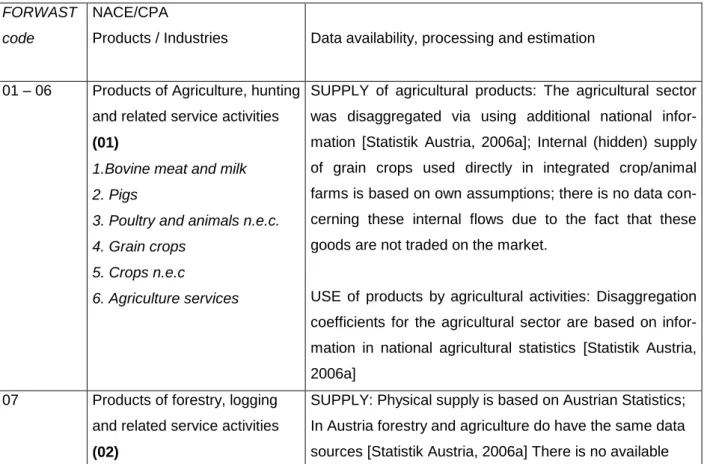
The following table gives an overview of the investigated product groups supplied and used – connected to the FORWAST-code. For each product group, the data availability and the
selected methodology for the data processing is reported. Several of the transactions of flows of product groups as provided by statistical agencies need to be disaggregated to fit with FORWAST classification. In the table below the data sources used for this purpose are described. The calculation steps and balancing exercise when disaggregating are described in deliverable D2.2: Data collection guideline and forms for WP3 and WP4. For several of the activities, it is specified how much of the feedstock that ends up in the supply of products by the activity, e.g. that 98% of the use of rapeseed by the vegetable oil industry becomes oil and oil meal. These feedstock efficiencies are a result of the data collection of physical flows combined with the calculation of waste flows (see deliverable 6.4: Documentation of the final model used for the scenario analyses).
The first column in the table below contains the FORWAST-codes, the second names the corresponding products and industries (NACE/CPA), the third column shows short descrip-tions regarding data availability and data processing. Generally monetary and physical sup-ply-use and import/export information is obtained directly from the detailed Danish supply-use table. When this is the case, nothing is mentioned in the table below.
Table 1: Investigated Categories and Data Processing
FORWAST code
NACE/CPA
Products / Industries
Data availability, processing and estimation 01 – 06 Products of Agriculture, hunting
and related service activities
(01)
1.Bovine meat and milk 2. Pigs
3. Poultry and animals n.e.c. 4. Grain crops
5. Crops n.e.c 6. Agriculture services
SUPPLY of agricultural products: The agricultural sector was disaggregated via using additional national infor-mation [Statistik Austria, 2006a]; Internal (hidden) supply of grain crops used directly in integrated crop/animal farms is based on own assumptions; there is no data con-cerning these internal flows due to the fact that these goods are not traded on the market.
USE of products by agricultural activities: Disaggregation coefficients for the agricultural sector are based on infor-mation in national agricultural statistics [Statistik Austria, 2006a]
07 Products of forestry, logging and related service activities
(02)
SUPPLY: Physical supply is based on Austrian Statistics; In Austria forestry and agriculture do have the same data sources [Statistik Austria, 2006a] There is no available
07. Forest products
08. Recycling of waste wood
statistical data concerning recycling of waste wood. The activity: „recycling of waste wood is left empty in the Aus-trian SUT.
09 Fish and other fishing prod-ucts; services incidental of fish-ing (05)
Physical supply is based on Statistics Austria [Statistik Austria, 2010]
11 Crude petroleum and natural gas; services incidental to oil and gas extraction excluding surveying (11)
Physical supply is based on USGS [Newman, 2006]
12 - 15 Metal ores (13)
11. Iron ores from mine 12. Bauxite from mine 13. Copper from mine 14. Metals from mine n.e.c.
SUPPLY: Confidential data in Austria; data was obtained by using other international sources [Newman, 2006] [Hetherington et al., 2007] There is no mining of copper and bauxite in Austria
USE: Confidential data 10,16 -18 Other mining and quarrying
products (10,14)
9. Coal and lignite; peat 15. Sand, gravel and stone
from quarry
16. Clay and soil from quarry 17. Minerals from mine n.e.c.
SUPPLY: Physical supply of mining and quarrying prod-ucts is based on Statistics Denmark (2009b). „Coal and lignite; peat‟ is included in the product group „Other mining and quarrying products‟ in the data from statistics Den-mark. Therefore, this product group is present here. USE of products by the mining activities: Due to lack of information in physical units in Austria, the same dis-aggregation coefficients like for the supply were used 19 Meat and fish products
(15.1-15.2)
SUPPLY: Disaggregation coefficients obtained from Aus-trian short term statistics [Statistik Austria, 2006b]
USE: Disaggregation coefficients for the use of agricultural products by the food industries are based on own as-sumptions
20 Dairy products (15.5) SUPPLY: Disaggregation coefficients obtained from Aus-trian short term statistics [Statistik Austria, 2006b]
USE: Disaggregation coefficients for the use of agricultural products by the food industries are based on own as-sumptions
Aus-cessed (15.3) trian short term statistics [Statistik Austria, 2006b]
USE: Disaggregation coefficients for the use of agricultural products by the food industries are based on own as-sumptions
22 Vegetable and animal oils and fats (15.4)
SUPPLY: Disaggregation coefficients obtained from Aus-trian short term statistics [Statistik Austria, 2006b]
USE: Disaggregation coefficients for the use of agricultural products by the food industries are based on own as-sumptions
23,25,26 Mfr. of starch, chocolate and sugar products (15.6-15.8) 23. Flour
25. Animal feeds
26. Food preparations n.e.c.
SUPPLY: Disaggregation coefficients obtained from Aus-trian short term statistics [Statistik Austria, 2006b]
USE: Disaggregation coefficients for the use of agricultural products by the food industries are based on own as-sumptions
24 Sugar (15.83) SUPPLY: Disaggregation coefficients obtained from Aus-trian short term statistics [Statistik Austria, 2006b]
USE: Disaggregation coefficients for the use of agricultural products by the food industries are based on own as-sumptions
27 Beverages (15.9) SUPPLY: Disaggregation coefficients obtained from Aus-trian short term statistics [Statistik Austria, 2006b]
USE: Disaggregation coefficients for the use of agricultural products by the food industries are based on own as-sumptions
28 Tobacco products (16) SUPPLY: Data obtained from Austrian short term statistics [Statistik Austria, 2006b]
USE: No physical data available
29 Textiles (17) SUPPLY: Data obtained from Austrian short term statistics [Statistik Austria, 2006b]
USE: No physical data available
Aus-trian short term statistics [Statistik Austria, 2006b]
USE: No data available; Disaggregation coefficients for the use of goods by the wearing apparel industry are based on own assumptions
31 Leather and leather products
(19)
SUPPLY: Data obtained from Austrian short term statistics [Statistik Austria, 2006b]
USE: No physical data available 32 Wood and products of wood
and cork (except furniture); articles of straw and plaiting materials (20)
SUPPLY: Disaggregation coefficients obtained from Aus-trian short term statistics [Statistik Austria, 2006b] USE: No physical data available
33 - 35 Pulp, paper and paper prod-ucts (21)
33. Pulp, virgin
34. Recycling of waste paper 35. Paper and paper products
SUPPLY: Disaggregation coefficients obtained from Aus-trian short term statistics [Statistik Austria, 2005a]; special attention at the internal flow within the integrated pulp pro-duction; internal flow was estimated based on own as-sumptions.
USE: No data available; Disaggregation coefficients for the use of goods by the pulp and paper industry are based on own assumptions
36 Printed matter and recorded media (22)
SUPPLY: Data obtained from Austrian short term statistics [Statistik Austria, 2006b]
USE: No physical data available 37-38 Coke, refined petroleum
prod-ucts and nuclear fuels (23) 37. Coke, refined petroleum products
38. Recycling of waste oil
Physical supply is based on USGS [Newman, 2006]
39-40 Manufacture of fertilizers etc.
(24.15)
39. Fertiliser, N
40. Fertiliser, other than N
SUPPLY: Disaggregation coefficients obtained from Aus-trian short term statistics [Statistik Austria, 2006b]
USE: No data available; Disaggregation coefficients for the use of goods by the fertilizer industry are based on own assumptions
Aus-rubber (24.16)
41. Plastics basic, virgin 42. Recycling of plastics basic
trian short term statistics [Statistik Austria, 2006b]
USE: No data available; Disaggregation coefficients for the use of goods by the rubber industry are based on own assumptions
43 Chemicals, chemical products and man-made fibres nec (24) 43. Chemicals, n.e.c.
SUPPLY: Disaggregation coefficients obtained from Aus-trian short term statistics [Statistik Austria, 2006b]
USE: No data available; Disaggregation coefficients for the use of goods by the chemicals industry are based on own assumptions
44 Rubber and plastic products
(25)
SUPPLY: Disaggregation coefficients obtained from Aus-trian short term statistics [Statistik Austria, 2006b]
USE: No data available; Disaggregation coefficients for the use of goods by the rubber and plastic industry are based on own assumptions
45-46 Mfr. of glass and ceramic goods etc. (26.1)
45.Glass, mineral wool and ceramic goods, virgin 46.Recycling of glass, mineral wool and ceramic goods
SUPPLY: Disaggregation coefficients obtained from Aus-trian short term statistics [Statistik Austria, 2006b]
USE: No data available; Disaggregation coefficients for the use of goods by the glass and ceramic goods industry are based on own assumptions
47,48,51-52 Mfr. of cement, bricks, tiles, flags etc. (26.3, 26.4, 26.5) 47. Cement, virgin
48. Recycling of slags and ashes
51. Bricks
52. Recycling of bricks
SUPPLY: Disaggregation coefficients obtained from Aus-trian short term statistics [Statistik Austria, 2006b]
USE: No data available; Disaggregation coefficients for the use of goods by the cement industry are based on own assumptions
49-50 Other non-metallic mineral products
49. Concrete, asphalt and other mineral products, virgin 50. Recycling of concrete,
as-phalt and other mineral products
SUPPLY: Disaggregation coefficients obtained from Aus-trian short term statistics [Statistik Austria, 2006b]
USE: No data available; Disaggregation coefficients for the use of goods by the non-metallic mineral industry are based on own assumptions
53-54 Mfr. of basic ferrous metals
(27.1)
53. Iron basic, virgin 54.Recycling of iron basic
SUPPLY: Disaggregation coefficients obtained from Aus-trian short term statistics [Statistik Austria, 2006b]
USE: No data available; Disaggregation coefficients for the use of goods by the basic ferrous metals industry are based on own assumptions
61 First processing of iron and steel (27.2,27.3)
61. Iron, after first processing
SUPPLY: Disaggregation coefficients obtained from Aus-trian short term statistics [Statistik Austria, 2006b]
USE: No data available; Disaggregation coefficients for the use of goods by the first processing of iron and steel industry are based on own assumptions
55-60 Mfr. of basic non-ferrous met-als (27.4)
55. Aluminium basic, virgin 56. Recycling of aluminium
basic
57. Copper basic, virgin 58. Recycling of copper, basic 59. Metals basic, n.e.c., virgin 60.Recycling of metals basic, n.e.c.
SUPPLY: Disaggregation coefficients obtained from Aus-trian short term statistics [Statistik Austria, 2006b]
USE: No data available; Disaggregation coefficients for the use of goods by the manufacture of basic non-ferrous metals are based on own assumptions
62-64 Casting of metal products
(27.5)
62. Aluminium, after first pro-cessing
63. Copper, after first pro-cessing
64. Metals n.e.c., after first pro-cessing
SUPPLY: Disaggregation coefficients obtained from Aus-trian short term statistics [Statistik Austria, 2006b]
USE: No physical data available; Disaggregation coeffi-cients for the use of goods by the manufacture of basic non-ferrous metals are based on own assumptions
65 Fabricated metal products, ex-cept machinery and equipment
(28)
SUPPLY: Data obtained from Austrian short term statistics [Statistik Austria, 2006b]
USE: No physical data available 66 Machinery and equipment
n.e.c. (29)
SUPPLY: Data obtained from Austrian short term statistics [Statistik Austria, 2006b]
67 Office machinery and comput-ers (30)
SUPPLY: Disaggregation coefficients obtained from Aus-trian short term statistics [Statistik Austria, 2006b]
USE: No data available; Disaggregation coefficients for the use of goods by the office machinery and computers are based on own assumptions
68 Electrical machinery and appa-ratus n.e.c. (31)
SUPPLY: Data obtained from Austrian short term statistics [Statistik Austria, 2006b]
USE: No physical data available 69 Radio, television and
commu-nication equipment and appa-ratus (32)
SUPPLY: Data obtained from Austrian short term statistics [Statistik Austria, 2006b]
USE: No data available; Disaggregation coefficients for the use of goods by the radio, television and communica-tion equipment and apparatus are based on own assump-tions
70 Medical, precision and optical instruments, watches and clocks (33)
SUPPLY: Data obtained from Austrian short term statistics [Statistik Austria, 2006b]
USE: No physical data available 71 Motor vehicles, trailers and
semi-trailers (34)
SUPPLY: Data obtained from Austrian short term statistics [Statistik Austria, 2006b]
USE: No physical data available
72 Other transport equipment (35) SUPPLY: Data obtained from Austrian short term statistics [Statistik Austria, 2006b]
USE: No data available 73 Furniture; other manufactured
goods n.e.c. (36)
SUPPLY: Data obtained from Austrian short term statistics [Statistik Austria, 2006b]
USE: No physical data available
74 Secondary raw materials (37) No physical flows included: Defined as service product 75 Electrical energy, gas, steam
and hot water (40.1,40.3)
SUPPLY: Data obtained from national statistics [Statistik Austria, 2009]
Austria, 2009]
76 Gas (40.2) Data obtained from national statistics [Statistik Austria, 2009]
77 Water, fresh (41) No physical flows included: Defined as service product 78-80 Construction (45)
75. Buildings, residential 76. Buildings, non-residential 77. Infrastructure, excluding
buildings
No physical flows included: Defined as service product
81 Trade and repair of motor ve-hicles; service stations (50)
82 Wholesale trade (51)
83 Retail trade and repair ser-vices (52)
84 Hotels and restaurants (55)
85 Land transport; transport via pipelines (60)
86 Transport by ship (61)
87 Air transport (62)
88 Cargo handling, harbours; travel agencies (63)
89 Post and telecommunication
(64)
90 Financial intermediation (65)
91 Insurance and pension funding
(66)
92 Services auxiliary to financial intermediation (67)
93 Real estate services (70)
94 Renting of machinery and equipment etc. (71)
(72)
96 Research and development
(73)
97 Business services n.e.c. (74)
98 Public service and security (75) 99 Education services (80)
100 Health and social work (85)
101-108 „Sewage removal and disposal„ and „Refuse collection and san-itation„ (90(disaggr.))
98. Incineration of waste 99. Manure treatment 100. Biogasification of waste 101. Composting of food waste 102. Waste water treatment 103. Landfill of waste
104. Land application of waste
All information is kept in one column and one row – the products/industries are disaggregated based on the waste module described in deliverable D5.4: Description of the environmental pressures from waste treatment
109 Membership organisations (91) 110 Recreational and cultural
ser-vices (92)
111 Services n.e.c. (93)
112 Household, to nourish (n.a.) Information on household products/activities are kept in the final demand column in the use table. The specified household products/activities are defined in deliverable: D6.1 Documentation of the data consolidation,calibration, and scenario parameterisation
113 Household, to clean (n.a.) 114 Household, to transport and
communicate (n.a.) 115 Household, to reside (n.a.) 116 Household, home composting
(n.a.)
117 Household, unauthorised in-cineration (n.a.)
3.2
References (Austria)
Anderl, M.; Edelmann, A.; Freudenschuß, A.; Halper, D.; Kurzweil, A.; Poupa, S.; Wappel, D.; Weiss, P.; Wieser, M. (2008) Austria's Annual National Greenhouse Gas Inventory 1990 - 2006 Submission under Decision 280/2004/EC. Umweltbundesamt GmbH. Wien.
Anderl, M.; Freudenschuß, A.; Halper, D.; Kurzweil, A.; Poupa, S.; Wappel, D.; Wieser, M. Austria´s National Inventory Report 2005. Umweltbundesamt GmbH. Wien.
Baud, S. (2006) Integrated NAMEA Austria 1999-2003. Statistik Austria. Wien.
BMLFUW (2004) Grüner Bericht 2004. Bundesministerium für Land- und Forstwirtschaft, Umwelt und Wasserwirtschaft (BMLFUW). Wien.
BMWA (2004) Österreichisches Montan-Handbuch 2004. Bergbau - Rohstoffe - Grundstoffe - Energie. 78. Jahrgang. Hrsg. v. Bundesministerium für Wirtschaft und Arbeit. Wien.
Daxbeck, H.; Buschmann, H.; Brandt, B.; Neumayer, S.; Weidema, B.; Schmidt, J. H.; Brunner, P. H.; Massmann, C. (2008) Data collection guidelines and forms for WP3 and WP4 (Deliverable D2-4). Ressourcen Management Agentur (RMA). 2.-0 LCA consultants. Vienna University of Technology. Overall mapping of physical flows and stocks of resources to forecast waste quantities in Europe and identify life-cycle environmental stakes of waste prevention and recycling. Project FORWAST. Aalborg, Vienna.
European Pollutant Emissions Register (2008) EPER Website. http://www.eper.ec.europa.eu/eper/.
EUROSTAT (2003) ESVG 95 Aufkommens-, Verbrauchs- und Input-Output Tabellen. EUROSTAT.
EUROSTAT (2008b) PRODCOM.
http://epp.eurostat.ec.europa.eu/portal/page?_pageid=2474,54156821,2474_54764840&_da d=portal&_schema=PORTAL#IOT.
Federal Ministery of Agriculture and Forestry, E. a. W. M. (2006) Federal Waste Management Plan 2006. Federal Ministery of Agriculture and Forestry, Environment and Water Management. Vienna.
Hetherington, L. E.; Brown, T. J.; Idoine, N. E.; Lusty, P. A. J.; Bide, T.; Hobbs, S. F.; Naden, J. (2007) European Mineral Statistics 2001-05. A product of the World Mineral Statistics database. British Geological Survey. Hrsg. v. British Geological Survey (BGS). Nottingham.
Newman, H. R. (2006) Minerals Yearbook Austria. United States Geological Survey.
Statistik Austria (2004) Konjunkturstatistik im Produzierenden Bereich 2003. Band 2 - Produktionsergebnisse nach CPA 2002 und ÖPRODCOM. Hrsg. v. Verlag Österreich GmbH. Wien.
Statistik Austria (2005a) Konjunkturstatistik im Produzierenden Bereich 2004. Band 2 - Produktionsergebnisse nach CPA 2002 und ÖPRODCOM. Hrsg. v. Verlag Österreich GmbH. Wien.
Statistik Austria (2005b) Land- und forstwirtschaftliche Erzeugerpreise 2005. Statistik Austria. Wien.
Statistik Austria (2006a) Landwirtschaftliche Gesamtrechnung. Statistik Austria. Wien.
Statistik Austria (2006b) Leistungs- und Strukturstatistik - Produktion & Dienstleistungen. Statistik Austria. Wien.
Statistik Austria (2009) Energiebilanzen Österreich 1970 - 2007.
WKO (2008) Internet-Portal der Wirtschaftskammer Österreichs. http://portal.wko.at/wk/startseite.wk?AngID=1 (24.10.2008)
4
Denmark: Data Processing
In Denmark detailed official supply-use tables based on macroeconomic accounting are available. The data availability of supply-use tables, emissions tables and resource infor-mation is good and the supply-use tables covers supply and use of approximately 2000 products by 134 sectors and most transactions are given in both monetary and physical unit.
4.1.1
Sources of data used for developing Supply and Use Matrices
The following national statistics purchased from Statistics Denmark are used for data pro-cessing (reference year 2003) within FORWAST:
- Detailed supply-use table covering approximately 2000 products by 134 sectors, 2003. All exports and imports are given in both monetary and physical values, and most of the domestic supply and use are also given in both monetary and physical units. The data are purchased from Statistics Denmark.
- The Danish Air Emissions Accounts specifying air emissions of CO2, SO2, NOx, CO, N2O, NH3, CH4, and NMVOC from 134 activities + four household activities in year 2003 (Statistics Denmark 2009a)
- Resource extraction of agricultural crops, forestry products, fish, aggregates, miner-als, and fossil fuels are based on the Danish resource statistics (Statistics Denmark 2009b)
4.1.2
Methodology and Data Quality
Extraction of monetary and physical supply-use tables from the raw data from Statis-tics Denmark
In general data quality in Denmark has a very high level. The Danish 2000 products by 134 sectors supply-use table is first processed into a square 134x134 table by using categorisa-tion provided by Statistics Denmark for the 2000 products. The monetary supply-use table can directly be extracted in this way. Before the physical (by mass) supply-use table can be created, it has to ensured that all physical products has a physical weight. The procedure for this is to calculate the average price (monetary transactions divided by physical transactions) for the products where physical information is available, and then use this price on the prod-ucts where no physical information is available. This procedure is implemented as an excel macro.
The 134 product categories in the Danish SUT does not fit with the FORWAST categories; some needs to be disaggregated (these are described in the data processing table present-ed later in this chapter), and some nepresent-eds to be aggregatpresent-ed. The aggregatpresent-ed product catego-ries are shown in the table below:
Product categories in Danish SUT to be aggregated Aggregated product category (FORWAST categories)
Crops n.e.c. (agr) Crops n.e.c.
Horticulture, orchards etc.
Agricultural services; landscape gardeners etc. Agricultural services n.e.c. Public landscape gardeners
Production etc. of meat and meat products Meat and fish products
Processing etc. of fish and fish products
Food preparations n.e.c. Food preparations n.e.c.
Mfr. of bread, cakes and biscuits Bakers' shops
Publishing of newspapers Printed matter and recorded media
Publishing activities, excluding newspapers
Mfr. of industrial gases and inorganic basic chemicals Chemicals n.e.c. Mfr. of dyes, pigments and organic basic chemicals
Manufacture of pesticides and other agro-chemical products
Mfr. of paints, printing ink and mastics Mfr. of pharmaceuticals etc.
Mfr. of detergents and other chemical products
Mfr. of rubber products and plastic packing goods etc. Rubber and plastic products Mfr. of builders' ware of plastic
Manufacture of other plastic products n.e.c.
Mfr. of construct. materials of metal etc. Fabricated metal products, except machinery
Mfr. of hand tools, metal packaging etc.
Machinery production for own use Machinery and equipment n.e.c.
Mfr. af marine engines, compressors etc. Mfr. of other general purpose machinery Mfr. of agricultural and forestry machinery Mfr. of machinery for industries etc. Mfr. of domestic appliances n.e.c.
Mfr. of transport equipment excl. ships, motor vehi-cles etc.
Mfr. of furniture Furniture; other manufactured goods n.e.c.
Mfr. of toys, gold and silver articles etc.
Sale of motor vehicles, motorcycles etc. Trade and repair of motor vehicles; service stations
Repair and maintenance of motor vehicles Service stations
Retail trade of food etc. Retail trade and repair services
Department stores
Re. sale of phar. goods, cosmetic art. etc. Re. sale of clothing, footwear etc. Other retail sale, repair work
Hotels etc. Hotels and restaurants
Restaurants etc.
Transport via railways Land transport; transport via pipelines
Other scheduled passenger land transport Taxi operation and coach services
Freight transport by road and via pipelines
Cargo handling, harbours etc.; travel agencies Cargo handling, harbours; travel agencies Activities of other transport agencies
Monetary intermediation Financial intermediation
Other financial intermediation
Life insurance and pension funding Insurance and pension funding
Non-life insurance
Real estate agents etc. Real estate services
Dwellings
Letting of non-residential buildings
Computer activities exc. software consultancy and supply
Computer and related services
Software consultancy and supply
Research and development (market) Research and development
Research and development (other non-market)
Legal activities Business services n.e.c.
Accounting, book-keeping, auditing etc. Consulting engineers, architects etc. Advertising
Industrial cleaning Other business activities
General (overall) public service activities Public service and security
Regulation of public service activities exc. for business Regulation of and contribution to more efficient busi-ness operation
Market-based surveillance, fire brigade, and emergen-cy services
Defence, police and lawcourts
Primary education Education services
Secondary education Higher education
Adult and other education (market)
Adult and other education (other non-market)
Hospital activities Health and social work
Medical, dental, veterinary activities etc. Social institutions for children
Social institutions for adults
Sewage removal and disposal Incineration of waste
Refuse collection and sanitation
Recreational, cultural, sporting activities (market) Recreational and cultural services Recreational, cultural, sporting activities (other
non-market)
Service activities n.e.c Services n.e.c.
Private households with employed persons
Tourist and foreign expenditures
The Danish supply-use table includes the 'product';'Tourist and foreign expenditures'. The row representing this product accounts for two things;
1) Tourists: Danish citizen's purcheses abroad, and foreign turist's purchases in Den-mark
2) Allowance for travelling expenses: Danish industries pay travelling expenses to their workers. This can be percieved as salery.
Because no information is available on which products tourists buy abroad, and on who (DK or foreign citizens) uses the products supplied in Denmark, the following assumption is intro-duced: The distribution of Danish citizen's purcheses abroad equals foreign turist's
purchas-es in Denmark. Thus, we can move the allowance for travelling expenspurchas-es (i.e. the entripurchas-es in domestic uses in the use table) to the 'Compensation of employees' row. Because of the as-sumption introduced above, we can eliminate the row and column representing 'Tourist and foreign expenditures'.
Primary factors
The monetary supply-use table extracted from the detailed Danish 2000 products by 134 sectors only include primary factors as one aggregated figure per activity, and not infor-mation on primary factors distributed on:
1) Gross compensation of employees 2) Other production taxes
3) Taxes on products
4) The gross operating surplus (i.e. net operating surplus + use of fixed capital) is calcu-lated as
1) and 2) are obtained directly from the Danish IO-table (Statistics Denmark 2009c). 3) is extracted from the detailed Danish supply-use table using an excel macro, and 4) is calcu-lated as the residual.
Human metabolism: respiratory emissions and mass balances
The human metabolism is included in the model in order to ensure that materials contained in food is coming out of the model as the correct flows: emissions, urine and faeces in waste water and food waste. The balance is based on Ortiz et al. (2007). Below, the balance is shown for one average person for one year. To have the total metabolism for the Danish population in 2003, the figures in the table are multiplied with 5,384,000 persons (Statistics Denmark 2009b).
Human metabolism (per person year) Carbon (kg) DM (kg)
Inputs Food 84.4 202.2 Body growth 0.2 0.6 Total 84.6 202.7 Outputs CH4 0.1 0.1
Urine (CH4ON2) 5.5 27.4
Faeces (C2H4O) 7.5 13.7
Respiration: C in CO2 71.2 71.2
Respiration: H2O 0.0 89.9
Total 84.2 202.2
Balance (input - output) 0.5 0.5
Animal metabolism: respiratory emissions and mass balances
Correspondingly to the human metabolism, it is ensured that materials contained in animal feed is coming out of the model as the correct flows: animal products at farm gate, emis-sions, and manure. Also, the balance is used to estimate the correct uses of feed inputs when knowing the output of animal products from statistics. In the tables below, the animal balances are shown normalised by the dry weight of animal products at farm gate (live weight + milk). The balance is based on physical information in the detailed Danish supply-use tables and figures in the National Environmental Research Institute‟s (NERI) reporting to the UNFCCC (Illerup et al. 2005). The relation between the dry matter balance and the car-bon balance is based on the carcar-bon contents in dry matter material in the table below.
Material Feed/plant material (% C) Bovines (% C) Pigs (% C) Other animals (% C) Grass+silage 46.0% Cereals/conc. 46.0% Milk 57.0%
Animal (live weight) 43.8% 41.8% 43.8%
Manure 44.5% 44.5% 46.5%
Bovine metabolism (per kg dry product output: milk and meat live weight)
Carbon (kg) DM (kg) Inputs Grass+silage 3.53 7.68 Cereals/conc. 1.17 2.54 Total 4.70 10.22 Outputs Milk 0.54 0.94
CH4 0.15 0.20
Manure 0.96 2.16
Respiration: C in CO2 3.03 3.03
Respiration: H2O 0.00 3.83
Total 4.70 10.22
Balance (input - output) 0.00 0.00
Pig metabolism (per kg dry product out-put: meat live weight)
Carbon (kg) DM (kg)
Inputs
Cereals/conc. 1.54 3.35
Total 1.54 3.35
Outputs
Meat live weight 0.42 1.00
CH4 0.01 0.01
Manure 0.56 1.24
Respiration: C in CO2 0.56 0.56
Respiration: H2O 0.00 0.54
Total 1.54 3.35
Balance (input - output) 0.00 0.00
Other animals metabolism (per kg dry product output: live weight)
Carbon (kg) DM (kg) Inputs Cereals/conc. 3.85 8.36 Total 3.85 8.36 Outputs Live weight 0.44 1.00 CH4 0.03 0.03 Manure 1.28 2.76 Respiration: C in CO2 2.10 2.10 Respiration: H2O 0.00 2.47 Total 3.85 8.36
Balance (input - output) 0.00 0.00
Emissions (not originating from animal and human respiration) are obtained from the Danish Air Emissions Accounts specifying air emissions of CO2, SO2, NOx, CO, N2O, NH3, CH4, and NMVOC from 134 activities + four household activities in year 2003 (Statistics Denmark 2009a). The data from Statistics Denmark (2009a) follows FORWAST classification rela-tively good. In cases where FORWAST classification is more disaggregated, the emissions have been distributed using information on the physical use of different fuels in the physical use table (see description of data processing in the data processing table below).
Ressources
Resource extraction of agricultural crops, forestry products, fish, aggregates, minerals, and fossil fuels are based on the Danish resource statistics (Statistics Denmark 2009b). These resource uses have been cross checked with the physical supply of the resource extraction industries. In cases where the two data sources showed different figures, one of them has been chosed as the most reliable data source. The resource material composition is pre-sented in deliverable D6-1 Documentation of data consolidation, calibration and scenario pa-rameterisation.
4.1.3
Data processing
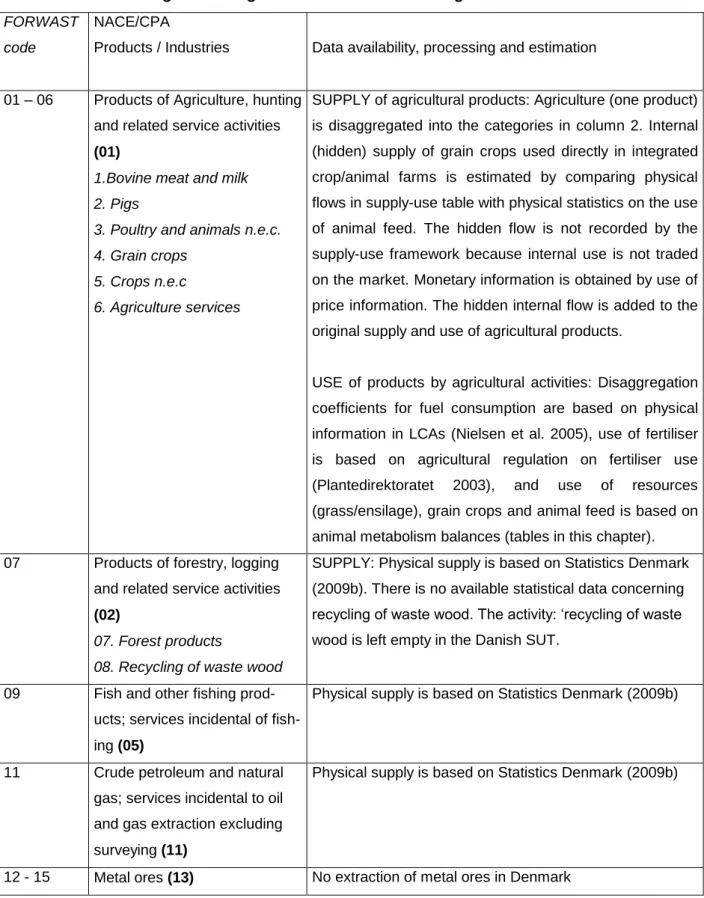
The following table gives an overview of the investigated product groups supplied and used – connected to the FORWAST-code. For each product group, the data availability and the selected methodology for the data processing is reported. Several of the transactions of flows of product groups as provided by statistical agencies need to be disaggregated to fit with FORWAST classification. In the table below the data sources used for this purpose are described. The calculation steps and balancing exercise when disaggregating are described in deliverable D2.2: Data collection guideline and forms for WP3 and WP4. For several of the activities, it is specified how much of the feedstock that ends up in the supply of products by the activity, e.g. that 98% of the use of rapeseed by the vegetable oil industry becomes oil and oil meal. These feedstock efficiencies are a result of the data collection of physical flows combined with the calculation of waste flows (see deliverable 6.4: Documentation of the final model used for the scenario analyses).
The first column in the table below contains the FORWAST-codes, the second names the corresponding products and industries (NACE/CPA), the third column shows short descrip-tions regarding data availability and data processing. Generally monetary and physical
sup-ply-use and import/export information is obtained directly from the detailed Danish supply-use table. When this is the case, nothing is mentioned in the table below.
Table 2: Investigated Categories and Data Processing
FORWAST code
NACE/CPA
Products / Industries
Data availability, processing and estimation 01 – 06 Products of Agriculture, hunting
and related service activities
(01)
1.Bovine meat and milk 2. Pigs
3. Poultry and animals n.e.c. 4. Grain crops
5. Crops n.e.c 6. Agriculture services
SUPPLY of agricultural products: Agriculture (one product) is disaggregated into the categories in column 2. Internal (hidden) supply of grain crops used directly in integrated crop/animal farms is estimated by comparing physical flows in supply-use table with physical statistics on the use of animal feed. The hidden flow is not recorded by the supply-use framework because internal use is not traded on the market. Monetary information is obtained by use of price information. The hidden internal flow is added to the original supply and use of agricultural products.
USE of products by agricultural activities: Disaggregation coefficients for fuel consumption are based on physical information in LCAs (Nielsen et al. 2005), use of fertiliser is based on agricultural regulation on fertiliser use (Plantedirektoratet 2003), and use of resources (grass/ensilage), grain crops and animal feed is based on animal metabolism balances (tables in this chapter). 07 Products of forestry, logging
and related service activities
(02)
07. Forest products
08. Recycling of waste wood
SUPPLY: Physical supply is based on Statistics Denmark (2009b). There is no available statistical data concerning recycling of waste wood. The activity: „recycling of waste wood is left empty in the Danish SUT.
09 Fish and other fishing prod-ucts; services incidental of fish-ing (05)
Physical supply is based on Statistics Denmark (2009b)
11 Crude petroleum and natural gas; services incidental to oil and gas extraction excluding surveying (11)
Physical supply is based on Statistics Denmark (2009b)
11. Iron ores from mine 12. Bauxite from mine 13. Copper from mine 14. Metals from mine n.e.c.
10,16 -18 Other mining and quarrying products (10,14)
9. Coal and lignite; peat 15. Sand, gravel and stone
from quarry
16. Clay and soil from quarry 17. Minerals from mine n.e.c.
SUPPLY: Physical supply of mining and quarrying prod-ucts is based on Statistics Denmark (2009b). „Coal and lignite; peat‟ is included in the product group „Other mining and quarrying products‟ in the data from statistics Den-mark. Therefore, this product group is present here. USE of products by the mining activities: Disaggregation coefficients for fuel consumption are based on physical information in the ecoinvent database v2: sand, clay, salt, and peat (ecoinvent 2007).
19 Meat and fish products (15.1-15.2)
USE: Disaggregation coefficients for the use of agricultural products by the food industries are based on common sense: Meat and fish products uses bovines, pigs and other animals. Physical flow: Approximately 85% of the meat used by the „Meat and fish products‟ industry is pre-sent in the products supplied.
20 Dairy products (15.5) USE: Disaggregation coefficients for the use of agricultural products by the food industries are based on common sense: Dairy products uses milk. Physical flow: Approxi-mately 95% of the raw milk used by the „Dairy products‟ industry is present in the products supplied.
21 Fruits and vegetables, pro-cessed (15.3)
USE: Disaggregation coefficients for the use of agricultural products by the food industries are based on common sense: fruits and vegetables uses crops nec. Physical flow: Approximately 78% of the crops used by the „Fruits and vegetables, processed‟ industry is present in the products supplied.
22 Vegetable and animal oils and fats (15.4)
USE: Disaggregation coefficients for the use of agricultural products by the food industries are based on common sense: vegetable oils uses crops nec. Physical flow: Ap-proximately 98% of the crops used by the „Vegetable and animal oils and fats‟ industry is present in the products supplied.
sugar products (15.6-15.8) 23. Flour
25. Animal feeds
26. Food preparations n.e.c.
of the products is based on the detailed Danish supply-use table.
USE: Disaggregation coefficients for the use of agricultural products by the food industries are based on common sense: flour uses grain crops, sugar uses crops nec, and animal feeds uses grain crops and crops nec. Physical flow: Approximately 80% of the crops used by the „Flour‟ industry is present in the products supplied, approximately 98% of the crops used by the „Animal feeds‟ industry is present in the products supplied, and approximately 42% of the feedstocks used by the „Food preparations n.e.c.‟ industry is present in the products supplied.
24 Sugar (15.83) USE: Disaggregation coefficients for the use of agricultural products by the food industries are based on common sense: sugar uses crops nec. Physical flow: Approximate-ly 67% of the crops used by the „Sugar‟ industry is present in the products supplied.
27 Beverages (15.9) USE: Disaggregation coefficients for the use of agricultural products by the food industries are based on common sense: beverages uses grain crops and crops nec. Physi-cal flow: Approximately 72% of the crops used by the „Beverages‟ industry is present in the products supplied. 28 Tobacco products (16)
29 Textiles (17) USE: Disaggregation coefficients for the use of agricultural products are based on common sense: textiles uses grain crops nec.
30 Wearing apparel; furs (18) USE: Disaggregation coefficients for the use of agricultural products are based on common sense: wearing apperal; furs uses animals nec. (hides of fur animals)
31 Leather and leather products
(19)
USE: Disaggregation coefficients for the use of agricultural products are based on common sense: leather products uses bovine meat and milk (hides of bovines)
32 Wood and products of wood and cork (except furniture);
articles of straw and plaiting materials (20)
33 - 35 Pulp, paper and paper prod-ucts (21)
33. Pulp, virgin
34. Recycling of waste paper 35. Paper and paper products
SUPPLY: Disaggregation coefficients for the total supply of „pulp‟ and „paper and paper products‟ are based on the detailed Danish supply-use table. However, this does not register internal flow of pulp to paper production in inte-grated pulp and paper industries. Therefore, the internal flow has been estimated based on figures on the use of kg pulp per kg produced paper (Schmidt et al. 2007) and prices on pulp obtained from detailed Danish SUT. The monetary supply of recycling services is not included in the FORWAST SUT. The physical supply of recycling ser-vices (kg waste recycled) is calculated based on the off-diagonal supply of recovered products by the recycling activity and the ratio between output of recovered material and recycled waste. For recycling of waste paper the off-diagonal supply of pulp corresponds to the total domestic supply of pulp in Denmark, because there is no production of virgin pulp in Denmark.
USE: Use of fuels by the pulp and paper industries is based on Schmidt et al. (2007). The use of „Mfr. of paints, printing ink and mastics‟by the pulp and paper industries is 100% allocated to the paper manufacturing. The use of pulp by the pulp and paper industry is 100% allocated to paper manufacturing, and the use of paper is distributed between the recycling and the paper industry based on monetary total supply of the two activities.
36 Printed matter and recorded media (22)
37-38 Coke, refined petroleum prod-ucts and nuclear fuels (23) 37. Coke, refined petroleum products
38. Recycling of waste oil
39-40 Manufacture of fertilizers etc.
(24.15)
39. Fertiliser, N
SUPPLY: According to supply-use, N-fertiliser contains 27% N and P fertiliser contains 100% P2O5
40. Fertiliser, other than N USE: The use of fuels and electricity by the fertiliser indus-tries is based on ecoinvent (2007) processes: „Ammonium nitrate, as N, at regional storehouse‟ (N-fertiliser) and „Tri-ple superphosphate, as P2O5, at regional storehouse‟ (P-fertiliser).
41-42 Mfr. of plastics and syntethic rubber (24.16)
41. Plastics basic, virgin 42. Recycling of plastics basic
SUPPLY: The monetary supply of recycling services is not included in the FORWAST SUT. The physical supply of recycling services (kg waste recycled) is calculated based on the off-diagonal supply of recovered products by the recycling activity and the ratio between output of recov-ered material and recycled waste. For recycling of plastics waste the off-diagonal supply of „Plastics basic, virgin‟ cor-responds to the total domestic supply of plastic in Den-mark, because there is estimated that there is no or only insignificant production of virgin plastic in Denmark. 43 Chemicals, chemical products
and man-made fibres nec (24) 43. Chemicals, n.e.c.
44 Rubber and plastic products
(25)
45-46 Mfr. of glass and ceramic goods etc. (26.1)
45.Glass, mineral wool and ceramic goods, virgin 46.Recycling of glass, mineral wool and ceramic goods
SUPPLY: The monetary supply of recycling services is not included in the FORWAST SUT. The physical supply of recycling services (kg waste recycled) is calculated based on the off-diagonal supply of recovered products by the recycling activity and the ratio between output of recov-ered material and recycled waste. For recycling of glass waste the off-diagonal supply of „Glass, mineral wool and ceramic goods, virgin‟ corresponds to 38% of the mone-tary domestic supply of glass in Denmark. 62% of the monetary domestic supply of glass in Denmark is supplied by the activity: virgin production, and the remaining is sup-plied by recycling of glass waste. This proportion is based on the amount of recycled glass waste in Denmark (Miljøstyrelsen 2005, p 23,30,31) and the ratio between supplied recovered glass and recycled glass waste (Schmidt 2005, p 99).