i
THE MANAGEMENT OF PARENT INVOLVEMENT AT SELECTED SECONDARY SCHOOLS IN THE ZEERUST DISTRICT, NORTH WEST PROVINCE
by
MADIRAYI CHARAMBA
Submitted in accordance with the requirements for the degree of
MASTER IN EDUCATION
in the subject
EDUCATION MANAGEMENT
at the
UNIVERSITY OF SOUTH AFRICA
SUPERVISOR: PROF A.E VAN ZYL
DECEMBER 2016
ii
DECLARATION
I declare that The management of parent involvement at selected secondary schools in the Zeerust District, North West Province is my own work and that all the sources that I have used or quoted have been indicated and acknowledged by means of complete references.
____________________________
M. CHARAMBA DECEMBER 2016
iii
ACKNOWLEDGEMENTS
I wish to express my gratitude to the under-mentioned for their assistance in this project:
To God for giving me the gift of good health, life, the knowledge, wisdom and strength to
complete this dissertation.
My wife Joice Charamba, for her prayers, motivation, assistance and support.
My mother Grace Charamba, my children, Rutendo, Roy Takudzwa and Worship Tatenda
for their support and understanding during my studies.
My supervisor, Prof, A.E Van Zyl, for his invaluable assistance and guidance.
Principals, SGB chairpersons, parents serving in the SGB and parents for granting me
permission to interview them. The Department of Education (DoE) for granting me permission to conduct the research at schools in the Zeerust district, North West Province.
My family and friends for their encouragement and continued support throughout my period
iv ABSTRACT
This research focuses on the issue of parent involvement at selected secondary schools in the Zeerust District of the North West Province in order to gain an understanding of relevant participants’ views on the following aspects that relate to the management of parent involvement: the concept of parent involvement, ways in which parent involvement should be realised, its benefits and challenges, as well as strategies to improve the management of parent involvement in the education of learner children. The theoretical frameworks that informed this study were Epstein’s theories of overlapping spheres and her typology of parent involvement, as well as Bronfenbrenner’s ecological model. These frameworks provided a meaningful lens for interpreting data and making recommendations in the final chapter. The researcher undertook an extensive literature study and conducted interviews with principals, SGB chairpersons, as well as selected SGB parent members and other active and inactive parents from the selected schools in the Zeerust district. The research shows, inter alia, that parent involvement has various benefits and that it faces several challenges which affect the management thereof. Benefits concern improvement in terms of academic performance of learners, provision of teaching and learning resources, relationships between parents and the school, learner motivation and school attendance. Challenges to parent involvement that were identified were time constraints of parents, poor communication between home and school, parents’ lack of interest and commitment, principals’ limitations in terms of the management of parent involvement, parents’ limited education, negative parental attitudes and negative teacher attitudes. Key recommendations were made in terms of Bronfenbrenner’s micro, exo- and macrosystem for addressing the management of parent involvement in a synergetic manner. They concerned, inter alia, the national Department of Basic Education in the macrosystem, provincial Departments of Basic Education in the exosystem and schools and parents in the microsystem.
KEY WORDS
Parent involvement, Epstein’s overlapping spheres, Epstein’s typology of parents, Bronfenbrenner’s ecological model, importance of parent involvement, challenges to parent involvement, strategies for parent involvement, benefits of parent involvement, South African Schools Act, School Governing Bodies, education management
v DECLARATION ... ii ACKNOWLEDGEMENTS ... iii ABSTRACT ... iv CHAPTER 1 ... 1 INTRODUCTION TO RESEARCH ... 1
1.1 INTRODUCTION: BACKGROUND TO THE PROBLEM ... 1
1.2 MOTIVATION FOR THE RESEARCH ... 4
1.3 DESCRIPTION OF THE PROBLEM AND PROBLEM FORMULATION ... 5
1.4 THE AIM AND OBJECTIVES OF THE STUDY ... 6
1.6 SCOPE AND LIMITATIONS OF THE STUDY ... 7
1.7 METHODOLOGICAL ISSUES ... 7
1.7.1 Population and sampling ... 8
1.7.2 Qualitative research approach ... 9
1.7.3 Data collection methods ... 10
1.7.3.1 Literature study ... 10
1.7.3.2 Interviews ... 10
1.7.4 Data analysis ... 11
1.7.5 Trustworthiness ... 11
1.7.6 Data collection procedures ... 12
1.8 ASPECTS PERTAINING TO ETHICS ... 13
1.9 THEORETICAL FRAMEWORKS ... 14
1.10 DEMARCATION OF THE STUDY ... 15
1.11 DEFINITION OF KEY CONCEPTS ... 16
1.12 CONCLUSION ... 18
CHAPTER 2 ... 19
REVIEW OF LITERATURE ... 19
2.1 INTRODUCTION ... 19
2.2 PARENT INVOLVEMENT IN SOUTH AFRICA ... 19
2.2.1 The situation prior to 1994 ... 20
2.2.2 The situation after 1994 ... 20
vi
2.3 THE IMPORTANCE OF PARENT INVOLVEMENT ... 25
2.3.1 Key contributions of parent involvement ... 25
2.3.1.1 Improved learner academic achievement ... 25
2.3.1.2 Promotion of acceptable thought patterns and behavior ... 25
2.3.1.3 Uplifting communities ... 26
2.3.2 Benefits of parent involvement to its key stakeholders ... 26
2.3.2.1 Benefits of parent involvement to schools... 26
2.3.2.2 Benefits of parent involvement to learners ... 27
2.3.2.3 Benefits of parent involvement to teachers ... 28
2.3.2.4 Benefits of parent involvement to parents ... 28
2.3.2.5 Benefits of parent involvement to the community ... 30
2.4 LITERATURE STUDY RELATING TO THEORETICAL FRAMEWORKS OF ... 31
THIS STUDY ... 31
2.4.1 Epstein’s theories concerning parent involvement ... 31
2.4.1.1 Epstein’s initial theoretical model of parent involvement ... 32
2.4.1.2 The theory of overlapping spheres of influence ... 33
2.4.1.3 Epstein’s typology of parent involvement ... 36
2.5 SCOPE OF PARENT INVOLVEMENT ... 46
2.6 CHALLENGES AND PROBLEMS RELATED TO PARENT INVOLVEMENT ... 47
2.6.1 Physical hindrances ... 48
2.6.2 Mind-centered hindrances ... 48
2.6.3 Lack of facilitation of parent involvement in education ... 50
2.7 STRATEGIES TO INCREASE PARENT INVOLVEMENT ... 50
2.8 BRONFENBRENNER’S ECOLOGICAL MODEL AS A THEORETICAL ... 52
FRAMEWORK FOR RESEARCHING PARENT INVOLVEMENT ... 52
CHAPTER 3 ... 57
METHODOLOGICAL ISSUES ... 57
3.1 INTRODUCTION ... 57
3.2 RESEARCH DESIGN ... 57
3.2.1 Methodological pillars of research ... 57
vii
3.2.1.2Selection of participants ... 58
3.2.1.3 Qualitative research approach ... 59
3.2.1.4 Data collection methods ... 60
3.2.1.4.1 Literature study ... 60
3.2.1.4.2 Interviews ... 60
3.2.1.5 Data analysis ... 62
3.3 ASPECTS CONCERNING ETHICS ... 65
3.3.1 Informed consent ... 66
3.3.2 Freedom to withdraw ... 66
3.3.3 Confidentiality and anonymity ... 66
3.4 CONCLUSION ... 67
CHAPTER 4 ... 68
PRESENTATION AND DISCUSSION OF FINDINGS ... 68
4.1 INTRODUCTION ... 68
4.2 CHARACTERISTICS OF PARTICIPANTS ... 68
4.2.1 Principals of schools ... 68
4.2.2 SGB chairpersons ... 69
4.2.3 Parents serving in the SGB at both schools ... 70
4.2.4 Parents ... 72
4.2.4.2 Inactive parents ... 74
4.3 ANALYSIS OF DATA ... 75
4.3.1 Perceptions of the meaning of parent involvement ... 76
4.3.1.1 Varied of the meaning of parent involvement ... 76
4.3.2.2 Encouraging school attendance ... 82
4.3.2.3 Supervision of homework ... 83
4.3.2.4 Provision of uniforms and transport ... 84
4.3.2.5 Consulting with teachers during open-book days ... 85
4.3.2.6 Provision of resources for teaching and learning ... 85
4.3.2.7 Attendance of school meetings and events ... 86
4.3.3 Benefits of parental involvement ... 87
viii
4.3.3.2 Improved provision of teaching and learning resources needed in classrooms ... 88
4.3.3.3 Improved relationships between parents and school ... 89
4.3.4 Challenges related to parent involvement... 90
4.3.4.1 Physical constraints ... 90
4.3.4.1.1 Time constraints ... 90
4.3.4.1.2 Poor communication between school and home ... 92
4.3.4.2 Mind-centred hindrances ... 93
4.3.4.2.1 Parents’ lack of interest and commitment ... 93
4.3.4.2.2 Principals’ limitations in terms of the management of parent involvement ... 95
4.3.4.2.3Parents’ limited education ... 97
4.3.4.2.4 Negative parental attitudes ... 98
4.3.4.2.5 Negative teacher attitudes ... 99
4.3.5 STRATEGIES TO OVERCOME CHALLENGES TO PARENT INVOLVEMENT ... 101
4.3.5.1 Organising workshops for parents ... 101
4.3.5.2 Enhancing communication between home and school ... 102
4.3.5.3 Schools are to have guidelines on parent involvement ... 103
4.3.5.4 Organising workshops for principals and teachers ... 104
4.3.5.5 Reducing teacher-pupil ratio ... 105
4.3.5.6 Schools are to facilitate programmes and events that would encourage parent ... 106
involvement ... 106
4.3.5.7 Messages are to be delivered to parents ... 107
4.4CONCLUSION ... 108
CHAPTER 5 ... 110
SYNTHESIS: CONCLUSIONS AND RECOMMENDATIONS ... 110
5.1 INTRODUCTION ... 110
5.2 A SUCCINCT PRESENTATION OF PRECEDING CHAPTERS ... 110
5.2.1 Key aspects relating to the introduction to this study ... 110
5.2.2 Literature review ... 111
5.2.3 Methodological issues ... 112
ix
5.3.1 Participants’ perceptions of the meaning of parent involvement and their views on how parents
should be involved in their children’s education ... 114
5.3.1.1 Active and inactive parents’ perceptions of the meaning of parent involvement and their views on how parents should be involved in their children’s education ... 115
5.3.1.2 Principals’, SGB chairpersons’ and parent SGB members’ perceptions of parent involvement and their views on how parents should be involved in their children’s education ... 117
5.3.2 Benefits of parent involvement ... 117
5.3.3 Challenges of parent involvement ... 119
5.3.3.1 Time constraints ... 119
5.3.3.2 Poor communication between home and school ... 120
5.3.3.3 Parent`s lack of interest and commitment ... 120
5.3.3.4 Principals` limited knowledge concerning parent involvement ... 120
5.3.3.5 Parents` limited education ... 121
5.3.3.6 Negative parental attitudes ... 121
5.3.3.7 Negative teacher attitudes ... 121
5.4 RECOMMENDATIONS ... 122
5.4.1 Perceptions of parent involvement and what it should entail ... 122
5.4.2 Benefits of parent involvement ... 123
5.4.3 Parent involvement challenges ... 124
5.5 OVERALL RECOMMENDATION AND RECOMMENDATIONS FOR ... 126
FUTURE RESEARCH ... 126
5.7 BIBLIOGRAPHY ... 127
APPENDIX I ... 138
PROOF OF REGISTRSTION ... 138
APPENDIX II ... 139
A LETTER FROM THE UNIVERSITY ... 139
APPENDIX III ... 140
CLEARANCE CERTIFICATE ... 140
APPENDIX 1V ... 141
LETTER TO ZEERUST DISTRICT TO CONDUCT RESEASRCH ... 141
APPENDIX V ... 142
x APPENDIX VI ... 143 LETTER TO PRINCIPALS ... 143 APPENDIX VII ... 144 LETTER TO SGB MEMBERS ... 144 APPENDIX VIII ... 145 LETTER TO PARENTS ... 145 APPENDIX IX ... 146
CONSENT FORM FOR PARTICIPANTS ... 146
APPENDIX X ... 147
FOCUS GROUP INTERVIEW SCHEDULE ... 147
APPENDIX XI ... 148
GENERAL INFORMATION FOR PRINCIPALS ... 148
APPENDIX XII ... 149
GENERAL INFORMATION FOR SGB CHAIRPERSONS ... 149
APPENDIX XIII ... 150
GENERAL INFORMATION FOR SGB MEMBERS ... 150
APPENDIX XIV ... 151
GENERAL INFORMATION FOR ACTIVE AND INACTIVE PARENTS ... 151
APPENDIX XV ... 152
INTERVIEW GUIDE FOR PRINCIPALS ... 152
APPENDIX XVI ... 153
INTERVIEW GUIDE FOR SGB CHAIRPERSONS ... 153
APPENDIX XVII ... 153
INTERVIEW GUIDE FOR SGB MEMBERS ... 153
APPENDIX XVIII... 155
INTERVIEW GUIDE FOR ACTIVE AND INACTIVE PARENTS ... 155
Table of figures and tables
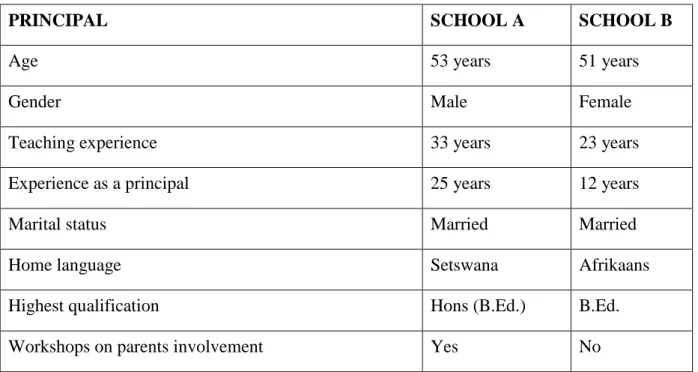
xi Table 4.1: Principals and schools
Table 4.2: Chairpersons of schools
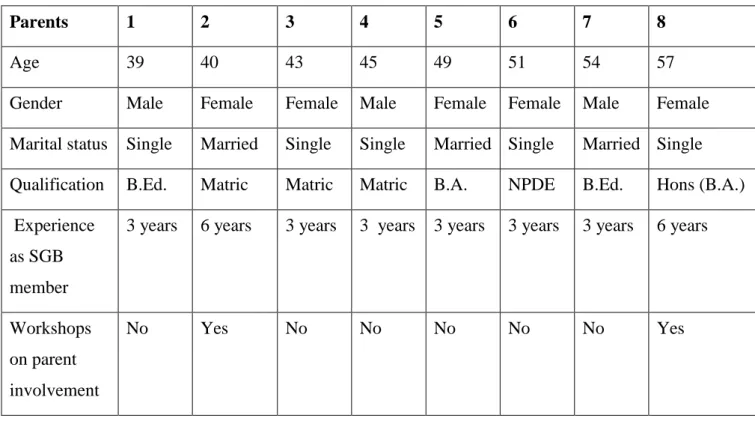
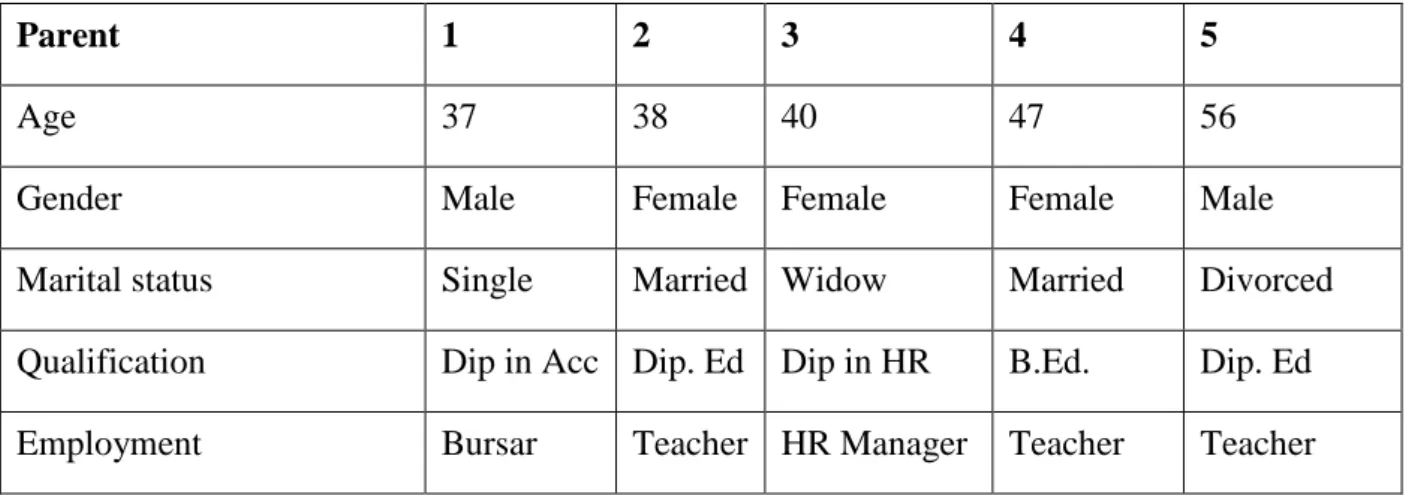
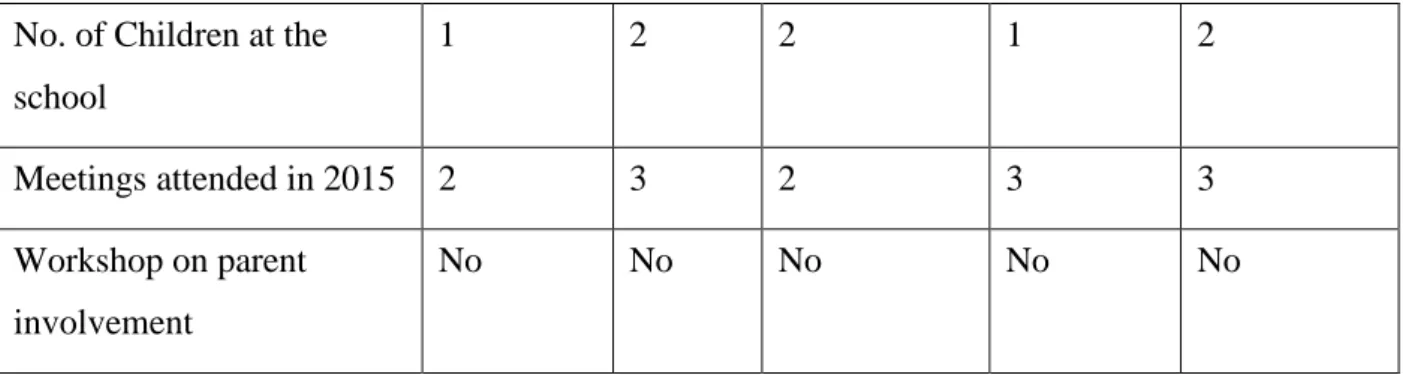
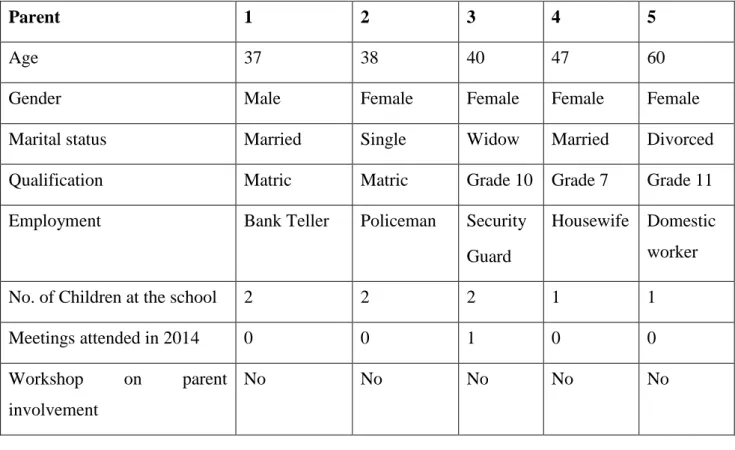
Table 4.3: Parents serving in the SGB at School A Table 4.4: Parents serving in the SGB at School B Table 4.5: Active parents of School A
Table 5.6: Active parents of School B Table 4.7: Inactive parents of School A Table 4.8: Inactive parents of School B
1 CHAPTER 1
INTRODUCTION TO RESEARCH
1.1 INTRODUCTION: BACKGROUND TO THE PROBLEM
Parent involvement in the formal education of their children has become an important educational issue which has resulted in current reforms in countries such as the United States of America, Canada, Britain and New Zealand. The reforms concerning parent involvement were brought into
effect by law, inter alia, by means of the Education Reform Act of 1988 in the United Kingdom and
the Education Act of 1989 in New Zealand (Caldwell & Spinks 1988:11-12).
The South African education system has changed since attaining independence in 1994 and is now aligning to the worldwide trend towards self-managing schools. The underlying assumption is to shift from centralised and bureaucratic control of education towards self-management of schools. It is assumed that schools are run efficiently if school communities, which include parents, are given the power to run their own affairs (Mpumalanga Department of Education 2000:18). The new South African constitution which ushered in a new educational dispensation which makes provision for the establishment of public school governance, in accordance with certain specified criteria (Beckman & Visser 1999:152), led to the establishment of the School Governing Bodies (SGBs) in which parents have to play an active role. The South African Schools Act (SASA), 84 of 1996, (RSA 1996, section 16) indicates that the governance of a public school is vested in its governing bodies. SGB members, of which parents have to constitute the majority, are elected by parents of learners at the school (North West Department of Education and Sport 2017:55-56; Squelch 2000:137).
The idea behind the new system of education governance is clearly captured in the preamble of the South African Schools Act 84 of 1996, which states that
the country requires a new national system for schools, which will redress past injustices in educational provision, provide an education of progressively high quality for all learners and in so doing lay a strong foundation for development of all our people’s talents and capabilities, protect and advance our diverse cultures and languages, uphold the rights of all learners, parents and educators and promote their acceptance of
2
responsibilities for organisation, governance and funding of schools in partnership with the state….(RSA 1996: 1-2).
The inclusion of parents to devolve their power to schools which was consolidated in the SASA (1996, Section 21) makes provision for parents to take equal responsibility with school management for the provision of efficient education and training in schools. SASA mandates the establishment of school governing bodies in all schools in the country in order to ensure that parents, learners and non-teaching staff actively participate in the governance and management of their schools with a view to provide better teaching and learning environments (North West Department of Education and Sport 2017:55-56); Squelch 2000:137).
As can be gathered from section 2.2.3 the present challenge of gaining effective parent involvement in the formal education of their children, apart from serving in the school governing bodies, is very noticeable. In this regard, Mr Panyaza Lesufi (2017:online), MEC for the Gauteng Department of Education, recognises the fact that challenges of parents relating to work, household management, taking care of children and time constraints impact negatively on parents’ involvement with schools. According to him the raising of children by a single parent or foster parents further complicates involvement with schools. He believes that parent involvement is the number one priority of public
schools and that some teachers are disheartened by inadequate parent involvement. The Cape Digital
Foundation (2017: online) also acknowledges the importance of parent involvement. It blames dysfunctionality of schools on the inadequate functioning of the education system in its entirety. It considers both in-school factors, such as leadership and management, and out-of school factors as essential aspects that influence the state of the South African educational scenario. It mentions socio-economic circumstances and parent involvement as examples of out-of school factors and mentions parent involvement as a cost-effective and feasible means of raising the level of a culture of teaching and learning.
Researchers are unanimous in their view that there are barriers to parent involvement that need to be addressed (see Section 2.2.3). The researcher, who has ten years teaching experience in South African schools, has noticed that the majority of parents do not actively participate in the formal education of their children. He observed that all parents do not attend parents’ meetings or assist their children with homework. Gounden (2016:2) is of the opinion that hindrances need to be identified by educational authorities. She posits that “parents, like their children come from different backgrounds, and have different barriers to overcome for them to involve themselves in their
3
children’s schooling effectively”. In this regard it should be mentioned that literature on parent involvement does not include departmental or provincial guidelines on the management of parent involvement other than guidelines for SGBs which relate to parents serving on them, and that this study adds to the tapestry of inadequate parent involvement by focusing on selected secondary schools in the Zeerust district of North West Province (see Section 1.7.1) in order to bring about a meaningful management thereof. The findings of this study would hopefully be used at departmental and governmental level to bring about diversified guidelines for managing parent involvement at schools.
In all probability parent involvement will never reach its full potential. Even at a well-established suburban public primary school in Gauteng, which was handed a provincial award for its excellence, a minority of parents expressed some concern in terms of the school’s reporting which entailed reporting on individual learner’s progress (although a detailed report is provided ever quarter), academic achievement, social and emotional wellbeing, as well as academic enrichment opportunities for learners and ways in which parents could assist their children academically (Meier and Lemmer 2015:online).
The need for improved parent involvement by means of the improved management thereof found
expression in the implementation of the Secondary School Improvement Programme, aimed at very
poor performing schools in Gauteng. It includes a section on parent involvement which is aimed at conscientising principals and teachers of secondary schools of the important role that parents can play in the formal education of their children and motivating them to interact with parents (Gauteng Provincial Department of Education 2011:6).It is founded on the knowledge that improved parent involvement is non-negotiable for better learning at schools. A home-school partnership programme, modest in scope, conducted with five poverty stricken parents in the Cape Flats, showed that the improvement of parent involvement, if properly managed, is not impossible and that parents could be taught to assist their children successfully with literacy lessons at home (Cozett & Condy 2016:online).
Van Wyk (2010:200), a well-known South African scholar on parent involvement, agrees with the view of Henderson and Berla (1994:1) who assert that when schools work with parents to support learning, learners tend to succeed not only in school, but throughout life. The Department for Children, Schools and Families in Nottingham (DCSF 2016:6-7) is convinced that parents’ interests and involvement in their children’s formal learning brings about better exam results, higher levels of
4
educational qualifications, greater progress at school and in life, higher educational expectations, as well as good behaviour accompanied by positive attitudes. Hamlin (2017:5) also mentions that parent involvement results in improved student achievement and behavioural outcomes.
Examples of parental involvement in the formal education of their children are plenty. In this regard Project Appleseed (2008:9) holds the view that parents’ support of children can be improved if they attend parent-teacher conferences which could motivate them to become more involved in helping children with their homework by encouraging good behavior, such as reading, at home. According to Epstein and Sheldon (2005:8), parents can also serve as human resources in the training of co-curricular activities such as traditional dances. They, too, note that schools may involve parents by encouraging them to engage with children in learning activities at home. MacNeil and Patin (2005:45) note that parental support for children in their assignments results in improved academic achievement. The importance of parent involvement is discussed in detail in Section 2.3.
1.2 MOTIVATION FOR THE RESEARCH
The interest in conducting this study started when the researcher, who is a senior teacher, worked closely with parents of learners at a school in the Zeerust district, where he is teaching. In terms of parents who serve in the school governing body, he realised that parents often experience problems relating to a lack of understanding concerning their roles and accountability, as well their capacity to fulfill their roles, which he ascribed to their educational backgrounds. He noticed that parents in general are not involved with the schools their children attend. These observations allowed the researcher to believe that inadequate parent involvement at schools would constitute a factor that would negatively impact on the performance of the school and that school and parents do not function as the Department of Education envisages. The Department of Education expects schools to manage parent involvement and expects parents to play an important role in the formal education of their children by supporting them to perform better (Squelch 2000:138). This researcher concurs with the view that parents struggle to learn their roles and responsibilities as a result of inadequate basic literacy levels which make the realisation of the objective of good performances by learners difficult (Beckman and Visser 1999:152; Malone 2017:5).
5
1.3 DESCRIPTION OF THE PROBLEM AND PROBLEM FORMULATION
The lack of parent involvement seems to be a serious challenge at most secondary schools within the Zeerust District of North West Province. Although SASA clearly list all the compulsory functions of school governing (RSA 1996, Section 30), parents seem to be uncertain about their roles in SGBs, as well as the actual formal education of their children.
The researcher decided to focus on parent involvement in terms of their involvement that relates to their school involvement that concerns their children’s education, rather than parents’ particular involvement in SGB activities since improved learner development, aided by parent involvement, would eventually remedy many inadequacies found in the South African society. The researcher has nevertheless included the views of parent SGB members on aspects of parent involvement that excludes their roles in SGBs.
Bearing the above in mind, this research sought to answer the following main research questions based on empirical evidence: How can a meaningful management of parent involvement be brought about at selected secondary schools in the Zeerust district?
To arrive at an answer to this question the following research sub-questions need to be answered:
What are the perceptions of parents, principals, SGB chairpersons, SGB parent members
and active and inactive parents at selected schools in the Zeerust district concerning the concept of parent involvement? (This question was posed since a narrow view of their perception of parent involvement would relate to recommendations aimed at addressing challenges which influence parent involvement negatively.)
What are the ways in which parents should be involved in the education of their children?
What are the challenges and problems concerning parent involvement that need to receive
managerial intervention?
What are the benefits of parent involvement in the education of learners?
What managerial recommendations can be made to improve parents’ involvement with the
6
It is clear that knowledge of the challenges and problems that parents face which hinder them to participate fully in the formal education of their children would play an essential role in deciding on managerial intervention to address them.
1.4 THE AIM AND OBJECTIVES OF THE STUDY
The study was geared towards collecting data from principals, SGB chairpersons, SGB parent members, as well as active and inactive parents to answer the research questions posed in section 1.3. The overall aim of this study is to bring about meaningful management of parent involvement at selected schools in the Zeerust district. The objectives which are complementary to this aim are:
to determine the perceptions of parents, principals, SGB chairpersons, SGB parent members
and active and inactive parents at selected schools in the Zeerust district of the concept of parent involvement since these could relate to recommendations concerning the management of parent involvement made in the final chapter;
to obtain information concerning the ways in which parents should be involved in the
education of their children;
to identify challenges and problems that contributes to inadequate parent involvement that
need to be managed;
to establish the benefits of parent involvement in learners’ educationthat accentuate the
importance of parent involvement; and
to provide managerial recommendations to improve parent involvement at the selected
schools.
1.5 SIGNIFICANCE OF THE STUDY
Even though the findings of this research cannot be generalised, they would be useful to the North West Department of Education and Sport who would most probably be in a position to determine which findings and recommendation that relate to the management of parent involvement show transferability to other schools under their jurisdiction. Principals in North West Province who are challenged by inadequate parent involvement might find that the findings are applicable to their schools, and principals of secondary schools elsewhere in South Africa could extend their knowledge base concerning the problematic issue of parent involvement and may also find the findings of this
7
study to be relevant, even though this research is not aimed at generalisation since researchers may not generalise in qualitative research (Chiromo 2006:86).
This research would:
1. equip principals, teachers and parents of the selected schools in the Zeerust district with a
sound and broadened knowledge base pertaining to parent involvement and the management thereof;
2. equip principals, teachers and teacher serving on the SGBs with knowledge that relates to
the management of parent involvement, and therefore also facilitate in developing parents who are better equipped in fulfilling their involvement with schools; and
3. help closing the gap in interaction between home, school and community by improving
parent participation in the formal education of their children through the implementation of appropriate managerial guidelines.
1.6 SCOPE AND LIMITATIONS OF THE STUDY
The study was conducted at two secondary schools in Zeerust district of North West Province. These schools were chosen as they are similar in the sense that parents of learners in these schools are from poor communities and that they are accessible to the researcher. It was not possible for the researcher to conduct research in all of the sixteen secondary schools in Zeerust because it would not be relevant for the purposes of this study.
As mentioned, the objective of the study was not to transfer its findings to all other secondary schools in poverty stricken areas but to provide relevant information that is necessary to embrace proper management of parent involvement at the selected secondary schools and to provide an impetus for further research on the topic.
1.7 METHODOLOGICAL ISSUES
The research design, which constitutes a process of setting a plan of action to collect, analyse and interpret data to draw conclusions(Creswell 2012:250), was anchored in qualitative research since a qualitative research approach is appropriate when in-depth descriptions of a phenomenon, in this case that of parent involvement at selected schools and its managerial implications, is required
8
(Chiromo 2006:86). A qualitative research approach was adopted because it makes provision for a rich description and much detail that allow the readers to understand the context of the actual setting. The research was expository rather exploratory in nature. According to Seliger and Shohamy (1989:117) exploratory research is defined as “initial research into a hypothetical or theoretical idea”(cf. Chiromo 2006:88). In terms of this study, the researcher applied established ideas, thereby engaging in expository research in order to gain an understanding of parent involvement as understood and practiced in terms of selected secondary schools in the Zeerust district of the North West Province, aimed at the improvement of the management of parent involvement.
1.7.1 Population and sampling
Chiromo (2006:16) views a population as “all the individuals, units, objects or events that will be considered in a research project”. This study focused on parent involvement at two selected secondary schools, two of sixteen secondary schools in the Zeerust district which constitute the population of the study. Purposive sampling was employed in selecting the schools. Both find themselves in the same social context and are rich in information concerning parent involvement. As shown, richness in information is a key component of purposeful sampling (Patton 1990:169; McMillan & Schumacher 2010:325-326).
As mentioned, participants consisted of the two principals of the two schools, the two SGB chairpersons, eight parents serving in the SGBs of each school and five active and inactive parents from each school. The principal of each school informed the SGB of the researcher’s envisaged research.
To select parents, the researcher selected five parents randomly from a register of active parents and a register of inactive parents of learners in grades 8A, 9A, 10A, 11A and grade 12A from each school to obtain the names of ten active and ten inactive parents in total. The selection of the active and inactive parents was conducted with the help of the principals who engaged their secretaries to assist in the identification of the active and inactive parents at each school who were available for participation in this research, based on registers previously compiled by the secretaries. The registers indicated the names of parents who were involved in particular activities and the names of parents who neither attended parents days nor partook in terms of any function held at the two schools.
9
The two principals, two SGB chairpersons and sixteen parent members serving in the two SGBs were selected according to purposeful sampling. The sample size was considered manageable in terms of the time of approximately thirty minutes that would be required to conduct each interview. Purposive sampling was also used to choose the schools.As mentioned in Section1.7.2, from the 16 schools, two schools from the same socio-economic status were selected. The one school was the school where the researcher was employed. Not only was the researcher motivated to find out more about the practice of parent involvement and the management thereof at his school, he also took into consideration that personnel who knew him and parents of children who attended the school where he was teaching would be willing to share information with someone whose research was ultimately geared towards improved learner performance.
1.7.2 Qualitative research approach
Denzin and Lincoln (1994:2) (in De Vos1998:240) define qualitative research as “an overall holistic approach to social interaction involving describing and making sense, as well as an interpretive, naturalistic approach to its subject matter”. Creswell (2013:45) defines qualitative research as “an inquiry in which researchers collect data in face to face situations by interacting with persons in their settings”. This means that qualitative researchers aim at studying phenomena in their natural settings and attempt to make sense of and interpret them in terms of the meaning that selected people attach to them. Creswell (2013:45) further states that qualitative research describes and analyses people’s individual and collective actions, beliefs, thoughts and perceptions. To ensure validity of research, more than one data collection method was applied to ensure triangulation (Creswell 2007:74). This included a literature review and semi-structured interviews.
The researcher used individual semi-structured interviews and semi-structured focus group interviews. Individual interviews were conducted with two principals and two SGB chairpersons of the two schools and semi-structured focus group interviews were conducted with five active and five inactive parents, as well as eight parents serving in the SGB from each school. Interviews were appropriate because the researcher wanted to obtain information from information-rich participants, if possible in their natural settings, as was the case for the principals and the SGB parents serving in the SGBs. Conducting field work in natural settings is supported by McMillan and Schumacher (1997:391) who say that “in qualitative research, the researcher collects data by interacting with selected persons in their settings and obtaining relevant information”. Another reason for choosing
10
the qualitative research approach is that it is user friendly and encourages participants to interact with the researcher (Creswell 2007:73).
1.7.3 Data collection methods
As mentioned, the researcher undertook a literature study and conducted interviews.
1.7.3.1 Literature study
The literature study mainly focussed on definitions of parent involvement, benefits of parent involvement, challenges related to parent involvement and ways of increasing parent involvement. It informed the empirical research and served as a theoretical base to which the empirical findings could be related. The literature study also enabled the researcher to establish theoretical frameworks, namely that of Bronfenbrenner’s ecological model and Epstein’s typology of parents and overlapping of spheres which related to the interpretation of the empirical findings and recommendations concerning the management of parent involvement. Data collected from relevant documents was analysed and informed individual and focus group interview schedules.
1.7.3.2 Interviews
Chikoko and Mhloyi (1995:30) describe an interview as “a structured conversation between researcher and respondent used to complete a survey”. The individual and semi-structured interviews conducted for this research helped the researcher to obtain an in-depth understanding of the participants’ opinions and experiences Creswell (1994:150).
Individual semi-structured interviews were conducted with the two principals and the two SGB chairs. The advantage of individual interviews, according to Creswell (1994:150), is that it enables the researcher to obtain an in-depth understanding of a person’s opinion and experiences.
Semi-structured focus group interviews were conducted with the parents serving in the SGB of the two schools and two groups of parents of each of the schools, namely the active and inactive parents, to establish their understanding of parent involvement, its benefits, its challenges and problems faced, as well as their thoughts on improving parent involvement. The focus groups chosen were appropriate since SGB parents who had been working together for some time for a common goal
11
would be motivated to air their views collectively. Parents of children in the same school would also be likely to contribute to the interviews since they were aware that this research was rooted in striving for better performance at the school. Hoberg’s (1999:93-94) view that focus group interviews have a potential to yield a wide range of responses was also considered in the decision to conduct focus group interviews.
1.7.4 Data analysis
Data analysis involves the interpretation of events and responses of participants. A tape recorder was used to collect data for this study and the responses of the participants were transcribed in preparation for data analysis. According to MacMillan and Schumacher (2010:109), qualitative data analysis is primarily an inductive process of arranging data into different categories and identifying patterns and similarities among the categories. Furthermore, Gay, Mills and Airasian (2006:76) describe data analysis as an attempt by the researcher to summarise collected data in a dependable and accurate manner. After collecting the data, the researcher familiarised himself with the data through listening to the recordings of interviews and reading and re-reading the notes concerning striking occurrences noticed during interviews. The researcher transcribed the interviews in order to obtain a verbatim record of data since this would enable the researcher to compare and contrast data.
Data collected during interviews was analysed in terms of themes and categories to make provision for a systematic presentation of findings which, in turn served as a framework for drawing conclusions and recommendations to bring about a meaningful management of parent involvement at the selected schools. The data collected by the specified data collection instruments was integrated during the analysis thereof, thereby making provision for a multi-dimensional strategy in addressing the research questions. (Also see Section 3.4).
1.7.5 Trustworthiness
According to Johnson and Christensen (2004:118-140) validity refers to “the accuracy of references, interpretations, or actions made on the basis of test scores”. Reliability refers to “the consistency or stability of test scores. If a test or assessment procedure provides reliable scores, the scores will be similar on every occasion” (Johnson & Christensen 2004:133). However, these explanations relate to quantitative research. In terms of qualitative research, validity implies credibility of research which can be defended when challenged (Bashir 2008:39). This would imply that triangulation (the use of
12
two or more data collection methods is applied and that bias is restrained as far as possible during the collection and analysis of data (Creswell 2012:258-9). It would also mean that the anonymity of participants are guaranteed to allow for honest and information rich responses. It was shown that two data collection methods were applied for this study, namely a literature study and interviews. Objectivity was maintained by the researcher.
Reliability in qualitative research would not be interpreted as the reproduction of congruent results as is the result with quantitative research. Rather, reliability would refer to constant and accurate capturing, analysis and interpretation of results since qualitative research is not geared towards establishing whether similar results are replicated (Merriam 2002:27). As shown, the researcher aimed at accurate collection, analysis and interpretation of results. It is noted that the terms validity and reliability are no longer frequently used in qualitative research and that an all-embracing terms, namely trustworthiness is often used as a comprehensive criterion which encompasses all the matters referred to above.
1.7.6 Data collection procedures
According to Chisi (2000:35),a “data collection procedure is a step taken in administering instructions and collection of data from subjects under study”. In this study the researcher sought for permission from the Circuit Manager of the Zeerust District Office who gave permission to conduct research at the two schools. The SGB chairpersons, parents serving on the SGBs and other active and inactive parents were informed about the research by the principals, stating that participation was voluntary. The researcher made appointments with participants to arrange for interviews during their free time. Written consent which included, inter alia, the aspects of voluntary participation and the right to withdraw from research at any point was accentuated prior to the commencement of interviews (De Vos 1998:2; see Appendix IX).
Permission to record the interviews were obtained and the interviewees were reminded of their ethical rights prior to the commencement of the interviews. They were informed that they would gain access to the completed research at their relevant schools. Transcripts were made of the audio-taped interviews and the interviews were analysed according to the description provided in Section 1.7.4.
13 1.8 ASPECTS PERTAINING TO ETHICS
De Vos (1998:24) defines ethics as a
set of moral principles which is suggested by an individual or group, is widely accepted, and offers rules and behavioural expectations about the most correct conduct towards experimental subjects and respondents, employers, sponsors, researchers, assistants and students.
Johnson and Christensen (2004:94) define ethics as “the principles and guidelines that assist the researchers to uphold things they value”. Research ethics are indeed a set of principles which guide and assist researchers in conducting educational studies. Ethical guidelines (as outlined by the American Educational Research Association (AERA) (Johnson & Christensen 2004:118-119) that need to be followed by educational researchers are informed consent, freedom to withdraw and confidentiality and anonymity.
The researcher applied the required criteria and gained the trust of the research participants by assuring them of confidentiality and anonymity. Mason (2001:290) argues that ethical concerns must be a priority on the research agenda of any researcher. De Vos (1998:2) posits that “the identified participants must be informed about the investigation, its goal and the procedures that will be followed to collect data before they decide to take part in the research”.
In this study the researcher gave ample time to the participants before the commencement of the interviews to decide if they wanted to participate in the research or not. The researcher informed the participants both verbally and in writing that participation was voluntary and that they could withdraw from the research at any time if they were not comfortable with the research process (see Appendix IX). The researcher clearly explained the purpose of the study, procedures to be followed during the research process, as well as the reasons why the participants were chosen. As mentioned, the researcher also assured confidentiality to the participants. This encouraged the participants to open up and give information willingly.
Ethical clearance was obtained from the University of South Africa’s Ethics Clearance Committee of
the College of Education. Relevant documents pertaining to permission to conduct research (see Appendix III) were included in the application. Furthermore, as mentioned, the researcher sought
14
permission from the Circuit Manager of the Zeerust District Office who granted permission to
conduct research at the two schools (see Appendix V).
1.9 THEORETICAL FRAMEWORKS
The theoretical frameworks that informed this study were Epstein’s theory of overlapping spheres and her typology of parents, as well as Bronfenbrenner’s ecological model.
Parent involvement is a phenomenon which should extend beyond the domains of the home and school. Epstein’s theory of overlapping spheres (Epstein 1995:704) which posits that parents, schools and communities should work together, and Bronfenbrenner’s ecological model (Bronfenbrenner 1979:22-29) support this perspective. These frameworks would also be relevant in terms of the provision of recommendations concerning the management of parent involvement.
Epstein’s theory of overlapping spheres relates to her theory of the typology of parents which, as mentioned, can also be considered as a theoretical framework of this research. According to her typology of parents, parent involvement includes the interaction with the school in terms of parenting at home, communication between school and parents, volunteering of parents to engage with activities at the school, parents supporting their children’s learning at home, parents being involved in decision making at school, as well as parents’ and schools’ collaboration with the community (Epstein 1995:704; Epstein 2008:11-12; Epstein and Sanders 2001:527).
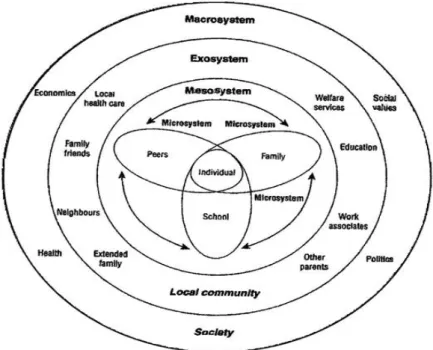
Bronfenbrenner’s ecological model embraces three spheres or systems that impact on the child’s development (1979:3). These are the microsystem, exosystem and macrosystem. In terms of this study it would mean that parent involvement, a factor which influences the child’s development, would also be influenced by these three systems. The microsystem which is closely related to the child is represented by components which directly influence the child, such as his/her immediate family, significant individuals such as his/her peers and teachers and other influential people at school. These components do not function in isolation, but interact with each other. The exosystem which is further removed from the child consists of indirect influential component such as family friends, neighbours, welfare services and the extended family which relate to the local community (Bronfenbrenner 1979:29) The macrosystem is furthest removed from the child but would bear an influence on the child’s development, and also on parent involvement which has a direct influence on the child’s development. Components relating to the macrosphere are inter alia, economics, social
15
values, politics and a country’s laws which pertain to society at large (Landsberg, Kruger and Nel 2005:11). Bronfenbrenner’s theoretical perspective explains relations between different systems which involves family, school, community and society but does not explain the reasons for the boundaries between them and how beneficial changes in family-school-community relations can be achieved.
A discussion of the theoretical frameworks are included in the literature study in Sections 2.5.1 and 2.5.2 since they constitute a key element without which a literature study on parent involvement, in terms of the parameters of this study, would be incomplete.
1.10 DEMARCATION OF THE STUDY
Chapter 1 outlines the problem to be addressed in the study, the background of the problem, motivation for the research, the aims and objectives of the study, description of the problem and problem formulation, methodological issues, data collection methods, data analysis, trustworthiness, the significance, scope and limitations of the study, a preliminary review of the theoretical frameworks, and definition of key concepts.
In Chapter 2 prevailing theories and research that relate to parent involvement and the management thereof, including the theoretical frameworks, are examined.
Chapter 3 presents a discussion of the research methodology that was used to investigate parent involvement at the selected secondary schools. The rationale for the choice of research methods, the data collection, data analysis and strategies are provided.
In chapter 4 a presentation and analysis of the findings regarding parent involvement at the selected secondary schools in the Zeerust district which relate to the management of parent involvement are presented. These inform the recommendations which occur in Chapter 5.
A synopsis of the research and its findings, together with the recommendations arising from this study, are presented in Chapter 5
16 1.11 DEFINITION OF KEY CONCEPTS
The meaning of the concepts “parent and parent involvement” were considered relevant for this study.
Parent
The South African School Act (RSA 1996 Section 16) defines a parent as:
a) the parent or guardian of a learner
b) the person legally entitled to custody of a learner or
c) the person who undertakes to fulfill the obligations of a person referred to in paragraphs a) and b) towards the learner’s education at school.
In terms of the above, the term “parent” includes all persons who are children’s caregivers at home. Some caregivers such as grandparents, aunts, or older siblings may be biologically related to children. Others, however, may be legally appointed guardians or persons who are entrusted by one or both of the biological parents with the raising of children (Gaetano 2007:149). The term “parent” may be defined broadly as an adult with the responsibility for the financial and emotional care and support of the school going age child (Patrikakou, Weissberg, Redding & Walberg 2005:132).For this study, only biological parents of learners were interviewed to remain within the parameters of the scope of a dissertation.
Parent involvement
Squelch and Lemmer (1994:93), and Decker and Lemmer (1993:115) describe parent involvement as “the participation of parents in a wide range of school based and home-based activities to improve the children’s education”. It implies support given to the school by means of cooperation, participation and partnership. The term goes by several synonyms for example “parent engagement”, “partnership” and “collaboration with schools’. Myeko; (2000:12) defines parent involvement as “a process through which parents meaningfully participate in the various educational activities of their children”.
17
The UNISA Metropolitan Life Project (1994:2) for the training of teachers in parent involvement defines parent involvement as follows:
The active and supportive participation of parents as partners and allies of the teacher in the primary aspects of formal and informal education of their own child and/or broad education of their community in an individual and/or collective way and in a structured/orderly manner in order to achieve the objectives of education as fully as possible.
This definition can be considered to be comprehensive since it calls for the active participation of parents as partners in all educative activities, curricular or non-curricular. It also relates to the importance of interaction between parents, the school and the community which is in line with Epstein’s (1995:702) view that parent involvement should be considered more broadly than only in terms of parents and schools. This definition was found to be the most comprehensive prior to Epstein’s (1995:702) view on parent involvement which not only ascribes various functions in which parents and schools have to partake to parent involvement, but also emphasises cooperation between parents, schools and community as being essential for parent involvement. It calls for the active participation of parents as partners in all educative activities, curricular and non-curricular.
The above definitions imply that parent involvement is the engagement of parents in home based and school based and even community based activities aimed at enhancing children’s education. The definitions also suggest that parental participation in the education of their children is necessary for parents to understand their children better.
The interaction between home, school and community is illustrated by Van Zyl’s (2013:229) definition of parent involvement. Bearing in mind the complexity of parent involvement which prevents distinguished, internationally acknowledged South African scholars of parent involvement from defining it, he says: “Perhaps parent involvement can best be summarised as mutually beneficial support and/or active participation between parents and the school in term of their children’s formal education, as well as the school’s endeavours to improve basic caring [which also relates to support and assistance given to children’s school related responsibilities] and nurturing by parents at home, preferably with the help of the community.”
18
Parents are often referred to as allies of teachers which means that this kind of partnership implies a special relationship between equals, that parents are equal to education managers and teachers and that power and control should be evenly distributed (Laureau 2000:35).
Education management
Education management cannot be divorced from the meaning of the concept of management in general. Management can be defined as “the process of working through individuals and groups and other resources to accomplish goals (Everard & Morrison 1990:5).The same definition would apply to education management except that the process described would now be placed within a particular setting, namely that of education. As is the case for management in general, education management means that four key components are applied. These are: planning of which the main function is the provision of directives and goals (Van Zyl (2013:144-146); organising which relates to “the function of arranging and forming things into a coherent whole (Adair(2017) in Van Zyl 2013:147) and implies coordination and delegation; control which ensures that people and other resources are applied effectively (Van Zyl 2013: 153); and leadership, a complex concept, which in essence means implementing an appropriate leadership approach and style to influence people and inspire them to work towards the goal of a group (cf. Marishane 2013:96). The components of management in this study find close relation to the final chapter which provides recommendations to establish the meaningful management of parent involvement in a synergetic manner.
1.12 CONCLUSION
In this chapter an introduction to this study was given. The background of the problem was followed by a description of the problem, the problem formulation, aims of the study, research questions and the significance of the study. In addition, the significance and the scope and limitations of the study were discussed, an exploration of the research approach and research methods were provided, a brief review of the study’s theoretical frameworks was given, the trustworthiness of the study was explained, key relevant concepts were defined and aspects pertaining to ethics were considered. A relevant literature review is presented in Chapter 2.
19 CHAPTER 2
REVIEW OF LITERATURE
2.1 INTRODUCTION
This chapter provides an analysis of relevant literature on parent involvement that relates to this study which is aimed at providing managerial guidelines to improve parent involvement at selected secondary schools in the Zeerust district. It commences with a succinct discussion of the South African educational setting that relates to parent involvement before and after 1994. This is followed by a section on African voices on parent involvement aired after liberation which shows that parent involvement in South Africa has many shortcomings and emphasises the necessity of this study which is geared towards commencing a meaningful management of parent involvement at the selected schools which takes cognisanse of problems relating to parent involvement (see section 1.3). The importance of parent involvement receives attention since it, too, points towards the necessity of aiming at the provision of managerial guidelines that would improve the quality and scope of parent involvement at the selected schools. A discussion of the theoretical frameworks applied are included in order to gain an understanding of the lens through which this study is approached. These are Epstein’s theoretical frameworks of parent involvement, as well as Bronfenbrenner’s bio-ecological model which, as mentioned in Section 1.9 can also be related to parent involvement and the management thereof. The mentioned theoretical frameworks are considered to be of importance in any research on parent involvement.
2.2 PARENT INVOLVEMENT IN SOUTH AFRICA
The perception of parent involvement in the South African educational setting has changed over time in accordance with the views of the ruling government during two key periods: the period before the liberation of 1994 and the period following the first democratic elections held in 1994. Soon after attaining its independence the South African government democratised the education system which had previously been designed in terms of racial division through legislation and statutes (Van Wyk 2000:49). In 1994 independence ushered in a new era in the South African education system and brought a formal end to apartheid rule. A shift from authoritarianism to democratic rule through the introduction of a new constitution, that included unequivocal commitment and accountability to representative and participatory democracy, took place. One key aim of decentralisation was to involve parents in the education system Mncube (2009:2).
20 2.2.1 The situation prior to 1994
In most former white schools statutory parent bodies (usually called statutory management councils) functioned at schools prior to 1994. According to Van Schalkwyk (1988:88) “these bodies had certain powers bestowed on them by law. All members serving on these bodies were elected by parents”.
In terms of “educational provision for blacks, schools committees were established, according to Mkwanazi, (1994:25) by the government since 1953”. These were noticeable different from white schools. Only four to six of the committee members could be elected by parents, while the rest of the members were government appointees. However, these structures were rejected by the black community and many schools chose to institute Parent Teachers Associations (PTAs). These bodies did not have powers acknowledged by legislation (Heysteck& Paquette (1999:189). Van Wyk (2001:1) posits that “both black and white schools parent bodies dealt mostly with issues pertaining to school fees”. According to him “the statutory governing bodies which were in existence by then were only found in white dominated schools” (Van Wyk (2001:49). He further notes that in “the majority of black schools a cosmetic type of alliance existed made up of a few members of parent bodies who were elected; the bulk were government appointees” (Van Wyk (2001:49).
2.2.2 The situation after 1994
Van Wyk (2000:49) states that independence was meant to “combat racism, sexism and all other forms of unfair discrimination and intolerance”, and that the National Department of Education and the nine Provincial Departments of Educationhad to implement this innovation. Heysteck (2006:477) notes that attempts were made to democratise the management of education through a process of decentralisation which had become a worldwide trend. Brown and Duku (2008:416) concur that the redistribution of power, administration, responsibilities and functions away from central government to lower levels was a big achievement that characterised this change.
According to Frielinghaus (2005:2) liberation was meant to transform the colonial education system, which was characterised by racial inequality and segregation policies, into a non-racial education system based on the principles of equity in order to advance the democratic transformation of South African society. According to Brown and Duku (2008:413) the issues of school governance in South Africa emerged as a response to a new national demand for educational reform. As part of the
21
change process, the Department of Education (DoE) published a White Paper, entitled the Organisation, Government and Funding of Schools (DoE, 1996), to encourage participatory democracy at school level. Parents were accorded active and responsible roles in a collective decision making process (Republic of South Africa 1996, Section 23). The South African Schools Act 84, of 1996 (SASA), which came into effect at the beginning of 1997 accorded parents the right to get involved in making decisions at schools.
In terms of SASA, all public state schools in South Africa must have democratically elected School Governing Bodies (SGBs) comprised of parents, learners, educators, non-teaching staff and the school principal. According to Frielinghaus (2005:2) the Act demands that all public schools must elect an SGB as part of the governance and management structure of the school. According to Van Wyk (2000:49) school management and governance are viewed separately in terms of the Act. While management of the school is considered the responsibility of the principal and the professional staff that constitute the School Management Team (SMT), the (SGB) is responsible for the governance of the school. However, it could be said that they cannot be seen as two independent entities since the SMT would act according to policy prescribed by the SGB whilst the SGB would be approached by the SMT if deemed necessary. According to the SASA (RSA 1996, Section 23) the SGB consists of the principal as an ex-officio member and selected members from various stakeholders, namely the educators at the school, non-educator staff, democratically elected parents of learners at the schools, and learners in grade eight or higher at secondary school level. In any given situation, the parents or guardians of learners must exceed the total of other members in the SGB by one (Republic of South Africa 1996, Section 23).
Parents employed by a school may not represent parents on the SGB. An active member of the body may be reimbursed for operational costs incurred although he/she may not receive any remuneration for executing the duties of the SGB (RSA 1996, Section 23). Sayed and Soudien (2005:112) criticise the latter part of legislation according to which parents who afford their personal time to school activities may not receive any form of remuneration. The statute further states that only a parent may assume the post of chairmanship. Members of the SGB are free to participate in various sub-committees constituted for the purpose of advancing the interest of learners by means of their expertise (RSA 1996, section 30). In 2007 Lemmer (2007:218) stated that “a considerable body of evidence suggests that changes in governance arrangements are only weakly related to teaching and learning”.They therefore have little, if any, effect on student achievement. Even if this very important deficiency is overlooked, parent SGB members do not always seem to fulfill their
22
responsibilities adequately (Lemmer 2007:218). While the execution of the mandate of parents serving in SGBs is possible in urban areas, parents in rural areas, who are of a different socio-economic standing and who are often illiterate, have been found to be marginalised in terms of participation in SGBs (Mncube 2009:7). Although the decentralisation of the governing of schools guaranteed parental ownership, it seems as if active participation by parents does not always materialise. The next section views parent involvement from an African perspective.
2.2.3 African voices on parent involvement in South Africa
After a scrutiny of sources on parent involvement by African reseachers in South Africa, this researcher has come to the conclusion that parent involvement still finds itself in its infancy. Views expressed in this regard reverberated the initial view of the researcher which prompted the researcher to undertake this study. As shown, parent involvement was initially accentuated primarily in terms of parents’ role in SGBs of schools. Parent involvement in terms of parents’ interaction with schools which related to learners formal education was, however, not emphasised by SGBs.
Studies show that many factors hamper parent involvement. In this regard Maluleke (2014:40) posits that in the Vhembe District of Limpopo Province few parents of three selected primary schools indicated an appreciation of parent involvement. Parents did not mention supervision or monitoring of their children’s school work at all. Parents’ limited education, disadvantaged social and economic status, as well as teachers’ negative attitudes towards parents, and the absence of a school policy concerning parent involvement, acted as barriers which prevented parents from being involved with schools.
A quantitative study that involved 330 teachers at primary schools in the rural Mawa and Molotsi Circuits in Mupani district of Limpopo Province showed that social and economic barriers were moderate to significant impediments that obstructed parent involvement. Teachers acknowledged the value of parent involvement in terms of the performance and social behaviour of learners, but complained that school initiatives and strategies to improve parent involvement were not satisfactory (Mathekga 2016:80-83) The latter finding concurs with that of Ramadikela (2012:98-104) who researched parent involvement at historically disadvantage schools in the Tshwane West district in Gauteng. This study found that minimal managerial involvement of School Management Teams and particularly school principals were characterised by inadequate initiation, facilitation and maintenance of parent involvement at three selected historically disadvantaged schools, despite the