The accumulation and sorption of phosphorus (P) in the soil depends on the content of clay minerals, Al and Fe oxide and soil organic matter (Börling et al. 2001), soil acidity, and fertilisation (Hooda et al. 2001, Varinderpal-Singh et al. 2006, Szara et al. 2017). Fertilisation exceeding the nutritional needs of plants for phosphorus affects the total content of the ele-ments to a higher degree than the content of a selected form of P in the soil (Szara et al. 2004). Nonetheless, the processes of sorption-desorption, precipitation-dissolution, and mineralisation-immobilisation lead to the development of soil phosphorus forms with variable availability for plants and mobility in the soil (Parham et al. 2002, Verma et al. 2005, Koopmans et al. 2007). Low content of phosphorus in sandy soil usu-ally forces the application of high doses of mineral and organic fertilisers. The accumulation of phosphorus in the soil is also determined by the degree of uptake and use of the element by plants. Approximately twice higher use of phosphorus from mineral fertilisers than from manure (Szara et al. 2004) suggests that organic fertilisation favours the accumulation of phosphorus
in the soil to a greater degree than mineral fertilisation. Meanwhile, after 78 years of experimental fertilisation with similar doses of P, content of total phosphorus in manured soil was only 11% higher than in the soil fertilised with superphosphate (Szara et al. 2004). This result suggests substantial differences in the effect of mineral and organic fertilisation on the sorption soil properties towards phosphorus, and the chemical form in which P is accumulated in soils under different systems of fertilisation.
The objective of the study was the assessment of the effect of the fertilisation system (organic, mineral and mineral-organic) on the accumulation and verti-cal distribution of different forms of phosphorus in reference to phosphorus sorption properties in the sandy soil profile.
MATERIAL AND METHODS
The research was conducted in a long-term ex-periment (since 1923) with rye monoculture at the Experimental Station of the Warsaw University of
Soil phosphorus sorption properties in different fertilization
systems
Ewa Szara*, Tomasz Sosulski, Magdalena Szymańska
Department of Soil Environment Sciences, Warsaw University of Life Sciences – SGGW, Warsaw, Poland
*Corresponding author: [email protected]
Citation: Szara E., Sosulski T., Szymańska M. (2019): Soil phosphorus sorption properties in different fertilization systems. Plant Soil Environ., 65: 78–82.
Abstract: The study aimed at the evaluation of the accumulation and vertical distribution of different forms of phos-phorus (P) in reference to phosphos-phorus sorption properties subject to mineral (NPK), mineral-organic (NPK + M), and organic (M) fertilisation. It was carried out in a long-term experimental field in Skierniewice (Central Poland) conducted since 1923 under rye monoculture. Total P content in the M and NPK soil profile was similar and lower than in the NPK + M soil. The content of organic P in Ap and Eet horizons of both manured soils was similar and higher than in the NPK soil. The Langmuir P sorption maximum (Smax) in the studied soils ranged from 39.7 to 90 mg P/kg, while the Freundlich P sorption coefficient aF ranged from 6.9 to 41.9 mg P/kg. Higher variability of pa-rameters related to the binding energy from the Lanqmuir (k) and Freundlich (aF) equations was determined between soil horizons than between the fertilisation systems. Nonetheless, in M and NPK + M soils, sorption parameters aF and Smax and binding energy (k, bF) were considerably lower than in the NPK soil. The content of water extracted P in manured soils was higher than in the NPK soil.
Life Sciences – SGGW in Skierniewice (Central Poland, 51°96'N, 20°16'E). The soil is Luvisol (FAO 2006). The soil particle size was reported elsewhere (Sosulski et al. 2017). The mineral (NPK), mineral-organic (NPK + M) and mineral-organic (M) fertilization systems were studied in four repetitions with plot area of 36 m2. The doses of fertilisers amounted to
90 kg N, 26 kg P and 91 kg K/ha. Manure was applied at the dose of 30 t/ha every 4 years and at 20 t/ha yearly in the NPK + M and M treatment, respectively. Consequently, the annual doses of phosphorus and nitrogen applied in M and NPK + M systems can be approximated as 21.9 kg P/ha, 100 kg N/ha and 33.7 kg P/ha, 127.5 kg N/ha, respectively. The average of grain rye yield obtained in the long-term experiment was higher under NPK + M than under NPK and M treatment (4.3 vs. 3.6 and 2.5 t/ha). Consequently, the P-accumulation by rye was higher under NPK + M (21.4 kg/ha) than under NPK (15.7 kg P/ha) and M treatment (11.2 kg P/ha). Liming (1.43 t Ca/ha) was applied every 4 years.
Soil samples were collected after rye harvest in 2015 from the following soil horizons: Ap (0–25 cm); Eet (25–50 cm) and Bt (50–75 cm). The following was determined in the soil samples: pH in 1 mol/L KCl (ISO 10390, 2005), total organic carbon (TOC) by means of a TOC-analyser, total content of soil phosphorus (Pt) – after soil digestion in HNO3 and HClO4, and the content of inorganic phosphorus (Pi) after extraction in 0.5 mol/L H2SO4 (O’Halloran and Cade-Menun 2008) and dissolved reactive P (DRP) after water soil extraction following centrifugation and vacuum-filtration (< 0.45 µm) (Sharpley et al. 2008). The content of soil organic phosphorus (Po) was estimated as a difference between Pt and Pi.
The Mehlich-3 method was applied to determine the content of AlM3, FeM3 (not presented), and PM3 (Ziadi and Sen Tran 2008). The degree of phospho-rus saturation (DSP) of soil was calculated as molar (mmol/kg) ratio: DPSM3 = [PM3/PSCM3] × 100%, where PSCM3 – (AlM3 + FeM3) (Khiari et al. 2000).
For the assessment of phosphorus sorption prop-erties, soil samples were equilibrated with graded phosphorus concentration 0–20 mg P/L (KH2PO4) in 0.01 mol/L CaCl2 (1:10) for 24 h. After centrifuging at 3000 rpm for 15 min and filtering, the phosphorus concentration (C) in the supernatant solution was measured. The amount of P sorbed (S) by the soil was calculated as the difference between the amount of phosphorus in solution before and after equilibrium (Sharpley et al. 2008).
In all extracts, phosphorus concentration was de-termined by means of the molybdenum-blue ascorbic method, and the content of metals by means of the atomic absorption spectrometry (AAS).
Sorption isotherms were examined by the Langmuir equation:
C/S = 1/kSmax + C/Smax
Where: Smax – sorption maximum; k – constant related to bonding energy of soil for P. A plot of C/S versus C gives a straight line with the slope value equal to 1/Smax and 1/kSmax as the y-axis intercept (Sharpley et al. 2008).
The data were also fitted to the Freundlich equation:
S = aFCbF
Where: aF – extent of P adsorption; bF – constants corre-sponding to the degree of linearity between the solution equilibrium concentration and absorption. A linear plot of log10aF versus log10C yields aF and bF from the intercept and slope, respectively (Graetz and Nair 2000).
The equilibrium of phosphorus concentration in solution (EPC0) is the value of C where S = 0 and it was determined from isotherm plots. Maximum buffering capacity (MBC) is derived as: MBC =
kSmax (Holford and Mattingly 1976).
The suitability of sorption equations was based on
R2 values. One-way analysis of variance (ANOVA) at
P < 0.05 was used for comparison of means for each soil horizon and treatments separately and mean total contents of parameters in soil profiles under treatments. The Spearman’s correlation coefficients (r) were calculated at P < 0.01 and P < 0.05 (SPSS IMAGO 23, IBM, Chicago, USA).
RESULTS AND DISCUSSION
The content of soil TOC was the highest in the Ap horizon of the studied soils and decreased with soil depth. Depending on the soil horizon, TOC soil content on M treatment was 1.2–1.4 times higher than in NPK + M treatment and 1.5–2.1 times higher than in NPK treatment (Table 1).
inner-sphere complexes with humic substances pro-tect monoesters from mineralisation. Orthophosphate diesters are considerably weakly sorbed onto soil par-ticles, more mobile and susceptible to mineralisation in the soil (Turner et al. 2003). As a consequence,
phosphate monoesters are the main organic P forms in the upper layer of soils (Dou et al. 2009, Dodd and Sharpley 2015), and their content may increase after manure application (Koopmans et al. 2007). This explains considerably higher content of Po in Ap and Eet horizon of M and NPK + M soil in comparison to NPK soil. In spite of considerably higher content of farmyard manure (FYM) introduced in M soil than in NPK + M soil, the combined content of Po in the profile of both soils was similar (216–221 mg/kg). The content of Po in Bt horizon was determined in NPK + M treatment, and the lowest in M treat-ment. This is explained by results of Koopmans et al. (2007) who determined strong accumulation of orthophosphate monoesters in the upper layers of the long-term manure-treated soils, and downward movement of only orthophosphate.
The mobility and availability of P accumulated in the soil is determined by phosphorus sorption properties. In our research, the soil phosphorus sorption data for different fertilisation systems were well fitted to the Langmuir (R2 > 0.991) and Freundlich (R2 > 0.960)
[image:3.595.61.290.112.307.2]equation (Table 2). Considering all soil horizons and fertilisation systems, the Langmuir P sorption maxi-mum (Smax) ranged from 39.7 to 90 mg P/kg, while the Freundlich P sorption coefficient aF ranged from 6.9 to 41.9 mg P/kg, and both parameters were strongly mutually correlated (r = 0.924, P < 0.01). Unlike in the case of the indices of the number of sites of P sorption Table 1. Properties of the soil profile
Fertilization
system Horizon TOC (g/kg)
Pt Pi Po (mg/kg)
NPK
Ap 7.2a 297b 210b 87a
Eet 2.1a 120a 82b 38a
Bt 1.7a 182a 132b 50a
total 11.1A 599A 424B 175A
M
Ap 10.7b 283a 169a 114c
Eet 4.4c 146b 87a 59b
Bt 3.0c 161a 118a 43a
total 18.0C 590A 374A 216B
NPK + M
Ap 9.3b 275a 174a 101b
Eet 3.3b 165c 107b 55b
Bt 2.3b 202c 137b 65b
total 14.9B 639B 418B 221B
a – within each horizon, means followed by the same small letter are not significantly different (P < 0.05); A – within each treatment, means of the total content in profiles by the same capital letter are not significantly different (P < 0.05). TOC – total organic carbon; Pt – total phosphorus; Pi – inorganic phosphorus; Po – organic phosphorus
Table 2. Phosphorus sorption parameters from the Langmuir and Freundlich equations
Fertilization
system Horizon
Langmuir MBC (L/mg)
Freundlich Smax
(mg/kg) (L/mg)k (mg/kg)aF (L/mg)bF
NPK
Ap 54.6c 0.152a 8.3b 7.9b 0.540b
Eet 44.4b 0.363c 16.1b 19.7b 0.265a
Bt 99.0c 0.656c 64.9c 41.9c 0.327c
total 198.0B – 89.3C 70.9C –
M
Ap 39.7a 0.130a 5.1a 6.9a 0.496a
Eet 41.0ab 0.188a 7.7a 9.8a 0.460c
Bt 82.6b 0.506b 41.8b 33.6b 0.312b
total 163.3A – 54.7B 50.5B –
NPK + M
Ap 49.3b 0.147b 7.2b 9.2c 0.488a
Eet 38.8a 0.223b 8.6a 10.6a 0.387b
Bt 75.2a 0.335a 25.1a 24.6a 0.365d
total 163.4A – 41.1A 44.7A –
[image:3.595.63.535.505.714.2](Smax and aF), the parameters related to the bonding energy k from the Langmuir model and bF from the Freundlich model were mutually negatively correlated (r = –0.800, P < 0.01).
Fertilisation leads to a decrease in soil P sorption capacity (Hooda et al. 2001, Lehmann et al. 2005, Jiao et al. 2007). In our research in manured soils (M and NPK + M), sorption parameters aF and Smax and binding energy (k, bF) were significantly lower than in the NPK soil. Similar study results were obtained by Varinderpal-Singh et al. (2006) and Bhattacharyya et al. (2015). Organic acids released from FYM compete with orthophosphate for sorption sites, and replace the loosely adsorbed phosphate from the bonding sites, or may chelate Fe and Al oxide limiting the number of phosphate binding sites in the soil (Jiao et al. 2007, Yan et al. 2014). Organic P from FYM may also cause desorption of mineral forms of P (Berg and Joern 2006). Moreover, due to an increase in the net negative surface charge as a result of nonspecific sorption, organic acid may cause an increase in the electrostatic repulsion of phosphate in soil considerably reducing the binding energy of phosphate (Jiao et al. 2007). Whalen and Chang (2002) determined that 25 years of soil ma-nuring reduced the binding energy (k) to a greater degree than the value of parameter Smax. A higher variability of parameters related to the binding energy from the Langmuir (k) and Freundlich (aF) between soil horizons than between fertilisation systems sug-gests different mechanisms of phosphorus sorption. High (more than 0.4) or higher than k value of bF
suggests a substantial contribution of precipitation in the sorption process (Castro and Torrent 1998, Hussain et al. 2006). It can be therefore presumed that systematic liming could favour the precipitation of Ca-P increasing the capacity for P retention. The importance of precipitation for P sorption, however, decreased with soil depth.
The maximum buffering capacity (MBC) value points to the capacity of the soil to maintain constant P concentration in the soil solution (Holford and Mattingly 1976). The MBC value in the Ap horizon of M and NPK + M soils showed relatively low fluc-tuations (5.1–7.2 L/mg). Fertilisation of soil with such a low MBC value can considerably increase the content of orthophosphorus in the soil solution. In deeper soil horizons, the variability of the values of the parameter was higher, and in soil Bt horizon it ranged from 25.1 to 41.8. This means that the proper-ties of soils fertilised with manure can counteract the
transfer of 1.9–2.5 times smaller mass of phosphorus to drainage water than from the NPK soil.
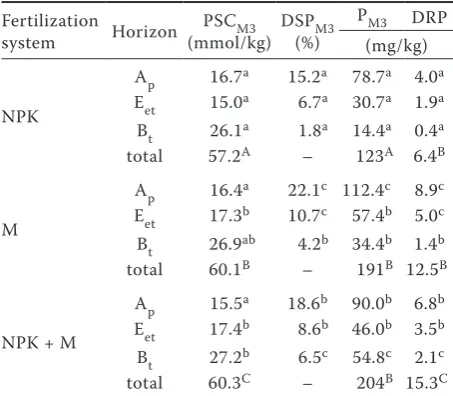
The variability of soil P sorption properties was reflected in the vertical distribution of available phosphorus contents (PM3) in the profiles of the studied soils (Table 3). The lowest variability of the PM3 content (78.7–112.0 mg/kg) concerned the Ap horizon of the studied soils. Due to the lowest buffer properties of deeper horizons in NPK + M soil pro-file, the PM3 content in the Bt horizon was 3.8 times higher than in the NPK soil. In M soil, the content of PM3 in the Bt horizon was 34.4 mg/kg and was considerably lower than in NPK + M soil.
Manured soils showed a considerable increase in the content of water extracted DRP in comparison to the NPK soil. Considerably higher content of DRP in the Ap horizon of M soil than NPK + M soil suggests that annual application of manure increases the risk of P losses with surface flow of water. Higher content of P can be leached from the NPK + M soil than from M soil.
[image:4.595.304.531.488.686.2]The degree of P saturation (DSP) is also commonly used to predict the potential of soil to release P (Khiari et al. 2000). In both manured soils, the content of PSCM3 was only inconsiderably higher than in the NPK soil (Table 3). Due to the lack of higher variability of PSCM3 values between the studied soils, the DSPM3 value
Table 3. Content of PM3 extracted by Mehlich-3, P saturation degree (DSPM3) and dissolved reactive P extracted with water (DRP)
Fertilization
system Horizon (mmol/kg)PSCM3 DSP(%)M3
PM3 DRP (mg/kg)
NPK
Ap 16.7a 15.2a 78.7a 4.0a
Eet 15.0a 6.7a 30.7a 1.9a
Bt 26.1a 1.8a 14.4a 0.4a
total 57.2A – 123A 6.4B
M
Ap 16.4a 22.1c 112.4c 8.9c
Eet 17.3b 10.7c 57.4b 5.0c
Bt 26.9ab 4.2b 34.4b 1.4b
total 60.1B – 191B 12.5B
NPK + M
Ap 15.5a 18.6b 90.0b 6.8b
Eet 17.4b 8.6b 46.0b 3.5b
Bt 27.2b 6.5c 54.8c 2.1c
total 60.3C – 204B 15.3C
depended exclusively on the PM3 content. Therefore, the highest value of DSPM3 was determined in the Ap horizon of M soil, and the lowest in the NPK soil.
REFERENCES
Bhattacharyya P., Nayak A.K., Shahid M., Tripathi R., Mohanty S., Kumar A., Raja R., Panda B.B., Lal B., Gautam P., Swain C.K., Roy K.S., Dash P.K. (2015): Effects of 42-year long-term ferti-lizer management on soil phosphorus availability, fractionation, adsorption-desorption isotherm and plant uptake in flooded tropical rice. The Crop Journal, 3: 387–395.
Berg A.S., Joern B.C. (2006): Sorption dynamics of organic and in-organic phosphorus compounds in soil. Journal of Environmen-tal Quality, 35: 1855–1862.
Börling K., Otabbong E., Barbies E. (2001): Phosphorus sorption in relating to soil properties in some cultivated Swedish soils. Nutrient Cycling in Agroecosystems, 59: 39–46.
Castro B., Torrent J. (1998): Phosphate sorption by calcareous Ver-tisols and IncepVer-tisols as evaluated from extended P-sorption curves. European Journal of Soil Science, 49: 661–667.
Dodd R.J., Sharpley A.N. (2015): Recognizing the role of soil or-ganic phosphorus in soil fertility and water quality. Resources, Conservation and Recycling, 105: 282–293.
Dou Z.X., Ramberg C.F., Toth J.D., Wang Y., Sharpley A.N., Boyd S.E., Chen C.R., Williams D., Xu Z.H. (2009): Phosphorus specia-tion and sorpspecia-tion-desorpspecia-tion characteristics in heavily manured soils. Soil Science Society of America Journal, 73: 93–101. FAO (2006): World Reference Base for Soil Resources. A
Frame-work for International Classification, Correlation and Commu-nication. World Soil Resources Reports 103. Rome, Food and Agriculture Organization of the United Nations, 116.
Graetz D.A., Nair V.D. (2000): Phosphorus sorption isotherm de-termination. In: Pierzynski G.M. (ed.): Methods of Phosphorus Analysis for Soil, Sediments, Residual and Water. Southern Co-operative Series Bulletin, 396: 35–38.
Hooda P.S., Truesdale V.W., Edwards A.C., Withers P.J.A., Aitken M.N., Miller A., Rendell A.R. (2001): Manuring and fertilization effects on phosphorus accumulation in soils and potential environmental im-plications. Advances in Environmental Research, 5: 13–21. Holford I.C.R., Mattingly G.E.G. (1976): A model for the behavior
of labile phosphate in soil. Plant and Soil, 44: 219–229.
Hussain A., Ghafoor A., Murtaza G. (2006): Use of models for phosphorus adsorption on some sodic soils of Punjab. Interna-tional Journal of Agriculture and Biology, 2: 241–248.
Jiao Y., Whalen J.K., Hendershot W.H. (2007): Phosphate sorption and release in sandy-loam soil as influenced by fertilizer sources. Soil Science Society of America Journal, 71: 118–124.
Khiari L., Parent L.E., Pellerin A., Alimi A.R.A., Tremblay C., Simirad R.R., Fortin J. (2000): An agri-environmental phospho-rus saturation index for acid coarse-textured soils. Journal of En-vironmental Quality, 29: 1561–1567.
Koopmans G.F., Chardon W.J., McDowell R.W. (2007): Phosphorus movement and speciation in a sandy soil profile after long-term
animal manure applications. Journal of Environmental Quality, 36: 305–315.
Lehmann J., Lan Z.D., Hyland C., Sato H.S., Solomon D., Ketter-ings Q.M. (2005): Long-term dynamics of phosphorus forms and retention in manure-amended soils. Environmental Science and Technology, 39: 6672–6680.
Li G.H., Li H.G., Leffelaar P.A., Shen J.B., Zhang F.S. (2014): Charac-terization of phosphorus in animal manures collected from three (dairy, swine, and broiler) farms in China. PLoS ONE 9 (7). O’Halloran I.P., Cade-Menun B.J. (2008): Total and organic
phos-phorus. In: Carter M.R., Gregorich E.G. (eds.): Soil Sampling and Methods of Analysis. Boca Raton, CRC Press, 265–291. Parham J.A., Deng S.P., Raun W.R., Johnson G.V. (2002): Long-term
cattle manure application in soil. I. Effect on soil phosphorus levels, microbial biomass C, and dehydrogenase and phosphate activites. Biology and Fertility of Soils, 35: 328–337.
Sharpley A.N., Kleinman P.J.A., Weld J.L. (2008): Environmental Soil Phosphorus Indices. In: Carter M.R., Gregorich E.G. (eds.): Soil Sam-pling and Methods of Analysis. Boca Raton, CRC Press, 141–159. Sosulski T., Szara E., Szymańska M., Stępień W. (2017): N2O
emis-sion and nitrogen and carbon leaching from the soil in relation to long-term and current mineral and organic fertilization – A laboratory study. Plant, Soil and Environment, 63: 97–104. Szara E., Sosulski T., Mercik S. (2004): Balance of phosphorus in
three fertilization systems. Annales Universitatis Mariae Curie-Skłodowska, Lublin-Polonia. Sectio E, 59: 599–606. (In Polish) Szara E., Sosulski T., Szymańska M., Stępień W. (2017): Phosphate
sorption and P soil-test in sandy loam soil as affected by manure and lime applications in a long-term fertilization experiment. Fresenius Environmental Bulletin, 26: 3191–3199.
Turner B.L., Cade-Menun B., Westermann D.T. (2003): Organic phosphorus composition and potential bioavailability in semi-arid arable soils of the western United States. Soil Science Soci-ety of America Journal, 67: 1168–1179.
Verma S., Subehia S.K., Sharma S.P. (2005): Phosphorus fractions in an acid soil continuously fertilized with mineral and organic fertilization. Biology and Fertility of Soils, 41: 295–300. Varinderpal-Singh, Dhillon N.S., Brar B.S. (2006): Influence of
long-term use of fertilizers and farmyard manure on the adsorption-desorption behavior and bioavailability of phosphorus in soils. Nutrient Cycling in Agroecosystems, 75: 67–78.
Whalen J.K., Chang C. (2002): Phosphorus sorption capacities of calcareous soils receiving cattle manure applications for 25 years. Communications in Soil Science and Plant Analysis, 33: 1011–1026.
Yan Y.P., Liu F., Li W., Feng X.H., Sparks D.L. (2014): Sorption and desorption characteristics of organic phosphates of different structures alumninium (oxyhydr)oxides. European Journal of Soil Science, 65: 308–317.
Ziadi N., Sen Tran T. (2008): Mehlich 3-extractable elements. In: Carter M.R., Gregorich E.G. (eds.): Soil Sampling and Methods of Analysis. Boca Raton, CRC Press, 81–87.