Semi-Supervised Frame-Semantic Parsing for Unknown Predicates
Dipanjan Das and Noah A. Smith Language Technologies Institute
Carnegie Mellon University Pittsburgh, PA 15213, USA
{dipanjan,nasmith}@cs.cmu.edu
Abstract
We describe a new approach to disambiguat-ing semantic frames evoked by lexical predi-cates previously unseen in a lexicon or anno-tated data. Our approach makes use of large amounts of unlabeled data in a graph-based semi-supervised learning framework. We con-struct a large graph where vertices correspond to potential predicates and use label propa-gation to learn possible semantic frames for new ones. The label-propagated graph is used within a frame-semantic parser and, for un-known predicates, results in over 15% abso-lute improvement in frame identification ac-curacy and over 13% absolute improvement in full frame-semantic parsingF1 score on a
blind test set, over a state-of-the-art supervised baseline.
1 Introduction
Frame-semantic parsing aims to extract a shallow se-mantic structure from text, as shown in Figure 1. The FrameNet lexicon (Fillmore et al., 2003) is a rich linguistic resource containing expert knowl-edge about lexical and predicate-argument seman-tics. The lexicon suggests an analysis based on the theory of frame semantics (Fillmore, 1982). Recent approaches to frame-semantic parsing have broadly focused on the use of two statistical classifiers cor-responding to the aforementioned subtasks: the first one to identify the most suitable semantic frame for a marked lexical predicate (target, henceforth) in a sentence, and the second for performing semantic role labeling (SRL) given the frame.
The FrameNet lexicon, its exemplar sentences containing instantiations of semantic frames, and full-text annotations provide supervision for learn-ing frame-semantic parsers. Yet these annotations lack coverage, including only 9,300 annotated tar-get types. Recent papers have tried to address the coverage problem. Johansson and Nugues (2007) used WordNet (Fellbaum, 1998) to expand the list of targets that can evoke frames and trained classifiers to identify the best-suited frame for the newly cre-ated targets. In past work, we described an approach where latent variables were used in a probabilistic model to predict frames for unseen targets (Das et al., 2010a).1 Relatedly, for the argument identifica-tion subtask, Matsubayashi et al. (2009) proposed a technique for generalization of semantic roles to overcome data sparseness. Unseen targets continue to present a major obstacle to domain-general se-mantic analysis.
In this paper, we address the problem of idenfi-fying the semantic frames for targets unseen either in FrameNet (including the exemplar sentences) or the collection of full-text annotations released along with the lexicon. Using a standard model for the ar-gument identification stage (Das et al., 2010a), our proposed method improves overall frame-semantic parsing, especially for unseen targets. To better han-dle these unseen targets, we adopt a graph-based semi-supervised learning stategy (§4). We construct a large graph over potential targets, most of which
1Notwithstanding state-of-the-art results, that approach was
only able to identify the correct frame for 1.9% of unseen tar-gets in the test data available at that time. That system achieves about 23% on the test set used in this paper.
bell.n ring.v
there be.v enough.a
LU
NOISE_MAKERS
SUFFICIENCY Frame
EXISTENCE
CAUSE_TO_MAKE_NOISE .
bells
N_m
more than six of the eight
Sound_maker Enabled_situation
ring to ringers
Item
enough
Entity Agent
n't are still there But
Figure 1: An example sentence from the PropBank section of the full-text annotations released as part of FrameNet 1.5. Each row under the sentence correponds to a semantic frame and its set of corresponding arguments. Thick lines indicate targets that evoke frames; thin solid/dotted lines with labels indicate arguments. N munder “bells” is short for theNoise makerrole of theNOISE MAKERSframe.
are drawn from unannotated data, and a fraction of which come from seen FrameNet annotations. Next, we perform label propagation on the graph, which is initialized by frame distributions over the
seen targets. The resulting smoothed graph con-sists of posterior distributions over semantic frames for each target in the graph, thus increasing cover-age. These distributions are then evaluated within a frame-semantic parser (§5). Considering unseen targets in test data (although few because the test data is also drawn from the training domain), sig-nificant absolute improvements of 15.7% and 13.7% are observed for frame identification and full frame-semantic parsing, respectively, indicating improved coverage for hitherto unobserved predicates (§6).
2 Background
Before going into the details of our model, we pro-vide some background on two topics relevant to this paper: frame-semantic parsing and graph-based learning applied to natural language tasks.
2.1 Frame-semantic Parsing
Gildea and Jurafsky (2002) pioneered SRL, and since then there has been much applied research on predicate-argument semantics. Early work on frame-semantic role labeling made use of the ex-emplar sentences in the FrameNet corpus, each of which is annotated for a single frame and its argu-ments (Thompson et al., 2003; Fleischman et al., 2003; Shi and Mihalcea, 2004; Erk and Pad´o, 2006,
inter alia). Most of this work was done on an older, smaller version of FrameNet. Recently, since the re-lease of full-text annotations in SemEval’07 (Baker et al., 2007), there has been work on identifying multiple frames and their corresponding sets of
ar-guments in a sentence. The LTH system of Jo-hansson and Nugues (2007) performed the best in the SemEval’07 shared task on frame-semantic pars-ing. Our probabilistic frame-semantic parser out-performs LTH on that task and dataset (Das et al., 2010a). The current paper builds on those proba-bilistic models to improve coverage on unseen pred-icates.2
Expert resources have limited coverage, and FrameNet is no exception. Automatic induction of semantic resources has been a major effort in re-cent years (Snow et al., 2006; Ponzetto and Strube, 2007,inter alia). In the domain of frame semantics, previous work has sought to extend the coverage of FrameNet by exploiting resources like VerbNet, WordNet, or Wikipedia (Shi and Mihalcea, 2005; Giuglea and Moschitti, 2006; Pennacchiotti et al., 2008; Tonelli and Giuliano, 2009), and projecting entries and annotations within and across languages (Boas, 2002; Fung and Chen, 2004; Pad´o and La-pata, 2005). Although these approaches have in-creased coverage to various degrees, they rely on other lexicons and resources created by experts. F¨urstenau and Lapata (2009) proposed the use of un-labeled data to improve coverage, but their work was limited to verbs. Bejan (2009) used self-training to improve frame identification and reported improve-ments, but did not explicitly model unknown tar-gets. In contrast, we use statistics gathered from large volumes of unlabeled data to improve the cov-erage of a frame-semantic parser on several syntactic categories, in a novel framework that makes use of graph-based semi-supervised learning.
2
2.2 Graph-based Semi-Supervised Learning
In graph-based semi-supervised learning, one con-structs a graph whose vertices are labeled and unla-beled examples. Weighted edges in the graph, con-necting pairs of examples/vertices, encode the de-gree to which they are expected to have the same label (Zhu et al., 2003). Variants of label propaga-tion are used to transfer labels from the labeled to the unlabeled examples. There are several instances of the use of graph-based methods for natural language tasks. Most relevant to our work an approach to word-sense disambiguation due to Niu et al. (2005). Their formulation was transductive, so that the test data was part of the constructed graph, and they did not consider predicate-argument analysis. In con-trast, we make use of the smoothed graph during in-ference in a probabilistic setting, in turn using it for the full frame-semantic parsing task. Recently, Sub-ramanya et al. (2010) proposed the use of a graph over substructures of an underlying sequence model, and used a smoothed graph for domain adaptation of part-of-speech taggers. Subramanya et al.’s model was extended by Das and Petrov (2011) to induce part-of-speech dictionaries for unsupervised learn-ing of taggers. Our semi-supervised learnlearn-ing settlearn-ing is similar to these two lines of work and, like them, we use the graph to arrive at better final structures, in an inductive setting (i.e., where a parametric model is learned and then separately applied to test data, following most NLP research).
3 Approach Overview
Our overall approach to handling unobserved targets consists of four distinct stages. Before going into the details of each stage individually, we provide their overview here:
Graph Construction: A graph consisting of ver-tices corresponding to targets is constructed us-ing a combination of frame similarity (for ob-served targets) and distributional similarity as edge weights. This stage also determines a fixed set of nearest neighbors for each vertex in the graph.
Label Propagation: The observed targets (a small subset of the vertices) are initialized with empirical frame distributions extracted from
FrameNet annotations. Label propagation re-sults in a distribution of frames for each vertex in the graph.
Supervised Learning: Frame identification and ar-gument identification models are trained fol-lowing Das et al. (2010a). The graph is used to define the set of candidate frames for unseen targets.
Parsing: The frame identification model of Das et al. disambiguated among only those frames associated with a seen target in the annotated data. For an unseen target, all frames in the FrameNet lexicon were considered (a large number). The current work replaces that strategy, considering only the topM frames in the distribution produced by label propagation. This strategy results in large improvements in frame identification for the unseen targets and makes inference much faster. Argument identification is done exactly like Das et al. (2010a).
4 Semi-Supervised Learning
We perform semi-supervised learning by construct-ing a graph of vertices representconstruct-ing a large number of targets, and learn frame distributions for those which were not observed in FrameNet annotations.
4.1 Graph Construction
We construct a graph with targets as vertices. For us, each target corresponds to a lemmatized word or phrase appended with a coarse POS tag, and it resembles thelexical unitsin the FrameNet lexicon. For example, two targets corresponding to the same lemma would look likeboast.N andboast.V. Here, the first target is a noun, while the second is a verb. An example multiword target ischemical weapon.N. We use two resources for graph construction. First, we take all the words and phrases present in the dependency-based thesaurus constructed using syntactic cooccurrence statistics (Lin, 1998).3 To construct this resource, a corpus containing 64 mil-lion words was parsed with a fast dependency parser (Lin, 1993; Lin, 1994), and syntactic contexts were used to find similar lexical items for a given word
3This resource is available at http://webdocs.cs.
difference.N similarity.N
discrepancy.N resemble.V
disparity.N
resemblance.N
inequality.N
variant.N
divergence.N poverty.N
homelessness.N
wealthy.A rich.A
deprivation.N
destitution.N
joblessness.N unemployment.N employment.N
unemployment rate.N
powerlessness.N
UNEMPLOYMENT_RATE UNEMPLOYMENT_RATE UNEMPLOYMENT_RATE POVERTY POVERTY
POVERTY
SIMILARITY SIMILARITY
SIMILARITY
[image:4.612.73.391.58.175.2]SIMILARITY SIMILARITY
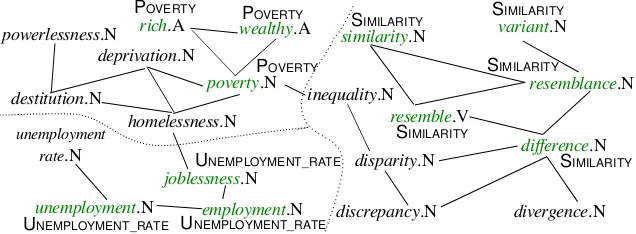
Figure 2: Excerpt from a graph over targets. Green targets are observed in the FrameNet data. Above/below them are shown the most frequently observed frame that these targets evoke. The black targets are unobserved and label propagation produces a distribution over most likely frames that they could evoke.
or phrase. Lin separately treated nouns, verbs and adjectives/adverbs and the thesaurus contains three parts for each of these categories. For each item in the thesaurus, 200 nearest neighbors are listed with a symmetric similarity score between 0 and 1. We pro-cessed this thesaurus in two ways: first, we lower-cased and lemmatized each word/phrase and merged entries which shared the same lemma; second, we separated the adjectives and adverbs into two lists from Lin’s original list by scanning a POS-tagged version of the Gigaword corpus (Graff, 2003) and categorizing each item into an adjective or an ad-verb depending on which category the item associ-ated with more often in the data. The second step was necessary because FrameNet treats adjectives and adverbs separately. At the end of this processing step, we were left with 61,702 units—approximately six times more than the targets found in FrameNet annotations—each labeled with one of 4 coarse tags. We considered only the top 20 most similar targets for each target, and noted Lin’s similarity between two targetstandu, which we callsimDL(t, u).
The second component of graph construction comes from FrameNet itself. We scanned the exem-plar sentences in FrameNet 1.54and the training sec-tion of the full-text annotasec-tions that we use to train the probabilistic frame parser (see§6.1), and gath-ered a distribution over frames for each target. For a pair of targetstandu, we measured the Euclidean distance5 between their frame distributions. This distance was next converted to a similarity score, namely, simF N(t, u) between 0 and 1 by subtract-ing each one from the maximum distance found in
4
http://framenet.icsi.berkeley.edu
5
This could have been replaced by an entropic distance metric like KL- or JS-divergence, but we leave that exploration to fu-ture work.
the whole data, followed by normalization. Like
simDL(t, u), this score is symmetric. This resulted
in 9,263 targets, and again for each, we considered the 20 most similar targets. Finally, the overall sim-ilarity between two given targetstanduwas com-puted as:
sim(t, u) =α·simF N(t, u) + (1−α)·simDL(t, u)
Note that this score is symmetric because its two components are symmetric. The intuition behind taking a linear combination of the two types of sim-ilarity functions is as follows. We hope that distri-butionally similar targets would have the same se-mantic frames because ideally, lexical units evoking the same set of frames appear in similar syntactic contexts. We would also like to involve the anno-tated data in graph construction so that it can elim-inate some noise in the automatically constructed thesaurus.6 LetK(t)denote theK most similar tar-gets to targett, under the scoresim. We link vertices
tandu in the graph with edge weightwtu, defined
as:
wtu = (
sim(t, u) ift∈ K(u)oru∈ K(t)
0 otherwise (1)
The hyperparametersα andK are tuned by cross-validation (§6.3).
4.2 Label Propagation
First, we softly label those vertices of the con-structed graph for which frame distributions are available from the FrameNet data (the same distri-butions that are used to computesimF N). Thus, ini-tially, a small fraction of the vertices in the graph
6
have soft frame labels on them. Figure 2 shows an excerpt from a constructed graph. For simplicity, only the most probable frames under the empirical distribution for the observed targets are shown; we actually label each vertex with the full empirical dis-tribution over frames for the corresponding observed target in the data. The dotted lines demarcate parts of the graph that associate with different frames. La-bel propagation helps propagate the initial soft laLa-bels throughout the graph. To this end, we use a vari-ant of the quadratic cost criterion of Bengio et al. (2006), also used by Subramanya et al. (2010) and Das and Petrov (2011).7
LetV denote the set of all vertices in the graph,
Vl⊂V be the set of known targets andFdenote the
set of all frames. LetN(t)denote the set of neigh-bors of vertext ∈ V. Let q = {q1,q2, . . . ,q|V|}
be the set of frame distributions, one per vertex. For each known targett ∈ Vl, we have an initial frame
distributionrt. For every edge in the graph, weights
are defined as in Eq. 1. We findqby solving:
arg minq P
t∈Vlkrt−qtk
2
+ µP
t∈V,u∈N(t)wtukqt−quk2
+ νP
t∈Vkqt−|F |1 k2
s.t. ∀t∈V, P
f∈Fqt(f) = 1 ∀t∈V, f ∈ F, qt(f)≥0
(2) We use a squared loss to penalize various pairs of distributions over frames:ka−bk2 =P
f∈F(a(f)−
b(f))2. The first term in Eq. 2 requires that, for known targets, we stay close to the initial frame dis-tributions. The second term is the graph smooth-ness regularizer, which encourages the distributions of similar nodes (large wtu) to be similar. The
fi-nal term is a regularizer encouraging all distributions to be uniform to the extent allowed by the first two terms. (If an unlabeled vertex does not have a path to any labeled vertex, this term ensures that its con-verged marginal will be uniform over all frames.)µ
andνare hyperparameters whose choice we discuss in§6.3.
Note that Eq. 2 is convex inq. While it is possible to derive a closed form solution for this objective
7Instead of a quadratic cost, an entropic distance measure could
have been used, e.g., KL-divergence, considered by Subra-manya and Bilmes (2009). We do not explore that direction in the current paper.
function, it would require the inversion of a|V|×|V|
matrix. Hence, like Subramanya et al. (2010), we employ an iterative method with updates defined as:
γt(f) ← rt(f)1{t∈Vl} (3)
+ µ X
u∈N(t)
wtuq(um−1)(f) +
ν
|F |
κt ← 1{t∈Vl}+ν+µ X
u∈N(t)
wtu (4)
q(tm)(f) ← γt(f)/κt (5)
Here, 1{·} is an indicator function. The iterative procedure starts with a uniform distribution for each
q(0)t . For all our experiments, we run 10 iterations of the updates. The final distribution of frames for a targettis denoted byq∗t.
5 Learning and Inference for Frame-Semantic Parsing
In this section, we briefly review learning and infer-ence techniques used in the frame-semantic parser, which are largely similar to Das et al. (2010a), ex-cept the handling of unknown targets. Note that in all our experiments, we assume that the targets are marked in a given sentence of which we want to ex-tract a frame-semantic analysis. Therefore, unlike the systems presented in SemEval’07, we do not de-fine a target identification module.
5.1 Frame Identification
For a given sentence xwith frame-evoking targets
t, letti denote theith target (a word sequence). We
seek a listf = hf1, . . . , fmiof frames, one per
tar-get. LetLbe the set of targets found in the FrameNet annotations. LetLf ⊆ Lbe the subset of these tar-gets annotated as evoking a particular framef.
The set of candidate framesFifortiis defined to
include every framef such thatti ∈ Lf. Ifti 6∈ L
(in other words,tiis unseen), then Das et al. (2010a)
considered all framesF in FrameNet as candidates. Instead, in our work, we check whether ti ∈ V,
where V are the vertices of the constructed graph, and set:
Fi ={f :f ∈M-best frames underq∗ti} (6)
The frame prediction rule uses a probabilistic model over frames for a target:
fi←arg maxf∈Fi
P
`∈Lf p(f, `|ti,x) (7)
Note that a latent variable ` ∈ Lf is used, which is marginalized out. Broadly, lexical semantic re-lationships between the “prototype” variable ` (be-longing to the set of seen targets for a framef) and the target ti are used as features for frame
identifi-cation, but since `is unobserved, it is summed out both during inference and training. A conditional log-linear model is used to model this probability: forf ∈ Fiand`∈ Lf,pθ(f, `|ti,x) =
expθ>g(f, `, ti,x) P
f0∈F i
P `0∈L
f0expθ
>g(f0, `0, t
i,x)
(8)
where θ are the model weights, andg is a vector-valued feature function. This discriminative formu-lation is very flexible, allowing for a variety of (pos-sibly overlapping) features; e.g., a feature might re-late a framef to a prototype `, represent a lexical-semantic relationship between ` and ti, or encode
part of the syntax of the sentence (Das et al., 2010b). Given some training data, which is of the form
hx(j),t(j),f(j),A(j)iN
j=1 (whereN is the number of sentences in the data and A is the set of argu-ment in a sentence), we discriminatively train the frame identification model by maximizing the fol-lowing log-likelihood:8
max θ
N X
j=1 mj
X
i=1
log X `∈L
f(j) i
pθ(f (j) i , `|t
(j) i ,x
(j)) (9)
This non-convex objective function is locally op-timized using a distributed implementation of L-BFGS (Liu and Nocedal, 1989).9
5.2 Argument Identification
Given a sentencex = hx1, . . . , xni, the set of
tar-gets t = ht1, . . . , tmi, and a list of evoked frames
8
We found no benefit from using anL2regularizer.
9While training, in the partition function of the log-linear
model, all framesFin FrameNet are summed up for a targetti
instead of onlyFi(as in Eq. 8), to learn interactions between
the latent variables and different sentential contexts.
f = hf1, . . . , fmicorresponding to each target,
ar-gument identification or SRL is the task of choos-ing which of eachfi’s roles are filled, and by which
parts of x. We directly adopt the model of Das et al. (2010a) for the argument identification stage and briefly describe it here.
Let Rfi = {r1, . . . , r|Rfi|} denote frame fi’s rolesobserved in FrameNet annotations. A setSof spans that are candidates for filling any roler∈ Rfi
are identified in the sentence. In principle,S could contain any subsequence ofx, but we consider only the set of contiguous spans that (a) contain a sin-gle word or (b) comprise a valid subtree of a word and all its descendants in a dependency parse. The empty span is also included inS, since some roles are not explicitly filled. During training, if an argu-ment is not a valid subtree of the dependency parse (this happens due to parse errors), we add its span toS. LetAi denote the mapping of roles inRfi to
spans inS. The model makes a prediction for each
Ai(rk)(for all rolesrk∈ Rfi):
Ai(rk)←arg maxs∈Sp(s|rk, fi, ti,x) (10)
A conditional log-linear model over spans for each role of each evoked frame is defined as:
pψ(Ai(rk) =s|fi, ti,x) = (11)
expψ>h(s, rk, fi, ti,x) P
s0∈Sexpψ>h(s0, rk, fi, ti,x)
This model is trained by optimizing:
max ψ
N X
j=1 mj
X
i=1
|R fi(j)|
X
k=1
logpψ(A(ij)(rk)|fi(j), t (j) i ,x
(j))
This objective function is convex, and we globally optimize it using the distributed implementation of L-BFGS. We regularize by including −101 kψk2
UNKNOWNTARGETS ALLTARGETS
Model Exact
Match
Partial Match
Exact Match
Partial Match
SEMAFOR 23.08 46.62 82.97 90.51
Self-training 18.88 42.67 82.45 90.19
LinGraph 36.36 59.47 83.40 90.93
[image:7.612.72.303.59.147.2]FullGraph 39.86 62.35∗ 83.51 91.02∗
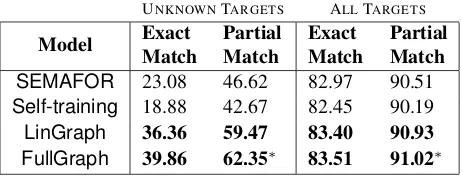
Table 1: Frame identification results in percentage accu-racy on 4,458 test targets. Bold scores indicate significant improvements relative toSEMAFORand (∗) denotes sig-nificant improvements overLinGraph(p <0.05). 6 Experiments and Results
Before presenting our experiments and results, we will describe the datasets used in our experiments, and the various baseline models considered.
6.1 Data
We make use of the FrameNet 1.5 lexicon released in 2010. This lexicon is a superset of previous ver-sions of FrameNet. It contains 154,607 exemplar sentences with one marked target and frame-role an-notations. 78 documents with full-text annotations with multiple frames per sentence were also released (a superset of the SemEval’07 dataset). We ran-domly selected 55 of these documents for training and treated the 23 remaining ones as our test set. After scanning the exemplar sentences and the train-ing data, we arrived at a set of 877 frames, 1,068 roles,10 and 9,263 targets. Our training split of the full-text annotations contained 3,256 sentences with 19,582 frame annotatations with correspond-ing roles, while the test set contained 2,420 sen-tences with 4,458 annotations (the test set contained fewer annotated targets per sentence). We also di-vide the 55 training documents into 5 parts for cross-validation (see §6.3). The raw sentences in all the training and test documents were preprocessed us-ing MXPOST (Ratnaparkhi, 1996) and the MST de-pendency parser (McDonald et al., 2005) following Das et al. (2010a). In this work we assume the frame-evoking targets have been correctly identified in training and test data.
10Note that the number of listed roles in the lexicon is nearly
9,000, but their number in actual annotations is a lot fewer.
6.2 Baselines
We compare our model with three baselines. The first baseline is the purely supervised model of Das et al. (2010a) trained on the training split of 55 documents. Note that this is the strongest baseline available for this task;11 we refer to this model as “SEMAFOR.”
The second baseline is a semi-supervised self-trained system, where we usedSEMAFORto label 70,000 sentences from the Gigaword corpus with frame-semantic parses. For finding targets in a raw sentence, we used a relaxed target identification scheme, where we marked every target seen in the lexicon and all other words which were not prepo-sitions, particles, proper nouns, foreign words and Wh-words as potential frame evoking units. This was done so as to find unseen targets and get frame annotations withSEMAFORon them. We appended these automatic annotations to the training data, re-sulting in 711,401 frame annotations, more than 36 times the supervised data. These data were next used to train a frame identification model (§5.1).12 This setup is very similar to Bejan (2009) who used self-training to improve frame identification. We refer to this model as “Self-training.”
The third baseline uses a graph constructed only with Lin’s thesaurus, without using supervised data. In other words, we followed the same scheme as in
§4.1 but with the hyperparameterα = 0. Next, la-bel propagation was run on this graph (and hyper-parameters tuned using cross validation). The poste-rior distribution of frames over targets was next used for frame identification (Eq. 6-7), withSEMAFOR as the trained model. This model, which is very sim-ilar to our full model, is referred to as “LinGraph.”
“FullGraph” refers to our full system.
6.3 Experimental Setup
We used five-fold cross-validation to tune the hy-perparametersα, K, µ, and M in our model. The
11
We do not compare our model with other systems, e.g. the ones submitted to SemEval’07 shared task, because SE-MAFORoutperforms them significantly (Das et al., 2010a) on the previous version of the data. Moreover, we trained our models on the new FrameNet 1.5 data, and training code for the SemEval’07 systems was not readily available.
12
UNKNOWNTARGETS ALLTARGETS
Model Exact Match Partial Match Exact Match Partial Match
P R F1 P R F1 P R F1 P R F1
SEMAFOR 19.59 16.48 17.90 33.03 27.80 30.19 66.15 61.64 63.82 70.68 65.86 68.18
Self-training 15.44 13.00 14.11 29.08 24.47 26.58 65.78 61.30 63.46 70.39 65.59 67.90
[image:8.612.77.537.58.147.2]LinGraph 29.74 24.88 27.09 44.08 36.88 40.16 66.43 61.89 64.08 70.97 66.13 68.46 FullGraph 35.27∗ 28.84∗ 31.74∗ 48.81∗ 39.91∗ 43.92∗ 66.59∗ 62.01∗ 64.22∗ 71.11∗ 66.22∗ 68.58∗
Table 2: Full frame-semantic parsing precision, recall andF1 score on 2,420 test sentences. Bold scores indicate
significant improvements relative toSEMAFORand (∗) denotes significant improvements overLinGraph(p <0.05).
uniform regularization hyperparameter ν for graph construction was set to 10−6 and not tuned. For each cross-validation split, four folds were used to train a frame identification model, construct a graph, run label propagation and then the model was tested on the fifth fold. This was done for all hyperpa-rameter settings, which were α ∈ {0.2,0.5,0.8},
K ∈ {5,10,15,20}, µ ∈ {0.01,0.1,0.3,0.5,1.0}
andM ∈ {2,3,5,10}. The joint setting which per-formed the best across five-folds wasα= 0.2, K = 10, µ = 1.0, M = 2. Similar tuning was also done for the baseline LinGraph, where α was set to 0, and rest of the hyperparameters were tuned (the se-lected hyperparameters wereK = 10,µ= 0.1and
M = 2). With the chosen set of hyperparameters, the test set was used to measure final performance.
The standard evaluation script from the Se-mEval’07 task calculates precision, recall, andF1 -score for frames and arguments; it also provides a score that gives partial credit for hypothesizing a framerelatedto the correct one in the FrameNet lex-icon. We present precision, recall, andF1-measure microaveraged across the test documents, report labels-only matching scores (spans must match ex-actly), and do not use named entity labels. This eval-uation scheme follows Das et al. (2010a). Statistical significance is measured using a reimplementation of Dan Bikel’s parsing evaluation comparator.13
6.4 Results
Tables 1 and 2 present results for frame identifica-tion and full frame-semantic parsing respectively. They also separately tabulate the results achieved for unknown targets. Our full model, denoted by “FullGraph,” outperforms all the baselines for both tasks. Note that the Self-training model even falls
13
http://www.cis.upenn.edu/˜dbikel/ software.html#comparator
short of the supervised baselineSEMAFOR, unlike what was observed by Bejan (2009) for the frame identification task. The model using a graph con-structed solely from the thesaurus (LinGraph) out-performs both the supervised and the self-training baselines for all tasks, but falls short of the graph constructed using the similarity metric that is a lin-ear combination of distributional similarity and su-pervised frame similarity. This indicates that a graph constructed with some knowledge of the supervised data is more powerful.
For unknown targets, the gains of our approach are impressive: 15.7% absolute accuracy improve-ment overSEMAFOR for frame identification, and 13.7% absolute F1 improvement over SEMAFOR for full frame-semantic parsing (both significant). When all the test targets are considered, the gains are still significant, resulting in 5.4% relative error reduction overSEMAFOR for frame identification, and 1.3% relative error reduction over SEMAFOR for full-frame semantic parsing.
Although these improvements may seem modest, this is because only 3.2% of the test set targets are unseen in training. We expect that further gains would be realized in different text domains, where FrameNet coverage is presumably weaker than in news data. A semi-supervised strategy like ours is attractive in such a setting, and future work might explore such an application.
Our approach also makes decoding much faster. For the unknown component of the test set, SE-MAFOR takes a total 111 seconds to find the best set of frames, while theFullGraphmodel takes only 19 seconds to do so, thus bringing disambiguation time down by a factor of nearly 6. This is be-cause our model now disambiguates between only
t=discrepancy.N t=contribution.N t=print.V t=mislead.V
f q∗
t(f) f q∗t(f) f q∗t(f) f q∗t(f)
∗SIMILARITY 0.076 ∗GIVING 0.167 ∗TEXT CREATION0.081 EXPERIENCER OBJ 0.152
NATURAL FEATURES0.066 MONEY 0.046 SENDING 0.054 ∗PREVARICATION 0.130
PREVARICATION 0.012 COMMITMENT 0.046 DISPERSAL 0.054 MANIPULATE INTO DOING0.046
QUARRELING 0.007 ASSISTANCE 0.040 READING 0.042 COMPLIANCE 0.041
[image:9.612.69.541.57.143.2]DUPLICATION 0.007 EARNINGS AND LOSSES0.024 STATEMENT 0.028 EVIDENCE 0.038 Table 3: Top 5 frames according to the graph posterior distribution q∗t(f)for four targets: discrepancy.N, contri-bution.N,print.V andmislead.V. None of these targets were present in the supervised FrameNet data. ∗ marks the correct frame, according to the test data. EXPERIENCER OBJis described in FrameNet as “Some phenomenon (the
Stimulus) provokes a particular emotion in anExperiencer.”
is noticeable, as SEMAFOR takes 131 seconds for frame identification, while theFullGraphmodel only takes 39 seconds.
6.5 Discussion
The following is an example from our test set show-ingSEMAFOR’s output (for one target):
REASON Discrepancies
discrepancy.N
between North Korean
de-clarations and IAEA inspection findingsAction indicate that North Korea might have re-processed enough plutonium for one or two nuclear weapons.
Note that the model identifies an incorrect frame REASONfor the targetdiscrepancy.N, in turn identi-fying the wrong semantic roleActionfor the under-lined argument. On the other hand, the FullGraph model exactly identifies the right semantic frame, SIMILARITY, as well as the correct role,Entities. This improvement can be easily explained. The excerpt from our constructed graph in Figure 2 shows the same targetdiscrepancy.N in black, conveying that it did not belong to the supervised data. However, it is connected to the targetdifference.Ndrawn from annotated data, which evokes the frameSIMILARITY. Thus, after label propagation, we expect the frame SIMILARITYto receive high probability for the target
discrepancy.N.
Table 3 shows the top 5 frames that are assigned the highest posterior probabilities in the distribu-tion q∗t for four hand-selected test targets absent in supervised data, including discrepancy.N. For all of them, theFullGraph model identifies the correct frames for all four words in the test data by rank-ing these frames in the top M = 2. LinGraph
also gets all four correct, Self-training only gets
print.V/TEXT CREATION, andSEMAFORgets none. Across unknown targets, on average theM = 2
most common frames in the posterior distribution q∗t found by FullGraph have q(t∗)(f) = 8777 , or seven times the average across all frames. This sug-gests that the graph propagation method is confi-dent only in predicting the top few frames out of the whole possible set. Moreover, the automatically selected number of frames to extract per unknown target,M = 2, suggests that only a few meaningful frames were assigned to unknown predicates. This matches the nature of FrameNet data, where the av-erage frame ambiguity for a target type is1.20.
7 Conclusion
We have presented a semi-supervised strategy to improve the coverage of a frame-semantic pars-ing model. We showed that graph-based label propagation and resulting smoothed frame distri-butions over unseen targets significantly improved the coverage of a state-of-the-art semantic frame disambiguation model to previously unseen pred-icates, also improving the quality of full frame-semantic parses. The improved parser is available at http://www.ark.cs.cmu.edu/SEMAFOR.
Acknowledgments
References
C. Baker, M. Ellsworth, and K. Erk. 2007. SemEval-2007 Task 19: frame semantic structure extraction. In
Proc. of SemEval.
C. A. Bejan. 2009. Learning Event Structures From Text. Ph.D. thesis, The University of Texas at Dallas. Y. Bengio, O. Delalleau, and N. Le Roux. 2006.
La-bel propagation and quadratic criterion. In Semi-Supervised Learning. MIT Press.
H. C. Boas. 2002. Bilingual FrameNet dictionaries for machine translation. InProc. of LREC.
D. Das and S. Petrov. 2011. Unsupervised part-of-speech tagging with bilingual graph-based projections. InProc. of ACL-HLT.
D. Das, N. Schneider, D. Chen, and N. A. Smith. 2010a. Probabilistic frame-semantic parsing. In Proc. of NAACL-HLT.
D. Das, N. Schneider, D. Chen, and N. A. Smith. 2010b. SEMAFOR 1.0: A probabilistic frame-semantic parser. Technical Report CMU-LTI-10-001, Carnegie Mellon University.
K. Erk and S. Pad´o. 2006. Shalmaneser - a toolchain for shallow semantic parsing. InProc. of LREC.
C. Fellbaum, editor. 1998. WordNet: an electronic lexi-cal database. MIT Press, Cambridge, MA.
C. J. Fillmore, C. R. Johnson, and M. R.L. Petruck. 2003. Background to FrameNet. International Journal of Lexicography, 16(3).
C. J. Fillmore. 1982. Frame semantics. InLinguistics in the Morning Calm, pages 111–137. Hanshin Publish-ing Co., Seoul, South Korea.
M. Fleischman, N. Kwon, and E. Hovy. 2003. Maximum entropy models for FrameNet classification. InProc. of EMNLP.
P. Fung and B. Chen. 2004. BiFrameNet: bilin-gual frame semantics resource construction by cross-lingual induction. InProc. of COLING.
H. F¨urstenau and M. Lapata. 2009. Semi-supervised se-mantic role labeling. InProc. of EACL.
D. Gildea and D. Jurafsky. 2002. Automatic labeling of semantic roles.Computational Linguistics, 28(3). A.-M. Giuglea and A. Moschitti. 2006. Shallow
se-mantic parsing based on FrameNet, VerbNet and Prop-Bank. InProc. of ECAI 2006.
D. Graff. 2003. English Gigaword. Linguistic Data Con-sortium.
R. Johansson and P. Nugues. 2007. LTH: semantic struc-ture extraction using nonprojective dependency trees. InProc. of SemEval.
D. Lin. 1993. Principle-based parsing without overgen-eration. InProc. of ACL.
D. Lin. 1994. Principar–an efficient, broadcoverage, principle-based parser. InProc. of COLING.
D. Lin. 1998. Automatic retrieval and clustering of sim-ilar words. InProc. of COLING-ACL.
D. C. Liu and J. Nocedal. 1989. On the limited mem-ory bfgs method for large scale optimization. Math. Programming, 45(3).
Y. Matsubayashi, N. Okazaki, and J. Tsujii. 2009. A comparative study on generalization of semantic roles in FrameNet. InProc. of ACL-IJCNLP.
R. McDonald, K. Crammer, and F. Pereira. 2005. Online large-margin training of dependency parsers. InProc. of ACL.
Z.-Y. Niu, D.-H. Ji, and C. L. Tan. 2005. Word sense disambiguation using label propagation based semi-supervised learning. InProc. of ACL.
S. Pad´o and M. Lapata. 2005. Cross-linguistic projec-tion of role-semantic informaprojec-tion. In Proc. of HLT-EMNLP.
M. Pennacchiotti, D. De Cao, R. Basili, D. Croce, and M. Roth. 2008. Automatic induction of FrameNet lexical units. InProc. of EMNLP.
S. P. Ponzetto and M. Strube. 2007. Deriving a large scale taxonomy from wikipedia. InProc. of AAAI. A. Ratnaparkhi. 1996. A maximum entropy model for
part-of-speech tagging. InProc. of EMNLP.
L. Shi and R. Mihalcea. 2004. An algorithm for open text semantic parsing. InProc. of Workshop on Robust Methods in Analysis of Natural Language Data. L. Shi and R. Mihalcea. 2005. Putting pieces together:
combining FrameNet, VerbNet and WordNet for ro-bust semantic parsing. In Computational Linguis-tics and Intelligent Text Processing: Proc. of CICLing 2005. Springer-Verlag.
R. Snow, D. Jurafsky, and A. Y. Ng. 2006. Semantic taxonomy induction from heterogenous evidence. In
Proc. of COLING-ACL.
A. Subramanya and J. A. Bilmes. 2009. Entropic graph regularization in non-parametric semi-supervised clas-sification. InProc. of NIPS.
A. Subramanya, S. Petrov, and F. Pereira. 2010. Efficient Graph-based Semi-Supervised Learning of Structured Tagging Models. InProc. of EMNLP.
C. A. Thompson, R. Levy, and C. D. Manning. 2003. A generative model for semantic role labeling. InProc. of ECML.
S. Tonelli and C. Giuliano. 2009. Wikipedia as frame information repository. InProc. of EMNLP.