754
S
TRUCTVAE: Tree-structured Latent Variable Models for
Semi-supervised Semantic Parsing
Pengcheng Yin, Chunting Zhou, Junxian He, Graham Neubig Language Technologies Institute
Carnegie Mellon University
{pcyin,ctzhou,junxianh,gneubig}@cs.cmu.edu
Abstract
Semantic parsing is the task of transducing natural language (NL) utterances into for-mal meaning representations (MRs), com-monly represented as tree structures. An-notating NL utterances with their cor-responding MRs is expensive and time-consuming, and thus the limited availabil-ity of labeled data often becomes the bot-tleneck of data-driven, supervised mod-els. We introduce STRUCTVAE, a vari-ational auto-encoding model for semi-supervised semantic parsing, which learns both from limited amounts of parallel data, and readily-available unlabeled NL utter-ances. STRUCTVAE models latent MRs not observed in the unlabeled data as tree-structured latent variables. Experiments on semantic parsing on the ATIS domain and Python code generation show that with extra unlabeled data, STRUCTVAE outperforms strong supervised models.1
1 Introduction
Semantic parsing tackles the task of mapping nat-ural language (NL) utterances into structured for-mal meaning representations (MRs). This in-cludes parsing to general-purpose logical forms such as λ-calculus (Zettlemoyer and Collins,
2005, 2007) and the abstract meaning represen-tation (AMR, Banarescu et al.(2013);Misra and Artzi (2016)), as well as parsing to computer-executable programs to solve problems such as question answering (Berant et al.,2013;Yih et al.,
2015;Liang et al.,2017), or generation of domain-specific (e.g., SQL) or general purpose program-ming languages (e.g., Python) (Quirk et al.,2015;
Yin and Neubig,2017;Rabinovich et al.,2017).
1Code available athttp://pcyin.me/struct vae
Structured Latent Semantic Space (MRs)
p(z)
Inference Model q (z|x)
Reconstruction Model p✓(x|z)
Sort my_list in descending order
[image:1.595.323.511.221.394.2]z
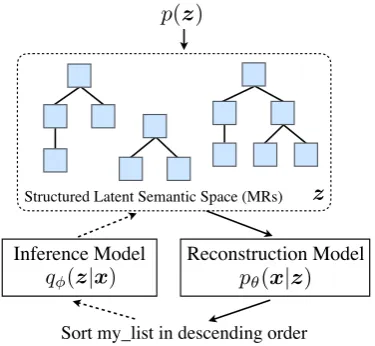
Figure 1: Graphical Representation of STRUCTVAE
While these models have a long history (Zelle and Mooney,1996;Tang and Mooney,2001), re-cent advances are largely attributed to the success of neural network models (Xiao et al.,2016;Ling et al., 2016;Dong and Lapata, 2016;Iyer et al.,
2017;Zhong et al., 2017). However, these mod-els are also extremelydata hungry: optimization of such models requires large amounts of training data of parallel NL utterances and manually anno-tated MRs, the creation of which can be expensive, cumbersome, and time-consuming. Therefore, the limited availability of parallel data has become the bottleneck of existing, purely supervised-based models. These data requirements can be alleviated withweakly-supervisedlearning, where the deno-tations (e.g., answers in question answering) of MRs (e.g., logical form queries) are used as indi-rect supervision (Clarke et al.(2010);Liang et al.
(2011); Berant et al.(2013), inter alia), or data-augmentation techniques that automatically gen-erate pseudo-parallel corpora using hand-crafted or induced grammars (Jia and Liang,2016;Wang et al.,2015).
amounts of parallel NL-MR corpora, and unla-beled but readily-available NL utterances. We draw inspiration from recent success in applying variational auto-encoding (VAE) models in semi-supervised sequence-to-sequence learning (Miao and Blunsom, 2016; Kocisk´y et al., 2016), and propose STRUCTVAE — a principled deep gener-ative approach for semi-supervised learning with tree-structured latent variables (Fig. 1). STRUCT -VAE is based on a generative story where the surface NL utterances are generated from tree-structured latent MRs following the standard VAE architecture: (1) an off-the-shelf semantic parser functions as the inference model, parsing an ob-served NL utterance into latent meaning represen-tations (§3.2); (2) areconstruction modeldecodes the latent MR into the original observed utterance (§ 3.1). This formulation enables our model to perform both standard supervised learning by op-timizing the inference model (i.e., the parser) us-ing parallel corpora, and unsupervised learnus-ing by maximizing the variational lower bound of the likelihood of the unlabeled utterances (§3.3).
In addition to these contributions to semi-supervised semantic parsing, STRUCTVAE con-tributes to generative model research as a whole, providing a recipe for training VAEs with struc-tured latent variables. Such a structural latent space is contrast to existing VAE research using flatrepresentations, such as continuous distributed representations (Kingma and Welling,2013), dis-crete symbols (Miao and Blunsom,2016), or hy-brids of the two (Zhou and Neubig,2017).
We apply STRUCTVAE to semantic parsing on the ATIS domain and Python code genera-tion. As an auxiliary contribution, we implement a transition-based semantic parser, which uses Ab-stract Syntax Trees (ASTs, § 3.2) as intermedi-ate MRs and achieves strong results on the two tasks. We then apply this parser as the inference model for semi-supervised learning, and show that with extra unlabeled data, STRUCTVAE outper-forms its supervised counterpart. We also demon-strate that STRUCTVAE is compatible with differ-ent structured latdiffer-ent represdiffer-entations, applying it to a simple sequence-to-sequence parser which uses
λ-calculus logical forms as MRs.
2 Semi-supervised Semantic Parsing
In this section we introduce the objectives for semi-supervised semantic parsing, and present high-level intuition in applying VAEs for this task.
2.1 Supervised and Semi-supervised Training
Formally, semantic parsing is the task of map-ping utterance x to a meaning representation z. As noted above, there are many varieties of MRs that can be represented as either graph structures (e.g., AMR) or tree structures (e.g., λ-calculus and ASTs for programming languages). In this work we specifically focus on tree-structured MRs (see Fig. 2 for a running example Python AST), although application of a similar framework to graph-structured representations is also feasible.
Traditionally, purely supervised semantic parsers train a probabilistic modelpφ(z|x) using parallel data L of NL utterances and annotated
MRs (i.e., L = {hx,zi}). As noted in the
introduction, one major bottleneck in this ap-proach is the lack of such parallel data. Hence, we turn to semi-supervised learning, where the model additionally has access to a relatively large amount of unlabeled NL utterances U = {x}.
Semi-supervised learning then aims to maximize the log-likelihood of examples in bothLandU:
J = X
hx,zi ∈L
logpφ(z|x)
| {z }
supervised obj. Js
+αX
x∈U
logp(x)
| {z }
unsupervised obj. Ju (1)
The joint objective consists of two terms: (1) a supervised objective Js that maximizes the con-ditional likelihood of annotated MRs, as in stan-dard supervised training of semantic parsers; and (2) a unsupervised objectiveJu, which maximizes the marginal likelihoodp(x)of unlabeled NL ut-terances U, controlled by a tuning parameter α.
Intuitively, if the modeling of pφ(z|x) and p(x) is coupled (e.g., they share parameters), then op-timizing the marginal likelihood p(x) using the unsupervised objectiveJu would help the learn-ing of the semantic parser pφ(z|x) (Zhu, 2005). STRUCTVAE uses the variational auto-encoding framework to jointly optimizepφ(z|x)andp(x), as outlined in§2.2and detailed in§3.
2.2 VAEs for Semi-supervised Learning
sampled from a prior, and then passed to the recon-struction model to decode into the surface utter-ancex. There is also aninferencemodelqφ(z|x) that allows us to infer the most probable latent MR z given the inputx(dashed arrows inFig. 1, ex-plained in § 3.2). In our case, the inference pro-cess is equivalent to the task of semantic parsing if we set qφ(·) , pφ(·). VAEs also provide a framework to compute an approximation ofp(x) using the inference and reconstruction models, al-lowing us to effectively optimize the unsupervised and supervised objectives inEq. (1)in a joint fash-ion (Kingma et al.(2014), explained in§3.3).
3 STRUCTVAE: VAEs with
Tree-structured Latent Variables
3.1 Generative Story
STRUCTVAE follows the standard VAE architec-ture, and defines a generative story that explains how an NL utterance is generated: a latent mean-ing representationz is sampled from a prior dis-tribution p(z) over MRs, which encodes the la-tent semantics of the utterance. A reconstruction model pθ(x|z) then decodes the sampled MR z into the observed NL utterancex.
Both the prior p(z) and the reconstruction modelp(x|z)takes tree-structured MRs as inputs. To model such inputs with rich internal structures, we followKonstas et al.(2017), and model the dis-tribution over a sequential surface representation of z, zs instead. Specifically, we have p(z) ,
p(zs)andpθ(x|z), pθ(x|zs)2. For code gener-ation,zsis simply the surface source code of the ASTz. For semantic parsing,zsis the linearized s-expression of the logical form. Linearization al-lows us to use standard sequence-to-sequence net-works to modelp(z)andpθ(x|z). As we will ex-plain in§4.3, we find these two components per-form well with linearization.
Specifically, the prior is parameterized by a Long Short-Term Memory (LSTM) language model over zs. The reconstruction model is an attentional sequence-to-sequence network (Luong et al., 2015), augmented with a copying mech-anism (Gu et al., 2016), allowing an out-of-vocabulary (OOV) entity inzs to be copied tox (e.g., the variable namemy listinFig. 1and its AST inFig. 2). We refer readers to Appendix B
for details of the neural network architecture.
2Linearizion is used by the prior and the reconstruction
model only, and not by the inference model.
3.2 Inference Model
STRUCTVAE models the semantic parserpφ(z|x) as the inference model qφ(z|x) in VAE (§ 2.2), which maps NL utterances xinto tree-structured meaning representations z. qφ(z|x) can be any trainable semantic parser, with the correspond-ing MRs formcorrespond-ing the structured latent semantic space. In this work, we primarily use a seman-tic parser based on the Abstract Syntax Descrip-tion Language (ASDL) framework (Wang et al.,
1997) as the inference model. The parser en-codesx into ASTs (Fig. 2). ASTs are the native meaning representation scheme of source code in modern programming languages, and can also be adapted to represent other semantic structures, like
λ-calculus logical forms (see § 4.2 for details). We remark that STRUCTVAE works with other se-mantic parsers with different meaning representa-tions as well (e.g., usingλ-calculus logical forms for semantic parsing on ATIS, explained in§4.3).
Our inference model is a transition-based parser inspired by recent work in neural semantic pars-ing and code generation. The transition system is an adaptation ofYin and Neubig(2017) (hereafter YN17), which decomposes the generation process of an AST into sequential applications of tree-construction actions following the ASDL gram-mar, thus ensuring the syntactic well-formedness of generated ASTs. Different from YN17, where ASTs are represented as a Context Free Grammar learned from a parsed corpus, we follow Rabi-novich et al.(2017) and use ASTs defined under the ASDL formalism (§3.2.1).
3.2.1 Generating ASTs with ASDL Grammar
First, we present a brief introduction to ASDL. An AST can be generated by applying typed construc-torsin an ASDL grammar, such as those inFig. 3
for the Python ASDL grammar. Each constructor specifies a language construct, and is assigned to a particularcomposite type. For example, the con-structor Call has type expr (expression), and it denotes function calls. Constructors are associated with multiplefields. For instance, the Call con-structor and has three fields: func, args and key-words. Like constructors, fields are also strongly typed. For example, the func field of Call has
Expr
Name
Call
value
func
Name
args keywords
Keyword sorted
id
id
my_list reverse Name
value arg
True t1
t2
t3
t4
t5
t6
t8
t9 t10
t11
id
sorted(my_list, reverse=True)
t Frontier Field Action
t1 stmt root Expr(expr value)
t2 expr value Call(expr func, expr* args, keyword* keywords) t3 expr func Name(identifier id)
t4 identifier id GENTOKEN[sorted] t5 expr* args Name(identifier id) t6 identifier id GENTOKEN[my list]
t7 expr* args REDUCE(close the frontier field)
t8 keyword* keywords keyword(identifier arg, expr value) t9 identifier arg GENTOKEN[reverse]
t10 expr value Name(identifier id) t11 identifier id GENTOKEN[T rue]
[image:4.595.73.529.60.206.2]t12 keyword* keywords REDUCE(close the frontier field)
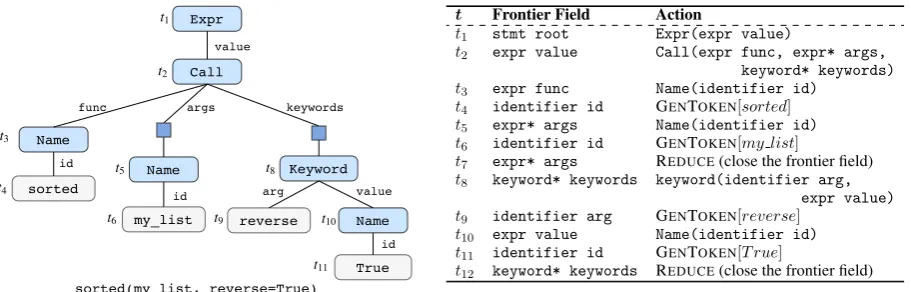
Figure 2: LeftAn example ASDL AST with its surface source code. Field names are labeled on upper arcs. Blue squares denote fields withsequentialcardinality. Grey nodes denote primitive identifier fields, with annotated values. Fields are labeled with time steps at which they are generated. RightAction sequences used to construct the example AST. Frontier fields are denoted by their signature(type name). Each constructor in the Action column refers to an APPLYCONSTRaction.
stmt FunctionDef(identifier name,
arguments args, stmt* body) | ClassDef(identifier name, expr* bases, stmt* body) | Expr(expr value)
| Return(expr? value) 7!
expr Call(expr func, expr* args, keyword* keywords) | Name(identifier id)
| Str(string s) 7!
Figure 3: Excerpt of the python abstract syntax gram-mar (Python Software Foundation,2016)
a cardinality (single, optional?, and sequential∗), specifying the number of values the field has.
Each node in an AST corresponds to a typed field in a constructor (except for the root node). Depending on the cardinality of the field, an AST node can be instantiated with one or multiple con-structors. For instance, the func field in the ex-ample AST has single cardinality, and is instan-tiated with a Name constructor; while the args field with sequential cardinality could have multi-ple constructors (only one shown in this exammulti-ple). Our parser employs a transition system to gen-erate an AST using three types of actions.Fig. 2
(Right) lists the sequence of actions used to gen-erate the example AST. The generation process starts from an initial derivation with only a root node of type stmt (statement), and proceeds ac-cording to the top-down, left-to-right traversal of the AST. At each time step, the parser applies an action to thefrontier fieldof the derivation:
APPLYCONSTR[c]actions apply a constructor
c to the frontier composite field, expanding the derivation using the fields ofc. For fields with sin-gle or optional cardinality, an APPLYCONSTR ac-tion instantiates the empty frontier field using the constructor, while for fields with sequential car-dinality, it appends the constructor to the frontier field. For example, att2 theCall constructor is
applied to thevaluefield ofExpr, and the deriva-tion is expanded using its three child fields.
REDUCEactions complete generation of a field with optional or multiple cardinalities. For in-stance, theargsfield is instantiated byNameatt5,
and then closed by a REDUCEaction att7. GENTOKEN[v] actions populate an empty primitive frontier field with tokenv. A primitive field whose value is a single token (e.g., identi-fier fields) can be populated with a single GEN -TOKENaction. Fields ofstringtype can be in-stantiated using multiple such actions, with a final GENTOKEN[</f>]action to terminate the genera-tion of field values.
3.2.2 Modelingqφ(z|x)
The probability of generating an ASTz is natu-rally decomposed into the probabilities of the ac-tions{at}used to constructz:
qφ(z|x) = Y
t
p(at|a<t,x).
Following YN17, we parameterizeqφ(z|x)using a sequence-to-sequence network with auxiliary re-current connections following the topology of the AST. Interested readers are referred toAppendix B
andYin and Neubig(2017) for details of the neu-ral network architecture.
3.3 Semi-supervised Learning
In this section we explain how to optimize the semi-supervised learning objective Eq. (1) in STRUCTVAE.
se-mantic parser) and the reconstruction model:
Js, X
(x,z)∈L
logqφ(z|x) + logpθ(x|z)
(2)
Unsupervised Learning To optimize the unsu-pervised learning objectiveJuinEq. (1), we max-imize the variational lower-bound oflogp(x):
logp(x)≥Ez∼q
φ(z|x) logpθ(x|z)
−λ·KL[qφ(z|x)||p(z)] =L (3)
whereKL[qφ||p]is the Kullback-Leibler (KL) di-vergence. Following common practice in optimiz-ing VAEs, we introduce λas a tuning parameter of the KL divergence to control the impact of the prior (Miao and Blunsom, 2016;Bowman et al.,
2016).
To optimize the parameters of our model in the face of non-differentiable discrete latent variables, we follow Miao and Blunsom (2016), and ap-proximate ∂∂φL using the score function estimator (a.k.a. REINFORCE,Williams(1992)):
∂L
∂φ = ∂
∂φEz∼qφ(z|x)
logpθ(x|z)−λ logqφ(z|x)−logp(z)
| {z }
learning signal
= ∂
∂φEz∼qφ(z|x)l 0
(x,z)
≈ 1
|S(x)| X
zi∈S(x)
l0(x,zi)∂logqφ(zi|x)
∂φ (4)
where we approximate the gradient using a set of samplesS(x)drawn fromqφ(·|x). To ensure the quality of sampled latent MRs, we follow Guu et al. (2017) and use beam search. The term
l0(x,z) is defined as the learning signal (Miao and Blunsom,2016). The learning signal weights the gradient for each latent sample z. In REIN-FORCE, to cope with the high variance of the learning signal, it is common to use a baseline
b(x)to stabilize learning, and re-define the learn-ing signal as
l(x,z),l0(x,z)−b(x). (5)
Specifically, in STRUCTVAE, we define
b(x) =a·logp(x) +c, (6)
where logp(x) is a pre-trained LSTM language model. This is motivated by the empirical obser-vation thatlogp(x)correlates well with the recon-struction scorelogpθ(x|z), hence withl0(x,z).
Finally, for the reconstruction model, its
gradi-ent can be easily computed:
∂L
∂θ ≈
1 |S(x)|
X
zi∈S(x)
∂logpθ(x|zi)
∂θ .
Discussion Perhaps the most intriguing question here is why semi-supervised learning could im-prove semantic parsing performance. While the underlying theoretical exposition still remains an active research problem (Singh et al., 2008), in this paper we try to empirically test some likely hypotheses. In Eq. (4), the gradient received by the inference model from each latent samplezis weighed by the learning signall(x,z).l(x,z)can be viewed as the reward function in REINFORCE learning. It can also be viewed as weights associ-ated with pseudo-training examples{hx,zi :z∈ S(x)} sampled from the inference model. Intu-itively, a sample z with higher rewards should: (1) have z adequately encode the input, leading to high reconstruction score logpθ(x|z); and (2) havezbe succinct and natural, yielding high prior probability. Letz∗ denote the gold-standard MR ofx. Consider the ideal case wherez∗ ∈ S(x) andl(x,z∗)is positive, whilel(x,z0)is negative for other imperfect samplesz0 ∈ S(x),z0 6=z∗. In this ideal case,hx,z∗iwould serve as a positive training example and other sampleshx,z0iwould be treated as negative examples. Therefore, the in-ference model would receive informative gradient updates, and learn to discriminate between gold and imperfect MRs. This intuition is similar in spirit to recent efforts in interpreting gradient up-date rules in reinforcement learning (Guu et al.,
2017). We will present more empirical statistics and observations in§4.3.
4 Experiments
4.1 Datasets
In our semi-supervised semantic parsing experi-ments, it is of interest how STRUCTVAE could further improve upon a supervised parser with ex-tra unlabeled data. We evaluate on two datasets:
-calculus logical forms using our transition-based parser, we use the ASDL grammar defined by Ra-binovich et al.(2017) to convert between logical forms and ASTs (seeAppendix Cfor details).
Code Generation The DJANGO dataset (Oda et al., 2015) contains 18,805 lines of Python source code extracted from the Django web frame-work. Each line of code is annotated with an NL utterance. Source code in the DJANGO dataset exhibits a wide variety of real-world use cases of Python, including IO operation, data structure manipulation, class/function definition, etc. We use the pre-processed version released byYin and Neubig(2017) and use theastorpackage to con-vert ASDL ASTs into Python source code.
4.2 Setup
Labeled and Unlabeled Data STRUCTVAE re-quires access to extra unlabeled NL utterances for semi-supervised learning. However, the datasets we use do not accompany with such data. We therefore simulate the semi-supervised learning scenario by randomly sub-sampling K examples from the training split of each dataset as the la-beled setL. To make the most use of the NL
ut-terances in the dataset, we construct the unlabeled setUusing all NL utterances in the training set3,4.
Training Procedure Optimizing the unsuper-vised learning objectiveEq. (3)requires sampling structured MRs from the inference modelqφ(z|x). Due to the complexity of the semantic parsing problem, we cannot expect any valid samples from randomly initialized qφ(z|x). We therefore pre-train the inference and reconstruction mod-els using the supervised objective Eq. (2) until convergence, and then optimize using the semi-supervised learning objectiveEq. (1). Throughout all experiments we setα(Eq. (1)) andλ(Eq. (3)) to 0.1. The sample size|S(x)|is 5. We observe that the variance of the learning signal could still be high when low-quality samples are drawn from the inference model qφ(z|x). We therefore clip
3
We also tried constructingUusing the disjoint portion of the NL utterances not presented in the labeled setL, but found this yields slightly worse performance, probably due to lacking enough unlabeled data. Interpreting these results would be an interesting avenue for future work.
4
While it might be relatively easy to acquire additional unlabeled utterances in practical settings (e.g., through query logs of a search engine), unfortunately most academic seman-tic parsing datasets, like the ones used in this work, do not feature large sets of in-domain unlabeled data. We therefore perform simulated experiments instead.
|L| SUP. SELFTRAIN STRUCTVAE
500 63.2 65.3 66.0
1,000 74.6 74.2 75.7
2,000 80.4 83.3 82.4
3,000 82.8 83.6 83.6
4,434 (All) 85.3 – 84.5
Previous Methods ACC.
ZC07 (Zettlemoyer and Collins,2007) 84.6
WKZ14 (Wang et al.,2014) 91.3
SEQ2TREE(Dong and Lapata,2016)† 84.6
ASN (Rabinovich et al.,2017)† 85.3
[image:6.595.314.522.63.217.2]+ supervised attention 85.9
Table 1: Performance on ATISw.r.t. the size of labeled train-ing dataL.†Existing neural network-based methods
|L| SUP. SELFTRAIN STRUCTVAE
1,000 49.9 49.5 52.0
2,000 56.6 55.8 59.0
3,000 61.0 61.4 62.4
5,000 63.2 64.5 65.6
8,000 70.3 69.6 71.5
12,000 71.1 71.6 72.0
16,000 (All) 73.7 – 72.3
Previous Method ACC.
YN17 (Yin and Neubig,2017) 71.6
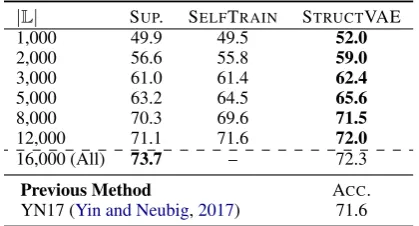
Table 2: Performance on DJANGOw.r.t. the size of labeled training dataL
all learning signals lower thank =−20.0. Early-stopping is used to avoid over-fitting. We also pre-train the priorp(z)(§3.3) and the baseline func-tionEq. (6). Readers are referred toAppendix D
for more detail of the configurations.
Metric As standard in semantic parsing re-search, we evaluate by exact-matchaccuracy.
4.3 Main Results
Tab. 1 and Tab. 2 list the results on ATIS and DJANGO, resp, with varying amounts of labeled data L. We also present results of training the
transition-based parser using only the supervised objective (SUP., Eq. (2)). We also compare STRUCTVAE with self-training (SELFTRAIN), a semi-supervised learning baseline which uses the supervised parser to predict MRs for unlabeled utterances in U−L, and adds the predicted
ex-amples to the training set to fine-tune the super-vised model. Results for STRUCTVAE are aver-aged over four runs to account for the additional fluctuation caused by REINFORCE training.
[image:6.595.313.523.261.374.2]−30 −20 −10 0 10 20 0.0
0.1
0.2 z∗(ˆµ= 2.59, ˆσ= 30.80)
z0(ˆµ=−5.12, ˆσ= 214.62)
(a) DJANGO
−30 −20 −10 0 10 20 0.0
0.1 0.2
z∗(ˆµ= 0.94, ˆσ= 19.06)
z0(ˆµ=−3.35, ˆσ= 96.66)
[image:7.595.90.267.60.221.2](b) ATIS
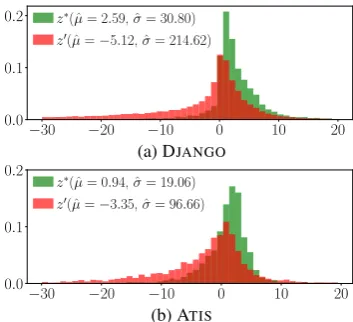
Figure 4: Histograms of learning signals on DJANGO(|L|=
5000) and ATIS(|L|= 2000). Difference in sample means is statistically significant (p <0.05).
our supervised baseline), we compare the super-vised version of our parser with existing parsing models. On ATIS, our supervised parser trained on the full data is competitive with existing neural network based models, surpassing the SEQ2TREE model, and on par with the Abstract Syntax Net-work (ASN) without using extra supervision. On DJANGO, our model significantly outperforms the YN17 system, probably because the transition sys-tem used by our parser is defined natively to con-struct ASDL ASTs, reducing the number of ac-tions for generating each example. On DJANGO, the average number of actions is 14.3, compared with 20.3 reported in YN17.
Semi-supervised Learning Next, we discuss our main comparison between STRUCTVAE with the supervised version of the parser (recall that the supervised parser is used as the inference model in STRUCTVAE, § 3.2). First, comparing our proposed STRUCTVAE with the supervised parser when there are extra unlabeled data (i.e., |L| <
4,434for ATISand|L| < 16,000for DJANGO), semi-supervised learning with STRUCTVAE con-sistently achieves better performance. Notably, on DJANGO, our model registers results as compet-itive as previous state-of-the-art method (YN17) using onlyhalfthe training data (71.5when|L|= 8000 v.s. 71.6 for YN17). This demonstrates that STRUCTVAE is capable of learning from un-labeled NL utterances by inferring high quality, structurally rich latent meaning representations, further improving the performance of its super-vised counterpart that is already competitive. Sec-ond, comparing STRUCTVAE with self-training, we find STRUCTVAE outperforms SELFTRAIN in eight out of ten settings, while SELFTRAIN
1 2 3 4 5 0.0
0.4 0.8
(a) DJANGO
1 2 3 4 5 0.0
0.4 0.8
(b) ATIS
Figure 5: Distribution of the rank ofl(x,z∗)in sampled set
under-performs the supervised parser in four out of ten settings. This shows self-training does not necessarily yield stable gains while STRUCTVAE does. Intuitively, STRUCTVAE would perform better since it benefits from the additional signal of the quality of MRs from the reconstruction model (§3.3), for which we present more analysis in our next set of experiments.
For the sake of completeness, we also report the results of STRUCTVAE when Lis the full
train-ing set. Note that in this scenario there is no extra unlabeled data disjoint with the labeled set, and not surprisingly, STRUCTVAE does not outper-form the supervised parser. In addition to the su-pervised objectiveEq. (2)used by the supervised parser, STRUCTVAE has the extra unsupervised objective Eq. (3), which uses sampled (probably incorrect) MRs to update the model. When there is no extra unlabeled data, those sampled (incor-rect) MRs add noise to the optimization process, causing STRUCTVAE to under-perform.
Study of Learning Signals As discussed in§3.3, in semi-supervised learning, the gradient received by the inference model from each sam-pled latent MR is weighted by the learning signal. Empirically, we would expect that on average, the learning signals of gold-standard samplesz∗,
l(x,z∗), are positive, larger than those of other (imperfect) samples z0, l(x,z0). We therefore study the statistics ofl(x,z∗)andl(x,z0) for all utterances x ∈ U−L, i.e., the set of utterances
which are not included in the labeled set.5 The statistics are obtained by performing inference using trained models. Figures 4a and 4b depict the histograms of learning signals on DJANGO and ATIS, resp. We observe that the learning signals for gold samples concentrate on positive intervals. We also show the mean and variance of the learning signals. On average, we have
l(x,z∗)being positive andl(x,z)negative. Also note that the distribution of l(x,z∗) has smaller variance and is more concentrated. Therefore the inference model receives informative gradient up-dates to discriminate between gold and imperfect
5We focus on cases wherez∗
[image:7.595.307.528.62.112.2]NL join p and cmd into a file path, substitute it for f
zs
1 f = os.path.join(p, cmd) 3
logq(z|x) =−1.00 logp(x|z) =−2.00 logp(z) =−24.33 l(x,z) = 9.14 z2s p = path.join(p, cmd) 7
logq(z|x) =−8.12 logp(x|z) =−20.96 logp(z) =−27.89 l(x,z) =−9.47
NL append i-th element of existing to child loggers
zs
1 child loggers.append(existing[i]) 3 logq(z|x) =−2.38 logp(x|z) =−9.66 logp(z) =−13.52 l(x,z) = 1.32 zs
2 child loggers.append(existing[existing])7 logq(z|x) =−1.83 logp(x|z) =−16.11 logp(z) =−12.43 l(x,z) =−5.08
NL split string pks by ’,’, substitute the result for pri-mary keys
zs
1 primary keys = pks.split(’,’) 3
logq(z|x) =−2.38 logp(x|z) =−11.39 logp(z) =−10.24 l(x,z) = 2.05 zs
2 primary keys = pks.split + ’,’ 7
[image:8.595.75.293.63.311.2]logq(z|x) =−0.84 logp(x|z) =−14.87 logp(z) =−20.41 l(x,z) =−2.60
Table 3: Inferred latent MRs on DJANGO(|L|= 5000). For simplicity we show the surface representation of MRs (zs, source code) instead.
samples. Next, we plot the distribution of the rank of l(x,z∗), among the learning signals of all samples ofx,{l(x,zi) : zi ∈ S(x)}. Results are shown in Fig. 5. We observe that the gold samples z∗ have the largest learning signals in around 80% cases. We also find that whenz∗ has the largest learning signal, its average difference with the learning signal of the highest-scoring incorrect sample is 1.27 and 0.96 on DJANGOand ATIS, respectively.
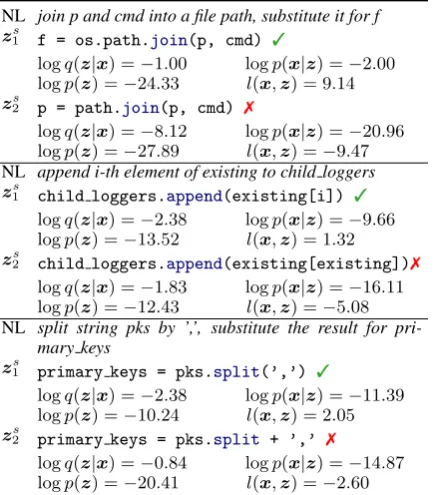
Finally, to study the relative contribution of the reconstruction score logp(x|z) and the prior logp(z) to the learning signal, we present ex-amples of inferred latent MRs during training (Tab. 3). Examples 1&2 show that the reconstruc-tion score serves as an informative quality measure of the latent MR, assigning the correct samplesz1s with highlogp(x|z), leading to positive learning signals. This is in line with our assumption that a good latent MR should adequately encode the se-mantics of the utterance. Example 3 shows that the prior is also effective in identifying “unnatu-ral” MRs (e.g., it is rare to add a function and a string literal, as in zs
2). These results also
sug-gest that the prior and the reconstruction model perform well with linearization of MRs. Finally, note that in Examples 2&3 the learning signals for the correct samplesz1sare positive even if their in-ference scoresq(z|x)are lower than those ofz2s.
|L| SUPERVISED STRUCTVAE-SEQ
500 47.3 55.6
1,000 62.5 73.1
2,000 73.9 74.8
3,000 80.6 81.3
4,434 (All) 84.6 84.2
Table 4: Performance of the STRUCTVAE-SEQ on ATIS
w.r.t. the size of labeled training dataL
ATIS DJANGO
|L| SUP. MLP LM |L| SUP. MLP LM 500 63.2 61.5† 66.0 1,000 49.9 47.0† 52.0
1,000 74.6 76.3 75.7 5,000 63.2 62.5† 65.6
2,000 80.4 82.9 82.4 8,000 70.3 67.6† 71.5
3,000 82.8 81.4† 83.6 12,000 71.1 71.6 72.0
Table 5: Comparison of STRUCTVAE with different base-line functionsb(x), italic†: semi-supervised learning with the MLP baseline is worse than supervised results.
This result further demonstrates that learning sig-nals provide informative gradient weights for op-timizing the inference model.
Generalizing to Other Latent MRs Our main results are obtained using a strong AST-based se-mantic parser as the inference model, with copy-augmented reconstruction model and an LSTM language model as the prior. However, there are many other ways to represent and infer structure in semantic parsing (Carpenter, 1998; Steedman,
2000), and thus it is of interest whether our ba-sic STRUCTVAE framework generalizes to other semantic representations. To examine this, we test STRUCTVAE using λ-calculus logical forms as latent MRs for semantic parsing on the ATIS domain. We use standard sequence-to-sequence networks with attention (Luong et al., 2015) as inference and reconstruction models. The infer-ence model is trained to construct a tree-structured logical form using the transition actions defined inCheng et al.(2017). We use a classical tri-gram Kneser-Ney language model as the prior. Tab. 4
lists the results for this STRUCTVAE-SEQmodel.
We can see that even with this very different model structure STRUCTVAE still provides signif-icant gains, demonstrating its compatibility with different inference/reconstruction networks and priors. Interestingly, compared with the results in Tab. 1, we found that the gains are especially larger with few labeled examples — STRUCT -VAE-SEQ achieves improvements of 8-10 points when |L| < 1000. These results suggest that
[image:8.595.330.504.63.130.2]0.0 0.2 0.4 0.6 0.8 1.0
λ
0.62 0.64 0.66
Accuracy StructVAE
[image:9.595.70.290.79.228.2]Sup.
Figure 6: Performance on DJANGO(|L| = 5000) w.r.t. the KL weightλ
1000 5000 8000 12000 14000 16000 Size of Unlabeled Data
0.645 0.650 0.655
Accuracy
StructVAE
Figure 7: Performance on DJANGO(|L| = 5000) w.r.t. the size of unlabeled dataU
Impact of Baseline Functions In§3.3 we dis-cussed our design of the baseline function b(x) incorporated in the learning signal (Eq. (4)) to stabilize learning, which is based on a language model (LM) over utterances (Eq. (6)). We com-pare this baseline with a commonly used one in REINFORCE training: the multi-layer perceptron (MLP). The MLP takes as input the last hidden state of the utterance given by the encoding LSTM of the inference model. Tab. 5 lists the results over sampled settings. We found that although STRUCTVAE with the MLP baseline sometimes registers better performance on ATIS, in most set-tings it is worse than our LM baseline, and could be even worse than the supervised parser. On the other hand, our LM baseline correlates well with the learning signal, yielding stable improvements over the supervised parser. This suggests the im-portance of using carefully designed baselines in REINFORCE learning, especially when the re-ward signal has large range (e.g., log-likelihoods).
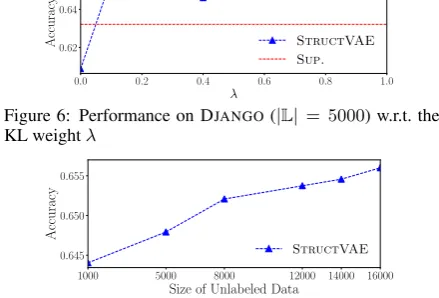
Impact of the Priorp(z) Fig. 6depicts the per-formance of STRUCTVAE as a function of the KL term weight λ in Eq. (3). When STRUCTVAE degenerates to a vanilla auto-encoder without the prior distribution (i.e.,λ = 0), it under-performs the supervised baseline. This is in line with our observation inTab. 3showing that the prior helps identify unnatural samples. The performance of the model also drops when λ > 0.1, suggesting that empirically controlling the influence of the prior to the inference model is important.
Impact of Unlabeled Data Size Fig. 7 illus-trates the accuracies w.r.t. the size of unlabeled data. STRUCTVAE yields consistent gains as the size of the unlabeled data increases.
5 Related Works
Semi-supervised Learning for NLP Semi-supervised learning comes with a long his-tory (Zhu,2005), with applications in NLP from early work of self-training (Yarowsky,1995), and graph-based methods (Das and Smith, 2011), to recent advances in auto-encoders (Cheng et al.,
2016;Socher et al.,2011;Zhang et al.,2017) and deep generative methods (Xu et al., 2017). Our work follows the line of neural variational infer-ence for text processing (Miao et al., 2016), and resemblesMiao and Blunsom(2016), which uses VAEs to model summaries as discrete latent vari-ables for semi-supervised summarization, while we extend the VAE architecture for more complex, tree-structured latent variables.
Semantic Parsing Most existing works allevi-ate issues of limited parallel data through weakly-supervised learning, using the denotations of MRs as indirect supervision (Reddy et al., 2014; Kr-ishnamurthy et al., 2016; Neelakantan et al.,
2016;Pasupat and Liang,2015;Yin et al.,2016). For semi-supervised learning of semantic pars-ing, Kate and Mooney (2007) first explore us-ing transductive SVMs to learn from a semantic parser’s predictions. Konstas et al. (2017) ap-ply self-training to bootstrap an existing parser for AMR parsing. Kocisk´y et al. (2016) em-ploy VAEs for semantic parsing, but in con-trast to STRUCTVAE’s structured representation of MRs, they model NL utterances as flat la-tent variables, and learn from unlabeled MR data. There have also been efforts in unsupervised se-mantic parsing, which exploits external linguis-tic analysis of utterances (e.g., dependency trees) and the schema of target knowledge bases to infer the latent MRs (Poon and Domingos,2009;Poon,
2013). Another line of research is domain adap-tation, which seeks to transfer a semantic parser learned from a source domain to the target domain of interest, therefore alleviating the need of paral-lel data from the target domain (Su and Yan,2017;
Fan et al.,2017;Herzig and Berant,2018).
6 Conclusion
References
Dzmitry Bahdanau, Kyunghyun Cho, and Yoshua Ben-gio. 2015. Neural machine translation by jointly learning to align and translate. In Proceedings of ICLR.
Laura Banarescu, Claire Bonial, Shu Cai, Madalina Georgescu, Kira Griffitt, Ulf Hermjakob, Kevin Knight, Philipp Koehn, Martha Palmer, and Nathan Schneider. 2013. Abstract meaning representation for sembanking. InProceedings of LAW-ID@ACL.
Jonathan Berant, Andrew Chou, Roy Frostig, and Percy Liang. 2013. Semantic parsing on freebase from question-answer pairs. InProceedings of EMNLP.
Samuel R. Bowman, Luke Vilnis, Oriol Vinyals, An-drew M. Dai, Rafal J´ozefowicz, and Samy Ben-gio. 2016. Generating sentences from a continuous space. InProceedings of the SIGNLL.
Bob Carpenter. 1998.Type-logical Semantics.
Jianpeng Cheng, Siva Reddy, Vijay Saraswat, and Mirella Lapata. 2017. Learning structured natural language representations for semantic parsing. In
Proceedings of ACL.
Yong Cheng, Wei Xu, Zhongjun He, Wei He, Hua Wu, Maosong Sun, and Yang Liu. 2016. Semi-supervised learning for neural machine translation. InProceedings of ACL.
James Clarke, Dan Goldwasser, Ming-Wei Chang, and Dan Roth. 2010. Driving semantic parsing from the world’s response. InProceedings of CoNLL.
Dipanjan Das and Noah A. Smith. 2011. Semi-supervised frame-semantic parsing for unknown predicates. InProceedings of HLT.
Li Dong and Mirella Lapata. 2016. Language to logical form with neural attention. InProceedings of ACL.
Xing Fan, Emilio Monti, Lambert Mathias, and Markus Dreyer. 2017. Transfer learning for neural seman-tic parsing. InProceedings of the 2nd Workshop on Representation Learning for NLP.
Jiatao Gu, Zhengdong Lu, Hang Li, and Victor O. K. Li. 2016. Incorporating copying mechanism in sequence-to-sequence learning. In Proceedings of ACL.
Kelvin Guu, Panupong Pasupat, Evan Zheran Liu, and Percy Liang. 2017. From language to pro-grams: Bridging reinforcement learning and maxi-mum marginal likelihood. InProceedings of ACL.
Jonathan Herzig and Jonathan Berant. 2018. Decou-pling structure and lexicon for zero-shot semantic parsing.arXiv preprint arXiv:1804.07918.
Srinivasan Iyer, Ioannis Konstas, Alvin Cheung, Jayant Krishnamurthy, and Luke Zettlemoyer. 2017. Learning a neural semantic parser from user feed-back. InProceedings of ACL.
Robin Jia and Percy Liang. 2016. Data recombination for neural semantic parsing. InProceedings of ACL.
Rohit J. Kate and Raymond J. Mooney. 2007. Semi-supervised learning for semantic parsing using sup-port vector machines. In Proceedings of NAACL-HLT.
Diederik P. Kingma and Jimmy Ba. 2014. Adam: A method for stochastic optimization. CoRR
abs/1412.6980.
Diederik P Kingma, Shakir Mohamed, Danilo Jimenez Rezende, and Max Welling. 2014. Semi-supervised learning with deep generative models. In Proceed-ings of NIPS.
Diederik P Kingma and Max Welling. 2013. Auto-encoding variational bayes. arXiv preprint arXiv:1312.6114.
Tom´as Kocisk´y, G´abor Melis, Edward Grefenstette,
Chris Dyer, Wang Ling, Phil Blunsom, and
Karl Moritz Hermann. 2016. Semantic parsing with semi-supervised sequential autoencoders. In Pro-ceedings of EMNLP.
Ioannis Konstas, Srinivasan Iyer, Mark Yatskar, Yejin Choi, and Luke Zettlemoyer. 2017. Neural amr: Sequence-to-sequence models for parsing and gen-eration. InProceedings of ACL.
Jayant Krishnamurthy, Oyvind Tafjord, and Aniruddha Kembhavi. 2016. Semantic parsing to probabilistic programs for situated question answering. In Pro-ceedings of EMNLP.
Chen Liang, Jonathan Berant, Quoc Le, Kenneth D. Forbus, and Ni Lao. 2017. Neural symbolic ma-chines: Learning semantic parsers on freebase with weak supervision. InProceedings of ACL.
Percy Liang, Michael I. Jordan, and Dan Klein. 2011. Learning dependency-based compositional seman-tics. InProceedings of ACL.
Wang Ling, Phil Blunsom, Edward Grefenstette, Karl Moritz Hermann, Tom´as Kocisk´y, Fumin Wang, and Andrew Senior. 2016. Latent predictor networks for code generation. In Proceedings of ACL.
Thang Luong, Hieu Pham, and Christopher D. Man-ning. 2015. Effective approaches to attention-based neural machine translation. In Proceedings of EMNLP.
Yishu Miao and Phil Blunsom. 2016. Language as a latent variable: Discrete generative models for sen-tence compression. InProceedings of EMNLP.
Dipendra K. Misra and Yoav Artzi. 2016. Neural shift-reduce CCG semantic parsing. In Proceedings of EMNLP.
Arvind Neelakantan, Quoc V. Le, and Ilya Sutskever. 2016. Neural programmer: Inducing latent pro-grams with gradient descent. In Proceedings of ICLR.
Yusuke Oda, Hiroyuki Fudaba, Graham Neubig, Hideaki Hata, Sakriani Sakti, Tomoki Toda, and Satoshi Nakamura. 2015. Learning to generate pseudo-code from source code using statistical ma-chine translation (T). InProceedings of ASE.
Panupong Pasupat and Percy Liang. 2015. Composi-tional semantic parsing on semi-structured tables. In
Proceedings of ACL.
Hoifung Poon. 2013. Grounded unsupervised semantic parsing. InProceedings of ACL.
Hoifung Poon and Pedro Domingos. 2009. Unsuper-vised semantic parsing. InProceedings of EMNLP.
Python Software Foundation. 2016. Python abstract grammar. https://docs.python.org/2/library/ast.html.
Chris Quirk, Raymond J. Mooney, and Michel Galley. 2015. Language to code: Learning semantic parsers for if-this-then-that recipes. InProceedings of ACL.
Maxim Rabinovich, Mitchell Stern, and Dan Klein. 2017. Abstract syntax networks for code generation and semantic parsing. InProceedings of ACL.
Siva Reddy, Mirella Lapata, and Mark Steedman. 2014. Large-scale semantic parsing without question-answer pairs. Transactions of ACL.
Aarti Singh, Robert D. Nowak, and Xiaojin Zhu. 2008. Unlabeled data: Now it helps, now it doesn’t. In
Proceedings of NIPS.
Richard Socher, Jeffrey Pennington, Eric H. Huang, Andrew Y. Ng, and Christopher D. Manning. 2011. Semi-supervised recursive autoencoders for predict-ing sentiment distributions. In Proceedings of EMNLP.
Mark Steedman. 2000. The Syntactic Process.
Yu Su and Xifeng Yan. 2017. Cross-domain seman-tic parsing via paraphrasing. In Proceedings of EMNLP.
Lappoon R. Tang and Raymond J. Mooney. 2001. Us-ing multiple clause constructors in inductive logic programming for semantic parsing. InProceedings of ECML.
Oriol Vinyals, Meire Fortunato, and Navdeep Jaitly. 2015. Pointer networks. InProceedings of NIPS.
Adrienne Wang, Tom Kwiatkowski, and Luke Zettle-moyer. 2014. Morpho-syntactic lexical generaliza-tion for ccg semantic parsing. In Proceedings of EMNLP.
Daniel C. Wang, Andrew W. Appel, Jeffrey L. Korn, and Christopher S. Serra. 1997. The zephyr ab-stract syntax description language. InProceedings of DSL.
Yushi Wang, Jonathan Berant, and Percy Liang. 2015. Building a semantic parser overnight. In Proceed-ings of ACL.
Ronald J. Williams. 1992. Simple statistical gradient-following algorithms for connectionist reinforce-ment learning. Machine Learning.
Chunyang Xiao, Marc Dymetman, and Claire Gardent. 2016. Sequence-based structured prediction for se-mantic parsing. InProceedings of ACL.
Weidi Xu, Haoze Sun, Chao Deng, and Ying Tan. 2017. Variational autoencoder for semi-supervised text classification. InProceedings of AAAI.
David Yarowsky. 1995. Unsupervised word sense dis-ambiguation rivaling supervised methods. In Pro-ceedings of ACL.
Wen-tau Yih, Ming-Wei Chang, Xiaodong He, and Jianfeng Gao. 2015. Semantic parsing via staged query graph generation: Question answering with knowledge base. InProceedings of ACL.
Pengcheng Yin, Zhengdong Lu, Hang Li, and Ben Kao. 2016. Neural enquirer: Learning to query tables in natural language. InProceedings of IJCAI.
Pengcheng Yin and Graham Neubig. 2017. A syntactic neural model for general-purpose code generation. InProceedings of ACL.
Wojciech Zaremba, Ilya Sutskever, and Oriol Vinyals. 2014. Recurrent neural network regularization.
arXiv preprint arXiv:1409.2329.
John M. Zelle and Raymond J. Mooney. 1996. Learn-ing to parse database queries usLearn-ing inductive logic programming. InProceedings of AAAI.
Luke Zettlemoyer and Michael Collins. 2005. Learn-ing to map sentences to logical form structured clas-sification with probabilistic categorial grammars. In
Proceedings of UAI.
Luke S. Zettlemoyer and Michael Collins. 2007. On-line learning of relaxed ccg grammars for parsing to logical form. InProceedings of EMNLP-CoNLL.
Xiao Zhang, Yong Jiang, Hao Peng, Kewei Tu, and Dan Goldwasser. 2017. Semi-supervised structured pre-diction with neural crf autoencoder. InProceedings of EMNLP.
Victor Zhong, Caiming Xiong, and Richard Socher. 2017. Seq2sql: Generating structured queries from natural language using reinforcement learning.
Chunting Zhou and Graham Neubig. 2017. Multi-space variational encoder-decoders for semi-supervised labeled sequence transduction. In
Proceedings of ACL.