Joint Inference of Named Entity Recognition and Normalization for Tweets
Xiaohua Liu‡ †, Ming Zhou†, Furu Wei†, Zhongyang Fu §, Xiangyang Zhou♯
‡School of Computer Science and Technology
Harbin Institute of Technology, Harbin, 150001, China §Department of Computer Science and Engineering
Shanghai Jiao Tong University, Shanghai, 200240, China ♯School of Computer Science and Technology
Shandong University, Jinan, 250100, China †Microsoft Research Asia
Beijing, 100190, China
†{xiaoliu, fuwei, mingzhou}@microsoft.com
§ [email protected] ♯ [email protected]
Abstract
Tweets represent a critical source of fresh in-formation, in which named entities occur fre-quently with rich variations. We study the problem of named entity normalization (NEN) for tweets. Two main challenges are the er-rors propagated from named entity recogni-tion (NER) and the dearth of informarecogni-tion in a single tweet. We propose a novel graphi-cal model to simultaneously conduct NER and NEN on multiple tweets to address these chal-lenges. Particularly, our model introduces a binary random variable for each pair of words with the same lemma across similar tweets, whose value indicates whether the two related words are mentions of the same entity. We evaluate our method on a manually annotated data set, and show that our method outper-forms the baseline that handles these two tasks separately, boosting the F1 from 80.2% to 83.6% for NER, and the Accuracy from 79.4% to 82.6% for NEN, respectively.
1 Introduction
Tweets, short messages of less than 140 characters shared through the Twitter service1, have become an important source of fresh information. As a re-sult, the task of named entity recognition (NER) for tweets, which aims to identify mentions of rigid designators from tweets belonging to named-entity types such as persons, organizations and locations (2007), has attracted increasing research interest. For example, Ritter et al. (2011) develop a sys-tem that exploits a CRF model to segment named
1
http://www.twitter.com
entities and then uses a distantly supervised ap-proach based on LabeledLDA to classify named en-tities. Liu et al. (2011) combine a classifier based on the k-nearest neighbors algorithm with a CRF-based model to leverage cross tweets information, and adopt the semi-supervised learning to leverage unlabeled tweets.
However, named entity normalization (NEN) for tweets, which transforms named entities mentioned in tweets to their unambiguous canonical forms, has not been well studied. Owing to the informal nature of tweets, there are rich variations of named enti-ties in them. According to our investigation on the data set provided by Liu et al. (2011), every named entity in tweets has an average of 3.3 variations 2. As an illustrative example, we show “Anneke Gron-loh”, which may occur as “Mw.,GronGron-loh”, “Anneke Kronloh” or “Mevrouw G”. We thus propose NEN for tweets, which plays an important role in entity retrieval, trend detection, and event and entity track-ing. For example, Khalid et al. (2008) show that even a simple normalization method leads to im-provements of early precision, for both document and passage retrieval, and better normalization re-sults in better retrieval performance.
Traditionally, NEN is regarded as a septated task, which takes the output of NER as its input (Li et al., 2002; Cohen, 2005; Jijkoun et al., 2008; Dai et al., 2011). One limitation of this cascaded approach is that errors propagate from NER to NEN and there is no feedback from NEN to NER. As demonstrated by Khalid et al. (2008), most NEN errors are caused
2
This data set consists of 12,245 randomly sampled tweets within five days.
by recognition errors. Another challenge of NEN is the dearth of information in a single tweet, due to the short and noise-prone nature of tweets. Re-portedly, the accuracy of a baseline NEN system based on Wikipedia drops considerably from 94% on edited news to 77% on news comments, a kind of user generated content (UGC) with similar style to tweets (Jijkoun et al., 2008).
We propose jointly conducting NER and NEN on multiple tweets using a graphical model, to address these challenges. Intuitively, improving the performance of NER boosts the performance of NEN. For example, consider the following two tweets: “· · ·Alex’s jokes. Justin’s smartness. Max’s randomnes· · · ” and “· · ·Alex Russo was like the best character on Disney Channel· · ·”. Identify-ing “Alex” and “Alex Russo” as PERSON will en-courage NEN systems to normalize “Alex” into “Alex Russo”. On the other hand, NEN can guide NER. For instance, consider the following two tweets: “· · ·she knew Burger King when he was a Prince!· · ·” and “· · ·I’m craving all sorts of food: mcdonalds, burger king, pizza, chinese· · ·”. Sup-pose the NEN system believes that “burger king” cannot be mapped to “Burger King” since these two tweets are not similar in content. This will help NER to assign them different types of labels. Our method optimizes these two tasks simultaneously by en-abling them to interact with each other. This largely differentiates our method from existing work.
Furthermore, considering multiple tweets simul-taneously allows us to exploit the redundancy in tweets, as suggested by Liu et al. (2011). For exam-ple, consider the following two tweets: “· · ·Bobby Shaw you don’t invite the wind· · ·” and “· · ·I own yah ! Loool bobby shaw· · ·”. Recognizing “Bobby Shaw” in the first tweet as a PERSON is easy owing to its capitalization and the following word “you”, which in turn helps to identify “bobby shaw” in the second tweet as a PERSON.
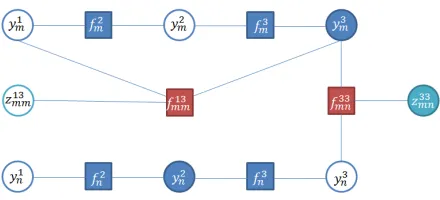
We adopt a factor graph as our graphical model, which is constructed in the following manner. We first introduce a random variable for each word in every tweet, which represents theBILOU (Begin-ning, the Inside and the Last tokens of multi-token entities as well as Unit-length entities) label of the corresponding word. Then we add a factor to con-nect two neighboring variables, forming a
conven-tional linear chain CRFs. Hereafter, we usetm to denote themthtweet ,tim and yim to denote theith word of oftmand itsBILOUlabel, respectively, and fmi to denote the factor related toyi−m1andymi . Next, for each word pair with the same lemma, denoted by tim and tjn, we introduce a binary random variable, denoted byzijmn, whose value indicates whetherti
[image:2.612.316.536.245.345.2]m andtjnbelong to two mentions of the same entity. Fi-nally, for anyzijmnwe add a factor, denoted byfmn,ij to connect yim, yjn and zmn. Factors in the sameij group ({fmnij } or {fmi }) share the same set of fea-ture templates. Figure 1 illustrates an example of our factor graph for two tweets.
Figure 1: A factor graph that jointly conducts NER and NEN on multiple tweets. Blue and green circles rep-resent NE type (y-serials) and normalization variables (z-serials), respectively; filled circles indicate observed random variables; blue rectangles represent the factors connecting neighboringy-serialvariables while red rect-angles stand for the factors connecting distanty-serial
andz-serialvariables.
It is worth noting that our factor graph is differ-ent from the skip-chain CRFs (Galley, 2006) in the sense that any skip-chain factor of our model con-sists not only of two NE type variables (yimandyjn), which is the case for skip-chain CRFs, but also a nor-malization variable (zmn). It is these normalizationij variables that enable us to conduct NER and NEN jointly.
We manually add normalization information to the data set shared by Liu et al. (2011), to eval-uate our method. Experimental results show that our method achieves 83.6% F1 for NER and 82.6% Accuracy for NEN, outperforming the baseline with 80.2%F1 for NER and 79.4% Accuracy for NEN.
We summarize our contributions as follows. 1. We introduce the task of NEN for tweets, and
multiple tweets using a factor graph, which leverages redundancy in tweets to make up for the dearth of information in a single tweet and allows these two tasks to inform each other. 2. We evaluate our method on a human annotated
data set, and show that our method compares favorably with the baseline, achieving better performance in both tasks.
Our paper is organized as follows. In the next sec-tion, we introduce related work. In Section 3 and 4, we formally define the task and present our method. In Section 5, we evaluate our method. And finally we conclude our work in Section 6.
2 Related Work
Related work can be divided into two categories: NER and NEN.
2.1 NER
NER has been well studied and its solutions can be divided into three categories: 1) Rule-based (Krupka and Hausman, 1998); 2) machine learning based (Finkel and Manning, 2009; Singh et al., 2010); and 3) hybrid methods (Jansche and Abney, 2002). Ow-ing to the availability of annotated corpora, such as ACE05, Enron (Minkov et al., 2005) and CoNLL03 (Tjong Kim Sang and De Meulder, 2003), data driven methods are now dominant.
Current studies of NER mainly focus on formal text such as news articles (Mccallum and Li, 2003; Etzioni et al., 2005). A representative work is that of Ratinov and Roth (2009), in which they system-atically study the challenges of NER, compare sev-eral solutions, and show some interesting findings. For example, they show that the BILOU encoding scheme significantly outperforms the BIO schema (Beginning, the Inside and Outside of a chunk).
A handful of work on other genres of texts exists. For example, Yoshida and Tsujii build a biomedi-cal NER system (2007) using lexibiomedi-cal features, or-thographic features, semantic features and syntactic features, such as part-of-speech (POS) and shallow parsing; Downey et al. (2007) employ capitaliza-tion cues and n-gram statistics to locate names of a variety of classes in web text; Wang (2009) intro-duces NER to clinical notes. A linear CRF model
is trained on a manually annotated data set, which achieves an F1 of 81.48% on the test data set; Chiti-cariu et al. (2010) design and implement a high-level language NERL which simplifies the process of building, understanding, and customizing com-plex rule-based named-entity annotators for differ-ent domains.
Recently, NER for Tweets attracts growing inter-est. Finin et al. (2010) use Amazons Mechani-cal Turk service3 and CrowdFlower4 to annotate
named entities in tweets and train a CRF model to evaluate the effectiveness of human labeling. Rit-ter et al. (2011) re-build the NLP pipeline for tweets beginning with POS tagging, through chunk-ing, to NER, which first exploits a CRF model to segment named entities and then uses a distantly su-pervised approach based on LabeledLDA to clas-sify named entities. Unlike this work, our work de-tects the boundary and type of a named entity si-multaneously using sequential labeling techniques. Liu et al. (2011) combine a classifier based on the k-nearest neighbors algorithm with a CRF-based model to leverage cross tweets information, and adopt the semi-supervised learning to leverage un-labeled tweets. Our method leverages redundance in similar tweets, using a factor graph rather than a two-stage labeling strategy. One advantage of our method is that local and global information can in-teract with each other.
2.2 NEN
There is a large body of studies into normalizing various types of entities for formally written texts. For instance, Cohen (2005) normalizes gene/protein names using dictionaries automatically extracted from gene databases; Magdy et al. (2007) address cross-document Arabic name normalization using a machine learning approach, a dictionary of person names and frequency information for names in a collection; Cucerzan (2007) demostrates a large-scale system for the recognition and semantic dis-ambiguation of named entities based on informa-tion extracted from a large encyclopedic collecinforma-tion and Web search results; Dai et al. (2011) employ a Markov logic network to model interweaved
con-3https://www.mturk.com/mturk/ 4
straints in a setting of gene mention normalization. Jijkoun et al. (2008) study NEN for UGC. They report that the accuracy of a baseline NEN system based on Wikipedia drops considerably from 94% on edited news to 77% on UGC. They identify three main error sources, i.e., entity recognition errors, multiple ways of referring to the same entity and am-biguous references, and exploit hand-crafted rules to improve the baseline NEN system.
We introduce the task of NEN for tweets, a new genre of texts with rich entity variations. In contrast to existing NEN systems, which take the output of NER systems as their input, our method conducts NER and NEN at the same time, allowing them to reinforce each other, as demonstrated by the experi-mental results.
3 Task Definition
A tweet is a short text message with no more than 140 characters. Here is an example of a tweet: “my-craftingworld: #Win Microsoft Office 2010 Home and Student #Contest from @office http://bit.ly/· · · ”, where “mycraftingworld” is the name of the user who published this tweet. Words beginning with “#” like “”#Win” are hash tags; words starting with “@” like “@office” represent user names; and “http://bit.ly/” is a shortened link.
Given a set of tweets, e.g., tweets within some pe-riod or related to some query, our task is: 1) To rec-ognize each mention of entities of predefined types for each tweet; and 2) to restore each entity mention into its unambiguous canonical form. Following Liu et al. (2011), we focus on four types of entities, i.e., PERSON, ORGANIZATION, PRODUCT, and LO-CATION, and constrain our scope to English tweets. Note that the NEN sub-task can be transformed as follows. Given each pair of entity mentions, decide whether they denote the same entity. Once this is achieved, we can link all the mentions of the same entity, and choose a representative mention, e.g., the longest mention, as their canonical form.
As an illustrative example, consider the following three tweets: “· · ·Gaga’s Christmas dinner with her family. Awwwwn· · ·”, “· · ·Lady Gaaaaga with her family on Christmas· · ·” and “· · ·Buying a maga-zine just because Lady Gaga’s on the cover· · ·”. It is expected that “Gaga”, “Lady Gaaaaga” and “Lady
Gaga” are all labeled as PERSON, and can be re-stored as “Lady Gaga”.
4 Our Method
In contrast to existing work, our method jointly conducts NER and NEN for multiple tweets. We first give an overview of our method, then detail its model and features.
4.1 Overview
Given a set of tweets as input, our method recog-nizes predefined types of named entities and for each entity outputs its unambiguous canonical form.
To resolve NER, we assign a label to each word in a tweet, indicating both the boundary and entity type. Following Ratinov and Roth (2009), we use the BILOU schema. For ex-ample, consider the tweet “· · ·without you is like an iphone without apps; Lady gaga with-out her telephone· · ·”, the labeled sequence us-ing the BILOU schema is: “· · ·withoutO youO isOlikeOanOiphoneU−P RODU CTwithoutOappsO; LadyB−P ERSON gagaL−P ERSON withoutO herO telephoneO· · ·” , where “iphoneU−P RODU CT” indi-cates that “iphone” is a product name of unit length; “LadyB−P ERSON” means “Lady” is the beginning of a person name while “gagaL−P ERSON” suggests that “gaga” is the last token of a person name.
To resolve NEN, we assign a binary value label zmnij to each pair of wordstimandt
j
nwhich share the same lemma. zmnij =1 or -1, indicating whethertim andtjnbelong to two mentions of the same entity5. For example, consider the three tweets presented in Section 3. “Gaga11” 6and “Gaga13” will be assigned a “1” label, since they are part of two mentions of the same entity “Lady Gaga”; similarly, “Lady12” and “Lady13” are connected with a “1” label. Note that there are no NEN labels for pairs like “her11” and “her12” or “with11and “with12”, since words like “her” and “with” are stop words.
With NE type and normalization labels obtained, we judge two mentions, denoted by ti1···ik
m and
5
Stop words have no normalization labels. The stop words are mainly from http://www.textfixer.com/resources/common-english-words.txt.
6We use wi
mto denote word w’sithappearance in themth tweet. For example, “Gaga11” denotes the first occurance of
tj1···jl
n , respectively, refer to the same entity if and only if: 1) The two mentions share the same entity type; 2)ti1···ik
m is a sub-string oft j1···jl
n or vise versa; and 3)zmnij = 1,i=i1,· · ·, ikandj =j1,· · · , jl, ifzijmn exists. Still take the three tweets presented in Section 3 for example. Suppose “Gaga11” and “Lady Gaga13” are labeled as PERSON, and there is only one related NE normalization label, which is associated with “‘Gaga11” and “Gaga13” and has 1 as its value. We then consider that these two men-tions can be normalized into the same entity; in a similar way, we can align “Lady12 Gaaaaga” with “Lady13 Gaga”. Combining these pieces informa-tion together, we can infer that “‘Gaga11”, “Lady12 Gaaaaga” and “Lady13 Gaga” are three mentions of the same entity. Finally, we can select ‘Lady13Gaga” as the representative, and output ‘Lady Gaga” as their canonical form. We choose the mention with the maximum number of words as the representa-tive. In case of a tie, we prefer the mention with an Wikipedia entry7.
The central problem with our method is infer-ring all the NE type (y-serial) and normalization (z-serial) variables. To achieve this, we construct a factor graph according to the input tweets, which can evaluate the probability of every possible assign-ment ofy-serials and z-serials, by checking the characteristics of the assignment. Each character-istic is called a feature. In this way, we can select the assignment with the highest probability. Next we will introduce our model in detail, including its training and inference procedure and features.
4.2 Model
We adopt a factor graph as our model. One advan-tage of our model is that it allows y-serials and z-serials variables to interact with each other to jointly optimize NER and NEN.
Given a set of tweetsT ={tm}Nm=1, we can build
a factor graphG = (Y, Z, F, E), where: Y and Z denote y-serials and z-serials variables, respec-tively; F represents factor vertices, consisting of
{fi
m} and{fmnij },fmi = fmi (ymi−1, ymi )and fmnij = fmnij (ymi , y
j
n, zmnij ); E stands for edges, which de-pends onF, and consists of edges betweenymi−1and ymi , and those betweenymi ,ynj andfmn.ij
7
If it still ends up as a draw, we will randomly choose one from the best.
G = (Y, Z, F, E) defines a probability distribu-tion according to Formula 1.
lnP(Y, Z|G, T)∝∑
m,i
lnfmi (yi−m1, yim)+
∑
m,n,i,j
δmnij ·lnfmnij (ymi , ynj, zijmn)
(1)
whereδmnij = 1 if and only if tim and t j
n have the same lemma and are not stop words, otherwise zero. A factor factorizes according to a set of features, so that:
lnfmi (ymi−1, yim) =∑
k
λ(1)k ϕ(1)k (yi−m1, ymi )
lnfmnij (ymi , ynj, zmnij ) =∑
k
λ(2)k ϕ(2)k (yim, yjn, zmnij )
(2)
{ϕ(1)k }K1
k=1and{ϕ (2)
k } K2
k=1are two feature sets. Θ =
{λ(1)k }K1
k=1 ∪
{λ(2)k }K2
k=1 is called the feature weight
set or parameter set of G. Each feature has a real value as its weight.
Training Θis learnt from annotated tweets T, by
maximizing the data likelihood, i.e.,
Θ∗= arg max
Θ lnP(Y, Z|Θ, T) (3)
To solve this optimization problem, we first calcu-late its gradient:
∂lnP(Y, Z|T; Θ)
∂λ1k =
∑
m,i
ϕ(1)k (ymi−1, ymi )
−∑
m,i
∑
ymi−1,ymi
p(yi−m1, ymi |T; Θ)ϕ(1)k (ymi−1, ymi )
(4)
∂lnP(Y, Z|T; Θ)
∂λ2
k
= ∑
m,n,i,j
δmnij ·ϕ(2)k (ymi , ynj, zmnij )
− ∑
m,n,i,j
δmnij ∑
yi m,yjn,zijmn
p(ymi , ynj, zmnij |T; Θ)
·ϕ(2)k (ymi , ynj, zmnij )
(5) Here, the two marginal probabilities p(ymi−1, yim|T; Θ) and p(ymi , ynj, zijmn|T; Θ) are computed using loopy belief propagation (Murphy et al., 1999). Once we have computed the gradient,
limited-memory BFGS algorithm (L-BFGS). We choose L-BFGS because it is particularly well suited for optimization problems with a large number of variables.
Inference Supposing the parameters Θ have been
set to Θ∗, the inference problem is: Given a set of testing tweets T, output the most probable assignment ofY andZ, i.e.,
(Y, Z)∗= arg max
(Y,Z)
lnP(Y, Z|Θ∗, T) (6)
We adopt the max-product algorithm to solve this inference problem. The max-product algorithm is nearly identical to the loopy belief propagation al-gorithm, with the sums replaced by maxima in the definitions. Note that in both the training and test-ing stage, the factor graph is constructed in the same way as described in Section 1.
Efficiency We take several actions to improve our
model’s efficiency. Firstly, we manually compile a comprehensive named entity dictionary from vari-ous sources including Wikipedia, Freebase 8, news articles and the gazetteers shared by Ratinov and Roth (2009). In total this dictionary contains 350 million entries 9. By looking up this dictionary10, we generate the possible BILOU labels, denoted by Yi
m hereafter, for each wordtim. For instance, con-sider “· · ·Good Morning new11 york11· · ·”. Suppose “New York City” and “New York Times” are in our dictionary, then “new11 york11” is the matched string with two corresponding entities. As a re-sult, “B-LOCATION” and “B-ORGANIZATION” will be added to Ynew1
1, and “I-LOCATION” and
“I-ORGANIZATION” will be added toYyork1 1. If
Yi
m ̸=∅, we enforce the constraint for training and testing thatymi ∈Ymi , to reduce the search space.
Secondly, in the testing phase, we introduce three rules related tozijmn: 1) zmmij = 1, which says two words sharing the same lemma in the same tweet denote the same entity; 2) setzijmnto 1, if the sim-ilarity betweentm and tnis above a threshold (0.8 in our work), ortm andtn share one hash tag; and 3)zmnij = −1, if the similarity between tm and tn is below a threshold (0.3 in work). To compute
8
http://freebase.com/view/military
9One phrase refereing toLentities hasLentries. 10
We use case-insensitive leftmost longest match.
the similarity, each tweet is represented as a bag-of-words vector with the stop bag-of-words removed, and the cosine similarity is adopted, as defined in Formula 7. These rules pre-label a significant part ofz-serial variables (accounting for 22.5%), with an accuracy of93.5%.
sim(tm, tn) =
⃗tm·⃗tn
|⃗tm||⃗tn| (7) Note that in our experiments, these measures reduce the training and testing time by 36.2% and 62.8%, respectively, while no obvious performance drop is observed.
4.3 Features
A feature in{ϕ(1)k }K1
k=1 involves a pair of
neighbor-ing NE-type labels, i.e., yi−m1 and ymi , while a fea-ture in{ϕ(2)k }K2
k=1concerns a pair of distant NE-type
labels and its associated normalization label, i.e., yim,ynj andzmn. Details are given below.ij
4.3.1 Feature Set One:{ϕ(1)k }K1
k=1
We adopts features similar to Wang (2009), and Ratinov and Roth (2009), i.e., orthographic features, lexical features and gazetteer-related features. These features are defined on the observation. Combining them withymi−1andymi constitutes{ϕ(1)k }K1
k=1. Orthographic features: Whethertim is capitalized or upper case; whether it is alphanumeric or contains any slashes; wether it is a stop word; word prefixes and suffixes.
Lexical features: Lemma of tim, ti−m1 and tim+1, respectively; whether tim is an out-of-vocabulary (OOV) word 11; POS oftim,tmi−1 andtim+1, respec-tively; whether tim is a hash tag, a link, or a user account.
Gazetteer-related features: WhetherYmi is empty; the dominating label/entity type inYi
m. Which one is dominant is decided by majority voting of the en-tities in our dictionary. In case of a tie, we randomly choose one from the best.
4.3.2 Feature Set Two:{ϕ(2)k }K2
k=1
Similarly, we define orthographic, lexical features and gazetteer-related features on the observation,yi
m 11
and yn; and then we combine these features withj zmn, formingij {ϕ(2)k }K2
k=1.
Orthographic features: Whethertim/tjnis capital-ized or upper case; whethertim /tjnis alphanumeric or contains any slashes; prefixes and suffixes oftim.
Lexical features: Lemma of ti
m; whether tim is OOV; whethertim /tim+1 /ti−m1 andtjn /tjn+1 /tj−n 1 have the same POS; whether ymi and ynj have the same label/entity type.
Gazetteer-related features: Whether Ymi ∩Ynj / Ymi+1∩Ynj+1 /Ymi−1
∩
Ynj−1 is empty; whether the dominating label/entity type in Ymi is the same as that inYnj.
5 Experiments
We manually annotate a data set to evaluate our method. We show that our method outperforms the baseline, a cascaded system that conducts NER and NEN individually.
5.1 Data Preparation
We use the data set provided by Liu et al. (2011), which consists of 12,245 tweets with four types of entities annotated: PERSON, LOCATION, ORGA-NIZATION and PRODUCT. We enrich this data set by adding entity normalization information. Two annotators12 are involved. For any entity mention, two annotators independently annotate its canonical form. The inter-rater agreement measured by kappa is 0.72. Any inconsistent case is discussed by the two annotators till a consensus is reached. 2,245
tweets are used for development, and the remainder are used for 5-fold cross validation.
5.2 Evaluation Metrics
We adopt the widely-used Precision, Recall and F1 to measure the performance of NER for a partic-ular type of entity, and the average Precision, Re-call and F1 to measure the overall performance of NER (Liu et al., 2011; Ritter et al., 2011). As for NEN, we adopt the widely-used Accuracy, i.e., to what percentage the outputted canonical forms are correct (Jijkoun et al., 2008; Cucerzan, 2007; Li et al., 2002).
12
Two native English speakers.
5.3 Baseline
We develop a cascaded system as the baseline, which conducts NER and NEN sequentially. Its NER module, denoted bySBR, is based on the state-of-the-art method introduced by Liu et al. (2011); and its NEN model , denoted by SBN, follows the NEN system for user-generated news comments proposed by Jijkoun et al. (2008), which uses handcrafted rules to improve a typical NEN system that normalizes surface forms to Wikipedia page ti-tles. We use the POS tagger developed by Ritter et al. (2011) to extract POS related features, and the OpenNLP toolkit to get lemma related features.
5.4 Results
Tables 1- 2 show the overall performance of the baseline and ours (denoted by SRN). It can be seen that, our method yields a significantly higher F1 (withp < 0.01) than SBR, and a moderate im-provement of accuracy as compared withSBN(with p <0.05). As a case study, we show that our system successfully identified “jaxon11” as a PERSON in the tweet “· · ·come to see jaxon11 someday· · ·”, which is mistakenly labeled as a LOCATION by SBR. This is largely owing to the fact that our system aligns “jaxon11” with “Jaxson12” in the tweet “· · ·I love Jaxson12,Hes like my little brother· · ·”, in which “Jaxson12” is identified as a PERSON. As a result, this encourages our system to consider “jaxon11” as a PERSON. We also find cases where our system works but SBN fails. For example, “Goldman11”
System Pre Rec F1
SRN 84.7 82.5 83.6 SBR 81.6 78.8 80.2 Table 1: Overall performance (%) of NER.
System Accuracy
SRN 82.6
SBN 79.4
Table 2: Overall Accuracy (%) of NEN .
System PER PRO LOC ORG
SRN 84.2 80.5 82.1 85.2
SBR 83.9 78.7 81.3 79.8
Table 3: F1 (%) of NER on different entity types.
Features NER (F1) NEN (Accuracy)
Fo 59.2 61.3
Fo+Fl 65.8 68.7
Fo+Fg 80.1 77.2
Fo+Fl+Fg 83.6 82.6
Table 4: Overall F1 (%) of NER and Accuracy (%) of NEN with different feature sets.
Table 4 shows the overall performance of our method with various feature set combinations, whereFo, Fl and Fg denote the orthographic fea-tures, the lexical feafea-tures, and the gazetteer-related features, respectively. From Table 4 we see that gazetteer-related features significantly boost the F1 for NER and Accuracy for NEN, suggesting the im-portance of external knowledge for this task.
5.5 Discussion
One main error source for NER and NEN, which accounts for more than half of all the errors, is slang expressions and informal abbreviations. For instance, our method recognizes “California11” in the tweet “· · ·And Now, He Lives All The Way In California11· · ·” as a LOCATION, however, it mis-takenly identifies “Cali12” in the tweet “· · ·i love Cali so much· · ·” as a PERSON. One reason is our system does not generate anyz-serialvariable for “California11” and “Cali12” since they have differ-ent lemmas. A more complicated case is “BS11” in the tweet “· · ·I, bobby shaw, am gonna put BS11 on
everything· · ·”, in which “BS11” is the abbreviation of “bobby shaw”. Our method fails to recognize “BS11” as an entity. There are two possible ways to fix these errors: 1) Extending the scope ofz-serial variables to each word pairs with a common prefix; and 2) developing advanced normalization compo-nents to restore such slang expressions and informal abbreviations into their canonical forms.
Our method does not directly exploit Wikipedia for NEN. This explains the cases where our system correctly links multiple entity mentions but fails to generate canonical forms. Take the following two tweets for example: “· · ·nitip link win711 sp1· · ·” and “· · ·Hit the 3TB wall on SRT installing fresh Win712· · ·”. Our system recognizes “win711” and “Win712” as two mentions of the same product, but cannot output their canonical forms “Windows 7”. One possible solution is to exploit Wikipedia to compile a dictionary consisting of entities and their variations.
6 Conclusions and Future work
We study the task of NEN for tweets, a new genre of texts that are short and prone to noise. Two chal-lenges of this task are the dearth of information in a single tweet and errors propagated from the NER component. We propose jointly conducting NER and NEN for multiple tweets using a factor graph, to address these challenges. One unique characteristic of our model is that a NE normalization variable is introduced to indicate whether a word pair belongs to the mentions of the same entity. We evaluate our method on a manually annotated data set. Experi-mental results show our method yields better F1 for NER and Accuracy for NEN than the state-of-the-art baseline that conducts two tasks sequentially.
In the future, we plan to explore two directions to improve our method. First, we are going to develop advanced tweet normalization technologies to re-solve slang expressions and informal abbreviations. Second, we are interested in incorporating knowl-edge mined from Wikipedia into our factor graph.
Acknowledgments
References
Laura Chiticariu, Rajasekar Krishnamurthy, Yunyao Li, Frederick Reiss, and Shivakumar Vaithyanathan. 2010. Domain adaptation of rule-based annotators for named-entity recognition tasks. InEMNLP, pages 1002–1012.
Aaron Cohen. 2005. Unsupervised gene/protein named entity normalization using automatically extracted dic-tionaries. In Proceedings of the ACL-ISMB Work-shop on Linking Biological Literature, Ontologies and Databases: Mining Biological Semantics, pages 17– 24, Detroit, June. Association for Computational Lin-guistics.
Silviu Cucerzan. 2007. Large-scale named entity disam-biguation based on wikipedia data. InIn Proc. 2007 Joint Conference on EMNLP and CNLL, pages 708– 716.
Hong-Jie Dai, Richard Tzong-Han Tsai, and Wen-Lian Hsu. 2011. Entity disambiguation using a markov-logic network. In Proceedings of 5th International Joint Conference on Natural Language Processing, pages 846–855, Chiang Mai, Thailand, November. Asian Federation of Natural Language Processing. Doug Downey, Matthew Broadhead, and Oren Etzioni.
2007. Locating Complex Named Entities in Web Text. InIJCAI.
Oren Etzioni, Michael Cafarella, Doug Downey, Ana-Maria Popescu, Tal Shaked, Stephen Soderland, Daniel S. Weld, and Alexander Yates. 2005. Unsu-pervised named-entity extraction from the web: an ex-perimental study.Artif. Intell., 165(1):91–134. Tim Finin, Will Murnane, Anand Karandikar, Nicholas
Keller, Justin Martineau, and Mark Dredze. 2010. Annotating named entities in twitter data with crowd-sourcing. InCSLDAMT, pages 80–88.
Jenny Rose Finkel and Christopher D. Manning. 2009. Nested named entity recognition. InEMNLP, pages 141–150.
Michel Galley. 2006. A skip-chain conditional random field for ranking meeting utterances by importance. In Association for Computational Linguistics, pages 364–372.
Bo Han and Timothy Baldwin. 2011. Lexical normalisa-tion of short text messages: Makn sens a #twitter. In ACL HLT.
Martin Jansche and Steven P. Abney. 2002. Informa-tion extracInforma-tion from voicemail transcripts. InEMNLP, pages 320–327.
Valentin Jijkoun, Mahboob Alam Khalid, Maarten Marx, and Maarten de Rijke. 2008. Named entity normal-ization in user generated content. InProceedings of the second workshop on Analytics for noisy unstruc-tured text data, AND ’08, pages 23–30, New York, NY, USA. ACM.
Mahboob Khalid, Valentin Jijkoun, and Maarten de Ri-jke. 2008. The impact of named entity normaliza-tion on informanormaliza-tion retrieval for quesnormaliza-tion answering. In Craig Macdonald, Iadh Ounis, Vassilis Plachouras, Ian Ruthven, and Ryen White, editors,Advances in In-formation Retrieval, volume 4956 ofLecture Notes in Computer Science, pages 705–710. Springer Berlin / Heidelberg.
George R. Krupka and Kevin Hausman. 1998. Isoquest: Description of the netowlT Mextractor system as used in muc-7. InMUC-7.
Huifeng Li, Rohini K. Srihari, Cheng Niu, and Wei Li. 2002. Location normalization for information extrac-tion. InCOLING.
Xiaohua Liu, Shaodian Zhang, Furu Wei, and Ming Zhou. 2011. Recognizing named entities in tweets. InACL.
Walid Magdy, Kareem Darwish, Ossama Emam, and Hany Hassan. 2007. Arabic cross-document person name normalization. InIn CASL Workshop 07, pages 25–32.
Andrew Mccallum and Wei Li. 2003. Early results for named entity recognition with conditional random fields, feature induction and web-enhanced lexicons. InHLT-NAACL, pages 188–191.
Einat Minkov, Richard C. Wang, and William W. Cohen. 2005. Extracting personal names from email: apply-ing named entity recognition to informal text. InHLT, pages 443–450.
Kevin P. Murphy, Yair Weiss, and Michael I. Jordan. 1999. Loopy belief propagation for approximate in-ference: An empirical study. InIn Proceedings of Un-certainty in AI, pages 467–475.
David Nadeau and Satoshi Sekine. 2007. A survey of named entity recognition and classification. Linguisti-cae Investigationes, 30:3–26.
Lev Ratinov and Dan Roth. 2009. Design challenges and misconceptions in named entity recognition. In CoNLL, pages 147–155.
Alan Ritter, Sam Clark, Mausam, and Oren Etzioni. 2011. Named entity recognition in tweets: An ex-perimental study. InProceedings of the 2011 Confer-ence on Empirical Methods in Natural Language Pro-cessing, pages 1524–1534, Edinburgh, Scotland, UK., July. Association for Computational Linguistics. Sameer Singh, Dustin Hillard, and Chris Leggetter. 2010.
Minimally-supervised extraction of entities from text advertisements. InHLT-NAACL, pages 73–81.
Yefeng Wang. 2009. Annotating and recognising named entities in clinical notes. InACL-IJCNLP, pages 18– 26.