Proceedings of the 2019 Conference on Empirical Methods in Natural Language Processing 6244
Multi-Task Learning for Chemical Named Entity Recognition with
Chemical Compound Paraphrasing
Taiki Watanabe1,3∗
Akihiro Tamura2,3 Takashi Ninomiya2,3
{tamura,ninomiya}@cs.ehime-u.ac.jp
Takuya Makino1,3Tomoya Iwakura1,3 {makino.takuya,iwakura.tomoya}@fujitsu.com
1Fujitsu Laboratories, Ltd. 2 Ehime University 3RIKEN AIP-FUJITSU Collaboration Center
Abstract
We propose a method to improve named entity recognition (NER) for chemical compounds using multi-task learning by jointly training a chemical NER model and a chemical com-pound paraphrase model. Our method en-ables the long short-term memory (LSTM) of the NER model to capture chemical com-pound paraphrases by sharing the parameters of the LSTM and character embeddings be-tween the two models. The experimental re-sults on the BioCreative IV’s CHEMDNER task show that our method improves chemi-cal NER and achieves state-of-the-art perfor-mance (+1.43 F-score).
1 Introduction
Named Entity Recognition (NER) is one of the important basic technologies for Natural Lan-guage Processing (NLP) such as Information Extraction and Entity Linking. LSTM-CRF NER models, which combine a conditional ran-dom field (CRF) and a long short-term mem-ory (LSTM), have achieved high performance (Lample et al., 2016; Ma and Hovy, 2016). The LSTM-CRF models that use a neural language model (NLM) pre-trained from a large-scale un-labeled corpus (Akbik et al., 2018; Peters et al., 2018) have shown state-of-the-art performances on the CoNLL 2003 shared task (Sang et al., 2003).
Chemical compound databases are widely used for investigating properties of chemical com-pounds or for developing new chemical products. However, updating the databases by hand is hard because new findings on chemical compounds are mainly reported in scientific papers and patents ev-ery day. Hence, chemical NER has been studied to recognize chemical compounds from chemical
∗Taiki Watanabe belonged to Ehime University when this
work was done.
documents (Leaman et al., 2015;Lu et al., 2015; Lin et al.,2018).
One of the problems in chemical NER is nota-tion variants of chemical compounds. For exam-ple,Phenylalaninehas different notations such as L-β-phenylalanine and (S)-2-Benzylglycine. The average number of notations of each compound in PubChem1is approximately 3.88.2
If these expressions are dealt with differently, the statistics of the same compound can be dis-persed, especially for low frequency compounds. In other words, the more distinct these representa-tions are, the more difficult identifying chemical compound entities becomes. However, existing chemical NER methods do not deal with notation variants of chemical compounds, derived from the partial structures or the notation fluctuation pecu-liar to these chemical compounds.
We propose HanPaNE, which Handles Paraphrase in NER by utilizing chemical com-pound paraphrase pairs as multi-task learning.
To train expression identity of different nota-tions,HanPaNElearns shared parameters between paraphrases using multi-task learning on NER and paraphrase generation. This contrasts with widely used approaches that automatically aug-ment training data by replacing NEs with other NEs (Yi et al., 2004). To train paraphrase gener-ation, we use an attention-based neural machine translation (ANMT) model (Luong et al., 2015; Bahdanau et al.,2015) that shares parameters with the NER model in the translation encoder. The experimental results on the BioCreative IV’s CHEMDNER task (Krallinger et al., 2015) show that our method achieves the best accuracy (+1.43 F-score).
1https://pubchem.ncbi.nlm.nih.gov/
Figure 1: An overview of the methodHanPaNE. The parameters ofLS T M(f),LS T M(b),LS T M(wc)andLS T M(sc) are shared in NER and paraphrase generation.
2 Proposed Method
Figure1 shows an overview of the method Han-PaNE. We first describe our NER and chemical compound paraphrase model, and then describe our multi-task learning of the NER and the para-phrase model.
2.1 NER using Character-level NLM
This section describes the NER model using a character-level NLM (Akbik et al., 2018), which is our baseline comparison with our approach. This model showed state-of-the-art performance on the CoNLL 2003 shared task.
For this NER model, given an input sentence
w = w1,w2,· · ·,wN, each word wi is converted
into a vector xi represented as the concatenation of the following three types of embeddings.
• 1) word embeddings obtained by looking up a parameter matrix.
• 2) CWSE is the hidden state of a BiLSTM (LS T M(wc)) on the character sequence con-sisting of a word (Lample et al.,2016).
• 3) CSE is the hidden state of a BiLSTM (LS T M(sc)) on the character sequence con-sisting of a whole sentence (Akbik et al., 2018).
CWSE for a word is the concatenation of the last hidden states of the forward LSTM and the backward LSTM of LS T M(wc). CSE for a word
is the concatenation of the hidden state of the last character of the word for the forward LSTM of LS T M(sc), and the hidden state of the first
character of the word for the backward LSTM of LS T M(sc). We note that LS T M(sc) is pretrained as character-level NLMs with log-likelihood. For example, a forward LSTM is trained with the fol-lowing:
P(c1:T)= T ∏
t=1
p(ct|c1:t−1), (1)
wherect is thet-th character in a sentence.
After obtaining the vector representations of the input wordsX = x1,· · ·,xN, the hidden state hi
of BiLSTM and the scores of NE tagseifor each wordwi are computed as:
− →h
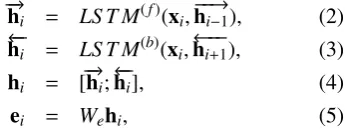
i = LS T M(f)(xi,−−→hi−1), (2)
←−
hi = LS T M(b)(xi,←−−hi+1), (3)
hi = [→−hi;←h−i], (4)
ei = Wehi, (5)
where the dimension of hi is d, We ∈ Rk×d is a
weight matrix, andkis the number of NE types to be identified.
The BiLSTM-CRF+CSE model predicts a tag sequence with the score matrix P =
(e1,· · ·,eN)T ∈ RN×k using CRF. Note thatPi,jis
[image:2.595.353.526.580.645.2]y=y1,· · ·,yN is calculated as follows:
p(y|w) = e
s(w,y)
∑
˜y∈Ywe
s(w,˜y), (6)
s(w,y) =
N ∑
i=−1
Ayi,yi+1+
N ∑
i=1
Pi,yi, (7)
whereYwis the set of all possible tag sequences,
Ais a matrix of transition scores,Ai,j represents a
score that transits from thei-th tag to the j-th tag, andy−1andyN+1are the special tag for the start of
the sentence and the end of sentence, respectively. During training, the model maximizes the fol-lowing equation using the correct tag sequences:
log(p(y|w))=s(w,y)−log(∑
˜y∈Yw
es(w,˜y)), (8)
where yis the correct tag sequence of w. When recognizing NEs, the model outputs a tag se-quence that maximizes the score calculated by the following equation:y∗=arg max
˜y∈Yw
s(w,˜y).
2.2 Paraphrase Model
We used the ANMT model (Luong et al., 2015; Bahdanau et al.,2015), which is a standard in ma-chine translation, as a chemical compound para-phrase model. The ANMT model converts an input sequence w into another sequence ytrg = ytrg1 ,ytrg2 ,· · ·,ytrgT , which is a paraphrase of the in-put in our model, using an RNN encoder and an RNN decoder. The RNN encoder converts an in-put sequence to a multiset of fixed-length vectors, and then the RNN decoder generates an output se-quence from the converted fixed length vector. We use a bidirectional LSTM defined by Eq. (2) and Eq. (3) as the encoder, and the vector represen-tationsxias the word embedding vectors of input
sentences. The concatenation of the final hidden states of the bidirectional LSTM encoder,→−hN of
Eq. (2) and←h−1of Eq. (3), was used as the initial
state of the LSTM decoder:s1 =[→−hN;←h−1]. The decoder calculates the j-th hidden state
sj as follows: sj = LS T Mdec([vj−1; ˆsj−1],sj−1),
wherevj−1is the word embedding vector ofytrgj−1,
and ˆsj−1 is the (j− 1)-th attention vector. Then,
the model calculates the j-th attention vector ˆsj us-ing the context vectoroj: ˆsj = tanh(We[sj :oj]).
whereWeis a weight matrix and tanh is the
hyper-bolic tangent function. The context vectoroj is a
weighted average of the encoder’s hidden states:
oj = N ∑
i=1
αj(i)hi, (9)
αj(i) =
exp(hi·sj) ∑N
k=1exp(hk·sj)
, (10)
where exp is the natural exponential function. The decoder generates an output based on the probabil-ity distribution of the j-th token: p(ytrgj |ytrg<j,w) = softmax(Wsˆsj), whereWsis a weight matrix. The
objective function is defined as follows:
J(θ)=− ∑
(w,ytrg)∈D
logp(ytrg|w), (11)
where D is the training data and θ is the set of model parameters.
2.3 Handling Paraphrases in NER
Our method, HanPaNE, learns the NER model described in Section 2.1 and the chemical com-pound paraphrase model described in Section2.2 at the same time through multi-task learning. In the multi-task learning, the character embedding weight matrix and the LSTM parameters in Eq. (2), Eq. (3) and the parameters of LS T M(wc) are shared between the two models. By the parame-ter sharing, the LSTM part of the NER model is expected to convert the same compound with dif-ferent notations into a similar vector expression. The objective functions of the two models are Eq. (8) and Eq. (11), respectively.
3 Experiments
3.1 Experimental Settings
We used the BioCreative IV CHEMDNER data set, which was preprocessed by Luo et al (2018)3. The word embedding layer with Word2vec and the character-based NLM were independently pre-trained from the MEDLINE abstracts from the PubMed website (PubMedAbs)4. We created Pub-ChemDic, a set of paraphrases of chemical com-pounds compiled from PubChem. The number of dimensions of the word embedding layer, the char-acter embedding layer, the charchar-acter LSTM, the LSTM of the NER model (the LSTM encoder of the paraphrase model), the LSTM decoder of the paraphrase model, and the LSTM of the character
3https://github.com/lingluodlut/Att-ChemdNER
4https://www.nlm.nih.gov/databases/download/
Model Precision Recall F-score Baseline 92.75 92.15 92.45
VE-P 93.11 91.40 92.25 HanPaNE-P 92.71 91.94 92.32
VE+P 93.15 91.79 92.47
[image:4.595.74.290.62.140.2]HanPaNE+P (Proposed) 92.81 92.33 92.57
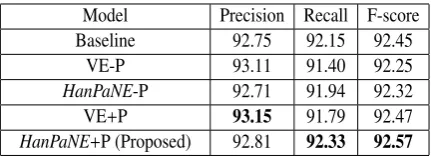
Table 1: Experimental results.+P indicates considera-tion of paraphrases and -P does not.
NLM are set to 100,25,50,200,400, and 2048, re-spectively.
We compared the following methods. “+P” in-dicates with consideration of paraphrases in Pub-ChemDic and “-P” indicates without consideration of paraphrases.
• A BiLSTM-CRF+CSE of (Akbik et al., 2018) described in Section 2.1 was used as our Baseline.
• VE-P is a baseline trained with virtual ex-amples (VEs) created by randomly replac-ing NEs of trainreplac-ing data with chemical compounds in the PubChemDic similar to (Yi et al.,2004).
• VE+P is a baseline trained with VEs cre-ated by replacing NEs of training data with their corresponding paraphrases in the Pub-ChemDic.
• HanPaNE-P is a multi-task for NER and
paraphrasing trained with randomly gener-ated sentence pairs with PubChemDic.
• HanPaNE+P is the proposed method trained
with generated sentence pairs by replacing NEs in sentences with their corresponding paraphrases in the PubChemDic.
The baseline was trained with 55,458 sen-tences of CHEMDNER training data. VE-P was trained with 110,916 sentences in total consist-ing of the original CHEMDNER trainconsist-ing data and 55,458 sentences automatically generated from the CHEMDNER training data. VE+P was trained with 59,033 sentences consisting of 3,575 sen-tences automatically generated from the original CHEMDNER training data with paraphrases of chemical compounds and the original CHEMD-NER training data.5 For HanPaNE-P and
Han-5VE+P had a smaller number of training data than
VE-P because we only replaced NEs with their paraphrases in-cluded in PubChemDic.
PaNE+P, we used randomly selected 100,000 sen-tences from PubMedAbs for training paraphras-ing and the original CHEMDNER trainparaphras-ing data for NER.
For example, for +P, “... Phenylalanineis ...” are converted into “... L-β-phenylalanine is ...” and “.. (S)-2-Benzylglycine is ...”, where
L-β-phenylalanine and (S)-2-Benzylglycine are
para-phrases of Phenylalanine. As for -P, “... Pheny-lalanineis ...” is converted into like “... ethylene is ....” whereethyleneis randomly sampled from chemical compounds.
3.2 Experimental Results
Table 1 shows the experimental results. We can see thatHanPaNE+P showed the highest accuracy andHanPaNE+P and VE+P, with consideration of paraphrases, showed a higher accuracy than Base-line. In contrast,HanPaNE-P and VE-P, without consideration of paraphrases, did not. The results indicate that the use of paraphrases contributed to improved accuracy.
We also conducted the following two types of hypothesis testing. The first one is a McNe-mar paired test on the labeling disagreements of words assigned by HanPaNE and the others as in (Sha and Pereira, 2003). All the results ex-cept for Baseline were significantly different (p< 0.01). The second one is a bi-nominal test used in (Sasano and Kurohashi, 2008). For this test, the number of the entities correctly recognized by
only HanPaNE and the number of entities
cor-rectly recognized by only the other method are counted. Then, based on the assumption that out-puts have the binomial distribution, we apply a binomial test. All the results were significantly different for this test (p < 0.05). These re-sults showed thatHanPaNEworks better than aug-mented training data.
chem-Model Acc.NC Acc.C Baseline 0.8475 0.9672 VE+P 0.8463 0.9623 HanPaNE+P (Proposed) 0.8510 0.9680
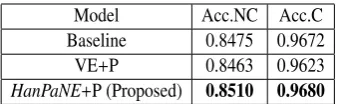
[image:5.595.83.281.198.264.2]Table 2: Accuracy of NEs covered (Acc.C) or not cov-ered (Acc. NC) by the training data and PubChemDic.
Table 3: Comparison with best results on BioCreative IV’s CHEMDNER task.
Method Precision Recall F-score
Leaman et al.(2015) 89.09 85.75 87.39
Lu et al.(2015) 88.73 87.41 88.06
Lin et al.(2018) 92.29 90.01 91.14
This paper 92.81 92.33 92.57
ical terms in the test data. The joint coverage of both is 61.79%. This means almost 1/3 of the NEs in the test data are not covered by the training data and PubChemDic even if these data include over 337 million names of chemical compounds and terms.
4 Related Works
BioCreative IV’s CHEMDNER task
Table 3 shows a comparison with the previous best results. (Leaman et al.,2015) and (Lu et al., 2015) proposed a feature-based approach to im-prove the chemical NER performance. (Lin et al., 2018) proposed a neural network approach that treats document level information to maintain tag-ging consistency across sentences. By learning paraphrasing, our method showed the best accu-racy on the CHEMDNER task.
Multi-task learning
Multi-task learning is often utilized to lever-age the performance of NLP systems (Liu et al., 2015; Luong et al., 2016; Dong et al., 2015; Hashimoto et al.,2017), including NER.Liu et al. (2018) and Rei (2017) studied multi-task learn-ing of sequence labellearn-ing with language models. Aguilar et al. (2018) and Cao et al. (2018) pro-posed multi-task learning of NER with word seg-mentation. Peng and Dredze (2017)’s method of multi-task learning leverages the performance of domain adaptation. Clark et al. (2018)’s method utilizes multi-task learning of NER with sev-eral NLP tasks such as POS tagging and pars-ing. Crichton et al.(2017) andWang et al.(2018)
leverage the performance of NER by multi-task learning of several tasks of biomedical NLP.
5 Conclusions
We proposed a multi-task learning method on an NER model and a paraphrase model to utilize paraphrase pairs efficiently. The evaluations on the BioCreative IV’s CHEMDNER task showed that our method achieved the best performance.
References
Gustavo Aguilar, Adrian Pastor L´opez Monroy, Fabio Gonz´alez, and Thamar Solorio. 2018. Modeling noisiness to recognize named entities using multi-task neural networks on social media. In Proceed-ings of the 2018 Conference of the North American Chapter of the Association for Computational Lin-guistics: Human Language Technologies, Volume 1 (Long Papers), pages 1401–1412.
Alan Akbik, Duncan Blythe, and Roland Vollgraf. 2018. Contextual string embeddings for sequence labeling. InProceedings of the 27th COLING, pages 1638–1649.
Dzmitry Bahdanau, Kyunghyun Cho, and Yoshua Ben-gio. 2015. Neural machine translation by jointly learning to align and translate. In Proceedings of the 3rd ICLR.
Pengfei Cao, Yubo Chen, Kang Liu, Jun Zhao, and Shengping Liu. 2018. Adversarial transfer learn-ing for chinese named entity recognition with self-attention mechanism. In Proceedings of the 2018 Conference on Empirical Methods in Natural Lan-guage Processing, pages 182–192.
Kevin Clark, Minh-Thang Luong, Christopher D. Man-ning, and Quoc Le. 2018. Semi-supervised se-quence modeling with cross-view training. In Pro-ceedings of the 2018 Conference on Empirical Meth-ods in Natural Language Processing, pages 1914– 1925. Association for Computational Linguistics.
Gamal Crichton, Sampo Pyysalo, Billy Chiu, and Anna Korhonen. 2017. A neural network multi-task learn-ing approach to biomedical named entity recogni-tion. BMC Bioinformatics, 18.
Daxiang Dong, Hua Wu, Wei He, Dianhai Yu, and Haifeng Wang. 2015. Multi-task learning for multi-ple language translation. InProceedings of the 53rd ACL and the 7th IJCNLP (Volume 1: Long Papers), pages 1723–1732.
Martin Krallinger, Florian Leitner, Obdulia Rabal, Miguel Vazquez, Julen Oyarzabal, and Alfonso Va-lencia. 2015. Chemdner: The drugs and chemical names extraction challenge. Journal of Cheminfor-matics, 7(1):S1.
Guillaume Lample, Miguel Ballesteros, Sandeep Sub-ramanian, Kazuya Kawakami, and Chris Dyer. 2016. Neural architectures for named entity recognition. In Proceedings of the 2016 NAACL-HLT, pages 260–270.
Robert Leaman, Chih-Hsuan Wei, and Zhiyong Lu. 2015. tmchem: a high performance approach for chemical named entity recognition and normaliza-tion. Journal of Cheminformatics, 7(1):S3.
Hongfei Lin, Jian Wang, Ling Luo, Pei Yang, Zhi-hao Yang, Yin Zhang, and Lei Wang. 2018. An attention-based bilstm-crf approach to document-level chemical named entity recognition. Bioinfor-matics, pages 1381–1388.
Liyuan Liu, Jingbo Shang, Xiang Ren, Frank Xu, Huan Gui, Jian Peng, and Jiawei Han. 2018. Empower sequence labeling with task-aware neural language model.
Xiaodong Liu, Jianfeng Gao, Xiaodong He, Li Deng, Kevin Duh, and Ye-Yi Wang. 2015. Representation learning using multi-task deep neural networks for semantic classification and information retrieval. In Proceedings of the 2015 NAACL-HLT, pages 912– 921.
Yanan Lu, Donghong Ji, Xiaoyuan Yao, Xiaomei Wei, and Xiaohui Liang. 2015. Chemdner system with mixed conditional random fields and multi-scale word clustering. Journal of Cheminformatics, 7(1):S4.
Minh-Thang Luong, Quoc V. Le, Ilya Sutskever, Oriol Vinyals, and Lukasz Kaiser. 2016. Multi-task se-quence to sese-quence learning.
Thang Luong, Hieu Pham, and Christopher D Man-ning. 2015. Effective approaches to attention-based neural machine translation. In Proceedings of the 2015 EMNLP, pages 1412–1421.
Xuezhe Ma and Eduard Hovy. 2016. End-to-end se-quence labeling via bi-directional lstm-cnns-crf. In Proceedings of the 54th ACL, pages 1064–1074.
Nanyun Peng and Mark Dredze. 2017. Multi-task do-main adaptation for sequence tagging. In Proceed-ings of the 2nd Workshop on Representation Learn-ing for NLP, pages 91–100.
Matthew Peters, Mark Neumann, Mohit Iyyer, Matt Gardner, Christopher Clark, Kenton Lee, and Luke Zettlemoyer. 2018. Deep contextualized word rep-resentations. In Proceedings of the 2018 NAACL-HLT, pages 2227–2237.
Marek Rei. 2017. Semi-supervised multitask learn-ing for sequence labellearn-ing. In Proceedings of the 55th Annual Meeting of the Association for Compu-tational Linguistics (Volume 1: Long Papers), pages 2121–2130. Association for Computational Linguis-tics.
Tjong Kim Sang, Erik F., and Fien De Meulder. 2003. Introduction to the conll-2003 shared task: Language-independent named entity recognition. In Proceedings of CoNLL-2003, pages 142–147.
Ryohei Sasano and Sadao Kurohashi. 2008. Japanese named entity recognition using structural natural language processing. InProc of . IJCNLP’08, pages 607–612.
Fei Sha and Fernando Pereira. 2003. Shallow parsing with conditional random fields. InProc. of NAACL HLT’03, pages 134–141.
Xuan Wang, Yu Zhang, Xiang Ren, Yuhao Zhang, Marinka Zitnik, Jingbo Shang, Curtis Langlotz, and Jiawei Han. 2018. Cross-type biomedical named entity recognition with deep multi-task learning. Bioinformatics, page bty869.