A u t o m a t i c Learning for Semantic Collocation
S a t o s h l S E K I N E *T o k y o I n f o r m a t i o n a n d C o m m u n i c a t i o n s R e s e a r c h L a b o r a t o r y M a t s u s h i t a E l e c t r i c I n d u s t r i a l C o . , L t d .
3-10-1, higashimita, tama-ku, kawasaki 214 J A P A N
J e r e m y J . C A R R O L L S o f i a A N A N I A D O U
J u n ' i c h i T S U J I I
C e n t r e for C o m p u t a t i o n a l L i n g u i s t i c s
U n i v e r s i t y of M a n c h e s t e r I n s t i t u t e of Science a n d T e c h n o l o g y
P . O . B o x 88, Manchester M60 1QD, United K i n g d o m
A b s t r a c t
The real difficulty in development of practical NLP systems comes from the fact that we do not have effective means for gathering "knowl- edge". In this paper, we propose an algorithm which acquires automatically knowledge of se- mantic collocations among "words" from sam- ple corpora.
The algorithm proposed in this paper tries to discover semantic collocations which will be useful for disambiguating structurally ambigu- ous sentences, by a statistical approach. The algorithm requires a corpus and minimum lin- guistic knowledge (parts-of-speech of words, simple inflection rules, and a small number of general syntactic rules).
We conducted two experiments of applying the algorithm to different corpora to extract dif- ferent types of semantic collocations. Though there are some unsolved problems, the results showed the effectiveness of the proposed algo- rithm.
1 I n t r o d u c t i o n
Quite a few grammatical formalisms have been proposed by computational linguists, which are claimed to be "good" (declarative, highly modular, etc.) for practi- cal application systems in NLP. It has also been claimed that extra-linguistic, domain specific knowledge is in- dispensable in most NLP applications, and computa- tional frameworks for representing and using such do- main knowledge have also been developed.
However, the real difficulty in developing practical NLP systems is due to the fact that we do not have effec- tive means for gathering the "knowledge", whether lin- *SEKINE is now a visitor at C.C.L., U.M.I.S.T.
s ekine @
ccl. umist, ac. uk
guistic or extra-linguistic. In particular, it has been re- ported [Ananiadou, 1990] that not only extra-linguistic, domain knowledge but also linguistic knowledge required for application systems varies, depending on text-type (technical reports, scientific papers, manuals, etc.), sub- ject domain, type of application (MT, automatic ab- straction, etc.) etc. This means that we have to have ef- fective and efficient methods either for adapting already existing knowledge for a specific "sublanguage" or for ac- quiring knowledge automatically, for example from sam- ple corpora of given applications.
In this paper, we propose an algorithm which auto- matically acquires knowledge of semantic collocations among "words". "Semantic" here means that the col- locations the algorithm discovers are not collocations among words in the sense of traditional linguistics but collocations that reflect ontological relations among en- tities in given subject domains. We expect that the knowledge to be extracted will not only be useful for disambiguating sentences but also will contribute to dis- covering ontological classes in given subject domains.
the system assumes t h a t there is a correct answer a m o n g them. T h e algorithm builds correct structural descrip- tions of sentences and discovers semantic collocations at the same time. It works as a relaxation process.
2
O v e r v i e w
Before giving the algorithm formally, we illustrate an overview in this section, by using simple examples. T h o u g h the algorithm can be used to extract knowledge useful to resolve a wide range of syntactic ambiguities, we use here the prepositional phrase a t t a c h m e n t problem as an illustrative example.
We assume a syntactic parser which provides all pos- sible analyses. It produces syntactic descriptions of sen- tences in the form of syntactic dependency structures. T h a t is, the description to be produced is represented by a set o f t u p l e s like [ h e a d word, s y n t a c t i c r e l a t i o n , a r g u m e n t ] , each of which expresses a dependency rela- tion in the input. T h e syntactic relation in a tuple is either a g r a m m a t i c a l relation like SUB J, OBJ, etc. (in case of a noun phrase) or a surface preposition like BY, W I T H , etc. Following the normal convention of depen- dency representation, the argument is represented by the governor of the whole phrase which fills the argument position.
When an input sentence has a t t a c h m e n t ambiguities, two or more tuples share the same argument and the same syntactic-relation but have different head-words.
For example, the description of the sentence "I saw a girl with a scarf."
contains two tuples like [girl, WITH, scarf]
[saw,
WITH, scarf]As repeatedly claimed in natural language under- standing literature, in order to resolve this ambiguity, a system m a y have to be able to infer "a s c a r f c a n n o t be used as an instrument to see", based on extra- linguistic knowledge. A practical problem here is that there is no systematic way of accumulating such extra- linguistic knowledge for given subject fields. Further- more, the ambiguity in a sentence like " I saw a g i r l w i t h a t e l e s c o p e " cannot be resolved only by refer- ring to knowledge a b o u t the world. It requires a full range of context understanding abilities, because the interpretation of " a g i r l w i t h a t e l e s c o p e " is less likely in general but can be a correct one in certain contexts. T h a t is, unless a system has a full range of contextual understanding abilities (which we think will be impossible in m o s t application environments in the foreseeable future), it cannot reject either of the possi- ble interpretations as "impossible". T h e best a system can do, without full understanding abilities, is to select more plausible ones or reject less plausible ones. This implies t h a t we have to introduce a measure by which we can judge plausibility of "interpretations".
T h e algorithm we propose computes such measures from a given sample corpus in a certain way. It gives a plausibility value to each possible tuple, based on the sample corpus. For example, the tuples (saw, WITH,
s c a r f ) and ( g i r l , WITH, s c a r f ) m i g h t be assigned 0.5 and 0.82 as their plausibility value, which would show ( g i r l , WITH, s c a r f ) to be m o r e plausible t h a n (saw, WITH, s c a r f ) . This produced knowledge can be used to disambiguate interpretations of the sentence " I saw a girl with a s c a r f " .
T h e algorithm is based on the assumption t h a t the ontological characteristics of the objects and actions de- noted by words (or linguistic expressions in general) and the nature of the ontological relations a m o n g t h e m are exhibited, though implicitly, in sample texts.
For example, nouns denoting objects which belong to the same ontological classes tend to appear in similar linguistic contexts (for example, in the same argument positions of the s a m e or similar verbs). Or if an ob- ject (or an ontological class of objects) is "intrinsically" related to an action (like " t e l e s c o p e " to " s e e " ) , the word denoting the class of objects co-occurs frequently with the verb denoting the action. T h e co-occurrence would be more frequent t h a n t h a t of those whose onto- logical relations are rather fortuitous, like " g i r l " and "telescope".
Note t h a t we talk a b o u t extra-linguistic "ontology" for the sake of explaining the basic idea behind the ac- tual algorithm. However, as you will see, we do not represent such things as ontological entities in the ac- tual algorithm. T h e algorithm counts frequencies of co- occurrences a m o n g words and calculates word distances which interpret such co-occurrences as contexts. Nor do we posit any dichotomy between "intrinsic" relations and "accidental" relations a m o n g actions and objects. Differences a r e quantitative, not qualitative. T h a t is, co-occurrences of "girl" and "scarf" are more frequent than, for example, those of "pig" and "scarf".
The algorithm in this paper c o m p u t e s the plausibility value of hypothesis-tuples like ( g i r l , WITH, s c a r f ) ,
(saw, WITH, s c a r f ) , etc., basically by counting frequencies of instance-tuples [ g i r l , WITH, s c a r f ] , [saw, WITH, s c a r f ] , etc. generated from sample texts by a syntactic parser.
3
A l g o r i t h m
3.1 R e l a x a t i o n P r o c e s s - I n f o r m a l E x p l a n a t i o n o f t h e A l g o r i t h m
Though the algorithm simply counts frequencies of co- occurrences of word relations, there are some compli- cations. In this section, we also use the prepositional phrase a t t a c h m e n t p r o b l e m as an example, though the algorithm can be applied to any kind of structural am- biguity.
1. We have to count frequencies of "meaningful" co- occurrences between verbs and nouns, i.e. co- occurrences where the nouns actually appear in the position of the head-noun of P P ' s which can be at- tached to verbs or other nouns. T h e frequency of "general" co-occurrences where the two words oc- cur, for example, in the s a m e sentences m a y be of little use.
quencies of "meaningful" co-occurrences in sample texts, we have to know the correct attachment po- sitions of PPs, and determining the correct attach- ments of PPs in sample texts requires knowledge of frequencies of "meaningful" co-occurrences.
2. We usually cannot expect to have a corpus of sample sentences large enough for "intrinsic" relations to appear significantly more often than "accidental" relations. It is desirable, or inevitable in a sense, to introduce methods of increasing the number of co-occurrences.
One possible way of doing this (which we have adopted in our algorithm) is to introduce "seman- tic" similarity measures between words, and count the number of extended co-occurrences taking the similarity measures into account. T h a t is, the frequency of [girl, WITH, necklace] in sample texts contributes not only to the plausibility value of the tuple ( g i r l , WITH, n e c k l a c e ) , but also to that of ( g i r l , WITH, s c a r f ) , according to the similarity value (or semantic distance) of " s c a r f " and "necklace".
Because we compute semantic distances a m o n g nouns based on (dis-)similarities of their patterns of co-occurrence with other words (in short, two nouns are judged to be close to each other, if they often co-occur with the same words), we also encounter an chicken and egg problem here. The calculation of semantic distance requires frequencies of collo- cation, and in order to find semantic collocations, semantic distance could be helpful.
The two chicken and egg problems in the above are treated differently in the algorithm. We focus on the first problem in this paper, while readers who are interested in the second problem can refer to [Sekine et al., 1992]
In the following, we call the tuples generated from sample texts by a parser "instance-tuples" and the tuples to which plausibility value are as- signed "hypothesis-tuples". Instance-tuples and hypothesis-tuples are indicated by [A, R, B] and (A, R, B), respectively.
Note that for the sake of explanation the following is not an accurate description of the algorithm. An accurate one is given in the next section.
Input: I saw a girl with a telescope.
( S T E P - I ) Generate instance-tuples
All possible instance-tuples such
as [saw, SUBJ, I], [girl, WITH, t e l e s c o p e ] , [saw, WITH, t e l e s c o p e ] , etc. are generated by a simple parser.
(STEP-2) Assign credits
Assign credits to the instance-tuples, by considering the plausibility value of corresponding hypothesis- tuples. As we will explain later, we assign credits in such a way that
(a)
(b)
the sum of credits assigned to competing instance-tuples is equal to 1. Competing tuples means such tuples as [girl, WITH, s c a r f ] and [saw, WITH, s c a r f ] which show different attachment positions of the same PP.
the credits assigned to instance-tuples are pro- portional to the plausibility value of the corre- sponding hypothesis-tuples.
Because hypothesis-tuples have the same plau- sibility value at the initial stage, each instance- tuple is assigned the same credit, say, 1/(num- ber of competing tuples). T h e credit of [saw, SUB J , I] is one, while the credits of [ g i r l , WITH, s c a r f ] and [saw, WITH, s c a r f ] are 0.5.
(STEP-3) Calculate plausibility values
Compute plausibility values of hypothesis-tuples, accumulating credits assigned to the corresponding instance-tuples.
All occurrences of instance-tuples generated from the sample corpus have their credits assigned in (STEP-2). We assume t h a t tuples correspond- ing to "intrinsic" ontological relations occur more often in texts than "accidental" ones. T h a t is, we expect that instance-tuples of [ g i r l , WITH, s c a r f ] occur more often than those of [saw, WITH, s c a r f ] and that the sum of the credits of [ g i r l , WITH, s c a r f ] is greater than that of [saw, WITH, s c a r f ] . This leads to a higher plausibility value for ( g i r l . , WITH, s c a r f ) than for (saw, WITH, s c a r f ) .
After (STEP-3), the algorithm goes back to (STEP- 2) to compute new credits to instance-tuples. Unlik~ the first cycle, because the hypothes{s-tuple ( g i r l , WITH, s c a r f ) has been assigned a higher plausi. bility value than (saw, WITH, s c a r f ) , the credit to be assigned to [ g i r l , WITH, s c a r f ] would b~ higher than [saw, WITH, s c a r f ] .
When we recompute the plausibility value ii (STEP-3), the increased credit assigned to [ g i r l ~ WITH, s c a r f ] in (STEP-2) increases the plausibil ity value of (girl, WITH, scarf) and on the othel hand, the decreased credit of [saw, WITH, s c a r f : results in a lower plausibility value for (saw, WITH s c a r f ) .
3.2 T e r m i n o l o g y a n d n o t a t i o n
instance-tuple [h, r, a] : a token of a dependency rela- tion; p a r t of the analysis of a sentence in a corpus. hypothesis-tuple ( h , r , a ) : a dependency relation; an
abstraction or type over identical instance-tuples. cycle : repeat time of the relaxation cycle.
CT,~ : Credit of instance-tuple T with identification n u m b e r i. [0, 1]
V~ : Plausibility value of a hypothesis-tuple T in cycle g. [0, 1]
D g (wa,wb) : distance between words, w= and Wb in
cycle g. [0, 1] 3.3 A l g o r i t h m
1. For each sentence we use a simple g r a m m a r to find all tuples possibly used in this sentence. Each instance-tuple is then given credit in proportion to the n u m b e r of competing tuples.
1
CT = number o f competing tuples (1)
This credit shows which rules are suitable for this sentence. On the first iteration t h e s p l i t of the credit between ambiguous analyses is uniform as shown above, but on subsequent iterations plausibility val- ues of the hypothesis-tuples V~ -1 before the itera- tion are used to give preference to credit for some analyses over others. T h e formula for this will be shown later.
2. Hypothesis-tuples have a plausibility value which indicates their reliability by a figure from 0 to 1. If an instance-tuple occurs frequently in the cor- pus or if it occurs where there are no alternative tuples, the plausibility value for the corresponding hypothesis m u s t be large. After analysing all the sentences of the corpus, we get a set of sentences with weighted instance-tuples. Each instance-tuple invokes a hypothesis-tuple. For each hypothesis- tuple, we define the plausibility value by the fol- lowing formula. This formula is designed so that the value does not exceed 1.
V~{ : 1 - H (1 - CT,~) (2)
i
3. At this stage, the word-distances can be used to modify the plausibility values of the hypothesis- tuples. The word-distances are either defined ex- ternally by h u m a n intuition or calculated in the previous cycle with the formula shown later. Dis- tance between words induces a distance between hypothesis-tuples. Then for each hypothesis-tuple, another hypothesis-tuple which gives greatest effect can be used to increase its plausibility value. The new plausibility value with similar hypothesis-tuple effect is calculated by the following formula.
V~{ = V@ + (1 - V~{) * V~, • (1 - D g (w=, wb)) 2 (3) 4.
Here, the hypothesis-tuple T ' is the hypothesis- tuple which gives the greatest effect to the hypothesis-tuple T (original one). Hypothesis-tuple T and T ' have all the s a m e elements except one. T h e distance between T and T ' is the distance be- tween the different elements, w= and Wb. Ordinarily the difference is in the head or a r g u m e n t element, but when the relation is a preposition, it is possible to consider distance f r o m another preposition. Distances between words are calculated on the basis of similarity between hypothesis-tuples about them. T h e formula is as follows:
.
D g (w~, wb) = E T (V~{ - V~{,)# (4)
n
T and T ' are hypothesis-tuples whose arguments are w= and wb, respectively and whose heads and rela- tions are the same. /9 is a constant parameter. This procedure will be repeated from the begin- ning, modifying the credits of instance-tuples be- tween ambiguous analyses by using the plausibility values of hypothesis-tuples. This will hopefully be more accurate t h a n the previous cycle. On the first iteration, we used just a constant figure for the cred- its of instance-tuples. But this t i m e we can use the plausibility value of the hypothesis-tuple which was deduced from the previous iteration. Hence with each iteration we expect m o r e reliable figures. 1'o calculate the new credit of instance-tuple T, we use:
.
C T -- V ~ a
o)
Here, V@ in the n u m e r a t o r position is the plausi- bility value of a hypothesis-tuple which is the same tuple as the instance-tuple T. VT g in the denomina- tor position are the plausibility values of competing hypothesis-tuples in the sentence and the plausibil- ity value of the s a m e hypothesis-tuple itself, a is a constant parameter.
Iterate step 1 to 5 several times, until the informa- tion is saturated.
4 E x p e r i m e n t
We conducted two experiments to show the effectiveness of our algorithm. T h e first one uses a small, artificial corpus to show how the algorithm works. The second one is a real experiment in which we use d a t a from a real corpus ( c o m p u t e r manuals).
4.1 A r t i f i c i a l c o r p u s
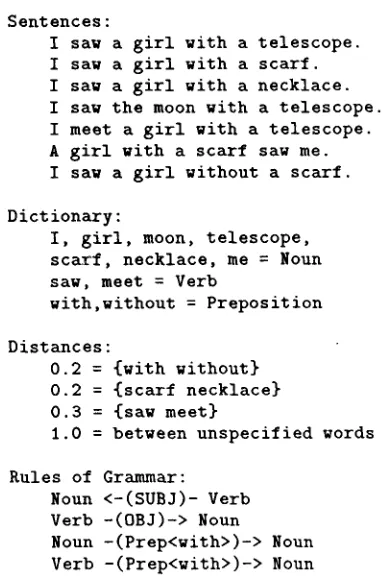
We treat the prepositional a t t a c h m e n t a m b i g u i t y in this experiment. T h o u g h the corpus consists of only 7 arti- ficial sentences, this experiment shows the basic charac- teristics and the effectiveness of the algorithm.
S e n t e n c e s :
I s a w a g i r l w i t h a t e l e s c o p e . I saw a g i r l w i t h a scarf. I s a w a g i r l w i t h a n e c k l a c e . I s a w t h e m o o n w i t h a t e l e s c o p e . I m e e t a g i r l w i t h a t e l e s c o p e . A g i r l w i t h a s c a r f s a w me. I saw a g i r l w i t h o u t a scarf.
D i c t i o n a r y :
I, g i r l , m o o n , t e l e s c o p e , scarf, n e c k l a c e , m e = N o u n saw, m e e t = V e r b
w i t h , w i t h o u t = P r e p o s i t i o n
D i s t a n c e s :
0.2 = { w i t h w i t h o u t } 0 . 2 = { s c a r f n e c k l a c e } 0 . 3 = { s a w m e e t }
1.0 = b e t w e e n u n s p e c i f i e d w o r d s
R u l e s of G r a m m a r :
N o u n < - ( S U B J)- V e r b V e r b - ( O B J ) - > N o u n
N o u n - ( P r e p < w i t h > ) - > N o u n V e r b - ( P r e p < w i t h > ) - > N o u n
Table 1 shows the result of the first cycle. Figures in this table show the plausibility values of hypothesis- tuples between the words in the corresponding columns. The plausibility value of the hypothesis-tuple (saw, WITH, t e l e s c o p e ) , for example, is 0.75.
WITH, n e c k l a c e ) becomes only 0.66. T h e difference in the behavior of these two hypothesis-tuples is caused by the difference of the plausibility values assigned to the hypothesis-tuples ( g i r l , WITH, s c a r f ) and (saw, WITH, s c a r f ) . T h e plausibility values are 1.00 and 0.50 respectively.
saw W I T H girl W I T H m o o n W I T H
meet W I T H saw W I T H O U T girl W I T H O U T
telescope scarf necklace
0.81 0.66 0.66
0.75 1.00 0.82
0.50 - -
0.68 0.24 0.24
0.48 0.66 0.32
0.48 0.82 0.32
Table 2: Plausibility values with similar hypothesis effect
Then we proceed to the second cycle, using the plausi- bility values which were produced in the previous cycle. Table 3 shows the plausibility values after the fifth cycle.
saw W I T H girl W I T H m o o n W I T H
meet W I T H saw W I T H O U T girl W I T H O U T
telescope scarf necklace
1.00 0.26 0.30
0.93 1.00 0.99
0.00 0.00 0.00
0.57 0.04 0.04
0.64 0.01 0.01
0.58 1.00 0.64
Table 3: Plausibility values after the fifth cycle
saw W I T H girl W I T H m o o n W I T H
meet W I T H saw W I T H O U T
girl W I T H O U T
telescope 0.75 0.75 0.50 0.50
scarf necklace
0.50 0.50
1.00 0.50
0.50 0.50
Table 1: Plausibility values after the first cycle
These plausibility values basically reflect the num- ber of co-occurrences of the two words. However, the hypothesis-tuple ( g i r l , WITH, s c a r f ) has plausibil- ity value 1.0, because in the sentence "A g i r l w i t h a s c a r f saw me", there is no ambiguity in the a t t a c h m e n t position of " w i t h a s c a r f " .
T h e n we c o m p u t e the effects of similar hypothesis- tuples by considering distances a m o n g words. T h e effects which the existence of similar hypotheses has on other hypotheses are clearly shown in Table 2.
T h e plausibility values of the hypothesis-tuples have changed f r o m the former ones. For example, we can find a sharp distinction between the plausibility values of the hypothesis-tuples (saw, WITH, n e c k l a c e ) and ( g i r l , WITH, n e c k l a c e ) T h o u g h these two have the same plausibility value 0.50 before considering the effect of similar hypotheses, the plausibility value of ( g i r l , WITH, n e c k l a c e ) becomes 0.82 while t h a t of (saw,
By the fifth cycle, m o s t of the figures have moved well • towards the extremes, either 0 or 1.
For example, the plausibility values of the hypothesis- tuples (saw, W I T H , n e c k l a c e ) a n d (girl, W I T H , n e c k l a c e ) , are well a p a r t , 0.30 and 0.99, respectively, although they had the s a m e plausibility value after the first cycle. Also the hypothesis-tuple (moon, WITH, t e l e s c o p e ) has the plausibility value 0.00, though its initial plausibility value was 0.50. We can claim t h a t the learning process has worked well in m a k i n g these differ- ences.
[image:5.612.106.298.59.347.2] [image:5.612.360.583.141.221.2] [image:5.612.362.585.304.385.2] [image:5.612.105.322.421.503.2]t e l e s c o p e ) , which has a relatively high plausibility value 0.57, is n o r m a l l y unacceptable. This is caused by the close distance between the words ' m e e t ' and ' s e e ' .
T h e distances between words in the 5th cycle are shown in Table 4.
telescope
telescope 0'.00
scarf 0.54
necklace 0.52
scarf necklace
0.54 0.52
0.00 0.26
0.26 0.00
Table 4: Distances between words in the 5th cycle
we put the credit 1/2 for each instance-tuple in which N 2 is an argument.
We have not m a d e any word distance information be- fore the process.
We classified the results obtained as correct or incor- rect. ' C o r r e c t ' means t h a t a hypothesis-tuple which has the highest plausibility value is the correct tuple accord- ing to our h u m a n j u d g e m e n t . 'Incorrect' means it is judged wrong by a human. 'Indefinite' means t h a t plau- sibility values of some hypothesis-tuples have the same highest value. ' U n c e r t a i n ' means t h a t it is impossible even for a h u m a n to judge which hypothesis tuple is the best without context. T h e results are shown in Table 6. These results, b o t h the plausibility values of
hypothesis-tuples and the word distances, seem to be- have as we expected.
4.2 T h e J a p a n e s e c o m p o u n d n o u n c o r p u s We conducted an experiment using c o m p o u n d nouns ex- tracted from a :Japanese computer manual, because of its simplicity and feasibility. The corpus consists of 4152 sentences (about 90,000 words). This might be small considered for statistical analysis purpose, but as the corpus is a sublanguage one, the structures of sentences are rather homogeneous and therefore the number of sen- tences might be considered sufficient.
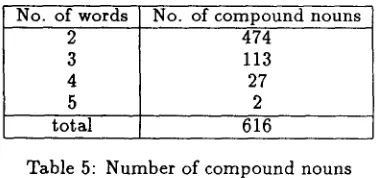
There are 616 c o m p o u n d nouns in the corpus, where 210 different words appear. We call an element word of a compound noun a 'word'.
No. of words No. of c o m p o u n d nouns
2 474
3 113
4 27
5 2
total 616
Table 5: N u m b e r of c o m p o u n d nouns
We assume t h a t all words in each c o m p o u n d noun can be structurally related, if they satisfy a condition that a relation has a preceding a r g u m e n t and a following head. For example, from a c o m p o u n d noun with 4 elements, we can extract 6 tuples as follows.
C o m p o u n d noun: N 1 N 2 N 3 N 4
tuples initialcredit
IN2, MODIFY, N1] 1/3
IN3, MODIFY, NI] 1/3
[N4, MODIFY, NIl i/3
[N3, MODIFY, N2] I/2
IN4, MODIFY, N2] i/2
IN4, MODIFY, N3] 1
We know t h a t each element can be the argument in one relation. In the above example, N1 has 3 instance- tuples in which to be the argument. We put the credit 1/3 as initial credit for each instance-tuple. Similarly,
Words 3 4 5 total
(%)
correct incorrect indefinite uncertain
66 29 5 13
41 7 5 1
4 0 0 2
111 36 10 16
(70.7) (22.9) (6.4) (-)
Table 6: Results of experiment with compound nouns
The percentage of correct answers was about 70 %. T h o u g h this result is not as impressive as that of the last experiment, it is not bad.
From a perusal of the incorrect analyses, we can find typical reasons for m a k i n g an incorrect analysis. When there are 2 competing tuples for a 3-element com- pound noun, these tuples are individually b o t h accept- able in m a n y cases. For example, let's take a compound noun 'file transfer operation'. If we consider the two instance-tuples, [ t r a n s f e r , MODIFY, f i l e ] and [ o p e r a t i o n , MODIFY, f i l e ] , b o t h are acceptable in the absence of any context. In this case, the plausibility values of the two hypothesis-tuples become almost the same. But there might be a very small difference which m a y be caused by the effect of a similar hypothesis-tuple. If the wrong hypothesis tuple gains the higher plausibil- ity value, the analysis becomes wrong.
We think t h a t the relation between the words of a c o m p o u n d noun can be defined not only by a semantic relation between each word b u t also by the structure of the c o m p o u n d noun itself. T h i s feature of compound nouns makes it hard to get a higher percentage of correct answers in this experiment.
5 U n s o l v e d P r o b l e m s
(a)
P a r a m e t e r sT h e behavior of the algorithm changes according to the two p a r a m e t e r s , a in f o r m u l a 5 and /3 in for- m u l a 4. T h o u g h the p a r a m e t e r s are set as a = 4.0 and 13 --- 20.0 in the experiments, we have no estab- lished procedures for determining these p a r a m e t e r s appropriately. We need to develop criteria or meth- ods to determine these p a r a m e t e r s , depending on characteristics of sample texts, etc..
[image:6.612.80.273.132.179.2] [image:6.612.319.561.220.293.2] [image:6.612.86.274.405.494.2]The entity of collocational relation is represented by a word and the relation labels are either a sim- ple grammatical functions or a surface prepositions. This means we ignored the word sense ambiguity of a word'or a preposition in this algorithm. A new m e t h o d to treat this problem might be needed. (c) Combination with other clues of disambiguation
It is already known that ontological knowledge is not the only clue to settle ambiguities. There are the problems related with context, discourse, situ- ation etc.. We want to weave these problems into our algorithm. It also has to be noted that rather local, structural preferential clues may help disam- biguations. [Wilks, 1985]
(d) Word distance
T h o u g h we currently assume that the semantic dis- tances of words are given in the form of single num- bers, our research group is now planning to extend to cover multi-dimensional aspects of word mean- ings. This extension m a y introduce another compli- cation in our algorithm.
(e) Form of collocation
In the current algorithm, semantic collocations are represented in the form of a triplet (tuple). How- ever, each tuple expresses only a collocation between two words. This is not sufficient for treating re- lationships among several words, such as subcate- gorization frames of predicates, knowledge frames, etc. In order to treat such multi-word collocations, we m a y have to treat co-occurrences of triplets in similar fashions to how we treat co-occurrences of words.
6 F u t u r e D i r e c t i o n s
Besides planning to resolve the problems written above, there are some other ideas for extending our project. Some of them are really stimulating.
(a) More experiments
T h o u g h the results of the two preliminary experi- ments look promising, we have to conduct more ex- periments using another real corpora before claim- ing that the algorithm is effective.
(b) Extension to Machine Translation
Though the algorithm in its present form is designed to acquire monolingual knowledge, we are planning to develop it for acquiring "knowledge" for transla- tion.
If "semantic" collocations discovered by the algo- rithm reflect the domain ontology, the collocations in two languages (and the semantic classes of words to be produced based on the collocations) are ex- pected to be similar in the sense that their corre- spondence is rather straightforward.
Experience in M T research, however, generally in- dicates the opposite, i.e. monolingual regularities and bilingual regularities are sometimes orthogonal and the correspondences of two languages are not so straightforward.
These two rather contradicting predictions (and ex- periences) have to be consolidated through actual experiments.
(c) Incremental learning system
We don't need to distinguish the knowledge acquisi- tion phase from the phase of using it in actual appli- cation systems. It is possible to acquire knowledge and exploit it at the same time.
7 A c k n o w l e d g e m e n t s
We would like to thank our colleagues at CCL, in partic- ular Mr.J.Phillips, Mr.K.Kageura, Mr.S.Kinoshita and Miss.E.van de Veen, whose comments on various occa- sions have been very useful.
R e f e r e n c e s
[Ananiadou, 1990] Sofia Ananiadou. Sublanguage stud- ies as the Basis for C o m p u t e r Support for Multilingual Communication.
Proceedings of Termplan '90, Kuala
Lumpur,
1990.[Church, 1988] Kenneth Ward Church. Word Associa- tion Norms, Mutual Information, and Lexicography.
Computational Linguistics,
16(1)22-29, March 1990. [Zernik and Jacobs, 1990] Uri Zernik and Paul Jacobs.Tagging for Learning: Collectin G thematic relations
from Corpus.
13ih COLING-90,
1990[Calzolari and Bindi, 1990]
Nicoletta Calzolari and Remo Bindi. Acquisition of Lexical Information from a large Italian Corpus.
13th
COLING-90,
1990[Garside and Leech, 1985] Roger Garside and Fanny Leech. A Probabilistic Parser
2nd Conference of the
European Chapter of the A.C.L.,
1985.[Hindle and Rooth, 1991] Donald Hindle and Mats Rooth. Structural Ambiguity and Lexical Relations.
29th Conference of the A.C.L.,
1991.[Brown et al., 1990] Peter Brown, John Cocke, Stephen A.Della Pietra, Vincent J.Della Pietra, Fredrick Jelinek, John D.Lafferty, Robert L.Mercer, Paul S.Roossin. A statistical approach to machine trans- lation.
Computational Linguistics,
16(2) 79-85, 1990 [Wilks, 1985] Yorick Wilks. Right A t t a c h m e n t and Pref-erence Semantics.