
ISSN Online: 1947-3826 ISSN Print: 1949-2421
DOI: 10.4236/cn.2019.111002 Jan. 28, 2019 11 Communications and Network
A New FLAME Selection Method for Intrusion
Detection (FLAME-ID)
Wafa Alsharafat
Al al-Bayt University, Mafraq, Jordan
Abstract
Due to the ever growing number of cyber attacks, especially of the online sys-tems, development and operation of adaptive Intrusion Detection Systems (IDSs) is badly needed so as to protect these systems. It remains as a goal of paramount importance to achieve and a serious challenge to address. Differ-ent selection methods have been developed and implemDiffer-ented in Genetic Al-gorithms (GAs) to enhance the rate of detection of the IDSs. In this respect, the present study employed the eXtended Classifier System (XCS) for detec-tion of intrusions by matching the incoming environmental message (packet) with a classifiers pool to determine whether the incoming message is a nor-mal request or an intrusion. Fuzzy Clustering by Local Approximation Mem-bership (FLAME) represents the new selection method used in GAs. In this study, Genetic Algorithm with FLAME selection (FGA) was used as a pro-duction engine for the XCS. For comparison purposes, different selection methods were compared with FLAME selection and all experiments and evaluations were performed by using the KDD’99 dataset.
Keywords
FLAME, Intrusion Detection, XCS, Genetic Algorithm
1. Introduction
Internet users increased greatly during the last decade. This increase gives the attackers motivation for initiating harm actions and making attacks. The Intru-sion Detection Systems (IDSs), however, act as a defense line against the attack attempts. The weakness analysis tools, as vulnerability assessment tools, should be carefully evaluated and frequently developed to establish a solution package as is the case in other computing security applications. Such tools are concerned with keeping systems confidential, available, reliable, integral, authenticated, and How to cite this paper: Alsharafat, W.
(2019) A New FLAME Selection Method for Intrusion Detection (FLAME-ID). Com- munications and Network, 11, 11-20. https://doi.org/10.4236/cn.2019.111002
Received: December 15, 2018 Accepted: January 25, 2019 Published: January 28, 2019
Copyright © 2019 by author(s) and Scientific Research Publishing Inc. This work is licensed under the Creative Commons Attribution International License (CC BY 4.0).
DOI: 10.4236/cn.2019.111002 12 Communications and Network impregnable against any attempts of attack. Thus, intrusion detection (ID) can be defined as “the process of monitoring the events occurring in a computer system or network and noticeably different from normal system activities and thus detectable” [1]. An IDS is classified as a defense mechanism that is intended to keep a system secure while the prevention system prevents the attacks from accessing the system.
There is a necessity for developing adaptive methods and techniques that work well entire systems to identify attacks trials. Currently, different optimizing algorithms, artificial intelligence (AI), and hybrid algorithms are employed to improve the intrusion detection possibilities. For example, Genetic Algorithms [2], the Artificial Neural Network [3], Swarm Intelligence [4], Fuzzy Logic [5], Learning Classifiers, Support Vector Machine [6], Machine learning [7], and Data Mining [8]. In this study, Genetic Algorithm (GA) has been adapted be-cause of its promised results in IDSs. Since GA has the ability to handle large state space [9].
In FLAME-ID, the XCS applied a modification on the classifier generator, GA, by applying the Fuzzy Clustering by Local Approximation Membership (FLAME) as a new selection method; FGA selection. FGA differs than previous selection methods that have been implemented in [2] [3] [10] [11].
In sum, this study applied a new approach, that is, FGA, as a classifier gene-rator in the eXtended Classifier System (XCS) for ID. Afterwards, the study as-sessed ability of FALME selection to enhance the attack detection rate (DR) rela-tive to the existing and commonly-used selection methods.
The remainder of this paper is organized as follows. Section 2 reviews related previous works. Section 3 describes the dataset that is commonly used in train-ing the IDS and testtrain-ing its performance. The research background is presented in Section 4. Thereafter, Section 5 discusses the proposed method for improving ID and Section 6 discusses evaluation of performance of the proposed method. Lastly, the experimental results are given in Section 7.
2. Related Works
DOI: 10.4236/cn.2019.111002 13 Communications and Network Researchers in [14] used data-mining techniques for detecting intrusions. The data-mining IDS they developed consisted of sensors, detectors, a data ware-house, and an Adaptive Model Generator. The data warehouse serves as a cen-tralized store for the data received by the sensors and models that are used by detector to determine if the incoming data is an attack or a normal request. For enhancements, an adaptive model generator facilitates the development and dis-tribution of new intrusion detection models. However, this proposed IDS needs enhancements because it has low accuracy of detection of different attack types like R2L and DOS.
In matter of feature filtration, Alsharafat in [10] has developed a model by combing the Artificial Neural Network (ANN) and XCS Where ANN has been applied in the first stage. This stage concerns about filtering features according to the attack type. Then, XCS, with modifications, plays the role of intrusion detection. The overall DR was 98.01% and the false alarm rate was 0.9%.
A method for attack sequence detection in the Cloud environment using Hidden Markov Model was developed by researchers in [15]. The proposed ap-proach was designed to determine and analyze the multiple logs for an attacked machine or a machine that is under attack to identify whether an attack se-quence does, or does not, exist.
In [16], Shrivastava and his colleagues proposed a model consisting of Rough Set and SVM. The Rough Set was used to reduce the number of network fea-tures whereas the SVM was employed to train and test the proposed model. The final DR of the proposed system was 95.98% and the false positive rate was 7.52%.
Danane and Parvat in [11] proposed a combined Fuzzy algorithm and GA. The Fuzzy algorithm was used to reduce the number of network features to six features while the GA was utilized to detect the intrusion. The GA para-meters; crossover probability (Pc) and mutation probability, were set to 0.8 and 0.088, respectively. The final accuracy of the proposed hybrid algorithm was 98%.
3. The KDD’99 Dataset
The KDD’99 dataset is a benchmark dataset that is frequently used in evaluating different IDSs like in [8] [10] [11] [13] [14] [15] [16]. This dataset consists of 41 network features. A list of these features can be found in [17]. These features are classified into two forms; continuous and discrete, with variable ranges. On the other hand, these 41 features are categorized into four categories:
• Basic Features
These features are derived from network packet headers, regardless of the payload.
• Content Features
DOI: 10.4236/cn.2019.111002 14 Communications and Network
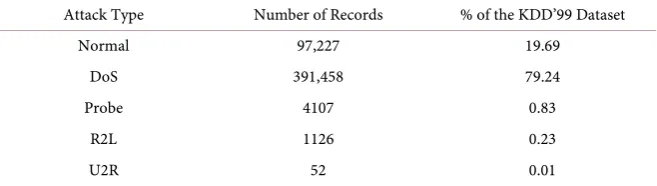
Table 1. Distribution of the records of the training data sub-set.
Attack Type Number of Records % of the KDD’99 Dataset
Normal 97,227 19.69
DoS 391,458 79.24
Probe 4107 0.83
R2L 1126 0.23
U2R 52 0.01
These are features that are used to capture second temporal window proper-ties.
• Host-based Traffic Features
These are features that utilize a historical window estimated over the number of connections.
Both of the time-based and host-based traffics are considered as traffic fea-tures in the KDD’99 dataset.
Likewise, attacks fall into four main categories [17]: • DoS attacks
These attacks focus on making all resources of the attacked system too busy and unable to accept legal request of resources.
• R2L attacks
This sort of attacks focuses on exploiting the vulnerabilities of the attacked system by unauthorized access from a remote machine.
• U2R attacks
These attacks entail access to local user accounts and their related privileges using the weakness traps of the attacked system.
• Probe attacks
This sort of attacks concentrates on monitoring networks and their related information to discover vulnerabilities and related trapdoors.
In the present study, the KDD’99 dataset was partitioned into two sub-sets: a training sub-set and a testing sub-set. The training sub-set consists of 10% of five million records that were distributed as shown in Table 1.
4. Research Background
The Learning Classifier System (LCS) is classified as a machine-learning paradigm that uses simple string rules, i.e., classifiers, to guide its performance in un-known environments. The LCSs have gained interest of researchers since 1995 [18] in their efforts to find solutions for different problems. The main part of the LCS is a group of rules called the population of classifiers. One of such rules is the XCS, which is one of the classifier systems that are categorized as rule-based systems that are employed for detecting intrusions.
DOI: 10.4236/cn.2019.111002 15 Communications and Network Learning is concerned with the reply from the environment so as to decide on whether or not the chosen rule leads to correct detection. Therefore, any learn-ing process achieved by taklearn-ing feedback from environment in positive or nega-tive way. In both cases, new rules must be created and evaluated to optimize DR. This step describe as an evolutionary process is realized via evolutionary algo-rithms as the GA [12].
The LCSs are of three types [9]: • Zeroth level classifier systems (ZCSs);
• Anticipatory learning classifier systems (ALCSs); • eXtended Classifier Systems (XCSs).
4.1. The eXtended Classifier System (XCS)
The XCS is a rule-based classifier system that was introduced by Wilson in 1995 [19]. Each rule, or classifier, consists of two parts:
• The condition part that can be represented using real code, integer code, or binary code, as is the case in the current study, for example, {0, 1, #}, where # denotes a non-significant value.
• The action part, which represents the result of the chosen rule to be applied in an environment. In general, the action can be either an attack or a normal action.
The XCS is based on two elements: reinforcement learning (RL) and GA. Reinforcement learning is concerned with gaining feedback from an environ-ment which can be a reward or a penalty. Thus, the RL is designed to determine how the rule, that is, the classifier, will be useful in other situations [20] [21]. The GA, on the other hand, works as a discovering mechanism which feeds the system with new rules. The main components of the XCS are shown in Figure 1. Briefly, they are [19] [20] [21] [22]:
• Detector
[image:5.595.255.501.544.701.2]The detector receives input from the environment that represents a network traffic record and converts it into a binary code.
Figure 1. Components of the XCS [19].
Detector
[A] [M]
Pop. Effectors
GA Predict
Array
DOI: 10.4236/cn.2019.111002 16 Communications and Network
• Match set [M]
The match set [M] is a pool of classifiers that are matched with a condition part of the incoming message from the detector.
• Prediction Array
This array is produced from [M] according to the average fitness-weighted prediction rules in [A].
• Action set [A]
This set represents a pool of classifiers derived from [M] that support the ac-tion which will be chosen.
• Effectors
The effectors are an output unit that will fire the action of the classifier se-lected from [A] to the environment where the result can be either a normal ac-tion or an attack.
4.2. Functioning of the XCS
Functioning of the XCS can be summarized in the following steps [19] [20] [21] [22]:
Step 1: Environment input is received via a detector that is concerned with the packet coming from the network.
Step 2: The received input is matched with a set of the existing system pop-ulation (Pop) classifiers. The matching process is involved in matching the re-ceived input with the Pop. So, the matched populations will be placed in a separate set called the matching set [M]. The contents of [M] represent the en-tire knowledge of the XCS that is concerned with deciding what to do with the incoming input.
Step 3: A prediction array is generated. This array is used to select the appro-priate action to be executed. The predictive ability of the action of every classifier in [M] is evaluated by taking a weighted average of the predictions of all the classifiers in [M], where the weight of every value of classifier represents the fit-ness, F.
Step 4: Producing an action set [A]. Next, a subset of [M] which supports the selected action is produced. This set is called the action set [A].
Step 5: Action execution and action set updating. The most appropriate classifier picked up from [A] will be fired to the environment by an effector. Then, feedback will be received from the environment in the form of reward if the taken action is correct. Otherwise, the system will get penalty. In each cycle, the XCS updates only the classifiers in [A] based on the feedback re-ceived, whether reward or penalty. Therefore, every classifier maintains a pre-diction about the feedback according to its response. Afterwards, the predic-tions are adjusted accordingly.
5. The Proposed Detection System
DOI: 10.4236/cn.2019.111002 17 Communications and Network developing IDSs. Every technique has its own pros and cons. Hence, these tech-niques have different detection powers in terms of the DR, FAR, or Accuracy measures of performance. The IDS proposed in the current study combines ma-chine learning (ML), represented by the XCS, and an evolutionary algorithm, represented by the FLAME_GA (FGA), which applies a new selection method called FLAME selection. In the traditional GAs, a set of operations is imple-mented in every generation. These operations are selection, crossover, mutation, and replacement. The method of FLAME selection is a new selection method that was adopted in the present study to provide an enhancement for the GA so as to improve the DR of the proposed IDS.
Fuzzy clustering by Local Approximation of Memberships (FLAME) deter-mines clusters according to fitness of the classifier. This selection method de-pends on the neighborhood relationships between parents that were applied to the neighboring memberships in fuzzy membership of populations [23]. Conse-quently, the FLAME is made up of several processes to perform clustering for the GA parents. It performs clustering via the following steps [23] [24]:
1) Extracting the information structure. This is usually realized by
a) Creating a graph to connect each parent to the best neighbor according to the k-Nearest Neighbors (KNN) algorithm.
b) Calculating the density for each parent according to its closeness to its k nearest neighbor.
c) Categorizing each parent into either of three classes; the inner, outer, or rest classes.
As such, the FLAME identifies the parents having archetypical features, which known as a Cluster-Supporting Objects (CSOs). Also, CSO represent an inner class.
2) Assigning a fuzzy membership vector to each parent. Achievement of this step entails
a) Provide initial values of fuzzy membership function:
i) Each parent in the inner CSO is fully assigned to one class to be associated with one class.
ii) All parents in the outlier class have fixed and full memberships to this class. iii) The rest class contains parents with equal membership.
b) Updating the fuzzy membership value for all parents in all three classes by applying a linear aggregation of the fuzzy memberships of the nearest neighbors.
3) Assignment of every parent to the cluster that has the highest membership value on a one-to-one object-cluster basis according to the following:
a) Passing on the highest membership value, based on a one-to-one par-ent-class basis, to all parent in the class.
b) Every parent will be assigned to specific class if that class has higher mem-bership value based on a one-to-multiple basis.
After implementing FLAME, all parents in the GA belong to one of the fol-lowing classes:
DOI: 10.4236/cn.2019.111002 18 Communications and Network
• Outer class: where parents have less density value compared with neighbors and a predetermined threshold.
• Rest class: where any parents not belong to inner or outer will be assigned to this class.
6. Performance Evaluation
Researchers in different studies like [8] [10] [11] [13] [14] [15] [16] have applied varying performance evaluation measures to develop a judgment on the perfor-mance of different IDSs. The DR and FAR are the two most popular measures that were used in previous studies to assess IDS performance. As well, they are used in the present study to evaluate performance of proposed IDS. A briefing on each follows.
• Detection Rate (DR)
The DR can be defined as “the ratio between the number of correctly detected attacks and the total number of attacks” [25] which can be expressed as in Equa-tion (1) [26]:
TP DR
TP FP =
+ (1)
• False Alarm Rate (FAR)
The FAR can be defined as “the number of ‘normal’ patterns classified as at-tacks (False Positive) divided by the total number of ‘normal’ patterns” [25] which can be expressed as in Equation (2) [26]:
FP FAR
FP TN =
+ (2)
The parameters appearing in Equation (1) and Equation (2) are explained in Table 2.
7. Experimental Results and Conclusions
This study proposed a new selection method called FLAME selection that has been implemented within a GA, which served as the classifier generator in the XCS. The initial results show that the FLAME selection method produced clas-sifiers with higher fitness than traditional selection methods such as the Rank-ing, Roulette Wheel, and Tournament methods.
[image:8.595.210.535.640.742.2]As regards ID, the experimental results showed that the XCS with FLAME se-lection is an effective method that can be used to improve the DR and reduce the
Table 2. Definitions of the parameters of Equation (1) and Equation (2) [26].
Parameter Definition
DOI: 10.4236/cn.2019.111002 19 Communications and Network FAR. Having a low FAR and high DR is an advantage for any IDS. Furthermore, parent (classifier) selection in the GA is a critical decision that must be soundly taken in the early stages of classifier generation for detecting the network at-tacks. Quite often, several modifications and trials will need to be conducted to gain high DR and several comparisons should be made to investigate and evi-dence gain of superior DR by the inner class than the other classes. In this re-gard, the FLAME selection method aims at selecting the best set of parents to breed a new generation with high potentiality to increase the DR and reduce the FAR.
In the future, further enhancements will be needed to improve the DR for all types of network attacks.
Conflicts of Interest
The author declares no conflicts of interest regarding the publication of this pa-per.
References
[1] Surat, S., Werasak, K., Witcha, Ch. and Siriporn, Ch. (2005) Network Anomaly De-tection Using Soft Computing. Proceedings of World Academy of Science, Engi-neering and Technology, 9, 140-144.
[2] Khan, M.S.A. (2011) Rule Based Network Intrusion Detection Using Genetic Algo-rithm. International Journal of Computer Applications, 18, 26-29.
[3] Srinivasu, P. and Avadhani, P.S. (2012) Genetic Algorithm Based Weight Extraction Algorithm for Artificial Neural Network Classifier in Intrusion Detection. Procedia Engineering, 38, 144-153. https://doi.org/10.1016/j.proeng.2012.06.021
[4] Li, W.S., Bai, X.M., Duan, L.Z. and Zhang, X. (2011) Intrusion Detection Based on Ant Colony Algorithm of Fuzzy Clustering. International Conference on Computer Science and Network Technology, IEEE, Piscataway, 1642-1645.
[5] Geramiraz, F., Memaripour, A.S. and Abbaspour, M. (2012) Adaptive Anoma-ly-Based Intrusion Detection System Using Fuzzy Controller. International Journal of Network Security, 14, 352-361.
[6] Ganapathy, S., Yogesh, P. and Kannan, A. (2012) Intelligent Agent Based Intrusion Detection Using Enhanced Multiclass SVM. Computational Intelligence and Neu-roscience, 10.
[7] Chan, P.K., Mahoney, M.V. and Arshad, M.H. (2003) A Machine Learning Ap-proach to Anomaly Detection. Florida Institute of Technology, Tech. Rep. CS-2003-06. [8] Amreen Sultana, A. and Jabbar, M.A. (2016) Intelligent Network Intrusion Detec-tion System Using Data Mining Techniques. 2nd International Conference on Ap-plied and Theoretical Computing and Communication Technology (iCATccT), 21 July 2016.
[9] Goldberg, D.E. (1989) Genetic Algorithms in Search, Optimization, and Machine Learning. Addison-Wesley, Boston.
[10] Wafa, A. (2013) Applying Artificial Neural Network and Extended Classifier System for Network Intrusion Detection. International Arab Journal of Information Tech-nology (IAJIT).
DOI: 10.4236/cn.2019.111002 20 Communications and Network
Algorithm. International Conference on Pervasive Computing (ICPC).
https://doi.org/10.1109/PERVASIVE.2015.7086963
[12] Kemmerer, R.A. and Vigna, G. (2002) Intrusion Detection: A Brief History and Overview. Computer, 35.
[13] Yin, G., Zhang, Y. and Zhao, Z. (2017) A Novel Computer Network Intrusion De-tection Algorithm Based on OSVM and Context Validation. International Confe-rence on Progress in Informatics and Computing (PIC).
[14] Kamble Jayshree, R. and Rangdale, S.P. (2014) Intrusion Detection Using Data Mining Approach. International Journal of Science and Research (IJSR), 3, 1142- 1145.
[15] Chen, Ch., Guan, D.J., Huang, Y. and Ou, Y. (2012) Attack Sequence Detection in Cloud Using Hidden Markov Model. The Seventh Asia Joint Conference on Infor-mation Security (Asia JCIS), 100-103. https://doi.org/10.1109/AsiaJCIS.2012.24 [16] Shrivastava, S.K. and Jain, P. (2011) Effective Anomaly Based Intrusion Detection
Using Rough Set Theory and Support Vector Machine. International Journal of Computer Applications, 18, 35-41.
[17] https://kdd.ics.uci.edu/
[18] Urbanowicz, R.J. and Moore, J.H. (2009) Learning Classifier Systems: A Complete Introduction, Review, and Roadmap. Journal of Artificial Evolution and Applica-tions, 2009, Article ID: 736398.
[19] Wilson, S.W. (1995) Classifier Fitness Based on Accuracy. Evolutionary Computa-tion, 3, 149-175.https://doi.org/10.1162/evco.1995.3.2.149
[20] Luca, L.P. (2008) Learning Classifier Systems: Then and Now. Evolutionary Intelli-gence, 1, 63-82.
[21] Holmes, J.H., et al. (2002) Learning Classifier Systems: New Models, Successful Ap-plications. Information Processing Letters, 82, 23-30.
https://doi.org/10.1016/S0020-0190(01)00283-6
[22] Bull, L. and Kovacs, T. (2005) Foundations of Learning Classifier Systems. Springer Science & Business Media, Berlin, Vol. 183. https://doi.org/10.1007/b100387
[23] Sampath, P. and Prabhavathy, M. (2015) Web Page Access Prediction Using Fuzzy Clustering by Local Approximation Memberships (FLAME) Algorithm. ARPN Journal of Engineering and Applied Sciences, 10, 3217-3220.
[24] Fu, L. and Medico, E. (2007) FLAME, a Novel Fuzzy Clustering Method for the Analysis of DNA Microarray Data. BMC Bioinformatics, 8, 3.
[25] Elhamahmy, M.E., Elmahdy, H.N. and Saroit, I.A. (2010) A New Approach for Evaluating Intrusion Detection System. International Journal of Artificial Intelligent Systems and Machine Learning, 2.
[26] Gulshan, K. (2014) Evaluation Metrics for Intrusion Detection Systems—A Study.
![Figure 1. Components of the XCS [19].](https://thumb-us.123doks.com/thumbv2/123dok_us/9216048.408637/5.595.255.501.544.701/figure-components-of-the-xcs.webp)
![Table 2. Definitions of the parameters of Equation (1) and Equation (2) [26]](https://thumb-us.123doks.com/thumbv2/123dok_us/9216048.408637/8.595.210.535.640.742/table-definitions-parameters-equation-equation.webp)
