Eggshell Crack Detection Based on Acoustic Impulse Response
and Supervised Pattern Recognition
Hao LIN, Jie-Wen ZHAO, Quan-Sheng CHEN, Jian-Rong CAI and Ping ZHOU
School of Food and Biological Engineering, Jiangsu University, Zhenjiang, Jiangsu, People’s Republic of China
Abstract
Lin H., Zhao J., Chen Q., Cai J., Zhou P. (2009): Eggshell crack detection based on acoustic impulse response and supervised pattern recognition. Czech J. Food Sci., 27: 393–402.
A system based on acoustic resonance was developed for eggshell crack detection. It was achieved by the analysis of the measured frequency response of eggshell excited with a light mechanism. The response signal was processed by recursive least squares adaptive filter, which resulted in the signal-to-noise ratio of the acoustic impulse response reing remarkably enhanced. Five features variables were exacted from the response frequency signals. To develop a robust discrimination model, three pattern recognition algorithms (i.e. K-nearest neighbours, artificial neural network, and support vector machine) were examined comparatively in this work. Some parameters of the model were optimised by cross-validation in the building model. The experimental results showed that the performance of the support vector machine model is the best in comparison to k-nearest neighbours and artificial neural network models. The optimal support vector machine model was obtained with the identification rates of 95.1% in the calibration set, and 97.1% in the prediction set, respectively. Based on the results, it was concluded that the acoustic resonance system combined with the supervised pattern recognition has a significant potential for the cracked eggs detection.
Keywords: eggshell; crack; detection; acoustic resonance; supervised pattern recognition
Supported by National Key Technology R&D Program of China, Grant No. 2006BAD11A12-06. Although many operations in the egg
produc-tion have been automated, the crack detecproduc-tion of the eggshell still relies mainly on the manual candling (Jindal & Sritham 2003). Eggs may be contaminated through damage such as cracks, and persons may be exposed to a high health risk when eating damaged eggs (Lin et al. 1995). It mostly results in significant economic losses to the egg industry (Bain 1990).
The acoustic resonance technique is a promising method for the detection and analysis of agro-products (Primo-Martín et al. 2009; Taniwaki
et al. 2009; Elbatawi 2008). The characteristic sounds produced by agro-products may
et al. 2000; De Ketelaere et al. 2000). De Kete-laere et al. (2003) evaluated several parameters for the eggshell measurement. Kemps et al. (2004) Calculated the elasticity modulus based on the reso-nant frequency of a curved shell segment. Wang et al. (2004) established the relationship between the dominant frequency and the egg physical properties. Jindal et al. (2003) employed ANN model to detect cracked eggs. Furthermore, dominant frequency and the normalisation average of the frequency domain were investigated for classification (Wang & Jiang 2005). The qualities of eggshells coming from differ-ent strains of laying hens were compared based on the acoustic impulse analysis (Amer Eissa. 2009). The mechanical properties of the rupture force, specific deformation, rupture energy, and firmness were examined (Altuntas & Şekeroğlu 2008). These studies mainly focused on the acoustic system parameters optimisation and on the characteristic frequency investigation of the response signals. However, few reports have appeared on the com-parison or selection of the calibration models for the cracked eggs discrimination. Generally, a robust discrimination model is a useful way to improve the identification rates of intact and cracked eggs.
The supervised pattern recognition refers to the techniques with the priori knowledge about the category membership of samples used for the clas-sification (Berrueta et al. 2007; Twellmanna et al. 2008). The identification model is developed on a training set of samples within categories. The model performance is evaluated in the prediction set. The application of the supervised pattern
recogni-tion within chemistry, biology, pharmacology, and food science is becoming ever and more important (Barbri et al. 2007; Jin et al. 2007). In order to highlight a good performance in the discrimination between intact and cracked eggs, three supervised pattern recognition algorithms were attempted at to develop a robust discrimination model. These algorithms are K-Nearest Neighbours (KNN), Arti-ficial Neural Network (ANN), and Support Vector Machine (SVM). Among them, KNN is a linear method, and both ANN and SVM are non-linear methods. In addition, recursive least squares (RLS) adaptive filter was used to enhance the signal-to-noise ratio. Some excitation resonant frequency characteristics of eggs were used as input vectors of the supervised pattern recognition.
MATERIAL AND METHODS
Samples preparation. In this work, 130 eggs with intact shells and 130 eggs with shell cracks were collected from a farm within 2 days after laying. All egg sizes from peewee to jumbo were used and cracks were inflicted on some eggs for the experiment. Eggs with irregular cracus were not incorporated in the data analysis. The cracks which were measured with a micrometer were 10–35mm long and less than 10-µm wide.
Experimental system. A system based on acous-tic resonance was developed for the eggshell crack detection. The system consisted of a product sup-port, a light exciting mechanism, a microphone,
signal amplifiers, a personal computer (PC), and the software to control the experimental setup and to analyse the results. A schematic diagram of the system is presented in Figure1.
The frequency response is greatly affected by the selection of the egg support. Based on previous experiments, a pair of rolls made of hard rubber was used to support the eggs. The shape of the support was focused normally onto the eggshell surface. During the measurements, the distortion of the egg natural motion caused by this sup-port was minimal. The excitation set included an electromagnetic driver, adjustable voltage (d. c.), and a light stick. The excitation mechanism was a cylinder duralumin stick. Total mass of the stick was 6 g, with the length and diameter of 6cm and 0.2 cm, respectively. The force of excitation is an important factor affecting the magnitude and width of the pulse. In this work, adjustable voltage (d. c.) is used to control the current of the electromagnetic driver so as to control the force of excitation. Based on a previous test, the voltage of excitation was set at 30 V. In this case, a proper frequency content of the force pulse was maintained and thus the maximum signal was achieved without any instrumentation overload. The impacting point was close to the crack in the cracked eggshell, and was placed randomly in the intact eggshell.
The response signal obtained from a microphone was amplified, filtred, and captured using a 16-bit data acquisition card. The microphone was placed on a shelf and isolated from the egg supporting structure so that no disturbing vibrations were in-troduced when performing the measurements.
Data acquisition and analysis. The software program was written in LabVIEW8.2 (National Instruments, Texas, USA) that allows a fast ac-quisition and processing of the response signal. The sampling rate was 22.05 kHz. The time signal was transformed to a frequency signal using a 512-point fast Fourier (FFT) transformation. The linear frequency spectrum obtained was trans-formed into the power spectrum. A band-pass filter was used to preserve the information of the frequency band between 1000 and 8000 Hz. Due to the signal-to-noise ratio, this favourable in the frequency band.
Software. All data processing algorithms were implemented with the statistical software Mat-lab7.1 (Mathworks, Massachusetts, USA) under Windows XP. SVM Matlab codes were downloaded
free of charge from http://www.esat.kuleuven. ac.be/sista/lssvmlab/.
RESULT AND DISCUSSION
Response signals
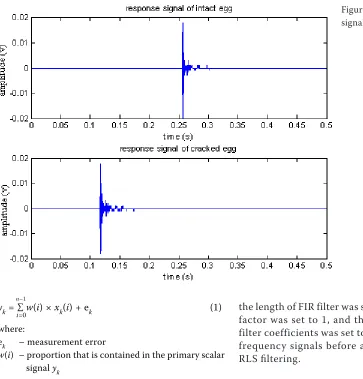
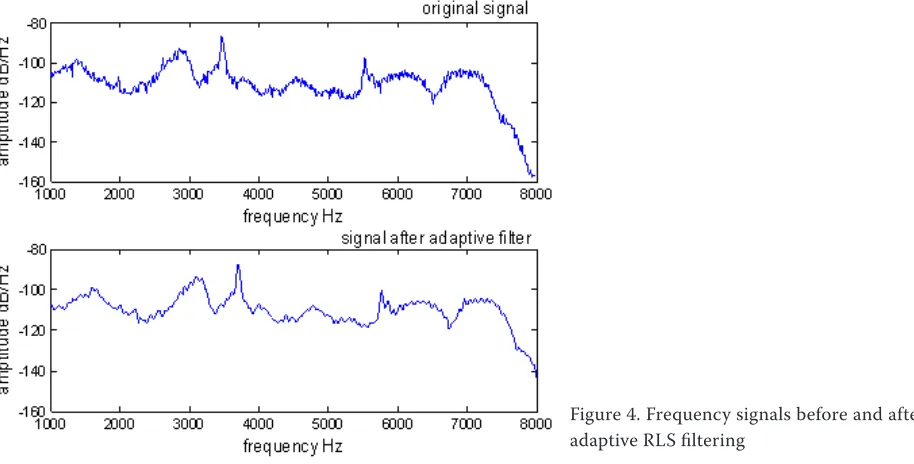
Figure 2 shows typical acquisition signals of the intact and cracked eggs in the time domain. Due to the acoustic response an instantaneous impulse occurred thus it was difficult to discriminate be-tween the response signals of cracked and intact eggs. The corresponding frequency domain signals transformed by FFT are shown in Figure 3. Here, the difference between them became remark-able. As a result of the analysis, the dominant resonance frequency could be observed and the average frequency value was found to be higher with the cracked eggs. As to the intact eggs, the peak frequencies were prominent and generally found in the middle position (3500–5000Hz). In contrast, the peak frequencies of the cracked eggs were dispersed and not prominent.
Adaptive RLS filtering
Owing to the cracked eggshell detection being based on the acoustic response measurement, it is apt to interference by the surrounding noise. This fact is accentuated by the much damped be-haviour of agro-products. Therefore, the response signal should be processed to remove the noise for further more analysis.
Adaptive interference cancelling is a standard ap-proach to remove the environmental noise (Adall & Ardalan 1999; Madsen 2000).The recursive least squares (RLS) is a popular algorithm in the field of the adaptive signal processing. In the adap-tive RLS filtering, the coefficients are adjusted from sample-to-sample to minimise the mean square error (MSE) between the measured noisy scalar signal and its modelled value from the filter (Chase et al. 2005). The scalar, real output signal,
yk = ∑
i=0w(i) × xk(i) + ek (1)
where:
ek – measurement error
w(i) – proportion that is contained in the primary scalar signal yk
The implementation of the RLS algorithm is op-timised by exploiting the inversion matrix lemma and provides fast convergence and small error rates (Djigan 2006).
In this work, FIR filter based on RLS algorithm was used to process the acoustic response signal. The parameters of RLS were optimised as follows:
the length of FIR filter was set to 32, the forgetting factor was set to 1, and the vector of the initial filter coefficients was set to 0. Figure 4 shows the frequency signals before and after the adaptive RLS filtering.
Variable selection
Based on the difference between the frequency domain response signals of intact and cracked eggs, five characteristics of the response frequency signals were exacted as input vectors of the
dis-Table 1. Frequency characteristics selection and expression
Variables Resonance frequency characteristics Expression
X1 area of amplitude value X1 = ∑
i=0Pi
X2 standard deviation of amplitude value X2 = √(Pi – P)2/n X3 frequency band of max amplitude value X3 = Indexmax (Pi) X4 mean of top three frequency amplitude values X4 = Max1:3 (Pi)/3
X5 ratio of amplitude values of middle frequency bands to low frequency banda X5 =
(
∑i=1Pi)
/200∑i=2Pi
Figur 2. Typical response time signals of of eggs
512
200
[image:4.604.75.438.80.459.2]crimination models. The frequency characteristics of the response are given in Table 1.
Qualitative discrimination between intact and cracked eggs
In this work, 260 fresh eggs were investigated after having been divided into two subsets. One of the subsets was called the calibration set used to build the model, and the other one was called the prediction set used to test the robustness of the model. The calibration set contained 170 samples,
while both the intact and cracked eggs comprised 85 samples each. The remaining 90 samples con-stituted the prediction set, consisting of 45 intact and 45 cracked eggs.
K-nearest neighbours
KNN(k-nearest neighbours) search is an impor-tant and classic means in the computer science. It is a linear method. An unknown sample of the prediction set is classified according to the ma-jority of its K-nearest neighbours in the training
[image:5.604.66.364.84.332.2]Figure 3. Typical response frequency signal of eggs
[image:5.604.69.526.530.762.2]set (Liu & Fu 2008; Gjertsen 2007). Parameter
K has a great influence on the identification rate of KNN model, the optimal values for these pa-rameters being selected in the calibration process. KNN-parameters are optimised with minimum prediction error estimated by cross-validation in the calibration set (Koukal et al. 2007; Chen 2008).That value of K which gives the lowest error rate is selected. Therefore, in this work 10 K values (K=1, 2, ..., 10) were tested by cross-validation. The identification results of the cross validation as influenced by the K values are shown in Figure 5. As seen in Figure 5, the optimal KNN was achieved. When K was equal to 5, the identification rate by cross-validation was 86.1%. Here, the identifica-tion rate was 88.9% in the predicidentifica-tion set.
Artificial neural network
Considering that KNN is a linear classification method that need not provide a complete solu-tion of the classificasolu-tion problem, the non-lin-ear approach such as artificial neural networks (ANN) was also used to compare with KNN. It is a powerful data-modelling tool that is able to capture and represent complex relationships
be-tween the inputs and outputs (Yetilmezsoy & Demirel 2008; O’Farrell et al. 2005).The back propagation artificial neural network (BP-ANN) is a classical feed-forward multi-layer network consisting of neurons arranged in layers (an input layer, one or more hidden layers, and an output layer) (Caglar et al. 2008; Jančić et al. 2008). The eigenvectors obtained from the response signals were processed by the neural network; the net-work output expresses the resemblance between the object and thea training pattern. Along with every pass of the training pattern and adjustment of the weight factors, the difference between the desired and calculated network outputs, defined as the net-work output error, will gradually be-come smaller until it meets the desired value. One cycle through all the training patterns is defined as an epoch. Before the optimal accordance of the network output errors is achieved for all training patterns, many epochs are required for the back propagation.
[image:6.604.72.360.85.275.2]In this work, BP-ANN as one of the calibration methods for comparison was applied. Three layers (i.e., the input-hidden- and output layer) of BP-NN were arranged. Five characteristics of the response frequency signals were exacted as input vectors of ANN models. The number of neurons in the Figure 5. Identification rate of KNN model by cross-validation calibration set under different K values
Table 2. Comparison of the identification results coming from three models
Discrimination models Identification rates (%)
cross-validation calibration set independent prediction set
KNN 86.1 88.9
BP-NN 93.2 92.1
SVM 95.1 97.1
1 2 3 4 5 6 7 8 9 10
Paramater K
100 90 80 70 60 50 40 30 20 10 0
Id
en
tifi
ca
tio
n
ra
te
s (
%
[image:6.604.73.540.669.755.2]hidden layer was set tor 5. The output of BP-NN was the free amino acid content of interest. Finally, optimum network architecture was obtained with the topological architecture 5–5–1. The learning rate factor and momentum factor were set to 0.1; the initial weights were 0.3; the scale function used was the ‘tan h’ function. The permitted error was set at 0.002 and the maximal training time was 50 000 times. The identification rates of intact and cracked eggs were 95.9% and 90.9% in the cross-validation calibration set, respectively. When the performance of BP-ANN model was evaluated by means of the samples, the identification rates of intact and cracked eggs were 90.9% and 93.2% in the prediction set, respectively. The performance of BP-ANN model was remarably better than that of KNN in both the cross-validation calibration set and the prediction set.
Support vector machines
Another non-linear approach, support vector machines (SVM), was also applied in this work. The support vector machine (SVM) is typically used to describe the classification problems with the support vector methods (Fernández et al. 2006).
The basic concept of SVM is to map nonlinearly the original data x into a higher dimensional feature space and create a hyperplane between two sets of data for classification. The transformation into the higher-dimensional space is implemented by a kernel function (Thissen et al. 2004). In general, there are three classical kernel functions: Polyno-mial kernel function, radial basis function (RBF) kernel function, and sigmoid kernel function. The selection of the kernel function has a great influ-ence on the performance of SVM. Comparing with other feasible kernel functions, RBF could handle the linear and nonlinear relationships between the spectra and target attributes. Besides, RBF is able to reduce the computational complexity of the training procedure and give a good performance under general smoothness assumptions (Chen
et al. 2007). Thus, RBF was recommended as the kernel function of SVM in this work.
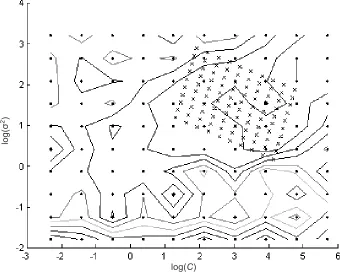
[image:7.604.126.466.461.733.2]In order to obtain a good performance, the regularisation parameter C and parameter σ of the kernel function in SVM model have to be optimised. Parameter C determines the trade-off between the minimising of the training error and the minimising of the model complexity. Param-eter σ implicitly defines the non-linear mapping from the input space to some high-dimensional
Figure 6. Contour plot of the optimisation parameters C and σ2 of the model using RBF kernel
log(C)
lo
g(
σ
feature space. As shown in Figure 6, the search procedure was carried out in two steps. First, a comparatively large step length in a 10 × 10 grid represented as “·” was applied. Subsequently, a much smaller step length was used to obtain the optimal combination of these parameters; the search grid “×” is also shown in Figure 6. The op-timal search area is determined based on the last step. The logarithmic form was employed in the search plane owing to the large magnitude in the investigated ranges of these parameters. Optimal C and σ2 for the calibration models were found as the values of 88.13 and 3.05, respectively.
When RBF kernel and optimised parameters of C
and σ2 were used, the optimal SVM model could be obtained. It was achieved with the identification rates of intact and cracked eggs of 94.7% and 95.5% in the cross-validation calibration set, respectively. When the performance of SVM model was evalu-ated by means of the samples, the identification rates of intact and cracked eggs were 96.2% and 97.2% in the prediction set, respectively. Compared with KNN and ANN models, SVM model showed superior ability in the discrimination between intact and cracked eggs in both the calibration and prediction sets.
Discussion of discrimination results
In order to get a good performance in the dis-crimination between intact and cracked eggs, KNN, ANN, and SVM models were examined compara-tively. Table 2 shows the identification results com-ing from the three models. SVM model and ANN model provided a remarkably better performance than KNN model, thus indicating that the nonlinear information was helpful to improve the prediction performance. These results can be explained by some relevant statistical learning theories. Gener-ally, the non-linear method is apter than the linear method at the level of self-learning and self-adjust. Therefore, the non-linear model has often a higher performance in the calibration model.
The performance of SVM model was close to that of ANN model in the calibration set, but bet-ter in the prediction set. As to the investigation between ANN and SVM models, the traditional ANN models are based on the empirical risk mi-nimisation (ERM) principle (Fang et al. 2008). ERM minimises the error of the training data, suffering from the problem of producing models
that can over-fit the data in generalisation. It means that the ‘best’ training model may always result in a poor performance in the prediction set. The foundation of SVM embodies the structural risk minimisation (SRM) principle, which covers the problem caused by ERM principle. The SRM principle theoretically minimises the expected risk based on the simultaneous minimisation of both the empirical risk and the confidence interval. SRM can maintain a trade-off between the accuracy of the training data and the capac-ity of the learning machine so as to improve the generalisation of the model (Wu et al. 2008). This equips SVM with a greater potential to generalise the input–output relationship learnt during its training phase for making good predictions for new input data. The difference in RM leads to a better generalisation performance for SVM than ANN. Therefore, SVM embodies excellent gen-eralisation in its theory, which results in better results than those obtained with ANN model in the prediction set.
CONCLUSIONS
The erggshell crack detection based on the acoustic impulse resonance was aimed at in this work. The signal-to-noise ratio of the acoustic impulse response was remarkably enhanced by adaptive filters. Three supervised pattern recogni-tion methods (KNN, ANN, and SVM) were exam-ined comparatively to develop a discrimination model in this work. All three methods provided acceptable results. Compared with KNN and ANN, SVM model showed superior ability in the discrimination between intact and cracked eggs in both the calibration and prediction sets. The re-sults indicated that a robust discrimination model can be a useful way to improve the identification rates of cracked eggs. It can be concluded that the use of the acoustic resonance technique combined with an appropriate supervised pattern recogni-tion is a promising method to detect cracked eggs.
References
Altuntas E., Şekeroğlu A. (2008): Effect of egg shape index on mechanical properties of chicken eggs. Jour-nal of Food Engineering, 85: 606–612.
Amer Eissa A.H (2009): Comparative eggshell stability assessment using three different non-destructive sens-ing instruments and breakage force strength. Journal of Food Engineering, 93: 444–452.
Bain M.M. (1990): Eggshell structure and mechani-cal strength. In: Proceedings 8th Australian Poultry and Feed Convention, Gold Coast, Queensland, Aus-tralia.
Barbri N.E., Amari A., Vinaixa M., Bouchikhi B., Correig X., Liobet E. (2007): Building of a metal oxide gas sensor-based electronic nose to assess the freshness of sardines under cold storage. Sensors and Actuators B, 128: 235–244.
Berrueta L.A., Salces R.M.A., Heberger K. (2007): Supervised pattern recognition in food analysis. Jour-nal of Chromatography A, 1158: 196–214.
Caglar N., Elmas M., Yaman Z.D., Saribiyik M. (2008): Neural networks in 3-dimensional dynamic analysis of reinforced concrete buildings. Construction and Building Materials, 22: 788–800.
Chase J.G., Begoc V., Barroso L.R. (2005): Efficient structural health monitoring for a benchmark struc-ture using adaptive RLS filters. Computers and Struc-tures, 83: 639–647.
Chen J.H. (2008): KNN based knowledge-sharing model for severe change order disputes in construction. Au-tomation in Construction, 17: 773–779.
Chen Q.S., Zhao J.W., Fang C.H., Wang D.M. (2007): Feasibility study on identification of green, black and Oolong teas using near-infrared reflectance spec-troscopy based on support vector machine (SVM). Spectrochimica Acta, Part A, 66: 568–574.
Cho H.K., Choi W.K., Paek J.K. (2000): Detection of surface in shell eggs by acoustic impulse method. Transaxtions of ASAE, 43: 1921–1926.
Coucke P. (1998): Assessment of some physical egg quality parameters based on vibration analysis. [Ph.D. Thesis.] Katholieke University, Leuven.
Coucke P., De Ketelaere B., De Baerdemaeker J. (2003): Experimental analysis of the dynamic, me-chanical behaviour of a chicken egg. Journal of Sound and Vibration, 266: 711–721.
De Ketelaere B., Coucke P., De Baerdemaeker J. (2000): Eggshell crack detection based on acoustic resonance frequency analysis. Journal of Agriculture Engineering Research, 76: 157–163.
De Ketelaere B., Vanhoutte H., De Baerdemaeker J.D. (2003): Parameter estimation and multivariable model building for the non-destructive, on-line
deter-mination of eggshell strength. Journal of Sound and Vibration, 266: 699–709.
Djigan V.I. (2006): Multi-channel parallelizable slid-ing window RLS and fast RLS algorithms with linear constraints. Signal Processing, 86: 776–791.
Elbatawi I.E. (2008): An acoustic impact method to detect hollow heart of potato tubers. Biosystems En-gineering, 100: 206–213.
Fang S.F., Wang M.P., Qi Q.H., Zheng F. (2008): Hybrid genetic algorithms and support vector regression in forecasting atmospheric corrosion of metallic materi-als. Computational Materials Science, 44: 647–655. Fernández Pierna J.A., Baeten V., Dardenne P.
(2006): Screening of compound feeds using NIR hyper-spectral data. Chemometrics and Intelligent Labora-tory Systems, 84: 114–118.
Gjertsen A.K. (2007): Accuracy of forest mapping based on Landsat TM data and a kNN-based method. Remote Sensing of Environment,110: 420–430.
Jančić B., Medenica M., Ivanović D., Janković S., Malenović A. (2008): Monitoring of fosinopril sodium impurities by liquid chromatography-mass spectrometry including the neural networks in meth-od evaluation. Journal of Chromatography A, 1189: 366–373.
Jindal V. K., Sritham E. (2003): Detecting eggshell cracks by acoustic impulse response and artificial neural networks. In: ASAE Annual International Meet-ing, Riviera Hotel and Convention Center, Las Vegas, Nevada.
Jin S., Yeung D.S., Wang X.Z. (2007): Network intru-sion detection in covariance feature space. Pattern Recognition, 40: 2185–2197.
Kemps B., De Ketelaere B., Bamelis F., Govaerts T., Mertens K., Kamers B., Tona K., Decuypere E., De Baerdemaeker J. (2004): Development of a methodology for the calculation of Young’s modulus of eggshell using vibration measurements. Biosystems Engineering, 89: 215–221.
Koukal T., Suppan F., Schneider W. (2007): The im-pact of relative radiometric calibration on the accuracy of kNN-predictions of forest attributes. Remote Sens-ing of Environment, 110: 431–437.
Lin J., Puri V.M., Anantheswaran R.C. (1995): Meas-urement of eggshell thermal mechanical properties. Transactions of the ASAE, 38: 1769–1776.
Liu C.M., Fu S.Y., (2008): Effective protocols for kNN search on broadcast multidimensional index trees. Information Systems, 33: 18–35.
O’farrell M., Lewisa E., Flanagana C., Lyonsa W.B., Jackmanb N. (2005): Combining principal com-ponent analysis with an artificial neural network to perform online quality assessment of food as it cooks in a large-scale industrial oven. Sensors and Actuators B, 107: 104–112.
Primo-Martín C., Sözer N., Hamer R.T., Vliet V. (2009): Effect of water activity on fracture and acous-tic characterisacous-tics of a crust model. Journal of Food Engineering, 90: 277–284.
Taniwaki M., Hanadab T., Sakurai N. (2009): Post-harvest quality evaluation of “Fuyu” and “Taishuu” persimmons using a nondestructive vibrational meth-od and an acoustic vibration technique. Postharvest Biology and Technology, 51: 80–85.
Thissen U., Pepers M., Űstűn B., Melssen W. J., buydens, L.M.C. (2004): Comparing support vector machines to PLS for spectral regression applications. Chemometrics and Intelligent Laboratory Systems, 73: 169–179.
Twellmanna T., Meyer-Baese A., Lange O., Foo F., Nattkemper T.W. (2008): Model-free visualization of suspicious lesions in breast MRI based on supervised and unsupervised learning. Engineering Applications of Artificial Intelligence, 21: 129–140.
Wang J., Jiang R.S. (2005): Eggshell crack detection by dynamic frequency analysis. European food Research Technology, 221: 214–220.
Wang J., Jiang R.S., Yu Y. (2004): Relationship between dynamic resonance frequency and egg physical proper-ties. Food Research International, 37: 45–50. Wu C.L., Chau K.W., Li H.S. (2008): River stage
predic-tion based on a distributed support vector regression. Journal of Hydrology, 358: 96–111.
Yetimezsoy K., Demirel S. (2008): Artificial neural network (ANN) approach for modeling of Pb(II) ad-sorption from aqueous solution by Antep pistachio (Pistacia vera L.) shells. Journal of Hazardous Materi-als, 153: 1288–1300.
Received for publication April 15, 2009 Accepted after corrections July 16, 2009
Corresponding author:
Jiewen Zhao, Ph.D., School of Food and Biological Engineering, Jiangsu University, Xuefu Road 301, Zhenjiang City, Jiangsu Province, 212013, P.R. China