ISSN Online: 2152-7393 ISSN Print: 2152-7385
Generating Epsilon-Efficient Solutions in
Multiobjective Optimization by
Genetic Algorithm
El-Desouky Rahmo
1,2, Marcin Studniarski
31Department of Mathematics, Faculty of Science, Taif University, Khurma, KSA 2Mathematics Department, Faculty of Science, Mansoura University, Mansoura, Egypt 3Faculty of Mathematics and Computer Science, University of Ƚódź, Ƚódź, Poland
Abstract
We develop a new evolutionary method of generating epsilon-efficient solu-tions of a continuous multiobjective programming problem. This is achieved by discretizing the problem and then using a genetic algorithm with some de-rived probabilistic stopping criteria to obtain all minimal solutions for the discretized problem. We prove that these minimal solutions are the epsilon- optimal solutions to the original problem. We also present some computa-tional examples illustrating the efficiency of our method.
Keywords
Vector Optimization, Approximate Solutions, Genetic Algorithm, Stopping Criteria
1. Introduction
The goal of multiobjective optimization, also called vector optimization, is to find a certain set of optimal (efficient) elements of a nonempty subset of a partially ordered linear space. However, finding an exact description of this set often turns out to be practically impossible or computationally too expensive. Therefore, many researchers have focused their efforts on approximation pro- cedures and approximate solutions (see e.g. [1][2] and references therein).
More than three decades ago, the notion of ε-efficiency has been introduced by Loridan [3] for multi-objective optimization problems (MOPs). Afterwards, this concept has been used e.g. in [2][4][5]. To deal with a continuous multi- objective optimization problem, one has to consider a finite discretization of the set of feasible points (see Section 3 below). The discretization of the search space How to cite this paper: Rahmo, E.-D. and
Studniarski, M. (2017) Generating Epsilon- Efficient Solutions in Multiobjective Opti-mization by Genetic Algorithm. Applied Ma- thematics, 8, 395-409.
https://doi.org/10.4236/am.2017.83032
Received: January 12, 2017 Accepted: March 27, 2017 Published: March 30, 2017
Copyright © 2017 by authors and Scientific Research Publishing Inc. This work is licensed under the Creative Commons Attribution International License (CC BY 4.0).
http://creativecommons.org/licenses/by/4.0/
is one of the efficient techniques to obtain approximate solutions for MOPs, (e.g.
[6][7]). The aim of the present paper is to develop a method of generating ε- efficient solutions (as defined in [4]) of a continuous MOP. This is achieved by discretizing the problem and then using a genetic algorithm according to the scheme described in [8]. In this way, some probabilistic stopping criteria are obtained for this procedure. They are given in the form of an upper bound for the number of iterations necessary to ensure finding all minimal elements of a finite partially ordered set with a prescribed probability. Supporting theoretical results are established and some computational examples are provided.
2. Stopping Criteria for Genetic Algorithms
In this section we review the results of [8] on probabilistic stopping criteria which will be applied later in Section 4 to some continuous multiobjective opti- mization problem.
2.1. Random Heuristic Search
The RHS (Random Heuristic Search) algorithm, described in [9], is defined by a fixed initial population pˆ and a transition rule τ which, for a given popu-
lation p, determines a new population τ
( )
p . Iterating τ , we obtain a se-quence of populations:
( )
2( )
ˆ, , ,ˆ ˆ
p
τ
pτ
p (1)Each population consists of a finite number of individuals which are elements of a given finite set Ω called the search space. Populations are multisets, which means that the same individual may appear more than once in a given popu- lation.
To simplify the notation, it is convenient to identify Ω with a subset of integers: Ω =
{
0,1,,n−1}
. The number n is called the size of search space. Then a population can be represented as an incidence vector (see [10], p. 141):(
)
T0, ,1 , n1 ,
v= v v v− (2)
where vi is the number of copies of individual i∈ Ω in the population (vi =0 if the i-th individual does not appear in the population). The size of population
v is the number
1
0
.
n
i i
r v
−
=
=
∑
(3)We assume that all the populations appearing in sequence (1) have the same size r. Dividing each component of incidence vector (2) by r, we obtain the population vector
(
)
T0, 1, , n 1 ,
p= p p p− (4)
longs to the set
( )
1 0: : 0 , 1 ,
n n
i i
i
x x i x
−
=
Λ = ∈ ≥ ∀ =
∑
(5) which is a simplex in n. However, not all points of this simplex correspond to finite populations. For a fixed r∈, the following subset of Λ consists of all populations of size r (see [9], p. 7):{ }( )
10
1
: : 0 , .
n n
r i i
i
x x i x r
r
−
=
Λ = ∈ ∈ ∪ ∀ =
∑
(6)We now define the mapping
:Λ → Λ,
called heuristic ([9], p. 9) or generational operator ([10], p. 144), in the following way: for a vector p∈ Λ representing the current population,
( )
p is theprobability distribution that is sampled independently r times (with replace-
ment) to produce the next population after p. For each of these r choices, the
probability of selecting an individual i∈ Ω is equal to
( )
p i, the i-th com- ponent of ( )
p .A transition rule τ is called admissible if it is a composition of a heuristic with drawing a sample in the way described above. Symbolically,
( )
p sample(
( )
p)
, .pτ = ∀ ∈ Λ (7)
Of course, a transition rule defined this way is nondeterministic, i.e., by applying it repeatedly to the same vector p, we can obtain different results. It should also be noted that, although
( )
p may not belong to Λr, the result of drawing an r-element sample is always a population of size r; therefore, itfollows from (7) that τ
( )
p ∈ Λr.2.2. The Case of a Genetic Algorithm
In this subsection we consider a genetic algorithm as a particular case of the RHS. We assume that a single iteration of the genetic algorithm produces the next population from the current population as follows:
1) Choose two parents from the current population by using a selection method which can be described by some heuristic (see [9], 4.2).
2) Crossover the two parents to obtain a child. 3) Mutate the child.
4) Put the mutated child into the next population.
5) If the next population contains less than r members, return to step 1.
The only difference between the iteration described above and the iteration of the Simple Genetic Algorithm defined in ([9], p. 44) is that in our version muta- tion is done after crossover.
refer the reader to ([10], Chapter 5)). The only requirement is that the com- position of the three operations (selection, crossover, mutation) can be described in terms of some heuristic.
We assume that mutation consists in replacing a given individual from Ω by another individual, with a prescribed probability. Let us denote by ui j, the probability that individual i mutates to j. In this way, we obtain a n n× matrix U= ui j, i j,∈Ω. We denote by Pr
( )
q p =Pr(
τ( )
p =q)
the probability of obtaining a population q in the current iteration of the RHS algorithm provided the previous population is p, and by Pr(
[ ]
j p)
=( )
p j the pro-bability of selecting an individual j∈ Ω by a single sampling of the probability distribution
( )
p . In particular, the probability of generating individual j from population p by successive application of selection, crossover and muta- tion is equal to (see [8], formula (7))( )
(
[ ]
)
1(
[ ]
)
,
scm sc
0
Pr Pr ,
n
i j j
i
p j p u j p
−
=
= =
∑
(8)
where the subscript sc means that we are dealing with the composition of selection and crossover, and the subscript scm indicates the composition of selection, crossover and mutation. To get a whole new population, one should draw an r-element sample from the probability distribution (8). The probability of generating a population q in this way is then equal to (see [8], formula (8))
( )
1(
(
[ ]
( )
)
)
scm scm
0
Pr
Pr ! .
!
j
rq n
j j
j p
q p r
rq
− =
=
∏
(9)2.3. Stopping Criteria for Finding All Minimal Elements of
Ω
We now consider the following multiobjective optimization problem. Let Ω be a finite search space defined in Subsection 2.1, and let f :Ω →F be a functionbeing minimized, where F =
{
f( )
ω ω: ∈ Ω}
and(
F,)
is a partially orderedset. An element x∗∈F is called a minimal element of
(
F,)
if there is nox∈F such that xx∗, where the relation is defined by
(
xy)
:⇔(
xy∧ ≠x y)
. (10)The set of all minimal elements of F is denoted by Min
(
F,)
. We definethe set of optimal solutions in our multiobjective problem as follows:
(
)
{
( )
(
( )
)
}
Minf , :
ω
:fω
Min f , .∗
Ω = Ω = ∈ Ω ∈ Ω (11)
In particular, if F is a finite subset of the Euclidean space k , and
(
1, , k)
f = f f , where each component of f is being minimized indepen-
dently, then the relation in F can be defined by
(
xy)
:⇔(
xi≤y ii, =1,,k)
.In this case, Ω∗ is the set of all Pareto optimal solutions of the respective
multiobjective optimization problem.
Suppose that the set Ω∗ of minimal solutions has the following form:
{
j j1, 2, ,jm}
,∗
Ω = (12)
where the (possibly unknown) number m of these solutions is bounded from above by some known positive integer M. We say that all elements of Ω∗ have
been found in the first t iterations if, for each l∈
{
1,,m}
, there exists{
1, ,}
s∈ t such that s
( )
ˆ 0jl
p
τ
> . This means that each minimal solution is a member of some population generated in the first t iterations.Theorem 1 ([8], Thm. 6.1) We consider the general model of genetic algori-
thm, described in Subsection 2.2, being a special case of the RHS algorithm with
the heuristic given by (8). Suppose that there exists a number β ∈
( )
0,1 sa-tisfying
, , , . i j
u ≥β ∀ ∈ Ω ∈ Ωi j ∗ (13)
Let M and t be two positive integers satisfying the inequality
(
1)
rt 1.M −β < (14)
Let Ω∗ be of the form (12) with
m≤M. Then the probability of finding all
elements of Ω∗ in the first t iterations is at least
(
)
1−M 1−β rt. (15)
Corollary 2 ([8], Cor. 2) We consider the same model of algorithm as in
Theorem 1. Suppose that condition (13) holds for some β ∈
( )
0,1 . Let M be agiven upper bound for the cardinality of Ω∗. For any
( )
0,1
δ ∈ , we denote by
( )
mint∗
δ
the smallest number of iterations required to guarantee that all elementsof Ω∗ have been found with probability δ . Then
( )
(
(
)
)
min
ln 1 ln , ln 1
M t
r
δ δ
β
∗ ≤ − −
−
(16)
where x is the smallest integer greater than or equal to x.
2.4. Construction of the Set of Minimal Elements
The results of Section 2.3 give no practical way of constructing the set Ω∗.
Different elements of this set are members of different populations generated by the genetic algorithm, and cannot be easily identified. To give an effective way of constructing Ω∗, some modification of the RHS is necessary.
The algorithm presented below is a combination of the RHS and the base VV (van Veldhuizen) algorithm described in ([11], 3.1). Suppose we have some RHS satisfying the assumptions of Theorem 1. It generates a sequence (1) of popu- lations, all of them being members of Λr. For each p∈ Λr, we define the set of individuals represented in population p:
( ) {
}
set p := ω∈ Ω:pω ≠0 . (17)
Then we construct a sequence
{ }
Dt of subsets of Ω as follows:( )
(
ˆ)
: set t , 0,1, ,
t
where 0
: id
τ = is the identity mapping. Finally, we define another sequence
{ }
Et of sets recursively by(
)
0: Minf 0, ,
E = D (19)
(
)
1: Min 1, , 0,1, ,
t f t t
E+ = E ∪D+ t= (20)
where we have used the notation Minf as in (11). Formulas (19) and (20) define the VV algorithm.
It is shown in ([11], Prop. 1) that the sets f E
( )
t converge with probability 1 to Min(
F,)
in the sense of some metric. However, as the authors comment,“The size of the sets Et will finally grow to the size of the set of minimal elements. Since this size may be huge, this base algorithm offers only limited usefulness in practice”. In fact, our considerations can have practical value only if the cardinality of Ω∗ is relatively small. For continuous multiobjective opti-
mization problems, such situation can be achieved by choosing a suitable dis- cretization.
Our final result is the following theorem which shows that, with a prescribed probability, the sets Et constructed by the VV algorithm are equal to
∗
Ω for t sufficiently large.
Theorem 3 ([8], Thm. 7.1) Let the assumptions of Corollary 2 be satisfied.
Then, with probability δ, we have
( )
min, .
t
E t t δ
∗ ∗
Ω = ∀ ≥ (21)
3. Generation of
ε
-Efficient Solutions for a Continuous
Problem
Let f :X →l be a given mapping, where X is a closed and bounded subset of k. We consider the following multiobjective optimization problem:
( )
{
}
min f x :x∈X . (22)
To solve this problem means to find all Pareto optimal (efficient) points of X with respect to the partial order relation in l defined by
(
uv)
:⇔(
ui≤v ii, =1,, .l)
(23) However, in practical situations this can be very difficult or even impossible. Therefore, we shall consider a discretized version of problem (22).For any given η>0, we say that a subset Ω of k is a η-discretization of X if
( )
and , ,
z
X X B zη
∈Ω
Ω ⊂ ⊂
(24)where B x
(
,η)
:={
y∈k : y−x <η}
. Since X is compact, we can alwaysfind a finite η-discretization of X. The discretized multiobjective optimi- zation problem can now be formulated as follows:
( )
{
}
min f x :x∈ Ω , (25)
It is natural to ask whether an exact solution of problem (25) yields some sort of approximate solution of problem (22). One of the cases where a positive answer can be given is described in the proposition below. Before formulating it, we must define ε-efficient solutions, following ([4], Definition 2.3 (ii)).
Let
(
1, ,)
l lε= ε ε ∈ be such that ε >i 0 1,
(
i= ,l)
. We say that a pointx∈X is an ε-efficient solution of problem (22) if there is no x∈X such that
( )
( )
,f x f x −ε (26)
where the relation “” is defined by formula (10). Proposition 4 Let
(
1, ,)
:l l
f = f f X → where X is compact and each
function fi is Lipschitz continuous with constant Ki >0 1,
(
i= ,l)
. Let lε ∈ be such that ε >i 0 1,
(
i= ,l)
. Define: min i : 1, , ,
i
i l
K ε
η = =
(27)
and let Ω be a η-discretization of X. Denote by Ω∗ the set of all Pareto
optimal solutions of problem (25) (i.e., Ω =∗ Minf
(
Ω,)
as in formula (11)).Then every point x∈ Ω∗ is an ε-efficient solution of problem (22).
Proof. Let x∈ Ω∗. Suppose to the contrary that x is not an ε-efficient solution of (22). Then there exists x∈X such that (26) holds. In particular, we have
( )
( )
, for all{
1, , .}
i i i
f x ≤ f x −ε i∈ l (28)
By the second inclusion in (24), there exists z∈ Ω such that z− <x η.
Therefore, using (27) and (28), we obtain, for all i∈
{
1,,l}
,( )
( )
( )
( )
( )
( )
( )
( )
,i i i i
i i
i i
i i i i
f z f x f z f x
f x K z x
f x K
f x K f x
η
ε η
≤ + −
≤ + −
< +
≤ − + ≤
which contradicts the assumption that x∈ Ω∗.
4. The Main Algorithm
Consider the multiobjective optimization problem (22), where the constraint set X is a box defined by
[
]
1
: , ,
k
i i
i
X α β
=
=
∏
(29)where αi <βi 1,
(
i= ,k)
. Suppose that the assumptions of Proposition 4 aresatisfied. We want to specify a η-discretization of X. We construct the set Ω as follows:
(
)
: k: i , 0,1, , , 1, , ,
i i i i i i
i t
x x t k i k
k
α β α
Ω = ∈ = + − = =
(30)
Proposition 5 For every given η>0, it is possible to find the numbers ki
so large that the set Ω defined by (30) is a η-discretization of X.
Proof. The inclusion Ω ⊂X is obvious. We now prove the second inclusion in (24). For simplicity, we consider the l∞ norm in k:
1
: max i.
i k
x∞ x
≤ ≤
= (31)
Let us choose ki so that
(
)
1
2 .
i i
i
k β α− < η (32)
Take any x∈X . Then, for each i∈
{
1,,k}
, there exists si∈{
0,1,,ki}
such that the number zi defined by(
)
: i
i i i i
i
s z
k
α β α
= + − (33)
satisfies
(
)
1
. 2
i i i i
i
x z
k β α η
− ≤ − <
Then the vector z:=
(
z1,,zk)
∈ Ω is such that1
: max i i ,
i k
x z∞ x z
η
≤ ≤
− = − <
which completes the proof.
In the sequel we consider the following simple evolutionary algorithm which is a special case of the algorithm described in Subsection 2.4. It does not contain selection and crossover. The mutation process is very simple and consists in replacing the current population by another randomly chosen population of the same size. However, the stopping criteria described above still hold for this algorithm because their proofs make use of the properties of the mutation alone.
Algorithm 1 Parameters: δ >0 (for the stopping criterion), ε ∈l (for
defining η-discretization). 1) Set t: 0= .
2) Choose randomly a population D0 consisting of r elements of Ω. 3) Construct the set E0 by formula (19).
4) Mutate the population Dt by replacing it by another randomly chosen population Dt+1 consisting of r elements of Ω.
5) Construct the set Et+1 by formula (20). 6) If t 1 tmin
( )
δ
∗
+ ≥ , then stop and define Ω =: Et+1. 7) Increase t by 1 and go to Step 4.
Proposition 6 After stopping Algorithm 1, the equality Ω = Ω∗ holds with
probability δ, and consequently, Ω consists entirely of ε-efficient solutions
of problem (22) with probability δ.
Proof. Apply Theorem 3 and Corollary 2 with M: card= Ω and β =: 1M
(we assume the equal probability 1M of mutating i to j for every ,
5. Computational Examples
Below we report on testing the algorithm described above on some examples taken from literature. To find the set of minimal elements (i.e., nondominated elements) of finite sets in Steps 3 and 5, we have used the simple algorithm for classifying a population according to non-domination, see Section 4.3.1 of [12].
Example 7 (Problem SCH in Table I of [13])
( )
( )
(
1 2)
min f x ,f x ,
where
( )
2( ) (
)
2 3 3 1 , 2 2 , 10 ,10 .f x =x f x = x− x∈ −
As stated in Table I of [13], any point x∈
[ ]
0, 2 is a Pareto optimal solutionof this problem. Let X = − 10 ,103 3.
Since each of the functions f ii, 1, 2,= is
continuously differentiable on X, which is closed and bounded, then each of
i
f is locally Lipschitz continuous on X. Here d1
( )
= 2d
f x x
x and
( )
(
)
2
d
= 2 2 . d
f x
x
x − Hence,
( )
1d
2000 sup
d
x X f x
x
∈ ≤ and
( )
2d
2004. sup
d
x X f x
x
∈ ≤
Therefore, we can take the Lipschitz constants Ki=2004, 1, 2i= such that
( )
( )
, for all , .i i i
f y − f z ≤K y−z y z∈X
Let ε =
(
ε ε1, 2) (
= 50, 50 .)
Then, from (27), we have25 . 1002
η = In formula
(30), let 3 1 64 10 .
k = × Hence the cardinality of Ω is card
( )
Ω =64 10× 3+1and
(
1 1)
1
1 1
, 32
k β α− = and therefore inequality (32) is satisfied. Suppose that
the population size is r=200. For the stopping criterion, we take δ =0.99
and compute tmin
( )
δ
5016∗ = . After 5016 iterations of Algorithm 1, the resulting
set Ω is the following:
1 1 3 1 5 3 7 1 9 5 11 3 13 7 15
0,1, 2, , , , , , , , , , , , , , , ,
32 16 32 8 32 16 32 4 32 16 32 8 32 16 32 1 17 9 19 5 21 11 23 3 25 13 27 7 29 15
, , , , , , , , , , , , , , ,
2 32 16 32 8 32 16 32 4 32 16 32 8 32 16 31 33 17 35 9 37 19 39 5 41 21 43 11 45 2
, , , , , , , , , , , , , ,
32 32 16 32 8 32 16 32 4 32 16 32 8 32
Ω = .
3 47 7
, ,
16 32 4 49 25 51 13 53 27 55 7 57 29 59 15 61 31 63
, , , , , , , , , , , , , ,
32 16 32 8 32 16 32 4 32 16 32 8 32 16 32
(34)
Remarks:
1) One should remember that the number tmin
( )
δ
2) The cardinality of Ω is card
( )
Ω =65. Each element of Ω belongs tothe interval
[ ]
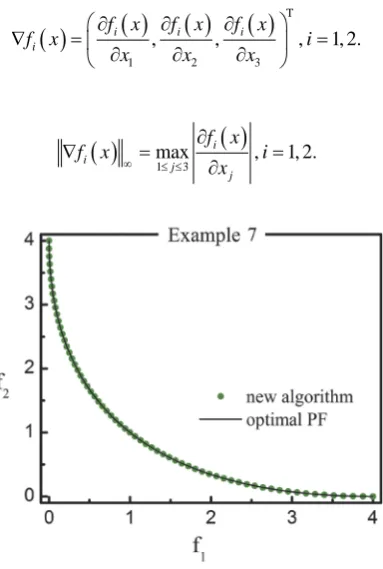
0, 2 , and hence is a Pareto efficient solution.3) According to the performance measure Diversity Metric ∆, see section B
page 188 in [13], the mean and variance of ∆ for Algorithm 1 is 0.1014490343
and 0.09539251009, respectively, where df =dl =0. Hence our algorithm
finds better spread of solutions than any other algorithm included in Table III of
[13], see Figure 1, this is because the mean is the smallest one.
Example 8 (Problem FON in Table I of [13]). Consider the following opti-
mization problem:
( )
( )
(
1 2)
min f x , ,f x
where
( )
3 2( )
3 21 2
1 1
1 1
1 exp , 1 exp ,
3 3
i i
i i
f x x f x x
= =
= − − − = − − +
∑
∑
with variable bounds x x x1, , 2 3∈ −
[
4, 4 .]
Table I of[13]states that every point
(
x x x1, 2, 3)
satisfying the condition1 2 3
1 1 , 3 3
x =x =x ∈ −
(35)
is a Pareto optimal solution of this problem. Let
[
]
34, 4
X = − . Since each of the
functions f ii, 1, 2,= is continuously differentiable on X, which is closed and
bounded, then each of fi is locally Lipschitz continuous on X. We denote by
( )
if x
∇ the gradient vector of fi at x:
( )
( )
( )
( )
T
1 2 3
, , , 1, 2.
i i i
i
f x f x f x
f x i
x x x
∂ ∂ ∂
∇ = =
∂ ∂ ∂
Then
( )
( )
1 3
max i , 1, 2.
i
j j
f x
f x i
x
∞ ≤ ≤ ∂
∇ = =
[image:10.595.279.471.421.706.2]∂
Figure 1. True PF and nondominated solutions by
Note that supx X∈ ∇fi
( )
x ∞ ≤1 for i=1, 2. For any y z, ∈X , there exists[ ]
,u∈ y z such that
( )
( )
( )
( )
(
)
( )
( )
( )
3 1 3 1 , 3 3sup . ii i i j j
j j
i
j j i
j j
i x X
f u
f y f z f u y z y z
x
f u
y z f u y z
x
f x y z
= ∞ ∞ = ∞ ∞ ∈ ∂ − = ∇ − = − ∂ ∂ ≤ − ≤ ∇ − ∂ ≤ ∇ −
∑
∑
(36)Therefore, we can take the Lipschitz constants Ki =3, 1, 2,i= such that
( )
( )
, for all , .i i i
f y − f z ≤K y−z∞ y z∈X (37)
Let
(
1 2)
3 3 , , .
5 5
ε= ε ε =
Then, from (27), we have
1 . 5
η= In formula (30),
let ki =50, 1, 2, 3.i= Hence the cardinality of Ω is
( )
3
card Ω =51 =132651
and 1
(
)
4 ,25
i i
i
k β α− = and therefore inequality (32) is satisfied. Suppose that
the population size is r=200. For the stopping criterion, we take δ =0.99
and compute tmin
( )
δ
10878∗ = . After
10878 iterations of Algorithm 1, the re- sulting set Ω is the following:
(
)
(
) (
) (
) (
)
(
) (
) (
) (
) (
)
(
) (
) (
) (
)
8 8 8 8 8 8 4 4 4 4 4 4
0, 0, 0 , , , , , , , , , , , , , 25 25 25 25 25 25 25 25 25 25 25 25
16 16 16 16 16 16 8 12 12 12, , , 12, 12, 12 , , , , , , , 4 , 4, , 25 25 25 25 25 25 25 25 25 25 25 25 25 25 25 8 , 4 , 4 , 4 , 8 , 4 , 4, 4 , 8 , 8 , 4 , 4 , 4 , 25 25 25 25 25 25 25 25 25 25 25 25 25
− − − − − − − − − − − − − − − − − − − − Ω =
(
)
(
) (
) (
) (
) (
)
(
) (
) (
) (
) (
)
(
) (
) (
)
8 , 4 , 25 25 8 8 8 8 8 8 8 8 8 8
4 , , , , , 4 , , 4 , , 4 , , , , , 4 , 25 25 25 25 25 25 25 25 25 25 25 25 25 25 25
8 , 4 , 8 , 12, 8 , 8 , 8 , 8 ,12 , 8 ,12, 8 , 12, 8 , 8 , 25 25 25 25 25 25 25 25 25 25 25 25 25 25 25
8 , 8 , 12 , 8 , 12, 8 , 12 12, , 8 , 8 ,12, 25 25 25 25 25 25 25 25 25 25 25
− − − − − − − − − − − − − − − − − − −
(
) (
)
(
) (
) (
) (
) (
)
(
) (
) (
) (
) (
)
(
)
8 12 , 12, ,12 , 25 25 25 258 8 8 16 16
12, 12, , , 12, 12 , 12, , 12 , 12 12, , , ,12 12, , 25 25 25 25 25 25 25 25 25 25 25 25 25 25 25
16 16 16 16 16 16
12, ,12 , 12, 12, , , 12, 12 , 12, , 12 , 12, , , 25 25 25 25 25 25 25 25 25 25 25 25 25 25 25 16 16, ,12 , 1
25 25 25
− − − − − − − − −
− − − − − − − − −
(
) (
) (
) (
)
(
) (
) (
) (
) (
) (
)
(
) (
) (
) (
) (
) (
)
6,12,16 , 12, 16, 16 , 16, 16, 12 , 16, 12, 16 , 25 25 25 25 25 25 25 25 25 25 25 25 4 , 4 , 0 , 0, 4, 4 , 4 , 0, 4 , 4 , 4 , 0 , 0, 4 , 4 , 4, 0, 4 , 25 25 25 25 25 25 25 25 25 25 25 25
4 , 0, 0 , 0, 0, 4 , 0, 4 , 0 , 4 , 0, 0 , 0, 0, 4 , 0, 4, 0 25 25 25 25 25 25
− − − − − − − − − − − − − − − − − − .
(38) Remarks:
1) In practical tests, the set Et+1 has always become the set (38) somewhere between iterations 3475 and 3500, and has not changed in the later iterations.
2) The cardinality of Ω is card
( )
Ω =57. The points in Ω which satisfysolutions with probability δ.
3) According to the performance measure Diversity Metric ∆, see section B
page 188 in [13], the mean and variance of ∆ for Algorithm 1 is
0.06078996663 and 0.4859115201, respectively, where
0.01343253265.
f l
d =d = Hence our algorithm finds better spread of solutions
than any other algorithm included in Table III of [13], see Figure 2, this is because the mean is the smallest one.
Example 9 (Problem POL in Table I of [13]).
( )
( )
(
1 2)
min f x , ,f x
where
( )
(
) (
2)
2( ) (
) (
2)
21 1 1 1 2 2 , 2 1 3 2 1 ,
f x = + A −B + A −B f x = x + + x +
1 0.5sin1 2 cos1 sin 2 1.5 cos 2,
A = − + − 1.5sin1 cos1 2 sin 2 0.5 cos 2,A2= − + − 1 0.5sin 1 2 cos 1 sin 2 1.5 cos 2,
B = x − x + x − x
2 1.5sin 1 cos 1 2 sin 2 0.5 cos 2,
B = x − x + x − x with variable bounds
[
]
1, 2 π, π .
x x ∈ −
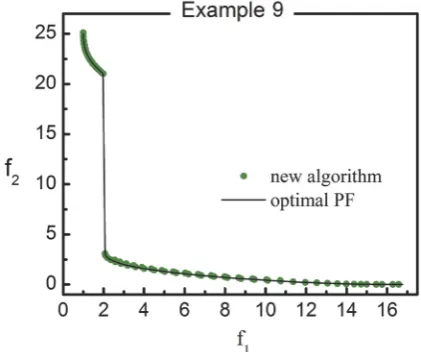
POL is a problem with two nonconvex Pareto fronts that are disconnected in
both the objective and decision variable spaces, see[13]. The true set of Pareto-
optimal solutions is difficult to know in this problem. Figure 3 illustrates that
Algorithm 1 is able to discover the two disconnected Pareto fronts that lie on the
boundaries of the search space.
Let X = −
[
π, π] [
× −π, π .]
Since each of the functions f ii, 1, 2,= is con-tinuously differentiable on X, which is closed and bounded, then each of
, 1, 2,
i
f i= is locally Lipschitz continuous on X. By using a computer program,
it is possible to show that supx X∈ ∇f1
( )
x ∞≤34 and supx X∈ ∇f2( )
x ∞ ≤13.Using an estimate similar to (36), but with two variables, we find that, for the
following Lipschitz constants: K1=68, and K2=26, we have
( )
( )
, for all , , 1, 2.i i i
[image:12.595.271.476.532.701.2]f y − f z ≤K y−z∞ y z∈X i=
Figure 2. True PF and nondominated solutions by New
Let ε=
(
ε ε1, 2) (
= 5 2 ,1 .)
Then, from (27), we have5 . 136
η = In formula
(30), let ki =100, i=1, 2. Hence the cardinality of Ω is
( )
2card Ω =101 =10201 and 1
(
)
π, 50i i
i
k β α− = and therefore inequality (32) is
satisfied. Suppose that the population size is r=200. For the stopping criterion,
we take δ =0.99 and compute tmin∗
( )
δ
=706. After 706 iterations of Algorithm1, the resulting set Ω is the following:
(
)
(
) (
) (
) (
)
(
) (
) (
) (
)
(
) (
) (
) (
)
(
) (
) (
) (
)
(
) (
) (
) (
)
(
) (
)
31 1 2
π,0 , π, , π, π , π, π , π, π , 50 25 50 25
3 7
1 4
π, π , π, π , π, π , π, π , 10 25 50 25
9 1 11 6
π, π , π, π , π, π , π, π , 50 5 50 25
3
1 1 2
π, π , π, π , π, π , π, π , 50 25 50 25
3 7
1 4
π, π , π, π , π, π , π, π , 10 25 50 25
9 1 11
π, π , π, π , π, 50 5 50
π − − − − − − − − − − − − − − − − − − − − − − − − − − − − − − − − − − − Ω =
(
)
(
) (
) (
) (
)
(
) (
) (
) (
)
(
) (
) (
) (
)
(
) (
) (
) (
)
(
) (
) (
)
π ,6 13 7 3
π, π , π, π , π, π , π, π , 25 50 25 10
8 13 1 13 13 13 27 π, π , π, π , π, π , π, π ,
25 50 2 50 25 50 50 17π,13π , 17π,27π , 8 π, π ,1 8 π,13π , 50 25 50 50 25 2 25 50
8 π,27π , 8 π,14π , 8 π,29π , 8 ,3π , 25 50 25 25 25 50 25 5
8 π,31π , 8 π,16π , 7 π,12π 25 50 25 25 25 25
v − − − − − − − − − −
(
)
(
) (
) (
) (
)
(
) (
) (
) (
)
(
) (
) (
)
(
) (
) (
) (
)
(
)
7 1 , π, π ,25 2 7 π,13π , 7 π,27π , 6 π,13π , 49π,0 , 25 25 25 50 25 25 50
49π, 1 π , 49π, 1 π , 49π, 3 π , 49π, 2 π , 50 50 50 25 50 50 50 25
49π, π ,1 49π, 3 π , 49π, 7 π , 50 10 50 25 50 50
49π, 4 π , 49π, 9 π , 49π, 1 π , 49π, 1 π , 50 25 50 50 50 50 50 25
49π, 3 π , 50 50 − − − − − − − − − − − − − − − −
(
−) (
)
(
) (
) (
) (
)
(
) (
) (
)
(
) (
) (
) (
)
(
) (
)
49π, 2 π , 49π, 1 π , 50 25 50 10
49π, 3 π , 49π, 3 π , 49π, 8 π , 3 π,12π , 50 25 50 10 50 25 10 25
3 π, π ,1 3 π,13π , 3 π,27π , 10 2 10 25 10 50
3 π,14π , 3 π,29π , 3 π, 3 π , 3 π,31π , 10 25 10 50 10 25 10 50
8 3
24π, π , 24π, π 10 25 10 10
− − − − − − − − − − − − − . (39) Remarks:
Figure 3. True PF and nondominated solutions by New Algorithm on POL.
between iterations 285 and 350, and has not changed in the later iterations. 2) The cardinality of Ω is card
( )
Ω =75. It follows from Proposition 6 thatall elements of Ω are ε-efficient solutions with probability δ .
3) According to the performance measure Diversity Metric ∆, see section B
page 188 in [13], the mean and variance of ∆ for Algorithm 1 is 0.5021982345
and 0.7382353788, respectively, where df =0.1063348336 and 0.01974325126
l
d = for the left Pareto front in Figure 3, and
0.0139738762
f
d = and dl =0.1941428847 for the right Pareto front in Fig-
ure 3. Hence, in Table III of [13], a better spread of solution is achieved by the algorithm NSGA-II (real-coded) in [13]. The spread of solution by our algori- thm is the next-best for this problem.
6. Conclusion
We have presented a new evolutionary method for generating ε-efficient so- lutions of a continuous multiobjective programming problem. This was achieved by discretizing the problem and then using a genetic algorithm. Some proba- bilistic stopping criteria were used for this procedure to obtain, with a pre- scribed probability, all minimal solutions for the discretized problem, which are ε-efficient solutions for the original problem. This article contains the main underlying theory and only some preliminary numerical computations pertaining to this method.
Acknowledgements
The authors are grateful to an anonymous referee for his/her comments which have improved the quality of the paper.
References
https://doi.org/10.1007/s10957-005-5494-4
[2] Ghaznavi-Ghosoni, B.A., Khorram, E. and Soleimani-damaneh, M. (2013) Scalari-zation for CharacteriScalari-zation of Approximate Strong/Weak/Proper Efficiency in Mul-ti-Objective Optimization. Optimization, 62, 703-720.
https://doi.org/10.1080/02331934.2012.668190
[3] Loridan, P.(1984) ε-Solutions in Vector Minimization Problems. Journal of Op-timization Theory and Applications, 42, 265-276.
https://doi.org/10.1007/BF00936165
[4] Engau, A. and Wiecek, M.M. (2007) Generating ε-Efficient Solutions in Multiob-jective Programming. European Journal of Operational Research, 177, 1566-1579.
https://doi.org/10.1016/j.ejor.2005.10.023
[5] Engau, A. and Wiecek, M.M. (2007) Exact Generation of Epsilon-Efficient Solutions in Multiple Objective Programming. OR Spectrum, 29, 335-350.
https://doi.org/10.1007/s00291-006-0044-5
[6] Laumanns, M., Thiele, L., Deb, K. and Zitzler, E. (2002) Combining Convergence and Diversity in Evolutionary Multiobjective Optimization. Evolutionary Computa-tion, 10, 263-282. https://doi.org/10.1162/106365602760234108
[7] Schutze, O., Laumanns, M., Tantar, E., Coello Coello, C.A. and Talbi, E.-G. (2007) Convergence of Stochastic Search Algorithms to Gap-Free Pareto Front Approxi-mations. Proceedings of the Genetic and Evolutionary Computation Conference (GECCO-2007), 892-899.
[8] Studniarski, M. (2011) Finding All Minimal Elements of a Finite Partially Ordered Set by Genetic Algorithm with a Prescribed Probability. Numerical Algebra, Control and Optimization, 1, 389-398. https://doi.org/10.3934/naco.2011.1.389
[9] Vose, M.D. (1999) The Simple Genetic Algorithm: Foundations and Theory. MIT Press, Cambridge.
[10] Reeves, C.R. and Rowe, J.E. (2003) Genetic Algorithms—Principles and Perspec-tives: A Guide to GA Theory. Kluwer, Boston.
[11] Rudolph, G. and Agapie, A. (2000) Convergence Properties of Some Multi-Objec- tive Evolutionary Algorithms. In: Zalzala, A., et al., Eds., Proceedings of the 2000 Congress on Evolutionary Computation (CEC 2000), Vol. 2, IEEE Press, Piscata-way, 1010-1016.
[12] Osman, M.S., Abo-Sinna, M.A. and Mousa, A.A. (2005) An Effective Genetic Algo-rithm Approach to Multiobjective Resource Allocation Problems (MORAPs). Ap-plied Mathematics and Computation, 163, 755-768.
https://doi.org/10.1016/j.amc.2003.10.057
Submit or recommend next manuscript to SCIRP and we will provide best service for you:
Accepting pre-submission inquiries through Email, Facebook, LinkedIn, Twitter, etc. A wide selection of journals (inclusive of 9 subjects, more than 200 journals)
Providing 24-hour high-quality service User-friendly online submission system Fair and swift peer-review system
Efficient typesetting and proofreading procedure
Display of the result of downloads and visits, as well as the number of cited articles Maximum dissemination of your research work
Submit your manuscript at: http://papersubmission.scirp.org/