Munich Personal RePEc Archive
Contribution of Information and
Communication Technology (ICT) in
Country’S H-Index
FARHADI, MARYAM and SALEHI, HADI and EMBI,
MOHAMED AMIN and FOOLADI, MASOOD and
FARHADI, HADI and AGHAEI CHADEGANI, AREZOO
and Ale Ebrahim, Nader
Department of Accounting, Mobarakeh Branch, Islamic Azad
University, Mobarakeh, Isfahan, Iran, Faculty of Education,
CONTRIBUTION OF INFORMATION AND
COMMUNICATION TECHNOLOGY (ICT) IN COUNTRY’S
H-INDEX
1MARYAM FARHADI1*, HADI SALEHI2,3, MOHAMED AMIN EMBI2, MASOOD FOOLADI1,
HADI FARHADI4, AREZOO AGHAEI CHADEGANI1, and NADER ALE EBRAHIM5
1Department of Accounting, Mobarakeh Branch, Islamic Azad University, Mobarakeh, Isfahan, Iran 2Faculty of Education, Universiti Kebangsaan Malaysia (UKM), Bangi, 43600, Malaysia 3Faculty of Literature and Humanities, Najafabad Branch, Islamic Azad University, Najafabad, Isfahan,
Iran
4School of Psychology and Human Development, Faculty of Social Sciences and Humanities, Universiti
Kebangsaan Malaysia (UKM), Malaysia
5Department of Engineering Design and Manufacture, Faculty of Engineering, University of Malaya, Kuala
Lumpur, Malaysia
*Corresponding author: Maryam Farhadi, Email: [email protected]
ABSTRACT
The a im o f th is s tudy is to examine t he e ffect o f I nformation a nd C ommunication Technology ( ICT) development o n co untry’s s cientific r anking as measured b y H -index. M oreover, t his s tudy ap plies I CT development sub-indices including ICT Use, ICT Access and ICT skill to find the distinct effect of these sub-indices on country’s H-index. To this purpose, required data for the panel of 14 Middle East countries over t he p eriod 1 995 t o 20 09 i s c ollected. F indings o f t he c urrent s tudy s how that I CT d evelopment increases the H-index of the sample countries. The results also indicate that ICT Use and ICT Skill sub-indices positively contribute to higher H-index but the effect of ICT access on country’s H-index is not clear.
Keywords: Information and Communication Technology (ICT) development, H-index, Middle East
1. INTRODUCTION
In the last decades, technology has improved the life s tyle and m ade eas ier t he human activities t hrough a n ew c ivilization. A new revolution na med I nformation a nd Communication Technology (ICT) has occurred in th e p resent world [1]. I CT i s d efined a s a concept including information equipment as well as computers and software, auxiliary equipment that is c onnected to a c omputer ( such a s calculators, cas h r egisters, p hotocopiers), communications equipment, and instruments [2]. In other words, ICT is a technology with the aim of co nnecting co mputers an d o ther communication e quipment t o ga ther, p roduce, process, cl assify, manage, cr eate, an d d istribute information. After t he invention of machines in 1970s, industrial revolution has been started and machines have been used instead of handworks.
Although, the key role of ICT is approved in different ar eas s uch as engineering [11], education [12], h ealth car e [13], a nd e conomy [6], its effect on the degree of scientific ranking of a co untry i s yet unexplored. Therefore, t he aim of this study is to explore the impact of ICT development a s measured b y I CT D evelopment Index (ID I) on H-index a s a proxy o f scientific progress of a country.
In a ddition, i n or der t o s hed m ore l ights on this area, present study applies three components of ICT development namely, ICT Skill, ICT Use and ICT Access to examine the distinct impact of these c omponents o n H -index as a p roxy o f scientific progress of a country. To this purpose, this study applies a multiple regression analysis on a p anel of 14 Middle East countries over the period 1995 to 2009.
The current study suggests the use of H-index provided by SCImago database [14] to measure the scientific r anking of c ountry. B ased on Hirsch [15], a s cientist o r a group o f scientists has H-index of h when h of their papers has at least h citations. In other words, H -index is t he number of articles with citation number higher or equal t o h [15]. T he H -index, w hich ha s been invented b y H irsch i n 2005, proposes a s imple and ap parently s trong measure t o co mpare t he scientific productivity and visibility of countries and institutions [16].
H-index can measure the quantity and quality of papers simultaneously since the total number of published articles and the number of citations received b y t hat ar ticles ar e co nsidered i n t he calculation o f H -index. I n addition, t here a re many s tudies, which r eveal the b enefits o f H -index a s a n a ppropriate a nd f air t ool f or evaluating a nd r anking s cientists, la boratories, scientific j ournals, u niversities, in stitutions a nd countries [17, 18, 19, 20, 21].
Hirsch [15] proposes t hat H-index c an b e used to appraise not only the scientists b ut a lso countries a nd in stitutions. H ence, f ollowing Jacso [22], current study also uses H-index as a proxy to measure scientific ranking of countries.
2. METHODOLOGY AND DATA
2.1. Empirical Model
In o rder t o e xamine t he effect o f IC T development o n s cientific d egree o f 1 4 M iddle
East c ountries, t his s tudy applies th e r egression techniques with countries’ H-index as dependent variable an d I DI as i ndependent variable as follows:
it 0 1 it it
H
=
α
+
α
IDI
+
ε
(1)where
α
's
are parameters to be estimated, H represents H-index, IDI stands for ICT development index a nd s ubscripts i and t showthe ith country i n tth year, r espectively.
ε
is th eerror term which is assumed to be independent of IDI. Then, for more inspections, instead of IDI, which cap tures t he co mposite ef fect o f I CT development, t he c urrent study u ses t hree I CT sub-indices including ICT Access, ICT Use and ICT S kill a s e xplanatory variables. I n t his approach, we can test the distinct impact of each sub-index o n t he c ountry’s H -index. Consequently, i n t his s tep o f t he a nalysis, following equation (Equation 2) is used:
it 0 1 it 2 it 3 it it
H
=
µ µ
+
Access
+
µ
Use
+
µ
Skill
+
δ
(2)where
µ
's
are parameters to be estimated, H shows H-index and Access, Use and Skill stand for I CT development s ub-indices. M oreover, subscripts i and t indicate t he ith country i n tthyear, respectively, and
δ
is the error term which is assumed to be independent of Access, Use and Skill variables.2.2.Data and Measurement 2.2.1. ICT development
information-based s ocieties. I t i s as sumed t hat these countries have experienced t he p rocess o f ICT de velopment t o t urn into an i nformation society. T herefore, t he I TU [ 23] suggests t he three-phase model i ncluding I CT r eadiness (showing the degree of networked infrastructure and I CT a ccess), I CT i ntensity ( showing t he degree of ICT use by the society) and ICT impact ( showing th e r esult o f e ffective a nd efficient ICT u se). IDI is a c omposite in dicator including I CT a ccess, I CT s kill a nd I CT u se. Each s ub-index i s c omposed of a number of indicators explained as follow:
1. Access S ub-Index s hows t he a vailability o f ICT infrastructure and individuals’ access to basic ICTs. This sub-index has five indicators including f ixed t elephone lines p er 1 00 inhabitants, mobile c ellular te lephone subscriptions pe r 100 i nhabitants, international I nternet b andwidth ( bit/s) p er Internet user, proportion of households with a computer and proportion of households with Internet access at home.
2. Use Sub-Index shows the real degree of ICTs strength o f u se b ased o n t he av ailable infrastructure a nd acces s i ndicators. Considering t he li mitation o n d ata f or I CT Use at t he g lobal s cale an d r esults o f t he PCA, t his subgroup ha s t hree i ndicators including I nternet us ers p er 1 00 i nhabitants, fixed broadband Internet subscribers per 100 inhabitants a nd mobile br oadband subscriptions per 100 inhabitants.
[image:5.612.324.522.90.215.2]3. Skill S ub-Index cap tures t he d egree o f I CT skill in different countries. Since the required data f or m any de veloping c ountries a re n ot collected, an appropriate indicator can be the degree o f l iteracy an d ed ucation. E specially in de veloping c ountries, t he poor l evel o f education is a major obstacle to the effective use o f i nternet a nd c omputers. W ith t he inclusion o f I CT i n s chool c ourses, s chool attendance may offer an appropriate indicator for s tudents’ e xposure t o t he I nternet or computers. Therefore, this subgroup has three indicators i ncluding, a dult lite racy r ate, secondary gross e nrolment r atio an d t ertiary gross en rolment r atio. T he r equired d ata f or this subgroup a re e xtracted f rom t he UNESCO Institute for Statistics (UIS) [24].
Figure 1. Three Stages In The Evolution Towards An Information Society (Source: ITU [25])
2.2.2. h-index
Different sources report the H-index. Some of these s ources are s ubscription-based s ources such as Scopus and Web of Science (WoS) and some o f t hem ar e f ree acce ss sources such a s Harzing's Publish or Perish program on the basis of Google Scholar entries. It should be noted that these sources r eport d ifferent H -index f or t he same institution, country and scholar because of their d ifferent co verage. F or ex ample, W oS covers a high range of published journals while it does n ot co ver h igh i mpact co nferences. Although, the coverage of publications in Scopus is poor prior to 1996, it covers conferences properly. Documents in Google Scholar receive more c itations in c omparison with those in Scopus and W oS. I t i s a rgued t hat G oogle Scholar has the most c overage o f j ournals a nd conferences p articularly t hose p ublished af ter 1990 [26].
The cu rrent study co llects the r equired d ata on H -index f or t he pa nel of 14 M iddle E ast countries o ver t he pe riod 1995 t o 2009, f rom SCImago d atabase [14]. The S CImago J ournal and C ountry Rank website p resents t he j ournal and c ountry s cientific indicators ba sed on t he information included in the Scopus database.
3. FINDING AND DISCUSSION
Table 1. Regression Results For The Impact Of ICT Development On H-Index
Dependent Variable: H-index
Variables Coefficient Standard Error T
IDI 31.69 4.67*** 6.79 Constant 24.16 13.35* 1.81 Observation = 210
F(1, 208) = 46.07*** R-squared = 0.1813
Adjusted R-squared = 0.1774 Note:
***, ** and * denote statistically significant at 1%, 5% and 10%, respectively. Standard errors are heteroskedasticity consistent.
Table 1 shows the effect of ICT development on e ach c ountry’s H -index. T he estimation results i ndicate a p ositive an d s ignificant e ffect of I CT d evelopment o n c ountry’s scientific ranking as proxied by H-index. This finding suggests that suitable p olicies aim a t i mproving the l evel o f I CT d evelopment c an s ignificantly increase the scientific rankings of a country. The results also assert that if a co untry raises its ICT development index by one unit, the H-index will increase by 31 units. As can be seen in Table 1, the adjusted R-squared is equal to 0.1774, which means that ICT development can explain 17.74% of variations in country’s H-index.
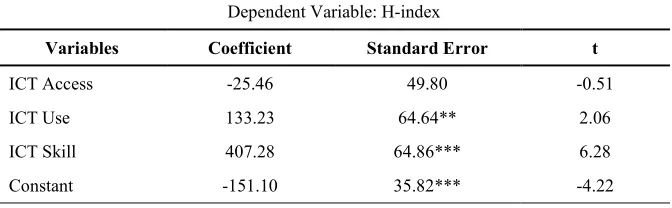
Table 2 e xhibits t he i mpact o f I CT development s ub-indices o n H -index o f 14
sample co untries. T he es timated co efficients show a positive and significant effect of ICT Use and I CT S kill o n c ountry’s s cientific r anking. This finding asserts that i ncreasing the application of ICTs and improving the ICT skills might significantly increase the scientific degree of a co untry. T he r esults al so i ndicate that i f a country increases t he I CT U se an d I CT S kill indices by one unit, its H-index will raise by 133 and 4 07 u nits, r espectively. As ca n b e s een i n Table 2, the coefficient explaining the e ffect of ICT A ccess o n H-index i s negative but not significant. F inally, b ased o n t he a djusted R-squared, ICT sub indices can explain 27.11% of variations in country’s H-index.
[image:6.612.139.475.478.582.2]
Table 2. Regression Results For The Impact Of ICT Development Sub-Indices On H-Index
Dependent Variable: H-index
Variables Coefficient Standard Error t
ICT Access -25.46 49.80 -0.51 ICT Use 133.23 64.64** 2.06 ICT Skill 407.28 64.86*** 6.28 Constant -151.10 35.82*** -4.22 Observation = 210
F(3, 206) = 26.91*** R-squared = 0.2816
Adjusted R-squared = 0.2711 Note:
4. CONCLUSION AND IMPLICATIONS
This paper focuses on examining the effect of ICT d evelopment o n t he s cientific d egree o f 1 4 Middle East countries as proxied by H-index. The results o f t he r egression a nalysis s how t hat I CT development has a positive and significant effect on the H-index of these countries. Moreover, applying t he I CT d evelopment s ub-indices, t his study finds that ICT Use and ICT Skill might have positive effects on H-index b ut the effect of ICT Access i s not cl ear s ince i ts co rresponding coefficient is not statistically s ignificant. Therefore, we can conclude that ICT induces outcomes that leads to higher H-index values and raises t he scientific level of sample countries. I n this situation, policy makers should aim increasing the level of ICT development through increasing i ts i ndicators i ncluding fixed an d mobile te lephone l ines, i nternational I nternet bandwidth, pr oportion of households with a computer and Internet access, Internet users, fixed and mobile br oadband I nternet s ubscribers, adult literacy r ate, s econdary a nd t ertiary gross enrolment ratios.
REFERENCES:
[1]R.J. Gordon, “Does the ‘ New E conomy’ measure up to the great inventions of the past?”, Journal of Economic Perspectives,
Vol. 14, No. 4, 2000, pp. 49-74.
[2]S.D. Oliner and D.E. Sichel, “Computers and output growth r evisited: H ow b ig is t he puzzle?”, Brookings Papers on Economic Activity, Vol. 2, 1994, pp. 273-334.
[3]S.S. Cohen, J.B. Delong and J. Zysman, “Tools for thought: What is new and important about the E-economy?”, BRIE Working Paper, No. 138, 2000.
[4]D.W. Jorgenson and K.J. Stiroh, “Information technology a nd growth”, American Economic review Papers and Proceedings, Vol. 89, No.
2, 1999, pp. 109-115.
[5]Gruber, H . a nd K outroumpis, P . “Mobile telecommunications an d the i mpact o n economic d evelopment”, Economic Policy,
Vol. 26, No. 67, 2011, pp. 387-426.
[6]Farhadi, M ., Ismail, R . a nd F ooladi, M . “Information and Communication Technology Use and Economic Growth”, PLoS ONE, Vol.
7, N o. 11, 201 2, e48903. doi:10.1371/journal.pone.0048903
[7]Haridasan, K ., R angarajan, S . an d P irio, G . “Re-Inventing H ealth C are Training I n T he Developing World: The C ase F or S atellite Applications I n R ural E nvironments”, Online Journal of Space Communication, 14(Winter),
2009.
[8]Sharma, A., G andhar, K., Sharma, S . and Seema, S. “ Role o f I CT in th e P rocess o f Teaching and Learning”, Journal of Education and Practice, Vol. 2, No. 5, 2011, pp. 1-6.
[9]Sangrà, A. and González-Sanmamed, M. “The role of i nformation a nd c ommunication technologies i n i mproving t eaching a nd learning p rocesses in p rimary an d s econdary schools”, Journal of Asynchronous Learning Networks, Vol. 15, No. 4, 2011, pp. 47-59.
[10] International T elecommunication U nion, “Measuring the information society: The ICT Development Index”, P lace d es N ations C
H-1211 Geneva Switzerland, 2011.
[11] C.C. Aldea, A .D. Popescu, A. D raghici and G. Draghici, “ICT T ools Functionalities Analysis for t he D ecision M aking P rocess o f Their I mplementation in V irtual E ngineering Teams”, Procedia Technology, Vol. 5, 2012,
pp. 649-658.
[12] F. Scheuermann and F. Pedró, “Assessing t he ef fects o f I CT i n ed ucation: Indicators, cr iteria an d b enchmarks for international c omparisons”, L uxembourg: Publications O ffice o f t he European U nion, 2009.
[13] A.R. B akker, “Health car e and I CT, partnership is a must”, International Journal of Medical Informatics, Vol. 66, No. 1-3, 2002 ,
pp. 51-57.
[14] SCImago, SJR — SCImago J ournal & Country Rank, 2007, Retrieved Mar ch 1 1, 2013, from http://www.scimagojr.com
[15] J.E. H irsch, “An i ndex t o qu antify a n individual’s s cientific r esearch o utput”,
Proceedings of the National Academy of Science, Vol. 102, N o. 46 , 2 005, pp .
16569-16572.
[16] J.F. Molinari a nd A. M olinari, “A n ew methodology for ranking scientific institutions”, Scientometrics, Vol. 7 5, N o. 1 ,
2008, pp. 163-174.
[17] P. Ball, “Index ai ms for fair ra nking o f scientists”, Nature, Vol. 436, No. 900, 2005.
doi:10.1038/436900a.
Scientometrics, Vol. 69, No. 1, 2006, pp.
117-120.
[19] W. Glanzel, “On t he h -index - A mathematical ap proach t o a n ew measure o f publication activity and citation impact”,
Scientometrics, Vol. 67, No. 2, 2006, pp.
315-321.
[20] T. Braun, W. G lanzel and A. Schubert, “A Hirsch-type index for journals Scientometrics, Vol. 69, No. 1, 2006, pp. 169-173.
[21] K.M. Mclntyre, L. Hawkes, A. WaretSzkuta, S. Morand an d M. Baylis, “The H -Index as a Q uantitative I ndicator o f t he Relative I mpact o f H uman Diseases”, PLoS ONE, Vol. 6, N o. 5, 2011. e19558.
doi:10.1371/journal.pone.0019558.
[22] P. Jacso, “The h-index for countries in Web of S cience a nd S copus”, Online Information Review, Vol. 33, No. 4, 2009, pp. 831-837.
[23] International Telecommunication U nion,
“Measuring the information society: The ICT Development Index”, P lace d es Nations
CH-1211 Geneva Switzerland, 2009.
[24] UNESCO I nstitute for S tatistics ( UIS), 2011. http://www.uis.unesco.org.
[25] International Telecommunication U nion, “Measuring the information society: The ICT Development Index”, P lace d es N ations C
H-1211 Geneva Switzerland, 2010.
[26] L.I. M eho and K. Yang, “Impact o f d ata sources on citation counts and rankings of LIS faculty: Web o f s cience versus s copus a nd google s cholar”, Journal of the American Society for Information Science and Technology, Vol. 58, No. 13, 2007, pp. 2105–
![Figure 1. Three Stages In The Evolution Towards An Information Society (Source: ITU [25])](https://thumb-us.123doks.com/thumbv2/123dok_us/7764130.714060/5.612.324.522.90.215/figure-stages-evolution-information-society-source-itu.webp)