© 2019, IRJET | Impact Factor value: 7.211 | ISO 9001:2008 Certified Journal | Page 1103
COMPARATIVE ANALYSIS ON SEISMIC BEHAVIOUR OF REGULAR AND
VERTICALLY IRREGULAR RCC FRAMED BUILDING
Kavya J C
1, Chetan Gonni S
21
Post Graduate in Structural Engineering, BIET College, Davangere, Karnataka, India
2Asst. Professor, M. Tech Structural Engineering, BIET College, Davangere
---***---Abstract -In the present study, the behaviour of regular and vertically irregular buildings with and without shear walls at various locations under seismic loading is considered. Total eight building structures are modelled and Equivalent Static Analysis and Response Spectrum Analysis are carried out for those structures using an analysis software ETABS 2016. Different seismic responses like Base Shear, Storey Shear, Storey Displacement, Storey Drift and Time Period are obtained. By the above responses, the Comparative study has been made between the regular and vertically irregular structures. The comparative results are noted and it is concluded that the structures which having shear wall are more stable compared to without shear wall structures. The Irregular buildings with shear walls show lesser seismic responses than regular structural buildings.
Key Words: Shear wall, Base Shear, Storey Displacement,
Storey Shear, Storey Drift and Time Period.
1. INTRODUCTION
The selection of specific framing type system depends on two parameters such as Seismic risk of the building in that particular zone and overall budget of the project. Depending upon seismic risks, the entire country is divided in to four seismic zones (II, III, IV, and V) by Indians Codes. RCC Framed structures are resistant to vibrations, earthquakes & shocks more effectively than any load bearings walled buildings. Earthquake is defined as horizontal movement of earth caused due to generation of seismic waves below ground surface. The structure tends to collapse during this process. The building together with ground and four floor above or building with heights of about 15m & above shall be adopted by norms prescribed in the national building code for design as well as construction & in “Criteria for Earthquake resistant designs of structures”. IS 1893-2002 published by the Bureau of Indian Standards, making building resistant to earthquake.
Shear Walls are structural members which provide stability to structures from lateral loads like self-weight, moving loads and it also gives stability against lateral earthquake loads and wind loads. It contribute greater strength & stiffness to buildings within direction of alignment and also it reduces the lateral displacement to the greater extend. These Shear wall are more stable against overturning and the earthquake loads. The Thickness of the shear walls varies from 150mm to 400mm.
1.1 IRREGULARITIES
During the construction of any structures, due to space requirement in the field the irregular buildings cannot be avoided. The structure should withstand against the lateral forces because of external loads. Therefore, in this project I have considered the Zone V for the analysis. The failure of the structure will start at the point of weakness in the structure during an earthquake. Due to discontinuity of stiffness, geometry and mass of the structures, weakness arises. Therefore, the structure having discontinuity is referred as Irregular structures. The buildings which are simple in geometry and are uniformly distributed over the mass as well as stiffness in plan and elevation will undergo lesser damage than the buildings of irregular configuration. The building should have mainly four aspects in order to execute well in earthquake. They are regular and simple configuration and adequate strength, lateral stiffness and ductility.
1.2 SEISMIC ANALYSIS
Equivalent Static method is sufficient for the analysis of regular structures & this type of analysis is for regular & low rise buildings. The Static methods are for single-mode response with simple corrections as well as higher mode effects. The Dynamic methods of analysis are carried out for the irregular or complex geometrical structures. Here, the analyses are done by Equivalent Statics Method & Dynamics Method. In Dynamic method, Response Spectrum is performed.
1.3 OBJECTIVE OF THE STUDY
1. To model the structures, SMRF (Special RC Moment Resisting Frames) configuration is considered for analysing the multi-storey building frames.
2. To study the behaviour of the building under Non-Ductility for both Regular and Irregular structures are according to IS codes.
3. To analyse RC structural building by
i. Equivalent Static Analysis
ii. Response Spectrum Analysis
© 2019, IRJET | Impact Factor value: 7.211 | ISO 9001:2008 Certified Journal | Page 1104
externally applied loads, Shear force, and NodalDisplacements.
5. To check the results of Shear walls at various location and comparison is made between them.
6. To analyse results like Basie Shear, Storey Shear, Storey Displacement, Storey Drift and Time period for Regular and Vertical Irregular structures.
2. DESCRIPTION OF THE MODEL
In this part, the different regular & irregular building structure with & without shear walls are modeled using the analysis software called ETABS 2016. The structures are developed and analysis is done by Equivalent static & Response spectrum method of investigation with different loading combinations as per the IS codal provisions.
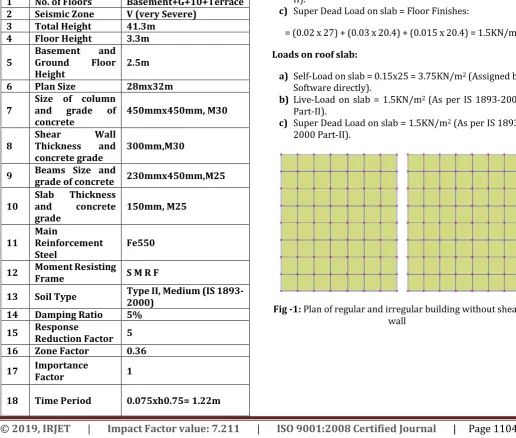
Table -1: Parameters for development of models
SL.
NO PARTICULARS DIMENSION/SIZE/VALUE 1 No. of Floors Basement+G+10+Terrace 2 Seismic Zone V (very Severe)
3 Total Height 41.3m 4 Floor Height 3.3m 5 Basement Ground Floor and
Height 2.5m
6 Plan Size 28mx32m
7 Size of column and grade of
concrete 450mmx450mm, M30 8 Shear Thickness Wall and
concrete grade 300mm,M30
9 Beams Size and grade of concrete 230mmx450mm,M25
10 Slab and Thickness concrete
grade 150mm, M25
11 Main Reinforcement
Steel Fe550
12 Moment Resisting Frame S M R F
13 Soil Type Type II, Medium (IS 1893-2000) 14 Damping Ratio 5%
15 Response Reduction Factor 5 16 Zone Factor 0.36 17 Importance Factor 1
18 Time Period 0.075xh0.75= 1.22m
2.1 LOAD CALCULATIONS a. Loads on beams:
For 200mm Thick wall: For 3.3m height wall, 20mm Plaster on both sides and depth of beam is taken as 450mm = 0.20x20x(3.3-0.45)+((0.02x2)x20.4x(3.3-0.45)= 13.89KN/m.
For 150mm Thick wall: For 3.3m height wall, 20mm Plaster on both sides and depth of beam is taken as 450mm = 0.15x20x(3.3-0.45)+((0.02x2)x20.4x(3.3-0.45)= 10.87KN/m.
For 150mm Thick parapet wall: For 1.2m height parapet wall, 20mm Plaster on both sides = (0.15x20x1.2)+((0.02x2) x 20.4x1.2) = 4.58KN/m.
b. Loads on slabs: Loads on floor slab:
a) Self-Load on slab = 0.15x25 = 3.75KN/m2. (Assigned by Software directly).
b) Live-Load on slab = 2KN/m2 (As per IS 1893-2000 Part-II).
c) Super Dead Load on slab = Floor Finishes:
= (0.02 x 27) + (0.03 x 20.4) + (0.015 x 20.4) = 1.5KN/m2.
Loads on roof slab:
a) Self-Load on slab = 0.15x25 = 3.75KN/m2 (Assigned by Software directly).
b) Live-Load on slab = 1.5KN/m2 (As per IS 1893-2000 Part-II).
c) Super Dead Load on slab = 1.5KN/m2 (As per IS 1893-2000 Part-II).
[image:2.595.36.553.358.796.2]
© 2019, IRJET | Impact Factor value: 7.211 | ISO 9001:2008 Certified Journal | Page 1105
Fig -2: Plan of regular and irregular building with shear wall- Case 1
Fig -3: Plan of regular and irregular building with shear wall- Case 2
Fig -4: Plan of regular and irregular building with shear wall- Case 3
Fig -5: Elevation of regular and irregular building
3. RESULTS AND COMPARISON 3.1 TIME PERIOD
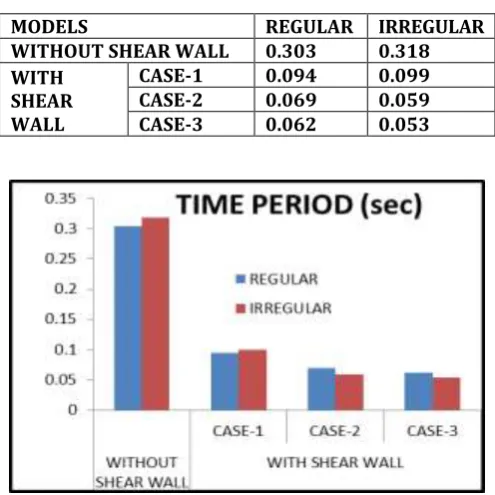
The Time needed in given point for one complete cycle of vibration to pass at the last mode of vibration is said to be Time period.
Table -2: Time period for nth mode in sec
MODELS REGULAR IRREGULAR
WITHOUT SHEAR WALL 0.303 0.318 WITH
SHEAR WALL
CASE-1 0.094 0.099 CASE-2 0.069 0.059 CASE-3 0.062 0.053
Chart -1: Variation of Time Period in sec
3.2 STOREY SHEAR
[image:3.595.36.286.264.395.2]Storey Shear is defined as design horizontal seismic forces which applied on each floor of structure and the maximum lateral shear is always at the base of the building and it is termed as Base Shear.
Table-3: Max. Storey shear for ESA and RSA along X & Y directions in kN
MODELS REGULAR IRREGULAR
WITHOUT SHEAR WALL 6750.7 5047.82
WITH SHEAR WALL
[image:3.595.37.284.434.577.2]© 2019, IRJET | Impact Factor value: 7.211 | ISO 9001:2008 Certified Journal | Page 1106
Chart -2: Variation of Maximum Storey Shear in kN From the above Table 3 and Chart 2, the maximum storey shear is obtained in model 1 without shear wall of the regular building in both X and Y directions by ESA and RSA. The maximum storey shear value is also noted as Base shear value.
3.3 STOREY DISPLACEMENT
The storey displacement is well-defined as absolute value of displacement of the storey under the action of lateral forces of the structures.
Table-4: Max. Storey displacement for ESA in mm
MODELS
REGULAR IRREGULAR
X directi on
Y directi on
X directi on
Y directio n WITHOUT
SHEAR WALL 122.26 119.88 99.41 101.98
WITH SHEA R WALL
CASE-1 57.19 60.24 53.4 51.33
CASE-2 39.21 34.51 30.06 25.87
CASE-3 34.87 31.76 22.15 22
Chart -3: Variation of Maximum Storey displacement in mm
Table-5: Max. Storey displacement for RSA in mm
MODELS
REGULAR IRREGULAR
X directi on
Y directi on
X directi on
Y directi on WITHOUT
SHEAR WALL 95.07 93.35 71.45 77.5
WITH SHEAR WALL
CASE-1 42.14 45.51 38.08 36.55 CASE-2 29.9 26.91 22.71 20.5 CASE-3 27.26 25.1 17.5 17.42
Chart -4: Variation of Maximum Storey displacement in mm
From Table 4 & 5 and Chart 3 & 4, it is seen that the storey displacement is maximum at regular building without shear wall model by ESA and it is minimum in irregular model with shear wall (Case-3) model by RSA. It shows that the displacement is more when there is no shear wall.
3.4 STOREY DRIFT
It may be expressed as difference of displacements between two consecutive stories divided by height of that storey. It is displacement of one level relative to other level of structures.
Table-6: Max. Storey drift for ESA
MODELS REGULAR X IRREGULAR
direction Y direction X direction Y direction WITHOUT
SHEAR WALL 0.00418 0.00411 0.00325 0.00325 WIT
H SHE AR WAL L
CASE-1 0.00172 0.00186 0.00165 0.00159 CASE-2 0.00119 0.00105 0.00097 0.00088
© 2019, IRJET | Impact Factor value: 7.211 | ISO 9001:2008 Certified Journal | Page 1107
Chart -5: Variation of Maximum Storey drift
Table-7: Max. Storey drift for RSA
MODELS
REGULAR IRREGULAR
X directio n
Y directio n
X directio n
Y directio n WITHOUT
SHEAR WALL 0.00367 0.00362 0.00257 0.00300
WITH SHEA R WALL
CASE
-1 0.00128 0.00143 0.00119 0.00115 CASE
-2 0.00091 0.00082 0.00074 0.00071 CASE
-3 0.00083 0.00077 0.00060 0.00059
Chart -6: Variation of Maximum Storey drift From Table 6 & 7 and Chart 5 & 6, represents the maximum storey drift values for regular and irregular structures for ESA and RSA along X & Y direction. The maximum storey drift values are all within the limits of h/250=0.0132, where h is floor to floor height.
4. CONCLUSIONS
i. The Time Period values obtained from both regular and vertically irregular structures are nearly same for the 12th mode of vibration, However, in the Case - 1 model of structural irregularity shows higher value of Time Period & in the regular model without shear wall shows very lesser Time period values.
ii. The variation of Storey Shear values are obtained over the number of storeys in both regular and vertically irregular structures in both directions. From all the above models, the storey shear values are less in without shear wall model of structural irregularity by ESA. This is due to the vertical irregularity of the structural building.
iii. Base Shear values are observed to be greater in the regular structures than in the irregular structures. In Case-3 model shows greater base shear value in both type of structures due to greater number of shear walls.
iv. The storey displacement is less in the structures which are having shear walls. In Case-3 model of irregular structure, the storey displacement is very less compared with all other models. By RSA, in irregular structure the displacement is less in Y-direction, due to shear wall locality and irregularity.
v. The greater displacement is seen in the without shear wall model along X-direction of irregular structure by the Static analysis condition.
vi. The maximum storey drift ratio predicted by both regular and vertical irregular methods of seismic analysis are within the maximum allowable confine as determined by Clause 7.11.1 of Part-1 of IeS 1893-(2002). The Case-3 model for irregular building shows minimum drift values in all direction.
vii. The estimates of Seismic parameters got from ESA are observed to be more than RSA.
Concluding Comments: Among all the above Cases of the structural RC frames considered in this study, The Case-3 model having shear wall in irregular structures shows lesser values of storey displacement and storey shear, thereby making the structure to be safest against seismic forces.
REFERENCES
[1] Ahmed VAqhar Kazim and Prof. Syed Farrukh Anwar
(2017), “Seismic Analysis of Irregular (L-Shaped) RCC Building”, Journa; for Research, Vol. 02, Issue 12.
[2] Akil Ahmed (2015), “Seismic Analysis of Irregular
Buildings”, International Conference on Inter Disciplinary Research in Engineering and Technology, Vol. 01.
[3] Arvinreddy and R. J. Fernandes (2015), “Seismic
Analysis of RC regular and irregular frame structures”, International Research Journal of Engineering and Technology, Vol. 02, Issue: 05.
[4] Dileshwar Rana and Prof. Juned Raheem (2015),
© 2019, IRJET | Impact Factor value: 7.211 | ISO 9001:2008 Certified Journal | Page 1108
Journal of Engineering and Technology, Vol. 02, Issue:04.
[5] Namani Saikiran and T Parimala (2017), “Study of
Irregular RC Framed Buildings under Seismic”, International Journal of Research Sciences and Advanced Engineering, Vol.2, PP: 30-36.
[6] IS 456 (2000), “Plain and Reinforced Concrete–Code of
Practice”, Bureau of Indian Standards, New Delhi, India.
[7] IS 875–Part 1 (1987), “Code of Practice for Design Loads
(Other than Earthquake) for Buildings and Structures. Part 1 Dead Loads – Unit Weights of Building Materials and Stored Materials”, Bureau of Indian Standards, New Delhi, India.
[8] IS 875–Part 2 (1987), “Code of Practice for Design Loads
(Other than Earthquake) for Buildings and Structures. Part 2 Imposed Loads”, Bureau of Indian Standards, New Delhi, India.
[9] IS 1893–Part 1 (2002), “Criteria for Earthquake
Resistant Design of Structures. Part 1–General Provisions and Buildings”, Bureau of Indian Standards, New Delhi, India.
BIOGRAPHIES
KAVYA J C
Post-Graduation Student
Department of Civil Engineering BIET, Davangere, Karnataka, India.
CHETAN GONNI S Assistant Professor