
Original citation:
Mayshar, Joram, Moav, Omer and Neeman, Zvika. (2017) Geography, transparency, and institutions. American Political Science Review, 111 (3). pp. 622-636.
Permanent WRAP URL:
http://wrap.warwick.ac.uk/94025
Copyright and reuse:
The Warwick Research Archive Portal (WRAP) makes this work by researchers of the University of Warwick available open access under the following conditions. Copyright © and all moral rights to the version of the paper presented here belong to the individual author(s) and/or other copyright owners. To the extent reasonable and practicable the material made available in WRAP has been checked for eligibility before being made available.
Copies of full items can be used for personal research or study, educational, or not-for profit purposes without prior permission or charge. Provided that the authors, title and full bibliographic details are credited, a hyperlink and/or URL is given for the original metadata page and the content is not changed in any way.
Publisher’s statement:
This article has been published in a revised form in American Political Science Review http://dx.doi.org/10.1017/S0003055417000132 . This version is free to view and download for private research and study only. Not for re-distribution, re-sale or use in derivative works. © American Political Science Association 2017
A note on versions:
The version presented here may differ from the published version or, version of record, if you wish to cite this item you are advised to consult the publisher’s version. Please see the ‘permanent WRAP url’ above for details on accessing the published version and note that access may require a subscription
Geography, Transparency and Institutions
∗
Joram Mayshar
†Omer Moav
‡Zvika Neeman
§April 7, 2017
Abstract
We propose a theory in which geographic attributes explain cross-regional institutional differences in: (1) the scale of the state, (2) the distribution of power within state hierarchy, and (3) property rights to land. In this theory, geography and technology affect the transparency of farming; and transparency, in turn, affects the elite’s ability to appropriate revenue from the farming sector, thus affecting institutions. We apply the theory to explain differences between the institutions of Ancient Egypt, Southern Mesopotamia and Northern Mesopotamia, and also discuss its relevance to modern phenomena.
Keywords: Geography, Transparency, Institutions, Land Tenure, State Capacity, State Concentration
JEL Classification Numbers:D02, D82, H10, O43
∗We have benefited from comments from Daron Acemoglu, Bob Allen, Josh Angrist, Ernesto Dal Bo,
Eddie Dekel, Diana Egerton-Warburton, Christopher Eyre, James Fenske, Oded Galor, Maitreesh Ghatack, Jeremy Greenwood, Avner Greif, James Malcomson, Andrea Matranga, Jacob Metzer, Stelios Michalopoulos, Motty Perry, Torsten Persson, Herakles Polemarchakis, Louis Putterman, Debraj Ray, Ariel Rubinstein, Yona Rubinstein, Larry Samuelson, Matthew Spigelman, Yannay Spitzer, Nathan Sussman, Juuso Valimaki, Joachim Voth, David Weil, and from comments from participants in various seminars and conferences.
†Department of Economics, Hebrew University of Jerusalem. Mayshar’s research was supported in part
by The Falk Institute for Economic Research in Israel. Address: Mt. Scopus. Jerusalem 9190501, Israel.
‡Department of Economics, University of Warwick; School of Economics, Interdisciplinary Center,
Herz-liya; CAGE and CEPR. Moav’s research is supported by the Israel Science Foundation (Grant No. 73/11). Address: Department of Economics, University of Warwick, Coventry CV4 7AL, United Kingdom.
1
INTRODUCTION
Following North (1981), recent theories about the success of nations ascribe a paramount role to the protection of property rights. Acemoglu and Robinson (2012) argue that the greatest detriment to economic prosperity is the presence of extractive institutions that compromise property rights. Ancient Egypt, however, had a prosperous civilization, built the great pyramids, and was stable over several millennia, in spite of having an extractive government and no land property rights for its peasant farmers.
We thus propose that North’s thesis about the importance of property rights pertains to post-agricultural societies, where private capital accumulation assumes a dominant role, but is less relevant for understanding agricultural societies where land is the main capital asset. This calls for an alternative theory to explain the success of some nations in the preindustrial world and the failure of others. In this paper, we seek to explain variations among pre-modern farming societies in: the scale of the state; the relative power of the center versus the periphery; and the land tenure regime. Unlike Acemoglu and Robinson (2012), who argue that institutions are by and large determined by the vagaries of human history, we propose a mechanism that explains how differences in institutions are the result of differences in geography and technology.
Our basic argument is that the government’s ability to appropriate revenue from the farming sector was a key factor that accounts for differences between the institutions of earlier states; and that this ability to appropriate was significantly affected by the transparency of production, and, in turn, by geographical and technological conditions. In a nutshell, we attribute the resilience and control of Ancient Egypt’s central government, the relative weakness of its regional cities, and the peasantry’s non-ownership of land, to the fact that its farming was highly transparent, and thus readily appropriable. From this perspective, Egypt is a polar case. Low transparency, on the other hand, explains the existence of owner-occupied farming and the relative weakness of the states in other regions, such as ancient Northern Mesopotamia.
gen-eral.1 Moreover, our appropriability theory can also help explain some modern phenomena.
First, since social institutions exhibit substantial inertia, our explanation of the institutions in farming-based societies can improve our understanding of current ones. And, to the extent that institutions impact the prosperity of nations, our model can expose deep-rooted factors that account for the current variation in the wealth of nations.2 Secondly, several scholars
attribute the unprecedented increase in the relative scale of government in the past century to a decline in the cost of collecting taxes.3 Our transparency theory provides a formal
structure and a broader perspective to this argument. Thus, according to our theory, there is an analogy between the long-term effects of the Agricultural Revolution in antiquity and the modern Industrial Revolution: in both cases the increased transparency of production transformed the state’s tax capacity.4
To better understand how our approach relates to the extensive literature on state intu-itions, we present the literature survey after presenting the model (in the next section) and its application to the civilizations of antiquity (in the section following the model). However, we want to clarify at the outset that there are two key issues that we do not deal with in this paper. First, we assume that the state is already established and that its government has a monopoly on the power to coerce. Thus, we do not discuss the emergence of the state, nor do we address the possible existence of external rivals and of warfare. Implicitly, in the spirit of Olson (1993), we posit that a governing hierarchy is an outcome of the advantage possessed by a dictator who monopolizes theft in the form of taxation, over uncoordinated theft that destroys incentives. Our focus is on how the sovereign’s access to information impacts its ability to appropriate. Second, we abstract from differences in land productivity, which is the focus of a large body of literature that seeks to explain differences in early state development. In this tradition, Diamond (1997), for example, attributes the relative back-wardness of New Guinea to its low land productivity relative to that in Eurasia. And Dal Bó et al. (2015) contend that states developed to provide defense in order to resolve what they identify as “the paradox of civilization,” namely the vicious circle by which increased
1The notion of a ‘tax technology’ was proposed by Mayshar (1991). 2See Bockstette et al. (2002) and Spolaore and Wacziarg (2013).
3Kau and Rubin (1981) and Kleven et al. (2016) contend that the shift away from self-employment in agriculture into production by hired labor transformed the capacity to tax, since it was accompanied by a paper trail that rendered private production much more transparent to the modern state and thus facilitated income taxation.
land productivity encourages predation, but farmers’ enhanced insecurity discourages the investment that generates that increase in productivity.
The theory that we propose is based on a variant of the conventional principal-agent paradigm.5 We address here three features that we incorporate in this framework. First,
we focus on variation in the extent of information asymmetry between agents, representing tenant farmers/tax payers, and the principal, representing an absentee land-owner or the government. In particular, the principal observes a signal about the state of nature that determines the productivity of farmers’ effort. On the basis of this signal, the principal infers with some error whether the agent worked diligently or not. The accuracy of this signal is our main exogenous variable, representing the degree of transparency of farming. The level of inundation of the Nile in Egypt is an example of such a signal. Second, we limit the incentive scheme that is available to the principal by assuming that in addition to remuneration (carrot), the only feasible sanction (stick) is the threat of dismissal upon suspected shirking. We assume that such dismissal is costly also for the principal.6 In the
spirit of Shapiro and Stiglitz’s (1984) “efficiency wages” theory of employment contracts, this implies that unlike the standard applications of the principal-agent framework, the agent’s outcome is not pinned down to his outside option. Third, to make the threat of dismissal meaningful, we embed the model in a multi-period setting.
The model’s results are fairly intuitive: when the signal is more accurate, the role of the carrot is smaller, the role of the stick is larger, and the principal collects more revenue. Our interpretation of these results is that greater transparency induces a form of servitude, since the tenant is denied tenure and may be evicted upon suspected shirking. On the other hand, when there is low transparency, the agent retains more of the output without facing the threat of dismissal.7
5In employing a formal game theoretic model for explaining historical institutions, we follow the lead of Greif (2006).
6Our assumption that the sanction is in the form of a threat of eviction is consistent with the literature on tenancy contracts (e.g. Banerjee and Ghatak 2004). One might question why we do not allow for corporal punishment as an incentive device, as was common with slaves; since this is painful for the agent but plausibly imposes only minor costs on the principal. We do not attempt to resolve this puzzle here, but note that Chwe (1990) points out that corporal punishment is rare in labor relations, even though it is common for criminal offences. Moreover, we also note that the peasants in ancient Egypt and Mesopotamia were almost invariably free tenants, rather than slaves, while slaves were not usually employed in agriculture (Dandamaev 1984, 277). We surmise that this may be due to the fact that in the absence of the threat of dismissal, slaves (unlike tenants) require close ongoing supervision.
In North’s (1981) depiction of the evolution of property rights in western societies since the Middle Ages, property rights are granted by an authoritarian government that seeks to maximize its revenue. This is the case also in our framework. However, in North’s formulation the elite grant property rights to encourage private investment by the non-elite; that is, property rights serve as a commitment device to overcome the hold-up problem of ex-post expropriation. In contrast, in our framework, private investment does not have a role. By focusing on the information constraints that hinder the appropriation of output, our theory offers an alternative explanation for the emergence of property rights to land. When transparency is high enough, the threat of dismissal – an indicator for the lack of property rights – is the prime motive for the agent to exert effort. But with sufficient opacity – when the cost of erroneous dismissal outweighs the benefits – the absolute, non-benevolent state, willingly gives up the option to dismiss, thus granting farmers de facto title to the land they cultivate. That is, according to our theory, property rights to land are explained by the extent of information asymmetry.
In a two-layered extension of the model, designed to explain variations in the extent of state centralization, we examine the role of different degrees of transparency at different tiers of the governmental hierarchy. We show that when local farming activity is sufficiently transparent, not only to the intermediary (governor), but also to the upper level of the hierarchy (king), the intermediary retains a smaller share of the revenue and is subject to dismissal. On the other hand, if farming activity is sufficiently opaque to the king, the governor retains autonomy and a larger share of revenue.
We contend that the success of early central states, such as ancient Egypt, was due to high global transparency that enabled the central authority to keep the subordinated intermediary lords at bay, and to extract a larger share of revenue from the periphery to the center. In contrast, the fragile and fragmented structure of the early states in Northern Mesopotamia reflects the region’s low local and global transparency. In an intermediate case, high local but low global transparency of farming in Southern Mesopotamia resulted in strong local urban elites that managed to retain power in the face of repeated attempts to subjugate them to a unified central state.
We note that our theory complements recent attempts to attribute key features of Imper-ial China to its fiscal capacity. According to Ma (2011), Imperial China achieved long-term success by replacing a hereditary feudal system with a rotating meritocratic bureaucracy.
Denying tenure to local provincial officials prevented their ability to acquire the local inform-ational advantage that would otherwise have given them independent power. We find this administrative innovation to be analogous to the (natural) lack of informational advantage by provincial officials in Ancient Egypt, which gave greater power to the Pharaohs.8
2
THEORY
We develop a version of the conventional principal-agent model to facilitate analysis of the effect of the extent of informational asymmetry. We consider a state with a given area of arable land, which is divided into plots. Each plot is allocated to one risk neutral agent-tenant, and produces either high or low output. High output is obtained if and only if the agent exerts high effort and the state of nature is “good.” Each agent decides whether to exert high or low effort. His payoff is the payment received from the principal, less his cost of exerting effort. The principal incentivizes agents using a ‘carrot’ in the form of a bonus payment upon delivering high output, and a ‘stick’ in the form of dismissal as punishment for suspected shirking. We assume that dismissal is painful for the agent, who is forced out of farming and into the urban sector, where he becomes a servant and enjoys no rents. Dismissal is also costly for the principal (the state). The principal designs a contract that maximizes her expected periodic income. This income equals the total output produced by all agents, net of the payments to the agents, and net of the cost incurred by dismissing agents suspected of shirking. The principal does not observe the state of nature, but observes a signal on this state. The accuracy of this signal is our main exogenous variable, representing the degree of transparency of farming. The model’s main result is that dismissal is conditioned on failure to deliver high output, coupled with a signal that is sufficiently accurate and that indicates that the state of nature was likely to have been “good.”
2.1
The Basic Model
The annual output () produced by the agent and the agent’s choice of effort () can be either low or high: ∈ { }, and ∈ { }, respectively. The state of nature is also binary: either good or bad: ∈ { }. Output is a function of the effort exerted by the agent and the state of nature, whereby output is high if and only if the state of nature is
good and the agent exerts high effort:
=
(
if = and =;
otherwise.
The ex ante probability that the state of nature is good is denoted by: ∈ (01). The agent chooses the level of effort before he learns the state of nature. After choosing the level of effort, both the agent and the principal observe a public signal about the state of nature:
∈{ } The accuracy of this signal, ∈[051]is such that:
(|) = (|) =; (|) = (|) = 1−
The accuracy level represents the degree of transparency of production. If = 1 then the signal perfectly reveals the state of the world (in this case, if = and = , the principal can be certain that the agent shirked); if = 05 then the signal is uninformative. Thus, we model transparency and land productivity as exogenous, and abstract from the fact that both could be affected by the principal and the agent. The principal might invest, for example, in monitoring, or in increasing productivity through irrigation systems. Farmers could impact transparency and productivity by the choice of crop type, or by investing in land improvements. We contend, however, that our abstraction should not have a qualitative effect on the theory’s prediction as long as exogenous geographical factors have a major impact on transparency and productivity.
We denote the annual cost (in units of output) of providing for the agent (and his family) until the next harvest period by +, where ≥ 0 is the cost of subsistence in case the agent exerts low effort, and 0 is the annual cost of exerting high effort. We assume that even low output is sufficient to cover the cost of upkeep of an agent who exerts high effort:
≥ +. We assume also that +. This implies that it is desirable for the principal to incentivize the agent to exert effort.
Both the agent and the principal are assumed to be risk neutral. The agent’s annual utility as a tenant farmer equals his expected income, denoted by , less the cost of subsist-ence and effort. Thus, the agent’s annual utility if he exerts high and low effort is given by
−(+) and−, respectively. The utility of a dismissed agent is normalized to zero. We assume that the agent has no other sources of income or wealth, and that he cannot save or borrow. The agent’s intertemporal discount factor is denoted by ∈(01).
is low and the signal indicates that the state of nature is bad ( = ). But if output is low and the signal indicates that the state of nature is good, the principal may dismiss the agent and replace him with another. For simplicity, we assume that the principal employs a non-probabilistic dismissal strategy, that is, the dismissal probability satisfies: ∈{01}.9
Thus, there are only two types of contracts: = 0 and= 1If the agent is dismissed, then the principal incurs a fixed cost 0 that represents the cost of dismissing the agent and the present value of lost output while recruiting and training a new agent.
The contract strikes the optimal balance between the use of the carrot () and the stick (). We refer to the contract where = 0 as the ‘pure-carrot’ contract, and to the contract where = 1 as the ‘stick-and-carrot’ contract, and denote this pair of contracts with subscripts and , respectively. Under the pure-carrot contract, the agent is never dismissed and is incentivized only through bonuses. Under the stick-and-carrot contract, the agent is dismissed whenever output is low but the signal is good ( = =), which occurs with probability = (1−)(1−) if the agent exerts high effort.
The expected cost of including the stick in the contract,, is thus decreasing with trans-parency. We assume that the dismissal costis sufficiently high to preclude the possibility that the agent will be dismissed whenever output is low, irrespective of the signal, and thus to guarantee that sufficiently low transparency renders dismissal too costly and results in a ‘pure carrot’ regime. In particular, we assume that ˆ=(1−2) (1−). Thus, a lowin a high transparency region would reinforce the choice of a ‘stick and carrot’ contract. The principal chooses ≥ 0 ≥ + and ∈ {01} to maximize = ( −) + (1−)−−, subject to providing the agent with the incentive to exert effort. The following proposition describes how the optimal contract depends on the precision of the public signal , that is, on the transparency of production.
Proposition. If ˆ then the optimal contract selected by the principal has the following properties:
1. the agent’s basic wage is set at its lowest possible value: =+
2. There exists a threshold ˆ∈(051) such that:
if ˆthe optimal contract is a pure carrot contract: = 0, and =;
if ˆthe optimal contract is a stick and carrot’ contract: = 1, and =
³
1− 1−(+−2)´;
if = ˆ, then both contracts above are optimal. The proof of this proposition is provided in Appendix 1.10
2.1.1 Discussion
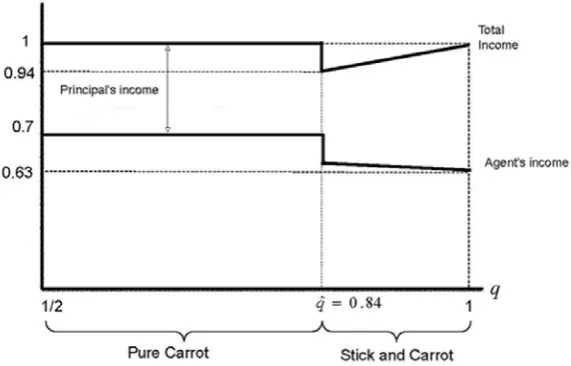
We illustrate the results of this proposition in a graph (Figure 1) for a simple calibration. We set: = 11, = 06 and= 08, so that a bad harvest with a significantly lower crop occurs about once every five years, and the expected crop size of each plot is set to one:
() = + (1−) = 1.11 To be consistent with tenants’ output share of about two thirds and with the relatively high cost of maintaining a family throughout the year, we set the subsistence cost to = 05 and the effort cost to = 01, thus making the basic wage
[image:10.595.165.451.286.469.2] = 06. Given an interest rate (in grain) of one third, as was customary in the ancient world, we set = 075. Finally, we set = 2, so that the present value cost of dismissing and replacing an agent is two expected crops.12
Figure 1. Periodic expected income as a function of signal accuracy
In this figure, the agent’s expected income as a function of accuracy is depicted by the lower solid line. Total expected income + is depicted by the upper solid line; and the difference between these two lines represents the principal’s expected income. The
expect the farming population to grow. In Online Appendix F we close the model as far as population size is concerned by assuming that any excess workers from the rural sector, including dismissed agents, are employed outside of farming, where the wage is low (particularly during famines) and does not guarantee reproduction.
11One should think of this unit as representing an annual net output of about 1.5 tons of grain, after deduction of the grain that is needed for seed (about 15 percent of the crop) and expected spoilage in storage (about 10-20 percent). For a more elaborate attempt to calibrate early Near Eastern farming see Hunt (1987).
figure clearly identifies the two regimes: ‘pure-carrot’ and ‘stick-and-carrot,’ and the switch between them at the critical transparency level ˆ.
If the economy is less transparent ( ˆ), the principal optimally refrains from ever dismissing the agent. In this case, the contract is socially efficient (since expected output is 1) and the expected income of both the principal and the agent is independent of . In this pure-carrot regime the expected income of the agent, , and the principal, , are:
=+ 2 and=(−) +−2−
and their combined expected income is: (−) +. In contrast, in the stick-and-carrot regime, when ˆ:
= + 2−
1−(+−2) and
= (−) +−−2+
1−(+−2) −
and the expected total income is:
+=(−) +−
The expected total income reveals that the stick-and-carrot contract is socially inefficient. This is because it entails an expected loss of, since the agent may be dismissed even though he works diligently. The efficiency loss declines as accuracy improves, and at the limit, when the signal is accurate (= 1), the stick-and-carrot regime becomes socially efficient.
The principal’s payoffis continuous at the threshold of transparencyˆand increases with
thereafter. The gains to the principal from a rise in in the latter range are derived both from a rise in total income and from a decline in the agent’s income. Indeed, it is the agent who bears the entire burden of the stick-and-carrot regime: at the threshold accuracy, ˆ, his expected income drops discretely by the expected cost of dismissal (ˆ). Beyond that threshold, his expected per-period income declines with .
Comparing the outcome when the signal fully discloses the state of nature (= 1) with the outcome when the signal is highly inaccurate ( ˆ) is revealing. In both cases the diligent agent is never dismissed and the economy is efficient. However, the distribution of income is quite different. The agent’s income above subsistence falls from −( =) = (= 01
in the example) in the range of the opaque signal to −( =) =−[1−(1−)]
(= 003) when = 1, as the bonus that is required to dissuade the agent from shirking is reduced to a minimum.13
These results confirm that when transparency is sufficiently low, the agent-tenant is never dismissed and could be considered a de facto owner of the land that he cultivates. In contrast, when transparency is sufficiently high, the farmer may be evicted and thus cannot be considered to have ownership rights to the land. In this range, an increase in transparency implies that the probability of (wrongful) dismissal () declines, so that expected cost of including a stick in the contract decreases. This enables the principal to rely more on the stick of dismissal and less on the carrot of bonus payments. This entails a correspondingly smaller share of output for the tenant and an increase in the revenue appropriated by the state. The effect of increased transparency on the optimal combination of the stick and carrot is robust and does not depend on our specific modeling assumptions. It reflects the logic that the credible threat of using a stick reduces the cost of incentivizing the agent with a carrot.
One may argue that the principal has an incentive to renege, by avoiding paying the bonus to the agent, or, alternatively, by failing to dismiss the agent when this is called for, and negotiate ex-post in order to avoid the cost of dismissal. We have in mind, though, a patient principal who faces many agents, repeatedly. Informally, we envision that the agents are likely to believe that if the principal reneges once, even if on one agent only, she is likely to continue doing so in the future and on other agents. Under these circumstances, the principal’s commitment to the contract becomes credible, since reneging would render her unable to incentivize agents by using the carrot or the stick.14
2.2
A Two-Level Hierarchy Model
This subsection provides a key extension of the basic model by incorporating both landlord-farmer relationships and those between the ruler and intermediary officials. This extension has important implications for the study of state concentration and the power structure between the center and the periphery. Our main conclusion is that if farming activity is sufficiently transparent, not only to the local elite but also to the center, the intermediary retains a smaller share of the revenue and is subject to dismissal. If, however, farming activity is sufficiently opaque to the king, the local official (governor) retains autonomy and
a larger share of revenue. We also introduce here an alternative depiction of the moral hazard problem that is more likely to apply to the relations between local elite and the center: misreporting tax collection.15
We assume now a two-tier case, where each plot is located within a district, and where officials at the district level mediate between the tenant-farmer and the king. This two-tier case can easily be extended to add more tiers. We attach subscripts 1 or 2 to the variables at each level of the hierarchy, from the bottom up.
Two independent state variables are assumed to determine the state of nature in each plot of land: 1 ∈ { } is plot specific, and 2 ∈ { } is district specific. The plot specific state can be thought of as injury to the tenant during the critical harvest time, or damage due to localizedflood or fire. The district specific state would be something affecting the entire district, such as widespread drought or blight. We denote the probability that each plot of land is in a plot-specific good state by1 ∈(01), and the corresponding probability for each district by2 ∈(01). We assume that the plot-specific states are independent across plots within a district, and independent also of the district state. As in the basic model, output in each plot can be either low or high: 1 ∈ {1 1} and the agent’s effort can be either low or high: ∈ { }. Plot output is assumed to be high if and only if the agent exerts high effort and both the plot’s and district’s states of nature are good (1 =2 =), which pertains with probability 12.
The district specific state of nature, 2, is revealed to both the farmer and the governor after the farmer’s effort decision is made. In addition, if the district specific state is good (2 = ), then the governor receives plot-specific signals 1 ∈ { } for each plot in the district. These signals are accurate with probability 1 ∈ [051] and are (conditionally) independent across plots. The relations between the district governor and the farmers under her control are just as in the basic model. The contract selected by the governor will thus have the same structure as before: it specifies a basic wage 1 = +, a bonus 1 if output is high, and a dismissal probability 1 ∈ {01} at a cost of 1 to the governor, if output is low (1 = 1) but both the district’s state and the plot’s signal are good (2 = 1 = ). Thus, subject to the farmer exerting high effort, he is dismissed with probability: 11 = (1−1)2(1−1)1. That is, the governor’s maximization problem is a variant of the principal’s problem in the basic model, in which12 substitutes foras the probability of high output upon high effort, and the probability of dismissal is11 instead of . Thus, the governor chooses a pure-carrot contract (1 = 0) if transparency is below
some threshold, 1 ˆ1, and a stick-and-carrot contract if 1 ˆ1. Above ˆ1, the expected income of the governor is increasing with 116
We also assume that the number of plots in each district, 1, is sufficiently large so that the total revenue obtained by the district governor can be substituted by its expected value. The governor’s revenue is then limited to two possible outcomes, depending on the district-specific state of nature 2: 2 in a bad year (2 = ) and 2 in a good year (2 = ), where:
2 = 1[1−(+)]
2 = 2(1) =1[1(1−1−1) +1 −(1−1)(1−1)11−(+)]
The parameters1 and1 are those selected by the governor (as a function of 1). As in the basic model, beyond a threshold ˆ1, the good-year revenue2 is increasing in1
For the relations between the king and the district governor, we employ a variant of our basic model in which, instead of possibly exerting low effort, the governor may hide some output in good years and report to the king 2 instead of 2. At this level of the hierarchy we assume an information structure analogous to the one in the basic model. The king does not know the specific states 2 for any of the districts, but he receives an independent signal 2 ∈ { } about each of the district states, whose accuracy is denoted by the probability 2 ∈[051]
The king is assumed to employ a two-edged incentive scheme analogous to the one above: a bonus2 if the governor reports collecting2, and dismissal (at a cost of2 to the king) if the governor’s report is2, but the signal 2 indicates that the district harvest is expected to be high. The king thus chooses 2 ≥0 and 2 ∈{01}to maximize:
2 = 2≥02∈{01}
2(2−2) + (1−2)[2−(1−2)22]
subject to providing the governor with the incentive to report truthfully.
The details of the solution to this problem are very similar to the solution to the basic model, and are reported in Appendix 2. Once again, the balance of power between the king and the district governor depends on the transparency of the district economy to the king,2. When local conditions are sufficiently opaque to the king, the intermediary governor enjoys substantial autonomy in that she retains a (relatively large)fixed part of her collected revenue and always keeps her position. But if the transparency of the local provincial economy to
16The corresponding bonus payments are:
1 = 12 under ‘pure carrot’ and 1 = (12) [1−1211(1−1(1−2)−12(1+1−211))] under ‘stick and carrot’. If 2 = 1, this
the king is sufficiently high, then the governor is subject to dismissal and retains a relatively lower share of the revenue collected.
3
APPLICATION: THE MAJOR CIVILIZATIONS OF
THE ANCIENT NEAR EAST
Our theory provides the following predictions that link transparency to institutions. Accord-ing to the basic model:
(1) When farming is locally transparent, farmers do not own the land they cultivate; (2) When farming conditions are more transparent, the state’s capacity to tax is higher and the inequality between the elite and the farming population is greater.
And, according to the hierarchical extension of the model:
(3) When farming is less transparent to the central state, local lords retain autonomy and higher income.
In this section we demonstrate that these three predictions are consistent with the insti-tutions that prevailed in the three major civilizations of the ancient Near East during the late fourth to the second millennia BCE: Northern (upper) Mesopotamia, Southern Mesopotamia (Babylonia, Sumer), and Egypt. Naturally, we do not pretend that our simple theory can explain all the institutional differences between these civilizations, nor that our theory is the only one that addresses these differences.
These three civilizations were listed above in accordance with their age, but are reviewed below in reverse order. Intensive agriculture was first adopted in the highlands of southern Anatolia and northern Mesopotamia in the seventh millennium BCE. Agriculture was ad-opted in the alluvial planes of Southern Mesopotamia and in the Nile Valley only two and three millennia later, respectively. It was in Sumer, however, that thefirst major city-states were formed in the fourth millennium (Liverani 2006). But thefirst central territorial state was formed in Egypt, in about 3000 BCE, starting from a core in Upper (southern) Egypt (Kemp 2006). The rapidity of the formation of a central state, and its subsequent stability, are among the key features that distinguish between ancient Egypt and Southern Mesopot-amia, leading Baines and Yoffee (1998, 268) to conclude “the two civilizations are profoundly different.”
in Northern Mesopotamia land was mostly owner-cultivated. Another major distinguishing feature concerns the role of cities. Fortified city-states existed in pre-dynastic Egypt, but Egyptian cities ceased to be fortified after the formation of the central state and played a limited role as administrative centers. This led Wilson (1960) to characterize Ancient Egypt as “a civilization without cities.” In contrast, for most of the time up to thefirst millennium BCE, the alluvial plains of southern Mesopotamia were ruled by rival, fortified city-states that retained their independence and resisted repeated attempts to unify Mesopotamia un-der a central state. This led Adams (1981) to characterize southern Mesopotamia as “the Heartland of Cities.” The highlands of Northern Mesopotamia on the other hand gave rise to more limited city-states.
We now review each of these three civilizations separately, and demonstrate how the geographical features and resulting transparency of agriculture in each region can account for their distinctive institutional characteristics. To summarize, we argue that ancient Egypt occupies a polar extreme, with farming that was highly transparent both at the local and the global levels. Northern Mesopotamia is closer to the other extreme, with low transparency at both the local and the global levels.17 Southern Mesopotamia, we suggest, presents an
intermediate case, being comparatively transparent at the local level, but quite opaque to any potential central state.
3.1
Egypt
The Nileflows northwards, receiving its water mainly from the early-summer monsoon rains in eastern Africa. As a result, it surges in summer, at which time it floods the narrow river valley in Egypt. The Egyptian basin irrigation system was based on lateral dikes across the river valley, constructed to retain the flood water. The trapped water soaked the land and deposited nutrients for about two months, before it was drained back to the Nile, in time for the sowing of the staple cereals (mostly barley). The moisture trapped in the soil was the sole source of water during the growing season. Harvest was in late March, before the hot winds could parch the grain stalks and cause the kernels to disperse. This form of farming within the Nile Valley originated at the southern tip of Upper Egypt in thefifth millennium BCE, from where the Egyptian central state subsequently emerged.18 The homogeneity of
17Agriculture in Northern Mesopotamia was, however, significantly less opaque than in the more arid regions of the Ancient Near East. Noy-Meir (1973) demonstrates the extreme effects of spatial variations in micro-climate and terrain quality on the heterogeneity of desert plant populations.
the land within each basin implied very high local transparency.
Since few details about tenancy arrangements in ancient Egypt have survived, historians often employ evidence from the more recent past. In describing district life in Egypt from the medieval period up to the nineteenth century, Baer (1969, 17) contends that it was characterized by three phenomena: (a) the village head periodically redistributed land among the peasants; (b) the village inhabitants were collectively responsible for tax payments; (c) the village as a whole was responsible for maintaining irrigation infrastructure and for providing labor for public works. Eyre (1997, 378) and Eyre (1999, 51-52) similarly maintains that in ancient Egypt, farmers did not have secure tenure and the village community as a whole was responsible for paying taxes. The village head exercised tight control over village land and could reassignfields as he sawfit, even if by custom the samefields were annually assigned to the same farmer, or to his heir.19
This description supports our prediction that the threat of dismissal (or relocation) of individual farmers was a widely used incentive device in Egypt and that land was not owned by the cultivating farmers. Indeed, the prevailing notion in ancient Egypt was that the entire land belonged to the Pharaoh (Baines and Yoffee 1998, 206), even if this coexisted in various periods with a practice by which much of the land was de facto owned by the temples, by various lay organizations, and by powerful individuals (Manning 2003, 65-98). That is, even when land in the Nile Valley was privately held, it was owned by absentee landlords who did not work thefields.20
This state of affairs is consistent with prediction (1). The high local transparency of farming eliminated the main disadvantage of absentee land ownership, and left peasants vulnerable by denying them an information advantage. Significantly, in the few known cases where private land lease documents survived from antiquity, the contracts were for one year only (Hughes 1952), providing further support for our proposed mechanism that tenants were constantly under the threat of eviction.21
19Eyre (1997, 1999) contends that the divorce between land-ownership and actual farming was endemic to Egypt and persisted until the mid-twentieth century. According to Baer (1969, 62-78), even the major agrarian reforms during the nineteenth century, which gave land title to the cultivating peasants, ended with much of the land reverting back to large absentee landlords after the small cultivators failed to pay the required taxes.
20Hughes (1952, 1-2) summarizes that in thefirst two millennia of the historic period (the third and second millennia BCE) there was never “a large body of small landholders who managed and worked their plots themselves . . . the lowest classes were largely serfs on the domains of Pharaoh, the wealthy and the temples.”
Transparency should not be confused with predictability. The fluctuations in the Nile’s annual inundation level were substantial and caused significant unpredictable annual vari-ations in crop output. Particularly high inundation would break the lateral dikes and flood villages, causing as much of a threat as very low inundation levels. The timing, length and severity of the hot spring winds at harvest time contributed to the uncertainty. However, in any given year, the conditions that farmers faced were fairly homogeneous within each irrigation basin system, and also across basin systems. As a result, farming activity was highly transparent not only locally, but also to the central government. The Nile’s annual peak inundation was recorded as early as the third millennium BCE (Kemp 2006, 64). Nilo-meters that measured the inundation level were set up along the Nile, and it appears that the Pharaohs used this information as a control device. Cooper (1976, 366) describes the taxation of Egyptian agriculture in the middle ages: “Agriculture was so well regulated in Egypt that, on the basis of the Nile flood recorded by the Nilometer, the government knew in advance what revenue to anticipate.” In particular, “The height of the Nileflood determ-ined how much and in what manner the tax assignments were made in each district.” We conjecture that this was the case also in antiquity.22
The Nile’s global transparency enabled the Pharaohs to employ a stick-intensive incentive scheme towards the district governors, and down the chain of middlemen who remitted taxes from the periphery to the center. That is, consistently with predictions (2) and (3), the high transparency of farming helps explains why the Pharaohs were able to run a lean state bureaucracy and to siphon off a substantial share of the tax revenue, without engaging in direct control. In turn, it explains why the provincial centers retained so little independent power. This is consistent with Eyre’s (1994, 74) summary: “The crucial factor for the central power was its ability to enforce fiscal demands and political control. . . . [P]ower lay in control over the ruling class . . . not in the detailed administration of the individual peasantry.” Indeed, at least in the early Old Kingdom period, the positions of governors and state bureaucrats were by a revocable appointment, and nonhereditary.23 The non-secure
status of these state bureaucrats is closely related to the relative weakness of the cities in the different districts. These cities essentially remained administrative centers, without amassing
communally. The homogeneity of farm land within each basin also reduced the importance of plot specific skills, implying that the cost of replacing an agent was not high, reinforcing the adoption of dismissal as part of the incentive scheme.
22The transparency of Egyptian farming was due also to the relative ease of monitoring farming activity in real time by inspectors traveling along the Nile. Kemp (2006, 254-6) provides evidence for such a monitoring expedition from 1140 BCE.
substantial independent wealth to threaten the predominance of the center.
The high transparency at all levels of the state hierarchy can also explain the rapidity of the formation of a strong central state in Egypt, and its remarkable subsequent stability.
3.2
Southern Mesopotamia
As in Egypt, farming in arid Southern Mesopotamia relied entirely on riverine irrigation. The water regime in the Tigris and the Euphrates, however, is very different from that in Egypt. Both these rivers flow southward, and are fed by the winter rains and by spring melting snow in the mountains of modern Turkey and Iran. The long distance between these mountain ranges and Southern Mesopotamia meant that water levels were low in October-December when irrigation was most needed, but high in the harvest season in late spring (Adams 1981, 3-6; Postgate 1994, 178; Wilkinson 2013). This mismatch prevented irrigation byflooding, as in Egypt. Cereals were cultivated on the outer slopes of levees, including the levees of abandoned courses of the rivers. An extended canals system was required to deal with the water shortage in the cultivation season: capturing water upstream and directing it towards the fields. Furthermore, since water quantity was insufficient to irrigate all the arable land, control mechanisms were required to distribute the water.24 The swelling of the
rivers in the spring posed another major threat of flooding the ripe fields at harvest time, and had to be overcome by diverting excess water into the marshy flood plain at the lower end of the cultivation zone (Adams 1981, 245; Wilkinson 2003, 89; Wilkinson 2013).25
These major problems apparently delayed the adoption of extensive agriculture in South-ern Mesopotamia well after agriculture flourished in Northern Mesopotamia, and after ir-rigation systems were established in southwest Iran (Wilkinson 2003, 72-76). In addition to the intricate canal system that overcame these problems, agriculture in Southern Mesopot-amia benefitted from another innovation: the cultivation in deep furrows, plowed by oxen, in narrow and longfields that sloped down from the feeding canal towards the marshy plain (Liverani 2006). This method enabled conservation of seed and water, and also helped divert the saline topsoil away from the plants.
Farming conditions in Southern Mesopotamia were complex (Wilkinson 2013). Even
24Adams (1981, 6) estimates that due to the shortage of water, only 8,000-12,000 square kilometers could be cultivated out of a potential that Wilkinson (2003, 76) estimates to be about 50,000 square kilometers. The shortage of water at the critical cultivation season is evidenced by the use of irrigation fees, as early as the late third millennium BCE. This underscores the power available to those upstream who could deny water.
fields within the same zone could vary in quality, depending on how high they were above the saline water table in the adjacent marsh. The overriding factor though was the dependency of cultivation on rationed water, which was controlled upstream, and which could have been directed elsewhere. Farmers were thus completely dependent on the local elite who controlled theflow of water at various canal junctures. In turn, the elaborate canal system provided the local elite with significant means of control and with information on the state of agriculture.26
Accordingly, we categorize farming activity in Southern Mesopotamia as highly trans-parent to the local elite. Consistent with prediction (1), we contend that this transparency explains why owner-cultivated farming was practically nonexistent in Southern Mesopotamia. As in Egypt, cultivation was conducted by sharecroppers, who were overseen by a hierarchy of intermediaries, under the ultimate control of dominant elite families who resided in the urban centers and controlled each city’s temple (Renger 1995; Liverani 2006).27 In accord
with prediction (2), this high local transparency explains why powerful early city-states were able to form and to persist in Southern Mesopotamia. Indeed, once irrigation agriculture was introduced, it led to relatively rapid development of civilization. More than thirty ma-jor city-states have been identified in Southern Mesopotamia in the late-fourth and third millennia BCE. Writing originated in about 3200- 3100 BCE in the largest of these cities, Uruk, when its population reached about twenty thousand (Yoffee 2005, 43).
At the same time, the complexity of the irrigation system required skilled local man-agers with a “thorough knowledge of local conditions on a day-to-day basis” (Hunt 1987, 172). Unlike the case of Egypt, the local managing elite in Southern Mesopotamia were thus indispensable and irreplaceable. In other words, we interpret farming activity in Southern Mesopotamia as rather opaque to any distant central government. Consistent with predic-tion (3), this opacity explains why the local elite in Southern Mesopotamia were extremely resilient, and why strong cities were one of the most distinctive features of Mesopotamian civilization. Thus, even when an early city-state in Southern Mesopotamia managed to conquer a competing city-state, it still needed the cooperation of the elite of the subjug-ated city to obtain on-going tax revenue from the conquered territory. It was the specific knowledge possessed by the local elites, we contend, that assured the autonomy of Southern Mesopotamian cities.
This helps explain why several aggressive attempts to unify Southern Mesopotamia under one of the rival city-states in the third and second millennia BCE ended in failure after a
26One may argue that such direct control provides power of coercion that goes beyond mere information. In our framework, however, the state is assumed to possess the power to coerce. Thus, implicitly, we view control as a form of transparency.
relatively short period – in marked contrast to the quick and durable unification of Egypt. The rival city states of Southern Mesopotamia fought each other periodically for a millennium before they were first consolidated under Sargon of Akkad in about 2350 BCE. However, Sargon’s central state lasted less than two centuries and started to disintegrate well before that. In about 2100 BCE another territorial state was formed, under the third dynasty of the city of Ur. This highly oppressive and bureaucratic state lasted only one century before it too collapsed. The next territorial state was established by Hammurabi of Babylon in 1790-1760 BCE, but it weakened substantially under his heirs, and collapsed by about 1600 BCE. Thus, until thefirst millennium, Mesopotamia was ruled most of the time by rival city-states, with only brief intermittent periods of a central territorial state.28 Our explanation of this historic pattern is consistent with Yoffee’s (2005) description of the fate of Sargon’s earliest central state. According to Yoffee, Sargon was well aware of the intermediation problem. When he ascended to power he sought “to disenfranchise the old landed aristocracy” (p. 37). But after conquering the diverse city states in Southern Mesopotamia, he ruled them through appointed “royal officials, who served alongside the traditional rulers of the conquered city-states” (p. 142). It was this “uneasy sharing of power . . . [that] led to a power struggle” and to the ultimate demise of Sargon’s territorial states (Yoffee 1995, 292-293, 2005, 143).
Furthermore, not only that the city-states in Southern Mesopotamia resisted subjugation to outside power, they also resisted local despots. These city-states were typically governed by hereditary kings by the rule of law, and with councils of elders and assemblies at their side, consisting of members of landed elite, merchants and artisans (Van de Mieroop 2013). We suggest that this pattern of governance prevailed since would-be despots were unable to raise sufficient revenue to sustain coercive power without the cooperation of the local elite who possessed specific information on the intricate countryside and the economy.29
3.3
Northern Mesopotamia
Farming started in Northern Mesopotamia long before it was adopted in Southern Meso-potamia. And urbanization was identified there already in the late fifth and early fourth
28The Neo-Assyrian Empire in thefirst millennium BCE devised various administrative methods to subject conquered states. In particular, they adopted bi-directional deportations, in which the elite of a conquered state were deported and replaced by people from elsewhere. But, significantly, even under the Neo-Assyrian, Neo-Babylonian and Persian empires, the elites in the cities in southern Mesopotamia retained much of their former autonomy (Van de Mieroop 1997, 128-139, 2013).
millennia BCE; but declined in the later part of the fourth millennium.30 The geographic
conditions in the highlands of Northern Mesopotamia are quite different from those in river-ine Southern Mesopotamia and Egypt. Agriculture was mostly rain fed. Due to the uncertain and idiosyncratic nature of rainfall, and to the relative unevenness of the terrain, farming was comparatively opaque even at the local level.31 Wilkinson (1994, 2003, 210) concludes
that the settlement pattern in Northern Mesopotamia was characterized by a large scattering of roughly equivalent, nucleated units. Each unit was administered by a central settlement, with a radius of control of about five kilometers, determined by the “constraining effect of land transport and the convenience of being within one day’s round trip of the center” (1994, 503).
Without disputing this observation, we take issue with Wilkinson’s explanation that this pattern was due to the fact that no center was able to dominate another, since none had an “overwhelming situational or demographic advantage” (2003, 210). By the winner-takes-all (increasing returns to scale) nature of violent conflicts, a priori advantage is not a prerequisite for the formation of larger territorial states under city leaders who happen to defeat their neighbors. From our perspective, the key to the nucleated pattern of semi-autonomous administrative units in early Northern Mesopotamia was the inability of the winner of any such territorial conflict to extract on-going revenue from distant conquered lands. In a more pronounced version of the situation in Southern Mesopotamia, and consistently with our third prediction, we propose that the localized nature of the early city-states in this region was due to the opacity of farming activity that limited the span of control of its urban centers.32
The relatively low transparency of farming in Northern Mesopotamia, even at the local level, can also explain the drastically different land tenure regime in that region. In contrast to the tenancy pattern in Egypt and Southern Mesopotamia, owner-operated farming was prevalent in Northern Mesopotamia from early on. Cuneiform documents from the mid-second millennium BCE from Nuzi (near modern Mosul) reveal that while the local kings and the elite owned large estates, the temples did not possess economic power or land, and
30The large size of these early cities and the architectural remains of the dwellings suggest that these cities were inhabited not only by the elite, but also by the farming peasants (Ur 2010). This pattern of inhabitance is consistent with the presumption of the elite’s inability to raise the needed resources to secure the countryside from banditry, which forced the peasants to seek refuge within the walls of the central city, and with the relatively small territorial span of these early city-states.
31See Wilkinson (1994) and Jas (2000).
much land was owned by nuclear families who worked their patrimonial property. The Nuzi evidence also reveals that land ownership in Northern Mesopotamia was in a constant state of flux. Small landholders regularly lost title of their land to rich families through debt and sale under duress (Zaccagnini 1999; Jas 2000). However, the persistence of owner-occupied farming indicates that the process of land consolidation must have been matched by an opposing process by which large, presumably less efficient, estates were gradually dissolved. The prevalence of owner-cultivated private farming in Northern Mesopotamia is consistent with prediction (1) that low transparency makes tenancy less profitable to absentee owners.33
4
RELATED LITERATURE
Since the body of related literature is large, we shall review only the leading alternative theories on the pattern of state governance in the Ancient Near East and some related general theories on statehood.34
We start with Wittfogel’s (1957) influential hydraulic theory of “oriental despotism,” according to which large-scale irrigation infrastructure was necessary to realize the agricul-tural potential in riverine environments. Strong, despotic states are presumed to have been a prerequisite for constructing and administering these irrigation projects. Wittfogel’s many critics pointed out, however, that the irrigation systems in ancient Egypt and Mesopotamia (and elsewhere) were constructed communally, prior to the emergence of a strong central state. Moreover, even after a central state emerged, these irrigation systems were managed locally, rather than from the center. Due to the cogency of these counter-arguments, Wittfo-gel’s theory is now considered defunct. But this leaves unexplained the correlation that he pointed out between riverine environments and strong ancient states. Our theory explains this correlation by reversing the direction of causality in Wittfogel’s theory. It is not that a despotic state was required to construct and to operate irrigation systems, but rather that irrigation-based agriculture provided transparency and facilitated state control.35
33Jas (2000) quotes Warriner (1948, 21, 104), who noted that the different land tenure regimes between Northern and Southern Mesopotamia in antiquity persisted to the modern era: “In the north, the forms of tenure are similar to those of Syria, with a class of small proprietors taking some but not all, the land. In the south large owners or sheiks own virtually all the land, letting it to share-tenants, through a series of intermediary lessees.”
34With regard to the related literature on property rights, we only note that in our framework rights to land do not arise spontaneously (as in Demsetz 1967), but are granted by an authoritarian government (as in North 1981).
An alternative functional theory posits that the early state served a redistributive pur-pose. Thus, Adams (1981, 244) views the Mesopotamian city-states as having been formed to cope with uncertainty in farming output, through precautionary storage against years of shortage: “In the largest sense, Mesopotamian cities can be viewed as an adaptation to the perennial problem of periodic, unpredictable shortages. They provided concentration points for the storage of surpluses.” Our framework, however, suggests that the attested extens-ive inter-annual storage in ancient Egypt and Mesopotamia may have served primarily to protect the urban elite against revenue shortfalls in years of famine, rather than to aid the farming population in the countryside.
Probably the most widespread alternative theory is the idea (referred to in our introduc-tion) that the emergence of the state was due to the increased productivity of agriculture and to the surplus that was thus created. It is argued that this surplus generated via diverse chan-nels (such as population pressure, trade, or required protection) a need for government. In an influential variant of these ideas, Carneiro’s (1970) “environmental circumscription” theory poses that states emerged only in circumscribed areas that trapped the agrarian population and restricted its ability to avoid subjugation by fleeing elsewhere. In his comprehensive study of the history of government, Mann (1986, 38-40, 75-102, 108-115) uses the metaphor of a “social cage” to explain the success of ancient Egypt and of other early states. Both Mann (1986) and Allen (1997) argue that Egypt’s success was due to the deserts that isolate the Nile Valley and inhibited the peasants from avoiding subjugation via out-migration, thus enabling the state to extract surplus from the farming sector. From our perspective, while this entrapment theoryfits Egypt, it does not adequately explain the institutional differences that were examined above, for example, between northern and southern Mesopotamia.
Tilly (1975) offered another influential conflict theory that relates the emergence of cent-ralized states to their capacity to tax. In seeking to explain the evolution of European states since the middle-ages, he contends that new military technologies disrupted the international equilibrium and forced states to consolidate in order tofinance ever costlier wars. Tilly fam-ously stated: “War made the state, and the state made war” (Tilly 1975, 42). Finer (1997) applied this warfare theory more broadly to explain the history of government, referring to this positive feedback theory as the “extraction—coercion cycle” (Finer 1997, 15-19).36
It is evident however that warfare theory cannot explain the state’s success in ancient Egypt, since, as argued for example by Dal Bó, et al. (2015), Egypt’s natural circumscription insulated it from the outside and implied that once a central state was formed, it was not
hierarchical political organizations;” leading to the formation of an early territorial state.
seriously threatened by competing states. This was in contrast to Mesopotamia, where local rivalries and nomadic banditry were a perennial problem. Stasavage (2010) proposed an alternative transparency theory — where the transparency is of government activity, rather than of production — that challenges Tilly’s theory on other grounds. He contends that the compact geographic span of small pre-modern European city-states generated greater trans-parency of their governments and enabled these city-states to raise the necessary resources, via taxes or credit, and thus withstand aggression and retain their independence.
As we see it, the critical element missing in the warfare theory is an explanation of what enabled a victor to extract ongoing revenue from a conquered territory to make the conquest viable and long-lasting. In other words, while admitting thatfiscal capacity contributes to a state’s military capacity, we question the general validity of the reverse causal relation that greater military capacity necessarily increasesfiscal capacity. These considerations, though, highlight that we assume here, as mentioned in the introduction, an isolated state with an absolute power to coerce; yet without incorporating rivalry between competing polities or taking into account the resources required to maintain such power and to deter secession.37
Moreover, we have avoided altogether assigning the state with the typical function of providing public goods, including the maintenance of law and order. We acknowledge in this respect the contribution of Levi (1988), who considers, as we do, the constraints on the government’s capacity to tax, but emphasizes how the provision of public goods and adherence to constitutional constraints may foster cooperative compliance by tax-payers, as a substitute for the sole reliance on coercion.
Finally, we note that in a companion contribution (Mayshar et al., 2016) we consider both the emergence of the state and the role of increased productivity, issues that we do not address here. In that paper we focus on a different aspect of the ability to appropriate, contending that the transforming feature of the Neolithic Revolution which gave rise to social hierarchy was the increased appropriability of crops, rather than increased productivity. In particular, we argue and provide empirical support for our claims that even after the adoption of highly productive agriculture, state institutions did not emerge in regions where farming relied on non-seasonal roots and tubers that are typically perishable and largely non-appropriable. Complex hierarchies and state institutions emerged only in regions of the world, such as the Ancient Near East, where farming relied on seasonal and non-perishable cereal crops, since such crops require storage from one harvest to the next and are thus highly vulnerable to appropriation.38
37The literature on these issues is extensive. See most recently Boix (2015).
5
CONCLUSION
Stigler (1961) stated that “knowledge is power.” We apply this maxim to examine how the extent and the structure of informational asymmetry shaped the institutions of pre-modern, agricultural state societies. Our overarching contention is that through its effect on the tax technology, the transparency of production affects the scale of the state, its hierarchical structure, and land tenure practices. This theory helps explains why ancient Egypt was rapidly united and was subsequently very stable and highly centralized, while Sumer remained a complex of competing city-states for several millennia. It also explains why land in Egypt belonged (at least nominally) to the Pharaoh, while in Southern Mesopotamia land belonged to the temples and to the elite, and in Northern Mesopotamia there was substantial owner-occupied farming.
Our environmental theory of early institutions offers a new paradigm for understanding antiquity, with an emphasis on how differences in the extent of information asymmetry affect hierarchical extractive institutions. While we apply our theory to the institutions of antiquity, we propose that it can be applied to all predominantly agricultural state societies. More generally, and unrelated to environmental considerations, our theory sheds light on how production technologies can impact the state’s capacity to tax and shape institutions. In particular, whereas the prevailing perception is that asymmetry of information hinders efficiency, our framework reveals that the lack of transparency of agents’ activities (‘privacy’) may in fact be beneficial to them in protecting their freedom, and possibly also in promoting their material well-being.
References
[1] Acemoglu Daron and James A. Robinson. 2012. Why Nations Fail: The Origins of Power, Prosperity, and Poverty. Random House.
[2] Adams, Robert M. .1981.Heartland of Cities: Surveys of Ancient Settlement and Land Use of the Central Floodplain of the Euphrates. Chicago: University of Chicago Press.
[3] Allen, Robert C. 1997. “Agriculture and the Origins of the State in Ancient Egypt.”
Explorations in Economic History 34 (2): 135-154.
[4] Baer, Gabriel. 1969.Studies in the Social History of Modern Egypt. Chicago: University of Chicago Press.
[5] Baines, John and Norman Yoffee. 1998. “Order, Legitimacy, and Wealth in Ancient Egypt and Mesopotamia.” InArchaic States, eds. Gary M. Feinman and Joyce Marcus. Advanced Seminar Series. Santa Fe: School of American Research Press, 199-260.
[6] Banerjee, Abhijit V. and Ghatak, Maitreesh. 2004. “Eviction Threats and Investment Incentives.” Journal of Development Economics 74 (2): 469-488.
[7] Billman, Brian R. 2002. “Irrigation and the Origins of the Southern Moche State on the North Coast of Peru.”Latin American Antiquity 13 (4): 371-400.
[8] Bockstette, Valerie, Areendam Chanda, and Louis Putterman. 2002. “States and Mar-kets: The Advantage of an Early Start,” Journal of Economic Growth 7(4): 347-69.
[9] Boix, Carles. 2015. Political Order and Inequality: Their Foundations and Their Con-sequences for Human Welfare. Cambridge: Cambridge University Press.
[10] Butzer, Karl W. 1976. Early Hydraulic Civilization: A Study in Cultural Ecology.
Chicago: University of Chicago Press.
[11] Carneiro, Robert L. 1970. “A Theory of the Origin of the State.” Science, 169(3947): 733-738.
[12] Chwe, Michael Suk-Young. 1990. “Why Were Workers Whipped? Pain in a Principal-Agent Model.” The Economic Journal 100(403): 1109-1121.
[13] Cooper, Richard S. 1976. “The Assessment and Collection of Khar¯aj Tax in Medieval Egypt.”Journal of the American Oriental Society 96(3): 365-382.
[15] Dandamaev, Muhammad A. 1984.Slavery in Babylonia: From Nabopolassar to Alexan-der the Great (626—331 BC). Translated by Victoria A. Powell. Illinois: Northern Illinois University Press.
[16] Dari-Mattiacci, Giuseppe. 2013. “Slavery and Information.” Journal of Economic His-tory 73(1): 79-116.
[17] De la Sierra, Raul Sanchez. 2016. “On the Origin of States: Stationary Bandits and Taxation in Eastern Congo.” Working paper, University of California Berkeley.
[18] Demsetz, Harold. 1967. “Toward a Theory of Property Rights.”The American Economic Review, Papers and Proceedings of the Seventy-ninth
[19] Annual Meeting of the American Economic Association 57(2): 347-359.
[20] Diamond, Jared. 1997. Guns, Germs, and Steel: The Fates of Human Societies. New York: Norton.
[21] Eyre, Christopher J. 1994. “The Water Regime for Orchards and Plantations in Pharaonic Egypt”Journal of Egyptian Archaeology 80: 57-80.
[22] Eyre, Christopher J. 1997. “Peasants and ‘Modern’ Leasing Strategies in Ancient Egypt.”Journal of the Economic and Social History of the Orient 40(4): 367-390.
[23] Eyre, Christopher J. 1999. “The Village Economy in Pharaonic Egypt.” In Proceedings of the British Academy, 96: Agriculture in Egypt from Pharaonic to Modern Times, eds. Alan K. Bowman and Eugene Rogan. Oxford: Oxford University Press, 33-60.
[24] Finer, Samuel E. 1975. “State and Nation-Building in Europe: The Role of the Military.” In The Formation of National States in Western Europe, ed. Charles Tilly. Princeton: Princeton University Press.
[25] Gennaioli, Nicola and Hans-Joachim Voth. 2015. “State Capacity and War.”Review of Economic Studies 82(4): 1409-1448.
[26] Greif, Avner. 2006. Institutions and the Path to the Modern Economy: Lessons from Medieval Trade. Cambridge: Cambridge University Press.
[27] Hughes, George Robert. 1952. Saite Demotic Land Leases. Chicago: University of Chicago Press.
![Figure 5: The optimal dismissal probability, ∈ [0 1], as a function of](https://thumb-us.123doks.com/thumbv2/123dok_us/9440349.451329/40.595.163.480.144.354/figure-optimal-dismissal-probability-function.webp)

