Design of Cooperative Non-Orthogonal Multicast
Cognitive Multiple Access for 5G Systems: User
Scheduling and Performance Analysis
Lu Lv, Jian Chen,
Member, IEEE,
Qiang Ni,
Senior Member, IEEE,
and Zhiguo Ding,
Senior Member, IEEE
Abstract—Non-orthogonal multiple access (NOMA) is emerg-ing as a promisemerg-ing, yet challengemerg-ing, multiple access technology to improve spectrum utilization for the fifth generation (5G) wireless networks. In this paper, the application of NOMA to multicast cognitive radio networks (termed as MCR-NOMA) is investigated. A dynamic cooperative MCR-NOMA scheme is proposed, where the multicast secondary users serve as relays to improve the performance of both primary and secondary networks. Based on the available channel state information (CSI), three different secondary user scheduling strategies for the cooperative MCR-NOMA scheme are presented. To evaluate the system performance, we derive the closed-form expressions of the outage probability and diversity order for both networks. Furthermore, we introduce a new metric, referred to as mu-tual outage probability to characterize the cooperation benefit compared to non cooperative MCR-NOMA scheme. Simulation results demonstrate significant performance gains are obtained for both networks, thanks to the use of our proposed cooperative MCR-NOMA scheme. It is also demonstrated that higher spatial diversity order can be achieved by opportunistically utilizing the CSI available for the secondary user scheduling.
Index Terms—Non-orthogonal multiple access (NOMA), coop-erative NOMA, multicast cognitive radio networks, opportunistic user scheduling, 5G systems.
I. INTRODUCTION
Recently, there has been a surge of increased interest in applying non-orthogonal multiple access (NOMA) to the next generation of wireless networks [1]–[3]. Empowered by the technology of superposition coding, multiple users’ signals are superimposed at the transmitter with distinct power allo-cation factors, and successive interference cancellation (SIC) is implemented at the receiver, so that the negative impacts of inter-user interference can be readily mitigated. In this regard, all users can share the same time, frequency or code domain, leading to a boost in spectral efficiency. Particularly, downlink NOMA has been applied to 3rd generation partnership project long-term evolution (3GPP-LTE) systems [4], and it has also
This work was supported by the EU FP7 CROWN project under Grant PIRSES-GA-2013-610524, by the National Natural Foundation of China under Grant 61601347, and by the “111” project of China under Grant B38038. The associate editor coordinating the review of this manuscript and approving it for publication was Dr. M. Abdallah. (Corresponding author: Qiang Ni.)
L. Lv and J. Chen are with the State Key Laboratory of Inte-grated Services Networks, Xidian University, Xi’an, 710071, China (email: [email protected]; [email protected]).
Q. Ni and Z. Ding are with the School of Computing and Communications, Lancaster University, Lancaster LA1 4WA, UK (email: [email protected]; [email protected]).
been designated as one of the key multiple access techniques for the fifth generation (5G) wireless networks [5]–[8].
A. Related Works
In contrast to traditional water-filling power allocation strat-egy, NOMA allocates more power to the users with worse channel conditions, which results in a better tradeoff between the system throughput and user fairness. In this context, the work in [9] has studied the power allocation with max-min fairness criterion. An uplink NOMA-OFDM scheme with joint power and subcarrier allocations has been proposed in [10], where the performance of both link-level and system-level has been investigated. Since it is always challenging to recruit all the users to perform NOMA, and it is preferable to implement user grouping/pairing to reduce the system complexity. To this end, the impact of user pairing on downlink NOMA systems has been characterized in [11]. The benefits of cooperative communications have been well acknowledged in the literature, where currently the diversity and relaying techniques have been used for the robust and reliable NOMA transmissions [12]–[15]. In [12], a cooperation-based NOMA scheme for coordinated direct and relay transmissions has been introduced. The performance of transmit antenna selection for NOMA assisted multiple-input multiple-output (MIMO) relay networks has been examined in [13]. A diversity-oriented detection mechanism for cooperative relaying system using NOMA has been proposed in [14]. Inspired by user collaboration, a cooperative NOMA transmission scheme has been proposed in [15], with jointly considering simultaneous wireless information and power transfer (SWIPT).
performance of cooperative multicast in selective relaying CR networks has been analyzed in [27].
B. Contributions and Outcomes
In light of the above cited works, both NOMA and multicast CR have demonstrated their advantages in spectrum utilization. However, by appropriately combining NOMA with multicast CR networking (termed as MCR-NOMA), further performance improvement in terms of spectral efficiency can be achieved. One example is to consider a situation where the PU locates closely to the edge of the cell, e.g., its channel conditions are poor; while the multicast SUs seat closely to the base station (BS) and thus have better channel conditions. The use of NOMA admits both PU and SUs to transmit at the same frequency band simultaneously, which substantially enhances the spectrum utilization. However, due to the existence of inter-user interference at the PU and heterogeneity of wireless channels at the SUs, the reception reliability of both networks may be degraded. Thanks to the SIC at the SUs, the signals intended to the PU and SUs can be jointly decoded. In order to improve the reliability, it is wisely to recruit the SUs as candidate relays for both primary and secondary networks, where user scheduling can be well implemented at the SUs to exploit the cooperative diversity. This cooperation is a win-win strategy for both networks, in the sense that the SUs help relay the primary and secondary traffic to boost both PU’s and SU’s performance, and meantime SUs obtain the opportunity to access the licensed spectrum, therefore improving the con-nectivity of the SUs and the overall spectral efficiency. Most recently, the application of NOMA to underlay CR networks has been studied in [28], where multiple unicast SUs are served simultaneously via non cooperative NOMA transmissions. In [29], a novel NOMA assisted cooperative spectrum sharing scheme for unicast primary and secondary streaming has been proposed and analyzed.
Different from [28] and [29] which mainly focus on the performance of unicast CR-NOMA communications, in this paper, we investigate the design of cooperative mechanism for the MCR-NOMA, where the multicast SUs serve as relays and collaboratively retransmit the signals intended for PU and SUs, respectively. The considered scenario can be directly applied to current cellular networks where local SUs may have common packets for nearby receivers, for example, local marketers may send the same advertising messages to people who happen to be in the neighborhood, while the PU locates at the cell edge. The main contributions of this paper can be summarized as follows. First, we propose a dynamic cooperative MCR-NOMA scheme, whereby the multicast SUs, served as poten-tial relays for the primary network, will also help improve the reliability of the secondary multicast transmissions if the sig-nals for both networks are decoded correctly by the SUs. This cooperation is particularly preferred by the primary network when the PU’s quality-of-service (QoS) cannot be met by the primary network itself. Second, based on the available CSI, we further propose three different secondary user scheduling strategies for the cooperative MCR-NOMA scheme. Third, we carry out analysis to provide the closed-form expressions to
reveal the outage performance and the diversity order at both primary and secondary networks. Furthermore, we introduce a new metric, referred to as mutual outage probability, to characterize whether the primary and secondary networks can take advantage of this cooperation, e.g., achieving a mutual cooperation benefit. Results show that a win-win situation can be eventually achieved and a more sophisticated user scheduling strategy can promise better outage performance for the overall networks, but at a sacrifice of consuming more communication overhead to obtain the required CSI. Finally, we present simulation results to demonstrate the effectiveness of the analytical results and the availability of the proposed cooperative MCR-NOMA with secondary user scheduling.
C. Organization and Notations
The remainder of this paper is organized as follows. The system model is explained and the cooperative MCR-NOMA scheme is introduced in Section II. In Section III, the perfor-mance of three secondary user scheduling strategies based on different CSI assumptions is investigated. Simulation results and discussions are presented in Section IV. Finally, the main outcomes are summarized in Section V.
Notations: Throughout the paper,P(·)symbolizes probabil-ity;fX(·)andFX(·)represent the probability density function (PDF) and the cumulative distribution function (CDF) of a random variableX, respectively; “≃” denotes asymptotically equal to, which holds in the high signal-to-noise ratio (SNR) regime.
II. SYSTEMMODEL
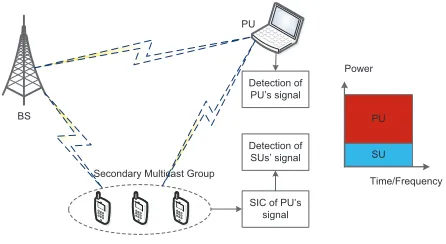
Consider a downlink cooperative MCR-NOMA framework consisting of one BS, one unicast PU and N multicast SUs, as illustrated in Fig. 1, which is envisioned to be of crucial importance for emerging wireless networks.1 Without loss of
generality, we assume that the PU locates closely to the edge of the cell and its channel conditions are poor, while the multicast SUs seat closely to the BS such that they have better channel conditions. This provides an incentive for the PU granting the multicast SUs an access to the licensed spectrum, in exchange for the SUs acting as relays to improve PU’s performance, due to the PU’s QoS may not be satisfied by the primary network itself in this case. Such an assumption has been commonly used in the literature on cooperative CR networking (see, e.g., [18]–[20] and references therein). For each transmission from the BS, both unicast signal for the PU and multicast signal for the SUs are transmitted simultaneously by NOMA signaling. Each node is equipped with a single antenna and operates in a half-duplex mode. All the channels in the network experience independent but not necessarily identically distributed (i.n.i.d.) Rayleigh block fading, e.g., the channels remain constant within each transmission block,
1Note that the considered cooperative MCR-NOMA scenario can be treated
Secondary Multicast Group
Detection of PU’ssignal
SIC of PU’s
signal Detection of SUs’signal BS
PU
SU PU
[image:3.612.62.285.67.189.2]Time/Frequency Power
Fig. 1. Schematics of the downlink cooperative MCR-NOMA scenario.
but vary independently between different blocks. Denotehb,p,
hb,n, hn,p, hn,n′ (n, n′ ∈ {1,· · ·, N}) as the channel gains from the BS to the PU, the BS to SUn, SUnto the PU, and SU nto SU n′, respectively. Thus, the channel power gains of these links follow an exponential distribution with means
d−b,pη,db,n−η, d−n,pη, and d− η
n,n′, where di,j denotes the Euclidean distance between nodes i andj, and η denotes the path loss exponent.
Note that in CR networks, the signal for the PU always has high priority to satisfy its real-time QoS constraint. While the SUs are to be served for low priority signal transmission, and are usually connected in an opportunistic manner [16]. Letxp and xs be the signals for the PU and SUs, with zero means and E[x∗pxp] = E[x∗sxs] = 1. The transmit power at each node is limited byP. The background noise is assumed to be white and Gaussian with variance of σ2.
The decode-and-forward protocol is applied at the SUs, and the proposed cooperative MCR-NOMA scheme consists of two contiguous time slots. During the first time slot, the BS broadcasts the superimposed signals(αpxp+αsxs), whereαp andαsdenote the power allocation coefficients. Invoking the NOMA signalling,2 we have the power allocation α
p > αs with α2
p+α2s = 1. Note that fixed power allocation is used in this paper. Optimizing the power allocation coefficients can further improve the performance of cooperative MCR-NOMA, which is beyond the scope of this paper. The received signals at the PU during the first time slot are expressed as
yp,1=
√
P hb,p(αpxp+αsxs) +ωp,1 (1)
whereωp,1 denotes the additive noise at the PU. Since αp>
αs, the received signal-to-interference-plus-noise ratio (SINR)
at the PU during the first time slot is given by
SINRp= α
2 p|hb,p|2
α2
s|hb,p|2+1ρ
(2)
where ρ=P/σ2 represents the transmit SNR. Similarly, SU
n (1≤n≤N) in the secondary multicast group observes
yn =
√
P hb,n(αpxp+αsxs) +ωn (3)
2Moreover, from the concept of CR that the PU is served with the high
priority while the SUs are connected opportunistically, it is reasonable to allocate more power to the PU to satisfy its high QoS requirement [16].
whereωnrepresents the additive noise at SUn. Using NOMA, SIC will be carried out at SUnto combat the negative effect of the inter-user interference. Specifically, SUnfirst decodes the signal for the PU, and then removes this component from the received signals to subtract its own information. Accordingly, the received SINR at SUn to detectxp is given by
SINRn,p= α
2 p|hb,n|2
α2
s|hb,n|2+1ρ
. (4)
After completely canceling outxp, the received SNR at SU n
to detectxs is shown by
SNRn,s=ρα2s|hb,n|2. (5)
Recalling the natural ordering of SIC, we denoteS1 as the set of SUs which can decode xp correctly but cannot decode
xs, shown as follows
S1= {
n: 1≤n≤N,SINRn,p≥τp,SNRn,s< τs }
(6)
and let S2 be the set of SUs which can decode bothxp and
xscorrectly, given by
S2= {
n: 1≤n≤N,SINRn,p≥τp,SNRn,s≥τs }
(7)
whereτp = 22Rp−1,τs= 22Rs−1,Rp andRs denote the targeted data rates for xp andxs, respectively. Note that the sizes ofS1 andS2 are represented by|S1| and|S2|.
During the second time slot, according to the results of whether the signals xp and xs are decoded correctly by the scheduled SU, a dynamic cooperative MCR-NOMA scheme, which adaptively switches between the cooperative NOMA and the cooperative spatial division multiple access (SDMA), is described in the following three cases.
(i) Event of1 ≤ |S2| ≤ N−1: In this case, suppose that SU n is selected from S2 to help the BS with cooperative NOMA, where the selection criterion will be discussed in the following section. In particular, SUnre-encodes and forwards the signal mixture (αpxp+αsxs)to the PU and other SUs. Therefore, during the second time slot, the PU receives
yp,2=
√
P hn,p(αpxp+αsxs) +ωp,2 (8)
whereωp,2is the additive noise. Upon maximal ratio combin-ing (MRC) over the two contiguous time slots, the resultcombin-ing SINR at the PU is given by
SINRp,end= α
2 p|hb,p|2
α2
s|hb,p|2+1ρ
+ α
2 p|hn,p|2
α2
s|hn,p|2+1ρ
. (9)
After using SIC, SU n′ belonging to S2c (e.g., S2c is the complementary set ofS2, indicating the SUs that fail to decode signalsxp andxs beforehand) tries to decode its own signal
xswith the following SNR:3 SNRn′,s=ραs2|hn,n′|2. (ii) Event of|S2|= 0and|S1| ̸= 0, or event of|S2|=N: In this case, suppose that SUnˆis selected fromS1to help the
3For mathematically tractable, SUn′inSc
2 does not combine the signals
BS with cooperative SDMA.4 Particularly, x
p is regenerated and forwarded by SU nˆ, and the received signal at the PU during the second time slot is
yp,2˜ =
√
P hn,pˆ xp+ωp,2. (10)
Similarly, by using MRC the resulting SINR at the PU follows
SINRp,end˜ =
αp2|hb,p|2
α2
s|hb,p|2+1ρ
+ρ|hn,pˆ |2. (11)
Since there is no SU which can decodexscorrectly (e.g.,S2is empty), an outage will be always declared at the secondary net-work. Therefore, the transmission scheme essentially reduces to the conventional cooperative relaying by recruiting the SUs as pure relays, in order to guarantee the QoS requirement of the PU [20].
(iii) Event of |S1|=|S2|= 0: In this case, there exists no SU that can decode the signalsxp andxscorrectly, therefore, the PU receives signal xp only from the direct linkhb,p and the overall SINR can be computed by (2) straightforwardly.
A detailed summary of the proposed dynamic cooperative MCR-NOMA scheme is shown in Algorithm 1.
Algorithm 1Dynamic cooperative MCR-NOMA scheme
1: During the first time slot, the BS broadcasts the signal mixture (αpxp+αsxs)to the PU and multicast SUs; 2: With the detection results at the SUs, it follows:
(i) Event of 1 ≤ |S2| ≤ N −1, the scheduled SU
n retransmits the signal mixture (αpxp +αsxs) with cooperative NOMA;
(ii) Event of |S2| = 0 and |S1| ̸= 0; or event of
|S2|=N: Being aware of the decoding results from other SUs, the scheduled SU n retransmits the signal xp with cooperative SDMA;
(iii) Event of|S1|=|S2|= 0, it cancels the coopera-tive MCR-NOMA.
3: During the second time slot, by appropriately schedul-ing SU n under different available CSI, the proposed dynamic cooperative MCR-NOMA begins.
III. SECONDARYUSERSCHEDULINGSTRATEGIES AND
PERFORMANCEANALYSIS
It is worth pointing out that the scheduled SU plays a crucial role for the primary and secondary networks, therefore it is important to investigate the user scheduling strategies for the cooperative MCR-NOMA. Under different CSI assumptions, the performance of three secondary user scheduling strategies is analyzed in the following subsections, providing thus more insights for practical setups.
4Note that for the event of|S
2|=N, all the SUs decodexs correctly. Therefore, being aware of the decoding results from other SUs, the scheduled SUnwill use all its power to relayxpin the second time slot. Otherwise, it still forwards the signal mixture (αpxp+αsxs), as will be detailed in Section III.
A. User Scheduling without Instantaneous CSI
Consider round robin scheduling, the BS will randomly select a SU served as a relay. This strategy does not require any CSI, which significantly reduces the communication overhead and is preferable to the limited-feedback systems. In this paper, two evaluation metrics, namely outage probability and diver-sity order, are used to characterize the system performance.
1) Outage Probability: Without loss of generality, we as-sume SUnis selected to help the BS. The outage probability for the primary network given the use of SUnis5
Pp=P(SINRp< τp,SINRn,p< τp) (12)
+P(SINRp,end˜ < τp,SINRn,p≥τp,SNRn,s< τs)
+P(SINRp,end< τp,SINRn,p≥τp,SNRn,s≥τs).
From (12), the first probability is for the event that neither the PU nor SUncan decodexp. The second and third probabilities are for the events that SU n applies cooperative SDMA and cooperative NOMA but the overall SINR cannot support the targeted data rate.
On the other hand, the capacity of secondary multicasting is dominated by the SU with the weakest channel gain in order to minimize outage and retransmission [21]. Accordingly, the outage probability for the secondary network can be defined as
Ps= (
1− P(SINRn,p≥τp,SNRn,s≥τs) )
+P(SINRn,p≥τp,SNRn,s≥τs,SINRn,n′ < τs )
(13)
wheren′ denotes the SU with the worst relaying channel gain inSc
2 to SUn. From (13), the former part indicates the event that SUnfails in decodingxs, and the latter part denotes the event thatxscan be decoded by SUnbut cannot be decoded by SUn′ (whose relaying channel gain is the weakest). The following theorem provides the outage probability for the primary and secondary networks achieved by the round robin scheduling strategy.
Theorem 1:For i.n.i.d. channels, the outage probability for the primary network with a randomly scheduled SU can be approximated as
Pp≈ (
1−e− ψpdηb,p
ρ
)(
1−e− ψpdηb,n
ρ
)
+χ
(
e− ψpdηb,n
ρ −e− ψsdηb,n
ρ
)(
1−e−
(τp−al)dηn,p
ρ
)
+χe− ψsdηb,n
ρ
(
1−e−
(τp−al)dηn,p
ρ(α2
p−α2s(τp−al))
)
. (14)
In (14), χcan be computed by
χ= πϖ 2L
L ∑
l=1 √
1−θ2 ld
η b,p
ρ(α2
p−α2sal)2
e− aldηb,p ρ(α2
p−α2s al) (15)
where ψp = τp
(α2
p−α2sτp), ψs =
τs
α2 s, ϖ =
α2p α2
s, al =
(θl+1)ϖ
2 ,
θl = cos(2lL−1π), and L is a complexity-accuracy tradeoff
5Since there is no CSI exchange or feedback among the multicast SUs, so
the randomly scheduled SU does not know whether the other SUs can detect
parameter. The outage probability for the secondary network is given by
Ps= (
1−e− ψsdηb,n
ρ
)
+
N∑−1
k=1
∑
Sc
2⊆{1,···,N}
|Sc
2|=k
e−∑n∈S2 ψsdηb,n˜
ρ
×
k ∏
i=1 (
1−e ψsdη
b,ni ρ
)(
1−e−∑ki=1 ψsdηn,ni
ρ
)
e− ψsdηb,n
ρ .
(16)
Proof: See Appendix A for details.
2) Mutual Outage Probability: It is worth noting that the proposed cooperative MCR-NOMA can lead to a win-win situation for both networks, e.g., the outage performance is enhanced for the PU while the SUs obtain the opportunity to access the licensed spectrum. In this regard, an outage event that either the primary or the secondary network is in outage, referred to as mutual outage probability, is considered in this paper. Since both networks should transmit reliably, the mutual outage probability can be formulated as
Pmop=P(O1) +P(O2) (17)
where O1 denotes the event that SU ncannot detect xp and
xs, and O2 denotes the event that though xp andxs can be detected by SU n, either the PU or SUn′ (n′ represents the SU whose relaying channel is the weakest) is in outage. From (17),P(O1)can be further written as
P(O1) = 1− P (
SINRn,p≥τp,SNRn,s≥τs )
. (18)
In addition, P(O2)can be defined as
P(O2) =P(|S2c|= 0)P(SINR˜p,end< τp) (19)
+
N∑−1
k=1 ∑
Sc
2⊆{1,···,N}
|Sc
2|=k
P(|S2c|=k)
×(Pout,s(|S2c|=k) +P(SINRp,end< τp) )
.
As such, by substituting the results derived in Appendix A into (17), an explicit expression of Pmop can be obtained immediately.
3) Diversity Analysis: To obtain the robustness of the cooperative MCR-NOMA scheme in the high SNR regime, we provide a diversity analysis for the primary and secondary networks achieved by the round robin user scheduling strategy. In the following, Lemma 1 provides the asymptotic outage probability and the diversity order analysis.
Lemma 1:For a sufficiently large SNR region, e.g.,ρ→ ∞, the asymptotic outage probability for the primary network can be expressed as
Pp≃
1 ρ2
(
ψp2dηb,pdηb,n+ χ
′(τ
p−al)dηn,p
α2
p−α2s(τp−al) )
(20)
whereχ′ is given by
χ′=πϖ 2L
L ∑
l=1 √
1−θ2 ld
η b,p
(α2
p−α2sal)2
. (21)
The asymptotic outage probability for the secondary network can be expressed as
Ps≃
ψsdηb,n
ρ +
N∑−1
k=1 ∑
Sc
2⊆{1,···,N}
|Sc
2|=k
k ∏
i=1
ψsdηb,ni
ρ
k ∑
i=1
ψsdηn,ni
ρ .
(22) The diversity order is defined as [28]:D=−limρ→∞loglogP(ρ)ρ , and therefore we obtain
Dp= 2, Ds= 1. (23)
Furthermore, we define system diversity order as
Dsys=− lim
ρ→∞
logPmop(ρ)
logρ = 1. (24)
Proof: By using the simple fact that1−e−x≃xwhen
x → 0, (20) and (22) can be obtained straightforwardly. Knowing the fact that the higher order of 1ρ can be ignored in the high SNR regime, and thus it is readily to attain the diversity order shown in (23). After substituting (17) into (24),
Dsys can be obtained similarly. This completes the proof.
Remark 1: As can be observed from (23), a diversity order of two is achieved for the primary network by using the round robin scheduling. This is due to the use of the proposed cooperative MCR-NOMA scheme. Surprisingly, the secondary network achieves only a diversity order of one, even if the randomly scheduled SU successfully decodesxpandxs, and then forwards them in the second time slot. Due to the performance of multicast transmission is dominated by the worst case (e.g., the randomly scheduled SU fails to decode
xpandxs), and thus, it determines the diversity performance.
However, the use of cooperative relaying can improve the outage performance when the randomly scheduled SU can fully decodexp andxs.
Furthermore, it is also observed that the system diversity order of the overall networks is only one, e.g., the worst case dominates the mutual outage probability. Therefore, from a system-level perspective, the transmission design for both primary and secondary networks should be jointly considered, in order to achieve the optimal performance.
Remark 2: Note that it is realistic to obtain the second order statistics of wireless channels without consuming much communication overhead. Such information can be determined by the distance between the transceivers and changes slowly compared to the instantaneous channel gains. In this context, intuition suggests that the optimal secondary user scheduling strategy for the overall network performance is to select the SU closest to the BS, which can be confirmed in Corollary 1.
Corollary 1: When the second order statistics of channel gains are available for user scheduling, selecting a SU that is closest to the BS minimizes the outage probability for both primary and secondary networks in the high SNR regime.
Pp in terms of db,n and dn,p are positive, e.g., ∂Pp
∂db,n > 0
and ∂Pp
∂dn,p > 0, which indicates that the outage probability
of primary networks is an increasing function in db,n and
dn,p. Similarly, we can obtain that the outage probability of
secondary networks is an increasing function indb,nanddn,n′. Therefore, choosing the SU closest to the BS, e.g., the smallest
db,n, the outage probability for both primary and secondary
networks can be minimized. This completes the proof. It is important to point out that the use of the second order statistics of wireless channels for secondary user scheduling can improve the outage performance compared with the round robin scheduling. Surprisingly, the knowledge of average CSI is not helpful for improving the system diversity, since the diversity order remains unchanged with the round robin scheduling. This necessitates the need for designing user scheduling strategies aimed at diversity enhancement.
B. User Scheduling with Partial CSI
For many practical cooperative CR scenarios, it is common that the primary network is able to be aware of the number and identity of the SUs available in the band of interest. Often the CSI between the primary and secondary networks, e.g., hb,n and hn,p, n ∈ {1,· · · , N}, can be obtained via channel estimation [18]–[20]. Under such partial CSI, an opportunistically scheduled SUn⋆can be determined by using the following criterion
n⋆= arg max
n∈S2∪S1
{|hn,p|2}. (25)
Note that whether applying NOMA or SDMA transmission for the cooperative MCR-NOMA scheme depends on the ex-istence ofS2orS1, as aforementioned. The detailed operation process for this secondary user scheduling with partial CSI is introduced inAlgorithm 2.6
Algorithm 2 User scheduling strategy with partial CSI
1: The BS broadcasts a training signal to the PU and multicast SUs. Based on the training symbol, each SU recovers hb,n and the PU estimates hb,p;
2: The PU broadcasts training signal to the SUs, and each SU acquires hn,p;
3: Each SU calculates (6) and (7) based on its local CSI, such that subsets S1 andS2 can be determined;
4: First, if S2 exists, each SU n (n ∈ S2) starts a virtual timer initiated by tn = t0exp(−|hn,p|2), where
t0 is a constant. The timer of SU n⋆ with the best channel condition to the PU will expire first. Then, SU
n⋆ broadcasts a flag message signaling its presence and other SUs back off;
5: Otherwise, if S2does not exist whileS1exists, repeat procedure 4 until SU n⋆ can be determined;
6: Finally, the cooperative MCR-NOMA begins with the selected SU n⋆.
6Note that the forward and backward channels between the PU and SUs
are reciprocal, because the transmissions of the training signals occur on the same frequency and coherence time.
It is worth pointing out that the opportunistic scheduling of the “best” SU n⋆ involves the discovery of the most appropriate SU in a distributed and “quick” fashion, well before the channels change again, and thus the execution time of the user scheduling is negligible.7
1) Outage Probability: With the proposed user scheduling strategy, the outage probability for the primary network can be formulated as8
Pp⋆ =P(|S1|= 0)P(SINRp< τp) (26)
+
N ∑
k1=1 ∑
S1⊆{1,···,N} |S1|=k1
P(|S1|=k1)P(SINR˜n,p< τp)
+
N ∑
k2=1 ∑
S2⊆{1,···,N} |S2|=k2
P(|S2|=k2)P(SINRn,p< τp).
From (26), the first probability corresponds to the event that neither the PU nor SUs can decode xp correctly. The second probability represents the event thatS2is empty while
S1 exists, the combined SINR is smaller than the targeted threshold. The third probability is for the event thatS2is non-empty, but the combined SINR is below the targeted threshold. As for the secondary network, if|S2|= 0, an outage event will be always declared. Therefore, the outage probability given the use of SUn⋆ can be expressed as
Ps⋆ =P(|S2|= 0) (27)
+
N∑−1
k2=1 ∑
S2⊆{1,···,N} |S2|=k2
P(|S2|=k2)Pout,s⋆(|S2|=k2).
The closed-form expressions for the outage probability are given in the following theorem.
Theorem 2:For i.n.i.d. channels, the outage probability for the primary network achieved by the user scheduling under partial CSI can be approximated as (28), shown at the top of the next page. Next, the outage probability for the secondary network can be computed by (29), illustrated at the top of the next page.
Proof:See Appendix B for details.
2) Mutual Outage Probability: Under the partial CSI sce-nario, the mutual outage probability for the primary and secondary networks can be formulated as
Pmop⋆ =P(O1⋆) +P(O⋆2) (30)
whereP(O1⋆) is for the event that no SU can decodexp and
xscorrectly, andP(O⋆2)is for the event that the scheduled SU
7In the case of two or more timers expire simultaneously, all of the collided
SUs back off and randomly generate their own timers. The timer that expires first will be designated the selected SU.
8It is noteworthy that under partial CSI, there is no handshaking among
the multicast SUs, so that the scheduled SUn⋆always retransmits the signal mixture(αpxp+αsxs)conditioned onS2exists during the second time slot.
Pp⋆ ≈
(
1−e− ψpdηb,p
ρ
)∏N
n=1 (
1−e− ψpdηb,n
ρ
)
+
N ∑
k1=1 ∑
S1⊆{1,···,N} |S1|=k1
χ k1 ∏ i=1 ( e− ψpdηb,ni
ρ −e− ψsdηb,ni
ρ
) ∏
n∈Sc 1
(
1−e− ψpdηb,n
ρ ) (28) × k1 ∏ i=1 (
1−e−
(τp−al)dηni,p
ρ
)
+
N ∑
k2=1 ∑
S2⊆{1,···,N} |S2|=k2
χe−∑kj=12 ψsdηb,nj
ρ
∏
n∈Sc 2
(
1−e− ψsdηb,n
ρ
)∏k2
j=1 (
1−e−
(τp−al)dηnj ,p ρ(α2
p−α2s(τp−al))
)
.
Ps⋆ =
N ∏
n=1 (
1−e− ψsdηb,n
ρ
)
+
N∑−1
k2=1 ∑
S2⊆{1,···,N} |S2|=k2
e−∑kj=12 ψsdηb,nj
ρ k2 ∑ j=1 ( 1 +
k∑2−1
i=1
∑
Ai={1,···,j−1,j+1,···,k2} |Ai|=i
(−1)idηnj,p
dηnj,p+
∑ i∈Aid
η ni,p
)
×
(
1−e− ∑
n∈Sc 2
ψsdηnj ,n
ρ ) ∏
n∈Sc 2
(
1−e− ψsdηb,n
ρ
)
. (29)
n⋆ causes an outage either at the PU or SU n′. As a result, we can further express Pmop⋆ as
Pmop⋆ =P(|S2|= 0) +
N∑−1
k2=1 ∑
S2⊆{1,···,N} |S2|=k2
P(|S2|=k2)
×(Pout,s⋆(|S2|=k2) +P(SINRn,p< τp) )
+P(|S2|=N)P(SINR˜n,p< τp). (31)
Using the analytical results derived in Appendix B, one can readily obtain Pmop⋆.
3) Diversity Analysis: For further insights, we provide diversity analysis for both the primary and secondary networks under the partial CSI scenario. In the following, Lemma 2 characterizes the asymptotic outage performance achieved by the proposed user scheduling.
Lemma 2:For the primary network, based on the analytical results, we derive the high SNR approximation for Pp⋆ as
Pp⋆ ≃ 1 ρN+1
(
ψpdηb,p N ∏
n=1
ψpdηb,n+ N ∑
k2=1 ∑
S2⊆{1,···,N} |S2|=k2
× ∏
n∈Sc 2
ψsχ′dηb,n k2 ∏
j=1
(τp−al)dηnj,p
(
α2
p−α2s(τp−al) )
)
. (32)
For the secondary network, its asymptotic behavior follows
Ps⋆ ≃
N ∏
n=1
ψsd η b,n
ρ +
N∑−1
k2=1 ∑
S2⊆{1,···,N} |S2|=k2
∏
n∈Sc 2
ψsd η b,n
ρ
× P(n⋆=nj) ∑
n∈Sc 2
ψsdηnj,n
ρ (33)
whereP(n⋆=n
j)is given by (68) in Appendix B. Based on the above equations, the diversity order can be derived as
Dp⋆ =N+ 1, Ds⋆ = 2, Dsys⋆ = 2. (34)
Proof:By applying the same rationale with (20) and (22), we can obtain the asymptotic outage probability straightfor-wardly. From (32), it is obvious thatPp⋆ decays withρby a
slope of (N+ 1), so that we have Dp⋆ =N + 1. Knowing
that the higher order terms of 1ρ can be omitted when the transmit SNR is sufficiently large, we can obtain that the second summation in (33) has the term of ρ12 as k2=N−1 (since in this case, the dominant factor will be the term with
|Sc
2|= 1). As a result, the remaining summations in (33), e.g., 1
ρm, m = 3,· · ·, N, can be ignored. Therefore, a diversity
order of two is achieved.
Remark 3:It can be observed from (34), full diversity order (e.g., a diversity order of(N+ 1)in the presence of (N+ 1)
individual fading paths) of the primary network is achieved by the proposed user scheduling strategy. Different from the round robin scheduling strategy, a diversity order of two is achieved at the secondary network. Such phenomenon is due to the fact that, the scheduled SU under partial CSI will always retransmit the signal mixture (αpxp+αsxs) to the PU and other SUs (e.g., whenS2is a non-empty set), while the sched-uled SU by the round robin strategy may be in outage (e.g., the worst case). As a result, the SUs that belong toS2cwill receive the signal xs twice, and only when these two signal copies failed in decoding results in an outage, and therefore achieving a diversity order of two at the secondary network. Therefore, compared to the round robin scheduling strategy, substantial outage performance can be achieved for both networks with a small amount of communications overhead.
Although the outage performance of the primary network is maximized, the system diversity order of the overall networks is still dominated by the secondary network, e.g., only a diversity order of two can be achieved, as indicated by (34). Therefore, to improve the overall outage performance, it is imperative to design the optimal secondary user scheduling strategy for both primary and secondary networks.
C. User Scheduling with Full CSI
vicinity. Also, it is easy for SUs that are in the same vicinity to cooperate, since cooperating transmitters that are close to each other can exchange messages without transmitting significant power and creating much interference to the rest of the networks [16]. When full CSI is available for user scheduling, e.g., each SU knows not only the instantaneous CSI for the relaying link to the PU, but the CSI for the links between itself and other SUs as well [23]–[25]. An example of the scenario is the cellular networks, where the SUs are the device-to-device (D2D) multicast user equipments and the PU is the cellular user. Note that when cellular network coverage is available, the PU’s and SUs’ transmissions are under relatively tight network control, and thus the instantaneous CSI can be obtained by a simple manner [23]. In this case, the optimal user scheduling strategy is to jointly take the performance of both primary and secondary networks into consideration. To this end, we propose a new two-stage user scheduling strategy, e.g., the first stage is to ensure the successful detection of the PU, and the second stage is to maximize the worst-case secondary multicasting.
First, we construct a new subsetS3containing the SUs that aim to guarantee the successful detection of the PU, shown as
S3= {
n: 1≤n≤N,SINRn,p≥τp,
SNRn,s≥τs,SINRp,end≥τp
}
. (35)
According to (35), it is straightforward that S3⊆ S2. Second, among the SUs inS3, the SU whose worst relaying gain is the strongest is selected to maximize the capacity of the multicast transmission, given by
n∗= arg max
n∈S3 {
min
n′∈Sc 2
|hn,n′|2 }
. (36)
The detailed operation process for the proposed user schedul-ing strategy proceeds inAlgorithm 3.
1) Outage Probability: Thanks to the handshaking among the SUs, the scheduled SU is able to know other SUs’ decoding results to adapt its cooperative transmission strategy. Therefore, the outage probability for the primary network can be interpreted as
Pp∗ =P(|S1|= 0)P(SINRp< τp)
+
N ∑
k1=1 ∑
S1⊆{1,···,N} |S1|=k1
P(|S1|=k1)P(SINR˜n,p< τp)
+
N∑−1
k2=1 ∑
S2⊆{1,···,N} |S2|=k2
P(|S2|=k2)P(SINRn,p< τp)
+P(|S2|=N)P(SINRˆn,p< τp). (37)
From (37), the former two probabilities are for the event that
S2is a null set, and the latter two probabilities are for the event that the SU inS2which has the strongest relaying channel gain to cannot support the targeted data rate, e.g., S3 is an empty set.
Algorithm 3User scheduling strategy with full CSI
1: The BS broadcasts a training signal to the PU and multicast SUs. Based on the training symbol, each SU recovershb,n and the PU estimateshb,p;
2: The PU broadcasts training signal containing a quan-tized version of hb,p to the SUs, and thus each SU acquireshn,p andhb,p;
3: Each SU calculates (6), (7) and (35) based on its local CSI, so that subsetsS1,S2 andS3 are determined; 4: Then, SU m (m ∈ {1,· · · , N}) broadcasts a flag message “Success” or “Failure” in a sequential manner, according to whether it belongs toS2 or not;
5: If the flag message is “Failure”, SU n (n ∈ S2) measures the CSI between SU m and itself, e.g., hn,m, by receiving the flag message from SUm. As thus, the inter-user CSIs for the multicast SUs are obtained; 6: Each SU in S3 computes its worst relaying channel gain according toTn = minn′∈Sc
2|hn,n′|
2;
7: By setting t′n =t0exp(−Tn), a virtual timer process is started. SU n∗ will expire first and other SUs in S3 will back off;
8: Finally, the cooperative MCR-NOMA begins with the selected SUn∗.
The outage probability for the secondary network with the proposed user scheduling strategy can be formulated as
Ps∗ =P(|S2|= 0) + N∑−1
k2=1 k2 ∑
k3=0 ∑
S2⊆{1,···,N} |S2|=k2
∑
S3⊆S2 |S3|=k3
(38)
P(|S2|=k2,|S3|=k3)Pout,s∗(|S2|=k2,|S3|=k3). The following theorem provides the closed-form expressions for the outage probability.
Theorem 3: With full CSI available, the outage probability for the primary network can be approximated as (39), shown at the top of the next page. In addition, the outage probability for the secondary network can be computed by (40), shown at the top of the next page.
Proof:See Appendix C for details.
2) Mutual Outage Probability: Under the full CSI scenario, the mutual outage probability achieved by the proposed user scheduling strategy is given by
Pmop∗ = N∑−1
k2=1 ∑
S2⊆{1,···,N} |S2|=k2
(
P(|S2|=k2,|S3|= 0)
+
k2 ∑
k3=0 ∑
S3⊆S2 |S3|=k3
P(|S2|=k2,|S3|=k3)
× Pout,s∗(|S2|=k2,|S3|=k3) )
+P(|S2|=N,|S3|= 0) +P(|S2|= 0). (41)
Pp∗ ≈ (
1−e− ψpdηb,p
ρ
)∏N
n=1 (
1−e− ψpdηb,n
ρ
)
+
N ∑
k1=1 ∑
S1⊆{1,···,N} |S1|=k1
χ k1 ∏ i=1 ( e− ψpdηb,ni
ρ −e− ψsdηb,ni
ρ
) ∏
n∈Sc 1
(
1−e− ψpdηb,n
ρ ) × k1 ∏ i=1 (
1−e−
(τp−al)dηni,p
ρ
)
+
N∑−1
k2=1 ∑
S2⊆{1,···,N} |S2|=k2
χe−∑kj2=1 ψsdηb,nj
ρ
∏
n∈Sc 2
(
1−e− ψsdηb,n
ρ
)∏N
n=1 (
1−e−
(τp−al)dηn,p
ρ ) × k2 ∏ j=1 (
1−e−
(τp−al)dηnj ,p ρ(α2
p−α2s(τp−al))
)
+χe−∑Nn=1 ψsdηb,n
ρ . (39)
Ps∗ ≈ N ∏
n=1 (
1−e− ψsdηb,n
ρ
)
+
N∑−1
k2=1 k2 ∑
k3=0 ∑
S2⊆{1,···,N} |S2|=k2
∑
S3⊆S2 |S3|=k3
e−∑kj=12 ψsdη
b,nj ρ
∏
n∈Sc 2
(
1−e− ψsdηb,n
ρ
)
×χk3e− ∑k3
r=1
(τp−al)dηnr ,p ρ(α2
p−α2s(τp−al))
k2∏−k3
t=k3+1 χ
(
1−e−
(τp−al)dηnt,p
ρ(α2
p−α2s(τp−al))
)∏k3
r=1 (
1−e− ∑
n∈Sc 2
ψsdηnr ,n ρ
)
. (40)
Corollary 2:Under the full CSI scenario, the proposed user scheduling strategy is outage-optimal for the overall networks.
Proof: We prove this corollary using contradiction. Sup-pose that there exists another SU n† (n† ̸= n∗), which can achieve better outage performance than the use of SU n∗. Obviously, both SU n† and SU n∗ belong to S3, otherwise, an outage will be always declared at the primary network. However, according to the definition in (36), the selected SU n∗ guarantees the worst-case outage performance of the secondary network, e.g., there exists no outage when the received SINR at the SU whose relaying channel is the worst is larger than the targeted threshold. Therefore, we haven† =n∗, which contradicts to the initial assumption that n† ̸=n∗. As a result, we can conclude that SU n∗ is the optimal solution under the full CSI scenario. This completes the proof.
3) Diversity Analysis: In order to obtain further insights, the following lemma characterizes the asymptotic outage per-formance achieved by the secondary user scheduling under full CSI.
Lemma 3:Based on the analytical results given by (39) and (40), the high SNR approximation of the outage probability for the primary network can be computed by
Pp∗ ≃
1 ρN+1
(
ψpdηb,p N ∏
n=1
ψpdηb,n+ N∑−1
k2=1 ∑
S2⊆{1,···,N} |S2|=k2 ∏
n∈Sc 2
ψsχ′d η b,n
k2 ∏
j=1
(τp−al)dηnj,p
α2
p−α2s(τp−al)
+χ′
N ∏
n=1
(τp−al)dηn,p )
. (42)
For the secondary network, the outage probability
asymptoti-cally goes by
Ps∗ ≃ N ∏
n=1
ψsd η b,n
ρ +
N∑−1
k2=1 k2 ∑
k3=0 ∑
S2⊆{1,···,N} |S2|=k2
∑
S3⊆S2 |S3|=k3
(χ′
ρ
)k2
× ∏
n∈Sc 2
ψsdηb,n
ρ
k2∏−k3
t=k3+1
(τp−al)dηnt,p
ρ(α2
p−α2s(τp−al) ) × k3 ∏ r=1 ( ∑
n∈Sc 2
ψsdηnr,n
ρ
)
. (43)
Therefore, the diversity order can be readily found as
Dp∗ =N+ 1, Ds∗ =N, Dsys∗ =N. (44)
Proof:This can be proved similarly with Lemma 2.
Remark 4:From Lemma 3, it is concluded that the proposed user scheduling strategy provides the full diversity order for both primary and secondary networks. In other words, by increasing the number of SUs, the outage probability for the overall networks reduces significantly. Therefore, under the full CSI available, the proposed user scheduling strategy fully exploiting the freedom offered by the cooperative MCR-NOMA scheme (e.g., maximizing the spatial diversity order), and it can be directly applied to the practical large-scale multicast CR networks.
Furthermore, a diversity order ofN, e.g., the maximal spa-tial diversity gain under the full CSI scenario, can be achieved for the overall networks. Consequently, in order to maximize the mutual cooperation benefit, it is advisable to acquire the full CSI since it can achieve the most robust transmission for the considered cooperative MCR-NOMA scenario.
IV. NUMERICALSTUDIES
0 5 10 15 20 25 30 10-3
10-2 10-1
100
(a)
0 5 10 15 20 25 30
10-3 10-2 10-1
100
[image:10.612.67.271.64.441.2](b)
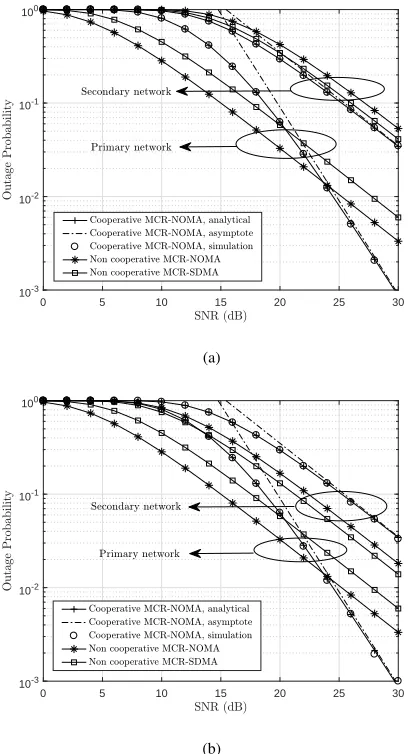
Fig. 2. Outage probability versus SNR with the round robin user scheduling strategy,Rp= 1bits/Hz,Rs= 1.5bits/Hz. (a)N= 6; (b)N= 2.
scheme, we provide numerical examples and evaluate the an-alytical results. Without loss of generality, we assume that the BS locates at the origin (0,0), the PU locates at (0,10), and all the SUs are randomly distributed inside a circle centered at (0,5) and with radius of 3. The path loss exponent is set toη= 2.7. Unless mentioned otherwise, the power allocation coefficients for the cooperative MCR-NOMA scheme are set as α2
p = 0.8 and α2s = 0.2, respectively, and the Gaussian-Chebyshev parameter is chosen asL= 10.
For illustration purpose, the performance of the non coop-erative MCR-NOMA/SDMA schemes is also plotted. Specif-ically, the non cooperative MCR-NOMA/SDMA schemes can be revised as follows. For the non cooperative MCR-NOMA scheme, the BS serves the PU and multicast SUs simultaneously via direct NOMA transmissions. While for the non cooperative MCR-SDMA scheme, orthogonal time or frequency resources are allocated to the PU and multicast SUs, so as to create parallel spatial pipes for the primary and secondary transmissions.
In Fig. 2, the outage performance of the cooperative MCR-NOMA achieved by the round robin user scheduling is
il-lustrated. It can be observed from Fig. 2(a) that the derived analytical results match perfectly the simulations, and the asymptotic curves always converge to the analytical one fast in the high SNR regions. As a benchmark, the performance of the non cooperative MCR-NOMA and non cooperative MCR-SDMA schemes is also presented. Several observations can be drawn as follows: 1) For the primary network, the proposed cooperative MCR-NOMA achieved by the round robin scheduling strategy gives better outage performance than its non cooperative MCR-SDMA when the SNR is larger than
20 dB, e.g., a tradeoff exists between the two schemes, and the outage probability gap becomes even larger when SNR increases. This phenomenon can be explained by using the simple fact that, full transmit power P is applied for the transmission of signalxpby the non cooperative MCR-SDMA, while only a fraction of P (e.g., α2
p = 0.8) for signal xp is applied by the cooperative MCR-NOMA, therefore yielding larger received SNR in the low to medium SNR regions. On the other hand, in the absence of CSI acquisition/exchange, the round robin scheduling can still ensure a diversity order of two at the primary network, higher than its non cooperative counterpart (e.g., a diversity order of one). Therefore, lower outage probability can be achieved by the cooperative MCR-NOMA at high SNRs due to the increased diversity gains. 2) The proposed cooperative MCR-NOMA outperforms the non cooperative MCR-NOMA when the SNR is larger than
24 dB, which can be understood by the fact that the 1/2
spectral efficiency loss caused by the two time-slot cooperation dominates the outage performance in the low to medium SNR regions. 3) The non cooperative MCR-NOMA always behaves superior outage performance than the non cooperative MCR-SDMA, since the use of NOMA allows the PU and SUs to be served simultaneously, without consuming additional time or frequency resource. As a result, the overall spectrum utilization can be significantly improved. Similar performance gains in terms of the outage probability can also be seen from Fig. 2(b). Then attention is shifted to the performance of the secondary network. As shown in Fig. 2(a), interestingly, note that when
N = 6 the outage performance achieved by a randomly scheduled SU obtains3dB SNR gain over the non cooperative MCR-NOMA, while the situation is opposite when N = 2, as is observed from Fig. 2(b). This is because a large value of N means that the probability that not all the SUs can be eventually successful is larger. However, when N is small, e.g.,N = 2, the randomly scheduled SU is more likely to be the worst-case SU which is in outage, thus leading to further outage events for the cooperative transmission. Moreover, similar outage performance for the comparison between the cooperative MCR-NOMA and non cooperative MCR-SDMA can also be observed from Fig. 2(b). Due to the fact that for the non cooperative MCR-SDMA, when more SUs participate in the communication, the probability of the existence of the worst-case SU becomes larger, which increases the outage probability for the secondary multicasting. In addition, the slope of the outage curves are the same for the cooperative and non cooperative MCR-NOMA/SDMA schemes, which confirms Lemma 1.
0 5 10 15 20 25 30 10-4
[image:11.612.332.534.65.225.2]10-3 10-2 10-1 100
Fig. 3. Outage probability achieved by the proposed strategy with partial CSI,
Rp= 1bits/Hz,Rs= 1.5bits/Hz,N= 3.
1 2 3 4 5 6 7 8
Number of SUs 10-8
10-6
10-4 10-2
100
O
u
ta
g
e
P
ro
b
a
b
il
it
y
Proposed strategy for primary network Proposed strategy for secondary network Non cooperative strategy for primary network Non cooperative strategy for secondary network
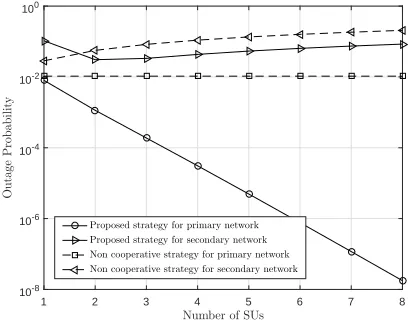
Fig. 4. Outage probability versus number of SUsNwith partial CSI,Rp= 1 bits/Hz,Rs= 1.5bits/Hz,ρ= 25dB.
strategy using partial CSI on the outage performance. In Fig. 3, we first look at the case for the primary network. As illustrated from the figure, the slope of the outage curve is much steeper than that achieved by the round robin scheduling, because a higher diversity order (e.g., full diversity order) is achieved by the proposed strategy, as indicated by Lemma 2. Notably, in the medium to high SNR regions (e.g., 16–
30 dB), the proposed strategy achieves a sufficient lower outage probability compared with the non cooperative MCR-NOMA/SDMA. On the other hand, as a convenient by-product of the NOMA signaling at the scheduled SU, a diversity order of two can be achieved at the secondary network, as shown in Fig. 3. Furthermore, in contrast to the phenomenon in Fig. 2, the outage performance of the secondary network achieved by the proposed strategy always outperforms the non cooperative MCR-NOMA when SNR is larger than20 dB.
Fig. 4 shows the outage probability as a function of N for different MCR-NOMA schemes. One important observation is that the outage probability for the primary network reduces significantly with an increase in the number of SUs, e.g., the value of N, due to its monotonically decreasing property in
0 5 10 15 20 25 30
[image:11.612.67.271.66.225.2]10-4 10-3 10-2 10-1 100
Fig. 5. Outage probability achieved by the proposed strategy with full CSI,
Rp= 1bits/Hz,Rs= 1.5bits/Hz,N= 3.
N. It is also worth noting that the outage performance for the secondary network meliorates whenN varies from1to2, because of the enhanced diversity order. However, it becomes worse with further increase inN, a similar phenomenon can be observed from the non cooperative scheme for the secondary network. This can be explained using the simple fact that with a large number of SUs, the diversity order remains the same but the probability that not all the SUs are eventually decodable becomes larger. Therefore, there exists a tradeoff of the reception reliability between the primary and secondary networks under the partial CSI scenario, e.g., increasing the number of SUs is beneficial to the primary network but not to the secondary network.
In what follows, we investigate the performance achieved by the proposed strategy under full CSI scenario. Fig. 5 plots the outage probability versus SNR for the primary and secondary networks. One can observe that the proposed strategy under full CSI maximizes the spatial diversity gain for both networks, e.g., the achievable diversity orders for the primary and secondary networks are proportional toN+1and
N, respectively. Such an observation confirms the analytical results developed in Lemma 3. Another interesting observation is that the intersection between the cooperative and non cooperative strategies for the secondary network moves left, e.g., yielding nearly3dB SNR gain compared with the strategy under partial CSI. By further increasing N, such SNR gain becomes more evident, which can be validated by Lemma 3.
[image:11.612.67.271.283.443.2]1 2 3 4 5 6 7 8 Number of SUs
10-8 10-6 10-4 10-2 100
O
u
ta
g
e
P
ro
b
a
b
il
it
y
[image:12.612.332.532.65.229.2]Proposed strategy for primary network Proposed strategy for secondary network Non cooperative strategy for primary network Non cooperative strategy for secondary network
Fig. 6. Outage probability versus number of SUsN with full CSI,Rp= 1 bits/Hz,Rs= 1.5bits/Hz,ρ= 25dB.
5 10 15 20 25 30 35
SNR (dB) 10-4
10-3
10-2 10-1
100
M
u
tu
al
O
u
ta
ge
P
ro
b
ab
il
it
y
Round robin scheduling strategy (without CSI) Proposed strategy with partial CSI Proposed strategy with full CSI Solid lines:N= 3 Dashed lines:N= 6
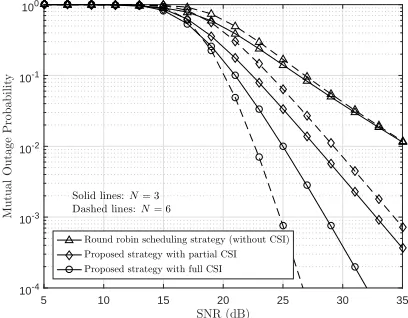
Fig. 7. Mutual outage probability achieved by different secondary user scheduling strategies,Rp= 1bits/Hz,Rs= 1.5bits/Hz.
CR networks.
Recall that the mutual outage probability is a good metric to judge the reliability of the PU-SU transmissions and evaluate whether the PU-SU collaboration can achieve a win-win situ-ation or not. In Fig. 7, the mutual outage probability achieved by different user scheduling strategies is presented. It is clear from the figure that the mutual outage probability decreases as a function of SNR, which guarantees an acceptable level of outage for both networks. Furthermore, among the three strategies, the proposed strategy under full CSI achieves the lowest outage probability, since it ensures the maximal diver-sity gain offered by the PU-SU cooperation. From the figure, it also demonstrates that different from other two strategies, the performance of the proposed strategy under full CSI can be further improved with an increase inN, and thus it is the outage-optimal strategy for the considered cooperative MCR-NOMA as mentioned in Corollary 2.
Finally, in order to explicitly characterize the cooperation benefits of the proposed cooperative MCR-NOMA scheme, based on the analytical results in Theorems 1–3, we define the cooperation benefit percentage as the percentage reduction
d−η b,p
0.1 0.2 0.3 0.4 0.5
C
o
o
p
er
a
ti
o
n
B
en
e
fi
t
P
er
ce
n
ta
g
e
0 0.4 0.8 1.2 1.6 2
Round robin scheduling strategy Proposed strategy with partial CSI Proposed strategy with full CSI
1.4764 1.8003
1.4729 1.7969
1.4716 1.7956
1.4709 1.7950
[image:12.612.67.271.66.226.2]1.4704 1.7945
Fig. 8. Cooperation benefit percentageΛas a function ofd−b,pηachieved by different secondary user scheduling strategies,ρ= 25dB,N= 3.
for the overall network. That is
Λ =
(
Pnon,p− Pp
Pnon,p
+Pnon,s− Ps
Pnon,s
)
(45)
wherePnon,p andPnon,s are the outage probabilities of non cooperative direct transmission for the primary and secondary networks. This metric is presented by Fig. 8, without loss of generality and for the illustration purpose, independent and identically distributed fading channel is assumed. It is worth noting that the cooperation-based results outperform the non cooperative MCR-NOMA scheme, especially preferred by the primary network whenhb,p is relatively weak (d−
η
b,p is small) and the QoS requirement of the PU may not be satisfied by the primary network itself. On the other hand, there always exists a minimum benefit gain by the three secondary user scheduling strategies, and as expected, more available CSI assisted secondary user scheduling could produce a more considerable cooperation benefit percentage.
V. CONCLUSION
[image:12.612.67.271.283.442.2]