The Technology Integration Model (TIM). Predicting the Continued
Abbreviations: TIM – Technology Integration Model, TAM – Technology Acceptance Model.
Abstract
The human-computer relationship is often convoluted, and despite decades of progress, many relationships relating to continued use are unclear and poorly defined. This may be due to a lack of interdisciplinary collaboration, especially from a theoretical standpoint between computer science and psychology. Following a review of existing theories that attempt to explain continued technology use, we developed the Technology Integration Model (TIM). In sum, the main objective of TIM is to outline the processes behind continued technology use in an individual’s everyday life. Here we present the model alongside a description of its scope and the relationships between constructs. This can help generate research questions relating to technology use while simultaneously addressing many previous shortcomings of existing models. As a unifying theory, TIM can quickly be adopted by researchers and developers when designing and implementing new technologies.
Disclosures
Funding: This research did not receive any specific grant from funding agencies in the public, commercial, or not-for-profit sectors.
Author Contributions: All authors contributed to developing the theory and writing the manuscript. All authors have read and approved the final manuscript.
Conflict of interest: None of the authors have any financial, personal or organisational conflicts of interest.
1. Introduction
1.1. Developing a new theory of technology use.
It has become increasingly important to understand the relationship people have with technology. Many positive effects have arisen from technology use such as social inclusion, increased access to information, assistance with every-day tasks, and healthcare applications (Andrade & Doolin, 2016; Khosravi, Rezvani, & Wiewiora, 2016; Kirkpatrick, 2016; Piwek, Ellis, Andrews, & Joinson; 2016). In contrast, negative side effects such as technology addiction, perceived privacy breaches, reduced physical activity, online shaming and
unsatisfactory work-life balance remain widespread (Akdemir, Vural, Çolakoğlu, & Birinci, 2015; Bergström, 2015; Clayton, Leshner, & Almond, 2015; Jeong, Kim, Yum, & Hwang, 2016; Klonick, 2016; Mamonov & Benbunan-Fich, 2014; Osiceanu, 2015; Schoneck, 2015; Steijn & Vedder, 2015). At the same time, technology rapidly develops and adapts, with current trends suggesting a dramatic increase in the number of everyday objects that connect to the internet (e.g. the internet of things) (Bergman, 2015). Yet, despite significant and measurable impacts, the relationship between people and technology remains poorly defined from a theoretical standpoint. This hinders the development of new technologies and prevents a fuller understanding of their impact.
Theoretical and empirical work often struggles to keep up with the speed of technological development, however the research remains essential when attempting to predict subsequent successes and failures. Continued use may indicate the potential life cycle of a developed technology and it is possible that by measuring technology use, we can explore applications that benefit many stakeholders including end-users, developers and retailers of technology. For example, those who develop and sell technologies will need to obtain customer
satisfaction through adequate and beneficial use if they wish to obtain a large and loyal consumer base. Furthermore, encouraging the use of quality of life technologies, such as health monitoring devices, can increase the positive impact of the intervention. The exploration of continued use may increase our understanding of technology use habits, a variable which can both prevent and encourage behavioral change. Technology is often developed to improve lifestyles but whether these benefits are realised depends on the way in which they are used.
1.2. Existing Theories
usefulness, perceived ease of use, external variables, attitude and behavioral intention as precursors of technology adoption and use (Davis, Bagozzie, & Warshaw, 1989). However, the variables which predict technology adoption have been shown to differ from the variables which predict continued technology use (Limayem, Cheung & Chan, 2003). For example, a person’s attitude towards a technology before adoption is often influenced by perceptions of usefulness, ease of use, result demonstrability, visibility and trialability, whereas attitudes after adoption are influenced by instrumental beliefs of usefulness and perceptions of image enhancements (Karahanna, Straub & Chervany, 1999). As such it appears that continued technology use is not just a continuation of technology adoption, but a phenomenon within itself. This raises additional questions regarding the suitability of TAM and successive extensions when measuring continued use.
After citing the original TAM model, many researchers simply extend it by including additional variables of their own choosing, which they perceive to have particular relevance to the technology being assessed. (Jafarpour, 2016; Ooi & Tan, 2016; Ramos-de-Luna, et al., 2016; Tsai, Chang & Ho, 2016; Wang & Sun, 2016; Yoon, 2016). This can make subsequent generalization difficult and a 2007 meta-analysis generated a list of 78 external variables that had been added to TAM with the aim to predict perceived ease of use and perceived
usefulness across various contexts (Yousafzai et al., 2007a). Examples of these included ‘Screen Design’, ‘Management Support’, ‘Organizational Policies’, ‘Cognitive Absorption’, and ‘Cultural Affinity’ (Yousafzai et al., 2007a). There is no coherent trend regarding which
future technologies. In turn, this will also become a platform for researchers to re-test the same concepts and improve our understanding of continued technology use.
1.3. Theoretical Unification
2. Review of Existing Literature
2.1. Key Predictor Variables
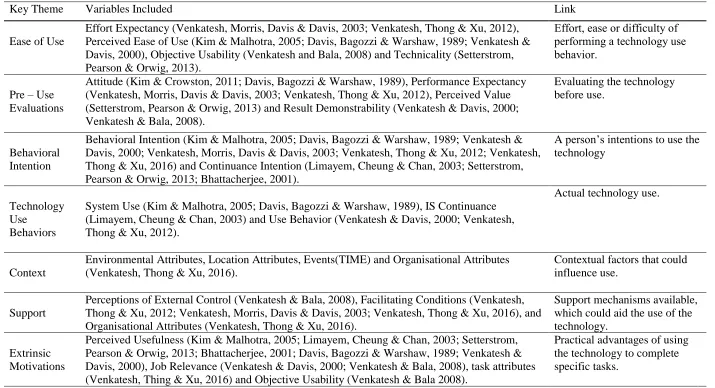
To identify key themes, 11 models of continued technology use were reviewed (Table 1). We did not include models that only predicted technology adoption, as the aim was to understand continued use beyond initial adoption. Numerous variables have been proposed to influence continued use such as satisfaction, habits and affective reaction (Bhattacherjee, 2001;
Table 1: Identification of key technology use variables by combining synonymous variables across models.
Key Theme Variables Included Link
Ease of Use
Effort Expectancy (Venkatesh, Morris, Davis & Davis, 2003; Venkatesh, Thong & Xu, 2012), Perceived Ease of Use (Kim & Malhotra, 2005; Davis, Bagozzi & Warshaw, 1989; Venkatesh & Davis, 2000), Objective Usability (Venkatesh and Bala, 2008) and Technicality (Setterstrom, Pearson & Orwig, 2013).
Effort, ease or difficulty of performing a technology use behavior.
Pre – Use Evaluations
Attitude (Kim & Crowston, 2011; Davis, Bagozzi & Warshaw, 1989), Performance Expectancy (Venkatesh, Morris, Davis & Davis, 2003; Venkatesh, Thong & Xu, 2012), Perceived Value (Setterstrom, Pearson & Orwig, 2013) and Result Demonstrability (Venkatesh & Davis, 2000; Venkatesh & Bala, 2008).
Evaluating the technology before use.
Behavioral Intention
Behavioral Intention (Kim & Malhotra, 2005; Davis, Bagozzi & Warshaw, 1989; Venkatesh & Davis, 2000; Venkatesh, Morris, Davis & Davis, 2003; Venkatesh, Thong & Xu, 2012; Venkatesh, Thong & Xu, 2016) and Continuance Intention (Limayem, Cheung & Chan, 2003; Setterstrom, Pearson & Orwig, 2013; Bhattacherjee, 2001).
A person’s intentions to use the technology
Technology Use
Behaviors
System Use (Kim & Malhotra, 2005; Davis, Bagozzi & Warshaw, 1989), IS Continuance (Limayem, Cheung & Chan, 2003) and Use Behavior (Venkatesh & Davis, 2000; Venkatesh, Thong & Xu, 2012).
Actual technology use.
Context
Environmental Attributes, Location Attributes, Events(TIME) and Organisational Attributes (Venkatesh, Thong & Xu, 2016).
Contextual factors that could influence use.
Support
Perceptions of External Control (Venkatesh & Bala, 2008), Facilitating Conditions (Venkatesh, Thong & Xu, 2012; Venkatesh, Morris, Davis & Davis, 2003; Venkatesh, Thong & Xu, 2016), and Organisational Attributes (Venkatesh, Thong & Xu, 2016).
Support mechanisms available, which could aid the use of the technology.
Extrinsic Motivations
Perceived Usefulness (Kim & Malhotra, 2005; Limayem, Cheung & Chan, 2003; Setterstrom, Pearson & Orwig, 2013; Bhattacherjee, 2001; Davis, Bagozzi & Warshaw, 1989; Venkatesh & Davis, 2000), Job Relevance (Venkatesh & Davis, 2000; Venkatesh & Bala, 2008), task attributes (Venkatesh, Thing & Xu, 2016) and Objective Usability (Venkatesh & Bala 2008).
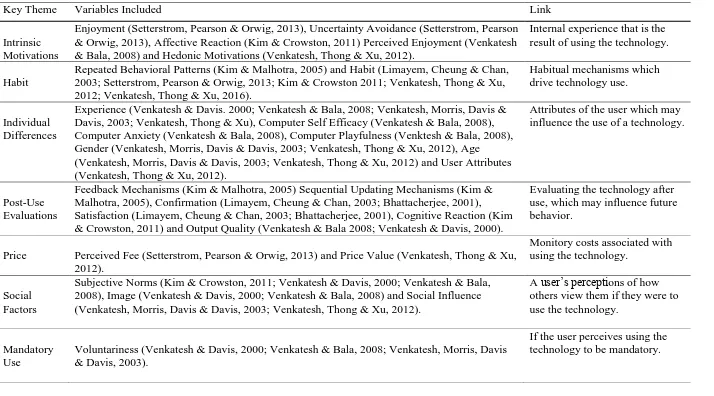
Table 1 Continued: Identification of key technology use variables by combining synonymous variables across models.
Key Theme Variables Included Link
Intrinsic Motivations
Enjoyment (Setterstrom, Pearson & Orwig, 2013), Uncertainty Avoidance (Setterstrom, Pearson & Orwig, 2013), Affective Reaction (Kim & Crowston, 2011) Perceived Enjoyment (Venkatesh & Bala, 2008) and Hedonic Motivations (Venkatesh, Thong & Xu, 2012).
Internal experience that is the result of using the technology.
Habit
Repeated Behavioral Patterns (Kim & Malhotra, 2005) and Habit (Limayem, Cheung & Chan, 2003; Setterstrom, Pearson & Orwig, 2013; Kim & Crowston 2011; Venkatesh, Thong & Xu, 2012; Venkatesh, Thong & Xu, 2016).
Habitual mechanisms which drive technology use.
Individual Differences
Experience (Venkatesh & Davis. 2000; Venkatesh & Bala, 2008; Venkatesh, Morris, Davis & Davis, 2003; Venkatesh, Thong & Xu), Computer Self Efficacy (Venkatesh & Bala, 2008), Computer Anxiety (Venkatesh & Bala, 2008), Computer Playfulness (Venktesh & Bala, 2008), Gender (Venkatesh, Morris, Davis & Davis, 2003; Venkatesh, Thong & Xu, 2012), Age (Venkatesh, Morris, Davis & Davis, 2003; Venkatesh, Thong & Xu, 2012) and User Attributes (Venkatesh, Thong & Xu, 2012).
Attributes of the user which may influence the use of a technology.
Post-Use Evaluations
Feedback Mechanisms (Kim & Malhotra, 2005) Sequential Updating Mechanisms (Kim & Malhotra, 2005), Confirmation (Limayem, Cheung & Chan, 2003; Bhattacherjee, 2001), Satisfaction (Limayem, Cheung & Chan, 2003; Bhattacherjee, 2001), Cognitive Reaction (Kim & Crowston, 2011) and Output Quality (Venkatesh & Bala 2008; Venkatesh & Davis, 2000).
Evaluating the technology after use, which may influence future behavior.
Price Perceived Fee (Setterstrom, Pearson & Orwig, 2013) and Price Value (Venkatesh, Thong & Xu, 2012).
Monitory costs associated with using the technology.
Social Factors
Subjective Norms (Kim & Crowston, 2011; Venkatesh & Davis, 2000; Venkatesh & Bala, 2008), Image (Venkatesh & Davis, 2000; Venkatesh & Bala, 2008) and Social Influence (Venkatesh, Morris, Davis & Davis, 2003; Venkatesh, Thong & Xu, 2012).
A user’s perceptions of how others view them if they were to use the technology.
Mandatory Use
Voluntariness (Venkatesh & Davis, 2000; Venkatesh & Bala, 2008; Venkatesh, Morris, Davis & Davis, 2003).
2.2. Additional Variable: Self-Extension
What remains absent in existing theories is an explanation of the core human-technology relationship. Without this, there is a large conceptual gap because scholars have ignored how technology and humans interact in a rudimentary manner. This is important to define as it can lay the foundations to explain more complex and abstract technology use behaviors.
Specifically, self-extension has repeatedly been shown to be important when it comes to explaining the psychological impact relating to the ownership of traditional goods and digital services (Sheth & Solomon, 2014).
likely to use their smartphone in everyday situations to retrieve information (Barr, Pennycook, Stolz, & Fugelsang, 2015).
3. Theoretical Construction
3.1. Scope
Unification models can easily become a “jack of all trades” in an attempt to explain all factors that lead to the phenomenon under investigation (Venkatesh, Thong & Xu, 2012). However, insights are often diluted across many variables which can negatively impact understanding of the described phenomenon (Venkatesh, Thong & Xu, 2016). Thus, the focus of this new theory is to describe factors which influence an individual user when predicting technology use. Explaining the spread of technology in an organization or a specified society will not be considered in this model due to the expanse of variables which would need to be incorporated. This topic would require a separate sociological model. However, context here will concern a person’s immediate surroundings including their current location.
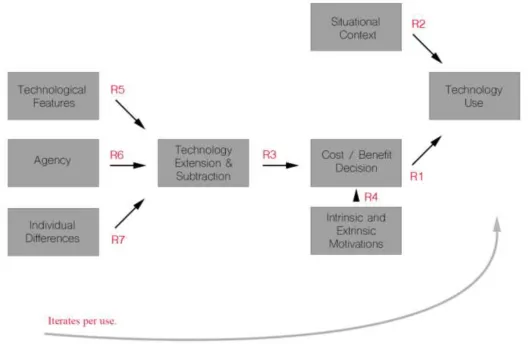
The new model (Figure 1) is entitled the Technology Integration Model (TIM) and the main objective of TIM is to outline the processes behind continued technology use in an
individual’s everyday life. TIM examines how technology integrates with its user over time via the model iterating repeatedly until the technology is abandoned or replaced. The
3.2. The Technology Integration Model (TIM)
The previous literature review and the exploration of a new variable, extended-self (Belk, 1998), has inspired the creation of The Technology Integration Model. TIM proposes that they are two direct predictors of technology use, which are, a cost-benefit decision (R1) and situation context (R2). This is because when the decision to use a technology becomes less conscious, use is prompted by contextual cues (Stawarz, Cox & Blandford, 2015). Over time it is proposed that the more a technology becomes habitual through repeated use, situational context will become more predictive and the cost/benefit decision will become less predictive of technology use. This allows us to understand how technology use can become habitual. Collectively, habit and perceived value which are two variables related to situational context and the cost-benefit decision, have previously been shown to explain 71% of the variance in continued use of a web-enabled wireless technology (Setterstrom, Pearson & Orwig, 2013). Therefore, there is already strong empirical evidence to suggest that the combination of cost/benefit decision making, and technology use in response to habitual cues such as situational context will be able to explain a large proportion of technology use variance.
currently described as connections as research is needed to determine whether they are moderating or mediating relationships. The development and precise definition of the variables in TIM are outlined in the following section.
3.3. Variable Development
By focusing on technology use separate from adoption, it is possible to isolate variables that predict subsequent usage. This facilitates the creation of a more parsimonious model, when compared to previous theories that attempt to combine both, such as the Unified theory of Technology Adoption and Use (UTAUT), the UTAUT2 and the Multi-Level Framework of Technology Acceptance and Use (Venkatesh, Morris, Davis & Davis, 2003; Venkatesh, Thong & Xu, 2012; Venkatesh, Thong & Xu, 2016). The variables defined in TIM have been chosen from the key themes review (Table 1) and adapted due to their relevance when
considering the scope of the model (section 3.1.). The following section will outline the development of the constructs included in the new model.
3.3.1 Technological Features
Existing technology use models rarely focus on features that a technology contains. Only the Multi-level Framework of Technology Acceptance and Use, deemed this important
(Venkatesh, Thong & Xu, 2016). Their variable, Technology Attributes, emphasises how the overall functions, characteristics and features of a technology plays a role in continued
technology use. (Venkatesh, Thong & Xu, 2016). TAM vaguely describes how the features of a technology influence technology adoption and use by stating that a technology’s perceived ease of use predicts the behavioral intention to use the technology (Davis, Bagozzi &
features, which could be included in the design of technology. For example, one study asked information system researchers their opinion on TAM, with one participant stating that “TAM’s simplicity makes it difficult to put into practice … imagine talking to a manager and saying that to be adopted, technology must be useful and easy to use” (Lee, Kozar & Larsen, 2003, p. 766). Therefore, the formation of the variable Technological features aims to
provide descriptive knowledge which can be used to guide the design and implementation of technology. Arguably a theory of human-computer interaction must incorporate both human and technological feature variables that may influence the use of technology.
Technology Features are therefore defined here as a technology’s hardware, and software properties. Technologies have a large array of features, for example: input modality, visual display, device connectivity, sensors, sharing features, device interactivity with the
environment, storage, ergonomics, build material and engineered physical movement etc. The features a technology may possess will change as technology advances, and therefore, this construct is required to have a wide scope to ensure it stays relevant for future technology. This differs slightly from the definition of Technology Attributes (Venkatesh, Thong & Xu, 2016) as the functions of a technology are described in a separate variable, technology extension and subtraction.
3.3.2. Agency
Venkatesh, Morris, Davis & Davis, 2003; Kim & Malhotra, 2005; Venkatesh. Thong & Xu, 2012; Setterstrom, Pearson & Orwig, 2013). Whilst referring to the effort, ease or difficulty of performing a technology use behavior, it is possible that core to all these variables is the idea of agency over the technology we use, as issues with usability leave the user with a lack of control over the technology. A recent review confirmed that a feeling of agency is
fundamental when encouraging human-computer interaction. Limerick, Coyle, & Moore (2014) discusses concepts such as intentional binding, gulf of execution, system reliability, system feedback, latency, task automation and embodiment which can affect the feelings of agency. These concepts are reminiscent of the criterion proposed for a technology to extend a person’s mind which include: trust, accessibility, reliability and availability of the technology (Clark & Chalmers, 1998). As this theory focuses on human-computer interaction as a new direction when comprehending technology use, it is deemed important to include agency in the model, as it may explain previous findings concerning why ease of use predicts system use and technology usage intentions (Yousafzai, Foxall & Pallister, 2007b). Finally, significant to the extension of self-theory is a sense of agency over the technology we use (Belk, 1988, 2013). This idea was first proposed by McClelland (1951) who stated that the more control you exert over an object or technology, the more incorporated an object becomes part of a person’s self-identity.
3.3.3. Individual Differences
Individual differences can include personality traits, demographics and other variables that can be used to describe the end user. Other examples might include a person’s time
Shneiderman & Plaisant (2004) discuss how “all design should begin with an understanding of the intended users, including population profiles” (p. 67). Furthermore, people learn, think, and solve problems through varying methods and will prefer certain types of technology over others (Shneiderman & Plaisant, 2004). Consequently, understanding a user by analysing their individual differences is pivotal. Individual differences have appeared in a variety of forms throughout existing models through the variables: experience, computer self-efficacy, computer anxiety, computer playfulness, gender and age (Venkatesh & Davis, 2000;
Venkatesh, Morris, Davis & Davis, 2003; Venkatesh & Bala 2008; Venkatesh, Thong & Xu, 2012)
The most recent model reviewed, ‘A Multi-level Framework of Technology Acceptance and Use’, merged the moderating effects of age, gender and experience into a singular variable called ‘User Attributes’. This was the result of researchers extending the Unified Theory of Acceptance and Use of Technology to encompass more demographics (Venkatesh, Thong & Xu, 2016). As a result, the model was more flexible and included other demographical variables such as occupation and user type (e.g. employee, consumers and citizens) Whilst the construct individual differences may be considered broad in nature, it is possible to repeatedly test the hypothesis that individual differences influence technology use (or in TIM technological extension and subtraction), regardless of the individual difference under
investigation. As a result, researchers are not required to expand the constructs in the model due to a lack of comprehensiveness. The advantage of exploring a wide range of individual differences is that it becomes possible to discover which are the most important and
3.3.4. Technology Extension and Subtraction
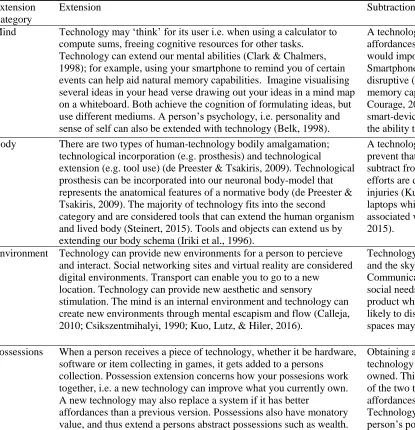
The current model adopts a modified extended self-theory to explain the human-computer relationship. It does this by describing the acts and functions that a technology enables us to do. Technology has been said to extend a person (Steinhart, 2015; Belk, 1988, 2013; Clark & Chalmers, 1998). An affordance “refers to the physical requirements for an action” (Adolph, 1995, p. 734 ). Technology executes actions by having affordances or features that extend a person’s capabilities, possessions and environment. This can allow a person to achieve something which wasn’t previously possible without the technological intervention, or can improve previous methods. When designing, or evaluating a technology we should consider four broad categories of extension (see Table 2). It is proposed that technology extends and adds affordances to our mind, body, environment and possessions.
However, it is also important to consider when technology can impede or become a negative influence. Belk (1998) considers how a loss of possessions can have a negative impact on a person’s sense of self. Dependant on the unique features of a technology, a feature might block successful technological extension, or even remove affordances from the user. In extreme cases, some features make the benefits of using a technology obsolete and
Table 2: Descriptions and examples of how technology can extend and subtract from a person’s mind, body, environment and possessions. Extension
Category
Extension Subtraction
Mind Technology may ‘think’ for its user i.e. when using a calculator to compute sums, freeing cognitive resources for other tasks. Technology can extend our mental abilities (Clark & Chalmers, 1998); for example, using your smartphone to remind you of certain events can help aid natural memory capabilities. Imagine visualising several ideas in your head verse drawing out your ideas in a mind map on a whiteboard. Both achieve the cognition of formulating ideas, but use different mediums. A person’s psychology, i.e. personality and sense of self can also be extended with technology (Belk, 1998).
A technology will not extend its user if it is too difficult to utilise its affordances. Problem solving due to a technology being difficult to use would impose a heavy cognitive load on the user (Sweller, 1988). Smartphone notifications have been shown to interrupt a task and be disruptive (Bowman, Waite, & Levine, 2015) and peoples’ working memory capacities, are related to their ability to multitask (Pollard & Courage, 2017). It has also been argued that offloading thinking onto smart-devices causes a new type of cognitive laziness and users may lose the ability to think for themselves (Barr et al., 2015).
Body There are two types of human-technology bodily amalgamation; technological incorporation (e.g. prosthesis) and technological extension (e.g. tool use) (de Preester & Tsakiris, 2009). Technological prosthesis can be incorporated into our neuronal body-model that represents the anatomical features of a normative body (de Preester & Tsakiris, 2009). The majority of technology fits into the second category and are considered tools that can extend the human organism and lived body (Steinert, 2015). Tools and objects can extend us by extending our body schema (Iriki et al., 1996).
A technology that is too physically demanding or difficult to use will prevent that technology from extending the person and may even subtract from their physical abilities when performing other tasks if all efforts are directed to using the technology. Power tools can cause limb injuries (Ku, Radwin, & Karsh, 2007) and smartphones, tablets and laptops which encourage unnatural upper body movements have been associated with an increase in repetitive strain injury (Christopherson, 2015).
Environment Technology can provide new environments for a person to percieve and interact. Social networking sites and virtual reality are considered digital environments. Transport can enable you to go to a new location. Technology can provide new aesthetic and sensory
stimulation. The mind is an internal environment and technology can create new environments through mental escapism and flow (Calleja, 2010; Csikszentmihalyi, 1990; Kuo, Lutz, & Hiler, 2016).
Technology can damage and reduce the environment by polluting the air and the sky (Colvile, et al. 2001; Falchi, et al. 2011; Sohaili, 2010). Communication in an instant messaging environment satisfies basic social needs less than face to face interactions (Sacco & Ismail, 2014). A product which is un-attractive to the visual, haptic and olfactory senses is likely to discourage use. Different types of environment such as private spaces may be reduced due to advances in technology.
Possessions When a person receives a piece of technology, whether it be hardware, software or item collecting in games, it gets added to a persons collection. Possession extension concerns how your possesions work together, i.e. a new technology can improve what you currently own. A new technology may also replace a system if it has better
affordances than a previous version. Possessions also have monatory value, and thus extend a persons abstract possessions such as wealth.
Obtaining a technology often subtracts from a person’s wealth. New technology can also be incompatible with the technology that is already owned. This can lead to a subtraction in affordances if the combination of the two technologies prevents either one from executing its
3.3.5. Intrinsic and Extrinsic Motivations
The current model argues that we use technology to satisfy both intrinsic and extrinsic motivations. Some motivations are short lived (e.g. complete a singular task), others are ongoing and require maintenance (e.g. the desire to be part of a social group). Thus, people will maintain several motivations simultaneously, but with different levels of saliency. Examples of using a technology for extrinsic purposes include using a technology to manage money, preserve the environment or to improve physical health. Therefore, extrinsic
motivations are goal oriented and instrumental (Wu & Lu, 2013). In contrast, intrinsic motivations are described as using a technology because of the desire to have a particular internal human experience, such as joy, pleasure, fear, satisfaction, excitement or pride (Lowry, Gaskin, Twyman, Hammer & Roberts, 2013). Perceived enjoyment has been shown to increase intentions to adopt an online payment system, and has also been shown to be a strong predictor of intended continual use of Habbo Hotel - a virtual, social world (Rouibah, Lowry, & Hwang, 2016; Mäntymäki & Salo, 2011). Accepting that intrinsic motivations play a role in technology adoption and use, the decision to use a technology does not always have to be rational, i.e. when using gambling machines to satisfy feelings of addiction (Gainsbury, King, Russell, Delfabbro, & Hing, 2017). When contemplating reasons for the low retention rates of wearable technologies, it has been proposed that “many wearables suffer from being a solution in search of a problem” and “don’t add functional value” (Piwek, Ellis, Andrews & Joinson, 2016, p. 2). As such, the designed purpose of a technology must therefore satisfy or be perceived to satisfy at least one of the users intrinsic or extrinsic motivations if a
These intrinsic and extrinsic motivations also include social factors such as subjective norms, image, and social influence which are common across technology use models (Venkatesh & Davis, 2000; Venkatesh, Morris, Davis & Davis, 2003; Venkatesh & Bala, 2008; Kim & Crowston, 2011; Venkatesh, Thong & Xu, 2012). They collectively refer to a user’s perceptions of how others view them if they were to use the technology. However, social factors do not have to be considered separately from a person’s motivations. Workman
(2014) describes in a literature review how humans have a need for experiencing relatedness, which is the need of belonging and being connected with others. The need to belong has been proposed to explain why people use social media such as Facebook (Nadkarni & Hofmann, 2012). Workman (2014) further describes that when technology satisfies this need, a
person’s intrinsic motivation to use that technology may increase and encourage them to use
this further. As a result, social factors appear to be an influential mechanism when
understanding the continued use of a technology, however, this does not require a separate construct from other types of human motivation.
3.3.6. Cost Benefit Decision
Existing technology use models posit that behavior is consciously driven from beliefs, attitudes, and other evaluative assessments such as ‘performance expectancy’ (Venkatesh, Morris, Davis & Davis, 2003). More recently, ‘value-based’ research models have been applied to technology use, whereby the variable, ‘perceived value’ examines the utility of
conceptually more of a direct precursor to technology use than ‘behavioral intention’.
Setterstrom, Pearson & Orwig (2013, p .1143) stated that “perceived value increases as either the benefits from product consumption increase or the costs associated with consumption decrease”. Therefore, perceived value has enhanced empirical falsifiability when compared to related constructs such as attitudes, as the formation and structure of attitudes are still being explored and debated in the literature (Hogg & Vaughen, 2008). Consequently, the most effective method of capturing a person’s opinion of the technology, prior to use, is through their assessment of costs and benefits, and the consequence of this decision is immediately observable through either use, or no use of the technology.
In TIM, the process of technology extension and subtraction is an interplay between how a technology adds and removes affordances from its user. However, whether it is perceived to cost or benefit the user will depend on whether this extension/subtraction is in line with a person’s motivations. A technology will be perceived to benefit its user if its features increase the ability for a person to satisfy their motivations. A technology will be perceived to cost the user if its features deduct from the ability to satisfy their motivations. As technologies will most likely have both additive and subtractive features, the user will weigh up whether the technology is worth using. Overall the outcome of this decision-making process is binary (worth or not worth using in that instant), and if positive will prompt use.
3.3.7. Situational Context
queues have been shown to have a direct positive effect on intention to use a mobile ticketing app (Mallat, Rossi, Tuuanainen & Öörni, 2009). Time of day is also related to a user’s
frequency of smartphone use (Andrews, Ellis, Shaw, Piwek, 2015). The term context
however, is ambiguous and can refer to a diverse range of meanings. Venkatesh, Thong & Xu (2016) describe 4 variables which could be considered contextual constructs. The first
‘Environmental attributes’ denotes the lights, temperature and the immediate physical
environment around a person when using technology. They also describe ‘Location
attributes’ such as culture, regional economy and organisational competition. Events (time) can be considered a contextual variable as it signifies the temporal setting. Finally,
‘Organization attributes’ can also belong to this context theme, as it includes climate, organizational culture, leadership and collective technology use (Venkatesh, Thong & Xu, 2016).
Due to the scope of the current theory, situational context is defined as the immediate environment surrounding the person directly prior to using a technology. This definition is similar to ‘Environmental Attributes’, and includes the objects, people and current events that are part of the user’s immediate surroundings. However, our adaption also incorporates the place and time as this can reflect a user’s routine and habit, an important predictor of
technology use (Stawarz, Cox & Blandford, 2015). Place reflects a user’s GPS location which can provide details as to where the technology is being used (E.g. the country, city, or
useful to describe when understanding how technology spreads (Rogers, 2003). Related concepts can be examined when measuring individual differences such as culture or
occupation. By defining and reducing context to what is described above, we can ensure that situational context has practical value in subsequent research.
3.3.8. Technology Use
It is common across models to include a variable that represents the use of a technology (Davis, Bagozzi & Warshaw 1989; Venkatesh & Davis, 2000; Limayem, Cheung & Chan, 2003; Kim & Malhotra, 2005; Venkatesh, Thong & Xu, 2012; Venkatesh, Thong & Xu, 2016). Very few designs have successfully measured objective usage (Turner et al., 2010; Andrews, Ellis, Shaw, Piwek, 2015). Instead, activity is predominately measured subjectively via self-reports methods as a substitute for actual logs of technology use (Shaikh &
Karjaluoto, 2015; Taylor & Todd, 1995; Turner, et al. 2010). Conversely, behavioral intention is a variable often included in models (Davis, Bagozzi & Warshaw 1989;
Bhattacherjee, 2001; Limayem, Cheung & Chan, 2003; Kim & Malhotra, 2005; Venkatesh, Thong & Xu, 2012; Venkatesh, Thong & Xu, 2016) because it has been “posited by many theorists as the closest cognitive antecedent to actual behavior” (Setterstrom, Pearson & Orwig , 2013, p. 1141), and avoids issues with developing applications that can measure technology use such as programming barriers, consent form “blindness” and privacy/security issues (Piwek, Ellis & Andrews, 2016). However, in a review of 73 publications, the
encourage this direction and to promote parsimony, it is unnecessary to include in a model a substitute variable alongside a construct which represents actual technology use. Thus, the general theme of Technology Use is deemed more appropriate for future models as it concerns itself with actual use.
The first and most straightforward technology use measure that could be explored relates to a person’s choice. Does a person choose to use a new system/technology or do they continue to use the systems and technology they already have? An additional measure involves collecting objective usage over time via the technology itself (Andrews, Ellis, Shaw, & Piwek, 2015). There is the assumption that increased use is indicative of greater levels of technological integration. However, it is proposed here that consistent patterns of use may be more
symptomatic of successful technological integration than a sum of overall use. For example, do you use your phone alarm to wake you up every morning? Thus, is a technology used again when aiming to satisfy the same motivations, or used repeatedly in the same contexts? This highlights that continued technology use needs to be measured longitudinally to
4. Discussion
4.1. Theoretical Contributions
TIM was developed to help predict technology use and impact, and to explain outstanding questions in the technology use literature. For example, multiple predictions can be generated regarding what contributes to long-term technology use. Based on the background that
underpins TIM, we would predict that a technology will be used long-term if it repeatedly satisfies a user’s intrinsic and extrinsic motivations and continually extends a person, as this
causes the user to consider the technology worth using across time. In addition, we can also effectively consider why people use technology in the first instance. Technology often extends the acts and functions of a person when trying to satisfy a user’s intrinsic and extrinsic motivations. Therefore, we have successfully created a framework which can increase our understanding of technology use.
technology use and the impact it has on the end user. This was achieved by capturing the core human-technology relationship through advancing extended-self ideas (Belk, 1988).
Theories of technology use often state that habit is an important influence of use (Limayem, Cheung & Chan, 2003; Setterstrom, Pearson & Orwig, 2013; Kim & Crowston 2011; Venkatesh, Thong & Xu, 2012; Venkatesh, Thong & Xu, 2016). TIM also extends existing theoretical knowledge here by illustrating how habitual use may form. As the model iterates with every use, we can measure the proposition that situational context will become more predictive and the cost/benefit decision will become less predictive of technology use over time. The more a technology is used in response to situational cues, rather than conscious decision making, the more habitual a technology has become (Stawarz, Cox & Blandford, 2015).
4.2. Applied Impact
Understanding and predicting continued technology use requires interdisciplinary collaboration (Schulz et al. 2012). TIM encourages interdisciplinary research because designing effective features of technology requires expertise from engineering, creative arts, cognitive and computer scientists. Equally, understanding individual differences, motivations and decision making requires expertise from medicine, psychology and the social sciences more broadly. Measuring situational context may benefit from geographical science knowledge, and many other disciplines could provide novel ways to examine the
Through describing how the model iterates, TIM encourages longitudinal research through the long-term tracking of each variable, which is arguably fundamental in the study of continued technology use. A collaboration between social and computer scientists could promote the method of documenting objective logs of the technology being examined (Andrews, Ellis, Shaw, Piwek, 2015). Researchers could also further utilise methods derived from ecological momentary and ambulatory assessment to examine other variables such as context, individual differences and motivations. These methods study individuals in their natural setting, in real time by using smartphones and wearable technology to sample a person’s current mood, heart-rate, location and other streams of data via several snapshots over time (Connor & Mehl, 2015). By looping the model iteratively, factors which lead to technological abandonment or long-term integration can be repeatedly measured using this methodology. For example, are the features of a technology the same, worse or improved? Is the technology still extending the person or has a person’s motivation changed? Finally, is the user still residing in contexts that allows them to use the technology? All these points may predict why a technology stops being used. In practice, it is assumed that the same tools and measures of Individual differences, Situational Context, Technological Features, Technology Extension and Subtraction, Intrinsic and Extrinsic Motivations, Agency, Cost/Benefit
Decision and Technology Use will be used repeatedly after a pre-defined length of time has passed since the last iteration. Therefore, TIM can be used to underpin longitudinal research.
user. Technology should be designed with the users’ motivations in mind, whilst aiming to maximise the compatibility between technological features and the user. It may be possible for a consumer to pick a technology that is most suited to them. For example, when choosing a smartphone, it is possible that a person’s individual differences will predict whether they should ideally purchase a smartphone with specific features (Shaw, et al. 2016). TIM moves the focus onto how technology can benefits consumers, and as a result technology developers and companies are assisted when creating technology that positively impacts the end user. A technology that is used long-term will offer greater value for money, and allow the consumer to master that particular technology, increasing feelings of agency. Future use may, in turn, indicate increased levels of satisfaction with a purchased technology (Bhattacherjee, 2001). As TIM explains technology integration beyond adoption and predicts future use, developers can use these predictions to produce satisfying and beneficial products for the user.
TIM describes how a technology might become a part of someone’s everyday life, making it stand out from other theories created by researchers from an information systems or business management perspective (Venkatesh, Morris, Davis & Davis, 2003; Kim & Crowston, 2011; Davis, Bagozzi & Warshaw 1989; Bhattacherjee, 2001). However, its predictions can still be applied within occupational and educational settings. When implementing new systems in the workplace, consider employees perception of agency. If this is perceived to be low,
without the perception of a technology being worth using, it is likely that employees will use the technology to the minimum, rather than exploring a technology’s full potential.
4.3. Limitations
While the model is derived from recent empirical work, and took inspiration from existing theories, future research is now required to empirically document or critique the relationships that we have defined. This will involve key decisions regarding how each aspect can be best measured. TAM is often relied on due to is its validated inventory of psychometric
measurement scales (Yousafzai et al., 2007a). Moving forward, our model (TIM) will require its own standardised set of validated empirical methods and measures if it is to be effectively operationalised by other researchers.
focuses on an individual’s technology use. Thus, one of the contributions of TIM is a balance of explanatory value and parsimony.
Like the TAM, it is unlikely that all the relationships and concepts in TIM will be tested simultaneously (Yousafzai, Foxall, & Pallister, 2007a). However, TIM can be broken into sections. For example, a researcher can measure what predicts technology extension or subtraction, the cost-benefit decision or technology use, as the variables which predict each of these constructs are shown in Figure 1. It can also be critiqued that variables such as individual differences, intrinsic and extrinsic motivations and technological features in TIM are broad in nature. However, it remains important that the described concepts in TIM are general enough for a wide range of technologies so that researchers do not need to test specific hypothesis for each study. It is possible to test idea that individual differences and technological features predict technological extension or subtraction, irrespective of which individual difference or technological feature under investigation. Equally, one can test the hypothesis that motivation influences the decision-making process by using a combination of different motivations. These features ensure that TIM will remain relevant as new
technologies emerge.
4.4. Conclusions
TIM is a new model which predicts continued technology use and provides strong
explanatory value whist maintaining parsimony and practicality. Each loop in TIM represents one use and this iteration is necessary as human-technology integration may not occur
instantly, but develop over time. This can be measured by examining the individual
5. References:
Adolph, K. E. (1995). Psychophysical Assessment of Toddler’s Ability to Cope With Slopes. Journal of Experimental Psychology: Human Perception and Performance, 21(4), 734– 750.
Akdemir, Ö., Vural, Ö., Çolakoğlu, Ö., & Birinci, G. (2015). Diminishing the Undesirable Effects of the Computer Games with the Kinect Sensors. Turkish Online Journal of Qualitative Inquiry, 6(2), 149–173.
Andrade, A. D., & Doolin, B. (2016). Information and Communication Technology and the Social Inclusion of Refugees. Management Information Systems Quarterly, 40(2), 405– 416.
Andrews, S., Ellis, D. A., Shaw, H., & Piwek, L. (2015). Beyond Self-Report: Tools to Compare Estimated and Real-World Smartphone Use. Plos One, 10, e0139004.
https://doi.org/10.1371/journal.pone.0139004
Barr, N., Pennycook, G., Stolz, J. A., & Fugelsang, J. A. (2015). The brain in your pocket: Evidence that Smartphones are used to supplant thinking. Computers in Human Behavior, 48, 473–480. https://doi.org/10.1016/j.chb.2015.02.029
15(2), 139–168. https://doi.org/10.1086/209154
Belk, R. W. (2013). Extended Self in a Digital World. Journal of Consumer Research, 40(3), 477–500. https://doi.org/10.1086/671052
Bergman, M. (2015, July). Product and Technology Trends from the 2015 International CES. IEEE Consumer Electronics Magazine, 99-100.
Bergström, A. (2015). Online privacy concerns: A broad approach to understanding the concerns of different groups for different uses. Computers in Human Behavior, 53, 419– 426. https://doi.org/10.1016/j.chb.2015.07.025
Bhattacherjee, A. (2001). Understanding Information Systems Continuance: An Expectation – Confirmation Model. Management Information Systems Quarterly, 25(3), 351-370.
http://www.jstor.org/stable/3250921
Bowman, L. L., Waite, B. M., & Levine, L. E. (2015). Multitasking and Attention. In L. D. Rosen, N. A. Cheever, & L. M. Carrier (Eds.), Psychology, Technology and Society. West Sussex, UK: John Wiley & Sons, Ltd.
Calleja, G. (2010). Digital Games and Escapism. Games and Culture, 5(4), 335–353.
Clark, A., & Chalmers, D. (1998). The Extended Mind. Analysis, 58(1), 7–19. Retrieved from
http://www.jstor.org/stable/3328150
Clayton, R. B., Leshner, G., & Almond, A. (2015). The Extended iSelf: The Impact of iPhone Separation on Cognition, Emotion, and Physiology. Journal of Computer-Mediated Communication, 20(2), 119–135. https://doi.org/10.1111/jcc4.12109
Cocosila, M., & Igonor, A. (2015). How important is the “social” in social networking? A perceived value empirical investigation. Information Technology & People, 28(2), 366-382. https://doi.org/10.1108/ITP-03-2014-0055
Christopherson, R. (2015). Mobiles and RSI’s. Occupational Health, 67(5), 24.
Colvile, R. N., Hutchinson, E. J., Mindell, J. S., & Warren, R. F. (2001). The Transport sector as a source of air pollution. Atmospheric Environment, 35, 1537–1565.
Conner, T. S., & Mehl, M. R. (2015). Ambulatory Assessment – Methods for studying everyday life. In R. Scott, S. Kosslyn, and N. Pinkerton (Eds.), Emerging Trends in the Social and Behavioral Sciences. Hoboken, NJ: Wiley
Harper Collins Publishers.
Davis, F. D., Bagozzie, R. P., & Warshaw, P. R. (1989). User Acceptance of Computer Technology: A Comparison of Two Theoretical Models Authors. INFORMS, 35(8), 982–1003.
de Preester, H., & Tsakiris, M. (2009). Body-extension versus body-incorporation: Is there a need for a body-model? Phenomenology and the Cognitive Sciences, 8(3), 307–319.
https://doi.org/10.1007/s11097-009-9121-y
Ding, Y., Chai, K.H. & Ng, G. (2012). Continued use of information technology: A synthesis and future directions. In 2012 International Joint Conference on Service Sciences (IJCSS), Shanghai. https://doi.org/10.1109/IJCSS.2012.63
Ducey, A., & Coovert, M. D. (2016). Predicting Tablet Computer Use: An Extended Technology Acceptance Model. Health Policy and Technology, 5, 268–284.
https://doi.org/10.1016/j.hlpt.2016.03.010
Falchi, F., Cinzano, P., Elvidge, C. D., Keith, D. M., & Haim, A. (2011). Limiting the impact of light pollution on human health, environment and stellar visibility. Journal of
Environmental Management, 92, 2714–2722.
Gainsbury, S. M., King, D. L., Russell, A. M. T., Delfabbro, P., & Hing, N. (2017). Virtual addictions: An examination of problematic social casino game use among at-risk gamblers. Addictive Behaviors, 64, 334–339.
https://doi.org/10.1016/j.addbeh.2015.12.007
Govindan, V.K. & Shivaprasad, A.P. (1990). Character Recognition – A Review. Pattern Recognition, 23(7), 671-683. https://doi.org/10.1016/0031-3203(90)90091-X
Hong, J-C.,Lin, P-H. & Hsieh, P-C. (2017). The effect of consumer innovativeness on percieved value and continuance intention to use smartwatch. Computers in Human Behavior, 67, 264-272. https://doi.org/10.1016/j.chb.2016.11.001
Hogg, M.A. & Vaughan, G.M. (2008). Social Psychology. Social Psychology, (Fifth Edition). Essex, UK: Pearson Education Ltd.
Iriki, A., Tanaka, M., & Iwamura, Y. (1996). Coding of modified body schema during tool use by macaque postcentral neurones. Neuroreport, 7, 2325–2330.
https://doi.org/10.1097/00001756-199610020-00010
Acceptance Model. Journal of Internet Banking and Commerce, 21(2), 1–23.
Jeong, S., Kim, H., Yum, J., & Hwang, Y. (2016). What type of content are smartphone users addicted to?: SNS vs. games. Computers in Human Behavior, 54, 10–17.
https://doi.org/10.1016/j.chb.2015.07.035
Karahanna, E., Straub, D., & Chervany, N. (1999). Information Technology Adoption Across Time: A Cross-Sectional Comparison of Pre-Adoption And Post-Adoption Beliefs. Management Information Systems Quarterly, 23(2), 183–213.
Khosravi, P., Rezvani, A., & Wiewiora, A. (2016). The impact of technology on older adults’
social isolation. Computers in Human Behavior, 63, 594–603.
https://doi.org/10.1016/j.chb.2016.05.092
Kim, Y., & Crowston, K. (2011). Technology adoption and use theory review for studying scientists' continued use of cyber‐infrastructure. Proceedings of the Association for
Information Science and Technology, 48(1), 1-10.
https://doi.org/10.1002/meet.2011.14504801197
Kirkpatrick, K. (2016). Existing technologies can assist the disabled. Communications of the ACM, 59(4), 16–18. https://doi.org/10.1145/2892714
Klonick, K. (2016). Re-shaming the debate: social norms, shame, and regulation in an internet age. Maryland Law Review, 75(4), 1029–1065.
Ku, C.-H., Radwin, R. G., & Karsh, B.-T. (2007). Power hand tool kinetics associated with upper limb injuries in an automobile assembly plant. Journal of Occupational and Environmental Hygiene, 4(6), 391–9. https://doi.org/10.1080/15459620701326521
Kuo, A., Lutz, R. J., & Hiler, J. L. (2016). Brave new World of Warcraft: a conceptual framework for active escapism. Journal of Consumer Marketing, 33(7), 498–506.
https://doi.org/10.1108/JCM-04-2016-1775
Lee, Y., Kozar, K. A., & Larsen, K. R. T. (2003). The Technology Acceptance Model: Past, Present, and Future. Communications of the Association for Information Systems, 12(50), 752–780. https://doi.org/10.1037/0011816
Limayem, M., Cheung, C., & Chan, G. (2003) "Explaining Information Systems Adoption and Post-Adoption: Toward an Integrative Model". ICIS 2003 Proceedings. Paper 59.
Limerick, H., Coyle, D., & Moore, J. W. (2014). The experience of agency in human-computer interactions: a review. Frontiers in Human Neuroscience, 8, 643.
https://doi.org/10.3389/fnhum.2014.00643
Lowry, P. B., Gaskin, J. E., Twyman, N. W., Hammer, B., & Roberts, T. L. (2013). Taking “Fun and Games” Seriously: Proposing the Hedonic-Motivation System Adoption Model (HMSAM). Journal of the Association for Information Systems, 14(11), 617– 671. http://aisel.aisnet.org/jais/vol14/iss11/2
Mallat, N., Rossi, M., Tuunainen, V.K. & Öörni, A. (2009). The impact of use context on mobile services acceptance: The case of mobile ticketing. Information & Management, 46(3), 190-195. https://doi.org/10.1016/j.im.2008.11.008
Mamonov, S., & Benbunan-Fich, R. (2014). Factors affecting perceptions of privacy breach among smartphone application users. Proceedings of the Annual Hawaii International Conference on System Sciences, 49, 3178–3187.
https://doi.org/10.1109/HICSS.2014.395
Marangunic, N., & Granic, A. (2015). Technology acceptance model: a literature review from 1986 to 2013. Universal Access in the Information Society, 14(1), 81–95.
https://doi.org/10.1007/s10209-014-0348-1
Maslow, A. H. (1954). Motivation and Personality. New York: Harper and Row Publishers.
Mazur, A. (2002). Take a chimp, add language, melt the glaciers... Journal for the Theory of Social Behaviour, 32(1), 29–39. https://doi.org/10.1111/1468-5914.00174
McClelland, D. (1951). Personality. New York: Holt, Rinehart, & Winston.
Nadkarni, A. & Hofmann, S. (2012). Why do people use Facebook? Personality and Individual Differences, 52, 243 – 249. https://doi.org/10.1016/j.paid.2011.11.007
Ooi, K.-B., & Tan, G. W.-H. (2016). Mobile technology acceptance model: An investigation using mobile users to explore smartphone credit card. Expert Systems with Applications, 59, 33–46. https://doi.org/10.1016/j.eswa.2016.04.015
Osiceanu, M.-E. (2015). Psychological implications of modern technologies: “technofobia” versus “technophilia.” Procedia - Social and Behavioral Sciences, 180, 1137–1144.
Piwek, L., & Ellis, D. A. & Andrews, S. (2016). Can programming frameworks bring smartphones into the mainstream of psychological science? Frontiers in Psychology, 7(1252). https://doi.org/10.3389/fpsyg.2016.01252
Piwek, L., Ellis, D. A., Andrews, S., & Joinson, A. (2016). The Rise of Consumer Health Wearables : Promises & Barriers. PLOS Medicine, 13(2), e1001953.
https://doi.org/doi:10.1371/journal.pmed.1001953
Pollard, M.A. & Courage, M.I. (2017). Working memory capactity predicts effective multi-tasking. Computers in Human Behavior, 76, 450-462.
https://doi.org/10.1016/j.chb.2017.08.008
Ramos-de-Luna, I., Montoro-Ríos, F., & Liébana-Cabanillas, F. (2016). Determinants of the intention to use NFC technology as a payment system: an acceptance model approach. Information Systems and E-Business Management, 14(2), 293–314.
https://doi.org/10.1007/s10257-015-0284-5
Rogers, E. M. (2003). Diffusion of Innovations (5th Edition). London: Free Press.
Sacco, D.F. & Ismail, M.M. (2014). Social belongingness satisfaction as a function of
interaction medium. Face-to-Face interactions facilitate greater social belongingness and interaction enjoyment compared to instant messaging. Computers in Human Behavior, 36, 359-364. https://doi.org/10.1016/j.chb.2014.04.004
Schoneck, N. M. (2015). Europeans’ work and life - out of balance? An empirical test of assumptions from the “acceleration debate.” Time & Society, 0(0), 1–37.
https://doi.org/10.1177/0961463X15577286
Schultz, D. (2014). Extending the Extended Self in the Digital World. The Journal of Marketing Theory and Practice, 22(2), 143-146. http://dx.doi.org/10.2753/MTP1069-6679220207
Schulz, R., Beach, S.R., Matthews, J.T., Courtney, K.L. & De Vito Dabbs, A.J. (2012). Designing and Evaluating Quality of Life Technologies: An Interdisciplinary Approach. Proceedings of the IEEE, 100(8), 2397-2409.
https://doi.org/10.1109/JPROC.2012.2200558
Shaw, H., Ellis, D. A., Kendrick, L.-R., Ziegler, F., & Wiseman, R. (2016). Predicting Smartphone Operating System from Personality and Individual Differences. Cyberpsychology, Behavior, and Social Networking, 19(12), 727–732.
https://doi.org/10.1089/cyber.2016.0324
Shaikh, A. A., & Karjaluoto, H. (2015). Making the most of information technology &
systems usage: A literature review, framework and future research agenda. Computers in Human Behavior, 49, 541–566. https://doi.org/10.1016/j.chb.2015.03.059
Sheth, J.N. & Solomon, M.R. (2014). Extending the Extended Self in a Digital World. Journal of Marketing Theory & Practice, 22(2), 123-132.
https://doi.org/10.2753/MTP1069-6679220201
Shneiderman, B., & Plaisant, C. (2004). Designing the user interface : strategies for effective human-computer-interaction (4th Edition). London: Pearson Addison - Wesley.
https://doi.org/10.1038/sj.bdj.2013.932
Schultz, D. (2014). Extending the Extended Self in the Digital World. The Journal of Marketing Theory and Practice, 22(2), 143-146.
Sohaili, K. (2010). The impact of improvement in iran iron and steel production technology on environment pollution. Procedia Environmental Sciences, 2, 262–269.
Stawarz, K., Cox, A.L. & Blandford, A. (2015). Beyond Self-tracking and Reminders: Designing Smartphone Apps That Support Habit Formation. In Proceedings of the 33rd annual AMC conference on human factors in computing systems.(2653-2662).
Steijn, W. M. P., & Vedder, A. (2015). Privacy concerns, dead or misunderstood? the perceptions of privacy amongst the young and old. Information Polity, 20(4), 299–311.
https://doi.org/10.3233/IP-150374
Steinert, S. (2015). Taking Stock of Extension Theory of Technology. Philosophy & Technology, 29, 61–78. https://doi.org/10.1007/s13347-014-0186-3
Sweller, J. (1988). Cognitive Load During Problem Solving: Effects on Learning. Cogntive Science, 12, 257–285.
Taylor, S., & Todd, P. A. (1995). Understanding information technology usage: A test of competing models. Information Systems Research, 6(2), 144–176.
https://doi.org/10.1287/isre.6.2.144
Tsai, T.-H., Chang, H.-T., & Ho, Y.-L. (2016). Perceptions of a Specific Family
https://doi.org/10.1371/journal.pone.0156680
Turner, M., Kitchenham, B., Brereton, P., Charters, S., & Budgen, D. (2010). Does the technology acceptance model predict actual use? A systematic literature review. Information and Software Technology, 52, 463–479.
https://doi.org/10.1016/j.infsof.2009.11.005
Venkatesh, V., & Bala, H. (2008). Technology Acceptance Model 3 and a Research Agenda on Interventions. Decision Sciences, 39(2), 273–315.
Venkatesh, V., & Davis, F. (2000). A Theoretical Extension of the Technology Acceptance Model: Four Longitudinal Field Studies. Management Science, 46(2), 186–204.
Venkatesh, V., Morris, M, G., Davis, G.B., Davis, F.D. (2003). User Acceptance of
Information Technology: Toward a Unified View. Management Information Systems Quarterly, 27(3), 425-478. http://www.jstor.org/stable/10.2307/30036540
Venkatesh, V., Thong, J.Y.L. & Xu, X. (2012). Consumer Acceptance and Use of
Venkatesh, V., Thong, J.Y.L. & Xu, X. (2016). Unified Theory of Acceptance and Use of Technology: A Synthesis and the Road Ahead. Journal of the Association for Information Systems, 17(5), 328-376.
Wang, Q., & Sun, X. (2016). Investigating gameplay intention of the elderly using an Extended Technology Acceptance Model (ETAM). Technological Forecasting and Social Change, 107, 59–68. https://doi.org/10.1016/j.techfore.2015.10.024
Wells, J. J. (2014). Keep calm and remain human: How we have always been cyborgs and theories on the technological present of anthropology. Reviews in Anthropology, 43, 5–
34. https://doi.org/10.1080/00938157.2014.872460
Workman, M. (2014). New media and the changing face of information technology use: The importance of task pursuit, social influence, and experience. Computers in Human Behavior, 31(1), 111-117. https://doi.org/10.1016/j.chb.2013.10.008
Wu, J., & Lu, X. (2013). Effects of Extrinsic and Intrinsic Motivators on Using Utilitarian, Hedonic, and Dual-Purposed Information Systems: A Meta-Analysis. Journal of the Association for Information Systems, 14(3), 153–191. Retrieved from
http://search.ebscohost.com/login.aspx?direct=true&db=buh&AN=87722095&site=ehos
t-live
An Application of the Technology Acceptance Model. The Journal of Academic Librarianship, 42(6), 687–693. https://doi.org/10.1016/j.acalib.2016.08.003
Yousafzai, S. Y., Foxall, G. R., & Pallister, J. G. (2007a). Technology acceptance: a meta-analysis of the TAM: Part 1. Journal of Modelling in Management, 2(3), 251–280.
https://doi.org/10.1108/17465660710834453
Yousafzai, S. Y., Foxall, G. R., & Pallister, J. G. (2007b). Technology acceptance: a meta-analysis of the TAM: Part 2. Journal of Modelling in Management , 2(3), 281-304.