ISSN Online: 2152-7393 ISSN Print: 2152-7385
DOI: 10.4236/am.2019.105022 May 21, 2019 312 Applied Mathematics
Solution of Some Second Order Ordinary
Differential Equations Using a Derived
Algorithm
R. B. Ogunrinde, J. O. Olubunmi
Department of Mathematical Sciences, Ekiti State University, Ado-Ekiti, Nigeria
Abstract
We emphasized explicitly on the derivation and implementation of a new numerical algorithm scheme which gave stable results that show the applica-bility of the method. In this paper, we aimed to solve some second order ini-tial value problems of ordinary differenini-tial equations and compare the results with the theoretical solution. Using this method to solve some initial value problems of second order ordinary differential equations, we discovered that the results compared favorably with the theoretical solution which led to the conclusion that the new numerical algorithm scheme derived in the research is approximately correct and can be prescribed for any related ordinary diffe-rential equations.
Keywords
Numerical Scheme, Ordinary Differential Equation, Scheme Development
1. Introduction
Numerical methods are methods that are constructed through a given interval. The methods start with an initial point and then take a short step forward in time to find the next solution point. The process then continues with subsequent steps to map out the solution. There are two main numerical methods of solving initial value problems of ordinary differential equations. They are single step methods, also known as one step method and multistep methods. The sin-gle-step methods are the method that uses information about the solution at one point xn, to advance it to the next point xn+1. The single step methods have cer-tain advantages which include, being self-starting and having the flexibility to change step size from one step to the next.
How to cite this paper: Ogunrinde, R.B. and Olubunmi, J.O. (2019) Solution of Some Second Order Ordinary Differential Equations Using a Derived Algorithm. Ap-plied Mathematics, 10, 312-325.
https://doi.org/10.4236/am.2019.105022
Received: July 6, 2018 Accepted: May 18, 2019 Published: May 21, 2019
Copyright © 2019 by author(s) and Scientific Research Publishing Inc. This work is licensed under the Creative Commons Attribution International License (CC BY 4.0).
DOI: 10.4236/am.2019.105022 313 Applied Mathematics
Various numerical methods have been developed for the solution of some ini-tial value problems of ordinary differenini-tial equations. Some of the numerical analysts who have worked extensively on the development on numerical me-thods are: [1][2][3][4][5]. Development of a scheme for solving some initial value problem of ordinary differential equations with a particular basis function was carried out by [1] which was improved upon by [2] for solving related prob-lems. [4] and [5] worked extensively in other to improve upon schemes devel-oped by [1] and [2] and better methods were produced. The efficiency of all these contributed efforts in numerical analysis had been measured and tested for their stability, accuracy, convergence and consistency properties [6] [7] [8]. The accuracy properties of different methods are usually compared by considering the order of convergence as well as the truncation error coefficients of the vari-ous methods. Research has shown that for a method to be suitable for solving any sets of initial value problems (ivps) in ordinary differential equations (ODEs), it must have all the mentioned characteristics.
Recently [9] developed a scheme in which standard finite difference schemes
were developed. Similarly, [4] also worked on some approximation techniques
which were used to derive qualitatively stable non-standard finite difference schemes.
In this paper, a new one-step numerical method is developed with the above mentioned characteristics in mind to solve some initial value problems of ordi-nary differential equations which were based on the local representation of the theoretical solution to initial value problem of the form y′ = f x y y a
(
, ;) ( )
=η.In the interval
(
x xn, n+1)
by interpolating function( )
2 3(
)
0 1 2 3 e kx
F x =a +a x a x+ +a x +bxR e +µ ,
0, , ,1 2 3
a a a a and b are real unde-termined coefficients and k,µ are complex parameters. But in this paper, we shall be using the same assumptions but different interpolating functions such as:
( )
2 3(
)
0 1 2 3 e kx
F x =a +a x a x+ +a x +bxR e +µ , where
0, , ,1 2 3
a a a a and b are real undetermined coefficients and k,µ are complex parameters.
2. Methodogy
Considering an interpolating function:
( )
2 3(
)
0 1 2 3 e kx
f x =a +a x a x+ +a x +bxR e +µ
(1) where a a a a0, , ,1 2 3 and b are real undetermined coefficients and k,µ are
complex parameters.
Since k and μ are complex parameters, then we have:
1 2
k k ik= +
(2)
Also,
µ θ
=
i
, where i2= −1, therefore putting this together with (2) in (1),we have the Interpolating function to be:
( )
2 3 1(
)
0 1 2 3 k cos 2
f x =a a x a x+ + +a x bxe x+ k x+
σ
DOI: 10.4236/am.2019.105022 314 Applied Mathematics
( )
( )
1
2
k x R x xe
x k x
θ σ
=
= +
(4)
Putting (4) in (3), we have:
( )
2 3( )
( )
0 1 2 3 cos
f x =a a x a x+ + +a x bR x+
θ
x(5) By assumption, yn is a numerical estimate to the theoretical solution
y x
( )
nand also
f
n=
f x y
(
n,
n)
. Let our mesh points (self length) be define as follows:(
)
1
;
0,1,2, ,
0,
.
1
n n n
x
= +
a nh n
=
a
=
x
=
nh x
+= +
n
h
(6)
Imposing the following constraints on the interpolating function (5), we have: 1) The interpolating function must coincide with the theoretical solution at
n
x x= and x x= n+1. This required that:
(
)
2 3(
)
( )
1 0 1 1 2 1 3 1 1 cos .
n n n n n n
f x+ =a a x+ + +a x + +a x+ +bR x+
θ
x (7) That is,f x
( ) ( )
n=
y x
n and(
)
2 3(
)
(
)
1 0 1 1 2 1 3 1 1 cos 1
n n n n n n
f x+ =a a x+ + +a x + +a x+ +bR x +
θ
x+ (8)It implies that
f x
( ) ( )
n+1=
y x
n+1 .2) The first, second, third and fourth derivatives with respect to x of the in-terpolating function respectively coincide with the differential equation as well as its first, second, third and fourth derivatives with respect to x at xn, i.e.
( )
( )
( )
( )
12 1
3 2
4 3
n n
n n
n n
n n
F x f
F x f
F x f
F x f
=
= = =
(9)
From Equation (9) implies:
( )
2( )
(
( )
)
( )
(
( )
)
2 3 d d
2 3 cos cos
d d
n n n n n n n
f x f a x a x x bR x bR x x
x x
θ θ
= + + +
′ +
(10)
where
( )
(
)
(
)
( )
1
1 1 1 1
1
1 1
1
d d
d d x
k k x k x k x k x
n
k x
n
bR x bxe e b bx k e be bk xe
x x
be bk R x
⋅ ⋅
= = + = +
= +
(11)
( )
(
2)
2( )
d cos d cos sin
dx
θ
xn dx k x+σ
= −kθ
xn (12)Putting (11) & (12) in (10) we have:
( )
( )
{
( )
}
( )
(
( )
)
( )
( )
( )
( )
(
( )
)
1
1
2
1 2 3 1
2 2
1 2 3 1
2
2 3 cos
sin
2 3 cos cos
sin
k x
n n n n n n
n n
k x
n n n n n
n n
f x f a a x a x x be bk R x
bR x k x
a a x a x be x bk R x x
bR x k x
θ θ
θ θ
θ
= = + + +
+ −
= + + + +
−
−
′
( )
( )
( )
( )
( )
1
2
1 2 3 1
2
2 3 cos cos
sin
n
k x
n n n n n n
n n
f a a x a x b e x k R x x
k R x x
θ θ
θ
= + + + +
−
(13)
DOI: 10.4236/am.2019.105022 315 Applied Mathematics
( )
( )
( )
( )
( )
( )
( )
( )
( )
( )
( )
1 1 2 3 1 1 d d2 6 cos cos
d d
d cos cos d
d d
d sin sin d
d d
n n
k x k x
n n n n n
n n n n
n n n n
n
F x f a x a x b e x x e
x x
k R x x x k R x
x x
R x x x R x
x x θ θ θ θ θ θ ′ = = + + + + + − + ′ ′ (14) where
( )
( )
1 1 1 1 1 11 1 1
2 2
1 1 1 1
d d
d d
n n n
n n n
k x k x k x
n
k x k x k x
n
k R x k xe k x e e x
x x
k xe k e k R x k e
= = + = + = +
(15)
Since
( )
1 1( )
1 .
n
k x k
n n n n
R x =x e x =e +k R x
Putting (15) in (14)
( )
{
(
( )
)
( )
(
)
}
( )
(
( )
)
( )
(
( )
)
( )
( )
( )
(
( )
)
{
}
1 1 1 12 3 1
2
1 1 1
1
2 6 sin cos
sin cos
cos sin
n n
n
n
k x k x
n n n n n
k x
n n n n
k x
n n
n
n n
F x f a x a x e x x k e
k R x x x k R
b
x k e
R x x x e k R x
θ θ θ θ θ θ ′ = = + − + − ′′ + + + + − + +
( )
{
( )
( )
}
( )
( )
( )
( )
( )
( )
( )
( )
( )
( )
1 1 1 12 3 1
2
1 1 1
1
2 6 sin cos
sin cos cos
cos sin sin
n n
n
n
k x k x
n n n n n
k x
n n n n n
k x
n n n n n
F x a x a x e x k e x
k R x x k R x x k e x
R x x e
b
x k R x x
θ θ
θ θ θ
θ θ θ
= + − ′′ + + − + + − − −
( )
( )
{
( )
( )
( )
( )
( )
( )
}
1 12 3 1
2
1 1
2 6 2 sin 2 cos
2 sin cos cos
n n
k x k x
n n n n
n n n n n n
n
f a x a x b e x k e x
k R x x k R x x R x x
θ θ
θ θ θ
′ = + + − +
− + − (16)
( )
( )
( )
( )
( )
( )
( )
( )
( )
( )
( )
( )
( )
( )
( )
( )
1 1 1 1 3 1 1 1 1 2 2 1 1 d d6 2 sin sin 2
d d
d d
2 cos cos 2
d d
d d
2 sin sin 2
d d
d cos cos d
d d
d cos cos d
d d
n n
n n
k x k x
n n n
k x k x
n n
n n n n
n n n
n n
n
n
n
F x f a e x x e
x x
k e x x k e
x x
k R x x x k R x
x x
k R x x x k R x
x x
R x x x
b x θ θ θ θ θ θ θ θ θ θ ′′ = = − + + + − + + + − + ′′′ +
( )
n R x x ( )
(
( )
( )
)
( )
(
)
( )
( )
( )
( )
( )
( )
(
( )
)
( )
( )
( )
(
( )
)
(
( )
)
( )
1 1 1 1 1 1 1 3 1 2 1 1 21 1 1
2 2 3
1 1 1
1
6 2 cos 2 sin
2 sin 2 cos
2 cos 2 2 sin
sin cos sin cos n n n n n n n
k x k x
n n n
k x k x
n n
k x
n n n n
k x
n n n n
k x
n n n n
F x a e x k e x
k e x k e x
k R x x k e k R x x
k R x x k e k R x x
R x x e R x x
DOI: 10.4236/am.2019.105022 316 Applied Mathematics
( )
( )
( )
( )
( )
( )
( )
( )
( )
( )
( )
( )
1 1 1 3 1 2 1 1 3 1 16 3 cos 6 sin
3 sin 2 cos
cos sin cos
n n
n
k x k x
n n n
n n n n
k x
n n n n n
n
F x f a b e x k e x
k R x x k R x x
k R x x R x x k e x
θ θ
θ θ
θ θ θ
′′ = = + − − + − − ′′ + + ′ (17)
( )
( )
( )
( )
( )
( )
( )
( )
( )
( )
( )
( )
1 1 1 1 1 1 2 1 2 1 d d3 cos cos
d d
d d
6 sin sin
d d
d d
3 cos cos
d d
d d
3 sin sin
d d n n n n n n v n n
k x k x
n n
k x k x
n n
k x k x
n n
n n n n
F x f x
b e x x e
x x
e x x e
x x
k e x x e
x x
k R x x x R x
x x θ θ θ θ θ θ θ θ ′ = = − + − + + + ′′ − + ′
( )
( )
( )
( )
( )
( )
( )
( )
( )
( )
( )
( )
( )
1 1 1 3 1 1 d d2 cos cos
d d
d cos cos d
d d
d sin sin d
d d
d cos cos d
d d
n n
n n n n
n n n
n n n n
k x k x
n n
k R x x x R x
x x
k R x x R x
x x
R x x x R x
x x
k e x x e
x x θ θ θ θ θ θ θ θ − + + + + + − +
( )
( )
( )
( )
( )
( )
( )
( )
( )
( )
( )
( )
( )
( )
( )
( )
( )
1 1 1
1
1
1
2
1 1
3 2 3
1 1 1
1 1
2 4
1 1
4 sin 11 cos 12 sin
4 cos 5 cos 4 sin
3 sin cos sin
cos cos
n n n
n
n
n
k x k x k x
IV
n n n n
k x
n n n n n
k x
n n n n n
k x
n n n
F x b e x k e x k e x
k e x k R x x k R x x
k R x x R x x k e x
k e x k R x x
θ θ θ
θ θ θ
θ θ θ
θ θ = − − + − − + + + − + (18)
( )
( )
( )
( )
{
( )
( )
}
( )
{
( )
( )
( )
( )
( )
}
1 2 3
1 1 1
2 2
1 1 1
3 4
1 1 1
4sin 11 cos 12 sin 4 cos
sin cos 5 cos
4 sin 3 sin cos cos
n
n k x
n n n n
n n n n
n n n n
f
e x k x k x k x
k x k x R x k x
k x k x x k
b
x
θ θ θ θ
θ θ θ
θ θ θ θ
′′′ − − + + − + − − + + + = (19)
From (17), we have:
( )
( )
( )
{
( )
( )
( )
( )
( )
( )
( )
( )
( )
}
1 1 1
1
2 2
3 1 1
2 3
1 1 1
1
1 3 cos 6 sin 3 cos
6
3 sin 2 cos cos
sin cos
n n n
n
k x k x k x
n n n n
n n n n n n
k x
n n n
a f b e x k e x k e x
k R x x k R x x k R x x
R x x k e x
θ θ θ
θ θ θ
θ θ = − − − + − − + + − (20)
DOI: 10.4236/am.2019.105022 317 Applied Mathematics
( )
( )
( )
( )
{
( )
( )
}
( )
{
( )
( )
( )
( )
( )
}
( )
( )
1 1 1 3 23 2 3
1 1 1
2 2
1 1 1
3 4
1 1 1
2
1 1
1
6 4sin 11 cos 12 sin 4 cos
sin cos 5 cos
4 sin 3 sin cos cos
3 cos 6 sin 3
n
n n
n
n k x
n n n n
n n n n
n n n n
k x k x
n n
f
a f
e x k x k x k x
k x k x R x k x
k x k x x k x
e x k e x k
θ θ θ θ
θ θ θ
θ θ θ θ
θ θ = − − − + + − + − − + + + × −
{
− +( )
( )
( )
( )
( )
( )
( )
( )
( )
( )
}
1 1 2 1 31 1 1
cos 3 sin
2 cos cos sin cos
n
n
k x
n n n
k x
n n n n n n n
e x k R x x
k R x x k R x x R x x k e x
θ θ
θ θ θ θ
− − + + − (21) Let:
( )
( )
( )
( )
( )
( )
( )
( )
( )
( )
( )
( )
1 1 1
1
2
1 1
2 3
1 1 1
1
3 cos 6 sin 3 cos
3 sin 2 cos cos
sin cos
n n n
n
k x k x k x
n n n
n n n n n n
k x
n n n
v e x k e x k e x
k R x x k R x x k R x x
R x x k e x
θ θ θ
θ θ θ
θ θ = − − + − − + + − (22)
Then, (21) becomes:
( )
( )
( )
( )
{
( )
( )
}
( )
{
( )
( )
( )
( )
( )
}
1 3 23 2 3
1 1 1
2 2
1 1 1
3 4
1 1 1
1
6 4sin 11 cos 12 sin 4 cos
sin cos 5 cos
4 sin 3 sin cos cos
n
n n k x
n n n n
n n n n
n n n n
f
a f v
e x k x k x k x
k x k x R x k x
k x k x x k x
θ θ θ θ
θ θ θ
θ θ θ θ
= − − − + + − + − − + + + (23)
From (16), we have:
( )
( )
( )
( )
{
( )
( )
}
( )
{
( )
( )
( )
( )
( )
}
1 3 1 22 2 3
1 1 1
2 2
1 1 1
3 4
1 1 1
1
2 4sin 11 cos 12 sin 4 cos
sin cos 5 cos
4 sin 3 sin cos cos
n
n
n n k x n
n n n n
n n n n
n n n n
f
a f f v x
e x k x k x k x
k x k x R x k x
k x k x x k x
θ θ θ θ
θ θ θ
θ θ θ θ
= − − − − + + − + − − + + +
( )
( )
( )
( )
{
( )
( )
( )
( )
}
1 1 1 1 2 12 sin 2 cos 2 sin
cos cos
n n
k x k x
n n n n
n n n n
b e x k e x k R x x
k R x x R x x
θ θ θ
DOI: 10.4236/am.2019.105022 318 Applied Mathematics
Putting (19) and (23) in (24) we have:
( )
( )
( )
( )
{
( )
( )
}
( )
{
( )
( )
( )
( )
( )
}
1 3 1 22 2 3
1 1 1
2 2
1 1 1
3 4
1 1 1
1
2 4sin 11 cos 12 sin 4 cos
sin cos 5 cos
4 sin 3 sin cos cos
n
n
n n k x n
n n n n
n n n n
n n n n
f
a f f v x
e x k x k x k x
k x k x R x k x
k x k x x k x
θ θ θ θ
θ θ θ
θ θ θ θ
= − − − − + + − + − − + + +
( )
( )
( )
( )
{
( )
( )
}
( )
{
( )
( )
( )
( )
( )
}
( )
( )
( )
( )
{
( )
1 1 1 3 2 31 1 1
2 2
1 1 1
3 4
1 1 1
1 1
2 1
4sin 11 cos 12 sin 4 cos
sin cos 5 cos
4 sin 3 sin cos cos
2 sin 2 cos 2 sin
c n
n n
n k x
n n n n
n n n n
n n n n
k x k x
n n n n
n
f
e x k x k x k x
k x k x R x k x
k x k x x k x
e x k e x k R x x
k R x
θ θ θ θ
θ θ θ
θ θ θ θ
θ θ θ
− − − + + − + − − + + + × − − −
+ osθ
( )
xn R x( )
n cosθ( )
xn}
− (25)
From (13) we have:
( )
( )
( ) ( )
( )
1
2
1 n 2 2 n 3 3 n k xncos n 1 n cos n n sin n
a = f − a x − a x b e−
θ
x +k R xθ
x −R xθ
x (26)Putting (19), (23) and (25) in (26), we have:
( )
( )
( )
{
( )
( )
( )
( )
}
( )
( )
( )
( )
{
( )
( )
}
( )
{
( )
( )
( )
( )
1 1 1
1
2 2
1 1
2 3
1 1
1 2 3
1 1 1
2 2
1 1 1
3
1 1 1
3 cos 6 sin 3 cos
3 sin 2 cos
4sin 11 cos 12 sin 4 cos
sin cos 5 cos
4 sin 3 sin cos
n n n
n
k x k x k x
n n n n
n n n n n
n k x
n n n n
n n n n
n n n
f e x k e x k e x
k R x x k R x x f
a f
e x k x k x k x
k x k x R x k x
k x k x x k
θ θ θ
θ θ
θ θ θ θ
θ θ θ
θ θ θ
− − − − + − − − − − + + − + − − + + + =
( )
}
( )
( )
( )
( )
{
( )
( )
( )
( )
}
( )
( )
( )
( )
{
( )
( )
}
( )
{
( )
1 1 1 4 1 1 2 1 2 31 1 1
2 2
1 1 1
3 1
cos
2 sin 2 cos 2 sin
cos cos
4sin 11 cos 12 sin 4 cos
sin cos 5 cos
4 sin
n n
n
n
k x k x
n n n n
n n n n
k x
n n n n
n n n
n
n
x
e x k e x k R x x
k R x x R x x
e x k x k x k x
k x k x k
k
x
R x x
θ
θ θ θ
θ θ
θ θ θ θ
θ θ θ
θ − − − + − − − + + − − − + −
( )
( )
( )
4( )
}
1 1
3 sin cos cos
n n n n
n
x k x x k x
x
θ θ θ
DOI: 10.4236/am.2019.105022 319 Applied Mathematics
( )
( )
( )
{
( )
( )
( )
( )
}
( )
( )
( )
( )
{
( )
( )
}
( )
{
( )
( )
( )
( )
( )
}
1 1 1
1
2
1 1
2
1 1
2
2 3
1 1 1
2 2
1 1 1
3 4
1 1 1
3 cos 6 sin 3 cos
3 sin 2 cos
1
2 4sin 11 cos 12 sin 4 cos
sin cos 5 cos
4 sin 3 sin cos cos
n n n
n
k x k x k x
n n n
n n n n
n k x
n n n n
n n n n
n n n n
e x k e x k e x
k R x x k R x x
f
e x k x k x k x
k x k x R x k x
k x k x x k x
θ θ θ
θ θ
θ θ θ θ
θ θ θ
θ θ θ θ
− − +
− −
−
− − +
+ − + −
− + + +
−
( )
( )
( )
( )
{
( )
( )
}
( )
{
( )
( )
( )
( )
( )
}
( )
( )
( )
1
1
2
3
2 3
1 1 1
2 2
1 1 1
3 4
1 1 1
1
4sin 11 cos 12 sin 4 cos
sin cos 5 cos
4 sin 3 sin cos cos
cos cos
n
n
n
n k x
n n n n
n n n n
n n n n
k x
n n n
x
f
e x k x k x k x
k x k x R x k x
k x k x x k x
e x k R x x R x
θ θ θ θ
θ θ θ
θ θ θ θ
θ θ
−
− − +
+ − + −
− +
+ +
×
−
+
( )
n sinθ( )
xn
(27)
For preservative of the scheme, then we can write the new scheme in a more compact form as:
(
)
(
)
(
)
1
2 3 2
1 1 2 3
2 2
2 1 3 3 1
cos cos sin sin cos
n n
k
n n n n
y y a h a a n h a n n
bR he h θ k h θ k h θ
+ = + + + + + +
+ − −
Putting a a1, 2 and a3 as derived above, we arrived at a new scheme. But to
test the scheme, we shall proceed to write a programme which will command the scheme to solve some firs order differential equations.
3. Implementation of the Scheem
PROBLEM 1. A spring with a mass of 2 kg has natural length m. A force of 5N is required to maintain it stretched to a length of m. If the spring is stretched to a length of m and then released with initial velocity 0, find the position of the mass at any time.
( )
0.2 25.6
k
=
(1) So, k=25.6 1280.2 = .
(2)
Using this value of the spring constant k, together with m = 2 then, we have
2
2 d
2 128 0
d
x x
t + = (3)
( )
1cos8
2sin8
x t
=
c
t c
+
t
(4)( )
8 sin8 8 cos8
1 2x t
′
= −
c
t c
+
t
(5)DOI: 10.4236/am.2019.105022 320 Applied Mathematics
( )
1 cos8 5x t = t (6)
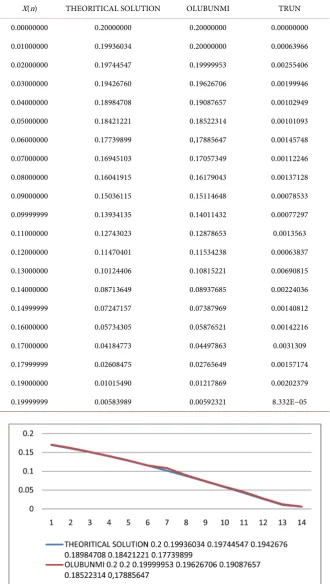
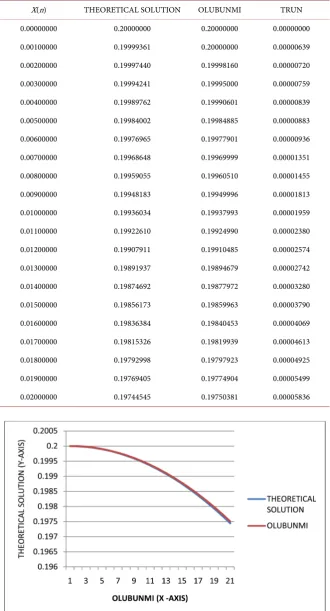
The result compared favourably with the theoretical solutions. PROBLEM 2:
Suppose that the spring of Problem 1 is immersed in a fluid with damping constant. Find the position of the mass at any time if it starts from the equili-brium Position and is given a push to start it with an initial velocity of m/s.
Mathematical Interpretation of the Problem
From Problem 1, the mass is m=2 and the spring constant is k=128, so the differential Equation (3) becomes
2
2
d d
2 40 128 0
d d
x x x
t
t + + = (7)
or
2
2
d 20d 64 0
d d
x x x
t
t + + = (8)
( )
4 161 t 2 t
x t =c e− +c e−
(9)
We are given that x
( )
0 =0, c c1+ 2 =0. Differentiating, we get( )
4 161 2
4 t 16 t
x t′ = − c e− + c e−
(10) So
( )
0 41 16 2 0.6x′ = − c + c =
(11) Since c2= −c1, this gives 12c1=0.6 or c1=0.05. Therefore
(
4 16)
0.05 t tx= e− −e−
(12)
The result compares favourably with the theoretical solutions. The result compares favourably with the theoretical solutions.
4. Conclusions
DOI: 10.4236/am.2019.105022 321 Applied Mathematics
[image:10.595.208.539.117.702.2]new method and so can be said to be approximately correct.
Table 1. Numerical results of problem 1 at H = 0.01.
X(n) THEORITICAL SOLUTION OLUBUNMI TRUN
0.00000000 0.20000000 0.20000000 0.00000000
0.01000000 0.19936034 0.20000000 0.00063966
0.02000000 0.19744547 0.19999953 0.00255406
0.03000000 0.19426760 0.19626706 0.00199946
0.04000000 0.18984708 0.19087657 0.00102949
0.05000000 0.18421221 0.18522314 0.00101093
0.06000000 0.17739899 0,17885647 0.00145748
0.07000000 0.16945103 0.17057349 0.00112246
0.08000000 0.16041915 0.16179043 0.00137128
0.09000000 0.15036115 0.15114648 0.00078533
0.09999999 0.13934135 0.14011432 0.00077297
0.11000000 0.12743023 0.12878653 0.0013563
0.12000000 0.11470401 0.11534238 0.00063837
0.13000000 0.10124406 0.10815221 0.00690815
0.14000000 0.08713649 0.08937685 0.00224036
0.14999999 0.07247157 0.07387969 0.00140812
0.16000000 0.05734305 0.05876521 0.00142216
0.17000000 0.04184773 0.04497863 0.0031309
0.17999999 0.02608475 0.02765649 0.00157174
0.19000000 0.01015490 0.01217869 0.00202379
0.19999999 0.00583989 0.00592321 8.332E−05
DOI: 10.4236/am.2019.105022 322 Applied Mathematics Table 2. Numerical results of problem 1 at H = 0.001.
X(n) THEORETICAL SOLUTION OLUBUNMI TRUN
0.00000000 0.20000000 0.20000000 0.00000000
0.00100000 0.19999361 0.20000000 0.00000639
0.00200000 0.19997440 0.19998160 0.00000720
0.00300000 0.19994241 0.19995000 0.00000759
0.00400000 0.19989762 0.19990601 0.00000839
0.00500000 0.19984002 0.19984885 0.00000883
0.00600000 0.19976965 0.19977901 0.00000936
0.00700000 0.19968648 0.19969999 0.00001351
0.00800000 0.19959055 0.19960510 0.00001455
0.00900000 0.19948183 0.19949996 0.00001813
0.01000000 0.19936034 0.19937993 0.00001959
0.01100000 0.19922610 0.19924990 0.00002380
0.01200000 0.19907911 0.19910485 0.00002574
0.01300000 0.19891937 0.19894679 0.00002742
0.01400000 0.19874692 0.19877972 0.00003280
0.01500000 0.19856173 0.19859963 0.00003790
0.01600000 0.19836384 0.19840453 0.00004069
0.01700000 0.19815326 0.19819939 0.00004613
0.01800000 0.19792998 0.19797923 0.00004925
0.01900000 0.19769405 0.19774904 0.00005499
0.02000000 0.19744545 0.19750381 0.00005836
DOI: 10.4236/am.2019.105022 323 Applied Mathematics Table 3. Numerical results of problem 2 at H = 0.001.
X(n) THEORETICAL SOLUTION OLUBUNMI TRUN
0.00000000 0.10000000 0.10000000 0.0000000
0.00100000 0.09900676 0.09900348 0.00000328
0.00200000 0.09802692 0.09807573 0.00004891
0.00300000 0.09706028 0.09713825 0.00007797
0.00400000 0.09610662 0.09618537 0.00007875
0.00500000 0.09516575 0.09527836 0.00011261
0.00600000 0.09423748 0.09434861 0.00011113
0.00700000 0.09332163 0.09343216 0.00011053
0.00800000 0.09241800 0.09252773 0.00010973
0.00900000 0.09152640 0.09173281 0.00020641
0.01000000 0.09064666 0.09081132 0.00016472
0.01100000 0.08977859 0.08999590 0.00021731
0.01200000 0.08892203 0.08899999 0.00022040
0.01300000 0.08807679 0.08835681 0.00028002
0.01400000 0.08724272 0.08752332 0.00028079
0.01500000 0.08641962 0.08673274 0.00031312
0.01600000 0.08560735 0.08570748 0.00030213
0.01700000 0.08480573 0.08413814 0.00043241
0.01800000 0.08401462 0.08427880 0.00051327
0.01900000 0.08323386 0.08382617 0.00059231
0.02000000 0.08246327 0.08209541 0.00063214
[image:12.595.203.541.90.713.2]DOI: 10.4236/am.2019.105022 324 Applied Mathematics Table 4. Numerical results of problem 2 at H = 0.0001.
X(n) THEORETICAL SOLUTION OLUBUNMI TRUN
0.00000000 0.10000000 0.10000000 0.00000000
0.00010000 0.09990007 0.09992720 0.00002713
0.00020000 0.09980027 0.09983454 0.00003427
0.00030000 0.09970061 0.09974292 0.00004231
0.00040000 0.09960109 0.09965531 0.00005422
0.00050000 0.09950170 0.09956093 0.00005923
0.00060000 0.09940244 0.09946347 0.00006123
0.00070000 0.09930332 0.09937088 0.00006676
0.00080000 0.09920434 0.09927559 0.00007125
0.00090000 0.09910548 0.09918759 0.00008211
0.00100000 0.09900676 0.09909777 0.00009101
0.00110000 0.09890819 0.09894247 0.00010113
0.00120000 0.09880973 0.09886919 0.00013274
0.00130000 0.09871142 0.09877561 0.00015777
0.00140000 0.09861323 0.09861727 0.00016238
0.00150000 0.09851518 0.09854087 0.00018621
0.00160000 0.09841727 0.09845110 0.00020000
0.00170000 0.09831949 0.09836652 0.00022135
0.00180000 0.09822183 0.09827469 0.00022927
0.00190000 0.09812431 0.09830139 0.00024221
0.00200000 0.09802692 0.09837561 0.00027725
DOI: 10.4236/am.2019.105022 325 Applied Mathematics
In our subsequent research, we shall pay more attention on the implementa-tion of this new scheme to solve some higher order initial value problems of or-dinary differential equation and also compare the results with the existing me-thods and thereafter we examine the characteristics properties such as the stabil-ity, convergence, accuracy and consistency of the scheme.
Conflicts of Interest
The authors declare no conflicts of interest regarding the publication of this paper.
References
[1] Fatunla, S.O. (1987) An Implicit Two-Point Numerical Integration Formula for Li-near and Non-LiLi-near Stiff System of ODEs. Mathematics of Computation, 32, 1-11.
https://doi.org/10.1090/S0025-5718-1978-0474830-0
[2] Ibijola, E.A. (1997) A New Numerical Scheme for the Solution of Initial Value Problem (IVPs). Ph.D. Thesis, University of Benin, Nigeria.
[3] Ibijola, E.A. (1998) On the Convergence, Consistency and Stability of a One-Step Method for Integration of ODEs. International Journal of Computer Mathematics, 73, 261-277. https://doi.org/10.1080/00207169908804894
[4] Obayomi, A.A. (2012) A Set of Non-Standard Finite Difference Schemes for the So-lution of an Equation of the Type y y′ =
(
1−yn)
. International Journal of Pure andApplied Sciences and Technology, 12, 34-42.
[5] Ogunrinde, R.B. (2010) A New Numerical Scheme for the Solution of Initial Value Problems in Ordinary Differential Equations. Ph. D. Thesis, University of Ado Ekiti, Nigeria.
[6] Ogunrinde, R.B. (2013) On Some Models Based on First Order Differential Equa-tions. American Journal of Scientific and Industrial Research, 4, 288-293.
https://doi.org/10.5251/ajsir.2013.4.3.288.293
[7] Ogunrinde, R.B. and Lebile, O. (2015) On Mathematical Model of Traffic Control.
Mathematical Theory and Modeling, 5, 58-68.
[8] Ogunrinde, R.B. (2016) On Error Analysis Comparison of Some Numerical Expe-rimental Results.