IS THERE AN IMPACT OF THE ELDERLY CLASS ON THEIR QUALITY OF LIFE ?
*Yanasita Mafluha, Tri Nurmiyati
Akademi Kebidanan Bina Husada, Tangerang
ARTICLE INFO ABSTRACT
Background
elderly. One of the program or nursing home of the e
research began with qualitative research and continued with quantitative collection in this
by filling in for the family (pvalue =
dimension to overall quality of life (pvalue 0.003). elderly class and the qualit
attention to Panti
Copyright © 2018,Yanasita Mafluha et al. This is an open use, distribution, and reproduction in any medium, provided
INTRODUCTION
Many problems experienced by the elderly, the first one is problem caused by changes in life and physical decline experienced by the elderly. Diseases suffered by elderly people in Indonesia, including hypertension, diabetes mellitus,
osteoarthritis, osteoporosis, coronary heart disease,
cerebrovascular disease, infections, hearing loss, visual impairment, dementia, and mental disorders.
problems faced by the elderly, including: immobility; instability (unstable or easy to fall); urine incontinence (uncontrolled urinary release and often frequently); intellectual impairment or dementia (severe impairment of intellectual function and memory); infection; impairment of vision and hearing, taste, smell, communication, convalescence, integrity (interference with the five senses, communication, healing and skin); impaction (constipation); inanition (malnutrition); impecunity (no money); latrogenesis (a disease caused by medicines); immune deficiency (decreased immune system); impotence (impotence) (Choirudin, 2011) second one is the elderly generally experiences loneliness caused by the breakup of relationships with people who are
*Corresponding author:Yanasita Mafluha,
Akademi Kebidanan Bina Husada, Tangerang-Indonesia, Ku No.1, Bencongan, Kelapa Dua, Tangerang.
ISSN: 0975-833X
Vol.
Article History: Received 19th July, 2018 Received in revised form 25th August, 2018
Accepted 08th September, 2018 Published online 31st October, 2018
Citation: Yanasita Mafluha, Tri Nurmiyati, and Akhmad Mukhsin Journal of Current Research, 10, (10), 74419-74424
Key Words: Elderly, Quality of life. Key Words:
Elderly, Quality of life.
RESEARCH ARTICLE
IS THERE AN IMPACT OF THE ELDERLY CLASS ON THEIR QUALITY OF LIFE ?
Yanasita Mafluha, Tri Nurmiyati and Akhmad Mukhsin
Akademi Kebidanan Bina Husada, Tangerang-Indonesia, Kutai Raya Street No.1, Bencongan,
Kelapa Dua, Tangerang
ABSTRACT
Background: In old age there are many problems that occur which can affect the quality of life of the elderly. One of the government's efforts to improve the quality of life of the elderly
am or nursing home. Objective: To determine how the elderly class influence the quality of life of the elderly. Method: This Research uses mixed methods with sequential exploratory strategies. This research began with qualitative research and continued with quantitative
collection in this research was done through 22 in-depth interviews and quantitative research was done by filling in 47 questionnaires. The sample in this research are all elderly in
the sampling technique. Results: Qualitative research found there were significant differences in family dimensions (pvalue 0,000), health dimension (pvalue = 0,000), ps
(pvalue = 0,042), financial dimension to overall quality of life (pvalue = 0,077), neighbor/environment dimension to overall quality of life (pvalue 0.003). Conclusion:
elderly class and the quality of life of the elderly, it is expected that the government would attention to Panti, in order to make them fell that they live a better quality of live.
open access article distributed under the Creative Commons Attribution provided the original work is properly cited.
Many problems experienced by the elderly, the first one is problem caused by changes in life and physical decline experienced by the elderly. Diseases suffered by elderly people in Indonesia, including hypertension, diabetes mellitus,
thritis, osteoporosis, coronary heart disease,
cerebrovascular disease, infections, hearing loss, visual impairment, dementia, and mental disorders. Other physical problems faced by the elderly, including: immobility; ; urine incontinence (uncontrolled urinary release and often frequently); intellectual impairment or dementia (severe impairment of intellectual function and memory); infection; impairment of vision and hearing, taste, smell, communication, convalescence, skin integrity (interference with the five senses, communication, healing and skin); impaction (constipation); inanition (malnutrition); impecunity (no money); latrogenesis (a disease caused by medicines); immune deficiency (decreased immune ence (impotence) (Choirudin, 2011). The second one is the elderly generally experiences loneliness caused by the breakup of relationships with people who are
Indonesia, Kutai Raya Street
closest and dearest, living alone, having lost a partner, having a partner but not having children, being away from children (left hometown) will make the elderly feel lonely, abandoned, and no attention from the neighborhood.
their parents (the elderly) in nursing homes.
residence that accommodates the elderly where many of them experience psychological problems that cause them to feel unhappy in their old age. Psychological problems experienced by the elderly are post power syndrome, insomnia, anxiety, depression, and delirium. Post power syndrome
experienced by many elderly people who have just retired, lost strength, income and happiness (Indrayani et al., 2016) Because the elderly often experiences these problems, as a result they have low quality of life since most of the elderly d not enjoy their old age. This is supported by Hardiwinoto (2005; Risdianto, 2009) which states that welfare is one of the parameters of a high-quality life of the elderly in order to enjoy their old life (Rohman, 2012). The government program which specifically established for the elderly, namely
terpadu (Posbindu). Posbindu is one of the community health efforts that was formed by the community based upon initiatives and needs of the community, especially the elderly. Posbindu's existence aims to improve the health and quality of life of the elderly. But the fact is, this program is not running properly. The failure of Posbindu program was
of socialization about the posbindu program thus many elderly
International Journal of Current Research Vol. 10, Issue, 10, pp.74419-74424, October, 2018
DOI: https://doi.org/10.24941/ijcr.32529.10.2018
Yanasita Mafluha, Tri Nurmiyati, and Akhmad Mukhsin, 2018. “Is there an impact of the elderly class on their quality of life ?
IS THERE AN IMPACT OF THE ELDERLY CLASS ON THEIR QUALITY OF LIFE ?
and Akhmad Mukhsin
Indonesia, Kutai Raya Street No.1, Bencongan,
which can affect the quality of life of the government's efforts to improve the quality of life of the elderly is the posbindu : To determine how the elderly class influence the quality of life with sequential exploratory strategies. This research began with qualitative research and continued with quantitative research. Qualitative data views and quantitative research was done sample in this research are all elderly in Panti, purposive sampling there were significant differences in dimensions (pvalue 0,000), health dimension (pvalue = 0,000), psychological dimension 0,042), financial dimension to overall quality of life (pvalue = 0,077), neighbor/environment
Conclusion: There is an influence between the that the government would pay more in order to make them fell that they live a better quality of live.
ribution License, which permits unrestricted
closest and dearest, living alone, having lost a partner, having a partner but not having children, being away from children (left hometown) will make the elderly feel lonely, abandoned, and ntion from the neighborhood. Even some children leave their parents (the elderly) in nursing homes. Panti is a the elderly where many of them experience psychological problems that cause them to feel unhappy in their old age. Psychological problems experienced by the elderly are post power syndrome, insomnia, anxiety, depression, and delirium. Post power syndrome is a problem experienced by many elderly people who have just retired, lost strength, income and happiness (Indrayani et al., 2016). Because the elderly often experiences these problems, as a result they have low quality of life since most of the elderly do not enjoy their old age. This is supported by Hardiwinoto (2005; Risdianto, 2009) which states that welfare is one of the quality life of the elderly in order to enjoy The government program which fically established for the elderly, namely pos pembinaan (Posbindu). Posbindu is one of the community-based health efforts that was formed by the community based upon initiatives and needs of the community, especially the elderly. ence aims to improve the health and quality of life of the elderly. But the fact is, this program is not running
properly. The failure of Posbindu program wascaused by lack
of socialization about the posbindu program thus many elderly
INTERNATIONAL JOURNAL OF CURRENT RESEARCH
people did not know the program; the location of Posbindu is far from the elderly residence; the establishment of Posbindu is based on the needs of the program, not based on the needs of the elderly; the absence of support from the family to facilitate the elderly to come to Posbindu; lack of budget for program
implementation and lack of incentives for posbinducadres; the
attitudes of health workers who are not good enough for the
elderly and cadres; the lack of knowledge and skills of
Posbindu cadres particularly in providing education to the elderly; there is no special training for health workers and cadres who will be involved in the posbindu program; the implementation of the Posbindu program is limited to the treatment of physical complaints and diseases of the elderly; inadequate facilities, infrastructure and access to Posbindu; the
government's indifference to the achievements and
sustainability of the program (Purnawati et al., 2014; Abas, 2015; Hidayati, 2009; Suwarsono, 2012; Bratanegara et al., 2012; Suparto et al., 2015; Handayani, 2012; Khotimah, 2011; Nurhayati, 2012; Budiyansi, 2013; Creswell, 2010). From these problems, the incompatibility of the concept of the elderly program with the needs of the elderly has caused the program to be ineffective and thus aroused the interest of researchers to examine the influence of the elderly class on the quality of life of the elderly in Tangerang Regency.
MATERIALS AND METHODS
This research uses mixed methods with sequential exploratory strategies, namely research methods starting with data collection and qualitative data analysis followed by quantitative data collection and analysis. Participants in the qualitative research are the elderly people in Tangerang District Health Office, who had gone through the stages of their lives, namely neonates, toddlers, pre-school, school, teenagers, adults, and were over 60 years old. The number of samples used is 22 respondents. The population in this research are all elderly in Tangerang Regency, while the accessible population in this research are all elderly in Panti totaling 47 respondents. The sample is a part or representative of the population studied. The sample used in quantitative research is the elderly people in Panti Tangerang Regency who meet the inclusion criteria and are not included in the exclusion criteria. Data collection methods used are in-depth interviews, and filling out questionnaires. Qualitative research was done by using thematic analysis and quantitative research data analysis was done by applying Wilcoxon test and paired t-test.
RESULTS
Qualitative Research: The results of the qualitative research
were obtained through in-depth interviews of 22 informants who were willing to be interviewed in Panti. Based on the results of data reduction, it is obtained that the quality of life components of the elderly in Panti consist of 5 components, namely family, health, psychological and spiritual, financial and neighborhood/environment components. Furthermore, the results of the in-depth interviews will be presented based on the five components.
1. Family dimensions: In the family component, generally
the elderly is not forbidden to live in Panti by their families. There are even children who prefer their mother to stay in a Panti rather than at home, or even do not care about their parents as conveyed by the following informant.
"Then my child said, "I am also busy taking care of my children so I can't take care of you", so I said "It’s fine if you can’t give me money for Panti now, maybe later" then I went here, stayed here to study Qur’an. I know this place from my niece, because her in-laws also stay here." (Informant 3)
2. Health dimensions: The informants who are elderly
people generally experience pain in the knees and the back and stiffness in the neck. Usually when they are sick, they go to the nearest health center or buy medicines at a store as stated by the informant below:
"Now complains, often waist pain, not strong enough to sit down for a long time, leg pain, rheumatic, sometimes drinking neo rheumacyl bought in a store." (Informant 2)
3. Psychological and spiritual dimensions: In general, the
informants chose to come and live in Panti to have enough time to study the Qur’an, and to get closer to God as told by the following informant.
"I came here of my own volition, I want to focus on worship, if I’m at home I always want to watch TV." (Informant 1)
4. Financial dimension: In this dimension, respondents
generally receive money from their children and family. If they do not have money, they usually ask for money to the guarantor of elderly in Nurunnisa LKS as stated below:
"Every three days, my children sent money for me to buy food. My children rarely visit, if they have money they would come every month, give 10, 20 thousand rupiah, just like that." (Informant 19)
5. Neighbor and environment dimensions: The informants
in elderly Nurunnisa LKS felt that the environment in Panti is more comfortable to spend their old age compared to home. People next-door are friends who can shares all things, as revealed by the following informant.
"It’s noisy at home, my grandchildren always cry and scream. In Panti, I’m happier because it is more peaceful to pray and recite Qur’an." (Informant 17)
Quantitative Research
Difference in quality of life according to dimensions before
treatment: Based on the results of statistical analysis, data
obtained were normally distributed in the family, health, and neighborhood/environment dimension (p value> 0.05), while quality of life, psychological and spiritual dimension and financial dimension were not normally distributed (p value <0.05).
Table 1. The Average Quality of Life of Respondents According to the Quality of Life Components Before Treating Elderly Classes
Component QoL Mean Median Modus Standar Deviasi Min Maks
Quality of Life 187,01 187 187 12,468 142 213
Family 52,40 52 54 4,689 43 65
Health 24,28 24 22 2,887 16 29
Psychology and Spirituality 53,51 54 50 5,208 39 62
Financial 20,09 20 20 3,658 8 27
Neighbor/environment 36,74 37 38 2,754 29 41
Table 2. The Average Quality of Life of Respondents According to the Quality of Life Components Before Treating Elderly Classes
Component QoL Mean Median Modus Standard Deviation Min Max Pvalue
Quality of Life 198,26 200 200 22,340 157 218 -
Family 56,09 55 53 5,481 45 68 0,000
Health 27,57 28 28 2,668 22 32 0,000
Psychology and Spirituality 55,23 55 61 4,962 44 64 0,000
Financial 20,94 21 20 3,266 11 27 0,838
[image:3.595.90.501.272.384.2]Neighbor/environment 38,43 40 41 3,752 27 42 0,247
Table 3 Influence of Elderly Classes on Family, Health and Neighbor/Environment Dimensions
Variable N Mean SD Difference
Mean SD
IK 95%
P value
Lower Upper
Family
- Pre eldery Class - Post eldery Class
47 47
52,40 4,67 56,09 5,48
-3,68 5,93 -5,422 -1,939 0,000
Health
- Pre eldery Class - Post eldery Class
47 47
24,28 2,89 27,57 2,67
-3,29 3,66 -4,372 -6,179 0,000
Neighbor/environment - Pre eldery Class - Post eldery Class
47 47
36,74 2,75 38,43 3,75
[image:3.595.85.509.402.764.2]-1,68 3,67 -2,759 -3,138 0,003
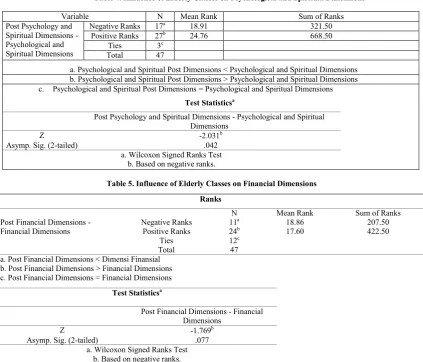
Table 4. Influence of Elderly Classes on Psychological and Spiritual Dimensions
Variable N Mean Rank Sum of Ranks
Post Psychology and Spiritual Dimensions - Psychological and Spiritual Dimensions
Negative Ranks 17a 18.91 321.50
Positive Ranks 27b 24.76 668.50
Ties 3c
Total 47
a. Psychological and Spiritual Post Dimensions < Psychological and Spiritual Dimensions b. Psychological and Spiritual Post Dimensions > Psychological and Spiritual Dimensions c. Psychological and Spiritual Post Dimensions = Psychological and Spiritual Dimensions
Test Statisticsa
Post Psychology and Spiritual Dimensions - Psychological and Spiritual Dimensions
Z -2.031b
Asymp. Sig. (2-tailed) .042
a. Wilcoxon Signed Ranks Test b. Based on negative ranks.
Table 5. Influence of Elderly Classes on Financial Dimensions
Ranks
N Mean Rank Sum of Ranks
Post Financial Dimensions - Financial Dimensions
Negative Ranks 11a 18.86 207.50
Positive Ranks 24b 17.60 422.50
Ties 12c
Total 47
a. Post Financial Dimensions < Dimensi Finansial b. Post Financial Dimensions > Financial Dimensions c. Post Financial Dimensions = Financial Dimensions
Test Statisticsa
Post Financial Dimensions - Financial Dimensions
Z -1.769b
Asymp. Sig. (2-tailed) .077
The difference in quality of life according to dimensions
after the treatment: Based on the data normality test, data
obtained with normal distribution is the same as before being treated, namely family, health, and neighborhood/environment dimension (p value> 0.05), while quality of life, psychological and spiritual dimension, and the financial dimension is not normally distributed (p value <0.05). The results of the post treatment data normality test are attached in this document. Mean and median values and other measures of quality of life and dimensions of quality of life of the elderly analyzed after being treated with elderly class can be described in Table 2 below. From table 2 above demonstrates the mean/median quality of life and each dimension of quality of life increased after being treated with the elderly class. The highest improvement in the quality of life was in general quality of life of 13 points (187-200), followed by health dimension of 4 points (24-28), family dimension of 3 points (52-55), neighborhood/environment dimension (37- 40), psychological and spiritual dimension (54-55), and financial dimension (20-21). Family, health, and psychological and spiritual dimensions affect the quality of life in general (p value <0.05), while the financial and neighborhood/environment dimensions do not significantly affect the overall quality of life (p value> 0.05).
Influence of the Elderly Class on the Quality of Life of the
Elderly: Based on the results of the data normality test, not all
[image:4.595.39.288.454.611.2]dimensions are normally distributed. Therefore, to determine whether there is an influence of the elderly class on the quality of life of the elderly, statistical tests are carried out differently based on the distribution of data obtained. Quality of life and psychological and financial dimension were done by using the Wilcoxon test, while other dimensions namely family, health, and neighborhood/environment
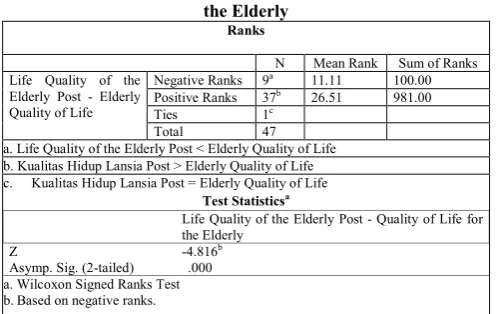
Table 6. Influence of the Elderly Classes on the Quality of Life of the Elderly
Ranks
N Mean Rank Sum of Ranks
Life Quality of the Elderly Post - Elderly Quality of Life
Negative Ranks 9a 11.11 100.00
Positive Ranks 37b 26.51 981.00
Ties 1c
Total 47
a. Life Quality of the Elderly Post < Elderly Quality of Life b. Kualitas Hidup Lansia Post > Elderly Quality of Life
c. Kualitas Hidup Lansia Post = Elderly Quality of Life
Test Statisticsa
Life Quality of the Elderly Post - Quality of Life for the Elderly
Z -4.816b
Asymp. Sig. (2-tailed) .000
a.Wilcoxon Signed Ranks Test
b.Based on negative ranks.
were done by using the paired t-test. The results are presented one by one as follows. Based on table 3 above, it can be seen that the mean value, both before and after the treatment, have increased the family, health and neighborhood/environment dimensions. The statistical test results showed that it had p value <0.05, which means there were significant differences in the quality of life in the three dimensions between before and after the treatment of elderly class. This proves that there is an influence of the elderly class on the quality of life of the elderly in Panti.
Based on the results of Wilcoxon above, it can be seen that there are 17 respondents with quality of life in the psychological and spiritual dimension decreased after the elderly class, there are 3 people with quality of life in the psychological and spiritual dimensions remained the same
after the treatment and 27 people with quality of life in the psychological and spiritual dimension were less improved after the elderly class treatment. The Wilcoxin test showed p = 0.042 which means there is a significant difference in the quality of life in the psychological and spiritual dimension after the elderly class treatment. This proves that there is an influence of the elderly class on the quality of life in the psychological and spiritual dimension of Panti.
Based on the results of Wilcoxon above, it can be seen there were 11 respondents with quality of life in the financial dimension decreased after the elderly class, there were 12 people with quality of life in the financial dimension remained the same after the treatment and 24 people with quality of life in the financial dimension increased after being treated with the elderly class. With the Wilcoxon test shows the value of p = 0.077 which means there is no difference in the quality of life in the financial dimension after being given the treatment of the elderly class. This proves that there is no influence of the elderly class on the quality of life in the financial dimension of Panti.
Based on the results of Wilcoxon above, it can be seen that there are 9 respondents with poor quality of life after the elderly class, there is 1 person with the same quality of life after the treatment and 37 people with improved quality of life after being treated with elderly class. The Wilcoxon test showed p value = 0,000 which means there is a significant difference in quality of life after the elderly class treatment. This proves that there is an influence of the elderly class on the quality of life of the elderly in Panti.
DISCUSSION
1. Family Dimension: Based on the results of qualitative
research which was then used to make a measurement tool for qualitative research, thus finding information that one of the components or dimensions of the quality of life of the elderly in Panti is family. In this dimension, it was found that family is one of the factors that determines the elderly to choose to spend their old age in Panti or often
called nursing homes by the elderly. Informants
complained that their children did not care, more suggested that they stay in Panti so they could rest or not be disturbed by their grandchildren while praying. Living in Panti is a solution for them to have more time to worship, which is done solemnly as a provision when called by the Almighty. Elderly needs to fill their lives with useful activities so that their lives are more meaningful, thus having a good quality of life and pleasant old age. In this research, after the treatment of elderly class, it was found there was an increase in the average quality of life in family dimension. This is because in the elderly class program, families are involved in existing activities. The elderly feels cherished by their children or family so they look happy. Based on the results of this research, it would be wise if each of us who meet the elderly, especially policy makers, launches a program of activities that can improve the quality of life of the elderly.
2. Health Dimension: In the course of life of every human
adaptation. The lack of an adaptation mechanism for the elderly to change will later bring the individual to a different quality of life. Based on the results of this research, it was found that the health dimension is one of the components or dimensions that affects the quality of life of the elderly. Information obtained is in regard of health disorder that is more often experienced by the elderly such as pain in the legs, waist, cough and cold. When sick, the elderly is usually taken to a Health Center or a midwife for treatment. Often, they also buy their own medicines at a store. This topic must be considered by the person in charge of the Panti, as well as local health workers so that the elderly do not consume medicines that are not suitable for them which can endanger their health.
After being treated with an elderly class, it was found that
there is an increase in the average quality of lifescore in the
health dimension. This is caused by the physical activities in the elderly class program such as planting vegetables and physical exercise every week to improve their blood circulation. The results of this research are also matched with the research reported by Wikanda (2017), which shows that the poor quality of life of the elderly is less associated with chronic diseases experienced by the elderly (Wikananda, 2017). Therefore, the arranged programs should pay attention to this, in order to be carried out regularly to maintain the health of the elderly.
3. Psychological and Spiritual Dimension: In this research,
it is found that the elderly chooses to live in Panti with the intention of being able to carry out worship in a focused and solemn manner. Elderly feel more peaceful staying in Panti, because they have more time in a quiet environment to carry out worship, without being bothered by their grandchildren. Psychologically, the elderly feels happier
living in Panti. The results of the quantitative research
prove that after receiving the elderly class treatment, the average quality of life of the elderly in the spiritual and psychological dimension. There is a significant difference in the quality of life in psychological and spiritual dimension after being treated for the elderly class. This can be due to the fact that there is a program in the elderly class such as the spiritual formation of local religious leaders as
well as recitations that can give them positive feelings.The
results of this research are matched with the theory of WHO that someone who has a good quality of life in the spiritual dimension is someone who feels his life is blessed, in a sense not only from one side such as the financial side. The elderly in Panti were found to have a life of gratitude, despite the limitations. Although financially lacking, they see life with gratitude (WHO, 1998). It is this gratitude that can give positive feelings and always make the elderly feel happy, even though not all of their needs are met. The intention to worship also makes them appreciate what they have, even though they live in an environment that is not always in line with their expectations.
4. Financial dimension: In financial dimension, the income of
the elderly is obtained from the children and their families with a modest amount. Nevertheless, it is not uncommon for them to have children or families who never pay attention to them, let alone give money to them. This situation actually forms an attachment among the elderly which develop a very strong bond, by sharing with each
other in any situations. The results of qualitative research
indicate that there is an increase in the quality of life score in the financial dimension after receiving treatment from
the elderly class, although there is no significant difference in the overall quality of life in the financial dimension. This can happen because within the elderly class, there are a lot of activities that can make them forget about their financial shortcomings. There are also gifts as an expression of gratitude that can make them feel cared for. This can also bring happiness to them. Being happy is not only about being cheerful and happy, but also experiencing that special feeling that are valuable and highly desirable (Muhaimin, 2009). Being happy is certainly not solely because of financially well-off. Therefore, families especially children need to spend their time with their parents in Panti. The presence of a child or family is more meaningful even though they cannot give money or other valuable gifts.
5. Neighborhood/Environment Dimension: In this
dimension, it is found that elderly prefer to stay in Panti, even though the nursing environment is not entirely ideal for the elderly. In Panti, they have many friends where they can share joy and sorrow, so they feel brighter. Even if there are elderly people who do not have close friends, because all the elderly is close to him. When compared to staying at home, the elderly prefers to live in Panti, the reason is more time for worship and can be done solemnly. Because at home, they are often disturbed by their
grandchildren. The results of quantitative research found
that there is a significant difference in the quality of life in
neighborhood/environment dimension after receiving
treatment from the elderly class. Neighborhood/
environment dimension also significantly affect the quality of life of the elderly in general. This is because in the elderly class program there are activities that can bring the elderly closer to one another, in addition to spiritual activities such as recitation and spiritual sermon by local religious leaders. This finding is in accordance with the theory presented by WHO that an environment can provide a sense of friendship, a sense of belonging, respect, love, a sense of sharing in time of happy or sad which relate to the level of someone’s quality of life (WHO, 1998). Thus, bonding between senior citizens in Panti needs to be maintained and cared for by the caregivers, health workers or other parties who are in direct contact with the elderly so that their quality of life is maintained.
6. Elderly Quality of Life: The results of the research on the
Of all the dimensions examined based on the results of qualitative research namely family, health, psychological and spiritual, financial and neighborhood/environmental dimensions, only the financial dimension found no significant difference in overall quality of life. This proves that the theory presented by WHO that a person's life satisfaction is not merely the financial aspect that are fulfilled in accordance with what is expected, but all aspects of human life (WHO, 1998). Children and family who visits Panti to see their parents is a source of happiness for the elderly, even though the children and family cannot provide material support in this case money or other valuables.
Conclusion
From the results of this research, it was found that there is an influence between the elderly class and the quality of life of the elderly. Before the elderly class treatment, there are only 3 related components of quality of life and after the elderly class is done there is an improvement in the quality of life of the elderly. Elderly classes are carried out in accordance with qualitative results seen from the family, health, psychological and spiritual, financial, and neighborhood/environmental dimensions. And after the elderly class treatment, it is proven that there are many elderly people who felt that their lives would be in a better quality through activities that the elderly should do but rarely did.
Suggestion
It is expected that the elderly class can become a regular program both by the institution and the government in this case the local health center, this can be an input for the family to provide and arrange time to visit their parents in the Panti, an input for policy makers to apply the elderly class treatment in subsequent work programs, an input for the government both in the health and social fields in designing the next policy so that the elderly can live a better quality of life.
Acknowledgment
This research was funded by Kemenristek DIKTI for beginner lecturer research in 2018. Hence, the research team would like
to express gratitudefor the implementation of this research and
lecturer from Akademi Kebidanan Bina Husada Tangerang
who had helped in the completion of this research.
REFERENCES
Abas FF. 2015. Faktor yang mempengaruhi minat lansia dalam mengikuti, posyandu lansia di wilayah Puskesmas Buko Kabupaten Bolaang, Mongondow Utara. Gorontalo: Skripsi, Universitas Negeri Gorontalo.
Bratanegara AS, Lukman M, Hidayati NO. Gambaran dukungan keluarga terhadap pemanfaatan posbindu lansia di Kelurahan Karasak Kota Bandung. Jurnal Penelitian FK Unpad. 2012;1.
Budiyansi VN. 2013. Hubungan tingkat pengetahuan keluarga tentang posyandu lansia dengan frekuensi kunjungan lansia ke posyandu Desa Mrican Salatiga. Available from: http://digilib.stibeth.ac.id/gdl.php?mod=browse&op=read& id=--vincentian-18.
Choirudin A. 2011. Implementasi bimbingan sosial pada lansia di taman pembinaan lansia Wirosaban, Sorosutan, Umbulharjo, Yogyakarta. Skripsi Yogyakarta: Universitas Sunan Kalijaga.
Creswell. 2010. Pendekatan Kualitatif, Kuantitatif, dan Mixed. Yogyakarta: Pustaka Pelajar.
Handayani DE. 2012. Pemanfaatan pos pembinaan terpadu oleh lanjut usia di Kecamatan Ciomas Kabupaten Bogor: Jurnal FKM UI.
Hidayati LN. 2009. Hubungan dukungan sosial dengan tingkat depresi pada lansia di Kelurahan Daleman Tulung Klaten [Skripsi] Surakarta: Jurusan Keperawatan, Fakultas Ilmu Kesehatan Universitas Muhammaiyah Surakarta.
Indrayani, Apsari RA. 2016. Faktor-faktor penghambat. pelaksanaan posbindu di wilayah Kecamatan Kertasari Desa Cihawuk Kabbupaten Bandung. Bandung: Akbid Dewi Sartika Bandung.
Khotimah SK. 2011. Faktor-faktor yang berhubungan dengan pemanfaatan posyandu lansia di wilayah kerja Puskesmas Walikukun Kabupaten Ngawi. Skripsi. Available from: http://eprint.undip.ac.id/33393/.
King S. 2008. Assesing Quality of Life, Measuring for Children; Canchild Centre For Childhood Disability Research.
Muhaimin T. 2009. Dampak HIV/AIDS Dalam Keluarga Terhadap Kualitas Hidup Anak. Depok: Universitas Indonesia.
Nurhayati K. 2012. Faktor-faktor yang mempengaruhi lansia dalam pemanfaatan pos binaan terpadu (posbindu).
Available from:
http://lib.unri.ac.id/skripsi/index.php?p=show_detail&id=3 7381.
Purnawati N, Irdawati, Yuniartika W. 2014. Faktor-faktor yang mempengaruhi kunjungan lansia dalam kegiatan posyandu di Desa Plumbon Kecamatan Mojolaban Sukoharjo.
Skripsi. Fakultas Ilmu Kesehatan: Universitas
Muhammadiyah.
Rohman AIN, Purwaningsih, Bariyah K. 2012. Quality Of Life Elderly.
https://media.neliti.com/media/publications/255810-kualitas-hidup-lanjut-usia-cc5cde49.pdf
Suparto TA, Sunjaya DK, Susanti RD. 2015. Masalah-masalah program posbindu di desa Dayeuhkolot, Kabupaten Bandung Jawa Barat. Bandung: Universitas Padjadjaran Bandung.
Suwarsono. 2012. Posyandu lansia di wilayah kerja Puskesmas Kabupaten Temanggung. Jurnal Kesehatan [Internet].
Available from:
http://akperngestiwaluyo.ac.id/jurnalkesehatan/.
WHO. 1998. WHOQOL User Manual. Division on Mental Health and Prevention of Substance Abuse. Geneva: World Health Organization.
Wikananda G. 2017. Hubungan kualitas hidup dan faktor resiko pada usia lanjut di wilayah kerja puskesmas tamppaksiring I Kabupaten Gianyar Bali 2015. Intisari
Sains Medis. 2017:8 (41-49).