Business Models for Reverse Innovation Marloes K.W. Hoekman
University of Twente
Masters of Business Administration
Specialisation track: Entrepreneurship, Innovation and Strategy
Master Thesis Part II 201500102
Examiners
Dr. K. Zalewska-Kurek &
T. Oukes
Abstract
As part of the globalisation process, increasingly the weight of the global consumer market has been moving towards the emerging market economies. At the same time companies from these emerging markets are becoming global players, putting increasing competitive pressure on long established western multinational companies (MNCs). The combination of these forces led western MNCs over the past decades to venture deeper into these emerging markets. Not only did many of them establish production facilities there to take advantage of lower operational costs, but also research and development operations to better serve these emerging markets. So-called frugal innovation was required to come up with functional and affordable products tailored to these markets. In some cases, products and services successfully developed in and for those emerging markets were also successfully introduced in more developed markets. This process of innovating in and for emerging markets and later bringing the same products and services to developed markets is known as reverse innovation. It basically mimics the same path as that followed by successful companies native to those emerging markets.
This research analyses the business models that western MNC have adopted in emerging markets in order to foster reverse innovation. Case studies of three purposively selected western MNCs are presented, analysed and compared. In the analysis of these business models the emphasis lies on the following three main elements: a) value proposition; b) value creation and delivery; and c) value networks. Comparisons are drawn upon the way the selected companies operated in each of these elements in their pursuance of reverse innovation. There are obviously differences, but also some striking similarities in the way these companies responded to the challenges that operating in and for emerging markets implied and how they responded to opportunities for reverse innovation and potentially disruptive technologies.
Table of Contents
ABSTRACT ... 2
LIST OF TABLES ... 5
LIST OF FIGURES ... 5
1. INTRODUCTION ... 6
2. LITERATURE REVIEW ... 9
2.1 REVERSE INNOVATION ... 9
2.2 EMERGING MARKETS ... 10
2.3 BUSINESS MODELS ... 15
2.4 THE NEXUS BETWEEN MNCS STRATEGY AND BUSINESS MODELS ... 18
3. CONCEPTUAL FRAMEWORK ... 21
4. RESEARCH METHODS ... 24
4.1 RESEARCH STRATEGY ... 24
4.2 DATA COLLECTION... 25
4.3 SAMPLING ... 27
4.4 DATA ANALYSIS ... 27
5. CASE DESCRIPTIONS ... 30
5.1 CASE 1:SIEMENS HEALTHINEERS ... 32
5.1.1 Company information. ... 32
5.1.2 Some reverse innovation successes. ... 36
5.1.3 Main factors contributing to reverse innovation success ... 40
5.2 CASE 2:GENERAL ELECTRIC HEALTHCARE ... 42
5.2.1 Company information. ... 42
5.2.2 Some reverse innovation successes. ... 48
5.2.3 Main factors contributing to reverse innovation success ... 51
5.3 CASE:ROYAL PHILIPS ... 53
5.3.2 Reverse innovation successes. ... 60
5.3.3 Main factors contributing to reverse innovation success ... 64
6. RESULTS ... 66
7. DISCUSSION ... 72
APPENDIX I - LIST OF ABBREVIATIONS /ACRONYMS ... 80
APPENDIX II – LITERATURE REVIEW SEARCH STRATEGY ... 82
SCOPUS ... 82
WEB OF SCIENCE ... 82
FINDUT ... 82
APPENDIX III – OVERVIEW OF DATA SOURCES INDIVIDUAL CASES ... 84
CASE 1:SIEMENS A.G. ... 84
CASE 2:GENERAL ELECTRIC ... 87
CASE 3:ROYAL PHILIPS ... 91
List of Tables
Table 1 - Brief overview of data sources 26
Table 2 - Overview of chosen companies 27
Table 3 - Key elements of the business model 29
Table 4 - Main factors contributing to Siemens A.G. reverse innovation success 41 Table 5 - Main factors contributing to General Electric reverse innovation success 52 Table 6 - Main factors contributing to Royal Philips reverse innovation success 65 Table 7 - Main factors that contributed to reverse innovation success 70
List of Figures
1. Introduction
In recent years, the importance of emerging markets and developing economies in the global economy has risen considerably (International Monetary Fund, 2017). According to Astmon, Child, Dobbs & Narasimhan (2012), the annual consumption in emerging markets will reach $30 trillion in the year 2025, up from US$ 12 trillion in 2010, making it the “biggest growth opportunity in the history of capitalism” (p. 4).
The list of emerging economies is long and includes some of the most populous nations in the world, such as China (1.41 billion people), India (1.34 billion people), Indonesia (264 million), Brazil (209 million), Mexico (129 million) and Turkey (81 million) (United Nations, Department of Economic and Social Affairs, Population Division, 2017). Together these countries comprise the bulk of the world population. With globalisation, more and more production capacity was established in those countries and they have become global manufacturing hubs. At first the increased production capacity was focused on export, benefiting from the much lower cost of the production factors in those poorer countries, but later on the industrial growth became much more focused on serving the rapidly increasing internal consumption by their large and increasingly more prosperous populations. Nowadays, these economies have become essential destinations for consumer goods, accounting for nearly 85 percent of growth in global consumption (Gruss, Nabar, & Poplawski-Ribeiro, 2017). Mancini, Namysl, Pardo and Ramaswamy (2017) estimate that by 2025 the emerging markets will be the destination for 65 percent of the world’s manufactured commodities.
channels (Astmon et al., 2012). How innovation is increasingly “trickling up” from developing and emerging economies to the developed economies is known as the concept of reverse innovation (Govindarajan & Ramamurti, 2011).
It is not sufficient for western multinational corporations (MNCs) to serve the emerging markets through glocalisation (Immelt, Govindarajan, & Trimble, 2009; Govindarajan, 2012 Brem & Wolfram, 2014), where products from the developed economies are introduced to the emerging economies (Corsi & Di Minin, 2014). These products are not specifically tailored to the needs of the latter (Agarwal & Brem, 2012; Brem & Ivens, 2013; Zeschky, Winterhalter, & Gassmann, 2014; Ostraszewska & Tylec, 2015; Ernst, Kahle, Dubiel, Prabhu, & Subramaniam, 2015). Through reverse innovation, western MNCs may be able to better respond to the needs of customers in the emerging markets and may even tap into opportunities further down the economic pyramid (Radojević, 2015) and find a fortune there (Brem & Wolfram, 2014). Ideally these innovations can be introduced into the developed economies (Radojević, 2015). Innovating for new markets requires taking into account the different contexts in which a company will operate, and hence demands the adoption of a value proposition for each market (Radojević, 2015). In other words, a profound change in the mind-set of western MNCs in every aspect of their operations is needed in order to attract consumers in emerging and developing markets (Astmon et al., 2012).
While previous research on reverse innovation has mainly focused on what it entails, little research has thus far been conducted on the business models that organisations employ to foster their reverse innovation efforts. This research paper aims to partly fill this void and focuses on specific business model elements used by Western MNCs in their reverse innovation efforts. Therefore. the central research question for this paper is:
How did the business models adopted by Western MNCs in emerging markets aid in
In order to respond to this question, the following sub-questions are identified:
What triggered Western MNCs to engage in reverse innovation?
What factors made Western MNCs consider alternative business models for
their operations in emerging markets?
How do these business models differ from those that Western MCNs apply in
the developed economies?
2. Literature review
2.1 Reverse innovation
Reverse innovation is, according to Agnihotri (2015), in essence, based on value and frugal innovations, which, in other words, are low-cost but high in value. Such frugal innovations are not developed with the intent per se to market the products back to developed economies (Govindarajan & Ramamurti, 2011; Agarwal & Brem, 2012). According to Govindarajan, a reverse innovation does not necessarily have to be low-cost innovation, it rather depends on whether the upper, middle or lower class in emerging and developing markets is targeted (Govindarajan & Euchner, 2012). Successful adoption by any of these classes in emerging and developing markets may lead to these products also being adopted in developed economies, either directly or after some further adaptation to make them better fit the customer preferences in these more developed markets.
Govindarajan and Ramamurti (2011) identified three stages of reverse innovation; 1) adoption of innovation in emerging markets, 2) the transfer of this innovation to other emerging markets and lastly 3), transferring the innovation selectively to developed economies. Initially, reverse innovation was practiced by companies in emerging markets. However, due to substantial growth of the middle-class segment in emerging markets (Hadengue, de Marcellis-Warin, & Marcellis-Warin, 2015), western MNCs have noticed the market potential of reverse innovation (Sarkar, 2011; Zeschky, Winterhalter, & Gassmann, 2014).
In order for the Western MNCs to capitalise on this opportunity, Brem and Wolfram (2014) argue that these companies need to decentralise their product development by allocating people and resources to the local markets they wish to serve. The different market contexts of emerging and developing markets, challenge the traditional value creation approach of western MNCs (Brem & Wolfram, 2014). It requires them to understand these markets truly and immerse themselves in these markets. This requires a total rethinking of each company’s business model.
For the purpose of this research, reverse innovation is referred to as an innovation that was developed for emerging markets, and has since also been introduced in developed countries (Immelt et al., 2009; Govindarajan & Ramamurti, 2011; Zeschky et al. 2014).
2.2 Emerging markets
significantly (Petrick & Juntiwasarakij, 2011; Meyer & Tran, 2006; The Economist, 2010). However, in these markets, it may not be sufficient to simply try and export products from the developed markets to these emerging economies, or produce and sell these same products in the emerging markets. Many a time, these products do not cater to the preferences of the local customers or are simply too expensive for the majority of the customers (Govindarajan & Trimble, 2012). To successfully engage in these emerging markets, a company needs to start producing specifically for that market and this generally implies focusing on value, frugal and resource-constrained innovations.
Emerging markets offer the opportunity of low-investment experiments with potentially high returns. Due to globalisation, competition in emerging economies has increased and these markets are increasingly evolving into centres of innovation (Sinha, 2013) as large corporations are establishing R&D centres in these markets. As Crosi and Di Mini (2014) state, research in reverse innovation “…emphasises the role of emerging economies as the new laboratory in the global economy…” (p 82). With more companies establishing R&D centres to address local customer needs in emerging and developing markets, western MNCs are also challenged by prospected higher levels of competition (Brem & Wolfram, 2014).
Besides the need to be aware of the importance of taking the different contexts into account, another point of attention for Western MNCs are the institutional voids present in emerging markets, such as the absence of contract enforcing mechanisms, regulatory systems and specialised intermediaries, that could hamper their efforts in emerging economies (Khanna, Palepu, & Sinha, 2005). In order to be successful in emerging markets, organisations must try to work around these institutional voids (Khanna, Palepu, & Sinha, 2005) or treat them as business opportunities (Khanna & Palepu, 2006). By doing so, a company will gain a better understanding on how to adapt their business model to better suit the country’s context (Khanna et al., 2005). Additionally, Bhattacharya and Michael (2008) acknowledge that the strategies of large corporations have often been unsuccessful in developing economies, partly due to holding the assumption that emerging markets eventually would become similar to those of the developed ones.
and developing economies, and they can only afford inexpensive products (Khanna & Palepu, 2006).
When targeting the BoP, one approach that has been regarded as successful, is to create products and services that are designed for functionality (Petrick & Juntiwasarakij, 2011). Often through the combination of existing knowledge and technologies, organisations can create novel solutions, and/or business models that address specific local problems (Govindarajan & Ramamurti, 2011; The Economist, 2010), bearing in mind that central to the BoP are not premium pricing and abundance, as it is in developed countries, but rather affordability and sustainability (Zanello, Fu, Mohnen, & Ventresca, 2016).
Due to globalisation, according to Ernst et al. (2015), emerging market firms are gradually internationalising, becoming emerging multinational corporations (EMNCs), and acquiring new capabilities outside their country of origin (Ernst et al., 2015; Wright, Filatotchev, Hoskisson, & Peng, 2005; Borini, de Miranda Oliveira, Silveira, & de Oliveira Concer, 2012; Kedia, Rhew, Gaffney, & Clampit, 2016). As the EMNCs gradually internationalise and acquire new capabilities, it opens up the possibility of EMNCs outperforming Western MNCs not only in the emerging markets, but eventually in the developed economies as well (Agnihotri, 2015).
competition from challenging them. Lastly, western MNCs often underestimate the management skills and talent of local companies.
Hence, western MNCs should execute strategies that help them overcome the obstacles they encounter in these emerging markets to operate successfully. To do so, Immelt et al. (2009) emphasise the importance of local growth teams (LGTs) as independent units from the MNC’s headquarters. This view is also shared by Brem and Wolfram (2014), stating that reverse innovation requires a new way of thinking to innovate for emerging economies, by decentralising the product development. These LGTs are important to tailor innovations to the local requirements and also help overcome local constraints (Corsi & Di Minin, 2014; Zhu, Zou, & Hu, 2017). In the same vein, Sarkar (2011) and Ernst et al. (2015) proposed the creation of local networks by partnering with local firms and non-governmental organisations (NGOs) to overcome institutional voids present in developing economies.
2.3 Business models
The term business model in its current use in the literature does not refer to one single concept. There are rather multiple interpretations of what a business model entails (Zott, Amit, & Massa, 2011). This subsection is devoted to understanding what business models are, and whether there is some level of consensus on the various elements that make up a business model.
Chesbrough and Rosenbloom (2002), view the business model as a tool that mediates between technology development and economic value creation. To them a business model has several purposes as it: a) expresses a value proposition; b) clarifies the market segment it wants to target; c) determines the structure of the value chain; d) approximates the cost structure and
profit potential; e) portrays the position of the firm within the value network thereby linking suppliers and customers, and identifying complementors and competitors; and f) articulates how the firm will gain and hold advantage over competitors through its competitive strategy
(Chesbrough & Rosenbloom, 2002). Johnson, Christensen and Kagermann (2008) narrow this view down to proposing that a business model consists of four elements, namely, the customer value proposition, a profit formula, key resources and processes. Osterwalder and Pigneur (2009), on the other hand, expand this view with the concept of the business model canvas, consisting of nine building blocks: the value proposition, key activities, key resources, key partners, customer relationships, channels, revenue streams and customer segments.
value to stakeholders and how it links factor and product markets. This is in line with DaSilva and Trkman (2014) who argue that the business model portrays the organisation and how all aspects in the organisation work together. The value creation and delivery concerns the activities an organisation performs to deliver value to stakeholders, which bears close resemblance to Porter’s (1985) value chain (Amit & Zott, 2001; Zott & Amit, 2013). In short, an organisation’s business model defines the organisation’s architecture that supports the key elements of creating a value for the customer and the ability to capture value (Teece, 2010).
Despite the absence of a singular definition of what a business model is, considerable agreement can be found on the key elements which make up a business model. The vast majority writes about the value the organisation can offer to its customers: a) the value the organisations can capture for itself; b) the creation and delivery of the value to its customers (Amit & Zott, 2001; Chesbrough & Rosenbloom, 2002; Johnson, et al., 2008; Osterwalder & Pigneur, 2009; Teece, 2010; Casadesus-Masanell & Ricart, 2010; Zott & Amit, 2011, 2013; Cortimiglia, et al., 2016; Tallman, Luo & Buckley, 2017); and c) the organisation’s value network (Chesbrough & Rosenbloom, 2002; Tallman et al., 2017; Demil & Lecoq, 2010; Zott & Amit, 2010). In the analysis of the business models employed by western MNCs in this study, the emphasis therefore lies on the following three main elements: a) value proposition; b) value creation and delivery; and c) value networks.
Achtenhagen, Melin, & Naldi, 2013; Wirtz, Pistoia, Ulrich, & Göttel, 2015; DaSilva & Trkman, 2014). Such alterations of the business model can involve incremental changes, or disruptive changes that replace the organisation’s existing model (Khanagha, Volberda, & Oshri, 2014).
Besides the need to alter a business model overtime due to the changing environmental contexts, an organisation may also need to consider adopting a new business model when entering a new market, such as the emerging markets. While the business models in their home markets might have been successful, the same may not be useful when entering emerging markets. To better suit the organisations business model to an emerging market, it needs adaptation and innovation. The organisation’s business model needs to fit the new context (Landau, Karna, & Sailer, 2016). The changing market contexts, or contingencies, have an effect on an organisation’s strategy, resources and capabilities, which in turn play a role in how an organisation must innovate its business model (Tallman et al., 2017). Innovating a business model is hard, there are barriers to overcome within an organisation and without, yet organisations should not fear trial and error to break free from entrenchment (Chesbrough, 2010).
innovate (Govindarajan & Trimble, 2012), especially when targeting the BoP. Furthermore, when targeting the BoP, London & Hart (2004) suggest that western MNCs should not simply focus on strategies that try to overcome the limitations and institutional voids in emerging and developing markets. Instead, they should rather create a strategy that conceptualises the external environment in emerging markets and use this as a means to create competitive advantage (London & Hart, 2004).
As mentioned before, this research will primarily focus on the following three key elements that make up a business model, on which there is a wide consensus in the literature: a) the value proposition; b) the value creation and delivery; and c) the value network.
2.4 The nexus between MNCs strategy and business models
Although an organisation’s business model makes implied expectations about customers and how best to go to market, it is not synonymous to an organisation’s strategy (Teece, 2010). Strategy is concerned with execution and implementation (Osterwalder, Pigneur, & Tucci, 2005), while a business model articulates what value will be delivered for the customers and how the organisation captures a portion of this value in revenue. In itself the business model does not guarantee a competitive advantage, yet coupled with strategy an organisation can create sustained competitive advantage (Teece, 2010).
business model can be regarded as a framework for strategy execution (Casadesus-Masanell & Ricart, 2010; Teece, 2010; Khanagha et al., 2014; Cortimiglia et al., 2016).
Through strategy an organisation can align itself with its environment, while the business model frames an organisation’s value creation and appropriation. However, as the environment around and within the organisation is dynamic and constantly changing, the task of strategy is to maintain a dynamic, not a static balance (Porter, 1991). Therefore, internal and external factors must be reviewed regularly to adapt and fit strategies to the organisation’s environment (Hitt, Ireland, & Hoskisson, 2013, and Wirtz, Pistoia, Ullrich & Göttel, 2016).
Hitt, Ireland and Hoskisson (2013) describe strategy as the goals and commitments that sets the organisation apart from its rivals. Likewise, Porter (1996), refers to a company’s competitive strategy which distinguishes it from others. An organisation’s strategy defines the arrangement of activities and their interrelations (Porter, 1991). The choice of these activities and how they are conducted in a different manner compared to the competition is the source of competitive advantage (Porter, 1996; 1991). Porter (1991) argues that to gain a competitive advantage an organisation can pursue either one of two generic strategies; the differentiation strategy, or the low-cost leadership strategy.
Two other dominant views on strategy are the resource-based perspective and the dynamic capabilities perspective (McGrath, 2010). Within the resource-based perspective the focus lies on capitalising on the organisation’s distinctive capabilities, that give it a competitive advantage (Peteraf, 1993; Teece, Pisano, & Shuen, 1997; Teece, 2007). The dynamic capability perspective, is an extension of the resource based view, which centralises on the notion that an organisation can create new forms of competitive advantage by rearranging and combining internal and external competencies (Teece et al., 1997; Al-Aali & Teece, 2014). DaSilva and Trkman (2014) claim that through its strategy an organisation can develop dynamic capabilities that allow it to respond to contingencies through its business model. An organisation’s strategy in this sense is what it aspires, a vision, and the business model frames that aspiration and portrays the organisation at a given time (DaSilva & Trkman, 2014).
By defining a strategy, an organisation can create a business model to execute this strategy. As mentioned earlier, when engaging in reverse innovation, western MNCs are compelled to establish dual business models. The organisation needs a business model suited to engage with, and innovate for the emerging market. Yet, when attempting to bring these innovations back to the developed markets, these might require alterations to suit the developed markets, and a business model tailored to these markets.
3. Conceptual framework
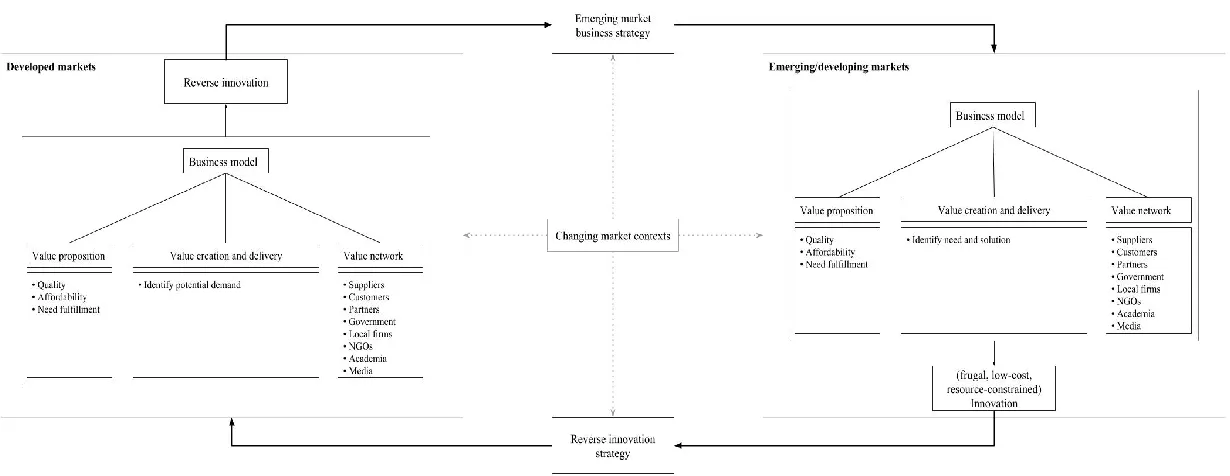
Based on the reviewed literature, the conceptual framework as portrayed in figure 1 has been developed. The strategy of an organisation depicts its vision, which can be realised through an organisation’s business model. For an organisation to be able to engage in reverse innovation, it must develop a strategy fit for the emerging market in which it needs to operate. This strategy can then be employed through the development of a business model fitting to that particular emerging market. The framework of the business model in this research is made up of the organisation’s value proposition, value creation and delivery, and value network. How the organisation identifies the necessities of each element can be done through strategic analysis.
Markets tend to be dynamic, reacting to changing market conditions. Due to globalisation, markets are in constant flux. These changing market contexts have an influence on both the organisation’s strategy and business model. This influence is shown in figure 1 by the dotted line arrow, directing at both strategy and business models. A change in market conditions, means that a change in strategy and business model may also be required.
A company may decide to engage in a strategy focused on reverse innovation. If it has successfully developed an innovation for the emerging markets, it may also start to consider the possibility of adapting and diffusing this innovation to the developed economies.
literature on reverse innovation points to several suggestions, such as the establishment of LGTs, or partnerships with local organisations in emerging and developing markets (Immelt et al., 2009; Sarkar, 2011; Ernst et al., 2015), which refers to the value network dimension.
4. Research methods
This chapter will focus on the overall research design, including the research strategy, intended data collection methods and the purposive sampling used to select a couple of companies that represent case studies on proactive reverse innovation. The case studies provide for comparative analysis concerning the central research question at the basis of this research paper.
4.1 Research strategy
4.2 Data collection
For the literature review, secondary data was collected through the electronic database Scopus, Web of Science and FindUT. From these databases articles were selected that were accessible using the University of Twente credentials. Using the keyword “reverse innovation” in Scopus eventually led to 45 articles, of which access was granted to 23. The full search query for the Scopus database can be found in appendix II. Through the Web of Science database, eventually 28 documents could be accessed that had “reverse innovation” as a keyword. Similarly, using the FindUT database, access was provided to 22 articles. The full search queries for Web of Science and FindUT can also be found in appendix II. Besides these databases, articles were also used using Google Scholar. It is worth to mention many of the articles did not strictly limit themselves to reverse innovation, but also included other innovations occurring in emerging markets, such as frugal innovation and low-cost innovation in general.
To understand how organisations can operate in these emerging markets, the literature search for emerging markets was a result of snowballing from the reverse innovation literature. Although some literature hints to the importance of business models for organisations conducting reverse innovation, none of the articles went in depth on this matter. To understand the phenomena of business models, the most influential works such as that of Chesbrough and Rosenberg (2002), Amit and Zott (2001, 2010, 2013) and Teece (2010) were reviewed, and from there it snowballed into other literature. Besides this snowball effect, literature on business models with a specific focus on organisations operating in emerging markets was also reviewed. Furthermore, to get a better understanding of the nexus between a business model and strategy, literature was also reviewed on this topic, such as Casadesus-Masanell & Ricart (2010).
reports, press releases and articles. Furthermore, other media websites were consulted such as newspapers and previously conducted interviews with the leadership of these organisations. In addition, previously conducted case studies of the sampled organisations were also reviewed. The articles for these case studies were found through the University of Twente’s electronic library, Google Scholar, the wider Internet and published books.
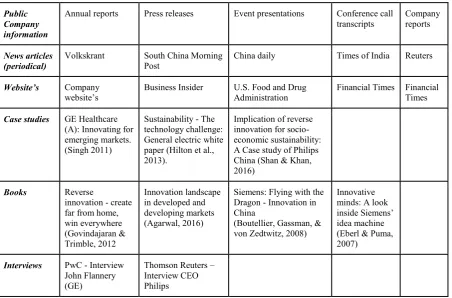
[image:26.595.74.527.449.747.2]To enable a comparative analysis, the gathered information was combined and outlined in an individual case description for each sample organisation. A brief overview of data sources can be found in table 1. The data sources are grouped by each individual case study. By reviewing an extensive amount of sources, the data was collected and integrated in a separate case description for each company. To increase the validity of the data sources used, all sources were cross-checked to verify their legitimacy. An elaborate overview of the data sources used to build each case description is provided in Appendix III. The use of multiple sources enhances the construct validity of this research (Yin, 1994).
Table 1 - Brief overview of data sources
Public Company information
Annual reports Press releases Event presentations Conference call
transcripts Company reports
News articles
(periodical) Volkskrant South China Morning Post China daily Times of India Reuters Website’s Company
website’s Business Insider U.S. Food and Drug Administration Financial Times Financial Times Case studies GE Healthcare
(A): Innovating for emerging markets. (Singh 2011)
Sustainability - The technology challenge: General electric white paper (Hilton et al., 2013).
Implication of reverse innovation for socio-economic sustainability: A Case study of Philips China (Shan & Khan, 2016)
Books Reverse
innovation - create far from home, win everywhere (Govindajaran & Trimble, 2012
Innovation landscape in developed and developing markets (Agarwal, 2016)
Siemens: Flying with the Dragon - Innovation in China
(Boutellier, Gassman, & von Zedtwitz, 2008)
Innovative minds: A look inside Siemens’ idea machine (Eberl & Puma, 2007)
Interviews PwC - Interview John Flannery (GE)
4.3 Sampling
The sample for the cases is based on purposive sampling and this resulted in the selection of three corporations namely, Siemens A.G., General Electric, and Royal Philips as examples of global companies which, among others, are focused on healthcare technology. The healthcare technology industry was chosen as the industry scope, with a view to strengthen the comparative quality of this research. The three above-mentioned MNCs have been chosen because: a) they are well-known Western MNCs; b) they have been known to proactively engage in the process of reverse innovation, and c) of the public availability and accessibility of relevant information. The purpose is to study how the business models of these organisations allowed them to foster and engage in reverse innovation.
Table 2 - Overview of chosen companies
Company Focal industry Reverse innovation examples
Siemens A.G Healthcare Health Technology SOMATOM (CT scanner) General Electric Healthcare Health Technology Vscan (ultrasound)
Royal Philips
Healthcare Health Technology VISIQ (ultrasound) Personal Health Domestic Appliances Soymilk maker
4.4 Data analysis
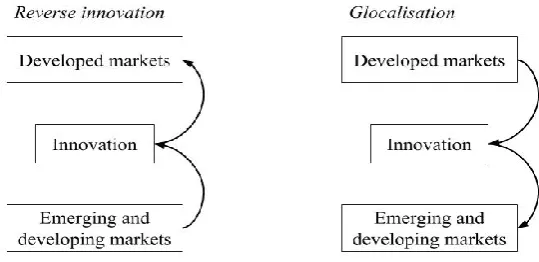
As mentioned earlier in chapter 2.1, for the purpose of this research reverse innovation is regarded as any innovation that has been developed for emerging markets and has subsequently been introduced in developed markets (Immelt et al., 2009; Govindarajan & Ramamurti, 2011; Zeschky et al. 2014). As figure 2 illustrates, reverse innovation is the opposite of what is known as glocalisation. With glocalisation the intent is to introduce products and services that have been innovated and marketed in developed markets first, to emerging and developing markets with or without slight alterations.
Figure 2: Reverse innovation vs. Glocalisation (Author's own illustration)
In order to judge if there is reverse innovation, it must be clear that an organisation has developed a product or service specifically for the emerging markets, and was also able to diffuse it to developed markets, with or without some minor adaptations. This was a key requirement for the case selection, which is why the sampling strategy was based on purposive sampling. In establishing whether organisations fit to these preconditions, a background research was conducted.
Analysing a business model in its entirety for each organisation is a cumbersome and unwieldy task (Casadesus-Masanell & Ricart, 2010). While, as was already explained in the literature review, no single definition exists on business models, throughout the semantic discussion considerable agreement can be found on the key elements that make up a business model, as described in table 3. This research focuses on those key elements, namely a) the value proposition, b) value delivery and creation, and c) value network.
Table 3 - Key elements of the business model
BM elements Description Authors
Value proposition
What product or service did the organisation offer
that is of value to its customers Chesbrough & Rosenbloom, 2002; Johnson, et al., 2008; Osterwalder & Pigneur, 2009; Teece, 2010; Casadesus-Masanell & Ricart, 2010; Zott & Amit, 2013; Cortimiglia, et al., 2016; Tallman et al., 2017
Value creation & delivery
The value chain activities of the organisation and the resources and capabilities that enabled the development of the customer value proposition
Amit & Zott, 2001; Chesbrough & Rosenbloom, 2002; Teece, 2010; Zott & Amit, 2010, 2011, 2013
Value network
Resources provided to the companies' by external stakeholders, such as suppliers customers, complementors and competitors, that aided in the development of the product.
Chesbrough & Rosenbloom, 2002; Demil & Lecoq, 2010; Zott & Amit, 2010; Tallman et al., 2017
5. Case descriptions
The case selection covers three western MNCs that have been successful at developing products for emerging markets, and that subsequently diffused these products in developed markets. In this section the key characteristics of these organisation’s business models are presented and discussed. The comparative analysis, identifying similarities or what sets these business models apart, will be presented in section six.
The three global companies that were chosen for this study all concern technology companies that are partially focused on healthcare technology. The case descriptions of these companies’ experiences highlight each organisation’s strategy and key elements of their business models that have contributed to their reverse innovation successes. Some of these reverse innovation successes are also described in the case study of each company. The first case covers the endeavours undertaken by the German company Siemens A.G, and more specifically by its healthcare division, which since 2014 is an independently managed unit under the Siemens A.G. umbrella called Siemens Healthineers (Siemens - Vision 2020, 2014) and which was recently floated as an independent company in March 2018. The second case covers the undertakings of the General Electric (GE) Healthcare division. The third case concerns Royal Philips, which has transformed itself into another major western health technology firm, especially after having spun off Philips Lighting as an independent company in 2016.
Morgenstern, 2012; Guillén, 2017). By the year 2020 the global healthcare spending is expected to reach $8.7 trillion, of which one third will be accounted for by emerging markets (Deloitte Touche Tohmatsu Limited, 2018; World Economic Forum, 2014). Besides the growing market potential, emerging markets also enable the companies to innovate and create healthcare solutions that can eventually be used in the developed markets – where costs have increased significantly – what makes these western MNC health technology firms to pursue reverse innovation. Another factor that played a role is that this strategy also allows them to stay ahead of the growing competition from emerging market MNCs (Guillén, 2017).
Two major demographic trends, the growing and aging population, are driving continued growth in demand for healthcare technologies trends and the driving force behind the R&D investments. Related to the trend of ageing are the sharply rising costs in healthcare. In ageing societies, an ever-larger proportion of healthcare costs tend to be dedicated to diagnosis and treatment of non-communicable diseases. Healthcare technologies can provide huge efficiency gains in these areas. Focusing on the healthcare divisions of Siemens A.G., General Electric, and Royal Philips, not only provides insight in how their business models facilitated their strategies to pursue reverse innovation in the emerging markets, but also enables a comparison between these three companies, which will be discussed in section six.
5.1 Case 1: Siemens Healthineers
5.1.1 Company information.
Siemens Healthineers is a global supplier of technology to the healthcare industry. It is a leader in imaging and laboratory diagnostics and also provides software solutions and clinical consulting services (Siemens A.G., 2015). The company is headquartered in Erlangen, Germany and employs over 46,000 people worldwide (Siemens Healthcare GmbH, n.d) generating Euro 13.6 billion in total revenues in 2017 (Siemens A.G., 2017a). While a large part of its R&D and production facilities are located in Germany and other developed markets, over the past 15 years the company has increasingly sought to establish R&D and production capacity in emerging markets, notably China. The following paragraphs are dedicated to provide a brief history of how Siemens Healthineers came about and what its plans are for the near future. This subsection also provides an impression on the company's engagement with emerging markets.
Advances in digital technologies and information processing, coupled with a growing demand for access to these technologies by the rapidly growing populations of emerging markets, made healthcare technologies an increasingly important part of Siemens. In 2001 this division was named Siemens Medical Solutions, which changed to Siemens Healthcare in
2008. In 2014 Siemens A.G. restructured itself and transformed the Healthcare Division into a
experienced expansion “…due to population and income growth in emerging markets…”
(Siemens A.G., 2016a, p. 7). Siemens Healthineers placed emphasis on becoming the leader in imaging systems, reflective of the fact that since 2010 the number of patients in emerging countries with access to the Siemens imaging systems increased from 760 million to 1,270 million in the year 2016 (Siemens A.G., 2016b).
Further change came in March 2018, when Siemens launched an initial public offering of Siemens Healthineers, whereby the former health division will continue as a completely separate company (Hübner & Scheutze, 2018). This move aims to better reflect the stand-alone value of this former business division of the large Siemens conglomerate. It will also allow the business to become more flexible and able to better respond to the growing competition, anticipate future changes, inter alia to enable it to generate the funds required for acquiring other firms or investments for organic growth in the healthcare sector (Hübner & Scheutze, 2018).
entry level products that could be marketed at a much lower price, while staving off increasing competition (Siemens A.G., 2014b).
Following the demographic trends the healthcare sector is experiencing, Siemens tries to supply healthcare providers with efficient and effective healthcare measures (Siemens A.G., 2014b). One of the R&D practices of Healthcare also concerns the development of products that meet the specific, targeted requirements of the healthcare systems of emerging markets (Siemens A.G., 2014b). The growth of Siemens Healthcare over the past years was in part driven by emerging markets and the company expects these markets to grow at a faster rate than the developed economies (Siemens A.G., 2015; Siemens A.G., 2016a), as emerging economies are still building up their healthcare infrastructure to provide everyone, including rural areas, with access to affordable medical technology (Siemens A.G., 2015).
Siemens has established R&D hubs in many emerging markets, including India (Jayakumar, 2010), but China seems to be the ideal innovation location for Siemens. China now represents Healthineers´ second largest market and it now has three important large R&D and manufacturing sites. These include the Siemens Shanghai Medical Equipment Ltd. (SSME), the company’s only CT R&D and manufacturing hub outside of Germany, for the development of CT and X-ray systems (Siemens A.G., 2017d). The development of X-ray tubes is done in the only R&D and manufacturing base outside of Germany, called the Siemens X-ray Vacuum Technology Ltd. (SXVT) located in Wuxi (Siemens A.G., 2017d). Likewise the only R&D and manufacturing base for magnetic resonance imaging (MRI) outside of Germany is the Siemens Shenzhen Magnetic Resonance Ltd. (SSMR), which operates in close collaboration with headquarters in Erlangen, Germany and a site in Oxford, U.K. (Siemens A.G., 2017d). The SSMR base is further divided into Angiography Imaging (AX) and Component and Vacuum (CV) (Siemens A.G., 2017d).
important move to strengthen its ability to support Chinese healthcare reform, aiming to deliver better outcomes at a lower cost to its customers (Siemens Ltd, China, 2016).
Besides close partnering with Government, in cooperation with China International Medical Foundation (CIMF), Siemens Healthcare supports “Healthy China” initiative and from 2012 till 2015 hosted trainings for doctors and hospital presidents in rural areas (Siemens A.G., 2014d). Siemens has a long tradition of creating partnerships with top universities, which helps the company in on-campus recruiting, but also in creating goodwill and potential future demand for its products, for instance by the medical doctors that graduated from those universities. In China, Siemens has also established partnerships with many universities and vocational schools, where it helped build university and institutional labs (Siemens A.G., 2017c). Siemens also provides scholarships to promote cooperation on scientific and technical exchanges, as well as talent cultivation. For example, Siemens established an educational scholarship in medical physics with Tsinghua University, and created the Siemens Management Institute in Beijing. It also sponsors the “Siemens Cup” China Intelligent Manufacturing Contest for 10 years to support development of innovative engineering talents (Siemens A.G., 2017c). These efforts were made to tackle the typically high attrition rates in this field (Donoghoe et al., 2012).
5.1.2 Some reverse innovation successes.
Multix Select DRdigital X-ray system
Siemens’ similar X-ray machines (Siemens A.G., 2011c). This made the device attractive for small and medium-sized hospitals in emerging markets, as well as to small hospitals and private practices in developed countries (Siemens A.G., 2012). This X-ray system has received clearance from the U.S: Food and Drug Administration (FDA) in 2014 (Siemens Medical Solutions USA, Inc., 2014).
Besides affordability and reliability, the Multix Select DR was also developed to be easy in use, with a robust and efficient design that enables the examination of many patients on a single day, which tends to be quite common in emerging market hospitals (Siemens A.G., 2012). Whereas comparable X-ray devices are stationary and have multiple detectors that are separate, in order to be able to x-ray patients when lying down or standing up, the Multix Select DR is mobile and can be positioned to take different images of patients (Siemens A.G., 2012).
For the development of the X-ray system, the Siemens’ Shanghai facility received assistance from other divisions in Germany, India and Spain; the German R&D centre provided the developers in Shanghai with training, whereas the Indian colleagues contributed their know-how to the design of mechanical subsystems and the X-ray table, and the engineers from Spain provided the digital imaging software (Siemens A.G., 2012). The X-ray system is produced in Shanghai, and from there it is also shipped to distribution centres in Germany and Brazil. The German distribution depot, assembles and tests the X-ray devices before delivery to customers in Europe. The same accounts for Brazil, from where it is distributed throughout South America (Siemens A.G., 2012).
Computed tomography (CT) scanners
and aimed to serve the local and global market (Boutellier et al., 2008; Dubiel & Ernst, 2013). Most of these CT scanners were developed with the Siemens’ SMART criteria in mind (Dubiel & Ernst, 2013).
SOMATOM Smile. In the year 2000, Siemens introduced the world’s most compact and cost-effective CT scanner for the entry-level segment such as private radiology practices and smaller medical facilities in China, Southeast Asia and Brazil, which is known as the SOMATOM Smile (Boutellier et al., 2008; Siemens Healthcare GmbH, 2015). The SOMATOM Smile won the Design Prize of the Federal Republic of Germany in 2002 and the iF Design Award in China in 2003 (Boutellier et al., 2008; Siemens Healthcare GmbH, 2015).
SOMATOM Spirit. The successor of the SOMATOM Smile was the SOMATOM Spirit, which was completely developed by the Siemens R&D hub in Shanghai (Siemens A.G., 2010). The SOMATOM Spirit received clearance on September 14, 2004 (Food and Drug Administration, 2014, p. 5) and was introduced that same year (Business Wire, Inc., 2004). This device was designed for the local market and rural areas as an entry-level scanner, mainly used for clinical routine examinations (Siemens A.G., 2010). However, this device has since also been well received in the global market as an entry level CT (Dubiel & Ernst, 2013). The main reason it was also received well in developed and ageing countries, is because healthcare providers are increasingly coming under cost pressure (Eberl & Puma, 2007).
diagnostic purposes ranging from 60 to 100 patients per day, as opposed to 20 to 30 patients per day in European hospitals (Siemens A.G., 2005; Eberl & Puma, 2007). To ensure that the device was easy in use, the SOMATOM Spirit device only has the basic necessities of a CT scanner (Eberl & Puma, 2007). In the end, while all value-chain activities took place in the Shanghai R&D centre, the development was an international effort (Eberl & Puma, 2007).
The development of the SOMATOM Spirit was again done under Siemens’ SMART strategy; simple, maintenance-friendly, affordable, reliable and timely-to (Siemens A.G., 2010).
SOMATOM Emotion 16-slice CT scanner. The SOMATOM Emotion 16 received
The country-level hospitals in China provide healthcare to around 70 percent of the population (Siemens A.G., 2014d), and use the 16 slice CT scanners for diagnostics purposes on many patients every day. For this purpose the SOMATOM Emotion IRIS 16 slice CT was developed. This device is built for efficiency and quality (Siemens A.G., 2014d).
SOMATOM Scope. In addition, the R&D hub of Siemens in Shanghai introduced the independently developed SOMATOM Scope, a 16-slice CT scanner, in the year 2014 (Siemens A.G., 2017d). This CT scanner was also developed for the entry-level segment, representing 35% lower operating costs (Siemens A.G., 2014c). Siemens has offered the CT-scanner in two editions, the cost-effective SOMATOM Scope, for entry level and the SOMATOM Scope Power, a more higher-end product (Siemens A.G., 2014c). On September 15, 2014 both CT scanners received FDA clearance for sales in the US (Food and Drug Administration, 2014).
5.1.3 Main factors contributing to reverse innovation success
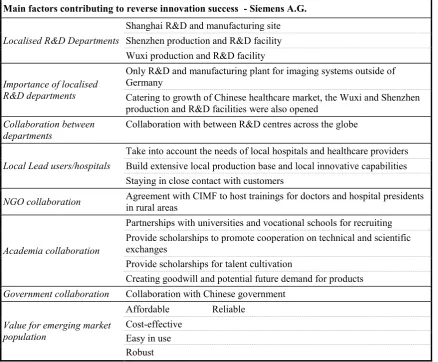
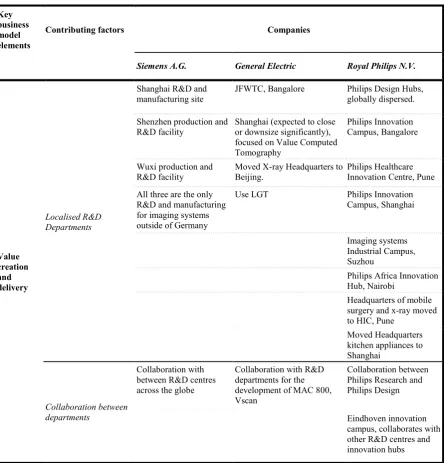
Table 4 - Main factors contributing to Siemens A.G. reverse innovation success
Main factors contributing to reverse innovation success - Siemens A.G.
Localised R&D Departments
Shanghai R&D and manufacturing site Shenzhen production and R&D facility Wuxi production and R&D facility
Importance of localised R&D departments
Only R&D and manufacturing plant for imaging systems outside of Germany
Catering to growth of Chinese healthcare market, the Wuxi and Shenzhen production and R&D facilities were also opened
Collaboration between departments
Collaboration with between R&D centres across the globe
Local Lead users/hospitals
Take into account the needs of local hospitals and healthcare providers Build extensive local production base and local innovative capabilities Staying in close contact with customers
NGO collaboration Agreement with CIMF to host trainings for doctors and hospital presidents in rural areas
Academia collaboration
Partnerships with universities and vocational schools for recruiting Provide scholarships to promote cooperation on technical and scientific exchanges
Provide scholarships for talent cultivation
Creating goodwill and potential future demand for products
Government collaboration Collaboration with Chinese government
Value for emerging market population
Affordable Reliable Cost-effective
5.2 Case 2: General Electric Healthcare
5.2.1 Company information.
General Electric Healthcare comprises the healthcare business of GE, an industry in which GE has been active for more than 100 years (GE Healthcare, n.d.a). Until 2016 GE Healthcare headquarters were in the United Kingdom, but has since moved to Chicago in the United States (General Electric, 2017b). GE Healthcare focuses on harnessing data and analytics across hardware, software and biotech (GE Healthcare, n.d.a) and is currently structured around nine primary business units (GE Healthcare, n.d.b). Its sales in 2017 topped $19 billion and it employs circa 50,000 employees in 100 countries (GE Healthcare, n.d.a) and serves customers in approximately 140 countries (General Electric, 2017b). Sales have been relatively flat for GE Healthcare since 2008 when sales stood at 17.4 billion (General Electric, n.d.a).
In its long history, most of General Electric´s R&D and production facilities used to be located in North America and other developed markets. However, as globalisation helped developing countries to transform into emerging markets, GE wanted to be part of that process and over the past 25 years the company has increasingly sought to establish R&D and production capacity in emerging markets. At present, the biggest R&D centre of GE Healthcare outside the United States is located in Bangalore, India (General Electric, 2017a).
cellular technologies; Magnetic Resonance (MR), provider of MR imaging systems; Molecular Imaging & Computed Tomography, providing CT systems, positron emission tomography (PET), diagnostic tools that use nuclear medicine, and PET Radiopharmacy providing complete solutions that enable access to PET; Surgery, which provides tools and technologies that help guide minimally invasive surgical procedures; Ultrasound, providing portable, non-invasive and non-ionizing imaging devices.; and Global Services, developing and delivering quality, productivity and service solutions for healthcare providers worldwide (GE Healthcare, n.d.b).
While it has offices around the globe, GE Healthcare has major regional operations in Yizhuang (suburb of Beijing), China; and Bangalore, India. It also has major R&D facilities in both China (notably Shanghai) and India (Bangalore) (Singh, 2011).
China Innovation Centres (CIC) in Chengdu, Xi’an and Harbin (General Electric, n.d.e; General Electric, n.d.f). Within the Healthcare division the CICs connect Chinese customers and GE engineers to jointly develop primary health-care solutions (General Electric, 2014d). In 2014, GE Healthcare innovation’s resulted into the development of over 40 products since 2010, of which 70% were designed for county and rural hospitals and clinics (General Electric, 2014d).
To foster this growth, the company collaborated with the Chinese government to develop affordable healthcare, provided local healthcare professionals with training and boosted medical distribution networks across China (Badkar, 2011). In addition, GE partnered with the Chinese Medical Doctors Association (CMDA) to provide training to over 2,000 doctors in county and rural hospitals over the course of 2014 (General Electric, 2014d).
GE in India. Having a presence in India since 1902 (General Electric, 2015), it was not until the early 1990’s that this presence started to intensify (PwC, 2013a). In 2000 General Electric (GE) started with building a multidisciplinary R&D lab in Bangalore, India, called the John F. Welch Technology Centre (JFWTC). This was GE’s first largest R&D centre outside the United States (General Electric, 2017a). However, the JFWTC in India, was initially solely focused on premium priced technology destined for the global (developed) markets (Ramdorai & Herstatt, 2015), and not on commercial applications tailored to the domestic market in India (PwC, 2013a). The main driver to create a presence and establish R&D centres in India was to have access to a vast amount of engineers (Leahy, 2010) at a much lower cost than in the developed markets. This also led to the establishment of other sites for its R&D efforts, such as the CTC in Shanghai, China (Singh, 2011; General Electric, n.d.c).
2013a). As the pace of change, inter alia through the use of information and communication technologies, has become faster, GE needed to rethink its business operations, as it was difficult to be a centralized business whilst also being effective simultaneously in emerging markets (PwC, 2013b).
For the Indian market, this meant that GE healthcare needed to pinpoint the actuality of the healthcare situation. The organisation started looking at the operations of healthcare providers in rural areas in terms of the labour skills, the funds they had and how much their customers were able to pay (PwC, 2013c). The organisation moved from a technology backed product development approach towards a “market-backed” product development focus (PwC, 2013c). Thus, it firstly identified a need and based product features and technological necessities on this need to provide a solution. GE is optimistic that products developed in India can eventually be diffused to developed markets, as the healthcare costs in Europe and the USA are rising (PwC, 2013c).
In India this increased focus on emerging markets has also led to establishing partnerships with several Indian companies across various businesses, such as, BHEL (engineering and manufacturing), State Bank of India, Wipro (IT services) and Triveni (engineering and industry) (General Electric, 2014c). For instance, GE Healthcare and Wipro created a 51:49 joint venture to gain a larger foothold in the Indian market (The Hindu Business Line, 2011). This joint venture aims at developing, selling and manufacturing 50-70 percent of the products in India, with the intent to export them (The Hindu, 2009). GE Healthcare also formed partnership with other organisations, such as the Bill and Melinda Gates Foundation, the National Institutes of Health, the University of Washington and Columbia University (General Electric, 2014b).
the machine required specialized skills (Govindarajan & Trimble, 2012). Over the past years, in order to be able to grow, GE Healthcare has focused more on the emerging markets (Trefis Team, 2014) and emphasized on market-backed innovation for the development of new products that suit the local environment (GE Healthcare, 2011; PwC, 2013c). The Bangalore R&D centre increased its emphasis on the development of products that addressed local needs and were also affordable and more importantly, accessible also by the rural population (Govindarajan & Trimble, 2012).
also consumers, governmental organisations, competitors, cooperation partners and employees (Herhausen, Trumann, & Schögel, 2011). With the healthymagination initiative, the company embraced open innovation by including internal and external partners of GE to drive its innovation capabilities. Furthermore, by combining GE Ventures with healthymagination the company invests in start-ups and entrepreneurs, giving them access to company resources and expertise, thus allowing the same to accelerate growth and commercialise innovation ideas (Herhausen, Trumann, & Schögel, 2011; General Electric, 2014a; General Electric, n.d.g). With this initiative and the establishment of the Bangalore R&D centre in India, GE emphasised the fact that an increasing part of its operations focuses on emerging markets, stepping away from its traditional focus on developed market customers (Ganguly, 2010; Singh, 2011).
In 2015 GE Healthcare created a new business unit, Sustainable Healthcare Solutions (SHS), for the development of robust and value-based products to strengthen its affordable healthcare portfolio (Business Wire Inc., 2015). GEs SHS business is committed to the UN Sustainable Development Goal (SDG) number 3. The UN SDG 3 is aimed at ensuring healthy lives and promoting wellbeing for everyone at any age (United Nations, n.d.).
Whilst having created an extensive network of global research centres, GE has announced serious downsizing with increasing pressure of shareholders to cut down costs. One such effort has been to streamline its global research centres from nine to only two, the JFWTC in Bangalore and the global research site in Niskayuna, New York (General Electric, 2018). Although no longer conducting corporate research in Shanghai the company says to be doubling down on localisation in China (He, 2017), yet sheds one of its R&D labs with
5.2.2 Some reverse innovation successes.
MAC 400 Electrocardiogram (ECG). In 2005, engineers in the Bangalore R&D centre started the development of a portable electrocardiogram (ECG) machine that could be used in rural areas and be affordable for the population in these areas (GE Healthcare, 2011; Govindarajan & Trimble, 2012). An (LGT) was established to identify the requirements for this new ECG device, and build it from the ground up (Govindarajan & Trimble, 2012). The LGT first established a price point that would be acceptable, and from there looked at ways in which it could develop the ECG (Mukerjee, 2012), by combining existing resources in a different manner to serve the customers (Tallman et al., 2017; Govindarajan & Ramamurti, 2011). The result was the MAC 400, a compact ECG device that was developed and manufactured in India for India (General Electric, n.d.d).
The State Bank of India provides rural doctors with no-interest loans, and through its partnership with this bank, GE was able to provide the ECG device in rural areas (Mukerjee, 2012). Besides being sold in India the product was also sold in Europe, however not in the United States or Canada, because here the MAC 800 ECG device is sold (Govindarajan & Trimble, 2012). As in Bangalore, a GE Healthcare LGT situated in China wanted to develop a ECG device that was suited to the Chinese market. Building upon the accumulated knowledge of the Bangalore LGT the Chinese team developed the MAC 800 ECG (Singh, 2011).
Vscan. In 2010 GE introduced the Vscan, a hand-held portable ultrasound device (General Electric, n.d.d) that was derived from an earlier model developed for rural China in 2002, known as the Logiq Book (Govindarajan & Trimble, 2012; Zeschky et al., 2014).
from Norway and the user interface from France, and system integration from the USA and eventually manufacturing expertise from China (Hilton, et al., 2013). The Vscan was developed for antenatal care in developing markets, where it could also be used in rural areas by making it lightweight, and solar-charged (Karti, 2014). Its design enables healthcare providers to travel to the remote community clinics (General Electric Company, 2013), and it has been made easy in use, so that paraprofessionals can also use this device (Karti, 2014). To date, the Vscan has become commercially available not only in China and India, but also in North America and Europe (General Electric, 2012). The device has received FDA clearance, Medical Device License from Health Canada, and the CE Mark by the European Union (General Electric, 2010b). To date, the device has now been rolled out in over 100 countries (General Electric, 2014e).
The Norfolk and Norwich University Hospital (NNUH) in England have been given a National Health Service (NHS) funding to provide for 25 Vscans, that helps the NNUH diagnose breech positions when women arrive in the hospital during labour and those who come in for induction (GE Healthcare, 2016b). The NNUH is used as a pilot site, to determine how the device aids the NNUH in assessing the breeches (GE Healthcare, 2016b).
Lullaby Warmer. Where the Vscan is aimed at the antenatal care in developing countries, GE is also geared towards new-born care (Karti, 2014). The Lullaby Warmer, is an example of reverse innovation in new-born healthcare (Karti, 2014). The Lullaby Warmer is an incubator that was brought to market in 2009, approximately 70% less-expensive than traditional incubators, aimed at reducing infant mortality rates in India (Govindarajan & Trimble, 2012; Kannan, 2013; General Electric Company, 2013; Karti, 2014). Developed at the JFWTC, it was designed with the Indian The Lullaby warmer was developed in the Bangalore centre (Govindarajan & Trimble, 2012). It was designed with the Indian market in mind and its use in rural areas, e.g. by reducing the power usage in comparison with traditional baby warmers (General Electric Company, 2013). In addition, the design of the Lullaby Warmer facilitates less skilled, and illiterate healthcare workers to operate this device, by giving it a colour coding and photographic warnings (Kannan, 2013). The Lullaby Warmer is now sold in over 80 countries, including developed countries such as Belgium and Switzerland (General Electric Company, 2013).
Lullaby LED Phototherapy. In addition to the Lullaby Baby warmer, GE’s Bangalore R&D centre has developed the Lullaby LED Phototherapy for the Indian market (Kellner, 2012; General Electric Company, 2013). This system treats neonatal jaundice and has since its inception found its way into European maternity wards (Kellner, 2012). Again, both the Lullaby Warmer and the Lullaby LED Phototherapy have been developed with the MDGs 4 and 5 in mind (General Electric Company, 2013).
scanner (General Electric, 2013). It has been developed to be a compact and easy to use CT scanner, at an affordable price, which makes it accessible to clinics and hospitals in rural areas (General Electric, 2013). The at the time product manager of GE Healthcare in China, called this CT scanner “reverse innovation at its best” (General Electric Company, 2011, p. 10).
Revolution ACTs. Following the ‘Make in India’ commitment, GE introduced the Revolution ACTs, a CT scanner developed in India (General Electric, 2015) and manufactured at GE Hangwei Medical Systems Co., Ltd. (Food and Drug Administration, 2017). In collaboration with healthcare providers from rural and urban settings, GE created an affordable, cost-effective and easy to use CT scanner (General Electric, 2015). The development of the CT scan was steered towards healthcare providers in India, however, the CT scanner is currently also commercially available and in clinical use in various other countries including Japan, EU countries and China, and has been cleared by the FDA on the 5th of June, 2017 (Food and Drug Administration, 2017).
5.2.3 Main factors contributing to reverse innovation success
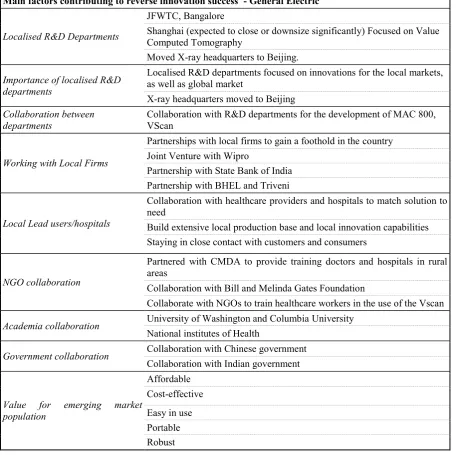
Table 5 - Main factors contributing to General Electric reverse innovation success
Main factors contributing to reverse innovation success - General Electric
Localised R&D Departments
JFWTC, Bangalore
Shanghai (expected to close or downsize significantly) Focused on Value Computed Tomography
Moved X-ray headquarters to Beijing.
Importance of localised R&D departments
Localised R&D departments focused on innovations for the local markets, as well as global market
X-ray headquarters moved to Beijing
Collaboration between
departments Collaboration with R&D departments for the development of MAC 800, VScan
Working with Local Firms
Partnerships with local firms to gain a foothold in the country Joint Venture with Wipro
Partnership with State Bank of India Partnership with BHEL and Triveni
Local Lead users/hospitals
Collaboration with healthcare providers and hospitals to match solution to need
Build extensive local production base and local innovation capabilities Staying in close contact with customers and consumers
NGO collaboration
Partnered with CMDA to provide training doctors and hospitals in rural areas
Collaboration with Bill and Melinda Gates Foundation
Collaborate with NGOs to train healthcare workers in the use of the Vscan
Academia collaboration University of Washington and Columbia University
National institutes of Health
Government collaboration Collaboration with Chinese government
Collaboration with Indian government
Value for emerging market population
Affordable Cost-effective
5.3 Case: Royal Philips
5.3.1 Company information.
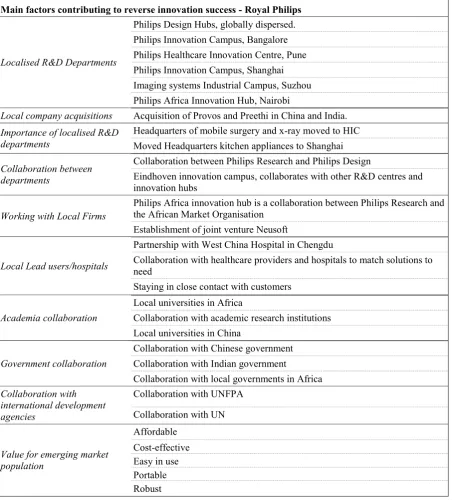
Royal Philips N.V. (henceforth referred to as Philips) is a Dutch health technology company, with a current sales portfolio of 17.8 billion euros, employing 74,000 people worldwide in over 100 countries (Koninklijke Philips N.V., n.d.a). Founded in 1891, the company started as an electric light bulb manufacturer, and quickly became one of Europe’s largest producers (Koninklijke Philips N.V., n.d.b). In 1918 the company diversified by adding X-ray and radio reception to its product lines, started protecting its innovations with patents and started to establish a sales organisation throughout Europe (Koninklijke Philips N.V., n.d.b). Over time it became a global consumer electronics firm, famous for the many innovations that it generated (video, CD, laserdisc, etc.), but which it was not always able to bring to market successfully, and for some large and well-known companies that it spun-off (notably ASML and NXP that both nowadays surpass Philips in market value).
In 2004, Philips repositioned its branding towards “Sense and Simplicity” reflecting the ambition to create more meaningful innovations, that make sense in the lives of people (Koninklijke Philips N.V., 2005). In the same year Philips set up a new business unit named Consumer Health & Wellness, tapping into the large personal healthcare and monitoring market (Koninklijke Philips N.V., 2005).