1431
©IJRASET: All Rights are Reserved
A Survey on Image Clustering using Soft
Computing Techniques
Megha Singhal
1,
Jaimala Jha
21, 2Department of CSE & IT, MITS College, Gwalior, India
Abstract: This paper includes detailed study of image clustering and the many algorithms of soft computing for image clustering. This paper gives a standard survey of image clustering. Specifically, it first instigates the basic knowledge for a good understanding of image clustering. Then some soft computing based image clustering algorithms are introduced. Finally, it concludes a better algorithm which is offered in image clustering based study by which it can find a similar cluster with great accuracy.
Keywords: Image Clustering, Methods, Properties, Algorithms, Representation.
I. INTRODUCTION
Image Clustering is a vast problem in computer vision and image processing system. A large quantity of input images or data is import to the clouds for sharing and storage. How can efficiently be organizing a large number of images data, this is an emerging and challenging issue.[1]
The aim of image clustering is that, grouping of homogeneous images in the same cluster with no outliers or minimum outliers. While similarities among images within the cluster are maximal similarities among images from dissimilarities of clusters are different.[2] “Clustering” algorithm basically are of two types: Partitional clustering and Hierarchical clustering. Partitional clustering is that in which decompose a data set into disjoint clusters and the Hierarchical clustering is that in which build a hierarchy of clusters.[3]
1432
©IJRASET: All Rights are Reserved
Example of Clustering the Image Dataset
A. Analysis of Existing Contribution of Techniques and Method
In this analysis, we study some algorithms or methods of image clustering like PSO, In [5,6] work on a Particle Swarm Optimization algorithm. In [5] the PSO works with the two fitness function and it compares with K-mean than the result is that PSO is better than the K-mean. And in [6] hybrid method is proposed based on merge the PSO with K-mean. This method is based on four features for estimate similarities: Features are color histogram, color moment, co-occurrence matrices and wavelet moment. According to [6] PSO is better than the CBIR.
Another one is the Artificial Bee Colony algorithm, in [9,10] work on ABC. In [9] ABC is used for image clustering on standard problem. And it compares with PSO than it takes a better result. In [10] ABC is used to select the novel feature of images. By these relevant features are suppressed and reduce the initial input.
The other is Deep Adapting Learning, In [11] DAC is work on single stage convent-based for clustering those image whose recast the clustering problem into a binary pairwise classification framework to check images belong to the same cluster.
The next is K-medoids in [16] two feature uses one is feature extraction and the second is Edge Histogram Descriptor (EHD) The K-medoids algorithm is applied on EHD to make a good cluster and increase the accuracy of the system.
The next is Unsupervised Convolution Neural Network in [17,18] work on UCNN. In [17] UCNN work on learning better features and representation of the image and make the cluster more accurate. In [18] improved the performance of large-scale image dataset based on iteration between an updating cluster centroid by using Fuzzy Rough C-Mean algorithm and UCNN.
In [19] Content Based Image Retrieval on Visual Features it means that in which having the comparison between the three features of image: color, shape and texture, this is very important for studying the image. In this paper also give the mathematical expression for performance assessment of query image and input image.
The next one is Fuzzy C-means, In [21, 22] work on this algorithm. In [21] “Diverse Fuzzy C-means” is used for clustering the images. This algorithm introducing novel diversity regularization into the traditional fuzzy c-means objective. This diversity regularization surety the learned image cluster centers to be different from each other and to fill the image data space as much as possible. In [22] combine the classical “Fuzzy C-Means” (FCM) and “Backtracking Search optimization Algorithm” (BSA) it is called “BSAFCM” by which it can minimize the objective function of both the algorithm for clustering of images. Then it can improve the local search ability of BSAFCM by proposed the inertia weight parameter (w) for BSA, then it is called as “w-BSAFCM”. The result is that “w-BSAFCM” can successfully solve the problem of image clustering.
Cluster 2
Image Dataset Cluster 1
Cluster 3 I3
I2 I1
I3 I1
I2
1433
©IJRASET: All Rights are Reserved
[image:3.595.49.566.531.727.2]
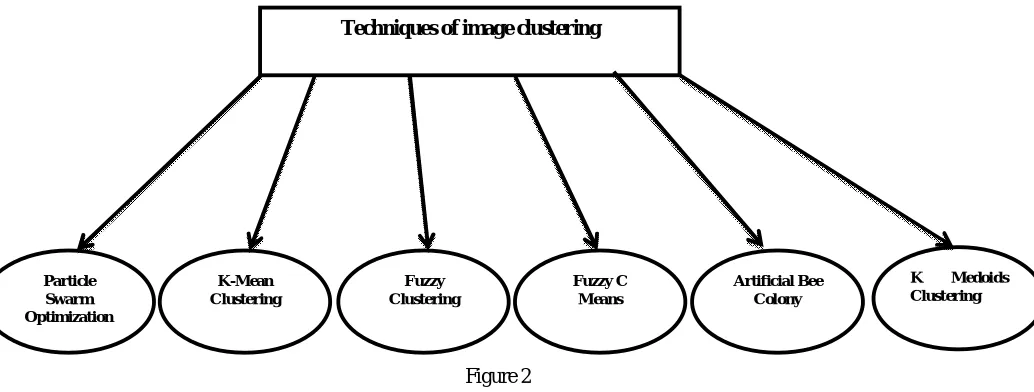
Soft Computing based techniques of image clustering
Figure 2
S. No Year Author Technique Used Used Dataset
1 2011 Man To Wong Particle Swarm
Optimization
Individual Image (pepper, Lena, Airplane)
2 2011 Dervis
Karaboga
Artificial Bee Colony
UCI Database
3 2014 Zeyad Safaa
Younus,
PSO and k-means clustering
Algorithm,
WANG Database(image Dataset)
4 2017 Chih-Chung
Hsu
Unsupervised Convolution Neural Network
ImageNet
5 2017 Jianlong
Chang
Deep Adaptive Image Clustering
MNIST,CIFAR-10,ImageNet-10
6 2017 Ruchi
Jayaswal
K-Medoid Clustering
Coral, Wang, and Oliva
7 2018 Saman Riaz Fuzzy Rough
C-Mean UCNN
MNIST , ILVSVRC, YTF
8 2018 Haidi Rao Artificial Bee
Colony and gradient boosting decision tree
UCI Database
9 2018 Lingling
Zhanga
Diverse Fuzzy c-Means
JAFFE, MSRA50 Handwritten, USPS Caltech101-7, Caltech101-20
10 2018 Güliz Toz backtracking search
optimization algorithm
Individual Image (Lena, Mandrill, Peppers)
Techniques of image clustering
Particle Swarm Optimization K-Mean Clustering Fuzzy Clustering Fuzzy C Means Artificial Bee Colony
1434
©IJRASET: All Rights are Reserved
1) Particle Swarm Optimization: The PSO is a population-based optimization algorithm. It maintains a population of entity, where each entity considers a most possible solution for the optimization problem. Each entity has assigned an arbitrary velocity. The goal of PSO is to detect the entity position that results is the best estimation for the defined fitness function. [9]
2) K-Mean: The K-means clustering algorithm is an unsupervised learning technique. The aim of K-means technique is to find clutches in the data, with the no. of clutches which is represented by the variable K. The K-Mean work on iterative aspects to assign each data sample to one of K group based on the parameters that are assigning. Data points are clustered by using the feature correspondence.
3) Fuzzy Clustering: Clustering is that in which the similar items from the datasets are clustered in a same cluster as possible. It means that the similar items or images are in the similar cluster or different are in the different cluster as possible. And the clusters are making on the basis of similarity measures. The similarities are measure on the basis of dataset.
4) Fuzzy C-means Clustering: The Fuzzy C-Mean is slightly similar as the Fuzzy Clustering. In Fuzzy C-Mean select a no. of cluster than randomly assign a coefficient for every single data point to being in the cluster. Then after calculate the centroid for each cluster and data point.
5) Artificial Bee Colony: The ABC algorithm is used to optimise the numerical problem. It is a precise and population-based optimization algorithm. In ABC having the “colony of artificial bees” in which bees have three groups: employed bees, onlookers and scouts. In which employed bees find the best possible solution according to nectar amount (fitness function) and after it shares the info with onlooker bees. Then later, it checks a food amount if the source of food abandoned than becomes a scout then start to hunt for finding a different food source. [5]
6) K Medoids: The K-medoids algorithm is a partitional clustering algorithm which is slightly modified from the K-means algorithm. This algorithm also called as Partition Around Medoids(PAM) is suggested in 1987 by Kaufman and Rousseuw. Both the algorithm attempt to minimize the squared-error but the K-means algorithm is less robust to noise than K-medoids
algorithm. [1
S.No Technique Method Description Merits Demerits
1. Particle Swarm
Optimization (PSO)
PSO is a population-based optimization technique. It is used to find the particle position.
It is easy to implement and take a short computational time.
It can be difficult to define initial design parameter.
2. K-Mean K-Mean clustering is an
unsupervised learning
algorithm and the aim is to find the cluster in the dataset.
It is simple for implement and computationally faster for large variables.
Challenging to conclude the number of clusters and the data order has an effect on the final result.
3. Fuzzy
Clustering
In Fuzzy clustering assigning data points to clusters than same are in similar cluster and differ are in different cluster.
It is self-organizing and It is used as the initial process in many other algorithms.
In which K must be provided and it is a linearly separating algorithm.
4. Fuzzy C-Mean
Clustering
In the Fuzzy C-Mean clustering first, we choose a number of the cluster than assign coefficient randomly.
Gives the better result as possible for the imbricate dataset and good than the k-means algorithm.
Apriori specification of the number of clusters.
5. Artificial Bee
Colony (ABC)
The ABC is used for optimizing the numerical problem.
It is easy to
implementation and ability to explore local information.
Require new fitness test on a new algorithm parameters and slow when in sequential parameters.
6. K-Medoids
Clustering
It is used to minimize the mean square error.
It is sensitive to outliers or noise.
it requires precision and is complex enough
1435
©IJRASET: All Rights are Reserved
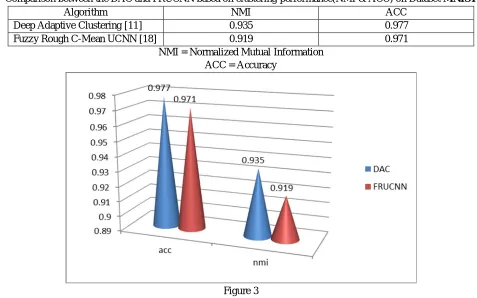
Algorithm NMI ACC
Deep Adaptive Clustering [11] 0.935 0.977
Fuzzy Rough C-Mean UCNN [18] 0.919 0.971
[image:5.595.57.534.118.416.2]NMI = Normalized Mutual Information ACC = Accuracy
Figure 3
This graph represents the Comparison between Deep Adapting Learning algorithm and Fuzzy Rough C-Mean Unsupervised Convolution Neural Network on basis of accuracy and normalized mutual information of the dataset MNIST.
II. CONCLUSION
In this survey, we find that every algorithm of the image clustering having the different efficiency, different accuracy and the number of clusters is also different from the same database. In this paper, we present the surve y on the various techniques of image clustering based on soft computing. Also, study about some features and model of the image. Image clustering is focused on how we can reduce the data. At that time data is increased at a high speed so very difficult to select the useful data. Then in the image clustering, we can make clusters of similar images and then with the help of it we can classify the data. Image clustering is an easy and efficient way of image processing.
REFERENCES
[1] Zhang Aili Jiang Xiuhua, “The Summary of Clustering Algorithm and The Application in I mages,” 2016 9th International Congress on Image and Signal Processing, Biomedical E ngi neering and Infor matics(CISP-BMEI 2016).
[2] K. Jain, M. N Murty, P. J. Flynn, “Data clustering: a review,” ACM Comp uter Survey., vol. 31, no. 3, 3, Sep. 1999. [3] E. Gose, R. Johnsonbaugh, S. Jost, “Pattern recognition and image analysis,” Prentice Hall, 1996.
[4] Bao-Jiang Z hao, “An ant colony cl ustering algorithm Proceedings of the Sixt h International Conference on Machine Learni ng and Cybernetics,” Hong Kong, 19-22 August 2007.
[5] Man To Wong, Xiangjian He Wei-Chang Yeh, “ Image Clustering Using Particle Swarm Optimization,” 978-1-4244-7835-4/11/$26.00 ©2011 IEEE.
[6] Zeyad Safaa Younus, Dzulkifli Mohamad, Tanzila Saba, Mohammed Hazim Alkawaz, Amjad Rehman, Mznah Al-Rodhaan, Abdullah Al-Dhelaan, “ Content-based i mage retrieval usi ng PSO and k-means clustering Algorithm,” Saudi Society for Geosciences 2014.
[7] Chih-C hung Hsu, Chia-Wen Lin, “Unsupervi sed convolution neural network for large scale image clustering,” 978-1-5090-2175-8/17/ /$31.00 ©2017 IEEE.
[8] Jagdeep Kaur, Jatinder Singh Bal, “ A Study of Particle Swarm Optimization based K -means Clustering for Detection of Dental Caries in Dental Xray Images,” Volume 8, No. 4, May 2017 (Special Issue) International Journal of Ad vanced Research in Comp uter Science.
1436
©IJRASET: All Rights are Reserved
[10] Haidi Rao, Xianzhang Shi, Ahoussou Kouassi Rodrigue, Juanjuan Feng, Yingchun Xia, Mohamed Elhoseny, Xiaohui Yuan, Lichuan Gu “Feature selection based on artificial bee colony and gradient boosting decisio n tree” ©2018 Elsevier B.V.
[11] Jianlong Chang, Lingfeng Wang Gaofeng Meng Shiming Xiang Chunhong Pan “Deep Adaptive Image Clustering” 2017 IEEE International Conference on Co mputer Vision.
[12] M. Karthikeyan, P. Arunea “Probability based document clustering and image clustering using content -based image retrieval” © 2013 Elsevier B.V .
[13] Swarndeep Saket J. and. Shar nil Pand ya, "Implementation of E xtend ed K-Medoids Al gorithms to Increase Efficiency and Scalability usi ng Large Dataset", International Journal of Computer Applications(0975-8887) Volume 146- No. 5, July 2016.
[14] Amit Khatami, and Saeed Mirghasemi, "A New Color Space Based on K-medoid s Clusterings for Fire Detection”, 978-1--4799-8697-2/15/$31.00 ©2015.
[15] Aruna Bhat, “K-Medoids Clustering Usi ng Partitioni ng Around Medoid s For Performing Face Recognition,” IJSCMC, Vol 3, No 3, August 2014. [16] Ruchi Jayaswal, Jai mala Jha, Ravi Devesh “An Effective Method of Image Mining usi ng K-Medoid Clustering Techniques” International Journal
of Computer Sciences and E ngineering Volume-5, Issue-3, 2017.
[17] Prabhjeet Kaur and Kamaljit Kaur, "Review of Different E xisting Image Mining Techniq ues," International Journal of Advanced Research i n Computer Science and Software Engineering (IJARCSSE), Volume 4, Issue 6 June 2014.
[18] Saman Riaz, Ali Arshad, and Licheng Jiao, “Fuzzy Ro ugh C-Mean Based Unsupervi sed CNN Clustering for Large-Scale Image Data” Applied Science 2018.
[19] Jaimala Jha, Sarita Singh Bhadauria, “Stud y Based Performance Anal ysi s on Content Based I mage Retrieval Techniques Based on Vi sual Features,” ICRTESM, 10th April 2016.
[20] Jaimala Jha, Sarita Singh Bhaduaria, “Review of Various Shape Measures for Image Content Based Retr ieval,” International Journal of Computer & Communication E ngineering Research (IJCCER), Volume 3 - Issue 6 November 2015.
[21] Lingling Zhanga, Minnan Luoa, Jun Liua, Zhihui Lid, Qinghua Zheng, “Diverse Fuzzy c-Means for Image Clustering,” ©2018 ELSEVIER. [22] Güliz Toz, Ibrahim Yücedag, Pakize Erdogmus,“A fuzzy image clustering method based on an i mproved backtracking search optimization