Proceedings of the 57th Annual Meeting of the Association for Computational Linguistics, pages 4747–4761
4747
A Cross-Sentence Latent Variable Model for
Semi-Supervised Text Sequence Matching
Jihun Choi, Taeuk Kim, Sang-goo Lee
Department of Computer Science and Engineering Seoul National University
{jhchoi,taeuk,sglee}@europa.snu.ac.kr
Abstract
We present a latent variable model for pre-dicting the relationship between a pair of text sequences. Unlike previous auto-encoding– based approaches that consider each sequence separately, our proposed framework utilizes both sequences within a single model by gen-erating a sequence that has a given relation-ship with a source sequence. We further extend the cross-sentence generating frame-work to facilitate semi-supervised training. We also define novel semantic constraints that lead the decoder network to generate seman-tically plausible and diverse sequences. We demonstrate the effectiveness of the proposed model from quantitative and qualitative exper-iments, while achieving state-of-the-art results on semi-supervised natural language inference and paraphrase identification.
1 Introduction
Text sequence matching is a task whose objec-tive is to predict the degree of match between two or more text sequences. For example, in natu-ral language inference, a system has to infer the relationship between a premise and a hypothesis sentence, and in paraphrase identification a sys-tem should find out whether a sentence is a para-phrase of the other. Since various natural language processing problems, including answer sentence selection, text retrieval, and machine comprehen-sion, involve text sequence matching components, building a high-performance text matching model plays a key role in enhancing quality of systems for these problems (Tan et al., 2016; Rajpurkar et al.,2016;Wang and Jiang, 2017;Tymoshenko and Moschitti,2018).
With the emergence of large-scale corpora, end-to-end deep learning models are achieving remark-able results on text sequence matching; these in-clude architectures that are linguistically moti-vated (Bowman et al.,2016a;Chen et al.,2017a;
Kim et al., 2019), that introduce external knowl-edge (Chen et al., 2018), and that use atten-tion mechanisms (Parikh et al.,2016;Shen et al., 2018b). The recent deep neural network–based work on text matching could roughly be catego-rized into two subclasses: i) methods that exploit inter-sentence features and ii) methods based on sentence encoders. In this work, we focus on the latter where sentences1are separately encoded us-ing a shared encoder and then fed to a classifier network, due to its efficiency and general applica-bility across tasks.
Meanwhile, despite the success of deep neu-ral networks in natuneu-ral language processing, the fact that they require abundant training data might be problematic, as constructing labeled data is a time-consuming and labor-intensive process. To mitigate the data scarcity problem, several semi-supervised learning paradigms, that take advan-tage of unlabeled data when only some of the data examples are labeled (Chapelle et al., 2010), are proposed. These unlabeled data are much easier to collect, thus utilizing them could be a good option; for example in text matching, possibly related sen-tence pairs could be retrieved from a database of text via simple heuristics such as word overlap.
In this paper, we propose a cross-sentence latent variable model for semi-supervised text sequence matching. The proposed framework is based on deep probabilistic generative models (Kingma and Welling, 2014; Rezende et al., 2014) and is ex-tended to make use of unlabeled data. As it is trained to generate a sentence that has a given rela-tionship with a source sentence, both sentences in a pair are utilized together, and thus training objec-tives are defined more naturally than other models that consider each sentence separately (Zhao et al., 2018;Shen et al., 2018a). To further regularize
the model to generate more plausible and diverse sentences, we define semantic constraints and use them for fine-tuning.
From experiments, we empirically prove that the proposed method significantly outperforms previous work on semi-supervised text sequence matching. We also conduct extensive qualitative analyses to validate the effectiveness of the pro-posed model.
The rest of the paper is organized as follows. In§2, we briefly introduce the background for our work. We describe the proposed cross-sentence latent variable model in§3, and give results from experiments in§4. We study the prior work related to ours in§5and conclude in§6.
2 Background
2.1 Variational Auto-Encoders
Variational auto-encoder (VAE, Kingma and Welling, 2014) is a deep generative model for modeling the data distribution pθ(x). It assumes that a data pointx is generated by the following random process: (1)z is sampled from p(z) and (2)xis generated frompθ(x|z).
Thus the natural training objective would be to directly maximize the marginal log-likelihood
logpθ(x) = log
R
zpθ(x|z)p(z)dz. However
it is intractable to compute the marginal log-likelihood without using simplifying assumption such as mean-field approximation (Blei et al., 2017). Therefore the following variational lower bound−Lis used as a surrogate objective:
− L(θ,φ;x) =−DKL(qφ(z|x)kp(z)) +Eqφ(z|x)[logpθ(x|z)],
where qφ(z|x) is a variational approximation
to the unknown pθ(z|x), and DKL(qkp) is the
Kullback-Leibler (KL) divergence betweenq and
p. Maximizing the surrogate objective −L is proven to minimizeDKL(qφ(z|x)kpθ(z|x)), and
it can also be seen as maximizing the expected data log-likelihood with respect toqφwhile using DKL(qφ(z|x)kpθ(z))as a regularization term.
VAEs are successfully applied in modeling var-ious data: including image (Pu et al.,2016; Gulra-jani et al.,2017), music (Roberts et al.,2018), and text (Miao et al., 2016; Bowman et al., 2016b). The VAE framework can also be extended to constructing conditional generative models (Sohn et al.,2015) or learning from semi-supervised data (Kingma et al.,2014;Xu et al.,2017).
VAEs for text pair modeling. The most
sim-ple approach to modeling text pairs using the VAE framework is to consider two text sequences sep-arately (Zhao et al., 2018; Shen et al., 2018a). That is, a generator is trained to reconstruct a sin-gle input sequence rather than integrating both se-quences, and the two latent representations en-coded from a variational posterior are given to a classifier network. When label information is not available, only the reconstruction objective is used for training. This means that the classifier param-eters are not updated in the unsupervised setting, and thus the interaction between the variational posterior (or encoder) and the classifier could be restricted.
2.2 von Mises–Fisher Distribution
Since the advent of deep generative models with variational inference, the typical choice for prior and variational posterior distribution has been the Gaussian, likely due to its well-studied properties and easiness of reparameterization. However it of-ten leads a model to face the posterior collapse problem where a model ignores latent variables by pushing the KL divergence term to zero (Chen et al., 2017b; van den Oord et al., 2017), espe-cially in text generation models where powerful decoders are used (Bowman et al., 2016b; Yang et al.,2017).
Various techniques are proposed to mitigate this problem: including KL cost annealing (Bowman et al., 2016b), weakening decoders (Yang et al., 2017), skip connection (Dieng et al.,2019), using different objectives (Alemi et al.,2018), and using alternative distributions (Guu et al.,2018). In this work, we take the last approach by utilizing a von Mises–Fisher (vMF) distribution.
A vMF distribution is a probability distribution on the(d−1)-sphere, therefore samples are com-pared according to their directions, reminiscent of the cosine similarity. It has two parameters— mean directionµ∈Rdand concentrationκ∈R. As the KL divergence between vMF(µ, κ)and the hyperspherical uniform distribution U(Sd−1) = vMF(·,0)only depends onκ, the KL divergence is a constant if the concentration parameter is fixed. Therefore when vMF(µ, κ)with fixedκand vMF(·,0)are used as posterior and prior, the pos-terior collapse does not occur inherently.
xs qφ zs pθ xt
y
[image:3.595.108.254.60.123.2]qψ
Figure 1: The overview of the entire framework. Blue dashed lines indicate semantic constraints.
zs xt
y pθ(x
t|zs
, y)
(a) Generation model
zs
xs xt
y qψ(y| xs,x
t)
qψ
(y|x
s,x
t)
qφ(zs|xs)
(b) Recognition model
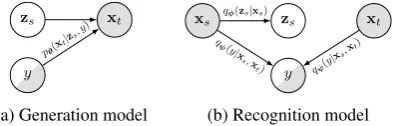
Figure 2: Illustration of the graphical models. (a) the generative process of the outputxt; (b) the approximate inference ofzsand the discriminative classifier fory.
for VAEs, andXu and Durrett(2018) empirically proved the effectiveness of vMF-VAE in natural language generation. Davidson et al.(2018) gen-eralized the vMF-VAE and proposed the reparam-eterization trick for vMF. We refer readers to Ap-pendixAfor detailed description of vMF we used.
3 Proposed Framework
In this section, we describe the proposed frame-work in detail. We formally define the cross-sentence latent variable model (CS-LVM) and de-scribe the optimization objectives. We also intro-duce semantic constraints to keep learned repre-sentations in a semantically plausible region. Fig. 1illustrates the entire framework.
3.1 Cross-Sentence Latent Variable Model
Though the auto-encoding frameworks described in §2.1 have intriguing properties, it may hinder the possibility of training an encoder to extract rich features for text pair modeling, due to the fact that the generative modeling process is confined within a single sequence. Therefore the interaction between a generative model and a discriminative classifier is restricted, since the two sequences are separately modeled and the pair-wise information is only considered through the classifier network.
Our proposed CS-LVM addresses this problem by cross-sentence generation of text given a text pair and its label. As the sentences in a pair are directly related within a generative model, the training objectives are defined in a more princi-pled way than VAE-based semi-supervised text matching frameworks. Notably it also mimics the
dataset construction process of some corpora: a worker generates a target text given a label and a source text (e.g. Bowman et al., 2015;Williams et al.,2018).
Given a pair(x1,x2), letxs,xt ∈ {x1,x2}be a source and a target sequence respectively. Then we assume xt is generated according to the
fol-lowing process (see Fig.2a):
1. a latent variablezsthat contains the content
of a source sequence is sampled fromp(zs),
2. a variabley that determines the relationship between a target and the source sequence is sampled fromp(y),
3. xt is generated from a conditional
distribu-tionpθ(xt|zs, y).
In the above process, the class labelyis treated as a hidden variable in the unsupervised case and an observed variable in the supervised case.
Accordingly, when the label information is available, the optimization objective for a gener-ative model is the marginal log-likelihood of the observed variablesxtandy:
logpθ(xt, y) = log
Z
pθ(xt,zs, y)dzs
= log
Z
pθ(xt|zs, y)p(zs)p(y)dzs. (1)
To address the intractability we instead optimize the lower bound of Eq.1:2
logpθ(xt, y)≥ −DKL(qφ(zs|xs)kp(zs)) +Eqφ(zs|xs)[logpθ(xt|y,zs)] + logp(y), (2)
whereqφ(zs|xs)is a variational approximation of the posterior pθ(zs|xt, y). Though Eq. 2 holds
for anyqφhaving the same support withp(zs), we
choose this form of variational posterior from the following motivation: sincexsis related toxtby the label information y, xs would have an influ-ence on the space ofzsin a similar way to(xt, y).
Due to this particular choice of qφ, zs depends
only onxsand is independent of the label
informa-tion possibly permeated inxt. In other words, this design induces qφ to extract the features needed
for controlling the semantics only fromxs, while
preventingqφfrom encoding other biases.
To extend the objective to the unsupervised setup, we marginalize out y from Eq. 2 using a
[image:3.595.82.280.168.231.2]classifier distribution. We will provide more de-tailed explanation of the optimization objectives in
§3.3.
3.2 Architecture
Now we describe the architectures we used for constructing CS-LVM. We first encode a source sequence into a fixed-length representation using a recurrent neural network (RNN):genc(xs) =ms.
Frommswe obtain a variational approximate
dis-tributionqφ(zs|xs) =gcode(ms)and sample a
la-tent representationzs ∼qφ(zs|xs). In our exper-iments, a long short-term memory (LSTM) recur-rent network and a feed-forward network are used asgenc andgcode respectively. From the fact that
the mean direction parameter µs of vMF(µs, κ)
should be a unit vector,gcodeadditionally
normal-izes the output of the feed-forward network to be
kgcode(ms)k
2= 1.
Then we generate the target sequence xt from
zs and y. Similarly to the encoder network, we use an LSTM for a decoder, thus the distribution is factorized as follows:
pθ(xt|y,zs) = Nxt+1
Y
i=1
pθ(wt,i|wt,<i, y,zs), (3)
where xt = (xt,1, . . . , xt,Nxt) and wt,0 = <s>,
wt,Nxt+1 = </s> are special tokens indicating
the start and the end of a sequence.
We project the word indexwt,iand label indexy
into embedding spaces to obtain the word embed-ding wt,i and label embedding y. Then to con-struct an input fori-th time step,vt, we
concate-nate thei-th target word embeddingwt,i, the label
embeddingy, and the latent representationzs al-together:
vi = [wt,i;y;zs].
Thus pθ(wt,i|wt,<i,zs, y) is computed from i-th
statesiof the decoder RNN:
pθ(wt,i|wt,<i, y,zs) =softmax(gout(si))
si =gidec(vi,si−1),
wheregout is a feed-forward network andgdec i is
the state transition function of the decoder LSTM ati-th time step.
For a discriminative classifier network we fol-low the siamese architecture, as mentioned in§1.
xsandxtare fed to a shared LSTM networkfenc
Algorithm 1Training procedure of CS-LVM.
Input:Labeled datasetXl, Unlabeled datasetXu,
Model parametersθ,φ,ψ
1: procedureTRAIN(Xl,Xu,θ,φ,ψ)
2: repeat
3: Sample(xl,s,xl,t, yl)∼ Xl
4: Sample(xu,s,xu,t)∼ Xu
5: ComputeLl(θ,φ,ψ;xl,s,xl,t, yl)by (6)
6: ComputeLu(θ,φ,ψ;xu,s,xu,t)by (9)
7: Updateθ,φ,ψby gradient descent onLl+Lu
8: untilstop criterion is met
9: procedureFINETUNE(Xl,Xu,θ,φ,ψ)
10: repeat
11: Updateθ,φ,ψfollowing line3–7
12: Updateθby gradient descent on (11–14) 13: untilstop criterion is met
to obtain sentence vectors h1 = fenc(xs) and h2 = fenc(xt). Then h1 and h2 are combined by the functionff useto form a single fused
vec-tor, and the fused representation is given to a feed-forward networkfdiscto infer the relationship:
qψ(y|x1,x2) =softmax(fdisc(ff use(h1,h2))).
To learn from data more efficiently and to re-duce the number of trainable parameters, we tie the weights for two encoders—for the generative model and the discriminative classifier; i.e.genc = fenc. This mitigates the problem that only source
sequences are used for traininggencand enhances
the interaction between the generative model and the classifier. We will see from experiments that tying encoder weights improves performance and stabilizes optimization (§4.3).
Also note that the functions g are only used
in training, and the model has the same test-time computational complexity with typical classifica-tion models.
3.3 Optimization
In this subsection we describe how the entire model is optimized. We first define optimization objectives for supervised and unsupervised train-ing, and then introduce constraints to regularize the model to generate sequences with intended semantic characteristics. The entire optimization procedure is summarized in Algorithm1.
3.3.1 Supervised Objective
In the supervised setting, a data sample is as-sumed to contain label information: (x1,x2, y)∈
Xl. Without loss of generality let us assume
(xs,xt) = (x1,x2).3 Sinceyis an observed
able in this case, we can directly use Eq.2in train-ing. From Eqs. 2and3, the objective for the gen-erative model is defined by:4
− Lgenl (θ,φ;xs,xt, y) = logpθ(xt|y,zs) + logp(y)−DKL(qφ(zs|xs)kp(zs)), (4)
where zs ∼ qφ(zs|xs) andp(y), p(zs) are prior
distributions of y, zs. Considering that we as-sumep(y)to be a fixed uniform distribution of la-bels, thelogp(y)term can be ignored in training:
k∇θ,φlogp(y)k2 = 0.
For training, the typical teacher forcing method is used; i.e. ground-truth words are used as in-put words. We use vMF(gcode(ms), κ)(κ:
hyper-parameter) for the variational posteriorqφ(zs|xs)
and vMF(·,0)for the priorp(zs).
The discriminator objective is defined as a con-ventional maximum likelihood:
−Ldisc
l (ψ;xs,xt, y) = logqψ(y|xs,xt). (5)
Finally, the two objectives are combined to con-struct the objective for supervised training:
Ll(θ,φ,ψ;xs,xt, y) =Lgenl +λL disc
l , (6)
whereλis a hyperparameter.
3.3.2 Unsupervised Objective
In this case, the model does not have an access to label information; a data point is represented by
(xs,xt) ∈ Xu and thusyis a hidden variable. To
facilitate the unsupervised training, we marginal-izeyout as below and derive the lower bound:
logpθ(xt) = log
X
y
Z
pθ(xt,zs, y)dzs
≥Eqφ,ψ(y,zs|xs,xt)
log pθ(xt,zs, y) qφ,ψ(y,zs|xs,xt)
.
(7)
And from the assumption presented in the graphi-cal model (Fig.2b),
qφ,ψ(y,zs|xs,xt) =qφ(zs|xs)qψ(y|xs,xt).
(8)
on the characteristics of a task. For some experiments we ad-ditionally used swapped data examples,(xs,xt) = (x2,x1),
for training. We explain more on this in§4. 4Note that we define all objectivesL,Ras
minimization objectivesto avoid confusion.
Finally we obtain the following lower bound for
logpθ(xt)from Eqs.7and8:5
Lu(θ,φ,ψ;xs,xt) =−H(qψ(y|xs,xt)) +Eqψ(y|xs,xt)
Lgenl (θ,φ;xs,xt, y)
. (9)
Here the second expectation term can be computed either by enumeration or sampling, and we used the former as the datasets we used have relatively small label sets (2 or 3) and it is known to yield better results than sampling (Xu et al.,2017). We will compare the two methods in§4.3.
To sum up, at every training iteration, given a labeled and unlabeled data sample (xl,s,xl,t, yl), (xu,s,xu,t), we optimize the following objective.
L=Ll(θ,φ,ψ;xl,s,xl,t, yl)
+Lu(θ,φ,ψ;xu,s,xu,t) (10)
3.3.3 Fine-Tuning with Semantic Constraints
Since the generator is trained via maximum likeli-hood training which considers all words in a sen-tence equivalently, the label information may not be reflected enough in generation owing to high-frequency words. For example in natural language inference, the word occurrences of the following three hypothesis sentences highly overlap, but they should have different relation with the premise.6
P:A man is cutting metal with a tool .
H1:A man is cutting metal .
H2:A man is cutting metal with the wrong tool .
H3:A man is cutting metal with his mind .
Thus for some data points, the strategy that only predicts words that overlap across hypotheses could receive a fairly high score, which might weaken the integration ofyinto the generator. To mitigate this, we fine-tune the trained generator using the following semantic constraint:
−Ry(θ;xs,xt) = logqψ(˜y|xs,ext), (11)
where y˜ ∼ p(y), zs ∼ qφ(zs|xs), and ext =
argmaxxtpθ(xt|y,˜ zs). This constraint enforces
the sequence ext generated by conditioning on y˜
andzsto actually have the relationshipy˜withxs. We also introduce a constraint onz that keeps the distributions ofezt(the latent content variable
5
See AppendixBfor details.
obtained by encoding the generated sequenceext)
andzsclose:
−Rz(θ;x
s,xt) = logqφ(zt=ezt|xt), (12)
whereezt ∼ qφ(ezt|ext). In other words, it pushes
the generated sequence ext to be in a similar
semantic space with the ground-truth target se-quencext. Consequently, it can help alleviate the generator collapse problem where a generator pro-duces only a handful of simple neutral patterns in-dependent of the input sequence, by relatingeztto
zt.7
From similar motivation, we also add an ad-ditional constraint that encourages the generated sentences originating from different source sen-tences to be dissimilar. To reflect this, we define the following minibatch-level constraint that pe-nalizes the mean direction vectors encoded from the generated sentences for being too close:
−Rµ(θ;B) =
EB[d(µt(i),µ¯t)], (13)
where we denote values related toi-th sample of a minibatchBusing superscript:(i). In the above, µ(ti) = gcode(genc(
e
x(ti))), µ¯t = P
|B|
i=1µ (i)
t /|B|,
andd(·,·)is a distance measure between vectors. The mean direction vectorµof vMF(µ, κ) is on a unit hypersphere, so we use the cosine distance:
d(µ1,µ2) = 1− hµ1,µ2i.
As the sequence generation process is not dif-ferentiable, the gradients from the semantic con-straints cannot propagate to the generator param-eters. To relax the discreteness, we use the Gumbel-Softmax reparameterization (Jang et al., 2017;Maddison et al.,2017). Using the Gumbel-Softmax trick, we obtain a continuous probability vector that approximates a sample from the cat-egorical distribution of words at each step, and use the probability vector to compute the expected word embedding for the subsequent step.
When multiple constraints are used, they are combined using the homoscedastic uncertainty
7The basic assumption behind this constraint is that a source and a target sequence are associated in a certain as-pect, and it generally holds in most of the available pair clas-sification datasets e.g. SNLI, SICK, SciTail, QQP, MRPC.
Model 28k 59k 120k
LSTM(a) 57.9 62.5 65.9 CNN(b) 58.7 62.7 65.6 LSTM-AE(a) 59.9 64.6 68.5 LSTM-ADAE(a) 62.5 66.8 70.9 DeConv-AE(b) 62.1 65.5 68.7 LSTM-VAE(b) 64.7 67.5 71.1 DeConv-VAE(b) 67.2 69.3 72.2 LSTM-vMF-VAE (ours) 65.6 68.7 71.1 CS-LVM (ours) 68.4 73.5 76.9
+Ry 70.0 74.5 77.4
+Rz
69.2 73.9 77.6
+Rµ
69.1 74.0 77.6 +Ry
,Rz
,Rµ
69.6 74.1 77.4
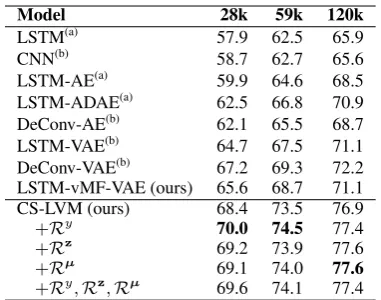
Table 1: Semi-supervised classification results on the SNLI dataset. (a) Zhao et al.(2018); (b)Shen et al. (2018a).
Model 1k 5k 10k 25k
CNN(a) 56.3 59.2 63.8 68.9 LSTM-AE(a) 59.3 63.8 67.2 70.9 DeConv-AE(a) 60.2 65.1 67.7 71.6 LSTM-VAE(a) 62.9 67.6 69.0 72.4 DeConv-VAE(a) 65.1 69.4 70.5 73.7 LSTM-vMF-VAE (ours) 65.0 69.9 72.1 74.9 CS-LVM (ours) 66.5 71.1 74.6 76.9
+Ry 66.4 70.8 74.5 77.5
+Rz
66.5 71.3 74.8 77.1
+Rµ
66.4 71.2 74.9 77.4
+Ry
,Rz
,Rµ
[image:6.595.321.512.60.210.2]66.3 71.3 74.7 77.6
Table 2: Semi-supervised classification results on the Quora Question Pairs dataset. (a)Shen et al.(2018a).
weighting (Kendall et al.,2018):8
R= 1 σ2
1
Ry+ 1 σ2
2
Rz+ 1
σ2 3
Rµ
+ logσ1+ logσ2+ logσ3, (14)
where σ1, σ2, σ3 are trainable scalar parameters. Also note that all constraints are unsupervised, where label information is not required.
4 Experiments
We evaluate the proposed model on two semi-supervised tasks: natural language inference and
paraphrase identification. We also implement a strong baseline that has a similar architecture to LSTM-VAE (Shen et al., 2018a) but uses vMF distribution for prior and posterior, named LSTM-vMF-VAE. To further explore the proposed model,
8
Though the weighting scheme is originally derived from the case of a Gaussian likelihood, Kendall et al. (2018);
Xiong et al.(2018);Hu et al.(2018) successfully applied it in
weighting various losses e.g. cross-entropy loss,L1loss, and
we conduct extensive qualitative analyses. For de-tailed settings and hyperparameters, please refer to AppendixC.
4.1 Natural Language Inference
Natural language inference (NLI) is a task of pre-dicting the relationship given a premise and a hy-pothesis sentence. We use Stanford Natural Lan-guage Inference (SNLI, Bowman et al., 2015) dataset for experiments. It consists of roughly 570k premise-hypothesis pairs, and each pair has one of the following labels: entailment, neutral, andcontradiction. Considering the asymmetry in some label classes and for conformance with the dataset generation process, we use premise and hypothesis sentence as source and target respec-tively:(xs,xt) = (xpre,xhyp).
Following the work ofZhao et al.(2018);Shen et al. (2018a), we consider scenarios where 28k, 59k, and 120k labeled data samples are available. Also, for fair comparison with the prior work, we set the size of a word vocabulary set to 20,000 and do not utilize pre-trained word embeddings such as GloVe (Pennington et al.,2014).
To combine the representations of a premise and a hypothesis and to construct an input tofdisc, we
use the following heuristic-based fusion proposed byMou et al.(2016):
ff use(hpre,hhyp)
= [hpre;hhyp;|hpre−hhyp|;hprehhyp],
(15)
where[a;b]indicates concatenation of vectorsa,
bandis the element-wise product.
Table 1 summarizes the result of experiments. We can clearly see that the proposed CS-LVM architecture substantially outperforms other mod-els based on auto-encoding. Also, the seman-tic constraints brought additional boost in perfor-mance, achieving the new state of the art in semi-supervised classification of the SNLI dataset.
When all training data are used as labeled data (≈ 550k), CS-LVM also improves performance by achieving accuracy of 82.8%, compared to the supervised LSTM (81.5%), LSTM-AE (81.6%), LSTM-VAE (80.8%), DeConv-VAE (80.9%).
4.2 Paraphrase Identification
Paraphrase identification (PI) is a task whose ob-jective is to infer whether two sentences have the same semantics. We use the Quora Question Pairs
Model 28k 59k 120k
CS-LVM 68.4 73.5 76.9
(i) without CS 65.6 68.7 71.1
(ii) Gaussian 66.9 72.0 74.9
(iii) sampling 68.0 72.9 76.5
[image:7.595.332.502.62.123.2](iv)fenc6=genc 63.3 69.1 74.7
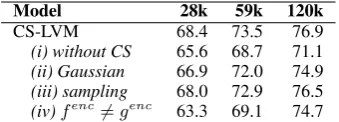
Table 3: Ablation study results.
dataset (QQP,Wang et al.,2017) for experiments. QQP consists of over 400k sentence pairs each of which has label information indicating whether the sentences in a pair paraphrase each other or not. We experiment for the cases where the num-ber of labeled data is 1k, 5k, 10k, and 25k, and set the vocabulary size to 10,000, followingShen et al.(2018a). Unlike auto-encoding–based mod-els that treat sentences in a pair equivalently, the CS-LVM processes them asymmetrically for its cross-sentence generating property. This property is useful when some relationships are asymmetric (e.g. NLI), however the paraphrase relationship is bidirectional, so that we also use swapped text pairs in training. To fuse sentence representations, the following symmetric function is used, as inJi and Eisenstein(2013):
ff use(h1,h2) = [h1+h2;|h1−h2|]. (16)
The result of experiments on QQP is sum-marized in Table 2. Again, the proposed CS-LVM consistently outperforms other supervised and semi-supervised models by a large margin, setting the new state-of-the-art result on the QQP dataset with the semi-supervised setting.
4.3 Ablation Study
To assess the effect of each element, we experi-ment with model variants where some of the com-ponents are removed. Specifically, we conduct an ablation study for the following variants: (i) with-out cross-sentence generation (i.e. auto-encoding setup), (ii) replacing the vMF distribution with Gaussian, (iii) computing the expectation term of Eq. 9 by sampling, and (iv) without encoder weight sharing (i.e. fenc 6= genc). SNLI dataset
is used for the model ablation experiments, and trained models are not fine-tuned in order to focus only on the efficacy of each model component.
59k and 120k settings, all other variants that main-tain the cross-generating property outperform the VAE-based models (see(ii),(iii),(iv)).
Replacing a vMF with a Gaussian does not severely harm the accuracy, however it requires the additional process of finding a KL cost anneal-ing rate. When samplanneal-ing is used instead of enu-meration for computing Eq.9, about 1.2x speedup is observed in exchange for slight performance degradation, and thus sampling could be a good option in the case that the number of label classes is large.
Finally, as mentioned in §3.2, variants whose encoder weights are untied do not work well. We conjecture this is becausegenc receives the error
signal only from a source sentence and could not fully benefit from both sentences. The fact that the performance degradation is larger when the num-ber of labeled data is small also agrees with our hy-pothesis, since unlabeled data affect the classifier encoder only by the entropy term when encoder weights are not shared.
4.4 Generated Sentences
We give examples of generated sentences, to val-idate that the proposed model learns to generate text having desired properties. From Table 4, we can see that sentences generated from the identi-cal input sentence properly reflect the label infor-mation given. More generated examples are pre-sented in AppendixD.
Further, to quantitatively measure the qual-ity of generated sentences, we construct artificial datasets, where each premise and label in the SNLI development set is used as input to our trained generator and generated hypotheses are collected. Then we prepare a LSTM classifier that is trained on the original SNLI dataset as a surrogate for the ideal classifier, and use it for measuring the quality of generated datasets.9 We also compute the diver-sity of the generated hypotheses using the metrics proposed byLi et al.(2016), to verify the effect of diversity-promoting semantic constraints.
Results of the evaluation on the artificial datasets are presented in Table 5. The classifier trained on the original dataset predicts the gener-ated data fairly well, from which we verify that the generated sentences contain desired seman-tics. Also, as expected, fine-tuning with Ry
in-9The accuracy of the trained classifier on the original de-velopment set is 81.7%.
creases the classification accuracy by a large mar-gin, whileRzandRµenhance diversity.
5 Related Work
Semi-supervised learning for text classification.
Using unlabeled data for text classification is an important subject and there exists much previous research (Zhu et al.,2003;Nigam et al.,2006;Zhu, 2008, to name but a few). Notably, the work of Xu et al.(2017) applies the semi-supervised VAE (Kingma et al., 2014) to the single-sentence text classification problem. Zhao et al. (2018); Shen et al.(2018a) present VAE models for the semi-supervised text sequence matching, while their models have drawbacks as mentioned in§3.
When the use of external corpora is allowed, the performance can further be increased. Dai and Le (2015); Ramachandran et al.(2017) train an encoder-decoder network on large corpora and fine-tune the learned encoder on a specific task. Recently, there have been remarkable improve-ments in pre-trained language representations (Pe-ters et al., 2018; Radford et al., 2018; Devlin et al., 2018), where language models trained on extremely large data brought a huge performance boost. These methods are orthogonal to our work, and additional enhancements are expected when they are used together with our model.
Cross-sentence generating LVMs. There
Input Entailment Neutral Contradiction
two girls play with bubbles near a boat dock .
two girls are outside . the girls are friends . two girls are swimming in the ocean .
a classroom full of men, with the teacher up front .
a group of boys are in-doors .
the teacher is teaching the students .
the students are at home sleeping .
a dune buggy traveling on sand . the vehicle is moving . the vehicle is red . a man is riding a bike .
Table 4: Selected samples generated from the model trained on the SNLI dataset.
Dataset Acc. distinct-1 distinct-2 CS-LVM 76.5 .0128 .0441
+Ry
81.9 .0135 .0479
+Rz
79.0 .0140 .0492
+Rµ
77.5 .0141 .0488
Table 5: Results of evaluation of generated artificial datasets. distinct-1anddistinct-2compute the ratio of the number of unique unigrams or bigrams to that of the total generated tokens (Li et al.,2016).
6 Conclusion
In this work, we proposed a cross-sentence latent variable model (CS-LVM) for semi-supervised text sequence matching. Given a pair of text se-quences and the corresponding label, it uses one of the sequences and the label as input and gener-ates the other sequence. Due to the use of cross-sentence generation, the generative model and the discriminative classifier interacts more strongly, and from experiments we empirically proved that the CS-LVM outperforms other models by a large margin. We also defined multiple semantic con-straints to further regularize the model, and ob-served that fine-tuning with them gives additional increase in performance.
For future work, we plan to focus on generat-ing more realistic text and use the generated text in other tasks e.g. data augmentation, address-ing adversarial attack. Although the current model makes fairly plausible sentences, it tends to pre-fer relatively short andsafesentences, as the main goal of the training is to accurately predict the rela-tionship between sentences. We expect the model could perform more natural generation via apply-ing recent advancements on deep generative mod-els.
Acknowledgments
This work was supported by BK21 Plus for Pio-neers in Innovative Computing (Dept. of Com-puter Science and Engineering, SNU) funded by the National Research Foundation of Korea (NRF) (21A20151113068). We would also like to thank
anonymous reviewers for their constructive feed-backs.
References
Alexander Alemi, Ben Poole, Ian Fischer, Joshua Dil-lon, Rif A. Saurous, and Kevin Murphy. 2018. Fixing a broken ELBO. In Proceedings of the 35th International Conference on Machine Learn-ing, volume 80 of Proceedings of Machine Learn-ing Research, pages 159–168, Stockholm, Sweden. PMLR.
David M. Blei, Alp Kucukelbir, and Jon D. McAuliffe. 2017. Variational inference: A review for statisti-cians. Journal of the American Statistical Associa-tion, 112(518):859–877.
Samuel R. Bowman, Gabor Angeli, Christopher Potts, and Christopher D. Manning. 2015. A large anno-tated corpus for learning natural language inference. In Proceedings of the 2015 Conference on Empiri-cal Methods in Natural Language Processing, pages 632–642, Lisbon, Portugal. Association for Compu-tational Linguistics.
Samuel R. Bowman, Jon Gauthier, Abhinav Ras-togi, Raghav Gupta, Christopher D. Manning, and Christopher Potts. 2016a. A fast unified model for parsing and sentence understanding. In Proceed-ings of the 54th Annual Meeting of the Association for Computational Linguistics (Volume 1: Long Pa-pers), pages 1466–1477, Berlin, Germany. Associa-tion for ComputaAssocia-tional Linguistics.
Samuel R. Bowman, Luke Vilnis, Oriol Vinyals, An-drew Dai, Rafal Jozefowicz, and Samy Bengio. 2016b. Generating sentences from a continuous space. In Proceedings of The 20th SIGNLL Con-ference on Computational Natural Language Learn-ing, pages 10–21, Berlin, Germany. Association for Computational Linguistics.
Olivier Chapelle, Bernhard Sch¨olkopf, and Alexander Zien. 2010. Semi-Supervised Learning. Adaptive computation and machine learning. MIT Press.
Qian Chen, Xiaodan Zhu, Zhen-Hua Ling, Si Wei, Hui Jiang, and Diana Inkpen. 2017a. Enhanced LSTM for natural language inference. In Proceed-ings of the 55th Annual Meeting of the Association for Computational Linguistics (Volume 1: Long Pa-pers), pages 1657–1668, Vancouver, Canada. Asso-ciation for Computational Linguistics.
Xi Chen, Diederik P. Kingma, Tim Salimans, Yan Duan, Prafulla Dhariwal, John Schulman, Ilya Sutskever, and Pieter Abbeel. 2017b. Variational lossy autoencoder. InInternational Conference on Learning Representations, Toulon, France.
Andrew M. Dai and Quoc V. Le. 2015. Semi-supervised sequence learning. InAdvances in Neu-ral Information Processing Systems 28, pages 3079– 3087, Montreal, Canada. Curran Associates, Inc.
Tim R. Davidson, Luca Falorsi, Nicola De Cao, Thomas Kipf, and Jakub M. Tomczak. 2018. Hy-perspherical variational auto-encoders. In Proceed-ings of the Thirty-Fourth Conference on Uncertainty in Artificial Intelligence, pages 856–865, Monterey, California, USA.
Michel Deudon. 2018.Learning semantic similarity in a continuous space. InAdvances in Neural Informa-tion Processing Systems 31, pages 986–997, Mon-treal, Canada. Curran Associates, Inc.
Jacob Devlin, Ming-Wei Chang, Kenton Lee, and Kristina Toutanova. 2018. BERT: Pre-training of deep bidirectional transformers for language understanding. Computing Research Repository, arXiv:1810.04805. Version 1.
Adji B. Dieng, Yoon Kim, Alexander M. Rush, and David M. Blei. 2019. Avoiding latent variable col-lapse with generative skip models. InProceedings of the 22nd International Conference on Artificial Intelligence and Statistics, volume 89 of Proceed-ings of Machine Learning Research, Naha, Japan. PMLR.
Ishaan Gulrajani, Kundan Kumar, Faruk Ahmed, Adrien Ali Taiga, Francesco Visin, David Vazquez, and Aaron Courville. 2017. PixelVAE: A latent variable model for natural images. InInternational Conference on Learning Representations, Toulon, France.
Kelvin Guu, Tatsunori B. Hashimoto, Yonatan Oren, and Percy Liang. 2018. Generating sentences by editing prototypes. Transactions of the Association for Computational Linguistics, 6:437–450.
Minghao Hu, Yuxing Peng, Zhen Huang, Xipeng Qiu, Furu Wei, and Ming Zhou. 2018. Reinforced mnemonic reader for machine reading comprehen-sion. In Proceedings of the Twenty-Seventh In-ternational Joint Conference on Artificial Intelli-gence, pages 4099–4106, Stockholm, Sweden. Inter-national Joint Conferences on Artificial Intelligence Organization.
Hakan Inan, Khashayar Khosravi, and Richard Socher. 2017. Tying word vectors and word classifiers: A loss framework for language modeling. In Inter-national Conference on Learning Representations, Toulon, France.
Eric Jang, Shixiang Gu, and Ben Poole. 2017. Cat-egorical reparameterization with Gumbel-Softmax. InInternational Conference on Learning Represen-tations, Toulon, France.
Yangfeng Ji and Jacob Eisenstein. 2013. Discrimina-tive improvements to distributional sentence simi-larity. In Proceedings of the 2013 Conference on Empirical Methods in Natural Language Process-ing, pages 891–896, Seattle, Washington, USA. As-sociation for Computational Linguistics.
Dongyeop Kang, Tushar Khot, Ashish Sabharwal, and Eduard Hovy. 2018. AdvEntuRe: Adversarial train-ing for textual entailment with knowledge-guided examples. InProceedings of the 56th Annual Meet-ing of the Association for Computational LMeet-inguistics (Volume 1: Long Papers), pages 2418–2428, Mel-bourne, Australia. Association for Computational Linguistics.
Alex Kendall, Yarin Gal, and Roberto Cipolla. 2018. Multi-task learning using uncertainty to weigh losses for scene geometry and semantics. In Pro-ceedings of the IEEE Conference on Computer Vi-sion and Pattern Recognition, pages 7482–7491, Salt Lake City, Utah, USA.
Taeuk Kim, Jihun Choi, Daniel Edmiston, Sanghwan Bae, and Sang-goo Lee. 2019. Dynamic composi-tionality in recursive neural networks with structure-aware tag representations. In Proceedings of the Thirty-Third AAAI Conference on Artificial Intelli-gence, Honolulu, Hawaii, USA.
Diederik P. Kingma and Jimmy Ba. 2015. Adam: A method for stochastic optimization. InInternational Conference on Learning Representations.
Diederik P. Kingma and Max Welling. 2014. Auto-encoding variational Bayes. In International Conference on Learning Representations, Banff, Canada.
Durk P. Kingma, Shakir Mohamed, Danilo Jimenez Rezende, and Max Welling. 2014. Semi-supervised learning with deep generative models. In
Advances in Neural Information Processing Systems 27, pages 3581–3589, Montreal, Canada. Curran Associates, Inc.
Chris J. Maddison, Andriy Mnih, and Yee Whye Teh. 2017. The Concrete distribution: A continuous relaxation of discrete random variables. In Inter-national Conference on Learning Representations, Toulon, France.
Yishu Miao, Lei Yu, and Phil Blunsom. 2016. Neu-ral variational inference for text processing. In
Proceedings of The 33rd International Conference on Machine Learning, volume 48 of Proceedings of Machine Learning Research, pages 1727–1736, New York, New York, USA. PMLR.
Lili Mou, Rui Men, Ge Li, Yan Xu, Lu Zhang, Rui Yan, and Zhi Jin. 2016. Natural language inference by tree-based convolution and heuristic matching. In
Proceedings of the 54th Annual Meeting of the As-sociation for Computational Linguistics (Volume 2: Short Papers), pages 130–136, Berlin, Germany. As-sociation for Computational Linguistics.
Kamal Nigam, Andrew McCallum, and Tom Mitchell. 2006.Semi-supervised text classification using EM.
Semi-Supervised Learning, pages 33–56.
Aaron van den Oord, Oriol Vinyals, and Koray Kavukcuoglu. 2017. Neural discrete representation learning. In Advances in Neural Information Pro-cessing Systems 30, pages 6306–6315, Long Beach, California, USA. Curran Associates, Inc.
Ankur Parikh, Oscar T¨ackstr¨om, Dipanjan Das, and Jakob Uszkoreit. 2016. A decomposable attention model for natural language inference. In Proceed-ings of the 2016 Conference on Empirical Methods in Natural Language Processing, pages 2249–2255, Austin, Texas. Association for Computational Lin-guistics.
Jeffrey Pennington, Richard Socher, and Christopher Manning. 2014. GloVe: Global vectors for word representation. In Proceedings of the 2014 Con-ference on Empirical Methods in Natural Language Processing, pages 1532–1543, Doha, Qatar. Associ-ation for ComputAssoci-ational Linguistics.
Matthew Peters, Mark Neumann, Mohit Iyyer, Matt Gardner, Christopher Clark, Kenton Lee, and Luke Zettlemoyer. 2018. Deep contextualized word rep-resentations. In Proceedings of the 2018 Confer-ence of the North American Chapter of the Associ-ation for ComputAssoci-ational Linguistics: Human Lan-guage Technologies, Volume 1 (Long Papers), pages 2227–2237, New Orleans, Louisiana, USA. Associ-ation for ComputAssoci-ational Linguistics.
Ofir Press and Lior Wolf. 2017. Using the output em-bedding to improve language models. In Proceed-ings of the 15th Conference of the European Chap-ter of the Association for Computational Linguistics: Volume 2, Short Papers, pages 157–163, Valencia, Spain. Association for Computational Linguistics.
Yunchen Pu, Zhe Gan, Ricardo Henao, Xin Yuan, Chunyuan Li, Andrew Stevens, and Lawrence Carin.
2016. Variational autoencoder for deep learning of images, labels and captions. InAdvances in Neu-ral Information Processing Systems 29, pages 2352– 2360, Barcelona, Spain. Curran Associates, Inc.
Alec Radford, Karthik Narasimhan, Tim Salimans, and Ilya Sutskever. 2018. Improving language under-standing by generative ptraining. Technical re-port, OpenAI.
Pranav Rajpurkar, Jian Zhang, Konstantin Lopyrev, and Percy Liang. 2016. SQuAD: 100,000+ questions for machine comprehension of text. In Proceed-ings of the 2016 Conference on Empirical Methods in Natural Language Processing, pages 2383–2392, Austin, Texas, USA. Association for Computational Linguistics.
Prajit Ramachandran, Peter Liu, and Quoc Le. 2017. Unsupervised pretraining for sequence to sequence learning. InProceedings of the 2017 Conference on Empirical Methods in Natural Language Process-ing, pages 383–391, Copenhagen, Denmark. Asso-ciation for Computational Linguistics.
Danilo Jimenez Rezende, Shakir Mohamed, and Daan Wierstra. 2014. Stochastic backpropagation and ap-proximate inference in deep generative models. In
Proceedings of the 31st International Conference on Machine Learning, volume 32 ofProceedings of Machine Learning Research, pages 1278–1286, Bei-jing, China. PMLR.
Adam Roberts, Jesse Engel, Colin Raffel, Curtis Hawthorne, and Douglas Eck. 2018. A hierarchical latent vector model for learning long-term structure in music. In Proceedings of the 35th International Conference on Machine Learning, volume 80 of
Proceedings of Machine Learning Research, pages 4364–4373, Stockholm, Sweden. PMLR.
Iulian Vlad Serban, Alessandro Sordoni, Ryan Lowe, Laurent Charlin, Joelle Pineau, Aaron Courville, and Yoshua Bengio. 2017. A hierarchical latent variable encoder-decoder model for generating dialogues. In
Proceedings of the Thirty-First AAAI Conference on Artificial Intelligence, pages 3295–3301, San Fran-cisco, California, USA.
Dinghan Shen, Yizhe Zhang, Ricardo Henao, Qinliang Su, and Lawrence Carin. 2018a. Deconvolutional latent-variable model for text sequence matching. In
Proceedings of the Thirty-Second AAAI Conference on Artificial Intelligence, pages 5438–5445, New Orleans, Louisiana, USA.
Tao Shen, Tianyi Zhou, Guodong Long, Jing Jiang, Shirui Pan, and Chengqi Zhang. 2018b.DiSAN: Di-rectional self-attention network for RNN/CNN-free language understanding. In Thirty-Second AAAI Conference on Artificial Intelligence, pages 5446– 5455, New Orleans, Louisiana, USA.
by cross-alignment. InAdvances in Neural Informa-tion Processing Systems 30, pages 6830–6841, Long Beach, California, USA. Curran Associates, Inc.
Kihyuk Sohn, Honglak Lee, and Xinchen Yan. 2015. Learning structured output representation using deep conditional generative models. In Advances in Neural Information Processing Systems 28, pages 3483–3491, Montreal, Canada. Curran Associates, Inc.
Ming Tan, Cicero dos Santos, Bing Xiang, and Bowen Zhou. 2016. Improved representation learning for question answer matching. In Proceedings of the 54th Annual Meeting of the Association for Compu-tational Linguistics (Volume 1: Long Papers), pages 464–473, Berlin, Germany. Association for Compu-tational Linguistics.
Kateryna Tymoshenko and Alessandro Moschitti. 2018. Cross-pair text representations for answer sentence selection. InProceedings of the 2018 Con-ference on Empirical Methods in Natural Language Processing, pages 2162–2173, Brussels, Belgium. Association for Computational Linguistics.
Shuohang Wang and Jing Jiang. 2017. A compare-aggregate model for matching text sequences. In
International Conference on Learning Representa-tions, Toulon, France.
Zhiguo Wang, Wael Hamza, and Radu Florian. 2017. Bilateral multi-perspective matching for natural lan-guage sentences. InProceedings of the Twenty-Sixth International Joint Conference on Artificial Intelli-gence, pages 4144–4150, Melbourne, Australia.
Adina Williams, Nikita Nangia, and Samuel Bowman. 2018. A broad-coverage challenge corpus for sen-tence understanding through inference. In Proceed-ings of the 2018 Conference of the North Ameri-can Chapter of the Association for Computational Linguistics: Human Language Technologies, Vol-ume 1 (Long Papers), pages 1112–1122, New Or-leans, Louisiana, USA. Association for Computa-tional Linguistics.
Yonghui Wu, Mike Schuster, Zhifeng Chen, Quoc V. Le, Mohammad Norouzi, Wolfgang Macherey, Maxim Krikun, Yuan Cao, Qin Gao, Klaus Macherey, Jeff Klingner, Apurva Shah, Melvin Johnson, Xiaobing Liu, Łukasz Kaiser, Stephan Gouws, Yoshikiyo Kato, Taku Kudo, Hideto Kazawa, Keith Stevens, George Kurian, Nishant Patil, Wei Wang, Cliff Young, Jason Smith, Jason Riesa, Alex Rudnick, Oriol Vinyals, Greg Corrado, Macduff Hughes, and Jeffrey Dean. 2016. Google’s neural machine translation system: Bridging the gap between human and machine translation. Comput-ing Research Repository, arXiv:1609.08144. Ver-sion 2.
Caiming Xiong, Victor Zhong, and Richard Socher. 2018. DCN+: Mixed objective and deep residual coattention for question answering. InInternational
Conference on Learning Representations, Vancou-ver, Canada.
Jiacheng Xu and Greg Durrett. 2018. Spherical latent spaces for stable variational autoencoders. In Pro-ceedings of the 2018 Conference on Empirical Meth-ods in Natural Language Processing, pages 4503– 4513, Brussels, Belgium. Association for Computa-tional Linguistics.
Weidi Xu, Haoze Sun, Chao Deng, and Ying Tan. 2017. Variational autoencoder for semi-supervised text classification. InProceedings of the Thirty-First AAAI Conference on Artificial Intelligence, pages 3358–3364, San Francisco, California, USA.
Zichao Yang, Zhiting Hu, Ruslan Salakhutdinov, and Taylor Berg-Kirkpatrick. 2017. Improved varia-tional autoencoders for text modeling using dilated convolutions. In Proceedings of the 34th Interna-tional Conference on Machine Learning, volume 70 of Proceedings of Machine Learning Research, pages 3881–3890, Sydney, Australia. PMLR.
Biao Zhang, Deyi Xiong, Jinsong Su, Hong Duan, and Min Zhang. 2016. Variational neural machine trans-lation. In Proceedings of the 2016 Conference on Empirical Methods in Natural Language Process-ing, pages 521–530, Austin, Texas, USA. Associa-tion for ComputaAssocia-tional Linguistics.
Junbo Zhao, Yoon Kim, Kelly Zhang, Alexander Rush, and Yann LeCun. 2018. Adversarially regularized autoencoders. In Proceedings of the 35th Interna-tional Conference on Machine Learning, volume 80 of Proceedings of Machine Learning Research, pages 5902–5911, Stockholm, Sweden. PMLR.
Xiaojin Zhu. 2008.Semi-supervised learning literature survey. Technical report, Department of Computer Sciences, University of Wisconsin-Madison.
Xiaojin Zhu, Zoubin Ghahramani, and John Lafferty. 2003. Semi-supervised learning using gaussian fields and harmonic functions. InProceedings of the Twentieth International Conference on International Conference on Machine Learning, pages 912–919. AAAI Press.
A von Mises–Fisher Distribution
A von Mises–Fisher (vMF) distribution is the dis-tribution defined on am-dimensional unit hyper-sphere. It is parameterized by two parameters: the mean direction µ ∈ Rm and the concentra-tionκ∈R. The probability density function (pdf) of vMF(µ, κ)is defined by
f(x;µ, κ) =Cm(κ) exp(κµ>x), (17)
where
Cm(κ) =
κm/2−1
(2π)m/2I
and Iv(κ) is the modified Bessel function of the
first kind at orderv. Eq. 17is used in the compu-tation ofRz.
A sample from a vMF distribution is drawn from the acceptance-rejection scheme presented in Algorithm 1 ofDavidson et al.(2018). In their al-gorithm, a stochastic variable obtained from the acceptance-rejection sampling does not depend on
µ, thus the sampling process can be rewritten as a deterministic function that accepts the stochastic variable as input (i.e. reparameterization trick).
The KL divergence between a vMF distribution vMF(µ, κ)and the hyperspherical uniform distri-butionU(Sm−1) =vMF(·,0)can be derived ana-lytically:
DKL(vMF(µ, κ)kvMF(·,0))
= logCm(κ)−log
Γ(m/2) 2πm/2 +κ
Im/2(κ)
Im/2−1(κ)
.
Note that the KL divergence does not depend on µ, thus the KL divergence is a constant if κ
is fixed. Intuitively, this is because the hyper-spherical uniform distribution has equal probabil-ity densprobabil-ity at every point on the unit hypersphere, and DKL(vMF(µ, κ)kvMF(·,0)) should not be
changed under rotations.
B Derivation of Lower Bounds
Let qθ(zs|·) be a distribution that has the same
support withp(zs). Then the KL divergence
be-tweenqθ(zs|·)andpθ(zs|xt, y)can be written as
DKL(qφ(zs|·)kpθ(zs|xt, y))
=
Z
qφ(zs|·) log
qφ(zs|·) pθ(zs|xt, y)
dzs
=
Z
qφ(zs|·) log pθ(xt, y)qφ(zs|·) pθ(xt|zs, y)p(zs)p(y)
dzs
= logpθ(xt, y) +DKL(qφ(zs|·)kp(zs)) −Eqφ(zs|·)[logpθ(xt|zs, y)]−logp(y) ≥0.
From the above inequality we obtain the lower bound oflogpθ(xt, y)presented in Eq.2.
The lower bound oflogpθ(xt)(Eq.7) could be
derived as follows.
logpθ(xt) = log
X
y
Z
pθ(xt,zs, y)dzs
= logEqφ,ψ(y,zs|xs,xt)
pθ(xt|zs, y)p(zs)p(y) qφ,ψ(y,zs|xs,xt)
≥Eqφ,ψ(y,zs|xs,xt)
logpθ(xt|zs, y)p(zs)p(y) qφ,ψ(y,zs|xs,xt)
From the graphical model qφ,ψ(y,zs|xs,xt) = qφ(zs|xs)qψ(y|xs,xt), and thus
Eqφ,ψ(y,zs|xs,xt)
logpθ(xt|zs, y)p(zs)p(y) qφ,ψ(y,zs|xs,xt)
=Eqψ
Eqφ
logpθ(xt|zs, y)p(zs)p(y) qφ(zs|xs)
−Eqψ[logqψ(y|xs,xt)] =Eqψ
−Lgenl (θ,φ;xs,xt, y)
+H(qψ(y|xs,xt)) =−Lu(θ,φ,ψ;xs,xt).
C Implementation Details
We used PyTorch10 and AllenNLP11 libraries for implementation. The default weight initialization scheme of the AllenNLP library is used unless ex-plicitly stated.
For all CS-LVM experiments, the size of word embeddings and hidden dimensions of LSTMs are set to 300, and the size of label embeddings is 50.
gcode is implemented as a linear projection of the
last hidden state of the encoder LSTM followed by normalization.goutis a linear projection followed
by the softmax function, and we reuse the word embeddings as its weight matrix (Press and Wolf, 2017;Inan et al.,2017). The discriminative clas-sifier is a feedforward network with single hidden layer and the ReLU activation function, and the hidden dimension is set to 1200. We apply dropout on word embeddings and the classifier with prob-abilitiespwandpcrespectively.
When multiple semantic constraints are used, to make uncertainty weights be always positive and be optimized stably, we instead uselogσ2
i as
model parameter, as inKendall et al.(2018). Each
logσ2
i is initialized with zero. The temperature
parameter of the Gumbel-Softmax is linearly an-nealed using the following schedule:
τ(t) = max(0.1,1.0−rt),
10
https://pytorch.org/
Model κ λ pw pc
[image:14.595.110.250.62.105.2]28k 150 0.8 0.75 0.1 59k 100 1.0 0.75 0.1 120k 120 0.8 0.50 0.1
Table 6: Hyperparameters for the SNLI models.
Model κ λ pw pc
1k 100 0.8 0.50 0.2 5k 120 0.5 0.75 0.2 10k 150 0.5 0.75 0.1 25k 100 0.5 0.75 0.1
Table 7: Hyperparameters for the QQP models.
wherer = 10−4 is the annealing rate andtis the training step.
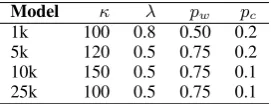
To find optimal hyperparameters, we performed a rough grid search onκ ∈ {100,120,150},λ∈ {0.2,0.5,0.8,1.0}, pw ∈ {0.25,0.50,0.75}, and
pc ∈ {0.1,0.2}. The KL divergence between a posterior and the prior is 23.57, 27.09, 31.60 when
κis set to 100, 120, 150 respectively.
For the LSTM-vMF-VAE experiments, we used the same hyperparameters and grid search scheme with those of the CS-LVM, except that we perform an additional search on the dimension of a latent coded∈ {50,150,300}.
Adam optimizer (Kingma and Ba, 2015) with learning rateγ = 10−3is used for all experiments, except for 1k QQP experiments where stochastic gradient descent optimizer is used. When fine-tuning the model, we set γ to 10−4. For other hyperparameters, we follow the configuration sug-gested by the authors. Best hyperparameter con-figurations found for SNLI and QQP datasets are presented in Tables6and7.
D Generated Examples
We used beam search withB = 10when gener-ating sentences, and the length normalization (Wu et al.,2016) is applied withα= 0.7.
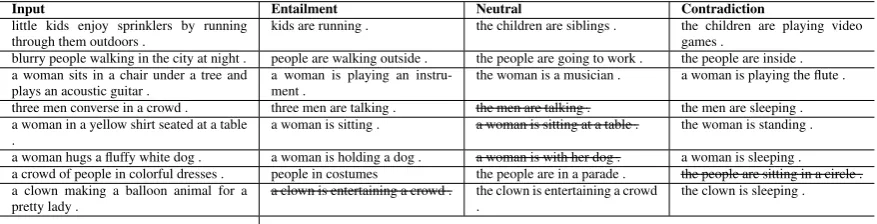
Examples are presented in Tables8–11. Though almost all generated hypotheses are realistic, we see that they lack diversity and fail to encode la-bel information in some cases. For example, the phrase ‘is/are sleeping’ appears in generated sen-tences frequently when conditioned on the ‘con-tradiction’ label, likely because generating a set of simple patterns could be a shortcut to the objec-tive. In Table5, we verified from experiments that adding constraints helps enhancing accuracy and diversity, however a model is still relatively in fa-vor of generating ‘easy’ sentences. We conjecture
[image:14.595.114.250.137.189.2]Input Entailment Neutral Contradiction little kids enjoy sprinklers by running
through them outdoors .
kids are running . the children are siblings . the children are playing video
games .
blurry people walking in the city at night . people are walking outside . the people are going to work . the people are inside .
a woman sits in a chair under a tree and plays an acoustic guitar .
a woman is playing an instru-ment .
the woman is a musician . a woman is playing the flute .
three men converse in a crowd . three men are talking . the men are talking . the men are sleeping .
a woman in a yellow shirt seated at a table .
a woman is sitting . a woman is sitting at a table . the woman is standing .
a woman hugs a fluffy white dog . a woman is holding a dog . a woman is with her dog . a woman is sleeping .
a crowd of people in colorful dresses . people in costumes the people are in a parade . the people are sitting in a circle .
a clown making a balloon animal for a pretty lady .
a clown is entertaining a crowd . the clown is entertaining a crowd
.
[image:15.595.80.519.71.183.2]the clown is sleeping .
Table 8: Sentences generated from the CS-LVM model trained on the SNLI dataset. Failure cases are denoted by strikethrough text.
Input Entailment Neutral Contradiction
little kids enjoy sprinklers by running through them outdoors .
kids are playing outside . the kids are playing in the water
.
the kids are sleeping .
blurry people walking in the city at night . people are walking . the people are walking to work . the people are inside .
a woman sits in a chair under a tree and plays an acoustic guitar .
a woman is playing music . the woman is a musician . a woman is sleeping .
three men converse in a crowd . three men are talking . three men are talking about
poli-tics .
the men are sleeping .
a woman in a yellow shirt seated at a table .
a woman is sitting . a tall human sitting . the woman is standing .
a woman hugs a fluffy white dog . a woman is holding a dog . the dog belongs to the woman . the dog is black .
a crowd of people in colorful dresses . people in costumes the people are in a parade . the people are sleeping .
a clown making a balloon animal for a pretty lady .
a clown is performing . the clown is entertaining a crowd
.
[image:15.595.82.518.419.547.2]the clown is sleeping .
Table 9: Sentences generated from the CS-LVM +Rymodel trained on the SNLI dataset. Note that failed examples in Table8are corrected due to the use ofRy.
Input Entailment Neutral Contradiction
little kids enjoy sprinklers by running through them outdoors .
kids are playing in water . the kids are having fun . the kids are sleeping .
blurry people walking in the city at night . people are walking . the people are walking to work . the people are inside .
a woman sits in a chair under a tree and plays an acoustic guitar .
a woman is playing an instru-ment .
the woman is a musician . a woman is playing the drums .
three men converse in a crowd . three men are talking . three men are talking about
poli-tics .
the men are sleeping .
a woman in a yellow shirt seated at a table .
a woman is sitting . a woman is sitting at a table . the woman is standing
a woman hugs a fluffy white dog . a woman is holding a dog . a woman is playing with her dog
.
a woman is sleeping .
a crowd of people in colorful dresses . people are wearing costumes . the people are in a parade . the people are sitting down .
a clown making a balloon animal for a pretty lady .
[image:15.595.82.518.603.722.2]a clown performs . the clown is a clown . the clown is sleeping .
Table 10: Sentences generated from the CS-LVM +Rz model trained on the SNLI dataset. Failure cases are denoted by strikethrough text.
Input Entailment Neutral Contradiction
little kids enjoy sprinklers by running through them outdoors .
kids are playing outside . the kids are having fun . the kids are sleeping .
blurry people walking in the city at night . people are walking . the people are walking to work . the people are inside .
a woman sits in a chair under a tree and plays an acoustic guitar .
a woman is playing an instru-ment .
the woman is a musician . a woman is playing the piano .
three men converse in a crowd . three men are talking . three men are talking about
poli-tics .
the men are sleeping .
a woman in a yellow shirt seated at a table .
a woman is sitting . a woman is sitting at a table . the woman is standing
a woman hugs a fluffy white dog . a woman is holding a dog . the dog belongs to the woman . a woman is petting a cat .
a crowd of people in colorful dresses . people are dressed up . the people are in a parade . the people are sitting down .
a clown making a balloon animal for a pretty lady .
a clown is blowing bubbles . the clown is a clown . the clown is sleeping .