Proceedings of the 55th Annual Meeting of the Association for Computational Linguistics, pages 1320–1330 Vancouver, Canada, July 30 - August 4, 2017. c2017 Association for Computational Linguistics Proceedings of the 55th Annual Meeting of the Association for Computational Linguistics, pages 1320–1330
Vancouver, Canada, July 30 - August 4, 2017. c2017 Association for Computational Linguistics
A Neural Local Coherence Model
Dat Tien Nguyen∗ Informatics Institute University of Amsterdam [email protected]
Shafiq Joty
Qatar Computing Research Institute HBKU, Qatar Foundation [email protected]
Abstract
We propose a local coherence model based on a convolutional neural network that op-erates over the entity grid representation of a text. The model captures long range en-tity transitions along with enen-tity-specific features without loosing generalization, thanks to the power of distributed repre-sentation. We present a pairwise ranking method to train the model in an end-to-end fashion on a task and learn task-specific high level features. Our evaluation on three different coherence assessment tasks demonstrates that our model achieves state of the art results outperforming existing models by a good margin.
1 Introduction and Motivation
What distinguishes a coherent text from a random sequence of sentences is that it binds the sentences together to express a meaning as a whole — the in-terpretation of a sentence usually depends on the meaning of its neighbors. Coherence modelsthat can distinguish a coherent from incoherent texts have a wide range of applications in text genera-tion, summarizagenera-tion, and coherence scoring.
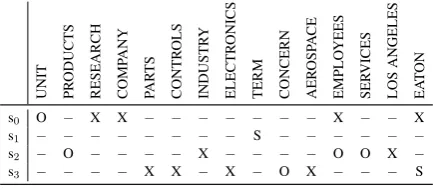
Several formal theories of coherence have been proposed (Mann and Thompson, 1988a; Grosz et al.,1995;Asher and Lascarides,2003), and their principles have inspired development of many existing coherence models (Barzilay and Lap-ata, 2008; Lin et al., 2011; Li and Hovy, 2014). Among these models, theentity grid(Barzilay and Lapata,2008), which is based on Centering The-ory (Grosz et al.,1995), is arguably the most pop-ular, and has seen a number of improvements over the years. As shown in Figure 1, the entity grid model represents a text by a grid that captures how
∗
Both authors contributed equally to this work.
grammatical roles of different entities change from sentence to sentence. The grid is then converted into a feature vector containing probabilities of local entity transitions, which enables machine learning models to learn the degree of text coher-ence. Extensions of this basic grid model incorpo-rate entity-specific features (Elsner and Charniak,
2011), multiple ranks (Feng and Hirst,2012), and coherence relations (Feng et al.,2014).
While the entity grid and its extensions have been successful in many applications, they are limited in several ways. First, they use discrete representation for grammatical roles and features, which prevents the model from considering suffi-ciently long transitions (Bengio et al.,2003). Sec-ond, feature vector computation in existing models is decoupled from the target task, which limits the model’s capacity to learn task-specific features.
In this paper, we propose aneural architecture for coherence assessment that can capture long range entity transitions along with arbitrary entity-specific features. Our model obtains generaliza-tion through distributed representations of entity transitions and entity features. We also present an end-to-end training method to learn task-specific high level features automatically in our model.
We evaluate our approach on three different evaluation tasks: discrimination, insertion, and summary coherence rating, proposed previously for evaluating coherence models (Barzilay and La-pata,2008;Elsner and Charniak,2011). Discrim-ination and insertion involve identifying the right order of the sentences in a text with different lev-els of difficulty. In the summary coherence rat-ing task, we compare the rankrat-ings, given by the model, against human judgments of coherence.
The experimental results show that our neu-ral models consistently improve over the non-neural counterparts (i.e., existing entity grid mod-els) yielding absolute gains of about4% on
crimination, up to 2.5% on insertion, and more than 4%on summary coherence rating.
Further-more, our model achieves state of the art results in all these tasks. We have released our source code for research purposes.1
The remainder of this paper is organized as fol-lows. We describe entity grid, its extensions, and its limitations in Section 2. In Section 3, we present our neural model. We describe evaluation tasks and results in Sections4 and5. We give a brief account of related work in Section6. Finally, we conclude with future directions in Section7.
2 Entity Grid and Its Extensions
Motivated by Centering Theory (Grosz et al.,
1995), Barzilay and Lapata (2008) proposed an entity-based model for representing and assessing text coherence. Their model represents a text by a two-dimensional array calledentity gridthat cap-tures transitions of discourse entities across sen-tences. As shown in Figure1, the rows of the grid correspond to sentences, and the columns corre-spond to discourse entities appearing in the text. They consider noun phrases (NP) as entities, and employ a coreference resolver to detect mentions of the same entity (e.g., Obama, the president). Each entry Gi,j in the entity grid represents the
syntactic role that entity ej plays in sentence si,
which can be one of: subject (S), object (O), or other (X). In addition, entities not appearing in a sentence are marked by a special symbol (-). If an entity appears more than once with different gram-matical roles in the same sentence, the role with the highest rank (SOX) is considered.
To represent the entity grid using a feature vec-tor, Barzilay and Lapata (2008) compute proba-bility for each local entity transition of length k
(i.e., {S, O, X,−}k), and represent each grid by
a vector of 4k transitions probabilities. To
dis-tinguish between transitions of important entities from unimportant ones, they consider thesalience of the entities, which they quantify by their oc-currence frequency in the document. Assessment of text coherence is then formulated as a ranking problem in an SVM preference ranking framework (Joachims,2002).
Subsequent studies proposed to extend the ba-sic entity grid model.Filippova and Strube(2007) attempted to improve the model by grouping
en-1https://github.com/datienguyen/cnn_
coherence/
UNIT PRODUCTS RESEARCH COMP
ANY
PAR
TS
CONTR
OLS
INDUSTR
Y
ELECTR
ONICS
TERM CONCERN AER
OSP
A
CE
EMPLO
YEES
SER
VICES
LOS
ANGELES
EA
TON
s0 O − X X − − − − − − − X − − X
s1 − − − − − − − − S − − − − − −
s2 − O − − − − X − − − − O O X −
s3 − − − − X X − X − O X − − − S
s0: Eaton Corp. said it sold its Pacific Sierra Research unit
to a company formed by employees of that unit. s1: Terms were not disclosed.
s2: Pacific Sierra, based in Los Angeles, has 200
employ-ees and supplies professional services and advanced products to industry.
s3: Eaton is an automotive parts, controls and aerospace
[image:2.595.309.526.62.157.2]electronics concern.
Figure 1: Entity grid representation (top) for a document (below) fromWSJ(id: 0079).
tities based on semantic relatedness, but did not get significant improvement.Elsner and Charniak
(2011) proposed a number of improvements. They initially show significant improvement by includ-ing non-head nouns (i.e., nouns that do not head NPs) as entities in the grid.2 Then, they extend
the grid to distinguish between entities of different types by incorporating entity-specific features like named entity, noun class, modifiers, etc. These ex-tensions led to the best results reported so far.
The Entity grid and its extensions have been successfully applied to many downstream tasks including coherence rating (Barzilay and Lapata,
2008), essay scoring (Burstein et al.,2010), story generation (McIntyre and Lapata,2010), and read-ability assessment (Pitler et al.,2010;Barzilay and Lapata,2008). They have also been critical com-ponents in state-of-the-art sentence ordering mod-els (Soricut and Marcu, 2006; Elsner and Char-niak,2011;Lin et al.,2011).
2.1 Limitations of Entity Grid Models
Despite its success, existing entity grid models are limited in several ways.
• Existing models use discrete representation for grammatical roles and features, which leads to the so-calledcurse of dimensionalityproblem ( Ben-gio et al.,2003). In particular, to model transitions of lengthkwithRdifferent grammatical roles, the
basic entity grid model needs to computeRk
sition probabilities from a grid. One can imagine that the estimated distribution becomes sparse ask
increases. This prevents the model from consider-ing longer transitions – existconsider-ing models usek≤3. This problem is exacerbated when we want to in-clude entity-specific features, as the number of pa-rameters grows exponentially with the number of features (Elsner and Charniak,2011).
• Existing models compute feature representa-tions from entity grids in a task-agnostic way. In other words, feature extraction is decoupled from the target downstream tasks. This can limit the model’s capacity to learn task-specific features. Therefore, models that can be trained in an end-to-end fashion on different target tasks are desirable. In the following section, we present a neural ar-chitecture that allows us to capture long range en-tity transitions along with arbitrary enen-tity-specific features without loosing generalization. We also present an end-to-end training method to learn task-specific features automatically.
3 The Neural Coherence Model
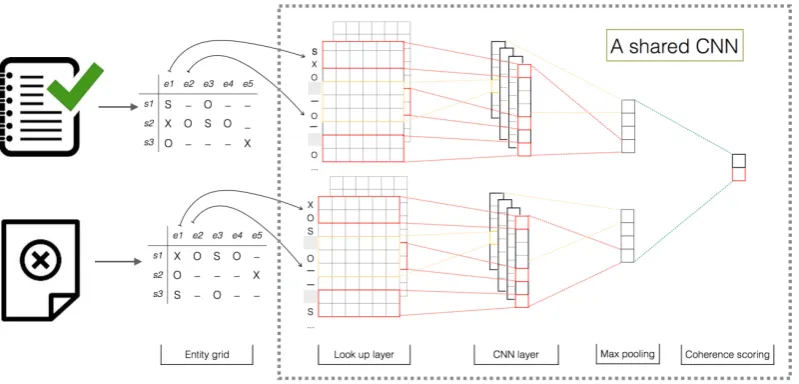
Figure 2 summarizes our neural architecture for modeling local coherence, and how it can be trained in a pairwise fashion. The architecture takes a document as input, and first extracts its en-tity grid.3 The first layer of the neural network
transforms each grammatical role in the grid into a distributed representation, a real-valued vector. The second layer computes high-level features by going over each column (transitions) of the grid. The following layer selects the most important high-level features, which are in turn used for co-herence scoring. The features computed at differ-ent layers of the network are automatically trained by backpropagation to be relevant to the task. In the following, we elaborate on the layers of the neural network model.
(I) Transforming grammatical roles into fea-ture vectors: Grammatical roles are fed to our model as indices taken from a finite vocabularyV. In the simplest scenario,Vcontains{S, O, X,−}. However, we will see in Section3.1that as we in-clude more entity-specific features,V can contain more symbols. The first layer of our network maps each of these indices into a distributed representa-tionRdby looking up a shared embedding matrix
3For clarification, pairwise input as shown in the figure is required only to train the model.
E ∈R|V|×d. We consider E a model parameter to be learned by backpropagation on a given task. We can initializeE randomly or using pretrained
vectors trained on a general coherence task. Given an entity gridGwith columns
represent-ing entity transitions over sentences in a docu-ment, the lookup layer extracts a d-dimensional
vector for each entryGi,j fromE. More formally,
L(G) =DE(G1,1) · · · E(Gi,j) · · · E(Gm,n)
E
(1) whereE(Gi,j) refers to the row in E that
corre-sponds to the grammatical roleGi,j ∈V;mis the
total number of sentences andnis the total
num-ber of entities in the document. The outputL(G)
is a tensor in Rm×n×d, which is fed to the next
layer of the network as we describe below.
(II) Modeling entity transitions: The vectors produced by the lookup layer are combined by subsequent layers of the network to generate a coherence score for the document. To compose higher-level features from the embedding vectors, we make the following modeling assumptions:
• Similar to existing entity grid models, we as-sume there is no spatio-temporal relation between the entities in a document. In other words, columns in a grid are treated independently.
• We are interested in modeling entity transitions of arbitrary lengths in a location-invariant way. This means, we aim to compose local patches of entity transitions into higher-level representations, while treating the patches independently of their position in the entity grid.
Under these assumptions, the natural choice to tackle this problem is to use a convolutional ap-proach, used previously to solve other NLP tasks (Collobert et al.,2011;Kim,2014).
Convolution layer: A convolution operation in-volves applying afilter w ∈ Rk.d (i.e., a vector of weight parameters) to each entity transition of lengthkto produce a new abstract feature
ht=f(wTLt:t+k−1,j+bt) (2)
where Lt:t+k−1,j denotes the concatenation of k
Figure 2: Neural architecture for modeling local coherence and the pairwise training method.
term, andf is a nonlinear activation function, e.g., ReLU (Nair and Hinton,2010) in our model.
We apply this filter to each possible k-length transitions of different entities in the grid to gener-ate afeature map,hi = [h1,· · · , hm.n+k−1]. We
repeat this processNtimes withN different filters to get N different feature maps (Figure 2).
No-tice that we use awideconvolution (Kalchbrenner et al.,2014), as opposed tonarrow, to ensure that the filters reach entire columns of a grid, including the boundary entities. This is done by performing zero-padding, where out-of-range (i.e., fort < 0
ort >{m, n}) vectors are assumed to be zero. Convolutional filters learn to compose local transition features of a grid into higher-level rep-resentations automatically. Since it operates over the distributed representation of grid entries, com-pared to traditional grid models, the transition length k can be sufficiently large (e.g., 5 − 8
in our experiments) to capture long-range tran-sitional dependencies without overfitting on the training data. Moreover, unlike existing grid mod-els that compute transition probabilities from a single document, embedding vectors and convo-lutional filters are learned from all training docu-ments, which helps the neural framework to obtain better generalization and robustness.
Pooling layer: After the convolution, we apply amax-poolingoperation to each feature map.
m= [µp(h1),· · ·, µp(hN)] (3)
whereµp(hi)refers to themaxoperation applied
to each non-overlapping4 window ofpfeatures in
the feature maphi. Max-pooling reduces the out-put dimensionality by a factor ofp, and it drives
the model to capture the most salient local features from each feature map in the convolutional layer.
Coherence scoring: Finally, the max-pooled features are used in the output layer of the network to produce a coherence scorey∈R.
y=vTm+b (4)
wherevis the weight vector andbis a bias term. Why it works: Intuitively, each filter detects a specific transition pattern (e.g., ‘SS-O-X’ for a co-herent text), and if this pattern occurs somewhere in the grid, the resulting feature map will have a large value for that particular region and small val-ues for other regions. By applying max pooling on this feature map, the network then discovers that the transition appeared in the grid.
3.1 Incorporating Entity-Specific Features
Our model as described above neuralizes the basic entity grid model that considers only entity transi-tions without distinguishing between types of the entities. However, asElsner and Charniak(2011) pointed out entity-specific features could be cru-cial for modeling local coherence. One simple way to incorporate entity-specific features into our model is to attach the feature value (e.g., named entity type) with the grammatical role in the grid.
4We set thestride sizeto be the same as the pooling length
For example, if an entityej of type PERSON
ap-pears as a subject (S) in sentencesi, the grid entry Gi,jcan be encoded as PERSON-S.
3.2 Training
Our neural model assigns a coherence score to an input document d based on the degree of lo-cal coherence observed in its entity grid G. Let y = φ(G|θ)define our model that transforms an
input gridGto a coherence scorey through a se-quence of lookup, convolutional, pooling, and lin-ear projection layers with parameter set θ. The
parameter setθincludes the embedding matrixE, the filter matrix W, the weight vectorv, and the biases. We use apairwise rankingapproach ( Col-lobert et al.,2011) to learnθ.
The training set comprises ordered pairs
(di, dj), where documentdi exhibits a higher
de-gree of coherence than documentdj. As we will
see in Section 4 such orderings can be obtained automatically or through manual annotation. In training, we seek to find θ that assigns a higher
coherence score todithan todj. We minimize the
following ranking objective with respect toθ:
J(θ) = max{0,1−φ(Gi|θ) +φ(Gj|θ)} (5)
whereGiandGj are the entity grids
correspond-ing to documents di anddj, respectively. Notice
that (also shown in Figure2) the network shares its layers (and hence θ) to obtain φ(Gi|θ) and φ(Gj|θ)from a pair of input grids(Gi, Gj).
Barzilay and Lapata (2008) adopted a similar ranking criterion using an SVM preference kernel learner as they argue coherence assessment is best seen as a ranking problem as opposed to classifi-cation (coherentvs. incoherent). Also, the ranker gives a scoring function φ that a text generation system can use to compare alternative hypotheses.
4 Evaluation Tasks
We evaluate the effectiveness of our coherence models on two different evaluation tasks: sentence ordering and summary coherence rating.
4.1 Sentence Ordering
Following Elsner and Charniak (2011), we eval-uate our models on two sentence ordering tasks: discrimination and insertion.
In thediscriminationtask (Barzilay and Lapata,
2008), a document is compared to a random
per-Sections # Doc. # Pairs Avg. # Sen.
TRAIN 00-13 1,378 26,422 21.5
TEST 14-24 1,053 20,411 22.3
Table 1: Statistics on theWSJdataset.
mutation of its sentences, and the model is con-sidered correct if it scores the original document higher than the permuted one. We use20
permu-tations of each document in the test set in accor-dance with previous work.
In the insertion task (Elsner and Charniak,
2011), we evaluate models based on their ability to locate the original position of a sentence pre-viously removed from a document. To measure this, each sentence in the document is removed in turn, and an insertion place is located for which the model gives the highest coherence score to the document. The insertion score is then computed as the average fraction of sentences per document reinserted in their actual position.
Discrimination can be easier for longer docu-ments, since a random permutation is likely to be different than the original one. Insertion is a much more difficult task since the candidate documents differ only by the position of one sentence.
Dataset: For sentence ordering tasks, we use the Wall Street Journal (WSJ) portion of Penn Treebank, as used byElsner and Charniak(2008,
2011);Lin et al.(2011);Feng et al.(2014). Table1
gives basic statistics about the dataset. Following previous works, we use 20 random permutations
of each article, and we exclude permutations that match the original document.5 The fourth column
(# Pairs) in Table 1 shows the resulting number of (original,permuted) pairs used for training our model and for testing in the discrimination task.
Some previous studies (Barzilay and Lapata,
2008; Li and Hovy, 2014) used the AIRPLANES
and theEARTHQUAKEScorpora, which contain
re-ports on airplane crashes and earthquakes, respec-tively. Each of these corpora contains100articles
for training and100 articles for testing. The
av-erage number of sentences per article in these two corpora is10.4and11.5, respectively.
We preferred the WSJ corpus for several
rea-sons. First and most importantly, the WSJ
cor-pus is larger than other corpora (see Table 1). A large training set is crucial for learning effective
deep learning models (Collobert et al.,2011), and a large enough test set is necessary to make a gen-eral comment about model performance. Second, asElsner and Charniak(2011) pointed out, texts in
AIRPLANES and EARTHQUAKES are constrained
in style, whereas WSJ documents are more like
normal informative articles. Third, we could re-produce results on this dataset for the competing systems (e.g., entity grid and its extensions) using the publicly available Brown coherence toolkit.6
4.2 Summary Coherence Rating
We further evaluate our models on the summary coherence rating task proposed by Barzilay and Lapata(2008), where we compare rankings given by a model to a pair of summaries against rankings elicited from human judges.
Dataset: The summary dataset was extracted from the Document Understanding Conference (DUC’03), which contains 6 clusters of multi-document summaries produced by human experts and 5 automatic summarization systems. Each cluster has 16 summaries of a document with pair-wise coherence rankings given by humans judges; see (Barzilay and Lapata,2008) for details on the annotation method. There are 144 pairs of sum-maries for training and 80 pairs for testing.
5 Experiments
In this section, we present our experiments — the models we compare, their settings, and the results.
5.1 Models Compared
We compare our coherence model against a ran-dom baseline and several existing models.
Random: The Random baseline makes a ran-dom decision for the evaluation tasks.
Graph-based Model: This is the graph-based unsupervised model proposed byGuinaudeau and Strube (2013). We use the implementation from the cohere7toolkit (Smith et al.,2016), and run it
on the test set with syntactic projection (command line option ‘projection=3’) for graph construction. This setting yielded best scores for this model.
Distributed Sentence Model: Li and Hovy
(2014) proposed this neural model for measuring
6https://bitbucket.org/melsner/browncoherence 7https://github.com/karins/CoherenceFramework
text coherence. The model first encodes each sen-tence in a document into a fixed-length vector us-ing a recurrent or a recursive neural network. Then it computes the coherence score of the document by aggregating the scores estimated for each win-dow of three sentences in the document. We used the implementation made publicly available by the authors.8 We trained the model on our WSJ
cor-pus with 512, 1024 and 1536 minibatch sizes for a maximum of 25 epochs.9 The model that used
minibatch size of 512 and completed 23 epochs achieved the best accuracy on theDEVset. We
ap-plied this model to get the scores on theTESTset. Grid-all nouns (E&C): This is the simple ex-tension of the original entity grid model, where all nouns are considered as entities.Elsner and Char-niak(2011) report significant gains by considering all nouns as opposed to only head-nouns. Results for this model were obtained by training the base-line entity grid model (command base-line option ‘-n’) in the Brown coherence toolkit on our dataset.
Extended grid (E&C): This represents the ex-tended entity grid model ofElsner and Charniak
(2011) that uses 9 entity-specific features; 4 of
them were computed from external corpora. This model considers all nouns as entities. For this sys-tem, we train the extended grid model (command line option ‘-f’) in the Brown coherence toolkit.
Grid-CNN: This is our proposed neural exten-sion of the basic entity grid (all nouns), where we only consider entity transitions as input.
Extended Grid-CNN: This corresponds to our neural model that incorporates entity-specific fea-tures following the method described in Section
3.1. To keep the model simple, we include only three entity-specific features from (Elsner and Charniak,2011) that are easy to compute and do not require any external corpus. The features are: (i) named entity type, (ii) salienceas deter-mined by occurrence frequency of the entity, and
8http://cs.stanford.edu/ bdlijiwei/code/
9OurWSJcorpus is about 14 times larger than theirAC
Batch Emb. Dropout Filter Win. Pool Grid-CNN 128 100 0.5 150 6 6 Ext. Grid-CNN 32 100 0.5 150 5 6
Table 2: Optimal hyper-parameter setting for our neural models based on development set accuracy.
(iii) whether the entity has apropermention.
5.2 Settings for Neural Models
We held out 10% of the training documents to
form a development set (DEV) on which we tune
the hyper-parameters of our neural models. For discrimination and insertion tasks, the resulting
DEV set contains 138 articles and 2,678 pairs
af-ter removing the permutations that match the orig-inal documents. For the summary rating task,DEV
contains 14 pairs of summaries.
We implement our models in Theano (Theano Development Team, 2016). We use rectified lin-ear units (ReLU) as activations (f). The
embed-ding matrix is initialized with samples from uni-form distributionU(−0.01,0.01), and the weight
matrices are initialized with samples from glorot-uniform distribution (Glorot and Bengio,2010).
We train the models by optimizing the pair-wise ranking loss in Equation5using the gradient-based online learning algorithm RMSprop with parameters (ρ and ) set to the values suggested
by Tieleman and Hinton (2012).10 We use up to
25 epochs. To avoid overfitting, we use dropout (Srivastava et al., 2014) of hidden units, and do early stoppingby observing accuracy on theDEV
set – if the accuracy does not increase for 10
consecutive epochs, we exit with the best model recorded so far. We search for optimal minibatch
size in {16,32,64,128}, embedding size in
{80,100,200}, dropout rate in {0.2,0.3,0.5},
filter number in {100,150,200,300}, window
size in {2,3,4,5,6,7,8}, and pooling length in
{3,4,5,6,7}. Table 2 shows the optimal hyper-parameter setting for our models. The best model onDEVis then used for the final evaluation on the TESTset. We run each experiment five times, each
time with a different random seed, and we report the average of the runs to avoid any randomness in results. Statistical significance tests are done using anapproximate randomizationtest based on the accuracy. We used SIGF V.2 (Pad´o,2006) with
10Other adaptive algorithms, e.g., ADAM (Kingma and
Ba,2014), ADADELTA (Zeiler,2012) gave similar results.
Discr. Ins.
Acc F1
Random 50.0 50.0 12.60
Graph-based (G&S) 64.23 65.01 11.93 Dist. sentence (L&H) 77.54 77.54 19.32 Grid-all nouns (E&C) 81.58 81.60 22.13 Extended Grid (E&C) 84.95 84.95 23.28
Grid-CNN 85.57† 85.57† 23.12
Extended Grid-CNN 88.69† 88.69† 25.95†
Table 3: Coherence evaluation results on
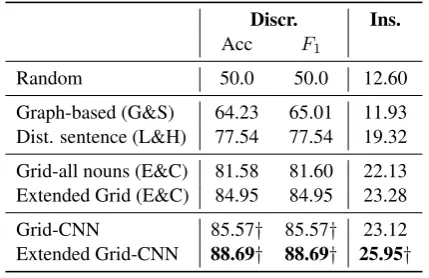
Discrimination andInsertion tasks. † indicates a neural model is significantly superior to its non-neural counterpart with p-value<0.01.
10,000 iterations.
5.3 Results on Sentence Ordering
Table 3 shows the results on discrimination and insertion tasks. The graph-based model gets the lowest scores. This is not surprising considering that this model works in an unsupervised way. The distributed sentence model surprisingly performed poorly on our dataset. Among the existing mod-els, the grid models get the best scores on both tasks. This demonstrates that entity transition, as a method to capture local coherence, is more ef-fective than the sentence representation method.
Neuralization of the existing grid models yields significant improvements in most cases. The Grid-CNN model delivers absolute improvements of about 4% in discrimination and 1% in insertion
over the basic grid model. When we compare our Extended Grid-CNN with its non-neural counter-part Extended Grid, we observe similar gains in discrimination and more gains (2.5%) in insertion.
Note that the Extended Grid-CNN yields these im-provements considering only a subset of the Ex-tended Grid features. This demonstrates the effec-tiveness of distributed representation and convolu-tional feature learning method.
[image:7.595.75.290.65.106.2]Acc F1
Random 50.0 50.0
Graph-based (G&S) 80.0 81.5
Grid (B&L) 83.8
-Grid-CNN 85.0 85.0
[image:8.595.75.279.63.210.2]Extended Grid-CNN 86.3 86.3 Pre-trained Grid-CNN 86.3 86.3 Pre-trained Ext. Grid-CNN 87.5 87.5
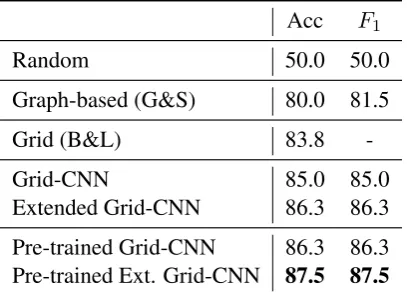
Table 4: Evaluation results on theSummary Co-herence Ratingtask.
to see how the model performs when it is trained on the insertion task directly.
5.4 Results on Summary Coherence Rating
Table 4 presents the results on the summary co-herence rating task, where we compare our mod-els with the reported results of the graph-based method (Guinaudeau and Strube, 2013) and the initial entity grid model (Barzilay and Lapata,
2008) on the same experimental setting.11 The
ex-tended grid model does not use pairwise training, therefore could not be trained on the summariza-tion dataset. Since there are not many training in-stances, our neural models may not learn well for this task. Therefore, we also present versions of our model, where we use pre-trained models from discrimination task on WSJ corpus (last two rows
in the table ). The pre-trained models are then fine-tunedon the summary rating task.
We can observe that even without pre-training our models outperform existing models, and pre-training gives further improvements. Specifically, Pre-trained Grid-CNN gives an improvement of
2.5% over the Grid model, and including entity
features pushes the improvement further to3.7%.
6 Related Work
Barzilay and Lapata(2005, 2008) introduced the entity grid representation of discourse to model lo-cal coherence that captures the distribution of dis-course entities across sentences in a text. They also introduced three tasks to evaluate the perfor-mance of coherence models: discrimination, sum-mary coherence rating, and readability.
11Since we do not have access to the output of their sys-tems, we could not do a significance test for this task.
A number of extensions of the basic entity grid model has been proposed. Elsner and Charniak
(2011) included entity-specific features to distin-guish between entities. Feng and Hirst (2012) used the basic grid representation, but improved its learning to rank scheme. Their model learns not only from original document and its permuta-tions but also from ranking preferences among the permutations themselves. Guinaudeau and Strube
(2013) convert a standard entity grid into a bi-partite graph representing entity occurrences in sentences. To model local entity transition, the method constructs a directed projection graph rep-resenting the connection between adjacent sen-tences. Two sentences have a connected edge if they share at least one entity in common. The co-herence score of the document is then computed as the average out-degree of sentence nodes.
In addition, there are some approaches that model text coherence based on coreferences and discourse relations. Elsner and Charniak (2008) proposed the discourse-new model by taking into account mentions of all referring expression (i.e., NPs) whether they are first mention ( discourse-new) or subsequent (discourse-old) mentions. Given a document, they run a maximum-entropy classifier to detect each NP as a label Lnp ∈
{new, old}. The coherence score of the
docu-ment is then estimated by Qnp:N P sP(Lnp|np).
In this work, they also estimate text coherence through pronoun coreference modeling. Lin et al.
(2011) assume that a coherent text has certain dis-course relation patterns. Instead of modeling en-tity transitions, they model discourse role transi-tions between sentences. In a follow up work,
Feng et al.(2014) trained the same model but us-ing features derived from deep discourse struc-tures annotated with Rhetorical Structure Theory or RST (Mann and Thompson, 1988b) relations.
neural framework to compute the coherence score of a document by estimating coherence probability for every window ofLsentences (in their
experi-ments, L = 3). First, they use a recurrent or a recursive neural network to compute the represen-tation for each sentence inL from its words and
their pre-trained embeddings. Then the concate-nated vector is passed through a non-linear hidden layer, and finally the output layer decides if the window of sentences is a coherent text or not. Our approach is fundamentally different from their ap-proach; our model operates over entity grids, and we use convolutional architecture to model suffi-ciently long entity transitions.
7 Conclusion and Future Work
We presented a local coherence model based on a convolutional neural network that operates over the distributed representation of entity transitions in the grid representation of a text. Our architec-ture can model sufficiently long entity transitions, and can incorporate entity-specific features with-out loosing generalization power. We described a pairwise ranking approach to train the model on a target task and learn task-specific features. Our evaluation on discrimination, insertion and sum-mary coherence rating tasks demonstrates the ef-fectiveness of our approach yielding the best re-sults reported so far on these tasks.
In future, we would like to include other sources of information in our model. Our initial plan is to include rhetorical relations, which has been shown to benefit existing grid models (Feng et al.,2014). We would also like to extend our model to other forms of discourse, especially, asynchronous con-versations, where participants communicate with each other at different times (e.g., forum, email).
Acknowledgments
We thank Regina Barzilay and Mirella Lapata for making their summarization data available and Micha Elsner for making his coherence toolkit publicly available. We also thank the three anony-mous ACL reviewers and the program chairs for their insightful comments on the paper.
References
N. Asher and A. Lascarides. 2003. Logics of Conver-sation, Cambridge University Press.
Regina Barzilay and Mirella Lapata. 2005. Model-ing local coherence: An entity-based approach. In
Proceedings of the 43rd Annual Meeting on Asso-ciation for Computational Linguistics. Association for Computational Linguistics, Ann Arbor, Michi-gan, ACL ’05, pages 141–148.
Regina Barzilay and Mirella Lapata. 2008. Mod-eling local coherence: An entity-based ap-proach. Computational Linguistics 34(1):1–34.
http://www.aclweb.org/anthology/J08-1001. Yoshua Bengio, R´ejean Ducharme, Pascal Vincent,
and Christian Janvin. 2003. A neural probabilis-tic language model. J. Mach. Learn. Res. 3.
http://dl.acm.org/citation.cfm?id=944919.944966. Jill Burstein, Joel Tetreault, and Slava Andreyev. 2010.
Using entity-based features to model coherence in student essays. InHuman Language Technologies: The 2010 Annual Conference of the North American Chapter of the Association for Computational Lin-guistics. Association for Computational Linguistics, Los Angeles, California, HLT ’10, pages 681–684. Ronan Collobert, Jason Weston, L´eon Bottou, Michael
Karlen, Koray Kavukcuoglu, and Pavel Kuksa. 2011. Natural language processing (almost) from scratch. The Journal of Machine Learning Research
12:2493–2537.
Micha Elsner and Eugene Charniak. 2008.
Coreference-inspired coherence modeling. In
Proceedings of the 46th Annual Meeting of the As-sociation for Computational Linguistics on Human Language Technologies: Short Papers. Association for Computational Linguistics, Columbus, Ohio, HLT-Short ’08, pages 41–44.
Micha Elsner and Eugene Charniak. 2011. Extending the entity grid with entity-specific features. In Pro-ceedings of the 49th Annual Meeting of the Associ-ation for ComputAssoci-ational Linguistics: Human Lan-guage Technologies: Short Papers - Volume 2. As-sociation for Computational Linguistics, Portland, Oregon, HLT ’11, pages 125–129.
Vanessa Wei Feng and Graeme Hirst. 2012. Extend-ing the entity-based coherence model with multi-ple ranks. In Proceedings of the 13th Confer-ence of the European Chapter of the Association for Computational Linguistics. Association for Compu-tational Linguistics, Avignon, France, EACL ’12, pages 315–324.
Vanessa Wei Feng, Ziheng Lin, and Graeme Hirst. 2014. The impact of deep hierarchical discourse structures in the evaluation of text coherence. In
COLING.
Xavier Glorot and Yoshua Bengio. 2010. Understand-ing the difficulty of trainUnderstand-ing deep feedforward neu-ral networks. InJMLR W&CP: Proceedings of the Thirteenth International Conference on Artificial In-telligence and Statistics (AISTATS 2010). Sardinia, Italy, volume 9, pages 249–256.
Barbara J. Grosz, Scott Weinstein, and Aravind K. Joshi. 1995. Centering: A framework for modeling the local coherence of discourse. Comput. Linguist.
21(2):203–225.
Camille Guinaudeau and Michael Strube. 2013. Graph-based local coherence modeling. In Proceed-ings of the 51st Annual Meeting of the Association for Computational Linguistics, ACL 2013, 4-9 Au-gust 2013, Sofia, Bulgaria, Volume 1: Long Papers. pages 93–103.
Thorsten Joachims. 2002. Optimizing search engines using clickthrough data. In Proceedings of the Eighth ACM SIGKDD International Conference on Knowledge Discovery and Data Mining. ACM, Ed-monton, Alberta, Canada, KDD ’02, pages 133–142.
Nal Kalchbrenner, Edward Grefenstette, and Phil Blun-som. 2014. A convolutional neural network for modelling sentences. In Proceedings of the 52nd Annual Meeting of the Association for Computa-tional Linguistics (Volume 1: Long Papers). As-sociation for Computational Linguistics, Baltimore, Maryland, pages 655–665.
Yoon Kim. 2014. Convolutional neural networks for sentence classification. InProceedings of the 2014 Conference on Empirical Methods in Natural Lan-guage Processing (EMNLP). Association for Com-putational Linguistics, Doha, Qatar, pages 1746– 1751.
Diederik P. Kingma and Jimmy Ba. 2014. Adam: A method for stochastic optimization. CoRR
abs/1412.6980. http://arxiv.org/abs/1412.6980.
Jiwei Li and Eduard Hovy. 2014. A model of
coherence based on distributed sentence repre-sentation. In Proceedings of the 2014 Confer-ence on Empirical Methods in Natural Language Processing (EMNLP). Association for Computa-tional Linguistics, Doha, Qatar, pages 2039–2048.
http://www.aclweb.org/anthology/D14-1218.
Jiwei Li, Rumeng Li, and Eduard H Hovy. 2014. Recursive deep models for discourse parsing. In
EMNLP. pages 2061–2069.
Ziheng Lin, Hwee Tou Ng, and Min-Yen Kan. 2011. Automatically evaluating text coherence using dis-course relations. InProceedings of the 49th Annual Meeting of the Association for Computational Lin-guistics: Human Language Technologies - Volume 1. Association for Computational Linguistics, Port-land, Oregon, HLT ’11, pages 997–1006.
Annie Louis and Ani Nenkova. 2012. A coherence model based on syntactic patterns. In Proceed-ings of the 2012 Joint Conference on Empirical Methods in Natural Language Processing and Computational Natural Language Learning. Asso-ciation for Computational Linguistics, Stroudsburg, PA, USA, EMNLP-CoNLL ’12, pages 1157–1168.
http://dl.acm.org/citation.cfm?id=2390948.2391078.
W. Mann and S. Thompson. 1988a. Rhetorical Struc-ture Theory: Toward a Functional Theory of Text Organization. Text8(3):243–281.
William C Mann and Sandra A Thompson. 1988b. Rhetorical structure theory: Toward a functional the-ory of text organization. Text8(3):243–281.
Neil McIntyre and Mirella Lapata. 2010. Plot induc-tion and evoluinduc-tionary search for story generainduc-tion. In Proceedings of the 48th Annual Meeting of the Association for Computational Linguistics. Associ-ation for ComputAssoci-ational Linguistics, Uppsala, Swe-den, ACL ’10, pages 1562–1572.
Vinod Nair and Geoffrey E. Hinton. 2010. Rec-tified linear units improve restricted boltzmann machines. In Johannes Frnkranz and Thorsten Joachims, editors, Proceedings of the 27th International Conference on Machine Learn-ing (ICML-10). Omnipress, pages 807–814.
http://www.icml2010.org/papers/432.pdf.
Sebastian Pad´o. 2006. User’s guide tosigf: Signifi-cance testing by approximate randomisation.
Emily Pitler, Annie Louis, and Ani Nenkova. 2010. Automatic evaluation of linguistic quality in multi-document summarization. In Proceedings of the 48th Annual Meeting of the Association for Compu-tational Linguistics. Association for Computational Linguistics, Uppsala, Sweden, ACL ’10, pages 544– 554.
Karin Sim Smith, Wilker Aziz, and Lucia Specia. 2016. Cohere: A toolkit for local coherence. In Proceed-ings of the Tenth International Conference on Lan-guage Resources and Evaluation (LREC 2016). Eu-ropean Language Resources Association (ELRA), Portoroz, Slovenia.
Richard Socher, John Bauer, Christopher D. Man-ning, and Ng Andrew Y. 2013. Parsing with compositional vector grammars. In Proceed-ings of the 51st Annual Meeting of the As-sociation for Computational Linguistics (Volume 1: Long Papers). Association for Computa-tional Linguistics, Sofia, Bulgaria, pages 455–465.
http://www.aclweb.org/anthology/P13-1045.
Radu Soricut and Daniel Marcu. 2006. Discourse gen-eration using utility-trained coherence models. In
Nitish Srivastava, Geoffrey Hinton, Alex Krizhevsky, Ilya Sutskever, and Ruslan Salakhutdinov. 2014. Dropout: A simple way to prevent neural networks from overfitting. Journal of Machine Learning Re-search15:1929–1958.
Theano Development Team. 2016. Theano: A
Python framework for fast computation of mathe-matical expressions.arXiv e-printsabs/1605.02688.
http://arxiv.org/abs/1605.02688.
T. Tieleman and G Hinton. 2012. RMSprop, COURS-ERA: Neural Networks
Matthew D. Zeiler. 2012. ADADELTA: an adap-tive learning rate method. CoRR abs/1212.5701.