Graph-based Local Coherence Modeling
Camille Guinaudeau and Michael Strube Heidelberg Institute for Theoretical Studies gGmbH
Schloss-Wolfsbrunnenweg 35 69118 Heidelberg, Germany
(camille.guinaudeau|michael.strube)@h-its.org
Abstract
We propose a computationally efficient graph-based approach for local coherence modeling. We evaluate our system on three tasks: sentence ordering, summary coherence rating and readability assess-ment. The performance is comparable to entity grid based approaches though these rely on a computationally expensive train-ing phase and face data sparsity problems.
1 Introduction
Many NLP applications which process or gener-ate texts rely on information about local coher-ence, i.e. information about which entities occur in which sentence and how the entities are dis-tributed in the text. This led to the development of many theories and models accounting for lo-cal coherence. One popular model, the center-ing model (Grosz et al., 1995), uses a rankcenter-ing of discourse entities realized in particular sentences and computes transitions between adjacent sen-tences to provide insight in the felicity of texts. Centering models local coherence rather generally and has been applied to the generation of refer-ring expressions (Kibble and Power, 2004), to re-solve pronouns (Brennan et al., 1987, inter alia), to score essays (Miltsakaki and Kukich, 2004), to arrange sentences in the correct order (Karamanis et al., 2009), and to many other tasks. Poesio et al. (2004) observe that it is not clear how to set parameters in the centering model so that optimal performance in different tasks and languages can be achieved. Barzilay and Lapata (2008) criticize research on centering to be too dependent on man-ually annotated input. This led them to propose a local coherence model relying on a more parsimo-nious representation, the entity grid model.
The entity grid is a two dimensional array where the rows represent sentences and the columns dis-course entities. From this grid Barzilay and La-pata (2008) derive probabilities of transitions be-tween adjacent sentences which are used as fea-tures for machine learning algorithms. They eval-uate this approach successfully on sentence order-ing, summary coherence ratorder-ing, and readability as-sessment. However, their approach has some dis-advantages which they point out themselves: data sparsity, domain dependence and computational complexity, especially in terms of feature space is-sues while building their model (Barzilay and La-pata (2008, p.8, p.10, p.30), Elsner and Charniak (2011, p.126, p.127)).
In order to overcome these problems we pro-pose to represent entities in a graph and then model local coherence by applying centrality mea-sures to the nodes in the graph (Section 3). We claim that a graph is a more powerful representa-tion for local coherence than the entity grid (Barzi-lay and Lapata, 2008) which is restricted to transi-tions between adjacent sentences. The graph can easily span the entire text without leading to com-putational complexity and data sparsity problems. Similar to the application of graph-based methods in other areas of NLP (e.g. work on word sense disambiguation by Navigli and Lapata (2010); for an overview over graph-based methods in NLP see Mihalcea and Radev (2011)) we model local coherence by relying only on centrality measures applied to the nodes in the graph. We apply our graph-based model to the three tasks handled by Barzilay and Lapata (2008) to show that it pro-vides the same flexibility over disparate tasks as the entity grid model: sentence ordering (Section 4.1), summary coherence ranking (Section 4.2), and readability assessment (Section 4.3). In the
The Turkish government fell after mob-tie allegations. Turkey’s constitution mandates a secular republic despite its Muslim majority.
Military and secular leaders pressured President Demirel to keep the Islamic-oriented Virtue Party on the fringe.
[image:2.595.309.526.62.186.2]Business leaders feared Virtue would alienate the EU.
Table 1: Excerpt of a manual summary M from DUC2003
experiments sections, we discuss the impact of genre and stylistic properties of documents on the local coherence computation. We also show that, though we do not need a computationally expen-sive learning phase, our model achieves state-of-the-art performance. From this we conclude that a graph is an alternative to the entity grid model: it is computationally more tractable for modeling local coherence and does not suffer from data sparsity problems (Section 5).
2 The Entity Grid Model
Barzilay and Lapata (2005; 2008) introduced the entity grid, a method for local coherence modeling that captures the distribution of discourse entities across sentences in a text.
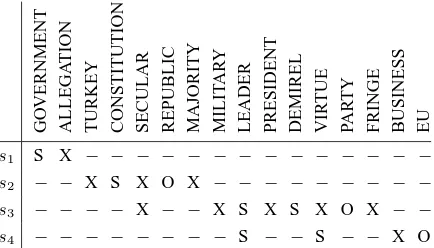
An entity grid is a two dimensional array, where rows correspond to sentences and columns to dis-course entities. For each disdis-course entity ej and each sentencesiin the text, the corresponding grid cellcijcontains information about the presence or absence of the entity in the sentence. If the entity does not appear in the sentence, the correspond-ing grid cell contains an absence marker “−”. If the entity is present in the sentence, the cell con-tains a representation of the entity’s syntactic role: “S” if the entity is a subject, “O” if it is an object and “X” for all other syntactic roles (cf. Table 2). When a noun is attested more than once with a different grammatical role in the same sentence, the role with the highest grammatical ranking is chosen to represent the entity (a subject is ranked higher than an object, which is ranked higher than other syntactic roles).
Barzilay and Lapata (2008) capture local coher-ence by means of local entity transitions, i.e. se-quences of grid cells(c1j. . . cij. . . cnj) represent-ing the syntactic function or absence of an entity in adjacent sentences1. The coherence of a sentence in relation to its local context is determined by the
1For complexity reasons, Barzilay and Lapata consider
only transitions between at most three sentences.
G O V E R N M E N T A L L E G A T IO N T U R K E Y C O N S T IT U T IO N S E C U L A R R E P U B L IC M A JO R IT Y M IL IT A R Y L E A D E R P R E S ID E N T D E M IR E L V IR T U E P A R T Y F R IN G E B U S IN E S S E U
s1 S X − − − − − − − − − − − − − −
s2 − − X S X O X − − − − − − − − −
s3 − − − − X − − X S X S X O X − −
s4 − − − − − − − − S − − S − − X O
Table 2: Entity Grid representation of summary M
local entity transitions of the entities present or ab-sent in the ab-sentence. To make this repreab-sentation accessible to machine learning algorithms, Barzi-lay and Lapata (2008) compute for each document the probability of each transition and generate fea-ture vectors representing the sentences. Coherence assessment is then formulated as a ranking learn-ing problem where the ranklearn-ing function is learned with SVMlight(Joachims, 2002).
The entity grid approach has already been ap-plied to many applications relying on local co-herence estimation: summary rating (Barzilay and Lapata, 2005), essay scoring (Burstein et al., 2010) or story generation (McIntyre and Lapata, 2010). It was also used successfully in com-bination with other systems or features. Sori-cut and Marcu (2006) show that the entity grid model is a critical component in their sentence or-dering model for discourse generation. Barzilay and Lapata (2008) combine the entity grid with readability-related features to discriminate docu-ments between easy- and difficult-to-read cate-gories. Lin et al. (2011) use discourse relations to transform the entity grid representation into a dis-course role matrix that is used to generate feature vectors for machine learning algorithms similarly to Barzilay and Lapata (2008).
s1 s2 s3 s4
e1 e2 e3 e4 e5 e6 e7 e8 e9 e10 e11 e12 e13 e14 e15 e16
3 1 1 3 1 2 1 1 1 3 1 3 1 2 1
3
3 1 2 s1 s2
s3 s4
1
1
s1 s2
s3 s4
1
2
(a) Bipartite Graph (b) Unweighted One-mode (c) Weighted One-mode
Projection Projection
e1 e2 e3 e4 e5 e6 e7 e8 e9 e10 e11 e12 e13 e14 e15 e16
s1 3 1 0 0 0 0 0 0 0 0 0 0 0 0 0 0
s2 0 0 1 3 1 2 1 0 0 0 0 0 0 0 0 0
s3 0 0 0 0 1 0 0 1 3 1 3 1 2 1 0 0
s4 0 0 0 0 0 0 0 0 3 0 0 3 0 0 1 2
s1 s2 s3 s4
s1 0 0 0 0
s2 0 0 1 0
s3 0 0 0 1
s4 0 0 0 0
s1 s2 s3 s4
s1 0 0 0 0
s2 0 0 1 0
s3 0 0 0 2
s4 0 0 0 0
(d) Incidence Matrix (e) Unweighted Adjacency (f) Weighted Adjacency
[image:3.595.79.530.61.265.2]Matrix Matrix
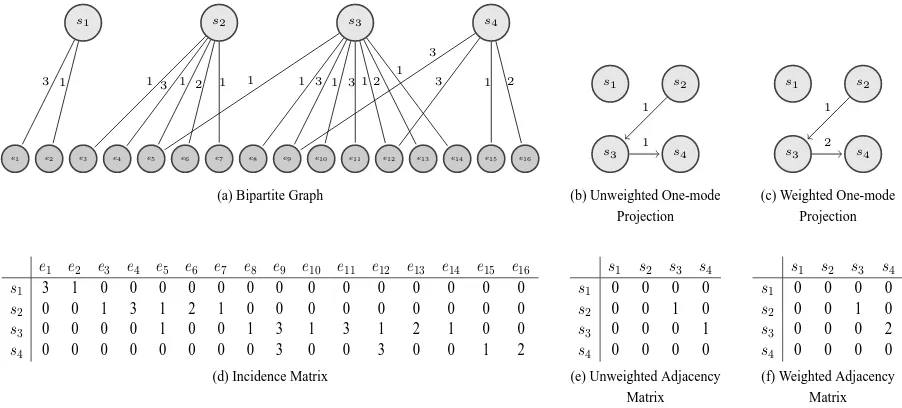
Figure 1: Bipartite graph for summary M from Table 1, one-mode projections and associated incidence and adjacency matrices. Weights in Figure 1(a) are assigned as follows: “S” = 3, “O” = 2, “X” = 1, “−” = 0 (no edge).
head noun. These extensions led to the best results reported so far for the sentence ordering task.
3 Method
Our model is based on the insight that the en-tity grid (Barzilay and Lapata, 2008) corresponds to the incidence matrix of a bipartite graph rep-resenting the text (see Newman (2010) for more details on graph representation). A fundamental assumption underlying our model is that this bi-partite graph contains the entity transition infor-mation needed for local coherence computation, rendering feature vectors and learning phase un-necessary. The bipartite graphG=(Vs, Ve, L, w) is defined by two independent sets of nodes – that correspond to the set of sentencesVsand the set of entitiesVeof the text – and a set of edgesL associ-ated with weightsw. An edge between a sentence nodesi and an entity nodeej is created in the bi-partite graph if the corresponding cell cij in the entity grid is not equal to “−”. Each edge is asso-ciated with a weightw(ej, si)that depends on the grammatical role of the entity ej in the sentence
si2. In contrast to Barzilay and Lapata’s entity grid that contains information about absent enti-ties, our graph-based representation only contains “positive” information. Figure 1(a) shows an ex-ample of the bipartite graph that corresponds to the grid in Table 2. The incidence matrix of this graph (Figure 1(d)) is very similar to the entity grid.
2The assignment of weights is described in Section 4.
By modeling entity transitions, Barzilay and Lapata rely on links that exist between sentences to model local coherence. In the same spirit, we apply different kinds of one-mode projections to the sentence node setVs of the bipartite graph to represent the connections that exist between – po-tentially non adjacent – sentences in the graph. These projections result in graphs where nodes correspond to sentences. An edge is created be-tween two nodes if the corresponding sentences have a least one entity in common. Contrary to the bipartite graph, one-mode projections are directed as they follow the text order. Therefore, in projec-tion graphs an edge can exist between the first and the second sentence while the inverse is not pos-sible. In our model, we define three kinds of pro-jection graphs, PU, PW andPAcc, depending on the weighting scheme associated with their edges. InPU, weights are binary and equal 1when two sentences have a least one entity in common (Fig-ure 1(b)). InPW, edges are weighted according to the number of entities “shared” by two sentences (Figure 1(c)). InPAccsyntactic information is ac-counted for by integrating the edge weights in the bipartite graph. In this case, weights are equal to
Wik =
X
e∈Eik
w(e, si)·w(e, sk),
where Eik is the set of entities shared bysi and
ex-ists between non adjacent sentences. In this case, the weights of the projection graphs are divided by
k−i.
From this graph-based representation, the local coherence of a textTcan be measured by comput-ing the average outdegree of a projection graphP. This centrality measure was chosen for two main reasons. First, it allows us to evaluate to which ex-tent a sentence is connected, in terms of discourse entities, with the other sentences of the text. Sec-ond, compared to other centrality measures, the computational complexity of the average outde-gree is low (O(N∗(N2−1)) for a document com-posed by N sentences), keeping the local coher-ence estimation feasible on large documents and on large corpora. Formally, the local coherence of a textT is equal to
LocalCoherence(T) =AvgOutDegree(P)
= 1
N
X
i=1..N
OutDegree(si),
where OutDegree(si)is the sum of the weights as-sociated to edges that leavesi andN is the num-ber of sentences in the text. This value can also be seen as the sum of the values of the adjacency ma-trix of the projection graph (Figures 1(e) and 1(f)) divided by the number of sentences.
4 Experiments
We compare our model with the entity grid ap-proach and evaluate the influence of the different weighting schemes used in the projection graphs, eitherPW orPAcc, where weights are potentially decreased by distance information Dist. Our baseline corresponds to local coherence computa-tion based on the unweighted projeccomputa-tion graphPU. For graph construction, all nouns in a document are considered as discourse entities, even those which do not head NPs as this is beneficial for the entity grid model as described in Elsner and Charniak (2011). We also propose to use a coref-erence resolution system and consider coreferent entities to be the same discourse entity. To do so, we use one of the top performing systems from the CoNLL 2012 shared task (Martschat et al., 2012). As the coreference resolution system is trained on well-formed textual documents and expects a cor-rect sentence ordering, we use in all our experi-ments only features that do not rely on sentence order (e.g. alias relations, string matching, etc.).
Grammatical information associated with each entity is extracted automatically thanks to the Stanford parser using dependency conversion (de Marneffe et al., 2006). Syntactic weights in the bipartite graph are defined following the linguistic intuition that subjects are more important than ob-jects, which are themselves more important than other syntactic roles. Preliminary experiments show that as long as weight assignment follows the scheme S>O>X, then more coherent docu-ments are associated with a higher local coherence value than less coherent document in 90% of cases (while this value equals 49% when no restric-tion is given on syntactic weights order). More-over, as the local coherence computation is a lin-ear combination of the syntactic weights, the func-tion is smooth and no large variafunc-tions of the local coherence values are observed for small changes of weights’ values. For these reasons, weights
w(e, si)are set as follows: 3 ifeis subject insi, 2 ifeis an object and 1 otherwise.
We evaluate the ability of our graph-based model to estimate the local coherence of a tex-tual document with three different experiments. First, we perfom a sentence ordering task (Sec-tion 4.1) as proposed in Barzilay and Lapata (2008). Then, as the first task uses “artificial” doc-uments, we also work on two other tasks that in-volve “real” documents: summary coherence rat-ing (Section 4.2), and readability assessment (Sec-tion 4.3). In these experiments, distance compu-tation and syntactic weights are the same for all tasks and all corpora. However, the model is also flexible and can be adaptated to the different tasks by optimizing the parameters on a development data set, which may give better results.
4.1 Sentence Ordering
The first experiment consists in ranking alternative sentence orderings of a document, as proposed by Barzilay and Lapata (2008) and Elsner and Char-niak (2011).
4.1.1 Experimental Settings
score of its permutation. In the insertion task, pro-posed by Elsner and Charniak (2011), we evaluate the ability of our system to retrieve the original position of a sentence previously removed from a document. For this, each sentence is removed in turn and a local coherence score is computed for every possible reinsertion position. The system output is considered as correct if the document as-sociated with the highest local coherence score is the one in which the sentence is reinserted in the correct position.
These two tasks were performed on docu-ments extracted from the English test part of the CoNLL 2012 shared task (Pradhan et al., 2012). This corpus, composed by documents of multiple news sources – spoken or written – was preferred to the ACCIDENTS and EARTHQUAKES corpora used by Barzilay and Lapata (2008) for two rea-sons. First, as mentioned by Elsner and Charniak (2008), these corpora use a very constrained style and are not typical of normal informative docu-ments3. Second, we want to evaluate the influence of automatically performed coreference resolution in a controlled fashion. The coreference resolution system used performs well on the CoNLL 2012 data. In this dataset, documents composed by the concatenation of differents news articles or too short to have at least 20 permutations were dis-carded from the corpus. This filtering results in 61 documents composed of 36.1 sentences or 2064 word tokens on average. In both discrimination and insertion, we compare our system against a random baseline where random values are associ-ated with the different orderings.
4.1.2 Discrimination
Accuracy is used to evaluate the ability of our sys-tem to discriminate a document from 20 differ-ent permutations. It equals the number of times our system gives the highest score to the original document, divided by the number of comparisons. Since the model can give the same score for a per-mutation and the original document, we also com-pute F-measure where recall is correct/total and precision equals correct/decisions. We test sig-nificance using the Student’s t-test that can detect significant differences between paired samples. Moreover, as increasing the number of hypotheses
3Our graph-based model obtains for the discrimination
task an accuracy of 0.846 and 0.635 on theACCIDENTSand
EARTHQUAKESdatasets, respectively, compared to 0.904 and
0.872 as reported by Barzilay and Lapata (2008).
Acc F Acc F
Random 0.496 0.496 B&L 0.877 0.877 E&C 0.915 0.915
wo coref w coref
PU, Dist 0.830 0.830 0.833 0.833
PW, Dist 0.871 0.871 0.849 0.849
[image:5.595.319.513.62.173.2]PAcc, Dist 0.889 0.889 0.852 0.852
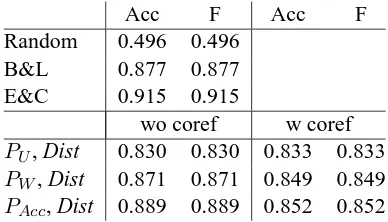
Table 3: Discrimination, reproduced baselines (B&L: Barzilay and Lapata (2008); E&C Elsner and Charniak (2011)) vs. graph-based
in a test can also increase the likelihood of wit-nessing a rare event, and therefore, the chance to reject the null hypothesis when it is true, we use the Bonferroni correction to adjust the increased random likelihood of apparent significance.
Table 3 presents the values obtained by three baseline systems when applied to our corpus. Re-sults for the entity grid models described by Barzi-lay and Lapata (2008) and Elsner and Charniak (2011) are obtained by using Micha Elsner’s reim-plementation in the Brown Coherence Toolkit4. The system was trained on the English training part of the CoNLL 2012 shared task filtered in the same way as the test part.
Table 3 also displays the results for our model. These values show that our system performs com-parable to the state-of-the-art. Indeed, the differ-ence between our best results and those of Elsner and Charniak are not statistically significant.
In this experiment, distance information is criti-cal. Without it, it is not possible to distinguish be-tween an original document and one of its permu-tation as both contain the same number and kind of entities. Distance however can detect changes in the distribution of entities within the document as space between entities is significantly modi-fied when sentence order is permuted. When the number of entities “shared” by two sentences is taken into account (PW), the accuracy of our sys-tem grows (from 0.830 to 0.871). Table 3 finally shows that syntactic information improves the per-formance of our system (yet not significantly) and gives the best results (PAcc).
We also evaluated the influence of coreference resolution on the performance of our system.
Us-4https://bitbucket.org/melsner/
Acc. Ins. Acc. Ins. Random 0.028 0.071
E&C 0.068 0.167
wo coref w coref
PU, Dist 0.062 0.101 0.068 0.120
PW, Dist 0.075 0.114 0.070 0.138
[image:6.595.85.279.63.157.2]PAcc, Dist 0.071 0.102 0.067 0.097
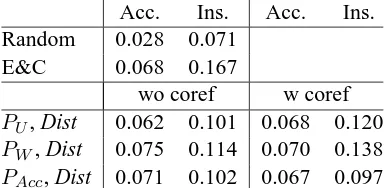
Table 4: Insertion, reproduced baselines vs. graph-based
ing coreference resolution improves the perfor-mance of the system when distance information is used alone in the system (Table 3). However, this improvement is not statistically significant.
4.1.3 Insertion
Sentence insertion is much more difficult than dis-crimination for two reasons. First, in insertion, permutations only differ by one sentence. Second, a document is compared to many more permuta-tions in insertion task than in discrimination.
In complement to accuracy, we use the insertion score introduced by Elsner and Charniak (2011) for evaluation. This score – the higher, the better – computes the proximity between the initial and the proposed position of a sentence, averaged by the number of sentences.
Table 4 shows that, as expected, results for this task are much lower than those obtained for dis-crimination. However they are still comparable with the results of Elsner and Charniak (2011)5.
As previously and for the same reasons, dis-tance information is critical for this task. The best results, that present a statistically significant im-provement when compared to the random base-line, are obtained when distance information and the number of entities “shared” by two sentences are taken into account (PW). We can see that the accuracy value obtained with our system is higher than the one provided with the entity grid model. However, the entity grid model reaches a signifi-cantly higher insertion score. This means that, if it makes more mistakes than our system, the position chosen by the entity grid model is usually closer to the correct position. Finally, contrary to the discrimination task, syntactic information (PAcc) does not improve the performance of our system.
5Their results are slightly lower than those presented in
their paper, probably because our corpus is composed by doc-uments that can be longer than the ones used in their experi-ments (Wall Street Journal articles).
When the coreference resolution system is used, the best accuracy value decreases while the inser-tion score increases from 0.114 to 0.138 (Table 4). Therefore, coreference resolution tends to asso-ciate positions that are closer to the original ones.
4.2 Summary Coherence Rating
To reconfirm the hypothesis that our model can es-timate the local coherence of a textual document, we perform a second experiment, summary co-herence rating. To this end, we apply our model on the corpus used and proposed by Barzilay and Lapata (2008). As the objective of our model is to estimate the coherence of a summary, we pre-fer this dataset to other summarization evaluation task corpora, as these account for other dimen-sions of the summaries: content selection, fluency, etc. Starting with a pair of summaries, one slightly more coherent than the other, the objective of the task is to order the two summaries according to local coherence.
4.2.1 Experimental Settings
For the summary coherence rating experiment, pairs to be ordered are composed of summaries extracted from the Document Understanding Con-ference (DUC 2003). Summaries, provided either by humans or by automatic systems, were judged by seven humans annotators and associated with a coherence score (for more details on this score see Barzilay and Lapata (2008)). 80 pairs were then created, each of these being composed by two summaries of a same document where the score of one of the summaries is significantly higher than the score of the second one. Even though all summaries are of approximately the same length (114.2 words on average), their sentence length can vary considerably. Indeed, more coherent summaries tend to have more sentences and con-tain less entities.
For evaluation purposes, the accuracy still cor-responds to the number of correct ratings di-vided by the number of comparisons, while the F-measure combines recall and precision F-measures. As before, significance is tested with the Student’s t-test accounting for the Bonferroni correction.
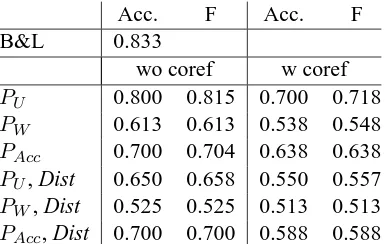
4.2.2 Results
Acc. F Acc. F B&L 0.833
wo coref w coref
PU 0.800 0.815 0.700 0.718
PW 0.613 0.613 0.538 0.548
PAcc 0.700 0.704 0.638 0.638
PU, Dist 0.650 0.658 0.550 0.557
PW, Dist 0.525 0.525 0.513 0.513
[image:7.595.86.279.62.184.2]PAcc, Dist 0.700 0.700 0.588 0.588
Table 5: Summary Coherence Rating, reported re-sults from Barzilay and Lapata (2008) vs. graph-based
our system gives results comparable to those ob-tained by Barzilay and Lapata (2008).
This table also shows that, contrary to sentence ordering task, accounting for the distance between two sentences (Dist) tends to decrease the results. This difference is explained by the fact that a man-ual summary, usman-ually considered as more coher-ent by humans annotators, tends to contain more (and shorter) sentences than an automatic one. As adding distance information decreases the value of our local coherence score, our graph-based model gives better results without it.
Moreover, in contrast to the first experiment, when accounting for the number of entities “shared” by two sentences (PW), values of accu-racy and F-measure are lower. We explain this behaviour by the number of sentences contained in the less coherent documents. Indeed, they are composed by a smaller number of sentences but contain more entities on average. This means that, in these documents, two sentences tend to share a larger number of entities and therefore have a higher local coherence score when thePW projec-tion graph is used.
When combined with distance information, syntactic information still improves the results (PAcc), though not significantly, but does not lead to the best results for this task.
Finally, Table 5 also shows that using a coref-erence resolution system for document represen-tation does not improve the performance of our system. We believe that, as mentioned by Barzi-lay and Lapata (2008), this degradation is related to the fact that automatic summarization systems do not use anaphoric expressions which makes the coreference resolution system useless in this case. With our graph-based model, the best results are
obtained by the baseline (PU), and experiments show that adding information about distance or syntax does not help in this context. It seems therefore necessary to integrate information that is more appropriate to summaries. Although making the model more appropriate for a specific task is out of the scope of this paper, our model is flex-ible and accounting for information about genre differences or sentence length, by adding weights in the graph-based representation of the document, is feasible without any modification of the model.
4.3 Readability Assessment
Barzilay and Lapata (2008) argue that grid models are domain and style dependent. Therefore they proposed a readability assessment task to test if the entity grid model can be used for style classifica-tion. They combined their model with Schwarm and Ostendorf’s (2005) readability features and use Support Vector Machines to classify docu-ments in two categories. With the same intention, we evaluate the ability of our model to differenti-ate “easy to read” documents from difficult ones.
4.3.1 Experimental Settings
The objective of the readability assessment task is to evaluate how difficult to read a document is. We perform this task on the data used by Barzilay and Lapata (2008), a corpus collected originally by Barzilay and Elhadad (2003) from the
Ency-clopedia Britannica and its version for children,
the Britannica Elementary. Both versions contain
107 articles. In Encyclopedia Britannica, docu-ments are composed by an average of 83.1 sen-tences while they contain 36.6 sensen-tences in
Bri-tannica Elementary. Although these texts are not
explicitly annotated with grade levels, they repre-sent two broad readability categories.
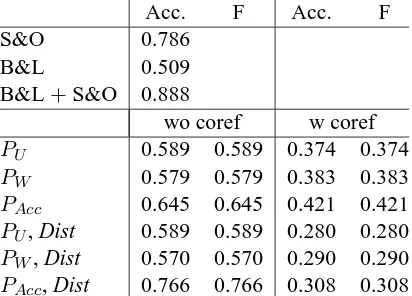
Acc. F Acc. F S&O 0.786
B&L 0.509 B&L+S&O 0.888
wo coref w coref
PU 0.589 0.589 0.374 0.374
PW 0.579 0.579 0.383 0.383
PAcc 0.645 0.645 0.421 0.421
PU, Dist 0.589 0.589 0.280 0.280
PW, Dist 0.570 0.570 0.290 0.290
[image:8.595.79.285.63.211.2]PAcc, Dist 0.766 0.766 0.308 0.308
Table 6: Readability, reported results from Barzi-lay and Lapata (2008) vs. graph-based (S&O: Schwarm and Ostendorf (2005))
4.3.2 Results
In order to compare our results with those reported by Barzilay and Lapata (2008), entities used for the graph-based representation are discourse enti-ties that head NPs.
Table 6 shows that, for this task, syntactic in-formation plays a dominant role (PAcc). A sta-tistically significant improvement is provided by including syntactic information. It gives more weight to subject entities that are more numerous in the Britannica Elementary documents which are composed by simpler and shorter sentences. Finally, when distance is accounted for together with syntactic information, the accuracy is signif-icantly improved (p<0.01) with regard to the re-sults obtained with syntactic information only.
Table 6 also shows that when the number of en-tities “shared” by two sentences is accounted for (PW), the results are lower. Indeed,
Encyclope-dia Britannica documents are composed by longer
sentences, that contain a higher number of enti-ties. This increases the local coherence value of difficult documents more than the value of “easy to read” documents, that contain less entities.
When our graph-based representation used the coreference resolution system, unlike the observa-tion of Barzilay and Lapata (2008), the results of our model decrease significantly. The poor perfor-mance of our system in this case can be explained by the fact that the coreference resolution system regroups more entities in Encyclopedia Britannica documents than in Britannica Elementary ones. Therefore, the number of entities that are “shared” by two sentences increases more importantly in the Encyclopedia Britannica corpus, while the
dis-tance between two occurrences of one entity de-creases in a more significant manner. For these reasons, the coherence scores associated with “dif-ficult to read” documents tend to be higher when coreference resolution is performed on our data, which reduces the performance of our system. As before, syntactic information leads to the best re-sults, but does not allow the accuracy to be higher than random anymore.
Compared to the results provided by Barzi-lay and Lapata (2008) with the entity grid model alone, our representation outperforms their model significantly. We believe that this difference is caused by how syntactic information is introduced in the document representation and by the fact that our system can deal with entities that appear throughout the whole document while the entity grid model only looks at entities within a three sentences windows. Our model which captures exclusively local coherence is almost on par with the results reported for Schwarm & Ostendorf’s (2005) system which relies on a wide range of lex-ical, syntactic and semantic features. Only when Barzilay and Lapata (2008) combine the entity grid with Schwarm & Ostendorf’s features they reach performance considerably better than ours.
In addition to the experiments proposed by Barzilay and Lapata (2008), we used a third read-ability category, the Britannica Student, that con-tains articles targeted for youths (from 11 to 14 years old). These documents, which are quite sim-ilar to the Encyclopedia Britannica ones, are com-posed by an average of 44.1 sentences. As we were only able to find 99 articles out of the 107 original ones in this category, sub corpora of the three categories were used for the comparison with the Britannica Student articles.
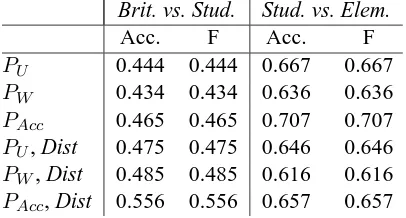
Table 7 shows the results obtained for the com-parisons between the two first categories and the
Britannica Student articles. As previously,
coref-erence resolution tends to lower the results, there-fore only values obtained without coreference res-olution are reported in the table.
When articles from Britannica Student are com-pared to articles extracted from Encyclopedia
Bri-tannica, Table 7 shows that the different
param-eters have the same influence as for comparing between Encyclopedia Britannica and Britannica
Elementary: statistically significant improvement
Brit. vs. Stud. Stud. vs. Elem.
Acc. F Acc. F
PU 0.444 0.444 0.667 0.667
PW 0.434 0.434 0.636 0.636
PAcc 0.465 0.465 0.707 0.707
PU, Dist 0.475 0.475 0.646 0.646
PW, Dist 0.485 0.485 0.616 0.616
[image:9.595.80.283.64.173.2]PAcc, Dist 0.556 0.556 0.657 0.657
Table 7: Readability, comparison between
Ency-clopedia Britannica, Britannica Elementary and Britannica Student
can also be seen that accuracy and F-measure are lower for comparing these two corpora. This is probably due to the stylistic difference between these two kinds of articles, which is less signifi-cant than the difference between articles from
En-cyclopedia Britannica and Britannica Elementary.
Concerning the comparison between Britannica
Student and Britannica Elementary articles,
Ta-ble 7 shows that integrating distance information gives slightly different results and tends to de-crease the values of accuracy and F-measure. This is explained by the fact that Britannica Elementary documents contain fewer entities than Britannica
Student articles. As the length of the two kinds of
articles is similar, distance between entities in
Bri-tannica Elementary documents is more important.
As a result, accounting for distance information lowers the local coherence values for the more co-herent document, which reduces the performance of our model. As previously, syntactic information improves the results and, for this comparison, the best result is obtained when syntactic information alone is accounted for. This leads to an accuracy which is almost equal to the one when comparing
Encyclopedia Britannica and Britannica Elemen-tary (0.707 against 0.766).
These two additional experiments show that our model is style dependent. It obtains better results when it has to distinguish between Encyclopedia
Britannica and Britannica Elementary or Britan-nica Student and BritanBritan-nica Elementary articles
which present a more important difference from a stylictic point of view than articles from
Ency-clopedia Britannica and Britannica Elementary.
5 Conclusions
In this paper, we proposed an unsupervised and computationally efficient graph-based local
coher-ence model. Experiments show that our model is robust among tasks and domains, and reaches rea-sonable results for three tasks with the same pa-rameter values and settings (i.e. accuracy values of 0.889, 0.70 and 0.766 for sentence ordering, summary coherence rating and readability assess-ment tasks respectively (PAcc, Dist)). Moreover, our model can be optimized and obtains results comparable with entity grid based methods when proper settings are used for each task.
Our model has two main advantages over the entity grid model. First, as the graph used for doc-ument representation contains information about entity transitions, our model does not need a learn-ing phase. Second, as it relies only on graph cen-trality, our model does not suffer from the com-putational complexity and data sparsity problems mentioned by Barzilay and Lapata (2008).
Our current model leaves space for improve-ment. Future work should first investigate the inte-gration of information about entities. Indeed, our model only uses entities as indications of sentence connection although it has been shown that distin-guishing important from unimportant entities, ac-cording to their named-entity category, has a pos-itive impact on local coherence computation (El-sner and Charniak, 2011). Moreover, future work should also examine the use of discourse relation information, as proposed in (Lin et al., 2011). This can be easily done by adding edges in the projec-tion graphs when sentences contain entities related from a discourse point of view while Lin et al.’s approach suffers from complexity and data spar-sity problems similar to the entity grid model.
Finally, these promising results on local coher-ence modeling make us believe that our graph-based representation can be used without much modification for other tasks, e.g. extractive sum-marization or topic segmentation. This could be achieved with link analysis algorithms such as PageRank, that decide on the importance of a (sen-tence) node within a graph based on global infor-mation recursively drawn from the entire graph.
References
Regina Barzilay and Noemie Elhadad. 2003. Sentence alignment for monolingual comparable corpora. In
Proceedings of the 2003 Conference on Empirical Methods in Natural Language Processing, Sapporo,
Japan, 11–12 July 2003, pages 25–32.
Regina Barzilay and Mirella Lapata. 2005. Model-ing local coherence: An entity-based approach. In
Proceedings of the 43rd Annual Meeting of the As-sociation for Computational Linguistics, Ann Arbor,
Mich., 25–30 June 2005, pages 141–148.
Regina Barzilay and Mirella Lapata. 2008. Modeling local coherence: An entity-based approach.
Compu-tational Linguistics, 34(1):1–34.
Susan E. Brennan, Marilyn W. Friedman, and Carl J. Pollard. 1987. A centering approach to pronouns. In Proceedings of the 25th Annual Meeting of the
As-sociation for Computational Linguistics, Stanford,
Cal., 6–9 July 1987, pages 155–162.
Jill Burstein, Joel Tetreault, and Slava Andreyev. 2010. Using entity-based features to model coherence in student essays. In Proceedings of Human Language
Technologies 2010: The Conference of the North American Chapter of the Association for Compu-tational Linguistics, Los Angeles, Cal., 2–4 June
2010, pages 681–684.
Marie-Catherine de Marneffe, Bill MacCartney, and Christopher D. Manning. 2006. Generating typed dependency parses from phrase structure parses. In
Proceedings of the 5th International Conference on Language Resources and Evaluation, Genoa, Italy,
22–28 May 2006, pages 449–454.
Micha Elsner and Eugene Charniak. 2008. Coreference-inspired coherence modeling. In
Proceedings ACL-HLT 2008 Conference Short Papers, Columbus, Ohio, 15–20 June 2008, pages
41–44.
Micha Elsner and Eugene Charniak. 2011. Extending the entity grid with entity-specific features. In
Pro-ceedings of the ACL 2011 Conference Short Papers,
Portland, Oreg., 19–24 June 2011, pages 125–129.
Micha Elsner, Joseph Austerweil, and Eugene Char-niak. 2007. A unified local and global model for discourse coherence. In Proceedings of
Hu-man Language Technologies 2007: The Conference of the North American Chapter of the Association for Computational Linguistics, Rochester, N.Y., 22–
27 April 2007, pages 436–443. Read this version: http://www.cs.brown.edu/ melsner/order.pdf.
Katja Filippova and Michael Strube. 2007. Ex-tending the entity-grid coherence model to seman-tically related entities. In Proceedings of the 11th
European Workshop on Natural Language Genera-tion, Schloss Dagstuhl, Germany, 17–20 June 2007,
pages 139–142.
Barbara J. Grosz, Aravind K. Joshi, and Scott Wein-stein. 1995. Centering: A framework for model-ing the local coherence of discourse. Computational
Linguistics, 21(2):203–225.
Thorsten Joachims. 2002. Optimizing search engines using clickthrough data. In Proceedings of the 8th
International Conference on Knowledge Discovery and Data Mining, Edmonton, Alberta, Canada, 23–
26 July 2002, pages 133–142.
Nikiforos Karamanis, Chris Mellish, Massimo Poesio, and Jon Oberlander. 2009. Evaluating centering for information ordering using corpora. Computational
Linguistics, 35(1):29–46.
Rodger Kibble and Richard Power. 2004. Optimizing referential coherence in text generation.
Computa-tional Linguistics, 30(4):401–416.
Ziheng Lin, Hwee Tou Ng, and Min-Yen Kan. 2011. Automatically evaluating text coherence using dis-course relations. In Proceedings of the 49th Annual
Meeting of the Association for Computational Lin-guistics, Portland, Oreg., 19–24 June 2011, pages
997–1006.
Sebastian Martschat, Jie Cai, Samuel Broscheit, ´Eva M´ujdricza-Maydt, and Michael Strube. 2012. A multigraph model for coreference resolution. In
Proceedings of the Shared Task of the 16th Confer-ence on Computational Natural Language Learning,
Jeju Island, Korea, 12–14 July 2012, pages 100–106.
Neil McIntyre and Mirella Lapata. 2010. Plot induc-tion and evoluinduc-tionary search for story generainduc-tion. In
Proceedings of the 48th Annual Meeting of the As-sociation for Computational Linguistics, Uppsala,
Sweden, 11–16 July 2010, pages 1562–1572.
Rada Mihalcea and Dragomir Radev. 2011.
Graph-based Natural Language Processing and Informa-tion Retrieval. Cambridge Univ. Press, Cambridge,
U.K.
Eleni Miltsakaki and Karen Kukich. 2004. Evaluation of text coherence for electronic essay scoring sys-tems. Natural Language Engineering, 10(1):25–55.
Roberto Navigli and Mirella Lapata. 2010. An ex-perimental study of graph connectivity for unsuper-vised word sense disambiguation. IEEE
Transac-tions on Pattern Analysis and Machine Intelligence,
32(4):678–692.
Mark E.J. Newman. 2010. Networks: An Introduction. Oxford University Press, New York, N.Y.
Massimo Poesio, Rosemary Stevenson, Barbara Di Eu-genio, and Janet Hitzeman. 2004. Centering: A parametric theory and its instantiations.
Computa-tional Linguistics, 30(3). 309-363.
In Proceedings of the Shared Task of the 16th
Con-ference on Computational Natural Language Learn-ing, Jeju Island, Korea, 12–14 July 2012, pages 1–
40.
Sarah E. Schwarm and Mari Ostendorf. 2005. Reading level assessment using support vector machines and statistical language models. In Proceedings of the
43rd Annual Meeting of the Association for Compu-tational Linguistics, Ann Arbor, Mich., 25–30 June
2005, pages 523–530.
Radu Soricut and Daniel Marcu. 2006. Discourse gen-eration using utility-trained coherence models. In
Proceedings of the 21st International Conference on Computational Linguistics and 44th Annual Meeting of the Association for Computational Linguistics,