558
Coherence Modeling of Asynchronous Conversations:
A Neural Entity Grid Approach
Tasnim Mohiuddin∗and Shafiq Joty∗ Nanyang Technological University
{mohi0004,srjoty}@ntu.edu.sg
Dat Tien Nguyen∗ University of Amsterdam
Abstract
We propose a novel coherence model for written asynchronous conversations (e.g., forums, emails), and show its applications in coherence assessment and thread recon-struction tasks. We conduct our research in two steps. First, we propose improve-ments to the recently proposed neural en-tity grid model by lexicalizing its enen-tity transitions. Then, we extend the model to asynchronous conversations by incorpo-rating the underlying conversational struc-ture in the entity grid representation and feature computation. Our model achieves state of the art results on standard co-herence assessment tasks in monologue and conversations outperforming existing models. We also demonstrate its effective-ness in reconstructing thread structures.
1 Introduction
Sentences in a text or a conversation do not occur independently, rather they are connected to form a coherent discourse that is easy to comprehend.
Coherence modelsare computational models that can distinguish a coherent discourse from incoher-ent ones. It has ranges of applications in text gen-eration, summarization, and coherence scoring.
Inspired by formal theories of discourse, a number of coherence models have been proposed
(Barzilay and Lapata, 2008; Lin et al., 2011; Li
and Jurafsky, 2017). The entity grid model
(Barzilay and Lapata, 2008) is one of the most
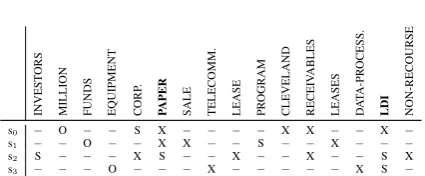
popular coherence models that has received much attention over the years. As exemplified in Table
1, the model represents a text by a grid that cap-tures how grammatical roles of different discourse entities (e.g.,nouns) change from one sentence to
∗
All authors contributed equally.
s0: LDICorp., Cleveland, said it will offer $50 million in commercialpaperbacked by leaserental receivables. s1: The program matches funds raised from the sale of the
commercialpaperwith small to medium-sized leases. s2: LDI termed the paper “non-recourse financing”, meaning that investors would be repaid from the lease receivables, rather than directly by LDI Corp. s3: LDIleases and sells data-processing,
telecommunica-tions and other high-tech equipment.
INVEST
ORS
MILLION FUNDS EQ
UIPMENT
CORP
.
P
APER
SALE TELECOMM. LEASE PR
OGRAM
CLEVELAND RECEIV
ABLES
LEASES DA
T
A-PR
OCESS.
LDI NON-RECOURSE s0 − O − − S X − − − − X X − − X −
s1 − − O − − X X − − S − − X − − −
s2 S − − − X S − − X − − X − − S X
[image:1.595.310.523.319.407.2]s3 − − − O − − − X − − − − − X S −
Table 1: Entity grid representation (bottom) for a document (top) from theWSJcorpus.
another in the text. The grid is then converted into a feature vector containing probabilities of local entity transitions, enabling machine learning mod-els to measure the degree of coherence. Earlier extensions of this basic model incorporate entity-specific features (Elsner and Charniak, 2011b), multiple ranks (Feng and Hirst,2012), and coher-ence relations (Feng et al.,2014).
Recently, Nguyen and Joty (2017) proposed a neural version of the grid models. Their model first transforms the grammatical roles in a grid into their distributed representations, and employs a convolution operation over it to model entity tran-sitions in the distributed space. The spatially max-pooled features from the convoluted features are used for coherence scoring. This model achieves state-of-the-art results in standard evaluation tasks on the Wall Street Journal (WSJ) corpus.
between entity types. Although the extended neu-ral grid considers entity features like named entity and proper mention, it requires an explicit feature extraction step, which can prevent us to transfer the model to a resource-poor language or domain.
Apart from these limitations, previous research on coherence models has mainly focused on monologic discourse (e.g.,news article). The only exception is the work of Elsner and Charniak
(2011a), who applied coherence models to the task
of conversation disentanglement insynchronous
conversations like phone and chat conversations. With the emergence of Internet technologies,
asynchronouscommunication media like emails, blogs, and forums have become a commonplace for discussing events and issues, seeking answers, and sharing personal experiences. Participants in these media interact with each other asyn-chronously, by writing at different times. We be-lieve coherence models for asynchronous conver-sations can help many downstream applications in these domains. For example, we will demonstrate later that coherence models can be used to pre-dict the underlying thread structure of a conversa-tion, which provides crucial information for build-ing effective conversation summarization systems
(Carenini et al., 2008) and community question
answering systems (Barron-Cedeno et al.,2015).
To the best of our knowledge, none has stud-ied the problem of coherence modeling in asyn-chronous conversation before. Because of its asynchronous nature, information flow in these conversations is often not sequential as in mono-logue or synchronous conversation. This poses a novel set of challenges for discourse analysis mod-els (Joty et al.,2013;Louis and Cohen,2015). For example, consider the forum conversation in Fig-ure2(a). It is not obvious how a coherence model like the entity grid can represent the conversation, and use it in downstream tasks effectively.
In this paper we aim to remedy the above lim-itations of existing models in two steps. First, we propose improvements to the existing neural grid model by lexicalizing its entity transitions. We propose methods based on word embeddings to achieve better generalization with the lexical-ized model. Second, we adapt the model to asyn-chronous conversations by incorporating the un-derlyingconversational structure in the grid rep-resentation and subsequently in feature computa-tion. For this, we propose a novel grid
representa-tion for asynchronous conversarepresenta-tions, and adapt the convolution layer of the neural model accordingly. We evaluate our approach on two discrimination tasks. The first task is the standard one, where we assess the models based on their performance in discriminating an original document from its ran-dom permutation. In our second task, we ask the models to distinguish an original document from its inverse order of the sentences. For our adapted model to asynchronous conversation, we also eval-uate it onthread reconstruction, a task specific to asynchronous conversation. We performed a se-ries of experiments, and our main findings are:
(a) Our experiments on the WSJ corpus validate the utility of our proposed extension to the ex-isting neural grid model, yielding absoluteF1
improvements of up to 4.2% in the standard task and up to 5.2% in the inverse-order dis-crimination task, setting a new state-of-the-art.
(b) Our experiments on a forum dataset show that our adapted model that considers the conver-sational structure outperforms the temporal baseline by more than 4% F1 in the standard
task and by about 10%F1in the inverse order
discrimination task.
(c) When applied to the thread reconstruction task, our model achieves promising results outperforming several strong baselines.
We have released our source code and datasets at https://ntunlpsg.github. io/project/coherence/n-coh-acl18/
2 Background
In this section we give an overview of existing coherence models. In the interest of coherence, we defer description of the neural grid model
(Nguyen and Joty,2017) until next section, where
we present our extension to this model.
2.1 Traditional Entity Grid Models
Introduced by Barzilay and Lapata (2008), the
entity grid model represents a text by a two-dimensional matrix. As shown in Table1, the rows correspond to sentences, and the columns corre-spond to entities (noun phrases). Each entryEi,j
represents the syntactic role that entityej plays in
sentencesi, which can be one of: subject (S),
entity appears more than once with different gram-matical roles in the same sentence, the role with the highest rank (SOX) is considered.
Motivated by the Centering Theory (Grosz
et al., 1995), the model considers local entity
transitionsas the deciding patterns for assessing coherence. A local entity transition of length k is a sequence of{S,O,X,–}k, representing
gram-matical roles played by an entity inkconsecutive sentences. Each grid is represented by a vector of
4ktransition probabilities computed from the grid. To distinguish between transitions of important entities from unimportant ones, the model con-siders the salienceof the entities, which is mea-sured by their occurrence frequency in the docu-ment. With the feature vector representation, co-herence assessment task is formulated as a ranking problem in a SVM preference ranking framework
(Joachims, 2002). Barzilay and Lapata (2008)
showed significant improvements in two out of three evaluation tasks when a coreference resolver is used to identify coreferent entities in a text.
Elsner and Charniak (2011b) show
improve-ments to the grid model by including non-head nouns as entities. Instead of employing a coref-erence resolver, they match the nouns to detect coreferent entities. They demonstrate further im-provements by extending the grid to distinguish between entities of different types. They do so by incorporating entity-specific features like named entity, noun class and modifiers. Lin et al.(2011) model transitions of discourse roles for entities as opposed to their grammatical roles. They instanti-ate discourse roles by discourse relations in Penn Discourse Treebank (Prasad et al.,2008). In a fol-low up work, Feng et al.(2014) trained the same model but using relations derived from deep dis-course structures annotated with Rhetorical Struc-ture Theory (Mann and Thompson,1988).
2.2 Other Existing Models
Guinaudeau and Strube(2013) proposed a
graph-basedunsupervised method. They convert an en-tity grid into a bipartite graph consisting of two sets of nodes, representing sentences and enti-ties, respectively. The edges are assigned weights based on the grammatical role of the entities in the respective sentences. They perform one-mode projections to transform the bipartite graph to a di-rected graph containing only sentence nodes. The coherence score of the document is then computed
as the averageout-degreeof sentence nodes.
Louis and Nenkova(2012) introduced a
coher-ence model based on syntactic patterns by as-suming that sentences in a coherent text exhibit certain syntactic regularities. They propose a local coherence model that captures the co-occurrence of structural features in adjacent sentences, and a global model based on a hidden Markov model, which learns the global syntactic patterns from clusters of sentences with similar syntax.
Li and Hovy(2014) proposed aneural
frame-work to compute the coherence score of a docu-ment by estimating coherence probability for ev-ery window of three sentences. They encode each sentence in the window using either a recurrent or a recursive neural network. To get a document-level coherence score, they sum up the window-level log probabilities. Li and Jurafsky (2017) proposed two encoder-decoder models augmented with latent variables for both coherence evalua-tion and discourse generaevalua-tion. Their first model incorporates global discourse information (topics) by feeding the output of a sentence-level HMM-LDA model (Gruber et al.,2007) into the encoder-decoder model. Their second model is trained end-to-end with variational inference.
In our work, we take an entity-based approach, and extend the neural grid model proposed re-cently byNguyen and Joty(2017).
3 Extending Neural Entity Grid
In this section we first briefly describe the neu-ral entity grid model proposed by Nguyen and Joty (2017). Then, we propose our extension to this model that leads to improved performance. We present our coherence model for asynchronous conversation in the next section.
3.1 Neural Entity Grid
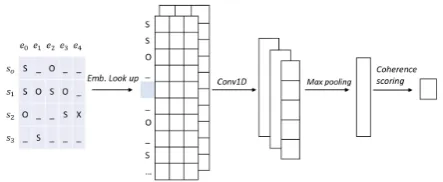
Figure1depicts the neural grid model ofNguyen
and Joty (2017). Given an entity grid E, they
first transform each entryEi,j(a grammatical role)
into a distributed representation of d dimensions by looking up a shared embedding matrix M ∈
R|G|×d, where G is the vocabulary of possible grammatical roles, i.e.,G = {S, O, X,−}. For-mally, the look-up operation can be expressed as:
L=hM(E1,1)· · ·M(Ei,j)· · ·M(EI,J) i
(1)
whereM(Ei,j)refers to the row inM that
Figure 1: Neural entity grid model proposed by
Nguyen and Joty(2017). The model is trained
us-ing a pairwise rankus-ing approach with shared pa-rameters for positive and negative documents.
the number of rows (sentences) and columns (en-tities) in the entity grid, respectively. The result of the look-up operation is a tensorL ∈RI×J×d, which is fed to a convolution layer to model local entity transitions in the distributed space.
The convolution layer of the neural network composes patches of entity transitions into high-level abstract features by treating entities indepen-dently (i.e.,1D convolution). Formally, it applies afilterw∈Rm.dto each local entity transition of lengthmto generate a new abstract featurezi:
zi=h(wTLi:i+m,j+bi) (2)
where Li:i+m,j denotes concatenation ofm
vec-tors inLfor entityej,bi is a bias term, andhis
a nonlinear activation function. Repeated applica-tion of this filter to each possible m-length tran-sitions of different entities in the grid generates a
feature map,zi = [z
1,· · ·, zI.J+m−1]. This
pro-cess is repeated N times with N different filters to getN different feature maps, [z1,· · · ,zN]. A
max-pooling operation is then applied to extract the most salient features from each feature map:
p= [µl(z1),· · · , µl(zN)] (3)
whereµl(zi)refers to the maxoperation applied
to each non-overlapping window of l features in the feature mapzi. Finally, the pooled features are
used in a linear layer to produce acoherence score:
y=uTp+b (4)
whereuis the weight vector andbis a bias term. The model is trained with apairwise rankingloss based on ordered training pairs(Ei, Ej):
L(θ) = max{0,1−φ(Ei|θ) +φ(Ej|θ)} (5)
where entity grid Ei exhibits a higher degree of
coherence than gridEj, andy=φ(Ek|θ)denotes
the transformation of input grid Ek to a
coher-ence scoreydone by the model with parametersθ. We will see later that such ordering of documents (grids) can be obtained automatically by permut-ing the original document. Notice that the network shares its parameters (θ) between the positive (Ei)
and the negative (Ej) instances in a pair.
Since entity transitions in the convolution step are modeled in a continuous space, it can effec-tively capture longer transitions compared to tradi-tional grid models. Unlike traditradi-tional grid models that compute transition probabilities from asingle
grid, convolution filters and role embeddings in the neural model are learned from all training in-stances, which helps the model to generalize well. Since the abstract features in the feature maps are generated by convolving over role transitions of different entities in a document, the model im-plicitly considers relations between entities in a document, whereas transition probabilities in tra-ditional entity grid models are computed with-out considering any such relation between entities. Convolution over the entire grid also incorporates
globalinformation (e.g.,topic) of a discourse.
3.2 Lexicalized Neural Entity Grid
Despite its effectiveness, the neural grid model presented above has a limitation. It does not con-sider any lexical information regarding the enti-ties, thus, cannot distinguish between transitions of different entities. Although the extended neural grid model proposed in (Nguyen and Joty,2017) does incorporate entity features like named entity type and proper mention, it requires an explicit feature extraction step using tools like named en-tity recognizer. This can prevent us in transferring the model to resource-poor languages or domains. To address this limitation, we propose to lexi-calize entity transitions. This can be achieved by attaching the entity with the grammatical roles. For example, if an entity ej appears as a
sub-ject (S) in sentence si, the grid entry Ei,j will
be encoded as ej-S. This way, an entity OBAMA
con-Author:barspinboyPost ID:1
s0:im having troubles since i uninstall some of my apps, then when i checked my systemregistrybunch of junks were left behind by the apps i already uninstall.
s1: is there any way i could clean myregistryaside from expensive registry cleaners.
Author:kees bakker Post ID:2
s2: use regedit to delete the ‘bunch of junks’ you found inregistry.
s3: regedit is free, but depending on which applications it were ..
s4: it’s somewhat doubtful there will be less crashes and faster setup.
Author:willy Post ID:3
s5: i tend to use ccleaner (google for it) as aregistrycleaner.
s6: using its defaults does pretty well.
s7: in no way will it cure any hardcore problems as you mentioned.
s8: i further suggest, ..
Author:caktus Post ID:4
s9: try regseeker to clean yourregistryjunk.
s10: it’s free and pretty safe to use automatic.
s11: then clean temp files (don’t compress any files or use indexing.)
s12: if the c drive is compressed, then uncompress it.
Author:barspinboyPost ID:5
s13: thanks guyz, myregistryis clean now
s14: i tried all those suggestions you mentioned ccleaners regedit de-fragmentation and uninstalling process; it all worked out
(a) A forum conversation
p1
s0
s1
p2
s2
s3
s4
p3
s5
s6
s7
s8
p4
s9
s10
s11
s12
p5
s13
s14
(b) Conversational tree
p1 O O
p2 O – –
p3 O – – –
p4 O – – –
p5 S –
(c) Role transition for‘registry’
registry
P2
P1
P0
l0 O O O
l1 O O O
l2 O O O
l3 – – –
l4 – – –
l5 φ – –
l6 φ φ S
l7 φ φ –
(d) Grid representations
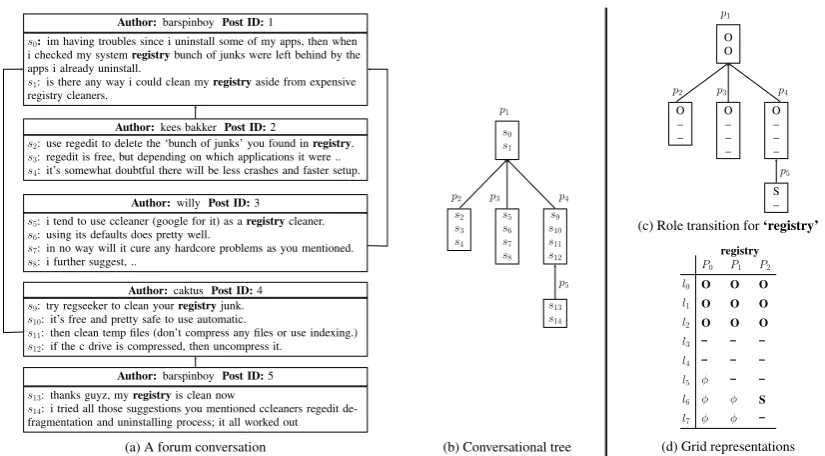
Figure 2: (a) A forum conversation, (b) Thread structure of the conversation, (c) Entity role transition over a conversation tree, and (d) 2D role transition matrix for an entity;φdenotes zero-padding.
catenated them after the look-up, thus enforcing
OBAMA-S and OBAMA-O to share a part of their representations. However, in our experiments, we found the former approach to be more effective.
4 Coherence Models for Asynchronous Conversations
The main difference between monologue and asynchronous conversation is that information flow in asynchronous conversation is not sequen-tial as in monologue, rather it is often interleaved. For example, consider the forum conversation in Figure2(a). There are three possible subconver-sations, each corresponding to a path from the root node to a leaf node in the conversation graph in Figure 2(b). In response to seeking sugges-tions about how to cleansystem registry, the first path (p1←p2) suggests to useregedit, the second
path (p1←p3) suggestsccleaner, and the third one
(p1←p4) suggests usingregseeker. These
discus-sions are interleaved in the chronological order of the posts (p1←p2←p3←p4←p5). Therefore,
monologue-based coherence models may not be effective if applied directly to the conversation.
We hypothesize that coherence models for asyn-chronous conversation should incorporate the con-versational structure like the tree structure in Fig-ure 2(b), where the nodes represent posts and the edges represent ‘reply-to’ links between them. Since the grid models operate at the sentence level, we construct conversational structure at the
sen-tence level. We do this by linking the boundary sentences across posts and by linking sentences in the same post chronologically. Specifically, we connect the first sentence of postpjto the last
sen-tence of post pi ifpj replies to pi, and sentence
st+1 is linked to st if bothst andst+1 are in the
same post.1 Now the question is, how can we rep-resent a conversation tree with an entity grid, and then model entity transitions in the tree? In the fol-lowing, we describe our approach to this problem.
4.1 Conversational Entity Grid
The conversation tree captures how topics flow in an asynchronous conversation. Our key hypothe-sis is that in a coherent conversation entities ex-hibit certain local patterns in the conversation tree in terms of their distribution and syntactic real-ization. Figure2(c) shows how the grammatical roles of entity‘registry’in our example conversa-tion change over the tree. For coherence assess-ment, we wish to model entity transitions along each of the conversation paths (top-to-bottom), and also their spatial relations across the paths (left-to-right). The existing grid representation is insufficient to model thetwo-dimensional (2D) spatialentity transitions in a conversation tree.
We propose a three-dimensional (3D) grid for representing entity transitions in an asynchronous conversation. The first dimension in our grid
rep-1The links between sentences are not explicitly shown in
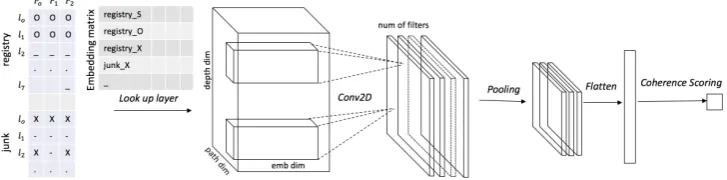
[image:5.595.85.498.59.287.2]Figure 3:Conversational Neural Gridmodel for assessing coherence in asynchronous conversations.
resentsentities, while the second and third dimen-sions representdepthandpathof the tree, respec-tively. Figure2(d) shows an example representa-tion for an entity ‘registry’. Each column in the matrix represents transitions of the entity along a path, whereas each row represents transitions of the entity at a level of the conversation tree.
Although illustrated with a tree structure, our method is applicable to general graph-structured conversations, where a post can reply to multiple previous posts. Our model relies on paths from the root to the leaf nodes, which can be extracted for any graph as long as we avoid loops.
4.2 Modeling Entity Transitions
As shown in Figure3, given a 3D entity grid as input, the look-up layer (Eq. 1) of our neural grid model produces a 4D tensorL∈RI×J×P×d, where
Iis the total number of entities in the conversation, Jis the depth of the tree,Pis the number of paths in the tree, anddis the embedding dimension. The convolution layer then uses a 2D filterw∈Rm.n.d
to convolve local patches of entity transitions
zi =h(wTLi,j:j+m,p:p+n+bi) (6)
where m and n are the height and width of the filter, andLi,j:j+m,p:p+n ∈Rm.n.ddenotes a con-catenated vector containing(m×n)embeddings representing a 2D window of entity transitions. As we repeatedly apply the filter to each possible win-dow with stride size1, we get a 2D feature mapZi of dimensions(I.J+m−1)×(I.P+n−1). Em-ployingN different filters, we getN such 2D fea-ture maps,[Z1,· · ·, ZN], based on which the max pooling layer extracts the most salient features:
p= [µl×w(Z1),· · · , µl×w(ZN)] (7)
whereµl×wrefers to themaxoperation applied to
each non-overlapping 2D window ofl×wfeatures in a feature map. The pooled features are then
lin-earized and used for coherence scoring in the final layer of the network as described by Equation4.
5 Experiments on Monologue
To validate our proposed extension to the neural grid model, we first evaluate our lexicalized neural grid model in the standard evaluation setting.
Evaluation Tasks and Dataset: We evaluate our models on the standard discrimination task
(Barzilay and Lapata, 2008), where a coherence
model is asked to distinguish an original docu-ment from its incoherent renderings generated by random permutations of its sentences. The model is considered correct if it ranks the original docu-ment higher than the permuted one.
We use the same train-test split of the WSJ
dataset as used in (Nguyen and Joty, 2017) and other studies (Elsner and Charniak, 2011b; Feng
et al.,2014). Following previous studies, we use
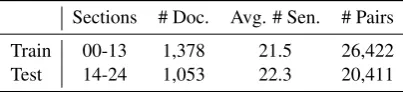
20 random permutations of each article for both training and testing, and exclude permutations that match the original article. Table 2 gives some statistics about the dataset along with the number of pairs used for training and testing. Nguyen and Joty(2017) randomly selected10%of the training pairs for development purposes, which we also use for tuning hyperparameters in our models.
In addition to the standard setting, we also eval-uate our models on aninverse-ordersetting, where we ask the models to distinguish an original doc-ument from the inverse order of its sentences (i.e.,
from last to first). The transitions of roles in a neg-ative grid are in the reverse order of the original grid. We do not train our models explicitly on this task, rather use the trained model from the stan-dard setting. The number of test pairs in this set-ting is same as the number of test documents.
Sections # Doc. Avg. # Sen. # Pairs
Train 00-13 1,378 21.5 26,422
[image:7.595.72.274.63.109.2]Test 14-24 1,053 22.3 20,411
Table 2: Statistics on theWSJdataset.
similar model settings as in (Nguyen and Joty,
2017)2 – ReLU as activation functions (h), RM-Sprop (Tieleman and Hinton, 2012) as the learn-ing algorithm, Glorot-uniform (Glorot and Ben-gio, 2010) for initializing weight matrices, and uniform U(−0.01,0.01) for initializing embed-dings randomly. We applied batch normalization
(Ioffe and Szegedy, 2015), which gave better
re-sults than using dropout. Minibatch size, embed-ding size and filter number were fixed to 32, 300 and 150, respectively. We tuned for optimal filter and pooling lengths in{2,· · · ,12}. We train up to 25 epochs, and select the model that performs best on the development set; seesupplementary doc-uments for best hyperparameter settings for differ-ent models. We run each experimdiffer-ent five times, each time with a different random seed, and we report the average of the runs to avoid any ran-domness in results. Statistical significance tests are done using anapproximate randomizationtest with SIGF V.2 (Pad´o,2006).
Results and Discussions: We present our re-sults on the standard discrimination task and the inverse-order task in Table 3; see Std (F1) and
Inv (F1) columns, respectively. For space
limi-tations, we only showF1 scores here, and report
both accuracy andF1 in the supplementary
docu-ment. We compare our lexicalized models (group III) with the unlexicalized models (group II) of
Nguyen and Joty(2017).3 We also report the
re-sults of non-neural entity grid models (Elsner and
Charniak, 2011b) in group I. The extended
ver-sions use entity-specific features.
We experimented with both random and pre-trained initialization for word embeddings in our lexicalized models. As can be noticed in Ta-ble3, both versions give significant improvements over the unlexicalized models on both the standard and the inverseorder discrimination tasks (2.7 -4.3% absolute). Our best model with Google pre-trained embeddings (Mikolov et al., 2013) yields state-of-the-art results. We also experimented
2
https://ntunlpsg.github.io/project/coherence/n-coh-acl17 3Our reproduced results for the neural grid model are
slightly lower than their reported results (∼1%). We suspect this is due to the randomness in the experimental setup.
Model Emb. Std(F1) Inv(F1)
I Grid (E&C) - 81.60 75.78
Ext. Grid (E&C) - 84.95 80.34
II Neural Grid (N&J) Random 84.36 83.94 Ext. Neural Grid (N&J) Random 85.93 83.00
III Lex. Neural Grid Random 87.03
† 86.88†
[image:7.595.307.523.64.151.2]Lex. Neural Grid Google 88.56† 88.23†
Table 3: Discrimination results on the WSJ
dataset. Superscript † indicates a lexicalized model is significantly superior to the unlexicalized Neural Grid (N&J) model with p-value<0.01.
with Glove (Pennington et al., 2014), which has more vocabulary coverage than word2vec – Glove covers 89.77%of our vocabulary items, whereas word2vec covers85.66%. However, Glove did not perform well givingF1 score of86%in the
stan-dard discrimination task. Schnabel et al. (2015) also report similar results where word2vec was found to be superior to Glove in most evaluation tasks. Our model also outperforms the extended neural grid model that relies on an additional fea-ture extraction step for entity feafea-tures. These re-sults demonstrate the efficacy of lexicalization in capturing fine-grained entity information without loosing generalizability, thanks to distributed rep-resentation and pre-trained embeddings.
6 Experiments on Conversation
We evaluate our coherence models for asyn-chronous conversations on two tasks: discrimina-tion and thread reconstrucdiscrimina-tion.
6.1 Evaluation on Discrimination
The discrimination tasks are applicable to conver-sations also. We first present the dataset we use, then we describe how we create coherent and in-coherent examples to train and test our models.
Dataset: Our conversational corpus contains discussion threads regarding computer trou-bleshootingfrom the technology related news site CNET.4 This corpus was originally collected by
Louis and Cohen (2015), and it contains 13,352
threads. For our experiments, we selected 3,825 threads assuring that each contains at least 3 and at most 15 posts. We use 2,400 threads for train-ing, 750 for testing and 675 for development pur-poses. Table 4shows some basic statistics about the resulting dataset. The threads roughly contain 29 sentences and 6 comments on average.
#Thread Avg Com Avg Sen #Pairs (tree) #Pairs (path)
Train 2,400 6.01 28.76 47,948 106,122 Test 750 5.75 27.79 14,986 33,852 Dev 675 6.27 30.70 13,485 28,897
[image:8.595.307.522.63.175.2]Total 3,825 5.98 28.77 76,419 168,871
Table 4: Statistics on theCNETdataset.
Model Settings and Training: To validate the efficacy of our conversational grid model, we com-pare it with the following baseline settings:
• Temporal: In the temporal setting, we con-struct an entity grid from the chronological order of the sentences in a conversation, and use it with our monologue-based coherence models. Models in this setting thus disregard the structure of the conversation and treat it as a monologue.
• Path-level: This is a special case of our model, where we consider each path (a column in our conversational grid) in the conversation tree sep-arately. We construct an entity grid for a path and provide as input to our monologue-based models.
To train the models with pairwise ranking, we create 20 incoherent conversations for each origi-nal conversation by shuffling the sentences in their temporal order. For models involving conversation trees (path-level and our model), the tree struc-ture remains unchanged for original and permuted conversations, only the position of the sentences vary based on the permutation. Since the shuf-fling is done globally at the conversation level, this scheme allows us to compare the three represen-tations (temporal, path-level and tree-level) fairly with the same set of permutations.
An incoherent conversation may have paths in the tree that match the original paths. We remove those matched paths when training the path-level model. See Table4for number of pairs used for training and testing our models. We evaluate path-level models by aggregating correct/wrong deci-sions for the paths – if the model makes more cor-rect decisions for the original conversation than the incoherent one, it is counted as a correct de-cision overall. Aggregating path-level coherence scores(e.g.,by averaging or summing) would al-low a coherence model to get awarded for as-signing higher score to an original path (hence, correct) while making wrong decisions for the rest; see supplementary document for an example. Similar to the setting in Monologue, we did not train explicitly on the inverse-order task, rather use the trained model from the standard setting.
Conv. Rep Model Emb. Std(F1) Inv(F1)
Temporal
Neural Grid (N&J) random 82.28 70.53 Lex. Neural Grid random 86.63 80.40 Lex. Neural Grid Google 87.17 80.76
Path-level
Neural Grid (N&J) random 82.39 75.68† Lex. Neural Grid random 88.13 88.38† Lex. Neural Grid Google 88.44 89.31†
Tree-level
Neural Grid (N&J) random 83.98† 77.33† Lex. Neural Grid random 89.87† 89.23† Lex. Neural Grid Google 91.29† 90.40†
Table 5: Discrimination results onCNET. Super-script†indicates a model is significantly superior to its temporal counterpart with p-value<0.01.
Results and Discussions: Table5compares the results of our models on the two discrimination tasks. We observe more gains in conversation than in monologue for the lexicalized models – 4.9% to 7.3% on the standard task, and 10% to 13.6% on the inverse-order task. Notice especially the huge gains on the inverse-order task. This indicates lex-icalization helps to better adapt to new domains.
A comparison of the results on the standard task across the representations shows that path-level models perform on par with the temporal models, whereas the tree-level models outperform others by a significant margin. The improvements are 2.7% for randomly initialized word vectors and 4% for Google embeddings. Although, the path-level model considers some conversational struc-tures, it observes only a portion of the conversation in its input. The common topics (expressed by en-tities) of a conversation get distributed across mul-tiple conversational paths. This limits the path-level model to learn complex relationships be-tween entities in a conversation. By encoding an entire conversation into a single grid and by mod-eling the spatial relations between the entities, our conversational grid model captures both local and global information (topic) of a conversation.
Interestingly, the improvements are higher on the inverse-order task for both path- and tree-level models. The inverse order yields more dissimilar-ity at the paths with respect to the original order, thus making them easier to distinguish.
6.2 Evaluation on Thread Reconstruction
One crucial advantage of our tree-level model over other models is that we can use it to build pre-dictive models to uncover the thread structure of a conversation from its posts. Consider again the thread in Figure2. Our goal is to train a coherence model that can recover the tree structure in Figure
2(b) from the sequence of posts(p1, p2, . . . , p5).
This task has been addressed previously (Wang
et al.,2008,2011). Most methods learn an
edge-level classifier to decide for a possible link be-tween two posts using features like distance in po-sition/time, cosine similarity, etc. To our knowl-edge, we are the first to use coherence models for this problem. However, our goal in this paper is not to build a state-of-the-art system for thread re-construction, rather to evaluate coherence models by showing its effectiveness in scoring candidate tree hypotheses. In contrast to previous methods, our approach therefore considers the whole thread structure at once, and computes coherence scores for all possible candidate trees of a conversation. The tree that receives the highest score is predicted as the thread structure of the conversation.
Training: We train our coherence model for thread reconstruction using pairwise ranking loss as before. For a given sequence of comments in a thread, we construct a set of valid candidate trees; a valid tree is one that respects the chronological order of the comments, i.e.,a comment can only reply to a comment that precedes it. The training set contains ordered pairs (Ti, Tj), whereTi is a
true (gold) tree andTjis a valid but false tree.
Experiments: The number of valid trees grows exponentially with the number of posts in a thread, which makes the inference difficult. As a proof of concept that coherence models are useful for find-ing the right tree, we built a simpler dataset by se-lecting forum threads from the CNET corpus en-suring that a thread contains at most 5 posts. The final dataset contains 1200 threads with an average of 3.8 posts and 27.64 sentences per thread.
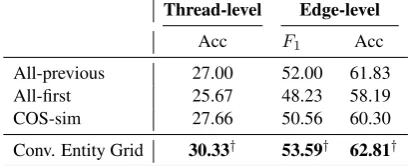
We assess the performance of the models at two levels: (i) thread-level, where we evaluate if the model could identify the entire conversa-tion thread correctly, and (ii) edge-level, where we evaluate if the model could identify individual replies correctly. For comparison, we use a num-ber of simple but well performing baselines:
• All-previouscreates thread structure by linking
Thread-level Edge-level
Acc F1 Acc
All-previous 27.00 52.00 61.83
All-first 25.67 48.23 58.19
COS-sim 27.66 50.56 60.30
[image:9.595.312.518.63.146.2]Conv. Entity Grid 30.33† 53.59† 62.81†
Table 6: Thread reconstruction results;†indicates significant difference from COS-sim (p< .01).
a comment to its previous (in time) comment.
• All-firstcreates thread structure by linking all the comments to the initial comment.
• COS-sim creates thread structure by linking a comment to one of the previous comments with which it has the highest cosine similarity. We use TF.IDF representation for the comments.
Table 6 compares our best conversational grid model (tree-level with Google vectors) with the baselines. The low thread-level accuracy across all the systems prove that reconstructing an en-tire tree is a difficult task. Models are reasonably accurate at the edge level. Our coherence model shows promising results, yielding substantial im-provements over the baselines. It delivers 2.7% improvements in thread-level and 2.5% in edge-level accuracy over the best baseline (COS-sim).
Interestingly, our best model for this task uses a filter width of 2 (maximum can be 4 for 5 posts). This indicates that spatial (left-to-right) relations between entity transitions are important to find the right thread structure of a conversation.
7 Conclusion
We presented a coherence model for asynchronous conversations. We first extended the existing neu-ral grid model by lexicalizing its entity transitions. We then adapt the model to conversational dis-course by incorporating the thread structure in its grid representation and feature computation. We designed a 3D grid representation for capturing spatio-temporal entity transitions in a conversation tree, and employed a 2D convolution to compose high-level features from this representation.
References
Alberto Barron-Cedeno, Simone Filice, Giovanni Da San Martino, Shafiq Joty, Llu´ıs M`arquez, Preslav Nakov, and Alessandro Moschitti. 2015. Thread-level information for comment classification in com-munity question answering. In Proceedings of the 53rd Annual Meeting of the Association for Computational Linguistics and the 7th International Joint Conference on Natural Language Processing, ACL’15, pages 687–693, Beijing, China. Associa-tion for ComputaAssocia-tional Linguistics.
Regina Barzilay and Mirella Lapata. 2008. Modeling local coherence: An entity-based approach. Compu-tational Linguistics, 34(1):1–34.
Giuseppe Carenini, Raymond T. Ng, and Xiaodong Zhou. 2008. Summarizing emails with conversa-tional cohesion and subjectivity. InProceedings of the 46nd Annual Meeting on Association for Com-putational Linguistics, ACL’08, pages 353–361, OH. ACL.
Micha Elsner and Eugene Charniak. 2011a. Disentan-gling chat with local coherence models. In Proceed-ings of the 49th Annual Meeting of the Association for Computational Linguistics: Human Language Technologies - Volume 1, HLT ’11, pages 1179– 1189, Stroudsburg, PA, USA. Association for Com-putational Linguistics.
Micha Elsner and Eugene Charniak. 2011b. Extending the entity grid with entity-specific features. In Pro-ceedings of the 49th Annual Meeting of the Associ-ation for ComputAssoci-ational Linguistics: Human Lan-guage Technologies: Short Papers - Volume 2, HLT ’11, pages 125–129, Portland, Oregon. Association for Computational Linguistics.
Vanessa Wei Feng and Graeme Hirst. 2012. Extend-ing the entity-based coherence model with multiple ranks. InProceedings of the 13th Conference of the European Chapter of the Association for Computa-tional Linguistics, EACL ’12, pages 315–324, Avi-gnon, France. Association for Computational Lin-guistics.
Vanessa Wei Feng, Ziheng Lin, and Graeme Hirst. 2014. The impact of deep hierarchical discourse structures in the evaluation of text coherence. In
COLING.
Xavier Glorot and Yoshua Bengio. 2010. Understand-ing the difficulty of trainUnderstand-ing deep feedforward neu-ral networks. InJMLR W&CP: Proceedings of the Thirteenth International Conference on Artificial In-telligence and Statistics (AISTATS 2010), volume 9, pages 249–256, Sardinia, Italy.
Barbara J. Grosz, Scott Weinstein, and Aravind K. Joshi. 1995. Centering: A framework for modeling the local coherence of discourse.Comput. Linguist., 21(2):203–225.
Amit Gruber, Yair Weiss, and Michal Rosen-Zvi. 2007. Hidden topic markov models. InProceedings of the Eleventh International Conference on Artificial In-telligence and Statistics, volume 2 ofProceedings of Machine Learning Research, pages 163–170, San Juan, Puerto Rico. PMLR.
Camille Guinaudeau and Michael Strube. 2013. Graph-based local coherence modeling. In Proceed-ings of the 51st Annual Meeting of the Association for Computational Linguistics, ACL 2013, 4-9 Au-gust 2013, Sofia, Bulgaria, Volume 1: Long Papers, pages 93–103.
Sergey Ioffe and Christian Szegedy. 2015. Batch nor-malization: Accelerating deep network training by reducing internal covariate shift. In Proceedings of the 32Nd International Conference on Interna-tional Conference on Machine Learning - Volume 37, ICML’15, pages 448–456. JMLR.org.
Thorsten Joachims. 2002. Optimizing search engines using clickthrough data. In Proceedings of the Eighth ACM SIGKDD International Conference on Knowledge Discovery and Data Mining, KDD ’02, pages 133–142, Edmonton, Alberta, Canada. ACM.
Shafiq Joty, Giuseppe Carenini, and Raymond T. Ng. 2013. Topic segmentation and labeling in asynchronous conversations. J. Artif. Int. Res., 47(1):521–573.
Jiwei Li and Eduard Hovy. 2014. A model of co-herence based on distributed sentence representa-tion. In Proceedings of the 2014 Conference on Empirical Methods in Natural Language Processing (EMNLP), pages 2039–2048, Doha, Qatar. Associa-tion for ComputaAssocia-tional Linguistics.
Jiwei Li and Dan Jurafsky. 2017. Neural net models of open-domain discourse coherence. In Proceed-ings of the 2017 Conference on Empirical Methods in Natural Language Processing, pages 198–209, Copenhagen, Denmark. Association for Computa-tional Linguistics.
Ziheng Lin, Hwee Tou Ng, and Min-Yen Kan. 2011. Automatically evaluating text coherence using dis-course relations. InProceedings of the 49th Annual Meeting of the Association for Computational Lin-guistics: Human Language Technologies - Volume 1, HLT ’11, pages 997–1006, Portland, Oregon. As-sociation for Computational Linguistics.
Annie Louis and Shay B. Cohen. 2015. Conversation trees: A grammar model for topic structure in fo-rums. InEMNLP.
William C Mann and Sandra A Thompson. 1988. Rhetorical structure theory: Toward a functional the-ory of text organization. Text, 8(3):243–281.
Tomas Mikolov, Ilya Sutskever, Kai Chen, Greg S Cor-rado, and Jeff Dean. 2013. Distributed representa-tions of words and phrases and their compositional-ity. InAdvances in neural information processing systems, pages 3111–3119.
Dat Nguyen and Shafiq Joty. 2017. A neural local coherence model. In Proceedings of the 55th An-nual Meeting of the Association for Computational Linguistics (Volume 1: Long Papers), pages 1320– 1330. Association for Computational Linguistics.
Sebastian Pad´o. 2006. User’s guide tosigf: Signifi-cance testing by approximate randomisation.
Jeffrey Pennington, Richard Socher, and Christo-pher D. Manning. 2014. Glove: Global vectors for word representation. InEmpirical Methods in Nat-ural Language Processing (EMNLP), pages 1532– 1543.
Rashmi Prasad, Nikhil Dinesh, Alan Lee, Eleni Milt-sakaki, Livio Robaldo, Aravind Joshi, and Bon-nie Webber. 2008. The penn discourse treebank 2.0. In Proceedings of the Sixth International Conference on Language Resources and Evaluation (LREC’08), Marrakech, Morocco. European Lan-guage Resources Association (ELRA).
Tobias Schnabel, Igor Labutov, David M Mimno, and Thorsten Joachims. 2015. Evaluation methods for unsupervised word embeddings. InEmpirical Meth-ods in Natural Language Processing (EMNLP), pages 298–307.
T. Tieleman and G Hinton. 2012. RMSprop. COURS-ERA: Neural Networks
Li Wang, Marco Lui, Su Nam Kim, Joakim Nivre, and Timothy Baldwin. 2011.Predicting thread discourse structure over technical web forums. InProceedings of the Conference on Empirical Methods in Natu-ral Language Processing, EMNLP ’11, pages 13– 25, Stroudsburg, PA, USA. Association for Compu-tational Linguistics.