The Language Library: Many Layers, More Knowledge
Nicoletta Calzolari, Riccardo Del Gratta, Francesca Frontini, Irene Russo
Istituto di Linguistica Computazionale “A. Zampolli”, Consiglio Nazionale delle Ricerche Via Moruzzi 1 56126 Pisa, Italy
{name.surname}@ilc.cnr.it
Abstract
In this paper we outline the general con-cept of the Language Library, a new initia-tive that has the purpose of building a huge archive of structured colletion of linguis-tic information. The Language Library is conceived as a community built repos-itory and as an environment that allows language specialists to share multidimen-sional and multi-level annotated/processed resources. The first steps towards its im-plementation are briefly sketched.
1 Introduction
In Natural Language Processing technologies even small amounts of annotated data can contribute to improve the performance of complex systems (Palmer and Xue, 2010). This evidence has led to the creation of many annotation schemes that encode our knowledge of syntactic, semantic and pragmatic features of every language.
Annotation is at the core of training and testing systems, i.e. at the core of NLP. Relations among phenomena at different linguistic levels are at the essence of language properties but we are cur-rently over-simplifying annotation tasks, focusing mostly on one specific linguistic layer at a time, without (having the possibility of) paying atten-tion to the relaatten-tions among the different layers. At the same time our efforts are too much scat-tered and dispersed without much possibility of exploitation of others’ achievements.
Today we have enough capability and resources for addressing the complexities hidden in multi-layer interrelations. Moreover, we can exploit to-day’s trend towards sharing for initiating a collec-tive movement that works towards creating syn-ergies and harmonisation among different annota-tion efforts that are now dispersed.
In this paper we present the Language Library, an initiative which is conceived as a facility for
gathering and making available through simple functionalities all the linguistic knowledge the field is able to produce, putting in place new ways of collaboration within the LRT community.
The rationale behind the Language Library ini-tiative is that accumulation of massive amounts of (high-quality) multi-dimensional data about lan-guage is the key to foster advancement in our knowledge about language and its mechanisms, in particular for finding previously unnoticed inter-relations between linguistic levels. The Language Library must be community built, with the entire LRT community providing data about language re-sources and annotated/encoded language data and freely using them.
With the Language Library we thus want also to enable/promote a more global approach to lan-guage studies and start a movement aimed at −
and providing the facilities to−collecting all
pos-sible annotations at all pospos-sible levels.
Given the state of the art of linguistic annota-tion, we can certainly hope to gather tens of dif-ferent annotation layers and types on the same data; once this is obtained, it will allow for a bet-ter analysis and exploitation of language phenom-ena that we tend to disregard today. In particu-lar, interesting interrelations are likely to become visible among levels that are not often considered together, thus leading to improved computability (e.g. a coreference annotation on top of simpler annotation layers would improve machine trans-lation performance). Part of this multi-layer and multi-language annotation should be performed on parallel (or at least comparable) texts, so as to fos-ter comparability of new achievements and equal-ity among languages.
Even if the Language Library will contain all kinds of processed linguistic data, in this paper we concentrate on the frequent case of annotated data.
2 Outline/General Concept
The Language Library is conceived as open and accessible repository where the language technol-ogy community can access and share corpora en-riched with several layers of linguistic annotation. The Library is going to be:
− open, in that its content will be accessible to the community without restrictions;
− multilingual and multi-domain;
− multi-user and community oriented;
− multi-dimensional, containing multiple
lay-ers of annotation of the same text, possibly by multiple contributors;
− collaborative, in the sense of collaboration among experts, and also academics and NLP companies;
− reuse-oriented, promoting the reuse of
anno-tated resources and annotation schemes;
− maintainable, endorsing the use of annotation
standards;
− scalable, starting with a demo version with
a limited number of texts and then progres-sively adding new features.
In order to reach this goal, a first population round of the Language Library will start around a core of parallel/comparable texts that will be an-notated over and over again by several contribu-tors submitting a paper for LREC2012. Hopefully the selected texts will be annotated with different tools and annotation schemes. The more this core grows, the more new contributors will be encour-aged to participate by the possibility of building on existing layers of annotation to develop their own, which will be in turn added to the resource and be-come available to the NLP community. Notice that the Library should also be seen as a space where the theoretical and the applied linguistics commu-nities could meet, in that the provided annotation can be both manually and automatically produced. It is possible to envisage a scenario where an annotation layer (e.g. a human made annotation of coreferences on a portion of the texts from the Li-brary) is first submitted by one author/researcher, used by another as a training set to tag a larger amount of the available texts, and then finally re-submitted enriched in size to be (at least partially)
human checked again. By recursively doing so the Language Library could come to contain a great number of human checked sections, alongside in-creasingly accurate machine tagged ones.
In later stages the Library will grow both verti-cally by adding annotation layers and horizontally, by adding languages, domains, and by increasing the size of the corpora. At this point the possibil-ity of comparing and cross-examining information from several annotation layers at a large scale will start to show its benefits both theoretically and in an NLP perspective.
In its mature stages the Library will consolidate by focusing on the enhancement of interoperabil-ity, by encouraging the use of common standards and schemes of annotation. It has to be under-lined that the Language Library is conceived as a theory-neutral space which will allow for several annotation philosophies to coexist. The interop-erability effort should not be seen as a superim-position of standards but rather as the promotion of a series of best practices that might help other contributors to better access and easily reuse the annotation layers provided.
In this sense encouraging the use of a represen-tation format such as GrAF (Ide and Suderman, 2007) in a second stage might be helpful. On the one hand the stand-off approach of keeping each layer of annotation separated from the oth-ers and from the raw data seems particularly suit-able for the Library; on the other hand GrAF en-ables a soft approach to interoperability, in that it can be used to uniformly represent formats that are both syntactically and semantically different and this could make it easier for the contributors to recognize compatible layers without forcing the adoption of a rigid standard. GraF converters from some known formats are currently under develop-ment and might be made available in the Language Library.
2.1 Building a community
around their existing communities.
A number of ongoing initiatives (FLaReNet, META-SHARE and CLARIN among others) have already attracted around themselves a growing LRT community that requires consolidation of its foundations and steady increase of its major as-sets, minimising dispersion of efforts and enabling synergies based on common knowledge and col-laborative initiatives.
The Language Library initiative will build upon the large experience gathered and the best prac-tices and tools developed in these projects, both in terms of documentation and of collection and storage of the resources. While these initiatives have concentrated so far on language resources and tools, with the Language Library - started as a FLaReNet1initiative - focus will shift mostly on
linguistic knowledge.
Most specifically the Language Library will be strictly connected with the following initiatives:
− The LRE Map (Calzolari et al., 2010), started
at LREC 2010, collecting metadata about Language Resource and Technology;
− META-SHARE (Piperidis et al., 2011), an open platform providing an open, distributed, secure, and interoperable infrastructure for the Language Technology domain.
Both these initiatives rest on the assumption that availability is not enough: resources must be vis-ible and easily retrievable. The Language Library will be made visible through META-SHARE, where a complete set of Metadata is already avail-able for language resources and it can be immedi-ately applied to describe and catalog the first nu-cleus of the Language Library.
2.2 Comparison with other initiatives
Recently other initiatives that share some points of similarity with the Language Library here de-scribed have been launched, proving the fact that the community is currently oriented towards simi-lar goals.
The Manually Annotated Sub-Corpus (MASC)2
of the American National Corpus (ANC)3 is an
open and downloadable corpus that that shares with the Language Library the idea of collecting
1www.flarenet.eu
2www.americannationalcorpus.org/MASC/Home.html
(Ide et al., 2010)
3http://americannationalcorpus.org/
as many annotation layers for a single text collec-tion as possible. However, it is not conceived as a multilingual project and is more strictly limited to one corpus.
The Human Language Project (Abney and Bird, 2010) on the other hand is a multilingual project, that aims to build a Universal Corpus of the world’s languages. In this case the immediate goal is to reach horizontal completeness (docu-ment as many languages as possible, with a spe-cial attention to endangered ones) and the project is specifically geared towards the Machine Trans-lation community.
The Language Commons4 finally is an online
archive for the collection of written and spoken corpora in the open domain. The Language Li-brary idea bears similarities to this experience, but it will dramatically shift the focus on the vertical dimension, in that it focuses also on gathering as many annotation levels for the same texts as pos-sible.
3 First Experiment
After the success of the LRE Map5 introduced
for LREC 2010 and now used in many confer-ences as a normal step in the submission pro-cedure (EMNLP and COLING among others), LREC 2012 will be the occasion to launch the LREC Language Library, that will constitute the first building block of the Language Library.
Because of the huge amount of data about re-sources provided for the LRE Map, we believe that times are ripe for the promotion of such col-laborative enterprise of the LREC Community that will constitute a first step towards the creation of this very broad, community-built, open resource infrastructure.
Together with ELRA we will prepare as a first step an LREC Repository, part of the META-SHARE network, hosting a number of raw data on all modalities (speech, text, images, etc.) in as many languages as possible. When submit-ting a paper, authors will be invited to process selected texts, in the appropriate language(s), in one or more of the possible dimensions that their submission addresses (e.g. POS-tag the data, ex-tract/annotate named entities, annotate temporal information, disambiguate word senses, transcribe audio, etc.) and put the processed data back in the
LREC Repository.
The processed data will be made available to all the LREC participants before the conference, to be compared and analyzed, and at LREC some/an event around them will be organized.
This collaborative work on
annota-tion/transcription/extraction/... over the same data and on a large number of processing dimen-sions will set the ground for the future Language Library, linked to the LRE Map for the description of the data, where everyone can deposit/create processed data of any sort all our “knowledge” about language.
3.1 A case study: Annotation Resources at LREC2010
With the aim to highlight the feasibility of the LREC Repository for the Language Library, we propose a brief analysis of the annotation guide-lines/tools inserted by authors as resources in the LREC2010 Map during the submission process. This will enable us to make, at this prelimi-nary stage, an educated guess on the number and variability (with respect to languages, modalities, uses) of annotated texts that will be part of the core of the Language Library.
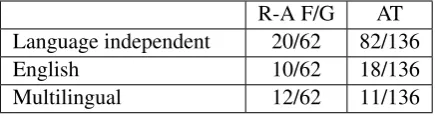
Amongst over 1990 resources, 62 are listed as “Representation-Annotation Formal-ism/Guidelines” (“R-A F/G” in Tables 1 and 2) while 136 are described as Annotation Tool (“AT” in Tables 1 and 2). Not every submission that report on the usage of an annotation tool provided also description for an annotation formalism, therefore its possible that more annotation schemes have been used.
As expected, the vast majority of annotation tools (see Table 1) are listed/described as language independent (82/136), while among Representa-tionAnnotation Formalism/Guidelines 10/62 have been developed for English, 20/62 are language in-dependent and 12/62 have been applied in multi-lingual resources.
R-A F/G AT
Language independent 20/62 82/136
English 10/62 18/136
[image:4.595.308.526.252.363.2]Multilingual 12/62 11/136
Table 1: Most frequent values with respect to the language
Concerning modality, very few formalisms have
been proposed for modalities other than Writ-ten (6/62), but among annotation tools 25/136 re-sulted useful for Multimodal/Multimedia modal-ity, 8/136 for Sign Language and 7/136 for Speech modality.
The range of resource uses (see Table 2) is quite wide, with a prevalence of Knowledge Dis-covery/Representation (8/62, 6/136), Information Extraction, Information Retrieval (7/62, 13/136), Machine Translation, Speech To Speech Trans-lation (6/62, 8/136). For Annotation Tool, Dis-course, Acquisition and Dialogue are the other most frequent uses.
R-A F/G AT
Knowledge
Discovery/Representation 8/62 6/136 Information Extraction,
Information Retrieval 7/62 13/136
Machine Translation, Speech to Speech
[image:4.595.72.290.648.707.2]Translation 6/62 8/136
Table 2: Most frequent with respect to the uses
This information relative to a small subsets of the resources described by LREC2010 authors shows how in the starting phase the Language Li-brary will be easily enriched with texts annotated on the basis of guidelines elaborated by scholars for a wide range of uses. Even if the incidence of languages other than English and of modalities other than Written is not so high, the existence of guidelines/formalisms focusing on more than one language represents an interesting chance to en-rich the Language Library with more annotated data.
Finally, 40/62 Representation-Annotation For-malism/Guidelines have been listed as Newly created-in progress or Newly created-finished, a figure that shows how the Language Library can foster the knowledge about brand new annotation formalisms.
3.2 Future developments
In order to improve this the platform should make annotation schemes and tools available to the users, in such a way as to encourage the shar-ing and use of already existshar-ing standards. Ideally the platform could at some stage enable the host-ing of on-line annotation tools, thus becomhost-ing a virtual environment for the recruitment of anno-tating workforce in a crowd-sourcing modality.
Also the dimensions and the modality of anno-tated data will have to be taken into account: we hope that not just small written corpora will be an-notated and that the efficient management of audio and video files will be allowed in the platform.
4 Conclusions
It has been recognized that Natural Language Pro-cessing is a data-intensive discipline, so the LR community must now be coherent and take con-crete actions leading to the coordinated gathering
− in a shared effort − of as many (annotated-encoded) language data as it is able to produce.
In doing this a positive inspiration can be drawn from the success of similar experiences in other disciplines, e.g. astronomy/astrophysics, where the scientific communities cooperate in accumu-late huge amounts of observation data for bet-ter understanding the universe. The most sig-nificant model is the recent successful effort for the mapping of human genome. The Language Library could be considered as a sort of big Genome project for languages, where the commu-nity will collectively deposit/create increasingly rich and mutilayered linguistic resources, enabling a deeper understanding of the complex relations between different annotation layers.
Acknowledgments
We thank the META-NET project (FP7-ICT-4 249119: T4ME-NET) for supporting this work. The Language Library started as an initiative within FLaReNet - Fostering Language Resources Network (Grant Agreement No. ECP-2007-LANG-617001).
The Language Library has been discussed, among others, with Khalid Choukri, Thierry Declerck, Olivier Hamon, Joseph Mariani, Stelios Piperidis.
References
Steven Abney and Steven Bird. 2010. The human lan-guage project: Building a universal corpus of the
world’s languages. InProceedings of the 48th
An-nual Meeting of the Association for Computational Linguistics, pages 88–97, Uppsala, Sweden, July. Association for Computational Linguistics.
Nicoletta Calzolari, Claudia Soria, Riccardo Del Gratta, Sara Goggi, Valeria Quochi, Irene Russo, Khalid Choukri, Joseph Mariani, and Stelios Piperidis. 2010. The LREC Map of Language
Resources and Technologies. In Nicoletta
Cal-zolari, Khalid Choukri, Bente Maegaard, Joseph Mariani, Jan Odijk, Stelios Piperidis, Mike Ros-ner, and Daniel Tapias, editors, Proceedings of the Seventh conference on International Language Re-sources and Evaluation (LREC’10), Valletta, Malta, May. European Language Resources Association (ELRA).
Nancy Ide and Keith Suderman. 2007. GrAF: A Graph-based Format for Linguistic Annotations. In
Linguistic Annotation Workshop, ACL 2007, pages 1–8, Prague.
Nancy Ide, Christiane Fellbaum, Collin Baker, and Re-becca Passonneau. 2010. Masc: The manually an-notated sub-corpus: A community resource for and
by the people. InProceedings of the ACL 2010
Con-ference Short Papers, pages 68–73. Association for Computational Linguistics.
Martha Palmer and Nianwen Xue. 2010. Linguistic
annotation. InThe Handbook of Computational
Lin-guistics and Natural Language Processing, Black-well Handbooks in Linguistics, pages 238–270. John Wiley & Sons.