Geschke Center
Master's Theses Theses, Dissertations, Capstones and Projects
Spring 5-18-2017
With Language Brings Light: Narratives by Deaf
Ethiopians and their Right to Sign Language
Jackie M. Eugster
University of San Francisco, [email protected]
Follow this and additional works at:https://repository.usfca.edu/thes
Part of theOther Education Commons
This Thesis is brought to you for free and open access by the Theses, Dissertations, Capstones and Projects at USF Scholarship: a digital repository @ Gleeson Library | Geschke Center. It has been accepted for inclusion in Master's Theses by an authorized administrator of USF Scholarship: a digital repository @ Gleeson Library | Geschke Center. For more information, please [email protected].
Recommended Citation
Eugster, Jackie M., "With Language Brings Light: Narratives by Deaf Ethiopians and their Right to Sign Language" (2017).Master's Theses. 219.
With Language Brings Light: Narratives by Deaf Ethiopians and
their Right to Sign Language
A Thesis Project Presented to The Faculty of the School of Education International and Multicultural Education Department
In Partial Fulfillment Of the Requirements for the Degree Masters of Arts in Human Rights in Education
by
ii
With Language Brings Light: Narratives by Deaf Ethiopians and
their Right to Sign Language
In Partial Fulfillment of the Requirements for the Degree
MASTERS OF ARTS
in
HUMAN RIGHTS EDUCATION
by
Jackie M. Eugster May 2017
UNIVERSITY OF SAN FRANCISCO
Under the guidance and approval of the committee, and approval by all the members, this thesis has been accepted in partial fulfillment of the requirements for the degree.
Approved:
Instructor/Chairperson
iii
TABLE OF CONTENTS
Page
List of Tables ... iv
List of Figures ... v
Acknowledgements ... vii
Abstract ... viii
Chapter I – Introduction ... 1
Statement of the Problem ... 1
Background and need for the Study ... 2
Purpose Statement ... 4
Research Questions ... 5
Theoretical Framework ... 6
Significance of the Study ... 19
Definition of Terms ... 20
Chapter II – Review of the Literature ... 25
Introduction ... 25
Review of the Literature ... 29
Summary ... 50
Chapter III – Research Design ... 52
Research Design ... 52
Participatory Action Research ... 52
Photovoice in Sign Language ... 56
Data Collection ... 61
Limitation to the Study ... 64
Chapter IV – Results ... 70
Introduction ... 70
Findings ... 70
Summary ... 97
Chapter V – Discussion, Conclusions, and Recommendations ... 98
Introduction ... 98
Discussion ... 99
Conclusions ... 108
Recommendations ... 110
References ... 113
iv
LIST OF TABLES
Table Page
v
LIST OF FIGURES
Figure
Page
1 An intellectual genealogy of critical race theory. Reprinted from “Whose culture has capital? A critical race theory discussion of community cultural wealth,” by T. Yosso, 2005, Race Ethnicity and
Education, Vo. 8, No. 1, p. 71. ………
11
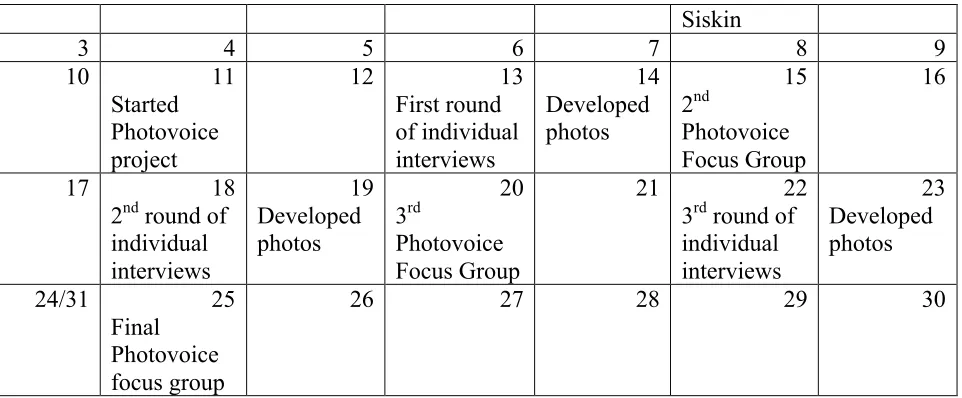
2 Photovoice Project Schedule, Siskin, Ethiopia ……… 64
3 Round 1 Photograph, Taken by Bekele ……… 73
4 Round 1 Photograph, Taken by Abebe ……… 74
5 Round 1 Photograph, Taken by Tigist ……… 76
6 Round 1 Photograph, Taken by Hakim ……… 77
7 Round 1 Photograph, Taken by Hakim ……… 77
8 Round 1 Photograph, Taken by Kamal ……… 78
9 Focus Group 2 Activity ……… 81
10 Round 2 Photograph, Taken by Kamal ……… 82
11 Round 2 Photograph, Taken by Alemnesh ……… 83
12 Round 2 Photograph, Taken by Alemnesh & Kamal ……… 84
13 Round 2 Photograph, Taken by Getachew ……… 85
14 Round 2 Photograph, Taken by Getachew ……… 86
15 Round 2 Photograph, Taken by Tigist………... 88
16 Round 2 Photograph-Taken by Bekele ………... 89
17 Gallery walk ………. 91
18 Gallery walk ………. 91
vi
20 Round 3 Photograph, Taken by Abebe ……… 93
21 Round 3 Photograph, Taken by Bekele ……… 94
22 Round 3 Photograph, Taken by Getachew ……… 95
23 Round 3 Photograph, Taken by Getachew ……… 95
24 Graph representing the number of times each capital was expressed within Deaf Community Cultural Wealth ……… 101
vii
ACKNOWLEDGMENTS
To all those who have supported me throughout this process, ‘thank you’ cannot express the immense amount of gratitude that I feel. This paper is not my own, but belongs to and is written in collaboration with the Ethiopian Deaf community. You have graciously and willingly opened your hearts to share your stories. Without you, this would not exist. This paper is for you.
To my advisor, Dr. Monisha Bajaj, who has graciously bestowed upon me the knowledge and network to develop a thesis project to the best of my abilities. Your efforts made me feel secure, confident and excited for my journey halfway across the world. Thank you for your guidance and support throughout this project while pushing me to become a more critical, yet understanding and open thinker and scholar.
To my undergraduate professors, Will Garrow and Flavia Fleischer, who have supported my scholarship from the southern end of California. I appreciate all the voluntary time, thought, and advice you have given me throughout this process. Thank you for being my foundation and for providing me with tools to articulate and comprehend the complexities and sometimes harsh realities of our world while also gently guiding me to strive for happiness and radical thinking at the same time. What a challenge, but I could not ask for a better team behind me.
To Lissa Stapleton, for your above and beyond support and guidance on developing this thesis and willingness to read multiple drafts of this work. I value your perspective and honesty and am so grateful to have your heart and mind be apart of this project.
To my family, who has shown me patience and encouragement during those times that stress can overcome me. Thank you for being understanding and always giving me a good laugh.
To Laura Schrenk, for being my anchor and voice of reason during this sometimes arduous process. Thank you for always believing in me and loving me, even in my most unlovable moments.
To Maya Steinborn, my partner ‘in solidarity,’ who has shared in the ups and downs throughout this academic journey. I am so unbelievably fortunate to have had you in class my first semester at USF. Thank you for all the extra time you took to look at my work and to help me become a better writer. I would not have made it without you.
To Dawn Troupe-Masi, for always working with me, collaborating, and having those hard conversations that allow us to unpack, reflect, and transform. I love you and appreciate you working with me on multiple projects during this two-year process. You are the light in my life that never fades.
To Gwen Gallagher, for introducing me to Deaf culture and ASL. You ignited a passion within me that has never burned out in twelve years. I will forever be grateful for your presence in my life.
To yeni nat, and the rest of my family in Ethiopia. I cannot wait until our paths cross again. My time spent with you has changed my life and I hope we can work together in the future. Thank you for being my family away from home. I miss you everyday.
To those who donated their digital cameras to this project—thank you for your contribution and participation in this process.
viii
ABSTRACT
The goal of this case study is to share the narratives of Deaf individuals in Ethiopia and how the Deaf community uses Deaf Community Cultural Wealth in order to explore and flourish in audist and colonized spaces. This study engaged photovoice, in a participatory action research technique that can empower and enhance the community’s sense of identity (Wang & Burris, 1997). This study considers the influence of American
missionaries and how colonization of African nations has also influenced the trajectory of Deaf education in Ethiopia. Moving away from deficient thinking, DCCW attempts to reframe the Deaf experience as one that has value and cultural knowledge that, if given a voice, can benefit society as a unified whole. This study considers the Deaf community as a cultural and linguistic minority that has the right to accessible language, sign language, from birth and Deaf role models that foster DCCW in the younger generation of Deaf youth.
CHAPTER I INTRODUCTION
“I think it’s time for a new perspective, one that only a deaf person can offer.” —Dr. Harvey J. Corson
Statement of the Problem
According to the World Health Organization (WHO), there are 360 million people
worldwide who have hearing loss that is considered ‘disabling.’1 Thirty-two million of these are children, the majority of whom come from middle- to low-income countries. By and large,
d/Deaf 2 people around the world are unemployed or underemployed and deaf children are less likely to attend school, resulting in reduced opportunity as adults (World Report on Disability,
2011). The World Federation of the Deaf estimates that 80 percent of deaf children do not have
access to education and that deaf individuals are “denied basic citizenship rights, such as voting
rights during public elections” (Murray, 2015, p. 380). Society’s rejection of d/Deaf people
further pushes them to the margins of society, creating barriers to education, success, and quality
of life.
In both high- and low-income nations, d/Deaf activists (within organizations by d/Deaf
people) have focused on two main strategic goals. The first is “economic development,
employment, and capacity-building objectives” and the second is “advocacy for [the]
implementation of the Convention on the Rights of Persons with Disabilities (CRPD) and goals
related to sign language rights and/or sign language planning activities” (Murray, 2015, p. 380).
Liisa Kauppinen and Markku Jokinen (2014) explain that this shift in focus to the centrality of
1 ‘Disabling’ hearing loss is considered to be 40 decibels (dB) in adults and 30 dB in children. While in this context
2 Traditionally, when a capitalize ‘d’ is used in ‘Deaf,’ it refers to the Deaf community that identifies with Deaf
sign language, specifically with drafting the CRPD, was an effort to “[recognize] deaf people’s
linguistic rights” which includes, “explicit recognition for sign language(s)[,] to ensure its use in
communication and in access to information and education throughout life” as well as,
“acceptance of Deaf people’s linguistic identity, Deaf culture” and access to sign language
interpreters (as cited in Murray, 2015, p. 383).
Still, d/Deaf individuals are stigmatized in society because of traditional beliefs and
social constructs that force many into isolation without access to language or social interaction.
d/Deaf people are judged as being physically defective, and thus mentally deficient. They are
‘othered’ as social deviants that exist in a separate world that is undesirable, and while the
d/Deaf community strives to be perceived as a cultural and linguistic minority, society continues
to stigmatize them as culturally inferior (Lane, 1999).
Background and Need for the Study
Similar to many areas around the world, most Ethiopians perceive disability as “a threat
to the survival of the family” (Mekonnen et al., 2015, p. 160). Especially in rural areas,
“[d]eafness often is understood as demonic possession or as a punishment from God for the
parent’s sins” (Mekonnen et al., 2015, p. 160) and deaf people are therefore hidden away from
the public and rest of society. Deaf children and adults are often thought of as burdens because
they cannot be educated and will be dependent on their families for the rest of their lives. Words
that describe having a hearing impairment in Amharic such as ‘denkoro’ and ‘duda’ carry a
negative meaning that imply that they are ‘idiots’ with the inability to learn or comprehend the
world around them (Mekonnen et al., 2015).
Stigmatization does not evade Deaf people in Ethiopia and have contributed to the late
(EthSL) prior to the introduction of American Sign Language (ASL) and Deaf education.
American missionaries established the first formal education settings for deaf people in Ethiopia.
Many missionaries taught through ASL, which marked the ‘forced’ evolution of EthSL; this was
an evolution that disregarded many indigenous and cultural signs (Tamene, 2016). Even with the
establishment of d/Deaf education, access to it remained concentrated within the larger cities
such as Addis Ababa and Hosaena, where the earliest boarding school for Deaf students was
founded (Tamene, 2016). d/Deaf people in more rural areas “were virtually forgotten and no one
cared or knew whether they [could] be educated at all” (Wakuma, 2015, p. 11).
There are approximately 1-2.5 million d/Deaf and Hard of Hearing individuals in
Ethiopia who are not provided language accessibility, public service opportunities, formal
education, social inclusion/participation or mobility (“Empowering Deaf Youth,” n.d.). Much of
the oppression that exists against d/Deaf people in Ethiopia stems from traditional and societal
norms that children with disabilities exist in families because of sin, bringing shame and disgrace
to the family. This leads to hiding and depriving them of social contact from the rest of the
community (Djoyou Kamga, 2013). These individuals are left unnoticed, suffering from not only
poverty, but also isolation from the rest of their community and the world around them. Without
access to language, d/Deaf Ethiopians are denied access to information, making many unaware
of the rights they have in society. This greatly impacts their chances of personal development
and quality of life.
In Ethiopia, d/Deaf education is still suffering; there are only a dozen deaf schools
established within the entire country, and they serve only a few thousand children combined.
There are no more than 40 interpreters in the country, furthering accessibility barriers within
children are ‘homeless’ and ‘helpless’ (Wakuma, 2015) and lack the financial and familial
resources to attend school. Teachers are also lacking in the skills, materials and resources to
educate d/Deaf children; specifically, teachers lack fluency in EthSL. These barriers result in
fewer d/Deaf children having access to communication, language and society, resulting in a lack
of independence and sustainability as well as behavioral and socio-emotional issues (Mekonnen,
Hannu, Elina, & Matti, 2015).
The Nyala Center strives to address, educate, and dismantle the negative cultural stigma
around people who are deaf. They empower Deaf people by providing services and resources
such as education, EthSL instruction, medical care, job training, and awareness-raising projects
about Deaf culture in hearing communities related to Deaf individuals. These efforts aim to
address the marginalization of d/Deaf people in Ethiopia while also providing resources and
empowerment to the community itself. The goal is to transform the lives of Deaf Ethiopians in
Siskin and provide avenues in which d/Deaf people can acquire their natural language as well as
improve their overall quality of life.
Purpose Statement
The goal of this project is to give voice to those who have been silenced and pushed
towards the margins of Ethiopian society, focusing on the d/Deaf community at the Nyala Center
in Siskin, Ethiopia as a case study. Through collecting multiple stories from individuals with
diverse backgrounds, this project represents systemic community issues and perspectives rather
than an individualistic point of view. This project also combats the stigma and oppression that
d/Deaf people experience in Ethiopia on a daily basis by providing evidence that d/Deaf people
are capable of contributing to the larger society and provide cultural knowledge that, if valued,
This research addresses the impact of colonization on African educational systems and
citizens through the lens of the Ethiopian d/Deaf experience. It looks at the Euro-centric
colonization of EthSL as well as educational methods for the country as a whole and how that
impacts the education of d/Deaf children. Lastly, it reveals the powerful resistance and wealth of
knowledge that the d/Deaf community possesses in systems and spaces created with audist bias –
whereby hearing is treated as the default mode of interacting with the world and d/Deaf people
are consciously or unconsciously discriminated against. Audism, as my frame of reference, has
been defined as
A diachronic and dynamic societal construct that oppresses Deaf people based on the
ideological stance that humanized specific perceived characteristics (e.g. hearing,
speaking) while simultaneously dehumanizing the opposite perceived characteristics (e.g.
don’t hear, don’t speak) that manifest itself in a complex weave of micro, meso, and
macro- aggressions that create both real and perceived barriers which leads to a system of
overprivilege for hearing people and underprivileged for Deaf people. (Garrow, Pak, &
Ettlin, 2016)
The final goal of this study is to give back to the community that shared their personal
lives and hospitality with me through educational videos created by the community and edited by
myself that will be uploaded to YouTube (see Appendix).
Research Questions
Three questions are addressed in this study: (1) What are the narratives of d/Deaf
experiences in Siskin, Ethiopia? (2) How has the colonization of Africa impacted the way Deaf
Ethiopians are taught within formal educational systems? (3) How do Deaf Ethiopians use Deaf
Theoretical Framework
Critical Race Theory
Critical Race Theory (CRT) is derived from both Critical Legal Studies (CLS) and
radical feminism (Delgaldo & Stefancic, 2012). CLS first made its appearance after the Civil
Rights Movement near the end of the 1970s. CLS scholars recognized that the traditional legal
system legitimized oppressive social structures (Yosso, 2005). However, Crenshaw argued that
CLS could not offer strategies towards social change and transformation because it “separated
critical theory from conversations about race” (as cited in Yosso, 2005, p.71). Derrick Bell and
Alan Freeman also argue that CLS “failed to incorporate race and racism into the analysis” and
did not consider the “lived experiences and histories of those oppressed by institutionalized
racism” (as cited in Yosso, 2005, p. 71).
CRT “draws from and extends a broad literature base of critical theory in law, sociology,
history ethnic studies and women’s studies” (Yosso, 2005, p. 71). Solorzano and Bernal (2001)
paraphrased Brian Fay and William Tierney’s definition of critical theory as “an attempt to
understand the oppressive aspects of society in order to generate societal and individual
transformation” (p. 311). Mari Matsuda’s (1991) perspective on critical race theory is as follows:
The work of progressive legal scholars of color who are attempting to develop a
jurisprudence that accounts for the role of racism in American law and that work toward
the elimination of racism as part of a larger goal of eliminating all forms of
subordination. (p. 1331)
It is a movement led by scholars and activists who intend to study and transform the
“relationship among race, racism, and power” (Delgado & Stefancic, 2012, p. 3). Although these
education system to understand issues of “school discipline and hierarchy, tracking, affirmative
action, high stakes testing, controversies over curriculum and history, and alternative and charter
schools” (Delgado & Stefancic, 2012, p. 6).
There are five basic tenets of CRT that scholars subscribe to in their work. The first is
that “racism is ordinary, not aberrational—‘normal science,’ the usual way society does business,
the common, everyday experience of most people of color in this country” (Delgado & Stefancic,
2012, p. 7). Additionally, this tenet addresses the issue that racism is difficult to resolve because
it is not acknowledged in conversation. Instead words contrived by white people are used such as
‘color-blind’ and ‘diversity’ to insinuate a place of equal opportunity and treatment across the
board.
The second tenet refers to ‘interest convergence’ or material determinism (Delgado &
Stefancic, 2012, p. 8). This is when social progress for people of color simultaneously advances
white elites (materially) and working-class whites (physically). Bell (1980) proposed that Brown
v. Board of Education is an example of interest convergence as it may have resulted more “from
the self-interest of elite whites than from a desire to help blacks” (as cited in Delgado & Stefanic,
2012, p. 8). In other words, social progress occurs when white elites benefit from it as well.
The third tenet claims that race and races are socially constructed through thought and
relations and are not based on biological or genetic traits. Instead “races are categories that
society invents, manipulates, or retires when convenient” (Delgado & Stefancic, 2012, p. 8).
The fourth tenet draws attention to “the ways the dominant society racializes different
minority groups at different times, in response to shifting needs” (Delgado & Stefancic, 2012, p.
9). An example of this would be people of Middle Eastern origin being perceived as exotic,
demonized and represented as extreme religious terrorists in another. This tenet is closely related
to intersectionality in that each human and their history is ever-evolving and that no person “has
a single, easily stated, unitary identity” (Delgado & Stefancic, 2012, p. 10).
Lastly, CRT takes into consideration the value of voices of color. Minority communities
are not shown honestly in the dominant narrative and CRT argues that “because of their different
histories and experiences with oppression, black, American Indian, Asian, and Latino/a writers
and thinkers may be able to communicate to their white counterparts matters that the whites are
unlikely to know” (Delgado & Stefancic, 2012, p. 10).
In the field of education, Daniel Solorzano and Dolores Delgado Bernal (2001) identified
five themes that represent the perspective, research methods, and pedagogy that inform CRT in
education. These themes stem from and expand upon the five tenets of CRT and should “inform
theory, research, pedagogy, curriculum and policy” (Yosso, 2005, p. 1). The centrality of race
and racism and intersectionality with other forms of subordination—which agrees that racism is
endemic and permanent as well as considering the intersections of belonging to multiple
dehumanized communities; 2) the challenge to dominant ideology—claims that education is not
a system of objectivity, meritocracy, color-blindness and equal opportunity; 3) the commitment
to social justice—where its goal is to eliminate racism, sexism, and poverty while simultaneously
empowering minority communities; 4) the centrality of experiential knowledge, which gives
values to the experiences and stories told by students of color and is critical to the understanding
analyzing and teaching racial subordination within education; and 5) the interdisciplinary
perspective, which challenges ahistoricism and unidisciplinarity by analyzing race and racism in
education in both historical and contemporary contexts (Solorzano & Delgado Bernal, 2001).
While considering the lived experience of a certain group of people, it should be
understood that within seemingly homogenous groups there are additional identifying factors
that may determine someone’s perspective. “The examination of race, sex, class, national origin,
and sexual orientation, and how their combination plays on various settings” is known as
intersectionality (Delgado & Stefancic, 2012, p. 57). Not only is intersectionality valuable in
understanding multiple consciousness—“that most of us experience the world in different ways
on different occasions, because of who we are” (p. 62)—but it is also an important lens through
which scholars should analyze concepts such as community cultural wealth and transformational
resistance (Solorzano & Delgado Bernal, 2001).
Kimberlé Crenshaw first coined ‘intersectionality’ in 1989 as an analytical tool rooted in
Black feminism and critical race theory. This tool soon became an interdisciplinary movement
where scholars have expanded upon a “range of issues, social identities, power dynamics, legal
and political systems, and discursive structures” (Carbado et al., 2013, p. 304).
Solorzano and Delgado Bernal (2001) describe the importance of understanding not only
the intersections of race, class, and gender, but expanding it further to see how those layers
impact one another and therefore change the person’s lived experience. No longer do people fit
in single identities or consciousnesses, but rather have complex and dynamic experiences
different from any other individual.
Deaf people experience intersectionality through their race and sexuality, among other
factors, because their position in raced or sexuality-centric communities are informed by their
being d/Deaf. Although not identified as ‘intersectionality,’ Bienvenu (2008) describes the
struggles of interacting with both Deaf straight community members and hearing LGBT folk.
about issues going on in either community. Dunn (2008) also discusses the experiences of both
racism and audism and how these identities developed both independently and collectively to
determine her lived experience. Foster and Kinuthia (2003) conducted a study on identity
development with Deaf people who also belonged to a racial minority group (Asian American,
Hispanic American, and African American). Many in their study experienced conflict between
understanding and identifying with their family’s minority community and their identity of being
culturally Deaf. This is largely due to families not being able to communicate with their child as
well as not being able to identify with their racial identity within the Deaf community (p. 286).
More recently scholars such as Stapleton (2014) and García-Fernández (2014) have
analyzed the impact of belonging to both the d/Deaf community and another marginalized
community. Stapleton discusses the struggle and hardships d/Deaf Black community members
experience in America while trying to succeed within higher education and how those
intersecting identities have provided them with a different perspective than a white Deaf
individual or a Black hearing one. García-Fernádez (2014) explores the lived experiences of five
Deaf-Latina/o high school students and proposes a new theoretical framework (Deaf-Lat) to
challenge issues related to racism and linguiscism in educational research.
DeafCrit
DeafCrit is a movement similar to other devalued communities; Women, Latinx, LGBT,
and even White communities have worked closely with CRT and find it to parallel with
experiences for people of intersecting identities. Below is a figure where Solórzano and Yosso
demonstrate the genealogy of CRT that “links the themes and patterns of legal scholarship with
umbrella next to other intersectional critical race theories (i.e. AsianCrit, FemCrit, LatCrit,
TribalCrit, and WhiteCrit).
Figure 1. An intellectual genealogy of critical race theory. Reprinted from “Whose culture has
capital? A critical race theory discussion of community cultural wealth,” by T. Yosso, 2005, Race Ethnicity
and Education, Vo. 8, No. 1, p. 71.
Before the identification of their own culture, deaf people tended to organized within
other groups (minority or majority) to which they belonged. During the 1970s, Deaf people
began to articulate a variety of characteristics within the Deaf community, which codified how
Deaf people had their own separate culture, norms of behavior, and language.
Following the bilingual/bicultural movement, the Deaf community shifted their
perspective of themselves to identify as a unique linguistic and cultural group rather than a group
of disabled people (Gertz, 2003).3 Even so, d/Deaf rights activists largely associate themselves
3Genie Gertz was the first Deaf scholar to propose the idea of dysconscious audism in relation to dysconscious
with contributing to the Disability movement that led to the Americans with Disabilities Act
(1990), which undoubtedly continues to reinforce the idea that deaf equals disability. It is
imperative to understand the complexity of Deaf people advocating for themselves as a cultural
minority while simultaneously expressing their need for rights that fall under the umbrella of
disability rights.
Gertz (2003) was the first to propose ‘DeafCrit’ as a theoretical framework that analyzes
the oppression of d/Deaf people within a framework that understood the imperativeness
challenging the dominant narrative and advocated for social change and consciousness raising.
She developed five tenants similar to those of CRT.
1. The Centrality and Intersectionality of Deaf People and Audism. DeafCrit recognizes
that audism is a center of oppression for Deaf people. This acknowledges the
intersections of multiple identities including race, gender and class, but emphasizes
experiences with audism as a major influence on the lives of d/Deaf individuals.
2. The Challenge of the Dominant Hearing Ideology. DeafCrit challenges the audist
power structures that establish interventions, solutions, and plans for d/Deaf people
with input only from hearing people. These claims often undermine deaf people and
validate the power and control that the hearing majority have over d/Deaf people.
Deaf Studies reveals the operation of audism by showing d/Deaf people in a different
through accepting dominant white norms and privileges while not thinking critically about their advantages in society. This would be the equivalent to when hearing people accept dominant norms and privileges in society based on their ability to hear (i.e. access to direct communication, access to intercom updates on public transportation, access to language, etc.). What Gertz describes more closely relates to theinternalization of audism withinoneself when that person is deaf themselves. Bivens (1995) describes internalized racism as “the situation that occurs in a racist system when a racial group oppressed by racism supports the supremacy and dominance of the dominating group by maintaining or participating in the set of attitudes, behaviors, social structures and ideologies that undergird the dominating group's power” (p. 2).
light through understanding their own history, language, education,
community/culture, and identity.
3. The Commitment of Social Justice for Deaf people. DeafCrit is committed to the
disruption of audism and development of transformative responses that halt the
oppression of d/Deaf people. One major goal is for Deaf people to view themselves as
full human beings and not incomplete people defined by the medical model that has
been systematically engraved in the minds of d/Deaf people. The fight for legitimacy
of ASL and Deaf culture shows d/Deaf people’s commitment to social justice.
4. The Centrality of Deaf Experiential Knowledge. Experiential knowledge of d/Deaf
people is legitimate and appropriate. DeafCrit critically analyzes, understands, and
teaches about the oppression of Deaf people and their relationship with audistic
subordination.
5. The Interdisciplinary Perspective to Broaden Understanding of Deaf People.
DeafCrit challenges ahistoricism and unidisciplinarity focus and instead places Deaf
people and audism in a historical and contemporary context using interdisciplinary
methods. Much knowledge is based off of ethnic studies, women’s studies, history,
sociology, linguistics, law, and other fields to better understand the “isms” (Gertz,
2003).
As the movement continues to grow, scholars have expanded upon the notion that the
Deaf community is a marginalized community that has undergone historical oppression and
continues to resist that oppression. Deaf Community Cultural Wealth studies (Garrow et al.,
2014) have furthered our understanding of DeafCrit and the invaluable narrative Deaf people
Over recent years, DeafCrit continues to challenge the master narrative and
misconceptions about Deaf and other undervalued communities by creating ‘zones of resistance’
(Garrow et al., 2016). This is done through decolonization and highlighting the necessity for the
existence of Deaf people and “valuing all of their unique intersectionalities.” This is known as
‘inspiritize,’ a term inspired by the term ‘indigenize’4 defined as:
The act and process of centralizing demoralized, degraded, and devalued communities’
unique experiential knowledge and the counter-narrative that comes along with that,
resulting in the valuing of the individual and their community cultural wealth. (Garrow,
et al., 2016, para. 4)
Community Cultural Wealth
It is argued that the most common form of racism stems from ‘deficient thinking,’ which
faults minority students and their parents for low academic performance, claiming that there is a
lack of value for education within their culture (Yosso, 2005, p. 75). This pattern of thinking –
perpetuated systemically throughout history – reproduces inequities for students from minority
sociocultural and linguistic communities (Yosso, 2005). Community Cultural Wealth (CCW)
argues against this notion by claiming that there is value within non-dominant cultural narratives
and that educators should not assume that our education system is ‘effective,’ ‘equitable,’ or ‘one
size fits all.’ Distorted views of minority cultures can be challenged within CRT and CCW to
expose the value and wealth within a devalued culture. In this research project, culture “refers to
behaviors and values that are learned, shared, and exhibited by a group of people” and is neither
“fixed nor static” (Yosso, 2005, p. 75). Expanding on this definition of culture, in her video post,
4 ‘Inspiritize’ is used in place of ‘indigenize’ in an attempt to avoid appropriating language used by indigenous/First
What is Deaf Culture?, Fleischer defines culture as “tools that are organically human that allows
a community to survive and flourish within our society” (Flavia Fleischer, 2015).
Yosso (2005) defines CCW as “an array of knowledge, skills, abilities and contacts
possessed and utilized by Communities of Color to survive and resist macro and micro-forms of
oppression” (p. 77). CRT and CCW shifts the center of focus from perceiving White, middle—
class culture and knowledge as the standard and refocusing on understanding Communities of
Color and the values they bring to individual humans and society as a whole. CCW manifests
itself within six forms of capital: aspirational, linguistic, social, familial, navigational, and
resistant. These capitals are not mutually exclusive or static, but rather “ are dynamic processes
that build on one another as part of community cultural wealth” (p. 77). Yosso (2005) defines
each of the capitals as follows:
1. Aspirational capital refers to the ability to maintain hopes and dreams for the future,
even in the face of real and perceived barriers (p. 77).
2. Linguistic capital includes the intellectual and social skills attained through
communication experiences in more than one language and/or style (p. 78).
3. Familial capital refers to those cultural knowledges nurtured among familia (kin) that
carry a sense of community history, memory, and cultural intuition (p. 79).
4. Social capital can be understood as networks of people and community resources (p.
79).
5. Navigational capital refers to skills of maneuvering through social institutions (p. 80).
6. Resistant capital refers to knowledges and skills fostered through oppositional
Reframing communities of color and cultures as valuable instead of deficient, scholars
can begin to identify and learn from multiple forms of cultural wealth. Yosso adds, “community
cultural wealth involved a commitment to conduct research, teach and develop schools that serve
a larger purpose of struggling toward social and racial justice” (p. 82). CCW then becomes a tool
to unpack cultural teachings that allows communities of color to navigate uncomfortable and
sometimes hostile situations. It also allows academics to consider its validity and how that
wealth contributes to the larger society. When reframing the Deaf community as a cultural and
linguistic minority, CCW can be articulated within different practices and knowledges that are
passed down from Deaf adults to Deaf youth.
Deaf Community Cultural Wealth
Deaf community cultural wealth (DCCW) expands upon the idea that Deaf individuals
have skills and cultural intuition, including that passed down from previous generations and the
innate ability to successfully navigate a world systemically structured through audism. Yosso’s
community cultural wealth highlights the skills and abilities of devalued communities that allow
them to resist daily micro and macro oppressions. For centuries, the Deaf community has
naturally developed and practiced DCCW in order to navigate, network, flourish, and be
productive, contributing members of society within hearing-centric spaces (Fleischer et al.,
2015).
Unlike in most devalued communities, it is rare that DCCW is passed down through
family teachings. This is because 96% of d/Deaf children have hearing parents (Mitchell &
Karchmer, 2004) and are not born into families “who do not immediately have the socially based
experience, knowledge, and tools to raise Deaf children who are spatially oriented” (Fleischer et
allow d/Deaf people to successfully navigate a hearing-centric world. Instead of making DCCW
for d/Deaf children attainable through interaction with the Deaf community in sign language,
society attempts to ‘normalize’ and ‘assimilate’ deaf children through requiring early
intervention and rehabilitation as well as mainstream or ‘inclusive’ programs where sign
language and other spatially-centered methods are not practiced and communication is ultimately
inaccessible (Fleischer et al., 2015; Lane 1999; Komesaroff, 2008; Ladd 2003). In these spaces,
d/Deaf children are rarely in classes with other children their age who are also deaf and lack
language models from their teachers. This further inhibits their social, emotional, psychological,
and linguistic development; d/Deaf communities are framed with a deficit perspective that results
in ‘solutions’ that appeal to hearing norms instead of capitalizing on their strength as spatial and
visual learners (Fleischer et. al, 2015).
Fleischer, Garrow, and Narr (2015) identify the same six capitals as Yosso (2005) but
further relate them to the lived experiences of Deaf people. Each capital represents accumulated
assets that allows for Deaf students to continue to grow academically, behaviorally, emotionally
and socially. The following section will show why it is difficult for Deaf children to gain DCCW
when not in Deaf spaces with sign language and other Deaf people.
1. Linguistic Capital. Deaf students more commonly experience an impoverished linguistic
capital when they are not provided with access to sign language (or tactile language for
DeafBlind folks) as a primary mode of communication. Linguistic capital develops
“complex cognitive skills, socialization for positive development, and
self-awareness” (Fleischer, 2015, p. 293). Even with hearing aids or cochlear implants,
sign language from birth with other native signers is the only guaranteed way to provide
linguistic capital to d/Deaf people.
2. Social Capital. Being able to communicate and interact with peers is invaluable for social
development all the way into adulthood. Unfortunately, Deaf children are met with
language barriers that can result in language and cognitive delays that make it difficult for
Deaf students to comprehend social experiences.
3. Familial Capital. This capital recognizes kinship as a key component to successful
navigation in spaces that were not created for d/Deaf individuals. “Kinship comes from a
network [of] support systems that provides the ability and opportunity to discuss one’s
feelings, thoughts, and ideas in depth, and to receive supporting feedback in return”
(Fleischer et al., 2015, p. 293). Sharing feelings and thoughts is a practice that even
well-adjusted adults struggle with daily. Without access to language in one’s family, kinship is
usually found in spaces where communication is accessible and with people that are
relatable. In a study by Garrow, Pak, and Ettlin (2016), one d/Deaf student expressed,
“For Deaf communities, I feel more connected because sometimes my family doesn’t
understand and provide full access. I feel like the University (with larger Deaf
population) is my second home” (p. 8).
4. Aspirational Capital. This capital provides a child with perseverance to attain their goals
and dreams while combatting perceived and real barriers (Yosso, 2005). Children gain
the tools to resist negativity and to “go beyond their immediate circumstances… and
attain better opportunities” (Fleischer et al., 2015, p. 293). Society’s stigmatization of
5. Navigational Capital. This capital allows you to successfully navigate institutions that
were not designed for minority communities. Deaf students consistently struggle with
navigating tasks such as applying to university, hearing the bell that sounds the end of a
period, and even understanding what a teacher is expecting of them. This is largely due to
the lack of accessibility these spaces have provided for Deaf people.
6. Resistant Capital. Resistant capital “provides the emotional and psychological ability to
resist and challenge negative slights toward [Deaf people] and their communities”
(Fleischer et al., 2015, p. 294) as well as creating spaces that can transform the views that
Deaf people might have of themselves. Some students do not develop the skills to
appropriately handle adverse situations in a way that does not negatively impact
themselves (e.g., getting in a fight after being teased for speaking ‘funny,’ resulting in
their own suspension).
This project reveals that Deaf Community Cultural Wealth exists within Siskin, Ethiopia’s
Deaf community. Through access to sign language and other Deaf pupils, the community
develops DCCW to navigate through hearing spaces as well as resist audist behaviors within
those spaces.
Significance of the Study
Through this project we can better understand the experiences of Deaf individuals in
Siskin, Ethiopia and dismantle the dominant narrative echoed throughout Ethiopia about d/Deaf
people and their ‘lack of ability.’ This case study can be evidence used to advocate for language
rights for rural Ethiopian d/Deaf children.
Many d/Deaf Ethiopians battle a negative stigma resulting in a lack of language
marginalization has silenced the community. The Nyala Center in Siskin is engaged in providing
services, language, support, education and love to attempt to eliminate these adversities. Through
photovoice methodology, this study provides a tool for deaf individuals to find their voice and
share their stories. It engages both youth and adults to seek ways to speak up about the issues in
their community and to participate in social change for the betterment of their own lives.
The results of this study contribute to the literature of Critical Race Theory, specifically
within the DeafCrit subdivision. This research could be used as an example for educators of Deaf
children to promote the use of sign language and access to sign language rights from birth.
Future research could apply these methods to Deaf youth in America as well as other countries to
further identify the skills and tools that d/Deaf individuals use to resist audism and flourish
within their communities. Through working with the d/Deaf community and understanding the
complexity of the d/Deaf experience, more effective solutions are developed in Deaf education,
resulting in a more productive community with more to contribute to the larger society.
Definition of Terms
ASL: Abbreviation for American Sign Language, a full and complete language that includes grammar, syntax, and other required linguistic properties. This is the natural language used
mainly by d/Deaf Americans; however, ASL has had a significant influence on many signed
languages throughout the world.
Audism: Coined by Tom Humphries in 1977, audism is “the notion that one is superior based on one’s ability to hear or behave in a manner of one who hears” (p. 12). Audism manifests itself
through discrimination of d/Deaf people in political, educational, social, and economic systems
Audist: A hearing person who practices either consciously or unconsciously in behaviors and systems that oppress Deaf, DeafBlind, DeafDisabled, Hard of Hearing individuals.
DDBDDHH: Abbreviation for Deaf, DeafBlind, DeafDisabled, Hard of Hearing used to show inclusivity of the intersecting identities of being deaf with other disabilities that impact societal
interactions. While I use this term on a daily basis, this project focuses on d/Deaf individuals
from a community who do not identify with having other disabilities.
Colonization: The practice of asserting the power and dominance of Euro-centric ideals, morals, systems and culture onto communities and nations of color. This practice can expand to include
the taking over of culture, language and minds of a range of marginalized communities,
including race, gender, sexuality, ability, and class usually manifesting itself in the mind of the
oppressed.
d/Deaf: Traditionally ‘Deaf’ with a capital ‘D’ refers to an individual who identifies with the Deaf community and culture and cultural practices including the use of sign language,
regardless of clinical thresholds of hearing ability (Woodcock, Rohan, & Campbell, 2007). A
lower case ‘d’ in ‘deaf’ refers to the person’s illustrating the medical diagnosis of an audiological
condition where an individual cannot hear. d/D is an inclusive term which addresses the
intersecting identities of d/Deaf individuals worldwide (Paul & Moores, 2010).
Disability/disabled: Disability is a self-identifying category informed by the social construct of (ab)normality. It can also be a label used by non-disabled persons to identify individuals who are
not considered to have ‘normal’ characteristics in regards to social, emotional, psychological,
EthSL: Abbreviation of Ethiopian Sign Language, a full and complete language that includes grammar, syntax, and other required linguistic properties. This is the natural language of d/Deaf
Ethiopians.
Hard of Hearing (HH or HoH): Often understood as a person with enough residual hearing to participate in the hearing community. However, the term is defined differently from two cultural
perspectives (Deaf versus hearing culture). For people in the Deaf community, someone who is
extremely hard-of-hearing is someone who participates in the hearing community and can almost
‘pass’ as being hearing. On the contrary, hearing people tend to view someone who is extremely
hard-of-hearing as someone who experiences the world closer to how a profoundly deaf person
would (Padden & Humphries, 1988). This cultural discrepancy is seen throughout the U.S.’s
hearing and Deaf communities, but not enough documentation has been done with Ethiopia’s
Deaf and hearing communities to know if they define the two differently, the same, or not at all.
Manualism: The campaign to use sign language in the classroom when teaching d/Deaf pupils. Residential schools, or Schools for the Deaf, used the manual method from the inception of
American education and have been advocated for in the teaching of d/Deaf Ethiopians as well.
However, after the Milan Congress in 1880, manualism has been pushed out by oralist whose
main goal was to eradicate all forms of sign language in the classroom after the Civil War in the
latter half of the nineteenth century (Baynton, 1996).
Mainstreaming: The integration of d/Deaf children in a hearing classroom usually manifesting itself as one or two deaf students with an interpreter. Sometimes public schools have a d/Deaf
classroom where d/Deaf students, varying in age, are combined into one classroom within the
public school. Teaching methods usually involve using a combination of sign systems,
assimilation of d/Deaf students in hopes that students would learn and rely more on English
instead of sign language in addition to not marrying d/Deaf spouses (Lane, 1999).
Normality/Normalcy: “Normality is a set of practices that surround a material characteristic with the common attributes of the dominant society” (Jankowski, 1997, p. 39). Anything that
deviates from the norm is then considered abnormal, a construct that the majority of people are
uncomfortable with because it reflects the idea of something being unknown. Rhetoric that
makes a binary distinction between normality and abnormality allows people who belong to the
majority to stigmatize and dominate those who are ‘abnormal.’ Being deaf is not the issue, but
rather the social construct of normality and the negative impact it has on deaf people and the
community is an issue.
Oralism: A movement to eliminate sign language use in the classroom and exclusively replace it with lip-reading and speech. Although attempted multiple times in the U.S., this method’s
success did not begin until the latter half of the 19th century. A major advocate of this method was Alexander Graham Bell, most famously known as the man who invented the telephone. This
movement took hold in the U.S. and by World War I, nearly 80% of d/Deaf children were taught
with no sign language in the classroom. This remained orthodox until the 1970s (Baynton, 1996).
“Most recent research has concluded that the oralist approach was devastating for generations of
deaf people” (Baynton, 1996, p. 5).
School for the Deaf (residential schools): An institution specifically designed for d/Deaf students that usually consist of dorms or cottages for students who live further away. Typically,
students stay for the entire school week and go home on the weekends, similar to some boarding
language at residential schools. This is usually the first time d/Deaf children have complete
access to language as most have hearing parents who speak (Lane, 1999).
Sign systems: Developed by hearing educators, sign systems are a combination of English word order and signs that assist with comprehension of what is being spoken. Sign systems include
Manually Coded English (MCE), Signed Essential English I), Signed Exact English
(SEE-II), and Signed English (SE). These are not complete languages, but rather a method for teaching
d/Deaf and Hard of Hearing students. These systems are also used in other countries. In Ethiopia
CHAPTER II INTRODUCTION
“The limits of my language are the limits of my world.”
—Ludwig Wittgenstein
Deaf people have existed on this earth just as long as hearing people, yet limited
resources, archives, or literature exists related to the experiences of Deaf individuals. The Deaf
perspective is nearly invisible in the dominant narrative. The medical profession, mass media,
and other sources of social knowledge have painted the ‘life without sound’ as an unfortunate,
empty, and isolating experience, which should be remedied by any means necessary. This
erasure allows for a majority hearing culture to exercise power and control over d/Deaf5 people in an attempt to create a more homogenous society where that which is ‘abnormal’ does not
exist. However, reframing deafness as not an illness or impairment, but a linguistic and cultural
minority characteristic shifts our thinking so we can begin to understand the wealth and
knowledge this community can provide. What can this community teach us about the human
experience and consciousness?
Similar to other marginalized communities, d/Deaf people experience a variety of
systemic oppressions that range from daily interactions with hearing people, to oppressive and
insufficient laws established within our education, legal, political, and social systems. Even so,
the Deaf community has developed their own tools to successfully navigate and flourish in a
world built without them in mind.
5 Traditionally ‘Deaf’ with a capital ‘D’ refers to an individual who identifies with the Deaf community, culture and
This literature review will examine audism as a theoretical framework that has
systemically oppressed d/Deaf people. It explores the historical context of Deaf education and
suggests that oralist methods are based on audist beliefs that degrade sign language and Deaf
culture. This section further considers the westernization and audism embedded in d/Deaf
education in Africa and how it is on a trajectory similar to that in the U.S., directly impacting the
way d/Deaf Ethiopians are educated today. Next, this literature review will discuss the
importance of language acquisition for deaf children, highlighting the value of early childhood
exposure to sign language. Then it will look at language cultural rights as human rights and
explore reasons why d/Deaf people should be considered a cultural and linguistic minority that
should be protected as such on both international and state levels. Further information will be
discussed in regard to what modern d/Deaf rights look like in both the U.S. and Africa. Lastly, it
will examine normality as a social construct that impacts the lives of d/Deaf people and how the
dominant narrative continues to minimize and disregard the d/Deaf experience.
REVIEW OF LITERATURE
Audism
Deafness through a medical lens is referred to as something that is ‘abnormal,’
‘deficient,’ or ‘needing to be fixed.’ The notion that being d/Deaf is not normal has determined
the way in which deafness in children is approached. Medicalized deafness is considered an
impairment needing to be fixed whereby d/Deaf children should focus on integrating ‘as best
they can’ through learning how to speak and read lips. These beliefs allow society to deny
d/Deaf children their right to their natural language: sign language.
In 1977, Tom Humphries coined the term ‘audism’ as “the notion that one is superior
Deaf community had a term to articulate and validate their experiences of oppression in a
majority hearing society. Since then, this definition has been expanded upon to further express
the deep-rooted and systemic audist attitudes that d/Deaf people experience. Garrow, Pak, and
Ettlin (2016) further developed the definition using a DeafCrit framework (see p. 5).
Audism contains the same assumptions as other –isms in regards to individual, systemic,
and institutional practices. Society has unconsciously (and sometimes consciously) absorbed
these practices as normal and acceptable in everyday life. These practices range from saying,
“you speak so well,” to shooting d/Deaf civilians who cannot hear police orders, to colonizing an
entire culture and detrimentally leaving d/Deaf children with major cognitive delays. Woven
within the fabric of our society, audism manifests itself through a variety of micro- and macro-
aggressions that occur against d/Deaf people to further marginalize and identify them as ‘less
human.’ Audism as a theoretical construct provides a framework to name and identify Deaf
people’s lived experiences of oppression and will be the foundation in comprehending data in
this project.
The Rise of Oralism in the U.S.
There are two overarching methods that have been used to formally educate d/Deaf
children since the early nineteenth century: manualism and oralism. Manualism practices sign
language and fingerspelling as the main method of instruction while oralism uses speech, lip
reading, and the comprehension of sound. Both have influenced d/Deaf education and influence
current Deaf education policies in Ethiopia.
Before the 19th century, efforts to educate deaf individuals in a formal setting were
nearly nonexistent. In the U.S., there is evidence that Martha’s Vineyard had a high rate of
communicate; however, sign language was never used to teach d/Deaf people. If Americans
wished their d/Deaf children to receive an education, the child was sent overseas to Europe. The
majority of d/Deaf children in Europe were educated under one of two methods. The Paris
Institution for the Deaf was “noted for their nearly exclusive dependence on sign language and
fingerspelling in their instruction for deaf students,” which became known as the French or
manual method (Van Cleve, 1989, p. 107). On the contrary, the oral method encouraged deaf
students to use speech, read lips, and comprehend sounds. Samuel Heinicke established many
German deaf schools in this oralist tradition. Similarly, the Braidwoods were oralists in England
who preferred to keep their methods secret as they wanted to profit off of Deaf education. For
this reason, Gallaudet studied under the French method and brought his teaching back to the U.S.
The American School for the Deaf, established in 1817, was the first school to use the manual
method in the United States.
In 1880, the Milan Congress was held to determine the ‘ideal’ method for teaching deaf
students. The Congress consisted of European and Northern American educators who used
oralist teaching methods to teach d/Deaf students. Six participants came from the United States.
Only one of the 164 participants, James Denison, was Deaf. The adoption of the oral method
passed (158-6) and resulted in ‘international approval’ for d/Deaf children to be taught without
sign language. The lack of engagement with the Deaf community resulted in the ‘agreed upon’
solution that oralism would be the new method for teaching d/Deaf pupils.
Concurrently to the Milan Congress, Alexander Graham Bell (1847-1922)—born to a
deaf mother, married to a deaf woman, and most well-known for his invention of the
telephone—desired the elimination of sign language as the primary mode of education for the
sign language should be banned in all residential schools6 because sign language made d/Deaf children different from their hearing peers, encouraged the growth of Deaf culture and produced
negative genetic traits.7 Moreover, hearing parents of deaf children believed sign language prevented their children from being ‘normal’ and politicians thought instruction through sign
language was ‘needlessly expensive’ (Van Cleve, 1989). Bell won the hearts of the American
people by stating, “It is important for the preservation of our national existence that the people of
this country should speak one tongue” (Jankowski, 1997, p. 24). He believed that sign language
kept deaf people in a lower class than the hearing majority.
Bell’s rhetoric strategically attacked residential schools. By 1919, nearly “80 percent of
deaf students received their instruction and communicated with their teachers without any
manual language” (Van Cleve, 1989, p. 122). Day schools8 were established at public schools, resulting in d/Deaf children staying with hearing parents who did not sign. This also separated
d/Deaf children from other d/Deaf peers, further inhibiting social development. The lack of
d/Deaf students learning sign language meant children were considered ‘failures,’ according to
oralist standards, making it difficult for d/Deaf individuals to reach powerful decision-making
6 Because deaf children were geographically spread out, residential or overnight schools were established. Deaf
children would usually stay at the school during the week and go home to their parents on the weekends. This is still practiced today, although enrollment continues to dwindle. In California there are two residential schools: California School for the Deaf, Fremont and California School for the Deaf, Riverside.
7 Through the medicalization of Deaf culture, Bell, promoted the use of eugenics to eradicate deaf people. It was
clear that, in some cases, when deafness was passed down within families (although not common, does exist to a relative extent), audists could argue that deaf couples should be discouraged from reproducing (Lane, 1999). Bell was aware, however, the difficulty in determining congenital deafness and therefore, promoted ‘preventative’ efforts by changing the social environment of deaf people. He recommended that residential schools should be closed, sign language and deaf teachers banned from deaf education, and the full integration with hearing peers to learn oral language only. He presented a Memoir upon the Formation of a Deaf Variety of the Human Race at the National Academy of Sciences and wrote, “It is to be feared that the intermarriage of such [deaf] persons would be attended by calamitous results to their offspring” (Lane, 1999, p. 214). The Breeders’ Association reflects his influence in the 1912 report where he deems blind and deaf people as “socially unfit” whose supply should, if possible, “be elimination from the human stock” (p. 215). This propelled the initiation of the eugenic law “for the sterilization of feebleminded, insane, criminalistic, epileptic, inebriate, diseased, blind, deaf, deformed and dependent people (including orphans, ne’er-do-wells, the homeless, tramps, and paupers)” (p. 215).
positions within education. As oralism spread, d/Deaf teachers were dwindling and more and
more were being pushed to the margins of their own community. Sign language and even sign
systems9 were only used when students were considered ‘oral failures,’ further establishing an inferior mental capacity rhetoric for ‘some’ deaf children.
The contemporary impact of oralism stems from the initiatives of the Milan Congress and
Alexander Graham Bell by encouraging the negative idea that deafness is a physical disability
that needs to be corrected. This reinforces the justification of eugenics and normalization through
the development of medical technological tools such as cochlear implants and genetic
engineering.
While both systems are still used today, sign language is still perceived as ‘unintelligent,’
‘gestural,’ and ‘too informal’ for properly educating d/Deaf children. Sign language is used only
as a last resort, when a student has ‘failed’ at oral techniques. When Deaf families resist societal
pressures to accommodate to hearing standards, many are met with appalled hearing educators
who perceive involvement in the Deaf community as isolating themselves from the rest of
society instead of a social and cultural haven.
It should also be noted that most of what is documented as Deaf history reflects the
history of d/Deaf people who belonged to intersecting communities of privilege. Documentation
is based on d/Deaf experiences, where the majority of deaf pupils were white, male, and of
middle or upper class. Although the literature does not always recognize it, this study will make
an effort to consider the intersections of belonging to both advantaged and disadvantaged
communities as well as being Deaf creating a more complete understanding of the d/Deaf
experience in Ethiopia.
9 Hearing educators created Signed Exact English or SEE to help Deaf children learn English. It uses a variety of
The Colonization of Education in Ethiopia
The influence of Western colonial powers is undeniable in Sub-Saharan Africa and is
present in Ethiopia’s education system. While little is specifically documented about d/Deaf
education in Ethiopia, the legacy of colonization is visibly at odds with d/Deaf education and
language rights. Ethiopia is one of the only nations in Sub-Saharan Africa considered to never
have been under colonial rule; however, European influence spread throughout the country and
the Ethiopian government so it established an education system similar to other African states
that had been colonized for a longer period of time (Negash, 2006). When African colonies
gained their independence, they were still expected to build on and expand existing
infrastructure, specifically in regards to education (Negash, 2006). This influence, in tandem
with the influx of Western missionaries—who founded a variety of schools for the d/Deaf in
Ethiopia—significantly impacted the education systems used in d/Deaf education today.
According to Negash (2006), Ethiopia has experienced three different political systems,
each with their own educational policies: the first (1941-1974) was known as the imperial
system, the second (1974-1991) was the military/socialist system, and the third (1994- present
day) is known as the federal system. Each system was influenced and altered through the
implementation of European ideas without carefully considering the progressive erasure of
Ethiopian traditions of social and political organization (Wakuma, 2015).
One “fundamental cause for the crisis of education is the use of English as the medium
instruction” (Negash, 2006, p. 37). The intention of westernization during the Imperial era was to
“build and strengthen the autocratic position of Emperor Haile Selassie” (p. 38). Selassie
language of instruction. Without a plan to transition educational instruction to use Amharic10 and other languages used within different regions of the nation that express both cultural traditions
and beliefs, Emperor Haile Selassie unintentionally pushed colonial ideas into the minds of
educated Ethiopians—through the books and curriculum that students were learning from—
without the necessary financial and economic resources for continued westernization. The
extensive use of English in fact undermined the imperial system itself. Ultimately, the students
felt that the governing that took place contradicted what they learned in their English textbooks
and European models, resulting in the Ministry of Education (led by the students) to reject the
Emperor’s policies. Negash (2006) emphasizes that this indirect push towards westernization
was not modernization, warning that “[m]odernisation through Westernization is a project
doomed for failure” and that “Westernization understood as the complete replacement of
tradition imported from the West could only create a loss of identity” (Negash, 2006, p. 38). The
damage to Ethiopia’s traditional ethos is still seen in their educational system today.
Negash (2006) also claims western expansion is not only done through the colonization
in the conventional sense, where European and Euro-centric countries conquer, control and
plunder natural resources and land while destroying indigenous cultures, but is also done through
development aid, including that from individual donors and the World Bank, which “runs the
risk of sapping initiative, creativity, and enterprise of citizens of the aid receiving countries” (p.
8).
After the Cold War, Sub-Saharan Africa was subjected to Structural Adjustment
Programmes in the 1980s with conditions that sought to dismantle social spending and that did
not, by and large, support the growth of African economies. Negash (2006) explains that most
internal markets in Africa are now too small to export and what can be produced for European