Centroid-based Text Summarization through
Compositionality of Word Embeddings
Gaetano Rossiello Pierpaolo Basile Giovanni Semeraro
Department of Computer Science University of Bari, 70125 Bari, Italy {firstname.secondname}@uniba.it
Abstract
The textual similarity is a crucial aspect for many extractive text summarization methods. A bag-of-words representation does not allow to grasp the semantic re-lationships between concepts when com-paring strongly related sentences with no words in common. To overcome this is-sue, in this paper we propose a centroid-based method for text summarization that exploits the compositional capabilities of word embeddings. The evaluations on multi-document and multilingual datasets prove the effectiveness of the continu-ous vector representation of words com-pared to the bag-of-words model. De-spite its simplicity, our method achieves good performance even in comparison to more complex deep learning models. Our method is unsupervised and it can be adopted in other summarization tasks.
1 Introduction
The goal of text summarization is to produce a shorter version of a source text by preserving the meaning and the key contents of the original text. This is a very complex problem since it requires to emulate the cognitive capacity of human beings to generate summaries. Thus, text summarization poses open challenges in both natural language un-derstanding and generation. Due to the difficulty of this task, research work in the literature focused on theextractiveaspect of summarization, where the generated summary is a selection of relevant sentences from a document (or a set of documents) in a copy-paste fashion. A good extractive sum-marization method must satisfy and optimize both coverage and diversity properties, where the se-lected sentences should cover a sufficient amount
of topics from the original source text, avoiding the redundancy of information in the summary. The diversity property is fundamental especially for a multi-document summarization. For instance in a news aggregator, a selection of too similar sen-tences may compromise the quality of the gener-ated summary.
An extractive method should define a sentence representation model, a technique for assigning a score to each sentence in the original source and a ranking module to properly select the most rel-evant sentences by relying on a similarity func-tion. Following this vision, several summariza-tion methods proposed in the literature use the bag of words (BOW) as representation model for the sentence scoring and selection modules (Radev et al., 2004; Erkan and Radev, 2004; Lin and Bilmes, 2011). Despite their proven effectiveness, these methods rely heavily on the notion of sim-ilarity between sentences, and a BOW represen-tation is often not suitable to grasp the semantic relationships between concepts when comparing sentences. For example, taking into account the following two sentences“Syd leaves Pink Floyd”
and “Barrett abandons the band”, in the BOW model their vector (sparse) representations result orthogonal since they have no words in common, nonetheless the two sentences are strongly related. In attempt to solve this issue, in this work we propose a novel and simple extractive summariza-tion method based on the geometric meaning of the centroid vector of a (multi) document by tak-ing advantage of compositional properties of the word embeddings (Mikolov et al., 2013b). Empir-ically, we prove the effectiveness of word embed-dings with a fair comparison to the BOW represen-tation by limiting, as much as possible, the param-eters and the complexity of the method. Surpris-ingly, the results achieved from our method on the gold standard DUC-2004 dataset are comparable,
and in some cases better, to those obtained using a more complex sentence representations coming from the deep learning models.
In the following section we provide a brief de-scription of word embeddings and text summariza-tion methods. The centroid-based summarizasummariza-tion method that uses word embeddings is described in Section 3, followed by experimental results in Sec-tion 4. Final remarks and a discussion about our future plans are reported in Section 5.
2 Related Work
2.1 Word Embeddings
Word embedding stands for a continuous vector representation able to capture syntactic and se-mantic information of a word. Several methods have been proposed in order to create word em-beddings that follow the Distributional Hypothe-sis (Harris, 1954). In our work we use two mod-els1, continuous bag-of-words and skip-gram,
in-troduced by (Mikolov et al., 2013a). These mod-els learn a vector representation for each word us-ing a neural network language model and can be trained efficiently on billions of words. Word2vec allows to learn complex semantic relationships us-ing simple vectorial operators, such as vec(king)
− vec(man) + vec(woman) ≈ vec(queen) and vec(Barrett) − vec(singer) + vec(guitarist) ≈
vec(Gilmour). However, our method is general and other approaches for building word embed-dings can be used (Goldberg, 2015).
2.2 Text Summarization
Since the first method proposed by (Luhn, 1958), automatic text summarization has been widely ad-dressed by the research community with the pro-posal of different methodologies as well as toolk-its (Saggion and Gaizauskas, 2004). Good sur-veys are proposed by (Jones, 2007; Saggion and Poibeau, 2013). Since our method exploits word embeddings as alternative representation to BOW, here we focus on the methods sharing this fea-ture. Methods based on matrix factorization, such as Latent Semantic Analysis (LSA) (Ozsoy et al., 2011) and Non-Negative Matrix Factorization (NMF) (Lee et al., 2009), have the aim to arise the latent factors by producing dense and compact representations of sentences. Recently, riding the wave of prominent results of modern Deep Learn-ing (DL) models in many natural language
[image:2.595.321.516.65.216.2]pro-1Commonly calledword2vec.
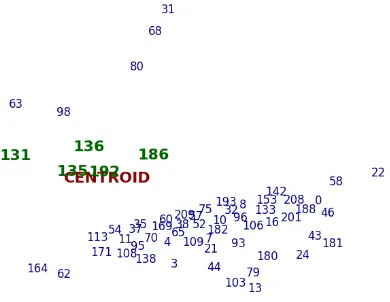
Figure 1: Sentence and centroid embeddings 2D visualization of the Donkey Kong (video game)
Wikipedia article. Dimensionality reduction is performed using t-SNE algorithm. For each sen-tence the position in the document is shown. The closest sentences to centroid embedding are marked in green.
cessing tasks (LeCun et al., 2015; Goodfellow et al., 2016), several groups have started to exploit deep neural networks for both abstractive (Rush et al., 2015; Nallapati et al., 2016) andextractive
(K˚ageb¨ack et al., 2014; Cao et al., 2015; Cheng and Lapata, 2016) text summarization.
3 Centroid-based Method
The centroid-based method for extractive summa-rization was introduced by (Radev et al., 2004). The centroid represents a pseudo-document which condenses the meaningful information of a docu-ment2. The main idea is to project in the vector
space the vector representations of both the cen-troid and each sentence of a document. Then, the sentences closer to the centroid are selected. The original method adopts the BOW model for the vector representations using the tf ∗idf weight scheme (Salton and McGill, 1986), where the size of vectors is equal to that of the document vocab-ulary. We adapt the centroid-based method intro-ducing a distributed representation of words where each word in a document is represented by a vector of real numbers of an established size. Formally, given a corpus of documents[D1, D2, . . .]and its vocabularyV with sizeN =|V|, we define a ma-trixE ∈ RN,k, so-calledlookup table, where the i-th row is a word embedding of sizek,k << N,
arcade donkey kong game nintendo coleco centroid embedding
arcades goat hong gameplay mario intellivision nes pac-man pig macao multiplayer wii atari gamecube
console monkey fung videogame console nes konami
famicom horse taiwan rpg nes msx wii
[image:3.595.91.510.63.144.2]sega cow wong gamespot gamecube 3do famicom
Table 1: Centroid words of theDonkey Kong (video game)article having the tf-idf values greater than a topic threshold equal to0.3. For each centroid word, the five closest words are shown using the skip-gram model trained on the Wikipedia (en) content. In the last column the words most similar to the centroid embedding computed using element-wise addition are shown.
of the i-th word in V. The values of the word embeddings matrixE are learned using the neu-ral network model introduced by (Mikolov et al., 2013b). The model can be trained on the collec-tion of documents to be summarized or on a larger corpus. This is a peculiar advantage of Represen-tation Learning (RL) (Bengio et al., 2013) that al-lows to reuse an external knowledge and this is especially useful for the summarization of docu-ments in specific domains, where large amount of data are not available. After learning the lookup table, our summarization method consists of four steps: 1) preprocess the input document; 2) build the centroid embedding; 3) compute the sentence scores; 4) select the relevant sentences.
3.1 Preprocessing
The first step follows the common pipeline for the summarization task: split the document into sen-tences, convert all words in lower case and remove stopwords. Stemming is not performed because we let the word embeddings to discover the lin-guistic regularities of words with the same root (Mikolov et al., 2013c). For instance, the most similar embeddings to the words that compose the centroid vector using the skip-gram model trained on the Wikipedia content are reported in Table 1. The closest word of arcadeis its plural arcades, while they are orthogonal in the vector space ac-cording to the BOW representation.
3.2 Centroid Embedding
In order to build a centroid vector using word em-beddings, we first select the meaningful words into the document. For simplicity and a fair compar-ison with the original method, we select those words having the tf ∗ idf weight greater than a topic threshold. Thus, we compute the
cen-troid embedding as the sum3 of the embeddings
of the top ranked words in the document using the lookup tableE.
C= X
w∈D,tfidf(w)>t
E[idx(w)] (1)
In the eq. (1) we denote with C the cen-troid embedding related to the document D and with idx(w) a function that returns the index of the word w in the vocabulary. In the headers of the Table 1 the centroid words extracted from a Wikipedia article are reported. The last column shows the words most similar to centroid embed-ding computed using element-wise addition. It is important to underline that all five closest words to the centroid vector are semantically related to the main topic of the document despite the size of the Wikipedia vocabulary (about 1 million words). 3.3 Sentence Scoring
For each sentence in the document, we create an embedding representation by summing the vectors for each word in the sentence stored in the lookup tableE.
Sj = X
w∈Sj
E[idx(w)] (2)
In the eq. (2) we denote withSj the j-th
sen-tence in the documentD. Then, the sentence score is computed as the cosine similarity between the embedding of the sentenceSjand that of the
cen-troidCof the documentD.
sim(C, Sj) = C T •Sj
||C|| · ||Sj|| (3)
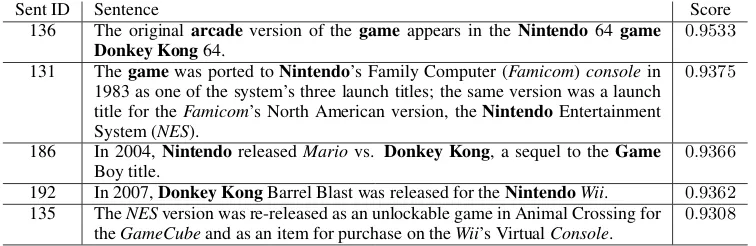
Sent ID Sentence Score 136 The originalarcadeversion of thegameappears in theNintendo64 game
Donkey Kong64. 0.9533
131 Thegamewas ported toNintendo’s Family Computer (Famicom)consolein 1983 as one of the system’s three launch titles; the same version was a launch title for theFamicom’s North American version, theNintendoEntertainment System (NES).
0.9375
186 In 2004,NintendoreleasedMariovs. Donkey Kong, a sequel to theGame
Boy title. 0.9366
192 In 2007,Donkey KongBarrel Blast was released for theNintendoWii. 0.9362
135 TheNESversion was re-released as an unlockable game in Animal Crossing for
[image:4.595.111.489.62.185.2]theGameCubeand as an item for purchase on theWii’s VirtualConsole. 0.9308
Table 2: The most relevant sentences of theDonkey Kongarticle selected with the centroid-based sum-marization method using word embeddings. For each sentence are reported the related position ID in the document and the similarity score computed between sentence and centroid embeddings. The words that compose the centroid vector are marked inbold. The most similar words to the centroid ones are reported initalic.
use t-SNE method (van der Maaten and Hinton, 2008) to reduce the dimensionality of vectors from 300 to 2. For each sentence the position ID in the document is shown. The closest sentences to the centroid embedding are marked in green. The words that compose the centroid are the same showed in Table 1. In Table 2 we report the sen-tences near to the centroid with the related cosine similarity values. As we expected, the most rele-vant sentence (136) contains many words close to the centroid vector. However, the relevant aspect concerns the last sentence (135). Despite this sen-tence does not contain any centroid word, it has a high similarity value so it is close to the cen-troid embedding in the vector space. The reason is due to the presence of the words, such asNES,
GameCubeandWii, that are the closest words to the centroid embedding (Table 1). This proves the effectiveness of the compositionality of word em-beddings to encode the semantic relations between words through vector dense representations.
3.4 Sentence Selection
The sentences are sorted in descending order of their similarity scores. The top ranked sentences are iteratively selected and added to the summary until the limit4 is reached. In order to satisfy
the redundancy property, during the iteration we compute the cosine similarity between the next sentence and each one already in the summary. We discard the incoming sentence if the similar-ity value is greater than a threshold. This proce-dure is reported in Algorithm 1. However,
sim-4The limit can be the number of bytes/words in the sum-mary or a compression rate.
ilar sentence selection approaches are described in (Carbonell and Goldstein, 1998; Saggion and Gaizauskas, 2004).
Algorithm 1Sentence selection Input: S,Scores,st,limit
Output: Summary
S ←SORTDESC(S,Scores) k←1
fori←1tomdo
length←LENGTH(Summary)
iflength > limitthen returnSummary SV ←SUMVECTORS(S[i])
include←T rue
forj ←1tokdo
SV2←SUMVECTORS(Summary[j]) sim←SIMILARITY(SV,SV2)
ifsim > stthen
include←F alse
ifincludethen
Summary[k]←S[i]
k←k+ 1
4 Experiments
4.1 Multi-Document Summarization
Dataset and Metrics During the document un-derstanding conference (DUC)5 from 2001 to
2007, several gold standard datasets have been developed to evaluate the summarization meth-ods. In particular, we evaluate our method on multi-document summarization using the DUC-2004 Task 2 dataset composed by 50 clusters, each of which consists of 10 documents coming from Associated Press and New York Times newswires. For each cluster, four summaries written by dif-ferent humans were supplied. For the evaluation, we adopt the ROUGE (Lin, 2004), a set of recall-based metrics that compare the automatic and hu-man summaries on the basis of the n-gram overlap. In our experiment, we adopt both ROUGE-1 and ROUGE-26.
Baselines For the comparison, we propose sev-eral baselines. Firstly, we adapt the cen-troid method proposed by (Radev et al., 2004) (C BOW) for a fair comparison. In the original work, the sentence scores are the linear combina-tion of the centroid score, the posicombina-tional value and the first sentence overlap. The centroid score is the sum of tf ∗idf weights of the words occur-ring both in the sentence and in the centroid. In our experiment, we apply both our sentence score and selection algorithms. LEAD simply chooses the first 665 bytes from the most recent article in each cluster. SumBasic is a simple probabilistic method proposed by (Nenkova and Vanderwende, 2005) commonly used as baseline in the summa-rization evaluation. Peer65is the winning system in DUC-2004 Task 2. To compare our method with others which also use compact and dense representations, we use the method proposed by (Lee et al., 2009) that adopts the generic rele-vance of sentences method using NMF. Another method often used in summarization evaluations isLexRankproposed by (Erkan and Radev, 2004) which uses the TextRank algorithm (Mihalcea and Tarau, 2004) to establish a ranking between sen-tences. Finally, we compare our method with the one proposed by (Cao et al., 2015) that uses Recur-sive Neural Network (RNN) for learning sentence embeddings by encoding syntactic features.
5http://duc.nist.gov
6ROUGE-1.5.5 with options -c 95 -b 665 -m -n 2 -x
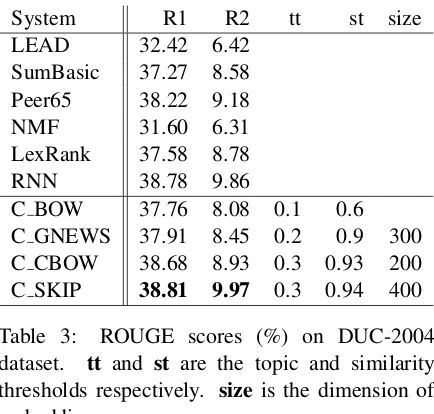
System R1 R2 tt st size
LEAD 32.42 6.42 SumBasic 37.27 8.58 Peer65 38.22 9.18 NMF 31.60 6.31 LexRank 37.58 8.78 RNN 38.78 9.86
C BOW 37.76 8.08 0.1 0.6 C GNEWS 37.91 8.45 0.2 0.9 300 C CBOW 38.68 8.93 0.3 0.93 200 C SKIP 38.81 9.97 0.3 0.94 400
Table 3: ROUGE scores (%) on DUC-2004 dataset. tt and st are the topic and similarity thresholds respectively. size is the dimension of embeddings.
Implementation Our system7 is written in
Python by relying on nltk, scikit-learn and gen-sim libraries for text preprocessing, building the sentence-term matrix and import the word2vec model. We train the word embeddings on DUC-2004 corpus using the original word2vec8
imple-mentation. We test both continuous bag-of-words (C CBOW) and skip-gram (C SKIP) neural ar-chitectures proposed in (Mikolov et al., 2013a) us-ing the same parameters9 but varying the
embed-ding sizes. Moreover, we compare our method us-ing the model trained on a part of Google News dataset (C GNEWS) which consists of about 100 billion words. In the preprocessing step each clus-ter of documents is divided in sentences and stop-words are removed. We do not perform stemming as reported in Section 3. To find the best parame-ters configuration, we run a grid search using this setting: embedding size in [100, 200, 300, 400, 500], topic and similarity thresholds respectively in [0, 0.5] and [0.5, 1] with a step of 0.01.
Results and Discussion The results of the ex-periment are shown in Table 3. We report the best scores of our method using the three different word2vec models along with their parameters. For all word embeddings models, our method outper-forms the original centroid one. In detail, with the skip-gram model we obtain an increment of 1.05% and 1.71% with respect to the BOW model using ROUGE-1 and ROUGE-2 respectively. Moreover, our simple method with skip-gram performs
[image:5.595.308.525.60.267.2]ter than the more complex models based on RNN. This proves the effectiveness of the compositional capability of word embeddings in order to en-code the information word sequences by applying a simple sum of word vectors, as already proved in (Wieting et al., 2015). Although our method with the model pre-trained on Google News does not achieve the best score, it is interesting to notice the flexibility of the word embeddings in reusing ex-ternal knowledge. Regarding the comparison be-tween BOW and embedding representations, the experiment shows different behaviors of the simi-larity threshold. In particular, the use of word2vec requires a higher threshold because the word em-beddings are dense vectors unlike the sparse rep-resentation of BOW. This proves that the embed-dings of sentences are closer in the vector space, thus the cosine similarity returns closer values.
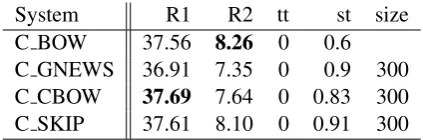
[image:6.595.307.532.60.136.2]System R1 R2 tt st size C BOW 37.56 8.26 0 0.6 C GNEWS 36.91 7.35 0 0.9 300 C CBOW 37.69 7.64 0 0.83 300 C SKIP 37.61 8.10 0 0.91 300 Table 4: ROUGE scores without topic threshold.
Also the topic threshold shows different trends. The word embeddings require a higher threshold value to make our method effective. In order to analyze this aspect we run another experiment set-ting the topic threshold to 0. The results are re-ported in Table 4. Results show that the BOW representation is more stable and obtains the best ROUGE-2 score, while the performance obtained by word2vec decreases considerably. This means that word embeddings are more sensitive to noise and they require an accurate choice of the mean-ingful words to compose the centroid vector. Summaries Overlap Although the different methods achieve similar ROUGE scores, they not necessarily generate similar summaries. An ex-ample is reported in Table 6. In this section we conduct a further analysis by comparing the sum-maries generated by the best four configurations of the centroid method reported in Table 3. We adopt the same criterion presented in (Hong et al., 2014), where the different summaries are compared in terms of sentences and words overlap using the Jaccard coefficient. Due to space constraint, we report in Table 5 only the sentence overlap. The results prove that different word representations
GNEWS CBOW SKIP BOW GNEWS 1 0.109 0.171 0.075
CBOW 1 0.460 0.072
SKIP 1 0.105
[image:6.595.75.287.317.387.2]BOW 1
Table 5: Sentence overlap.
lead to different summaries. In particular, the sum-maries using BOW differ considerably from those generated using word2vec, but this is true even for different embedding models. On the other hand, only the models trained on the DUC-2004 corpus (CBOW and SKIP) tend to generate more similar summaries. This analysis suggests that a combina-tion of various models trained on different corpora could result in good performance.
4.2 Multilingual Document Summarization Task Description We carried out an experiment on Multilingual Single-document Summarization (MSS). Our main goal is to prove empirically the effectiveness of the use of word embeddings in the document summarization task across dif-ferent languages. For this purpose, we evaluate our method on the MSS task proposed in Multi-Ling 2015 (Giannakopoulos et al., 2015), a spe-cial session at SIGDIAL 2015. Starting from 2011 the aim of MultiLing community is to promote the cutting-edge research in automatic summa-rization by providing datasets and by introducing several pilot tasks to encourage further develop-ments in single and multi-document summariza-tion and in summarizing human dialogs in on-line forums and customer call centers. The goal of the MSS 2015 task is to generate a single doc-ument summary from a selection of some of the best written Wikipedia articles with at least one out of 38 languages defined by organizers of the task. The dataset10 is divided into a training and
a test sets, both consisting of 30 documents for each of 38 languages. For both datasets, the body of the articles and the related abstracts with the character length limits are provided. Since the Wikipedia abstracts are summaries written by hu-mans, they are useful to perform automatic evalua-tions. We evaluate our method using five different languages: English, Italian, German, Spanish and French.
BOW - Bag of Words baseline
The controversy centers on the payment of nearly dlrs 400,000 in scholarships to relatives of IOC members by the Salt Lake bid committee which won the right to stage the 2002 games. Pound said the panel would investigate allegations that “there may or may not have been payments for the benefit of members of the IOC or their families connected with the Salt Lake City bid.” Samaranch said he was surprised at the allegations of corruption in the International Olympic Committee made by senior Swiss member Marc Hodler.
CBOW - Continuous Bag of Words trained on DUC-2004 dataset
Marc Hodler, a senior member of the International Olympic Committee executive board, alleged malpractices in the voting for the 1996 Atlanta Games, 2000 Sydney Olympics and 2002 Salt Lake Games. The IOC, meanwhile, said it was prepared to investigate allegations made by Hodler of bribery in the selection of Olympic host cities. The issue of vote-buying came to the fore in Lausanne because of the recent disclosure of scholarship payments made to six relatives of IOC members by Salt Lake City officials during their successful bid to play host to the 2002 Winter Games.
SKIP - Skip-gram trained on DUC-2004 dataset
Marc Hodler, a senior member of the International Olympic Committee executive board, alleged malpractices in the voting for the 1996 Atlanta Games, 2000 Sydney Olympics and 2002 Salt Lake Games. The IOC, meanwhile, said it was prepared to investigate allegations made by Hodler of bribery in the selection of Olympic host cities. Saying “if we have to clean, we will clean,” Juan Antonio Samaranch responded on Sunday to allegations of corruption in the Olympic bidding process by declaring that IOC members who were found to have accepted bribes from candidate cities could be expelled.
GNEWS - Skip-gram trained on Google News dataset
[image:7.595.79.523.63.286.2]The International Olympic Committee has ordered a top-level investigation into the payment of nearly dlrs 400,000 in scholarships to relatives of IOC members by the Salt Lake group which won the bid for the 2002 Winter Games. The mayor of the Japanese city of Nagano, site of the 1998 Winter Olympics, denied allegations that city officials bribed members of the International Olympic Committee to win the right to host the games. Swiss IOC executive board member Marc Hodler said Sunday he might be thrown out of the International Olympic Committee for making allegations of corruption within the Olympic movement.
Table 6: Summaries of the clusterd30038in DUC-2004 dataset using the centroid-based summarization method with different sentence representations.
Model Configuration In order to learn word embeddings for the different languages, we ex-ploit five Wikipedia dumps11, one for each
cho-sen language. We extract the plain text from the Wiki markup language using Wikiextractor12, a
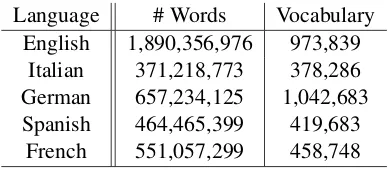
Wikimedia parser written in Python. Each article is converted from UTF-8 to ASCII encoding us-ing the Unidecode Python package. Since in the previous evaluation we observe a similar behav-ior between the continuous bag of words and skip-gram models, in this evaluation we adopt only the skip-gram one using the same training parame-ters13 for all five languages. The Table 7 reports
the Wikipedia statistics for the five languages re-garding the number of words and the size of the vocabularies.
Language # Words Vocabulary English 1,890,356,976 973,839
Italian 371,218,773 378,286 German 657,234,125 1,042,683 Spanish 464,465,399 419,683
French 551,057,299 458,748
Table 7: Wikipedia statistics.
Experiment Protocol In order to reproduce the same challenging scenario of the MultiLing 2015
11https://dumps.wikimedia.org/langwiki/20161220/ with lang in [en, it, de, es, fr]
12https://github.com/attardi/wikiextractor/wiki 13-hs 1 -min-count 10 -window 8 -negative 5 -iter 5
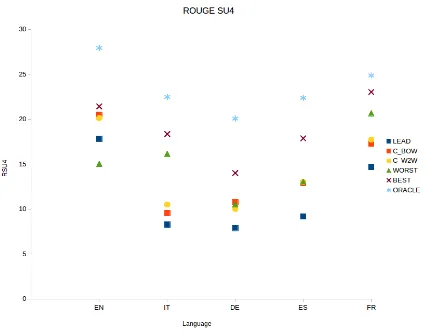
MSS task, we performed the tuning of parameters using only the training set. To find the best topic and similarity threshold parameters we run a grid search as explained in Section 4.1. The grid search is performed for each language separately using both BOW and skip-gram representations. The pa-rameter configurations are in line with those of the previous experiment on DUC-2004. In detail, the topic thresholds are in the range [0.1, 0.2] using the BOW model and in the range [0.3, 0.5] using word embeddings. While, the similarity thresh-olds are slightly higher w.r.t. the multi-document experiment: about 0.7 and 0.95 for BOW and skip-gram, respectively. This is due to the fact that too similar sentences are rare, especially with well-written documents as Wikipedia articles. The best parameters configuration for each language is used to generate summaries for the documents in the test set. Also for this task, each document is preprocessed with the sentences segmentation and stopwords removal, without stemming. We adopt the same automatic evaluation metrics used by the participating systems in MSS 2015 task: ROUGE-1, -2, -SU414. ROUGE-SU4 computes the score
between the generated and human summaries con-sidering the overlap of the skip-bigrams of 4 as well as the unigrams. Finally, the generated sum-mary for each document must comply with a spe-cific length constraint (rather than using a unique length limit for the whole collection). This differs
[image:7.595.84.278.558.643.2]English Italian German Spanish French
R1 R2 R1 R2 R1 R2 R1 R2 R1 R2
LEAD 44.33 11.68 30.46 4.38 29.13 3.21 43.02 9.17 42.73 8.07 WORST 37.17 9.93 39.68 10.01 33.02 4.88 45.20 13.04 46.68 12.96
BEST 50.38 15.10 43.87 12.50 40.58 8.80 53.23 17.86 51.39 15.38 C BOW 49.06 13.43 33.44 4.82 35.28 4.93 48.38 12.88 46.13 10.45 C W2V 50.43‡ 13.34† 35.12 6.81 35.38† 5.39† 49.25† 12.99 47.82† 12.15
[image:8.595.74.530.61.175.2]ORACLE 61.91 22.42 53.31 17.51 54.34 13.32 62.55 22.36 58.68 17.18 Table 8: ROUGE-1, -2 scores (%) on MultiLing MSS 2015 dataset for five different languages.
from the previous evaluation on DUC-2004. Results and Discussion The results for each languages are shown in Table 8. We report the ROUGE-1, -2 scores for each chosen language. LEADandC BOWrepresent the same baselines used in the multi-document experiment. The for-mer uses the initial text of each article truncated to the length of the Wikipedia abstract. The lat-ter is the centroid-based method with the BOW representation. Our method that uses word em-beddings learned with skip-gram model is labeled with C W2V. For each metric and language we also report the WORSTand the BEST scores15
obtained by the 23 participating systems at MSS 2015 task. Finally,ORACLEscores can be con-sidered as an upper bound approximation for the extractive summarization methods. It uses a cover-ing algorithm (Davis et al., 2012) that selects sen-tences from the original text covering the words in the summary without disregarding the length limit. We highlight in bold the scores of our method when it outperforms the baselineC BOW. On the other hand, the superscripts† and‡ imply a bet-ter performance of our method with respect to the WORSTand theBESTscores respectively.
Both centroid-based methods overcome the simple baseline over all languages. Our method always achieves better scores against the BOW model except for ROUGE-2 metric for English. This confirms the effectiveness of using word embeddings as alternative sentence representa-tions able to capture the semantic similarities be-tween the centroid words and the sentences, when summarizing single documents too. Moreover, our method outperforms substantially the lowest scores performing systems participating in MSS 2015 task for English and German languages. For
15 http://multiling.iit.demokritos.gr/file/view/1629/mss- multilingual-single-document-summarization-submission-and-automatic-score
English our method obtains a ROUGE-1 score even better than the one of the best system in MSS 2015. Instead, our method fails in summa-rizing Italian documents and it achieves the worst ROUGE-2 for Spanish and French languages. The reason may lie in the size of the Wikipedia dumps used to learn the word embeddings for different languages. As showing in Table 7, the sizes of the various corpora as well as the ratios between the number of words and dimension of the vocab-ularies, differ consistently. The English version of Wikipedia consists of nearly 2 billion words against about 300 million words of Italian one. Thus, according to the distributional hypothesis reported in (Harris, 1954), we expect better per-formance for our method in summarizing English or German articles with respect to the other lan-guages where the word embeddings are learned using a smaller corpus. Our results and in partic-ular the ROUGE-SU4 scores reported in Figure 2 support this hypothesis.
[image:8.595.312.526.528.694.2]5 Conclusion
In this paper, we propose a centroid-based method for extractive summarization which exploits the compositional capability of word embeddings. One of the advantages of our method lies on its simplicity. Indeed, it can be used as a base-line in experimenting new articulate semantic rep-resentations in summarization tasks. Moreover, following the idea of representation learning, it is feasible to infuse knowledge by training the word embeddings from external sources. Finally, the proposed method is fully unsupervised, thus it can be adopted in other summarization tasks, such as query-based document summarization. As future work, we plan to evaluate the centroid-based summarization method using a topic model, such as Latent Dirichlet Allocation (LDA) (Blei et al., 2003) or Non-negative Matrix Factoriza-tion (NMF) (Berry et al., 2007), in order to ex-tract the meaningful words to compute the cen-troid embedding as well as to carry out a com-prehensive comparison of different sentence rep-resentations using more complex neural language models (Le and Mikolov, 2014; Zhang and Le-Cun, 2015; J´ozefowicz et al., 2016). Finally, the combination of distributional and relational se-mantics (Fried and Duh, 2014; Verga and McCal-lum, 2016; Rossiello, 2016) applied to extractive text summarization is a promising further direc-tion that we want to investigate.
References
Y. Bengio, A. Courville, and P. Vincent. 2013. Repre-sentation learning: A review and new perspectives.
IEEE Transactions on Pattern Analysis and Machine Intelligence, 35(8):1798–1828, Aug.
Michael W. Berry, Murray Browne, Amy N. Langville, V. Paul Pauca, and Robert J. Plemmons. 2007. Al-gorithms and applications for approximate nonneg-ative matrix factorization. Computational Statistics & Data Analysis, 52(1):155–173, September.
David M. Blei, Andrew Y. Ng, and Michael I. Jordan. 2003. Latent dirichlet allocation. J. Mach. Learn. Res., 3:993–1022, March.
Ziqiang Cao, Furu Wei, Li Dong, Sujian Li, and Ming Zhou. 2015. Ranking with recursive neu-ral networks and its application to multi-document summarization. In Proceedings of the Twenty-Ninth AAAI Conference on Artificial Intelligence, AAAI’15, pages 2153–2159. AAAI Press.
Jaime Carbonell and Jade Goldstein. 1998. The use of mmr, diversity-based reranking for reordering docu-ments and producing summaries. InProceedings of the 21st Annual International ACM SIGIR Confer-ence on Research and Development in Information Retrieval, SIGIR ’98, pages 335–336, New York, NY, USA. ACM.
Jianpeng Cheng and Mirella Lapata. 2016. Neural summarization by extracting sentences and words. pages 484–494, August.
S. T. Davis, J. M. Conroy, and J. D. Schlesinger. 2012. Occams – an optimal combinatorial covering algo-rithm for multi-document summarization. In2012 IEEE 12th International Conference on Data Min-ing Workshops, pages 454–463, Dec.
Gunes Erkan and Dragomir R. Radev. 2004. Lexrank: Graph-based lexical centrality as salience in text summarization. J. Artif. Int. Res., 22(1):457–479, December.
Daniel Fried and Kevin Duh. 2014. Incorporating both distributional and relational semantics in word rep-resentations. CoRR, abs/1412.4369.
George Giannakopoulos, Jeff Kubina, John M. Conroy, Josef Steinberger, Benoˆıt Favre, Mijail A. Kabadjov, Udo Kruschwitz, and Massimo Poesio. 2015. Mul-tiling 2015: MulMul-tilingual summarization of single and multi-documents, on-line fora, and call-center conversations. InProceedings of the SIGDIAL 2015 Conference., pages 270–274.
Yoav Goldberg. 2015. A primer on neural network models for natural language processing. CoRR, abs/1510.00726.
Ian Goodfellow, Yoshua Bengio, and Aaron Courville. 2016. Deep Learning. MIT Press. http://www.
deeplearningbook.org.
Zellig Harris. 1954. Distributional structure. Word, 10(23):146–162.
Kai Hong, John Conroy, Benoit Favre, Alex Kulesza, Hui Lin, and Ani Nenkova. 2014. A repository of state of the art and competitive baseline summaries for generic news summarization. In Nicoletta Cal-zolari (Conference Chair), Khalid Choukri, Thierry Declerck, Hrafn Loftsson, Bente Maegaard, Joseph Mariani, Asuncion Moreno, Jan Odijk, and Stelios Piperidis, editors,Proceedings of the Ninth Interna-tional Conference on Language Resources and Eval-uation (LREC’14), Reykjavik, Iceland, may. Euro-pean Language Resources Association (ELRA). Karen Sp¨arck Jones. 2007. Automatic summarising:
The state of the art. Information Processing & Man-agement, 43(6):1449–1481.
Mikael K˚ageb¨ack, Olof Mogren, Nina Tahmasebi, and Devdatt Dubhashi. 2014. Extractive summariza-tion using continuous vector space models. In Pro-ceedings of the 2nd Workshop on Continuous Vector Space Models and their Compositionality (CVSC)@ EACL, pages 31–39.
Quoc Le and Tomas Mikolov. 2014. Distributed rep-resentations of sentences and documents. In Tony Jebara and Eric P. Xing, editors,Proceedings of the 31st International Conference on Machine Learning (ICML-14), pages 1188–1196. JMLR Workshop and Conference Proceedings.
Yann LeCun, Yoshua Bengio, and Geoffrey Hinton. 2015. Deep learning. Nature, 521:436–444. Ju-Hong Lee, Sun Park, Chan-Min Ahn, and Daeho
Kim. 2009. Automatic generic document summa-rization based on non-negative matrix factosumma-rization.
Inf. Process. Manage., 45(1):20–34, January. Hui Lin and Jeff Bilmes. 2011. A class of
submodu-lar functions for document summarization. In Pro-ceedings of the 49th Annual Meeting of the Associ-ation for ComputAssoci-ational Linguistics: Human Lan-guage Technologies, pages 510–520, Portland, Ore-gon, USA, June. Association for Computational Lin-guistics.
Chin-Yew Lin. 2004. Rouge: A package for auto-matic evaluation of summaries. In Stan Szpakowicz Marie-Francine Moens, editor, Text Summarization Branches Out: Proceedings of the ACL-04 Work-shop, pages 74–81, Barcelona, Spain, July. Associa-tion for ComputaAssocia-tional Linguistics.
H. P. Luhn. 1958. The automatic creation of literature abstracts. IBM J. Res. Dev., 2(2):159–165, April. Rada Mihalcea and Paul Tarau. 2004. Textrank:
Bringing order into texts. In Dekang Lin and Dekai Wu, editors, Proceedings of EMNLP 2004, pages 404–411, Barcelona, Spain, July. Association for Computational Linguistics.
Tomas Mikolov, Kai Chen, Greg Corrado, and Jef-frey Dean. 2013a. Efficient estimation of word representations in vector space. arXiv preprint arXiv:1301.3781.
Tomas Mikolov, Ilya Sutskever, Kai Chen, Greg S Cor-rado, and Jeff Dean. 2013b. Distributed represen-tations of words and phrases and their composition-ality. InAdvances in neural information processing systems, pages 3111–3119.
Tomas Mikolov, Wen-tau Yih, and Geoffrey Zweig. 2013c. Linguistic regularities in continuous space word representations. In Proceedings of the 2013 Conference of the North American Chapter of the Association for Computational Linguistics: Human Language Technologies, pages 746–751, Atlanta, Georgia, June. Association for Computational Lin-guistics.
Ramesh Nallapati, Bowen Zhou, Cicero dos Santos, Caglar Gulcehre, and Bing Xiang. 2016. Abstrac-tive text summarization using sequence-to-sequence rnns and beyond. pages 280–290, August.
Ani Nenkova and Lucy Vanderwende. 2005. The im-pact of frequency on summarization. Microsoft Re-search, Redmond, Washington, Tech. Rep. MSR-TR-2005-101.
Makbule G. Ozsoy, Ferda N. Alpaslan, and Ilyas Ci-cekli. 2011. Text summarization using latent se-mantic analysis. Journal of Information Science, 37(4):405–417.
Dragomir R. Radev, Hongyan Jing, Malgorzata Stys, and Daniel Tam. 2004. Centroid-based summariza-tion of multiple documents. Inf. Process. Manage., 40(6):919–938, November.
Gaetano Rossiello. 2016. Neural abstractive text sum-marization. InProceedings of the Doctoral Consor-tium of AI*IA 2016 co-located with the 15th Inter-national Conference of the Italian Association for Artificial Intelligence (AI*IA 2016), Genova, Italy, November 29, 2016., pages 70–75.
Alexander M. Rush, Sumit Chopra, and Jason Weston. 2015. A neural attention model for abstractive sen-tence summarization. In Proceedings of the 2015 Conference on Empirical Methods in Natural Lan-guage Processing, pages 379–389, Lisbon, Portugal, September. Association for Computational Linguis-tics.
Horacio Saggion and Robert Gaizauskas. 2004. Multi-document summarization by cluster/profile rele-vance and redundancy removal. In Proceedings of the HLT/NAACL Document Understanding Work-shop (DUC 2004), Boston, May.
Horacio Saggion and Thierry Poibeau. 2013. Auto-matic text summarization: Past, present and future. In Multi-source, Multilingual Information Extrac-tion and SummarizaExtrac-tion, pages 3–21. Springer. Gerard Salton and Michael J. McGill. 1986.
Intro-duction to Modern Information Retrieval. McGraw-Hill, Inc., New York, NY, USA.
Laurens van der Maaten and Geoffrey E. Hinton. 2008. Visualizing high-dimensional data using t-sne. Journal of Machine Learning Research, 9:2579–2605.
Patrick Verga and Andrew McCallum. 2016. Row-less universal schema. CoRR, abs/1604.06361.
John Wieting, Mohit Bansal, Kevin Gimpel, and Karen Livescu. 2015. Towards universal paraphrastic sen-tence embeddings. CoRR, abs/1511.08198.