Exploring Content Models for Multi-Document Summarization
Aria Haghighi
UC Berkeley, CS Division
Lucy Vanderwende
Microsoft Research
Abstract
We present an exploration of generative prob-abilistic models for multi-document summa-rization. Beginning with a simple word fre-quency based model (Nenkova and Vander-wende, 2005), we construct a sequence of models each injecting more structure into the representation of document set content and ex-hibiting ROUGE gains along the way. Our final model, HIERSUM, utilizes a
hierarchi-cal LDA-style model (Blei et al., 2004) to represent content specificity as a hierarchy of topic vocabulary distributions. At the task of producing generic DUC-style summaries,
HIERSUMyields state-of-the-art ROUGE
per-formance and in pairwise user evaluation strongly outperforms Toutanova et al. (2007)’s
state-of-the-art discriminative system. We
also explore HIERSUM’s capacity to produce
multiple ‘topical summaries’ in order to facil-itate content discovery and navigation.
1 Introduction
Over the past several years, there has been much in-terest in the task of multi-document summarization. In the common Document Understanding Confer-ence (DUC) formulation of the task, a system takes as input a document set as well as a short descrip-tion of desired summary focus and outputs a word length limited summary.1 To avoid the problem of generating cogent sentences, many systems opt for an extractive approach, selecting sentences from the document set which best reflect its core content.2
1In this work, we ignore the summary focus. Here, the word topicwill refer to elements of our statistical model rather than summary focus.
2Note that sentence extraction does not solve the problem of
selecting and ordering summary sentences to form a coherent
There are several approaches to modeling docu-ment content: simple word frequency-based meth-ods (Luhn, 1958; Nenkova and Vanderwende, 2005), graph-based approaches (Radev, 2004; Wan and Yang, 2006), as well as more linguistically mo-tivated techniques (Mckeown et al., 1999; Leskovec et al., 2005; Harabagiu et al., 2007). Another strand of work (Barzilay and Lee, 2004; Daum´e III and Marcu, 2006; Eisenstein and Barzilay, 2008), has explored the use of structured probabilistic topic models to represent document content. However, lit-tle has been done to directly compare the benefit of complex content models to simpler surface ones for generic multi-document summarization.
In this work we examine a series of content models for multi-document summarization and ar-gue that LDA-style probabilistic topic models (Blei et al., 2003) can offer state-of-the-art summariza-tion quality as measured by automatic metrics (see section 5.1) and manual user evaluation (see sec-tion 5.2). We also contend that they provide con-venient building blocks for adding more structure to a summarization model. In particular, we uti-lize a variation of the hierarchical LDA topic model (Blei et al., 2004) to discover multiple specific ‘sub-topics’ within a document set. The resulting model,
HIERSUM (see section 3.4), can produce general summaries as well as summaries for any of the learned sub-topics.
2 Experimental Setup
The task we will consider is extractive multi-document summarization. In this task we assume a document collection D consisting of documents D1, . . . , Dndescribing the same (or closely related)
narrative (Lapata, 2003).
set of events. Our task will be to propose a sum-marySconsisting of sentences inDtotaling at most L words.3 Here as in much extractive summariza-tion, we will view each sentence as a bag-of-words or more generally a bag-of-ngrams (see section 5.1). The most prevalent example of this data setting is document clusters found on news aggregator sites.
2.1 Automated Evaluation
For model development we will utilize the DUC 2006 evaluation set4consisting of 50 document sets each with 25 documents; final evaluation will utilize the DUC 2007 evaluation set (section 5).
Automated evaluation will utilize the standard DUC evaluation metric ROUGE (Lin, 2004) which represents recall over various n-grams statistics from a system-generated summary against a set of human-generated peer summaries.5 We compute ROUGE scores with and without stop words removed from peer and proposed summaries. In particular, we utilize R-1 (recall against unigrams), R-2 (recall against bigrams), and R-SU4 (recall against skip-4 bigrams)6. We present R-2 without stop words in the running text, but full development results are pre-sented in table 1. Official DUC scoring utilizes the jackknife procedure and assesses significance using bootstrapping resampling (Lin, 2004). In addition to presenting automated results, we also present a user evaluation in section 5.2.
3 Summarization Models
We present a progression of models for multi-document summarization. Inference details are given in section 4.
3.1 SumBasic
The SUMBASIC algorithm, introduced in Nenkova and Vanderwende (2005), is a simple effective pro-cedure for multi-document extractive summariza-tion. Its design is motivated by the observation that the relative frequency of a non-stop word in a doc-ument set is a good predictor of a word appearing in a human summary. InSUMBASIC, each sentence
3For DUC summarization tasks,Lis typically 250. 4http://www-nlpir.nist.gov/projects/duc/data.html
5All words from peer and proposed summaries are
lower-cased and stemmed.
6Bigrams formed by skipping at most two words.
S is assigned a score reflecting how many high-frequency words it contains,
Score(S) = X
w∈S
1
|S|PD(w) (1) wherePD(·)initially reflects the observed unigram probabilities obtained from the document collection
D. A summary S is progressively built by adding
the highest scoring sentence according to (1).7 In order to discourage redundancy, the words in the selected sentence are updated Pnew
D (w) ∝
PDold(w)2. Sentences are selected in this manner un-til the summary word limit has been reached.
Despite its simplicity, SUMBASIC yields 5.3 R-2 without stop words on DUC 2006 (see table 1).8 By comparison, the highest-performing ROUGE sys-tem at the DUC 2006 evaluation, SUMFOCUS, was built on top ofSUMBASIC and yielded a 6.0, which is not a statistically significant improvement (Van-derwende et al., 2007).9
Intuitively, SUMBASIC is trying to select a sum-mary which has sentences where most words have high likelihood under the document set unigram dis-tribution. One conceptual problem with this objec-tive is that it inherently favors repetition of frequent non-stop words despite the ‘squaring’ update. Ide-ally, a summarization criterion should be more recall oriented, penalizing summaries which omit moder-ately frequent document set words and quickly di-minishing the reward for repeated use of word.
Another more subtle shortcoming is the use of the raw empirical unigram distribution to represent con-tent significance. For instance, there is no distinc-tion between a word which occurs many times in the same document or the same number of times across several documents. Intuitively, the latter word is more indicative of significant document set content. 3.2 KLSum
TheKLSUMalgorithm introduces a criterion for se-lecting a summarySgiven document collectionD,
S∗ = min
S:words(S)≤LKL(PDkPS) (2)
7Note that sentence order is determined by the order in
which sentences are selected according to (1).
8This result is presented as 0.053 with the official ROUGE
scorer (Lin, 2004). Results here are scaled by 1,000.
9To be fair obtaining statistical significance in ROUGE
φB
Z
W
φC
φD
ψ
t [image:3.612.95.278.58.191.2]Document Set Document Sentence Word
Figure 1: Graphical model depiction of TOPIC
-SUM model (see section 3.3). Note that many
hyper-parameter dependencies are omitted for compactness.
where PS is the empirical unigram distribution of the candidate summary S and KL(PkQ) repre-sents the Kullback-Lieber (KL) divergence given by
P
wP(w) logPQ((ww)).10 This quantity represents the
divergence between the true distributionP (here the document set unigram distribution) and the approx-imating distribution Q (the summary distribution). This criterion casts summarization as finding a set of summary sentences which closely match the doc-ument set unigram distribution. Lin et al. (2006) propose a related criterion for robust summarization evaluation, but to our knowledge this criteria has been unexplored in summarization systems. We ad-dress optimizing equation (2) as well as summary sentence ordering in section 4.
KLSUMyields 6.0 R-2 without stop words, beat-ingSUMBASICbut not with statistical significance. It is worth noting however thatKLSUM’s performance matchesSUMFOCUS(Vanderwende et al., 2007), the highest R-2 performing system at DUC 2006.
3.3 TopicSum
As mentioned in section 3.2, the raw unigram dis-tribution PD(·) may not best reflect the content of
D for the purpose of summary extraction. We propose TOPICSUM, which uses a simple LDA-like topic model (Blei et al., 2003) similar to Daum´e III and Marcu (2006) to estimate a content
distribu-10In order to ensure finite values of KL-divergence we
smoothePS(·)so that it has a small amount of mass on all doc-ument set words.
System ROUGE -stop ROUGE all
R-1 R-2 R-SU4 R-1 R-2 R-SU4
SUMBASIC 29.6 5.3 8.6 36.1 7.1 12.3
KLSUM 30.6 6.0 8.9 38.9 8.3 13.7
TOPICSUM 31.7 6.3 9.1 39.2 8.4 13.6
HIERSUM 30.5 6.4 9.2 40.1 8.6 14.3
Table 1: ROUGE results on DUC2006 for models pre-sented in section 3. Results in bold represent results sta-tistically significantly different from SUMBASIC in the
appropriate metric.
tion for summary extraction.11 We extract summary sentences as before using theKLSUMcriterion (see equation (2)), plugging in a learned content distribu-tion in place of the raw unigram distribudistribu-tion.
First, we describe our topic model (see figure 1) which generates a collection of document sets. We assume a fixed vocabularyV:12
1. Draw a background vocabulary distributionφB
from DIRICHLET(V,λB) shared across docu-ment collections13representing the background distribution over vocabulary words. This distri-bution is meant to flexibly model stop words which do not contribute content. We will refer to this topic asBACKGROUND.
2. For each document set D, we draw a content distributionφC from DIRICHLET(V,λC)
repre-senting the significant content of D that we
wish to summarize. We will refer to this topic asCONTENT.
3. For each document D in D, we draw a document-specific vocabulary distribution φD
from DIRICHLET(V,λD) representing words which are local to a single document, but do not appear across several documents. We will refer to this topic asDOCSPECIFIC.
11A topic model is a probabilistic generative process that
gen-erates a collection of documents using a mixture of topic vo-cabulary distributions (Steyvers and Griffiths, 2007). Note this usage of topic is unrelated to the summary focus given for doc-ument collections; this information is ignored by our models.
12In contrast to previous models, stop words arenotremoved
in pre-processing.
13DIRICHLET(V,λ) represents the symmetric Dirichlet
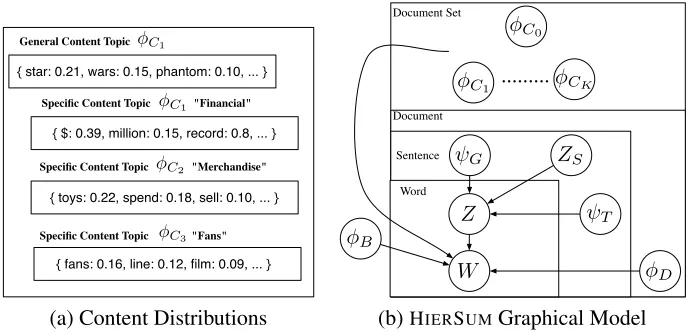
[image:3.612.316.542.58.130.2]{ star: 0.21, wars: 0.15, phantom: 0.10, ... }
General Content TopicφC1
{ $: 0.39, million: 0.15, record: 0.8, ... }
Specific Content Topic "Financial"φC1
{ toys: 0.22, spend: 0.18, sell: 0.10, ... }
{ fans: 0.16, line: 0.12, film: 0.09, ... }
Specific Content Topic "Merchandise"
Specific Content Topic "Fans" φC2
φC3
Document Set
φC0
φCK
φC1
ZS
φD
Document
Sentence
Word
Z
W
ψT
[image:4.612.134.479.60.226.2]ψG
...
φB
(a) Content Distributions (b)HIERSUMGraphical Model
Figure 2: (a): Examples of general versus specific content distributions utilized by HIERSUM(see section 3.4). The
general content distributionφC0 will be used throughout a document collection and represents core concepts in a
story. The specific content distributions represent topical ‘sub-stories’ with vocabulary tightly clustered together but consistently used across documents. Quoted names of specific topics are given manually to facilitate interpretation. (b) Graphical model depiction of the HIERSUMmodel (see section 3.4). Similar to the TOPICSUMmodel (see section 3.3)
except for adding complexity in the content hierarchy as well as sentence-specific prior distributions between general and specific content topics (early sentences should have more general content words). Several dependencies are missing from this depiction; crucially, each sentence’s specific topicZS depends on the last sentence’sZS.
4. For each sentence S of each document D, draw a distribution ψT over topics
(CONTENT,DOCSPECIFIC,BACKGROUND) from a Dirichlet prior with pseudo-counts (1.0,5.0,10.0).14 For each word position in the sentence, we draw a topic Z from ψT,
and a word W from the topic distribution Z indicates.
Our intent is that φC represents the core
con-tent of a document set. Intuitively, φC does
not include words which are common amongst several document collections (modeled with the
BACKGROUND topic), or words which don’t appear across many documents (modeled with theDOCSPE -CIFIC topic). Also, because topics are tied together at the sentence level, words which frequently occur with other content words are more likely to be con-sidered content words.
We ran our topic model over the DUC 2006 document collections and estimated the distribution φC(·) for each document set.15 Then we extracted
14The different pseudo-counts reflect the intuition that most
of the words in a document come from theBACKGROUNDand
DOCSPECIFICtopics.
15While possible to obtain the predictive posterior CON
-a summ-ary using theKLSUM criterion with our es-timatedφCin place of the the raw unigram
distribu-tion. Doing so yielded 6.3 R-2 without stop words (see TOPICSUMin table 1); while not a statistically significant improvement overKLSUM, it is our first model which outperformsSUMBASICwith statistical significance.
Daum´e III and Marcu (2006) explore a topic model similar to ours for query-focused multi-document summarization.16 Crucially however, Daum´e III and Marcu (2006) selected sentences with the highest expected number of CONTENT words.17 We found that in our model using this extraction criterion yielded 5.3 R-2 without stop words, sig-nificantly underperforming our TOPICSUM model. One reason for this may be that Daum´e III and Marcu (2006)’s criterion encourages selecting sen-tences which have words that are confidently gener-ated by theCONTENT distribution, but not necessar-ily sentences which contain a plurality of it’s mass. TENTdistribution by analytically integrating overφC(Blei et al., 2003), doing so gave no benefit.
16Daum´e III and Marcu (2006) note their model could be
used outside of query-focused summarization.
17This is phrased as selecting the sentence which has the
(a)HIERSUMoutput
The French government Saturday announced sev-eral emergency measures to support the jobless people, including sending an additional 500 million franc (84 million U.S. dol-lars) unemployment aid package. The unem-ployment rate in France dropped by 0.3 percent to stand at 12.4 percent in November, said the Ministry of Employment Tuesday.
(b) PYTHYoutput
Several hundred people took part in the demon-stration here today against the policies of the world’s most developed nations. The 12.5 percent unem-ployment rate is haunt-ing the Christmas sea-son in France as militants and unionists staged sev-eral protests over the past week against unemploy-ment.
(c) Ref output
High unemployment is France’s main economic problem, despite recent improvements. A top worry of French people, it is a factor affecting France’s high suicide rate. Long-term unemployment causes social exclusion and threatens France’s social cohesion.
(d) Reference Unigram Coverage word Ref PYTHY HIERSUM unemployment 8 9 10
france’s 6 1 4
francs 4 0 1
high 4 1 2
economic 2 0 1
french 2 1 3
problem 2 0 1 benefits 2 0 0
social 2 0 2
jobless 2 1 2
Table 2: Example summarization output for systems compared in section 5.2. (a), (b), and (c) represent the first two
sentences output from PYTHY, HIERSUM, and reference summary respectively. In (d), we present the most frequent
non-stop unigrams appearing in the reference summary and their counts in the PYTHY and HIERSUM summaries.
Note that many content words in the reference summary absent from PYTHY’s proposal are present in HIERSUM’s.
3.4 HIERSUM
Previous sections have treated the content of a doc-ument set as a single (perhaps learned) unigram dis-tribution. However, as Barzilay and Lee (2004) ob-serve, the content of document collections is highly structured, consisting of several topical themes, each with its own vocabulary and ordering preferences. For concreteness consider the DUC 2006 docu-ment collection describing the opening ofStar Wars: Episode 1(see figure 2(a)).
While there are words which indicate the general content of this document collection (e.g.star,wars), there are several sub-stories with their own specific vocabulary. For instance, several documents in this collection spend a paragraph or two talking about the financial aspect of the film’s opening and use a specific vocabulary there (e.g.$,million,record). A user may be interested in general content of a docu-ment collection or, depending on his or her interests, one or more of the sub-stories. We choose to adapt our topic modeling approach to allow modeling this aspect of document set content.
Rather than drawing a single CONTENT distribu-tion φC for a document collection, we now draw
a general content distribution φC0 from DIRICH
-LET(V,λG) as well as specific content distribu-tions φCi for i = 1, . . . , K each from DIRICH -LET(V,λS).18 Our intent is thatφC0 represents the
18We chooseK=3 in our experiments, but one could flexibly
general content of the document collection and each φCirepresents specific sub-stories.
As with TOPICSUM, each sentence has a distribution ψT over topics
(BACKGROUND,DOCSPECIFIC,CONTENT). When
BACKGROUND or DOCSPECIFIC topics are chosen, the model works exactly as inTOPICSUM. However when the CONTENT topic is drawn, we must decide whether to emit a general content word (fromφC0)
or from one of the specific content distributions (from one ofφCi fori= 1, . . . , K). The generative story ofTOPICSUMis altered as follows in this case:
• General or Specific? We must first decide whether to use a general or specific content word. Each sentence draws a binomial distribu-tionψGdetermining whether aCONTENT word
in the sentence will be drawn from the general or a specific topic distribution. Reflecting the intuition that the earlier sentences in a docu-ment19 describe the general content of a story, we biasψG to be drawn from BETA(5,2),
pre-ferring general content words, and every later sentence fromBETA(1,2).20
• What Specific Topic? If ψG decides we are
chooseKas Blei et al. (2004) does. 19In our experiments, the first 5 sentences.
20BETA(a,b) represents the beta prior over binomial random
emitting a topic specific content word, we must decide which ofφC1, . . . , φCK to use. In or-der to ensure tight lexical cohesion amongst the specific topics, we assume that each sentence draws a single specific topicZS used for every
specific content word in that sentence. Reflect-ing intuition that adjacent sentences are likely to share specific content vocabulary, we uti-lize a ‘sticky’ HMM as in Barzilay and Lee (2004) over the each sentences’ ZS.
Con-cretely, ZS for the first sentence in a
docu-ment is drawn uniformly from 1, . . . , K, and each subsequent sentence’sZS will be
identi-cal to the previous sentence with probabilityσ, and with probability1−σ we select a succes-sor topic from a learned transition distribution amongst1, . . . , K.21
Our intent is that the general content distribution φC0 now prefers words which not only appear in
many documents, but also words which appear con-sistently throughout a document rather than being concentrated in a small number of sentences. Each specific content distribution φCi is meant to model topics which are used in several documents but tend to be used in concentrated locations.
HIERSUM can be used to extract several kinds of summaries. It can extract a general summary by plugging φC0 into the KLSUM criterion. It can
also produce topical summaries for the learned spe-cific topics by extracting a summary over eachφCi distribution; this might be appropriate for a user who wants to know more about a particular sub-story. While we found the general content distribu-tion (fromφC0) to produce the best single summary,
we experimented with utilizing topical summaries for other summarization tasks (see section 6.1). The resulting system,HIERSUMyielded 6.4 R-2 without stop words. While not a statistically significant im-provement in ROUGE overTOPICSUM, we found the summaries to be noticeably improved.
4 Inference and Model Details
Since globally optimizing the KLSUM criterion in equation (equation (2)) is exponential in the total number of sentences in a document collection, we
21We chooseσ= 0.75in our experiments.
opted instead for a simple approximation where sen-tences are greedily added to a summary so long as they decrease KL-divergence. We attempted more complex inference procedures such as McDonald (2007), but these attempts only yielded negligible performance gains. All summary sentence order-ing was determined as follows: each sentence in the proposed summary was assigned a number in[0,1] reflecting its relative sentence position in its source document, and sorted by this quantity.
All topic models utilize Gibbs sampling for in-ference (Griffiths, 2002; Blei et al., 2004). In gen-eral for concentration parameters, the more specific a distribution is meant to be, the smaller its con-centration parameter. Accordingly for TOPICSUM, λG = λD = 1and λC = 0.1. For HIERSUM we
usedλG = 0.1 andλS = 0.01. These parameters
were minimally tuned (without reference to ROUGE results) in order to ensure that all topic distribution behaved as intended.
5 Formal Experiments
We present formal experiments on the DUC 2007 data main summarization task, proposing a general summary of at most 250 words22which will be eval-uated automatically and manually in order to simu-late as much as possible the DUC evaluation envi-ronment.23 DUC 2007 consists of 45 document sets, each consisting of 25 documents and 4 human refer-ence summaries.
We primarily evaluate the HIERSUM model, ex-tracting a single summary from the general con-tent distribution using theKLSUMcriterion (see sec-tion 3.2). Although the differences in ROUGE be-tween HIERSUM and TOPICSUM were minimal, we foundHIERSUMsummary quality to be stronger.
In order to provide a reference for ROUGE and manual evaluation results, we compare against
PYTHY, a state-of-the-art supervised sentence ex-traction summarization system.PYTHYuses human-generated summaries in order to train a sentence ranking system which discriminatively maximizes 22Since the ROUGE evaluation metric is recall-oriented, it is
always advantageous - with respect to ROUGE - to use all 250 words.
23Although the DUC 2007 main summarization task provides
System ROUGE w/o stop ROUGE w/ stop R-1 R-2 R-SU4 R-1 R-2 R-SU4
HIERSUMunigram 34.6 7.3 10.4 43.1 9.7 15.3
HIERSUMbigram 33.8 9.3 11.6 42.4 11.8 16.7
PYTHYw/o simp 34.7 8.7 11.8 42.7 11.4 16.5
[image:7.612.159.459.59.145.2]PYTHYw/ simp 35.7 8.9 12.1 42.6 11.9 16.8
Table 3: Formal ROUGE experiment results on DUC 2007 document set collection (see section 5.1). While HIER
-SUMunigram underperforms both PYTHYsystems in statistical significance (for R-2 and RU-4 with and without stop
words), HIERSUMbigram’s performance is comparable and statistically no worse.
ROUGE scores. PYTHY uses several features to rank sentences including several variations of the
SUMBASIC score (see section 3.1). At DUC 2007,
PYTHYwas ranked first overall in automatic ROUGE evaluation and fifth in manual content judgments. As PYTHY utilizes a sentence simplification com-ponent, which we do not, we also compare against
PYTHYwithout sentence simplification.
5.1 ROUGE Evaluation
ROUGE results comparing variants ofHIERSUMand
PYTHY are given in table 3. The HIERSUM system as described in section 3.4 yields 7.3 R-2 without stop words, falling significantly short of the 8.7 that
PYTHY without simplification yields. Note that R-2 is a measure of bigram recall andHIERSUMdoes not represent bigrams whereas PYTHY includes several bigram and higher order n-gram statistics.
In order to put HIERSUM and PYTHY on equal-footing with respect to R-2, we instead ran HIER
-SUM with each sentence consisting of a bag of bi-grams instead of unibi-grams.24 All the details of the model remain the same. Once a general content distribution over bigrams has been determined by hierarchical topic modeling, the KLSUM criterion is used as before to extract a summary. This sys-tem, labeledHIERSUMbigram in table 3, yields 9.3 R-2 without stop words, significantly outperform-ing HIERSUM unigram. This model outperforms
PYTHYwith and without sentence simplification, but not with statistical significance. We conclude that bothPYTHYvariants andHIERSUMbigram are com-parable with respect to ROUGE performance.
24Note that by doing topic modeling in this way over
bi-grams, our model becomes degenerate as it can generate incon-sistent bags of bigrams. Future work may look at topic models over n-grams as suggested by Wang et al. (2007).
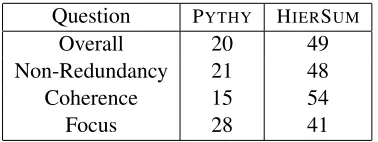
Question PYTHY HIERSUM
Overall 20 49
Non-Redundancy 21 48
Coherence 15 54
Focus 28 41
Table 4: Results of manual user evaluation (see sec-tion 5.2). 15 participants expressed 69 pairwise
prefer-ences between HIERSUMand PYTHY. For all attributes,
HIERSUM outperforms PYTHY; all results are
statisti-cally significant as determined by pairwise t-test.
5.2 Manual Evaluation
In order to obtain a more accurate measure of sum-mary quality, we performed a simple user study. For each document set in the DUC 2007 collection, a user was given a reference summary, aPYTHY sum-mary, and aHIERSUMsummary;25note that the orig-inal documents in the set werenot provided to the user, only a reference summary. For this experiment we use the bigram variant ofHIERSUMand compare it to PYTHY without simplification so both systems have the same set of possible output summaries.
The reference summary for each document set was selected according to highest R-2 without stop words against the remaining peer summaries. Users were presented with 4 questions drawn from the DUC manual evaluation guidelines:26 (1) Overall quality: Which summary was better overall? (2) Non-Redundancy: Which summary was less redun-dant? (3) Coherence: Which summary was more coherent? (4) Focus: Which summary was more
25The system identifier was of course not visible to the user.
The order of automatic summaries was determined randomly.
26
[image:7.612.333.522.212.283.2]Figure 3: Using HIERSUMto organize content of document set into topics (see section 6.1). The sidebar gives key
phrases salient in each of the specific content topics in HIERSUM(see section 3.4). When a topic is clicked in the right
sidebar, the main frame displays an extractive ‘topical summary’ with links into document set articles. Ideally, a user could use this interface to quickly find content in a document collection that matches their interest.
focused in its content, not conveying irrelevant de-tails? The study had 16 users and each was asked to compare five summary pairs, although some did fewer. A total of 69 preferences were solicited. Doc-ument collections presented to users were randomly selected from those evaluated fewest.
As seen in table 5.2, HIERSUM outperforms
PYTHY under all questions. All results are statis-tically significant as judged by a simple pairwise t-test with 95% confidence. It is safe to conclude that users in this study strongly preferred theHIER
-SUMsummaries over thePYTHYsummaries.
6 Discussion
While it is difficult to qualitatively compare one summarization system over another, we can broadly characterizeHIERSUMsummaries compared to some of the other systems discussed. For example out-put from HIERSUMand PYTHY see table 2. On the whole, HIERSUM summaries appear to be signifi-cantly less redundant than PYTHY and moderately less redundant thanSUMBASIC. The reason for this might be that PYTHY is discriminatively trained to maximize ROUGE which does not directly penalize redundancy. Another tendency is forHIERSUMto se-lect longer sentences typically chosen from an early sentence in a document. As discussed in section 3.4,
HIERSUM is biased to consider early sentences in documents have a higher proportion of general con-tent words and so this tendency is to be expected.
6.1 Content Navigation
A common concern in multi-document summariza-tion is that without any indicasummariza-tion of user interest or intent providing a single satisfactory summary to a user may not be feasible. While many variants of the general summarization task have been proposed which utilize such information (Vanderwende et al., 2007; Nastase, 2008), this presupposes that a user knows enough of the content of a document collec-tion in order to propose a query.
As Leuski et al. (2003) and Branavan et al. (2007) suggest, a document summarization system should facilitate content discovery and yield summaries rel-evant to a user’s interests. We may useHIERSUMin order to facilitate content discovery via presenting a user with salient words or phrases from the spe-cific content topics parametrized by φC1, . . . , φCK (for an example see figure 3). While these topics are not adaptive to user interest, they typically reflect lexically coherent vocabularies.
Conclusion
In this paper we have presented an exploration of content models for multi-document summarization and demonstrated that the use of structured topic models can benefit summarization quality as mea-sured by automatic and manual metrics.
References
Regina Barzilay and Lillian Lee. 2004. Catching the drift: Probabilistic content models, with applications
to generation and summarization. InHLT-NAACL.
David M. Blei, Andrew Y. Ng, and Michael I. Jordan. 2003. Latent dirichlet allocation. JMLR.
David M. Blei, Thomas L. Griffiths, Michael I. Jordan, and Joshua B. Tenenbaum. 2004. Hierarchical topic models and the nested chinese restaurant process. In NIPS.
S.R.K. Branavan, Pawan Deshpande, and Regina
Barzi-lay. 2007. Generating a table-of-contents. InACL.
Hal Daum´e III and Daniel Marcu. 2006. Bayesian
query-focused summarization. InProceedings of the
Confer-ence of the Association for Computational Linguistics (ACL).
Jacob Eisenstein and Regina Barzilay. 2008. Bayesian
unsupervised topic segmentation. In
EMNLP-SIGDAT.
Thomas Griffiths. 2002. Gibbs sampling in the genera-tive model of latent dirichlet allocation.
Sanda Harabagiu, Andrew Hickl, and Finley Laca-tusu. 2007. Satisfying information needs with
multi-document summaries. Inf. Process. Manage., 43(6).
Mirella Lapata. 2003. Probabilistic text structuring:
Ex-periments with sentence ordering. InACL.
Jurij Leskovec, Natasa Milic-frayling, and Marko Gro-belnik. 2005. Impact of linguistic analysis on the se-mantic graph coverage and learning of document ex-tracts. InIn AAAI 05.
Anton Leuski, Chin-Yew Lin, and Eduard Hovy. 2003. ineats: Interactive multi-document summarization. In ACL.
Chin-Yew Lin, Guihong Cao, Jianfeng Gao, and Jian-Yun Nie. 2006. An information-theoretic approach to
au-tomatic evaluation of summaries. InHLT-NAACL.
Chin-Yew Lin. 2004. Rouge: A package for automatic
evaluation of summaries. InProc. ACL workshop on
Text Summarization Branches Out.
H.P. Luhn. 1958. The automatic creation of literature
abstracts. IBM Journal.
Ryan McDonald. 2007. A study of global inference
al-gorithms in multi-document summarization. InECIR.
Kathleen R. Mckeown, Judith L. Klavans, Vasileios Hatzivassiloglou, Regina Barzilay, and Eleazar Eskin. 1999. Towards multidocument summarization by
re-formulation: Progress and prospects. In In
Proceed-ings of AAAI-99.
Vivi Nastase. 2008. Topic-driven multi-document sum-marization with encyclopedic knowledge and
spread-ing activation. InProceedings of the 2008 Conference
on Empirical Methods in Natural Language Process-ing.
A. Nenkova and L. Vanderwende. 2005. The impact of frequency on summarization. Technical report, Mi-crosoft Research.
Dragomir R. Radev. 2004. Lexrank: graph-based
cen-trality as salience in text summarization. Journal of
Artificial Intelligence Research (JAIR.
M. Steyvers and T. Griffiths, 2007. Probabilistic Topic
Models.
Kristina Toutanova, Chris Brockett, Michael Gamon Ja-gadeesh Jagarlamudi, Hisami Suzuki, and Lucy Van-derwende. 2007. The pythy summarization system:
Microsoft research at duc 2007. InDUC.
Lucy Vanderwende, Hisami Suzuki, Chris Brockett, and Ani Nenkova. 2007. Beyond sumbasic: Task-focused summarization with sentence simplification and lexi-cal expansion. volume 43.
Xiaojun Wan and Jianwu Yang. 2006. Improved affinity
graph based multi-document summarization. In
HLT-NAACL.