Constructing Datasets
for Multi-hop Reading Comprehension Across Documents
Johannes Welbl1 Pontus Stenetorp1 Sebastian Riedel1,2
1University College London, 2Bloomsbury AI
{j.welbl,p.stenetorp,s.riedel}@cs.ucl.ac.uk
Abstract
Most Reading Comprehension methods limit themselves to queries which can be answered using a single sentence, paragraph, or docu-ment. Enabling models to combine disjoint pieces of textual evidence would extend the scope of machine comprehension methods, but currently no resources exist to train and test this capability. We propose a novel task to encourage the development of models for text understanding across multiple documents and to investigate the limits of existing methods. In our task, a model learns to seek and com-bine evidence – effectively performing multi-hop, alias multi-step, inference. We devise a methodology to produce datasets for this task, given a collection of query-answer pairs and thematically linked documents. Two datasets from different domains are induced,1 and we identify potential pitfalls and devise circum-vention strategies. We evaluate two previ-ously proposed competitive models and find that one can integrate information across doc-uments. However, both models struggle to se-lect relevant information; and providing doc-uments guaranteed to be relevant greatly im-proves their performance. While the mod-els outperform several strong baselines, their best accuracy reaches 54.5% on an annotated test set, compared to human performance at 85.0%, leaving ample room for improvement.
1 Introduction
Devising computer systems capable of answering questions about knowledge described using text has
1Available athttp://qangaroo.cs.ucl.ac.uk
The Hanging Gardens, in [Mumbai], also known as Pherozeshah Mehta Gardens, are terraced gardens … They provide sunset views over the [Arabian Sea] …
Mumbai (also known as Bombay, the official name until 1995) is the capital city of the Indian state of Maharashtra. It is the most populous city in India …
Q: (Hanging gardens of Mumbai, country, ?)
Options: {Iran, India, Pakistan, Somalia, …}
The Arabian Sea is a region of the northern Indian Ocean bounded on the north by Pakistan and Iran, on the west by northeastern
Somalia and the Arabian Peninsula, and on the east by India …
Figure 1: A sample from the WIKIHOPdataset where it is necessary to combine information spread across multi-ple documents to infer the correct answer.
been a longstanding challenge in Natural Language Processing (NLP). Contemporary end-to-end Read-ing Comprehension (RC) methods can learn to ex-tract the correct answer span within a given text and approach human-level performance (Kadlec et al., 2016; Seo et al., 2017a). However, for exist-ing datasets, relevant information is often concen-trated locally within a single sentence, emphasizing the role of locating, matching, and aligning informa-tion between query and support text. For example, Weissenborn et al. (2017) observed that a simple bi-naryword-in-queryindicator feature boosted the rel-ative accuracy of a baseline model by 27.9%.
We argue that, in order to further the ability of ma-chine comprehension methods to extract knowledge from text, we must move beyond a scenario where relevant information is coherently and explicitly stated within a single document. Methods with this capability would aid Information Extraction (IE) ap-plications, such as discovering drug-drug
interac-287
tions (Gurulingappa et al., 2012) by connecting pro-tein interactions reported across different publica-tions. They would also benefit search (Carpineto and Romano, 2012) and Question Answering (QA) ap-plications (Lin and Pantel, 2001) where the required information cannot be found in a single location.
Figure 1 shows an example from WIKIPEDIA,
where the goal is to identify thecountryproperty
of theHanging Gardens of Mumbai. This cannot be inferred solely from the article about them without additional background knowledge, as the answer is not stated explicitly. However, several of the linked articles mention the correct answerIndia(and other countries), but cover different topics (e.g. Mumbai,
Arabian Sea, etc.). Finding the answer requires
multi-hopreasoning: figuring out that theHanging
Gardens are located in Mumbai, and then, from a
second document, thatMumbaiis a city inIndia. We define a novel RC task in which a model should learn to answer queries by combining ev-idence stated across documents. We introduce a methodology to induce datasets for this task and de-rive two datasets. The first, WIKIHOP, uses sets of
WIKIPEDIAarticles where answers to queries about
specific properties of an entity cannot be located in the entity’s article. In the second dataset, MEDHOP,
the goal is to establish drug-drug interactions based on scientific findings about drugs and proteins and their interactions, found across multiple MEDLINE
abstracts. For both datasets we draw upon existing Knowledge Bases (KBs), WIKIDATA and DRUG
-BANK, as ground truth, utilizing distant
supervi-sion (Mintz et al., 2009) to induce the data – similar to Hewlett et al. (2016) and Joshi et al. (2017).
We establish that for 74.1% and 68.0% of the samples, the answer can be inferred from the given documents by a human annotator. Still, construct-ing multi-document datasets is challengconstruct-ing; we en-counter and prescribe remedies for several pitfalls associated with their assembly – for example, spuri-ous co-locations of answers and specific documents. For both datasets we then establish several strong baselines and evaluate the performance of two pre-viously proposed competitive RC models (Seo et al., 2017a; Weissenborn et al., 2017). We find that one can integrate information across documents, but nei-ther excels at selecting relevant information from a larger documents set, as their accuracy increases
sig-nificantly when given only documents guaranteed to be relevant. The best model reaches 54.5% on an annotated test set, compared to human performance at 85.0%, indicating ample room for improvement.
In summary, our key contributions are as follows: Firstly, proposing a cross-document multi-step RC task, as well as a general dataset induction strat-egy. Secondly, assembling two datasets from dif-ferent domains and identifying dataset construction pitfalls and remedies. Thirdly, establishing multiple baselines, including two recently proposed RC mod-els, as well as analysing model behaviour in detail through ablation studies.
2 Task and Dataset Construction Method
We will now formally define the multi-hop RC task, and a generic methodology to construct multi-hop RC datasets. Later, in Sections 3 and 4 we will demonstrate how this method is applied in practice by creating datasets for two different domains.
Task Formalization A model is given a queryq, a
set of supporting documentsSq, and a set of
candi-date answersCq– all of which are mentioned inSq.
The goal is to identify the correct answera∗ ∈ Cq
by drawing on the support documentsSq. Queries
could potentially have several true answers when not constrained to rely on a specific set of support doc-uments – e.g., queries about the parent of a certain individual. However, in our setup each sample has only one true answer amongCq andSq. Note that
even though we will utilize background information during dataset assembly, such information will not be available to a model: the document set will be provided in random order and without any metadata. While certainly beneficial, this would distract from our goal of fostering end-to-end RC methods that in-fer facts by combining separate facts stated in text.
Dataset Assembly We assume that there exists a document corpusD, together with a KB containing
fact triples(s, r, o)– with subject entitys, relationr,
and object entity o. For example, one such fact
could be(Hanging Gardens of Mumbai, country, India). We start with individual KB facts and trans-form them into query-answer pairs by leaving the object slot empty, i.e.q= (s, r,?)anda∗=o.
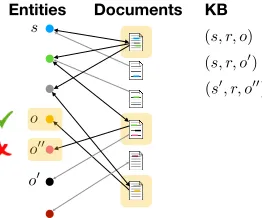
vertices on one side correspond to documents in
D, and vertices on the other side are entities from
the KB – see Figure 2 for an example. A docu-ment nodedis connected to an entityeifeis men-tioned ind, though there may be further constraints
when defining the graph connectivity. For a given (q, a∗) pair, the candidates Cq and support
docu-mentsSq⊆Dare identified by traversing the
bipar-tite graph using breadth-first search; the documents visited will become the support documentsSq.
As the traversal starting point, we use the node belonging to the subject entitysof the queryq. As
traversal end points, we use the set of all entity nodes that are type-consistent answers to q.2 Note that
whenever there is another fact (s, r, o0) in the KB, i.e. a fact producing the sameq but with a different a∗, we will not includeo0 into the set of end points
for this sample. This ensures that precisely one of the end points corresponds to a correct answer toq.
When traversing the graph starting at s, several of the end points will be visited, though generally not all; those visited define the candidate setCq. If
however the correct answera∗is not among them we discard the entire(q, a∗)pair. The documents visited to reach the end points will define the support docu-ment setSq. That is,Sq comprises chains of
docu-ments leading not only from the query subject to the correct answer candidate, but also to type-consistent false answer candidates.
With this methodology, relevant textual evidence for (q, a∗) will be spread across documents along the chain connectingsanda∗– ensuring that
multi-hop reasoning goes beyond resolving co-reference within a single document. Note that including other type-consistent candidates alongsidea∗as end
points in the graph traversal – and thus into the sup-port documents – renders the task considerably more challenging (Jia and Liang, 2017). Models could otherwise identify a∗ in the documents by simply
relying on type-consistency heuristics. It is worth pointing out that by introducing alternative candi-dates we counterbalance a type-consistency bias, in contrast to Hermann et al. (2015) and Hill et al. (2016) who instead rely on entity masking.
2 To determine entities which are type-consistent for a queryq, we consider all entities which are observed as object in a fact withras relation type – including the correct answer.
Documents
Entities KB
(s, r, o) (s, r, o0) (s0, r, o00) s
o
[image:3.612.361.492.53.162.2]o0 o00
Figure 2: A bipartite graph connecting entities and doc-uments mentioning them. Bold edges are those traversed for the first fact in the small KB on the right; yellow high-lighting indicates documents inSqand candidates inCq. Check and cross indicate correct and false candidates.
3 WIKIHOP
WIKIPEDIA contains an abundance of
human-curated, multi-domain information and has sev-eral structured resources such as infoboxes and
WIKIDATA (Vrandeˇci´c, 2012) associated with it.
WIKIPEDIA has thus been used for a wealth of
re-search to build datasets posing queries about a single sentence (Morales et al., 2016; Levy et al., 2017) or article (Yang et al., 2015; Hewlett et al., 2016; Ra-jpurkar et al., 2016). However, no attempt has been made to construct a cross-document multi-step RC dataset based on WIKIPEDIA.
A recently proposed RC dataset is WIKIREAD -ING (Hewlett et al., 2016), where WIKIDATA
tu-ples (item, property, answer)are aligned with the WIKIPEDIA articles regarding their item. The tuples define a slot filling task with the goal of pre-dicting theanswer, given anarticleandproperty. One problem with using WIKIREADING as an
ex-tractive RC dataset is that 54.4% of the samples do not state the answer explicitly in the given arti-cle (Hewlett et al., 2016). However, we observed that some of the articles accessible by following hy-perlinks from the given article often state the answer, alongside other plausible candidates.
3.1 Assembly
We now apply the methodology from Section 2 to create a multi-hop dataset with WIKIPEDIA as
the document corpus and WIKIDATA as structured
together form our queryq– e.g.,(Hanging Gardens of Mumbai, country, ?). Similar to Yang et al. (2015) we only use the first paragraph of an article, as rel-evant information is more often stated in the begin-ning. Starting with all samples in WIKIREADING,
we first remove samples where theansweris stated explicitly in the WIKIPEDIAarticle about theitem.3 The bipartite graph is structured as follows: (1) for edges from articles to entities: all articles mentioning an entitye are connected to e; (2) for
edges from entities to articles: each entityeis only
connected to the WIKIPEDIAarticle about the entity.
Traversing the graph is then equivalent to iteratively following hyperlinks to new articles about the an-chor text entities.
For a given query-answer pair, the item entity is chosen as the starting point for the graph traver-sal. A traversal will always pass through the article about theitem, since this is the only document
con-nected from there. The end point set includes the correctansweralongside other type-consistent can-didate expressions, which are determined by consid-ering all facts belonging to WIKIREADING
train-ing samples, selecttrain-ing those triples with the same propertyas in q and keeping theiranswer expres-sions. As an example, for the WIKIDATA property
country, this would be the set{France,Russia, ...}.
We executed graph traversal up to a maximum chain length of 3 documents. To not pose unreasonable computational constraints, samples with more than 64 different support documents or 100 candidates are removed, discarding≈1% of the samples.
3.2 Mitigating Dataset Biases
Dataset creation is always fraught with the risk of inducing unintended errors and biases (Chen et al., 2016; Schwartz et al., 2017). As Hewlett et al. (2016) only carried out limited analysis of their
WIKIREADING dataset, we present an analysis of
the downstream effects we observe on WIKIHOP.
Candidate Frequency Imbalance A first obser-vation is that there is a significant bias in the answer distribution of WIKIREADING. For example, in the
majority of the samples the propertycountryhas
theUnited States of Americaas the answer. A simple
3We thus use a disjoint subset of WIKIREADINGcompared to Levy et al. (2017) to construct WIKIHOP.
majority class baseline would thus prove successful, but would tell us little about multi-hop reasoning. To combat this issue, we subsampled the dataset to en-sure that samples of any one particular answer can-didate make up no more than 0.1%of the dataset, and omitted articles about theUnited States.
Document-Answer Correlations A problem
unique to our multi-document setting is the possibil-ity of spurious correlations between candidates and documents induced by the graph traversal method. In fact, if we werenotto address this issue, a model designed to exploit these regularities could achieve 74.6% accuracy (detailed in Section 6).
Concretely, we observed that certain documents frequently co-occur with the correct answer, inde-pendently of the query. For example, if the article aboutLondon is present inSq, the answer is likely
to be theUnited Kingdom, independent of the query type or entity in question.
We designed a statistic to measure this effect and then used it to sub-sample the dataset. The statistic counts how often a candidatecis observed
as the correct answer when a certain document is present inSqacross training set samples. More
for-mally, for a given document d and answer
candi-datec, letcooccurrence(d, c)denote the total count of how oftendco-occurs withc in a sample where c is also the correct answer. We use this statistic
to filter the dataset, by discarding samples with at least one document-candidate pair(d, c) for which
cooccurrence(d, c)>20.
4 MEDHOP
either severely limited in size (Hersh et al., 2007) or cover a very diverse set of query types (Nentidis et al., 2017), complicating the application of neu-ral models that have seen successes for other do-mains (Wiese et al., 2017).
A task that has received significant attention is detecting Drug-Drug Interactions (DDIs). Exist-ing DDI efforts have focused on explicit mentions of interactions in single sentences (Gurulingappa et al., 2012; Percha et al., 2012; Segura-Bedmar et al., 2013). However, as shown by Peng et al. (2017), cross-sentence relation extraction increases the number of available relations. It is thus likely that cross-document interactions would further im-prove recall, which is of particular importance con-sidering interactions that are never stated explicitly – but rather need to be inferred from separate pieces of evidence. The promise of multi-hop methods is finding and combining individual observations that can suggest previously unobserved DDIs, aiding the process of making scientific discoveries, yet not di-rectly from experiments, but by inferring them from established public knowledge (Swanson, 1986).
DDIs are caused by Protein-Protein Interac-tion (PPI) chains, forming biomedical pathways. If we consider PPI chains across documents, we find examples like in Figure 3. Here the first document states that the drug Leuprolide causes GnRH receptor-induced synaptic potenti-ations, which can be blocked by the protein Progonadoliberin-1. The last document states that another drug,Triptorelin, is a superagonist of the same protein. It is therefore likely to affect the po-tency ofLeuprolide, describing a way in which the two drugs interact. Besides the true interaction there is also a false candidateUrofollitropinfor which, although mentioned together with GnRH receptor within one document, there is no textual evidence indicating interactions withLeuprolide.
4.1 Assembly
We construct MEDHOP using DRUGBANK (Law
et al., 2014) as structured knowledge resource and research paper abstracts from MEDLINE as
docu-ments. There is only one relation type for DRUG
-BANKfacts,interacts with, that connects pairs of drugs – an example of a MEDHOPquery would thus
be (Leuprolide, interacts with, ?). We start
Q: (Leuprolide, interacts_with, ?)
Options: {Triptorelin, Urofollitropin}
Leuprolide ... elicited a long-lasting potentiation of excitatory postsynaptic currents… [GnRH receptor]-induced synaptic potentiation was blocked … by [Progonadoliberin-1], a specific [GnRH receptor] antagonist…
Analyses of gene expression demonstrated a dynamic response to the
Progonadoliberin-1 superagonist Triptorelin.
… our research to study the distribution, co-localization of Urofollitropin and its receptor[,] and co-localization of Urofollitropin and GnRH receptor…
Figure 3: A sample from the MEDHOPdataset.
by processing the 2016 MEDLINE release using the
preprocessing pipeline employed for the BioNLP 2011 Shared Task (Stenetorp et al., 2011). We re-strict the set of entities in the bipartite graph to drugs in DRUGBANKand human proteins in SWISS
-PROT(Bairoch et al., 2004). That is, the graph has
drugs and proteins on one side, and MEDLINE
ab-stracts on the other.
The edge structure is as follows: (1) There is an edge from a document to all proteins mentioned in it. (2) There is an edge between a document and a drug, if this document also mentions a protein known to be a target for the drug according to DRUGBANK. This
edge is bidirectional, i.e. it can be traversed both ways, since there is no canonical document describ-ing each drug – thus one can “hop” to any document mentioning the drug and its target. (3) There is an edge from a proteinpto a document mentioningp,
but only if the document also mentions another pro-teinp0which is known to interact withpaccording to
REACTOME (Fabregat et al., 2016). Given our
dis-tant supervision assumption, these additionally con-straining requirements err on the side of precision.
As a mention, similar to Percha et al. (2012), we consider any exact match of a name variant of a drug or human protein in DRUGBANK or SWISS
-PROT. For a given DDI(drug1, interacts with,
drug2), we then select drug1 as the starting point
for the graph traversal. As possible end points, we consider any other drug, apart fromdrug1and those
interacting withdrug1 other thandrug2. Similar to
WIKIHOP, we exclude samples with more than 64
support documents and impose a maximum docu-ment length of 300 tokens plus title.
Document Sub-sampling The bipartite graph for MEDHOPis orders of magnitude more densely
poten-tially large support document sets Sq, to a degree
where it becomes computationally infeasible for a majority of existing RC models. After the traver-sal has finished, we subsample documents by first adding a set of documents that connects the drug in the query with its answer. We then iteratively add documents to connect alternative candidates until we reach the limit of 64 documents – while ensuring that all candidates have the same number of paths through the bipartite graph.
Mitigating Candidate Frequency Imbalance
Some drugs interact with more drugs than others
– Aspirin for example interacts with 743 other
drugs, but Isotretinoin with only 34. This leads to similar candidate frequency imbalance issues as with WIKIHOP – but due to its smaller size
MEDHOP is difficult to sub-sample. Nevertheless
we can successfully combat this issue by masking entity names, detailed in Section 6.2.
5 Dataset Analysis
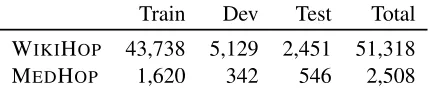
Table 1 shows the dataset sizes. Note that WIK -IHOP inherits the train, development, and test set
splits from WIKIREADING – i.e., the full dataset
creation, filtering, and sub-sampling pipeline is ex-ecuted on each set individually. Also note that sub-sampling according to document-answer correlation significantly reduces the size of WIKIHOP from ≈528K training samples to≈44K. While in terms of
samples, both WIKIHOPand MEDHOPare smaller
than other large-scale RC datasets, such asSQuAD
and WIKIREADING, the supervised learning signal
available per sample is arguably greater. One could, for example, re-frame the task as binary path clas-sification: given two entities and a document path connecting them, determine whether a given rela-tion holds. For such a case, WIKIHOP and MED
-HOPwould have more than 1M and 150K paths to
be classified, respectively. Instead, in our formula-tion, this corresponds to each single sample contain-ing the supervised learncontain-ing signal from an average of 19.5 and 59.8 unique document paths.
Table 2 shows statistics on the number of candi-dates and documents per sample on the respective training sets. For MEDHOP, the majority of
sam-ples have 9 candidates, due to the way documents are selected up until a maximum of 64 documents is
Train Dev Test Total WIKIHOP 43,738 5,129 2,451 51,318
[image:6.612.320.534.54.98.2]MEDHOP 1,620 342 546 2,508
Table 1: Dataset sizes for our respective datasets.
min max avg median # cand. – WH 2 79 19.8 14 # docs. – WH 3 63 13.7 11 # tok/doc – WH 4 2,046 100.4 91
# cand. – MH 2 9 8.9 9
# docs. – MH 5 64 36.4 29 # tok/doc – MH 5 458 253.9 264
Table 2: Candidates and documents per sample and doc-ument length statistics. WH: WIKIHOP; MH: MEDHOP.
reached. Few samples have less than 9 candidates, and samples would have far more false candidates if more than 64 support documents were included. The number of query types in WIKIHOPis 277, whereas
in MEDHOPthere is only one:interacts with.
5.1 Qualitative Analysis
To establish the quality of the data and analyze po-tential distant supervision errors, we sampled and annotated 100 samples from each development set.
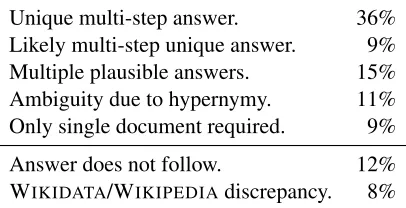
WIKIHOP Table 3 lists characteristics along with
the proportion of samples that exhibit them. For 45%, the true answer either uniquely follows from multiple texts directly or is suggested as likely. For 26%, more than one candidate is plausibly sup-ported by the documents, including the correct an-swer. This is often due to hypernymy, where the appropriate level of granularity for the an-swer is difficult to predict – e.g. (west suffolk, administrative entity, ?) with candidates suffolk and england. This is a direct conse-quence of including type-consistent false answer candidates from WIKIDATA, which can lead to
doc-Unique multi-step answer. 36% Likely multi-step unique answer. 9% Multiple plausible answers. 15% Ambiguity due to hypernymy. 11% Only single document required. 9% Answer does not follow. 12%
[image:7.612.84.287.52.156.2]WIKIDATA/WIKIPEDIAdiscrepancy. 8%
Table 3: Qualitiative analysis of WIKIHOPsamples.
ument as Louis Auguste. Finally, although our task is significantly more complex than most pre-vious tasks where distant supervision has been ap-plied, the distant supervision assumption is only vi-olated for 20% of the samples – a proportion sim-ilar to previous work (Riedel et al., 2010). These cases can either be due to conflicting information be-tween WIKIDATA and WIKIPEDIA (8%), e.g. when
the date of birth for a person differs between WIKI -DATA and what is stated in the WIKIPEDIA article,
or because the answer is consistent but cannot be inferred from the support documents (12%). When answering 100 questions, the annotator knew the an-swer prior to reading the documents for 9%, and pro-duced the correct answer after reading the document sets for 74% of the cases. On 100 questions of a val-idated portion of the Dev set (see Section 5.3), 85% accuracy was reached.
MEDHOP Since both document complexity and number of documents per sample were significantly larger compared to WIKIHOP, it was not feasible to
ask an annotator to readall support documents for 100 samples. We thus opted to verify the dataset quality by providing only the subset of documents relevant to support the correct answer, i.e., those tra-versed along the path reaching the answer. The an-notator was asked if the answer to the query “fol-lows”, “is likely”, or“does not follow”, given the relevant documents. 68% of the cases were consid-ered as “follows” or as “is likely”. The majority of cases violating the distant supervision assumption were errors due to the lack of a necessary PPI in one of the connecting documents.
5.2 Crowdsourced Human Annotation
We asked human annotators onAmazon Mechanical Turkto evaluate samples of the WIKIHOP
develop-ment set. Similar to our qualitative analysis of MED
-HOP, annotators were shown the query-answer pair
as a fact and the chain of relevant documents leading to the answer. They were then instructed to answer (1) whether they knew the fact before; (2) whether the fact follows from the texts (with options “fact follows”, “fact is likely”, and “fact does not fol-low”); and (3); whether a single or several of the documents are required. Each sample was shown to three annotators and a majority vote was used to ag-gregate the annotations. Annotators were familiar with the fact 4.6% of the time; prior knowledge of the fact is thus not likely to be a confounding effect on the other judgments. Inter-annotator agreement as measured by Fleiss’ kappa is 0.253 in (2), and 0.281 in (3) – indicating a fair overall agreement, ac-cording to Landis and Koch (1977). Overall, 9.5% of samples have no clear majority in (2).
Among samples with a majority judgment, 59.8% are cases where the fact “follows”, for 14.2% the fact is judged as “likely”, and as “not follow” for 25.9%. This again provides good justification for the distant supervision strategy.
Among the samples with a majority vote for (2) of either“follows”or“likely”, 55.9% were marked with a majority vote as requiring multiple docu-ments to infer the fact, and 44.1% as requiring only a single document. The latter number is larger than initially expected, given the construction of samples through graph traversal. However, when inspecting cases judged as“single”more closely, we observed that many indeed provide a clear hint about the cor-rect answer within one document, but without stat-ing it explicitly. For example, for the fact(witold cichy, country of citizenship, poland) with documentsd1: Witold Cichy (born March 15, 1986
in Wodzisaw lski) is a Polish footballer[...] andd2:
Wodzisaw lski[...] is a town in Silesian Voivodeship, southern Poland[...], the information provided ind1
suffices for a human given the background knowl-edge thatPolishis an attribute related toPoland, re-moving the need ford2 to infer the answer.
5.3 Validated Test Sets
answer can be inferred from the text. This is in con-trast to prior work such as Hermann et al. (2015), Hill et al. (2016), and Hewlett et al. (2016), who evaluate only on distantly supervised samples. For WIKIHOP, we applied the same annotation strategy
as described in Section 5.2. The validated test set consists of those samples labeled by a majority of annotators (at least 2 of 3) as“follows”, and
requir-ing“multiple”documents. While desirable,
crowd-sourcing is not feasible for MEDHOP since it
re-quires specialist knowledge. In addition, the number of document paths is≈3x larger, which along with
the complexity of the documents greatly increases the annotation time. We thus manually annotated 20% of the MEDHOPtest set and identified the
sam-ples for which the text implies the correct answer and where multiple documents are required.
6 Experiments
This section describes experiments on WIKIHOP
and MEDHOPwith the goal of establishing the
per-formance of several baseline models, including re-cent neural RC models. We empirically demonstrate the importance of mitigating dataset biases, probe whether multi-step behavior is beneficial for solv-ing the task, and investigate if RC models can learn to perform lexical abstraction. Training will be con-ducted on the respective training sets, and evaluation on both the full test set and validated portion (Sec-tion 5.3) allowing for a comparison between the two.
6.1 Models
Random Selects a random candidate; note that the number of candidates differs between samples.
Max-mention Predicts the most frequently men-tioned candidate in the support documents Sq of a
sample – randomly breaking ties.
Majority-candidate-per-query-type Predicts the candidatec∈Cqthat was most frequently observed
as the true answer in the training set, given the query type ofq. For WIKIHOP, the query type is the
prop-erty pof the query; for MEDHOPthere is only the
single query type –interacts with.
TF-IDF Retrieval-based models are known to be strong QA baselines if candidate answers are pro-vided (Clark et al., 2016; Welbl et al., 2017). They
search for individual documents based on keywords in the question, but typically do not combine infor-mation across documents. The purpose of this base-line is to see if it is possible to identify the correct an-swer from a single document alone through lexical correlations. The model forms its prediction as fol-lows: For each candidatec, the concatenation of the queryqwithcis fed as anORquery into thewhoosh
text retrieval engine. It then predicts the candidate with the highest TF-IDF similarity score:
arg max c∈Cq
[max s∈Sq
(TF-IDF(q+c, s))] (1)
Document-cue During dataset construction we observed that certain document-answer pairs appear more frequently than others, to the effect that the correct candidate is often indicated solely by the presence of certain documents inSq. This baseline
captures how easy it is for a model to exploit these informative document-answer co-occurrences. It predicts the candidate with highest score acrossCq:
arg max c∈Cq
[max d∈Sq
(cooccurrence(d, c))] (2)
Extractive RC models: FastQA and BiDAF In our experiments we evaluate two recently proposed
LSTM-based extractive QA models: the Bidirec-tional Attention Flow model (BiDAF, Seo et al. (2017a)), and FastQA (Weissenborn et al., 2017), which have shown a robust performance across sev-eral datasets. These models predict an answer span within asingledocument. We adapt them to a multi-document setting by sequentially concatenating all
d ∈ Sq in random order into a superdocument,
adding document separator tokens. During training, the first answer mention in the concatenated docu-ment serves as the gold span.4 At test time, we
mea-sured accuracy based on the exact match between the prediction and answer, both lowercased, after re-moving articles, trailing white spaces and punctu-ation, in the same way as Rajpurkar et al. (2016). To rule out any signal stemming from the order of documents in the superdocument, this order is ran-domized both at training and test time. In a prelimi-nary experiment we also trained models using differ-ent random documdiffer-ent order permutations, but found that performance did not change significantly.
ForBiDAF, the default hyperparameters from the implementation of Seo et al. (2017a) are used, with pretrained GloVe (Pennington et al., 2014) embed-dings. However, we restrict the maximum docu-ment length to 8,192 tokens and hidden size to 20, and train for 5,000 iterations with batchsize 16 in or-der to fit the model into memory.5 For FastQAwe
use the implementation provided by the authors, also with pre-trained GloVe embeddings, no character-embeddings, no maximum support length, hidden size 50, and batch size 64 for 50 epochs.
While BiDAF and FastQA were initially devel-oped and tested on single-hop RC datasets, their us-age of bidirectional LSTMs and attention over the full sequence theoretically gives them the capacity to integrate information from different locations in the (super-)document. In addition,BiDAFemploys iterative conditioning across multiple layers, poten-tially making it even better suited to integrate infor-mation found across the sequence.
6.2 Lexical Abstraction: Candidate Masking
The presence of lexical regularities among an-swers is a problem in RC dataset assembly – a phenomenon already observed by Hermann et al. (2015). When comprehending a text, the correct an-swer should become clear from its context – rather than from an intrinsic property of the answer ex-pression. To evaluate the ability of models to rely on context alone, we created masked versions of the datasets: we replace any candidate expression randomly using 100 unique placeholder tokens, e.g.
“Mumbai is the most populous city in MASK7.”
Masking is consistent within one sample, but gen-erally different for the same expression across sam-ples. This not only removes answer frequency cues, it also removes statistical correlations between fre-quent answer strings and support documents. Mod-els consequently cannot base their prediction on in-trinsic properties of the answer expression, but have to rely on the context surrounding the mentions.
6.3 Results and Discussion
Table 5 shows the experimental outcomes for WIK -IHOP and MEDHOP, together with results for the
maskedsetting; we will first discuss the former. A
5 The superdocument has a larger number of tokens com-pared to e.g.SQuAD, thus the additional memory requirements.
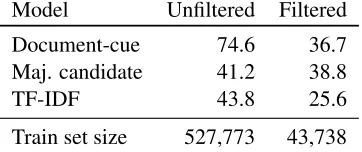
Model Unfiltered Filtered Document-cue 74.6 36.7 Maj. candidate 41.2 38.8
TF-IDF 43.8 25.6
[image:9.612.337.518.56.132.2]Train set size 527,773 43,738
Table 4: Accuracy comparison for simple baseline mod-els on WIKIHOPbeforeandafterfiltering.
first observation is that candidate mention frequency does not produce better predictions than a random guess. Predicting the answer most frequently ob-served at training time achieves strong results: as much as 38.8% / 44.2% and 58.4% / 67.3% on the two datasets, for the full and validated test sets re-spectively. That is, a simple frequency statistic to-gether with answer type constraints alone is a rela-tively strong predictor, and the strongest overall for
the“unmasked”version of MEDHOP.
The TF-IDF retrieval baseline clearly performs better than random for WIKIHOP, but is not very
strong overall. That is, the question tokens are help-ful to detect relevant documents, but exploiting only this information compares poorly to the other base-lines. On the other hand, as no co-mention of an interacting drug pair occurs within any single doc-ument in MEDHOP, the TF-IDF baseline performs
worse than random. We conclude that lexical match-ing with a smatch-ingle support document is not enough to build a strong predictive model for both datasets.
TheDocument-cuebaseline can predict more than
a third of the samples correctly, for both datasets, even after sub-sampling frequent document-answer pairs for WIKIHOP. The relative strength of this
and other baselines proves to be an important is-sue when designing multi-hop datasets, which we addressed through the measures described in Sec-tion 3.2. In Table 4 we compare the two relevant baselines on WIKIHOP before and after applying
WIKIHOP MEDHOP
standard masked standard masked
Model test test* test test* test test* test test* Random 11.5 12.2 12.2 13.0 13.9 20.4 14.1 22.4 Max-mention 10.6 15.9 13.9 20.1 9.5 16.3 9.2 16.3 Majority-candidate-per-query-type 38.8 44.2 12.0 13.7 58.4 67.3 10.4 6.1
TF-IDF 25.6 36.7 14.4 24.2 9.0 14.3 8.8 14.3
Document-cue 36.7 41.7 7.4 20.3 44.9 53.1 15.2 16.3 FastQA 25.7 27.2 35.8 38.0 23.1 24.5 31.3 30.6
BiDAF 42.9 49.7 54.5 59.8 47.8 61.2 33.7 42.9
Table 5: Test accuracies for the WIKIHOPand MEDHOPdatasets, both in standard (unmasked) and masked setup. Columns marked with asterisk are for the validated portion of the dataset.
WIKIHOP MEDHOP
standard gold chain standard gold chain
Model test test* test test* test test* test test*
BiDAF 42.9 49.7 57.9 63.4 47.8 61.2 86.4 89.8
BiDAFmask 54.5 59.8 81.2 85.7 33.7 42.9 99.3 100.0
FastQA 25.7 27.2 44.5 53.5 23.1 24.5 54.6 59.2
[image:10.612.96.520.54.200.2]FastQAmask 35.8 38.0 65.3 70.0 31.3 30.6 51.8 55.1
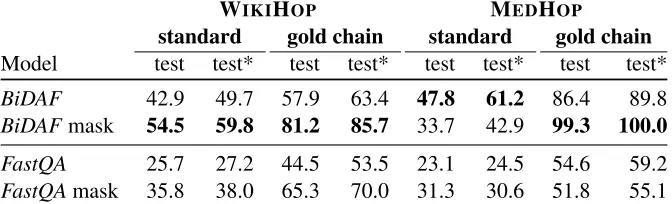
Table 6: Test accuracy comparison when only using documents leading to the correct answer (gold chain). Columns with asterisk hold results for the validated samples.
the measures undertaken successfully mitigate the issue. A downside to aggressive filtering is a signif-icantly reduced dataset size, rendering it infeasible for smaller datasets like MEDHOP.
Among the two neural models, BiDAFis overall strongest across both datasets – this is in contrast to the reported results for SQuAD where their perfor-mance is nearly indistinguishable. This is possibly due to the iterative latent interactions in theBiDAF
architecture: we hypothesize that these are of in-creased importance for our task, where information is distributed across documents. It is worth empha-sizing that unlike the other baselines, bothFastQA
andBiDAF predict the answer by extracting a span
from the support documents without relying on the candidate optionsCq.
In themaskedsetup all baseline models reliant on lexical cues fail in the face of the randomized answer expressions, since the same answer option has dif-ferent placeholders in difdif-ferent samples. Especially on MEDHOP, where dataset sub-sampling is not a
viable option, masking proves to be a valuable alter-native, effectively circumventing spurious statistical correlations that RC models can learn to exploit.
Both neural RC models are able to largely retain or even improve their strong performance when an-swers are masked: they are able to leverage the tex-tual context of the candidate expressions. To under-stand differences in model behavior between WIK -IHOP and MEDHOP, it is worth noting that drug
mentions in MEDHOP are normalized to a unique
single-word identifier, and performance drops under masking. In contrast, for the open-domain setting of WIKIHOP, a reduction of the answer vocabulary to
100 random single-tokenmask expressions clearly helps the model in selecting a candidate span, com-pared to the multi-token candidate expressions in the unmasked setting. Overall, although both neural RC models clearly outperform the other baselines, they still have large room for improvement compared to human performance at 74% / 85% for WIKIHOP.
[image:10.612.139.475.250.352.2]WIKIHOP MEDHOP
test test* test test*
BiDAF 54.5 59.8 33.7 42.9
BiDAFrem 44.6 57.7 30.4 36.7
FastQA 35.8 38.0 31.3 30.6
FastQArem 38.0 41.2 28.6 24.5
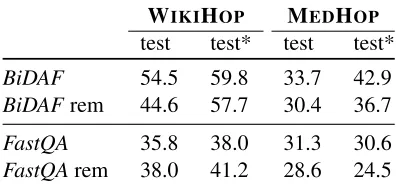
Table 7: Test accuracy (masked) when only documents containing answer candidates are given (rem).
sets, we observe that the results consistently improve on the validated sets. This suggests that the training set contains the signal necessary to make inference on valid samples at test time, and that noisy samples are harder to predict.
6.4 Using only relevant documents
We conducted further experiments to examine the RC models when presented with only the relevant documents inSq, i.e., the chain of documents
lead-ing to the correct answer. This allows us to investi-gate the hypothetical performance of the models if they were able to select and read only relevant docu-ments: Table 6 summarizes these results. Models improve greatly in this gold chain setup, with up to 81.2% / 85.7% on WIKIHOPin the masked
set-ting forBiDAF. This demonstrates that RC models are capable of identifying the answer when few or no plausible false candidates are mentioned, which is particularly evident for MEDHOP, where
docu-ments tend to discuss only single drug candidates. In the masked gold chain setup, models can then pick up on what the masking template looks like and achieve almost perfect scores. Conversely, these results also show that the models’ answer selec-tion process is not robust to the introducselec-tion of un-related documents with type-consistent candidates. This indicates that learning to intelligently select rel-evant documents before RC may be among the most promising directions for future model development.
6.5 Removing relevant documents
To investigate if the neural RC models can draw upon information requiring multi-step inference we designed an experiment where we discard all doc-uments that do not contain candidate mentions, in-cluding the first documents traversed. Table 7 shows
the results: we can observe that performance drops across the board for BiDAF. There is a significant drop of 3.3%/6.2% on MEDHOP, and 10.0%/2.1%
on WIKIHOP, demonstrating that BiDAF, is able
to leverage cross-document information. FastQA
shows a slight increase of 2.2%/3.2% for WIKIHOP
and a decrease of 2.7%/4.1% on MEDHOP. While
inconclusive, it is clear that FastQAwith fewer la-tent interactions thanBiDAFhas problems integrat-ing cross-document information.
7 Related Work
Related Datasets End-to-end text-based QA has witnessed a surge in interest with the advent of large-scale datasets, which have been assembled based
on FREEBASE (Berant et al., 2013; Bordes et al.,
2015), WIKIPEDIA (Yang et al., 2015; Rajpurkar
et al., 2016; Hewlett et al., 2016), web search queries (Nguyen et al., 2016), news articles (Her-mann et al., 2015; Onishi et al., 2016), books (Hill et al., 2016; Paperno et al., 2016), science ex-ams (Welbl et al., 2017), and trivia (Boyd-Graber et al., 2012; Dunn et al., 2017). Besides Trivi-aQA(Joshi et al., 2017), all these datasets are con-fined to single documents, and RC typically does not require a combination of multiple independent facts. In contrast, WIKIHOP and MEDHOP are
specifi-cally designed for cross-document RC and multi-step inference. There exist other multi-hop RC re-sources, but they are either very limited in size, such as theFraCaStest suite, or based on synthetic language (Weston et al., 2016). TriviaQA partly involves multi-step reasoning, but the complexity largely stems from parsing compositional questions. Our datasets center around compositional inference from comparatively simple queries and the cross-document setup ensures that multi-step inference goes beyond resolving co-reference.
Compositional Knowledge Base Inference
[image:11.612.86.284.53.145.2]limited coverage and inefficient inference, though efforts to circumvent sparsity have been under-taken (Schoenmackers et al., 2008; Schoenmackers et al., 2010). A more scalable approach to compos-ite rule learning is the Path Ranking Algorithm (Lao and Cohen, 2010; Lao et al., 2011), which performs random walks to identify salient paths between entities. Gardner et al. (2013) circumvent these sparsity problems by introducing synthetic links via dense latent embeddings. Several other methods have been proposed, using composition functions such as vector addition (Bordes et al., 2014), RNNs (Neelakantan et al., 2015; Das et al., 2017), and memory networks (Jain, 2016).
All of these previous approaches center around learning how to combine facts from a KB, i.e., in a structured form with pre-defined schema. That is, they work as part of a pipeline, and either rely on the output of a previous IE step (Banko et al., 2007), or on direct human annotation (Bollacker et al., 2008) which tends to be costly and biased in cov-erage. However, recent neural RC methods (Seo et al., 2017a; Shen et al., 2017) have demonstrated that end-to-end language understanding approaches can infer answers directly from text – sidestepping in-termediate query parsing and IE steps. Our work aims to evaluate whether end-to-end multi-step RC models can indeed operate on raw text documents only – while performing the kind of inference most commonly associated with logical inference meth-ods operating on structured knowledge.
Text-Based Multi-Step Reading Comprehension
Fried et al. (2015) have demonstrated that exploit-ing information from other related documents based on lexical semantic similarity is beneficial for re-ranking answers in open-domain non-factoid QA. Jansen et al. (2017) chain textual background re-sources for science exam QA and provide multi-sentence answer explanations. Beyond, a rich col-lection of neural models tailored towards multi-step RC has been developed. Memory networks (We-ston et al., 2015; Sukhbaatar et al., 2015; Kumar et al., 2016) define a model class that iteratively attends over textual memory items, and they show promising performance on synthetic tasks requiring multi-step reasoning (Weston et al., 2016). One common characteristic of neural multi-hop models
is their rich structure that enables matching and in-teraction between question, context, answer candi-dates and combinations thereof (Peng et al., 2015; Weissenborn, 2016; Xiong et al., 2017; Liu and Perez, 2017), which is often iterated over several times (Sordoni et al., 2016; Neumann et al., 2016; Seo et al., 2017b; Hu et al., 2017) and may contain trainable stopping mechanisms (Graves, 2016; Shen et al., 2017). All these methods show promise for single-document RC, and by design should be capa-ble of integrating multiple facts across documents. However, thus far they have not been evaluated for a cross-document multi-step RC task – as in this work.
Learning Search Expansion Other research ad-dresses expanding the document set available to a QA system, either in the form of web navi-gation (Nogueira and Cho, 2016), or via query reformulation techniques, which often use neural reinforcement learning (Narasimhan et al., 2016; Nogueira and Cho, 2017; Buck et al., 2018). While related, this work ultimately aims at reformulating queries to better acquire evidence documents, and not at answering queries through combining facts.
8 Conclusions and Future Work
We have introduced a new cross-document multi-hop RC task, devised a generic dataset derivation strategy and applied it to two separate domains. The resulting datasets test RC methods in their ability to perform composite reasoning – something thus far limited to models operating on structured knowledge resources. In our experiments we found that contem-porary RC models can leverage cross-document in-formation, but a sizeable gap to human performance remains. Finally, we identified the selection of rele-vant document sets as the most promising direction for future research.
Acknowledgments
We would like to thank the reviewers and the ac-tion editor for their thoughtful and constructive sug-gestions, as well as Matko Boˇsnjak, Tim Dettmers, Pasquale Minervini, Jeff Mitchell, and Sebastian Ruder for several helpful comments and feedback on drafts of this paper. This work was supported by an Allen Distinguished Investigator Award, a Marie Curie Career Integration Award, the EU H2020 SUMMA project (grant agreement number 688139), and an Engineering and Physical Sciences Research Council scholarship.
References
Michael Ashburner, Catherine A. Ball, Judith A. Blake, David Botstein, Heather Butler, J. Michael Cherry, Al-lan P. Davis, Kara Dolinski, Selina S. Dwight, Janan T. Eppig, Midori A. Harris, David P. Hill, Laurie Issel-Tarver, Andrew Kasarskis, Suzanna Lewis, John C. Matese, Joel E. Richardson, Martin Ringwald, Ger-ald M. Rubin, and Gavin Sherlock. 2000. Gene on-tology: tool for the unification of biology. Nature Ge-netics, 25(1):25.
Amos Bairoch, Brigitte Boeckmann, Serenella Ferro, and Elisabeth Gasteiger. 2004. Swiss-Prot: Juggling be-tween evolution and stability. Briefings in Bioinfor-matics, 5(1):39–55.
Michele Banko, Michael J. Cafarella, Stephen Soderland, Matt Broadhead, and Oren Etzioni. 2007. Open infor-mation extraction from the web. InProceedings of the 20th International Joint Conference on Artifical Intel-ligence, IJCAI’07, pages 2670–2676.
Jonathan Berant, Andrew Chou, Roy Frostig, and Percy Liang. 2013. Semantic parsing on freebase from question-answer pairs. In Proceedings of the 2013 Conference on Empirical Methods in Natural Lan-guage Processing, pages 1533–1544.
Tamara Bobic, Roman Klinger, Philippe Thomas, and Martin Hofmann-Apitius. 2012. Improving distantly supervised extraction of drug-drug and protein-protein interactions. InProceedings of the Joint Workshop on Unsupervised and Semi-Supervised Learning in NLP, pages 35–43.
Kurt Bollacker, Colin Evans, Praveen Paritosh, Tim Sturge, and Jamie Taylor. 2008. Freebase: a collabo-ratively created graph database for structuring human knowledge. InSIGMOD 08 Proceedings of the 2008 ACM SIGMOD international conference on Manage-ment of data, pages 1247–1250.
Antoine Bordes, Sumit Chopra, and Jason Weston. 2014. Question answering with subgraph embeddings. In
Empirical Methods for Natural Language Processing (EMNLP), pages 615–620.
Antoine Bordes, Nicolas Usunier, Sumit Chopra, and Jason Weston. 2015. Large-scale simple
ques-tion answering with memory networks. CoRR,
abs/1506.02075.
Jordan Boyd-Graber, Brianna Satinoff, He He, and Hal Daum´e, III. 2012. Besting the quiz master: Crowd-sourcing incremental classification games. In Pro-ceedings of the 2012 Joint Conference on Empir-ical Methods in Natural Language Processing and Computational Natural Language Learning, EMNLP-CoNLL ’12, pages 1290–1301.
Christian Buck, Jannis Bulian, Massimiliano Ciaramita, Andrea Gesmundo, Neil Houlsby, Wojciech Gajewski, and Wei Wang. 2018. Ask the right questions: Ac-tive question reformulation with reinforcement learn-ing. International Conference on Learning Represen-tations (ICLR).
Claudio Carpineto and Giovanni Romano. 2012. A sur-vey of automatic query expansion in information re-trieval. ACM Comput. Surv., 44(1):1:1–1:50, January. Danqi Chen, Jason Bolton, and Christopher D. Manning.
2016. A thorough examination of the CNN/Daily Mail reading comprehension task. In Proceedings of the 54th Annual Meeting of the Association for Compu-tational Linguistics (Volume 1: Long Papers), pages 2358–2367.
Peter Clark, Oren Etzioni, Tushar Khot, Ashish Sab-harwal, Oyvind Tafjord, Peter Turney, and Daniel Khashabi. 2016. Combining retrieval, statistics, and inference to answer elementary science questions. In
Proceedings of the Thirtieth AAAI Conference on Arti-ficial Intelligence, AAAI’16, pages 2580–2586. Kevin Bretonnel Cohen and Lawrence Hunter. 2004.
Natural language processing and systems biology. Ar-tificial Intelligence Methods and Tools for Systems Bi-ology, pages 147–173.
Mark Craven and Johan Kumlien. 1999. Constructing biological knowledge bases by extracting information from text sources. InProceedings of the Seventh Inter-national Conference on Intelligent Systems for Molec-ular Biology, pages 77–86.
Rajarshi Das, Arvind Neelakantan, David Belanger, and Andrew McCallum. 2017. Chains of reasoning over entities, relations, and text using recurrent neural net-works. European Chapter of the Association for Com-putational Linguistics (EACL), pages 132–141. Matthew Dunn, Levent Sagun, Mike Higgins, V. Ugur
Antonio Fabregat, Konstantinos Sidiropoulos, Phani Garapati, Marc Gillespie, Kerstin Hausmann, Robin Haw, Bijay Jassal, Steven Jupe, Florian Korninger, Sheldon McKay, Lisa Matthews, Bruce May, Mar-ija Milacic, Karen Rothfels, Veronica Shamovsky, Marissa Webber, Joel Weiser, Mark Williams, Guan-ming Wu, Lincoln Stein, Henning Hermjakob, and
Peter D’Eustachio. 2016. The Reactome
path-way knowledgebase. Nucleic Acids Research,
44(D1):D481–D487.
Daniel Fried, Peter Jansen, Gustave Hahn-Powell, Mihai Surdeanu, and Peter Clark. 2015. Higher-order lexi-cal semantic models for non-factoid answer reranking.
Transactions of the Association of Computational Lin-guistics, 3:197–210.
Matt Gardner, Partha Pratim Talukdar, Bryan Kisiel, and Tom M. Mitchell. 2013. Improving learning and infer-ence in a large knowledge-base using latent syntactic cues. InProceedings of the Conference on Empirical Methods in Natural Language Processing, pages 833– 838.
Alex Graves. 2016. Adaptive computation time for re-current neural networks.CoRR, abs/1603.08983. Harsha Gurulingappa, Abdul Mateen Rajput, Angus
Roberts, Juliane Fluck, Martin Hofmann-Apitius, and Luca Toldo. 2012. Development of a benchmark cor-pus to support the automatic extraction of drug-related adverse effects from medical case reports. Journal of Biomedical Informatics, 45(5):885 – 892. Text Min-ing and Natural Language ProcessMin-ing in Pharmacoge-nomics.
Karl Moritz Hermann, Tomas Kocisky, Edward Grefen-stette, Lasse Espeholt, Will Kay, Mustafa Suleyman, and Phil Blunsom. 2015. Teaching machines to read and comprehend. InAdvances in Neural Information Processing Systems, pages 1693–1701.
William Hersh, Aaron Cohen, Lynn Ruslen, and Phoebe Roberts. 2007. TREC 2007 genomics track overview. InNIST Special Publication.
Daniel Hewlett, Alexandre Lacoste, Llion Jones, Illia Polosukhin, Andrew Fandrianto, Jay Han, Matthew Kelcey, and David Berthelot. 2016. WIKIREADING: A novel large-scale language understanding task over Wikipedia. In Proceedings of the The 54th Annual Meeting of the Association for Computational Linguis-tics (ACL 2016), pages 1535–1545.
Felix Hill, Antoine Bordes, Sumit Chopra, and Jason We-ston. 2016. The goldilocks principle: Reading chil-dren’s books with explicit memory representations.
ICLR.
Lynette Hirschman, Alexander Yeh, Christian Blaschke, and Alfonso Valencia. 2005. Overview of BioCre-AtIvE: Critical assessment of information extraction for biology.BMC Bioinformatics, 6(1):S1, May.
Minghao Hu, Yuxing Peng, and Xipeng Qiu. 2017. Mnemonic reader for machine comprehension. CoRR, abs/1705.02798.
Sarthak Jain. 2016. Question answering over knowledge base using factual memory networks. InProceedings of NAACL-HLT, pages 109–115.
Peter Jansen, Rebecca Sharp, Mihai Surdeanu, and Peter Clark. 2017. Framing QA as building and ranking in-tersentence answer justifications. Computational Lin-guistics, 43(2):407–449.
Robin Jia and Percy Liang. 2017. Adversarial exam-ples for evaluating reading comprehension systems. In
Empirical Methods in Natural Language Processing (EMNLP).
Mandar Joshi, Eunsol Choi, Daniel S. Weld, and Luke Zettlemoyer. 2017. TriviaQA: A large scale distantly supervised challenge dataset for reading comprehen-sion. InProceedings of the 55th Annual Meeting of the Association for Computational Linguistics, July. Rudolf Kadlec, Martin Schmid, Ondrej Bajgar, and Jan
Kleindienst. 2016. Text understanding with the at-tention sum reader network. Proceedings of the 54th Annual Meeting of the Association for Computational Linguistics, pages 908–918.
Jin-Dong Kim, Yue Wang, Toshihisa Takagi, and Akinori Yonezawa. 2011. Overview of Genia event task in BioNLP shared task 2011. InProceedings of BioNLP Shared Task 2011 Workshop, pages 7–15.
Ankit Kumar, Ozan Irsoy, Peter Ondruska, Mohit Iyyer, Ishaan Gulrajani James Bradbury, Victor Zhong, Ro-main Paulus, and Richard Socher. 2016. Ask me anything: Dynamic memory networks for natural lan-guage processing. International Conference on Ma-chine Learning, 48:1378–1387.
J. Richard Landis and Gary G. Koch. 1977. The mea-surement of observer agreement for categorical data.
Biometrics, pages 159–174.
Ni Lao and William W Cohen. 2010. Relational re-trieval using a combination of path-constrained ran-dom walks.Machine learning, 81(1):53–67.
Ni Lao, Tom Mitchell, and William W. Cohen. 2011. Random walk inference and learning in a large scale knowledge base. InProceedings of the Conference on Empirical Methods in Natural Language Processing, pages 529–539.
Omer Levy, Minjoon Seo, Eunsol Choi, and Luke Zettle-moyer. 2017. Zero-shot relation extraction via read-ing comprehension. InProceedings of the 21st Con-ference on Computational Natural Language Learning (CoNLL 2017), pages 333–342, August.
Dekang Lin and Patrick Pantel. 2001. Discovery of in-ference rules for question-answering. Nat. Lang. Eng., 7(4):343–360, December.
Fei Liu and Julien Perez. 2017. Gated end-to-end mem-ory networks. InProceedings of the 15th Conference of the European Chapter of the Association for Com-putational Linguistics, EACL 2017, Volume 1: Long Papers, pages 1–10.
Mike Mintz, Steven Bills, Rion Snow, and Daniel Juraf-sky. 2009. Distant supervision for relation extraction without labeled data. InProceedings of the Joint Con-ference of the 47th Annual Meeting of the ACL and the 4th International Joint Conference on Natural Lan-guage Processing of the AFNLP, pages 1003–1011. Alvaro Morales, Varot Premtoon, Cordelia Avery, Sue
Felshin, and Boris Katz. 2016. Learning to answer questions from Wikipedia infoboxes. InProceedings of the 2016 Conference on Empirical Methods in Nat-ural Language Processing, pages 1930–1935. Karthik Narasimhan, Adam Yala, and Regina Barzilay.
2016. Improving information extraction by acquiring external evidence with reinforcement learning. In Pro-ceedings of the 2016 Conference on Empirical Meth-ods in Natural Language Processing, EMNLP 2016, pages 2355–2365.
Arvind Neelakantan, Benjamin Roth, and Andrew Mc-Callum. 2015. Compositional vector space models for knowledge base completion. Proceedings of the 53rd Annual Meeting of the Association for Computational Linguistics and the 7th International Joint Conference on Natural Language Processing, pages 156–166. Anastasios Nentidis, Konstantinos Bougiatiotis,
Anasta-sia Krithara, Georgios Paliouras, and Ioannis Kakadi-aris. 2017. Results of the fifth edition of the BioASQ challenge. InBioNLP 2017, pages 48–57.
Mark Neumann, Pontus Stenetorp, and Sebastian Riedel. 2016. Learning to reason with adaptive computation. In Interpretable Machine Learning for Complex Sys-tems at the 2016 Conference on Neural Information Processing Systems (NIPS), Barcelona, Spain, Decem-ber.
Tri Nguyen, Mir Rosenberg, Xia Song, Jianfeng Gao, Saurabh Tiwary, Rangan Majumder, and Li Deng.
2016. MS MARCO: A human generated
ma-chine reading comprehension dataset. CoRR,
abs/1611.09268.
Rodrigo Nogueira and Kyunghyun Cho. 2016. WebNav: A new large-scale task for natural language based se-quential decision making. CoRR, abs/1602.02261.
Rodrigo Nogueira and Kyunghyun Cho. 2017. Task-oriented query reformulation with reinforcement learning. Proceedings of the 2017 Conference on Empirical Methods in Natural Language Processing, pages 574–583.
Takeshi Onishi, Hai Wang, Mohit Bansal, Kevin Gim-pel, and David A. McAllester. 2016. Who did what: A large-scale person-centered cloze dataset. In Pro-ceedings of the 2016 Conference on Empirical Meth-ods in Natural Language Processing, EMNLP 2016, pages 2230–2235.
Denis Paperno, Germ´an Kruszewski, Angeliki Lazari-dou, Ngoc Quan Pham, Raffaella Bernardi, Sandro Pezzelle, Marco Baroni, Gemma Boleda, and Raquel Fernandez. 2016. The LAMBADA dataset: Word pre-diction requiring a broad discourse context. In Pro-ceedings of the 54th Annual Meeting of the Associa-tion for ComputaAssocia-tional Linguistics (Volume 1: Long Papers), pages 1525–1534.
Michael Pazzani, Clifford Brunk, and Glenn Silverstein. 1991. A knowledge-intensive approach to learning re-lational concepts. InProceedings of the Eighth Inter-national Workshop on Machine Learning, pages 432– 436, Evanston, IL.
Baolin Peng, Zhengdong Lu, Hang Li, and Kam-Fai Wong. 2015. Towards neural network-based reason-ing.CoRR, abs/1508.05508.
Nanyun Peng, Hoifung Poon, Chris Quirk, Kristina Toutanova, and Wen-tau Yih. 2017. Cross-sentence N-ary relation extraction with graph LSTMs. Transac-tions of the Association for Computational Linguistics, 5:101–115.
Jeffrey Pennington, Richard Socher, and Christopher D. Manning. 2014. GloVe: Global vectors for word rep-resentation. In Proceedings of the Empirical Meth-ods in Natural Language Processing (EMNLP), pages 1532–1543.
Bethany Percha, Yael Garten, and Russ B Altman. 2012. Discovery and explanation of drug-drug interactions via text mining. InPacific symposium on biocomput-ing, page 410. NIH Public Access.
John Ross Quinlan. 1990. Learning logical definitions from relations. Machine Learning, 5:239–266. Pranav Rajpurkar, Jian Zhang, Konstantin Lopyrev, and
Percy Liang. 2016. SQuAD: 100,000+ questions for machine comprehension of text. In Proceedings of the 2016 Conference on Empirical Methods in Natural Language Processing (EMNLP), pages 2383–2392. Bradley L. Richards and Raymond J. Mooney. 1991.
Matthew Richardson and Pedro Domingos. 2006. Markov logic networks. Mach. Learn., 62(1-2):107– 136.
Sebastian Riedel, Limin Yao, and Andrew McCallum. 2010. Modeling relations and their mentions with-out labeled text. InProceedings of the 2010 European Conference on Machine Learning and Knowledge Dis-covery in Databases: Part III, ECML PKDD’10, pages 148–163.
Stefan Schoenmackers, Oren Etzioni, and Daniel S. Weld. 2008. Scaling textual inference to the web. In EMNLP ’08: Proceedings of the Conference on Empirical Methods in Natural Language Processing, pages 79–88.
Stefan Schoenmackers, Oren Etzioni, Daniel S. Weld, and Jesse Davis. 2010. Learning first-order horn clauses from web text. In Proceedings of the 2010 Conference on Empirical Methods in Natural Lan-guage Processing, EMNLP ’10, pages 1088–1098. Roy Schwartz, Maarten Sap, Ioannis Konstas, Leila
Zilles, Yejin Choi, and Noah A. Smith. 2017. The effect of different writing tasks on linguistic style: A case study of the ROC story cloze task. In Proceed-ings of the 21st Conference on Computational Natural Language Learning (CoNLL 2017), pages 15–25. Isabel Segura-Bedmar, Paloma Mart´ınez, and Mar´ıa
Her-rero Zazo. 2013. SemEval-2013 Task 9: Extraction of drug-drug interactions from biomedical texts (DDIEx-traction 2013). InSecond Joint Conference on Lexi-cal and Computational Semantics (*SEM), Volume 2: Proceedings of the Seventh International Workshop on Semantic Evaluation (SemEval 2013), pages 341–350. Minjoon Seo, Aniruddha Kembhavi, Ali Farhadi, and Hannaneh Hajishirzi. 2017a. Bidirectional attention flow for machine comprehension. InThe International Conference on Learning Representations (ICLR). Minjoon Seo, Sewon Min, Ali Farhadi, and Hannaneh
Hajishirzi. 2017b. Query-reduction networks for question answering.ICLR.
Yelong Shen, Po-Sen Huang, Jianfeng Gao, and Weizhu Chen. 2017. ReasoNet: Learning to stop reading in machine comprehension. In Proceedings of the 23rd ACM SIGKDD International Conference on Knowl-edge Discovery and Data Mining, KDD ’17, pages 1047–1055.
Alessandro Sordoni, Phillip Bachman, and Yoshua Ben-gio. 2016. Iterative alternating neural attention for machine reading. CoRR, abs/1606.02245.
Pontus Stenetorp, Goran Topi´c, Sampo Pyysalo, Tomoko Ohta, Jin-Dong Kim, and Jun’ichi Tsujii. 2011. BioNLP shared task 2011: Supporting resources. In
Proceedings of BioNLP Shared Task 2011 Workshop, pages 112–120.
Sainbayar Sukhbaatar, Arthur Szlam, Jason Weston, and Rob Fergus. 2015. End-to-end memory networks. In
Advances in Neural Information Processing Systems, pages 2440–2448.
Don R. Swanson. 1986. Undiscovered public knowl-edge. The Library Quarterly, 56(2):103–118.
The UniProt Consortium. 2017. UniProt: the univer-sal protein knowledgebase. Nucleic Acids Research, 45(D1):D158–D169.
Denny Vrandeˇci´c. 2012. Wikidata: A new platform for collaborative data collection. In Proceedings of the 21st International Conference on World Wide Web, WWW ’12 Companion, pages 1063–1064.
Dirk Weissenborn, Georg Wiese, and Laura Seiffe. 2017. Making neural QA as simple as possible but not sim-pler. InProceedings of the 21st Conference on Com-putational Natural Language Learning (CoNLL 2017), pages 271–280. Association for Computational Lin-guistics.
Dirk Weissenborn. 2016. Separating answers from queries for neural reading comprehension. CoRR, abs/1607.03316.
Johannes Welbl, Nelson F. Liu, and Matt Gardner. 2017. Crowdsourcing multiple choice science questions. In
Proceedings of the Third Workshop on Noisy User-generated Text, pages 94–106.
Jason Weston, Sumit Chopra, and Antoine Bordes. 2015. Memory networks.ICLR.
Jason Weston, Antoine Bordes, Sumit Chopra, and Tomas Mikolov. 2016. Towards AI-complete ques-tion answering: A set of prerequisite toy tasks. ICLR. Georg Wiese, Dirk Weissenborn, and Mariana Neves.
2017. Neural question answering at BioASQ 5B. In
Proceedings of the BioNLP 2017, pages 76–79. Caiming Xiong, Victor Zhong, and Richard Socher.
2017. Dynamic coattention networks for question an-swering. ICLR.