The Tao of CHI:
Towards Effective Human-Computer Interaction
Robert Porzel
Manja Baudis
European Media Laboratory, GmbH
Schloss-Wolfsbrunnenweg 33
D-69118 Heidelberg, Germany
robert.porzel,[email protected]
Abstract
End-to-end evaluations of conversational dia-logue systems with naive users are currently uncovering severe usability problems that re-sult in low task completion rates. Preliminary analyses suggest that these problems are related to the system’s dialogue management and turn-taking behavior. We present the results of ex-periments designed to take a detailed look at the effects of that behavior. Based on the result-ing findresult-ings, we spell out a set of criteria which lie orthogonal to dialogue quality, but neverthe-less constitute an integral part of a more com-prehensive view on dialogue felicity as a func-tion of dialogue quality and efficiency.
1
Introduction
Research on dialogue systems in the past has fo-cused on engineering the various processing stages involved in dialogical human-computer interaction (HCI) - e. g., robust automatic speech recognition, intention recognition, natural language genera-tion or speech synthesis (cf. Allen et al. (1996), Cox et al. (2000) or Bailly et al. (2003)). Alongside these efforts the characteristics of computer-directed language have also been examined as a general phe-nomenon (cf. Zoeppritz (1985), Wooffitt et al. (1997) or Darves and Oviatt (2002)). The flip side, i. e., computer-human interaction (CHI), has received very little attention as a research question by itself. That is not to say that natural language generation and synthesis have not made vast improvements, but rather that the nature and design of the computer as an interlocutor itself, i. e., the effects of human-directed language, have not been scrutinized as such.
Looking at broad levels of distinctions for dialogue systems, e. g., that of Allen et al. (2001) between con-trolled and conversational dialogue systems, we note the singular employment of human-based differentiae, i. e.,
the degree of the restriction of the human interactions. Differentiae stemming from the other communication partner, i. e., the computer, are not taken into account -neither on a practical nor on a theoretical level.
In the past controlled and restricted interactions be-tween the user and the system increased recognition and understanding accuracies to a level that systems became reliable enough for deployment in various real world applications, e. g., transportation or cinema information systems (Aust et al., 1995; Gorin et al., 1997; Gall-witz et al., 1998). Today’s more conversational dia-logue systems, e. g., SMARTKOM(Wahlster et al., 2001) or MATCH (Johnston et al., 2002), are able to cope with much less predictable user utterances. Despite the fact that in these systems recognition and processing have become extremely difficult, the reliability thereof has been pushed towards acceptable degrees by employ-ing an array of highly sophisticated technological ad-vances - such as dynamic lexica for multi-domain speech recognition and flexible pronunciation models (Rapp et al., 2000), robust understanding and discourse modeling techniques (Johnston, 1998; Engel, 2002; Alexandersson and Becker, 2001) combined with ontological reasoning capabilities (Gurevych et al., 2003; Porzel et al., 2003).
2
Studies on Human-Computer Dialogues
The first studies and descriptions of the particulari-ties of dialogical human-computer interaction, then la-beled as computer talk in analogy to baby talk by Zoeppritz (1985), focused - much like subsequent ones - on:
proving that a regular register for humans con-versing with dialogue system exists, e. g., those of Krause (1992) and Fraser (1993),
describing the regularities and characteristics of that register, as in Kritzenberger (1992) or Darves and Oviatt (2002).
The results of these studies clearly show that such a regis-ter exists and that its regularities can be replicated and ob-served again and again. In general, this work focuses on the question: what changes happen to human verbal be-havior when they talk to computers as opposed to fellow humans? The questions which are not explicitely asked or studied are:
how does the computer’s way of communicating af-fect the human interlocutor,
do the particulars of computer-human interaction help to explain why today’s conversational dialogue systems are by and large unusable.
In this paper we claim that this shift of perspective is of paramount importance, for example, to make sense of the phenomena observable during end-to-end evalu-ations of conversational systems. We designed our ex-periments and started our initial observations using one of the most advanced conversational dialogue research prototypes existing today, i. e., the SMARTKOMsystem (Wahlster et al., 2001). This system designed for intu-itive multimodal interaction comprises a symmetric set of input and output modalities (Wahlster, 2003), together with an efficient fusion and fission pipeline (Wahlster, 2002). SMARTKOMfeatures speech input with prosodic analysis, gesture input via infrared camera, recognition of facial expressions and their emotional states. On the output side SMARTKOMemploys a gesturing and speak-ing life-like character together with displayed generated text and multimedia graphical output. It currently com-prised nearly 50 modules running on a parallel virtual machine-based integration software called
MULTIPLAT-FORM (Herzog et al., 2003). As such it is certainly
among the most advanced multi-domain conversational dialogue systems.
To the best of our knowledge, there has not been a single publication reporting a successful end-to-end evaluation of a conversational dialogue system with naive users. We claim that, given the state of the
art of the dialogue management of today’s conversa-tional dialogue systems, evaluation trials with naive users will continue to uncover severe usability problems re-sulting in low task completion rates.1 Surprisingly, this occurs despite acceptable partial evaluation results. By partial results, we understand evaluations of indi-vidual components such as concerning the word-error rate of automatic speech recognition or understanding rates as conducted by Cox et al. (2000) or reported in Diaz-Verdejo et al. (2000). As one of the reasons for the problems thwarting task completion, Beringer (2003) points at the problem of turn overtaking, which occurs when users rephrase questions or make a second remark to the system, while it is still processing the first one. Af-ter such occurrences a dialogue becomes asynchronous, meaning that the system responds to the second last user utterance while in the user’s mind that response concerns the last. Given the current state of the art regarding the dialogue handling capabilities of HCI systems, this in-evitably causes dialogues to fail completely.
We can already conclude from these informal findings that current state of the art conversational dialogue sys-tems suffer from
a) a lack of turn-taking strategies and dialogue han-dling capabilities as well as
b) a lack of strategies for repairing dialogues once they become out of sync.
In human-human interaction (HHI) turn-taking strategies and their effects have been studied for decades in unimodal settings from Duncan (1974) and Sack et al. (1974) to Weinhammer and Rabold (2003) as well as more recently in multimodal settings as in Sweetser (2003). Virtually no work exists concerning the turn-taking strategies that dialogue systems should pursue and how they effect human-computer interaction, except in special cases such as in Woodburn et al. (1991) for the case of conversational computer-mediated com-munication aids for the speech and hearing impaired or Shankar et al. (2000) for turn negotiation in text-based dialogue systems. The overview of classical HCI exper-iments and their results, given in Wooffitt et al. (1997), also shows that problems, such as turn-overtaking, -handling and -repairs , have not been addressed by the research community.
In the following section we describe a new experimen-tal paradigm and the first corresponding experiments tai-lored towards examining the effects of the computer’s communicative behavior on its human partner. More specifically, we will analyze the differences in HHI and
1
HCI/CHI turn-taking and dialogue management strate-gies, which, in the light of the recent end-to-end eval-uation results described above, constitutes a promising starting point for an examination of the effects of the computer’s communicative behavior. The overall goal of analyzing these effects is, that future systems become us-able by exhibiting a more felicitous communicative be-havior. After reporting on the results of the experiments in Section 4, we highlight a set of hypotheses that can be drawn from them and point towards future experiments that need to be conducted to verify these hypotheses in Section 6.
3
Experiments
For conducting the experiments we developed a new paradigm for collecting telephone-based dialogue data, called Wizard and Operator Test (WOT), which con-tains elements of both Wizard-of-Oz (WoZ) experiments (Francony et al., 1992) as well as Hidden Operator Tests (Rapp and Strube, 2002). This procedure also represents a simplification of classical end-to-end experiments, as it is - much like WoZ experiments - conductible without the technically very complex use of a real conversational sys-tem. As post-experimental interviews showed, this did not limit the feeling of authenticity regarding the simu-lated conversational system by the human subjects ( ). The WOT setup consists of two major phases that begin after subjects have been given a set of tasks to be solved with the telephone-based dialogue system:
inPhase 1the human assistant ( ) is acting as a
wizard who is simulating the dialogue system, much like in WoZ experiments, by operating a speech syn-thesis interface,
inPhase 2, which starts immediately after a
sys-tem breakdown has been simulated by means of beeping noises transmitted via the telephone, the hu-man assistant is acting as a huhu-man operator asking the subject to continue with the tasks.
This setup enables to control for various factors. Most importantly the technical performance (e. g., latency times), the pragmatic performance (e. g., understanding vs. non-understanding of the user utterances) and the communicative behavior of the simulated systems can be adjusted to resemble that of state of the art dialogue sys-tems. These factors can, of course, also be adjusted to simulate potential future capabilites of dialogue systems and test their effects. The main point of the experimental setup, however, is to enable precise analyses of the dif-ferences in the communicative behaviors of the various interlocutors, i. e., human-human, human-computer and computer-human interaction.
3.1 Technical Setup
During the experiment and were in separate rooms.
[image:3.612.315.520.375.503.2]Communication between both was conducted via tele-phone, i. e., for the user only a telephone was visible next to a radio microphone for the recording of the sub-ject’s linguistic expressions. As shown in Figure 1 the assistant/operator room featured a telephone as well as two computers - one for the speech synthesis interface and one for collecting all audio streams; also present were loudspeakers for feeding the speech synthesis out-put into the telephone and a microphone for the record-ing of the synthesis and operator output. With the help of an audio mixer all linguistic data were recorded time synchronously and stored in one audio file. The assis-tant/operator acting as the computer system communi-cated by selecting fitting answers for the subject’s re-quest from a prefabricated list covering the scope of the SMARTKOM repertoire of answers, which - despite the more conversational nature of the system, still does not include any kind of dialogue structuring or feedback par-ticles. These responses were returned via speech synthe-sis through the telephone. Beyond that it was possible for the wizard to communicate over telephone directly with the subjects when acting as the human operator.
Figure 1: Communication inPhase 1goes from syn-thesized speech out of the loudspeakers into the opera-tor room (left) phone to the subject room (right) and in
Phase 2directly via the phone between the humans.
3.2 The Experiments
of 20 very general touristic activities, such as visit
mu-seum or eat out, from which each subject had to pick
six tasks which had to be solved in the experiment. The manager then removed the original list, dialed the sys-tem’s number on the phone and exited from the room after handing over the telephone receiver. The subject was always greeted by the system’s standard opening ply:
Welcome to the Heidelberger tourist information system. How I can help you? After three tasks were finished
(some successful some not) the assistant simulated the system’s break down and entered the line by saying
Ex-cuse me, something seems to have happened with our sys-tem, may I assist you from here on and finishing the
re-maining three tasks with the subjects.
4
Results
The PARADISE framework (Walker et al., 1997; Walker et al., 2000) proposes distinct measurements for dia-logue quality, diadia-logue efficiency and task success met-rics. The remaining criterion, i. e., user satisfaction, is based on questionaries and interviews with the subjects and cannot be extracted (sub)automatically from log-files. The analyses of the experiments described herein focus mainly on dialogue efficency metrics in the sense of Walker et al. (2000). As we will show below, our find-ings strongly suggest that a felicitous dialogue is not only a function of dialogue quality, but critically hinges on a minimal threshold of efficiency and overall dialogue management as well. While these criteria lie orthogo-nal to the Walker et al. (2000) criteria for measuring di-alogue quality such as recognition rates and the like, we regard them to constitute an integral part of an aggregate view on dialogue quality and efficiency, herein referred to as dialogue felicity. For examining dialogue felicity we will provide detailed analyses of efficiency metrics per
se as well as additional metrics for examining the
num-ber and effect of pauses, the employment of feedback and turn-taking signals and the amount of overlaps.
The Data: The length of the dialogues was on aver-age 5 minutes for the German (G) and 6 minutes for the English (E) sessions.2 The subjects featured approx-imately proportional mixtures of gender (25m,18f), age (12 71) and computer expertise. Table 1 shows the
duration and turns per phase of the experiment.
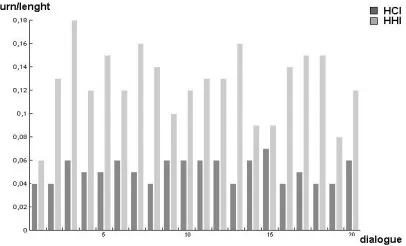
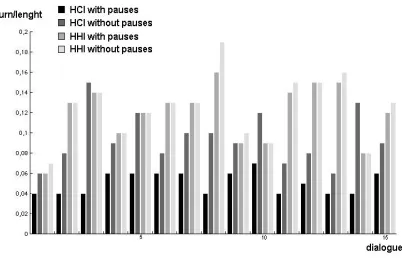
Measurements: First of all, we apply the classic Walker et al. (2000) metric for measuring dialogue effi-ciency, by calculating the number of turns over dialogue length. Figure 2 shows the discrepancy between the di-alogue efficiency inPhase 1(HCI) versusPhase 2
2
The shortest dialogues were 3:18 (E) and 3:30 (G) and the longest 12:05 (E) and 10:08 (G).
(HHI) of the German experiment and Figure 3 shows that the same patterns can be observed for English.
Phase HHI G HHI E HCI G HCI E
Average 1:52 2:30 2:59 3:23 length min. min. min. min. Average turns 11.35 21.25 9.2 7.4
[image:4.612.317.520.208.331.2]Table 1: Average length and turns inPhase 1and2
[image:4.612.316.518.378.506.2]Figure 2: Dialogue efficiency (German data)
Figure 3: Dialogue efficiency (English data)
While it is obvious that the existing latency times in-crease the number and length of pauses of the computer interactions as compared to the human operator’s interac-tions, there are no such obvious reasons why the number and length of pauses in the human subjects’ interactions should differ inPhase 1andPhase 2. However, as shown in Table 3, they do differ substantially.
[image:5.612.319.535.248.414.2]Figure 4: Efficiency w/out latency in German
Figure 5: Efficiency w/out latency in English
Efficiency HCI -p HCI +p HHI -p HHI +p
Mean 0.18 0.05 0.25 0.12 German
Standard- 0.04 0.01 0.06 0.03 deviation
Mean 0.16 0.05 0.17 0.17 English
Standard- 0.25 0.02 0.07 0.07 deviation
Table 2: Overall dialogue efficiencies with pauses +p and without pauses -p.
Next to this pause-effect, which contributes greatly to dialogue efficiency metrics by increasing dialogue length, we have to take a closer look at the individual turns and their nature. While some turns carry propositional
information and constitute utterances proper, a signif-icant number solely consists of specific particles used to exchange signals between the communicative part-ners or combinations thereof. We differentiate between dialogue-structuring signals and feedback signals in the sense of Yngve (1970). Dialoguestructuring signals -such as hesitations like hmm or ah as well as expressions like well, yes, so - mark the intent to begin or end an utter-ances, make corrections or insertions. Feedback signals-while sometimes phonetically alike - such as right, yes or
hmm - do not express the intent to take over or give up the
speaking role, but rather serve as a means to stay in con-tact with the speaker, which is why they are sometimes referred to as contact signals.
Pauses HCI-G HHI-G HCI-E HHI-E
Number 79 10 94 21
total
Number 3.95 0.5 4.7 1.05 per dialog
Number 0.46 0.05 0.64 0.05 per turn
total 336sec 19sec 467sec 48sec length
of 9.37 0.84 13.74 1.75 phase
of 5.75 0.3 7.46 0.766 dialogue
Table 3: Overall pauses of human subjects:
Phase 1 and 2 German (HCI-G/HHI-G) and
En-glish (HCI-G/HCI-E)
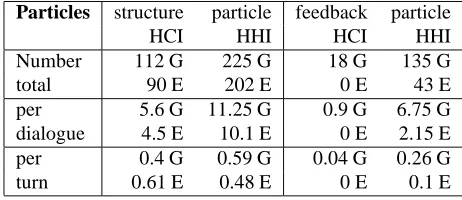
In order to be able to differentiate between the two, for example, between an agreeing feedback yes and a dialogue-structuring one, all dialogues were annotated manually. Half of the data were annotated by sepa-rate annotators, yielding an inter-annotator agreement of 90.61 . The resulting counts for the user utterances in phase one and two are shown in Table 4. Not shown in Table 4 are the number of particles employed by the computer, since it is zero, and of the human operator in the HHI dialogues, as they are like those of his human interlocutor.
ig-nored by today’s “conversational” dialogue systems.3
Particles structure particle feedback particle
HCI HHI HCI HHI
Number 112 G 225 G 18 G 135 G total 90 E 202 E 0 E 43 E per 5.6 G 11.25 G 0.9 G 6.75 G dialogue 4.5 E 10.1 E 0 E 2.15 E per 0.4 G 0.59 G 0.04 G 0.26 G turn 0.61 E 0.48 E 0 E 0.1 E
Table 4: Particles of human subjects: HCI vs. HHI
Before turning towards an analysis of this data we will examine the overlaps that occurred throughout the dia-logues. Most overlaps in human-human conversation oc-cur during turn changes with the remainder being feed-back signals that are uttered during the other interlocu-tor’s turn (Jefferson, 1983). The results on measuring the amount of overlap in our experiments are given in Ta-ble 5. Overall the HHI dialogues featured significantly more overlap than the HCI ones, which is partly due to the respective presence and absence of feedback signals as well as due to the fact that in HCI turn takes are accompanied by pauses rather than immediate overlapping -hand overs.
Overlaps HCI-G HHI-G HCI-E HHI-E
[image:6.612.70.301.96.196.2]Number total 7 49 4 88 per dialogue 0.35 3.06 0.2 4.4 per turn 0.03 0.18 0.01 0.1
Table 5: Overlaps in Phase 1 versus Phase 2
Lastly, our experiments yielded negative findings con-cerning differences in the type-token ratio (denoting the lexical variation of forms), speech production errors (false starts, repetitions etc.) and syntax. This means that there was no statistically significant difference in the lin-guistic behavior with respect to these factors. We regard this finding to strengthen our conclusions (see Section 6), that to emulate human syntactic and semantic behavior does not suffice to guarantee effective and therefore fe-licitous human computer interaction.
5
An Analysis of Ineffective
Computer-Human Interaction
The results presented above enable a closer look at di-alogue efficiency as one of the key factors influencing overall dialogue felicity. As our experiments show, the difference between the human-human efficiency and that
3
In the English data the subject’s employment of dialogue structuring particles in HCI even slightly surpassed that of HHI.
of the human-computer dialogues is not solely due to the computer’s response times. There is a significant amount of white noise, for example, as users wait after the com-puter has finished responding. We see these behaviors as a result of a mismanaged dialogue. In many cases users are simple unsure whether the system’s turn has ended or not and consequently wait much longer than necessary.
The situation is equally bad at the other end of the turn taking spectrum, i. e., after a user has handed over the turn to the computer, there is no signal or acknowledgment that the computer has taken on the baton and is running along with it - regardless of whether the user’s utterance is understood or not. Insecurities regarding the main ques-tion, i. e., whose turn is it anyways, become very notable when users try to establish contact, e. g., by saying hello -pause- hello. This kind of behavior certainly does not happen in HHI, even when we find long silences.
Examining why silences in human-human interaction are unproblematic, we find that, these silences have been announced, e. g., by the human operator employing lin-guistic signals, such as just a moment please or well, I’ll
have to have a look in our database in order to
commu-nicate that he is holding on to the turn and finishing his round.
To push the relay analogy even further, we can look at the differences in overlap as another indication of crucial dialogue inefficiency. Since most overlaps occur at the turn boundaries and, thusly, ensure a smooth (and fast) hand over, their absence constitutes another indication why we are far from having winning systems.
6
Conclusion and Future Work
As the primary effects of the human-directed language exhibited by today’s conversational dialogue systems, our experiments show that the human interlocutor:
ceases in the production of feedback signals, which has been observed before,
still attempts to use his or her turn signals for mark-ing turn boundaries - which, however, remain ig-nored by the system - and
increases the amount of pauses, caused by waiting and uncertainty effects, which also is manifested by missing overlaps at turn boundaries.
not serve the intended end, i. e., efficient, intuitive and felicitous human-computer interaction.
As future work we propose to take the Wizard and Op-erator Test paradigm introduced herein and to change and adjust the parameters of the computer-human interaction - while performing subsequent measurements of the en-suing effects - until an acceptable degree of dialogue ef-ficiency is reached. That is, finding out just how much extra-propositional signaling is needed to guarantee a fe-licitous dialogue. Such communicative behavior, then has to be implemented in dialogue systems, to make their way of communicating more like that of their human partners. In our minds, achieving dialogue quality remains an im-portant challenge for the scientific community, but - as we have shown herein and seen in recent evaluations - di-alogue efficiency constitutes another necessary condition for achieving dialogue felicity.
Acknowledgments
This work has been partially funded by the German Federal Ministry of Research and Technology (BMBF) and by the Klaus Tschira Foundation as part of the SMARTKOM, SMARTWEB, and EDU projects. We would like to thank the International Computer Science Institute in Berkeley for their help in collecting the data especially, Lila Finhill, Thilo Pfau, Adam Janin and Fey Parrill.
References
Jan Alexandersson and Tilman Becker. 2001. Overlay as the basic operation for discourse processing. In
Pro-ceedings of the IJCAI Workshop on Knowledge and Reasoning in Practical Dialogue Systems. Springer,
Berlin.
James F. Allen, Bradford Miller, Eric Ringger, and Teresa Sikorski. 1996. A robust system for natural spoken di-alogue. In Proceedings of the 34th Annual Meeting of
the Association for Computational Linguistics, Santa
Cruz, USA.
James F. Allen, George Ferguson, and Amanda Stent. 2001. An architecture for more realistic conversational system. In Proceedings of Intelligent User Interfaces, Santa Fe, NM.
Harald Aust, Martin Oerder, Frank Seide, and Volker Steinbiss. 1995. The Philips automatic train timetable information system. Speech Communication, 17.
Gerard Bailly, Nick Campbell, and Bernd M¨obius. 2003. Isca special session: Hot topics in speech synthesis. In Proceedings of the European Conference on Speech
Communication and Technology, Geneva, Switzerland.
Nicole Beringer, Ute Kartal, Katerina Louka, Florian Schiel, and Uli T¨urk. 2002. PROMISE: A Procedure for Multimodal Interactive System Evaluation. In
Pro-ceedings of the Workshop ’Multimodal Resources and Multimodal Systems Evaluation, Las Palmas, Spain.
Nicole Beringer. 2003. The SmartKom Multimodal Cor-pus - Data Collection and End-to-End Evaluation. In
Colloquium of the Department of Linguistics,
Univer-sity of Nijmwegen, June.
R.V. Cox, C.A. Kamm, L.R. Rabiner, J. Schroeter, and J.G. Wilpon. 2000. Speech and language process-ing for next-millenium communications services.
Pro-ceedings of the IEEE, 88(8).
Charles Darves and Shannon Oviatt. 2002. Adapta-tion of Users’ Spoken Dialogue Patterns in a Conver-sational Interface. In Proceedings of the 7th
Inter-national Conference on Spoken Language Processing,
Denver, U.S.A.
J. Diaz-Verdejo, R. Lopez-Cozar, A. Rubio, and A. De la Torre. 2000. Evaluation of a dialogue system based on a generic model that combines robust speech under-standing and mixed-initiative control. In 2nd
Interna-tional Conference on Language Resources and Evalu-ation (LREC 2000), Athens, Greece.
Starkey Duncan. 1974. On the structure of speaker-auditor interaction during speaking turns. Language
in Society, 3.
Ralf Engel. 2002. SPIN: Language understanding for spoken dialogue systems using a production system ap-proach. In Proceedings of the International
Confer-ence on Speech and Language Processing 2002,
Den-ver, USA.
J.-M. Francony, E. Kuijpers, and Y. Polity. 1992. To-wards a methodology for wizard of oz experiments. In
Third Conference on Applied Natural Language Pro-cessing, Trento, Italy, March.
Norman Fraser. 1993. Sublanguage, register and natural language interfaces. Interacting with Computers, 5.
Florian Gallwitz, Maria Aretoulaki, Manuela Boros, J¨urgen Haas, Stefan Harbeck, R. Huber, Heinrich Nie-mann, and Elmar N¨oth. 1998. The Erlangen spoken dialogue system EVAR: A state-of-the-art information retrieval system. In Proceedings of 1998 International
Symposium on Spoken Dialogue, Sydney, Australia.
Allen L. Gorin, Guiseppe Riccardi, and Jerry H. Wright. 1997. How may I help you? Speech Communication, 23.
Iryna Gurevych, Robert Porzel, and Stefan Merten. 2003. Less is more: Using a single knowledge rep-resentation in dialogue systems. In Proceedings of
the HLT/NAACL Text Meaning Workshop, Edmonton,
Gerd Herzog, Heinz Kirchmann, Stefan Merten, Alas-sane Ndiaye, Peter Poller, and Tilman Becker. 2003. MULTIPLATFORM: An integration platfrom for mul-timodal dialogue systems. In Proceedings of the
HLT/NAACL SEALTS Workshop, Edmonton, Canada.
G. Jefferson. 1983. Two explorations of the organistion if overlapping talk in coversation. Tilburg Papers in
Language and Literature, 28.
Michael Johnston, Srinivas Bangalore, Gunaranjan Vasireddy, Amanda Stent, Patrick Ehlen, Marilyn Walker, Steve Whittaker, and Preetam Maloor. 2002. Match: An architecture for multimodal dialogue sys-tems. In Proceedings of the 40th Annual Meeting of the
Association for Computational Linguistics,
Philadel-phia, Germany.
Michael Johnston. 1998. Unification-based multimodal parsing. In Proceedings of the 17th International
Con-ference on Computational Linguistics and 36th Annual Meeting of the Association of Computational Linguis-tics, Montreal, Canada.
J. Krause. 1992. Nat¨urlichsprachliche mensch-computer-interaktion als technisierte kommunikation: Die computer talk-hypothese. In J. Krause and L. Hitzenberger, editors, Computer Talk. Olms,
Hildesheim.
H. Kritzenberger. 1992. Unterschiede zwischen mensch-computer-interaktion und zwischenmenschlicher kom-munikation aus der interpretativen analyse der dicos-protokolle. In J. Krause and L. Hitzenberger, editors,
Computer Talk, pages 122–156. Olms, Hildesheim.
Robert Porzel, Norbert Pfleger, Stefan Merten, Markus L¨ockelt, Ralf Engel, Iryna Gurevych, and Jan Alexan-dersson. 2003. More on less: Further applications of ontologies in multi-modal dialogue systems. In
Pro-ceedings of the 3rd IJCAI 2003 Workshop on Knowl-edge and Reasoning in Practical Dialogue Systems,
Acapulco, Mexico.
Stefan Rapp and Michael Strube. 2002. An iterative data collection approach for multimodal dialogue sys-tems. In Proceedings of the 3rd International
Con-ference on Language Resources and Evaluation, Las
Palmas, Spain.
Stefan Rapp, Sunna Torge, Silke Goronzy, and Ralf Kompe. 2000. Dynamic speech interfaces. In
Pro-ceedings of the ECAI 2000 Workshop on Artificial In-telligence in Mobile Systems, Berlin, Germany.
Sadock Sack, E Schegloff, and G Jefferson. 1974. A simplest systematics for the organization of turn-taking for conversation. Language, 50.
Tara Rosenberger Shankar, Max VanKleek, Antonio Vi-cente, and Brian K. Smith. 2000. A computer medi-ated conversational system that supports turn negotia-tion. In Proceedings of the Hawai’i International
Con-ference on System Sciences, Maui, Hawaii, January.
Eve Sweetser. 2003. Levels of meaning in speech and gesture: Real space mapped onto epistemic and speech-interactional mental spaces. In Proceedings of
the 8th International Conference on Cognitive Linguis-tics, Logrono, Spain, July.
Wolfgang Wahlster, Norbert Reithinger, and Anselm Blocher. 2001. Smartkom: Multimodal communica-tion with a life-like character. In Proceedings of the
7th European Conference on Speech Communication and Technology.
Wolfgang Wahlster. 2002. SmartKom: Fusion and fis-sion of speech, gerstures and facial expresfis-sions. In
Proceedings of the Firsat International Workshop on Man-Machine Symbiotic Systems, Kyoto, Japan.
Wolfgang Wahlster. 2003. SmartKom: Symmetric mul-timodality in an adaptive an reusable dialog shell. In
Proceedings of the Human Computer Interaction Sta-tus Conference, Berlin, Germany.
Marilyn Walker, Diane Litman, Candace Kamm, and Ali-cia Abella. 1997. PARADISE: A framework for eval-uating spoken dialogue agents. In Proceedings of the
35th Annual Meeting of the Association for Computa-tional Linguistics, Madrid, Spain.
Marilyn A. Walker, Candace A. Kamm, and Diane J. Lit-man. 2000. Towards developing general model of us-ability with PARADISE. Natural Language
Engeneer-ing, 6.
Karl Weinhammer and Susan Rabold. 2003. Dura-tional Aspects in Turn Taking. In Proceedings of
In-ternational Conference Phonetic Sciences, Barcelona,
Spain.
R. Woodburn, R. Procter, J. Arnott, and A. Newell. 1991. A study of conversational turn-taking in a commu-nication aid for the disabled. In People and
Com-puters, pages 359–371. Cambridge University Press,
Cambridge.
Robin Wooffitt, Nigel Gilbert, Norman Fraser, and Scott McGlashan. 1997. Humans, Computers and Wizards:
Conversation Analysis and Human (Simulated) Com-puter Interaction. Brunner-Routledge, London.
V Yngve. 1970. On getting a word in edgewise. In
Papers from the Sixth Regional Meeting of the Chicago Linguistic Society, Chicago, Illinois, April.