Traditionally, most applications are found in the food industry for the concentration of fruit juice, wine, beer and coffee extract. In thisReld, the advant-ages of freeze concentration over competing tech-nologies (membranes and evaporation) are the superb preservation of aromas and colour while decay reac-tions are slowed down by the low operating temper-ature.
Recently, world-scale installations have come on-stream where wastewater from chemical plants is concentrated. The produced melt water can be re-used as process water while the residual concentrate is incinerated. Here the advantages of freeze concen-tration are the low energy costs and the capability to concentrate beyond the eutectic point, where salts start to precipitate.
Drawbacks of freeze crystallization are the rela-tively high investment cost and the above-average maintenance intensity (there are many pieces of rotating equipment).
Conclusion and Future Outlook
Melt crystallization is the third most applied physical separation technology after distillation and extrac-tion. Conventional processes are based on layer or suspension growth by indirect cooling.
E Layer growth may be considered as proven and mature technology, whereby the absence of slurry handling is a major advantage. Fully automated semi-continuous units can be delivered as turnkey projects. The need for repeated recrystallization steps to achieve a high product purity, however, increases both investment and operating cost. The desire to develop economically attractive continu-ously operated equipment seems to be in conSict with the basic characteristic of layer growth on a cooled surface.
E Suspension growthis also proven but not yet ma-ture technology. The superior selectivity and high
speciRc productivity of crystal growth in a suspen-sion create a huge potential, which can be further exploited by simpliRcation of equipment design and minimization of slurry handling.
E Evaporative melt crystallizationis a relatively young technology which combines the merits of suspension growth with a minimum of slurry handling. For certain applications, such as caprolactam, this tech-nique is expected to take off in coming years. E Pressure crystallization is an alternative
techno-logy, which is well suited to purify components with a very low melting point at ambient temper-ature but elevated pressure. Outside this niche use, pressure crystallization probably cannot compete with indirect/direct cooling crystallization due to high equipment cost.
See Colour Plate 36.
Further Reading
Arkenbout GF (1995) Melt Crystallization Technology. Basel: Technomic Publishing AG.
Jansens PJ and Van Rosmalen GM (1994) Fractional crys-tallisation. In: Hurle DJT (ed.) Handbook of Crystal Growth, Vol. 2A, ch. 6. Amsterdam: Elsevier Science. Matsuoka M and Fukushima H (1986) Determination of
solid}liquid equilibrium.Bunri Gijutsu(Separation Pro-cess Engineering) 16: 4}10.
Matsuoka M, Takiyama H and Soutome O (1997) Separ-ation characteristics of an inclined column crystallizer. Transactions of the Institution of Chemical Engineers 75(A): 206}212.
Moritoki M (1984) Crystallisation and sweating ofp-cresol by application of high pressure.Industrial Crystalliza-tion84: 369}380.
Randolph AD and Larson MA (1988)Theory of Particulate Processes, 2nd edn. San Diego: Academic Press. Sloan GJ and McGhie AR (1988)Techniques of Melt
Crys-tallization. New York: John Wiley.
Yasuda M, Sato Y and Suematsu H (1991)p-Cresol with high pressure crystallization.Kagaku Kogaku55(4): 290}291. Zief M and Wilcox WR (1967)Fractional SolidiTcation.
New York: Marcel Dekker.
Polymorphism
M. R. Caira, University of Cape Town, Rondebosch, South Africa
Copyright^ 2000 Academic Press
Introduction
When the molecules of a chemical substance are able to crystallize in more than one three-dimensional
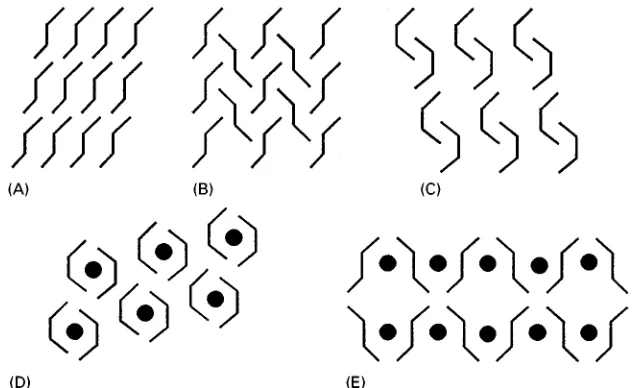
Figure 1 Schematic diagram illustrating polymorphism (A)}(C) and pseudopolymorphism (D), (E); Filled circles represent included solvent molecules.
display very signiRcant differences in physical proper-ties such as melting point, colour, hardness, density, electrical conductivity, heat of fusion, solubility and dissolution rate, as well as differences in chemical reactivities. Polymorphism is a common phenomenon which has vital ramiRcations in the crystallization and processing of pharmaceuticals, in food chemistry, explosives manufacture and in crystal engineering. The profusion of polymorphic forms that might be encountered for a single compound (e.g. up to ten in some instances) has often been viewed as an unwel-come source of confusion, threatening to undermine reproducible isolation of a speciRc crystalline form. However, those engaged in the study of polymor-phism see the beneRts this diversity of forms may offer. At the same time, it is recognized that in order to control the polymorphic outcome of the crystalli-zation process, systematic research aimed at a full understanding of the interplay of thermodynamic, kinetic and structural factors involved is paramount. This is a daunting task, however, since the phenom-enon of polymorphism is acknowledged to be a com-plex one with many questions as yet unanswered. Further progress depends critically on a multidiscip-linary approach.
Terminology/Nomenclature
Figure 1(A)}(C) are schematic illustrations of differ-ent polymorphs of a compound. In (A) and (B), the molecular conformation is retained but the crystal structures are different. The occurrence of a form such as (C), in which the molecule crystallizes with a signiRcantly different conformation gives rise to the term ‘conformational polymorphism’. In addition to
the possibility of forming different (but chemically identical) polymorphs, the molecules of a given sub-stance may upon crystallization from solution incor-porate solvent molecules (stoichiometrically or non-stoichiometrically) in the resulting crystal structure. These solvated crystalline forms (examples shown schematically inFigure 1(D) and (E)) are often refer-red to as ‘pseudopolymorphs’ and are no less impor-tant in practice than polymorphs of the parent sub-stance. Thus, for a single organic compound, it is frequently possible to crystallize from solution a series of polymorphs as well as a series of pseudo-polymorphs (in the latter case species containing dif-ferent solvent molecules, either individually or as mixtures). Furthermore, it is possible for a compound to yield pseudopolymorphs which are chemically identical, but structurally distinct (e.g. a monoclinic dihydrate and an orthorhombic dihydrate). Such spe-cies may be considered as polymorphic pseudo-polymorphs. Since physical properties are ultimately dependent on crystal structure, each of these species will therefore have unique properties. It is also note-worthy that the desolvation (e.g. by controlled heat-ing) of pseudopolymorphs such as those in Fig-ures 1(D) and (E) would yield polymorphs of the parent compound. Hence, this represents another route to isolation of polymorphs in addition to crys-tallization from solution, melt or vapour.
and ‘crystal modiRcation’ as synonyms for poly-morph; ‘solvate’, ‘inclusion compound’, ‘clathrate’ for pseudopolymorph). Pharmaceutical chemists tend to use ‘polymorph’ to describe a one-component sys-tem and ‘pseudopolymorph’ for a multi-component system. Finally, it should be noted that amorphous (non-crystalline or ‘glassy’) states of matter are also relevant in the context of polymorphism, since such phases may arise during transformation of one polymorph into another or during trituration of a cry-stalline polymorph. Amorphous phases are thermo-dynamically unstable and will tend to undergo spon-taneous crystallization to yield a stable polymorph.
Polymorphic Crystallization and
Polymorphic Transformations
Thermodynamic Aspects of Polymorphism
Thermodynamic treatment of a system displaying polymorphism is based on considerations of the Gibbs free energy,Gi, of each polymorph as well as
the variation ofGiwith the thermodynamic variables
temperature (T) and pressure (p). Furthermore, since each polymorph is distinct, each has a characteristic value for its entropy,Si(50), under any given
condi-tions ofTandp. Considering constant pressure, the thermodynamic relationship (Gi/T)p"!Si
there-fore indicates that the slope of theG}Tcurve for each polymorph of a compound at any given value ofTis (a) negative and (b) different. The stable phase at any given temperature is that polymorph with the lowest value ofG, and since theG}Tcurves for the various polymorphs will generally intersect one another at various temperatures owing to their different slopes, it follows that at a givenT, one polymorph will be stable and all others metastable with respect to it. When twoG}Tcurves intersect, the polymorphs they represent are in thermodynamic equilibrium at their transition temperature (Tt) and these phases then
have identical values for their Gibbs free energy. Each polymorph thus has a temperature range within which it is stable. (From a thermodynamic viewpoint, the co-existence of several polymorphs of a given substance at e.g. 1 atm, 253C is a paradox; the reason that this situation arises frequently in practice is that the activation energies for solid}solid transforma-tions to the stable phase are generally very high and such transitions are therefore under kinetic control).
The general principles outlined above can be ap-plied to a dimorphic system, for which the thermo-dynamic behaviours are classiRed as being either enantiotropic or monotropic, each of which has prac-tical implications as far as interconversion of the two
polymorphs is concerned. Figure 2 illustrates these cases. Here A, B, and L denote the lower and higher melting polymorphs and their common liquid phase respectively. Intersections of the Gibbs free energy curves of A and B with that of L coincide with the respective melting pointsTm,AandTm,B. In the case of
enantiotropy, the curves for A and B intersect at the transition temperatureTtwhich lies below either of
the melting points; furthermore, on either side ofTt,
the stability order of A and B is reversed. Each poly-morph therefore has a temperature range in which it is stable and the transition between the two is revers-ible. In practice, processing conditions which involve temperatures nearTtcould therefore induce a
poly-morphic transformation from one stable form to the other (which may or may not be desirable). In the monotropic system, the higher melting polymorph (B) is always the more stable one and the other (A) is metastable with respect to it. If a metastable poly-morph is prepared, it may spontaneously convert to the more stable polymorph under conditions conduc-ive to phase transformation.
Figure 2 Gibbs free energy-temperature relationships in dimorphic systems. Symbols are defined in the text. (Reproduced with permission from Yu L (1995) Journal of Pharmaceutical Science 84: 966, Copyright American Chemical Society and American Pharmaceutical Association.)
infrared frequencies for hydrogen bonded molecular crystals, were also formalized. In more detailed stud-ies of polymorphism, these rules are often applied in an attempt to deduce relative thermodynamic stabili-ties in a dimorphic pair (especially to determine which is the more stable species at room temper-ature). Exceptions to the rules are known (conforma-tional polymorphism being acknowledged as a com-plication) and this may account for the fact that they are not applied universally when the necessary
Figure 3 Schematic energy diagram for RG 12525 polymorphs I and II which are enantiotropically related. (Reproduced with permission from Carlton RA, Difeo TJ, Powner TH, Santos I and Thompson MD (1996)Journal of Pharmaceutical Science 85: 966. Copyright American Chemical Society and American Pharmaceutical Association.)
Figure 4 van’t Hoff plots for Piretanide Forms A and B at pH 5: *, Form A; 䢇, Form B. (Reproduced with permission from Chikaraishi Y, Otsuka M, and Matsuda Y (1995)Chem. Pharm. Bull. 43: 1966, Copyright Pharmaceutical Society of Japan.) with those of Burger and Ramberger showing that,
with little exception, they are effectively equivalent, despite the different routes for their derivation. It is likely that this recent endorsement of the Burger and Ramberger rules will lead to more frequent attempts to classify polymorphic systems in terms of enantiot-ropy or monotenantiot-ropy. A further important outcome of the more recent treatment is that the transition tem-perature,Tt, is easily estimated by extrapolating the
value of the temperature-dependent quantityG(T) to zero. Knowledge of the value of Tt for a pair of
polymorphic forms is of practical importance in the case of enantiotropy and of theoretical interest in the case of monotropy, since for the latter, it is a virtual temperature.
Solubility data provide an alternative means of determining polymorphic transition temperatures. Over a small temperature range, a plot of ln (solubil-ity) against 1/T(a van’t Hoff plot) for a polymorph is linear, with a slope related to the enthalpy of dissolu-tion. If the solubility data for two polymorphs of the compound in a common solvent are treated in this way, the point of intersection of the plots will yield the polymorphic transition temperature Tt. An
example is illustrated in Figure 4. Furthermore, the heat of transition (Ht) may be calculated as the
[image:5.568.302.517.478.664.2]of solvent-mediated polymorphic phase transforma-tion during solubility measurement. This type of transformation is but one of several which poly-morphs may undergo.
Kinetics of Nucleation and Polymorphism/ Pseudopolymorphism
A prerequisite for crystallization of a speciRc poly-morphic phase is the formation of viable nuclei of that phase, nuclei being deRned as the smallest mo-lecular aggregates with a conRguration resembling that of theRnal crystal. The probability of nucleation occurring increases with increasing supersaturation of the solution; in such a solution, where incipient nuclei of all possible polymorphs may exist, kinetic factors determine which of these will become viable, i.e. lead to crystallization of a speciRc poly-morph. The critical parameter associated with the formation of a nucleus is the Gibbs free energy of activation, GH. Nucleation, which proceeds with a rate dependent onGH, may occur heterogeneously or homogeneously depending on whether random impurities or substrates promoting nucleation are present or not. In the former case, the mechanism of nucleation is associated with a reduction in GH, relative to the uncatalysed process.
A detailed treatment of homogeneous nucleation shows that the value ofGHis determined by several factors including a geometrical factor speciRc to the shape of the nucleating cluster, the molecular volume, the interfacial energy (between the nucleating cluster and the crystallization medium), and the chemical potential difference between the crystal and the me-dium. The crucial point that emerges as regards crys-tallization of different polymorphs of a given com-pound from a given medium is, that for each poly-morph the values of the various individual factors affecting GHgenerally differ. This empha-sizes the competitive nature of polymorphic crystalli-zation. In this context, Ostwald’s law of stages pre-dicts that nucleation of metastable forms will success-ively precede that of the stable form, but this has been shown to be valid only in limited regions of chemical potential difference. Since much has still to be learnt regarding evaluation of the individual parameters af-fectingGHfor individual polymorphs, the problem of predicting polymorphic outcome on the basis of nucleation kinetics remains a complex issue which is receiving continued attention. Molecular dynamics methods have also been applied to the nucleation process with some success. Simultaneous precipita-tion of different polymorphs occurs frequently in in-dustrial crystallizations. Recent theoretical modelling of this type of process for a dimorphic system has
indicated that polymorphic composition depends on the ratio of the nucleation rates, the ratio of the growth rates and the aggregation tendencies of the two polymorphs.
Crystallization of the solute alone from the me-dium has been considered thus far. Solvation plays a major role in the crystallization of pseudo-polymorphs from solution. Here, the enthalpic ad-vantage associated with particularly strong solute} solvent interactions (e.g. intermolecular hydrogen bonds) outweighs the entropic one associated with liberation of solvent molecules, and the resultant crystals contain entrapped solvent molecules. Theor-etical aspects of pseudopolymorphism have not been addressed to any great extent despite the practical importance of these species. A recent survey of documented crystal structures of organic compounds indicates that 15 percent of them contain included solvent molecules.
Types of Polymorphic Transformation
Phase transformations are driven by the tendency for minimization of the Gibbs free energy of the system. In the absence of a liquid phase, the transformation of one polymorph to another of lower Gibbs free energy is possible in principle, but such a process is generally very slow due to the high activation energy associated with nucleation and growth of a new polymorph within the solid matrix of the old one.
The presence of a liquid phase can signiRcantly reduce the activation energy for transformation. Melt-mediated and solution-mediated phase trans-formations are thus common. In the former, follow-ing the meltfollow-ing of a metastable polymorph, the stable polymorph crystallizes (Figure 2, monotropic case, applies here). Solution-mediated polymorphic trans-formations have received much attention because of their practical importance. Here, a stable solid phase crystallizes from a solution which originally con-tained a metastable phase, mass transfer being effec-ted through the solution medium. The rate of such a transformation depends on several factors, the most important of which are the difference in solubility of the two polymorphs, the nature of the solvent, tem-perature and the rate of agitation of the solution. Kinetically, this process has been satisfactorily modelled in terms of dissolution of the more soluble metastable phase (characterized bykD, the rate
con-stant for dissolution), and crystallization and growth of the stable, less soluble polymorph (rate constant kG). Experimentally,kDandkG are determined from
Figure 5 Numerical simulation of the supersaturation-time pro-files as a function of the relative rates of dissolution and crystalli-zation during a solution-mediated transformation. Generated from a kinetic model developed by Cardew PT and Davey RJ, (1985) Proceedings of the Royal Society of London, A398: 415. (Repro-duced with permission form RodrOHguez-Hornedo N and Murphy D (1999)J. Pharm. Sci. 88: 651. Copyright American Chemical Society and American Pharmaceutical Association.)
Figure 6 Representative portions of the crystal structures of the monoclinic (left) and orthorhombic (right) polymorphs of paracetamol.
dissolution-limited depending on the whether the ra-tio kD/kG is large or small. In Figure 5, theoretical
supersaturation proRles for these extreme cases are compared with the case where the rate constants are equal.
Structural Aspects
The various polymorphs of an organic compound (e.g. those shown schematically in Figure 1(A)}(C)), are characterized by different sets of intermolecular interactions (e.g. van der Waals forces, hydrogen bonding, X}H2 interactions, where X"C, N, O typically). For molecules containing hydrogen bond donor and acceptor groups, the incidence of polymorphism generally increases owing to the var-iety of ways in which such molecules can
self-assemble to form supramolecular arrays. Figure 6 shows portions of the crystal structures of two poly-morphs of the drug paracetamol. Despite similar mo-lecular conformations, the intermomo-lecular relation-ships differ very signiRcantly as a result of the differ-ent hydrogen bonding arrangemdiffer-ents adopted. Ulti-mately, it is these features which determine all the observed differences in the physical properties of these polymorphic forms.
Prediction of the crystal structure (or rather, of the family of possible polymorphic structures) of an or-ganic compound from a knowledge of the molecular structure alone is considered a highly desirable goal, but the current state of knowledge of the nature of intermolecular interactions generally prevents its achievement. As to prediction of the outcome of poly-morphic crystallization, it would be necessary to in-voke additional considerations of thermodynamic, kinetic and solvent effects. These problems are cur-rently being addressed by computational methods with moderate success.
Practical Detection and Analysis of
Polymorphs and Pseudopolymorphs
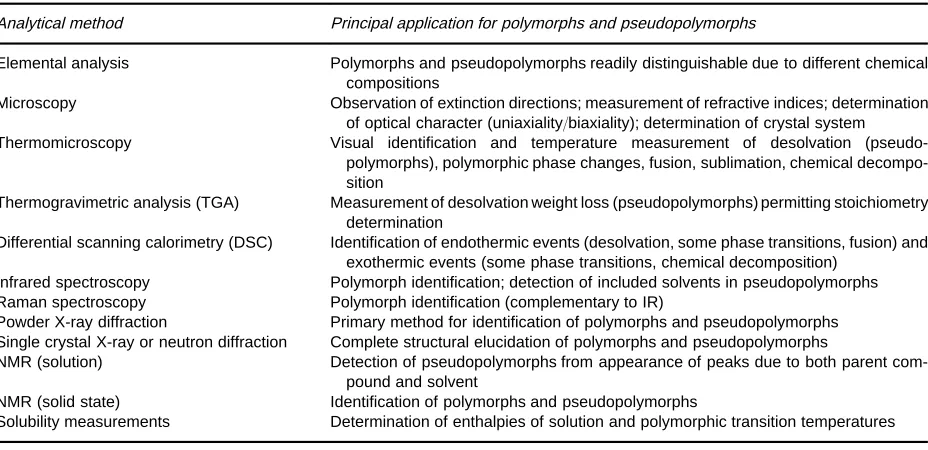
[image:7.568.60.516.529.684.2]Table 1 Analytical methods suitable for the study of polymorphism and pseudopolymorphism
Analytical method Principal application for polymorphs and pseudopolymorphs
Elemental analysis Polymorphs and pseudopolymorphs readily distinguishable due to different chemical compositions
Microscopy Observation of extinction directions; measurement of refractive indices; determination of optical character (uniaxiality/biaxiality); determination of crystal system Thermomicroscopy Visual identification and temperature measurement of desolvation
(pseudo-polymorphs), polymorphic phase changes, fusion, sublimation, chemical decompo-sition
Thermogravimetric analysis (TGA) Measurement of desolvation weight loss (pseudopolymorphs) permitting stoichiometry determination
Differential scanning calorimetry (DSC) Identification of endothermic events (desolvation, some phase transitions, fusion) and exothermic events (some phase transitions, chemical decomposition)
Infrared spectroscopy Polymorph identification; detection of included solvents in pseudopolymorphs Raman spectroscopy Polymorph identification (complementary to IR)
Powder X-ray diffraction Primary method for identification of polymorphs and pseudopolymorphs Single crystal X-ray or neutron diffraction Complete structural elucidation of polymorphs and pseudopolymorphs
NMR (solution) Detection of pseudopolymorphs from appearance of peaks due to both parent com-pound and solvent
NMR (solid state) Identification of polymorphs and pseudopolymorphs
Solubility measurements Determination of enthalpies of solution and polymorphic transition temperatures
Figure 7 Powder XRD patterns for piroxicam pivalate (A) poly-morph 1 (B) polypoly-morph 2. (Reproduced with permission from Caira MR, Zanol M, Peveri T, Gazzaniga A and Giordano F (1998) Journal of Pharmaceutical Science 87: 1608. Copyright American Chemical Society and American Pharmaceutical Association.) Detection of more than one polymorph in an indus-trial crystallization batch may be achieved using this technique since the PXRD patterns are additive. Levels of an adulterating polymorph down to a few percent are detectable. (Near-IR spectroscopy can be equally sensitive in this regard).
When suitable single crystals of the individual poly-morphs of a compound can be isolated, complete structural elucidation of each species by X-ray methods is usually possible and highly desirable (cf. Figure 6). The information derived contains all intra-molecular parameters (bond lengths, bond angles, conformational parameters) as well as those
asso-ciated with the crystal packing (intermolecular van der Waals contacts and hydrogen bonding) character-istic of each polymorph. These structural parameters can be used to interpret data obtained from other methods. A typical example would be the observation of unequal C"O bond lengths in the molecules of a dimorphic pair, which would account for differences observed inC"OIR data. For pseudopolymorphs, the
observed topology of solvent inclusion (e.g. location within channels, isolated cavities, or layers) and the nature of ‘host}guest’ hydrogen bonding may be used to explain differences in crystal solvent volatility ob-served by thermal methods such as DSC. Thus, a knowledge of the crystal structure of each poly-morph and pseudopolypoly-morph of a given compound represents a robust foundation for interpretation of many other physicochemical data.
Another major advantage of complete structural elucidation of a polymorph or pseudopolymorph is that the reRned parameters may be used to compute an idealized powder XRD pattern for that phase. Such a pattern is invaluable as a primary reference for future identiRcation of that species and for monitor-ing the purity of the material experimentally durmonitor-ing industrial processing.
Implications of Polymorphism and
Control of Polymorphic Crystallization
Since the Gibbs free energy differences between poly-morphs of the same substance are small (typically 2}3 kJ mol\1), even minor changes in crystallization
[image:8.568.58.273.496.653.2]precipitation of an undesired polymorph or to mix-tures of polymorphs. Hence practical difRculties asso-ciated with polymorphism manifest themselves prom-inently in areas where the same compounds undergo repeated crystallization. One notable example is the pharmaceutical industry, where polymorphism and pseudopolymorphism of active agents used in solid dosage forms may have a very signiRcant effect on the efRcacy and quality of the formulation. In particular, since different polymorphs of a drug may have differ-ent solubilities and differdiffer-ent dissolution rates, use of the inappropriate polymorph in a formulation will compromise the bioavailability of the drug. Other problems which could arise include: (a) use of a ther-modynamically unstable polymorph which sub-sequently undergoes spontaneous transformation into a more stable polymorph, with consequent re-duction in bioavailability; (b) solvent-mediated con-version of a drug in a suspension resulting in the slow precipitation of an insoluble drug pseudopolymorph (e.g. a hydrate), again leading to reduction in the concentration of therapeutically active material; (c) transformation of the original polymorph to an unde-sired one induced by processing conditions, e.g. heat-ing, compression, grinding; (d) precipitation of the drug hydrate instead of the desired anhydrous species due to traces of water in the organic crystallizing solvent. Since reproducible behaviour of the dosage form is of paramount importance, pharmaceutical scientists recognize the necessity for a thorough in-vestigation of the polymorphic and pseudopolymor-phic behaviour of a drug during its development in order to avert problems of the type described above. Analogous problems, seriously compromising prod-uct performance, occur in other industries. Very de-tailed documentation of crystallization procedures listing all possible parameters is therefore essential in attempting to ensure reproducible outcomes.
Polymorphism can affect other important techno-logical properties such as tablet compaction. In the case of paracetamol (Figure 6), the crystal structure of the monoclinic polymorph has a complex three-dimensional hydrogen bonding network which is not conducive to plastic deformation during pressuriz-ation. The crystals consequently resist direct com-pression during tabletting. The facile direct compress-ibility of the orthorhombic polymorph is attributed to the presence of slip planes in the crystal structure which separate the planes of hydrogen bonded mol-ecules (Figure 6), rendering this the industrially de-sired form of the drug.
In the development of solid-state devices, target species displaying second-harmonic generation are crystallographically non-centrosymmetric poly-morphs; their selective crystallization, in preference
to inactive centrosymmetric polymorphs of the same compound, is therefore a goal of crystal engineering. Amino acid crystallization is another area affected by polymorphism. For example, precipitation of the -rather than the -polymorph of L-glutamic acid is
preferred in industry since the former yields a higher solid}liquid separation efRciency.
The above examples highlight the necessity for con-trolling crystallization mechanisms to ensure precipita-tion of the desired polymorph. In addiprecipita-tion to the computational studies referred to earlier, there are several experimental approaches to this problem (other than solvent-selective polymorphic crystalliza-tion), all of which depend on detailed structural know-ledge of the stable and metastable polymorphs of the material in question as a basis for understanding the relationship between molecular interactions in the crystallization medium and the supramolecular struc-tures of the polymorphs that might ensue.
Selective crystallization of metastable polymorphs has been achieved by adding inhibitors which retard the growth of the stable polymorph. Inhibitor design is based on identiRcation of the fastest growing crys-tal faces of the stable polymorph and tailor-making a substrate which will be incorporated along the direction of fastest growth, thereby blocking crystal development. Polymeric inhibitors have been used to control polymorphism in induced enantiomeric res-olution of racemates. Essential to these approaches is detailed knowledge of the relationship between crys-tal morphology and internal structure and this in-formation can usually be obtained only by X-ray diffraction methods.
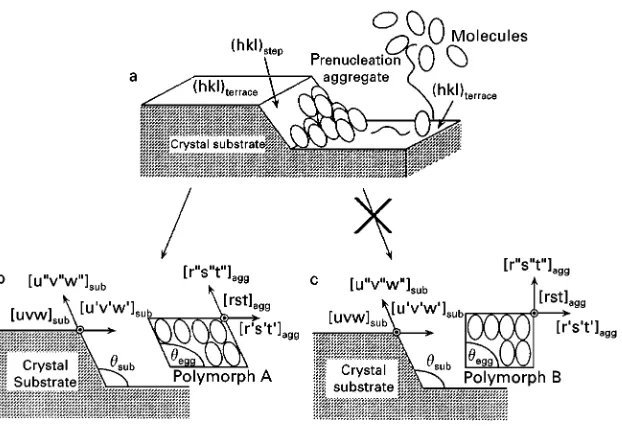
Another approach to controlling crystallization is based on the knowledge that the molecular topology of a substrate can affect polymorph selectivity and that such heterogeneous nucleation is energetically more favourable than homogeneous nucleation. The mechanism of ledge-directed epitaxy (LDE), illustrated inFigure 8, utilizes these principles. Here, a selected substrate, with surface ledges characterized by sub, directs the preferred crystallization of that
polymorph exclusively whose prenucleation aggreg-ate has a matching dihedral angleaggbetween
close-packed crystal planes. A metastable polymorph with aggmatchingsubcan thus be induced to crystallize in
preference to a stable polymorph for which this geo-metrical condition is not met.
Future Developments
Figure 8 Schematic representation of LDE on a single-crystal substrate and the role of LDE in selective nucleation of polymorphs. Symbols are defined in the original reference. (Reproduced with permission from Bonafede SJ and Ward MD (1995)Journal of the American Chemical Society 117: 7853, Copyright American Chemical Society.)
industrially important compounds. In the case of pharmaceuticals, further motivation comes from drug-regulatory bodies (e.g. the FDA) which require details of crystallization procedures for speciRc drug polymorphs and pseudopolymorphs. It is vital that theoretical development of the subject of polymor-phism continues to keep pace with these demands. Computational and experimental techniques, which have during the last decade led to substantial ad-vances in the understanding of the primary event in the crystallization process, namely nucleation, are expected to improve in terms of the complexity of the models employed and in the systems investigated. The strategy of ‘rational crystal seeding’ epitomized by the LDE technique is likely to be applied more widely to the control of polymorphic crystallization. A consequent growth is expected in the number of reports documenting successful isolation of speciRc polymorphs utilizing approaches based on deliberate intervention at the nucleation stage. Detailed struc-tural elucidation of metastable polymorphs and microcrystalline polymorphs will be facilitated by the combined use of methods such as computational crystal structure prediction, solid state NMR, high-resolution X-ray and neutron powder diffraction, and single crystal X-ray methods employing synchrotron radiation sources. Accompanying the demand for iso-lation of particular polymorphs, methods for more rapid analysis and quantiRcation will be needed to satisfy both production and legal requirements. An increase in the number and types of on-line systems for continuous monitoring of polymorphic purity in the industrial environment is also envisaged.
See also: I/Crystallization.
Further Reading
Bernstein J (1991) Polymorphism and the investigation of structure-property relations in organic solids. In: Gar-barczyk JB, James DW (eds)Organic Crystal Chemistry. Oxford: Oxford University Press.
Burger A and Ramberger R (1979)On the Polymorphism of Pharmaceuticals and Other Molecular Crystals. I. Theory of Thermodynamic Rules, Vienna: Mikro-chimica Acta, 259}271.
Byrn S R (1982)Solid State Chemistry of Drugs. New York: Academic Press.
Byrn S, Pfeiffer R, Ganey M, Hoiberg C and Poochikian G (1995) Review: pharmaceutical solids: a strategic ap-proach to regulatory considerations. Pharmaceutical Research12: 945}954.
Caira MR (1998) Crystalline polymorphism of organic compounds. In: Weber E (ed.)Design of Organic Solids, Topics in Current Chemistry, Vol. 198, pp. 163}208. Berlin: Springer-Verlag.
Desiraju GR (1989)Crystal Engineering. Amsterdam: Else-vier.
Dunitz JD and Bernstein J (1995) Disappearing poly-morphs.Acc.Chem.Res. 28: 193}200.
Gavezzotti A and Filippini G (1997) In: Gavezzotti A (ed.) Theoretical Aspects and Computer Modeling of the Molecular Solid State. Vol. 1, Ch. 3. New York: Wiley.
Klug HP and Alexander LE (1974)X-Ray Diffraction Pro-cedures for Polycrystalline and Amorphous Materials. New York: Wiley.
RodrmHguez-Hornedo N and Murphy D (1999) Minireview: signiRcance of controlling crystallization mechanisms and kinetics in pharmaceutical systems.Journal of Phar-maceutical Sciences88: 651}660.
Sato K (1993) Polymorphic transformations in crystal growth. Journal of Physics, D:Applied Physics26: B77}B84.
Threlfall TL (1995) Analysis of organic polymorphs, a re-view.Analyst120: 2435}2460.
Weissbuch I, Popovitz-Biro R, Lahav M and Leiserowitz L (1995) Understanding and control of nucleation, growth, habit, dissolution and structure of 2-dimensional and 3-dimensional crystals using tailor-made auxiliaries.Acta Crys-tallographica, Sect. B:Structural Science B51: 115}148. Wendlandt WW (1986)Thermal Analysis. 3rd edn, New
York: John Wiley&Sons.
Zone Re
\
ning
C.-D. Ho and H.-M. Yeh, Tamkang University, Taipei, Taiwan, ROC
Copyright^ 2000 Academic Press
Introduction
Zone reRning is a powerful tool for applying coupled melting and freezing operations for manipulating im-purities in crystals, as well as for separating liquid or solid mixtures. It wasRrst used to purify germanium in 1952. Zone reRning combines the well-known fact that a freezing crystal differs in composition from its corresponding liquid phase, so that passing a short heater along a solid ingot leads to a puriRcation of the ingot. For improving the separation efRciency and reducing time, a series of narrow heaters moving slowly over a solid ingot can be used in multi-pass zone reRning.
Several mathematical models have been presented for modelling multi-pass zone reRning processes when zone length affects the separation efRciency. Furthermore, variable cross-sectional area ingots with speciRed volumes have been introduced to im-prove the separation efRciency. Analogue simulators were used to simulate zone reRning by means of a single mathematical equation that expresses solute concentration as a function of distance for any initial distribution of solute and any number of passes through an ingot of a speciRed length. These simula-tors include liquid mechanical and electrical analogue simulators. Thousands of signiRcant papers devoted entirely or largely to some aspect of application of zone reRning have appeared in the last two decades. For instance, silicon-on-insulator (SOI) Rlms, and semiconducting and superconducting materials were prepared by zone reRning operations.
Separation Theory in Multi-pass
Operation
Eqn (1) can be derived by taking the mass balance within the moving zone ABCD or ABCD as
shown in Figure 1. It is based on the following as-sumptions: (a) constant distribution coefRcient; (b) uniform composition and no diffusion in the molten zone; (c) no change in density during melting and freezing; (d) a constant cross-sectional area for the ingot.
dCM n(Z) dZ #
dYn(Z) dZ #k
Yn(Z)
CMn(Z)
"kCMn\1[Z#Yn(Z)]
Yn(Z)
1# dYn(Z)dZ
,0)Z)1!Yn(Z) [1]
dCM n(Z) dZ #
dYn(Z) dZ #k
Yn(Z) CMn(Z)"0,
1!Yn(Z))Z)1 [2] and the boundary conditions of eqns (1) and (2) become:
atZ"0, CMn"
k Yn(0)
Yn(0)
0
CM n\1(Z) dZ [3]
atZ"1!Yn(Z),
CM n" k
Yn(Z)
1!1\Yn(Z)
0
CMn(Z) dZ
[4]in which:
CMn(Z)"Cn(x)/C0 [5]
Yn(Z)"ln(x)/L [6]