A HYBRID E-LEARNING FRAMEWORK: PROCESS-BASED,
S
EMANTICALLY-
E
NRICHED AND
S
ERVICE-
O
RIENTED
R
AWAD K. M.
H
AMMAD
This thesis is submitted in partial fulfilment of the requirements of the University of the West of England, Bristol for the degree of Doctor of Philosophy
Software Engineering Research Group (SERG), Faculty of Environment and Technology,
University of the West of England, Bristol
ii
Abstract
Despite the recent innovations in e-Learning, much development is needed to ensure better learning experience for everyone and bridge the research gap in the current state of the art e-Learning artefacts. Contemporary e-learning artefacts possess various limitations as follows. First, they offer inadequate variations of adaptivity, since their recommendations are limited to e-learning resources, peers or communities. Second, they are often overwhelmed with technology at the expense of proper pedagogy and learning theories underpinning e-learning practices. Third, they do not comprehensively capture the e-learning experiences as their focus shifts to e-learning activities instead of e-learning processes. In reality, learning is a complex process that includes various activities and interactions between different roles to achieve certain gaols in a continuously evolving environment. Fourth, they tend more towards legacy systems and lack the agility and flexibility in their structure and design.
To respond to the above limitations, this research aims at investigating the effectiveness of combining three advanced technologies (i.e., Business Process Modelling and Enactment, Semantics and Service Oriented Computing – SOC–) with learning pedagogy in order to enhance the e-learner experience. The key design artefact of this research is the development of the HeLPS e-Learning Framework – Hybrid e-Learning Framework that is Process-based, Semantically-enriched and Service Oriented-enabled. In this framework, a generic e-learning process has been developed bottom-up based on surveying a wide range of e-learning models (i.e., practical artefacts) and their underpinning pedagogies/concepts (i.e., theories); and then forming a generic e-learning process. Furthermore, an e-Learning Meta-Model has been developed in order to capture the semantics of e-learning domain and its processes. Such processes have been formally modelled and dynamically enacted using a service-oriented enabled architecture. This framework has been evaluated using a concern-based evaluation employing both static and dynamic approaches. The HeLPS e-Learning Framework along with its components have been evaluated by applying a data-driven approach and artificially-constructed case study to check its effectiveness in capturing the semantics, enriching e-learning processes and deriving services that can enhance the e-learner experience. Results revealed the effectiveness of combining the above-mentioned technologies in order to enhance the e-learner experience. Also, further research directions have been suggested.
iv
To my mother Amina and my father Khamis
To my wife Alaa and my children Mohammed, Layan, and Dania
v
Acknowledgement
All praise is to Allah.
I would like to thank my family for their support and allowing me to pursue my research interests
without ever complaining.
I would also like to thank Dr. Mohammed Odeh and Dr. Zaheer Khan for acting as my supervisors for
this PhD. I would also like to extend my thanks to my senior colleagues including Dr. Kamran
Munir, Dr. David Ludlow, Dr. Mahmoud Ahmed, Dr. Kamran Soomro, Dr. Mohammed Hassona,
vi
Table of Contents
Abstract ...ii
Acknowledgement ... v
List of Figures ... x
List of Tables ...xii
Glossary ... xiii
Acronyms ... xvi
Index ... xvii
Chapter 1: Introduction ... 1
1.1Background and Motivation ... 1
1.2 The Research Problem ... 2
1.3 Research Hypothesis and Questions ... 4
1.4 Research Contributions ... 6
1.5 Research Publications ... 8
1.6 Thesis Outline ... 9
Chapter 2: Background and Literature Review ... 10
2.1 Introduction ... 10
2.2 Literature Review Approach ... 10
2.3 Pedagogy and e-Learning ... 14
2.3.1 From Pedagogy to Learning Theories ... 14
2.3.2 Learning Theories ... 15
2.3.3 Learning Theories Comparative View ... 23
2.3.4 Summary ... 23
2.4 Common e-Learning Models/Practitioner Perspective ... 27
2.4.1 Learning Object (LO) ... 27
2.4.2 Learning Management Systems (LMS)... 28
2.4.3 Open-based Learning Model ... 29
2.4.4 Cloud-based e-Learning Models ... 30
2.5 Process-Based and Service-Oriented e-Learning Models ... 31
2.5.1 Business Process and Learning ... 31
2.5.2 Service-Oriented Computing (SOC) ... 33
2.5.3 IMS Learning Design (IMS LD) ... 34
2.5.4 Workflow-based e-Learning Model ... 35
2.5.5 e-Learning Management System Using Service-Oriented Architecture ... 36
vii
2.6 Semantically-Enriched e-Learning Models ... 36
2.6.1 Ontology ... 37
2.6.2 Recommender Systems ... 38
2.6.3 Intelligent Tutoring Systems ... 39
2.6.4 Semantic Framework for Cloud Learning Environments ... 40
2.7 Advanced e-Learning Models ... 41
2.7.1 Game-Enhanced Learning ... 41
2.7.2 Virtual-Enhanced Learning (VEL) ... 42
2.7.3 Adaptive e-Learning Systems (AES) ... 43
2.8 Theoretical and Institutional e-Learning Models ... 44
2.8.1 Khan’s e-Learning Framework ... 44
2.8.2 e-Learning P3 Model ... 45
2.8.3 e-Learning Success Model ... 45
2.8.4 Process-Oriented Model for Technology-Enhanced Learning ... 46
2.9 Critical Gap Analysis, Lessons Learnt and Conclusions... 47
Chapter 3: The Research Framework Design ... 52
3.1 Introduction ... 52
3.2 Research Design ... 52
3.3 Introducing the HeLPS e-Learning Framework ... 56
3.3.1 Model-Driven Engineering in the Context of the HeLPS e-Learning Framework ... 60
3.3.2 The Process of Developing the e-Learning Meta-Model ... 61
3.3.3 The e-Learning Meta-Model Description ... 63
3.4 Conclusion ... 70
Chapter 4: Design and Development of the HeLPS e-Learning Framework ... 72
4.1 Introduction ... 72
4.2 The Process of Instantiating the HeLPS e-Learning Framework ... 72
4.3 The Presentation Layer ... 74
4.4 The Business Logic Layer ... 75
4.4.1 The e-Learning Semantic Module ... 76
4.4.1.1 e-Learning Meta-Model: Modelling Considerations ... 78
4.4.1.2 e-Learning Meta-Model Specifications ... 79
4.4.1.3 Semantic Web Rule Language (SWRL) e-Learning Rules ... 81
4.4.1.4 Reflections on Underpinning Modelling Limitations and Challenges ... 85
4.4.2 The e-Learning Process Module ... 85
4.4.2.1 Deriving Business Process Models from e-Learning Literature ... 85
viii 4.4.3 The Proposed Approach to Developing a Generalised e-Learning Business Process Model from a Set of
Related Business Processes ... 101
4.4.4 The Generalised e-Learning Processes for the HeLPS Framework ... 102
4.4.5 Business Process Modelling and Execution in the HELPS Framework ... 109
4.4.6 The Service Orientation Module ... 110
4.4.6.1 Service Orientation in the e-Learning Domain ... 111
4.4.6.2 Criteria for the Service Identification Approach ... 113
4.4.6.3 The Service Derivation Process... 114
4.5 The e-Learner Experience Model ... 120
4.5.1 Background ... 120
4.5.2 The e-Learner Experience Model ... 121
4.5.3 e-Learner Experience Model Constituent Constructs ... 123
4.5.4 e-Learner Experience Model: Structural and Measurement Perspectives ... 127
4.5.5 e-Learner Experience Model: A Proposed Scale ... 129
4.5.6 Summary ... 131
4.6 The e-Learning Capability Maturity Model... 131
4.6.1 Background ... 132
4.6.2 e-Learning Capability Maturity Model Structure and Concerns ... 133
4.6.3 e-Learning Capability Maturity Model Key Process Areas ... 134
4.6.4 e-Learning Capability Maturity Model Detailed Description ... 135
4.6.5 Discussion ... 142
4.6.6 Summary ... 142
4.7 The Data Layer ... 143
4.8 Critical Reflection and Conclusion ... 143
Chapter 5: Evaluating the HeLPS e-Learning Framework ... 146
5.1 Research Evaluation Design ... 146
5.1.1 Spiral Evaluation Process ... 148
5.2 The Validation and Verification Model ... 150
5.2.1 Rationale for Data-Driven Evaluation Approach ... 151
5.2.2 Sufficiency Analysis ... 152
5.2.3 Assumptions/Criteria for the Selected Testing Data/Scenarios ... 155
5.2.4 The Testing Scenarios of the Validation and Verification Model ... 158
5.3 Evaluation Results ... 164
5.3.1 Verification in the Context of the HeLPS Proof of Concept ... 169
5.3.2 Validation in the Context of the HeLPS Proof of Concept ... 170
5.4 Results Reflections in the Context of Research Questions ... 173
ix
Chapter 6: Conclusion and Future Work ... 178
6.1 Introduction ... 178
6.2 Key Contributions ... 178
6.3 Fulfilment of the Research Hypothesis and the Research Questions ... 179
6.4Research Limitations ... 184
6.5Future Research Directions ... 185
6.5.1 Adopting Further Advanced Contextualisation Approaches ... 185
6.5.2 Expanding the Scope of the HeLPS e-Learning Processes ... 185
6.5.3 Improving the Service Orientation Module of the HeLPS e-Learning Framework ... 186
6.5.4 Further Development and Testing for the HeLPS e-Learning Framework Supportive Models ... 186
6.5.5 Enhancing the Process of Capturing the e-Learner Behaviour... 187
6.5.6 Incorporating the HeLPS e-Learning Framework with Existing e-Learning Systems ... 187
References ... 189
Appendices ... 210
Appendix I: Applying the Process of Developing the e-Learning Meta-Model on the Learning Object Model211 Appendix II: HeLPS e-Learning Meta-Model Description ... 219
Appendix III: SWRL Rules Specifications ... 237
Appendix IV: Traceability of the e-Learning Meta-Model ... 247
Appendix V: Example-Based Operationalisation Scenario of HeLPS e-Learning Framework ... 250
Appendix VI: Proof of Concept Design Choices and Deployment ... 253
Appendix VII: e-Learning Models Commonalities and Specific Features ... 257
Appendix VIII: HeLPS e-Learning Framework Proof of Concept ... 267
Appendix IX: The Log File of Applying the Generalisation Methodological Approach ... 275
Appendix X: The Experimental Setup of the V&V Evaluation Approach ... 279
Appendix XI: Potential Publications ... 280
Appendix XII: Verification Model Scenarios/Testing Cases ... 281
x
List of Figures
Figure 1.1: The Main Research Domains ... 3
Figure 2.1: Roadmap to Literature Review ... 11
Figure 2.2: e-Learning Models Comparison ... 13
Figure 2.3: Kolb’s Experiential Learning Cycle ... 19
Figure 2.4: Learning Theories from Different View ... 22
Figure 2.5: IEEE LOM Elements and their Hierarchy ... 27
Figure 2.6: Broad Classifications of LMSs Capabilities ... 28
Figure 2.7: MOOCs and Open Learning Model Timeline ... 29
Figure 2.8: Module-scale e-Learning Process ... 32
Figure 2.9: Learning-Oriented e-Learning Process ... 32
Figure 2.10: Service Oriented Architecture Model ... 33
Figure 2.11: The Web Service Technology Stack ... 33
Figure 2.12: IMS LD Conceptual Model ... 34
Figure 2.13: The Simplified Internal Mechanism of Problem-Solving Oriented ITS ... 39
Figure 2.14: CLE Semantic Knowledge Base ... 40
Figure 2.15: Khan e-Learning Framework ... 44
Figure 2.16: e-Learning Success Model ... 45
Figure 3.1: Research Design Along with its Five Phases ... 55
Figure 3.2: The HeLPS Framework Architectural Design ... 56
Figure 3.3: MDE in the Context of HeLPS eLearning Framework ... 60
Figure 3.4 The Process of Deriving the Hybrid e-Learning Meta-Model ... 62
Figure 3.5: Adaptation Lifecycle ... 63
Figure 3.6: The Main Eight e-Learning Concepts ... 65
Figure 3.7: Conceptualisation and Classifications of e-Learning Common Actors ... 66
Figure 3.8: High Level Abstraction of the e-Learning Meta-Model ... 68
Figure 3.9: Class Diagram Representation of the e-Learning Meta-Model ... 69
Figure 4.1: HeLPS Use Case Diagram ... 75
Figure 4.2: Visualisation of the eLearner Behavioural Model ... 76
Figure 4.3: Sample of the e-Learning Meta-Model Description ... 77
Figure 4.4: Sample of OWL-DL Specification ... 79
Figure 4.5: Part of ProcessActivity Ontology ... 80
Figure 4.6: e-Learning Meta-Model in Figures ... 80
Figure 4.7: Classification of e-Learning Processes ... 86
Figure 4.8: Instructional Design-based e-Learning Process Model ... 88
Figure 4.9: Intelligent Tutoring e-Learning Process Model ... 89
Figure 4.10: Direct Instruction e-Learning Process Model... 91
Figure 4.11: Problem-Based e-Learning Process Model ... 92
Figure 4.12: Self-Regulated e-Learning Process Model ... 94
Figure 4.13: Recommender System e-Learning Process Model ... 96
Figure 4.14: Adaptive System e-Learning Process ... 97
Figure 4.15: VEL/GEL Situated Learning Process ... 99
Figure 4.16: Communication/Participation Situated e-Learning Process ... 100
Figure 4.17: ULP1: The Generalised Behavioural e-Learning Process ... 104
Figure 4.18: ULP2: The Generalised Cognitive Constructive e-Learning Process ... 105
Figure 4.19: ULP3: The Generalised Situated e-Learning Process ... 106
Figure 4.20: GLP: The Generalised e-Learning Process ... 108
xi
Figure 4.22: Service Utilisation in the context of HeLPS ... 110
Figure 4.23: Generic Categories of e-Learning Processes... 112
Figure 4.24: The Cycle of e-Learning Research and Innovations ... 122
Figure 4.25: The classification of the enhancements of e-learning ... 123
Figure 4.26: e-Learner Experience Model: A Structural View ... 128
Figure 4.27: CMM Five-Level Representation ... 131
Figure 4.28: eMM Sample Process and its Practices ... 133
Figure 4.29: Concern-based e-Learning Capability Maturity Model ... 133
Figure 4.30: The Structure of the eLearning Capability Maturity Model ... 134
Figure 4.31: e-Learning Capability Maturity Model Detailed Structure ... 135
Figure 5.1: A Concern-based Evaluation Approach ... 147
Figure 5.2: The Research Evaluation Spiral Instantiation Process ... 149
Figure 5.3: The Research Evaluation Framework Constituent Model Interaction ... 149
Figure 5.4: The Diversity of e-Learning Processes/Paths ... 150
Figure 5.6: Competency Questions Utilisation in the Context of HeLPS ... 155
Figure A.1: IEEE LOM Elements and their Hierarchy [133] ... 216
Figure A.2: IEEE LOM Class Model ... 217
Figure A.3: Extended IEEE LOM Class Diagram... 218
Figure A.4: Ontological and Process Models interaction ... 252
Figure A.5: Web Protégé Deficiencies ... 254
Figure A.6: Errors seen when trying to reuse the BPMN2.0 Ontology ... 254
Figure A.7: Protégé 4.3 Failure to Reserve the Data Generated by SWRL Rules ... 255
Figure A.8: HeLPS Framework Modules and Packages ... 267
Figure A.9: HeLPS e-Learning Framework Class Diagram ... 268
Figure A.10: HeLPS e-Learning Framework Sequence Diagram ... 269
Figure A.11: HeLPS Login Screen ... 270
Figure A.12: Waterfall Process Lesson (i.e., Web Service) ... 270
Figure A.13: Assessment Web Services ... 271
Figure A.14: Assessment Results ... 271
Figure A.15: Business Process Instances ... 272
Figure A.16: Business Process Representation in BPEL and its Visualisation ... 272
Figure A.17: Adding Web Services to the UDDI ... 273
Figure A.18: Selected List of Web Services ... 273
xii
List of Tables
Table 1.1: Research Questions ... 5
Table 2.1: Selected e-Learning Models ... 12
Table 2.2: Self-Regulated Learning versus Self-Directed Learning ... 20
Table 2.3: Comparative Summary for Different Learning Perspectives, Theories and Models Used in e-Learning Contexts... 25
Table 2.4: Comparison of Different Ontology Modelling Languages ... 37
Table 2.5: Summary of Process-Oriented Model for TEL ... 46
Table 3.1: Ideal Uses of Learner Modelling Approaches ... 70
Table 4.1: Examples of HeLPS e-Learning Framework SWRL Rules Specification ... 81
Table 4.2: Selected HeLPS Underpinning Web Services ... 112
Table 4.3: e-Learner Experience Model Constituent Constructs ... 126
Table 4.4: Model Constructs Proposed Weights and Collection Methods ... 129
Table 4.5: e-Learner Experience Model Proposed Scale ... 130
Table 4.6: e-Learning Process Categories ... 132
Table 4.7: eLCMM Key Process Areas ... 134
Table 4.8: Processes of Product Quality Key Process Area ... 135
Table 4.9: Processes of Quality in Use Key Process Area... 138
Table 4.10: Processes of Data Quality Key Process Area ... 139
Table 4.11: Processes of Pedagogical Quality Key Process Area ... 140
Table 5.1: Coverage Matrix of Research Questions ... 148
Table 5.2: HeLPS Main Constructs ... 152
Table 5.3: Possible Combinations of Pairs of e-Learning Processes Bi-based ... 154
Table 5.4: Possible Combinations of Three e-Learning Processes ... 155
Table 5.5: Assumptions/Criteria for Testing Scenarios ... 155
Table 5.6: The Detailed Specifications of the Subset of the Validation and Verification Model Testing Cases ... 159
Table 5.7: Validation and Verification Model Coverage Matrix ... 161
Table 5.8: The Combinations of the First Testing Case ... 163
Table 5.9: Actual Behaviour of the HeLPS e-Learning Framework Proof of Concept ... 164
Table 5.10: Reflections on Error Testing Cases ... 173
Table A.1: Applying The Process-based Approach on Learning Object Model to Develop eLMM ... 211
Table A.2: e-Learning Meta-Model Core Element Traceability ... 247
Table A.3: e-Learning Meta-Model core element traceability ... 248
xiii
Glossary
A
Adaptive Hypermedia is the opposite of ‘one-size-fits-all’ approach used in the development of hypermedia systems.
Adaptive hypermedia systems construct a model through interaction with the user with the purpose of adapting to the needs of that user.
Application Profiles refers to schemas which consist of data elements drawn from one or more namespaces, combined together by implementers and optimised for a particular local application.
Assessment refers to the process where instructors set specific tasks to judge the extent to which learners can demonstrate learning outcomes.
Artefacts refer to designed frameworks, models or other arrangements that are designed to fulfil a purpose or solve
a problem. This arrangement could be software system, tool, theoretical framework, pedagogical model, or a combination of them.
B
Business Process is a process involves activities which are performed by people and/or machine working in collaborative groups to achieve specific business goals.
Behavioural Learning Theory which considers learner’s minds as a black box while the focus always goes to the
changes in learner’s behaviour.
Business Process Enactment refers to the instantiation and execution of business processes using computing facilities.
C:
Cloud Computing (CC) is a large-scale distributed computing paradigm that is driven by economies of scale, in which a pool of abstracted, virtualized, dynamically-scalable, managed computing power, storage, platforms, and services are delivered on demand to external customers over the Internet.
Cloud Learning Environment (CLE) is a learning facility enabled by learning services on the cloud. The users of cloud learning services are academics or learners, who share the same privileges, including control, choice, and sharing of content on these services.
Cognitive Learning Theory emphasis on modelling the processes of interpreting and constructing meaning inside
the mind.
Constructivist Learning Theory focuses on how previous learner knowledge is used to either assimilate or
accommodate new information into conceptual framework.
Cognitive Perspective that sees learning as a way to model the processes of interpreting and constructing meaning, and knowledge acquisition is the outcome of an interaction between previous learner structure for understanding and new experiences.
Completeness a response is specified for every possible input and input sequence, with respect to a set of criteria.
Consistency the degree of freedom from contradiction among the components of the system or its testing results.
D:
Dynamic Validation is the checking the correctness of the system semantics.
E:
xiv e-Learning Model describes where technology plays a specific role in supporting learning.
e-Learning Meta-Model a meta-model that describes the e-learning domain, abstracts from technical details and can lead to different e-learning models.
Evaluation refers to judging how effective the design of the learning environment is for supporting learning.
I:
Interoperability refers to the ability of two or more systems or components to exchange information and to use the information that has been exchanged.
IEEE LOM is a multi-part standard that specifies a conceptual data schema that defines the structure of a metadata instance for a Learning Object, to describe the characteristic of Learning Object.
Intra-contextual reusability refers to the use of learning objects several times in similar contexts.
Inter-contextual reusability refers to the use of learning objects in domains other than that for which they were designed.
L:
Learning is the act or process by which behavioural change, knowledge, skills and attitudes are acquired. It is also used to refer to how experience produces long-lasting effects in the way that behaviour changes with variation in the environment.
Learning Theory provides empirically-based investigations of the variables which influence the learning process, and provide explanations of the ways in which that influence occurs.
Learner/e-Learner An actor who gains new knowledge and skills through interacting with his or her environment, mainly students.
Learning/e-Learning process is the acquisition of knowledge, behaviours, skills, values, preferences or understanding through interacting with the learning environment.
Learner/e-Learner behaviour is the sum of the interaction activities between learners/e-learners and the internet environment under the guidance of a motivation in order to obtain planned results.
P:
Pedagogy refers to the processes, experiences, contexts, outcomes and relationships of teaching and learning in higher education.
Pedagogical model usually aligns with a particular pedagogical approach or learning theory.
Pedagogical framework describes the broad principles through which theory is applied to learning and teaching practice.
Personal Learning Environment (PLE) is a facility for an individual to access, aggregate, configure and manipulate digital artefacts of their ongoing learning experiences.
R:
Reusability for LO is the property that allows Learning Objects to be used more than once in multiple instructional contexts, whether to be part of a larger Learning Object, or to be part of a course.
S:
Self-Regulated Learning SRL/Self-Directed Learning is a process in which learners/e-learners take the initiative, with
xv Static Verification and Validation techniques are concerned with the analysis and checking of software system
representations, such as the requirements document, design diagrams and the program source code.
U:
Undecidability of a particular construct refers to the wide range of values of a certain construct so that they cannot be
listed in one set.
V:
Validity refers to the correct value/behaviour (i.e., the actual behaviour is similar to the expected/specified
xvi
Acronyms
BPMN: Business Process Modelling and Notations
BPEL: Business Process Execution Language
CLE: Cloud Learning Environment
eLEM: e-Learner Experience Model
eLCMM: e-Learning Capability Maturity Model
eLMM: e-Learning Meta-Model
EL/ELT: Experiential Learning/ Experiential Learning Theory
HeLPS: Hybrid e-Learning Framework that is Process-based, Semantically-enriched, and Service-oriented
ICT: Information and Communication Technology
LMS: Learning Management Systems
LBD: Learning by Doing
MDE/MDA: Model Driven Engineering/Architecture
MOOCs: Massive Open Online Courses
Moodle: Modular Object Oriented Dynamic Learning Environment
OER: Open Educational Resources
OWL: Web Ontology Language
PLE: Personal Learning Environment
SME: Subject Matter Expert
SOA/SOC: Service Oriented Architecture/ Service Oriented Computing
SRL/SDL: Self-Regulated Learning/Self-Directed Learning
TEL: Technology-Enhanced Learning
UDDI: Universal Description, Discovery, and Integration
UML: Unified Modelling Language
VLE: Virtual Learning Environment
V&V: Validation and Verification
WBL: Web-Based Learning
WSDL: Web Service Description Logic
xvii
Index
BPEL ... 6, 7, 32, 49, 58, 110, 146, 185 BPMN ... 5, 6, 9, 32, 49, 57, 110, 111, 146, 157, 177, 182, 183 CLE ... 40 eLCMM ... 7, 53, 59, 134, 135, 143, 146, 174, 175, 181, 185, 189 eLEM ... 7, 53, 59, 122, 146, 174, 181, 185, 189 eLMM ... 52, 58, 60, 61, 63, 64, 67, 68, 72, 77, 78, 79, 80, 108, 145, 171 HeLPS………..………..… 7, 8, 52, 53, 56, 57, 59, 61, 63, 64, 71, 72, 73, 74, 76, 78, 111, 116, 117, 118, 126, 144, 146, 147, 148, 151, 152, 153, 154, 156, 158, 166, 170, 171, 172, 173, 177, 180, 181, 185, 186, 189, 190 ICT ... 1, 7, 15 LBD ... 19, 20, 21 LMS... 1, 28, 29, 30, 48, 146 MDE...42, 49, 60, 61, 77, 173 OWL ... 37, 49, 53, 80, 82, 86, 144, 184 PLE... 40 SOA ... 48, 49, 52, 53, 71, 72, 111, 116, 145, 146, 172, 173, 178, 182, 183, 185, 186 SRL ... 2, 21, 22, 25, 40, 49, 82, 94, 103, 117, 120, 125, 128, 131, 187 TEL ... 1, 13, 18, 38, 45, 121, 143, 146 UDDI ... 33, 49, 74, 175, 176 V&V ... 162, 171 VLE ... 1 WSDL ... 33, 49, 59, 120, 144, 184 XML ... 33, 34, 37, 49, 58
1
1
Chapter 1:
Introduction
1.1
Background and Motivation
Learning is one of the very oldest human activities that have been practiced since the dawn of humankind. Throughout the course of history, learning has been approached in different ways according to surrounds environments, goals, available technologies and other contextual inputs. Learning took different forms, such as traditional schools/classrooms, learning discovery, e-learning and blended learning. A variety of terms, with different definitions, have been used in relation to utilising technology in learning such as e-Learning, Technology-Enhanced Learning (TEL) and Web-Based Learning (WBL). Similarly, tools used for this utilisation vary in their goals, scope, adopted strategies, etc. Examples of such tools include: Learning Management System (LMS), Virtual Learning Environment (VLE) and Adaptive e-Learning Systems. For the context of this research, e-Learning will be used to describe the use of innovative information and communication technologies (ICT) to support learning (Hammad, Odeh and Khan, 2013).
Over the last two decades, a substantial escalation in the use of technology in different domains such as e-learning, e-business and e-health have been evolved (Sun et al., 2008). However, the effective application of technology in learning, which is a complex cognitive domain that is not totally discovered by scientists and psychologists, is more challenging (Wenger et al., 2013). For instance, Wenger et al (Wenger, McDermott and Snyder, 2002) explained the complexity of learning as it cannot be reduced to a simple process of knowledge transmission. Learning is an inherent dimension of everyday life and is fundamentally a social process. Therefore, learning is a journey across various landscape of practices/contexts. Additionally, Dewey (Dewey, 1897) affirms the social aspect of learning. Such different conceptualisations of learning make the improvements of learning processes by using technology more challenging.
2 domain and the technology domain. For instance, the proliferation of new or relatively new e-learning models such as the Connectivism and Community of Practices (Bell, 2011) has been influenced by the development of new technologies that facilitate better interactions, encourage self-regulated learning and offer a massive number of resources. Moreover, the e-learning is context-dependent, as it can perform and function differently based on the context. Therefore, there is a need to capture the continuously evolving contextual parameters and acting upon them to effectively meet the requirements of stakeholders.
1.2
The Research Problem
There exist a number of e-learning frameworks, models, tools, processes, and theories; however, there is a lack of research to investigate the suitability of different e-learning approaches using technological interventions and to assess the extent to which learning goals and outcomes of different e-learners are met. In this respect, key challenges are listed below. First, there is no satisfactory answer for why a particular e-learning approach can enhance the experience of a particular e-learner and cannot do that for another e-learner. In other words, which e-learning pedagogical approaches and technological interventions are most suitable to a specific e-learner? Limited evidence in the literature exists on the clear involvement of pedagogy in current e-learning artefacts. For instance, Mikroyannidis (Mikroyannidis, 2012) used Self-Regulated Learning (SRL) pedagogical approach, while Alagha and Burd (AlAgha and Burd, 2009) adopted the constructivist learning theory to learn from hypertext. These approaches are expected to enhance the e-learner experience, but literature shows that often it needs to be developed further (Hammad et al., 2013). Since e-learning is conceived as a process through which e-learners achieve their learning goals by carrying out a number of e-learning activities and participating in interactions to reflect their understanding (Kahiigi et al., 2007), this research intends to incorporate the pedagogy of learning as an intrinsic component of the proposed e-learning artefact/framework. To do so, learning theories will be investigated because they provide empirically-based investigations of the variables that influence the learning process and provide explanations of the ways in which that influence occurs (Mayes and De Freitas, 2004).
Second, current e-learning artefacts are deficient in matching the e-learner’s requirements because they do not
3 e-learning processes instead of activities will bring further coherence for the e-learning experience, and consequently decision on which e-learning approaches and technological interventions are most suitable for a specific e-learning process can be taken.
Fourth, the distributed computing paradigm has been utilised in the e-learning to add further flexibility to
e-learning artefacts (Yang, 2011; Sagayaraj, Rajalakshmi and Poovizhi, 2012); however, this utilisation is rare and limited. For instance, Web Services have not been widely used in e-learning domain for various reasons (e.g., web services are not good in transmitting large amount of data). Most e-learning artefacts that dominate the e-learning applications are monolithic systems. Also, central concerns to applying distributed computing paradigm in e-learning such as: (i) enhancing data exchange and representation, (ii) automatic wrapping of existing e-e-learning contents in the form of web services, (iii) using Semantic Web Services for further annotations, and (iv) service identification and discovery are not well-investigated in the e-learning context.
Furthermore, the current artefacts are not comprehensive to the extent that they can effectively cover different e-learning models based on hybrid inputs from the context of e-learning. This context is not limited to e-learner preferences, learning styles or e-learning resources, but also in relation to pedagogical approaches underpinning the e-learning processes, organisational aspects, e-learning contents-related concerns and the type of skills to be taught. Evidence in the literature (Zhuhadar et al., 2009) revealed that the hybrid e-learning artefacts/approaches are beneficial for both technology domain and e-learning domain, especially on extending the current pedagogical principles in order to accommodate the rapid technological changes. This is supported by the fact that e-learners’
[image:21.595.193.401.467.696.2]demand and quality of their educational experience should be the main derivers of e-learning development because e-learning is fundamentally about learning and not technology (SFEFC/SHEFC, 2013).
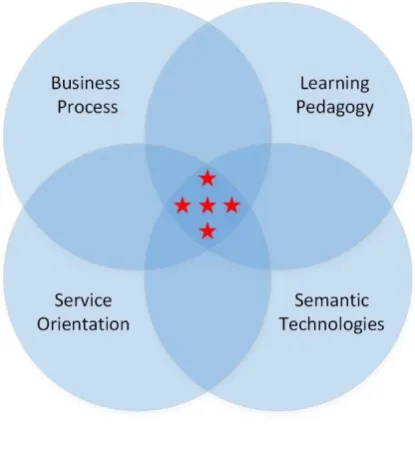
Figure 1.1: The Main Research Domains
This research is an attempt to build a framework for e-learning based on learning pedagogy and the following technologies as shown in Figure 1.1: the business process, semantics and service-orientation. First, this research will
4 sufficient to draw conclusions necessary to proceed to the subsequent research steps. Second, a business process will be used to model and enact various e-learning processes. These e-learning processes vary because: (i) they have different activities, and (ii) they might be individually or socially-oriented. Third, since the e-learning process is context-dependent to a large extent, semantic technologies will be used to capture context of e-learning processes and encode domain-specific rules to enrich the e-learning processes, and consequently tailor/customise e-learning processes according to the e-learner requirements to enhance his/her e-learning experience. Fourth, the semantically-enriched e-learning processes need to be dynamically enacted, so that their elements (e.g., activities, conditions, roles, etc.) can be mapped to software services. Therefore, Service-Oriented Architecture will be adopted to map e-learning processes to web services to respond to the e-learner’s requirements. These requirements vary from simple e-leaning activities (e.g., reading a lesson web page) to more complicated and cooperative one (e.g., engaging with other users and responding to learning requirements). Moving towards automated e-learning solution is one of the main aim of this research, therefore once the e-learning contents designed and published by instructors, and supportive teams, e-learners are expected to practice their e-learning activities without much involvement from their instructors. Instructors role is expected to be limited to respond to e-learners’ requests and help them to manage their learning journey.
1.3
Research Hypothesis and Questions
The research hypothesis in this thesis states that:
“A hybrid, semantically-enriched and process-based e-learning framework, when enacted using service oriented enabled
e-learning services, results in enhancing the e-learner’sexperience.”
Some of the above-stated research hypothesis aspects are further clarified according to the research context. First, hybrid means that the proposed e-learning framework will: (i) utilise different inputs, such as the e-learner’s
learning style, e-learner goals and skills, e-learning processes and learning resources, and (ii) combine different technologies and approaches (i.e., business process, semantics, and SOA) to enhance the e-learner’s experience. Second, process-based e-learning framework is associated with business process modeling and enactment
techniques to model and enact e-learners’ learning processes.
In order to thoroughly understand the drawbacks of the existing e-learning artefacts/processes and the potential for developing a generic e-learning process model, a literature review must be carried out. In this context, a generic e-learning process means that the model should be capable of generating a wide range, not all, of specialised
e-learning processes based on various contextual inputs. It is impossible to guarantee that the identified generic e-learning process can specialise to all possible learning processes due to the richness of learning domain; however, the most common e-learning processes must be covered. Therefore, the first research question is:
5 As mentioned earlier, e-learning processes need to be described and modelled in order to understand their activities, roles involved, produced artefacts and other related e-learning process constructs. In this research, Business Process Modelling and Notation (BPMN) will be utilised to capture and model e-learning processes. Hence, the second research question is:
Research Question 2: To what extent can the industry-standard Business Process Modelling and Notation capture e-learning processes?
As stated above, additional semantics can help in enriching the e-learner’s behaviour and e-learning processes. The e-Learner’s behaviour includes his/her interaction with e-learning artefacts, while an e-learning process is more comprehensive as it includes other roles involved in learning such as instructor and technician, actions specified by the instructor or organisation, etc. Therefore, the third research question is:
Research Question 3: To what extent can semantic-based approaches enrich e-learner’s processes and accordingly the e-learner’s behaviour?
After specifying the generic e-learning process and semantically enriching it, dynamically enacting the derived e-learning processes using service-oriented architecture is investigated in this research to enhancing the e-learner’s
experience. Therefore, the fourth research question is:
Research Question 4: Can the semantically-enriched generic e-learning process model and the e-learners’
behaviour models be dynamically enacted using service-oriented enabled e-learning services?
As this research aims at enhancing the e-learner’s learning experience, the impact of enacting the semantically-enriched e-learning processes in SOA-enabled environment needs to be assessed. Hence, the fifth research question is:
Research Question 5: What research evaluation methods/artefacts can be utilised to critically assess the enhancement of the e-learner experience using the e-learning research developed?
The above-mentioned research questions, listed in Table 1.1, have been identified based on the early-identified research hypothesis. Therefore, those research questions will be answered one by one in the coming chapters in order to prove or disprove the research hypothesis.
Table 1.1: Research Questions
RQ # Research Questions
RQ 1 What e-learning process models exist and how these models can be utilised to develop a generic e-learning model?
RQ 2 To what extent can the industry-standard Business Process Modelling and Notation capture e-learning processes?
RQ 3 To what extent can semantic-based approaches enrich e-learner’s processes and accordingly the e
-learner’s behaviour?
RQ 4 Can the semantically-enriched generic e-learning process model and the e-learners’ behaviour models
be dynamically enacted using service-oriented enabled e-learning services?
6 After identifying the research problem, hypothesis, and questions, it will be useful to define the scope of this research as follows. First, e-learning processes include various types of processes, such as: (i) learning processes where e-learners interact with learning activities and submit their assignments, (ii) management processes where quality and accreditation concerns are handled, permissions are assigned to users according to their organisational roles, (iii) design processes where e-learning and e-assessment contents/activities are designed and published, to name but a few. This research is after the first type of processes, learning processes or learning-oriented processes and other activities that directly impact learning activities. Other processes (e.g., management, design, etc.) are outside the scope of this research. To better support e-learning processes, only fine-grained e-learning processes are considered. Fine-grained e-learning processes include certain flow of activities and interaction implemented by e-learners and other supportive stakeholders (e.g., instructor, teaching assistant, learning buddies, etc.) to achieve some short-term goals (e.g., mastering a topic/lesson). However, course-grained e-learning processes are more complex and could span over one or more academic term/year and require additional supportive processes, such as management, design processes, etc., which are out of the scope. Expanding the scope of this research to cover such processes remains for future work.
Second, as explained earlier this research will incorporate pedagogy/learning theories to develop more effective
learning artefacts. However, it is beyond the scope of this research to delineate all learning theories used in e-learning contexts. Instead, this research will investigate the widely used e-learning theories and analyse them to design more effective e-learning artefact. Third, since business processes are used to model and enact e-learning processes, extensive comparison between current business process modelling notations and business process execution languages is out of the scope of this research. Instead, industry-standard modelling notation (i.e., Business Process Modelling Notation (BPMN) and Business Process Execution Language (BPEL)) will be adopted to model e-learning processes and dynamically enact them, respectively. Forth, as this research is limited to learning-oriented processes only, its outcomes (i.e., research artefacts) will be evaluated against e-learner-oriented concerns. This means that other concerns, such as institutional concerns (e.g., instructors are not responsive to their e-learners, which negatively impact their experience) are out of the scope. Similarly, other technical concerns such as Human Computer Interaction, interface design, usability concerns are not considered in this research.
1.4
Research Contributions
The principal contribution of this research is minimising the research gap, identified in Chapter 2, in enhancing the e-learner experience using a hybrid approach. In this approach, business process modelling notation has been used to model and enact the semantically-enriched e-learning processes in a service-oriented architecture. The following list summarises the main research contributions:
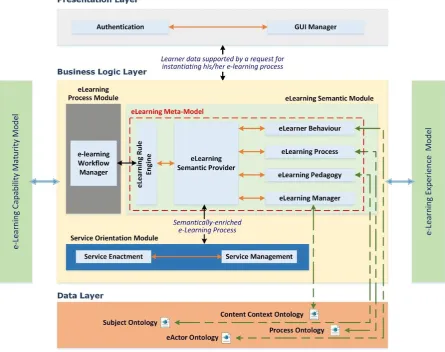
7 in the SOA-enabled environment. The HeLPS framework has been proposed as a three-layered architecture, where the Core Business Logic layer is composed of the next main artefacts. First, the e-Learning Meta-Model, which allows generating various models (i.e., producing a specific model out of the generic one), captures a high-abstract view of learning domain, decouples e-learning processes from contents and tools utilised in e-learning, and provides an interoperable approach for the various e-learning components to exchange the proper information and work collaboratively to enhance the e-learner experience. Second, the e-Learning Business Process artefact acts as a transformation mechanism to transform the generic e-learning process (i.e., captured in the e-Learning Meta-Model) to a specific e-learning process for a certain e-learner. Third, the Service-Orientation artefact, which allows enacting the early-specified and semantically-enriched e-learning process in SOA-enabled environment. 2- The Generic e-Learning Business Process and its Specialisation, which has been developed via: (i) deriving, in a bottom-up approach, specifications for different e-learning process models from a thorough pedagogical analysis and e-learning models/framework review and (ii) semantically enriching these e-learning process models via the e-Learning Meta-Model to generate various specific models out of the generic one, and (iii) dynamically enacting these e-learning process models using BPEL execution engine. 3- The Development of Rule-based Specialisation (Customisation) Mechanism represented by the Semantic Web Rule Language (SWRL) in order to: (i) encode domain-specific knowledge (e.g., rules), and (ii) generate a specialised e-learning process from the generic e-learning process for a particular e-learner. 4- Semantically-enriched Service Derivation algorithms to derive relevant web services based on the
behaviour encoded in the e-learning business process model and its constituent activities.
5- The e-Learner Experience Model (eLEM). Despite the obvious claim of using ICT to enhance teaching and learning, a limited investigation of the term enhancement was found in the literature. Neither the e-learner experience nor what is meant by enhancement in the context of e-learning have been clarified. To respond to this gap, eLEM has been developed to act as a model that can measure the impact of adopting certain e-learning artefact in a certain context.
6- The e-Learning Capability Maturity Model (eLCMM) has been developed based on Systems and Software Engineering standards: Systems and Software Quality Requirements and Evaluation (SQuaRE) Product Quality (PQ), Quality in Use (QiU), and Data Quality (DQ) models due to their comprehensive list of qualities that are precisely defined. The aim of developing such a model is to respond to research gap in: (i) assessing the e-learner experience and (ii) providing a path for improvement of the current e-learning practices. The eLCMM provides a defined evolutionary plateau towards achieving a mature e-learning process.
7- The e-Learning Evaluation Framework, which includes, in addition to the early-mentioned eLEM and eLCMM, a data-driven Validation and Verification Model to test and verify e-Learning Software Systems. A spiral instantiation process for evaluating the HeLPS e-Learning Framework has been developed to facilitate the application of this evaluation framework in certain contexts.
8 Learning is a process that includes further constructs such as the way of teaching and learning and its extended context. This entails that the e-learning context needs to be comprehensively specified through a mechanism that allows interoperable and flexible interactions between various constructs. So, adopting
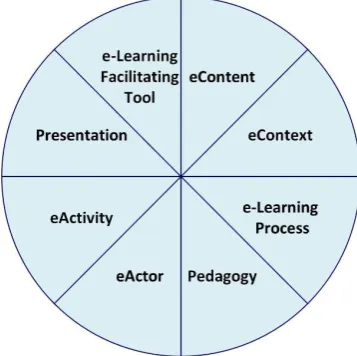
Model Driven Engineering (MDE) for the e-Learning Meta-Model that provides a hybrid approach to enhance the e-learner experience by capturing information about: (i) actors, (ii) e-learning pedagogy, (iii) content, (iv) process model, (v) external context, (vi) e-learning processes and activities, (vii) facilitating tools and (viii) presentation formats.
9- A Methodological Approach to Generalise a Business Process Model from a set of related business processes sharing the same goals and associated objectives. The proposed approach has been applied in the e-learning domain, which demonstrated its ability to develop a generalised e-learning business process model that is derived from the existing pedagogical models and technology-enhanced learning artefacts.
To facilitate these contributions, standard-based approaches such as Web Service Description Language have been adopted to describe learning/assessment web services. This makes it easier for such contributions to be applied by different researchers or organisations due to their implications on interoperability, flexibility, and agility. The above-listed contributions, especially the HeLPS e-Learning Framework, are important as they significantly expand the scope of learning process beyond resources recommendations. Learning is far complicated and needs to be investigated in many contexts, such as project-based learning and social learning, which is well considered in the above-listed contributions via modelling various detailed learning processes based on learning theories and abstracting them in one generic e-learning process.
Academic organisations, such as universities and colleges, deliver their teaching and learning services to a wide range of learners. Those learners are very different as they belong to different communities, have different background, skill, and preferences. Therefore, their needs/requirement are quite different and here is the main added value of this research. Furthermore, three of the above-mentioned contributions (i.e., the e-Learning Evaluation Framework, the e-Learner Experience Model, and the e-Learning Capability Maturity Model) have been designed and developed to evaluate the effectiveness of applying e-learning approaches at a certain organisation. e-Learning practitioner and experts are expected to find the above-listed contributions useful. Experts, in this context, refer to: (i) technological experts, who are looking for new developments in e-learning domain and (ii) educational experts who are looking after underpinning pedagogical theories and the best arrangements for effective learning environments.
1.5
Research Publications
The following papers stemmed from the work undertaken within the framework of this research:
R. Hammad, M. Odeh, and Z. Khan, “A Novel e-Learner Experience Model,” International Arab Journal of
9 R. Hammad, “Game-enhanced and Process-based e-Learning Framework,” In: El Rhalibi, A., Tian, F., Pan Z., (eds) Edutainment: The 11th International Conference on e-Learning and Games, Bournemouth, UK, 2017, Lecture Notes in Computer Science, Vol 9655, pp. 279 – 284, Springer.
R. Hammad, M. Odeh, and Z. Khan, “eLCMM: e-Learning Capability Maturity Model,” The 15th International Conference on e-Society (e-Society), Budapest, Hungary, 2017, pp. 169-178.
R. Hammad, M. Odeh, and Z. Khan, “Towards a Generalised e-Learning Business Process Model,” The 7th International Conference on Business Intelligence and Technology (BUSTECH), Athens, Greece, 2017, pp. 20-28.
R. Hammad, M. Odeh, and Z. Khan, “e-Learner Experience Model,” The 17th International Arab Conference on Information Technology (ACIT16), Beni-Mellal, Morocco, 2016, pp. 86-94.
R. Hammad and D. Ludlow, “Towards A Smart Learning Environment for Smart City Governance,” The 9th IEEE/ACM International Conference on Utility and Cloud Computing, Shanghai, China, 2016, pp. 185-190.
R. Hammad, M. Odeh, and Z. Khan, “Towards A Model-based Approach to Evaluating the Effectiveness of e-Learning,” The 9th European conference on IS management and evaluation (ECIME), Bristol, UK, 2015, pp. 111-119.
R. Hammad, M. Odeh, and Z. Khan, “Towards a Generic Requirements Model for Hybrid and Cloud-based e-Learning Systems,” The 5th International Conference on Cloud Computing (CloudCom), Bristol, UK, 2013, pp. 106-111.
1.6
Thesis Outline
10
2
Chapter 2:
Background and Literature Review
2.1
Introduction
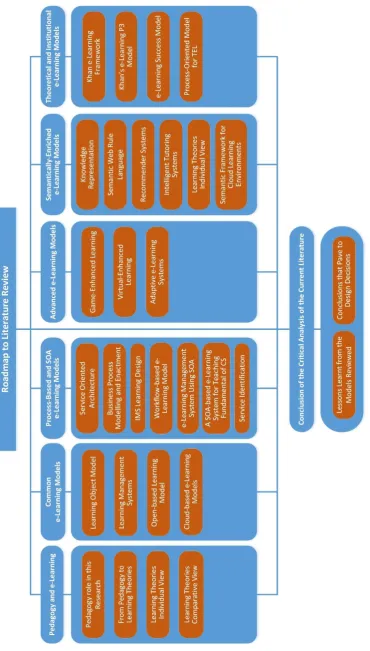
As introduced earlier, this research is multidisciplinary as it combines the following research domains: (i) e-learning pedagogy, (ii) business process modelling and enactment, (iii) semantic representation and (iv) service-oriented computing. These domains belong to two different disciplines: (i) social science which includes learning pedagogy and (ii) technology which includes the rest of the three domains. In general, pedagogy provides the basis for the overall e-learning framework, while the three remaining domains are seamless technologies that contribute to specify a learning process, semantically enrich it and finally enact it using service-oriented enabled environment to enhance the e-learner learning experience. Therefore, this chapter introduces a background to these domains and reviews the relevant literature. Figure 2.1 shows the roadmap for the literature review carried out in relation to this research.
2.2
Literature Review Approach
To conduct a comprehensive literature review, the following three phases have been followed: (i) planning, (ii) conducting the review and (iii) reporting the review. The Planning phase answers the basic questions: what to be covered, why and how. In the planning phase, the researcher uses scientific databases, library and other sources to get relevant literature. The main criteria for selecting the literature are: (i) they represent successful e-learning models, (ii) they are related to the domain of this research, (iii) they have distinctive features (i.e., they significantly differ) and (iv) their implications on learning and teaching practices are important and relevant to this research context. A second-cut filtering has been performed to exclude unrelated research/sources.
11
F
ig
ure
2
.1
: Ro
adma
p
t
o
Li
ter
at
ure
Rev
ie
[image:29.595.117.488.99.751.2]12 institutional models that set out general rules and framework for adopting e-learning, (v) advanced models that use
unconventional techniques, such as adaptive systems and virtually-enhanced systems and (vi) pedagogical models that refer to the broad principles through which the theory is applied in learning context, they usually align with a pedagogical approach or learning theory (Conole, 2010).
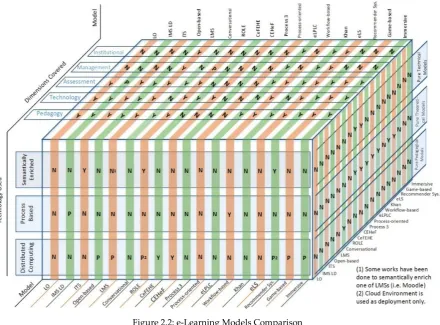
For better investigation and analysis, the early-identified models have been labelled as: (i) core model which refers to models used in other e-learning models (e.g., Learning Objects), (ii) standard-based which refers to specifications adopted by internationally recognised bodies (e.g., IMS LD), (iii) full system which refers to systems applied and adopted by institutions (e.g., Blackboard), (iv) concept which refers to research-based models which could be abstract, design-based or proposed framework, (v) prototype which refers to pilot implementations rather than actual implementation (e.g., most of the adaptive systems), and (vi) theoretical which refers to models suggested to set up general e-learning settings (e.g., Khan e-learning framework). Table 2.1 lists all reviewed models, while Figure 2.2 reveals their differences/diversity.
Table 2.1: Selected e-Learning Models
# Model Title Code Model Category Artefact Lifecycle
Stage 1. Learning Object
- Sub Model: IEEE LOM and Extended Learning Object Model
C1
Common e-Learning Models
Core Model IEEE LOM is a standard model
2. Open-based Models
- Sub Model: MOOCs, OERs, OCWs, FutureLearn
C2
Sub/Full systems
3. Learning Management Systems - Sub Model: e-Training
C3
Full systems
4. Cloud-based Models C4 Concept
5. IMS Learning Design PS1
Process-based and Service-oriented e-Learning Models
Standard
6. Workflow enabled e-Learning Services PS2 Concept
7. e-Learning Management System Using Service Oriented Architecture
PS3
Prototype
8. A SOA-based e-Learning System for Teaching Fundamental Information of Computer Science Courses
PS4
Prototype
9. A Service-oriented Architecture for Adaptive and Collaborative e-Learning System
PS5
Prototype
10.Intelligent Tutoring Systems S1
Semantically-enriched e-Learning Models
Full systems and prototype
11.ROLE S2 Prototype
12.Recommender Systems S3 Full systems and
prototype
13.Game-based e-learning model A1
Advanced e-Learning Models
Full systems
14.Virtual-Enhanced e-learning models A2 Full systems
15.Adaptive e-learning model A3 Prototype
16.Khan’s e-learning Framework T1
Theoretical & Institutional e-Learning
Models
Theoretical
17.Khan’s 3P Model T2 Theoretical
18.E-Learning Success Model T3 Theoretical
13
# Model Title Code Model Category Artefact Lifecycle
20.Kolb’s Experiential Learning Cycle P1 Pedagogical e-Learning Models
Theoretical
21.Merill’s Instructional Design Model P2 Theoretical
Keys:
C 1..4 Common Models
PS 1..5 Process and Service Oriented Model S 1..3 Semantically-enriched Models A 1..3 Advanced Models
T 1..4 Theoretical Models P 1,2 Pedagogical Models
The second phase is conducting the review. It includes: (i) reviewing the early-identified models via related sources to extract the appropriate information and (ii) analysing them using SWOT analysis to identify model’s strengths
(S), weaknesses (W), opportunities (O) and threats (T) that are related to this research scope (i.e., hypothesis and questions) (Ming et al., 2014). All models have been compared against ISO 25010 and ISO 25012: Systems and software Quality Requirements and Evaluation (SQuaRE) Product Quality (PQ), Quality in Use (QiU) and Data
[image:31.595.78.519.325.650.2]Quality (DQ) standards as they have a list of precisely defined qualities which provide consistent approach to perform comparative analysis. Additional qualities (i.e., pedagogically-based) to the early-identified PQ, QiU and DQ have been driven from literature to accommodate the particularities of e-learning domain/artefacts. Lessons learnt from this review will be inspire the design and instantiation of the proposed solution/artefact because the expected artefact should reinforce strengths, overcome weaknesses, facilitate or realise opportunities and mitigate/counter threats. The final phase is reporting the results. This phase manifested itself through documenting
14 the reviewed literature in terms of (i) information supported by figures and proper visualisation and (ii) critical reflections on the gap in the existing literature. This will be used to rationalise the new proposed e-learning framework and pave the ground for the research design phase.
2.3
Pedagogy and e-Learning
Pedagogy is defined by the Cambridge Dictionary as ‘the study of the methods and activities of teaching.1’ Also, it refers
to ‘the art or science of teaching’ (Beetham and Sharpe, 2007). Further investigation into pedagogy reveals the little
consensus in the literature upon one definition. One reason for that is that pedagogy is an interrelated concept and should be considered within its larger context. This entails that ICT-based educational practices be considered as a larger framework that e-learning pedagogy may be explained within. Another reason for the little consensus is the dynamic nature of pedagogy because our understanding of pedagogy does not remain static (Webb and Cox, 2004). Consequently, our conceptualisation about pedagogy becomes more complex over time as a result of our growing understanding of theories underpinning pedagogy such as cognition and metacognition (Watkins and Mortimore, 1999). Nevertheless, the UK universities’ research assessment exercise (RAE) developed a more generic definition for pedagogy to include reference to the processes, experiences, contexts, outcomes and relationships of teaching and learning in higher education (RAE, 2006). This definition affirms the dialogue initiated between learning and
teaching in pedagogy (Beetham and Sharpe, 2007), where learning asserts the active participation of the learner instead of the passivity implied by teaching. This intimate connection between learning and teaching is more
realistic from the researcher’s point of view as real life learning could contain, even implicitly, some aspects of teaching.
So, this part of the research is an attempt to thoroughly understand the current conceptions of pedagogy in order to suggest how the new innovative technologies can be useful in the context of learning and teaching. In other words, developing a successful e-learning artefact requires establishing a proper understanding of pedagogy first and then making suitable technological interventions. Since learning differs from one learner to another and from one context to another, successful e-learning artefact should be generic in order to respond to different learning contexts, such as formal, informal, professional or lifelong learning. Such technological interventions can be realised in the form of e-learning models or frameworks. In this research, models and frameworks are used interchangeably. Although some researchers tend to use frameworks to express a more comprehensive artefact or technological interventions than models, evidence from literature shows that both terms can be used interchangeably (Conole, 2010).
2.3.1 From Pedagogy to Learning Theories
Learning environments/spaces have significantly evolved into complex, multipurpose, technology-intensive environments (Bonanno, 2010b). For instance, LMSs have strongly dominated the e-learning domain (Mikroyannidis, 2012), they integrate administrative and management capabilities, social tools, complex
15 architectures and course-based capabilities. This cross-domain, rapid and intensive development has led to complex learning environments/spaces, where learners need effective guidance based on careful consideration for the underlying complex pedagogical models. The incorporation or reconsideration of the pedagogical theories/models is required to enable technology to enhance the overall learning process and more specifically the e-learner experience.
The reviewed literature reveals two arguments regarding the use of learning theories in learning and teaching. The first is the anti-theory argument, which does not believe in theories at all. Robert Gagne and B. F. Skinner are examples of this approach, as they do not consider that a learning phenomenon can be explained by simple theories (Gagné, 1965). The second argument, adopted in this research, considers learning theories as an essential component of teaching and learning. Various researchers claim that following a learning theory approach is inevitable in any good pedagogy design (Conole, 2010; Schunk, 2012; Mayes and De Freitas, 2004). In this research, learning refers to the act or process by which behavioural change, knowledge, skills and attitudes are acquired (Boyd and Apps, 1980) based on external or internal stimuli (Susimetsa, 2006), while theory refers to a comprehensive, coherent, and internally consistent system of ideas about a set of phenomena (Knowles, Holton III and Swanson, 2011). This research investigates learning theories that provide empirically-based accounts of the variables which influence the learning process, and provide explanations of the ways in which that influence occurs (Mayes and De Freitas, 2004), but not e-learning theories that overlap with other categories of theories such as Human Computer Interaction (HCI) and Information Structuring theories (Hoadley, 2007). The next section will present an analytical review of learning theories that are widely utilised in e-learning contexts along with an attempt to adopt a taxonomy of the different schools of learning theories.
2.3.2 Learning Theories
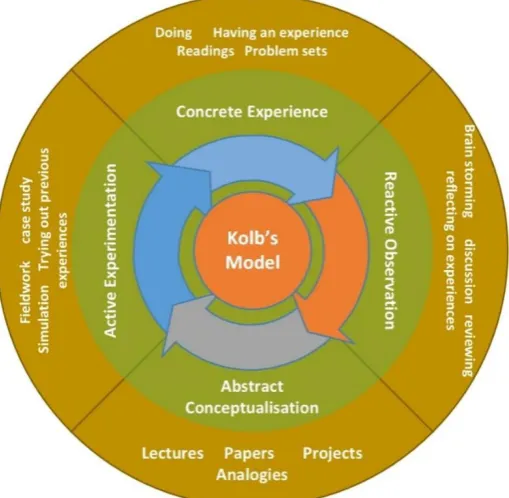
In this section, first, the most common learning theories are presented, then the second part briefly discusses: (i) other learning theories within the context of specific learning approaches (e.g., Pinritch theories in the context of Self-Regulated Learning) and (ii) the two pedagogical models (Kolb’s Learning Cycle and Merill’s Design Principles) as examples to reveal their value in e-learning contexts. The third part presents one of the most adopted classifications for learning theories (i.e., Mayes and de Freitas classification) with some reflections. Finally, the fourth part concludes this section with a comparative summary of learning theories. It is essential to say that it is beyond the scope of this research to delineate all learning theories used in e-learning contexts. Full comprehensive coverage can be found in the literature (e.g., (Harasim, 2012; Knowles et al., 2011; Schunk, 2012) and (Millwood, 2013)).
2.3.2.1 Learning Theories: the Individual Approach
Behaviourism
16
in the learner’s behaviour (Kruse, 2009). Behaviourism is associated with a number of theorists such as: Pavlov, Watson, Thorndike, Skinner and Bandura; however, Skinner’s view is currently the most dominant. Moreover,
behaviourism is divided into two types: (i) classical conditioning, which refers to natural reflexes in response to various stimuli and (ii) operant conditioning, which refers to the reinforcement of these responses through the concept of extrinsic rewards/punishments so that such responses become more/less probable in the future (Susimetsa, 2006). On the one hand, behaviourism is attractive because it is simple and easily explains some learner actions or situations (Collins, 2002). Yet on the other hand, it has been criticised because it does not explain the
internal learning processes or learners’ reasoning and thinking, especially higher-level critical thinking skills and problem solving (Kruse, 2009; AlAgha, 2009). Behaviourism is tightly coupled with Instructional Design (ID) models such as Merrill First Five Principles model that: (i) engage learners in a problem, (ii) allow them to activate their knowledge, (iii) allow them to discover knowledge through demonstration, (vi) allow them to apply and (v) integrate knowledge in the wider context (Merrill, 2002). Additional ID models, also known as pedagogical models, exist such as: (i) ADDIE: Analyse, Design, Develop, Implement and Evaluate, (ii) Dick and Carey Systems Approach Model and (iii) Gagné's Nine Events of Instruction (Gagné et al., 2005).
Direct Instruction
Direct Instruction (DI) refers to the academic focus, precise sequencing of content, high learner engagement, careful teacher monitoring, and specific corrective feedback to learners (p. 35) (G. G. Duffy and Roehler, 1982). This contradicts with exploratory models such as inquiry-based learning. According to Huitt et al, one of DI variant models, DI is composed of three main activities: (i) presentation which introduces knowledge, reviews new concepts, explains and reflect upon them, etc., (ii) practice which allows learners to practice learned knowledge under guided and independent practice schemes, and (iii) assessment and evaluation which include formative and summative assessment (Huitt, Monetti and Hummel, 2009). This model puts further emphasis on practice, close observation and feedback.
Cognitivism
17 processes used in human learning (T. Bates, 2015). On the other hand, and from an epistemological perspective, it belongs to objectivism which means that knowledge is absolute, matches reality (Harasim, 2012) and exists outside the human mind, independently of what an individual may or may not believe (A. W. Bates and Poole, 2003) which is not true for all kind of knowledge.
Social Learning Theory
Learning has been linked to its social perspective in many views. For instance, Wenger recognises learning as a social process (Wenger et al., 2002). Moreover, Bates explains that knowledge is either acquired through: (i) a social process or (ii) institutions that are socially constructed, e.g., schools/universities. Consequently, knowledge is conceptualised as content plus the socially constructed value (T. Bates, 2015). In social learning theory, knowledge is constructed via social interaction, and learners are able to learn from observing and interacting within social and cultural contexts (Ruohotie, 2000; Kruse, 2009; Bandura and McClelland, 1977). Hence, social learning theory is related to cognitive learning theories because it admits the existence of individual intelligence and reasoning abilities (Susimetsa, 2006). The rapid developments in social tools influenced TEL and led to inventing social learning environments2.
Constructivism
Constructivism is one of the main learning paradigms. Unlike the previous behaviourist and cognitivist paradigms, constructivism takes a holistic approach. In constructivism, each learner constructs his/her own knowledge for him/herself, each learner individually and socially constructs meaning while he/she learns (Hein, 1991). Hence, learners make sense of their external environments by a meaning-making process, which depends on previous and current internal experience (T. Bates, 2015). Constructivism assimilates most of the cognitive-based learning theories such as information processing and social learning theories (Susimetsa, 2006). Additionally, it is not as deterministic as behaviourism and some elements of cognitivism in terms of the predictable behaviour of learners (Susimetsa, 2006). Constructivists claim that it takes more realistic and logical perspective since it focuses on the uniqueness of learners. Humans are very dynamic in nature; their views and values change over time and this change reflects on the future knowledge. Moreover, the learner is at the centre of a continuously changing rich world of facts, experiences and knowledge. Hence, the learners perceive external knowledge/information and interpret it according to their internal understanding (Rogers, 1969; T. Bates, 2015).
So, learning is a complex recursive phenomenon, and every individual: (i) is unique in his/her own way of thinking, (ii) his/her behaviour is not predictable or deterministic and (iii) uses previous knowledge to make meaning of his/her environment. Constructivism is attached to the following two essential concepts: (i) assimilation, where learners fit new information within their existing mental framework and (ii) accommodation, where learners add to/modify their existing mental framework. Wadsworth nicely describes accommodation as a qualitative change while assimilation is a quantitative change (Wadsworth, 2004). Constructivism has been criticised because previous le