
Semi-supervised Chinese Word Segmentation based on Bilingual
Information
Wei Chen
Institute of Automation, Chinese Academy of Sciences,
Beijing, 100190, China [email protected]
Bo Xu
Institute of Automation, Chinese Academy of Sciences,
Beijing, 100190, China [email protected]
Abstract
This paper presents a bilingual semi-supervised Chinese word segmentation (CWS) method that leverages the nat-ural segmenting information of English sentences. The proposed method in-volves learning three levels of features, namely, character-level, phrase-level and sentence-level, provided by multiple sub-models. We use a sub-model of condi-tional random fields (CRF) to learn mono-lingual grammars, a sub-model based on character-based alignment to obtain ex-plicit segmenting knowledge, and anoth-er sub-model based on translitanoth-eration sim-ilarity to detect out-of-vocabulary (OOV) words. Moreover, we propose a sub-model leveraging neural network to ensure the proper treatment of the semantic gap and a phrase-based translation sub-model to s-core the translation probability of the Chi-nese segmentation and its corresponding English sentences. A cascaded log-linear model is employed to combine these fea-tures to segment bilingual unlabeled data, the results of which are used to justify the original supervised CWS model. The eval-uation shows that our method results in su-perior results compared with those of the state-of-the-art monolingual and bilingual semi-supervised models that have been re-ported in the literature.
1 Introduction
Chinese word segmentation (CWS) is generally accepted to be a necessary first step in most Chi-nese NLP tasks because ChiChi-nese sentences are written in continuous sequences of characters with no explicit delimiters (e.g., the spaces in English). Many studies have been conducted in this area, re-sulting in extensive investigation of the problem of
CWS using machine learning techniques in recent years. However, the reliability of CWS that can be achieved using machine learning techniques re-lies heavily on the availability of a large amount of high-quality, manually segmented data. Because hand-labeling individual words and word bound-aries is very difficult (Jiao et al., 2006), producing segmented Chinese texts is very time-consuming and expensive. Although a number of manual-ly segmented datasets have been constructed by various organizations, it is not feasible to com-bine them into a single complete dataset because of their incompatibility due to the use of various segmenting standards. Thus, it is difficult to build a large-scale manually segmented corpus, and the resulting lack of such a corpus is detrimental to further enhancement of the accuracy of CWS.
To address the scarcity of manually segment-ed corpora, a number of semi-supervissegment-ed CWS approaches have been intensively investigated in recent years. These approaches attempt to ei-ther learn the predicted label distribution (Jiao et al., 2006) or extract mutual information ((Liang et al., 2005); (Sun and Xu, 2011); (Zeng et al., 2013a)) from large-scale monolingual unlabeled data to update the baseline model (from manual-ly segmented corpora). In addition to these tech-niques, several co-training approaches (Zeng et al., 2013b) using character-based and word-based models have also been employed. However, be-cause monolingual unlabeled data contain limit-ed natural segmenting information, in most semi-supervised methods, the objective function tend-s to be optimized batend-sed on the pertend-sonal experi-ence and knowledge of the researchers. This prac-tice means that these methods can typically yield high performance in certain specialized domain-s, but they lack generalizability. In contrast with these methods, we propose to leverage bilingual unlabeled data, i.e., a Chinese-English corpus with sentence alignment. Because English sentences
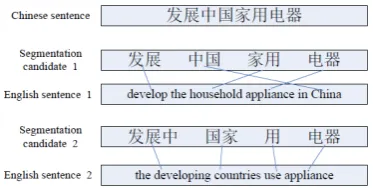
Figure 1: The examples of different segmentation on the same Chinese sentences guided by the En-glish sentences
are naturally segmented, extracting information from a bilingual corpus is a much more objective task. As the example presented in Fig 1 shows, the English sentences that correspond to Chinese text can easily help guide better segmentation, and thus, the learning of segmenting information from bilingual data is a very promising approach.
In this paper, to obtain high-quality segment-ing information from bilsegment-ingual unlabeled data, we leverage multilevel features using the following steps: first, we integrate character-level features calculated using a conditional random field (CRF) model, which is used to capture the monolingual grammars. Then, we employ a statistical align-er to palign-erform charactalign-er-based alignment. Given the results of this character-based alignment, we apply several phrase-level features to extract ex-plicit and imex-plicit segmenting information: (1) we use two types of English-Chinese co-occurrence features (one-to-many and many-to-many) to learn the explicit segmenting information of the English sentences, (2) we use the transliteration similarity feature to detect out-of-vocabulary (OOV) words using a phrase-based translation model, and (3) we employ a neural network to calculate the seman-tic gap between the Chinese and English words to ensure that the Chinese segmentation follows the semantic meanings of the corresponding En-glish sentences as closely as possible. Finally, we employ another phrase-based translation model to perform a sentence-level calculation of the trans-lation probability of the Chinese segmentation and its corresponding English sentences. After obtain-ing these multilevel features, we normalize them and combine them into two log-linear models in a cascaded structure, which is illustrated in Fig 2. Finally, we segment the bilingual unlabeled da-ta using the proposed model and use the segmen-tation of those data to justify the original
super-Figure 2: The structure of cascaded log-linear model with multilevel features
vised CWS model, which was trained on a stan-dard manually segmented corpus.
In fact, several semi-supervised CWS methods have previously been proposed that leverage bilin-gual unlabeled data ((Xu et al., 2008); (Chang et al., 2008); (Ma and Way, 2009);(Chung et al., 2009); (Xi et al., 2012)). However, most were de-veloped for statistical machine translation (SMT), causing them to focus on decreasing the perplex-ity of the bilingual data and the word alignmen-t process raalignmen-ther alignmen-than on achieving more accuraalignmen-te segmentation. These methods achieve significan-t improvemensignifican-t in SMT performance busignifican-t are nosignifican-t very suitable for common NLP tasks because in many situations, they ignore the standard gram-mars to satisfy the needs of SMT. By contrast, we employ various types of features to capture both monolingual standard grammars and bilin-gual segmenting information, which allows our semi-supervised CWS model to be very efficient at other NLP tasks and endows it with higher gen-eralizability.
Our evaluation also shows that our method sig-nificantly outperforms the state-of-the-art mono-lingual and bimono-lingual semi-supervised approaches.
2 Related Work
First, we review related work on monolingual supervised and semi-supervised CWS methods. Then, we review bilingual semi-supervised CWS.
2.1 Monolingual Supervised and Semi-supervised CWS Methods
[image:2.595.310.519.61.147.2]al., 2005); (Zhang and Clark, 2007); (Zhao et al., 2010)). However, the primary shortcoming of these approaches is that they rely heavily on a large amount of labeled data, which is very time-consuming and expensive to produce. Thus, the s-cale of available manually labeled data has placed considerable limitations on the further enhance-ment of supervised CWS methods.
To address this problem, a number of semi-supervised CWS approaches have been intensive-ly investigated in recent years. For example, (Sun and Xu, 2011) enhanced their segmenta-tion results by interpolating statistics-based fea-tures derived from unlabeled data into a CRF mod-el. (Zeng et al., 2013a) introduced a graph-based semi-supervised joint model of Chinese word seg-mentation and part-of-speech tagging and regular-ized the learning of a linear CRF model based on the label distributions derived from unlabeled da-ta. However, because monolingual unlabeled data lack natural segmenting information, most previ-ous semi-supervised CWS methods have required certain assumptions to be made regarding their ob-jective functions based on the researchers’ person-al experiences. By contrast, we leverage bilinguperson-al unlabeled data that contain the natural segmenta-tion that is present in English sentences and can therefore extract linguistic knowledge without any manual assumptions or bias.
2.2 Bilingual Semi-supervised CWS Methods
Some previous work ((Xu et al., 2008); (Chang et al., 2008); (Ma and Way, 2009);(Chung et al., 2009); (Xi et al., 2012)) has been performed on leveraging bilingual unlabeled data to achieve bet-ter segmentation, although most such studies have focused on statistical machine translation (SMT). These approaches leverage the mappings of indi-vidual English words to one or more consecutive Chinese characters either to construct a Chinese word dictionary for maximum-matching segmen-tation (Xu et al., 2004) or to form a labeled dataset for training a sequence labeling model (Peng et al., 2004). (Zeng et al., 2014) also used such map-pings to bias a supervised segmentation model to-ward a better solution for SMT. However, because most of these approaches focus on SMT perfor-mance, they emphasize decreasing the perplexity of the bilingual data and word alignment rather than improving the CWS accuracy. Thus, they sometimes ignore the standard grammars during
segmentation in favor of satisfying the needs of SMT, thereby causing these methods to be rather unsuitable for other NLP tasks. By contrast, we propose to use various types of features to capture syntactic and semantic information and a cascaded log-linear model to maintain balance between the monolingual grammars and the bilingual knowl-edge.
3 Multilevel Features
In this section, we describe the three levels of fea-tures used in our approach. We propose to use character-level features to capture monolingual grammars and phrase-level and sentence-level fea-tures to obtain bilingual segmenting information. Moreover, we describe a cascaded log-linear mod-el by proposing both inner and outer log-linear models.
3.1 Character-level Feature
The conditional random field (CRF) (Lafferty et al., 2001) model was first used for CWS tasks by (Xue et al., 2003) who treated the CWS task as a sequence tagging problem and demonstrated this model’s effectiveness in detecting OOV words.
In this paper, we score the character-level fea-ture in the same manner defined by (Xue et al., 2003). For the jth character cj in the sentence cJ
1 = c1...cJ, the score can be calculated as
fol-lows:
fCRF(j) =
X
k
λkfk(yj−1, yj, cJ1, j) (1)
where fk(yj−1, yj, cJ1, j) is a feature function
andλk is a learned weight that corresponds to the featurefk. j represents the index of the character
in the sentence. yj−1 andyj represent the tags of
the previous and current characters, respectively. We do not introduce the CRF-based CWS mod-el in detail here, but more information can be ob-tained from (Lafferty et al., 2001) and (Xue et al., 2003).
3.2 Phrase-level Features
3.2.1 English-Chinese Character-based Alignment
To avoid introducing omissions and mistakes in-to the linguistic information in the initial segmen-tations of the bilingual data, we perform a statis-tical character-based alignment: First, every Chi-nese character in the bitexts is separated by white spaces so that individual characters are recognized as unique/words0 or alignment targets. Then,
they are associated with English words using a s-tatistical word aligner.
By representing the English and Chinese sen-tences aseI
1 = e1e2...eI andcJ1 = c1c2...cJ,
re-spectively, where ei and cj represent single
ele-ments of the sentences, we define their alignment as aK
1 , of which each element is a spanak =< s, t >and represents the alignment of the English word es with the Chinese characterct. Then, the corpus of unlabeled bilingual data can be repre-sented as the set of sentence tuples<eI
1,cJ1,aK1 >
To obtain the character-based alignment, we employ an open-source toolkit Pialign1 ((Neubig et al., 2011); (Neubig et al., 2012)) which us-es Bayus-esian learning and inversion transduction grammars.
3.2.2 Features Obtained from the Character-based Alignment
Given the English-Chinese character-based align-mentaK
1 , we extract several phrase-level features
to optimize the segmentation. For the jth char-acter in cJ
1, we assume that one of the
segmen-tations of the substring cj1 can be represented as
wN1 +1 = w1w2w3...wN+1 = cj11 cj2j1+1...cjjN+1.
Then, we calculate the scores of each Chinese word wn = cjn
jm (jm = jn−1 + 1) in wN1 +1
us-ing the followus-ing features.
English-Chinese One-to-Many Alignment
To evaluate the probability that a sequence of Chinese characterscjn
jm = cjmcjm+1...cjn should
be combined into a wordwn based on the
corre-sponding English sentence, we integrate the fea-ture of English-Chinese one-to-many alignmen-t (one English word is aligned wialignmen-th mulalignmen-tiple Chi-nese characters). First, for any English wordei in
eI
1, the phrase tuple< ei, cjjnm >can be defined as
an aligned One-to-Many phrase tuple if it satisfies the following conditions:
(1)< i, jm >∈aK1 ,< i, jn>∈aK1
(2)∀j0 ∈/[jm, jn],< i, j0 >/∈aK
1 1http://www.phontron.com/pialign/
(3)∀i0 6=i§∀j0 ∈[j
m, jn],< i0, j0>/∈aK1
Then, for any phrase tuple< ei, cjjnm >that
sat-isfies these conditions, the span< i, jm, jn >is defined as a One-to-Many span and as a member of the setAOne.
Thus, for each span< i, jm, jn >, the
One-to-Many score can be calculated as follows:
s(< i, jm, jn>) =
(
t(cjn
jm|ei) if < i, jm, jn>∈AOne 0 else
(2)
wheret(cjn
jm|ei)represents the translation
proba-bility of the phrase tuplecjn
jm|ei.
Finally, the score for the feature of English-Chinese One-to-Many alignment forwn =cjjnm is
derived as follows:
fOne−to−Many(n) = argmax
i∈[1,I] s(< i, jm, jn>) (3)
English-Chinese Many-to-Many Alignment
The second phrase-level feature, called English-Chinese Many-to-Many Alignment (multiple En-glish words are aligned with multiple Chinese characters), is used to evaluate the probability that a space should be inserted betweencnandcn+1.
Similar to One-to-Many alignment, for any se-quence of English wordsei2i1 and the Chinese word
wn = cjjnm, the phrase tuple < ei2i1, c
jn
j1 > is
de-fined as an aligned Many-to-Many phrase tuple if it satisfies the following conditions:
(1)j1 ≤ jm, andj1 is the beginning character
of a word inwn
1
(1)< i1, j1 >∈a1K,< i2, jm >∈aK1
(2)∀j0 ∈/[j1, jm],∀i0 ∈[i1, i2],< i0, j0>/∈aK
1
(3)∀j0 ∈[j1, jm],∀i0 ∈/[i1, i2],< i0, j0>/∈aK
1
Then, for any phrase tuple< ei2i1, cjn
jm >that
sat-isfies these conditions, the span< i1, i2, j1, jn >
is defined as a Many-to-Many span and as a mem-ber of the setAMany.
Thus, for each span < i1, i2, j1, jn >, the
Many-to-Many score can be calculated as follows:
s(< i1, i2, j1, jn>) =
t(cjn
j1|e
i2
i1)
if < i1, i2, j1, jn>∈AMany
0 else
(4)
wheret(cjn
j1|ei2i1)represents the translation
proba-bility of the phrase tuple< ei2i1, cjn
Finally, the score for the feature of English-Chinese Many-to-Many alignment for wn = cjjnm
is derived as follows:
fMany−to−Many(n) = argmax i1∈[1,I]i2∈[i1,I]j1≤jm
s(i1, i2, j1, jn) (5)
Transliteration Feature
To account for named entities (NEs), which suf-fer from sparsity and thus make it difficult to cal-culate the probabilities discussed above, we intro-duce a transliteration feature to evaluate the simi-larities between the pronunciations of Chinese and English words because many NEs are translated via transliteration. To perform this task, we first introduce an initial NE dictionary and convert each dictionary item—for example, we convert ”Ow
d/Alice” into ”ai l i s i/a l i c e” —by
transform-ing the Chinese word into its pronunciation (rep-resented by the functionFpy(·)) and splitting the
English word into its constituent letters (represent-ed by the function Flet(·)). Then, we train two
phrase-based translation models (Chinese-English and English-Chinese) on the data obtained from the converted NE dictionary.
Specifically, we apply two standard log-linear phrase-based SMT models. The GIZA++ align-er is adopted to obtain word alignments (Och and Ney, 2000) from the converted NE dictio-nary. The heuristic strategy of grow-diag-final-and (Koehn et al., 2003) is used to combine the bidi-rectional alignments to extract phrase translations and to reorder tables. A 5-gram language mod-el with Kneser-Ney smoothing is trained using S-RILM (Stolcke et al., 2002) on the target language. Moses (Koehn et al., 2007) is used as a decoder. Minimum error rate training (MERT) (Och et al., 2003) is applied to tune the feature parameters on the development dataset.
Given these two phrase-based translation mod-els, we calculate each span< i, jm, jn>inAOne
for the Chinese wordwnusing the following
for-mula:
Str(< i, jm, jn>) =Sch−en(< i, jm, jn>)
+Sen−ch(< i, jm, jn>) (6)
where Sch−en(<i, jm, jn>) = DLev(Fletei, P Tch−en(Fpy(cjjnm))) means that the
pronuncia-tion conversion in the Chinese-English direcpronuncia-tion is performed as follows: First, the English word
ei is split into its constituent letters; Second, the
sequence of Chinese characters cjn
jm is converted
into its pronunciation; Third, this pronunciation is input into the Chinese-English phrase-based trans-lation model, and the corresponding transtrans-lation re-sult is obtained; And finally, the Levenshtein dis-tance between the English letters and the transla-tion result is returned.
Sen−ch(<i, jm, jn>) can be calculated in
ex-actly the same way.
We set any span that does not belong to AOne
to zero, and the transliteration feature score of a wordwn=cjjnmis derived as follows:
ftransliteration(n) = argmax
i∈[1,I] Str(< i, jm, jn>) (7)
English-Chinese semantic gap feature
To guarantee that the semantic meanings of the Chinese segmentation match those of the corre-sponding English sentences as closely as possible, we propose to use a feature based on the English-Chinese semantic gap to ensure the retention of se-mantic meaning during the segmentation process.
First, we pre-train word embeddings using the open-source toolkit Word2Vec (Mikolov et al., 2013) on the Chinese (segmented using character-level features only) and English sentences sepa-rately, thereby obtaining the vocabulariesVchand Ven and their corresponding embedding matrixes Lch∈Rn×|Vch|andLen∈Rn×|Ven|. Given a
Chi-nese wordwnwith an index i in the vocabulary, it
is then straightforward to retrieve the word’s vec-tor representation via simple multiplication with a binary vector d that is equal to zero at all positions except that with index i:
Xi=Lchdi∈Rn (8)
Because the word embeddings for the two lan-guages (Lch andLen) are learned separately and
located in different vector spaces, we suppose that a transformation exists between these two seman-tic embedding spaces. Thus, we collect all the One-to-Many phrase tuples< e1, cj2j1 > that
sat-isfye1∈Venandcj2j1 ∈Vchfrom the entire corpus
of bilingual data. Then, we insert the word embed-ding tuple of each One-to-Many phrase tuple into the setAembed. Let us consider a word embedding
tuple < ps, pt > in Aembed as an example. We
Esem(ps, pt;θ) =Esem(ps|pt, θ) +Esem(pt|ps, θ) (9)
Here, Esem(ps|pt, θ) = Esem(pt, f(Wch enps + bch
en)) represents the transformation of ps and is
performed as follows: We first multiply a parame-ter matrixWch
en byps, and after adding a bias term bch
en, we apply an element-wise activation function f =tanh(·). Finally, we calculate their Euclidean distance:
Esem(ps|pt, θ) = 12||pt−f(Wenchps+bchen)||2 (10)
Esem(pt|ps, θ)can be calculated in exactly the
same way.
Given the definition of the semantic distance of each word-embedding tuple inAembed, we wish to
minimize the following objective function:
J = X
<ps,pt>∈Aembed
Esem(ps, pt;θ) (11)
We apply the Stochastic Gradient Descent (S-GD) algorithm to optimize each parameter and ul-timately obtain the optimized parametersθ∗.
Usingθ∗, we can calculate the semantic gap for
any possible span forwn, such as < i, jm, jn >,
as follows:
Sgap(< i, jm, jn>) =
1
Esem(p0s|p0t,θ∗)
if ei∈Ven cjjnm∈Vch
< i, jm, jn>∈AOne
0 else
(12)
wherep0
sandp0tare the word vector representation
ofeiandcjjnm, respectively. Thus, the semantic gap
feature score of the wordwn =cjn
jm is derived as
follows:
fsem(wn) = argmax
i∈[1,I] Sgap(< i, jm, jn>) (13)
3.2.3 Normalization and the Inner Log-Linear Model
Because the output scores of each sub-model de-scribed above are not probabilistic and they vary by orders of magnitude, we must first normalize
the output scores of each sub-model. After nor-malization, the scores have means and standard deviations of zero. We represent the normalization function byNorm(·).
Thus, for the substringcj1 (j ∈ [1, J)) incJ
1 of
the sentence tuple <eI
1, cJ1, aK1 >, assuming that
one of its candidate segmentations is wN+1
1 =
w1w2w3...wN+1 = cj11 cj2j1+1...cjjN+1, the feature
score of the inner log-linear model is derived as follows:
finner = X j0∈[1,j]
Norm(fCRF(j0))+
λ1 X
n∈[1,N+1]
(X
k
Norm(fk(n)))
(14)
wherefk(n)represents the phrase-level features.
Then, we tune the weightλ1from 0 to 1 in equal
increments of 0.1 to optimize its value.
3.3 Sentence-level Features
In this section, we describe the sentence-level fea-tures calculated using the phrase-based translation model and the outer log-linear model that is used to combine the sentence-level features with the features in the inner log-linear model.
3.3.1 Features Obtained from the Phrase-based Translation Model
Let us consider the last charactercJ incJ1 and
as-sume that its candidate segmentation (according to the inner log-linear model only) is wN+1
1 =
w1w2w3...wN+1. We now add a sentence-level
feature to incorporate into the inner log-linear model. This sentence-level feature is obtained us-ing a phrase-based translation model. We segmen-t segmen-the Chinese sensegmen-tences from segmen-the bilingual unla-beled data using character-level features only and train a phrase-based translation model on the bilin-gual data that is similar to the phrase-based trans-lation model used for the transliteration features.
Unlike the usage of the phrase-based translation model in the case of the transliteration features, here, we input both the source and target sentences and achieve the output of translation probability. Thus, we perform a force decoding for the sen-tence tuple<w1N+1,eI
1>and obtain the set of
de-coding paths P(w1N+1), where each element acts as a decoding path that can translate wN+1
1 into
eI
1. Finally, we define the sentence-level feature
score of<wN1+1,eI
fsent(w1N+1) = argmax
p(wN1+1)∈P(wN1+1)
Ftrans(p(w1N+1))
(15)
where Ftrans(·) returns the translation score of the given decoding path based on the phrase-based translation model.
3.3.2 The Outer Log-Linear Model
Finally, we normalize the sentence-level features in a manner similar to that described previously and construct the outer log-linear model by com-bining the inner log-linear model and the sentence-level features as follows:
fouter =finner+λ2Norm(fsent(w1N+1)) (16)
Then, we also tune the weightλ2from 0 to 1 in
equal increments of 0.1 to optimize its value.
3.3.3 Decoder
A traditional viterbi beam search procedure is ap-plied in the decoder to seek the segmented se-quence with the highest score. Given a sentence tuple< eI
1, cJ1, aK1 >, the decoding procedure will
proceed in a left-right fashion using a dynamic programming approach. At each position j in the sequencecJ
1, we maintain a vector of size N to
s-tore the top N candidate segmentations of subse-quence cj1 which are scored using the inner log-linear model (j ∈ [1, J)) or the outer log-linear model (j = J). Finally, we return the best seg-mentation.
4 Justifying the Original CWS Model
We justify the original CWS model (the CRF-based model trained on manually segmented data) using the new CRF model trained on the segmen-tation of unlabeled bilingual data. To avoid over-weakening the influence of the small-scale manu-ally segmented data, we again utilized a log-linear model to balance their weights. The formula can be described as follows:
fnew mono=X k1
λk1fk1(yj−1, yj, cJ1, j)
+θ3X
k2
λk2fk2(yj−1, yj, cJ1, j) (17)
whereθ3represents the weights of the second
CR-F model, which are set via minimum error rate training using the developing dataset, and λki (i
=1, 2) represents the learned weights of the fea-tures of the CRF models.
5 The Datasets
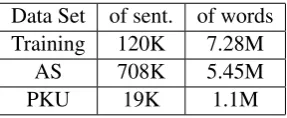
In this paper, we conduct our experiments on the corpus of People’s daily of 1998 (from January to June) as the standard (manually segmented) train-ing corpus, the corpus of Bakeoff-2 CWS evalua-tion as the developing and testing dataset. As the corpus of Bakeoff-2 is made up of several sets pro-vided by different organizations, we only select t-wo sets whose segmenting standards are similar to the training corpus. For each set, we take 3000 sentences as the developing dataset and the others as the testing dataset. The statistics of every set and the standard training corpus are shown in Ta-ble 1.
Data Set of sent. of words Training 120K 7.28M
AS 708K 5.45M
[image:7.595.345.489.308.367.2]PKU 19K 1.1M
Table 1: Statistics of training and testing datasets
Moreover, the bilingual unlabeled data is formed by a large in-house Chinese-English par-allel corpus (Tian et al., 2014). There are in total 2,215,000 Chinese-English sentence pairs crawled from online resources, concentrated in 5 different domains including laws, novels, spoken, news and miscellaneous.
6 Experiments
In our evaluation, the F-score was used as the ac-curacy measure. The precision p is defined as the percentage of words in the decoder output that are segmented correctly, and the recall r is the percent-age of gold-standard output words that are correct-ly segmented by the decoder. The balanced F- s-core is calculated as 2pr/(p + r). We also report the recall of OOV words in our experiments. In the following, we refer to our methods as ”SLBD” (segmenter leveraging bilingual data).
methods F ASOOV FPKUOOV
Peng 91.6 52.5 91.1 59
Asahara 92.2 63.1 91.4 61.6
Z&C 92.9 69.9 91.6 67.9
Zhao 93.1 72 92.3 60.6
[image:8.595.73.291.61.191.2]character-level 92.3 58.6 92.9 60.8 Inner log-linear 95.9 78.8 96.1 81 Outer log-linear 96.7 80.8 97.1 85
Table 2: Word segmentation performance of SLB-D and supervised CWS methods[%]
segmenting the bilingual unlabeled dataset using character-level features only, the inner log-linear model (which includes character-level and phrase-level features) and the outer log-linear model (the full SLBD approach). After applying these three segmentations using the different sub-models, we trained the new CRF models on the results of the three segmentations to justify the original CWS model. The evaluation results for the supervised CWS methods and the sub-models are presented in Table 2.
It can be seen that we achieved significant im-provement in performance when we combined the character-level and phrase-level features in the in-ner log-linear model, demonstrating that the pro-posed phrase-level features can be used to effi-ciently obtain bilingual segmenting information. Moreover, the outer log-linear model achieves a further enhancement, thereby demonstrating that the sentence-level features can be used to effec-tively re-rank the candidate segmentations pro-duced by the inner log-linear model.
Next, we compared the SLBD method with sev-eral state-of-the-art monolingual semi-supervised methods, including those of (Sun et al., 2012) (Sun); (Sun and Xu, 2011) (S&X); (Zeng et al., 2013b) (Zeng). To ensure a fair comparison, we performed the evaluation in two steps. First, we input the entire bilingual unlabeled dataset into the SLBD method and input only the Chinese sen-tences from the bilingual unlabeled dataset into the other semi-supervised methods. Then, because the available monolingual unlabeled dataset was much larger than the bilingual unlabeled dataset in natu-ral, we used the XIN CMN portion of Chinese Gi-gaword 2.0 as an additional unlabeled dataset for the monolingual semi-supervised methods. which contains 204 million words, more than ten times
methods Bilingual data Monolingual dataF OOV F OOV
Sun 93.9 63.1 94.6 67.9
S&X 94.1 66 94.4 71
Zeng 94.0 64.5 94.8 63.2
SLBD 96.7 80.8 -
-Table 3: Word segmentation performance of SLB-D and other monolingual semi-supervised CWS methods[%]
methods F ASOOV F PKUOOV
Xu 92.8 70.5 92.1 66
Ma 93.1 73 92.6 71.1
Xi 90.2 63 90.9 67.2
Zeng2014 93.5 76 93.2 73.3
SLBD 96.7 80.8 97.1 85
Table 4: Word segmentation performance of SLB-D and other bilingual semi-supervised CWS meth-ods[%]
the number of words in the bilingual unlabeled dataset. The testing data was the set of AS only. The evaluation is summarized in Table 3.
The results demonstrate that either leveraging the same unlabeled data or providing a much larg-er unlabeled dataset for the monolingual semi-supervised methods, the SLBD method can sig-nificantly outperform the evaluated monolingual semi-supervised methods, which indicates that the segmenting information obtained using SLBD is much more efficient at optimizing segmentation.
[image:8.595.309.524.61.148.2] [image:8.595.320.514.228.333.2]7 Conclusion
In this paper, we propose a cascaded log-linear model to involve learning three levels of bilin-gual linguistic features to semi-supervisedly learn a new CWS model. Different from other mono-lingual and bimono-lingual semi-supervised approach-es, we employ various types of features to cap-ture both monolingual grammars and bilingual segmenting information, which allows our mod-el to be very efficient at other NLP tasks and en-dows it with higher generalizability. The evalu-ation shows that our method significantly outper-forms the state-of-the-art monolingual and bilin-gual semi-supervised approaches.
References
Masayuki Asahara, Kenta Fukuoka, Ai Azuma, ChooiLing Goh, Yotaro Watanabe, Yuji Matsumo-to, and Takahashi Tsuzuki. 2005. Combination of machine learning methods for optimum chinese word segmentation. In Proceedings of The Fourth SIGHAN Workshop, pages 134-137.
Pi-Chuan Chang, Michel Galley, and Christopher D Manning. 2008. Optimizing Chinese word segmen-tation for machine translation performance. In Pro-ceedings of WMT, pages 224-232. Association for Computational Linguistics.
Tagyoung Chung and Daniel Gildea. 2009. Un-supervised Tokenization for Machine Translation. Proceedings of the 2009 Conference on Empirical Methods in Natural Language Processing: Volume 2-Volume 2. Association for Computational Lin-guistics, 2009: 718-726.
John Lafferty, Andrew McCallum, and Fernando Pereira. 2001. Conditional random fields: Prob-abilistic models for segmenting and labeling se-quence data. In Proc. 18th International Conf. on Machine Learning.
Percy Liang. 2005. Semi-supervised learning for nat-ural language.. Master.s thesis.
Yanjun Ma and Andy Way. 2009. Bilingually moti-vated domain-adapted word segmentation for statis-tical machine translation. Proceedings of the 12th Conference of the European Chapter of the Associ-ation for ComputAssoci-ational Linguistics. AssociAssoci-ation for Computational Linguistics, 2009: 549-557.
Mikolov, Tomas, et al. 2013. Distributed representa-tions of words and phrases and their compositional-ity. InAdvances in Neural Information Processing Systems. 2013.
Graham Neubig, Taro Watanabe et al. 2011.An Unsu-pervised Model for Joint Phrase Alignment and Ex-traction. Proceedings of ACL 2011.
Graham Neubig, Taro Watanabe et al. 2012. Machine Translation without Words through Substring Align-ment. Proceedings of ACL 2012.
Feng Jiao, Shaojun Wang, and Chi-Hoon Lee. 2006. Semi-supervised conditional random fields for im-proved sequence segmentation and labeling. In Pro-ceedings of ACL, pages 209-216, Sydney, Australia. Koehn, Philipp, Franz Josef Och, and Daniel Mar-cu. 2003. Statistical phrase-based translation. In Proceedings of the 2003 Conference of the North American Chapter of the Association for Computa-tional Linguistics on Human Language Technology-Volume 1. Association for Computational Linguis-tics, 2003.
Koehn, Philipp, et al. 2007. Moses: Open source toolkit for statistical machine translation. In Pro-ceedings of the 45th annual meeting of the ACL on interactive poster and demonstration sessions. Asso-ciation for Computational Linguistics, 2007: 177-180.
Franz Josef Och and Hermann Ney. 2000. Improved s-tatistical alignment models. InProceedings of ACL, pages 440-447.
Och, Franz Josef. 2003. Minimum error rate training in statistical machine translation. InProceedings of the 41st Annual Meeting on Association for Compu-tational Linguistics-Volume 1. Association for Com-putational Linguistics, 2003: 160-167.
Fuchun Peng, Fangfang Feng and Andrew McCallum. 2004. Chinese segmentation and new word detec-tion using condidetec-tional random fields. Proceedings of the 20th international conference on Computational Linguistics.
Stolcke, Andreas. 2002. SRILM-an extensible lan-guage modeling toolkit. InINTERSPEECH. 2002 Weiwei Sun and Jia Xu. 2011. Enhancing chinese
word segmentation using unlabeled data. . In Pro-ceedings of EMNLP 2011.
Xu Sun, Houfeng Wang, Wenjie Li. 2012. Fast Online Training with Frequency-Adaptive Learning Rates for Chinese Word Segmentation and New Word De-tection. In Proceedings of the 50th Annual Meet-ing of the Association for Computational LMeet-inguistic- Linguistic-s, pages 253-262
Tian, Liang, et al. 2014. UM-Corpus: a large English-Chinese parallel corpus for statistical machine trans-lation. InProceedings of the 9th International Con-ference on Language Resources and Evaluation. EL-RA Reykjavik, Iceland, 2014.
Jia Xu, Richard Zens, and Hermann Ney. 2004. Do we need Chinese word segmentation for statistical machine translation?. Proceedings of the Third SIGHAN Workshop on Chinese Language Learn-ing, pages 122õ128.
Jia Xu, Jianfeng Gao, Kristina Toutanova, and Herman-n Ney. 2008. Bayesian Semi-Supervised Chinese Word Segmentation for Statistical Machine Transla-tion. Proceedings of Coling 2008.
Nianwen Xue. 2003. Chinese word segmentation as character tagging. Computational Linguistics and Chinese Language Processing, pages 29õ48. Zhang and Clark. 2007. Chinese segmentation with a
word-based perceptron algorithm.. Proceedings of ACL 2007.
Hai Zhao, Chang-Ning Huang, Mu Li, and Bao-Liang Lu. 2010. A unified character-based tagging frame-work for chinese word segmentation. ACM Trans-actions on Asian Language Information Processing, 9(2):5:1-5:32, June.
Xiaodong Zeng, Derek F. Wong, Lidia S. Chao and Isabel Trancoso. 2013a. Graph-based Semi-Supervised Model for Joint Chinese Word Segmenta-tion and Part-of-Speech Tagging. Proceedings of the 51st Annual Meeting of the Association for Compu-tational Linguistics.
Xiaodong Zeng, Derek F. Wong, Lidia S. Chao and Is-abel Trancoso 2013b. Co-regularizing character-based and word-character-based models for semi-supervised Chinese word segmentation. Proceedings of the 51st Annual Meeting of the Association for Computa-tional Linguistics.
![Table 3: Word segmentation performance of SLB-D and other monolingual semi-supervised CWSmethods[%]](https://thumb-us.123doks.com/thumbv2/123dok_us/1362009.668948/8.595.320.514.228.333/table-word-segmentation-performance-slb-monolingual-supervised-cwsmethods.webp)
