Named Entity Learning and Verification:
Expectation Maximization in Large Corpora
Uwe QUASTHOFF, Christian BIEMANN, Christian WOLFF CS Institute, Leipzig University
Augustusplatz 10/11 Leipzig, Germany, 04109
Abstract
The regularity of named entities is used to learn names and to extract named entities. Having only a few name elements and a set of patterns the al-gorithm learns new names and its elements. A verification step assures quality using a large background corpus. Further improvement is reached through classifying the newly learnt elements on character level. Moreover, unsuper-vised rule learning is discussed.
1
Introduction
The task of recognizing person names in text corpora is well examined in the field of Infor-mation Extraction. Most of the approaches, us-ing machine-learnus-ing or statistical methods make excessive use of annotated data or large gazetteers. We present a method that needs little input knowledge and performs unsupervised learning on unlabeled data, restricting ourselves to person names.
In most languages, named entities form regular patterns. Usually, a surname has a preceding first name, which in turn might have a preceding title or profession. Similar rules hold for differ-ent kinds of named differ-entities consisting of more than one word. Moreover, some elements of such multiwords (like president) are high fre-quency items, well known and of high signifi-cance for identifying a named entity. On the other hand, there are elements that often appear in named entities, but are not characteristic for them (like the first name Israel).
Therefore, a verification step is included in the learning algorithm.
2
The Algorithm
Our learning algorithm starts with a set of pat-terns and initial name elements. A large corpus of more then 10 million sentences [cf. Quasthoff & Wolff 2000], taken from newspapers of the last 10 years is used for both, the identification of candidates for new name elements as well as for verifying the candidates found. The algo-rithm stops, if no more new name elements are found.
The algorithm implements expectation maximi-zation (EM) [cf. Dempster, 1977, Collins, 1999] in the following way: The combination of a learning step and a verification step are iterated. If more name elements are found, the recall of the verification step increases. The key property of this algorithm is to assure high precision and still get massive recall.
From another point of view our algorithm im-plements bootstrapping [cf. Riloff 99], as it starts from a small number of seed words and uses knowledge found during the run to find more candidates.
2.1
Patterns and Pattern Rules
The next step is to find tag sequences which are typical for names, like TI-FN-LN. From here, we can create rules like
TI-UC-LN ⇒ TI-FN-LN,
which means that an upper case word between title and last name is a candidate for a first name. An overview of handmade start rules is given in appendix 1.
Looking at the rules, it is possible to argue that a rule like UC-LN ⇒ FN-LN is a massive over-generalization. This would be true if we would learn new name elements simply by applying rules. However, the verification step ensures that false friends are eliminated at high rate.
2.2
The Outer Loop
The algorithm is described as follows:
Load pattern rules.
Let unused name elements = initial set of name elements Loop:
For each unused name entity Do the learning step and collect new candidates For each new candidate
Do the verification step Output verified candidates Let unused name elements = verified candidates
2.3
The Learning Step: Finding
Candi-dates
Using the pattern rules and the current name elements, new candidates are searched. Here we use the corpus.
Search 255 random sentences con-taining the unused name entity (or all, if <255).
Use the pattern rules to identify new candidates as described above.
2.4
The Verification Step
In a verification step, each candidate is tested before it is used to generate new candidates. We test the following property: Does the candidate appear often enough together with verified name elements? Again, we use the corpus.
Search 30 random sentences contain-ing the name element to be veri-fied (or all, if <30).
If the ratio fulfilling at least one right side of a pattern rule is above some threshold, the can-didate is accepted.
3
The Exhaustion Cycle
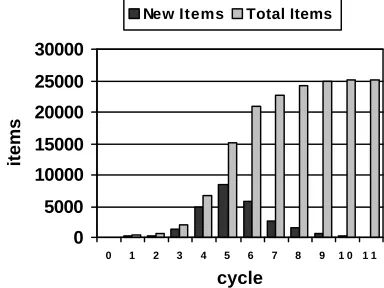
The overall performance of the algorithm can be estimated as follows: For simplicity let us as-sume that the average number of items (in our task: name elements) findable by any unused item equals N. Then the number of items starts to grow exponentially. Sooner or later, the total number of unseen entities decreases. Hence, most of the N items found are known already. The numbers of new items found in each turn decreases, until no more items can be reached. So we discriminate between a phase of growth and a phase of exhaustion.
The following figures visualize the number of new items per turn and the accumulated total number of items for each turn. Data was taken from an experiment with 19 items of knowledge (see appendix 2). The test was performed on the German corpus and designed to find first and last names only. The phase of growth lasts until the 5th cycle, then exhaustion takes over, as can be seen in figure 11.
0 5000 10000 15000 20000 25000 30000
0 1 2 3 4 5 6 7 8 9 1 0 1 1
cycle
items
[image:2.595.318.510.485.629.2]New Items Total Items
Figure 1: total and new items vs. cycles2
1
Additional runs with more start items produced the same amount of total items in less cycles.
2
Natural growth in the number of items takes place under the following conditions:
• Sufficient size of corpus
• Sufficient frequency of start items • Suitable relation, e.g. names
If the corpus is not large enough or it is not pos-sible to find enough candidates from the start items, exhaustion takes place immediately.
4
Examples
Let us closely examine the learning of items by example: From the known first name John, the candidate for being a last name Hauberg was found in the fragment "...by John Hauberg and.." by the rule FN-UC-LC => FN-LN-LC and verified in occurrences like "Robert Hauberg, ...", "Robert Hauberg urges..." using the already known first name Robert.
Errors occur in the case of words, which are mainly used in positions which are often occu-pied by first names. In German, the algorithm extracts and verifies "Ära" (era) and "Transport-panzer" (Army transportation tank) because of the common usage "Ära Kohl" and the proper name "Transportpanzer Fuchs" (fox tank). In the case of "Ära", this false first name supports the classifications of the proper last names Hinrichs, Strauß, Bangemann, Albrecht, Gorbatchow, Jelzin and many more.
5
Precision and Recall
5.1
Precision
Note that precision will be different for the dif-ferent types of name elements. Usually surnames are recognized with high precision. First names may be confused with titles, for instance. Moreover, precision is language dependent mainly due to the different usage of capital let-ters: In German, nouns start with capital letters and can much easier be confused with names. For German first names in the run mentioned above, the algorithm yields a precision of 84.1%. Noise items mainly are titles and profes-sion names, which are spelled with a capital letter in German. Using the additional fact that first names usually do not exceed 10 letters in
length, the precision for first names rose to 92.7%.
For last names, results were excellent with a precision of more than 99%. The same holds for titles, as further experiments showed.
The ratio number of first names vs. number of last names happens to be about 1:3, overall pre-cision for German scored 97.5%.
Because of the fewer capitalized words in Eng-lish the precision for EngEng-lish first names is higher, scoring 92.6% without further filtering. Overall precision for English first and last names was 98.7%.
5.2
Recall
Recall mainly depends on the pattern rules used. The experiments were performed with the 14 handmade rules given in appendix 1, which surely are not sufficient.
Calculating the recall is not at all straightfor-ward, because we do not know how many names are contained in our corpora and experiments on small corpora fail to show the natural growth of items described in the previous section. Further, recall will rise with a growing knowledge size. So we modified the algorithm in a way that it takes plain text as input, applies the rules to find candidates and checks them in the big corpus. Providing a large set of knowledge items, in an experiment processing 1000 sentences, 71.4% of the person names were extracted correctly. To increase the coverage of the rules it is possi-ble to add rules manually or start a process of rule learning as described below.
5.3. Propagation of Errors
During the run the error rate increases due to finding candidates and verification through mis-classified items. However, as the "era" example (see section 4) illustrates, misclassified items support the classification of goal items.
The amount of deterioration highly depends on the pattern rules. Strict rules mean low recall but high precision, whereas general rules have greater coverage but find too much, resulting in a trade-off between precision and recall.
From this we conclude that the algorithm is ro-bust against errors and the quality of the classifi-cations remains relatively stable during the run when using appropriate rules.
total items interval
Precision for FN without length filter
Precision for FN with length filter
1-1000 87.1% 93.8%
1001-2000 90.0% 95.3%
4001-5000 88.1% 97.1%
9001-10000 83.2% 94.4%
19001-20000 83.7% 91.2%
21001-22000 86.2% 92.4%
24001-25000 83.0% 87.9%
Table 1: Propagation of Errors
6
Classification on character level
In German, most words misclassified as first names were titles and professions. While they cannot be distinguished by the rules used, they differ strongly from the morphological view. German titles are usually longer because they are compounds, and parts of compounds are used very frequently.
In this section, we introduce a method to distin-guish between titles and first names at character level, using the fact that the formation of words follows language-dependent rules.
This procedure is implemented in the following classifier A: Assume the property we are inter-ested in is visible at the ending of a word (this is basically true for different word classes in lan-guages like English, French or German). We build a decision tree [cf. McCarthy & Lehnert 1995] reading the words character-by-character, starting from the end. We stop if the feature is uniquely determined.
Moreover, we could as well start from the be-ginning of a word (classifier B). Finally, we can use any connected substring of the word instead of substrings containing the end or the beginning (classifier C).
If the training set is large enough and the algo-rithm of the classifier is appropriate, it will cover both general rules as well as many exceptions.
Classifier A and B only differ on the direction a word is analyzed. We build decision trees with additional default child nodes as follows.
6.1
Classifier A: Considering Prefixes
Step 1: Building the ordinary decision tree: Given the training word list we construct a prefix tree [cf. Gusfield 1999, Navarro 2001:38ff]. The leaves in the tree corre-spond to word endings; here we store the feature of the corresponding word. Step 2: Reduction of the decision tree: If all
children of a given node have the same feature, this feature is lifted to the parent node and the children are deleted. Step 3: Insertion of default features: If a node
does not yet have a feature, but one of the features is very dominant (say, pres-ent in 80% of the children), this feature will be assigned as default feature.
For classification, the decision tree is used as follows:
Step 1: Searching the tree: Reading the given word from left to right we follow the tree as far as possible. The reading proc-ess stops in a certain node N.
[image:4.595.66.283.159.300.2]Step 2: Classification: If the node N has an as-signed feature F then return F. Other-wise return no decision.
Figure 2 shows a part of the decision tree built using first names Theoardis, Theobald, Theo-derich, Theodor, Theresa, Therese, … and the singular title Theologe (which should be the only title in our training list starting with Theo). As a result, all children of Theo will be first names; hence they get the feature firstname. The node Theologe gets the feature title.
Theologe (TI)
Theodor (FN)
Theobald (FN) Theo [default]
(FN) ...
... T
A Z
(root)
Figure 2: Prefix Decision Tree for Proper Names
As mentioned above, algorithm B works the same way as algorithm A, using suffixes instead of prefixes for the decision tree.
6.2
Classifier C: Considering Substrings
Instead of concentrating on prefixes or suffixes, we consider all relevant continuous substrings of a given word. Unfortunately, there is no natural tree structure for this set. Hence, we will con-struct a decision list without default features. Given is a training list containing pairs (word, feature):
Construction of the decision list
Step 1: Collect all substring information. We produce the following list L: For all pairs (wordN, featureN) from the train-ing list we generate all possible pairs of the kind (continuous substring of wordN, featureN). If wordN has length n, we have n(n+1)/2 continuous sub-strings. Finally the list is sorted alpha-betically and duplicates are removed. Step 2: Removing contradictions: If a substring
occurs with more then one feature, these lines are deleted from L.
Step 3: Removing tails: If a certain string now has a unique feature, all extensions of this string should have the same feature and the corresponding entries are re-moved from L.
For classification, the decision list is used as follows:
Step 1: Look-up of substrings: For a word to be classified we generate its continuous
substrings and collect their features from L.
Step 2: Classification: If all collected features are equal, then return this feature. Oth-erwise, return no decision.
6.3
Properties of the classifiers
In the following, we assume that the classifiers are trained with non-contradictory data. The classifiers now have the following properties: • The classifiers reproduce the results given in
the training set. Hence, they can also be trained with rare exceptions.
• It is necessary to have a training set covering all aspects of the data, otherwise the deci-sion tree will be confused.
• It is appropriate to return no decision if the classifier stops in the decision tree at a point where children have mixed features.
Bagging [cf. Breiman 1996] the three classifiers, we achieved a precision of 94.7% with 94.5% recall, using merely a training set of 1368 exam-ples on a test set of 683 items, distinguishing between the three classes:
• First name (FN) • Title (TI) • None of these.
This method of postprocessing is applicable to all features visible by the three classifiers, which are:
• Features represented by word suffixes or prefixes like inflection and some word for-mation rules.
• Words carrying the same feature if they are similar as strings. Candidates are all kinds of proper names, as well as distinguishing parts-of-speech.
7
Rule Learning
Unlike most tasks in Inductive Logic Program-ming (ILP) [cf. Dzeroski, 2001], our method needs rules-of-thumb that find many candidates like in boosting [cf. Collins, 1999], rather then a rule precision of 100%.
For automatic rule induction we used a training set of 236 sentences found automatically by taking sentences containing known first names and last names from the corpus. After excessive annotation, all possible rules were built accord-ing to the contexts of known items and after-wards tested on the training set. To avoid rules too general like UC-UC⇒FN-UC, the patterns had to contain at least one problem specific tag (i.e. FN, LN, TIT). The rules performing above a certain precision threshold (in our experiments we used 0.7) were taken as input for our algo-rithm.
We obtained 106 rules for first names, 67 for last names and 4 for titles, ranging from very specific rules like
PM-PM-UC-LN ⇒ PM-PM-FN-LN
to very general ones like
TI-UC ⇒ TI-FN.
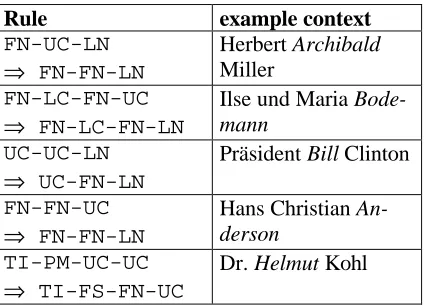
In the table below some rules found by auto-matic induction are shown.
Rule example context FN-UC-LN
⇒ FN-FN-LN
Herbert Archibald Miller
FN-LC-FN-UC
⇒ FN-LC-FN-LN
Ilse und Maria Bode-mann
UC-UC-LN
⇒ UC-FN-LN
Präsident Bill Clinton
FN-FN-UC
⇒ FN-FN-LN
Hans Christian An-derson
TI-PM-UC-UC
⇒ TI-FS-FN-UC
[image:6.595.70.283.485.639.2]Dr. Helmut Kohl
Table 2: Rules Found by Automatic Induction
Using those rules as input for our algorithm, we gained both, higher recall as well as higher pre-cision compared to the handmade rules when starting with the same knowledge. Table 3 shows precision rates for the three classes of name elements, data was taken from a run with
19 start elements, the length filter for first names was applied, and the string classifiers were not. Due to less strict rules, precision decreases.
total items interval
Prec. FN Prec. LN Prec. TIT
1-1000 94,6% 99,6% 100%
1001-2000 94,8% 98,6% 100%
2001-3000 94,7% 98,4% 100%
4001-5000 84,7% 99,1% 100%
9001-10000 86,6% 98,6% 100%
24001-25000 74,0% 89,7% 100%
Table 2: Propagation of errors for inferred rules
Percentage of first name items from the number of total items was 23,3%, last name items made 75,2% of total items and title items yielded only 1,4%, because to the low number of title rules.
8
Future work
Despite of the good results when using inferred rules as described above for our algorithm, we hope to improve the method as a whole with respect to the size of the input knowledge. Natural growth behaviour can be observed from some 10 frequent start items, the string classifier requires a couple of hundred words for training whereas rule learning needs some 200 fully an-notated sentences containing names. Experi-ments with sparsely annotated training sentences (100 knowledge items) yielded too specific and too weak rules with poor performance w.r.t. recall.
Another possibility would be to start with a small set of seed rules [cf. Riloff 1999] and to construct-by-example and rate rules during the classification task.
Another interesting issue is the understanding of relations suitable for this method from a theo-retical viewpoint.
9
Acknowledgements
10
References
Apte, C.; Damerau, F.; Weiss, S. M. (1998) Text Mining with Decision Trees and Decision Rules. Proc. Conference on Automated Learning and Dis-covery, Carnegie-Mellon University, June 1998. Breiman, L. (1996) Bagging Predictors, Machine
Learning, Vol. 24, No. 2, pp. 123-140
Califf, M. E.; Mooney, R. J. (1997) Relational Learning of Pattern-match Rules for Information Extraction. Working Papers of the ACL-97 Work-shop in NLP, 1997, 6-11.
Collins, M.; Singer, Y. (1999) Unsupervised Models for Named Entity Classification. In: Proc. Of the Joint SIGDAT Conference on Empirical Methods in Natural Language Processing and very Large Corpora.
Dempster, A.P.; Laird, N. M.; Rubin, D.B. (1977)
Maximum Likelihood from Incomplete Data via the EM Algorithm, Journal of the Royal Statistical So-ciety, Ser B, 39, 1-38.
Dzeroski, S.; Lavrac, N. (2001) Introduction to In-ductive Logic Programming. In Saso Dzeroski and Nada Lavrac, editors, Relational Data Mining, pages 48-73. Springer-Verlag, Berlin
Freitag, D. (1998) Multistrategy Learning for Infor-mation Extraction. Proc. 15th International Conf. on Machine Learning, 161-169.
Gusfield, Dan (1999) Algorithms on Strings, Trees, and Sequences. Cambridge University Press, UK. McCarthy, J.; Lehnert, W. (1995) Using Decision
Trees for Coreference Resolution. In: Mellish, C. (ed.) (1995). Proc. Fourteenth International Con-ference on Artificial Intelligence, 1050-1055. Nahm, U. Y.; Mooney, R. J. (2002) Text Mining with
Information Extraction. To appear in AAAI 2002 Spring Symposium on Mining Answers from Texts and Knowledge Bases, Stanford, CA.
Navarro, G. (2001) A guided tour to approximate string matching. ACM Computing Surveys 33(1) (2001), 31-88.
Ng, H.; Lee, H. (1996) Integrating Multiple Knowl-edge Sources to Disambiguate Word Sense: An Ex-emplar-Based Approach. Proc. of the 34th Annual Meeting of the ACL, 40-47.
Quasthoff, U.; Wolff, Ch. (2000) An Infrastructure for Corpus-Based Monolingual Dictionaries. Proc. LREC-2000. Second International Conference on Language Resources and Evaluation. Athens, May / June 2000, Vol. I, 241-246.
Riloff, E.; Jones, R. (1999) Learning Dictionaries for Information Extraction by Multi-Level
Bootstrap-ping. Proceedings of the sixteenth National Con-ference on Artificial Intelligence (AAAI-99) Roth, D. (1998) Learning to Resolve Natural
Lan-guage Ambiguities: A Unified Approach. Proc. of the American Association of Artificial Intelligence, 806-813.
Witten, I. H.; Frank, E. (1999) Data Mining: Practi-cal Machine Learning Tools and Techniques with Java Implementations. San Francisco, CA: Morgan Kaufman.
Appendix 1: Initial Handmade Rule Set
UC-LN ⇒ FN-LN
PM-FN-PM-UC ⇒ PM-FN-PM-FN
TI-PM-UC-LN ⇒ TI-PM-FN-LN
FN-LN-PM-UC-LN ⇒ FN-LN-PM-FN-LN
FN-UC-PM ⇒ FN-LN-PM
FN-UC-LC ⇒ FN-LN-LC
TI-UC-LC ⇒ TI-LN-LC
TI-PM-UC-LC ⇒ TI-PM-LN-LC
LN-PM-FN-UC-PM ⇒ LN-PM-FN-LN-PM
UC-PM-FN-LN ⇒ TI-PM-FN-LN
UC-PM-LN ⇒ TI-PM-LN
DET-UC-FN-LN ⇒ DET-TI-FN-LN
DET-UC-FN-FN-LN ⇒ DET-TI-FN-FN-LN
DET-UC-LN ⇒ DET-TI-LN
Note that the last three rules are specific for German because titles are in upper case in this language.
Appendix 2: 19 Start items used in the
experiments
Name element Class
Schmidt LN
Reuter LN
Wagner LN
Schäuble LN
Vogts LN
Hoffmann LN
Schulz LN
Möller LN
Meyer LN
Beck LN
Michael FN
Thomas FN
Klaus FN
Wolfgang FN
Hans FN
Werner FN
Martin FN
Walter FN