Lattice-based Minimum Error Rate Training
for Statistical Machine Translation
Wolfgang Macherey Franz Josef Och Ignacio Thayer Jakob Uszkoreit
Google Inc.
1600 Amphitheatre Parkway Mountain View, CA 94043, USA
{wmach,och,thayer,uszkoreit}@google.com
Abstract
Minimum Error Rate Training (MERT) is an effective means to estimate the feature func-tion weights of a linear model such that an automated evaluation criterion for measuring system performance can directly be optimized in training. To accomplish this, the training procedure determines for each feature func-tion its exact error surface on a given set of candidate translations. The feature function weights are then adjusted by traversing the error surface combined over all sentences and picking those values for which the resulting error count reaches a minimum. Typically, candidates in MERT are represented as N -best lists which contain theN most probable translation hypotheses produced by a decoder. In this paper, we present a novel algorithm that allows for efficiently constructing and repre-senting the exact error surface of all trans-lations that are encoded in a phrase lattice. Compared to N-best MERT, the number of candidate translations thus taken into account increases by several orders of magnitudes. The proposed method is used to train the feature function weights of a phrase-based statistical machine translation system. Experi-ments conducted on the NIST 2008 translation tasks show significant runtime improvements and moderate BLEU score gains overN-best MERT.
1 Introduction
Many statistical methods in natural language pro-cessing aim at minimizing the probability of sen-tence errors. In practice, however, system quality is often measured based on error metrics that assign non-uniform costs to classification errors and thus go far beyond counting the number of wrong de-cisions. Examples are the mean average precision
for ranked retrieval, the F-measure for parsing, and the BLEU score for statistical machine transla-tion (SMT). A class of training criteria that provides a tighter connection between the decision rule and the final error metric is known as Minimum Error Rate Training (MERT) and has been suggested for SMT in (Och, 2003).
MERT aims at estimating the model parameters such that the decision under the zero-one loss func-tion maximizes some end-to-end performance mea-sure on a development corpus. In combination with log-linear models, the training procedure allows for a direct optimization of the unsmoothed error count. The criterion can be derived from Bayes’ decision rule as follows: Letf f1, ..., fJ denote a source
sentence (’French’) which is to be translated into a target sentence (’English’) e e1, ..., eI. Under
the zero-one loss function, the translation which maximizes the a posteriori probability is chosen:
ˆ
earg max
e Pr
pe|fq (
(1)
Since the true posterior distribution is unknown, Prpe|fqis modeled via a log-linear translation model
which combines some feature functions hmpe,fq
with feature function weightsλm,m1, ..., M:
Prpe|fqp
λM
1
pe|fq
exp
°
M
m1λmhmpe,fq
°
e1exp
°
M
m1λmhmpe 1,f
q
(2)
The feature function weights are the parameters of the model, and the objective of the MERT criterion is to find a parameter setλM1 that minimizes the error
count on a representative set of training sentences. More precisely, letf1S denote the source sentences
of a training corpus with given reference translations
rS1, and letCs tes,1, ...,es,Kudenote a set ofK
candidate translations. Assuming that the corpus-based error count for some translations eS1 is
addi-tively decomposable into the error counts of the indi-vidual sentences, i.e.,Epr
S
1,eS1q °
S
s1Eprs,esq,
the MERT criterion is given as:
ˆ
λM1 arg min
λM
1
#
S
¸
s1
E rs,ˆepfs;λ
M
1 q
+
(3)
arg min
λM
1
#
S
¸
s1
K
¸
k1
Eprs,es,kqδ ˆepfs;λ
M
1 q,es,k
+
with
ˆ
epfs;λ
M
1 qarg max
e
#
M
¸
m1
λmhmpe,fsq +
(4)
In (Och, 2003), it was shown that linear models can effectively be trained under the MERT criterion us-ing a special line optimization algorithm. This line optimization determines for each feature function
hm and sentence fsthe exact error surface on a set of candidate translations Cs. The feature function
weights are then adjusted by traversing the error surface combined over all sentences in the training corpus and moving the weights to a point where the resulting error reaches a minimum.
Candidate translations in MERT are typically rep-resented asN-best lists which contain the N most probable translation hypotheses. A downside of this approach is, however, that N-best lists can only capture a very small fraction of the search space. As a consequence, the line optimization algorithm needs to repeatedly translate the development corpus and enlarge the candidate repositories with newly found hypotheses in order to avoid overfitting onCs
and preventing the optimization procedure from stopping in a poor local optimum.
In this paper, we present a novel algorithm that allows for efficiently constructing and representing the unsmoothed error surface for all translations that are encoded in a phrase lattice. The number of candidate translations thus taken into account increases by several orders of magnitudes compared toN-best MERT. Lattice MERT is shown to yield significantly faster convergence rates while it ex-plores a much larger space of candidate translations which is exponential in the lattice size. Despite this vast search space, we show that the suggested algorithm is always efficient in both running time and memory.
The remainder of this paper is organized as fol-lows. Section 2 briefly reviews N-best MERT and
introduces some basic concepts that are used in order to develop the line optimization algorithm for phrase lattices in Section 3. Section 4 presents an upper bound on the complexity of the unsmoothed error surface for the translation hypotheses repre-sented in a phrase lattice. This upper bound is used to prove the space and runtime efficiency of the suggested algorithm. Section 5 lists some best practices for MERT. Section 6 discusses related work. Section 7 reports on experiments conducted on the NIST 2008 translation tasks. The paper concludes with a summary in Section 8.
2 Minimum Error Rate Training on
N-best Lists
The goal of MERT is to find a weights set that minimizes the unsmoothed error count on a rep-resentative training corpus (cf. Eq. (3)). This can be accomplished through a sequence of line minimizations along some vector directions td
M
1 u.
Starting from an initial point λM1 , computing the
most probable sentence hypothesis out of a set ofK
candidate translations Cste1, ...,eKu along the
lineλM1 γd
M
1 results in the following
optimiza-tion problem (Och, 2003):
ˆ
epfs;γqarg max
ePCs !
pλ
M
1 γd
M
1 q J
h
M
1 pe,fsq )
arg max
ePCs "
¸
m
λmhmpe,fsq
loooo oooomooo ooooon
ape,fsq
γ ¸
m
dmhmpe,fsq
loo ooo ooomoooo oooon
bpe,fsq *
arg max
ePCs
ape,fsq γbpe,fsq loo o oooo oooomoo oo oooo ooon
pq
(
(5)
Hence, the total score pq for any candidate
trans-lation corresponds to a line in the plane with γ as the independent variable. For any particular choice ofγ, the decoder seeks that translation which yields the largest score and therefore corresponds to the topmost line segment.
Overall, the candidate repository Cs defines K
lines where each line may be divided into at most
K line segments due to possible intersections with the otherK1lines. The sequence of the topmost
line segments constitute the upper envelope which is the pointwise maximum over all lines induced by
Cs. The upper envelope is a convex hull and can
be inscribed with a convex polygon whose edges are the segments of a piecewise linear function inγ
(Papineni, 1999; Och, 2003):
Envpfqmax
ePC
ape,fq γbpe,fq:γ PR (
Score
γ
Error count
γ
0
0
e1
e2
e5
e6
e8
e1
e2
e3
e4
e5
e6
e7
[image:3.612.71.302.58.227.2]e8
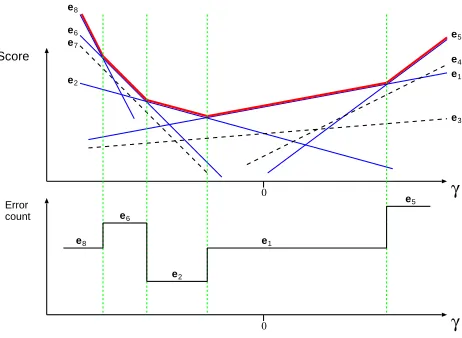
Figure 1: The upper envelope (bold, red curve) for a set
of lines is the convex hull which consists of the topmost line segments. Each line corresponds to a candidate translation and is thus related to a certain error count. Envelopes can efficiently be computed with Algorithm 1.
The importance of the upper envelope is that it pro-vides a compact encoding of all possible outcomes that a rescoring of Cs may yield if the parameter
setλM1 is moved along the chosen direction. Once
the upper envelope has been determined, we can project its constituent line segments onto the error counts of the corresponding candidate translations (cf. Figure 1). This projection is independent of how the envelope is generated and can therefore be applied to any set of line segments1.
An effective means to compute the upper enve-lope is a sweep line algorithm which is often used in computational geometry to determine the intersec-tion points of a sequence of lines or line segments (Bentley and Ottmann, 1979). The idea is to shift (“sweep”) a vertical ray from 8to 8 over the
plane while keeping track of those points where two or more lines intersect. Since the upper envelope is fully specified by the topmost line segments, it suffices to store the following components for each line object ℓ: the x-intercept ℓ.x with the left-adjacent line, the slopeℓ.m, and they-interceptℓ.y; a fourth component, ℓ.t, is used to store the candi-date translation. Algorithm 1 shows the pseudo code for a sweep line algorithm which reduces an input arraya[0..K-1]consisting of theK line objects of the candidate repositoryCsto its upper envelope.
By construction, the upper envelope consists of at mostK line segments. The endpoints of each line
1
For lattice MERT, it will therefore suffice to find an efficient way to compute the upper envelope over all translations that are encoded in a phrase graph.
Algorithm 1SweepLine
input: arraya[0..K-1]containing lines
output: upper envelope ofa
sort(a:m);
j = 0; K = size(a); for (i = 0; i < K; ++i) {
ℓ = a[i];
ℓ.x = -8;
if (0 < j) {
if (a[j-1].m == ℓ.m) {
if (ℓ.y <= a[j-1].y) continue; --j;
}
while (0 < j) {
ℓ.x = (ℓ.y - a[j-1].y)/ (a[j-1].m - ℓ.m); if (a[j-1].x < ℓ.x) break; --j;
}
if (0 == j) ℓ.x = -8;
a[j++] = ℓ; } else a[j++] = ℓ; }
a.resize(j); return a;
segment define the interval boundaries at which the decision made by the decoder will change. Hence, as γ increases from 8 to 8, we will see that
the most probable translation hypothesis will change wheneverγpasses an intersection point.
Letγfs
1 γ
fs
2 ... γ
fs
Ns denote the sequence of
interval boundaries and let ∆Efs
1 ,∆E
fs
2 , ...,∆E
fs
Ns
denote the corresponding sequence of changes in the error count where∆Efs
n is the amount by which the error count will change ifγis moved from a point in
rγ
fs
n1, γ
fs
nqto a point inrγ
fs
n, γ
fs
n 1q. Both sequences
together provide an exhaustive representation of the unsmoothed error surface for the sentence fs along
the line λM1 γ d
M
1 . The error surface for the
whole training corpus is obtained by merging the interval boundaries (and their corresponding error counts) over all sentences in the training corpus. The optimalγ can then be found by traversing the merged error surface and choosing a point from the interval where the total error reaches its minimum.
After the parameter update,ˆλM1 λ
M
1 γoptd
M
1 ,
the decoder may find new translation hypotheses which are merged into the candidate repositories if they are ranked among the topN candidates. The relation K N holds therefore only in the first
3 Minimum Error Rate Training on Lattices
In this section, the algorithm for computing the upper envelope onN-best lists is extended to phrase lattices. For a description on how to generate lattices, see (Ueffing et al., 2002).
Formally, a phrase lattice for a source sentence f
is defined as a connected, directed acyclic graph
Gf pVf,Efqwith vertice setVf, unique source and
sink nodess, tPVf, and a set of arcsEf Vf Vf.
Each arc is labeled with a phrase ϕij ei
1, ..., eij
and the (local) feature function values hM
1 pϕij,fq.
A pathπ pv0, ε0, v1, ε1, ..., εn1, vnqinGf (with εi P Ef and vi, vi 1 P Vf as the tail and head of εi,0 ¤ i n) defines a partial translation eπ off
which is the concatenation of all phrases along this path. The corresponding feature function values are obtained by summing over the arc-specific feature function values:
π :
v0
ϕ0,1
ÝÝÝÝÝÝÑ
hM1 pϕ
0,1,fq
v1
ϕ1,2
ÝÝÝÝÝÝÑ
hM1 pϕ
1,2,fq
ϕn
1,n ÝÝÝÝÝÝÝÝÑ
hM1 pϕ
n1,n
,fq
vn
eπ
i,j:
viÑvjPπ ϕ
ij ϕ
0,1...ϕ
n1,n
hM1 peπ,fq ¸
i,j:
viÑvjPπ hM1 pϕ
ij,fq
In the following, we use the notationinpvqandoutpvq
to refer to the set of incoming and outgoing arcs for a nodev PVf. Similarly,headpεqand tailpεq denote
the head and tail ofεPEf.
To develop the algorithm for computing the up-per envelope of all translation hypotheses that are encoded in a phrase lattice, we first consider a node
vPVf with some incoming and outgoing arcs:
v
v1 ε
Each path that starts at the source nodesand ends in
vdefines a partial translation hypothesis which can be represented as a line (cf. Eq. (5)). We now assume that the upper envelope for these partial translation hypotheses is known. The lines that constitute this envelope shall be denoted by f1, ..., fN. Next we consider continuations of these partial translation candidates by following one of the outgoing arcs
Algorithm 2Lattice Envelope
input: a phrase latticeGfpVf,Efq
output: upper envelope ofGf
a = H;
L = H;
TopSort(Gf);
for v = s to t do { a = SweepLine(
εPinpvq
L[ε]);
foreach (εPinpvq)
L.delete(ε); foreach (εPoutpvq) {
L[ε] = a;
for (i = 0; i < a.size(); ++i) { L[ε][i].m = a[i].m +
°
mdmhmpε, fq;
L[ε][i].y = a[i].y +
°
mλmhmpε, fq;
L[ε][i].p = a[i].pϕv,head pεq;
} } }
return a;
ε P outpvq. Each such arc defines another line
denoted bygpεq. If we add the slope andy-intercept
ofgpεq to each line in the settf1, ..., fNu, then the
upper envelope will be constituted by segments of
f1 gpεq, ..., fN gpεq. This operation neither
changes the number of line segments nor their rela-tive order in the envelope, and therefore it preserves the structure of the convex hull. As a consequence, we can propagate the resulting envelope over an outgoing arc ε to a successor node v1
headpεq.
Other incoming arcs for v1
may be associated with different upper envelopes, and all that remains is to merge these envelopes into a single combined envelope. This is, however, easy to accomplish since the combined envelope is simply the convex hull of the union over the line sets which constitute the individual envelopes. Thus, by merging the arrays that store the line segments for the incoming arcs and applying Algorithm 1 to the resulting array we obtain the combined upper envelope for all partial translation candidates that are associated with paths starting at the source node s and ending in
v1
. The correctness of this procedure is based on the following two observations:
(1) A single translation hypothesis cannot consti-tute multiple line segments of the same envelope. This is because translations associated with different line segments are path-disjoint.
again. Proof: Suppose that such a continuation exists, then this continuation can be represented as a line g, and since f˜has been discarded from the envelope, the path associated withg must also be a valid continuation for the line segments f1, ..., fN that constitute the envelope. Thus it follows that maxpf1 g, ..., fN gqmaxpf1, ..., fNq g
˜
f gfor someγ P R. This, however, is in
contra-diction with the premise thatf˜ maxpf1, ..., fNq
for allγ PR.
To keep track of the phrase expansions when propagating an envelope over an outgoing arc ε P tailpvq, the phrase labelϕv,head
pεqhas to be appended
from the right to all partial translation hypotheses in the envelope. The complete algorithm then works as follows: First, all nodes in the phrase lattice are sorted in topological order. Starting with the source node, we combine for each nodevthe upper envelopes that are associated withv’s incoming arcs by merging their respective line arrays and reducing the merged array into a combined upper envelope using Algorithm 1. The combined envelope is then propagated over the outgoing arcs by associating each ε P outpvq with a copy of the combined
envelope. This copy is modified by adding the parameters (slope and y-intercept) of the linegpεq
to the envelope’s constituent line segments. The envelopes of the incoming arcs are no longer needed and can be deleted in order to release memory. The envelope computed at the sink node is by construc-tion the convex hull over all translaconstruc-tion hypotheses represented in the lattice, and it compactly encodes those candidates which maximize the decision rule Eq. (1) for any point along the line λM
1 γ d
M
1 .
Algorithm 2 shows the pseudo code. Note that the component ℓ.x does not change and therefore requires no update.
It remains to verify that the suggested algorithm is efficient in both running time and memory. For this purpose, we first analyze the complexity of Algorithm 1 and derive from it the running time of Algorithm 2.
After sorting, each line object in Algorithm 1 is visited at most three times. The first time is when it is picked by the outer loop. The second time is when it either gets discarded or when it terminates the inner loop. Whenever a line object is visited for the third time, it is irrevocably removed from the envelope. The runtime complexity is therefore dominated by the initial sorting and amounts to
OpKlogKq
Topological sort on a phrase lattice G pV,Eq
can be performed in timeΘp|V| |E|q. As will be
shown in Section 4, the size of the upper envelope forGcan never exceed the size of the arc setE. The same holds for any subgraph Grs,vs of G which is
induced by the paths that connect the source node
swithv PV. Since the envelopes propagated from
the source to the sink node can only increase linearly in the number of previously processed arcs, the total running time amounts to a worst case complexity of
Op|V||E|log|E|q.
4 Upper Bound for Size of Envelopes
The memory efficiency of the suggested algorithm results from the following theorem which provides a novel upper bound for the number of cost mini-mizing paths in a directed acyclic graph with arc-specific affine cost functions. The bound is not only meaningful for proving the space efficiency of lattice MERT, but it also provides deeper insight into the structure and complexity of the unsmoothed error surface induced by log-linear models. Since we are examining a special class of shortest paths problems, we will invert the sign of each local feature function value in order to turn the feature scores into cor-responding costs. Hence, the objective of finding the best translation hypotheses in a phrase lattice becomes the problem of finding all cost-minimizing paths in a graph with affine cost functions.
Theorem: LetG pV,Eqbe a connected directed
acyclic graph with vertex setV, unique source and sink nodess, t P V, and an arc setE V V in
which each arc ε P E is associated with an affine
cost function cεpγq aε γ bε, aε, bε P R.
Counting ties only once, the cardinality of the union over the sets of all cost-minimizing paths for all
γ PRis then upper-bounded by|E|:
¤
γPR
π : π πpG;γqis a cost-minimizing
path inGgivenγ (
¤ |E| (7)
Proof: The proposition holds for the empty graph
as well as for the case that V ts, tu with all
arcs ε P E joining the source and sink node. Let
G therefore be a larger graph. Then we perform an s-t cut and split G into two subgraphs G1 (left
subgraph) andG2 (right subgraph). Arcs spanning
the section boundary are duplicated (with the costs of the copied arcs in G2 being set to zero) and
connected with a newly added head or tail node:
G: c1 G1 G2
c3
c2
c4
c1
c3
c4
c2
0
The zero-cost arcs in G2 that emerged from the
duplication process are contracted, which can be done without loss of generality because zero-cost arcs do not affect the total costs of paths in the lattice. The contraction essentially amounts to a removal of arcs and is required in order to ensure that the sum of edges in both subgraphs does not exceed the number of edges in G. All nodes in
G1 with out-degree zero are then combined into a
single sink node t1. Similarly, nodes in G2 whose
in-degree is zero are combined into a single source node s2. Let N1 and N2 denote the number of arcs in G1 and G2, respectively. By construction, N1 N2 |E|. Both subgraphs are smaller
than G and thus, due to the induction hypothesis, their lower envelopes consist of at mostN1 andN2
line segments, respectively. We further notice that either envelope is a convex hull whose constituent line segments inscribe a convex polygon, in the following denoted byP1andP2. Now, we combine
both subgraphs into a single graph G1
by merging the sink node t1 in G1 with the source node s2
in G2. The merged node is an articulation point
whose removal would disconnect both subgraphs, and hence, all paths in G1
that start at the source nodesand stop in the sink nodetlead through this articulation point. The graphG1
has at least as many cost minimizing paths as G, although these paths as well as their associated costs might be different from those inG. The additivity of the cost function and the articulation point allow us to split the costs for any path from stotinto two portions: the first portion can be attributed to G1 and must be a line
inside P1; the remainder can be attributed to G2
and must therefore be a line inside P2. Hence, the
total costs for any path in G1
can be bounded by the convex hull of the superposition of P1 and P2.
This convex hull is again a convex polygon which consists of at most N1 N2 edges, and therefore, the number of cost minimizing paths inG1
(and thus also inG) is upper bounded byN1 N2. l
Corollary: The upper envelope for a phrase lattice Gf pVf,Efqconsists of at most|Ef|line segments.
This bound can even be refined and one obtains (proof omitted)|E||V| 2. Both bounds are tight.
This result may seem somewhat surprising as it states that, independent of the choice of the direction along which the line optimization is performed, the structure of the error surface is far less complex than one might expect based on the huge number of alternative translation candidates that are rep-resented in the lattice and thus contribute to the error surface. In fact, this result is a consequence
of using a log-linear model which constrains how costs (or scores, respectively) can evolve due to hypothesis expansion. If instead quadratic cost functions were used, the size of the envelopes could not be limited in the same way. The above theorem does not, however, provide any additional guidance that would help to choose more promising directions in the line optimization algorithm to find better local optima. To alleviate this problem, the following section lists some best practices that we found to be useful in the context of MERT.
5 Practical Aspects
This section addresses some techniques that we found to be beneficial in order to improve the performance of MERT.
(1) Random Starting Points: To prevent the line optimization algorithm from stopping in a poor local optimum, MERT explores additional starting points that are randomly chosen by sampling the parameter space.
(2) Constrained Optimization: This technique allows for limiting the range of some or all feature function weights by defining weights restrictions. The weight restriction for a feature function hm is specified as an interval Rm rlm, rms, lm, rm P
RYt8, 8uwhich defines the admissible region
from which the feature function weightλm can be chosen. If the line optimization is performed under the presence of weights restrictions, γ needs to be chosen such that the following constraint holds:
l1M ¤λ
M
1 γ d
M
1 ¤r
M
1 (8)
(3) Weight Priors: Weight priors give a small (pos-itive or negative) boostω on the objective function if the new weight is chosen such that it matches a certain target valueλ
m:
γopt arg min
γ
! ¸
s
E rs,ˆepfs;γq
¸
m
δpλm γdm, λ
mqω )
(9)
A zero-weights prior (λ
m 0) provides a means of
doing feature selection since the weight of a feature function which is not discriminative will be set to zero. An initial-weights prior (λ
m λm) can
(4) Interval Merging: The interval rγ
fs
i , γ
fs
i 1q of
a translation hypothesis can be merged with the interval rγ
fs
i1, γ
fs
i q of its left-adjacent translation
hypothesis if the corresponding change in the error count∆Efs
i 0. The resulting intervalrγ
fs
i1, γ
fs
i 1q
has a larger range, and the choice of γopt may be
more reliable.
(5) Random Directions: If the directions chosen in the line optimization algorithm are the coordinate axes of the M-dimensional parameter space, each iteration will result in the update of a single feature function only. While this update scheme provides a ranking of the feature functions according to their discriminative power (each iteration picks the fea-ture function for which changing the corresponding weight yields the highest gain), it does not take possible correlations between the feature functions into account. As a consequence, the optimization procedure may stop in a poor local optimum. On the other hand, it is difficult to compute a direction that decorrelates two or more correlated feature functions. This problem can be alleviated by ex-ploring a large number of random directions which update many feature weights simultaneously. The random directions are chosen as the lines which connect some randomly distributed points on the surface of anM-dimensional hypersphere with the hypersphere’s center. The center of the hypersphere is defined as the initial parameter set.
6 Related Work
As suggested in (Och, 2003), an alternative method for the optimization of the unsmoothed error count is Powell’s algorithm combined with a grid-based line optimization (Press et al., 2007, p. 509). In (Zens et al., 2007), the MERT criterion is optimized on
N-best lists using the Downhill Simplex algorithm (Press et al., 2007, p. 503). The optimization proce-dure allows for optimizing other objective function as, e.g., the expected BLEU score. A weakness of the Downhill Simplex algorithm is, however, its decreasing robustness for optimization problems in more than 10 dimensions. A different approach to minimize the expected BLEU score is suggested in (Smith and Eisner, 2006) who use deterministic annealing to gradually turn the objective function from a convex entropy surface into the more com-plex risk surface. A large variety of different search strategies for MERT are investigated in (Cer et al., 2008), which provides many fruitful insights into the optimization process. In (Duh and Kirchhoff, 2008), MERT is used to boost the BLEU score on
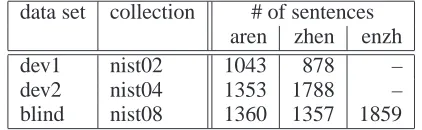
Table 1: Corpus statistics for three text translation sets:
Arabic-to-English (aren), Chinese-to-English (zhen), and English-to-Chinese (enzh). Development and test data are compiled from evaluation data used in past NIST Machine Translation Evaluations.
data set collection # of sentences aren zhen enzh
dev1 nist02 1043 878 –
dev2 nist04 1353 1788 – blind nist08 1360 1357 1859
N-best re-ranking tasks. The incorporation of a large number of sparse feature functions is described in (Watanabe et al., 2007). The paper investigates a perceptron-like online large-margin training for sta-tistical machine translation. The described approach is reported to yield significant improvements on top of a baseline system which employs a small number of feature functions whose weights are optimized under the MERT criterion. A study which is comple-mentary to the upper bound on the size of envelopes derived in Section 4 is provided in (Elizalde and Woods, 2006) which shows that the number of inference functions of any graphical model as, for instance, Bayesian networks and Markov random fields is polynomial in the size of the model if the number of parameters is fixed.
7 Experiments
[image:7.612.321.532.129.194.2]Experiments were conducted on the NIST 2008 translation tasks under the conditions of the con-strained data track for the language pairs Arabic-to-English (aren), English-to-Chinese (enzh), and Chinese-to-English (zhen). The development cor-pora were compiled from test data used in the 2002 and 2004 NIST evaluations. Each corpus set provides 4 reference translations per source sen-tence. Table 1 summarizes some corpus statistics.
Table 2: BLEU score results on the NIST-08 test set
obtained after 25 iterations using N-best MERT or 5 iterations using lattice MERT, respectively.
dev1+dev2 blind task loss N-best lattice N-best lattice aren MBR 56.6 57.4 42.9 43.9
35.5 36 36.5 37 37.5 38 38.5 39 39.5 40
0 5 10 15 20 25
BLEU[%]
iteration lattice MERT N-best MERT
5 15 25 35 45
[image:8.612.314.543.62.221.2]0 5 10 15 20 25
Figure 2: BLEU scores for N-best MERT and lattice MERT after each decoding step on the zhen-dev1 corpus. The grey shaded subfigure shows the complete graph including the bottom part forN-best MERT.
Translation results were evaluated using the mixed-case BLEU score metric in the implementation as suggested by (Papineni et al., 2001).
Translation results were produced with a state-of-the-art phrase-based SMT system which uses EM-trained word alignment models (IBM1, HMM) and a 5-gram language model built from the Web-1T collection2. Translation hypotheses produced on the blind test data were reranked using the Minimum-Bayes Risk (MBR) decision rule (Kumar and Byrne, 2004; Tromble et al., 2008). Each system uses a log-linear combination of 20 to 30 feature functions.
In a first experiment, we investigated the conver-gence speed of lattice MERT and N-best MERT.
2
http://www.ldc.upenn.edu, catalog entry: LDC2006T13
35.6 35.8 36 36.2 36.4 36.6 36.8 37
-15 -10 -5 0 5 10 15
BLEU[%]
γ
lattice 50-best
36.28 36.3 36.32 36.34
-0.2 -0.1 0 0.1 0.2
35 35.5 36 36.5 37
[image:8.612.69.302.64.220.2]-40 -20 0 20 40
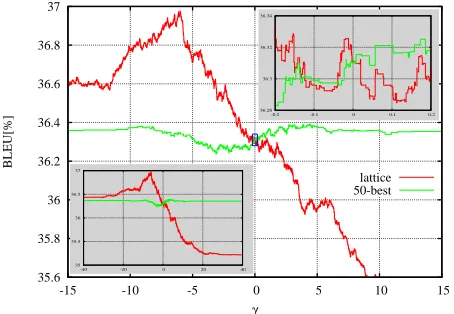
Figure 3: Error surface of the phrase penalty feature after
the first iteration on the zhen-dev1 corpus.
0 1 2 3 4 5
35.5 36 36.5 37 37.5 38 38.5 39 39.5 40
BLEU[%]
iteration
lattice MERT: 1000 directions 1 direction
Figure 4: BLEU scores on the zhen-dev1 corpus for
lattice MERT with additional directions.
Figure 2 shows the evolution of the BLEU score in the course of the iteration index on the zhen-dev1 corpus for either method. In each iteration, the training procedure translates the development corpus using the most recent weights set and merges the top ranked candidate translations (either repre-sented as phrase lattices or N-best lists) into the candidate repositories before the line optimization is performed. ForN-best MERT, we usedN 50
which yielded the best results. In contrast to lattice MERT,N-best MERT optimizes all dimensions in each iteration and, in addition, it also explores a large number of random starting points before it re-decodes and expands the hypothesis set. As is typical for N-best MERT, the first iteration causes a dramatic performance loss caused by overadapting the candidate repositories, which amounts to more than27.3BLEU points. Although this performance loss is recouped after the 5th iteration, the initial decline makes the line optimization under N-best MERT more fragile since the optimum found at the end of the training procedure is affected by the initial performance drop rather than by the choice of the initial start weights. Lattice MERT on the other hand results in a significantly faster convergence speed and reaches its optimum already in the 5th iteration. For lattice MERT, we used a graph density of 40 arcs per phrase which corresponds to anN-best size of more than two octillion p210
27
q entries. This
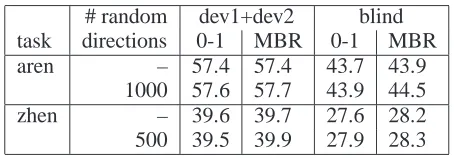
[image:8.612.71.298.513.670.2]Table 3: BLEU score results on the NIST-08 tests set
obtained after 5 iterations using lattice MERT with different numbers of random directions in addition to the optimization along the coordinate axes.
# random dev1+dev2 blind task directions 0-1 MBR 0-1 MBR aren – 57.4 57.4 43.7 43.9
1000 57.6 57.7 43.9 44.5 zhen – 39.6 39.7 27.6 28.2 500 39.5 39.9 27.9 28.3
lattice MERT with 5 weights updates per iteration. The performance drop in iteration 1 is also attributed to overfitting the candidate repository. The decline of less than 0.5% in terms of BLEU is, however, almost negligible compared to the performance drop of more than 27% in case of N-best MERT. The vast number of alternative translation hypotheses represented in a lattice also increases the number of phase transitions in the error surface, and thus prevents MERT from selecting a low performing feature weights set at early stages in the optimization procedure. This is illustrated in Figure 3, where lattice MERT andN-best MERT find different op-tima for the weight of the phrase penalty feature function after the first iteration. Table 2 shows the BLEU score results on the NIST 2008 blind test using the combined dev1+dev2 corpus as training data. While only the aren task shows improvements on the development data, lattice MERT provides consistent gains over N-best MERT on all three blind test sets. The reduced performance forN-best MERT is a consequence of the performance drop in the first iteration which causes the final weights to be far off from the initial parameter set. This can impair the ability ofN-best MERT to generalize to unseen data if the initial weights are already capable of producing a decent baseline. Lattice MERT on the other hand can produce weights sets which are closer to the initial weights and thus more likely to retain the ability to generalize to unseen data. It could therefore be worthwhile to investigate whether a more elaborated version of an initial-weights prior allows for alleviating this effect in case of N -best MERT. Table 3 shows the effect of optimizing the feature function weights along some randomly chosen directions in addition to the coordinate axes. The different local optima found on the development set by using random directions result in additional gains on the blind test sets and range from0.1%to 0.6%absolute in terms of BLEU.
8 Summary
We presented a novel algorithm that allows for efficiently constructing and representing the un-smoothed error surface over all sentence hypotheses that are represented in a phrase lattice. The proposed algorithm was used to train the feature function weights of a log-linear model for a statistical ma-chine translation system under the Minimum Error Rate Training (MERT) criterion. Lattice MERT was shown analytically and experimentally to be supe-rior over N-best MERT, resulting in significantly faster convergence speed and a reduced number of decoding steps. While the approach was used to optimize the model parameters of a single machine translation system, there are many other applications in which this framework can be useful, too. One possible usecase is the computation of consensus translations from the outputs of multiple machine translation systems where this framework allows us to estimate the system prior weights directly on con-fusion networks (Rosti et al., 2007; Macherey and Och, 2007). It is also straightforward to extend the suggested method to hypergraphs and forests as they are used, e.g., in hierarchical and syntax-augmented systems (Chiang, 2005; Zollmann and Venugopal, 2006). Our future work will therefore focus on how much system combination and syntax-augmented machine translation can benefit from lattice MERT and to what extent feature function weights can robustly be estimated using the suggested method.
References
J. L. Bentley and T. A. Ottmann. 1979. Algorithms for reporting and counting geometric intersections. IEEE
Trans. on Computers, C-28(9):643–647.
D. Cer, D. Jurafsky, and C. D. Manning. 2008. Regular-ization and Search for Minimum Error Rate Training. In Proceedings of the Third Workshop on Statistical
Machine Translation, 46th Annual Meeting of the Association of Computational Linguistics: Human Language Technologies (ACL-2008 HLT), pages 26–
34, Columbus, OH, USA, June.
D. Chiang. 2005. A Hierarchical Phrase-based Model for Statistical Machine Translation. In ACL-2005, pages 263–270, Ann Arbor, MI, USA, June.
K. Duh and K. Kirchhoff. 2008. Beyond Log-Linear Models: Boosted Minimum Error Rate Training for N-best Re-ranking. In Proceedings of the Third
S. Elizalde and K. Woods. 2006. Bounds on the Number of Inference Functions of a Graphical Model, October.
arXiv:math/0610233v1.
S. Kumar and W. Byrne. 2004. Minimum Bayes-Risk Decoding for Statistical Machine Translation. In Proc. HLT-NAACL, pages 196–176, Boston, MA, USA, May.
W. Macherey and F. J. Och. 2007. An Empirical Study on Computing Consensus Translations from Multiple Machine Translation Systems. In Conference on
Empirical Methods in Natural Language Processing (EMNLP), pages 986–995, Prague, Czech Republic,
June.
F. J. Och. 2003. Minimum Error Rate Training in Statis-tical Machine Translation. In 41st Annual Meeting of
the Association for Computational Linguistics (ACL),
pages 160–167, Sapporo, Japan, July.
K. Papineni, S. Roukos, T. Ward, and W. Zhu. 2001. BLEU: a Method for Automatic Evaluation of Machine Translation. Technical Report RC22176 (W0109-022), IBM Research Division, Thomas J. Watson Research Center, Yorktown Heights, NY, USA.
K. A. Papineni. 1999. Discriminative training via linear programming. In IEEE Int. Conf. on Acoustics,
Speech, and Signal Processing, volume 2, pages 561–
564, Phoenix, AZ, March.
W. H. Press, S. A. Teukolsky, W. T. Vetterling, and B. P. Flannery. 2007. Numerical Recipes: The Art of Scientific Computing. Cambridge University Press, Cambridge, UK, third edition.
A. V. Rosti, N. F. Ayan, B. Xiang, S. Matsoukas, R. Schwartz, and B. Dorr. 2007. Combining outputs from multiple machine translation systems. In Human
Language Technologies 2007: The Conference of the North American Chapter of the Association for Computational Linguistics; Proceedings of the Main Conference, pages 228–235, Rochester, New York,
April. Association for Computational Linguistics. D. A. Smith and J. Eisner. 2006. Minimum Risk
Annealing for Training Log-linear Models. In 21st
International Conference on Computational Linguis-tics and 44th Annual Meeting of the Association for Computational Linguistics (Coling/ACL-2006), pages
787–794, Sydney, Australia, July.
R. Tromble, S. Kumar, F. J. Och, and W. Macherey. 2008. Lattice minimum bayes-risk decoding for statistical machine translation. In Conference on Empirical
Methods in Natural Language Processing (EMNLP),
page 10, Waikiki, Honolulu, Hawaii, USA, October. N. Ueffing, F. J. Och, and H. Ney. 2002. Generation
of word graphs in statistical machine translation. In
Proceedings of the 2002 Conference on Empirical
Methods in Natural Language Processing, pages 156–
163, Philadelphia, PE, July.
T. Watanabe, J. Suzuki, H. Tsukada, and H. Isozaki. 2007. Online large-margin training for statistical machine translation. In Proceedings of the 2007 Joint
Conference on Empirical Methods in Natural guage Processing and Computational Natural Lan-guage Learning (EMNLP-CoNLL), pages 764–773,
Prague, Czech Republic.
R. Zens, S. Hasan, and H. Ney. 2007. A Systematic Comparison of Training Criteria for Statistical Ma-chine Translation. In Proceedings of the 2007
Con-ference on Empirical Methods in Natural Language Processing, Prague, Czech Republic, June.
Associa-tion for ComputaAssocia-tional Linguistics.
A. Zollmann and A. Venugopal. 2006. Syntax aug-mented machine translation via chart parsing. In
NAACL ’06: Proceedings of the 2006 Conference of the North American Chapter of the Association for Computational Linguistics on Human Language Technology, pages 138–141, New York, NY, June.